Friday, July 28, 2023

Web Log 7.27.23

Status update: Reading a long dreary science fiction novel about unlovable people with whose goals I can't sympathize. You'd think it'd be easy to choose sides in a story where one character wants to kill another character and the other character prefers to stay alive, but no. I don't feel that the would-be killer deserves to succeed, nor do I feel that the possible victim really deserves to survive. The old book reviewer's joke comes to mind. 

"What these poems lack is fire."

"You think I should put more fire into my poetry?"

"I think you should put more of your 'poetry' into the fire!" 

I will write a review of this book that will say something nicer about it than that its four hundred and some pages should make your dry-flush toilet happy, or should light a lot of fires this winter...but so far I'm not sure what.

Books 

Publishers keep throwing fiction and more fiction at us, so it's refreshing to see a reading list from a blogger who favors a mix of fiction and nonfiction, with some titles I'd like to read too:


Flowers 

This looks like our wild garlic. 


More midwestern wildflowers at 


Glyphosate Awareness 

Bumblebees don't come into this world with the impressively complex instincts wasps have. Bumblebees can be described as more intelligent: They're built to learn at least some new information about the world as they encounter it. What can we learn from the bumblebees about how glyphosate exposure affects their learning process?


Health 

Not exactly news: "I have yet to meet an unemployed patient who benefitted more from a pill than from a steady job." 


For those who imagine that building a tier of government above national governments would mean less corruption, a look at how long it's taking a corporation to set its tentacles into the World Health Organization: 


History 

Vince Staten considers ball park music:


Music 

Shared by Tom Cox: 


While everyone else has shared the sad news that Sinead O'Connor, only 56 years old...May she rest in peace. Her songs weren't played on local radio and I'm hearing them for the first time today. What does it say about our culture that a face and voice like hers couldn't earn a living just singing inoffensive old songs?

Zazzle 

They suggested a birthday party guest book. Are birthday parties big enough to need guest books? This design just wanted to be an autograph album. Whatever. You could customize it for a birthday party guest book, if you know someone whose birthday parties are huge bashes.


Not mine: 


Not new, but mine: 


Not mine, but on sale: 


Book Review: One More River to Cross

Title: One More River to Cross

Author: Will Henry

Date: 1967

Publisher: Random House

ISBN: none

Length: 236 pages

Quote: “The war went forward three more summers and a spring. Ines­capably Ned became a part of it, serving as personal forager for his owner, who had taken a commission in a Confederate regiment. A forager in war is many things-—cook, valet, mess boy, runner, jack-of-all-officers—but primarily he is a thief.”

There are stories omitted from both Black and Native American history because they are too painful to remember. What became of regular enlisted soldiers (White) in the Union army is a sufficiently sad and shameful story. What became of the Black, female, and other volunteers who served on the winning side is a disgrace. A few people remember that women and Cherokees served the Confederate side, as a curiosity. What of the Black Confederates? Very few want to remember them.

Will Henry tried, with all the sympathy a White man of his time could muster, to tell the story of a Black Confederate veteran. The story is based on sociology more than history, but it's lively enough to appaal to those who like "westerns."

He emphasizes that what he is telling are legends, not history. He reminds us that he’s putting together odd bits by giving one character four names. One man could use four names in the 1870s. “¿Quién sabe?” was a phrase much used in the Wild West. Anyway, the legends convinced Henry that although they were shadowy figures, there were Black cowboys and gunslingers whose adventures were as wild as their White peers’, or wilder. White and Red people had some family and tribal loyalties, however scattered they were. Black people weren’t always outlaws or criminals—there are records of a few quiet Black farm families—but, if they were outlaws, they were legendary.

There are, however, two valid reasons why this novel gets mixed reviews. It’s a splendid Western epic of a decent man forced to survive by a combination of super survival skills and desperate crimes, in the very best tradition of the genre. Even if you don’t usually like Westerns, this one is lively, suspenseful, and terse enough that you might like it. But Henry’s vision was constrained by his politics. While reading it I thought continually, “Well, the women and Native Americans in this book are a sorry lot, but that would be the Black man’s prejudice at work.”In the final scenes...no. The stories of the Black men of the Old West were told by White men, through their prejudices. Henry’s own prejudice kept him from seeing something that leaped out at me—something that his generation understood well enough that they, too, must have spotted the prejudice.

To preserve the suspense I’ll just list the prejudices that wear the story thin in just a few crucial places. The part where the young Black fugitive never tries to molest the grieving White widow, but kills a White man who does, I can believe; it’s not impossible for young men to be able to recognize when a woman is not interested in them, or for a woman who’s only just buried her husband to be uninterested in any other men. But at least three other details in the book ring false.

1. Henry tells us that the Black man with the four names is handsome in the classic North African way, with relatively straight hair. By now we all know what that looks like; if you don’t know anyone from Morocco or Ethiopia, at least you’ve seen a similar look on celebrities from (young, unscarred) Michael Jackson to Barack Obama. The problem is that, although White and Red slaves were sold in the American colonies, by 1849 a slave baby would not have been born in any part of Africa. Probably his parents would never have seen Africa either. The look is the basic human look that some scientists believe existed before the extreme “Black”and “White”genotypes evolved, but in North America it was most often produced by crossbreeding between those types. This baby was bought by a man who didn’t have even a baby-craving wife, and given that man’s name and his freedom just because he was such a promising child? That might have been the slavemaster’s story. I’d like to have seen a DNA test. My suspicion is that Ned is “given” the name of Huddleston, in chapter three when Colonel Huddleston advises him to go north, because it’s his name by birthright. Probably the farm is his by birthright, too. Ned, like Elvira in Jubilee, knows better than to claim to be the rightful heir, but he is.

2. Later on, Henry tells us that a Black man who has good healthy conformation himself takes an interest in a repulsive Shoshone woman because the woman’s little daughter’s face has the look of a Southern aristocrat. And where did she come by that look? Do young men who’ve never even wanted wives or children of their own really bond with other men’s babies ? ??? I suspect that, in real life, the Southern aristocrat the baby resembled was the Black man’s father.

3. But where the prejudice really becomes annoying is in the final scene. Isom Dart, former slave, and Billy Casebeer, poor White man, were childhood friends. Casebeer is rearing the Shoshone woman’s unexpectedly pretty daughter, whom Isom considers “stupid.” She runs off with a boy who doesn't even leave her pregnant--he leaves her with smallpox. Isom wants to kill the boy; Henry asks us to believe that Isom spares the boy because Rash calls Isom by a hateful name that paralyzes Isom by recalling his slave past. Hoo-wee. I can picture that scene happening and Isom not killing the boy, but I can't believe it would be because the boy threw out the N-bomb. It would be because the boy had smallpox.

Meanwhile, the only woman Henry really characterizes, beyond having a female show up when the men need something to protect, is Tickup, the Shoshone horrorcow, who makes a career of “working as a wife” for one man after another, staying with each one until another comes along, then taking whatever she can carry and moving on with her next victim. Among other things Tickup cuts off her Black ex’s ear—on purpose—but she goes back to him, later.I can believe there were women like Tickup, because there still are men and women like that; education and civil rights may or may not have expanded the number of tricks they dedicate to the Deadly Sin of Avarice. I find it hard, though, to believe that an unprejudiced observer wouldn’t have met a nicer woman than Tickup, even in the West.

So if you’re a woman this book will probably disappoint and very likely annoy you. How could any publisher ever have paid for a book that can be read as one big insult to all of us? That kind of writing was tolerated in the 1960s. It should not be tolerated now. Fictional heroes don’t have to meet women they want to marry; if the scope of their stories is narrow enough, they don’t have to meet women at all; but if they meet only bad women and never good ones, their author probably has not lived long enough to write a book.

Whatever his personal issues may have been, Will Henry was generally acclaimed as a close student of history who was willing to flash a light into its darkest corners. 

Thursday, July 27, 2023

Web Log 7.26.23

A new book of snarky poems, more...

Books 

Megan McDermott considers the fundamental silliness of gadgets sold to Sunday School classes. Do they help children understand the Bible? Probably not, and possibly in the wrong way. Ah, but do they keep some church member, somewhere, off welfare? That's also a worthy goal. Still, some of the products are just so...tacky.


Women's Issues 

I like Candace Owens. But I don't like the way she criticized the "Barbie" movie. No good parts for men in it? Well, there are real women's stories like that. If a man made a movie where all the female characters were hateful and stupid, he'd be called out for sexist bigotry? Well, for the first fifty years, that was basically the way Hollywood made movies--when there were female characters at all, when the actresses weren't just trotted out in costumes to be looked at and maybe to scream or be kissed or something. What changed that? "Feminists" did. 

Feminists include all people who think women are at least equally valuable with men, including some of the women who've turned out to oppose some feminist activities. How is that possible? Because "women" are, like "men," too big a group to form a solid consensus on anything. There are Republican, Democrat, Green, Libertarian, and Independent women voters just as there are men voters. So we do not always agree, nor do we all want the same thing.  There are feminists who want to have abortions and still feel good about themselves, and there are feminists who think the existence of a market for abortion as a "choice" is the problem. We can oppose our opponents on this and that but I don't think it's a good idea to bash "feminists." Bash the ideas with which you disagree, Candace Owens.

And meanwhile, little girls at the Barbie-doll age need a counter-message to the sick "romance" messages they get from pop culture. They need to know that women who get up on stage and yowl, grovel, drool, and generally act out the message that they've never figured out how to gratify their own carnal urges, are doing that because it pays, not because that's the way growing up or even "falling in love" really feel. They need to know that they don't have to try to get themselves turned into sick defective males, or at least non-females, because pop culture's images of young womanhood are so repulsive. They need a healthier image. If that boyfriend tries to control your life, and he's not even supporting you as a husband...yes, by all means, put him back in the box! I think little girls can tell the difference between a bossy boyfriend who needs to be put back in the box, and a real father, brother, or husband who needs encouragement to behave well, but not idolatry.

And boys...I think we are seeing some real discrimination against men in education, employment, publishing, and we need to oppose that. As women, and as feminists. In order to sell women's books we do not need a ban on publishing men's books, for pity's sake. But boys do need to know that limitations apply to their behavior, that in order to be loved and supported they need to control themselves and make sure they aren't infringing on anyone else's rights--especially not a girlfriend's. They do need to know that some behavior that may come naturally to them seems like bullying and bossing to others and, while other boys are more likely to beat them up than girls are, that does not mean it's all right to boss or bully or "tease" girls either.


Best promo for what's probably going to be a lame, commercial movie I ever saw.

Zazzle 

Filling in the gaps with gifts for guys, this vinyl bumper sticker comes in sizes to fit on cars, bikes, luggage, helmets, lockers or whatever. 


Not mine: 

Butterfly of the Week: Atrophaneura, Pachliopta, etc. Phlegon, or Papilio Annae

Not much has been published about this week's butterfly,  and most of what has been published about it has been about changing its scientific name. The most up-to-date name is Pachliopta phlegon. The earliest was Papilio annae. Atrophaneura phlegon came in between, and was used in books likely to be in your library today. 

Google has exactly one good clear photo of a living Pachliopta phlegon, taken by Juan Manuel Sanchez, and for whatever reason Google absolutely refuses to add it to this page. Sanchez couldn't be positive that it wasn't P. strandi, which used to be listed as a subspecies of phlegon but is now considered a separate species.


Though "not uncommon or known to be threatened" in the real world, it's uncommon in the literature because people have disagreed about its classification. How different from P. annae is it? Should it be listed as a species, subspecies, or variety? The debate seems to have swirled about museum specimens, like the oldie shown above, photographed by C. Felder in the mid-nineteenth century. People don't seem to be studying the living animals. 

 Papilio annae was not reclassified as an Atrophaneura. There is some serious confusion about where this butterfly fits into the taxonomic system. That is, of course, of great importance to those who hold as a religious belief that these butterfly species must have "evolved" from theoretical common ancestors. To those who are more interested in the scientific study of what living animals are made of and how they behave, the obsession with an evolutionary theory can seem silly.  

Pachliopta phlegon is found on several of the Philippine Islands. The butterflies live in and near forests where the caterpillars can eat vines in the genus Aristolochia. The butterflies fly for about two weeks. Some information about their behavior and life cycle is probably known, but it's hard for scientists to publish that information in the absence of a clear consensus about how different phlegon is from strandi. (Strandi seems to be considered the more interesting species. It doesn't merely fade to yellow as some other Atrophaneuras sometimes do. It has a distinct yellow pigment underneath the red, which allows the spots on some specimens of strandi to remain yellow without fading).

Phlegon (often pronounced like "FLEA-gun") was the name given to one of the four horses that pulled the sun's chariot in Greek mythology, the name of a first-century Christian saint about whom little else is known, and the name of a second-century Greek writer. None of these characters is remembered as particularly associated with funerals today. Possibly, because phlegon was named after the fashion for naming butterflies after characters from ancient literature had passed its peak, the naturalists were no longer thinking about funerals and chose phlegon just because it was a good old Greek name that hadn't been used for anything for a while. 

Wednesday, July 26, 2023

Book Review: Shadow of a Lady

Book Review: Shadow of a Lady

Author: Jane Aiken Hodges

Date: 1973

Publisher: Coward McCann & Geoghegan

ISBN: none

Length: 312 pages

Quote: “Helen might well have grown up in a state of ignorance worthy of a Rousseau heroine, if the vicar’s sister had not intervened.”

Helen, who thinks for herself enough to read such shocking stuff as Tom Jones and A Vindication of the Rights of Woman, admires that scandalous woman who becomes Lady Hamilton, and grows up to achieve a love life of her own that would be equally gossip-worthy if people didn’t conspire to help her keep it all hushed up. Her husband prefers male bedmates but manages to give Helen a son, and she manages not to flop into bed with her True Love before she’s free to marry him.

Set close enough to the “Regency Period” of English history to entice readers of “Regency Romances” onto new ground, Shadow of a Lady moves its central characters to Italy, where they’re closer to less familiar historical details, and plenty of them: political intrigues, naval battles, erupting volcanoes. Some things remain constant. Men wear knee breeches; women wear flimsy “Grecian” gowns. Everyone worries about Napoleon. Letters take months to arrive, if they arrive. Sexual ethics has a double standard—low for both sexes. Soldiers get cannonball wounds. Husbands crave male heirs. Readers, however, get to meet a different royal family.

By and large the adventures are tastefully narrated. Feelings are expressed more by meaningful looks and things left unsaid than by explicit details. The word “rape” is used (it happens to Helen) but Hodges assumes that readers who need to know how this crime is committed already do. Adults will know exactly why Helen doesn’t want her son to spend much time with Price and Merritt, but children are free to imagine that she thinks they’ll teach the boy picturesque eighteenth-century swearwords. There aren’t even a lot of swearwords in this book.

If you’re a person who generally doesn’t care for novels about adults, this one won’t win you over, but people who like Regency Romances like Shadow of a Lady.

Web Log 7.25.23

Books 

The fogs and the sorrows of Ireland...


Economics

If the Confederate flag has been dishonored beyond reclamation, the word "communism" has been a hundred times more so. But what this author argues that Ruskin, some other idealistic communards in the nineteenth century, and some traditional and tribal cultures had in common was never dishonored because Marx and the Bolsheviks never understood it or aspired to it at all. I like the word "usufruct." It looks like "use of fruit" because that's one of the things it means: a relationship in which you help your neighbors harvest their fruit, and if you feel hungry from your exertions during the harvest, or if you notice any stray fruit ripening before or after the harvest, enjoy!--you're a friend and a guest. It describes the way my neighborhood got along until the Professional Bad Neighbor moved in: Property lines were drawn, children were taught where they were, but nobody actually meant to lock anyone out, apart from, occasionally, a bathroom. Children could scamper pretty much anywhere unless they were being punished for damaging property. Fences were built to contain cattle but to be easy for humans to get over, under, or through at any point. No formal invitation was necessary to be guests. When picking morels in the woods my brother and I could search Neighbor A's woodlot, but not disturb the ginseng that grew on it, which everyone understood "belonged" to Neighbor B. There would be, on the right day, a good crop of morels in that woodlot; we took buckets, and after filling them we would meander around to A's and B's houses and divide the supply, since morels don't keep well and there'd be more than any one household wanted. "Usufruct" is an idea neighborhoods could revive without a hint of violence against the capitalist status quo. Of subtle, nonviolent revolution...maybe. It needs only one really bad neighbor to spoil the lovely community relationship--temporarily.


Poems 

Hard to believe that a deaf child was "forbidden to sign until I was fourteen"--because the family wanted him to learn to write English first? Attitudes that seem to have been common in the twentieth century seem so bizarre today. My parents used to reminisce about knowing a family where the husband's native language was English, the wife's was Spanish, and the nanny's was French. "So your children speak all three languages, then!" "Oh no--we want them to be Americans--they've only ever heard English." Anyway, the poet learned to sign, and he writes poems in standard English and performs them in American Sign Language. A sample can be watched at


Zazzle

The "Save the Butterflies" Collection has reached a point where, having put a butterfly picture on everything Zazzle offers that seems as if it could use one, I can now go back and find what we already have that's on sale. Zazzle has, perhaps coincidentally, found a new way to use up Zazzlers' time--a new way of marketing collections. Meanwhile, here's my pillow:


And someone else's pillow. These look like Asian butterflies, especially the great gorgeous Birdwing. (We will get to the Birdwings, presently.)


A Job I'd Be Good At

It's another Long And Short Reviews question: Describe a job you'd be good at.

I don't have to speculate. I've done this before. I can be a great Writer's Assistant. I type accurately at a good speed, remember how to spell words, think in long but mostly grammatical sentences, read French and Spanish easily, at least recognize other languages, can hear "Tell him to go to Hell" and type "Due to budget constraints we have decided not to...", know when to slap or shake a machine and when to call the repair shop, don't draw rigid little lines between "business" and "personal" or feel offended if I'm asked to take the dog for a walk while the writer makes a phone call, will water the plants and feed the animals while the writer's on the road, focus on remote work as well as on on-site work, and know better than to count on every connection being made when scheduling travel. 

Some people are, of course, more congenial than others. I've lived long enough to know why some relationships don't work. Astigmatism (the peculiar way my eyes have been able to work so well for so long without glasses) keeps visual cues from being a primary method of communication for me, so I'm not going to waste a lot of effort trying to build rapport with a visual thinker. It's my disability not theirs, but I don't communicate easily or well with deaf people--including my natural sister. I have tended to work well with blind people and wheelchair users. 

I enjoy letting my mind follow the way someone else's mind works. Wherever it may go. Writers' minds tend to go in more interesting directions than, say, insurance claims adjusters' minds. 


Tuesday, July 25, 2023

Tortie Tuesday Book Review: Every Living Thing

Title: Every Living Thing

Author: James Herriot

Date: 1992

Publisher: St Martins

ISBN: 0-312-08188-X

Length: 342 pages

Quote: “I’ve seen dogs with bad hearts go on for years, but then—you never know. Anything could happen any time.”

This was volume five of five in a delightful series of...

Of what? Memoirs? They’re not straight memoirs; apart from the obvious changes of at least the humans’ names and other identifying details, who knows how many of the episodes were fictionalized, either to make a point about animal welfare or to improve the story, and how many may have been donated by more than one British country veterinarian. Neither are they mere fiction; the writer really was a British country veterinarian. So let’s just say stories.

In some ways volume five may be the most satisfying in the set. Though as long as any of its predecessors it seems to have been given more time and thought, the stories more carefully selected to form something resembling an overall plot. Medical science, including the veterinary branch, was making rapid progress and vets like the semi-fictional “James Herriot” really were making local history with their use of new antibiotics and technology. More of the animals make full recoveries in this volume, I think, without counting. Of course, more of the animal stories are not, in fact, life-and-death. Cats and dogs are better represented in this volume, too, as are the wild animals who become accidental pets.

Of course, there’s a sad aspect of this book to balance its felicities. It’s volume five. The children go away to school. James and Helen aren’t shown growing old, but they’re growing older. After Every Living Thing there’ll be no more of these stories—though at the time readers might have hoped to persuade the writer known as James Herriot to have written some more, especially if they let him use one of theirs or their father’s, or perhaps grandfather’s. But by 1992 the author really was old.

What cat people have to love is the final triumph that unifies Herriot’s final animal story. After saving dozens of horses, cows, sheep, swine, donkeys, chickens, cats, and dogs from what seemed certain death, making a fair number of stupid mistakes, becoming Siegfried’s full partner and training three junior partners, courtship, marriage, fatherhood, and the War, James Herriot finally managed to...bond with a feral cat. 

In Every Living Thing the junior partner, Calum, is the splendidly eccentric character who travels with his devoted badger. Calum stays, gets married, rooms above the vets’ clinic and enlivens the place by constantly bringing in wild animals with whom he bonds in the spare time he spends outdoors. Memorable despite its small role in the story is the British heron who prowls about the building looking “big as an ostrich” to startled James and Siegfried.

The laugh’s often on James, with the premium-grade suit the dotty local tailor does and doesn’t cut down to fit him in time for him to wear, the daffy dog owner who confers with him about the dog’s horse and dog racing tips, the new swearwords James learns from a man recovering from a bad electric shock, the temporary bidding insanity he’s able to defend (successfully) to Helen as having raised the price enough to help the widow, his abject fear of a wounded horse and his self-compensation by noting the fearless farrier’s fear of dogs, and several other stories. Nearly all the stories in this volume are funny.

There are gross-outs, too, like a brief discussion of what “abortion” still means to the Greatest Generation (a bacterial infection that causes spontaneous abortion in cattle and can also affect humans), the removal of a large non-fatal tumor from a dog right in the owner’s front room, and the house that’s still infested with human fleas. (Herriot doesn’t explain this to readers as adequately as modern readers may need for it to be explained. If you visit a house infested with dog or cat fleas you may pick up a few visitors; neither species can live on human blood, but fleas do not instinctively know this. When enough fleas have been draining one animal’s blood to affect its health the fleas will try any new animal they find, including humans, and may ride along on the new animal until they find a better potential source of nourishment. You will be itching and you may become ill; you will not be infested, yourself, because you’re not a potential host for those species. But if you visit a house infested with human fleas, those little menaces will move into your home, with results as described in the story.)

In this glyphosate-polluted world where one unaltered pair of cats left alone for ten years will not produce a thousand offspring, Herriot’s almost automatic decision to sterilize the feral kittens whose mother brings them to him can seem like another gross-out. Before glyphosate, however, free-range cats could overpopulate and sometimes did, producing plagues of distemper. In this volume Herriot describes his own initial reluctance to sterilize a healthy animal. Once convinced that the operations were safe and easy, however, he did them frequently. There is a slight suspicion that his sterilizing both kittens was done for the sake of practice.

(Serena: It’s Tortie Tuesday isn’t it? I think your readers need to know something about me, the Perfect Calico, and my mother Samantha, the Perfect “Tortie.”

Samantha had mostly black fur with some orange, some white, and some mixed spots. That’s what you humans call a tortoiseshell or tortie-colored cat. Samantha had a very long tail. It was a nuisance; she had to hold it up to walk.

I have mostly white fur with some black, some orange, some yellow, and some mixed spots. That’s what you call a calico cat. My tail is not very long. I curl it up behind me when I’m eating, the way Ma did, more as a tribute to her than anything else. My father may have had what you call a Manx Gene, and it may have caused several of his siblings to die very young, but it’s never done him or me any harm. And if you think I look fat when I’m not, well, consider that British cat on the cover of this book!

But I have a gene, or genes, that fit a well documented pattern. That’s the pattern of glyphosate reactions where a female shows no reaction to the chemical, herself, but after exposure she gives birth to badly defective babies. Some people in Italy found that in one group of rats, most of the females who didn’t have obvious glyphosate reactions had this genetic pattern and had horribly damaged babies. People in Argentina say it’s common in cows, sheep, and goats. In France they say it’s found in women, too. Nobody seems to know which genes are involved in this pattern or where they come from but the problem is not limited to one species. 

I usually have not been sick when my human has been wailing about her glyphosate reactions, but if I was pregnant or had babies, there they went! Every time! Only during the one time when my human wasn’t sick during the whole time I was pregnant did all four kittens come out alive and well.

You may have imagined that during these years with my daughters I’ve been like a human and just chosen not to have any more babies. If so you have been mistaken. I wanted more babies. I’ve tried to have more babies every way I knew. Once I gave birth to eight kittens in one night. There hadn’t been much of that smell in the air before they were born. Seven of those kittens came out full-sized and healthy, with good appetites. Then an evil wind blew over us and all seven babies died.

Samantha was the same way. I was the only kitten she ever brought up but I was one of four fetuses she dropped prematurely—the only one that was close enough to the right time to survive being born. How she and the human worried over whether I was warm and well fed! How could I not have been warm and well fed when I had all the milk my mother was meant to offer four of us? It was friends of my own age, size, and kind, to play with, that I always lacked! I think that’s why I love kittens so. I have been told I’m good at bringing them up but actually I just love to watch them play together, and play with them as they grow big enough. I spent so much time lying alone in my warm little nest, wishing there was someone else to wrestle with or chase around the office!

The human didn’t even write about my other kittens, the ones that weren’t born, or that didn’t live a whole day if they were born. It always discouraged her, and she thought it would discourage you readers too.

When I was little the human thought I might need to be spayed because of the Manx Gene. I soon put a stop to that stupidity! I have never given birth to a kitten with that set of deformities that features an incomplete tail. If people would stop poisoning the air and the food supply I’m sure most of my kittens would have lived.

During one of the years when you readers saw nothing about my having kittens, I was really working at it! I tried four times! The human said I was only wearing myself out, but what else could I do? Despite appearances I’m not growing younger! Every three months of that year I gave birth to something. Most of those poor little fetuses never so much as moved. The last lot came at what the humans called Christmas Day. I had tried very hard to make sure they would be healthy and beautiful. One was even a calico like me, and everyone said how pretty her coat was and what a long tail she had, but I knew just by cleaning her up that she wouldn’t live to see Holy Innocents Day, which is the third day after Christmas.

When all the other humans except the-old-one-who-is-no-longer-with-us had gone home my human said, “If you ever try to start more than two litters in the same year again, I will...”

“That’s enough of that thought!” I said. “If you ever did such a horrible thing I’d scratch out both your eyes. Can’t you see how much I want kittens.”

“But social cats who can’t have kittens of their own usually just adopt kittens,” she said, “and vets can usually recommend some orphans.”

“Not! Another! Word!” I said, biting her fingers for emphasis. “What I want is for humans to stop damaging my kittens!”

Now she asks, “Would you like to add a comment on this book about animals, and especially about the two feral cats, who don’t seem to be social cats so much as just a two-cat hunting team?”

Well I think that old Englishman should have left them alone of course. He would have been so much less lonely when they were gone if he’d had kittens to remember them by!

“Serena, there’ve been times and places when cats were not as badly threatened a species as they are here and now! Only about thirty years ago, about the time this book was written, I saw a Cat Sanctuary in Tennessee go through a population explosion and collapse with distemper. That sort of thing used to be common. It used to be what people like the writer known as James Herriot were worried about. If they lived with two cats, by the time the original two were gone they might easily be living with fifty cats. Then there’d be none because the fifty overcrowded cats would become ill. At least we need to tell readers he had good intentions and valid reasons for the time of writing.”

You can tell them that yourself. I wasn’t alive back then so what would I know.

“Serena, would you consider adopting kittens as a way to prevent your giving birth to sickly babies? You did that last summer, and you and Silver’s kittens were much better off. I am not talking about violating your precious purrson. I am talking about a way to prevent any damage to the miracle of Creation that is your body. Instead of your going to the trouble of producing defective fetuses, would you consider bringing up some ordinary kittens whose mother had died?”

They wouldn’t be as wonderful as my own kittens were meant to be...

“Obviously. But wouldn’t it be sort of wonderful to find out what you could teach ordinary non-social kittens to do?”

Obviously it’s not an option for everyone, and all decisions must be made by the social queen cat on a kitten-by-kitten basis, but humans should know that a social cat is the exception to that line you’ve heard about how “All cats would prefer to be alone with you.” Social cats like our humans, of course, but we were designed to live in our own families. Two social cats is the minimum. Six may be the optimum. We want to keep our mothers and sisters. We want to keep our own kittens, too. When that is not possible, we welcome other cats, so long as they are not violent. It’s hard to resist kittens. Cats can induce lactation quickly if we adopt baby kittens who need milk; sometimes some cats induce lactation just as a treat to spoil kittens who are mostly eating solid food, or just bathe and snuggle them to show that we’ve adopted them.

Having kittens around us reduces the feeling of loneliness social cats have when we’re alone with only humans. Lactation usually prevents ovulation. This prevents us coming into heat and starting kittens when we don’t really need their companionship. While cats’ milk production adjusts to the needs of growing kittens and tapers off after the two months it takes kittens to start eating solid food, social cats often, I might even say normally, choose to stay in a low-production lactation mode all summer; this is how we have only one litter each year, if that litter includes even one healthy kitten.

"What should other humans know about the process of adoption for cats?"

Cats can imagine how things might be different than they are, and pretend that things are the way we want them to be. So, to some limited extent, we can do what humans would call telling lies. A kitten who's not a good hunter might borrow another kitten's prey and show it to the other cats, and/or the humans, as if it had caught the prey itself. A cat who's done something a human doesn't like might pretend not to know the thing had been done, or remember having done it. A cat who's hunting, fighting, or play-fighting, might pretend not to notice what it's going to pounce on.

But we don't fake friendship to be polite in the way humans do. We don't make commitments we don't intend to keep "just to be nice." Orphan kittens want a foster mother, and a cat who doesn't have kittens of her own may want to be a foster mother, but we don't pretend that it's happened before it has. First the cat has to teach the kittens the rules. Even if she's going to induce lactation, for the first few days the kittens have to eat solid food or go hungry. (Unless they're infested with internal parasites, in which case they're not likely to live long anyway, kittens can survive for two or even three weeks without food; growth will be delayed until they resume eating.) Kittens also need to learn how to show respect to their foster mother. So for the first day or two, a cat who intends to adopt kittens will not snuggle and nurse them, and may slap them around and scold them. It may look to humans as if she doesn't like these kittens. Pay attention. If she's careful not to hurt them, slapping is part of the process.

Sometimes a mother cat utterly refuses to feed kittens because they are sick, and need to starve out the infection. If that happens there's not much anyone can do but wait and see whether the kittens improve or die. Medicines given to older cats for bacterial or parasitic infections may kill kittens. Sometimes powdered charcoal in water, given by the cubic centimeter from a syringe, can wash out the infection; sometimes not. Cats just accept that not all kittens grow up. Sometimes humans have to accept that too.

If an adoption is going to work, in two or three days the slapping and scolding will give way to snuggling. Not all kittens want or need for their foster mother to induce lactation, and not all cats do; if that's going to happen, it will take a few more days.

Not that a certain old dried-up Englishman...

“He was born more than a hundred years ago. But if James Herriot did not document a social cat adopting kittens, he documented animals doing other things that showed that they had more good sense and public spirit than humans usually imagine other animals can have. That’s one reason why humans who start to read his books always seem to enjoy them.”

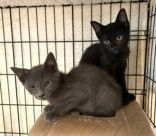
Petfinder shelters are full of unwanted kittens, Gentle Readers. Some unaltered cats are determined to have kittens of their own and will not foster other cats' kittens. Others will accept foster kittens, with apparent gratitude, as a means of birth control. Here are three especially adorable pictures of kittens who need homes. As always, sharing the pictures can help these kittens find homes. People who can't adopt these individual kittens may find, on visiting the shelter, that a kitten who didn't photograph so well is even more adorable, in real life, than the one who did.

Zipcode 10101: Brandon & Megan from NYC 


Her web page: https://www.petfinder.com/cat/megan-65367037/ny/new-york/anjellicle-cats-rescue-ny488/

Isn't that the quintessential image of shelter kittens? They were born in May. Megan is the gray one. Brandon is the black one. Kittens who have other kittens to play with find it easier to learn that humans are for cuddling up to and their siblings are for play-fighting with. These two are so young, they'd probably even learn to recognize new names that are not what anyone you know calls per children or grandchildren. 

Zipcode 20202: Triplet and Trilogy from DC  

There ought to be one more. Sometimes it's best not to know. Anyway, if you pay the fee to adopt one you can adopt the other one free of charge. 

Zipcode 30303: Lentil from Atlanta 


Her web page: https://www.petfinder.com/cat/lentil-65397579/ga/atlanta/fulton-county-animal-services-ga217/

As with so many shelter kittens, all they can really tell about her is that she and a brother (Crumpet) were brought to the shelter together by someone who didn't appreciate them. 

Bad Poetry: Good Mood Anchor

California was handed my brother and me,
Eccentricities to explain,
While further south, to Mexico,
Went the parents of John and Jane. 

Returning to old Virginia,
We knew we'd come home again;
But, from laziness, the language we studied
At school was the language of Spain.

The Mississippi River, we said,
We never would cross again,
But Spanish was good for sharing
A secret with John or Jane.

Then we went away to college
And considered it all again:
In the cities, many people speak
Some form of the language of Spain.

And Joe, being a few years older
And known for his great brain,
Went to work for a famous man
Who took him directly to Spain.

And when I grew up I married well,
And so did young cousin Jane,
But harder fates the boys befell,
Even Joe, growing rich in Spain.

In all of our Spanish the English accent
Forever will remain;
When we speak it with Cubans or Mexicans
They laugh, and we laugh again.

Muy divertidas estamos,
Entendemos sin desden,
Como vacas locas holandeses
Mangling the language of Spain.

Widowed before age forty,
Returning home again,
I laughed to hear my cousin Joe
Mangling the language of Spain,

And the laughter was balm to a heart soon old
And surcease to a dying man's pain,
And many a day it comforted Joe
When I tortured the language of Spain.

And on Joe's grave this summer
Grass grows thick and green in the rain;
I remember how he said the best years of all
His life were his years in Spain.

I often read Spanish for pleasure
In holding the ground I did gain.
I sometimes speak Spanish with visitors
If English overburdens their brain.

If I had found one use for Spanish
In life, and never used it again,
It would have been well worth the learning
To remind Joe of his time in Spain.

Note to Local Readers: All names have been changed. That's all I have to say on that subject.

But I often remember the whines of left-wingnuts in my generation, at school: "Art, music, literature, foreign languages, algebra, physics--what use will we ever have for all those antiquated bourgeois affectations they teach in high school? Why can't we just go directly into trade school?" 

I am all in favor of trade school courses, apprenticeships, and anything else that gives students a chance to learn grown-up money to pay for their own higher education. If the question is what to learn first, by all means study Bricklaying or Auto Mechanics before you study Languages and Literature. 

But always remember that the so-called "liberal arts" were the arts of free men and women for a reason. They make life better. They form good mood anchors in the brain. You too might happen to know someone who is dying slowly, painfully, and prematurely. Music is what's usually recommended as a better mood booster for that person than any pill, but you never know whether, for the individual you know, it might be algebra or botany or a foreign language. My objection to Spanish, if I had one, would be that it is (or should be) so easy and familiar that it hardly counts as a foreign language. Saying you studied Spanish at school, if you didn't make it a major and make translating Spanish poetry a career, is like saying "I am a slacker." Nevertheless, the best free mood booster anyone could give the relative remembered here was to speak Spanish with him. You never know. When life hands you opportunities to learn something, life is probably preparing to hand you a need to know it. Use all opportunities to learn anything useful that come your way.

Fun Facts: Web Log 7.24.23

Special Fun Facts edition! Dropping early, due to the time-sensitivity of one of the links!

Books 

I've not seen it, but I'd like to read it: 


Fun Facts 

Remember last week's fluff post question? 

George L. Thomas reports that elephant manure can be made into paper. (Horse and cow? Meh...they excrete a lot of softened fibre but it might be too well softened.)


Tanith Davenport reports on an ice cream flavor you just don't find any more. Aren't you glad?


Lydia Schoch gives some reasons why blind people don't learn to read braille.


Stephen at Reading Freely follows the stories of the astronauts, the big celebrities of my childhood. (I didn't even remember all of their names.)


Patrick M. Prescott reports on the benefits of keeping a logbook on board a ship.


Michael Mock discusses a peculiar-looking fossil animal.


M at Rain City Reads questions a reported fact about turtles. I googled this for her. Yes, PBS reported that turtles seem to be able to breathe, as well as excrete and reproduce, through their back ends. 


Rewriting Kel shares a handful of fun facts, including one about giraffes that ought to add some comic relief to everyone's day.


Alex Isle has some about the reactions of rats. If any readers happen to be rearing rodents, this blog post is likely to give them an interesting day. I wonder whether these are true for all rat species.


Health News 

Anthrax vaccine manufacturer knowingly includes toxic ingredients in the mix...and recommends the vaccine be given along with the antibiotics, which, of course, are what you'd need if you came down with anthrax, by which time the vaccine would be completely useless. This is the kind of vaccine that completely fails the risk/benefits analysis. Anthrax can kill humans, but it sounds as if all this vaccine does is make them ill before anthrax has a chance to finish them off.


Then there's chlormequat, which sounds as if it's made of chlorine (bleach) and paraquat, which is a fairly close description of the chemical. Not precise, but close. So what chlorine does is, basically, kill things. What paraquat does in fields is kill specific unwanted plants--including many good ones, if the vapors drift onto another field. What PARaquat does for humans is cause PARkinson's Disease, in which people gradually lose control of all their muscles, beginning by losing control of continual shaking and twitching, and going on to be completely paralyzed. So this chlormequat, which is too general a poison to be approved for use as a "pesticide," is now being considered for licensing as a food additive. If you spray it on crops, well for one thing your own life will probably be shorter and your dying longer, as will your family's and your customers', but what the corporate marketing guys want you to think about is that all the grain will stop growing and be ready to harvest right away--more convenient that way, more profitable. The clock's running out on this one, probably because nobody took the risk of this poison being approved as a food additive seriously. But yes, Gentle Readers, you need to tell the EPA not to allow this to be sprayed on grain. 


If you want to see my comment--perhaps hasty, because this is not my issue, sorry about that--it's number lkh-g808-07az  . Youall can write better comments. Google "chlormequat risks" and start writing now.

Meanwhile, here is your one-long-line answer to anyone who might call this web site "anti-vaxxer":

"

1. Like “antibiotics,” “vaccines” are a large and diverse class of medicines, and as with all large classes of medicines, different products in the class work by different mechanisms, some being quite effective while others are ineffective, some being reasonably safe for appropriate human use while others are fraught with side effects and toxicities and therefore to assume that any large class of medicines — including vaccines — is categorically “safe and effective,” is naïve, illogical, false and dangerous.

"

The number 1 is there because it's number 1 of 10 "sentences" Dr. Clayton Baker invites you to write down, or memorize, and use in this kind of conversation. Obviously his undergraduate major field was not English, because the list includes some "sentences" even I find ridiculously long, but what do youall think of his article?


And today's e-mail brings a round-up of new studies about Roundup (glyphosate):

Monday, July 24, 2023

One Cute Picture: Web Log 7.23.23

While actively seeking links to put into other posts I found only one picture to drop into a random log.

Cute Things 

Ganked from HowToMeowInYiddish.blogspot.com; Google traced the picture to an Italian site, notes that it's been copied into paint-by-numbers kits, and says the flower is Pulicaria dysenterica. With a Latin name like that it ought to be an interesting plant. Google says it's what Europeans call fleabane. North Americans gave that name to another plant so, when this one occasionally turns up in our meadows, we call it Meadow False Fleabane. (I'll take their word; I've never seen it.) They say you burn it like incense for an insect repellent. Since it apparently does drive away insects Europeans tried it on disease germs, but had less success with that.


What Americans call fleabane is one of those flowers that most of my neighbors fail to appreciate because it's wild and pops up in gardens. It grows in my not-a-lawn and is welcome. Serena says the crushed leaves really do discourage fleas; she likes to lie on a clump of it. The plant is hardy enough to have kept growing despite this. Soaking up the rain we've had every day, often twice a day, my fleabane's been overgrowing just as my jewelweed has. Both plants normally grow about four feet tall but are now producing stalks twice that height. 

Book Review: Land of Little Rain

Title: Land of Little Rain

Author: Mary Austin

Date: 1903

Publisher: Houghton Mifflin

ISBN: none

Quote: “The county where you may have sight and touch of that which is written lies between the high Sierras south from Yosemite—east and south over a very great assemblage of broken ranges beyond Death Valley, and on illimitably into the Mojave Desert.”

I downloaded this book from Gutenberg.org. If you’re online, you can read, print, or download it too, paying only printing expenses. If you’re not, I’ll print a copy for you at cost.

Mary Austin wrote several novels and is usually remembered for her poetry. (She dared to be trendy, writing poems patterned with thoughts but not sounds, like the translations of Native American poems she had studied.) Gutenberg.org has made several of her books available again, and after comparison, this is the one of her e-books I like best. It’s a nonfiction account of the stories Mary Austin collected in the Southwest—“Western” adventure stories, Native American stories, and Austin’s own stories of what she saw—coyotes, cattle, quail, buzzards, wildflowers. Frantic topophilia.

Austin’s intended audience were “armchair travellers,”and if you like a book that takes your mind on a tour of a different time and place, this is one. If you’ve never been through this part of the continent you may recognize places and wildlife from the old “Bonanza” TV series; no Cartwrights, who were later inventions, but canyons (Austin wrote “cañon”) and bighorns, chamiso and Shoshones. If you don’t care for the melodramas, shootouts, and boy-clique orientation of “Western” movies and TV shows but enjoy watching them for the landscapes and horses, this book is for you.


Glimmers, Anchors, Triggers, Whatever

When I think of "a glimmer" I think of a faint gleam of light, or understanding, insight. "The first glimmer of dawn appeared in the sky." 

A different idea is the "mood anchor," which does not necessarily mean a trigger for a pleasant mood, although that's usually the idea. A mood anchor is a trigger you intentionally create for yourself, your students, clients, etc. Better results are usually obtained by using anchors to pleasant moods--restful or energetic, family affection or romance, solemnity or laughter, etc.--but battle cries and fear triggers also work.

The literature of popular psychology overflows with unnecessary, often awkward neologisms created by people who hadn't read enough of their colleagues' work to know when the word they wanted already existed. So somebody now wants to use "glimmer" to mean a trigger for a pleasant mood.


This word usage does not work for me, but everybody always likes the idea.


This kitten. This attitude, when she weighed less than two pounds. My big strong Queen Cat Serena was the sole survivor of a litter of kittens who were born prematurely when their mother was reacting to glyphosate poisoning. It was such a pleasant surprise, so many days in her early life, just to see that she was still breathing. The face became a mood anchor for me. Still is. Her purrsonality is still too spicy for most people, but I love this cat.

Like one of the poets who accepted the challenge to write a poem about "glimmers," I live in a place full of pleasant mood anchors. Every flower in the not-a-lawn links to pleasant memories. I grew up mostly in the house where I now live, and mine was a mostly happy childhood. 

If you recognize a friend's mood anchors (or set up a new one) you can give the person a little mood boost on a bad day. The more of these tiny acts of friendship a person can keep track of, and use without embarrassing the friends person wants to cheer and comfort, the more person is likely to be remembered as having "a well educated heart."

One might even indulge a friend in this strange new use of “glimmer.”

Sunday, July 23, 2023

Web Log 7.21.23 and 7.22.23

People tend to send their best e-mails on Friday. Some people send out batch e-mails only on Friday...

Censorship Exposed 

Expuesto en espanol, que se lo comparte con todo el mundo! (Share it with everybody!)


Meanwhile, Keanu Reeves is certainly welcome here, but let him be warned. Talking about Morality, Sustainability, and Philosophy, instead of just passively letting people scream at us to buy things that violate all three, gets people banned on the censored social media.


Hasn't he heard that the Party of Censorship think talking about Morality, Sustainability, and Philosophy is racist?

Crawling Behavior Exposed 

Fox News buys off its viewers' philosophical enemies. Yes, liberals and Democrats, "far left charities" include Satanic Temples. Yes, if the Ds can't rise up and reclaim their party, dividing its leadership between real liberals and its culturally-conservative, liberal-only-with-regard-to-specific-handouts voter base, and really fold in to the center, we may need a Liberal Party that will destroy the Loony Left group currently steering the Ds. I've been thinking this for years. I'm not a Republican--but recent D behavior has been forcing me to vote like one. Robert Kennedy is showing just how many people feel this way. Ds need to acknowledge that "progress" in a positive sense means burying Marxist ideas, and focus on cushioning the fall of unsustainable socialist programs. But I hope that does not mean giving money to Satanic Temples. 


Cybersecurity 

(In French; it would have been at The Defender in English first, one day when I wasn't surfing, earlier in the week. Probably there ought to be a version in every language on Earth.) ChatGPT is nothing but a plagiarism site. It can be hard to prove when a student used Chat GPT, and there is a legitimate use of programs like Chat GPT to generate a draft you use as an outline before completely rewriting every sentence, but using it should always be considered plagiarism. Instant F for the course. Plagiarizing fifty different people at one time is not better than plagiarizing one.


Flowers 

Christian content, linked today especially for Christina Rossetti's poem that counts the "sturdy weed" among the flowers that teach us about God.


Health 

There's hope for this doctor, who writes about the dilemma of treating patients with chronic pain (for a Christian magazine, yes). There's hope for the patient. Pain control is a skill, or set of skills. I teach those skills. I've described them at this web site--but it is a bit like describing riding a bicycle. People don't become able to ride a bicycle by reading "The key is to keep the bicycle moving forward at a speed that stops it from falling to the side. To do this you look both ways and focus on your goal, put your feet on the pedals, turn the pedals, and use the brakes and handlebars as may be indicated." You have to practice doing it, and at first it may seem like something you can't do. Then your body learns how it's done, and it's easy..


Music 

Jason Aldean's chart-topper is rockabilly, not country. Not even good rockabilly. Monotonous, with a back-beat that's lost in the eighties. Lyrics that sound as if they were meant to rime and failed--assonance may be sophisticated in literary poetry but it just sounds amateurish in pop songs. And it may describe the way someone felt about a small town in 1953, but I doubt very much it describes a real small town today. (My town's been Not Getting Involved at least since the Kingsport Strike in the late 1960s.) But it's not racist. Some people are so stuck on calling everything they don't like "racist" that they can't even recognize when a song is just plain bad  So they got the left-wingnuts of the Internet to censor it. So now it is (sigh) our grim patriotic duty to listen to it. Aaarrrggghhh. At least "Trump Won and You Know It" was funny, and "Let's Go Brandon" had a catchy tune....Looking on the bright side, it is less painful than reading things like The Turner Diaries. Guss buying/reading censored material is always more fun when the censors are wingnuts... 


History 

Kingsport, from which my screen name is derived, really is unique. 


Political Humor 


Writing Tips 

If you suffer from writer's block, Mona Andrei has fabulous suggestions: Use a template...or hire a professional. 


(Yes, I do guest posts. Usually they're anonymous, business-supportive posts with topics like "How to Tell When It's Time to Call the Washing Machine Repair Service," "Does a G.E.D. Tutor Need a College Degree?", or "How to Raise Painted Lady Butterflies in the Classroom." If you have a well focussed niche and a relevant degree to impress Google with, I can do brilliant SEO posts. You know how the SEO Cat Post at this blog reads as a ridiculous little post about Samantha Scaredycat, silly but natural, not keyword-stuffed, and yet it is in fact SEO? I do that with business blogs, too.

Back-links to my own content at other people's sites, I don't do. Links to other people's content at sites that also publish mine, yes, if I think it's share-worthy. Nobody pays to get into these Link Logs.)

Zazzle 

Friday's new Zazzle design: the "Save the Butterflies" Square Compact Mirror features a Vanessa, a.k.a. Cosmopolitan or Painted Lady. You could substitute a different butterfly, or a flower or whatever, and still support the cause.


Not mine; features three of Virginia's favorite butterflies: