Showing posts with label Hemileuca. Show all posts

Monday, August 21, 2023

Hemileuca Californica

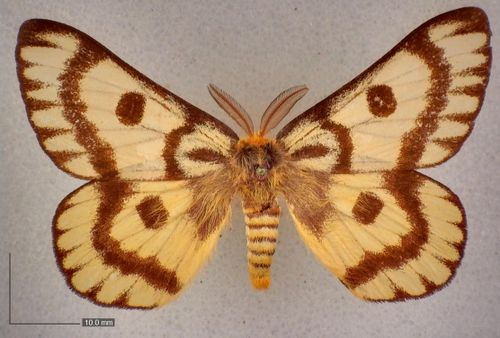
In the nineteenth century, it was a news item for naturalists that the adjacent states of California and Nevada each seemed to have its own typical species of Hemileuca. The moths, H. californica and H. nevadensis, were almost identical except that nevadensis was yellow and gray, while californica was white and grey. Both were occasionally found as far east as Wisconsin and central Canada, and they weren't hard to get to hybridize, but naturalists out West always seemed to find one moth in one neighborhood and the other in another neighborhood...


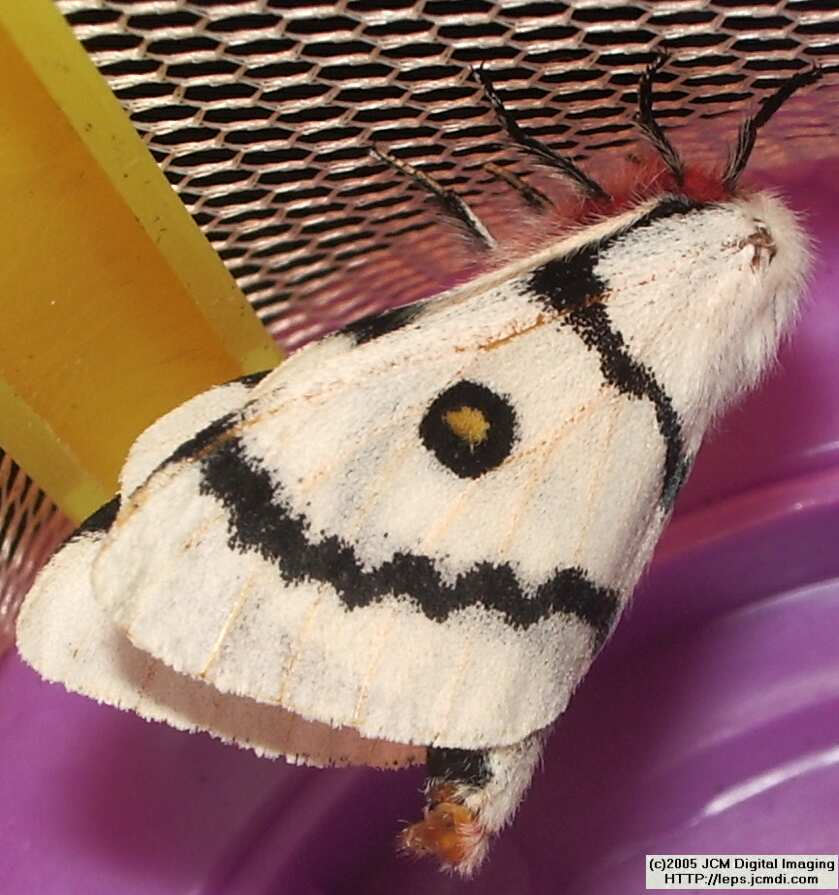
Though some of the big silk moths don't fold in their wings as small moths do, the Hemileucas tend to fold in their wings, so this picture may suggest the Meal Moth. Don't make that mistake. Meal Moths are tiny; Buck Moths are not. Though not as gigantic as other silk moths, Hemileucas generally have wingspans from two to three inches across.

As regular readers guessed by now, by the early twentieth century Holland's Moth Book had definitively lumped californica and nevadensis into one species. They are basically one species. A web search yields very little for californica today and, although I found some lovely fair-use photos of the color type that used to be called Hemileuca californica, I found them listed as specimens of nevadensis.

It is sometimes considered a pretty moth.


The female is slightly larger than the male. The wings of Hemileuca moths can have thin coats of scales and look translucent; we can see where fore and hind wings overlap in the picture above.

Moths often fly in the daytime, in autumn. Caterpillars hatch in spring, This one looks less bristly than some other stingingworms do, but in view of the correlation between unpleasantness reported for being stung and the number of stinging tips that make contact with the skin, it may need killing even more desperately than the spikier-looking types. Flattened rosettes are more likely to deliver more venom than branching bristles. 


However, caterpillars can also resemble those of burnsi and electra. The yellow color pattern is the most typically "Californian" but is not necessarily correlated with the californica wing pattern in adults.

When we want to see fewer of a species in a given place...and let's face it, that is the concern most people have with the Hemileucas, though some people do seem to admire these animals...the first rule is NOT to spray poison on it. Well, alcohol kills stingingworms reliably, quickly enough to be considered humane, in situations where there might be good reasons not to whack one with a stick. (In situations where a stingingworm is crawling on an individual, the important thing is to get it to crawl off again without contact between spines and skin. Remain calm. Try to get it to crawl onto a loose end of clothing from which it can be made to drop off, well away from the person.) 

When we spray poisons to kill plants or animals, we also kill their natural predators and competitors. Unwanted lifeforms always reproduce faster than their main predators do, and some isolated individuals always survive a spray poisoning, so spraying the pests away means that in their next generation their population will increase exponentially. Keeping up efforts to control unwanted animals by poisoning has made rare species into real pest species. 

We can, however, reduce unwanted species populations by functioning as predators, even though we don't eat most unwanted species. (People do eat bear meat--and like it.) If you have a real infestation of unwanted insects, and you crush several at once, you may find natural predators eager to help dispose of the bodies. When I've swatted a lot of flies, my friendly neighborhood White-faced Hornets have buzzed up to watch and wait for a chance to remove bodies. I've never found and destroyed a whole clump of stingingworms; at the clustering stage they tend to stay high in trees, but if you did kill a whole brood you might find out what their primary local predator is. There is no need to increase predator populations. Just don't do anything that harms or interferes with them. Natural predators usually control nuisance species nicely wherever humans have not created an ecological imbalance by cultivating unusual numbers of food plants.

Californians are likely to have to deal with Hemileuca californica if they've planted or encouraged several dozen possible host plants. The native species these caterpillars eat are listed, with pictures and tips if you want to encourage them, at Calscape:


Serious problems with californica may occur when several cherry, peach, or almond trees have been planted close together. Every child deserves the opportunity to climb up into a tree and pick cherries. Stingingworms seem to exist primarily for the purpose of turning what ought to be one of children's favorite chores into one they dread and avoid. Separating the host trees helps, but does not completely solve the problem. Still, spraying poisons can only aggravate the insect problems and reduce the value of the fruit. Predator populations will increase in proportion to nuisance insect populations. Flies and miniature wasps are the primary predators on large caterpillars in California.


The friendly tachinid fly is smaller than a housefly, has yellow wing joints, and most importantly leaves people alone. A less general feeder than the housefly, she's not attracted to human sweat. Her microscopic eggs hatch into tiny maggots that parasitize stingingworms, tomato hornworms, and other nuisance caterpillars to the point that, where the flies are free to do their job, the caterpillars are only occasional nuisances. You can attract tachinid flies by leaving crushed caterpillars on the ground, or simply avoid spraying poison and wait for them to move in. Tachinid flies leave eggs on leaves for caterpillars to eat if they don't find a chance to lay eggs on the caterpillars themselves. Either way, although parasitized caterpillars often survive until the tachinid maggots eat their way out of the caterpillars to pupate, they don't mature and reproduce. 

What makes insects so inconvenient to us is that, as recommended by some psychologists and philosophers, they never think things through logically or discuss them with others (bees are an exception). They have no guide through life beyond their instincts. Having limited perception and no reasoning whatsoever, they are incapable of understanding that they are making themselves nuisances. To get rid of them you have to kill them. Personally, I find some consolation that, in killing nuisance insects, I am helping natural selection encourage the species to develop a higher incidence of instincts that guide them to avoid humans. If we only ever swat the flies that annoy us, we can maintain a healthy population of friendly tachinids and other harmless fly species, without having to put up with houseflies.

Today it may seem that the value of Hemileuca californica is to demonstrate the need to check and correct "the science." Besides the wing color, old authors pointed to other differences between nevadensis and californica. The bodies of both are always furry, but nevadensis, it was easy to see from actual specimens, tapered down toward the tail end, whereas any taper in californica's shape was offset by a tuft of red-orange hair on the tail end. Nevadensis had narrow rings of black and white around the body, while californica's body was dark above its tail tuft. The specimens did look different, but shouldn't the description of their habits have shown that they were at most subspecies variations, more likely variations produced by environmental factors, within one species? How could anyone have been so eager to claim the honor of discovering a new species as to overlook the implications...when animals hybridize easily and produce healthy offspring that inherit and pass on traits from both parents, they belong to one species that can have different looks.

What a contrast between entomology, as a "pure" science studied by people who "only" want to know more about this fascinating world, and some scientific studies that can be "applied" directly to ways of making money. If there were any real commercial profit in clinging to the error, would people who had accepted Hemileuca californica as a distinct species be arguing that those who noticed its crossbreeding with look-alike electra, burnsi, nevadensis, and some others, were deluding themselves for some sort of politically subversive reasons? (Maybe they would tend to feel that blondes should be allowed, if not encouraged, to marry non-blond men?) Would there be efforts to censor discussion of the influence of food plants on Hemileuca color patterns from social media?

This is the fourth Hemileuca post published here--the last one paid for. A few more have been written, and the full series will be thoroughly researched, written, illustrated, and posted at no expense to the student as the articles are funded. They cost $5 each. As with the first four, some posts will be short, noting that named species have been reclassified as subspecies, and others will be long, with lots of pictures. The ones about H. eglanterna and electra are profusely detailed; much more information about the life cycle of californica will be in the article about nevadensis. The pertinent chapters from Tuskes' $400 book are not duplicated in these articles, but they will be consulted. If interest persists they may become a book.

Monday, August 14, 2023

Hemileuca Burnsi

Skipping over Hemileuca boisduvali, quickly shown to be the same thing as H. eglanterina, and H. bifasciata, quickly shown to be the same thing as H. burnsi, we come to burnsi itself. Burns' Buck Moth is one of the six, out of more than sixty,  kinds of Hemileuca whose DNA is distinctive enough to keep them classified as a distinct species. Google has lots of material about this species, because it's pretty, as moths go, anyway, and it lives in California.


(Butterfly photographers usually want and deserve credit. Moth photos pop up in different places, making it hard to tell who deserves credit; since some people don't like to look at moths, some might even say the photographers deserve blame. Some pictures here come from fantastically detailed photo essays that have been linked and credited; others, like this one, seem to have been donated to science.) 

Some Hemileucas are garishly colored but burnsi display a very simple, yet striking, color pattern. 


The "buck moths" are, as we saw with H. artemis, a genus of madly variable moths. They're thought to have originated in the dry west-to-central part of North America, because their behavior seems adapted to dry air, hot days, and chilly nights. Variations in diet, weather, and individual DNA can cause moths that hatched from the same egg cluster to look as if they belonged to different species. 

Burnsi has been given other names, some at first accepted as different species names. It's bifasciata because most individuals have two narrow bands of black across the white forewings, nigrovenosa because the black bands suggest veins, and paradoxa because it may or may not be able to crossbreed with the "sibling species" H. electra, which is active in some of the same times and places, but in recent years entomologists have agreed that its most noteworthy feature is having been named after somebody called Burns.

For "giant" silk moths they're small, especially when they fold up their wings, as they often do, and try to pass for oversized Noctuids. Hemileucas aren't very big. The unfolded wings may spread out to all of two inches, or more or less.


For some of these moths it's possible to say that the hatchlings all start out looking alike but, by the fourth or fifth instar (and they can molt through seven instars, growing bigger, more venomous, and harder to whack with a stick in each new skin!), siblings can look different. When we get to the E's I'll try to include a fair-use photo documenting that hatchlings, as they crawl out of eggshells laid in one clump, can look like three different kinds of first-instar caterpillars. (That means they can look like their father, their mother, or a grandparent--all in one litter produced immediately after a freshly fledged female moth mated just one time. Something interesting is going on with their DNA.) That's one reason why Hemileucas cause entomologists to tear out their hair and swear in possibly novel mixes of languages.

The other reason is that, while Hemileuca caterpillars can be any color including plaid (yes, literally, plaid), what they all have in common is that they're covered in little branching spines. While many other caterpillars have branching bristles that are harmless, mere mimics of Hemileuca's bristles, each of these caterpillars' bristles contains about as much venom as a bee sting. An entomologist in Florida has produced a video documenting that how many bristls touch yoour skin makes a big difference.They share with a few "related" genera, Autometis and Saturnia, the nickname "stingingworms."

There are people who would miss the Hemileucas if they went extinct, but having lived through their local extinction, recovery, and re-extinction, I'd predict thsat those people are in a minority. Nobody misses stingingworms. Nobody now has much hope that they're really gone forever this time--we've seen them come back, in quantities, before--but nobody ever wants to see another one. It is very hard to like an animal whose relatively weak grip and heavy weight, for a caterpillar, cause it to lose its grip and fall out of trees, stinging people who were just walking under the trees, doing the caterpillar no harm. So in 2001 the U.S.D.A. developed pheromone traps for some Hemileucas and determined that only about half the male moths thought to belong in the target species were attracted to pheromone traps. Given the urgency with which the silk moths seek mates, it was hard to say that this mean that many Hemileuca males in California are victims of crowded conditions (some sources document local populations having reached unhealthy density) or species confusion (individuals with otherwise different DNA looking alike), or even of moths being able to tell a difference between synthetic pheromone bait and the scent of a living moth.


It has, however, been possible for researchers to determine that female moths are not just sitting or flitting about, minding their own business, when all these males approached and began displaying themselves. Female moths actively, though silently, "call" for mates by assuming a specific posture in which a scent gland can be extruded, often rhythmically, releasing bursts of scent. This is why female Hemileucas usually choose a mate immediately after the process of spreading their wings is complete, sometimes before. Silk moths have short adult lives; it's to the female's advantage to start placing her eggs as soon as she can start flying. While flying, she stops summoning males, so they move on and compete for another female's attention.


The model here was raised from a caterpillar in California. A complete photo essay of her life, including pupation and eclosion, is available at http://lepidoptera.jcmdi.com/m/Sat/burnsi/burnsir.html . Hidden in the little tuft of brown hair on her tail segment, the female moth above is flicking her scent gland in and out, actively exuding waves of a chemical other moths can smell. This behavior is known as "calling" or "scenting." Humans neither hear the call nor smell the scent, but moths do--they seem to see, hear, and smell different ranges of stimuli than we do. The female silk moth has only a few days to lay her eggs and needs to get them fertilized. She has no time for subtleties. To other moths she's screaming "Take me now!" though Hemileucas don't actually grab; if several males show up she'll choose one, the others will rush off in search of other females, and she and the chosen male will snuggle. 

What does she smell like, to the moths who can smell her from a distance? It's hard to imagine. Her scent contains palmityl acetate, a "fresh, sweet" smelling ingredient found in some skin lotions, but since users of these skin lotions aren't mobbed by male moths we have to imagine that other chemicals provide the dominant notes of her fragrance.

In some cases male Hemileucas are attracted only to their own species, or sub-species, or type, but this may not always be the case. In California research showed that some nuttalli males were atttracted to eglanterina females, and some were not. The moths in the same area looked similar, but females pheromone-"called" for mates with slightly different odors at different times of day (Hemileuca fly in the daytime.) Some individuals in these species, or sub-species, hybridize readily, and some do not. H. burnsi and H. electra do not hybridize well. Male burnsi are sometimes attracted to one sub-speces of electra, but not to another. A researcher "forced" some male H. burnsi to hybridize with female H. electra mojavensis and found that, in fact, these two species did not produce viable hybrid offspring


Once the calling female has attracted and accepted a mate, the couple slow down and enjoy being together for an hour or two. In nature Hemileucas typically cling to a twig so they can mate face to face, but their flexible bodies can mate side to side while they cling to the screen of a cage.  The female then spends ten to twenty minutes flying while the process of fertilization completes, then drops eggs in a cluster on a twig of something her young will be able to eat. Then she finds another twig and lays another cluster of eggs. Typically female Hemileucas produce three egg clusters, the biggest one first, before their bodies' energy reserves run out. Meanwhile, a male may be able to mate with three females in his lifetime. Like all the big silk moths they don't eat or drink, but live entirely on the energy reserves stored as fat in their bodies, which last only a few days.


Her legs and underside were red when she was a caterpillar (many stingingworms' undersides are reddish) and the underside of her thoracic segment stays red while she's a moth. Burnsi don't necessarily arrange their egg clusters in a ring shape, as their neighbors, H. electra, usually do.


When the eggs hatch, the baby caterpillars are likely to stay in a cluster, as much as possible, for their first week or so of life. Although they are cold-blooded they can use this clustering behavior, as well as their thick dark skins, to regulate their body temperature through hot afternoons and chilly nights. The cluster is also less attractive to most predators than an isolated caterpillar would be...and since the babies already have some venom in their little spines, touching the cluster will discourage any predator desperate enough to try it.

An important adaptation to life in Southern California is the ability to eat whatever is able to grow in a given year. Burnsi caterpillars can eat several kinds of leaves, including almond and fruit trees as well as many garden flowers. The Calscape gardening site lists more than a dozen flowers that are native to California and may attract Hemileuca burnsi.


(I thought this post needed one picture that everyone could agree is pretty, though I like the moth's minimalist design myself, so here is the Desert Smoke Tree, one of burnsi's favorite food plants. Google really went into fits trying to shrink the nursery's poster-size picture to fit this page. If you live in a suitable part of California and have a place for this gorgeous flowering tree, well away from parts of the garden frequented by humans, here is the nursery's link: https://www.spadefootnursery.com/fabaceae-psorothamnus-spinosus .)

This particular brood was then adopted by humans and kept in a cage. People who've tried it say that Hemileucas are hard to rear, and although these caterpillars' human godparents successfully reared a few viable adult moths, most of the caterpillars failed to pupate and mature normally. Most did, however, survive as caterpillars. By the third instar they're showing more color variation--at least shades of gray--but still living in a cluster. At night they can huddle together to conserve warm air.


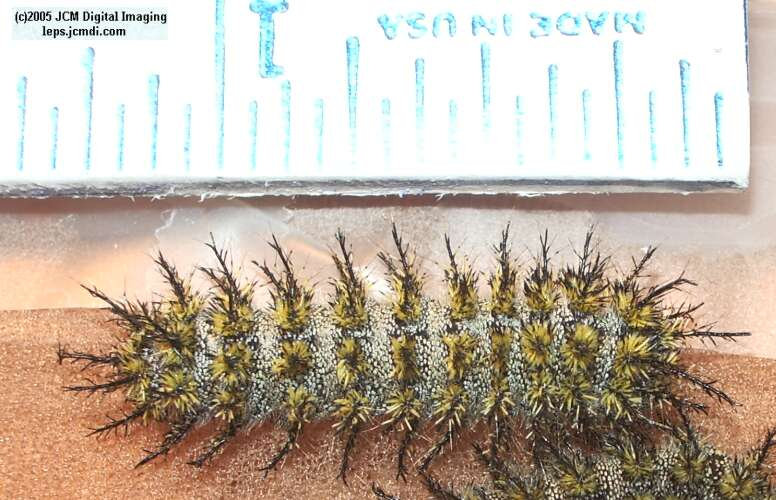
By the fourth instar, the black skin is almost covered in white dots, and the black central spines of the bristles are surrounded by yellow branches. Each tip is a "stinger." The more tips touch your skin, the more venom. Thus the caterpillar punishes those who grab or crush it more severely than it does those who merely get in its way, as it might be when the fat, foolish little beast falls out of a tree.


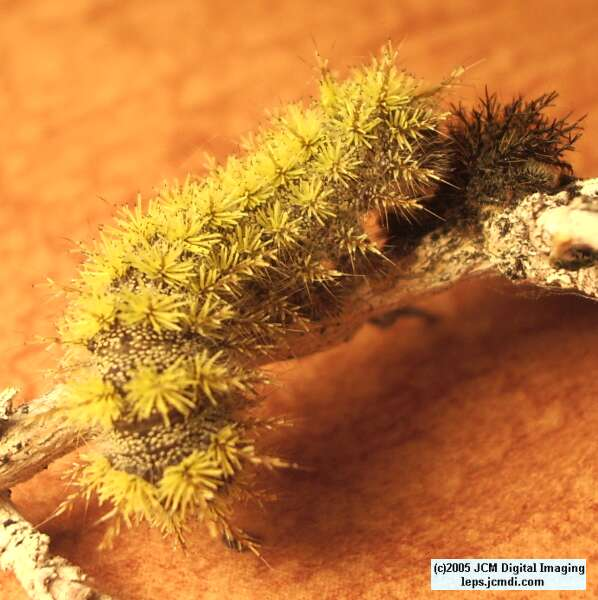
The bristles change with the skins. This little fellow, just entering the fifth instar, is standing on its discarded gray-brown skin in its new coat--California gold! 


The bright yellow color soon faded to orange, then brown. The basic skin color remained black but showed increasing amounts of white, then tan, spots.


From below, this individual's feet and underside are a much paler shade of red-brown than its head. The brood studied at the JCM site all seemed to be in the same general color range, showing more consistency than some Hemileuca family groups show. They can look different, though they're not as variable as some Hemileucas. There can be a white stripe along each lower side...


,,,or dark stripes crosswise, or both (this is one of the species in which some individuals can fairly be described as plaid). 


An extensive collection of H. burnsi photos is available at https://www.inaturalist.org/taxa/221168-Hemileuca-burnsi/browse_photos

During pupation the caterpillars don't really dig down into the ground as some Sphingids do, and don't spin cocoons. They just curl up as deep under the loose layer of leaf material, sand, gravel, etc., as they can easily get, all their bristles out, and wait. It can take several days for the larval skin, with its bristles, to loosen, leaving a pupa much smaller than the caterpillar was, helpless, on the ground. Looking like a pebble or bird dropping is its only defense. In 1974 Smith reported that cage-reared caterpillars could pupate successfully in a box of Kitty Litter with shredded tissue paper on top. This kind of dry, absorbent, initially sterile material seems likely to have helped, but nature seems to stack the odds against all the big silk moths. They are just too big and hungry to be allowed to reproduce as freely as smaller moths do.

In Texas, the typical burnsi caterpillar can be mimicked by Hemileuca grotei. The resemblance is probably produced by biochemicals in the plants it eats, since grotei is "grotty" enough in its own right and does not need to impersonate its cousins to look nasty...or be nasty. All photos ganked in this series will appear at the page for the correct species, but you might want to visit http://sherylsmithrodgers.blogspot.com/2012/04/caterpillar-id-request.html for comparison. (Grotei moths have the same general wing pattern as burnsi but most of grotei's wings are gray or even brown, rather than white,)

Paul M. Tuskes, whose Wild Silk Moths of North America now lumps all the Hemileucas into just six true species with lots of variation, took his turn trying to define the differences between the named species on the Pacific Coast so that it would be possible at least for entomologists to tell them apart by looking. But that was before DNA studies...Yes, the "image" here is a PDF document.


In 2017 Rubinoff, San Jose, and Peigler discussed the possibility that environment has more to do with these moths' looks than DNA does. Instead of telling the moths' bodies to show a certain look, their genes may direct the bodies to develop a certain look in response to certain conditions.

Monday, August 7, 2023

Hemileuca Artemis

How many species are in the genus Hemileuca? Depends where you look. Funet lists 57 species names, and some authorities add a few more, but at least half of them have long been regarded as synonyms (two or more naturalists "discovered" the same moth close to the same time). Some others are known only from specimens found in Mexico or further south; they may still exist, somewhere, but little is known about them. Passing right over H. arizonensis, which was soon agreed to be the same as H. nuttalli, we come to H. artemis. Scientists disagree on whether artemis should be considered a separate species or a sub-species. It's one of the confusing Western "sheep moths" that are found where sheep graze. It's the one that can have very showy black-on-white forewings and black-on-orange hindwings.

Or not.


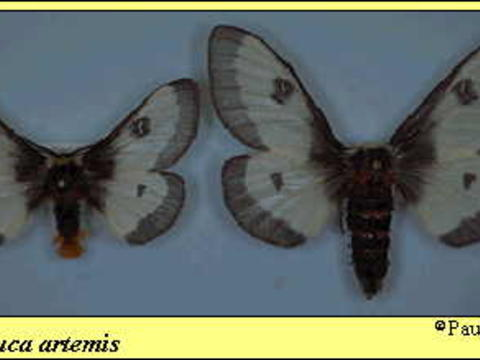
W. Holland, whose Moth Book was the definitive work on the subject in the early twentieth century, accepted only eight Hemileuca species and regarded artemis as a synonym for nevadensis, of which some still call it a sub-species. He observed that it "closely resembles" H. maia in having wings that can look translucent, almost scaleless. Individuals photographed usually have colorful wings but, in real life, the wings can look worn, or as if the scales failed to develop. Or the wings can be covered in scales, but the colors can be muted, as in the museum piece shown above. He also mentioned that the western Hemileucas tend to have a wider transverse band across the forewings, and more orange color on the tail end. 


Holland was the sort of naturalist sometimes called a lumper--the kind who lump similar lifeforms into one species if they're able to crossbreed. More recent naturalists have inclined to be splitters, who split genera into species when they find a consistent genetic type. Holland regarded all the eastern Hemileucas as "local variants" of H. maia. A more recent researcher carefully noted finding, in two parts of Tennessee one of which included Kingsport and Bristol, Hemileuca maia, H. lucina, H. peigleri, H. burnsi, H. artemis, H. nevadensis, H. slosseri, and one of the Bogbean Buck Moths whose classification has been a point of recent debate. If accurate, this study found that "Western" Hemileucas may cross the Missisippi and be found in East Coast states. Or, as with dogs, wolves, and coyotes, the DNA may be complex enough that individuals who vary widely in size, shape, and color may really belong to one immensely diverse species.

The splitter who claimed to have "resurrected artemis from synonymy," or proved that artemis is a distinct species from nevadensis, was the same Richard S. Peigler for whom H. peigleri is named. (In the same  1989 paper, although someone else had described and named H. peigleri, Peigler discussed evidence validating the claim for H. peigleri's status as a separate species.) He said that although both artemis and nevadensis eat native willow leaves, and the moths can look very much alike, the caterpillars are consistently different. Artemis eggs and caterpillars were sometimes found on Salix longifolia (a native willow species; their primary host plant was Rio Grande Valley cottonwood. This cottonwood species, and the moths, are usually found near the rivers that flow through the western desert, but H. artemis is also found near rivers in grassland areas. 


Even within a litter the colors of Hemileuca caterpillars can vary, but this pale yellow color distinguished cottonwood-eating artemis from willow-eating nevadensis.

Evidently a kindhearted man, Peigler was concerned about the survival of his stingingworms. They require a lot of sunlight to survive, and are apt to die of a virus infection, as well as fungus and parasite infestations, in damp weather. Populations of H. artemis seemed to be declining in 1989, although in the 1960s the little loathlies had been numerous enough that people demanded spray poisoning. Parasites and predators introduced in the coastal states to control gypsy moths (he didn't say "Virginia," but yes) linger in the ecosphere after the gyps have died or survived, and attack silk moth caterpillars too. H. slosseri also seemed to be threatened by Texans' natural inclination to get rid of shinnery oak, an inconvenient species even when not full of stingingworms. 

"Clearly there are numerous and varied conflicts between continued existence of these moths or their habitat and the social attitudes and demands of civilization. We hope that none of these species will become threatened or endangered before steps are taken to stem the tide, because by that time it may be too late," Peigler wrote.

Ordinarily I care about extinction, but in my part of the world stingingworms went locally extinct in the early twentieth century due to logging. Older people still warned kids about them but nobody was sure what they were. In fact my interest in the whole topic of caterpillars, which I don't particularly like, was piqued when some school friends thought a harmless Eastern Tent Caterpillar was a stingingworm; I knew better than that, and wondered what they thought they were talking about. (Eastern Tent Caterpillars' fur will prickle and even raise a rash if it gets down your neck in hot weather, but so will your own hair.) As oak trees came back, so did the stingingworms. I miss the other casualties of the war on gyps, lament the decline of Tiger Swallowtails and Tuliptree Beauties, but life without the Hemileucas is...just...better

Dr. Peigler was still teaching during the school term in which this post was written, and his paper introducing H. slosseri was printed in English with a Japanese summary at the end, which caused it to be digitized as a PDF: 


Despite including "char.ja" at the end it was easy for me to read; the Unsatisfactory Toshiba likes PDF. For Peigler, at least, it may be good news that H. artemis was found in Tennessee.

Photos of artemis and nevadensis side by side show that the different-looking caterpillars grew into slightly different-looking adults. But not very different. You can find the photos online at 


Tuskes, Collins, and Tuttle, whose Wild Silk Moths of North America is on sale for just under $500, reported that when artemis caterpillars were reared in California, they looked just like nevadensis. So maybe they're not a distinct species after all. A 2017 paper Peigler co-authored with Daniel Rubinoff concedes that, after DNA studies, the lumpers seem to be prevailing; the genus Hemileuca is now thought to have only six true North American species, with lots and lots of local variations. 

"Diagnostic morphological traits are generally lacking" for the Hemileucas, complained B. Christian-Schmidt in a 2022 paper. DNA studies of this genus have not shed much more light on the question of species identity. They suggest that at least two of the variants that were first reported as distinct species, then declared too similar on the surface to be regarded even as sub-species, may actually be distinct species. When genetically distinct lifeforms look more like each other than genetically similar lifeforms, research is thoroughly confused. If you observe a female Hemileuca in a cage, the males who crawl around the cage trying to attract her attention won't all look alike. If she mates successfully (female Hemileucas mate once before laying eggs, and can mate one or two times more before laying more eggs), all of the hatchlings may be uniformly black or red, but by the fourth or fifth instar they won't all look exactly alike either. When even the consistent differences, like the yellow coloring of fifth-instar artemis caterpillars, may be food-dependent or weather-influenced, even entomologists are apt to give up and document the animal as "Hemileuca sp.," the old traditional shorthand for "I know there are different kinds of these animals but I don't know or care which one it was! It was a Hemileuca," or in ornithology "an Empidonax," or whatever else, "right? Now anyway, as I was saying..." 

In fact, depending on the circumstances, Christian-Schmidt documented, the males attracted to a caged female won't all necessarily belong to her species. Artemis aren't closely related to the Great Lakes population that look similar to nevadensis and artemis, but they are mutually attracted, given opportunities. (Latifascia caterpillars can be yellow or yellow-striped. Or not..) Given a chance to produce offspring, an artemis-latifascia crossbreeding produced weak offspring that didn't live to maturity, a datum that might be useful toward encouraging local extinction. All the big silk moths have very limited time and are fairly desperate to mate; that some of the tests Christian-Schmidt reports showed males failing to approach a female of their own species suggests that something may have been wrong with the female. If hybridization can keep a female buck moth from producing viable offspring...that's not quite as good as her producing no offspring at all, but...

I like for these insect posts to feature modern, research-quality photos of living insects on the wing, or on the proleg in the case of caterpillars. I'm always disappointed when opening fifty or sixty pages yields only fair-use photos of sad little museum pieces. However, in the case of a species that has never been shown to serve any useful purpose, while at least annoying the daylights out of people and spoiling the pleasure of picking your own berries and cherries, maybe it's just as well. New pictures of artemis aren't likely to be collected because the latest research techniques don't support the status of artemis as a clearly separable species. Few people will miss the tiny distinctions among fifty or sixty color patterns on moths that, even when considered separate species, always were prone to hybridization as well as color variation. Not many more would miss the moths themselves. If the entire genus Hemileuca went extinct (without any other lifeforms being affected), among the minority of Americans who recognize moth species, some would be pleased.

Monday, July 31, 2023

Hemileuca Annulata: Subspecies or Separate Genus?

The first four moth stories have been funded! Send $5 for each subsequent post about a moth in the genus Hemileuca


Caterpillars are sneaky, deceptive, confusing animals.  Most are small, and try to look like twigs or leaves. Some are too big to hide, and parade around trying to look like snakes or lizards, or just advertising to birds how unpleasant they'd be to eat, with knobs and bristles of extra skin, prickly or choking-thick hair, and color schemes that advertise to birds that the caterpillar ate some kind of leaf that tastes nasty or is poisonous to birds. Then there are the ones who try to be mistaken for the toxic ones; they'd be more digestible, or less indigestible, but they benefit when birds do not realize this. 


The moth genera Hemileuca and Automeris are among the most confusing. These are fairly large moths, in the silk moth family/ Caterpillars usually grow about two inches long, sometimes a little longer. While many kinds of caterpillars display bristling spines that look hard for birds to swallow, and often are, most of these bristles are harmless hairlike structures. Some of the bigger silk moth caterpillars have harmless bristles that mimic those of Hemileuca and Automeris caterpillars, because, though these genera are smaller, their bristles have sharp points and contain venom. The venom causes allergy-type reactions in humans. Usually the reactions consist of harmless skin irritation, but, like bee stings, they could put a particularly sensitive person in the hospital. There are survival advantages for many harmless species in looking like the Hemileuca and Automeris caterpillars, which are also nicknamed stingingworms, asps, or pugs. And the Hemileuca and Automeris moths themselves have a wide variety of looks. The caterpillars live in clumps when they're little, and different looks are observed within a single clump. 


This one is annulata, too. The range of variations is so wide that scientists disagree whether one type of moth in this group, which some call Hemileuca annulata, is a subspecies of Hemileuca eglanterina or actually belongs in the Automeris genus. Seriously. It can look so similar to another Hemileuca moth that it doesn't need to be classified as a separate species, or so different that it seems to belong in a whole separate genus? Now that's confusing.

As a result of this confusion, while there's no shortage of photos of "Western Sheep Moths," there is reluctance to identify them positively as annulata


The species name consistently given to these moths, annulata, simply means "ringed." It has been given to several kinds of plants and animals. Hemileuca annulata, or H. eglanterina annulata, or Automeris annulata can be described, as all moths and butterflies can, as shaped like a tube made of ring-shaped segments. It can also have conspicuous ring-shaped markings, on the moth's wings, and even on the sides of the caterpillar. Note the half-rings along the sides of the annulata shown at 


Not that all of them have this pattern, or any other pattern, of conspicuous markings. Hatchlings, scientists confidently say, are black. As they grow and molt they display markings, which can be white, yellow, or pink, or remain black. The bristles may be gold-toned. Scientists have not found a consistent pattern to predict how an individual stingingworm is going to look. 

They are better camouflaged, and more likely to be noticed by humans showing the "YeeOWCHHH what was THAT?" reaction pattern, when they stay black throughout life. They may, like some butterflies, tend to show more dark color if exposed to lower temperatures, more light color under warmer conditions. Caterpillars in these genera are the ones people describe as "nasty," "vicious," and "evil." They do not show much evidence of consciousness. They don't think through their problems. Instincts tell them, when disturbed in any way, to curl up in a ball with their stinging bristles outward and drop to the ground. They don't know whether they're being attacked or not, but their reflex reaction could be described as an "If there is a predator, inflict as much damage as possible" pattern. (They are light enough, and their bristles are firm enough, that falling fifty feet out of a tree and landing on their bristles doesn't seem to hurt them.) 

"There is no single rule for separating...eglanterina, annulata, and other populations," one scientist observed in Tuskes, Collins, and Tuttle's Wild Silk Moths of North America. If the different types of moth in this group are distinct species, they hybridize freely. They are large moths that typically fly in the daytime and aren't attracted to light at night. The moths, like the caterpillars, show some combination of black, white, pink, or yellow colors. 

A photo essay studying one individual annulata, with particularly clear and gorgeous black rings on its pinkish white and bright yellow wings, appears at https://www.argentinat.org/taxa/1026499-Hemileuca-eglanterina-annulata/browse_photos .Our featured photo (at the top) appears on several other pages but seems to have come from this collection.

The big silk moths don't eat. They live on the fat they stored up as caterpillars. They have only days to find mates. Males are attracted to the scent of females, which humans don't seem to notice. Females usually choose a mate after their wings have expanded but before they fly. After mating the female moth usually lays her first and biggest batch of eggs on the branch where she crawled out of her pupal skin to spread her wings. Then she flies off to find more twigs and lay more eggs. A female will tpically lay three batches of eggs, sometimes more, with fewer eggs in each batch. Meanwhile the male may mate with three or more females if he can, and he also produces fewer viable sperm each time. Then their energy is spent and their lives are over. Scientists can easily pick male moths off the cage in which a female is confined. If the moths can get together to mate they are, like some of the real giants in this family, in no hurry. "Dum vivimus, amamus," they nonverbally say. Annulata couples like to snuggle for anywhere from thirty minutes to two hours. They probably experience their lives as very romantic.

Egg clusters are big enough for humans to find the clusters on tree branches and pick them off trees we want to protect, but the branches chosen may be too high to reach easily or may be concealed by foliage. Female moths usually try to lay their eggs on plants their larvae will be able to eat. Since the moths in this group can eat almost anything, they don't need to be particular about where they lay their eggs.

In the warmer part of their range (Alberta to Argentina), especially, caterpillars in this group are likely to hatch during North America's winter months. Having black skin and sticking close together in groups may help them keep warm when the days are mild and the nights are cool. Their slow growth rate and relatively long lives may have something to do with their living in dry climates (they succumb to fungus infections in damp weather) and going into hibernation mode at night. If the group are disturbed they may start wagging their heads; the movement may persist until the whole group are oscillating, presenting a confusing target to predators that might want to grab a head, and increasing the probability that the said predator will bump into their spines. 

How bad is the sting, and are some species' stings worse than others? Answers to this question cluster around entomologist David Fine's not very scientific experiment, video-recorded at https://www.youtube.com/watch?v=jv6YApmwo5k . In the video, Fine touches the thumb edge of one hand to the back of a Hemileuca caterpillar and the thumb edge of the other hand to the back of an Automeris io caterpillar. (Io's are easy to recognize by their bright green color; their name comes from a character in Greek literature, probably originally pronounced more like "E-O.") We can't really see welts form, though Fine tells us he can, and have to take his word that the Io sting was much more painful. Some commenters describe much more painful reactions to Hemileuca stings when they inadvertently grabbed or stepped on the caterpillars. 

Lightbulb! Hemileuca bristles usually branch around a central spine. A light touch such as Fine did would touch only the tip of each central spine, releasing relatively little venom into his skin, while grabbing or stepping on the caterpillar would bring more skin into contact with more spines and more venom. Automeris bristles are flat-topped, allowing almost all the tips of each clump of spines to touch the skin at the same time. Even a light touch would release much more venom into the skin. So it depends less on the species than on the extent of contact with stinging spines. If stung, rinse with cold water, use sticky tape to remove any spine tips that may stick in the skin, and wait. Call a hospital if anaphylactic shock sets in, since it's curable, but most people have nothing to fear. The pain will subside in minutes or days, depending on how much venom the person absorbed.

As the caterpillars mature and the spines branch more conspicuously, they separate, but as they separate from a central point, where you find one you're likely to find more. They are vulnerable to micro-predators--tiny burrowing wasps that may be starting to eat a caterpillar while it is crawling about. They can hibernate through the winter; in Colorado and further north these moths normally live more than a year, though they spend more of their lives as caterpillars or pupae, and hibernate through much of that time. They normally mature in early summer, pupate in late summer, and fly in autumn. The name "buck moth," widely given to this group, was associated with "buck" deer hunting season

Again, while photos of Hemileuca are abundant, it takes an expert to identify one as annulata. A good clear color photo of a confirmed annulata caterpillar is available at https://repository.arizona.edu/bitstream/handle/10150/609134/dp_10_01-013-030.pdf?sequence=1&isAllowed=y . The photo section is between the main text and the bibliography.

Though they're in the silk moth family, they don't produce much silk. Usually they pupate under a leaf, a rock,or a layer of dirt rather than making a cocoon. After pupating they climb onto a twig to eclose, or expand into their adult bodies and spread teir wings. Then the cycle starts over again.