Not Yet A Fair Trade Book
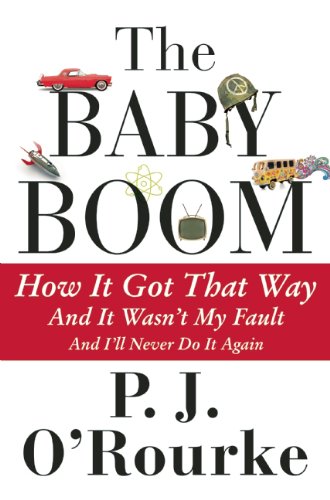

Title: The Baby Boom
Author: P.J. O’Rourke
(It may be helpful to click on that link and see if just the display of this author's book jackets makes you chortle. If it does, you'll enjoy the books...probably all of them. This is, so far as I know, the most gentle and evenhanded one, and the author gives his sisters credit.)
Date: 2014
Publisher: Atlantic Monthly Press
ISBN: 978-0-8021-2197-4
Length: 263 pages
Quote: “We’ve reached the age of accountability. The world is our fault.”
Now that the entire baby-boom generation is well into middle age, P.J. O’Rourke says, it’s time to contemplate the effect we’ve had on our cultures.There is of course no meaningful way to identify the voluntary acts for which an individual is responsible with the demographic trends for an entire demographic generation; but when O’Rourke identifies himself with a demographic that includes people almost young enough to be his children but not quite too old to be his siblings, not to mention females, males of other than Irish descent, and humor-impaired people, the result is consistently funny.
If O’Rourke ever wrote anything that wasn’t laugh-out-loud-in-public funny, he’d use a different pen name.
However,
The Baby Boom is funny in a different way than O’Rourke’s better known books. In this book he’s not cracking jokes from war zones, disaster areas, or even the approximations of those that he leads literal readers to imagine that places through which he test-drove sports cars for
Car & Driver might have become. In
All the Trouble  in the World, Give War a Chance
, and similar he was telling us how different his experiences were from ours. In
Baby Boom, which is a cheerfully ambiguous mix of history and memoir, he’s telling us about his very typical childhood, in a suburb, in Ohio, where he claims his experiences were similar to most of ours.
But which of ours? There are major disparities in the historical influences on baby-boomers. O’Rourke does a better job of diagramming them than some writers have done. A human demographic generation must by definition span at least twenty years. Since baby-boomers have often seemed as if our lives and identities really focussed around our teen years, what better way to describe the four subcategories as the senior, junior, sophomore, and freshman classes of the generation. The Clintons, Al Gore, Dan Quayle, and W Bush represent the senior class of baby-boomers; the Obamas, Sarah Palin, and Oprah Winfrey represent the freshman class.
O’Rourke is a senior-class baby-boomer who grew up playing outside more than watching television:
“There was a thing of Susie Inwood’s invention called Flying Horses. We were flying horses. We indicated that we were flying by…flapping our elbows. There was no point to our being flying horses. We ran around as usual although this time neighing instead of squealing.”
“In fairness it should be said that it never occurred to us to use our slingshots to settle personal grudges, let alone rob drugstores.”
“We slipped a comic book inside another comic book and paid the cashier for one comic book. We pocketed Dad’s change from the top of the dresser. We swiped cigarettes from Mom’s purse…we were led by Joe Brody, one of those kids who are real trouble that we met playing sports. Joe would go so far as to take the family car when his parents were asleep. But he only took it around the block. Come to think of it, we weren't there and had nothing but Joe’s word to go on that he really did this.”
“Yet another Baby Boom idea is that life is like high school. We are the first generation to make this claim…Nowhere in the philosophy of Plato does the phrase ‘Life is like Plato’s Symposium’ appear.”
“The school authorities forbade work clothes in school. However, the school authorities said we had to work hard in school. Otherwise, when we left school, we’d have to do hard work. Probably wearing blue jeans.”
“Joe Brody had the idea of using a hypodermic needle to inject vodka into a watermelon. Ideas, we were beginning to understand, were important for their own sake. That is, we didn’t know where to get a hypodermic needle. Even Joe’s parents would miss a whole bottle of vodka. In November, there weren’t any watermelons. And why would anyone bring a watermelon to a homecoming dance? We were almost ready for ideas of peace and love.”
Y’know which classic Baby Boomer Male thing O’Rourke is doing here? He’s using humor in a connective, empathetic way. “I’ve done something that was so stupid it was funny, and I’ll bet you have too.” Earlier generations saw nothing wrong with this type of humor.
James Thurber 
and
Mark Twain 
used it; the case can be made that
Montaigne
did, during his occasional light moments, and that
Apuleius
at least invented a narrator who did. It remained for baby-boomers to determine that connective, empathetic humorous writing is the kind women (that is, more precisely speaking,
Jean Kerr
and
Erma Bombeck
) do well. Anything a woman can do is a womanly thing to do, so if you ever listened to the Mars-and-Venus drivel, O’Rourke is writing from, shudder, his
feminine side! I didn’t know he had one…Actually
The Bachelor Home Companion
contains this type of humor too, and it’s laugh-out-loud funny too.
The best humor writing is funny on more than one level. Some readers remember: in a show making fun of Democrats who seemed to be having too much fun with a well-known Republican’s second grade level spelling mistake, Rush Limbaugh made a second grade level arithmetic mistake—how many layers can a “We all make mistakes” comedy act have? O’Rourke often achieves a similar layered effect, and never better than in the outrageous concluding rant of The Baby Boom, when he’s imagining how things “will be when we really are the world”: “There is no escape from happiness, attention, affection, freedom, irresponsibility, money, peace, opportunity, and finding out that everything you were ever told is b…”
(O’Rourke actually used a word that, at this site, activates an Aunt Filter Program which requires me to observe that “
a speech for Buncombe” was a very early American piece of political satirists’ slang for superfluous verbiage, as credited to a certain Congressman. Over the years it was shortened to “bunkum” or “bunk.” There is a ruder substitute that also begins with the letters “bu,” and there is no valid excuse for using it, having the right to use “bunk” in any situation, unless it be for the specific purpose of inciting a reviewer who happens to be an aunt to cap your joke with a joke at your expense. Thanks, P.J.)
Doing things that make your parents weep is neither fun nor funny, whatever O’Rourke may have written when he was younger. Writing things that make them laugh until they cry is both. O’Rourke has discovered one of the Great Secrets of Life. Read his book.
It's too new to be a Fair Trade Book. If you click on the image of the book at the top of this review, and buy a brand-new copy from the publisher, in theory I get some money and O'Rourke gets more money than the $1 he'd get if you bought it as a Fair Trade Book from me.


