Showing posts with label Russia. Show all posts

Monday, November 24, 2025

Book Review: White Swan

Title: White Swan

Author: E.G. Ellory

Date: 2025

Quote: "I'm...hunting down a person known only as White Swan...somewhere in Moscow."

Solomon Stone is off on another adventure in espionage. Retirement is not an option for him. He'll be rewarded with promotions, but he's trapped in his life of cloak-and-dagger, kill-or-be-killed, tests of his wits against those of strangers. He tries not to think about it much. He needs his brainpower for tracking down people like the White Swan, whoever that turns out to be. 

You know Solomon Stone is going to find the White Swan. The suspense is about what's going to happen when he does. Will the White Swan be a man or a woman? Must the White Swan be killed, or taken back to some sort of other authorities? How will Stone know? 

I don't feel qualified to judge spy fiction and did not, in fact, ask to be an advance reader for this installment. For those who like this kind of thing, it's a short, straightforward installment in a series. This is the sixth short book about Solomon Stone; by now fans probably know they want it. 

Sunday, June 18, 2023

Book Review: I Found God in Soviet Russia

Title: I Found God in Soviet Russia

Author: John Noble

Publisher: St Martin’s

Date: 1959

ISBN: none

Length: 192 pages

John Noble, a German-American living in Germany, had trouble getting back to the United States when the war broke out. When the Russian army invaded, he and his father were arrested, apparently for having tried to leave Germany. Such official excuses were made, he tells us, when either of the two cash-strapped governments coveted someone’s wealth—his father had a thriving camera factory, which, unfortunately, had been damaged in the war.

Believing that God had allowed this to happen to them because they had not been practicing their Christian faith, father and son resolved to pray and testify in prison. The eventual result was this story of ecumenical Christian services in a Soviet labor camp. “Inspiring”? Maybe, but when Noble finally got back to the States, he expressed no interest in going back.

In addition to their persistence in prayer, this book gives a sketch of the cultural diversity the Soviets tried to flatten out. We meet people from several different ethnic groups and religious traditions. Unfortunately, due to the circumstances, we learn little more about them, but this memoir does affirm that good (and bad) people are found in all ethnic groups.


Sunday, November 27, 2022

E-Book Review: The Gospel in Dostoyevsky

Title: The Gospel in Dostoyevsky 

Authors: Fyodor Maximovich Dostoyevsky, J.I. Packer, Malcolm Muggeridge, Ernest Gordon

Date: 2011

Publisher: Plough

Length: 214 pages

Quote: "The true content and context of Dostoyevsky’s great works is man’s struggle to find God, in the face of every imaginable temptation to deny Him."

It has been said, and said by Russians, that the Russian church has emphasized ceremony and neglected individual spirituality. This is one of the errors into which churches can easily fall; but then we must consider the testimony of Fyodor M. Dostoyevsky. He certainly thought a great deal about individual spirituality. His characters are characterized, even defined, by their spirituality or lack of it. Their spirituality is radical, defining their personalities and determining their actions. They are good Christians, or good people who are not yet Christians, or bad people as both a cause and an effect of their not being Christians. Their faith often leads them to do things that were probably more controversial then than they are now; they talk respectfully with sex workers and worry about the plight of abused children, and The Idiot is, of course, an intelligent man who is seen as an idiot because he ignores worldly wisdom and does what he believes Jesus would have done.

Though Dostoyevsky's novels have plots, Muggeridge's claim to have read them "like a thriller" is--not exactly suspect, so much as a reminder of what an unusual student Muggeridge must have been. In Dostoyevsky what catches people's attention, what is anthologized, and what is commented on, are the long speeches in which characters express Dostoyevsky's philosophical and religious ideas. Such passages may be considered flaws in the modern novel but Dostoyevsky's fans seem to read the stories, such as they are, for those long digressive speeches.

This book is a compilation of the scenes in Dostoyevsky's novels where the Christian characters expound their beliefs at length. They are not orthodox, though their denomination is presumably Eastern Orthodox. They express ideas like "What Jesus meant by Hell must be the inability to love" and "I'd be frightened to meet a truly godless man...What I have met were restless men." 

If you already have Dostoyevsky's major novels, the short commentaries by Packer, Muggeridge, and Gordon will add only a little to your library. If you've avoided the novels because they are so long, this book contains all the passages that are most often quoted, in their context, and may interest you enough that you'll want to read the novels after all. 

Friday, April 30, 2021

Book Review: Life of a Useless Man

Title: The Life of a Useless Man 

Author: Maxim Gorki (pseudonym for Alexis Peshkov)

Translator: Moura Budberg

Date: 1917 (Russian), 1971 (English)

Publisher: Doubleday (1971)

ISBN: none

Length: 240 pages

Quote: "[E]veryone called the boy Old Man. The nickname suited him perfectly."

Yevgeny, the little orphan nicknamed Old Man, is a timid little fellow who thinks the world around him ought to be nicer than it is, but lacks the courage to seek the goodness he admires either inside or outside himself. When he witnesses a homicide, he has no particular reason to report it or person to report it to. Nevertheless, he becomes a political spy, and when he learns that his duty requires him to do harm to the living people he likes best, he feels despair.

Alexis Peshkov, who chose a pen name that can be translated as "The Most Bitter One," wrote from his own formative experience in the years before the Russian revolution. Spying, corruption, appeals to the Czar that didn't lead to the results they led people to expect, are the substance of his story. They were things he presumably fictionalized from personal experience. 

Neither Czarist Russian nor Soviet publishers were willing to publish what Budberg tells us was the full text of Gorki's novel. According to her this was the first complete edition, available only in countries that were still officially enemies to Gorki's country in the Cold War, only in a language foreign to its author. Gorki was greatly admired by his contemporaries but his work was censored.

How much can you trust a novel that purports to be the first complete edition of what someone no longer living wrote, that is published only in translation? Is this Gorki's novel, or Budberg's? I have no idea. 

As a novel it's a lively, picturesque, not exactly cheerful read. Its form can be classified as either a biography or a tragedy, depending on whether or not we accept Yevgeny as a tragic hero whose fatal flaw is weakness. How can a hero be weak? If you're looking for a novel where the protagonist overcomes his fatal flaw and lives happily ever elsewhere, this is not it. If you're willing to read about the events that led up to the revolution as seen through the eyes of a weak character, this book is for you.

Thursday, May 25, 2017

Peace to All People of Good Will: Official Statement to Foreign Readers

Recently I posted about the hateful myth that "conservatives" are haters. The post mentioned a Christian church (which no longer exists) some of whose publications did contain lines that seem hateful when read, but, in context, what those lines actually expressed was Cold War-generated fear. The computer shows a drop in Russian readership...I hope that's not because readers thought I was trying to revive fear.

Is it time for this web site to display an Official Statement about Russians and Other Foreigners, Generally?

Official Statement: This web site denounces hate against any large group simply as a group. The position of this web site is that human beings can generally be trusted to act in what they believe to be their own best interest. In healthy social, business, or even international situations, intelligent humans will generally recognize that their own best interest is seldom completely incompatible with yours, and mutually satisfactory results can be negotiated. In times of war, intelligent humans are likely to believe that their own best interest is opposed to yours, and negotiation may become impossible. Russian, Chinese, Muslim, and other demographic types of humans, are about the same as other humans. This web site has no loyalty to any foreign government that would affect this web site's behavior in the event of war. (This web site generally deplores war.) This web site has no ill will toward individual readers in any foreign country. Actually, this web site likes having them (even though for local sponsors' purposes they don't count) and wishes more of them were able to post comments.

When I was growing up, people living in the U.S. were really being encouraged to distrust, dislike, ridicule, even fear, if not hate at least be in a position from which we could be led to hate, people in the U.S.S.R. I've mentioned being given a church history book that was all about Catholics and Protestants and completely ignored the Orthodox church; I've mentioned being told that even biblical or saints' names that are more common in Eastern Europe than in Western Europe were "weird" names to give to dolls or animals, as a child. This changed--earlier this spring this web site received reports of "conservatives" chanting, at rallies, their belief that "Russians are our friends"--and the people I know seem to be very glad it changed. Most U.S. citizens my age still know very little about anything "Russian" or Slavic or Eastern European...but many are delighted that we're now free to like them if we ever get to know any of them. This web site has no foreign policy; it does have correspondents who've expressed pro-Russian sentiments as vigorously as they've expressed pro-British, pro-French, or pro-Israeli sentiments.

I got into that rant about how, even when L.C.C. Christians were circulating lists of actors and movie producers who were to be distrusted because of their Eastern European Jewish identity, the message they were sharing was not "Hate all Jews" but "Distrust people from Soviet-bloc countries who identify as Jews while promoting socialist ideas"...and took it for granted that readers were aware that, while continuing to oppose socialist ideas, North Americans have much, much warmer and fuzzier feelings about the former Soviet-bloc countries in 2017 than we had in 1977. Well, if they're Russians using automatic translation software to read this web site, they might not have access to that information. For that, I apologize.

Russian readers, if you're still out there: Your parents, maybe the older ones among you, participated in an experiment that showed the rest of the world just how wrong ideas that sound good can be. That was brave of them; in the long run it should prove to have been a service to humankind. This web site in no way blames anybody for the mistakes his or her parents made. You are responsible for correcting the damage socialism did to you. That's likely to be a heavy burden; this web site can't do much to help you with it, but we wish you success. And, as should go without saying, we wish peace...to all the private people in all countries.

That includes even the ISIS-infested countries, in some of which we do know a few people. I'm not even going to try to communicate the dismay I feel when a "conservative" correspondent I generally respect is circulating a petition to Congress to "declare war on ISIS." Duh--the list of ISIS-infested countries includes our own. When you've worked, travelled, eaten, and even prayed with Muslims you can certainly feel disgusted that evildoers identify as Muslims even in their most evil acts, but the idea of war, destroying their homes, their tiny struggling village schools--reversing such progress as some of these people have been making to recover from abuses that originated from times of poverty...One thing the L.C.C. used to proclaim that was not a reaction to then-current news, but an understanding of the Bible that I still believe was accurate, is that Christians should never call for an offensive war.

Prosecute crimes, yes. ISIS is a big, overfunded criminal gang. If we can go after them as such, I'm in favor of that. Find the scum who attacked the concert-goers in Manchester, the way we found the scum who attacked the Boston Marathon, and let the victims' families decide whether they should be hanged or drowned or poisoned or just worked to death. Meanwhile, not as a foreign policy but as a general policy, this web site always likes diplomatic strategies better than war.

*****

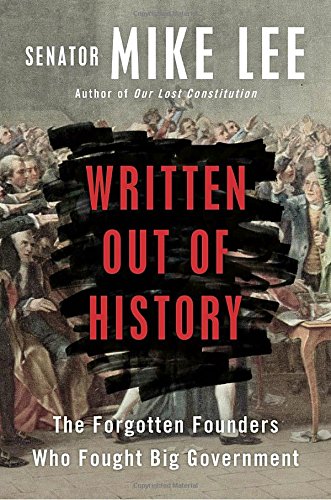
An Official Statement shouldn't have to include a book link...but a correspondent shared one that seems apropos. Adam Brandon wants us to remind all readers, once again, that Senator Mike Lee recently published a positive statement about "conservative" demographic diversity that should be available at your local bookstores. Note the diversity of the people in whose biographies Senator Lee highlights "conservative" values:
Friday, May 12, 2017

Book Review: Stories and Prose Poems

Title: Stories and Prose Poems


Author: Alexander Solzhenitsyn

Translator: Michael Glenny

Date: 1970 (Germany), 1971 (U.S.)

Publisher: Luchterhand Verlag (German), Farrar Straus & Giroux (U.S.)

ISBN: none

Length: 267 pages

Quote: “So, he thought, we’ve got to start all over again. Gather all nine hundred of them and explain: we haven’t got a building.”

In the Cold War era Alexander (or Aleksandr) Solzhenitsyn, combat veteran, cancer survivor, political prisoner, and eventual defector to the United States, was to the Soviet Union something like what the prophets were to ancient Israel:

(1) He believed in the stated goals of his country’s leaders.

(2) He told them what he saw that they were and were not doing toward achieving those goals.

(3) As a reward he was always controversial and was eventually banished from his native country.

When he came to the U.S. he told us what he saw here, too, and lost a lot of his fans. Careless readers, who wanted to like him just because he was too honest to fit well into a totalitarian state, had not realized that Soviet Socialism had been accepted because it appealed to the moral sense of sensitive, intelligent people. Socialism is the philosophy of the Deadly Sin of Envy. Nevertheless, people with a healthy conscience don’t want to hoard wealth while others are unable to earn livings, to bicker over dead friends’ belongings, to receive even earned benefits that are withheld from someone else who earned similar or better ones. Solzhenitsyn “converted” to the belief that more individual freedom is better than more totalitarian control; people who had really read his books wouldn’t have expected him to “convert” to any belief that “greed is good.”

I was too young to appreciate Solzhenitsyn during his lifetime. I’ve enjoyed discovering his work as an adult. Not many writers succeed in making short stories interesting to me. Solzhenitsyn does. In six long and sixteen short pieces, in this book, he illuminates the internal conflict between ideal and practice.

Not one of these stories is about sex or romance, although some of the characters are coupled. Not one is violent, although some of the characters die. All of them are about morality, although they can hardly be called moralistic. “Matryona’s House” is about a hardworking old woman and her greedy relatives. “For the Good of the Cause” is about teenagers who are bored with school generally, but enthusiastic about building their own vocational school—until the bureaucracy shuts it down. “The Easter Procession” and some of the shorter stories are about the persistence of Christianity in an atheistic state. “Akhar the Pouch” is about a cranky old park warden who earns respect from smart young travellers. “The Right Hand” is about a disabled veteran waiting to be admitted to a hospital. “An Incident at Krechetovka Station” is a war story about a spy. The short pieces are descriptions that convey a wonderful sense of topophilia, among other things.

Page 247 was the point where the author vividly reminded me of my father. “[W]e men will soon be flying to Venus…Yet, with all our atomic might, we shall never—never!—be able to make this feeble speck of a yellow duckling.” As I remembered Dad saying, sooner or later in any conversation about science, things like “Scientists may fly to the moon and back, but they can’t make a blade of grass grow,” it occurred to me that this is what fiction does for humankind. Fiction writers may or may not succeed in portraying other people the way those people really were; they can hardly help portraying people the way writers are.

The Cold War was primarily a trade war. We, humankind, can hope that there’ll always be some question whether we, the U.S. and the U.S.S.R., really could have destroyed the whole planet ten times over, or more, or fewer. Nevertheless at the time most of us took the Cold War seriously. “Can you trust the Russians?” was a serious question to anyone who thought it might be a good idea to stop building nuclear bombs, which I did, and also a cliché, a joke; I heard a good bit of it after someone noticed that a shelter cat I’d fostered for a few weeks had the look, and probably some of the same DNA, as the breed of cats called “Russian Blue”—ah, Dusty dushka, she could always be trusted to behave exactly like a normal cat who was only a little bit cleverer than most.For some of us, Solzhenitsyn’s ability to communicate that sense of wonder, reverence for life, respect for quirky old people, was a badly needed reminder that those “godless Communists” were human beings with a full range of noble and venal motives for the things they were doing.

That is widely considered to be the benefit fiction offers to humankind. So, this old book contains some of the twentieth century’s best fiction. It's not a Fair Trade Book (the author has no further use for a dollar) but it's available here on our usual terms: $5 per book, $5 per package, $1 per online payment, and as usual you can order as many books as will fit into one package for one $5 shipping charge.

Thursday, July 14, 2016

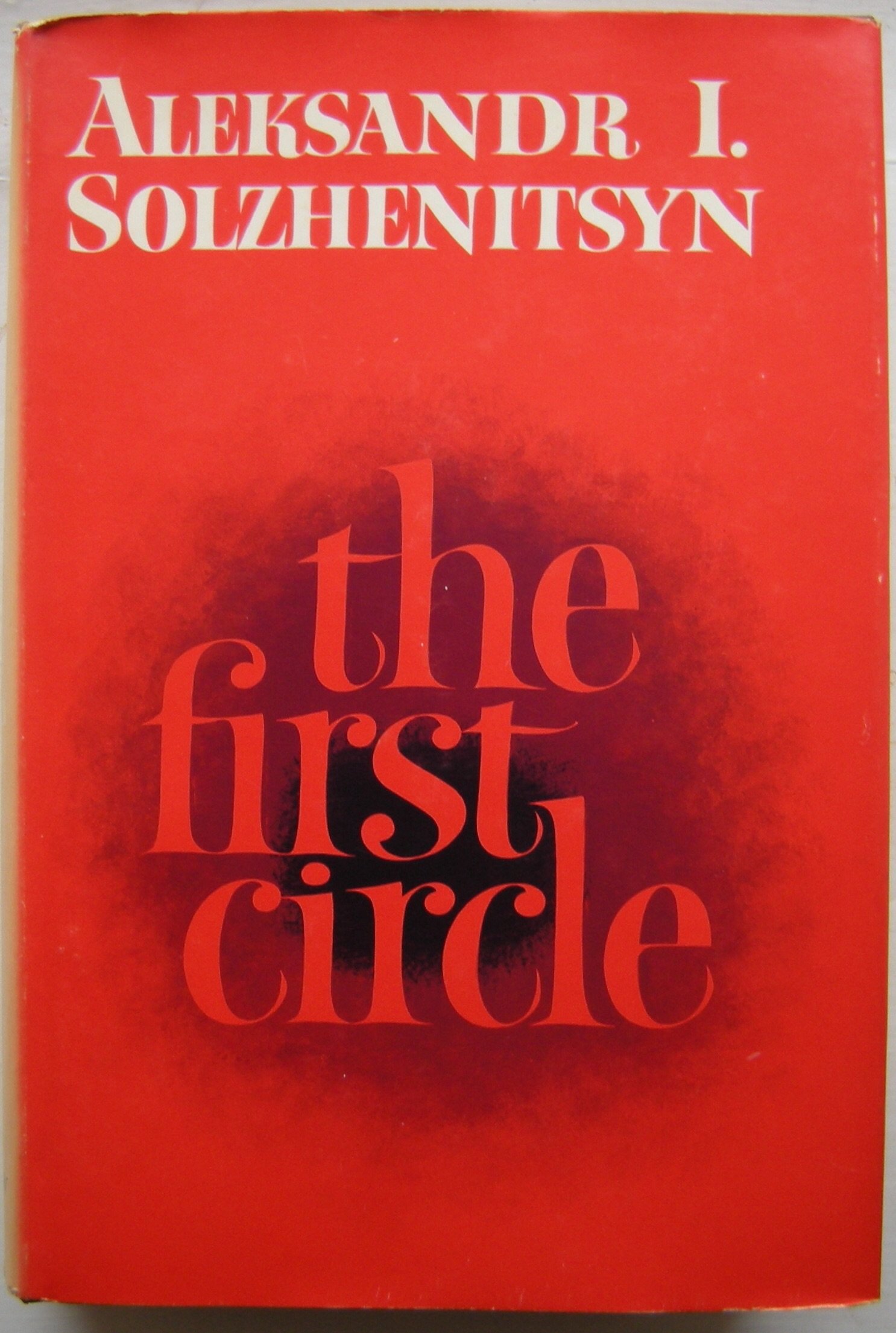
Book Review: The First Circle

Happy Bastille Day! Today's book review needs to be either French or about prison...what do I have ready to post? I have a book about a prison...


Title: The First Circle

Author: Aleksandr Solzhenitsyn

Date: 1968

Publisher: Harper & Row

ISBN: none

Length: 580 pages

Quote: “We have mathematicians, physicists, chemists, radio engineers…”

In Dante’s Inferno, the “first circle” is the level of relatively mild punishment. Solzhenitsyn uses this as a metaphoric name for a place where highly educated people with valuable talents work under close supervision by the old Soviet government. They’re not free; their contact with friends and family is limited to short supervised visits, and they can always be sent to more unpleasant places—but, apart from that, in many ways their prison resembles the offices where they used to work. They pursue their professional interests, form alliances with one another or the opposite, help each other or stab each other in the back in a strictly professional sense, just like co-workers in a corporation.

The First Circle is thus an almost sex-free, almost violence-free, strictly humanistic study of the relationships among a lot of men who might be described as yuppie-types, or even geeks, rather than convicts in the ordinary sense. They may or may not have shown any real disloyalty to the Soviet State. None is violent; none wants any further trouble. Mostly they seem in agreement to avoid agitating themselves by thinking or talking, more than they can help, about the women they will seldom if ever be allowed to see (no emotion!) or the men whose treachery or carelessness has put them where they are.

Their story does have some trace of a plot, in the sense that some will be released and some busted down to a lower level in the prison system, and research will be carried out and used in a way none of the prisoners would approve, but mostly it’s a character study, like Cancer Ward only broader. The blurb on the jacket designates Gleb Nerzhin, age 31, as “the hero,” possibly in a tragic sense; his story ends without triumph, unless we count his "triumph" in rejecting the favors of a female prison employee and pledging loyalty to his faithful wife. The third person omniscient viewpoint gives us glimpses of all the prisoners’ consciousness, and of a fictional Stalin’s, in turns. The purpose of The First Circle seems to be primarily to tell people that this kind of “prison” exists, and show readers what being inside one is like. Solzhenitsyn knew; the rest of us can only take his word.

To readers in search of light entertainment it’s probably true that all realistic stories about prison are too long. Imprisonment is the loss of the imprisoned people’s time. To the extent that a writer communicates their experience, the reader is aware of a loss of time. Many readers of fiction feel that their time is being lost, at least in the sense of having been sold to an employer on a less than thrilling job, and may not mind if the way they pass this time involves reading about characters whose time is being lost in even more unpleasant ways.

Solzhenitsyn’s talent, even in translation, is to give readers an illusion that they’ve spent that lost time getting to know interesting people. Quite a lot of them. I wouldn’t go so far as to call them “unforgettable,” because in between the day I finished the novel and the day I picked it up again to write this review I’d forgotten all of their names. (Even Innokenty, whose name does indeed mean “innocent,” whom the others are unknowingly helping to prosecute for the crime of warning a colleague that sharing a medical advance with French contacts may become dangerous. Somehow I feel that I really ought to have remembered Innokenty.) But, as in Cancer Ward, each one was interesting enough to keep me reading this long book. 


Since Solzhenitsyn no longer needs $1 from the $5 per book + $5 per package this web site has to charge, you might as well know that Harry Willets has co-authored a new edition called In the First Circle, which purports to be "the first uncensored edition" of this story in English. If you want to compare the two, or to own the first English edition, send payment to either address at the very bottom of the screen. (The seller who uploaded that photo to Amazon is currently listing the book as "unavailable," so although copies aren't even expensive on Amazon, we may be buying them from someone other than our photographer. I think the photographer still gets a commission, as do I, if you use the photo link to buy directly from Amazon. I could be wrong.)

Monday, February 29, 2016

Book Review: Cancer Ward

(Reclaimed from Blogjob. Tags: 1950’scensorship and literatureeffects of totalitarian government on cancer survivorsexperimental treatments for cancer in fictionhormone therapy for cancer in fictionnovels about cancer survivorsradiation therapy for cancer in fictionsexual effects of cancer treatmentsexuality of middle-aged adultssincerity in fiction,Union of Soviet Socialist Republics.)

Title: Cancer Ward 
Author: Alexander Solzhenitsyn (also spelled Alexandr, Aleksandr, etc.)
Date: 1968
Publisher: Farrar Straus Giroux (1969), Random House (1983), and other editions
ISBN: 0-394-60499-7 (Random House Modern Library, the one I'm looking at as I type)
Length: 536 pages
Quote: "But affairs of state did not succeed in diverting him or cheering him up either. There was a stabbing pain under his neck."
Rakovyi Korpus, soon to be translated as Cancer Ward, might have been considered an undistinguished novel if it hadn't got Solzhenitsyn into so much trouble with the thin-skinned Soviet authorities. It contrasts two cancer patients, a "successful" civil servant, husband and father, Rusanov, and a young, tough prisoner, Kostoglotov, who don't like each other much, as they endure treatment and achieve remission.
A lot of suffering goes on. Anyone who's spent time on a real cancer ward will recognize that the suffering has been considerably toned down just to make their story readable. Body parts, body fluids, painful symptoms and treatments, are mentioned liberally, but in nothing like the proportion to ideas, feelings, and stories in which they're mentioned in a real hospital. We see characters sick, crying, delirious; we don't see them howling in agony, or dying, as might be expected in a real hospital. What makes this a novel is that they have ideas, and families, and future plans.
What made it a controversial novel is that, although they're good patriotic citizens of the Soviet Union, they are...human. Rusanov thinks his position in the government ought to entitle him to better service than others get, or than he gets, even while he's living in fear that a past political mistake may be exposed. Other characters have been "exiled" or imprisoned merely because they belonged to ethnic minority groups. All the characters are loyal Soviets, yet the Soviet system isn't serving any of them really well.
"Telling the people the truth doesn't mean telling them the bad things," proclaims Alla, the "smart" daughter whose visit cheers the ward for an hour. "Where does this false demand for so-called harsh truth come from?...Our literature ought to be wholly festive."
Of course this is not the most encouraging thing Alla has come to tell the patients; what she says that really lifts her father's spirits has been more private--"It's out of the question to get someone on a charge of giving false evidence now. Rodichev won't utter a squeak."
Solzhenitsyn was, like his characters, a good patriotic Soviet at the time of writing, but he wasn't Alla. He seems to have more sympathy with the young man Alla is shouting down with her speech about making literature "wholly festive." Domka, like his author, prefers "sincerity." It's impossible to read Cancer Ward without feeling a sense of the author's sincere compassion...and yet, how could he express that compassion without showing how the totalitarian government made Alla the liar and her father the coward they are?
And what about the end of the story? "The hero renounces life," one critic summed it up, but does he? Does he really, necessarily, even renounce love? I can't claim to understand the novel better than readers of the author's own nationality and generation, but must it be understood as hopelessly as the critic Kerbabaev claims? Solzhenitsyn said it was a story in which "life conquers death." He never says straight out, "With just a little liberalization of government policy, Oleg and Vera could marry." He may not have meant to say that...but it's what his story brings to this American reader's mind.
That it aroused opposition in the U.S.S.R. naturally gave Cancer Ward, and Ivan Denisovich also, an audience in the English-speaking countries. Not only was it translated into English in the year of publication; the English translation was even rushed to press in parts, so that, although the novel fits into one average-sized volume, it's been printed as a two-volume set. At the same time, the mere fact that a book was allowed to filter through the "Iron Curtain" made it somewhat suspect. Cancer Ward was in print, and was in some public libraries, when I was growing up; it wasn't a huge seller, nor can I remember anyone ever suggesting that I ought to read it--nor did I read it before age fifty.
So, who should read it? Mature adults only, for sure. I wouldn't have liked or appreciated it even at thirty-nine--before becoming a cancer widow. It's not at all a bawdy story, and yet the possibility of a "life conquers death" reading depends on the reader's understanding of middle-aged sexuality. Teenagers (how old was Kerbabaev?) just won't understand. Additionally, as stories about cancer wards go, this one is clean, wholesome, and hopeful, but you have to have spent time in a cancer ward to see that.
Now a note on prices and editions. At the top of this review I've pasted two graphics. One (bigger picture, smaller book) shows a cheap paperback edition that's likely to be available indefinitely at prices that allow me to offer it for $5 per copy + $5 per package + $1 per online payment. The other shows a much nicer library edition, which is the one I physically own at the time of writing; if online shoppers want this or another "nice" hardcover copy, I may have to charge $10 per copy. Solzhenitsyn no longer has any use for either $1 or $1.50, so if you can find a better price for this book, feel free to buy something else from this web site.

Wednesday, June 24, 2015

Book Review: Short Novels (L. Tolstoy)

Title: Short Novels

Author: Leo Tolstoy

Editor: Ernest J. Simmons

Publisher: Random House

Date: 1965

ISBN: none

Length: 455 pages

Quote: “Early in the nineteenth century, when there were as yet no railways or macadamized roads, no gaslight, no stearine candles, no low couches with sprung cushions...”

Late in the nineteenth century, the Count Leo Tolstoy wrote a short novel contrasting two military officers, father and son. Although the father behaved badly, he was bold and generous, and people in the small town he disrupted liked him. The son was petty and greedy, and so, although in some ways he might have been said to do less harm...Simmons tells us that Tolstoy “noted a friend's remark that the son is described without love” and commented in his notebook, “The first condition of an author's popularity...is the love with which he treats all his characters.”

He probably found it easier to love the main character in his next short novel about "modern" nineteenth century Russia, Landlord's Morning, in which the young heir to an estate tries to improve the lot of the people who work on his land. Tolstoy had tried doing that himself.

A later story, Polikushka, discusses the trouble that starts when a rather shabby character really tries to do a job right, and fails.

This was followed by Family Happiness, a male-fantasy romance in which a seventeen-year-old girl falls in love with an older man. After a happy honeymoon, they realize that they are not actually compatible. The husband, however, is mature and philosophical, at about forty years old, and counsels his bride that if they've lost passionate love they can at least devote themselves to the baby and enjoy peaceful family-type love. Simmons does not consider this solution “false...to the reality of things.” It may not be altogether false, but readers who have observed the behavior of forty-year-old men will agree that it's certainly unusual, and readers who've studied the collected diaries of Sophie Tolstoy may judge how true or false Leo Tolstoy's hopeful fiction was to his real experience.

The longest of the Short Novels is called The Cossacks. Tolstoy had lived among “Cossacks” while serving in the Russian army, and his Short Novel about this ethnic group seems to me to be a long rambling reminiscence about, among other things, a beautiful girl with an unaccountable taste for stupid men and a likable old heretic who tries to lead a pious young Russian soldier into sin (“Where's the sin? A sin to look at a nice girl? A sin to have some fun with her?”). Simmons explains it as a draft of a never-finished longer novel. Despite its rambling quality, Simmons also claims that Turgenev hailed The Cossacks as “the best story that has been written in our language.”

Again I say: although a great quantity of fiction was thrust upon me recently, and this collection of Short Novels is high-quality fiction I'm not ashamed to resell, I myself seldom actually like fiction. The Short Novels didn't exactly thrill or delight or inspire me. Few novels written for adults do, and it's possible that one or more of Tolstoy's Short Novels will become a favorite of yours. 

As regular readers undoubtedly know, during and after his lifetime Leo Tolstoy was hailed as one of the world's great writers. Some believe the art of fiction has made progress since then. Others think his fiction may have been overrated because he (and his wife) were interesting people, and the progressive, innovative quality of their life made their work seem more interesting than it would otherwise have been. All I'll say is that Tolstoy's fiction undoubtedly suffers from translation and from being so exotic, to me, that whatever realistic merit it once had is lost. 

On checking Amazon, I find that this edition of these five novelettes has gained collector value. To buy it here will cost $10 + $5 shipping...and, since neither of the Tolstoys has any use for $1.50, it won't even be used to encourage another living author. Only me. However, shipping prices can be consolidated on multiple purchases so you could add this book to a package including a Fair Trade Book and consider the shipping free. Current addresses for Paypal or postal money orders appear at the very bottom of the screen.

Thursday, October 16, 2014

Shot Across the Newspapers' Bows (Web Site Bashes a Popular Fallacy)

(Yes, this was originally written in the first week of January. The scarcity of public-access computers that can read floppy disks creates a long turnaround time for what I write with the intention of posting.)

Although this web site does have an official Disaster Relief Theme and has often mentioned places where prayers, and extra cash, will be welcome, we’ve not discussed every natural disaster...In 2013, in Russia, over a thousand deaths were attributed to a collision between Earth and a meteorite.

Most of the “falling stars” in the sky burn to nothing recognizable or, if they do touch Earth, are reduced to small fragments of molten mineral matter. Every few hundred years we see a meteorite big enough to demolish a farm. Oregon’s Crater Lake is credited to one of these phenomena. No history of human fatalities is associated with Crater Lake; apparently, at the time the meteor struck, Oregon enjoyed a very low, very sparse human population. But yes, it could happen here.

A newspaper article, apparently inspired by the phrase “Act of God” that describes this kind of rare, bizarre natural disaster, described the meteor as “a shot across the bows of a nation that had outlawed belief in God.” I probably wouldn't have noticed this throwaway line if some reader hadn't sent the newspaper a verbal "bouquet" for printing it. Right. It needs a verbal brickbat.

Harrumph. The nation that outlawed Christianity was the bad old Soviet Union, in the bad old Cold War days when they were trying to prop up the toppling dogma of Marxism by taking over small countries. Russia’s experiment with atheism was especially poignant because Russia is the home of so many quaintly beautiful old churches, churches designed to make people want to pray, and now people are reportedly praying in those churches again. The current administration has been criticized for being too supportive of the Russian Orthodox Church.

Did this meteorite manage to crash on top of an atheist activists’ convention, or did it, like most natural disasters, affect Christians, Jews, Muslims, Pagans, and atheists impartially? Would anybody actually know that?

Even if a natural disaster affected only an atheists’ convention, how would we know whether some people at the convention were sensitive Christian souls going through periods of doubt...C.S. Lewis called himself an atheist for a few years. Madeleine L’Engle admitted to atheist and agnostic phases. Scott Peck did. The long line of Christian writers and teachers who’ve gone through atheist phases stretches back past St. Augustine, arguably all the way to St. Paul, who didn’t consciously call himself an atheist but denied his faith in God by his works before he became a Christian. And if the best Christian writers, the “Doctors of the Church,” have had atheist phases, then how are we to judge twelve hundred souls, none of whom we’ve ever met? How do we know whether some other saint, perhaps not a writer but a great doctor or a noble foster parent or an honorable storekeeper, was among those twelve hundred?

When it affects an entire town...most cities and towns these days contain a mixture of Christians, atheists, and others, but Russian Christians’ faith is special because it’s survived almost a hundred years of active persecution. By all reports even the Soviets didn’t outlaw belief in God; they merely outlawed evangelism and implemented policies of active socioeconomic discrimination against Christians—good jobs went to Communist Party members, who had of course identified themselves as atheists. Still, the faith of Russian Christians, and likewise Jews and Muslims, deserves admiration from believers who have never faced even overt discrimination for their faith.

If God arranges for meteors to hit apostate Christian nations, it’s strange that God waited so long after Russia reconciled itself with its Church Militant, stopped desecrating the old church buildings, and resumed praying in them. It’s even stranger that the meteor didn’t hit China, which was never a Christian nation and actively tried to suppress Christian displays by visiting athletes and spectators during the Olympics. And it’s downright bizarre that the meteor didn’t hit these United States, where Christianity has picked up political accretions, and left-wing Christians creep and whimper and apologize for whatever faith they actually have, while right-wing Christians attach God’s name to hatespews about people deserving, because of their ancestors' mistakes, to be homeless, hungry, maimed, or dead; God must feel mocked and blasphemed by both factions. 

Thursday, March 21, 2013

Cool Dance Video

Thanks to Elizabeth Barrette for sharing this cool, family-friendly dance video (hey, it worked on this computer, so it may work for yours too):

http://www.youtube.com/watch?feature=player_embedded&v=LP3w-oJjH8I

I think what I like about this one is that the actual dance moves are easy; if you made this type of costumes for an elementary school drill team or Scout troop, they could do the dance.

Wednesday, January 9, 2013

Gina Loudon on International Adoption

Dr. Gina Loudon of Politichicks.tv shares her experience with international adoption and, specifically, U.S. citizens who've adopted Russian children:

http://politichicks.tv/column/dr-gina-tours-putins-russian-gulags-aka-orphanages/

Check out the comments. Apparently these were extremely sick children. The parents who didn't get to adopt them may be luckier than they know.

If anybody's interested in discussing this story further, there's a lot we don't know, and the comment section is open. I'm particularly curious about you Russian readers. Who are you, and what are you getting out of a web site that's mostly about U.S. domestic politics? Are any of you by chance social workers, and can you tell us more about homeless children and their needs? Beyond the obvious fact that colder, darker winters produce more "Seasonal Affective Disorder" and aggravate any physical tendency to alcoholism that individuals may have, would you like to add anything else to what Cold War survivors are saying about Russia at the Politichicks page?

Where should the finger of blame be pointed next? This web site points at the adoption agencies that have slurped up these baby-craving parents' money and given them nothing but a lot of hassle "verifying" their fitness to adopt. We are not generally fond of middlemen, and we think adoption agencies are a particularly unlovable kind of middlemen. I'd like to see the agencies donate all that money toward the goal of finding treatment for the Russian children in their own communities--send doctors to their own part of Russia, these agencies have collected enough money for that--and donate their time toward the goal of finding children, not necessarily "White Newborns," for the parents who really want children.

This web site also reminds parents and would-be-parents who have seen pictures of adorable Russian children, flowing blond hair and all, that nobody has to go halfway around the planet to find an adorable, adoptable child. If you're willing to change your prejudices against children who've lived long enough to form personalities of their own, you can probably even find a blond child. Or children--it's usually easy to find adoptable sibling groups. If you're willing to forget about that "newborn" business, you can even find healthy blue-eyed blond children, right in your own city or county.

In Washington, D.C., according to Blaze readers you can still find a local TV program that introduces one child (or sibling group) per week to all the would-be-parents out there, every Wednesday morning. There are that many. Actually, there are more; "Wednesday's Children" presents a very small, select sample of the homeless children in the D.C. metropolitan area. I used to think they picked the most adorable ones, but that was before I met my adoptive sister.

Are you concerned that older children might have a higher risk of behavior problems? There's a way to find out how well you will get along with a child before you commit to adoption. Be a foster family first. You get some choice about gender, physical type, and any known problems before you even meet a child, and you and the child get extra time to decide whether you want to adopt one another or not.

Of course poorer countries tend to have less luxurious facilities for child welfare services, and there are things we can do about that, too. There are international charities that specialize in helping orphans overseas. Although www.volunteeroverseas.org has researched organizations that place volunteers more closely than organizations that merely collect material resources, it's a reliable guide to organizations that are actually doing some good in the places where they say they're working. If you are especially interested in Russia or in some other country, volunteeroverseas.org is a good place to begin looking for ways to help needy children.

Tuesday, January 8, 2013

About Russian-American Adoptions: Apologies...

Gentle Readers, the Politichicks sent a very relevant (although distressing) discussion of the problems that have produced that ban on U.S. citizens adopting Russian children. I planned to post links and comments yesterday. Unfortunately, I stored that whole post on that dear little laptop computer you've been reading about. Now Yahoo's innovations seem not only to be clogging up this computer, but allowing e-mail to be hacked--I received, and her other e-friends seem to have received, a bit of spam in Grandma Bonnie Peters' name yesterday. I called GBP, and she had no idea where it might have come from. Now I'm worried. I don't want to run Yahoo on the laptop until this is cleared up. I don't want to bring out the laptop and be tempted to open Yahoo, because a hacker might be able to damage the laptop. So...I'll have to take another half-hour to dig back through the e-mail itself in order to do a whole new version of the article with the Politichicks links in it. Dang.

(For those who've wondered, "dang" does not actually derive from an English swearword, although its popularity is probably due to its sounding like one. "Dang" is the English phonetic spelling of the French word dingue, which has a different origin and precise meaning, but is used as a French equivalent of, and is thus an English euphemism for, "crazy." Which is about the most obnoxious word Southern Ladies of my generation were allowed to learn as children. So it fits.)

Sunday, January 6, 2013

Jail Time for Offending Religious Feelings?

In Russia, even the Patriarch of the Orthodox Church thinks an official backlash against official atheism may be going too far:

http://news.yahoo.com/russias-church-urges-kremlim-restraint-religious-law-160750909.html

Should anyone really have the right to demand that their government do anything about their "offended feelings"? (Or anyone else, for that matter?) Shouldn't the legal remedy for "offended feelings" be something like "I'm so sorry, what a pity, you poor dear"?

That doesn't mean that individuals can't offer personal, emotional payback for their "offended feelings." For example, if youall found it easier to post comments on this site--which I hope to make possible--and this ease tempted someone out there to post obnoxious troll comments like some of the hatespews I've seen on Yahoo News and The Blaze, my recourse would be to pull down the offending comments, and yours would be to complain about the ones that offended you more than they did me. But...jail terms? For basic obnoxiousness? Mercy.