From U.S. Representative H. Morgan Griffith (R-VA-9):
"
The
coronavirus outbreak has upended many of the ways we go about our lives.
As a Member of Congress, I believe it must not alter the essential duty
I was elected to perform: voting in person on legislation.
To be sure, many of the regular practices of my job have already changed.
When
I am not in Washington for votes, hearings, and meetings, I would
usually be traveling across the Ninth Congressional District to attend
constituent meetings, events, and other responsibilities. I am still
meeting with constituents, but by video or telephone conferencing now. I
use these tools to confer with other Members of Congress and Trump
Administration officials as well.
But changing the way voting on legislation is done raises serious concerns.
The
House Democrat majority recently put forward a plan for a remote quorum
and remote voting by proxy, and then shelved it. I am glad they did so.
This
plan called for proxy voting on the House floor during a pandemic
emergency period, in which a representative could submit a signed letter
to the House clerk authorizing another representative to vote in his or
her place as directed.
Other
suggestions have incorporated technology to allow for remote voting.
While I believe that technological innovation can solve many of our
problems, this is not one of them.
Remote
voting would possibly conflict with the Constitution, which requires a
quorum to do business. There is no pandemic emergency exception to our
oath of office to support and defend the Constitution.
Remote voting proposals are also out of line with our history.
The United States has faced many challenges and periods of difficulty in the past, yet Congress still met.
If
anyone might have benefited from proxy voting in our history, it would
have been Caesar Rodney, a representative of Delaware in the Second
Continental Congress. Rodney was plagued by ill health, including gout,
asthma, and a terminal cancerous growth on his face, and on July 1, 1776
was in Dover. But when he learned he was needed in Philadelphia to
break the tie in the Delaware delegation on the question of independence
from Britain, he rode by horseback through a stormy night to cast his
vote on July 2 in favor of independence.
Congress
met during the Civil War, even with Confederate territory directly
across the Potomac. At nights, planks on some of the bridges that
spanned the river were removed to foil raiders such as John Singleton
Mosby, the “Gray Ghost.” At several points in the war, Confederate
armies threatened to fall on the capital. But the work went on.
Even
in the 1918 influenza epidemic, Congress met, although at times it
lacked a quorum and so was not able to conduct business. Telephones
existed, but nobody proposed that Congress just phone in votes.
Circumstances
of grave danger and hardship did not put a long-term halt to
congressional activity before, and I believe we can meet this challenge,
too.
Beyond
fulfilling our constitutional obligations, the legislative process
depends on face-to-face personal interaction. We can be separated by six
feet and wear masks, but this interaction is still essential.
In
Washington, voting is one of the few occasions that brings everyone
together. We ask for support on one another’s bills, exchange
information, talk about families, friends, and hobbies, and build the
relationships that ultimately help move the process forward.
Additionally,
being present when big questions are raised can clarify, persuade, and
inspire. Patrick Henry’s “Give me liberty or give me death!” speech
would not have the impact it did if he spoke in an empty room or sent it
to be read.
I
have heard numerous speeches or arguments during my service that shaped
my thinking on an issue. Of those, I particularly remember an
impassioned speech by then-Delegate Kenny Melvin, a Democrat. His speech
took what was expected to be a close vote and turned it into a 97-3
proposition. I was not the only one whose mind was changed. Remote
voting would have hindered or entirely obstructed these occasions.
The
Virginia House of Delegates recently considered an even broader remote
voting proposal and fortunately rejected it. Apparently, enough of them
recalled the power of live, in-person speeches like Henry’s at St.
John’s Church just a few blocks away.
The
coronavirus outbreak has called for changes in our behavior, and some
of these can be implemented in Congress without significantly
interfering with our work. But the most essential task, voting, must be done in person.
If
you have questions, concerns, or comments, feel free to contact my
office. You can call my Abingdon office at 276-525-1405, my
Christiansburg office at 540-381-5671, or my Washington office at
202-225-3861. To reach my office via email, please visit my website at www.morgangriffith.house.gov.
"
Editorial comment: It's interesting that, even within the same culture, humans learn to communicate in different ways. In cyberspace, I know there's a whole subculture of word people who prefer to conduct meetings and even socialize with friends by telephone...and for us the idea of video-phones, though potentially useful in some situations, is a non-starter. ("Even on the phone, people would be saying 'Oh your face twitched, what does that mean? It has to be something about me!' No way," we say, or "Even on the phone, I get to say unforgivable things and claim they were jokes because I pulled my face a certain way? Is that something other people want?" Though the face-to-face stuff may be useful in conversations with people who use it intelligently, and even exciting with people we find especially attractive, it's easily replaced by the sound of the voice in phone conversations.) We are a minority, and I'm not sure to what extent the word-thinking minority overlaps with the not-nearly-so-much-a-minority of introverts. We also tended to be the people who earned the top grades at school, which is sometimes confused with the much broader category of people who are generally intelligent.
Making all communication electronic could give us the chance to demand that all communication be done our way. And I'm sure Congressman Griffith is only one of the most articulate of the masses of people who would hate that...
As a word-nerd reading this e-mail I initially thought, "A little practice in the school radio lab would have taken care of that reaction." Then I thought, "No. I liked the 'Read the Bills Act' that's been a primary issue for our e-friend Jim Babka. Bills presented in Congress should stick to one topic, and it should be possible for the sponsors of those bills to read them in one day, so that they can be debated and voted on intelligently. We need no more idiocies like poor old Nancy Pelosi blurting out 'We've got to pass [this bloated rambling mess of a bill] to find out what's in it!' We need to know that in order for a bill to become a law, every word of it has been read and heard, if not by every one of us at least by people we trust." In order for that to happen, the members of Congress have to be able to communicate with one another, as well as with their constituents, in the way that works for them.
Have you received those messages notifying you that your totally video-free cell phone will stop working? (All these years I've thought cell phones were a valuable safety device, but yes, I can live without one.) What about the e-mails warning of an effort to shut down the U.S. Postal Service? There are people who want to be able not only to overhear conversations that don't involve them, but to watch those conversations. They want to force all communication to be done their way.
The Seventh-Day Adventists have long been saying that the biblical book of Daniel foretells that the United States will eventually become the most oppressive tyranny on Earth and will destroy life as we know it (but that's okay, because that's when Jesus will literally swoop down out of the clouds and reclaim the Earth). Sort of a Left Behind scenario, yes, only they say most of the Christians will be on Earth to suffer through it.
What the book of Daniel plainly says is that even its author didn't know exactly what was going to happen. I have never accepted or rejected any interpretation of the book of Daniel. When I attended a Seventh-Day Adventist school and church I was asked, not officially but by classmates who worried about this, to choose my fellow cave dwellers in the event that religious persecution forces us to hide in caves. I used to think that whole scenario was far-fetched and mainly useful as a plot line for science fiction that was mostly not as well written as Left Behind; recent events are making it seem much more probable than it used to seem.
Monday, April 27, 2020
Friday, April 17, 2020
Status Update: No Market This Friday
That there's no Friday Market this Friday totally bites. Last Friday was a major religious holiday, and on previous Fridays the weather was inconvenient, but this Friday, with the fantastic view of slowly greening hardwoods and clouds of dogwood and pink blushes of redbud, and the bright sunshine, and the first few irises beginning to bloom as the forsythia and Prunus fade...
It'll be worth the inconvenience if we all learn the right lesson, Gentle Readers.
Years ago, this web site quoted a cookbook writer who said that scallops became the emblem of medieval pilgrims (who were accustomed to eating other things) because on the way to the shrine of St. James of Compostela they used to eat scallops as a penance, and "I wish somebody would make me do the penance of eating Coquilles St Jacques"!
My townsfolk who are being forced to take an unplanned, unwanted spring break are lucky in a way. They are--I see and hear them, as I walk through town, maintaining a good healthy distance from them--they are spring-cleaning and grilling and working on projects and playing with their children and dogs and generally having fun. Apart from the alarming circular winds we caught off the edge of that tornado when it hit Chattanooga, the weather here in Gate City has been absolutely perfect for staying at home. If you ever wished someone would make you do the penance of admiring flowers on the prettiest days of spring, that's what my townsfolk are now "suffering" through. They're complaining like good fellows because they're losing money, but they are having fun.
This is American readers' first experience of full-bore totalitarian socialism. We've been living with various "socialized" schemes for handling this and that--unsustainable, and often unsatisfactory, and badly in need of revision, but they've not ruined us yet. Now some people want us to have a little tempting taste of having Big Government tell us where we can go, what we can buy and sell, when we can go to religious services, whom we can visit, and when it's convenient for Big Government to send everybody a handout check that, though it'd be a big pay raise for me, represents a terrible loss for a lot of people.
I'm looking forward to that check, too--not as a future lifestyle option, but as punitive damages.
I think the general idea of quarantine is a good one, and the 66% to 75% of poll respondents who say it's too soon to lift the quarantine have a point.
I think government went wrong by trying to order everybody to observe quarantine in lockstep, without regard to individuals' situations. I think Big Government always has gone wrong, when it's tried to impose top-down mandates on people for their own good, and it always will go wrong--for this reason. People's risks and concerns vary.
People have died, are dying, are going to die, from coronavirus and related pneumonia.
People have died, are dying, are going to die, from ordinary cold and flu virus and related pneumonia.
While one correspondent is bashing Dr. Fauci for not having called for a massive nationwide lockdown sooner, I'm remembering: All winter I've avoided visiting my own mother, or the cousin who baby-sat for us when my mother was young and hard-pressed. I've put off trying to arrange a car pool for the don't-say-it-but-this-could-be-the-last visit to each other that both of them wanted. I've even avoided riding with one car pool buddy, or speaking to her when I've seen her, because her father is old and frail too. Not even because of coronavirus; because of flu. I've been keeping a good healthy distance from people, not going to market on days when I would have gone in other years, wearing a shawl in temperatures when I would have left it at home in other years, running the heater at home when I didn't run it in other years, because of flu. I've not actually come down with flu myself--but I have felt it, and taken a few extra precautions with my own glyphosate-damaged body and extreme precautions with my elders.
So, meanwhile...Grandma Bonnie Peters distanced herself, socially and emotionally, from a lot of friends, fans, and relatives when she stopped driving and admitted she had pneumonia in 2015. Like the rest of us, I've seen her, chatted with her, almost like old times--but she's not made plans, with anybody, to do anything, so far as I can tell. When people have happened to catch her on a day when she felt willing to entertain or be entertained, she's been her old delightful self. When asked about plans for anything at all, she's been vague.
I talked to her on the phone a few days before the coronavirus panic. I thought, "Now, when everyone's over the flu, before the coronavirus gets here, is the time for a whole van load of these people to get together..." But somebody in Tennessee was still down with the flu that day, so the owner of the van didn't want to go out and let them have that don't-say-it's-the-last-time shopping trip together on the weekend before St. Patrick's Day--and then, although nobody in Virginia or Tennessee actually had the coronavirus, we were all ordered into quarantine. Because someone in New York was ill.
And where do you think GBP was on that Friday when the old friends weren't quite ready for the don't-say-it-might-be-the-last shopping run? Why, she was nursing her friend in Tennessee through the flu, that's where.
I've not been able to reach her since. The last few times I've not been able to reach her by phone, she's been ill. I don't expect she has coronavirus. I expect she has ordinary pneumonia from ordinary flu. And she might be walking to Wal-Mart again this summer, and she might die. And it will have been her own choice.
She always said she wanted to die with her boots on.
This is what I think we should all learn from the coronavirus panic: People have to claim the right, and take the responsibility, for their own choices about quarantines.
In my churchgoing youth, first as an undiagnosed celiac and even worse when I had mononucleosis, I was immune-compromised and really needed to maintain a good healthy distance from normal people--optimally, I shouldn't have been in church or school at all. But I thought the never-ending mono had to be "all in my mind," part of the "neurotic pattern" of being a creative introvert. I thought I was supposed to power through it. So I'd go to church when I wasn't ill enough to be sent home, and some horrible old bat or buzzard would flap up to me, coughing with their mouths wide open, "Oh, I've had this silly little cold that's going around too, what a bore, but I'm so-o-o glad to see you!" And they'd grab me. My skin would crawl from head to toe, and they'd grab me and pat me and breathe virus in my face, and by morning I'd be coughing and sneezing again.
Never mind that most of their virus had been "killed." Virus are only barely classifiable as lifeforms--it's not always possible to tell whether they are dead or alive--and immune-compromised people react to killed virus too, it seems. The sick old people at church would go home and feel better. I'd go home and feel worse. It was literally true that these "friendly greetings" on the way home from church services were draining the life out of me, for their apparent short-term benefit.
You couldn't have told me at that time that I needed to quit going to church. Later, when I saw that the emotional affection these people were literally drooling and spitting on everyone else was not going to grow into any motivation for any practical benefit to the people they "loved" so much, I came to that decision for myself--but at nineteen I loved my "church family" and would probably have made myself ill, or at least miserable, if I'd been ordered to stay home.
I lived. I learned. I learned that there's nothing "neurotic" about either creativity or introversion, or about keeping a good healthy distance from other people, either. I learned that when I stopped eating wheat, then until food processors started spraying glyphosate right on food and splicing genes from E. coli into food crops so the plants could be drenched in glyphosate, in 2009, I could be a normal healthy person. During those gluten-free-and-healthy years it might have been a neurotic habit to insist on keeping a healthy distance from everybody.
I didn't insist. I liked having the freedom to let children climb up me, let lonely old people lean on me, even let young men I dated kiss and cuddle at that stage of my life.
But then there was the summer...One of my writing clients used to stand right behind me and dictate. She had a silly little summer cold, one Tuesday. I had a silly little summer cold on the Thursday. My husband had it on the Saturday when he went upstate to give some respite time to the caretakers of a disabled child. On the Monday that child was taken to the hospital and diagnosed with staphylococcal pneumonia. She came home later that summer, but she never was strong enough to go to school that fall--and she liked school. I had knitted a purple sweater (she liked purple) for her birthday in November. My husband took it with him when he went upstate, then turned around, came home, and reported, "She's gone."
If it hadn't been my writing client's summer cold it would have been something else, we both knew...but I was more conscientious about avoiding anyone who seemed old or frail, when I had or had not noticed even the silliest of little summer colds, after that.
I think we should keep the social distance going until everyone has either recovered from coronavirus or died from it. I think some people's difficulty is that they don't know what social distance is. Standing six feet from another adult means, for most of us, that if you reach out and I reach out at the same time, by leaning forward just slightly we could choose to shake hands. Some people are actually standing ten or fifteen feet apart, which is all to the good for their health, and requires only a little more mindfulness about speaking and listening if they want to have a conversation.
I think we should let people make their own decision to stay home, work from home or not work, without prejudice if and when they come back to work (or school or church), whenever they may have been exposed to anything...bearing in mind that it is up to the immune-compromised to quarantine themselves. Nobody else can do it for them, even if we try. If you are one of the people who is likely to die from staphylococcal pneumonia six months after someone breathes on you, you need to be the one to decide your uncle should stay in the city and not bring any little summer colds into your home.
If you are immune-compromised and you want to go to school, go to work, play sports or go on dates like other people your age...you should probably be required to read "The Lady of Shalott" aloud, and reflect on it for a day or two, but if you then choose to mingle with friends, then the responsibility for shortening your life is yours entire and alone.
You cannot demand that healthy people not mingle with each other, and swap all those staph and strep and other bacteria, common cold and flu virus, and green mold organisms that are constantly and harmlessly present in their breath, because you have no resistance to these things.
Neither should anyone demand that you, as an immune-compromised person, mingle with others. No child should ever be sent to school when the child has a cold and wants to stay home. Nobody should ever feel that if he or she takes a day off work, he or she will not have a job the next day.
I don't think government should order people to go back to work this week. I don't think government should authorize employers to put any kind of pressure on anybody to go back to work. I think government should just back off, and let people go back to work when they and their employers and employees feel confident that none of them is likely to die from coronavirus, or to be unable to avoid transmitting the virus to a family member who is.
I think we should maintain and even expand respect for people's individual quarantines that they choose to observe after consultation with their doctors.
I think everybody should read Hiding Ezra and think about how haphazardly whole communities survived epidemic diseases for hundreds of years when people didn't understand how diseases spread. Plenty of communities didn't survive at all. In Europe we still know the names of the towns that were destroyed by plagues. In North America we've never put most of those towns on the maps.
We have a lot of young parents who are being forced to depend on unsustainable federal handouts to keep roofs over their children's heads. That's not right. Their being forced into that horrible position is not going to keep people from dying of coronavirus--or of ordinary viral pneumonia from last winter's ordinary flu. These working parents and their children are watching their lives collapse in order to protect them from what, when they inevitably get it, is going to be just another kind of chest cold. That's not right.
We have a lot of frail, sickly people who aren't going to be celebrating the Fourth of July this year, whether people have avoided visiting them all winter or avoid doing anything else at all this spring. Some of those people may live another year or another ten years, or a few of them may even live another fifty years, if they choose to observe strict quarantine now. Some of them aren't going to see the fireworks on this Fourth of July in any case. Some of them may choose to die of pneumonia now and be done with it rather than suffer through longer, nastier final illnessses.
To think that two and two are four, and neither five nor three, the heart of man has long been sore, and long will likely be.
Me? I'm middle-aged--in cyberspace I've always been part of the older generation, but in real life I'm only just starting to qualify for any kind of "seniority." I live high on a hill, above the town, where my grandfather and his siblings lived long healthy lives watching their friends die from Spanish Influenza and tuberculosis and this and that. I live much as they lived. Even the celiacs in Mother's family have shown the effects of the longevity gene. I expect that after exposure to coronavirus I'll do some coughing and sneezing, stay home in bed as long as I feel feverish and stay away from nervous people for another week or two, and then feel fit as a fiddle. As so many times before. I expect to lose a few elders to the virus. As so many times before--we are losing our older generation.
And if I'm wrong, well, I've lived in such a way as to look forward to joining most of my favorite people in the Good Place, which is what people should really be concerned about during any virus panic. I have another fifty or sixty years' worth of projects I'd like to finish before I die, but at fifty I've already lived longer than, probably, the majority of humans who've lived on Earth; I'm ready to go. As Grandma Bonnie Peters was--and still is, I suppose, not having heard that she's died. I'd like to be the home nurse people request when I'm 85, but that's for God to decide.
But I seriously do not expect, after reading what survivors say, that the coronavirus is going to be anywhere near as unpleasant for me as any of the glyphosate reactions our government is still allowing fools to inflict on me every few weeks. Maybe our government should be doing something about glyphosate reactions, which are caused by a voluntary human behavior our government could and should recognize as a crime. Our government should not be trying to do anything about virus, which are not subject to human control.
I think the federal government has contributed nothing good to people's efforts to avoid or survive any virus, and should not try to dictate what efforts people make in that direction, ever again.
It'll be worth the inconvenience if we all learn the right lesson, Gentle Readers.
Years ago, this web site quoted a cookbook writer who said that scallops became the emblem of medieval pilgrims (who were accustomed to eating other things) because on the way to the shrine of St. James of Compostela they used to eat scallops as a penance, and "I wish somebody would make me do the penance of eating Coquilles St Jacques"!
My townsfolk who are being forced to take an unplanned, unwanted spring break are lucky in a way. They are--I see and hear them, as I walk through town, maintaining a good healthy distance from them--they are spring-cleaning and grilling and working on projects and playing with their children and dogs and generally having fun. Apart from the alarming circular winds we caught off the edge of that tornado when it hit Chattanooga, the weather here in Gate City has been absolutely perfect for staying at home. If you ever wished someone would make you do the penance of admiring flowers on the prettiest days of spring, that's what my townsfolk are now "suffering" through. They're complaining like good fellows because they're losing money, but they are having fun.
This is American readers' first experience of full-bore totalitarian socialism. We've been living with various "socialized" schemes for handling this and that--unsustainable, and often unsatisfactory, and badly in need of revision, but they've not ruined us yet. Now some people want us to have a little tempting taste of having Big Government tell us where we can go, what we can buy and sell, when we can go to religious services, whom we can visit, and when it's convenient for Big Government to send everybody a handout check that, though it'd be a big pay raise for me, represents a terrible loss for a lot of people.
I'm looking forward to that check, too--not as a future lifestyle option, but as punitive damages.
I think the general idea of quarantine is a good one, and the 66% to 75% of poll respondents who say it's too soon to lift the quarantine have a point.
I think government went wrong by trying to order everybody to observe quarantine in lockstep, without regard to individuals' situations. I think Big Government always has gone wrong, when it's tried to impose top-down mandates on people for their own good, and it always will go wrong--for this reason. People's risks and concerns vary.
People have died, are dying, are going to die, from coronavirus and related pneumonia.
People have died, are dying, are going to die, from ordinary cold and flu virus and related pneumonia.
While one correspondent is bashing Dr. Fauci for not having called for a massive nationwide lockdown sooner, I'm remembering: All winter I've avoided visiting my own mother, or the cousin who baby-sat for us when my mother was young and hard-pressed. I've put off trying to arrange a car pool for the don't-say-it-but-this-could-be-the-last visit to each other that both of them wanted. I've even avoided riding with one car pool buddy, or speaking to her when I've seen her, because her father is old and frail too. Not even because of coronavirus; because of flu. I've been keeping a good healthy distance from people, not going to market on days when I would have gone in other years, wearing a shawl in temperatures when I would have left it at home in other years, running the heater at home when I didn't run it in other years, because of flu. I've not actually come down with flu myself--but I have felt it, and taken a few extra precautions with my own glyphosate-damaged body and extreme precautions with my elders.
So, meanwhile...Grandma Bonnie Peters distanced herself, socially and emotionally, from a lot of friends, fans, and relatives when she stopped driving and admitted she had pneumonia in 2015. Like the rest of us, I've seen her, chatted with her, almost like old times--but she's not made plans, with anybody, to do anything, so far as I can tell. When people have happened to catch her on a day when she felt willing to entertain or be entertained, she's been her old delightful self. When asked about plans for anything at all, she's been vague.
I talked to her on the phone a few days before the coronavirus panic. I thought, "Now, when everyone's over the flu, before the coronavirus gets here, is the time for a whole van load of these people to get together..." But somebody in Tennessee was still down with the flu that day, so the owner of the van didn't want to go out and let them have that don't-say-it's-the-last-time shopping trip together on the weekend before St. Patrick's Day--and then, although nobody in Virginia or Tennessee actually had the coronavirus, we were all ordered into quarantine. Because someone in New York was ill.
And where do you think GBP was on that Friday when the old friends weren't quite ready for the don't-say-it-might-be-the-last shopping run? Why, she was nursing her friend in Tennessee through the flu, that's where.
I've not been able to reach her since. The last few times I've not been able to reach her by phone, she's been ill. I don't expect she has coronavirus. I expect she has ordinary pneumonia from ordinary flu. And she might be walking to Wal-Mart again this summer, and she might die. And it will have been her own choice.
She always said she wanted to die with her boots on.
This is what I think we should all learn from the coronavirus panic: People have to claim the right, and take the responsibility, for their own choices about quarantines.
In my churchgoing youth, first as an undiagnosed celiac and even worse when I had mononucleosis, I was immune-compromised and really needed to maintain a good healthy distance from normal people--optimally, I shouldn't have been in church or school at all. But I thought the never-ending mono had to be "all in my mind," part of the "neurotic pattern" of being a creative introvert. I thought I was supposed to power through it. So I'd go to church when I wasn't ill enough to be sent home, and some horrible old bat or buzzard would flap up to me, coughing with their mouths wide open, "Oh, I've had this silly little cold that's going around too, what a bore, but I'm so-o-o glad to see you!" And they'd grab me. My skin would crawl from head to toe, and they'd grab me and pat me and breathe virus in my face, and by morning I'd be coughing and sneezing again.
Never mind that most of their virus had been "killed." Virus are only barely classifiable as lifeforms--it's not always possible to tell whether they are dead or alive--and immune-compromised people react to killed virus too, it seems. The sick old people at church would go home and feel better. I'd go home and feel worse. It was literally true that these "friendly greetings" on the way home from church services were draining the life out of me, for their apparent short-term benefit.
You couldn't have told me at that time that I needed to quit going to church. Later, when I saw that the emotional affection these people were literally drooling and spitting on everyone else was not going to grow into any motivation for any practical benefit to the people they "loved" so much, I came to that decision for myself--but at nineteen I loved my "church family" and would probably have made myself ill, or at least miserable, if I'd been ordered to stay home.
I lived. I learned. I learned that there's nothing "neurotic" about either creativity or introversion, or about keeping a good healthy distance from other people, either. I learned that when I stopped eating wheat, then until food processors started spraying glyphosate right on food and splicing genes from E. coli into food crops so the plants could be drenched in glyphosate, in 2009, I could be a normal healthy person. During those gluten-free-and-healthy years it might have been a neurotic habit to insist on keeping a healthy distance from everybody.
I didn't insist. I liked having the freedom to let children climb up me, let lonely old people lean on me, even let young men I dated kiss and cuddle at that stage of my life.
But then there was the summer...One of my writing clients used to stand right behind me and dictate. She had a silly little summer cold, one Tuesday. I had a silly little summer cold on the Thursday. My husband had it on the Saturday when he went upstate to give some respite time to the caretakers of a disabled child. On the Monday that child was taken to the hospital and diagnosed with staphylococcal pneumonia. She came home later that summer, but she never was strong enough to go to school that fall--and she liked school. I had knitted a purple sweater (she liked purple) for her birthday in November. My husband took it with him when he went upstate, then turned around, came home, and reported, "She's gone."
If it hadn't been my writing client's summer cold it would have been something else, we both knew...but I was more conscientious about avoiding anyone who seemed old or frail, when I had or had not noticed even the silliest of little summer colds, after that.
I think we should keep the social distance going until everyone has either recovered from coronavirus or died from it. I think some people's difficulty is that they don't know what social distance is. Standing six feet from another adult means, for most of us, that if you reach out and I reach out at the same time, by leaning forward just slightly we could choose to shake hands. Some people are actually standing ten or fifteen feet apart, which is all to the good for their health, and requires only a little more mindfulness about speaking and listening if they want to have a conversation.
I think we should let people make their own decision to stay home, work from home or not work, without prejudice if and when they come back to work (or school or church), whenever they may have been exposed to anything...bearing in mind that it is up to the immune-compromised to quarantine themselves. Nobody else can do it for them, even if we try. If you are one of the people who is likely to die from staphylococcal pneumonia six months after someone breathes on you, you need to be the one to decide your uncle should stay in the city and not bring any little summer colds into your home.
If you are immune-compromised and you want to go to school, go to work, play sports or go on dates like other people your age...you should probably be required to read "The Lady of Shalott" aloud, and reflect on it for a day or two, but if you then choose to mingle with friends, then the responsibility for shortening your life is yours entire and alone.
You cannot demand that healthy people not mingle with each other, and swap all those staph and strep and other bacteria, common cold and flu virus, and green mold organisms that are constantly and harmlessly present in their breath, because you have no resistance to these things.
Neither should anyone demand that you, as an immune-compromised person, mingle with others. No child should ever be sent to school when the child has a cold and wants to stay home. Nobody should ever feel that if he or she takes a day off work, he or she will not have a job the next day.
I don't think government should order people to go back to work this week. I don't think government should authorize employers to put any kind of pressure on anybody to go back to work. I think government should just back off, and let people go back to work when they and their employers and employees feel confident that none of them is likely to die from coronavirus, or to be unable to avoid transmitting the virus to a family member who is.
I think we should maintain and even expand respect for people's individual quarantines that they choose to observe after consultation with their doctors.
I think everybody should read Hiding Ezra and think about how haphazardly whole communities survived epidemic diseases for hundreds of years when people didn't understand how diseases spread. Plenty of communities didn't survive at all. In Europe we still know the names of the towns that were destroyed by plagues. In North America we've never put most of those towns on the maps.
We have a lot of young parents who are being forced to depend on unsustainable federal handouts to keep roofs over their children's heads. That's not right. Their being forced into that horrible position is not going to keep people from dying of coronavirus--or of ordinary viral pneumonia from last winter's ordinary flu. These working parents and their children are watching their lives collapse in order to protect them from what, when they inevitably get it, is going to be just another kind of chest cold. That's not right.
We have a lot of frail, sickly people who aren't going to be celebrating the Fourth of July this year, whether people have avoided visiting them all winter or avoid doing anything else at all this spring. Some of those people may live another year or another ten years, or a few of them may even live another fifty years, if they choose to observe strict quarantine now. Some of them aren't going to see the fireworks on this Fourth of July in any case. Some of them may choose to die of pneumonia now and be done with it rather than suffer through longer, nastier final illnessses.
To think that two and two are four, and neither five nor three, the heart of man has long been sore, and long will likely be.
Me? I'm middle-aged--in cyberspace I've always been part of the older generation, but in real life I'm only just starting to qualify for any kind of "seniority." I live high on a hill, above the town, where my grandfather and his siblings lived long healthy lives watching their friends die from Spanish Influenza and tuberculosis and this and that. I live much as they lived. Even the celiacs in Mother's family have shown the effects of the longevity gene. I expect that after exposure to coronavirus I'll do some coughing and sneezing, stay home in bed as long as I feel feverish and stay away from nervous people for another week or two, and then feel fit as a fiddle. As so many times before. I expect to lose a few elders to the virus. As so many times before--we are losing our older generation.
And if I'm wrong, well, I've lived in such a way as to look forward to joining most of my favorite people in the Good Place, which is what people should really be concerned about during any virus panic. I have another fifty or sixty years' worth of projects I'd like to finish before I die, but at fifty I've already lived longer than, probably, the majority of humans who've lived on Earth; I'm ready to go. As Grandma Bonnie Peters was--and still is, I suppose, not having heard that she's died. I'd like to be the home nurse people request when I'm 85, but that's for God to decide.
But I seriously do not expect, after reading what survivors say, that the coronavirus is going to be anywhere near as unpleasant for me as any of the glyphosate reactions our government is still allowing fools to inflict on me every few weeks. Maybe our government should be doing something about glyphosate reactions, which are caused by a voluntary human behavior our government could and should recognize as a crime. Our government should not be trying to do anything about virus, which are not subject to human control.
I think the federal government has contributed nothing good to people's efforts to avoid or survive any virus, and should not try to dictate what efforts people make in that direction, ever again.
Status Update: Calling All Would-Be Writers
Well, I'm online again, never mind from where, waiting to receive payment for the last batch of hack writing and start the next...The first part of today's status update is an invitation to would-be writers.
I'm certainly willing to work with established book writers on book contracts with big-name publishers, but the type of writers I'm addressing here is the type who hire hack writers via sites like Guru, Upwork, Freelancer, Hirewriter, Iwriter, et al. (See "Hello, Guru Clients" for an explanation of what I was doing on Guru up into the last month, and why I'm no longer available there now.)
I have a little down time because of the coronavirus panic. So do you. If you were planning to use that down time to take advantage of Amazon's e-book system, and you're now thinking about hiring help, I am one of the people you used to meet through writing sites: professional writers' assistants. As the primary author of a dozen e-books that have been published under other people's names, I may be available through those writing sites or others in the near future--if, when, and as they process my correct U.S. tax identity as a business, not an individual--but, meanwhile, I'm still available to work directly with you.
You can trust me with an advance payment as much as you could trust any of those writing sites--most definitely more than you could trust Freelancer. As a business I've been around longer than most of them have. I have a reputation to maintain, just as they have. I have a banker who's willing to hold your payments for a reasonable amount of time while you review our collaborative work and suggest changes. I have an Amazon Associate account that those of you who don't have one can use to help market our work. I have a book blog and its associated tribe of regular readers.
I also have some advantages over several of those writing sites. As a native U.S. citizen I can guarantee acceptable English. I can preserve your ethnic, regional, or foreign "voice" while making sure your e-book is easy for U.S. readers to understand. I don't charge any additional agents' fees. And I'm familiar with the "short e-book, free or cheap, as a trailer to market a full-length book" format. (A sample manuscript for a short e-book--the one I wrote last winter, for a Guru client who slept through his chance to pay for it through Guru--will appear here as a series in the next few weeks, unless the client pays me for it, pronto.) And I'm an individual human, so if your project is problematic or just not for me, I'll tell you so and refund your money before doing the work.
Project descriptions that motivate me to bid on project listings at writing sites include:
* any "Tags," "Labels," or topics on which I write at this site, Live Journal, or Twitter. (Retweets on Twitter count as topics of interest.)
* scientific/technical--if I understand the topic well enough to handle it that way. Generally I can write scientifically about "life sciences" and copy-edit scientifically about physics, chemistry, and mechanical sciences.
* generally theistic/spiritual, or specifically Christian content--if the topic lends itself to that market. (I'm not wild about faith-filtered treatments of scientific topics.)
* family-friendly, middle school, young adult, sweet/wholesome, or literary (for fiction). I'm not terribly interested in "adult fiction" unless it's very well done. If you think your manuscript is the millennial counterpart to Tropic of Cancer and The Color Purple, I'll read it, but I do not generally care to read detailed descriptions of rape and murder. Even profanity tends to attract nasty stuff to computers and activate spam filters and other technical problems, so if you've written a war memoir full of the way soldiers talk, think, and carry on in a war zone or the kind of romance that helps you rise to your spouse's expectations, I'll proofread it offline, thanks. Generally I'm hoping to work on books that I'm going to be able to display to grandparents who shop with their grandchildren.
* However, men's interests--in the sense of work, health, sports, crafts, hobbies, music, philosophy, religion, politics, fathering, memoirs, personal life--are fine as long as they're not going to embarrass grandfathers. I'm not going to try to write as a man; I enjoy writing with men.
* quirky niche-market projects--I don't demand a blockbuster if you don't, and I'm perfectly willing to help you make a family, school, or company project read like a real book
* I can copy-edit content with which I don't agree. Some writers even like working with someone who's willing to check and challenge their facts, and I don't mind reviewing the case for the opposition.
* I can write content that leaves room for different points of view as long as it's not in direct opposition to my own point of view on moral grounds. (Obviously, sympathetic fictional characters can make personal choices that don't agree with mine or yours or one another's. An evangelical atheist who's conflicted and obnoxious but basically a good person is not a problem.)
* A question people used to ask on Fiverr was "Can you do a British accent?" Actually I have a sort of Middle Atlantic accent. Having learned to speak BBC and tried to imitate Joan Aiken's fiction and C.S. Lewis's nonfiction in youth, I can sound hard to place...but if you want a really authentic British (or Canadian or Australian or Indian) writing voice, please hire one. There are masses of underemployed writers in cyberspace. Since I really am trying to promote an Asian-American Book Club, I wrote a poem about hack writing globally that did not win a prize but did win some e-friends...In the past I wrote "guaranteed native U.S. English" short articles about India, Singapore, and the Philippines for sites in those countries. Over the years I've watched some writers from those countries build their skills. There are people in those countries who write English as fluently, in their own voices, as people in the U.S. or U.K. do now. I can't guarantee you Alfian Bin Sa'at or Daniel Yeo, but I can recommend some competent Asian writers who are looking for paid jobs. Or you can read their short free posts for yourself on writing sites like Beermoney or Seoclerks.
Here's the fee schedule I was using on writing sites:
For $5-30: I will write a blog post or short printable article to your specifications with "search engine optimization" and relevant stock photos.
For $50: I will copy-edit your 10,000 to 20,000-word e-book as you have written it. People for whom I've copy-edited include Andrei Codrescu, Joe Collins, and Mason Weaver.
Also for $50: I will write a 1500 to 2000-word review of your commercially published, printed book, which will appear on this web site and/or on "literary review" sites on or near the date of publication if you send the review copy in time, and a short review on Goodreads.
For $100: I will write the first draft of your e-book from your outline. (The more material, links, drafts, or instructions you can add to the outline, the more likely you are to be pleased with this draft. However, I will look up references online and provide citations, complete with working Amazon links if you want them.) The draft will be publishable as it stands, though I recommend you revise it to preserve your voice. E-books can include tables of contents, indices, quotes, stock graphics, your original graphics, footnotes, endnotes, live web links, and some special visual effects. Graphics and special effects may, however, need to be redone when e-books are transferred to Amazon or other formats. This offer applies to drafts written from source material in English.
For $200: I will write the first draft of your e-book in English from your draft, outline, and/or source material in French or Spanish only. If your material is in another language, please consider hiring someone from a country where that language is spoken.
For $500: I will write all five sections of your 75,000-word e-book series and/or full-length book.
For $2500: I will co-write your full-length book, print it, bind it, distribute a limited first edition, and pray fervently that a commercial publisher snaps up reprint rights and puts it into stores everywhere. (This should not be a problem, if it's an excellent book. It did not hurt, e.g., Duck Commander.)
I'm certainly willing to work with established book writers on book contracts with big-name publishers, but the type of writers I'm addressing here is the type who hire hack writers via sites like Guru, Upwork, Freelancer, Hirewriter, Iwriter, et al. (See "Hello, Guru Clients" for an explanation of what I was doing on Guru up into the last month, and why I'm no longer available there now.)
I have a little down time because of the coronavirus panic. So do you. If you were planning to use that down time to take advantage of Amazon's e-book system, and you're now thinking about hiring help, I am one of the people you used to meet through writing sites: professional writers' assistants. As the primary author of a dozen e-books that have been published under other people's names, I may be available through those writing sites or others in the near future--if, when, and as they process my correct U.S. tax identity as a business, not an individual--but, meanwhile, I'm still available to work directly with you.
You can trust me with an advance payment as much as you could trust any of those writing sites--most definitely more than you could trust Freelancer. As a business I've been around longer than most of them have. I have a reputation to maintain, just as they have. I have a banker who's willing to hold your payments for a reasonable amount of time while you review our collaborative work and suggest changes. I have an Amazon Associate account that those of you who don't have one can use to help market our work. I have a book blog and its associated tribe of regular readers.
I also have some advantages over several of those writing sites. As a native U.S. citizen I can guarantee acceptable English. I can preserve your ethnic, regional, or foreign "voice" while making sure your e-book is easy for U.S. readers to understand. I don't charge any additional agents' fees. And I'm familiar with the "short e-book, free or cheap, as a trailer to market a full-length book" format. (A sample manuscript for a short e-book--the one I wrote last winter, for a Guru client who slept through his chance to pay for it through Guru--will appear here as a series in the next few weeks, unless the client pays me for it, pronto.) And I'm an individual human, so if your project is problematic or just not for me, I'll tell you so and refund your money before doing the work.
Project descriptions that motivate me to bid on project listings at writing sites include:
* any "Tags," "Labels," or topics on which I write at this site, Live Journal, or Twitter. (Retweets on Twitter count as topics of interest.)
* scientific/technical--if I understand the topic well enough to handle it that way. Generally I can write scientifically about "life sciences" and copy-edit scientifically about physics, chemistry, and mechanical sciences.
* generally theistic/spiritual, or specifically Christian content--if the topic lends itself to that market. (I'm not wild about faith-filtered treatments of scientific topics.)
* family-friendly, middle school, young adult, sweet/wholesome, or literary (for fiction). I'm not terribly interested in "adult fiction" unless it's very well done. If you think your manuscript is the millennial counterpart to Tropic of Cancer and The Color Purple, I'll read it, but I do not generally care to read detailed descriptions of rape and murder. Even profanity tends to attract nasty stuff to computers and activate spam filters and other technical problems, so if you've written a war memoir full of the way soldiers talk, think, and carry on in a war zone or the kind of romance that helps you rise to your spouse's expectations, I'll proofread it offline, thanks. Generally I'm hoping to work on books that I'm going to be able to display to grandparents who shop with their grandchildren.
* However, men's interests--in the sense of work, health, sports, crafts, hobbies, music, philosophy, religion, politics, fathering, memoirs, personal life--are fine as long as they're not going to embarrass grandfathers. I'm not going to try to write as a man; I enjoy writing with men.
* quirky niche-market projects--I don't demand a blockbuster if you don't, and I'm perfectly willing to help you make a family, school, or company project read like a real book
* I can copy-edit content with which I don't agree. Some writers even like working with someone who's willing to check and challenge their facts, and I don't mind reviewing the case for the opposition.
* I can write content that leaves room for different points of view as long as it's not in direct opposition to my own point of view on moral grounds. (Obviously, sympathetic fictional characters can make personal choices that don't agree with mine or yours or one another's. An evangelical atheist who's conflicted and obnoxious but basically a good person is not a problem.)
* A question people used to ask on Fiverr was "Can you do a British accent?" Actually I have a sort of Middle Atlantic accent. Having learned to speak BBC and tried to imitate Joan Aiken's fiction and C.S. Lewis's nonfiction in youth, I can sound hard to place...but if you want a really authentic British (or Canadian or Australian or Indian) writing voice, please hire one. There are masses of underemployed writers in cyberspace. Since I really am trying to promote an Asian-American Book Club, I wrote a poem about hack writing globally that did not win a prize but did win some e-friends...In the past I wrote "guaranteed native U.S. English" short articles about India, Singapore, and the Philippines for sites in those countries. Over the years I've watched some writers from those countries build their skills. There are people in those countries who write English as fluently, in their own voices, as people in the U.S. or U.K. do now. I can't guarantee you Alfian Bin Sa'at or Daniel Yeo, but I can recommend some competent Asian writers who are looking for paid jobs. Or you can read their short free posts for yourself on writing sites like Beermoney or Seoclerks.
Here's the fee schedule I was using on writing sites:
For $5-30: I will write a blog post or short printable article to your specifications with "search engine optimization" and relevant stock photos.
For $50: I will copy-edit your 10,000 to 20,000-word e-book as you have written it. People for whom I've copy-edited include Andrei Codrescu, Joe Collins, and Mason Weaver.
Also for $50: I will write a 1500 to 2000-word review of your commercially published, printed book, which will appear on this web site and/or on "literary review" sites on or near the date of publication if you send the review copy in time, and a short review on Goodreads.
For $100: I will write the first draft of your e-book from your outline. (The more material, links, drafts, or instructions you can add to the outline, the more likely you are to be pleased with this draft. However, I will look up references online and provide citations, complete with working Amazon links if you want them.) The draft will be publishable as it stands, though I recommend you revise it to preserve your voice. E-books can include tables of contents, indices, quotes, stock graphics, your original graphics, footnotes, endnotes, live web links, and some special visual effects. Graphics and special effects may, however, need to be redone when e-books are transferred to Amazon or other formats. This offer applies to drafts written from source material in English.
For $200: I will write the first draft of your e-book in English from your draft, outline, and/or source material in French or Spanish only. If your material is in another language, please consider hiring someone from a country where that language is spoken.
For $500: I will write all five sections of your 75,000-word e-book series and/or full-length book.
For $2500: I will co-write your full-length book, print it, bind it, distribute a limited first edition, and pray fervently that a commercial publisher snaps up reprint rights and puts it into stores everywhere. (This should not be a problem, if it's an excellent book. It did not hurt, e.g., Duck Commander.)
Thursday, April 16, 2020
Misplaced Tortie Tuesday Post: Sommersburr
#TortieTuesday is the Twitter hashtag for posts about Samantha the Tortie and Serena the Calico cat. This is not Tuesday. Well, it's not really about the three-colored cats either.
Samantha's Partner for Life, and Serena's father, is a big semiferal social tomcat who answers to the name of Burr. Officially he left me when he was four months old, but he visited often after Samantha moved in.

My cheap cell phone takes terrible pictures, but that mug shot was enough to prove the big black-and-white Stumpie cat who came to visit was Burr...up to last winter.
Burr was never, ever cuddly, though he's nonviolent. He tolerates being among social cats for several hours at a time. He does not hold still and let himself be petted, nor did he ever seem to like snuggling up among his siblings and cousins in their den. Once he was big enough to walk out on his own, he did. He's been a real partner in hunting as well as a mate and friend to Samantha, a kind father to Serena, and even willing to share a food treat with poor little Traveller, but basically he seems to be more of a normal cat who likes a lot of personal space.
One day last winter I came home and found the remains of a fast-food meal in the yard. Local restaurant chains send out coupons to get people to buy more. Nobody gets a free meal, but someone who wants a hamburger for himself can use a coupon to get another burger, fries, etc., free of charge. So someone had dumped out a second meal. The cats had left the little box that had held the fries, the little tinfoil packages of ketchup, and some of the paper that had wrapped the burger. I saw a big black and white cat in the hedge. I assumed he was Burr, but didn't get a close look at him.
Over the winter I'd see glimpses of the black and white cat and call, "Burr?" He answered to the name of Burr all right, and Burr seldom had actually come when called...until the day Samantha disappeared.
Samantha had had a disagreement with Serena and had been straying further from home, staying out longer, for some time. Someone might have wanted to adopt her. There was a bear, a big mean-looking one, in the neighborhood. Anyway one night I went out calling Samantha, and she came home and purred and cuddled and acted as if she'd had a nice time wherever she'd been. The next night I went out calling her, and she didn't come home. I've not seen her since.
The black and white cat was in the hedge. "Burr," I said, pleading, "can you bring Samantha home?"
Serena went to him. He did not come to me. However, in the next few days Serena and the kittens, Silver and Swimmer, coaxed him to start coming to me.
He was not Burr. By this time he'd accepted that "Burr" might be his name, too. He answers to it. But he's not our original Burr. He has more black on his face, more white on his back, more of a tail, and he's much older than Burr. Someone just dumped out an old tomcat in another dump-and-run episode.
People. Please. Do not dump out cats or any other animal, whatever you have heard...When I named and dedicated my home as the Cat Sanctuary, it was the Cat Sanctuary, the only one. When I set up a Live Journal account by that name, other places in Virginia were using it, many of them really no better than shelters. By now I'm aware of other private homes having been dedicated as Cat and Dog Sanctuaries. However, they all have one thing in common: Much as the owners of those houses may love all animals, we can't just take every animal everyone from the five-state region wants to get rid of, when they want to get rid of it. We don't rely on cages and may not have one. We don't receive funding to ensure every new animal is fit to be around the ones in residence. If the animals dumped out on us aren't the same kind we've been feeding, we may have nothing they can eat, and if they are the same kind, we may not have enough food to go around for even one evening and morning.
Since the reign of our Founding Queen Cat, Black Magic, the Cat Sanctuary has seen many things.
We've seen whole packs of dogs abandoned on the eve of a record-setting long, hard freeze. I could have told whoever did that that that was especially inhumane. Those little dogs soon found a place to get out of the icy wind, up in the woods. That place is a narrow chimneylike entrance to a limestone cave. It would have been so easy and so inviting for them to get into...and impossible to get back out of, even if the cave hadn't been flooded or been in use by a bear, unless they found another entrance I don't know about. That cave looks as if it would connect to other small caves in these limestone hills, but it doesn't, at least not by a passage big enough for humans to see and use. A bear, cat, or raccoon can scramble in and out. A small dog could not.
There was the fluffy little caged pet--what species? Gerbil, hamster, guineapig, even a small rabbit? I'll never know, because when I found it on the porch the cats hadn't left much of it. It had been fluffy and cuddly and cute, and as far as the cats were concerned, it was a big fat mouse.
There was the little black king snake. Gulegi ate him of course. "I am a snake," he nonverbally said. "I don't sit down and think through these things. I act on reflexes."
There was the world's cutest puppy, for that winter anyway. His little soft paws had never walked on the ground before. If Queen Cat Grayzel hadn't had such a thing about dogs I would have been tempted to try to keep him. I had nowhere to keep him, nothing to feed him. That was the winter we didn't even have a dog pound. I walked nine miles to take that puppy to Tennesssee, where people could at least put him in a shelter, and he cried, and I cried.
There was the pregnant bull terrier, a big ugly-looking animal that would have scared anyone who hadn't seen her try to run and be too clumsy and crampy to jump across a ditch. People said she and some other big dogs had been dumped out of a truck with Tennessee tags on a busy highway.
One cold day last winter there was a heifer. I would not have made that up. A young female cow is a useful animal. You wouldn't expect one to be dumped out at a Cat Sanctuary, but she was.
One horrible day in midsummer someone abandoned a pet possum. A sick pet possum that snarled and threatened the cats and the resident possums.
Once we even received a half-grown kitten whom my cats adopted--Inky the Manx. Inky bonded with a resident tomcat called Tickle. When she moved out he mourned, and then he started spending his time near her new home, the way Burr had started spending his time near Samantha.
The old tomcat who isn't Burr went through the motions of mating with Serena, Silver, and Swimmer every time they showed any interest, this spring. None of them became pregnant. The old tomcat didn't smell as foul as intact tomcats do, either. He nonverbally told me that he'd been a pet, but he didn't really like or trust humans, especially not to touch or look at his back end.
The real Burr stopped visiting and this other black-and-white cat settled in to stay. "Not on the porch," I said. "You can stay under the porch."
He had probably had a name. I don't know what that name was. I know he's the kind of cat who does not obey orders, exactly, but does know his name. He always answers to "Burr," now. Sometimes he answers by looking at me and nonverbally saying "Leave me alone," and sometimes by snarling like a possum--but he's learned that that's his name.
He does not particularly like me. He now usually lets me rub those hard-to-groom patches of fur around the ears and at the top of his head, but if I touch his back he shudders and walks away.
"You can't have the same name as my Burr," I said. I remembered a movie I watched twenty years ago, called Sommersby, where an escaped prisoner moves into the home and life of another man who looked like him, and people only notice because the prisoner is now trying to behave well and actually behaves better than the man whose identity he's stolen used to do. According to Wikipedia Sommersby was based on something that really happened in France. The Hollywood version moved it to the United States, and people I know hated it, or refused to watch it, because the movie made Richard Gere's character a Northerner who moved into Tennessee right after the Civil War. "You could be Sommersburr," I said to the old tomcat.
"Urggurrgurrr, wow," he said.
He is a talkative cat.
Cats who vocalize a lot tend to be cats who have spent time around humans and really are trying to talk to humans. They don't usually do it very well. Part of the difficulty is that cats and humans actually have normal hearing ranges that overlap only partway, so each species hears only part of what the other says. Cats who do "the silent miaow" are probably meowing on a high pitch. Cats are more likely to hear enough to recognize women's or children's words than men's.
Serena was talkative, as a kitten without siblings; I'd figured out some of the things she said, but not most. Traveller was another talkative kitten without siblings; he'd worked out a completely different "language" from Serena's, so I understood very little of what he seemed to think he was saying. When the two kittens got together, almost overnight they stopped vocalizing and started communicating silently, through body language, as social cats do. Except for the occasional whine when they were sick, as babies, and the occasional yip of protest when they play, Swimmer and Silver are quiet, like the older cats. Sommersburr vocalizes at them; they don't seem to recognize his "words" any more than I do, nor does he use "words" I remember Serena or Traveller using.
I wonder whom Sommersburr grew old with, whether his human is dead or is still missing him in some sort of project or hospital somewhere. It's very obvious that he's accustomed to being around a human he liked better than he does me. He wouldn't have stayed if he'd thought he had a chance of finding his way back to the home he misses. For several weeks he lived in the orchard on what Serena fed him. He was as big as Burr when I saw him first. When the resident cats coaxed him into the yard he was skinny, though still big-boned.
I wonder why anyone would put a cat through what Sommersburr's gone through, this winter, instead of just asking me: "Can the Cat Sanctuary take a geriatric tomcat?" We could, and my cats are fond of him--but how many times these dump-and-runs have turned out badly! How easily the bear could have caught Sommersburr instead of Samantha...
...and how often I've wished it had. If one of the two had to be eaten by a bear, it should definitely not have been Samantha.
I've been feeding him, anyway.
He's too old to prowl or hunt. He spends a lot of time snoozing in the not-a-lawn. I know geriatric cats are hard to place, but it seems to me that Sommersburr might be happier and live longer if he were snoozing on somebody's ottoman. He's not a mean cat, at all. I think he's going through some sort of mourning process, but he's a nice cat who might be willing to bond with a new human, if I knew of someone who was looking for a big, lazy, dozy pillow-substitute.
Ebony Jewel Wing: Featured Creature for GAN0420
Not one full business day after I'd posted about requiring pots of coffee to get through the coronavirus panic, we were all notified that it was now illegal for any restaurants to allow any customers to sit down. The Nanny State really wants to give Americans a taste of socialism! Let's remember this in November, Gentle Readers. Government is not an efficient way to manage our health.
All this sitting on your hands at home, waiting for someone hundreds of miles away to tell you when they think it might be safe for you to play basketball with a friend or attend a religious service...having ideas and energy, not being allowed to go to work and use them...getting projects done, but being banned by law from selling them to your clients...this is socialism, Gentle Readers. This is what Bernie Sanders and Alexandra Ocasio-Cortez and similar people are really talking about when they promise that if you vote for them the federal government will be sending you free money every month. Yes, and the kicker is, the federal government won't have free money to send you for long, anyway. So when you feel that you can't wait for the coronavirus panic to be over, remind yourself: this is what everyone who's lived in a socialist country (other than Sweden) says they've been going through.
On to this month's Newsletter. Here is this month's complete Creature Feature, with color pictures. Subscribers to the printed Newsletter have the option of paying for a picture-free version.
The Glyphosate Awareness Newsletter is published monthly by Priscilla King, c/o Boxholders, P.O. Box 322, Gate City, Virginia, 24251-0322. It’s available free, in plain text as an e-mail or attachment. Printed or audiocassette versions are available for the cost of production. (Audiofiles are free to anyone who can convince me that s/he is blind and can’t read a document aloud using widely available software.) Reprinting, recirculating, and sharing this information at the reader’s own expense is encouraged, provided that all sources of material are credited.
THE CREATURE FEATURE: Damselfly
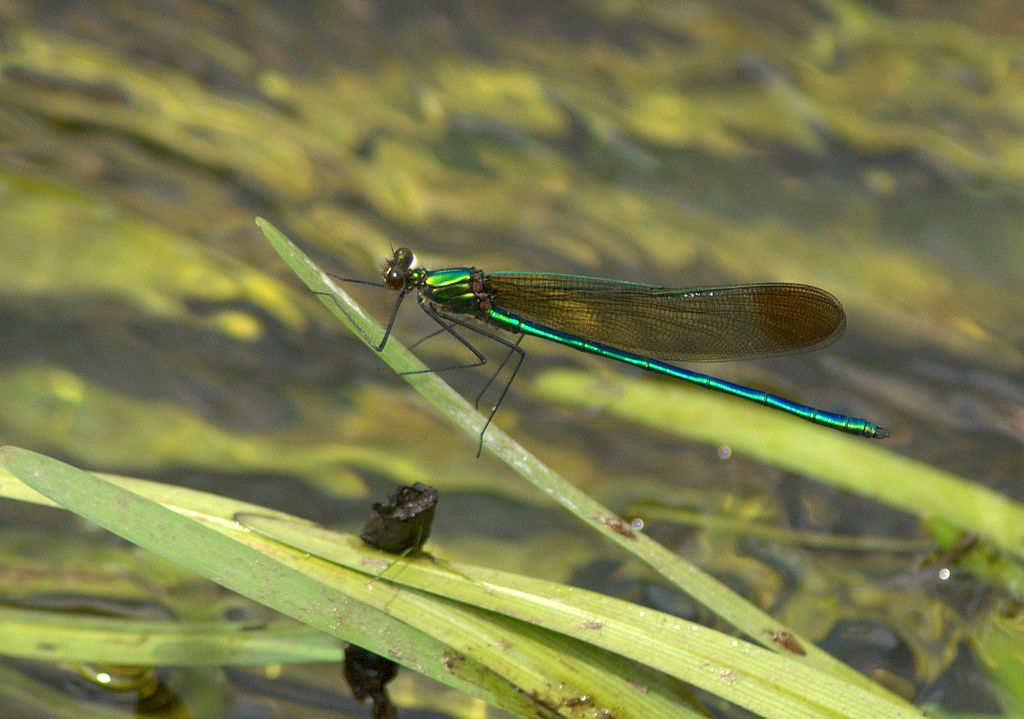
Here, courtesy of Clconroy at Morguefile, is the most conspicuous kind of damselfly found in eastern North America, the Ebony Jewel Wing. Actually its English name seems backward. In sunshine they often look like jewels on ebony wings.
Courtesy of Explorenayarit at Pixabay, this one is male. Generally males gleam in shades of emerald green, sapphire blue, turquoise, or jade depending partly on their individual base color and more on how the light hits them, and females are glossy black; but this general rule is not always reliable. Some females can look more colorful and some males can look black. The reliable gender indicator that's obvious to humans is that females have white dots on the tips of their wings, and males don't.
In most of the eastern and central part of North America, these damselflies are widely distributed, well known, and well liked. They deserve to be well liked. Although the adults fly around looking gorgeous for only a few weeks in summer, these little animals live for more than a year, and they spend most of that time eating gnats, flies, and mosquitoes.



All this sitting on your hands at home, waiting for someone hundreds of miles away to tell you when they think it might be safe for you to play basketball with a friend or attend a religious service...having ideas and energy, not being allowed to go to work and use them...getting projects done, but being banned by law from selling them to your clients...this is socialism, Gentle Readers. This is what Bernie Sanders and Alexandra Ocasio-Cortez and similar people are really talking about when they promise that if you vote for them the federal government will be sending you free money every month. Yes, and the kicker is, the federal government won't have free money to send you for long, anyway. So when you feel that you can't wait for the coronavirus panic to be over, remind yourself: this is what everyone who's lived in a socialist country (other than Sweden) says they've been going through.
On to this month's Newsletter. Here is this month's complete Creature Feature, with color pictures. Subscribers to the printed Newsletter have the option of paying for a picture-free version.
The Glyphosate Awareness Newsletter is published monthly by Priscilla King, c/o Boxholders, P.O. Box 322, Gate City, Virginia, 24251-0322. It’s available free, in plain text as an e-mail or attachment. Printed or audiocassette versions are available for the cost of production. (Audiofiles are free to anyone who can convince me that s/he is blind and can’t read a document aloud using widely available software.) Reprinting, recirculating, and sharing this information at the reader’s own expense is encouraged, provided that all sources of material are credited.
THE CREATURE FEATURE: Damselfly
 |
| Calopteryx maculata (female) |
 |
| Calopteryx maculata (male) |
In most of the eastern and central part of North America, these damselflies are widely distributed, well known, and well liked. They deserve to be well liked. Although the adults fly around looking gorgeous for only a few weeks in summer, these little animals live for more than a year, and they spend most of that time eating gnats, flies, and mosquitoes.
Damselflies are in the insect order
Odonata, which includes all damselflies and dragonflies. Though damsels are
thinner than dragons and can indeed be eaten by dragons, they're not
necessarily smaller or weaker. Ebony Jewel Wings are one of the bigger damselfly
species. With bodies two or three inches long and wingspans over two inches,
they're bigger than some dragonfly species. Big damsels and small dragons
are evenly matched and more likely to avoid each other than to kill each other.
Mostly they eat the nuisance insects that attack humans. However, Ebony Jewel
Wings and Green Darner dragonflies are among each other’s main predators.
None of the Odonata eats warm-blooded
prey. If you were cruel enough to grab them in your hands they would bite,
scratch, and squirm, and their sturdy little jaws can pinch, but they're not
likely to break the skin on your hand. If they perch on your arm, willingly,
they're not going to bite you; they are hoping to bite something else that was
going to bite you.
When I was growing up, possibly to
counteract the stupid old story about any insect "sewing up mouths"
of people, children were told "If a dragonfly perches on you, and you can
hold still long enough for somebody to snap a picture, you will be famous."
I even saw a few other kids' pictures in local newspapers, proving that this
was true. However, the Odonata don't often perch on humans, and I didn't have
an opportunity to find out that I personally couldn't hold still that long
until I was thirty-eight years old.
All of the Odonata hatch from tiny,
barely visible eggs left in or near water. Hatchlings live in water, growing
through several changes of skins to somewhere near their adult sizes, before
they climb out and molt into their winged adult forms. Young Odonata may be
called larvae, nymphs, or naiads. Dragonfly naiads may look like beetles with
hairs or spikes on their backs instead of wings. Broad-winged damselfly naiads
look like small wingless damselflies. They live in mud, are muddy-colored, and
avoid being stepped on or eaten mainly by seeing other animals approaching and
darting away. Though dragonfly naiads’ spikes and damselfly naiads’ tail
segments are pointy and may make the animals harder to swallow, they contain no
venom and provide little defense when predators grab naiads.
Baby damselflies’ tails may have
inspired the peculiar pointed ends sometimes drawn on the tails of mythical
monsters. That wasn’t very scientific. The leaf-like, or even
Valentine-heart-like, shape at the posterior end of a damselfly naiad is
actually the gills the animal uses to extract oxygen from water. Such a
structure would be useless to a mythical fire-breathing dragon.
Ebony Jewel Wings make themselves easy
to observe, so we know a bit more about them than we do about many of the
thousands of Odonata species. They show only a tiny hint of family
feeling—which is still more than some of the other Odonata have. Such family
instincts as they have are more parental than romantic. After mating a
couple will stay together for a day or so. The female tucks each egg into a
different decomposing plant stalk, where rising water will disperse her eggs
over hundreds or thousands of miles. The male seems definitely to be trying to
guard and protect the mother of his offspring, as best he can, while she lays
eggs. If he mates again during this time he’ll try to protect both females,
probably an overall loss to the species. Once the eggs have been deposited the
two adults may mate again with each other, or with others. If anything they are
more likely to separate. Males tend to like to stake out territories, while
females have a motive to look for fresh egg-laying sites. Individuals rarely
travel as far as half a mile. Parents aren't likely to live to see their offspring.
All of the Odonata have elaborately alien reproductive parts and processes. When mating the broad-winged damselflies curl their bodies into a heart-shaped position in which the male can fly, carrying the female, if he has to. The tail segment has vestigial claspers, not as well developed as an earwig's or caterpillars, which the insects use to hold on to each other while mating. The position is probably more comfortable than it looks because, although damselfly eggs can be fertilized in less than an hour, most pairs hold this position for three hours or more.
Photo supplied to Wikipedia By Kevin Payravi - Own work / Cropped from File:Calopteryx maculata mating.jpg, CC BY-SA 3.0, https://commons.wikimedia.org/w/index.php?curid=34124668
What qualifies Ebony Jewel Wings to be
featured in a Glyphosate Awareness Newsletter is that their egg distribution
process depends on the kind of tall, stalky plants that are often considered
“weeds” and destroyed by glyphosate spraying. The more of these “weeds” mature,
die, and dissolve naturally into a stream, the more damselflies have a chance
to survive. According to Wikipedia, their favorite plants include “yellow water lily, hydrilla, lizard's tail, pickerelweed, common
cattail, upright sedge, common bladderwort, common
duckweed, black willow, orange jewelweed, spotted Joe-Pye weed, poison ivy, wild grape, sassafras, common greenbrier, and buttonbush.”
While some of these plants are
minimally damaged by glyphosate spraying, others are threatened by the spraying
and by the overgrowth of really undesirable nuisance species that typically
follows spraying. The damselflies themselves are more directly harmed by
insecticides but are not found in glyphosate-sprayed marshes.
Ebony Jewel Wings were abundant in my
part of the world when I was growing up. They were among the first insects I
learned to recognize as a “friendly” species, as a child. I remember noticing
that local individuals always seemed to be sapphire blue, emerald green, or
coal black in the sunshine, and wondering whether the black, blue, and green
ones were different sub-species, or whether turquoise-colored individuals I saw
in other places were. This species seemed to survive the DDT years better than
most insects did.
As DDT and other poisons like chlordane
and malathion were banned, I was glad to see new species of Odonata, but
disappointed by a local decline in Ebony Jewel Wings. As an adult I observed
that most nature parks in Maryland center around bodies of water. Often the
water is stagnant and the ground is swampy, but Maryland’s abundant “wetlands”
are protected by a rich variety of mosquito-eating lifeforms, including many
species of Odonata. Though Asian Tiger mosquitoes make being outdoors in
formerly nice suburbs a miserable experience, they are not a problem in those
marshy nature parks.
Growing up in Virginia I’d seen exactly
two kinds of dragonflies in addition to the Ebony Jewel Wings, which were the
dominant species. In Maryland I saw red and blue dragons and pale blue damsels
for the first time. Knowing that any naiad is likely to eat any smaller naiad
competing for food in the same pond explained why there was a greater variety
of species with no obviously dominant species.
Back home, competition from those other
Odonata species that were rebounding from DDT did not explain the decline in
Ebony Jewel Wings. The damselflies I loved to watch as a child have not been
replaced by a wider variety of Odonata, or by anything else but growing
populations of gnats, flies, and mosquitoes. According to BayerScience,
glyphosate could not be to blame. I’ll agree that this species’ regular
population redistribution by water levels causes natural variations, and might
allow different Odonata to thrive in the same places in different years...but glyphosate
certainly is not helping damselflies.
There are over 100 other kinds of
damselflies. Most are smaller than Ebony Jewel Wings. A few are bigger. None of
them harms humans. All of them eat nuisance insects and very little else. Nine broad-winged damselfly species are found in North America. Appalachian Jewel Wings, which are found in other parts of Virginia but I don't think I've ever seen one, have the same blue-to-green-to-black iridescent bodies as Ebony Jewel Wings but their wings are greyish. Sparkling Jewel Wings have transparent wings, sometimes with spots at the tips. River Jewel Wings have dark bodies with yellow stripes and mostly transparent wings with color at the tips. Superb Jewel Wings have translucent brownish wings. Ruby Spots may or may not show bright red color on the head and wing joints; this coloring deepens with age, and males develop it before females do.
This Superb Jewel Wing looks clearly different from Ebony Jewel Wings in a well-lighted photo. In real life, and in less clear snapshots, pictures are confusible although they are distinct species and don't mix. Photo supplied to Wikipedia By Mike Ostrowski from North Bethesda, Maryland, USA - Superb Jewelwing, CC BY-SA 2.0, https://commons.wikimedia.org/w/index.php?curid=17315499
It can be hard to identify damselfly
species from pictures! We know this English damselfly is not an Ebony Jewel Wing
because Michael Apel says it was found in a place where Calopteryx virgo, the Beautiful Demoiselle, is found. (In good clear pictures like this one, the copper-colored eyes and wing joints are also clues. On stock photo sites such features aren't always clear.)
Photo supplied to Wikipedia By Michael Apel - photo taken by Michael Apel, CC BY 2.5, https://commons.wikimedia.org/w/index.php?curid=842997
Bluets are another family of damselfly
species. Some Bluets are bigger than Ebony Jewel Wings; there's a Big Bluet and a Little Bluet, and a few dozen others. Not all of these damselflies share the pale blue color for which they're named, and some prefer to call them Narrow-Winged Damselflies. They have narrower wings and more club-shaped tail segments than the Broad-Winged Damselflies. As Virginia recovers from DDT I've seen some Bluets here, but I don't remember seeing this "Familiar Bluet" until I went to Maryland.
Photographed By Bruce Marlin - Own work http://www.cirrusimage.com/damselfly_Enallagma_civile.htm, CC BY 2.5, https://commons.wikimedia.org/w/index.php?curid=2132267 .
This blue to white color is common to several kinds of Odonata. Called pruinescence, from Latin pruina, "frost," it typically develops as damsels or dragons age, and usually appears on males earlier in life than it does on females. It produces interesting patterns and shadings as the blue coating develops over body surfaces that might have been black, red, or yellow when the insect first began to fly. Some Bluets don't seem to develop it, like this Scarlet Bluet from Canada...
Photographed By Jim Bell, CC BY-SA 4.0, https://commons.wikimedia.org/w/index.php?curid=57287765 . There are also Cherry, Burgundy, Orange, Golden, and Florida Bluet species in which most individuals show no blue color at all.
For those who like old songs, it may be interesting to know that there is a Blue-Tailed Damselfly. The names of confusible species tend to reflect confusion. This little damsel wouldn't have bitten a pony. It probably wouldn't even have tackled the big horseflies that were biting the pony. It's not likely to be found in North America, anyway; it's a European species. And the species comes in a wide range of colors; what individuals have in common is the blue segment at the tail end.
Photographed By I, Luc Viatour, CC BY-SA 3.0, https://commons.wikimedia.org/w/index.php?curid=891189
Though most of them are small and may be inconspicuous,
these damsels are good mosquito killers, too. Many of them are also known to lay eggs in decaying plant stalks.
Subscribe to:
Posts (Atom)


