Showing posts with label phenology. Show all posts

Friday, September 26, 2025

Bad Poetry: September Villanelle


(Photo from the National Park Service: Monarch butterfly on Goldenrod)

The summer bids a lingering farewell.
The sunflowers rejoice in gold and green.
Winter will soon be here, it's plain to tell.

The jewelweeds fire orange and yellow shell.
No yellow leaves on walnut trees are seen.
The summer bids a lingering farewell.

Though willow still weeps green above the well,
The poplars clearly show us what they mean:
Winter will soon be here, it's plain to tell.

The goldenrod tolls the black locust's knell;
One won't be long where the other one has been.
The summer bids a lingering farewell.

The deer are fat and insolent; can tell
That lawful hunting's not yet on the scene.
Winter will soon be here, it's plain to tell.

May you, dear readers, be safe, warm, and well
As green departs and northeast winds grow keen.
Though summer bids a lingering farewell,
Winter will soon be here, it's plain to tell.

The Poets & Storytellers United present poems and prose that celebrate the autumn season. 

Thursday, July 24, 2025

Blogjob Phenology: Blue Jay

[Reclaimed from Blogjob, where it describes what was going on in September 2016. Bluejays are active in July, too. Some readers may enjoy the history; others should scroll down to the bird image for the links and photo. 

Blogjob paid fifty cents for each of two posts on one day, and pennies up to a dollar for each view, comment, or share of another Blogjobber's posts and for other blog housekeeping tasks, which tended to prompt people to publish quickie posts for which fifty cents was generous. Considering how thorough the moth posts have been and how much more information is generally available about birds than about moths, do youall think this is one of those posts?

I think, if I Googled blue jays and clicked on as many links as I do to write a post about an obscure butterfly species, I'd get enough material to fill a book. And Amazon would probably publish that book--it's published some books with less research and more violation of copyright. The only trouble is that I would know the difference between fair use of images on a blog everyone can read free of charge, and exploitative, illegal use of those images in a book that's published and sold for money.]

Colored ink indicates statements that were true for September 2016...

The most noticeable life form in Kingsport these days is some sort of pathogenic microorganism. I've not learned yet whether it's a virus or bacterial infection, but it has been going around. Most people seem to be "under the weather." Some people are coughing. A few people, not necessarily even older people, have developed bronchitis and break out with horrific, painful-sounding coughs in public.

Last week Grandma Bonnie Peters' beautiful voice "broke" and she went around sounding like Tallulah Bankhead, or maybe even like Odetta, in between the coughs. That was bad enough but on Sunday morning, instead of coming out to meet me, she called to say she was unfit to drive. So of course I had to walk nine miles, and since I hadn't been walking much all summer that took four hours, and for the rest of the day I didn't have much more energy than she had.

It is actually easier to fend off infections on an empty stomach. For dinner I had a garlic clove. For breakfast this morning I had a garlic clove. For lunch I had another garlic clove and an orange. I feel almost normal now.

GBP is still coughing. She has a lot of friends and a few patients in Kingsport, and sings in the choirs of two different churches. Of course she just loved missing both church services and not talking to her friends, even on the phone...NOT! When people who normally have active minds get into the mental state from which television seems like fun, and they don't have television, they are usually no fun to be around. GBP has been less tiresome than many.

But anyway we have been back to the Cat Sanctuary and observed some birds and flowers. Flowers include out-of-season crown vetch, honeysuckle, and daisies, and more typical goldenrod, thistles, and asters. Birds include cardinals, mockingbirds, and a blue jay.


Blue jays used to be very common and very easy to observe. They are often classified as songbirds, but they're bigger than most songbirds, their squawks of "Jay! Jay!" (or perhaps "Thief! Thief!") aren't very musical, and in some other ways they seem more closely related to crows than to sparrows or warblers. One of the ways jays resemble crows is their susceptibility to West Nile virus. Jays and crows have not become endangered species, but there aren't nearly as many of them as there used to be.

When they're not bullying songbirds or raiding gardens, blue jays are attractive birds. Here's a picture from Wikipedia, photographed by Saforrest and widely copied:

File:Blue Jay with Peanut.jpg

The blue color is an effect of the way the feathers react to light. Jays look bright blue in bright light, pale bluish grey in softer light.

Here's a gallery of 24 different, cute pictures of blue jays. The crest feathers can stand up or smooth down behind the head depending on the bird's mood; the body feathers can be fluffed out for warmth.

All jays have crests, but at the bottom of this page about odd-looking birds is a mutant blue jay with quite an amazing crest:

Jay called "Papa Smurf"

As shown in the picture, jays like nuts and use their long beaks to shell large nuts. They may hoard nuts in a hollow tree for future use, like squirrels. They are omnivores and also eat fruit and insects. If you don't mind attracting jays to a bird feeder, offer peanuts and sunflower seeds. If you live near an oak tree, you will probably see blue jays, since they love acorns.

Like crows and cormorants, blue jays are curious and may pick up any kind of shiny or colorful little object they can carry, just to play with it. They have been known to steal earrings, although, for their purposes, bottle caps would be as good as jewels, or better. Though not as intelligent as crows, they seem cleverer than most songbirds; in cages, jays have been known to figure out how to use sticks or bits of paper to retrieve food, or even unlock the cage door. They also use paper, string, cloth, yarn, and ribbon to decorate their nests.

Blue jays are bold, especially in groups. They sometimes attack hawks, owls, cats, even dogs or humans, with the intention of chasing them off the jays' territory. Successful gangs of jays have been reported to kill and eat bird-eating bats. Nevertheless, jays bully songbirds enough that songbirds seldom seem to welcome jays into flocks, even the mixed flocks that travel together in winter.

Some people claim to have taught jays to imitate human speech. I've never seen that in real life, but I have seen jays imitate red-tailed hawk noises to startle chickens. They can make several different noises, not all of which even sound loud and angry. If reading this on an audio-enhanced computer, you can listen to recordings of more than a dozen sounds blue jays make here:

https://www.audubon.org/field-guide/bird/blue-jay

Blue jays are found in the Eastern States. A larger, darker bird called Steller jays take their ecological place further west. Blue jays and Steller jays are usually considered two distinct species that hybridize easily.

Friday, November 15, 2024

Ode to the Long Awaited November Rain

In a land of endless summer
smoke and dust make brazen air
like a greenhouse glass; a bummer
if we live or sojourn there.

So returning to the moody
places where four seasons roll
and November's bleak and broody
is refreshing to the soul.

Though the air's a long time cleaning,
in the end the scent of rain
gathers to itself the meaning
of refreshment for the brain.

Hail the bleakness of November
onto which we can project
all things tedious to remember
(even those that we elect),

stash provisions in a bunker,
break out quilts and rocking chairs,
gather with our cronies, hunker
round the fire like sleepy bears,

until positively freezing
wind blows in to dissipate
mists of all that's been unpleasing,
and we eagerly await

ice and snow and all December's
round of primal winter-bliss;
sing and dance around the embers,
light the next fire's logs from this.

We can do without November,
some say. Do they say amiss?
Frostless, colorless September
said to us, this year: Remember
winter's own peculiar bliss. 

This poem was suggested by Rosemary Nissen-Wade, who lives where November is a spring month:

Monday, October 7, 2024

Status Update: Hurricane Helene Hits

Well...it was still only an Edge. People in North Carolina reportedly got their first look at a real hurricane. Here in the Point of Virginia we got, mostly, rain. Lots and lots and lots of rain. Then the wind finally blew in, first one way and then the other, and as the ground was now soaked, trees went down left and right. 

I'm told that the Cat Sanctuary actually had electricity longer than some parts of town had. Some houses down in the valley were dark on the Thursday night. I was online for an hour on Friday morning before all the lights in the neighborhood went off. 

Something told me that it wouldn't be worth the trouble to report the power outage on Friday or Saturday. By Monday I ventured out to ask a neighbor whether his family in town had electricity. He confirmed that nobody had. Wires were lying across the road every half-mile or so, trees closer together than that. It wasn't that he, and other neighbors who'd been in town, weren't able to get up my road; it was that on Friday and Saturday they hadn't been able to drive on the roads in town. He had been in the neighborhood on Sunday afternoon and again on Monday afternoon. Trees had been across our private road. I had seen, and broken, a little one that had been growing on my property, so it seemed my responsibility, on the Thursday night. After that, the neighbor wanted me to know, the big trees had gone down across the road. Big oak trees, a couple of them. He had finally got the wood sawn and stacked beside the road before his son-in-law came up to help a little. He is about eighty years old. 

He did not say "And some lazy lady writers and Young Grouches of fifty, who might have been out clearing the road for their elders, were nowhere in sight." That is not his style. He liked doing the work, though he felt tired afterward. He wanted his energy and enterprise to be admired. Well...he has a chain saw in his truck. I don't. It took me about half an hour to break up a maple tree about the size of my leg with hand tools--with a little help toward the end. It would have taken me half a day to break a big oak tree, and I would probably have had to break it in more than one place to get it out of the road.

On the Tuesday the cheerful deliveryman delivered Queen  Cat Serena's usual 35 pints of Pure Life water. All six cats still enjoy sharing a bottle of water with me, though the weather's not been all that warm. It's about the sharing. A slurp of water still seems to mean as much to the cats as a piece of meat. 

Anyway, the deliveryman had a phone. I begged a ride down into town where I could call the electric company. On the way down the hill we saw that the power line where the White-Faced Hornets had built their nest was lying in the flooded creek below; the nest was gone. It had been warm, so maybe the hornets escaped. I hope so. They were the nicest hornet family I ever saw or heard of. Then, below that point, we saw where a big old oak tree had taken a little buckeye and a maple sapling down, and taken a chunk out of the road, making a hole, three or four feet deep, five or six feet long, covering the quarter of the road near the long steep bank. When we got into phone range I told the company they would need to make a detour to get to the power lines, which had snapped under at least three fallen trees. 

They said, giving themselves plenty of time (they thought), they expected to have all the lights back on by Thursday night. My lights were on for a few hours on Friday morning; then they went off again until six o'clock on Friday night. 

There was, of course, no Internet. I came to McDonald's today. In town I heard that some of the businesses, and a few houses, were connected to the Internet as of today. Most are not. So far I'm not seeing a mob of people inside the restaurant using the Internet. I am seeing a lot of people out in the parking lot in their cars. Nobody's even trying to guess when my privately funded connection on the screen porch will come back online. 

Oh well...at least the hurricane also delivered unreasonably mild weather. A few sycamore leaves are just starting to color. Everything else is still green, green, green, and overnight lows have dipped down as low as 55 degrees Fahrenheit. Nobody's had any reason to miss either electric heat or electric air conditioning during the week without electricity. The Kingsport Times-News reported that people evacuated from flood zones in North Carolina were able to enjoy camping at nice nature parks in Tennessee.

It will be interesting to see the comparisons between Hurricanes Helene and Camille, Virginia's Official Standard of Awfulness in Weather. I was in California when Hurricane Camille hit the Swamp and don't remember its awfulness firsthand. I was in a different part of California, later, when primary school children were shown an educational documentary film about the awfulness of Camille. But I've read some estimates that Helene was wetter. 

Regular posts will resume when the Internet connection comes back. I have FINALLY been able to open and read, offline, a review copy of a book the publisher tried to send me about a year ago. It's still a good book. I may post the review in two pieces, the Fiscally Conservative Review that jeers at Robert Turner's bad, overpriced, untenable ideas and the Socially Liberal Review that applauds his excellent ideas. Or you could just get ahead of me, read Creating a Culture of Repair yourselves, and tell me what youall think. I think the good ideas outnumber the bad ones and there's an important piece of history in the book, too, that youall probably missed. 

One more thought...Here in McDonald's, the manager was complaining that the McHelp aren't supposed to wear long-sleeved T-shirts under their official McDonald's shirts. No jackets, either, unless they are official McDonald's jackets. I observe that the air conditioning in this building is fantastic. If you're sitting down in here on one of those 90-degree, 90-percent-humidity days in summer, in a few hours you could start shivering. The McHelp are supposed to keep moving, and stay close to the heat sources in the kitchen, which helps--but I wouldn't quibble about their undershirts. 

Thursday, September 5, 2024

Phenology: Abrupt Seasonal Change in Flowers

What's in the not-a-lawn? Not much, compared with other summers. Some years we have flowers, I've told visitors, and some years we have kittens. 

These kittens have been unusually interested in the game of pulling down flowers. They like chasing things that fall out of trees and bushes. I've wondered whether they were hoping to find another cicada, which has not happened, but they like playing with dead flowers and broken twigs too. 

They have been brought up as cuddly pets, and their favorite toy of all is a human, but they are discovering that humans can disappoint them. Sadly, now that they weigh about five pounds, they have had to learn that humans don't like for them to pounce on our heads. And I'm not even much fun when they try to scratch off one another's claw marks from the door. Winter is coming, I tell them, and the adult cats and I may need a door.

They are sweet, gentle little guys. They're just at that stage of learning, every week, that they have to be even more careful if they want to play with humans. Though Diego has always said it's unfair that he's expected to chase the ends of sticks when he has had the bright and innovative idea of grabbing the hands holding the other ends of the said sticks. The fact that he's never been allowed to play this game has not convinced him that it wouldn't be a great improvement.

Well, they are Borowiec's kittens, and Borowiec left them a lot of purrsonality as well as their silky "mixed" hair. Sometimes I think I'll miss them, and sometimes I wish their purrmanent families would come and get them now. But Pastel and Silver, neither of whom wants to have any more kittens this year, say they'd make good winter holiday presents. 

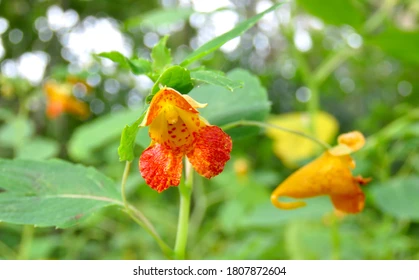
Anyway, for the past few years, the not-a-lawn has been dominated by jewelweed. Some people prefer the scientific name, impatiens. The north side of the house is pretty close to water, because the house bestrides the slab of limestone that covers part of the artesian well. The water table underground is a few yards higher than the stream below the road. 


Fair use of a photo from Shutterstock. Flowers are orange, shading from orange-yellow to orange-red. Their color and cone shape invite pollination by hummingbirds, though they can also be pollinated by some insects.


Photo from the USDA Forest Service. Jewelweed leaves have a blue undertone that can really stand out against plants like most grasses, which have a strong yellow undertone.


Photo from the Arkansas Native Plant Society, focussing on the shape of the leaves. 

Jewelweed loves water. It doesn't seem terribly fussy about other factors affecting plants' quality of life, but it likes to sink its taproot into water. It's a real drama queen, in early summer when it's growing taller. It will turn up its leaves and look as if it;s dying any time it gets a few hours of full sunlight. It actually needs some full sunlight, but it will beg for extra water,

I encourage the jewelweed. Mother always liked it; her pale skin was sensitive to poison ivy and she was one of the people who believe jewelweed's soapy sap dissolves urushiol enough to reduce their reactions to contact with poison ivy. She had a terrible time with poison ivy anyway, most years; she said it used to be even worse. I'm not terribly sensitive to poison ivy and have never noticed jewelweed making a difference when I have been exposed. One never knows when Moher's relatives might decide to bring their pale sensitive skins out for a visit, and one wants to be able to offer whatever help one can. 

It should be mentioned that jewelweed is not for everyone. The sap really does contain saponins, which means it works like mild soap dissolved in cold hard water. You don't get clouds of bubbles and scent, but it will, very gradually, dissolve grease and dirt. Many people who are sensitive to poison ivy find that it reduces the amount of urushiol that sinks into their skin and the amount of blistering they have. A few unlucky people are, however, allergic to jewelweed itself. They've been quoted as saying that their reactions to jewelweed sap, rubbed in and left on their skin, were worse than their usual reactions to casual cntact with poison ivy.

Most things that have been encouraged to grow around the Cat Sanctuary are pot herbs. Jewelweed is a power herb, though it's not a very powerful one. People do eat the young leaves in early spring, and live, but there just about have to be better leaves to eat in early spring. Jewelweed is full of oxalates.

Jewelweed is supposed to grow three to five feet tall, but something, maybe all the food scraps left out for the animals all these years, makes it tend to grow more exuberantly at the Cat Sanctuary. I'm still 5'4" and, before they start to bloom, most of my jewelweed plants are taller than I am. In a wet year they can reach eight feet. Which of course only makes them thirstier and more dramatic with their appeals for extra water. 

It's worth it, though, in August, because jewelweed attracts hummingbirds. One year when the jewelweed was blooming I sat in the yard, talking to a visitor, and we counted seven hummingbirds pollinating the jewelweed all at the same time. 

Well, this year the kittens had a good time pulling down jewelweed plants, and although the hummingbirds found flowers to pollinate, they complained. I am not making this up. Two of them flew close to my face, hovered, and pointed at the few surviving jewelweeds. Clearly they were saying, "What happened to all the richness we've found here in other years? How could you disappoint us so?"

The bright orange jewelweed flowers are always a pretty contrast to the bright blue dayflowers that bloom below them. 


Photo by Asergeev. This is the "good," or native, dayflower, Commelina virginica.
 

Photo by the North Carolna Extension Gardeners. This is the "bad," or "invasive," dayflower, C. communis. Both flowers have three petals. Communis, which is bigger and brighter in real life, has a much smaller and paler third petal; it looks like just two blue petals. The other difference is that communis can grow quite aggressively in favorable conditions, while virginica is a modest little plant that will let itself be crowded out if you don't protect it.

Dayflower plants look like a sturdy kind of grass, They can be described as one or more huge sprawling plants with lots of little branches, or as clumps of plants that grow 6 to 12 inches above the ground from rhizomes that often lie above the ground. Leaves and roots of both species can be eaten if a person is hungry enough. The blue color can also be extracted from the petals and used in dye or paint, but it fades fast in light.

Dayflowers are literally beneath the attention of hummingbirds, but after a summer of kittens rolling on them and tearing them up, where hundreds of flowers have been, maybe half a dozen flowers were.

This year, because there were so few flowers altogether, the changeover was abrupt. Where there are lots of flowers, the transition usually involves a few days when more of one flower and fewer of the other can be seen. This year the last jewelweed flower fell the morning before the first goldenrod bloomed.


Photo from Gardening Know-How. 

Everybody knows goldenrod. The interesting thing about it is the way this flower has gone from being blamed for allergy problems to being praised as a food or medicine. Like jewelweed, goldenrod contains saponins. However, goldenrod leaves don't have to be boiled in three changes of water to become digestible, and goldenrod flowers can be dried and brewed in tea. The leaves contain fibre and vitamins; the tea is used to discourage out-of-balance yeasts in the digestive system. 

A few people really are allergic to goldenrod. They are more likely to have a skin rash after contact with the plant rather than asthma or hayfever. I believe most hayfever is caused by chemical sensitivities but it cn be mechanically triggered by pollen or dust of any kind. WebMD, however, says some people's respiratory allergies are still believed to be caused by genuine pollen allergies, but the pollen usually involved in autumn hayfever is ragweed.

The bottom layer of flowers that I usually see below my goldenrod are the ladies-thumbs. Ladies-thumb grass, sometimes called smartweed, is a pot herb n the buckwheat family. Its bloom and seeds usually appear at the top of the plant, about a foot off the ground, but it too can grow exuberantly at the Cat Sanctuary. Flower stalks can grow four or five feet tall. At that height they're frail and likely to blow over in the wind.

Looking at the not-a-lawn today, I see not one ladies-thumb flower. I see plenty of ladies-thumb grass. This wonderful plant is something in between a grass and a grain. If it's constantly trampled, rolled on, cut or bitten back, etc., it will grow like grass, covering the ground with green. If it's allowed to grow, it produces some of the tastiest flowers...


Photo from Illinois Wildflowers.

Ladies-thumb or redshank grass has a reddish undertone to the talks, tends to form red spots on the leaves, and bears pink flowers. These flowers look like grass seed heads, or like miniature buckwheat heads, because that is what they are, The pink flowers are tender enough to eat raw, and have a flavor that reminds me of fresh corn on the cob. It's not the same, and not as good, but it's in that flavor family. As the flower heads dry out, the pink blooms are replaced by hard brown seeds, which can be either ground or boiled tender. Since they're small, they're more likely to be boiled for hot cereal than baked for bread, and it would be a crumbly bread because the seeds don't contain wheat-type gluten. Again, the flavor is not the same as buckwheat, but it's in that flavor family. I don't eat a lot of ladies-thumb but it's nice to have an underlayer of yard grass, below the big showy flowers, that actually tastes good if you do need to harvest and eat it. 

But few ladies-thumb plants will have a chance to bloom and re-seed in my not-a-lawn, this year.

This post was prompted when I posted a casual comment at someone else's blog and someone else commented that they weren't familiar with these flowers. They are all considered native in most parts of the Eastern States and are available from garden shops. As their names suggest, they're all common enough that some people consider them weeds, which is ridiculous. If you don't have a place where you want these pretty flowers to grow, why not give them to someone who has? People pay actual money for seeds or starters of each of these flowers. If they're hungry enough, people can even eat them.

None of the flowers has been lost, though the sturdy goldenrod stems have been bent over and most of the goldenrod blooms are much closer to the ground than they would normally be. All of them still grow in the side and back yards. But the poor front yard, where the kittens have been playing hard all summer, looks positively grassy.

Some people claim to think the grassy look is an improvement. I just don't have that knd of eyes. I think, well, this year there were kittens, and the plants are all hardy natives (except for the "Asian" dayflowers) that will probably need little or no encouragement to spread back into the not-a-lawn next year.

Thursday, January 4, 2024

Status Update: Blog Returns to Life

Happy New Year, Gentle Readers! I hope you've all been enjoying all of the holidays.

The good news is that the computer's connecting to the Internet from that private connection again; I'm not in McDonald's today. That's very good news, because the walk back from McDonald's felt much more tiring than it ought to have felt; I may be fighting the flu, or a cold or COVID or some such tiresome little thing. 

It wasn't all that cold last night. At the weather station the temperature was above freezing while I was walking back from McDonald's. In Gate City I could feel the ground freezing under my feet as I walked briskly into the wind, overcoat open because it had to cover the laptop computer slung over my shoulder. Near the shopping plaza it was slushy; before I reached the bridge it was icy. Along the way, people could see that something was moving along the side of the road--they swung over into the fast lane to dodge whatever-it-was--but through the falling rain and snow what they saw undoubtedly looked more like Quasimodo than like a harmless old lady, so it was hard to blame them for driving around me as fast as they could instead of sharing their cars. I have walked farther in worse weather. My resistance has been lowered by glyphosate and other chemical poisoning earlier this week. I'm still losing blood.

The bad news is of course that the cyberchores have kept piling up through the holidays. 

Book reviews that should have gone live during December will be popping up, a few hours apart, until I've caught up. Links and regular non-book posts will resume after the book reviews are done. Short reviews and star points should start appearing on the public book sites (Goodreads, Library Thing, etc.) by Monday if not before.

I've wondered whether this disconnection was some sort of cosmic message about the blog's observation of Christmas this year...but then someone did hand me a lovely Christmas post, so among the first regular posts to go live will be one about a new Christmas "tradition" I had the opportunity to observe in Kingsport this year.

Now, back to the books and book reviews...December's Best Cozy Mysteries were not Christmas-themed so they'll appear after the Christmas-themed books. 

Saturday, November 11, 2023

Bad Poetry: Adjectives for Autumn

This one should have gone live on Friday, and didn't, because I was distracted by fair weather and new e-books.

For narrative writing, we're often advised to cut out adjectives and use livelier verbs. For poetry, this week's Poets & Storytellers United prompt was an invitation to use all those adjectives...I remember that in many languages an adjective is just another form of a verb. This poem, however, uses a bare minimum of verbs.

We've just had record high temperatures in what some call "Indian summer," some "St Martin's little summer." Very little is known about this St Martin. Some doubt whether he really existed. He was a favorite saint in old England, though, because he was associated with those last warm sunny days of autumn. His name was adopted by other saints (who definitely did exist) and by several distinguished men who weren't even Catholic. I like "little summer" as a name for this weather pattern. The weather is far too pleasant, when it comes, to be wasted on quibbling about the meaning of the word "saint" and the most correct attitude to take toward the legend of St Martin.

1. Green and Yellow

Cooler, yes, but not much. Thinner sun 
beams slant true west, earlier each afternoon.
Relief. Could be more. Summer's job is done,
Surely? Mozzies whne; same old tune.
Walnut and poplar leaves turn yellow.
Weather's still summer, only more mellow.

2. Red

Red maple. Purple dogwood. Red, pink, white
Flybush. Pink lady's thumb. White oaks brown
But coppery. Scarlet oaks red. Black oaks bright
Orange-red. Frosty nights; daytime highs down.
Afternoon sun, west-south-west. Persimmons blue
Undertone through the orange; white oaks, too.

3. Orange

Most trees bare now. First freezing night leaves frost
In thin southwestern sun all afternoon.
Beech leaves, orange and stubborn, never lost
Till spring. Orange haze on yellow hunter's moon.
All oak leaves shade through orange to brown
Before, or after, they come down.
 
4. Drab

Warm again. Not for long. Bare, dormant trees.
Twigs down along with leaves, all fading fast.
Nuts ripe, in last thaw after the first freeze.
All's waiting for the year's next freezing blast.
Alles ist hin. All gone. Leaves to be found,
Except some oaks and beeches, on the ground.

Friday, June 2, 2023

Book Review: Hill Country Harvest

Reclaimed from Blogjob...

Title: Hill Country Harvest

Author:  Hal Borland

Date: 1967

Publisher: J.B. Lippincott

ISBN: none, but click here to see it on Amazon

Length: 377 pages

Quote: “An editor…forty miles or so up the Housatonic valley from where I live, asked me to write a weekly column for his daily newspaper. ‘What about?’ I asked. ‘Nature,’ he said, ‘the outdoors, life in general.’”

Ten years later, Borland and his book publisher looked back over his columns and decided, “We’ve got a book.” This is the book.

Borland’s home was farther west, but he had married a native of New England, and this book is about New England. It’s about the Appalachian foothills rather than the Atlantic seacoast, which may explain why the book was read and enjoyed here, too. The similarities and differences between our hill countries are interesting.

New Englanders are hereby invited to keep up the consideration of a question Borland raised after reading an old book about New England : “It is observed by the Indians that every tenth year there is little nor no winter.” Borland had not observed this, but if any readers in New England observe it I hope they’ll keep the rest of us posted. Of course, the old book was written “about 330 years” before some point between 1956 and 1967, when Borland was writing about it. Between 1625 and 1640 the English in America were still stumbling around in confusion. They were aiming for Virginia when they struck Massachusetts and it’s possible that Borland’s misinformant, one William Wood, thought he was in Massachusetts when he was actually in Virginia .

That was the topic of one column. There are dozens. There are columns about the behavior of Borland’s squirrels (he was able to attract red squirrels and gray squirrels to the same feeder), about the origins of Groundhog Day, about why the grass greens and the flowers bloom earlier above the septic tank. There’s an explanation of why Weather Service reports started including “wind-chill factors” and why the thermometer on your porch is likely to run a few degrees colder than the one at the local weather station. There are observations of towhees and ground-ivy and lilacs and country people who whistle in public. There are complaints about rhubarb and salsify…people who dutifully ate those two New England classics never complained about zucchini. And so on.

If Borland had meticulously noted the date of each of his observations of nature and listed them in chronological order, his book might have seemed bloggier and less like a novel than it does, but he would also have been practicing “phenology,” the scientific observation of shifts in natural cycles from year to year. Bloggers who keep methodical phenological records are helping professional ecologists with tasks like proving or disproving theories such as global warming. Borland was not a really meticulous phenologist, but he came close enough to give Hill Country Harvest some real scientific and historical value.

In short, Hill Country Harvest is a fun read, often comic, never very sad, often informative…warmly recommended.

Posted on September 8, 2015 Categories Book, Green Tags Appalachian Mountains, nature notes


Wednesday, February 22, 2023

Wednesday Prompts

One prompt came from LongAndShortReviews. After last week's prompt, which everyone answered at some length, usually with a longish list of favorite foods, this week's prompt seems likely to generate really short answers.

"What was the first web site you remember visiting?"

That ought to tell how long we've been online...In the 1980s there were corporate computer systems, the function of which seemed to be to keep the Office Computer Expert busy fixing the steady stream of problems with awkward early programs, and there were freestanding, unconnected personal computers. I was an advocate of personal computers. I didn't think good was likely to come from linking them--still don't, actually. The fad has lasted long enough and the Internet has grown big enough that being online can certainly be interesting, but let's face it, word and data processing programs still work about five thousand times more efficiently when you're not online. 

So it was late in the 1990s when Zahara Heckscher talked me into looking up things online. She had Compuserve, like Rush Limbaugh. It wasn't free; you paid per minute, so you minimized online time and didn't surf around. Beyond her Compuserve account, the public web site we visited was an early search engine called Ask Jeeves. 

The Internet was less cluttered even in the early 2000s. I remember Asking Jeeves about Zambia. Jeeves found all of the four web sites that mentioned that country. One was a US government site, two were UN, and one was the official Zambian government site, which, most memorably, tried to attract tourists with the promise of "a treat": being allowed to hunt rare semitropical animals. The Zambian government site said nothing about the antimalarial drugs tourists would be taking, or their potential side effects. The reason why Z needed a writing assistant was the nerve damage, the chronic pain, which typing aggravated. 

Another prompt came from Spencer George, and recalls our old long-abandoned phenology theme:

"What's blooming where you live?" 

Well, yes, I suppose he does write for fellow Southerners.

I think of February as generally a beige time of year, where I live. Things aren't blooming yet, in a normal year. November is brown, the month when the dead leaves cover the earth. December and January are not always, but usually, black-and-white, the months of ice and snow. February is most often a chilly, muddy, dreary season when the dead leaves are faded and worn, and the overall color of the ground, hills, and trees, is a sort of deep rose-beige or rose-tan or rose-taupe.

This year's unusually mild winter followed an unusually long summer. The flowers that are most often tricked into blooming during the February thaw, and frostbitten in our "redbud winter," bloomed and were frostbitten in December, so I'm not seeing many of them despite temperatures in the sixties. Some years, dandelions will pop up in the January thaw. This year, I've not seen them; they all bloomed in December.

Nevertheless, in town, on the sunny side of someone's lawn, forsythia has bloomed; and I've seen the first few dandelions of this February.

What's blooming where you live, Gentle Readers?

Sunday, October 16, 2022

Seeing Red Yet?

Red is the color of the autumn leaves
taking their winter holidays from their trees;
when the frost brings them leave to go,
they're in haste to be off before the snow.
The first frost has come and gone. It was brief.
It has hardly colored a maple leaf.
Sumac and sycamore leaves go by light,
leaving when equinox comes into sight.
After a long rainy summer the flowers
of September had hardly enough time to bloom
before Hurricane Ian's edge of cool showers
laid rugs of red leaves on the flowers' room.
Though a touristy town is a tedious thing 
it's always fun to see what the autumn leaves bring:
the more colors in the leaves' bright profusion
the better the seasonal cash infusion
so keep oaks and beeches, whose leaves are strongest;
if not the brightest, show color the longest,
but all maple trees can be tapped for syrup
as well as the reds and the yellows they stir up.
So the tourists had sycamore leaves to view,
and sumac leaves bright as the red maples' hue,
and sunflower, goldenrod, boneset, and asters
distracting their minds from the far-South disasters,
Horrid thoughts? Greedy? It would have been horrider
if they'd found nowhere to be tourists but Florida.
When the rain washed down all the red and brown,
next to leave were the tall tulip poplars' crown,
bright gold leaves shaped like the saddlebacks
between the ridges that steer our tracks.
This rain is washing them down and away,
another light rain that will last all day.
But the oak, beech, and maple leaves are still green;
even dogwood's purple has yet to be seen.
Last week Michigan had all the color
(even Adirondack views seemed duller).
The Blue Ridge still has a look of September.
Has that ever lasted so long before?
Not often; and, as the oldtimers remember,
a wet July made the leaves take more
time to do their work of digesting light
before sun-drying to perfectly bright
color to take their leave and their parting flight.
And the tourists come, and the tourists go.
There's still time to see the leaves' final show. 


From another year, a view of poplar and sumac trees below the Mendota fire tower where birders gather to try to count the migrating hawks. 


Friday, August 26, 2022

Tiger Swallowtail

Recently a Tiger Swallowtail butterfly fluttered into a store. Someone said, "It's a moth! It's going to eat the fabric!" Someone else said, "It's a Monarch butterfly!" 

"It's a Tiger Swallowtail butterfly," I said, but my quiet reasonable voice was lost in the commotion as people were chasing the butterfly, dodging it, or dodging those chasing it.

Clearly there is a need for a post about the Tiger Swallowtail butterfly, a human-friendly creature on the whole, though not one I'd choose to handle (as someone in the store eventually did).

Though sometimes nicknamed "monarchs of the woods" and suchlike, Tiger Swallowtails are a completely different species from the one called Monarch butterflies.

Photo courtesy of By HaarFager at English Wikipedia, CC BY-SA 3.0, https://commons.wikimedia.org/w/index.php?curid=5373024

Actually, Tiger Swallowtails are a group of species. They are found in almost every part of North America, different species in different regions. Slight but consistent differences show experts whether a butterfly found where species ranges overlap is Eastern, Western, Canadian, Appalachian, etc. In my part of the world, I always thought the slightly paler yellow ones might be individuals who'd grown up in different conditions than the brighter ones, but scientists now say the pale ones are Appalachian and the brighter ones are Eastern. 

Anyway, note that the Tiger Swallowtail is yellow (some females are black; more about this later) and its most conspicuous black stripes cross the veins in its wings. The Monarch, shown below, is orange (some individuals are white; more about this at monarch-butterfly.com) and its black stripes outline the veins in its wings.

Photo courtesy of By Kenneth Dwain Harrelson, CC BY-SA 3.0, https://commons.wikimedia.org/w/index.php?curid=14917505

Which is bigger? Individuals vary; these two species are the biggest butterflies normally found in Virginia. Monarchs' wingspread tends to be wider. Tiger Swallowtails' wings are longer, especially when spread out in museum displays. Both butterflies are very large and showy...in contrast to the moths that eat fabric (in their larval stage). The Clothes Moth is so small that, although some individuals have interesting patterns of black and white spots on their drab gray wings, humans seldom notice. Clothes Moths usually fold their wings in over their backs, anyway.

Eastern Tiger Swallowtails are wider and longer than the palm of most people's hands. At times males are even aggressive, to the extent that aggressive behavior is possible for butterflies. Butterflies “fight” by flapping through each other’s space, which can create drafts and knock the other butterfly off course, and Tiger Swallowtails frequently fly head-on toward larger animals, or even cars. They also frequently mistime their threat-display flight toward oncoming cars, and are found beside paved roads, stunned or killed.

Tiger Swallowtails have distinct sex roles and fairly distinct sex-linked color patterns. Males are yellow and black. Some females are yellow and iridescent blue-black, in a pattern similar to the males'. Other females are predominantly iridescent blue-black, with spots on the hind wings similar to the yellow females'. In the 1980s an amusing study reported that dark females have a better survival rate due to their resemblance to other Swallowtail butterflies that are toxic when eaten, but yellow females have a better reproductive rate due to males being more likely to approach them--proving that Anita Loos' "Gentlemen prefer blondes, but gentlemen marry brunettes" is truly biologically based, right? Other studies did not find this tendency to be consistent. 

Baby Tiger Swallowtails eat new, young leaves at the tops of trees. They can live on several kinds of leaves but they thrive and multiply most conspicuously where there are a lot of tulip poplar trees. In Virginia, after the logging boom a hundred years ago, the first tall trees to re-form our forests were tulip poplars; thus we used to see hundreds of Tiger Swallowtails at every puddle, engaged in social behavior known as lekking and biological behavior known as composting. As slower-growing trees replace aging and dying tulip poplars, we're seeing fewer Tiger Swallowtails. They are still our official state butterfly.

In addition to chasing cars and (sometimes) choosing mates who are less likely to survive (probably by flying toward another yellow butterfly in an aggressive display, then realizing at close range that it's female), male Tiger Swallowtails also seek out and eagerly slurp up all the nastiest messes on the ground. They like oil spills, dung, and carrion. From these sources they extract mineral salts, which their bodies need to digest. Females usually slurp up flower nectar; they absorb and digest mineral salts through contact with males. 

Observing the behavior of creatures like the male Tiger Swallowtail has led scientists to question exactly how much these creatures have in the way of brains. The Tiger Swallowtail has very few neurological structures corresponding to the brain in other animals. What sense, or senses, a butterfly has are distributed around its body in ways that seem bizarre to humans. Butterflies slurp up liquid nourishment with their long tubular tongues, but they “taste” things, before slurping, with their feet. So it is not unusual for a Tiger Swallowtail to fly at a human, land on an arm or leg or even the face, decide the human’s sweat tastes good, and linger to remove a few mouthfuls of sweat from the human’s skin. This is the butterfly most likely to perch on your hand, or even walk up and down your arm, for several minutes. Males do this more often than females, but despite their aggressive defense of what they’ve defined as their mating territory, Tiger Swallowtails share nourishment with other butterflies of any sex or species...so if you hold still long enough, it’s possible to induce two or more Tiger Swallowtails to share your sweat. But, in view of the other things they taste and like, why would you want to? 

Tiger Swallowtail caterpillars are easy to see on the ground, but are almost never found on the ground. If they can, they spend their caterpillar days in the treetops. Their main defense against birds is being the same shade of green as a poplar leaf, which makes them a little harder to see, but if they survive into their fifth caterpillar skin (the “final instar”) they acquire a funny little forked “tongue” they can stick out, located across where their shoulders would be, if they had shoulders. The “tongue,” or “osmeterium,” resembles a snake’s tongue and has an odor that birds seem to dislike. (The individual below is not sticking out its osmeterium.)


Photo courtesy of Jerry F. Butler of the University of Florida. This picture, and several other nice clear pictures of Papilio glaucus, are at https://entnemdept.ufl.edu/creatures/bfly/tiger_swallowtail.htm .

Monarch butterfly caterpillars look completely different. In nature you would never find a caterpillar at each stage of their development all in a group on one leaf. People rear monarch butterflies in cages, making it possible to pose these caterpillars together, showing how fast they grow. They develop from the tiny stage 1 to the comparatively huge stage 5, as shown below, in about a month.


.Photo courtesy of Ba Rea at https://blog.nwf.org/2014/09/a-visual-journey-through-the-monarch-life-cycle/ .

In temperate regions "large caterpillars" usually grow to about two inches long. Tiger Swallowtails and Monarchs are bigger butterflies, and some individual caterpillars can be three inches long. What these completely different-looking caterpillars have in common, other than size, is that they don't live in cozy family groups, as some other moth and butterfly caterpillars do. In a dim way bigger, older Eastern Tent Caterpillars seem protective of their little brothers and sisters. Monarch and Swallowtail caterpillars are not. They are shell eaters; they eat their own cast-off skin. A natural appetite for their own skin leads them to eat other skins of their own kind of caterpillars too, and too bad about the sibling who might have been still occupying that skin. It would be cruel to leave a collection of caterpillars, like the baby Monarchs above, together for longer than it took to snap their picture. In nature these caterpillars hatch from eggs placed far enough apart that two caterpillars never meet, so they have no social instincts whatsoever. They probably don't have enough brain to realize that their instincts lead to cannibalism, but it happens. 

While turning into butterflies these species look even more different. Monarch pupae hang from a thread and look like little green leaves. Tiger Swallowtail pupae are braced at an angle to tree branches and look like broken twigs. 

As butterflies, they behave differently. Monarchs are seen as having "royal" qualities because they like a lot of space. Though they fly longer, while carrying more weight, than our other butterflies do, they fly at a slow, almost languid pace. In a quiet garden you can hear their wings flap. During the breeding season, after the mass migrations, Monarchs spread themselves out and avoid places where other Monarchs are or have been. This is not because they have any cannibalistic or hostile impulses; the adult butterflies eat only flower nectar. Rather, each female looks for a fresh, untouched milkweed plant on which to lay each of several hundred eggs, and males tend to follow females. Occasionally you might see two Monarchs apparently fighting, not only flying close enough to disturb each other's air but flying into headlong collisions. This is play-fighting. The pair are courting. They don't hurt each other as they fall to the ground. They may mate, or part as friends. You are likely to see only one Monarch in spring and one in fall, because other Monarchs can smell that one has already visited your neighborhood and will look for other places to migrate through. 

Named for their stripes, Tiger Swallowtails aren't predators. They are a composter species. However, they gather around puddles and nasty stuff, where the males slurp up those mineral salts in clusters, sometimes of dozens or hundreds, and females hang around the edges and check our the males. These gathering sites are called leks; the pattern of behavior is called lekking. In the case of butterflies, "licks" would also be appropriate. As they satisfy their appetites and leave the leks, males are likely to flit off with one of the female spectators. They travel several hundred yards together, sometimes play-fighting and teasing, and ultimately mate. Though some smaller, shorter-lived moths and butterflies mate only once, butterflies don't seem to form pair bonds. Females flit off to lay their eggs. 

Like Monarchs, Tiger Swallowtails look for a different tree branch for each egg. Because they can use big trees rather than flower plants, however, Tiger Swallowtails don't need to fly as far as Monarchs do. In places that have four distinct seasons, all butterflies show some vestigial pattern of seasonal migration, though no other species migrates as dramatically as Monarchs do. Individual Tiger Swallowtails may linger at the same place for several days. If the females find enough suitable tree limbs and all of them find enough edible liquids, individuals may not travel far, nor will they necessarily migrate northward in spring and southward in autumn. Maps of the whole species population would, however, show movement northward in spring and southward in autumn, as their food plants grow.

Wednesday, August 24, 2022

Summer Haiku

I'd missed the deadline. 
Too late! My brain ticked over
into haiku mode.

Everybody likes writing haiku. Easy, aren't they? Hello? The question has been raised whether Americans, writing in English, can ever write anything fit to be called haiku. There are rules beyond "count five, seven, five syllables." Syllable counting alone yields lines that have the shape of haiku, but don't qualify as the real thing--as shown above.

Here are the three late summer haiku my brain generated while reading the discussion of what makes a Real Haiku at https://classicalpoets.org/2022/06/29/what-makes-a-good-haiku/#/ .

Although a good haiku stands alone, it may help if you know that butterflies can be classified as pollinators or composters. Some individual butterflies do both jobs. In many species, like the Tiger Swallowtails one of which I watched earlier this summer, the females normally like sweet things, flower nectar and fruit juice, so they mostly pollinate; the males normally like salts, so they mostly dry out oil spills and nastier things. Though the female butterflies need the minerals the males get from these mineral salts, they usually receive the minerals secondhand, from males. 

And Grandma Bonnie Peters never lived to see more than one hummingbird pollinating her jewelweeds.


Photo by Miroslaw Krol at Pixabay


Desperate female
butterfly seeks males, finds none,
sips at the oil spill.

Four hummingbirds buzz
among her jewelweeds: how
that would have pleased her!

Kudzu grows green through
house and car-strewn yard of the
herbicide sprayer.

Tuesday, August 2, 2022

Morgan Griffith Visits the Flood Zone

U.S. Representative Morgan Griffith describes what was taking place just fifty miles away while, as usual, Gate City had rain:

"

A Wild Day From Wise to Washington

Serving as the U.S. Representative for Virginia’s Ninth Congressional District has meant putting a lot of miles on my car. Getting around the 29 jurisdictions in the district’s current boundaries as well as to Washington, D.C., requires frequent travel here and there.

Even so, the driving I did on July 28-29 was quite a lot for one day.

That legislative week in the House of Representatives began on Tuesday, July 26, and ended on Friday, July 29, and involved more than 30 votes on bills, resolutions, and amendments.

While I was in Washington, Southwest Virginia was again struck by heavy storms that caused substantial flooding. Just weeks after floodwaters swept through Buchanan County, the same disaster befell Dickenson and Wise Counties.

Serving in Congress requires choices, in how I vote and how I spend my time. As damage reports came in on Thursday, I decided that I needed to see the situation for myself. I try to avoid missing votes whenever possible, but the bills expected at the time on the floor Friday were not controversial and likely to pass by large margins. Being on the ground at the site of the floods was more important.

We often vote in the evening, but the Congressional Baseball Game for charity was taking place that night. So after votes concluded on Thursday afternoon, I skipped the game, packed up my car, and headed for Southwest Virginia. My staff coordinated with law enforcement to set up the visits.

I arrived in St. Paul to stay overnight around 12:30 am on Friday and woke up around 5:30 am to head to my first stop, Clintwood. There I met with Dickenson County officials and inspected the flood damage.

Following Clintwood, I visited flooded sites in the Towns of Pound, Wise, and Coeburn in Wise County to see how the storms had affected them, joined by county officials and Virginia House of Delegates Majority Leader Terry Kilgore.

At some locations, the waters had not yet receded. Roads and bridges had been washed away, The result of this damage for two neighborhoods in Dickenson County was to cut them off from the rest of the public road system. A ballfield in Coeburn had been covered by three to four feet of water.

Fortunately, no lives were lost, but recovery from the physical destruction will take time and require cooperation at all levels of government and with support from nonprofits, businesses, and individuals.

Just as I left Coeburn, I was notified that a controversial bill would be coming up later that day in the House of Representatives after all, thanks to some procedural trickery.

Earlier in the week, House Democrats had been negotiating between themselves on a package of bills that included a ban on some guns and funding for police departments. Negotiations had appeared to be at an impasse, so these bills were not scheduled for floor action. But overnight Thursday into Friday, a deal was reached so Democrats could proceed with a gun ban. Apparently, they could not agree on supporting the police, but they could find consensus on taking away some guns.

Typically, bills must be available for 72 hours before they can be considered on the floor. The Democrat majority evaded this requirement by passing a rule allowing for “same day authority” to bring up any legislation they wanted within one legislative day.

Knowing the vote would be close, I raced back to Washington from Wise County and after the six and a half-hour drive arrived just in time to vote no on the gun ban. It had been a long ride, but our Constitution, including the Second Amendment, demanded my support.

Ultimately, the House passed the gun ban by a vote of 217-213. If just a few more Democrats had joined the five who voted against the ban, or if the two Republicans who supported it had not, the measure would not have passed. But the narrow margin and strong opposition may have given the bill a “fever,” as we said in the House of Delegates: the bill was now sick and its prospects for survival doubtful. In this case, the Senate hopefully will not want to press forward with the gun ban.

It was a long and demanding day, but I am honored to serve the people of the Ninth District on any day, whether in Wise County or Washington.

If you have questions, concerns, or comments, feel free to contact my office. You can call my Abingdon office at 276-525-1405, my Christiansburg office at 540-381-5671, or my Washington office at 202-225-3861. To reach my office via email, please visit my website at www.morgangriffith.house.gov.

"

Thursday, April 15, 2021

The Dear Cute Little Birds in the Orchard

In his mind, he's a mean, fierce, angry wad of testosterone. Touch him and he'll bite. It would feel like having a spring-type clothespin stuck on your finger, and you'd think he was adorable.

The phoebe and the cardinal yell
at each other, this time every year.
To them it's very plain to tell
each wants the other far from here.

The cardinal has the better claim:
of humans he has much less fear.
The phoebe stomps and shouts his name;
in his mind that makes his case clear.

The cardinal likes the privet hedge
whose berries he alone can eat.
The phoebe wants a wider edge
between his hunting field and street.

If this goes on they'll come to blows
and the cardinal has his strangling move,
which every little male bird knows
his case will absolutely prove.

More likely, phoebe's weary wife
will settle closer to the road,
and phoebe will give up the strife
and grudgingly take up his load.

Meanwhile when some city folk
see tiny feathers, hear shrill tweet,
they'll say without a hint of joke,
"The birds! So happy, cute, and sweet..."