Showing posts with label flower. Show all posts

Thursday, April 23, 2026

Napowrimo 23: Cardinals Return to Privet Hedge

Finally catching up with a National Poetry Writing Month Challenge prompt on the intended day...Today's prompt dared poets to write a villanelle that ends with a question.


(Photo from Google, which credits Gardening Know How: male and female cardinal in privet bush. Cardinals' sex roles are less strongly stereotyped than some birds'. Males are much more colorful and conspicuous, but females show some color when they want to. Males are much noisier, but both sexes sing, often in duets. They mate for life, and both parents rear the young.)

Cardinalis virginiensis, the Cardinal bird, lived in Virginia before privet (Ligustrum spp.) was introduced. But the birds became year-round residents rather than summer visitors as privet hedges became common. They are unmistakably attracted to privet berries, which most species, including humans, can't eat. Many cardinals still winter in Central America, where they eat other berries (and compete with farmers), but the birds continue to bring "cheer" and be "pretty birdies" in North America where their territory includes a privet bush that holds on to its berries until spring, or until cardinals eat them, whichever comes first. Privet does not actually spread much, nor is it difficult to control its spread from seeds and roots in your yard. What makes privet so invasive is that cardinals and a few other native birds and mice drop its seeds wherever they fly...and, where privet has spread, cardinals have followed. At one time naturalists actually used Richmondena as a name for the birds because Richmond was as far north as they would go. Now these fruit-loving, weather-tolerant birds live in New Brunswick.

Some people hate privet. They have no reason to hate it; the bushes are hardy enough to choke out some other plants but, if you'd rather have the other plants, all you have to do is cut the privet sprouts down close to the ground; the root may die right then and there, or it may oblige you by sending out another rhizome and sprouting somewhere else, and if that still doesn't suit you, you can cut those sprouts too. It's easy. Privet sprouts are slim little things you can cut with garden shears.  Privet trimmings are good for toasting marshmallows over a fire; they're too sappy to ignite while a marshmallow is toasting and thin enough to dry out and burn well after the marshmallow is cooked.

Some troll even expressed a wish that Mark Gelbart would breathe deeply of privet blossoms and choke on allergic reactions. This is just pathetic. Nobody's allergic to privet blossoms. They release an intense, sweet, delicious odor for a few evenings in May and do no harm whatsoever. People who have allergy reactions in May need to investigate the "pesticides" being sprayed on nearby gardens. Lots of people have allergy-type reactions to glyphosate. Almost everybody has some respiratory system reaction to dicamba. Some other "pesticides" are known to trigger really violent coughing and sneezing fits. But a person who sneezes while passing a privet hedge is a person whose allergies, probably to chemicals, have been aggravated to the point of being "allergic to" every kind of dust and pollen on Earth; such a person should try to find a place to stay indoors and recover.

Sadly, perhaps, privet has a lifespan. Although it does not attract insect predators and the few American animals who can eat it actually propagate it, privet is vulnerable to infection by fungi and nematodes. In a hundred years or so a stand of privet is likely to die out naturally. Cardinals and other songbirds will probably keep the species alive, but not in the same place...however useful privet may be in the places where it's been planted, to control soil erosion and build up soil that can support native plants.

I love my privet hedges because, during the fifty-one weeks of each year when privet is not bearing sweet-smelling white flowers, it "blooms" with cardinals. How can anyone not love a bird that bobs around the windows, in the dead of winter, singing "Cheer! Cheer! Cheer!" Brave flying flowers, that I could gallant it like you and be as little vain...

Brave birds who nest among privet's blossoms white,
Do you spread north because of heat's increase?
Do you count humans as a boon or blight?

When winter reminds us of our life's twilight
Your calls of "cheer" and "pretty birdy" please,
Brave birds who nest among privet's blossoms white.

Other birds, including chickens, like a bite 
Of privet berries dropped among plants and trees.
To you, are humans' chickens boon or blight?

I love the scent of privet's blossoms white
Mixed in with violets, roses, poplar trees,
Brave birds who spread the privet's blossoms white.

In summers when heat beats as if for spite
But no more than it's done for centuries,
We humans ask: have we been boon or blight

To this green planet where we seek the Light
For so few days before our sure demise.
Brave birds who nest among privet's blossoms white,
Do you count humans as a boon or blight?

Friday, April 3, 2026

Bad Poetry: April Is the Kindest Month

For the Poets & Storytellers United, an extra poem celebrating what looks like my laptop's recovery from an attack earlier this week...


(Azalea. All photos from Google; for this one Google credits https://www.gardeningknowhow.com/ornamental/azalea/essential-spring-azalea-care )

"April is the kindest month. April gets you out of your head and out working in the garden."--Marty Rubin*


(Cherry blossoms: https://www.gardenia.net/genus/prunus-cherry-blossom-tree )

April is the kindest month
with all its showers and flowers:
It thaws the land, brings longer days
for tidying our bowers.


(Vinca minor: https://www.gardenia.net/guide/periwinkle-plant-care-and-growing-guide )

It's still not warm enough for real
agricultural toil;
no sweat, no blisters, no mosquitoes
garden's bliss to spoil.


(Forsythia: https://www.thetreecenter.com/lynwood-gold-forsythia/ }

It merrily skips from bloom to bloom,
warming more each day,
from daffodils through iris flowers
to rose blooms and May.


(Claytonia: Facebook)

---

* Obviously this would be April on the Atlantic coasts of the US and UK. Some of the Poets & Storytellers post from India, Trinidad, Australia, and other places where April feels very different. It'll be fun to read their April poems. The next month's name is intentionally used ambiguously to include a favorite flower in England, or not, as the reader prefers.


(Dogwood: https://www.britannica.com/plant/dogwood )

Friday, November 14, 2025

Bad Poetry: Tearing Hate Down with Love


[Photo credit was lost because Google behaved badly.[


Let's all hate
glyphosate.
Tear it down.

In its place
love Queen Anne's Lace,
tall and proud and in your face.
Love milkweed
where butterflies feed.
Love pretty fluff
of dandelion puff.
Love a sharawaggi look;
let tall flowers form a shady nook
carpeted by violets and sheltered from the weather:
Can you get five colors of violets together?

Oh, so mean--
atrazine.
Tear it down.

Where it was
let the laws
of nature mandate kittens' paws
or ponies' feet
or lambs' faint bleat.
Love the children
and the beasts.
Love a fruit or flowering tree.
Bend your back and bend your knee
till every trace of Astroturf or of devil grass
is covered up by something native that was meant to last.

What a blot--
paraquat.
Tear it down.

Cry "begone!"
to the lawn
and the corporate greedheads' pawn.
Plant green peas,
strawberries.
Plant potatoes
or tomatoes.
Let green push away the pavement,
gardens push away enslavement
to the foolishness of zoning that, a hundred years ago,
said that from our homes to work needed twenty miles to go.

Thursday, September 5, 2024

Phenology: Abrupt Seasonal Change in Flowers

What's in the not-a-lawn? Not much, compared with other summers. Some years we have flowers, I've told visitors, and some years we have kittens. 

These kittens have been unusually interested in the game of pulling down flowers. They like chasing things that fall out of trees and bushes. I've wondered whether they were hoping to find another cicada, which has not happened, but they like playing with dead flowers and broken twigs too. 

They have been brought up as cuddly pets, and their favorite toy of all is a human, but they are discovering that humans can disappoint them. Sadly, now that they weigh about five pounds, they have had to learn that humans don't like for them to pounce on our heads. And I'm not even much fun when they try to scratch off one another's claw marks from the door. Winter is coming, I tell them, and the adult cats and I may need a door.

They are sweet, gentle little guys. They're just at that stage of learning, every week, that they have to be even more careful if they want to play with humans. Though Diego has always said it's unfair that he's expected to chase the ends of sticks when he has had the bright and innovative idea of grabbing the hands holding the other ends of the said sticks. The fact that he's never been allowed to play this game has not convinced him that it wouldn't be a great improvement.

Well, they are Borowiec's kittens, and Borowiec left them a lot of purrsonality as well as their silky "mixed" hair. Sometimes I think I'll miss them, and sometimes I wish their purrmanent families would come and get them now. But Pastel and Silver, neither of whom wants to have any more kittens this year, say they'd make good winter holiday presents. 

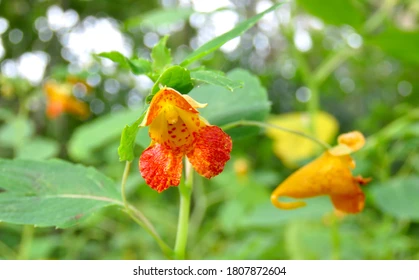
Anyway, for the past few years, the not-a-lawn has been dominated by jewelweed. Some people prefer the scientific name, impatiens. The north side of the house is pretty close to water, because the house bestrides the slab of limestone that covers part of the artesian well. The water table underground is a few yards higher than the stream below the road. 


Fair use of a photo from Shutterstock. Flowers are orange, shading from orange-yellow to orange-red. Their color and cone shape invite pollination by hummingbirds, though they can also be pollinated by some insects.


Photo from the USDA Forest Service. Jewelweed leaves have a blue undertone that can really stand out against plants like most grasses, which have a strong yellow undertone.


Photo from the Arkansas Native Plant Society, focussing on the shape of the leaves. 

Jewelweed loves water. It doesn't seem terribly fussy about other factors affecting plants' quality of life, but it likes to sink its taproot into water. It's a real drama queen, in early summer when it's growing taller. It will turn up its leaves and look as if it;s dying any time it gets a few hours of full sunlight. It actually needs some full sunlight, but it will beg for extra water,

I encourage the jewelweed. Mother always liked it; her pale skin was sensitive to poison ivy and she was one of the people who believe jewelweed's soapy sap dissolves urushiol enough to reduce their reactions to contact with poison ivy. She had a terrible time with poison ivy anyway, most years; she said it used to be even worse. I'm not terribly sensitive to poison ivy and have never noticed jewelweed making a difference when I have been exposed. One never knows when Moher's relatives might decide to bring their pale sensitive skins out for a visit, and one wants to be able to offer whatever help one can. 

It should be mentioned that jewelweed is not for everyone. The sap really does contain saponins, which means it works like mild soap dissolved in cold hard water. You don't get clouds of bubbles and scent, but it will, very gradually, dissolve grease and dirt. Many people who are sensitive to poison ivy find that it reduces the amount of urushiol that sinks into their skin and the amount of blistering they have. A few unlucky people are, however, allergic to jewelweed itself. They've been quoted as saying that their reactions to jewelweed sap, rubbed in and left on their skin, were worse than their usual reactions to casual cntact with poison ivy.

Most things that have been encouraged to grow around the Cat Sanctuary are pot herbs. Jewelweed is a power herb, though it's not a very powerful one. People do eat the young leaves in early spring, and live, but there just about have to be better leaves to eat in early spring. Jewelweed is full of oxalates.

Jewelweed is supposed to grow three to five feet tall, but something, maybe all the food scraps left out for the animals all these years, makes it tend to grow more exuberantly at the Cat Sanctuary. I'm still 5'4" and, before they start to bloom, most of my jewelweed plants are taller than I am. In a wet year they can reach eight feet. Which of course only makes them thirstier and more dramatic with their appeals for extra water. 

It's worth it, though, in August, because jewelweed attracts hummingbirds. One year when the jewelweed was blooming I sat in the yard, talking to a visitor, and we counted seven hummingbirds pollinating the jewelweed all at the same time. 

Well, this year the kittens had a good time pulling down jewelweed plants, and although the hummingbirds found flowers to pollinate, they complained. I am not making this up. Two of them flew close to my face, hovered, and pointed at the few surviving jewelweeds. Clearly they were saying, "What happened to all the richness we've found here in other years? How could you disappoint us so?"

The bright orange jewelweed flowers are always a pretty contrast to the bright blue dayflowers that bloom below them. 


Photo by Asergeev. This is the "good," or native, dayflower, Commelina virginica.
 

Photo by the North Carolna Extension Gardeners. This is the "bad," or "invasive," dayflower, C. communis. Both flowers have three petals. Communis, which is bigger and brighter in real life, has a much smaller and paler third petal; it looks like just two blue petals. The other difference is that communis can grow quite aggressively in favorable conditions, while virginica is a modest little plant that will let itself be crowded out if you don't protect it.

Dayflower plants look like a sturdy kind of grass, They can be described as one or more huge sprawling plants with lots of little branches, or as clumps of plants that grow 6 to 12 inches above the ground from rhizomes that often lie above the ground. Leaves and roots of both species can be eaten if a person is hungry enough. The blue color can also be extracted from the petals and used in dye or paint, but it fades fast in light.

Dayflowers are literally beneath the attention of hummingbirds, but after a summer of kittens rolling on them and tearing them up, where hundreds of flowers have been, maybe half a dozen flowers were.

This year, because there were so few flowers altogether, the changeover was abrupt. Where there are lots of flowers, the transition usually involves a few days when more of one flower and fewer of the other can be seen. This year the last jewelweed flower fell the morning before the first goldenrod bloomed.


Photo from Gardening Know-How. 

Everybody knows goldenrod. The interesting thing about it is the way this flower has gone from being blamed for allergy problems to being praised as a food or medicine. Like jewelweed, goldenrod contains saponins. However, goldenrod leaves don't have to be boiled in three changes of water to become digestible, and goldenrod flowers can be dried and brewed in tea. The leaves contain fibre and vitamins; the tea is used to discourage out-of-balance yeasts in the digestive system. 

A few people really are allergic to goldenrod. They are more likely to have a skin rash after contact with the plant rather than asthma or hayfever. I believe most hayfever is caused by chemical sensitivities but it cn be mechanically triggered by pollen or dust of any kind. WebMD, however, says some people's respiratory allergies are still believed to be caused by genuine pollen allergies, but the pollen usually involved in autumn hayfever is ragweed.

The bottom layer of flowers that I usually see below my goldenrod are the ladies-thumbs. Ladies-thumb grass, sometimes called smartweed, is a pot herb n the buckwheat family. Its bloom and seeds usually appear at the top of the plant, about a foot off the ground, but it too can grow exuberantly at the Cat Sanctuary. Flower stalks can grow four or five feet tall. At that height they're frail and likely to blow over in the wind.

Looking at the not-a-lawn today, I see not one ladies-thumb flower. I see plenty of ladies-thumb grass. This wonderful plant is something in between a grass and a grain. If it's constantly trampled, rolled on, cut or bitten back, etc., it will grow like grass, covering the ground with green. If it's allowed to grow, it produces some of the tastiest flowers...


Photo from Illinois Wildflowers.

Ladies-thumb or redshank grass has a reddish undertone to the talks, tends to form red spots on the leaves, and bears pink flowers. These flowers look like grass seed heads, or like miniature buckwheat heads, because that is what they are, The pink flowers are tender enough to eat raw, and have a flavor that reminds me of fresh corn on the cob. It's not the same, and not as good, but it's in that flavor family. As the flower heads dry out, the pink blooms are replaced by hard brown seeds, which can be either ground or boiled tender. Since they're small, they're more likely to be boiled for hot cereal than baked for bread, and it would be a crumbly bread because the seeds don't contain wheat-type gluten. Again, the flavor is not the same as buckwheat, but it's in that flavor family. I don't eat a lot of ladies-thumb but it's nice to have an underlayer of yard grass, below the big showy flowers, that actually tastes good if you do need to harvest and eat it. 

But few ladies-thumb plants will have a chance to bloom and re-seed in my not-a-lawn, this year.

This post was prompted when I posted a casual comment at someone else's blog and someone else commented that they weren't familiar with these flowers. They are all considered native in most parts of the Eastern States and are available from garden shops. As their names suggest, they're all common enough that some people consider them weeds, which is ridiculous. If you don't have a place where you want these pretty flowers to grow, why not give them to someone who has? People pay actual money for seeds or starters of each of these flowers. If they're hungry enough, people can even eat them.

None of the flowers has been lost, though the sturdy goldenrod stems have been bent over and most of the goldenrod blooms are much closer to the ground than they would normally be. All of them still grow in the side and back yards. But the poor front yard, where the kittens have been playing hard all summer, looks positively grassy.

Some people claim to think the grassy look is an improvement. I just don't have that knd of eyes. I think, well, this year there were kittens, and the plants are all hardy natives (except for the "Asian" dayflowers) that will probably need little or no encouragement to spread back into the not-a-lawn next year.

Monday, April 15, 2024

Book Review: The Eugene Veran Community Garden the Beginning

Title: The Eugene Veran Community Garden the Beginning 

Author: Lorna Bycroft

Date: 2022

Publisher: Lorna Bycroft

Quote: "I tend to babble about flowers."

This mini-novel leads into a series of novels about the fictional community garden, telling the story of the man who left the garden for his widow to run. When they met, he half-apologized for his tendency to babble about flowers. She thought there were worse topics. They lived happily ever after.

If you like sweet romances with flowers in them, you will enjoy this mini-book.


Friday, December 2, 2022

Flowers That Confuse Language Learners

Bleeding hearts
(more like other parts
if viewed from some angles)

Indian pipes
(moist as packaged wipes,
on slopes, in tangles)

Naked lady
leaves nothing shady
on the ground below

Dutchman's breeches
history teaches
the Dutch wore them so

Lady's thumb
has a flavor some-
thing like fresh millet

Dry land fish
are a tasty dish
fried up in a skillet

Oak apples
thorn apples
they can't be serious

Cedar apples
love apples
sarcasm was furious

Lady's slipper
fits a doll's flipper
like a miniature shoe

But elephant ears
the linguist fears
never would do

Look up sass
look up frass
glad sassafras is neither?

Pineapple's
not pine nor apple
and never was either

A moon penny
is not worth any
money, Earth or lunar

Blue grass
from green will pass
to orange, sooner

Bread-and-butter,
people mutter,
no more that than cheese--

and at least a hundred
more plant names are
as funny as these

(Fun fact: Except for the human fat, Raymond Buckland has documented that all the nasty-sounding things Shakespeare put into the witches' brew in Macbeth were wildflowers.)

Wednesday, August 24, 2022

Summer Haiku

I'd missed the deadline. 
Too late! My brain ticked over
into haiku mode.

Everybody likes writing haiku. Easy, aren't they? Hello? The question has been raised whether Americans, writing in English, can ever write anything fit to be called haiku. There are rules beyond "count five, seven, five syllables." Syllable counting alone yields lines that have the shape of haiku, but don't qualify as the real thing--as shown above.

Here are the three late summer haiku my brain generated while reading the discussion of what makes a Real Haiku at https://classicalpoets.org/2022/06/29/what-makes-a-good-haiku/#/ .

Although a good haiku stands alone, it may help if you know that butterflies can be classified as pollinators or composters. Some individual butterflies do both jobs. In many species, like the Tiger Swallowtails one of which I watched earlier this summer, the females normally like sweet things, flower nectar and fruit juice, so they mostly pollinate; the males normally like salts, so they mostly dry out oil spills and nastier things. Though the female butterflies need the minerals the males get from these mineral salts, they usually receive the minerals secondhand, from males. 

And Grandma Bonnie Peters never lived to see more than one hummingbird pollinating her jewelweeds.


Photo by Miroslaw Krol at Pixabay


Desperate female
butterfly seeks males, finds none,
sips at the oil spill.

Four hummingbirds buzz
among her jewelweeds: how
that would have pleased her!

Kudzu grows green through
house and car-strewn yard of the
herbicide sprayer.

Wednesday, August 14, 2019

Belated Tortie Tuesday Post: Charlie and the Hummingbird

I slept badly on Friday night--kept waking up sneezing. This is often an indication of some sort of pesticide vapor drift. I went into town anyway, feeling sluggish and grumpy. A lot of people who usually come to Friday Market didn't, although the weather was that perfect "sunny and 75" (degrees Fahrenheit) their favorite radio station often blares songs about. One claimed to have come to market, then felt too bad to shop and gone back. It was a sluggish and grumpy market; another day when all good cheer seemed to be imported from Tennessee.

Some booksellers have been discussing the question of whether it's possible to sell vintage fiction in hardcover editions that have lost their paper jackets. I had a few to test my theory that it is. A lady picked up a copy of a football player's memoir, They Still Call Me Assassin. "Assassin?" she murmured.

"Do you remember when that guy used to play football?" I murmured. Most people in my home town wouldn't, because "The Assassin," Jack Tatum, retired just about the time my town started picking up TV channels that broadcast NFL games. He reminisced about O.J. Simpson and Larry Csonka, and wisecracked about Jerry Rice.

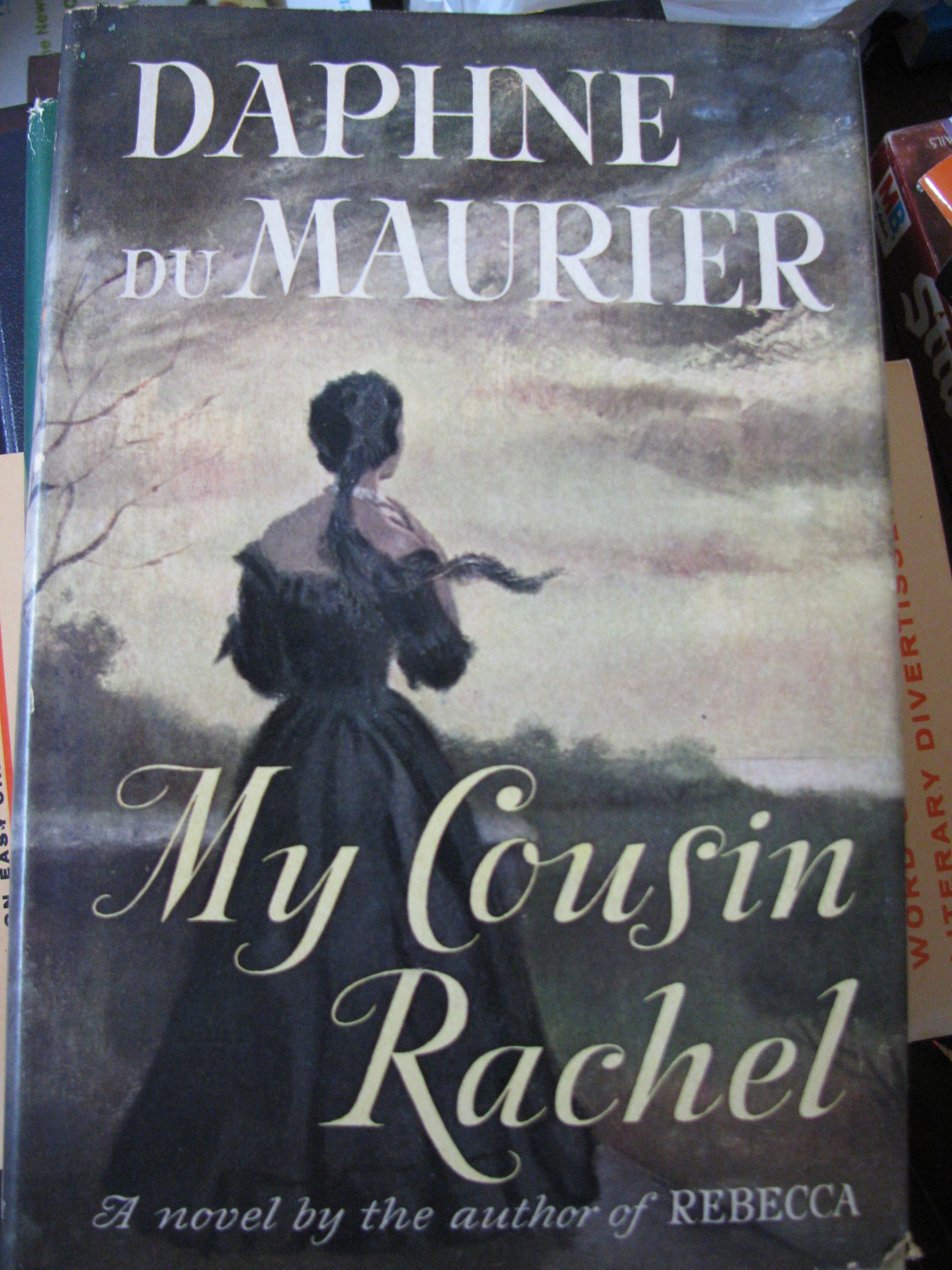
I happened to have a copy of one of Daphne Du Maurier's other novels, My Cousin Rachel, that had lost its jacket. "This is the novel of suspense I brought this week," I said. This is what the jacket would probably have looked like.


So she took both books and walked away looking pleased. My Cousin Rachel sold well enough that its resale value isn't high, but for anyone who likes clean, romantic novels of suspense it's a bargain. For anyone who wants to resell rare books, Jack Tatum's second memoir was the bargain. It did not sell well in its own time; no use showing a picture of it here because Amazon doesn't even have one. It's become a collector's item.

Well, first I found a fabulous deal on some of the blue yarn I want for the Anti-Bullying Blue Hats display, two extra-large shopping bags full. Then a person who was stuck in per own store was wanting to know whether people were moving in or out of another store, which was on my way. I walked a block up the street, found that they were moving out, and had three more bags full of old books thrust upon me. I also wanted to bring home some provisions for the weekend. This was going to be quite a load to carry. I asked a retired person who likes to get out and drive, when not feeling too ill. "Not driving today," person said. "I think I've got flu. Everybody in the building seems to have it."

I flagged down a younger person who was driving in the right direction, we took advantage of a sale on Route 23, and on the way back I could see what had given me such an unpleasant night and probably given the whole retirement project their "flu." There might actually be some sort of virus making the rounds. I know what you're thinking, since I mentioned someone being sick within minutes after drinking a V-8 in last week's status update, and it is not Norwalk Flu. If that person had had Norwalk Flu I would have smelled its unmistakable odor, person would not have been fit to drive home, and I would have had some symptoms during the last week. But all those older people might have had some sort of "summer cold." Maybe they had a summer cold. Funnily enough patches of vegetation along Route 23 were starting to brown out from glyphosate spraying. What a coincidence.

A body is a system, so tracing causes and effects is not as simple as people want to imagine. Someone shared, after I'd tweeted a bit about exactly how our cats Traveller and Bisquit died, that their symptoms--especially coughing up froth--sounded like algae poisoning. Dogs can show that symptom, and sometimes die, after drinking stagnant water contaminated with some kinds of algae. Cat Sanctuary cats normally drink out of a fast-moving stream that has never contained visible algae. But then somebody else shared that glyphosate can promote the growth of the kind of algae that make water undrinkable...The fact that some of these things are only secondary effects of a glyphosate poisoning episode does not mean that glyphosate didn't cause them.

I'm disgusted by our Environmental Protection Agency's caving on the question of those "glyphosate causes cancer" labels. It is virtually impossible to prove that anything is a sole or even a primary cause of cancer; there's still some debate about X-rays and DDT as well as cigarettes. (For what it's worth, the major carcinogen in cigarettes is not the tobacco but the bleached white paper.) However, glyphosate causes tissue damage on contact. People who breathe the vapors may sneeze or cough blood from the respiratory tract. People who eat or drink contaminated food may form bleeding ulcers, and they can be massive and bleed heavily, all along the digestive tract from the lips down. People who get glyphosate on their skin may get a mild rash or form huge bleeding lesions. Any or all of these things PROMOTE THE GROWTH of cancer, although these and the other glyphosate reactions people are having may be even more likely to cause death before cancer has time to grow.

I don't expect to die from cancer of the colon. If we don't get a serious glyphosate ban, I don't expect to survive long enough for that to happen. I've had celiac sprue for most of this year with only a few days between episodes. Celiacs for whom the sprue reaction becomes chronic usually die when the intestines stop repairing themselves and become "leaky" enough to cause blood poisoning. It's not a pleasant way to go but it is fast; people are usually going about their daily routines up to the last week or so.

I had celiac sprue all weekend. Still have it at the time of writing.

Still going about my weekend routine, I went out in the front yard and burned the trash. While the pages of a magazine that was in too bad condition to resell were burning, I heard a peculiar sort of sound. It mght have been a bird or a cat.

"Who said that?" I asked the cats. Samantha and the spring kittens seemed to have nothing to squeak about. "Where's Serena?" I asked the cats. Serena popped up from behind a bush. I watched the flames die and turned to go back indoors.

Serena pointed to a tiny damp kitten squirming about on some pressed-down dayflowers, a little ginger tom with a long tail. It reminded me of a stuffed toy of my childhood. "Is your name Charlie? Charlie Dale Lion?" The kitten's ears weren't open yet. Serena, however, was nonverbally saying, "Yes, you can call him Charlie if you like. Now come and let me show you another thing."

I followed Serena to the porch. She scratched vigorously at a chair. "You're saying the chair is blocking the way to your nest? You want to put Charlie in your nest?" Serena agreed. I moved the chair. Serena scratched at a bag. I moved the bag. Serena chirped appreciatively and disappeared into the nest where she'd reared the spring kittens.

I went back into the yard and kept an eye on Charlie, shooing flies and mosquitoes away from him. Though too young to see or hear, he could smell; he followed traces of his mother's scent on me and thus began following me around about a square foot of crushed dayflowers; we've bonded. Presently I heard a loud buzz. A wasp's or hornet's threat display? No, it was the hummingbird, watching this unusual human and cat behavior in between sips from the jewelweed.

I say "the" hummingbird. For years I only ever saw one. One day last summer I sat out in the driveway in a visitor's car, with a good view of the jewelweed, and saw that "the" hummingbird had a mate and family. I still don't know where the nest is, whether they're rearing babies again this year, or even--thanks to my astigmatism--whether it was Mr. or Mrs. Hummingbird who flew up to look at the kitten and me. I thought how conveniently nature times these things: although the hummingbirds don't eat insects, as the cardinals do, they do pollinate the pretty jewelweed flowers, during the weeks when the cardinals are mostly hiding. The cardinals usually don't let other songbirds hang around the Cat Sanctuary, except when we've had house wrens who were willing to stay closer to the house than the cardinals do.

I saw the Isodontia wasp. I saw the new Chlorion aerarium who's taken the place of last spring's office-mate Jade--Jadeite, of course. I saw Polistes carolina and a lonely little Polistes fuscatus. There weren't very many flies and mosquitoes, although the cardinals and most other songbirds keep a low profile in August. It was another humid but otherwise perfect afternoon.

Sunny and 75
Sunny and 75


Usually the birth of four kittens takes most of a day but, within two hours, Serena came out, still a "big fat cat." She hadn't bulged a great deal before giving birth and didn't look much thinner afterward. Looking damp and triumphant, she let me place Charlie in the nest with his classic calico sister and two black-and-white kittens of undetermined gender. All four have long tails.

Burr was with us all weekend too, a proud and devoted social cat...grandfather? Father? Surely not. Could Burr be the father of four healthy long-tailed kittens? In any case there was no question of his doing them any harm, as there is with some tomcats. Burr's main interest is in Samantha but he is another tomcat, like his great-grand-uncle Mac, who protects kittens.

I wondered whether glyphosate had anything to do with the sudden and rapid birth of these kittens. If so it doesn't seem to have harmed them--yet. They all dried off looking exactly the way newborn kittens are supposed to look: eyes closed, ears curled in, coats fluffy but sparse, every claw sticking out of every little bare paw.

I went online again yesterday and today. Storms roiled around the area. Internet connectivity comes and goes, or comes up showing as "limited." I saw the person who'd complained of "flu" on Friday driving again today. So far, I've not heard of any casualties of this glyphosate poisoning episode. But either the rain's not washed the poison out of the air, or it's washed into the local water supply; I've not noticed any evidence that I'm recovering from it, myself, either.

The kittens, the estivating songbirds, the friendly insects, the hummingbirds, the other animals and human children who were born this summer need your help, Gentle Readers. Spread Glyphosate Awareness everywhere. Spread it especially to St. Louis, Missouri, if you know people there.

Tuesday, June 25, 2019

Status Update, Tortie Tuesday, Phenology and All That

"This is Tortie Tuesday. Would either of you gorgeous three-colored cats like to do today's blog post?" I asked Samantha and Serena.

"Hmph," said Serena. "Why don't you stay home, grow some fur, and play with me all morning, then snooze on the storage bin just below mine all afternoon, instead. That would be much more fun."


Serena, the Queen Cat next to the barrels, sorely misses Traveller, the young tomcat next to the camera. While he was living I didn't think this photo of Traveller was especially good, but since it's the last one there will ever be...Traveller was the cuddliest kitten ever, and, sadly, it's often the case that kittens who aren't as healthy as they ought to be are extra-cuddly; presumably the sensation of snuggling distracts from pain.)


"Hold out for readers to send us some more of that premium-grade kibble," said Samantha, who is Serena's mother and who induced lactation, as social cats often do, around the time Serena was ready to end the lactation cycle. "If they'd been sending us glyphosate-free, GMO-grain-free food, Trav might be with us still, and Swimmer might not be so bony. I worry about that kitten. It demonstrated the ability to swim at such an early age because it was weaker than the others, and although they were all born the same size--small--it's hardly half the size of Silver now. Even my milk supplements aren't helping it grow."


Swimmer was the cuddliest, friendliest kitten--not that there's ever been much range of variation in this look-alike litter--so when it rejected cuddling this weekend, I suspected that its ribby little body is in pain. Fatal Manx Syndrome would have happened earlier and would not have affected a kitten with a complete tail, but glyphosate sensitivity, or who knows what else, may be interfering with its growth.

"I'll write it! Let me at the computer!" said little Black Stache. "I may not be a Tortie or even a calico cat, but I do have a patch of mixed black and white hairs that look gray, on the back of my neck, as well as patches of black and white. I ought to count as a three-colored cat. And I'm three months and three weeks old now, so I know everything! I'm big enough that Ma's let me go out to the gate several times and even spend the night on the porch twice now!"


"That's because I was out late and fell asleep as soon as I came in, fed you, and leaned back on my bench beside the computer," I explained. "But by all means, since I'm getting tired of picking your little two-colored body out of the doorway every time I go in or come out, such that I've felt tempted to grab you by your long white tail--which is a cruel act no cat owner should ever do--let's show the world how adorable and adoptable you are."

12
34 Z

ZZZZZZZZZ
ZZZZjjjjjjjjjjjjjjjjjjhhhhhjjjjjjjjjj

"That's enough typing for one day, Stache," I said. "Now I'll tell readers what we really mean to say here."

1. Black Stache got its (I suspect her) name from the character on the cover of this book, which is as funny as you'd expect from the authors' names on the cover:

Way funnier than the original Peter Pan and Wendy, this one started a series.
2. Samantha is the true Tortie (a three-colored cat with large areas of black-and-orange mottled fur). She is still beautiful. She's been much calmer and friendlier during the prolactin surge of being a nursing grandma cat. She has not only purred and cuddled, but positively called me to participate in purr-and-cuddle sessions.


Though she's reached her full adult size--average, smaller than Serena--Samantha is still a young, bouncy-pouncy cat, still learning the rules of etiquette about which she was badly confused while growing up around middle school boys. 

She is strong and energetic, and likes to show off her ability to jump five or six feet off the ground. This is a bit of a Cat Sanctuary record. One of our Founding Queen Black Magic's many unique achievements was routinely jumping up through the transom, over ten feet, in what might have been called a single bound, but actually Magic relied on little booster push-offs, placing one forepaw on the doorknob and one hind paw on the top of the door before surging through the transom--it only looked like a single move. Samantha can get one forepaw up above my head by leaping straight up in the air. 

Unfortunately she likes to practice by trying to grab anything that might contain food out of my hands. 

So during the recent heavy rain, when Samantha grabbed a bucket and spilled water all over us, I devised a new game called Mad Pans, which all humans at the Cat Sanctuary are encouraged to play. To play, the human picks up any container, full or empty, covered or open, and waves it about shouting, "Beware the Pan! Pan's coming to get revenge on Samantha! All cats off the porch now!" Containers may be clunked against objects, or against any cats who fail to clear off the porch. (Not hard enough to hurt a cat, just hard enough to jangle their sensitive nerves.) After all cats clear the porch, humans may or may not choose to show the cats what's in a container, and offer it to them if it's food.

Mad Pans is similar in principle to my new, temporary-I-hope, policy of blocking all "promoted tweets" on Twitter. It's excessive and may seem mean-spirited to strangers, but its goal is to resolve a problem before the problem gets worse. The cats know the porch is still their home; the sponsors know they're still welcome to behave politely on Twitter. 

My goal is to get corporate Twitter accounts to use Twitter in the way that made Twitter great, just as my goal is to get the cats to step back and warily watch anyone carrying any rounded container.

3. Twitter has, for whatever reason--Google updates that made all web sites less functional last week, the activist Twits (others as well as me) blocking all the promoted tweets, Jack Dorsey's not actually being as stupid as the political statement behind New Twitter made him seem--gone back to its original format, at least for me. Hurrah! Does anyone miss anything about New Twitter? Well...I liked the nice neat f'list format...but that's still available at mobile.twitter.com. The "dark mode," which shows up on browsers other than the user's as a black screen? I was curious about whether New Twitter really would show that on other people's browsers; none of my Tweeps was new enough to the Internet to try "dark mode" but apparently it did cause a few tweets to show up in a few Twits' screens as black holes. The filtering and "top views"? Feh. Bury them deep! Long may original Twitter wave.

(This week's chat worked very smoothly on original Twitter. Not nearly as tedious as the last few Tuesdays have been.)

4. In phenology news (I really ought to do more phenology posts! Youall ought to sponsor some!), summer flowers are blooming beautifully. Along Route 23, the red clover, chicory, fleabane daisies, and white vetch recovering from last year's glyphosate madness are especially colorful. White roses are gone, red roses have peaked, and I saw the first mimosa tree in pale but lovely bloom this morning. 

I also noticed, on some private person's lawn, an especially gorgeous selection of daylilies. Orange "tigers" are the daylilies we all know best, but they've been cultivated in a wild array of colors. This local daylily fancier has decorated the lawn with some orange daylilies, some pure lemon-yellow ones, some in a lovely shading of cantaloupe-pink that my cheap cell phone failed to capture, and these great gaudy things...Google got something right. Who knew the cell phone could photograph shades of red?


These showy flowers take root and spread. With a little encouragement they'll crowd out grass, which is a plus point as far as I'm concerned. If you get tired of looking at them, which is a possibility with this purple-and-gold variety, you can also eat them! Pure white daylilies have also been cultivated. If you want to spend money on daylilies, rather than just digging up some of the neighbors' surplus as is customary, it's possible to buy strains that will reliably bloom in every color except blue.

Many moth and butterfly populations are also rebounding. I saw Vanessa, the Painted Lady, sunning her wings on the not-a-lawn this weekend, but didn't even try to snap a picture as good as this one:

0 Belle-dame (Vanessa cardui) - Echinacea purpurea - Havré (3).jpg
Shared at Wikipedia By Jean-Pol GRANDMONT - Self-photographed, CC BY 3.0, https://commons.wikimedia.org/w/index.php?curid=27747981

More about this group of "Cosmopolitan Butterfly" species at https://en.wikipedia.org/wiki/Vanessa_cardui and https://priscillaking.blogspot.com/2017/09/status-report-money-phenology-news.html . The bottom line is that although there currently seem to be three distinct species of Vanessa in the Eastern States, it can be hard to tell by looking which one an individual butterfly belongs to. Generally V. atalanta is darker than V. cardui, and V. virginiensis has showier underwings, so the one who visited me was probably V. cardui

Baby Vanessas have bristling spikes that seem to be trying to copy those on stingingworms, but the bristles don't have sharp points or contain venom, and the caterpillars are much smaller. They eat "weeds," so they are among the lovable animals threatened by glyphosate. (The butterflies need little nourishment and are "cosmopolitan" partly because they can get what they need from all kinds of sources, including sweat; if you sit still on a hot day you might get one to lick your hand.) 

Real weather news is that, while we've been complaining of too much rain and too cool mornings, here in Virginia, a deadly heat wave may be moving our way. Last week in India several people died of 45-degree Celsius heat. (45 degrees Celsius is approximately 113 degrees Fahrenheit.) As usual I've seen no real local news from the Middle East but now the brutal heat is menacing France. That we've not had a deadly heat wave in Virginia for some years did not disprove global warming theory, and if we get one next week, that won't prove global warming theory either; our ancestors survived many heat waves, at least long enough to become our ancestors. But it will make the flatter and hotter corners of the state unpleasant places to be and it is my (not very) painful duty to report that although Gate City just doubled its downtown AirBNB capacity, the new BNB rooms are already booked for most of the summer. During August Race Week, refugees from the north and east may have to settle for lodgings in Roanoke. Urban Virginians, plan your escape routes now.

5. The cafe will as usual be closing for the first ten days in July. In search of long-term writing jobs I've referred people to this web site. Here are the links some new readers may be looking for: 

Survival food: 
https://priscillaking.blogspot.com/2019/05/survival-food-weekend-part-1-may-yea.html
https://priscillaking.blogspot.com/2019/05/survival-food-weekend-part-2-may-be.html
https://priscillaking.blogspot.com/2019/05/survival-food-weekend-part-3-may-nay.html

Review written from research...This one originally started with the sentence "Vietnam has many beaches and enjoys lots of beach weather." 
https://priscillaking.blogspot.com/2016/02/beaches-of-vietnam-another-hack-writing.html

Post specifically about women aging well: 
https://priscillaking.blogspot.com/2016/10/my-mother-is-beautiful.html

Me: 
salolianigodagewi@yahoo.com
twitter.com/5PriscillaKing

Tuesday, May 28, 2019

Privet and Other Non-Problems

(This was actually meant to be Friday's post. By now the privet and roses have peaked, though a few white flowers are still exuding scent.)

Here are two pictures, the best the cheap cell phone camera could do, of the dominant fragrance perfuming the air in my part of the world.


The tangle is a mixed clump of privet and white roses. Lovely for now...though doesn't it ever need pruning, later, after the flowers are gone and the green branches spread out over the road.


This is privet (Ligustrum) alone, almost life-size.

Roses, honeysuckle, clover, iris, and locust blossoms are also in the mix, and both fleabane-daisies and real oxeye daisies have been seen, but this brief-blooming feral shrub from England is the sweetest of the flowers--this week. (Privet blossoms, like iris blossoms, delight the eyes and nose for just a few hours. This bush, photographed on Friday, is bloomless now. My own privet, budding on Friday, is starting to bloom now.)

Privet is not native to North America. Because it's hardy and thrives on heavy pruning, people worry about its being an invasive nuisance that will crowd out native plants. Well, my ancestral home is located on a shelf of land in between two thinly covered steep banks of crumbling limestone, where grasses or vines would not hold the land in place, and here I stand to testify that the privet hedges above and below the house have not crowded out anything. They're vulnerable to predation by carpenter ants, so the challenge is to keep them growing in the right places. Their main function is to provide food and shelter to the cardinals, and we've always liked watching the cardinals flit around, eating their little black tasteless berries in winter, and singing "Cheer, cheer, cheer!"

You can buy privet that's been selectively bred to be seedless, so it won't replenish itself if the carpenter ants get into the roots in a wet year, which they will. I wouldn't, but some people do. Personally I like the challenge of maintaining my nice orderly hedges. Seedless privet would have nothing to offer cardinals.

Allergies? Hah. Though all these fragrant flowers, along with celandine, oak, pawpaw, and other spring blossoms, have been exuding layers of pollen in which kids can write "Wash me" with their fingers on the sides of cars, nobody was sniffling on Sunday. Monday morning, right around 3:30 a.m., I woke up with the sneezes. I sneezed and sneezed and sneezed for about fifteen minutes. Then one of those little rain clouds off the edge of the storm further south did its thing, and I was able to get some sleep. The privet had nothing to do with it; hardly a blossom at the tip of a cluster had even opened yet. The roses that had been blooming all week were not the problem, either. What I was reacting to was the poison spray that left that swath of browned-out grass alongside the railroad this morning.

Glyphosate has been carelessly flung around as if it were as safe as salt for about ten years now. It's a deeply weird chemical. Individuals react differently, depending on their genes, health condition, how and how much of this "weed killer" they were exposed to. Because even close relatives' reactions can look different, manufacturers want us to believe that each of these reactions is "statistically insignificant," surely not even caused by their "safe" product. Wrong. They want us to believe we're doomed to a short life full of painful chronic illness produced by reactions to their profitable products. Wrong. And they want us to blame flowers when we wake up sneezing in the middle of the night. Wrong.

After the rain, when the sun came out, the computer heated up the office a bit so I opened a window. The privet and roses and other pretty flowers smelled delicious. I didn't even sniffle. I'm not allergic to flowers, and unless they're inhaling great choking wads of pollen, I doubt that most other "allergy sufferers" are, either. What we are is sensitive to chemical pollutants.

Last week on Twitter, glyphosate apologists started claiming to be Greener-than-thou because they nee-ee-eed to poison the land to get rid of "invasive nuisance" plants.

(Hint: Nuisance plants, like ailanthus and Bermuda grass, tend to be able to absorb a lot more of any poison than fragile, endangered plants, like rock lettuce and ladies-slippers.)

In addition to privet, they wailed that you need glyphosate to get rid of honeysuckle. Hah. Honeysuckle (the invasive kind, Lonicera japonica) is a nuisance to lazy people; it's a relatively small, brittle vine that little kids can yank up off the ground and use to practice basket weaving. If you don't want to yank your own honeysuckle out of your trees, no worries, in Virginia at least. Leave it there. It may reduce the yield of berries and cherries, but the deer will clean it out. If you don't have deer (will somebody please remind people in Virginia why we used to think we wanted all these deer?), you can always get goats, which are sassier but generally smaller, and less likely to break a rib if they disagree with you. Though classified as grazing, meaning grass-eating, animals, most goats won't touch grass if they can eat honeysuckle, or poison ivy or any of several other "weeds."

Even the dreaded kudzu is a plant goats will eat...although you might not want to let any individual goat eat as much kudzu as it might want, because the phytochemicals in kudzu may affect lactation and reproduction.

Some guys on Twitter posted a photo of a patch of kudzu and claimed nobody could clear this weed out and make room for native species without glyphosate. Woo-hoo! Three hundred dollars, I said. No takers. One guy hesitantly tweeted about a bulldozer. Well, obviously he never was one of those little kids who hang around the fence and learn the differences among construction devices...

https://www.dieselforum.org/news/is-it-a-bulldozer-backhoe-or-excavator-diesel-technology-forum

Kudzu removal demands strength and energy. I happen to have a White relative who has plenty of those things, especially when any combination of helping a neighbor and beer money is involved. Kudzu removal can usually be classified as helping a neighbor and is usually good for beer money. Anyway, here's Kudzu Removal 101:

1. You don't just tear up the weeds with a bulldozer, as such. Bulldozers are good for clearing away rocks, logs, etc., on the way to the kudzu. They're used to "make the road." However, you pull carefully at the kudzu by hand, once you get to it, not because you want to spend more than a day clearing it off five acres, but because you need to find the roots. Kudzu has soft, tender, sappy stems that pull off easily; if the root remains in the ground it'll send up more of those stems by morning. So you follow the vines to their point of origin.

2. After locating all the roots, then, if the ground is damp and not too rocky, you can go after the roots with a spade, shovel, mattock, or post-hole digger...but kudzu roots, which can be as big as a man's leg, may be deep in the ground, sometimes lurking under large rocks. So, if you want to win a bet fairly and squarely, you bring out an excavator, the diesel-era version of a steam shovel. Use it carefully, because however much sweating and swearing kudzu roots cost you, they are valuable

It would be possible to clear kudzu vines from a field, while leaving the roots in, and claim you'd cleared the field (five acres a day? Easy!) and collect the money. It would be cruel, and it would be cheating.

3. Remove the vines from the soil (once they're dry they'll burn). Collect money from the bet. Then take the roots home and collect money for them.

Energetic, enterprising people could probably make a lot of money betting people in the Deep South that they can clear kudzu out of fields. In the Blue Ridge Mountains the kudzu problem is slightly different. We do have soil erosion problems. Some people need kudzu, nuisance though it is. Their neighbors just have to keep cutting back the encroaching tendrils day after day.

Kudzu is a problem. So is cinnamon vine (Dioscorea polystachya), which the CCC introduced to my neighborhood as a less daunting kind of soil erosion blocker. I will now pass on to The Nephews what my grandfather taught my father and my father taught me: "When you see that nuisance plant, pull it up by the roots, remember the Roosevelt Administration and all their mistakes, remember the Law of Unintended Consequences, and think long and hard about what may appear to be a simple solution to a problem you have created for yourself, e.g. soil erosion." Well, they were Army men and said it in Army language, but that's the general idea.

Cinnamon vine in summer, with its weird little fruits forming around the bases of the leaves. Polystachia means "many fruits," and does this vine ever produce many fruits. Photo donated By James H. Miller, USDA Forest Service, Bugwood.org - This image is Image Number 2307129 at Forestry Images, a source for forest health, natural resources and silviculture images operated by The Bugwood Network at the University of Georgia and the USDA Forest Service., CC BY 3.0, https://commons.wikimedia.org/w/index.php?curid=18252361
I grew up hearing that cinnamon vine is inedible, although its little fruits do look remarkably like miniature potatoes, complete with eyes. The vines don't produce conspicuous flowers but they do produce "bulbils" that range from lentil-size to mulberry-size. The "bulbils" drop off the vines in autumn, send roots down and shoots up, and form yamlike tubers as they grow over the summer. I was warned that these "cinnamon'taters" are toxic.

According to Wikipedia their toxic content is oxalate, which interferes with the metabolism of some nutrients and may trigger some people's allergies, so eating one "bulbil" would be unlikely to do anybody any harm. (The most likely allergic reaction would be a flare-up for an arthritis sufferer.) The Wikipedia article further claims that soaking the grated tubers in vinegar reduces the oxalate content enough to make the tubers a favorite vegetable in some Asian countries, where they are eaten raw, stir-fried, or made into noodles:

https://en.wikipedia.org/wiki/Chinese_yam

Well, the Japanese and Koreans can have mine, thanks. Anyway, the article makes it clear that solutions to the cinnamon vine and kudzu problems don't involve glyphosate at all. Both plants are, in fact, Free Money. What we need to do to clear them out of nature parks is offer a lot of students, retirees, starving artists, etc., the chance to harvest these vines for use or sale.

This leaves a few weeds that really are problems...Bermuda grass is the toughest weed to get out of a garden; Spanish Needles are the most annoying, ailanthus trees are the biggest mess to handle. They really can choke out native plants, as privet, boxwood, the showier breed of dayflowers, etc., cannot. Glyphosate actually encourages those invasive nuisances to take over fields.

Farmers who've started spraying poisons on fields do, of course, suffer a withdrawal reaction (of reduced crop yield) when they break out of the Vicious Spray Cycle. So it's possible that some of the people wailing "I'm a farmer and we nee-ee-eed glyphosate to cope with invasive nuisance plants" really are facing a problem. Only wheat farmers ever had a real need to poison weeds--other crops can be weeded more efficiently by hand--but, having destroyed the natural predators on the weeds, many of which grow aggressively bigger, faster, after damage, these farmers may have to do more digging and chopping. But why postpone the misery? All poison sprays lose their effectiveness. As glyphosate, like other "weed killers," does more damage to humans, it does less damage to weeds.

Then there's that war on farming, on rural and small town life generally, about which our "conservative" correspondents complain. How can people not want to surround themselves with beautiful green space, and the more the better, in May? How is it possible that people don't want to visit parks? It's possible for people who don't feel sick enough to rush to the hospital, after breathing outdoor air with traces of "pesticide" vapors in it, to feel just generally uncomfortable, unhappy, uninterested in hiking or farming. They don't like being outdoors. They suffer from "nature deficiencies" because, when the parks, farms, and gardens they've visited have made them just a tiny bit ill, they've been conditioned to associate walking and gardening with feeling tired, depressed, ill at ease, with generally wanting to go in and lie down and watch television.

The idea that "we can feed all those hypothetical future billions of additional humans if we pack everyone into slums and drench all the farms with poisons" is not a product of clear realistic thought. Even when embraced by people whose real thinking is "I won't be around to see how bad an idea this is," it probably is a symptom of the damage glyphosate can do to the brain. Serious farmers need to be making the transition away from all the "'cides" now, and one good way to do that is to let ourselves realize how useful the "invasive nuisance" plants can be. Kudzu, like honeysuckle and cinnamon vine, can be a real nuisance...or it can be free money.

Fiskars 339950-1001 39" 4-Claw Weeder, 1-Pack, Black/Orange

(What's that? you might ask. It's the latest style in weeding tools. Not built for kudzu, but it'd be a cool way to pick smaller weeds out from between roses or raspberries. From Fiskars, it's a hot seller and highly rated on Amazon.)

Now, today's own, proper post will contain an update on the consequences of that railroad spraying. That is not a happy story. If you're depressive, why not go directly to Amazon and order that nifty little weeding tool instead of reading the Tortie Tuesday post.

Wednesday, May 8, 2019

Survival Food Weekend Part 3: May Nay

This is the list of things that grow near the Cat Sanctuary that I don't eat, or recommend that humans eat. For disclaimers and warnings, please see Part 1. This list includes two poisonous plants, three merely inedible plants, four "power herbs" that are medicine not food, and one plant that, as far as I'm concerned, has no valid reason for existing (but it pops up just the same).

1. Pokeweed. (Not to be confused with Hawaiian poké). Phytolacca americana is basically poisonous to humans. Claims that humans have died after eating one berry may have involved small children who might have been sick already. I know people, mostly younger children who were born into large families during the Depression, who've carefully prepared a very young stem or leaf in early spring, when the level of toxicity is lowest, and eaten it and claimed to like it. And they're still here, and some of them are still active and healthy. But although some small birds and animals do eat pokeberries, my elders said "If you watch closely, you'll see that even birds that eat very many will start acting sick." When this plant has sprouted in the not-a-lawn, I've cut it down. It's the most toxic of the common local plants I know. It's not as deadly as the pretty oleanders people used to cultivate in California, but it will definitely make people sick, and not just in a benign purgative way either. (If you ever really need a purgative, lobelia works, but rose petals are more pleasant and just trying to swallow something that won't go down far, such as your finger, is safer.)

2. Trumpet flowers--the whole family. Apparently all plants in the genus Datura are toxic to humans. Virginia has the dubious honor of association with our native species, which was first identified as the Jamestown Weed and is now known as jimsonweed. It apparently coexists and may hybridize with other species in this genus, worldwide. This is another plant that will definitely make people sick, possibly dead, only Datura typically makes them demented first. Experimenters claim that the leaves have a "bitter and nauseous" taste; either the colonists who cooked and ate bowls full, like spinach, were extremely hungry, or else they secretly wanted to take wild drug trips. Although they certainly made themselves sick, they shipped this plant back to Europe, where "witches" reportedly used it to "fly." This weed may pop up anywhere, in any year. However hungry we may become, we should recognize that this is not food.

Datura stramonium 2 (2005 07 07).jpg
Photo anonymously donated to Wikipedia By No machine-readable author provided. Taka assumed (based on copyright claims). - No machine-readable source provided. Own work assumed (based on copyright claims)., CC BY-SA 3.0, https://commons.wikimedia.org/w/index.php?curid=237684
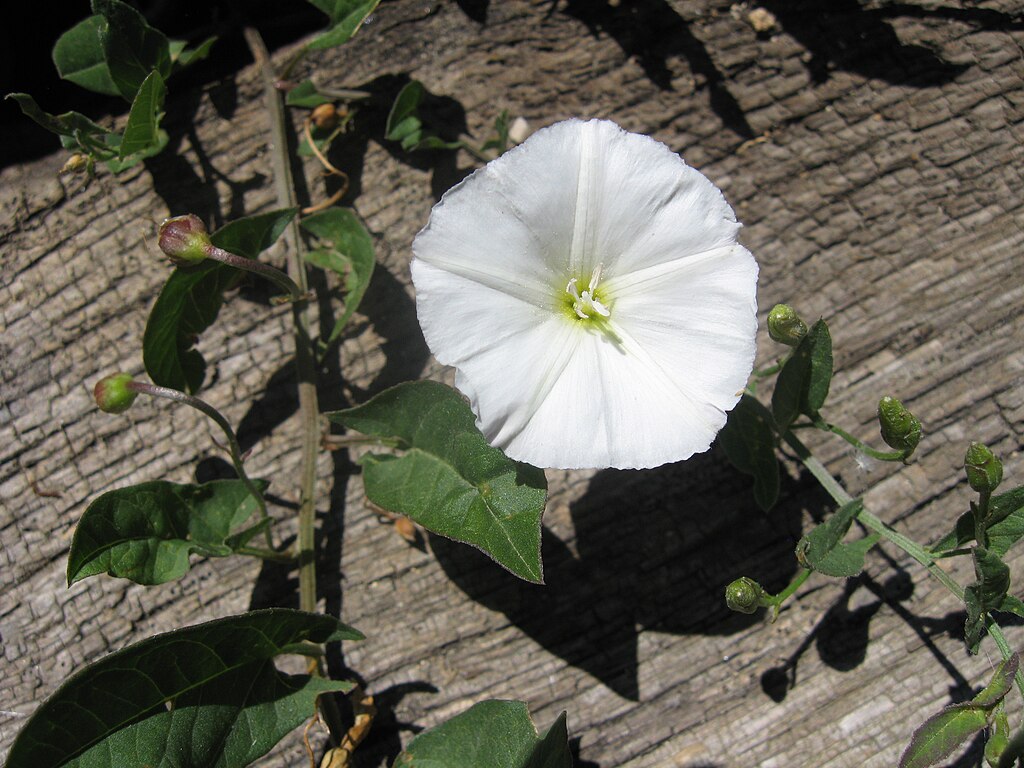
Other plants with trumpet-shaped flowers, like brugmansia ("Angels' Trumpets" because that's what people who eat it reportedly hear, if they hear anything, any more) and the whole Convolvulus genus ("morning glories" and less glamorous bindweeds), aren't food either. The Convolvuli have pretty flowers and are less toxic than the Daturas and Brugmansia, but in similar ways.

Convolvulus arvensis bg.jpg
Donated to Wikipedia by Galia: https://en.wikipedia.org/wiki/Convolvulus . While some Convolvuli have triangular or oval leaves, note this one's resemblance to the Datura above. 
3. Grass. It's hard to get a not-a-lawn completely free from grass, which keeps trying to grow in beneath the flowers and vegetables. I've been known to put mulch around plants I wanted to encourage to out-compete the grass; in the not-a-lawn I just let grass fill in the space between the wild flowers. Grass is the natural food of cows, horses, sheep, some insects, and chickens. It contains too much cellulose to be digested by humans.

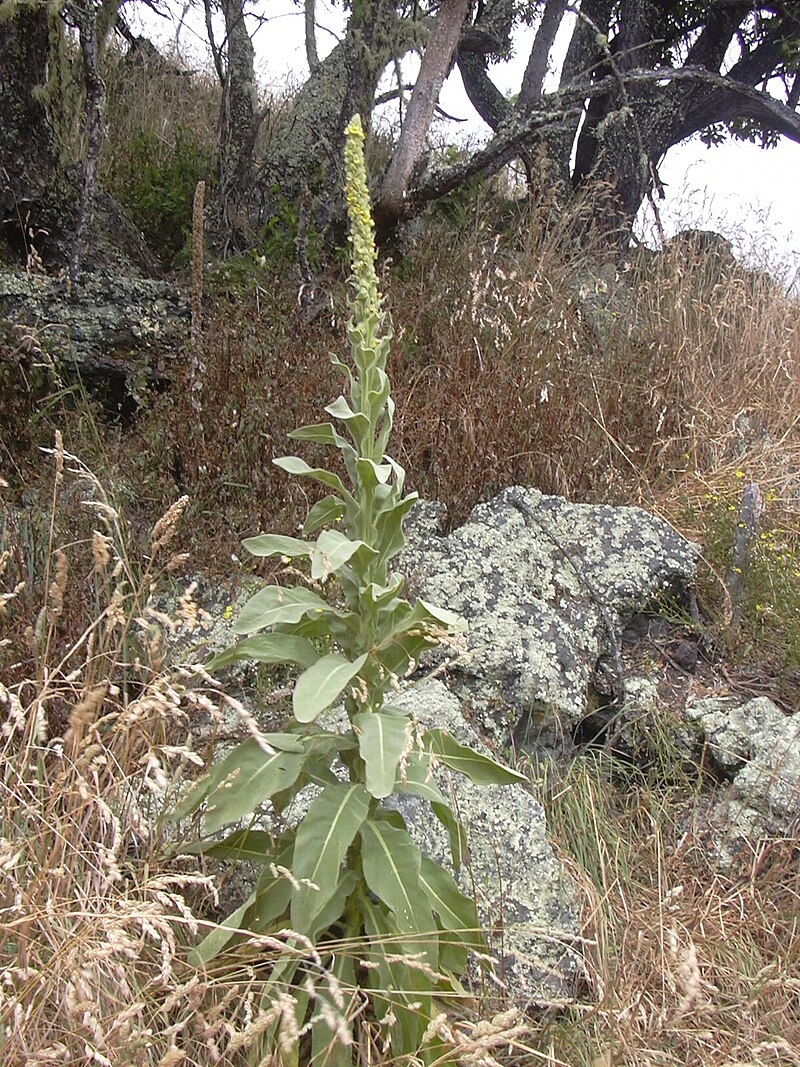
4. Mullein. I like this fuzzy-leafed plant, though it's not really very useful. Its main value to humans is probably as "Quakers' Rouge." Members of churches that used to ban wearing rouge would rub a leaf against their faces for an instant blush. Verbascum thapsus may or may not be really useful as a natural antibiotic or antifungal treatment, probably depending on the amount of glycyrrhizin in the plant, which probably varies.

Starr 040723-0030 Verbascum thapsus.jpg
Photo donated to Wikipedia By Forest & Kim Starr, CC BY 3.0, https://commons.wikimedia.org/w/index.php?curid=6128973

The year the not-a-lawn had enough bare ground for this plant to reach its full impressive size, I was astonished that people thought it was marijuana. It is not closely related to marijuana or tobacco, nor does it really look like either. (Though similar in shape, the leaves are much thicker and hairier than tobacco leaves.) The herbal benefits North Americans have claimed for it have, however, involved smoking the dried leaves as what some herbalists used to hope would be an effective way to break the tobacco addiction. Every plant ought to be good for something--but as nicotine produces a real physical addiction, and mullein contains no nicotine, it's not really even good for those who want to quit smoking. Perhaps its best use is that, after the flowers die down, the stalk is woody enough to make a nice straight light stick, not strong enough to make a reliable walking cane but adequate for a towel rack, spindle, etc.

5. Roses. My white roses began to bloom last weekend, and very pretty they are. If you need a fast but gentle emetic, I'm told, as it might be to give to a child, a bowl of rose petals soaked in honey or syrup is one the child will probably like taking. For other purposes...I've been known to eat an occasional rose hip (mostly seeds, not much flavor, but they are a natural source of Vitamin C in winter), but mostly I think of roses as something to look at, not something to eat.

6. Cleavers. Galium aparine, also sometimes called Galium horridum, is a sort of scentless bedstraw covered in prickly little hairs that stick to animals' fur or humans' clothes. "Horridum" means simply "bristling," in Latin, although as a child I found the sensation of having cleavers stick to me horrid.

Photo donated to Wikipedia By Mike Pennington, CC BY-SA 2.0, https://commons.wikimedia.org/w/index.php?curid=14249638
It doesn't stand up straight, but sprawls over the ground, across other plants, and spreads by lifting easily off the ground and being carried about till someone brushes it off. So in its natural state this plant is most noticeable as a nuisance, and you might think nobody would eat it...but actually people do. All the little hairs melt when the plant is cooked. What happens when it's eaten is still a matter of controversy.

Euell Gibbons said that in Pennsylvania people used to eat bowls full of cooked cleavers, like spinach, in spring, and found it to be "the reducing diet par excellence, painlessly paring pounds from plump persons."


Grandma Bonnie Peters used to dry it and use it in tea. As a tea Galium aparine is generally agreed to have a stimulating effect on the kidneys. I've seen and felt it as a powerful stimulant and febrifuge--"Cleavers take down fevers" fast. 

The effects of natural herbs vary depending on the conditions under which they've grown, but after having used cleavers as medicine I'm not inclined to try it as food. 

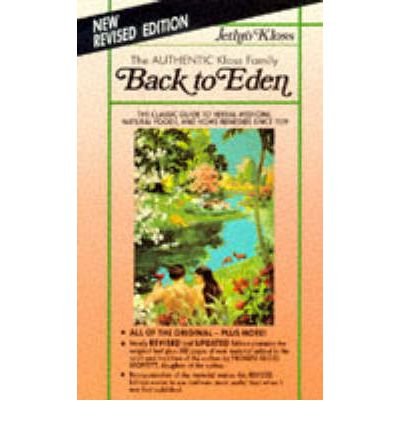
7. Lobelia. In the early twentieth century Dr. Jethro Kloss, of Battle Creek and the Washington Adventist Hospital, used lobelia as a purgative for patients with several diseases. It certainly will induce vomiting fast, without other painful effects. And, while the effects of many herbs vary, lobelia is 99% guaranteed to work within minutes. And it grows well in most of North America. Why pay for things like ipecac when lobelia will grow in most people's not-a-lawns free of charge. 

Well, it turns out, there is a reason. Liberal use of lobelia can damage the brain. While most users of Kloss's masterwork, Back to Eden, weren't tempted to abuse purgatives, after bulimia became a Thing Kloss's heirs revised Back to Eden to contain lots of warnings about the hazards of lobelia. Nature intended us to use this herb in emergencies only, not as a substitute for a low-calorie diet and exercise.

Both GBP and I have found Kloss's work very valuable, but then, neither of us is tempted to abuse emetics. If that's what it takes to stay skinny (which, for most people, it's not), better to be fat.

8. Pennyroyal. Mentha pulegium, the flea-repellent mint, has a pleasant minty odor that discourages flies and mosquitoes. It's also a powerful phytoestrogen. The story is told that at a weekend feminist conference in the 1970s an enthusiasic novice herbalist sold everybody pennyroyal extract to keep the insects away. So on the Saturday nobody was bitten, and on the Sunday the conference broke up as everyone rushed back into town for extra paper products...

From an old herbal, found linked to more information at https://en.wikipedia.org/wiki/Mentha_pulegium .
I believe, from careful observation, that cats and perhaps other animals instinctively use pennyroyal to terminate pregnancy. They do this safely, by rolling on crushed plants, not eating it. Humans can do this too, especially when a woman who's sure she's not pregnant wants to speed up her hormone cycle for convenience in travelling, but, when smelling the herb fails to induce menstruation at once and desperate women start swallowing pennyroyal oil, there are a few recorded cases of fatalities. This is a "power herb" that humans should respect and not swallow.

9. Boneset. The genus Eupatorium contains a lot of confusible tall weeds, and then there's the really distinctive Eupatorium perfoliatum, whose precisely paired leaves grow separately at first, then wrap back around the stalk and join into what appear to be a single "perfoliate," stem-pierced leaf.

Photo donated to Wikipedia By Jomegat, CC BY-SA 3.0, https://commons.wikimedia.org/w/index.php?curid=2609601
People looking at this plant thought a plant that grew so strangely must have special medicinal benefit. They hoped that boneset might cause wounds to heal or broken bones to reset themselves. It doesn't. It does have some benefit when used in moderation; it's a stimulant that can speed up the process of sweating out a fever. No serious toxicity is known, nor have the benefits of the various phytochemicals in this herb been fully explained, except that one of them is chemically similar to caffeine. Like caffeine, boneset stimulates bowel, kidney, and other immune system activity, and an overdose can produce temporary faintness or weakness along with the anticipated purgative effects.

Boneset tea is bitterer than coffee. It is possible that the risks and benefits of using this tea as a substitute for your favorite morning brew remain unknown because nobody's ever wanted to try it. When using boneset tea you don't sip and savor it; you swallow it fast and look for something more pleasant-tasting as a chaser.

Once you know what to expect, the bitter flavor of a single fresh leaf of boneset is not terribly unpleasant, nor are the medicinal effects noticeable. So my brother and I used to like, as a joke, to get some unsuspecting friend from town to nibble on a bit of boneset. After the surprise, a harmless leaf of mint, growing nearby, cleared the bitter taste out of everyone's mouth. But no, I don't actually eat or chew boneset, or recommend that you do, as an everyday practice. It's a medicine healthy people seldom need.

10. Ailanthus. This invasive nuisance tree has invaded the Cat Sanctuary, some years. Where has it not invaded? It's hardy, fast-growing, and toxic to other plants. It's annoying enough that people have tried spraying herbicides on it; that failed. The Chinese claim to have used ailanthus bark for medicinal benefits, but scientific studies don't show that it actually has any. It's a natural herbicide, as tobacco is a natural insecticide. Apart from that it's not even very good for firewood. Nevertheless I try to cut it down and burn it on sight, because that's all it's good for.