Showing posts with label plant. Show all posts

Friday, November 14, 2025

Bad Poetry: Tearing Hate Down with Love


[Photo credit was lost because Google behaved badly.[


Let's all hate
glyphosate.
Tear it down.

In its place
love Queen Anne's Lace,
tall and proud and in your face.
Love milkweed
where butterflies feed.
Love pretty fluff
of dandelion puff.
Love a sharawaggi look;
let tall flowers form a shady nook
carpeted by violets and sheltered from the weather:
Can you get five colors of violets together?

Oh, so mean--
atrazine.
Tear it down.

Where it was
let the laws
of nature mandate kittens' paws
or ponies' feet
or lambs' faint bleat.
Love the children
and the beasts.
Love a fruit or flowering tree.
Bend your back and bend your knee
till every trace of Astroturf or of devil grass
is covered up by something native that was meant to last.

What a blot--
paraquat.
Tear it down.

Cry "begone!"
to the lawn
and the corporate greedheads' pawn.
Plant green peas,
strawberries.
Plant potatoes
or tomatoes.
Let green push away the pavement,
gardens push away enslavement
to the foolishness of zoning that, a hundred years ago,
said that from our homes to work needed twenty miles to go.

Thursday, March 20, 2025

Web Log for 3.19.25

All I had time to find were some spring flower pictures. Most of the computer time was lost to "updates." Nevertheless...

Azaleas never heard of moderation. These are in New Orleans, shared by Messy Mimi, and reposted because I'm seeing a few azaleas starting to bloom here. Like blueberries, huckleberries, bilberries, etc., they like acid soil, and despite their name (said to mean something like "flowers from the desert") they like a reasonable amount of rain but they have to have good drainage. In some parts of the Blue Ridge Mountains (as in Takoma Park, Maryland) they're exuberant. In other parts (as in Hyattsville, Maryland) they don't grow well. Having azaleas says more about your land than it does about you--it's only in Takoma Park that people who don't maintain their azaleas would be seen as failures.


Hyattsville had, by way of compensation for their lack of success with azaleas, generally good success with roses. And forsythias, some of the first and loveliest flowers of Spring. And both Hyattsville and Takoma Park revelled in irides. And Takoma Park is one of the places where spring-beauties can get out of hand....


There's no way Claytonia virginica can ever become really invasive. In the right growing conditions they will spread. If your whole yard starts to look like this photo, you just dig up some of the dainty little plants, enough to give everyone a dish of tubers, and eat them. Iroquois people believed they were a great contraceptive. It's hard to say why they believed that. Claytonia roots look (and can be cooked) like miniature potatoes, and are said to taste more like chestnuts by people who remember chestnuts.


Wednesday, March 29, 2023

Some Doggerel for National Weed Day

How could this web site possibly ignore  a topic so delicious as "weeds"? This is long enough to be Friday's post, but I'll let it go live now, in honor of the occasion.

What gardeners need most seems to be a clearer way of thinking. The wild plants that sprout in the garden, and threaten to crowd out the vegetables and the pricey imported flowers, are mostly not nuisances after all. There are exceptions, like Bermuda grass, that are neither useful nor ornamental, but most of these volunteer plants are actually what a frugal person wants to eat in spring. 


Keep a few of these around;
No better salve or lotion's found
For bruises, cuts, scrapes, burns of skin;
Eat when the leaves are young and thin.


Though they're growing big and tough,
Leaves are smooth as burs are tough.
If last year's roots went to waste,
Here's a pleasant sour taste.


Once the flowers bloom, the leaves'
Bitterness the palate grieves;
But the sap removes all warts
And roots make a tea of sorts.


Though I've never cared for these,
They delight the Japanese;
Roots they pick, peel thick, and pickle
Lend steamed rice a pleasant tickle.


Dig the roots soon as you can--
Morning's work for a strong young man;
While they thicken sauces, they
Help keep heart attacks away.


None of this plant's fit to eat
Till a berry, yellow, sweet,
Shows where that husk splits and dries;
Berries make quite tasty pies.

Nothing's fit to eat at all
On the milkweed coarse and tall,
But its rather pallid flowers
Will be good for many hours
Of bees, birds, and butterflies,
Always pleasing to the eyes.


Dried and brewed with mints in tea
Boneset stimulates, we see,
And may speed recovery.


Cleavers trails along the ground
Till the stiff hairs that surround
Leaves and stems can cleave unto
Something upright, such as you,
This peculiar sensation
Is not pain, but education,
When the plants are brought inside,
In the chimney corner dried,
They become great flu relievers,
Because cleavers break down fevers.


Tasting this one, some agree
It's best left to please a bee,
Though a kind of mint it be.
But a few leaves do no harm
Anywhere mint flavors charm.


Though the stems and husks so hairy
Make this garden stray look scary,
Once the husks have pulled away
From the berries. people say
They're like raspberries to eat,
Only bigger, and more sweet.


Smilax vines are nuisance plants,
Trip us up or make us dance,
Really make our tempers shine,
Often known as "blaspheme vine"!
Yet, in times of hunger dire,
People have lived on green briar.


All Spanish Needles I detest
More than, together, all the rest
Of weeds shown here. Still, in great need,
One might eat even this ugly weed.


If there's an enemy whose brain
Of all his parts seems least,
And whether he's dead or insane
From him you'd be released,
Then friendship with him you might feign
And serve this at a feast.
(But he will surely spit it out
Unless great powers for it you tout,
And now that people know about it,
Can this trick work again? I doubt it.)
The Algonquins put this to the test
When Englishmen became a pest.
For them we see it did not work.
So jimsonweed from ground we jerk,
And then we burn it, in all haste,
Before poor innocent creatures taste.
Still, nothing's altogether bad
In nature. Some use this stuff's had.


Of all things found in any field
This is the vilest "weed."
Whatever else that field did yield
That he felt such a need
To poison, soon there's ten times more
Of it than there ever was before.
For "bigger fleas have smaller fleas
Upon their backs to bite'm,
And smaller fleas have smaller fleas,
And so ad infinitum,"
And so a balance is maintained
By which all creatures are sustained,
Until this fool who thinks he's wise
God's plan for nature to despise
Creeps in and kills the "smaller fleas"
That check the ones that us displease.
So such a feeble helpless thing
As the corn earworm loss can bring.
And still increases each year's grief
Of those who from loss sought relief
By spraying poisons on the land,
Now not a cornstalk can withstand
The hordes of corn earworms unchecked,
And nothing can the corn protect,
And every ear they pick's defiled
Unless it's been completely spoiled,
And each year's gain is less and less,
And sprays cost more, to their distress,
And soon men take them by the hand,
Lead ruined men from ruined land.
If so you've tried to keep a garden,
First beg God's and your neighbors' pardon,
And then all poison sprays forsake,
And seven years' loss you must take
As nature's toll for poisoned land,
And to some other work set hand.
When land's had seven years of rest,
Then once again you may be blest
With crops or flowers worth the time
To plant them, as before this crime.

Friday, July 10, 2020

How Herbicides Foster Evil Weeds

This post would be a lot better if I had a decent cell phone camera...The good plant pictures below come from Wikipedia. The bad ones are mine.

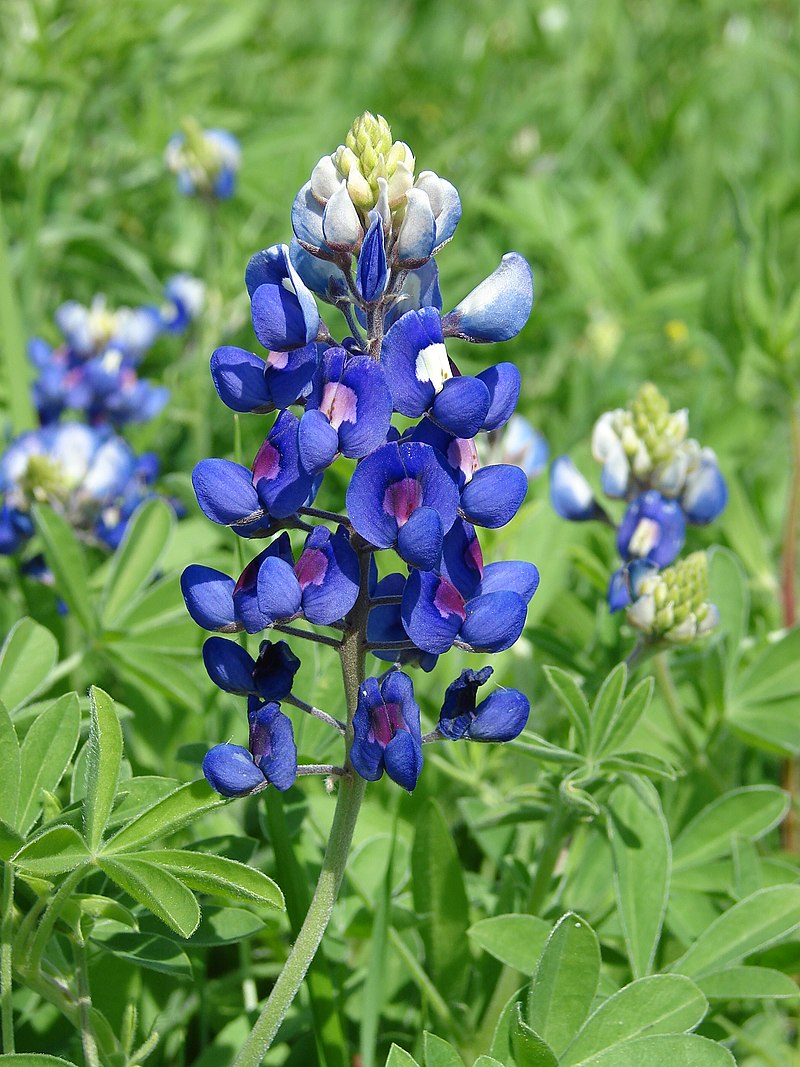
Once again, toward the end of June, Route 23 was desecrated by poison spraying...to kill the wildflowers a wiser generation actually planted there. The lupines, I think, are completely gone now (and I liked lupines).

There are hundreds of species of lupines. Some of them even produce edible seeds. The ones planted along Route 23 in the 1990s were spikier, but this is a native Southern species many people like. This photo of a Texas Bluebonnet was donated to Wikipedia By Loadmaster (David R. Tribble). Also see his personal gallery at Google Photos - Own work, CC BY-SA 3.0, https://commons.wikimedia.org/w/index.php?curid=10100551 .
Some sections of the highway are still lovely mixes of red and white clover, chicory, vetches, fleabane daisies and a few real oxeye daisies in full bloom. The flowers are especially pretty in the morning when the chicory blossoms are wide open, bright light blue. The daisies have taken a real beating from the road poisoners, but the native white vetch is growing and blooming furiously in what is probably a stress reaction. This morning I brushed past two white vetches that must have been close to six feet tall.

There are many species of vetch, too. This European variety has fluffier flowers than the American white vetch along Route 23, but it's in the same general family--tall, narrow-leaved, weedy-looking plants with spiky-looking clusters of flowers rather than single blooms or round "crowns." Photo donated By Bernd Haynold - Own work, CC BY 2.5, https://commons.wikimedia.org/w/index.php?curid=867437 .

Native plants tend to be well adapted to their environments and to displace non-natives. Right after the completion of this section of Route 23, in the 1970s, non-native crown vetch was planted as a safe but fast-growing ground cover. It still grows; its little round crowns of pink and white bloom still form a pretty backdrop, but the white vetch is crowding it back further every summer.

Pink Flowers Crown Vetch DSC 0076.JPG
Crown vetch: pretty, useful to prevent soil erosion, hard to kill (with chemicals), but easy to displace (by encouraging native plants to crowd it out). Poisonous to horses, edible to cows. Photo donated By Daniel Gross - Own work, CC BY-SA 4.0, https://commons.wikimedia.org/w/index.php?curid=38223543

Then there are those sections along the guard rails where you'd think plants helping to hold the hillsides together, below the highway, would be most appreciated...but no. Idiots always spray poison there, and the effect on the vegetation that grows back, afterward, is definitely not what the chemical companies want people to expect.

This is a pathetic cell phone photo of a roadside area that has been sprayed with chemical "herbicides."


In real life, from that distance, you can clearly see...What's growing closest to the camera, front and center, is Johnson grass, which looks like young corn plants but is toxic to cows that eat it.

Starr 030612-8001 Sorghum halepense.jpg
Johnson grass is closely related to sorghum, but seeds look very different from the species used to make molasses. Photo donated By Forest & Kim Starr, CC BY 3.0, https://commons.wikimedia.org/w/index.php?curid=6192566

The smaller plants around it are jimsonweed, which can be used to produce genuine temporary insanity, which may or may not be followed by long-term brain damage and/or death, in humans.

Datura stramonium 2 (2005 07 07).jpg
Jimsonweed in healthier, more mature condition than the measly plants in my snapshot, with blooms and seedpods. Photo anonymously donated to https://commons.wikimedia.org/w/index.php?curid=237684 . Details about the history and toxicity at https://en.wikipedia.org/wiki/Datura_stramonium .

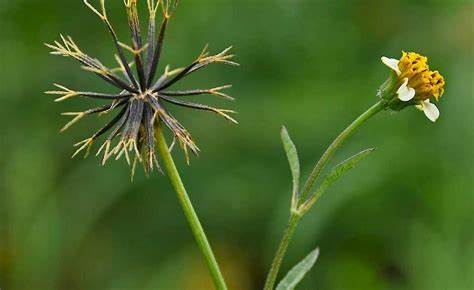
Further along the road are Spanish Needles, the little burs that stick through your clothes and prickle your skin if you walk through them. In places where this weed will grow when it's not been selectively encouraged by poisoning so many nicer plants, people do eat it, but they don't claim to like it. In Virginia, eating any Spanish Needles you find would be a very, very bad idea.

Starr 080601-5248 Bidens alba var. radiata.jpg
I suspect Wikipedia picked this image of a tropical variety from Midway Island because the flowers have visible petals. In Virginia the petals don't show nearly so well for so long, and the needle-shaped burs are much more conspicuous. Photo donated By Forest & Kim Starr, CC BY 3.0, https://commons.wikimedia.org/w/index.php?curid=6153528

The spray that killed the native plants around these three noxious weeds is thus actually promoting the growth of three of the most deservingly hated weeds in North America.


This is the natural vegetation about ten yards from the ecological disaster photographed above. In real life you can recognize the plants here, too. They've been mown rather than poisoned; in real life they're mostly healthy shades of green with yellow at the cut edges. They include crabgrass, dandelions, and red clover. They might be considered "weeds" in a garden but they're just what you want beside a road.

Harig vingergras plant (Digitaria sanguinalis).jpg
In war-torn Europe people have eaten crabgrass seeds; that's why this "large" crabgrass variety is sometimes nicknamed Polish Millet. Americans may never have been quite that hungry, but eating the small, uninviting seeds would be one way to control this garden weed! Photo donated By Rasbak - Own work, CC BY-SA 3.0, https://commons.wikimedia.org/w/index.php?curid=1053034

In my corner of Virginia we don't usually find a lot of Johnson grass, jimsonweed, or Spanish Needles. What nature intended to grow here are the more useful native plants. Dandelions, clover, burdock, chicory, plantain, daisies, buttercups, and less annoying species of Bidens will crowd out the evil weeds, and native fescue and sedgegrass will even displace nasty Johnson grass or Bermuda grass, when they get a chance. Only when people spray poison on our useful native plants do we see the really vile weeds take over.

Trifolium pratense - Keila2.jpg
When these lovely flowers dry out, they can be brewed into a tea that's known as one of the few plant sources of Vitamin B-12. Photo donated By Ivar Leidus - Own work, CC BY-SA 4.0, https://commons.wikimedia.org/w/index.php?curid=50438310

Kudzu and cinnamon vine are the only invasive species that choke out our native wild plants. I recently read an old novel that described a very young landscaper tackling kudzu the way the corporations advise--cutting the vines back to the ground, then painting glyphosate on the cut ends. While painting poison on target plants is much safer for humans and animals than spraying poison is (if I were running the Environmental Protection Administration, people could still get licenses to paint poisons), by now we've all seen what happens to fields where this approach to kudzu has been taken. There are farms that look like this...you can still see vague outlines of fences, equipment, and trucks beneath the kudzu growth.

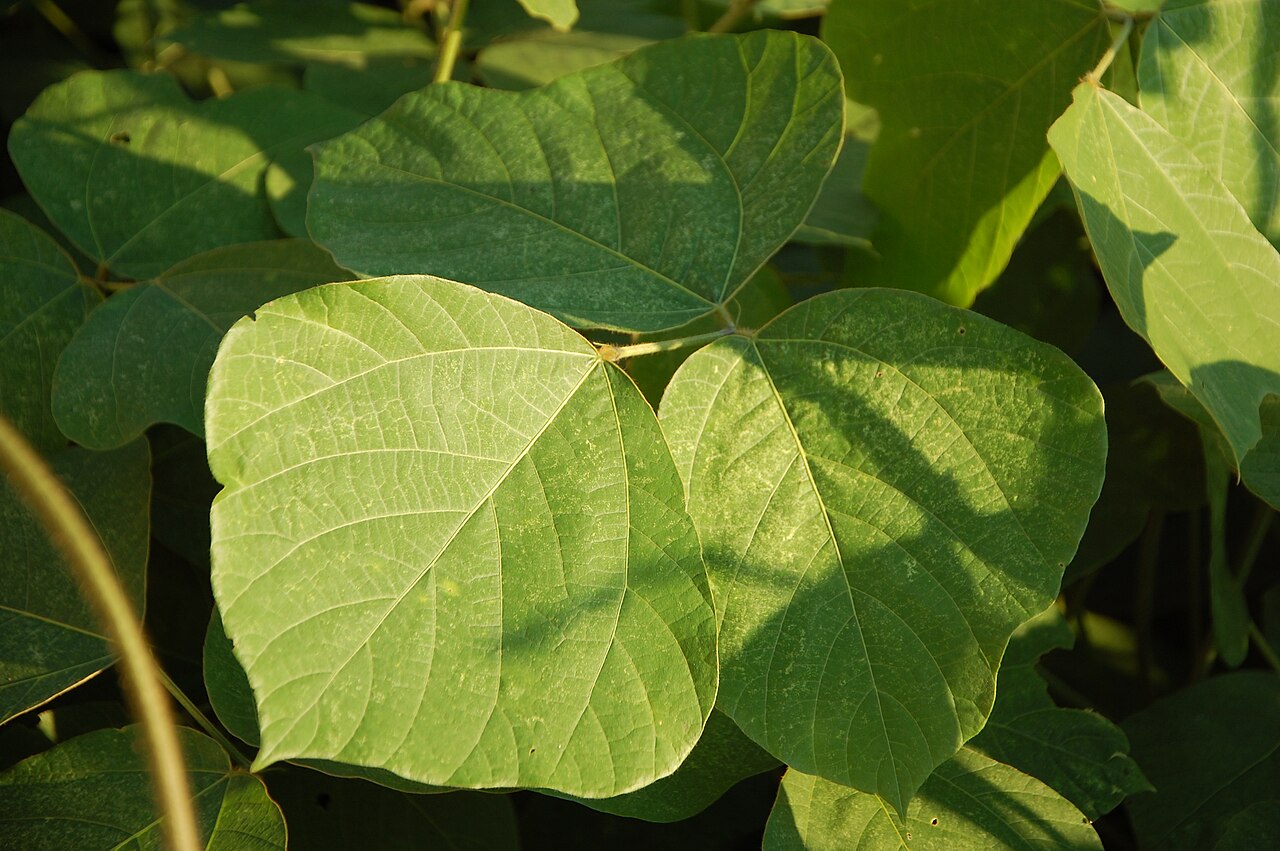
What you get if you follow Monsanto's recommendations for kudzu control. Leaves die in autumn; new leaves sprout among old growth in spring. This is what certain properties in Scott County look like in April, but the clear photo was donated to Wikipedia By Rhododendrites - Own work, CC BY-SA 4.0, https://commons.wikimedia.org/w/index.php?curid=88927032

No. Actually there is a way to get rid of kudzu, for...exercise (I wouldn't say fun) and profit. You have to dig up the main roots. It's a day's work: if the roots don't strike bedrock they may grow twenty feet down below the surface, and they can be as big as your leg. But although cows and goats sometimes eat kudzu leaves, and people can make jelly from the flowers, the roots are the most useful part of a kudzu plant. Dried and powdered, they can be used like cornstarch or arrowroot to thicken the sauce in a stir-fry. Regular use of kudzu root starch in cooking is thought to help regulate blood pressure.
Kudzu. Photo donated By Bubba73 (Jud McCranie) - Own work, CC BY-SA 3.0, https://commons.wikimedia.org/w/index.php?curid=33772551


The main roots of cinnamon vines are "Chinese Yams" or "Japanese Yams." They don't taste like yams, sweet potatoes, or Irish potatoes, but if they're peeled thickly enough and soaked in vinegar for several hours, many Japanese and Korean people claim they taste good. They're certainly welcome to all of mine...but the point is, nature did not intend us to kill animals and harm humans by poisoning even these invasive "weeds." Wild plants have uses and the ethical thing to do with them is use them.

The species that's a nuisance in Scott County is Dioscorea polystachya, the Many-Fruited Cinnamon Vine, and are they ever "many-fruited." Let one vine go to seed and you'll be picking sprouts out of several square yards of lawn or garden...or else seeing those square yards covered in vines. Photo donated By James H. Miller, USDA Forest Service, Bugwood.org - This image is Image Number 2307129 at Forestry Images, a source for forest health, natural resources and silviculture images operated by The Bugwood Network at the University of Georgia and the USDA Forest Service., CC BY 3.0, https://commons.wikimedia.org/w/index.php?curid=18252361


Even the plants we find easiest to hate have their uses. Even Bermuda grass, loathsome though it is to gardeners, does tolerate heavy mowing and give that tacky oldfashioned Astroturf look to a "lawn." Personally I wish people who wanted Astroturf would just buy some and join the rest of the world in helping kill Bermuda grass, but some people do like looking at the stuff. And they'd even have a right to look at Bermuda grass...if they could keep it from spreading beyond their own property lines!

If you want a lawn that looks like this, why waste water, waste fertilizer, and spray poisons? This lawn wasn't very expensive. Sheets that will look like lush, close-cut Bermuda grass for years cost pennies per square foot...and instead of choking useful plants, they'll mulch the ground around the useful plants! Photo of the Astroturf Lawn Look done right donated by By ProGreenGrass - Own work, CC BY-SA 4.0, https://commons.wikimedia.org/w/index.php?curid=38355102

I don't like wild grapevines, and neither did the Bible writers, who expected everyone to relate to the disappointment of a person who had planted domestic grapes in a field that "brought forth wild grapes." However, people make things, wreaths and sometimes even baskets or hammocks, out of wild grapevines.
Wild grapes will eventually look like miniature grapes. They're edible, though not very palatable or nutritious. Photo donated By Vassil - Own work, Public Domain, https://commons.wikimedia.org/w/index.php?curid=2098262


I used to live near a park where the rangers didn't like chinaberries and phragmite reeds, both of which had invaded the park from suburban gardens. I don't mind either of those plants myself, but if you do, you should know that crafters find all kinds of uses for them. If I wanted to get rid of these or other introduced ornamental plants that have spread and become nuisances, I'd organize a crafts contest with a cash prize for the most inventive use of them.

It's possible that NASA chose to donate this picture of supersized phragmites from the Great Lakes, rather than the Greenbelt or nearby parks along the Anacostia River, because in Maryland the reeds never seem to grow quite that huge. Some scientists think there's actually a native variety that is easily crowded out by a more invasive foreign variety of what seems to be the same species. Photo donated By NASA Goddard Space Flight Center from Greenbelt, MD, USA - NASA Tracks an Environmental Invader, CC BY 2.0, https://commons.wikimedia.org/w/index.php?curid=81860613


If I wanted to get rid of crabgrass, I'd tear out the clumps it forms and sow fescue or sedge grass. (It's noteworthy that Wikipedia uses "sedge grass" to mean a different genus than what my elders called by that name.)These grasses grow taller, and will shade out crabgrass and even Bermuda grass if you let them.

Lolium-pratense1web.jpg
Fescue in full bloom. Photo Public Domain, https://commons.wikimedia.org/w/index.php?curid=2740153

You don't want to get rid of clover, dandelion, dock, plantain, or daisies. When these plants grow right on the berms of busy highways they're not fit to eat, but they do absorb pollution and reduce soil erosion. When they grow in yards, near houses, they are food. They nourish many other creatures as well as humans, which is a good thing.

There are only a few plants for which nobody has ever found a good use. Three of them are Johnson grass, Spanish Needles, and jimsonweed. (Actually some historians believe jimsonweed was reintroduced to Europe and Africa by people who wanted a new way to commit murder...but though researchers have experimented with microdoses as cures for diseases, nobody has yet found a good use for jimsonweed.)

"You can't please everybody," wailed a local park manager. "I like the nice clean" (imitation Astroturf) look of that bank. It looks as if someone cares about it," which he must do, having mown that steep bank in the hot, humid weather we've been having. "It's not a scary, ratty, snaky look."

Americans need to re-educate ourselves to feel less fear of native plants and the other natural inhabitants of our natural environment. The kind of rats and snakes you might have been trained to fear do not live in my not-a-lawn, although my family have been encouraging useful native plants to choke out any invasive Bermuda grass that might creep in, for many years, and some years the ladies' thumbs "grass" does grow four feet high. The main reason why we've never had problems with undesirable rats and snakes are (1) the resident snake, and (2) the cats. If you don't entertain morbid fears of cats and the friendlier kinds of snakes you won't have to worry about vermin lurking among native plants, either.

Black Rat Snake - Elaphe obsoleta obsoleta, Merrimac Farm Wildlife Management Area, Virginia.jpg
Though scientists are currently debating what its Latin name ought to be, there's nothing "obsolete" about this common, harmless snake. The Black Rat Snake is the "climbing" species properly called gulegi in the Cherokee language. They're not venomous (though the big ones can chomp). They're not social; apart from occasional mating visits their only interest in other snakes is eating them. (The myth that they mate with venomous snakes comes from the difficulty some people have in telling exactly what snakes are doing.) They can grow big enough to eat a dumpster rat. They usually avoid humans. If you live near one of these snakes you'll probably never see a venomous snake. Photo donated By Judy Gallagher - https://www.flickr.com/photos/52450054@N04/6936274620/, CC BY 2.0, https://commons.wikimedia.org/w/index.php?curid=54266563

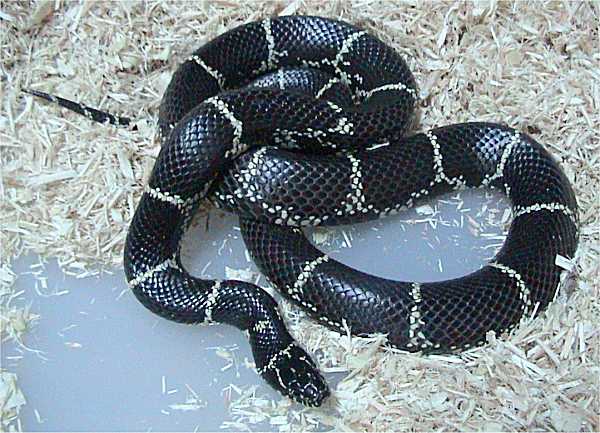
The Black King Snake is a little showier, less common, and less likely to grow more than a yard long, although it can. The more common variety of King Snake where I live has bands of light brown and tan. Other species have other patterns--some even ringed with red and black, like poisonous coral snakes. But they don't harm humans. They don't let inferior kinds of snakes harm humans, either. Their favorite food is a smaller snake. Photo donated By en:User:Dawson - Own work, CC BY-SA 2.5, https://commons.wikimedia.org/w/index.php?curid=1518737


By itself a taste for the dowdy Astroturf look might be considered harmless, like a taste for red over white roses or vice versa. However, we really can't afford to indulge any landscaping tastes that depend on spraying poisons on the land. Dead songbirds, or sick people, or even learning-disabled children, need protection in a way a garden look does not. We all need to learn to appreciate the beauty of clover, dandelions, and chicory.

The result of a phobic reaction to these pretty, useful native "weeds" is--really nasty weeds.

Friday, January 31, 2020

Three-Colored Lawns as Evidence of Glyphosate Poisoning

Flu has made its rounds during the past three weeks. There was talk of closing the schools. A school in Tennessee really was closed for a day or two as all the teachers and students stayed home to sweat out the virus.

I had it, after what's become my usual fashion in the last ten years. Nobody else would have noticed. I could tell I had the virus because I felt chilly even in a room where people who hadn't been walking briskly outdoors were comfortable, because my eyes got tired easily, because I felt tired by ordinary routine chores or even by eating...you know, that fighting-the-flu feeling. It was not a stomach flu (norovirus is the one that always gives me noticeable symptoms). It did not affect the digestive process.

In my forties I had this feeling for hours, maybe a day, at a time. This winter I noticed it for about ten days. Is that because I'm now in my fifties? I don't think so. Up to about age thirty, as a young undiagnosed celiac, I did not shake off that fighting-the-flu feeling. I came down with the flu. Yes, and as a child, when I was forced to eat everything other people thought I needed to eat and bundle up when other people thought I needed to bundle up and go outside when other people thought I needed to go outside, I didn't even have separate cases of colds and flu during the winter; basically, if it was winter, I had a cold; the question was whether I was sick enough to distract the teacher when I went to school coughing and sneezing at people. Because the law required children to be sent to school on 145 days of the year, even when what they were learning at school was to stay home when they had a cold, and even when they had one...which was why, as a teenager who was a little healthier and finally able to enjoy some of my classes at school, I was still very keen on school choice.

I don't know about you, but when I talk about changes in the quality of my life during the past ten years, I'm old enough to be told "Well, of course, you're getting older." What is getting old, stale, and tired of living is that cliche phrase. We are all getting older. My Nephews are noticing the same sort of changes, and although not all of them have even reached their full height yet, fourteen years old is older than four. However, the changes in the quality of my life (1) correlate pretty precisely with my exposure to glyphosate, and (2) feel to me like being younger. Like aging backward. I was not a healthy person until age 30 so when I feel sick it brings back memories of youth or even childhood. Not the sort of childhood I wanted The Nephews to have.

There are some changes we can all expect to happen just because, after a certain age (it varies, and seems to be determined by genes), the human body's hormone balance changes. In between one range of birthdays we grow taller, then grow heavier, and the texture of our skins changes to allow the skin pores to become bigger, and some of those pores tend to clog up, etc., etc. In between another range of birthdays we start growing more white hair in place of black or brown or whatever it used to be, and the texture of our skins changes again to allow the skin to dry out and form wrinkles more easily, and those of us who don't get enough exercise find ourselves losing weight in the form of calcium from the bones, etc., etc. I am actually starting to grow white hair, although during glyphosate reactions it falls out so it's not showing yet. The other changes normally start later in my family; no doubt they'll come along in due time.

Illness is a separate thing from age. The two things are correlated to some extent because, the older we are, the harder it is for our immune systems to recover from some kinds of illness--notably flu. However, young people can be ill and old people can be healthy.

One thing that definitely cheats some people out of enjoying a healthy old age is confusing age with illness. No symptom of illness is a valid indicator of age, but the belief that low-grade chronic illness is part of "growing older" keeps some people from correcting imbalances in time to avoid more serious illness...and illness definitely makes the body "older," slower to recover, more vulnerable to the next attack on our health.

So I had this dopey-sneezy-sleepy-grumpy-bashful feeling for ten days, and finally shook it off. Then on Wednesday morning I woke up at two o'clock, sneezing and sniffling. Having been well hydrated to help keep off the flu, I didn't dry out enough to go back to sleep until after six. Then my brain kept remembering that six o'clock is time to get up, so I caught three separate ten-minute naps before it was time to go to work, still losing water as I trudged through the drizzle that didn't become a real rain. At least only water was draining out of my face (nose, and also eyes). When I used the toilet I lost about a tablespoon of blood.

Where had that come from, I asked myself. What had I eaten that might have been contaminated? I decided to stop sweetening my coffee at the cafe, just in case.

It was raining when I went home. I felt dopey, sleepy, sneezy, grumpy, bashful, and a few more little guys Disney overlooked: lazy, weary, whiny--and the last one wasn't "Doc," he was "Blocked." Disney mis-heard that one. He mis-heard "Happy," too, but this web site's contract bans mentioning that Dwarf's real name.

On Thursday morning the junior cats Silver and Swimmer came to breakfast, one with her left eye swollen hut, one with her right eye swollen shut. I was sniffling again, and had the predictable gas bloating that means the sniffles were caused by glyphosate vapors rather than a cold. The junior cats had, too. Poor little things, they probably remembered it from when they were kittens...that was how Swimmer got her name; she was trying to climb up my coat, wasn't strong enough, and fell into water. Most cats hate to swim, but they can.

When I came in on Thursday evening my nose was clear enough to notice just one whiff of a smell I've learned to loathe, as I walked past a house someone has been trying to sell. Then my nose clogged up again and all the water in my body started trying to pour out through my face, again.

Then I came home, and my Queen Cat Serena, who snuggled against me for many a kitten-nap but does not think snuggling befits a Queen...snuggled. Yes. Serena was snuggling. Serena didn't have a real fever but her nose was warmer than it ought to have been, from inflammation, from breathing toxic vapors. Serena wasn't feeling well either. Serena didn't seem positively ill during any of last year's glyphosate episodes. Well, she didn't seem ill enough to be taken to the vet yesterday, either, but she was not her tough and sassy healthy self, not the cat who always shrugs away any petting and tries to redirect me to throw or drag something she can chase. What was bothering her was closer than the railroad.

I went into my home office feeling not just grumpy, but seriously angry. I can be too soft when it comes to forgiving or even pardoning things people do to me, personally. Touching my loved ones is the way to see the fighting side of me. I know who poisoned Serena. I'd always thought of them as a nice family, before. I'd even presumed to pardon them for poisoning some valuable wineberry bushes, because the poor idjit had not looked them up but only asked the guys at the shop, who'd told him they were poisonous. However. I went into the office, closed the door, and I started praying out loud: "God, please heal these cats and all the other innocent animals this fool has poisoned, and transfer all of their suffering to him, now."

Even if I felt any compassion for people who torture other people's pets, I couldn't forgive them. That would not be possible. Only those animals and the God Who made them can forgive those who poison animals. And I hope to live to see those disgraces to humankind suffer much, much more than any individual animal...enough to balance all the misery of all the animals who did and did not survive.

I got up this morning knowing that it might be a good market day, but I had too much to do online. One job  to collect payment for, one to finish, one to negotiate. Cyberchores to wrap up. Yes, although the big glyphosate news story hasn't broken enough to be worth reporting yet, it's been a month; there ought to be a Glyphosate Awareness Newsletter. And also there had to be a blog post about what the cell phone's cheap little camera doesn't quite show you: the three-colored grass. No direct sunlight, no true colors in cell phone pictures. You might think this photograph of the lazy fool's side yard shows just the usual wintertime mix of tiny green plants and frozen dead ones. Look again. The colors are grayed, but you'll see that two of those grass stalks, and a few of the blades of crabgrass, have a much redder color than the other yellowish winter-killed grass...


What produces that three-colored grass? New, green grass (including crabgrass) pops up, even in January, whenever the temperatures are not actually below freezing. Idiot and his sons used, when his children were living in the house, to mow this sloping patch of yard every week. That was bad enough, because the slope is below a road and Bermuda grass will not hold a steep bank below a road in wet weather, as we have all seen along Route 23...but on Thursday, probably in the morning, one of this idiot family had swung by and thought, "I don't have time to mow but I don't want any prospective buyers to see unmown grass--horrors!--so I'll just spray poison on the whole lawn." During the next few hours, glyphosate had no effect on the yellow vegetation, which was already dead, nor on the new vegetation, which continued to pop up, but it dried out the stalks of those other little plants and some of the tips of the crabgrass, producing that brighter, redder color for a day or so before those plant parts will fade to the same color as the parts that died naturally.

What woke me in the night would have been glyphosate vapors drifting up from the railroad, which was lined with three-colored vegetation this morning too; the Southern Railroad Company always spray poison on the railroad in the middle of the night. What I smelled yesterday evening would have been a fresher application of glyphosate to the idiots' yard. Maybe it was even some "helpful" real estate agent, rather than the idiots themselves, who poisoned the yard; I wasn't watching. But that three-colored yard tells us all we need to know.

I'm not going to post the idiots' name here, but I am going to post the picture of the property they're trying to sell, so that they can keep paying taxes on it for another ten years or else pay somebody to take it over.

One thing we can do to build a healthier world, Gentle Readers, is to look for three-colored vegetation around houses for sale. People poison their yards because they think that will help them sell houses for higher prices. We can help correct that mistake. We can publicize the fact that these properties may contain residues of poisons that may make people sick for who knows how long, so their market value has dropped below zero. We can tell owners who are trying to unload real estate with three-colored grass around it, "I might take that place off your hands if you pay me a couple of thousand dollars an acre, just to pay taxes on it while it recovers from having been poisoned! It's not worth anything now, for sure. Maybe in ten years, if the soil is assayed and all that stuff you sprayed on it has completely broken down, it might be worth some money again. Maybe. It's a very risky investment."


Do not buy this property, Gentle Readers. Do not let anyone else buy it. That lovely, scenic little brook runs below the poisoned grass shown above. It is washing glyphosate residues, AMPA and other nasty stuff, down toward Tennessee now. Whoever owns it might be considered responsible for making people sick in Tennessee, Arkansas, Mississippi, or even Louisiana. Yes, the idiots who poisoned that grass need to pay anyone who takes the risk of owning that field now.

We should be snapping pictures of poisoned properties, whenever it's possible to snap a blurry image that proves that plants have been poisoned. We should be posting them on social media with tags that include #GlyphosateAwareness and the name of the nearest town, e.g. #GateCityVA, so people will know better than to pay for these properties.

Further along the road, before accepting a lift into town with a neighbor, I saw further evidence of glyphosate poisoning along the railroad. Some poor soul had spewed blood-flecked mocha-colored froth into a napkin and thrown the napkin out beside the road. Since it landed on the passenger's side, who knows whether the sufferer spewed upward or downward, but it had definitely come out of a human body. Maybe the body belonged to the fool who poisoned the lawn; I hope it did, rather than to some innocent child who waited for the school bus at a railroad crossing. It was too cold for frogs, dead or alive, or for birds to be flying and singing. I did not see a dead bird...yet. At least the robins I've often seen flitting over the lawn photographed above are probably still further south.

I came in, sat down, bought coffee, went to the bathroom, and instead of anything a healthy person would see floating around a water-flush toilet, what I flushed away this morning was about a tablespoon full of blood and little separate semi-solid blood clots. That, too, is now on its way to promote the growth of cancers, the loss of valuable native animals and birds and insects, and the growth of Bermuda grass and Johnson grass and Spanish Needles and kudzu and very little else, in Tennessee. Sorry, Tennessee readers, that's what youall get for having sewer systems so you can keep those nasty old water-flush toilets. Nobody in Virginia would be dropping poisoned blood into your water supply if we could help it. 

Maybe it's a symptom of glyphosate poisoning, too...I think people need to have the evidence of the harm glyphosate does shoved in their faces. I snapped a picture of blighted grass. Maybe I should have snapped one of the blood clots. Maybe I should have saved the actual blood clots, themselves, and thrown them at the idiot's white door frame. Maybe what worked for the homosexual lobby is what it will take to convince Americans to stop the insanity. 

There is not, there never was, and there never will be a "weed" as ugly as glyphosate. Friends don't let friends spray poisons...especially on yards they are hoping to sell.

Tuesday, September 11, 2018

Phenology: Pests Recovering First, with Christmas Present Hint

Here's the follow-up from last week's post: Rereading, I realize that 


could have been better written. I described the scorched earth along Route 23 for people who'd been there, and thus omitted a crucial detail. Every yard of this roadside was not equally poisoned. Real moonscapes where everything had been killed appeared along guardrails. Selective spraying of bigger plants was visible along other segments (about as long as city blocks) on the three-mile roadside I described. There were greenish patches and browned-out patches.

During the past week, after the storms we've had hot humid weather, the kind we normally get in late July or early August but had missed this year. (We have still not had a true Code Red Day! All summer long!) That was what some plants had been waiting for; and although most plants are harmed by glyphosate, some plants react to it (and to other "herbicides" that haven't completely killed the roots) with bursts of explosive, aggressive regrowth. 

As a result, the eastbound side of miles 4-7 on Route 23 now has a weird, patchy look. Here, with predictable swirl effects, is the best I could do toward documenting it with a cheap cell phone camera. You still see scorched earth along the guardrail, but in this particular spot you can see positively lush regrowth with all your favorite late-summer flowers, not far away! 


That's goldenrod...one of my favorites,'cos people used to blame it for my hayfever and asthma and it is so not an allergy trigger for me, but not necessarily one of your favorites,'cos it is a weed that crowds out garden plants and it does trigger some people's allergies. It felt the burn from the poisoning nearby. Close up you can see a few withered leaves. But it's roaring back. So are the other roadside standards I missed last week. Chicory, Ladies' Bedstraw (so called because it smells the way good perfumes try to smell), daisies, Queen Anne's Lace, wild sunflowers, native vetches, jewelweed (both orange and yellow), petunias, dandelions, late honeysuckle and red clover, morning glories, kudzu, a few early asters, had all been blooming slowly or not at all before poisoning, then withered by poisoning, but oh how they're roaring back now. Along some stretches of Route 23 the blue, yellow, pink, and orange are positively screaming at each other. If you can't be here later for the leaf peeping, you might want to drive through now for the flowers.

Along those guardrails...you can actually see a few things starting to grow back. Spanish Needle's preliminary rosettes appeared first but wild garlic, dandelions, and convolvuli grow fastest. But don't eat any of those wild garlic and dandelions, delicious though young sprouts of both species are when they pop up in your unsprayed not-a-lawn at home. They are cleaning poison out of the soil along Route 23 and are probably poisonous enough to send some people to the hospital.

The convolvulus varieties called bindweeds, or "bad bindweed," grow much faster than the varieties called morning glories, which have prettier flowers. I saw two varieties of bindweed and three of morning glory blossoms. More about this large family of flowering vines:


When you poison anything, even with natural disease germs that affect some other lifeforms but are harmles to humans, you always see more of the unwelcome lifeforms sooner than you see more valuable species that are vulnerable to the same toxin or pathogen.

Here in the Blue Ridge Mountains, nobody wants to see heirloom orchards and historic forests munched up by the unlovable larvae of Lymantria dispar, the Dreaded Gyps, so various bacteria and virus cultures have been cultivated for the purpose of making Dreaded Gyps sick. These are diseases that caterpillars naturally get; human interference is being limited to collecting and concentrating the pathogenic microorganisms so that more caterpillars succumb to these diseases. Caterpillars are alien enough from birds and animals that most of the diseases they get do not affect most of their natural predators.

Predators are important because the only real problem with the gyps is that in North America they don’t have enough predators. Nature controls populations of this over-reproducing species in two ways. In Europe, where they’re native, birds eat them; and also in Europe trees have evolved to be less nutritious or even toxic, so that it’s harder for little gyps to survive. In North America, where neither of these natural processes has had time to occur, humans have to become predators on gyps, which is a nuisance—even though the most efficient way to do it does not involve handling either poison or caterpillars.

To control Lymantria dispar, which is required by law in some parts of the Northeast, you just look for light brown furballs that adhere to vertical surfaces, showing that they were not coughed up by a cat. They actually consist of a froth of gypsy moth eggs covered by the parents’ long loose hair. (Most moths have a lot of body hair. Gypsy moths are positively furry when they emerge from their cocoons, but shed most of their hair in the process of fertilizing and laying eggs.) You scrape this egg mass into a bucket and burn it. You don’t even have to kill anything that can feel pain.

The Blue Ridge Mountains contain enough acres of forests that so far nobody has felt confident about recruiting students to collect all the gypsy moth eggs, although it’s the kind of tedious job that seems naturally suitable for convicts.

Anyway we’ve had almost a mothless, butterfly-less, wasp-less year at the Cat Sanctuary. Mainly I’ve missed my colonies of Polistes fuscatus, which are almost exclusively insect eaters and, being insects, are vulnerable both to insect diseases and to nest predation by stinkbugs. If you hate having gnats dive at your eyes and nose as much as I do, you too can positively warm up to paper wasps.

I’ve seen only one pair of Tiger Swallowtails, our state butterfly. Normally there ought to be dozens by early September. They’re great composters and particularly like slurping up oil-slicked mud; males gather in masses at polluted puddles and females fly around checking them out. But not this year.

I’ve seen only three cute little Desmia moths, who eat wild grapevines, which are native but a nuisance.

I’ve seen none of the amusing Tiger moths, of which my favorite is Haploidea bipuncta...but I’ve not seen any Isia or Arctia either. (Then again, I have seen encouraging numbers of Hyphantria cunea in the fall, and several caterpillars of a related family that have the English name “Daggers.” Daggers caterpillars are mostly covered in long pale fur, with a few ornamental tufts of dark hair that might suggest daggers on a belt.)

This cell phone takes bad, bad pictures, even under ideal conditions, but that's the general shape of a Daggers caterpillar crawling on the rim of a water dish.

I’ve seen no Sphinx moths all year. (Big Sphinx moths in the genus Manduca are pests; smaller ones are interesting, with long lives and strong bodies as moths go, enough sense not to be distracted by lights, and in some species the ability to hiss or squeak.)

I’ve seen very few of the pretty Zebra Swallowtails on which pawpaw trees depend for pollination.

I’ve seen none of the smaller dark swallowtails the female Tigers imitate.

I’ve seen no Tulip Tree Beauties and very few of the smaller Geometrid moths whose caterpillars are called inchworms.

I’ve seen just a few little dark Skipper butterflies, none of the Silver-Spotted ones, which can be a nuisance but are another species of great composters.

I’ve seen one or two Red-Spotted Purples, one or two Vanessas, but no pairs...and no Fritillaries.

If I’d seen the Hibiscus Leaf Moth in time, I wouldn’t have seen...actually, only ten or twenty Hibiscus Caterpillars got past the wrens and cardinals, but as Mother planted only two Hibiscus syriaca that was enough to blast the flowers and defoliate one of the bushes.

And then on Sunday night I went out looking for hibiscus caterpillars at night. I didn’t see any. I did see spiders watching for them, which was sort of heart-warming (I like spiders, and anything else that eats gnats and mosquitoes), and then I also saw the “Packsaddle.”


Books usually call this caterpillar “Saddleback,” but its four branching bristles, and the color pattern that suggests a vented cover, look remarkably like an oldfashioned pack saddle. Funnily enough, when I was growing up I heard people calling the more common Daggers “Packsaddles” too, since some of them have four tufts placed at the corners. That may be why the local common name is not used in the books. If you touch them you'll know the difference. Daggers look spiky, but their soft fur feels almost like a cat's fur. Packsaddles' bristles sting.

Out with the loppers and I brought this nasty little animal indoors. Packsaddles’ branching bristles are loaded with venom so, although interesting, they’re another species that needs for humans to be predators, not poisoners. I didn’t think the local population needed to be allowed to evolve a taste for hibiscus leaves and I think they always need encouragement to evolve a preference to stay as far away from humans as they can get. As with gyps: see one, kill one. They have thick little hides so this one didn’t seem badly hurt by being picked up in the loppers. (I use loppers to pick thinner-skinned hibiscus caterpillars off the leaves and kill them.)

They’re in a family of moths, the Limacodidae, defined by the caterpillars’ peculiar feet. Note how smooth its underside looks. The feet have suckers rather than claws and stick out at its side edges.


This specimen of Acharia or Sibine stimulea is in a tin of wax I use for off-grid cooking, perching on kitchen matches, to illustrate how small it is. I don’t particularly care that it’s hardly an inch long; if it had got down someone’s neck it could leave more than an inch-long rash. No points for guessing what’s about to become of it.

Most insects have relatively thin exoskeletons so burning them in a tin of wax is a very efficient, humane way to kill them, almost as humane as crushing them with sticks or, if one happened to be a bird, in one’s beak. The Packsaddle, unfortunately, has a thick skin and might have had half a minute to feel the heat before it stopped quivering and sank down into the melting wax.

Moths and butterflies are so small, with so little room for brain, that many species display mind-boggling “stupidity”—lack of perceptions and defenses other animals have. The Packsaddle is able to depend so completely on its thick skin and venomous bristles that it didn’t try to escape while being photographed, even when handled (with burnt matches, held like chopsticks). For this caterpillar, unlike most, standing still and letting itself be gripped is its most effective defense, so nature has not provided it with others.

When transferred from the loppers to the matches propped up in the wax like candle wicks, it bit into a charred end, spat out a lump of charcoal, and flopped down onto the solid wax. (I took a picture of its little beady black head biting off an end of a match, but that one came out even worse than these pathetic pictures you see above.) When turned upside down to display its slick underside it did display a righting reflex (few animals want to stay upside down), but it didn’t try to move off the wax. Even when I lighted the matches the Packsaddle showed a lack of survival intelligence, a complete reliance on survival instincts that were all wrong for the situation. It clung to the wax as the wax melted under it, quivering but not budging, holding up its bristles.

The appearance of the Packsaddle, Daggers, and Fall Webworms shows that autumn caterpillars are less affected than spring ones, which means local populations of moths and butterflies that have two-month life cycles may begin to recover this fall. Swallowtail caterpillars and inchworms can be considered fall as well as spring species.
But you notice which species are recovering first! In the fifteen years since Mother planted the “Rose of Sharon” hibiscus bushes, this is the first time they’ve attracted a Packsaddle.


Can this post use an Amazon link? Oh totally! Click here to improve the quality of photos at your favorite web site...

GoPro HERO4 BLACK
https://www.paypal.me/PriscillaKingUS/188