Showing posts with label censorship. Show all posts

Friday, October 10, 2025

Bad Poetry: One Sister for Sale

"One sister for sale! One sister for sale!
One lying and spying young sister for sale!
This is not about my biological sister
(Though one is a blister and one is a twister).
It's about the sisterhood, likewise the brotherhood,
Of those who do evil and think they do rather good. 
They say banning books is the best way to get
Protected and sheltered from feeling upset
By writers who might not appreciate your type,
But underneath all of their posturing and hype,
Books where people might think and do things for themselves
Are the ones they remove from the library shelves.
They say information might go out of date,
But really what they mean is how much they hate
That anyone might make some increase in knowledge
Without paying outrageous fees to a college.
They say feelings are hurt if some type is left out,
But what they are doing is trying to tout
Books nobody ever liked, or ever will,
That readers would gladly send to the landfill,
In place of books readers have always enjoyed,
Because they express ideas 'Sis' wants destroyed.
One sister for sale! One sister for sale!
One prying and crying young sister for sale!
I'm really not kidding, so who'll start the bidding?
I've already put up with so much of her guff,
It would be hard to take her far away enough!
I don't even care if you treat the brat rough!
Why, even some lists of books that have been banned
Are sales pitches for books whose rejection was planned
And continue to participate in suppressing
Books that bring readers joy, learning, and blessing.
One sister for sale! One sister for sale!"

The proimpt at DVerse was to write a poem around a line from a banned book. Shel Silverstein's goofy, funny poems for kids (and the inner kids of adults) have been banned from some school libraries as likely to encourage unruly behavior, such as, in one poem,  trying to sell a younger sibling. Some of the lines of this verse are direct quotes from a short verse in Where the Sidewalk Ends.

Thursday, December 26, 2024

Censorship and Cybersecurity

A rant that outgrew the Link Log... 

Let me begin by saying that I, personally, will never miss Tiktok. I have about 200 tabs full of videos that people posted instead of writing blog posts like human beings, and how many of them I'll be able to watch before Google loses the tabs--much as I want to keep up with these people's news--I have no earthly idea. Videos take too long. I tolerate "vlogs" as background noise here on the screen porch because no one else objects to them and because the "vloggers" are older bloggers whose eyes can't read screens as they once did. They're walking around without white canes, but there is a real possibility that, if they read and wrote real blogs, that might cease to be the case. They have to decide what their old eyes are going to see, these days. But I am not interested in the videos young people post because they're too lazy to learn to type. I seldom leave the tab playing the video on the screen; I'm not going to spend those minutes looking at anybody's foolish face. I want people to type at least tweets, or Blue Sky "skeets." Life is too short to sit through videos.

But although Tiktok has already exposed all the personal information young Americans so foolishly shared to people in China who might become our enemies if socialism does enough economic damage in their country, while telling them how rich we are...although a hostile Chinese person who wanted to steal a Tiktokker's identity for evil purposes might already have digital "verification" of that Tiktokker's real first name, where person goes to school, per friends' and crushes' and teachers' names, per face, per voice, per way of walking, and per fingerprints as scanned from a touch screen...as a mechanism for gathering data Americans, and I include everybody on at least the northern continent, should never have typed or scanned into a computer, and using that information to harass people, and claiming a need to censor "hateful" and "hurtful" content as an excuse for censoring valid information that "hurt" sales and political campaigns of people who couldn't dispute the facts, Tiktok's record is outclassed by Meta's. The fact that Meta is US-based in no way means that Meta is either pro-American, or less than un-American. 

Meta is the company that started out as Facebook, then added most of Facebook's former competitors to its competitors. Meta currently owns Beluga, Instagram, Messenger, Onavo, Reality Labs, Snapchat, Threads, and Whats App, and has been allowed to "manage" some operations for Yougov, which is why Yougov's US standards have gone so far downhill. For a while Meta was "managing the US interface" of Live Journal; my understanding is that Meta failed to reduce the frequency or annoying quality of LJ-glitches and settled for alienating the majority of LJ bloggers with an obnoxious ad format, then abandoned ship. 

This web site has had little to say about Meta because the position of this web site is that, if you are surfing the'Net and a site or person asks for your real-world name, or any kind of real-world live-contact information, bank information, medical information, basically any information you would hesitate to give to a stranger on the street, you should close the tab and have nothing to do with that site or person. Sites you want to visit are of two kinds: informative, and interactive. Informative sites display the same information to every visitor, like a newspaper. Interactive sites should ask you to choose a screen name, share an e-mail address, and optionally disclose your web site (if you have one) or set up a password. Laws forbidding sites to ask for a phone number are overdue. If you still have a phone, nobody in cyberspace needs to know about it. If you have or have ever had a credit card, nobody in cyberspace should ever know about that, either. So you should have no interaction with any site owned by Meta, whose business is all about gathering and misusing the kind of information this web site has consistently warned you not to share with anybody online. 

Does your school have a right to know your real name? Does your mother? Does the IRS? Of course they have but that does not mean your real name should be in a computer. You should never touch a computer screen with a fingertip. You should never post a picture of your face or participate in video chat that allows other people to see your face. If someone says you're "secretive" or "paranoid," a useful thing to say is "Yes, I even lock my doors." You should be "secretive" and "paranoid" in cyberspace because it's a precise equivalent of locking doors.

Meta has little or no information about intelligent Americans but, for evil purposes, enemies may prefer information about stupid Americans who post pictures of their homes, inside and out, and pay bills, and put their whole genealogies online. Science fiction used to speculate that biometric "security scans" would give criminals an incentive to murder innocent people for their fingertips. That wouldn't be altogether impossible but it's turned out to be easier for criminals to hack the scanning devices, inserting other people's data, including biometric data, in place of their own. By sending hair to genealogy sites for DNA tests, fingering touch screens that recognize our fingerprints, even turning a video camera on our faces while we sing or dance, we supply biometric data to people who may want to use it against us...whether that be government or corporate interests that want to punish us for dissent, or foreign enemies that want to pretend to be us when they hijack planes or plant bombs. 

Meta belongs to US citizens who enjoy the power of granting access to that information exclusively to the US government--now--but Meta is not omnipotent. Sooner or later Meta will be hacked and that information will be available to those who hate the US. 

Everyone always thinks "Oh that's silly. I'm not rich or famous; who'd want to pretend to be me?" until someone does. Like someone disputing a will who wants to get per hands on someone's legacy to you. Or someone who already has a six-figure credit-card debt and wants to enjoy the benefits of your solid credit. Identity theft can be petty, even trivial: you'd probably use your library card to check out books for someone who's not a local resident, even someone who doesn't find it convenient to pay a library fine, but you'd probably draw the line at lending your card to someone who doesn't even ask you before checking out a book, even if it's only the one book and the person returns it on time. Or even someone with noble intentions, like a student who can't afford the extra expense of being a foreign student at a US university, looks a bit like you, and wants to learn how to help people in per own, poor homeland...whose use of your identity will keep you from getting the tuition grant you need if you want to finish a degree. Accept it. If you are a US, Canadian, or Mexican citizen, even if you are currently homeless, you're better off than a lot of people in this world. Some of those people look enough like you to be able to convince people that an old photo of you is an old photo of one of them. Some of them would pay well for the use of your identity if you'd sell it to them, and some would just as soon keep your identity and take you on a one-way ocean cruise.

So Meta has the full legal names, home addresses, face photos, fingerprint scans, in some cases the DNA scans, bank and credit information, medical test reports, prescriptions, children's names and photos and school records, and list of all the passwords, for all the vain and foolish people in North America and a good number of them around the world. And for people, like Grandma Bonnie Peters, who had enough sense to stay out of Facebook, but who did not anticipate that an employee would "helpfully" set up Facebook accounts for them. There is no way this can possibly end well. The best possible outcome might be for the federal government to criminalize possession of that kind of information and melt down all of Meta's computers but the information is undoubtedly already stored in China, Russia, Nigeria, and other places. 

So who hates Tiktok most? Who's the competitor that's failed to buy a piece of it? Who is guaranteed to profit from Tiktok's demise? Who's detested and distrusted by some people who like Tiktok? Funny, isn't it, how these questions all have the same answer. If Tiktok is shut down, which might not be such a bad thing in et per se apart from being unconstitutional, Meta grows even bigger.

I think that a ban on Tiktok could be framed and enforced as legitimate, constitutional protection of any more gathering of data for evil purposes...but only if it's followed by a ban on Meta. Punishing Tiktok in order to reward Meta for doing the same bleep thing is altogether unethical. Ignoring both companies is the sort of thing the Biden administration would do. Shutting both down is the sort of thing serious swamp drainers would do. The shutdown should be based on the inherent risk of storing identifying data and the need to keep such data out of the Internet. It should require businesses to store information about customers, like home addresses, on paper or on devices that cannot be connected to the Internet.

Sabrina Salvati doesn't seem to be very conscious of the evils of censorship, and may have emotional feelings about foreign countries that I would not describe as "smart" or even "funny." (If you have not lived in a country, the only kind of emotion you can intelligently attach to it is curiosity.) She sounds as if she's most concerned about the incomes of her foreign e-friends. And I can see no reason why a woman would ever defend rapists and baby killers, nor why anyone would embed the clips of the foul-mouthed young man's rant in a video and publish them under her own name. But she's right about the badness of what is, as it stands, in force as a "Facebook Aggrandizement Act." Here is her video, and yes, vlogs do languish on my waiting list for nine months or more. Use it if you need audiovisual communication. I recommend muting the sound when the young man comes on.

Wednesday, December 18, 2024

Poem: A Penalty for Sarcasm

This one wasn't finished in time to be timely, but it may have some ongoing relevance. I hope. 

Peace to that Prince of the auspicious name,
Mohammed Bin Salman! Long may his fame
Of pleasant tidings bring the world a feast,
As "Who spread God's peace in the Middle East."
May Arabs see each Arab as a brother
And scorn all vain disputes with one another;
May even Israel be reconciled,
As Isaac was, to his father's firstborn child. 
May all good Muslims in all disputes know
The joy of having mercy on a foe.
May all remember Israel's great King David,
Whose sins were great, and yet The Merciful sav-ed
Him from destruction he had surely earned
Because the ways of mercy he had learned.
For as a child he was told he'd be king;
And to his innocence that meant one thing,
To go to court and please the monarch so
That with the princes he might be let go
To war, and show himself as brave as they,
Become a royal son-in-law that way,
And, being younger than the princes, wait
The fourth-in-order-of-succession's fate.

The whole world knows the story. He defieth
The rules, at seventeen, and kills Goliath.
The firstborn princess thinks herself above him,
But what of that? The younger one can love him.
And then, for his sins, the poor old king's brain
Begins to fail; and sometimes, quite insane,
He thinks his sons, his daughters, even David
(Who more than once his forfeit life hath saved)
Are out to kill him; he must kill them first.
For years, while the king's mania's at its worst,
David among the enemies must dwell,
Yet never raise his hand against Israel.
The old king leads the princes into war,
And in one battle they are killed all four.
Now surely David will sing and rejoice?
No such! In anguish he lifts up his voice,
Recalls the joy his royal wedding brought,
Says loyalty to the prince with whom he fought
Surpassed the love of his young ardent bride,
And kills the man who eagerly did ride
To tell him where that prince now fallen lies;
For smiling when a king weeps is unwise.
So in deep mourning David claims the throne,
And treats the prince's young son as his own.
A house of worship he desires to build,
Buys rare materials, chooses workmen skilled.
Yet he is told, "That honor's not for you.
Though there's no blame for what you had to do
In times of war, the House of the Divine
Must be built by a man of peace: a sign
That God prefers that people live in peace." 
All David's dreams of building temples cease,
And "Man of Peace," Absalom, is the name
He gives the son whose merits all acclaim.
Absalom grows up handsome, and so charming
A father born a king would find alarming;
He kills his own half-brother, for good reasons.
He's banished from the palace a few seasons.
Of time with common folk his use is wise,
And soon some offer with him to uprise
Against King David, who cannot believe
What the lad's idle grumbling might achieve.

To parley with his son the king did ride,
And out there flew against him from the side
A little old man, cramped and crabbed with bile,
Hurling at David accusations vile
Of treason against the good friends of his youth,
And things even worse, if they had any truth.
A murmur ran through David's entourage:
"What kind of king endures such a barrage?
Why does not David kill this unbeliever?
Is our great monarch suffering from a fever?"
This wretched man pursued them as they rode,
Flung at them clods and litter from the road.
A senior courtier his colleagues led.
"Sire, shall I go and take off this man's head?"
But David, looking forward to surcease
In counselling his headstrong son to peace,
Looked on the man who wished him loss and worse,
And said with kingly mercy: "Let him curse!"

If father's love could save sons from their fate,
King Absalom's fame would by now be great.
Alas! No king called Absalom ever reigned.
King David named as heir, when his life waned,
Another son called "Peaceful," Solomon,
Who strove always to be a worthy son.
To David's story Solomon made the sequel;
At boosting nation's wealth he's had no equal.
The stories of these two kings men still tell,
And name sons "Salman," modern style, as well.

And so, O Prince Bin Salman, came my way
News of another Salman in our day--
That tiresome one, of whom you've heard enough,
Alodah, who thinks he's such clever stuff.
Consider David, hasty in his youth,
Rebuked for punishing unwelcome truth;
Consider David, wiser with his years,
Pitying the poor old burden on his ears.
If all God's given men to do is curse,
Send them where their words leave you none the worse;
Imagine Alodah in Germany:
No princes there to blame for burdens he
Now feels, let him rail ever with impunity
About the weather, which complete immunity
Grants mortals still. Let persecution cease;
Let Alodah go on his way in peace.

Monday, September 9, 2024

Book Review: The Agency DDD Inc.

You're reading on a computer, therefore you need this book:

Title: The Agency--DDD Inc.

Author: Hunter Chadwick

Date: 2024

Quote: "Did you ever feel like what you and your company were trying to do was actually bad for your customers?"

Is there a whole agency, a government contractor even, spying on our every move, using censored and filtered social media to keep people from doing what they want to do to improve their lives? Chadwick says he doesn't think there is one, yet, but there might be some day. 

Fair disclosure: I read this book under circumstances that fed any paranoid tendencies I felt while reading it. It was an advance reader's copy, with copy-editing help requested. The copy that reached me needed a good deal of editing; it was generally a well written book, terse (though long) and plotty, every word advancing the slow-building and mostly nonviolent story, but it contained boring little typos, misplaced punctuation, numerals instead of number words. As a good copy editor, I read with my hands, literally typing a samizdat copy to make sure I catch every one of those boring little typos--things the eye automatically corrects and ignores. So I was typing a copy of this novel into my good, Net-free, desktop computer, it was a warm afternoon, and my desktop computer crashed and died. Around the same time, my Internet connection, which had been weak since it was restored in January, became so feeble it wouldn't even open this web site. It would open a few very low-memory, text-only sites, like Book Funnel, on which I happened to be reading this book. Book Funnel would hold most, not necessarily all, of a book in working memory when I was in the office, not on the screen porch with the Internet. So I could read The Agency--DDD Inc. but could not check e-mail or make a list of corrections. Was somebody Out There trying to suppress me? Trying to suppress Glyphosate Awareness?

Maybe not. Mountainet sent out a young man who found storm damage in a small piece of hardware and replaced it in less than ten minutes. Weather conditions could account for the damage to both computer and connection. When I was growing up, everyone knew that computers had to be kept in climate-controlled, smokeproof, insect-proof, food-free, mostly locked rooms. The first computers on which I worked were kept in such rooms; they had their own offices, at the core of the suite where the programmer(s) and data entry person(s) worked in outer offices. Everyone knew it'd be insane to try to operate a computer on a screen porch. Especially in a mild but humid summer. Humidity killed computers. You didn't want to take a computer course if you were one of those people who don't thrive on really dry air. So it's entirely possible that all the hardware problems that are part of my memory of reading this book were merely functions of weather conditions; that what's really extraordinary is that either of the desktop computers ever worked in the office at all. For years everyone knew that you just don't set up a computer in a room that's not fully climate-controlled! 

And then again...I e-mailed, a few summers ago, about a glyphosate article for the Audubon Society 'zine. Their e-mails just kept disappearing. They'd e-mail to say they'd said they were interested, but no such e-mail would be in Outlook. I'd send them what I'd done, and they wouldn't get it. Somebody was doing that. Intentionally. All that wasn't obvious was whether the interference was pre-programmed into an algorithm, or whether someone was actually taking the trouble to read all of my e-mail. That sort of tampering never happened with the daily spam and bacon, nor did it happen (thank goodness) with more mundane e-mails to private individuals. So who knows.

The Agency--DDD Inc. will make you think twice about what you see on social media sites, if you ever visit them any more. Are you seeing more corporate, or corporate-supportive, content than content from people with whom you socialize? Are you seeing all posts by the people with whom you socialize, in real time? Probably not. For me, that killed the social media sites. But many people have just formed the habit of "doing" their social media and don't even seem to notice how many commercial messages are crowding out the messages they're looking for. The Agency postulates that people might be paid to spend whole days just taking automated referrals from computers that determine that you're exchanging too many political or religious or just plain personal messages. Entry-level workers would be in charge of sending you more tempting ads to distract your attention in the direction of more mindless hanging out on social media and shopping sites. More advanced workers would be in charge of "dividing" you from e-friends who influenced you in a more serious direction...

It's still (mostly) speculative fiction--but, although there's not known to be a firm dedicated specifically to these practices, they are known to be what the greedheads want Internet censorship, or "filtering," to do. 

Mixed in with the satirical and speculative plot, there's also character development. At the beginning of the novel roommates Kerry, who gets tapped to work for DDD Inc. after being fired for wasting time on a boring entry-level job, and Jackson, who is still waiting tables, are slacker-boys who don't respect themselves enough to think about their work as vocations. By the end they're serious men who are thinking, not in specifically religious terms, about what they're meant to do with their lives. This level of emotional maturity is only beginning, within the time frame of a rather fast-moving story, to lead to money and serious romance. The author is young, and knows what today's young people are up against.

It is a long read. At first it may seem to be moving slowly. Kerry gets fired, then hired by DDD Inc. Jackson quits one restaurant and goes to another. First one little thing and then another seems wrong or at least tiresome about DDD Inc. It takes a few chapters--there are over 200 chapters, but in this book a chapter is generally what will make a scene in the movie version--for readers, as for Kerry, to get an idea of where the story is going. However, even those slow early chapters move briskly into what soon becomes a tense, fast-breaking plot. Most of the action is grown-up and "reasonable," involving cerebral more than physical action. Burglars' tools, firearms, and fast cars will eventually appear., though, in a climax in which men who don't like violence and have liked each other reach a final impasse. 

And once again, as a celebration of the new novel, Chadwick is giving away free copies of his first novel. I'm not sure that this giveaway of After It's Over makes as much sense as the giveaway of After It's Over to celebrate its sequels did, but readers don't even have to buy The Agency--DDD Inc. itself to enter the author's other series, free of charge with Kindle-in-the-cloud:


At the top of the screen you'll see that the book is free for subscribers to Kindle Unlimited, or you can order printed copies at today's standard high prices. On a smaller screen you may have to scroll down to find the button to buy the Kindle copy for $0.00. People have complained of this with other Amazon giveaways. When authors want to do a giveaway Amazon honors their agreement to do one; Amazon even encourages authors to do occasional giveaways, but not without trying to make a sale. This giveaway lasts through Wednesday. If you're up for post-apocalyptic survival adventures, and don't already have After It's Over, you'll want it. 

Oh, and there's a PS: Chadwick says The Agency--DDD Inc. was inspired by The Screwtape Letters' idea of a bureaucracy of devils. I didn't think of Screwtape while reading it but I did think of the classic speculative satirical movie Brazil. For those who don't remember, that's high praise.

Wednesday, July 3, 2024

My Thoughts on Social Media

This week's Long & Short Reviews prompt is...an easy one to rush through. What are your thoughts on social media? Regular readers know my thoughts on social media.


When individuals use social media in a natural, un-manipulated way, they create their own experience--for better or for worse. Usually it's easy to make it "for better." If you've made it "for worse," e-die and come back with a new screen name. Claims that people's feelngs are terribly hurt by social media turn out to be pretexts for censorship, which is what makes social media less than a good thing.

When social media are manipulated so that individuals are not communicating naturally with each other, they lose their social value and become just one more channel for the greedhead corporations that ought to know we're not interested in their messages. If we wanted to see and hear what big corporations want us to see and hear, we'd be watching television. 

So, allow any kind of censorship beyond the basic, individual-user-activated "screen out images of naked bodies," and a social media site is dead.

So, if social media companies want to monetize their sites, they have to stick firmly to their principles and tell the corporations, "By interacting with unfiltered individual content, you have a chance to communicate with people who aren't willing to watch television. If you want censorship, or if you think censorship is ever acceptable, do not use this site." 

That's the only rule that has a chance of keeping social media alive.   

Friday, April 26, 2024

Bad Poetry: The Death of Social Media?

"Anyone can talk to anyone,"
We said, when Twitter used to flourish.
"Each one decides what to welcome or to shun."
Such rules could nourish
Conversations lively, conversations lame,
Mere vulgarisms,
The comfort of greetings every day the same,
Loyalties or schisms,
Insults exchanged with giggles or with tears
By children learning
The rules of conversation with their peers,
Effect discerning,
And messages from distant friends,
Soldier or student,
Flirtations, or friendships, or quarrels, too,
Foolish or prudent.
People were free to be themselves,
And for a writer,
Hundreds of people being themselves--
What prospect's brighter?
Much could be learned of politics
By politicians;
Of marketing, and even public health,
By statisticians.

But censorship threw up its ugly head;
Foreigners, greedy
For profits gained from the worst kind of fraud,
Claimed they were needy
Of censorship to pamper feelings of 
Snowflakes so special
That they were hurt by any word or none
Of all things racial.
Now no one talks to anyone
On censored Twitter;
For only the corporations' speech,
Strident and bitter,
Has opportunities to reach
Those who would follow
Friends, kin, writers or politicians,
The deep, the shallow.
And corporate messages are nothing new;
With scorn, derision,
We note that we had heard them all before
On television.
The corporations pay to own the airwaves,
Drool on lips glistening;
How long before they notice that
Nobody's listening?


Sunday, April 21, 2024

Sunday Post: Watching the News

This doggerel is not specifically Christian. What's it doing in a Sunday post? Is it Christian? For me it is--oh, it is! (And it's a dang shame what the media are comin' to, for people like me and people like you...) Those who want a more specifically Christian thought than fits into a piece of snarky doggerel may meditate on the one source of our Good News, the Gospels.

If we are going to watch the news
The teevee is no tool to use;
It only blares its sponsors' views;
The reasoning mind it will abuse.
The sensible teevee owner knows
It's best for viewing comedy shows.
Newspapers used to do much better
With motives for the call or letter
Or simply sending people money,
But big newspapers have gone funny,
(Not "funny, ha ha"; "funny, strange")
Conserving that which most needs change,
Repeating blindly, without question,
Products of mental indigestion,
Suppressing honest people's thought
To give rich men results they've sought.
It's sad to be cut off and blind
From news that could engage the mind,
But how much have we ever learned
From old reportage, long since burned?
The local news of bargain sales,
Births, deaths, and weddings, passes, fails,
In local papers still is found.
The rest was always passed around,
Dispatched with hasty errors replete,
Then edited to forms more neat
Whether or not more nearly true,
So that what news reached me and you
Quite often had to be corrected
In books, as history was perfected;
How often did we buy those books?
Which stories deemed worth second looks?
That we no more trust "news" is good;
It may be that we never should
Have trusted more the Post or Times 
Than we should trust a blogger's rhymes.
The "Trusted News Initiative"
Gave newspapers one day to live,
And though the presses still roll on,
Their day of influence has gone.
Let editors who want a grip
Start by opposing censorship,
Headline what has been censored out,
Let Schwab and Soros sit and pout;
Even supporting Donald Trump
Beats serving as brain-garbage dump.
Meanwhile, to local news confined,
I wail: True news is hard to find.


Friday, February 9, 2024

Bad Poetry: Ode to the Internet

The topic was proposed at Poets & Storytellers United, and the form was proposed at DVerse, this morning. Everyone who chose to write about their favorite modern convenience chose something to do with the Internet, except for one who wrote about the teapot.

Every Internet writer's most favorite mod. con.
Is the medium in which our works are set.
Given free choice of topics to write poems on,
Almost all choices were a safe bet:
We're fascinated by the Internet.

The digital camera's inspiring to some.
The heights to which cameras have gone
Inspire all those whose thoughts readily come
Through the eyes and the things they gaze on:
Yes, the camera's a favorite mod. con.

The networking is the best part for some others.
Instant contact, from bigotry free as can get,
Anonymous, makes strangers sisters and brothers.
Some people, once bonded, have actually met!
What a medium in which works to set!

Some of us are in love with the look of our blogs.
Print them, ring-bind them, sell at a con!
Flowers or butterflies, food, cars, or dogs,
We can log every phenomenon,
Having choice of what to write blogs on!

Disagreements cause some people fear,
Yet no one has disputed, as yet,
The truth that emerges so clear:
Any niche topic followers can get;
Almost any choice is a safe bet.

Its expense is too high to sustain,
And its future's uncertain, as yet.
Censorship makes it dwindle and wane,
While free forums few paid sponsors get.
Still, we all enjoy our Internet.

Thursday, December 7, 2023

Namesakes, Not Relations: Post That Outgrew the Link Log

This post started out as a comment on a group of links I found on 12.3.23 and 12.4.23. It grew too long to be called part of a link log, even by me. It's a post about what are probably four unrelated families that use the same name, and about the current political issue facing one of the people using that name.

As a family name, "Peters" is traced to the Greek word petros, meaning a stone. It commemorates an extroverted yet lovable disciple whose original name was Simon Bar Jona. Of three nicknames by which he was known (the others meant "Big Fisherman" and "The Head"), "Rock" was the name given to Simon by Jesus, who told him, "You are Petros, and on this Petras (a boulder) I will build my church." While living, Simon Petros Bar Jona was known for denying that he knew Jesus during His trial, for repenting and being reconciled with Jesus after His Resurrection, and for being the most outspoken leader of the Jewish apostolic church. Tradition says that he eventually faced his own trial for preaching Christianity, affirmed that he was indeed a Christian, and when sentenced to be crucified said that he was unworthy to die the same way Jesus did, and asked to be crucified upside down. In an even later tradition the Roman Catholic Church named this saint (Petrus in Latin, Pietro in Italian, Pedro in Spanish, Pierre in French, Peter or Pieter in northwest Europe and Britain) the first pope. Though Petros clearly identified Simon as something smaller in relation to Petras, suggesting that Petras was a reference either to God or to the company of disciples, the Papist school of Christian thought blurred this distinction and identified Petros, the individual man, with the foundation of the church. In Spanish literature, Sor Juana Ines de la Cruz called San Pedro her "father" and wrote a musical drama about his story. In western Europe and in the countries colonized by western Europe, Peter or Pieter was a popular name given to a lot of people's sons and taken as a family name by the descendants of those sons, whenever the country became crowded enough for people to register family names. The names Peters, Pererson, Petersen, McPeters, McPheeters, Pierson, and Pearson were chosen by several unrelated families in western Europe. 

Two of those families are the numerous Peters family of western Virginia, descendants of three brothers who immigrated from Germany in in the 1730s, and the smaller Peters (sometimes Petres, Petre, or Petrie) family of Maryland, descended from a rich Anglo-Catholic family associated with the Howards in England. The German family were well-off farmers and builders; the English family were landowners who were proud of not working for a living. The original meaning of "all men are created equal" was that, by the time the American colonies became States, men in both of these families were landowners who worked as builders, teachers, and ministers  A descendant of one of the German brothers surveyed the "District of Estilville," later known as the town of Gate City. A direct descendant of his, born on the land the surveyor chose as his home, was our late lamented Grandma Bonnie Peters' husband George Peters.

Grandma Bonnie Peters was not my grandmother, although she joked about being just barely old enough to be--she was thirty years older. She chose her own screen name when celebrating the arrival of her first grandchild, the little girl portrayed on the boxes of Grandma Bonnie's Allergy-Ease Foods. I checked. Google remembers that that company had a GoDaddy site but no longer has images of the products, which are no longer made. GBP lost a great deal of money by trying to make the company grow faster than nature seems to have intended. It was a great local business until she tried to take it to the national level.

Today we consider two very different men who represent other Peters families in former British colonies. Both men's given names celebrate the most admired Englishman of the twentieth century, Sir Winston Churchill. They live on opposite sides of the globe and look about as unrelated to each other as it is possible for two  men to look. What can be said about both of them is that "Winston Peters" seems to be an auspicious name for politicians.


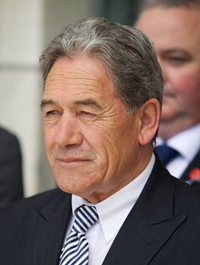
Photo of the Hon. Winston Peters from the official web site of the Parliament of Trinidad & Tobago.

Winston Peters of Trinidad rose to international fame first as a musician. Calypso music was at first considered a disreputable, working-class style, and it became traditional for calypso singers to choose stage names rather than using their real names. Winston Peters originally performed as "Gypsy," and later, as a tribute to a previous Calypso King called the Mighty Sparrow, "the Mighty Gypsy." The title of Calypso King, later Calypso Monarch, is conferred on the lead singer of one of the bands that compete in the international contest during the Carnival on Trinidad island. Calypso songs are a folk form with lyrics often about local news and gossip, sometimes very rude, but the prize is awarded for songs that are considered uplifting, in the category called "patriotic." Here is the song for which "Gypsy" first won the title:


I remember my husband bringing back a tape from a visit to the island in the late 1990s. At the time I thought George Peters might want to share it with the blind community on a FacTape, but a week after I heard the song, someone had "permanently borrowed" the tape! The song was quite popular in Washington during the Clinton and Bush administrations, though. "Look at the bank, see who's the banker. Look at the business, see who's the owner. Look at the prison, see who's in there, too!...Be Black, be Black, but be conscious." The song stayed in my mind through the folk process. 


It certainly helped the song "Little Black Boy" that its writer and singer was a living example of "Education is the key to get yourself off the streets and off poverty." On Trinidad, as on Jamaica and other Caribbean islands, African immigrants settled as free landowners just as English, Indian, European, and other kinds of people did, but most of these families were "landed poor" for a long time...sometimes until they sold their land, after which they were just  plain poor in Port of Spain, Kingston, or some other city. Traditionally calypso songs wee associated with farm workers and street vendors, but as the genre gained international popularity it gained respectability. Some twentieth century "calypsonians" came from white-collar backgrounds. When not performing as "Gypsy," Winston Peters was a politician.


Competitors objected to his election because Peters had dual citizenship; he had served in the US Marines. He renounced his US citizenship but has maintained some personal friendships and interests in our country, notably allowing a song of concern about Trnidad and Tobago's economy ("oil pressure reading low") to be used in a US political campaign.


At 71, according to latest reports, Winston Peters is serving out his term in Parliament but has resigned his position as a Cabinet Minister over disagreements with others in the party. His Wikipedia page shows an inclination to identify as a musician more than a politician--or veteran.


Photo of the Rt Hon. Winston Peters from the official web site of the Parliament of New Zealand.

More recently, Winston Peters of New Zealand has been in the news. Without claiming dual citizenship, he also says he wants to strengthen his countries ties with the United States.

Unfortunately, he has not starred in any music videos. Back to the serious stuff!

On promotion to the position of Deputy Prime Minister, Peters of New Zealand was called to account for the persecution of "whistleblowers" who first publicized the sad fact that experimental vaccines for COVID-19 were being developed too late to offer any actual benefit to people hoping to evade the currently circulating mutation of the virus, while carrying high risks of side effects up to and ncluding death--associated with contamination, specifically including glyphosate contamination, and with the uae of mRNA rather than traditional "killed germ" or "weak virus" as an ingredient in the injections. 

I want to emphasize this detail because people discussing the recent vaccine-triggered death of a teenager in a town near mine have said, "Doctors ought to know from a blood test what kind of immunity a person has, and whether a vaccine will help or harm that person, before they vaccinate a person." They really ought to know that, especially in the case of flu and COVID vaccines, because specific batches of those vaccines have killed people who were only slightly inconvenienced by the virus themselves. How many of us expect to work right through most years' "flu season" whether or not we notice, much less whether anyone else suspects, when our bodies react to the virus. We grew up thinking that working through colds and flu was honorable--evidence of fortitude and dedication. We're still adjusting to the idea of the same choice being blamed, taken as evidence of selfish cruelty. But in any case it's hard for doctors to be sure about the effect a COVID-19 shot will have on a person because the effects of both the mRNA itself, and the potential glyphosate contamination, are unknown. 

Many people have reported feeling very sick after a COVID jab. Vaccine reactions have often been described as much worse than the disease. People who may or may not have noticed feeling tired or having "that peculiar cough" when they actually had COVID have complained of having to spend days in bed, being sick or faint, having serious symptoms here and there, after the jab. Those immediate reactions are likely to have involved glyphosate contamination, especially if they involved internal bleeding. There are certainly other potential contaminants too, but glyphosate is known to be a factor in immediate adverse reactions to the vaccine. Individuals react to glyphosate differently. So long as doctors hide their heads in the sand and fail to diagnose glyphosate poisoning as a factor in the chronic illnesses so many people now have, they will fail to recognize the dangers of glyphosate contamination in vaccines. 

Actual deaths from cancer and heart failure, the latter often caused by the formation of bizarre new types of solid formations clogging bloodvessels, can be ascribed to the "spike protein" reaction to either COVID or the mRNA in COVID vaccines...but although doctors studying this issue say that "spike proteins" can form when people have had only mild, unnoticeable reactions to COVID, the sudden deaths have been strongly correlated with vaccines rather than COVID itself. Glyphosate is known to promote the growth of cancer tumors. Spike proteins are believed to trigger the formation of tumors and/or those strangely solid, fast-growing, massive blood clots. 

This link represents the cutting edge of naturopathic medicine as doctors try to find ways to protect the body from those spike proteins. Like the vaccines, it is new experimental research. It may or may not save lives. My feeling is that it's more likely to save lives than a vaccine is. I am a fallible mortal.


This web site is not going to link to the inflammatory speeches of some indignant New Zealanders accusing their government of having known the vaccines would kill people. It's hard to prove what people knew and it's far more likely that people discounted warnings about vaccine dangers because they so wanted vaccines to work, rather than that they deliberately urged people to take vaccines they knew to be deadly. New vaccines are always experimental. Some risk of adverse reactions, even fatal reactions, and some risk of simple failure--the probability that new vaccines won't protect people against the disease--has to be accepted. People want very much for "someone to invent a vaccine" against every disease. That desire motivates people to try new vaccines. People who line up to take new vaccines, not because they have been ordered to do so to keep their jobs or stay in school, but because they hope their vaccinations will protect them or others and help wipe out the diseases, can be remembered as heroically wrong if the vaccines kill them; they took a risk and paid the cost of it; they were not "murdered." Nobody took my Significant Other's life; he laid it down. He died as he lived, a man of extraordinary strength and fortitude who did many dangerous things in order to protect or encourage others. He was an Army volunteer in 1971, a COVID vaccine tester in 2021, and a risk taker in other ways in between. When people were coerced into taking vaccines they did not choose, of course, that's another matter.

This web site does, however, call on all government leaders, including Deputy Prime Minister Peters of New Zealand, to protect the freedom, the privacy, and the safety of all "whistleblowers" who warn people that popular products--vaccines, or whatever else--may be harmful. Corporations aren't going to stop selling profitable products merely because those products harm people unless the "whistleblowers" are free to call them to account. The world is free to call us party-poopers, buzz-killers, Cassandras, etc., but the world desperately needs ua. No nation that fails to protect us can fairly be called civilized.

Why has the Deputy Prime Minister been singled out for attention? Apparently a reputation for protecting whistleblowers was part of his early political branding in the 1980s, and his constituents are demanding that he maintain that reputation.

Google isn't doing too well sorting out the documentation of his record. One "trusted journalist" source, ranked high on Google, actually claimed that Peters was the protester whose home had been raided by the police. (Other news media make it clear that the whistleblower is a different man, though the name he apparently gave one reporter, "Winston Smith," the name of the protagonist in 1984, seems likely to be self-chosen.) So let's conclude our considerations of this topic, today, with a reminder of the sort of thing whistleblowers bring to public attention--the sort of thing that goes on and on in the absense of whistleblowers.


Do you want to know whether a doctor is actually treating your disease or merely observing its progress as it makes you sicker? Then demand that anyone for whom you vote, any newspapers to which you  subscribe, any social media you use, very specifically BAN any attempt to censor content because it fails to support some sponsor's short-term commercial interests. 

While recognizing the need to protect whistleblowers is not exclusively common to the US and New Zealand--An Enemy of the People was written in Norway--it is one of the cultural traditions that have contributed to the extraordinary success and prosperity of the English-speaking countries generally. It is a part of our culture that the rest of the world would do well to appropriate. 

Thursday, November 2, 2023

Should Web Sites Remove Misleading Health Information?

The breakthrough occurred during the coronavirus panic, while so many adults who had been using the Internet from work or school were offline. The multitudes of polls and surveys on this subject finally told some people what they wanted to hear: a Yahoo News survey found a sample of Web users who wanted web sites to protect them from “misleading information” about health matters.

Interesting. Wonder why I didn’t get that survey? Maybe because the subjects were set up to respond as they did by watching a movie, which my computer wouldn’t have played, that pretended to “document” blatantly false, upsetting “information” about COVID-19 having been deliberately bioengineered.

No points for guessing that the survey was sponsored by some corporation whose executives hoped the survey could be used to suppress accurate information by association with the misleading kind. It is in fact misleading to state that “Vaccines cause autism,” so Merck and other pharmaceutical companies’ official are no doubt drooling with the hope of persuading web sites to suppress more accurate information like “Individual reactions to vaccines can include fevers high enough to do permanent brain damage, which may produce or aggravate autism.”

It’s hairsplitting, but surely everyone sees the difference? Masses of people who are not autistic have had vaccines, so obviously vaccines don’t always cause autism. On the other hand hundreds of children who seemed normal before having certain vaccines have seemed autistic afterward, so, equally obviously, vaccines had something to do with their autism. The simple physical process by which some vaccine reactions produce or aggravate autism has been accepted by responsible pediatricians for more then sixty years. It’s not news. In fact, denying that a measles vaccination may make all the difference in whether a given child will become or seem autistic would be misleading information.

How do people recognize "fake news"? Well, on a five-minute timed test, they don't--and this came as a shock to some people. 

During the Trump Administration a hurricane left many people without electricity or drinking water in Puerto Rico. This web site was one of several that posted nags like our little ditty, "Our territories we'll protect, we said, come flood, come fire. If we don't stand by Puerto Rico, then we are a liar. A liar, a liar, we'll be a big fat LIIIIar..." Naomi Parker, whose blog is about knitting patterns, posted more political comments on Twitter and was also vocal about our obligations to Puerto Rico. So some Tweep of hers teased her and her other Tweeps with a bit of fake news. Trump had invited Puerto Rican hurricane victims to stay in Florida, but he was going to seize their passports and make them pay to get them back. 

Instantly NP and I posted comments like "How tacky can you get?" 

Then, because this was a qiestion of human rights and not merely budgeting, I asked first: "They have passports? People on that income level usually don't have passports. Why would they need passports anyway--they are U.S. citizens. They can visit any State for as long as they want and go back to their own Territory when they want."

And then we recognized that the news item was fake news. "Gotcha!" the joker scored off, by now, a couple dozen of NP's Tweeps who'd posted things like "How tacky can you get?" There has always been some fake news out there. Much of it slips past people because they don't really care. When people care whether a news story is true or not, they may not recognize fake news on sight but they can and do recognize it by following up on it. 

I say large multi-user web sites should continue to assume no responsibility for whatever facts, opinions, or outright lies people choose to post. I say people who read the words, if not people who believe whatever they see in a movie, are capable of remembering that anybody can post anything on Twitter, including typographical errors like omitting negative particles. That is, it’s possible for people to intend to tweet “It’s not raining outside” and actually post “It’s raining outside.” So if you see outright lies, e.g. “Glyphosate is safe” or “Measles is a deadly disease from which measles vaccines, which are harmless, keep us safe” or “The temperature in Virginia was 69 degrees Celsius at the time of writing,” on Twitter you check the facts elsewhere. You know that few people would survive if the temperature were 69 degrees Celsius so you automatically think “The person meant 69 degrees Fahrenheit.” About other things people say out loud or post on forum sites as if they were facts, you might need more work to reach a less positive conclusion.

Measles is a mostly trivial disease that can cause complications, including high fevers, brain or nerve damage most often associated with blindness, and death, in a minority of vulnerable individuals. Measles vaccines are a mostly non-fatal cure that can cause complications, including high fevers, brain or nerve damage most often associated with conditions that resemble autism, and death, in a minority of vulnerable individuals. Measles is a virus, which means vaccines contain live virus and are extremely susceptible to contamination. It also means the virus can mutate, so measles vaccines do not necessarily guarantee lifelong immunity to measles; people who’ve had either measles or the vaccine don’t “come down” with the disease but they can have unmistakable symptoms of it, twenty or thirty years later. The facts about measles and vaccines generally may not be as prejudicial to Merck as the facts about certain specific batches of Merck vaccines have been, but the facts are not “product-supportive.” After exposure to accurate facts on this topic many, if not most, people will not want the vaccine. And accurately reported facts will dramatically reduce sales of flu vaccine and other vaccines against minor diseases, too.

About health matters, the corporations will frantically admit when confronted with the product-unfriendly facts, there are, um, er, a lot more opinions than facts. This is true. For example, “[Cows’] milk is the perfect food [for humans]” definitely qualifies as misleading information, but what about “Cows’ milk has some place in a healthy diet for humans”? The majority of humans, worldwide, lose lactose tolerance at least by the age of fifteen! “Cheese is more digestible than milk, so restaurants should decorate everything with cheese”? Demonstrably false for some people, like me, who can still drink a glass of milk and keep it down, but cannot eat a slice of cheese and keep it down. (That cheese smells like vomit is an officially confirmed fact. That the vomit-like odor of cheese is disgusting and should be confined to a separate, fully enclosed room in restaurants that do continue to serve cheese is my opinion.) “Some humans do absorb some nutrition from milk, even as adults, so milk should still be sold as a food product” is less misleading, but it’s still an opinion. I happen to like ice cream but, if web sites are held responsible for any harm done to anyone by potentially misleading information about other people’s opinions, Twitter would have had to censor my encouragement to Ben & Jerry’s to keep their considerable weight behind the cause of making ice cream glyphosate-free again...because some people really do not need the suggestion that ice cream is food. For me ice cream is food; for many people it's toxic waste.

What about gluten? I saw this prompt on a survivalist site. What is gluten and should you be concerned about it when stocking your emergency supply of food? Several plant proteins are described as glutens, and in fact a few people may be unable to digest the others too, but wheat gluten intolerance is the kind that’s a problem for a large number of people. As many as one out of four or five people of Celtic descent may have some difficulty digesting wheat gluten but, during periods of history when wheat had not been treated with certain chemicals, serious health problems caused by this genetic trait were found in about one of every ten thousand people in Ireland, one in a hundred thousand in other parts of Western Europe, with no known incidence in non-Celtic populations. (The word “celiac,” the name for these people and their gene, is not related to the word “Celtic.”) As recently as 2008 it was possible to say that, although the gluten-free plates offered in some institutions tended to contain better and fresher food than the stale bread-based alternatives, for most people wheat gluten was a valuable source of protein and nutrients. Vegetarians actually throve on high-gluten bread! Then in 2009 glyphosate, which had previously been used only as a pesticide, went generic and manufacturers encouraged farmers to spray it directly onto grains, nuts, fruits and vegetables as a ripening agent to allow them to harvest more crops at one time. Masses of people became ill, didn’t get accurate information or helpful treatment, and found that adopting a gluten-free diet helped—somewhat—for a while—because avoiding gluten reduced the amount of glyphosate in their food. People have died from the unacknowledged effects of the glyphosate reactions they were having, some of which resembled celiacs’ gluten reactions, some of which did not. When stocking your emergency supply of food, if you’re not a celiac you should not have to worry about wheat gluten, which ought by rights to be a safe healthy food to store. Unfortunately the glyphosate that’s been added to the existing supply of wheat in the United States has killed many non-celiacs already and will probably kill more. Survivalists, very unfortunately, currently need to avoid stockpiling wheat. In fact almost any commercial plant-based food grown in the United States, including overpriced "organic" food, contains enough glyphosate to make you sick. And the corporate weasels have worked to prevent farmers from telling you if any of their crops do happen to be safe to eat. Many "gluten-free" foods trigger celiac reactions because they're not glyphosate-free...and the industry has attacked, and sabotaged, food processors who've tried to offer products that were glyphosate/GMO-free. 

Should web sites remove the misleading suggestion that wheat, other grains, nuts, vegetables, fruit, or meat commercially grown in the United States are safe for humans to eat? Or touch? In many cases, due to the extreme level of glyphosate contamination the industry is fighting so hard to maintain, that’s not true. If web sites are held to account for allowing people to post “misleading health information,” anyone who tries a yummy vegan recipe somebody posted on Tumblr and develops massive bleeding ulcers from ingesting glyphosate-poisoned tomatoes and glyphosate-poisoned spinach will be able to sue Tumblr. Is this really the way we want American society to be?

We need to put coronairus behind us and get back to work on the glyphosate contamination issue. We need to accept the fact that, during the coronavirus panic, even the most authoritative sources spouted “misleading information” about the dreaded virus, and because they were really reporting hasty opinions based on incomplete information about something new, “misleading” was the only kind of information about coronavirus that existed.

The value of the Internet is that it allows rapid transfer of information. Whenever news is breaking, some of that information is certain to be incomplete and, therefore, misleading. That is the nature of early information.

In order for the Internet—or daily newspapers—to be useful, people need to be reminded that some of the information they convey is going to be misleading. There will always be items like “Four people died in the fire” reports that have to be followed by next week’s “No, actually seven, counting the three who were taken to hospitals but not revived,” or “Candidate A won a close race in the Eastern States” followed by “But then Candidate B’s party rallied the vote and swept the polls in the West, so B won the popular vote.” On interactive sites there will also be items like “John Doe has an apartment for rent—oh no he doesn’t, his grandfather just moved into it,” and “Jack and Jill’s wedding will take placenext Sunday—or no, wait, it won’t take place at all, now that Jill got a good long look at Jack’s porn collection,” or “Suzy Q’s boutique has X on sale...erm, make that ‘had’.” And there will also be “Celebrity X just collapsed...was it a heart attack, an overdose? No, doctors now say it looked more like diabetes. No, wait, it’s not diabetes, it’s...” and similar “misleading health information” whenever any piece of health news, private or public, trivial or substantial, is either new, or bitterly resisted by unethical profit-oriented corporations.

The best way to reduce the harm done by misleading information is to allow prompt correction. Therefore web sites need to avoid clogging the flow of information by any kind of censorship. Instead they should rely on disclaimers, like “Individual users are responsible for the information they post here.”

--At least, that is what reason has been telling web site owners from the beginning of the Internet. However, web site owners are fallible mortals, and as a Twitter Insider I had opportunities to see firsthand how the marketing department wheedled, “Oh please, can’t we offer big corporate sponsors the brand-friendly benefits of corporate censorship, just like all those TV news channels that Real Twits dislike, distrust, and avoid for that reason? Yes, of course Twitter will lose all redeeming social value if it becomes the voice of the big corporations, another form of television, and Real Twits will detest and abandon Twitter if it does...but can’t we destroy Twitter, grab the money and run? Please please pleeeeasse?” 

I don’t really expect web site owners to grow enough of a spine to tell the marketing departments that, if that’s what it takes to make their web sites profitable, they might as well just shut down the web sites while their individual names still have some credibility, or while the basically unsustainable Internet retains enough users to make it usable for any purpose. I expect the Internet to self-destruct, actually; the way things are going now, I give it three years.

But, if any web sites are going to be around five years from now, I think they’ll be the ones that rely on disclaimers rather than censorship to avoid the horror of being held responsible for misleading information. 

As for the sites, like Elon Musk's X.com, that agree to censor content that hurts sales of sponsors' products--i.e. whistleblowing on vaccines that are more likely to kill previously healthy people than COVID was, or glyphosate, or cigarettes...I think we all know what decent people do about them.

Wednesday, June 21, 2023

Can Linda Yaccarino Save Twitter?

I'm not optimistic. If our Republican Congress don't grow the backbones so many of them have lacked for so long and crack down hard on the Party of Censorship, it's hard to see grounds for optimism about anything in cyberspace. A censored web site is a dead web site; a censored Internet will be a dead Internet. While fretting about the lack of moderators to pull down content thought to contain "animal cruelty," Twitter's new CEO continued to allow an algorithm to delay a "Please help this shelter dog" message until after the dog was scheduled to be killed. 

I do think it's possible for a good thing to come out of the World Economic Forum--screaming, tearing its hair, running frantically for the place as far as that convention of cartoon villains as it's possible to get.

Does this look like a good thing to you?

 
Not as much, perhaps, as little Greta Thunberg in that video where she was surrounded on the street and badgered by a gaggle of much bigger, older reporters, but Yaccarino has had more practice. She does look frazzled. 

I have a dream in which that hair makes her feel desperate enough to listen to an older woman who can tell her: "When I was eighteen my hair looked like that. When I was thirty I discovered a way that even my hair could look good, for the first time in my life. Together, you and I can guide the world back to a condition in which even your and my hair can look good again." 

I had a dream in which my husband's ex was not lying through her teeth about being in contact with their adoptive son, and we could become a blended family before my husband died, too, eighteen years ago.

But there is a way Yaccarino can save Twitter, in the short term, and actually make it pay...not as much as the stockholders may want, but it can pay...if she's serious about taking it back to first principles.

The relevant first principle would be: Twitter reached the size it reached because it provided instant communication for private individuals, before the corporate advertisers got there. The world did not need another commercial medium, would not have supported one, and won't support one. The world did need a social medium that would flash messages like "Please help! This dog is scheduled to be killed tomorrow morning," around the world, from anybody to any number of other bodies wherever people were interested in dogs.

People will expect Yaccarino to make Twitter work just like NBC. It won't. There is neither a need nor a desire nor a space in this world for any more of NBC. Yaccarino needs to sell her friends at NBC the first principle that TWITTER IS RADICALLY DIFFERENT FROM NBC.

That does not mean that Twitter can't serve them. It merely means that Twitter will fail to serve them if Yaccarino indulges them with another moment of thinking that Twitter can be made into more of NBC. She must help them understand that, in order to be profitable, Twitter needs to remain very, very different from NBC...while serving (some of) the same sponsors.

The key difference, and I say this as a disenchanted former Twitter Insider who's been watching the site and helping it grow for many years--the key difference is the difference between television and social media. 

Television is a medium where corporate sponsors, and the bloat in government that functions as a de facto corporate sponsor, incessantly blare their message to passive viewers who are seldom paying full attention to the broadcasted message. 

People don't interact with the TV set, unless they're pathetic dead-end kids like the TV cartoon characters Beavis and Butthead. Actually, my favorite people don't even turn on the TV set very often, if they even have one. When people I know do turn on the TV set, there are a few shows they actually sit down to watch--weather forecasts, "Jeopardy," and an occasional live broadcast of some special event. Even then, they talk, move around, and step out of the room during the ever-increasing commercial breaks. Most TV programs function as background noise in front of which people can avoid actual conversation while eating, snogging, or falling asleep. The sponsors can say anything they want in the part of the TV broadcast that matters to them, because nobody engages with it, nobody even consciously listens to it or looks at it, and so all they have to do is pound the name of their brand into people's ears. 

Does it work? Maybe. Maybe not. The companies that invest heavily in advertising products on television also invest heavily in getting those products well placed in the right stores. Awareness that brands exist may influence people to be a little more willing to buy those brands, but it does not actually hypnotize people into buying anything. As mentioned before at this web site, as a child I memorized the commercial jingles that were broadcast during the child-friendly shows I watched on family road trips, but although I can still sing some of those jingles today I've never bought the products they advertised.

What TV broadcasts do undeniably do is add stress to people's lives, mild or even benign stress for some people, toxic stress for others. For those who want to watch the ball game or talent show, the effect of the stress is limited to keeping them from sleeping, meditating, or exercising; only when this becomes a long-term pattern does it do any harm. For the family member who hates those ball games or talent shows and hears each one as a fresh display of ingratitude and ill will, every minute the TV blares is another brick in the wall. When couples want to be reconciled, or parents want children to focus and calm down and do well in school, their chances of success are better if they unplug the TV.

For those who want TV broadcasts, there are already plenty of TV broadcasts out there. Nobody is going to pay for an Internet connection that delivers the same experience as a TV broadcast. 

In order for a web site to interest anyone but the advertisers, the web site needs to deliver an experience that's very different from a TV broadcast. So Yaccarino might start by writing down a complete list of everything the sponsors want a TV program to be, then writing a list of what would be the opposite of that, throwing away the first list, and putting the second list on every wall.

Or I could just tell her what attracted so many people who don't watch TV, if we can avoid it, to Twitter as Jack Dorsey built it--something new, something useful, something that has only two things in common with television: (1) it appears on a screen, and (2) it can be used to display images and advertisements for products.

Here are the most obvious salient features Twitter absolutely must keep in order to stay different from television, to attract Real Twits, and to exist. These descriptions aren't necessarily true of Twitter today, but they are true of the original, viable Twitter. They must be true of "Twitter 2.0" if Twitter 2.0 isn't going to go the way of My Space, Google +, or Niume.

1. Twitter is silent unless a site visitor clicks on a button to play an audio clip. 

2. Twitter contains more words than pictures. This is no longer always obvious, but it used to be. Just accept it: People who choose the Internet over television prefer words to pictures. You never, never want to allow a picture to fill up the screen, as the pictures do on some social media sites like Gettr, unless someone deliberately clicks on a button to enlarge it. You want each picture to take up less of the screen than the words that introduce it. You don't ever want a picture to "move," or "pop," or "flash," unless someone deliberately clicks on a button to allow that.

3. Twitter is rich in the content site visitors are actually looking for. Original Twitter ran about fifty tweets from accounts the individual visitors had chosen to follow in between every one "promoted tweet" from an advertiser. That was, of course, because Twitter had to achieve viability on its own before it had a lot of advertisers. However, it's also a feature that made it possible for Twitter to achieve viability, while other social media sites crashed and burned. I personally feel that it wouldn't hurt the Twitter experience to allow a steady stream of advertising messages to occupy the right side of the screen--provided that the ads are clearly subordinated to the tweets. The center column should remain wider than the sidebars. Paid ads should contain text and thumbnail pictures only until Twits click on a button to expand them. Twits know that Twitter needs sponsors, but sponsors need to have it firmly in mind, at all times, that the different benefits people get from Twitter come from keeping the individual tweets dominant over the paid ads, at all times, in all ways.

(Yes, this can be of benefit directly to the sponsors, but they're going to have to think outside the box to accept the potential benefit. They might need to take a break or do some deep breathing to cope with the cognitive dissonance.)

4. Twitter's safety is maintained by site visitors' control of their own experience. Nobody wants to watch a video that starts with someone saying "Today we're going to beat up a younger kid" or "Today I'm going to slash my wrists," right? Yes, people did things like that on Facebook, and while other people sat there horrified, unable to believe what they were watching, these deranged Facebookers actually committed suicide and real crimes, in real time, live on social media. What have we learned from this? No, NOT to try to filter out bad content so that people don't see it. That's what will NOT help, so don't ever even think about it again. What helps is to watch for the bad content and take it seriously. Somebody posts, "Today we're going to beat up a younger kid." Leave that message where it is! Police should have someone watching. In case they don't, the social media site should have a prominently displayed "hot button" that notifies a site monitor to call the police. Police can trace the signal, find the source of the bad content, and probably stop the crime before it happens, while the malicious user is still bragging about what he's going to do. 

You need to trust individual users, now that people realize that these things are possible, to call the police and then click on to something more pleasant to watch. Which they will do. People love letting other people take care of problems. One of Junior's little friends just threatened suicide, notify the authorities, now back to the chat with the person whose screen image is a woman in a low-cut blouse.

5. Twitter's content is spontaneous and uncensored. People exchange PERFECTLY FRANK opinions of the sponsors' products. You know how that works. People do not actually say, like the character in the Totally Amateurish Radio Drama put together by the characters in an old radio serial that was re-broadcast when I was a kid, "I can find it because I have my new Brand X flashlight. It runs on two 'D' batteries and cost 79 cents at Store Y." Fifty-one weeks in a year they go to Wal-Mart, buy a few dozen staples they use every day, come home, and never think about posting anything as basic and boring as that they have this weekly ritual of buying things they enjoy using at this store. Then the week something goes wrong, they get on social media and flame that Wal-Mart where they expect they should be able to enjoy, in a bland boring way, buying the things they use every day. They never type a word about why they like that Wal-Mart better than the Target, or vice versa. Nor do they type about all the groceries and toiletries they like to use every day. Only when something goes wrong do they flame the everlovin' daylights out of the store and/or the product that disappointed them.

Yes, we all understand the TV sponsors hate this. Yes, we all understand it's the one thing TV sponsors want to censor out of existence in TV Land. But that's what makes live, uncensored, unfiltered social media fun...and what can make them useful to sponsors. They just have to accept this: The Twits who made Twitter great do not live in TV Land, nor do many of them even visit TV Land. Sposnors have to venture into our neighborhood. To do that safely, as when they visit the neighborhoods of the Black friends they all claim to have or at least want, they need to show respect.

What do sponsors do when somebody...like me, because in this respect I am, if anything, a harder sell than the typical Twit, yet it is possible to sell me things...somebody who never thinks of tweeting "We just went to Wal-Mart and bought our favorite brands of groceries and toiletries: Brand X, Y, Z... What fun!" as person might easily do fifty times in a year, does, unfortunately, think of tweeting "Wal-Mart was out of the Brand X soap, the Brand Y printer paper, AND the Brand Z rice I always buy there, AND THE CLERK WAS RUDE!!!"? 

First, it's OK to pound a fist on the table or mutter the rude words that come to the sponsors' minds. Everyone can understand that. 

Now, having acknowledged and released those emotions, the sponsors should be ready to think creatively about how to spin these moments in the direction of profits.

Some people are Difficult Customers and proud of it. We are both made and born this way. Some people voted for Jimmy Carter because they've always gone through life thinking "Why not the best?", but they've been made to feel ashamed of it. Others have embraced it. I was brought up by a well-known Difficult Customer. I preferred spending time with milder-mannered adults rather than my Drill Sergeant Dad, and didn't think I wanted to grow up like him, so I didn't always complain about things as a young woman. I even went to one of those churches where the False Gospel of Nicely-Nice Verbal Abuse had crept in and some people may actually have been able to believe that it was nice not to tell people what they needed to improve...for a short time. Then I got out into the grown-up world of work and realized that well-known Difficult Customers were my best customers. They didn't have to sound like total old-school drill sergeants. Dad was one and sounded like one, but more successful Difficult Customers were fractionally more tactful than that. Fractionally. And I even had the pleasure of voting for one of them for President. I really like a Difficult Customer who is tough, but fair, and I decided before it was too late that I did want to grow up and be one. So now I am.

What makes people choose to be Difficult Customers is that we know that indulging people in undesirable behavior, such as imagining that the seller is ever "on equal terms" with a Customer, is not doing those people any favors. That's it, and that's all. We can be pleased--and we actually enjoy rewarding people when we are pleased. But you do have to earn the rating you want. You have to please us. 

That's where social media come in as the way to market your products to us. We can be pleased. We want to be pleased. And, because you are not wired to be able to understand how to please us, on social media we'll tell you exactly what you need to know.

You just have to think outside the TV advertising box. You cannot go on social media to pound your words into our minds; that's killed other social media sites already, and it can kill both Facebook and Twitter, too. You can go on social media and regain our good will by doing what it takes to please us. 

Not by looking for any rewards before you've earned them. I've been known to give zero stars if the "rate the service you received" screen pops up before I say it's time for it to pop up. 

Not by just trying to smooth over the "feelings" while ignoring the facts. Emotional feelings come and go. They last approximately ninety seconds, then fade quickly if they're not aggravated by feeding them more attention than they deserve. So if, let us say, you represent a shoe store where somebody tried on a pair of shoes, told the clerk they'd take that pair, accepted a wrapped box, took it home, opened the box, and discovered a completely different pair of shoes that didn't even match inside the box, you do not need to waste time with "I can tell you're upset." 

(Number one: if you believe you're a psychotherapist, what are you doing in customer service? Number two: you don't know which people use "upset" to mean a milder form of "angry" and which use it to mean a milder form of "nauseated," but you don't want the conversation to be about either of those things. Number three: the customer may be a woman, in which case, if you've CUTESIPATED her by ignoring a statement of FACT and babbling about her supposed "feelings," you have just outed yourself as a hater and made it her goal to get you fired. From your next ten jobs after this one, likely.) 

You need to own your feelings, approximately as frankly as the customer has just expressed per own feelings, as in "I'm very sorry that happened! It makes me feel like an idiot! Please let me send you the pair of shoes you intended to buy. If you could be so kind as to bring back the box, just in case we have another pair that look just like them somewhere and can donate both pairs to a secondhand store, I'd be grateful." 

Now you're making your store look good. Window dressing is all very well, but you're displaying honesty and a commitment to good service. Now the customer is motivated to reward you. Don't push; let it come naturally. You may have to grovel to a customer who you think is making unreasonable, unrealistic demands, repeatedly, depending on how deeply the customer is set in that dissatisfaction groove, but eventually you'll get free advertising from this customer. And if other people agree with you that this customer is unusually hard to please,per recommendations rate. People automatically discredit everything you say about your products or your honesty or your commitment to customer service, but if you get full marks from that customer, you are obviously doing something right--they'll try a box of whatever you're selling, too.

Before social media, it might have taken months or years for the Difficult Customer to feel confident enough to give you a positive recommendation. Maybe in real life he's never had a conversation about shoes with anyone outside the store. Maybe in real life she has no friends and her grandchildren avoid talking to her long enough to hear her opinions. But on social media, all of the Difficult Customer's followers can see your conversation. Maybe they agree that the customer expects too much; maybe they agree that you're doing a good job. Either way, you've just demonstrated to them, without either paying for an advertisement or automatically self-discrediting by advertising, that your store is a place to look for honest, courteous service. They have not only noticed your brand; they've laid down a foundation of agreement with your message. That kind of advertisement is like motherly love: there's no price tag on it, because it's beyond price.

Of course, some complaints are harder to turn into super-value publicity than others are. Everyone understands that Wal-Mart is so big that some complaints are inevitable. The person who posted the complaint about not finding X, Y, and Z at Wal-Mart will probably be back in the store next week, as will the people who read the complaint. What about "I used your product, as directed, and the doctor reckons that's why I now have cancer"? What about "Taking the guns away from patients only makes Prozac Dementia homicide-suicides deadlier--we have to monitor use of the DRUGS!"? 

This is where Yaccarino has the opportunity to be of real, lasting service to humankind. She needs to stand firm on those first principles.No censorship, ever. 

In fact she should consider making it part of Twitter's Terms of Service: "If a sponsor tries in any way to suppress complaints about a product, that will be taken as an admission that the product is harmful and the sponsor is not trying to repair the damage, so the sponsor will be permanently banned." And stick to that, however big and rich the corporaiton is and however much they offer. Make that an advertising point for Twitter. "Bayer tried to suppress the Glyphosate Awareness movement? Bayer's gone. Lilly failed to encourage the newspapers to print the results of an analysis of a homicide-suicide's blood tests? Lilly will never be seen on Twitter. Merck had the gall to say rude things to and about people whose children were harmed by vaccines? Die, Merck, die." 

If people have, inadvertently and in good faith, made a product that turned out to be more harmful than they thought it would be, then the way for them to demonstrate that good faith is to take everything the indignant customers throw at them. Humbly. Gratefully. With sincere penitence. "Yes, Sir, it's possible that our product hastened the progress of your cancer. Please accept our deepest apologies and know that your widow and orphans will never be poor," s all Bayer should have had to say--over and over, with different specifics and pronouns--since the total global ban onglyphosate that should have gone into effect in 2018. 

It's been said that, if you look out the window and see a little old lady being beaten until blood drips on the pavement, and you don't feel a reaction, you are what they call a psychopath. Well, I happen to be a little old lady, and I've been battered by repeated glyphosate poisoning--of the air, of food, of water--many times. So far I've not gushed blood onto pavement--only a bathroom floor, once, and you may be sure I scrubbed that floor. But there've been enough days in the past two years when I've stayed home, because I was likely to gush blood onto pavement, that I now classify myself as disabled. I do not want a pension. I want to go back to work. I want that glyphosate ban. And if you don't feel a reaction, you might want to talk to a psychiatrist about that. 

Feel that reaction, Yaccarino, and reconnect the global Glyphosate Awareness network Twitter helped me build, before the coward-boy Agrawal let Bayer interfere with our telling the truth. We've all heard and heard and heard about the coronavirus panic and the fear that people might not be saved by the vaccines that turned out to make them more vulnerable to the way the virus had mutated by the time the vaccine was available...oh well, anyway, it seemed to be so terribly necessary to censor anti-vaccine tweets so that...BOSH, I say. Everyone in Glyphosate Awareness knows the corporate censorship started with us, after political censorship had found a way to exploit the system during the 2016 elections. (Lilly had been leaning on newspapers not to print the most important fact in every homicide-suicide story since 2001, and Merck may have been gaslighting and insulting people with vaccine injury claims before that.) 

Twitter needs to take a firm stand on its first principles. Sponsors with genuine good intentions need to support that firm stand. Nothing must be offered to those who want to censor the unpleasant truth about their products except endless, boundless contempt.

If a corporation has any right to continue to exist, its executives and stockholders need to accept that market forces are what nature intended to impose morality on the corporation. Censorship must not be allowed to protect the corporation's profits. Rather,, any attempt to suppress the facts about a product must cut so deeply into the corporation's profits that nobody would dare to suggest such an immoral, unethical, stupid idea.

And if that means the Democratic Party has a lot of apologizing to do for having hidden behind the filthy coattails of the corporate censors, during even one election--and if that little venture into censorship costs all Democrats any chance at State or federal office for another decade!--even that would serve the Ds right. They didn't start apologizing and purging their ranks soon enough. They need to be doing that, nonstop, from now until November.