(Reclaimed from Blogjob, with apologies...I've been reading a new book I'm eager to share, but I've not finished it.)
Title: Kenilworth
Author:
Walter Scott
Date:
1821 (many reprints)
ISBN:
none, but click
here to see one of the reprints on Amazon
Length:
typically about 350 pages
Illustrations:
vary
When
a book is as old as Kenilworth,
does one write a book review, or a book report? Technically, what I
have to say about this bestseller of the nineteenth century is
neither. It’s a protest.
I
postponed reading this novel until I acquired one of the dozen or so
reprints that are currently available. It was one of the nicer
hardcover editions, with black-and-white photographs of real places
and people named in the book. That said…this is not and never was a
nice book.
Historical
novels now usually contain a review of the facts that inspired the
story and the parts the author invented. Most authors of historical
novels are expected to stick to the known historical facts about real
people, although this rule doesn’t seem to have been enforced on
either Nikos Kazantzakis or Elliott Roosevelt. Walter Scott was
another novelist, like these two, who got away with falsifying the
known facts. That’s what’s wrong with Kenilworth. I was underwhelmed by Jesus channelling the chap Kazantzakis wrote about in an earlier novel, and by Eleanor Roosevelt solving all the murders in the Eastern States, too.
This
novel uses the names of three real people for major characters in a
plot that more or less completely falsifies what’s known about
them. In England’s Tudor Period, the confirmed facts about most
well-known real people are scandalous enough; Scott, not satisfied
with the real dirt on Queen Elizabeth I, Robert Dudley, and Amy Robsart,
drags their names through the sewer. Before reading Kenilworth it
is, therefore, useful to have read a factual study of these people.
Since my local library has a copy of Elizabeth Jenkins’ Elizabeth
and Leicester,
and yours may not have one, here’s a short list of pertinent facts:
1.
Robert Dudley, a younger son of the Earl of Northumbria, married Amy
Robsart when he and Queen Elizabeth were about twenty years old. The
Dudley children were brought up as close to Henry VIII’s heirs as
their scheming father could manage. Guildford Dudley, the eldest
brother, had been browbeaten into marrying Elizabeth’s elder half
sister, Jane Grey. Robert Dudley may have been Elizabeth’s closest
friend, but Elizabeth, who had been molested by Kathryn Parr’s
second husband as a teenager, didn’t want to marry anybody. She
went to the Robsart-Dudley wedding with her brother, the future King
Edward. It was no news to Elizabeth that Robert and Amy were
married…but it would
have surprised her if anyone had ever referred to Amy Robsart as
Countess of Leicester, because she hadn’t given Robert the title of
Earl of Leicester at the time. Amy’s title was “Lady Dudley.”
2. As
queen, Elizabeth I flirted outrageously with her courtiers—most
outrageously of all with Robert Dudley—and discouraged their wives
from coming to court, probably because no married woman likes to
watch a single woman flirting with her husband. Lady Dudley, however,
was never a prisoner. For years she enjoyed an active social life at
a low, wide, two-storey house called Cumnor or Cumner. She liked
horses and was often seen riding. What eventually confined her to her
bedroom was a mysterious, debilitating disease.
3.
Exactly what went wrong with Amy Robsart will never be known, but her
first specific complaint was about a “malady in her breast” that,
within two years, grew into pain all over. The mystery about her
death at Cumnor was how she managed to break her neck when there were
only two flights of stairs to fall down. If her “malady” was
breast cancer, which then metastasized, that would have explained the
pain all over and the brittleness of her bones. Amy, however, would
not have known that breast cancer tends to metastasize, and probably
did entertain all kinds of fears about poisoning and witchcraft. A
2008 investigation of Amy’s mortal remains suggested violence...or euthanasia.
4.
Prejudiced people accused Robert and Elizabeth of having had Amy
murdered so that they could marry each other. Since they didn’t
marry each other and there was no clear evidence that
Amy was murdered,
the accusations were hard to take seriously. However, throughout
Robert’s life, a rather startling number of people who became
inconvenient to him did die—usually from what seemed to be natural
causes, and never while he was in their neighborhood. Robert Dudley
was regarded as a devout member of the Church of England; he even
wrote a Christian book. At this period in English history, it
wouldn’t have been unusual for a member of a church to have
employed murderers, possibly without knowing it.
5.
Nevertheless, while suffering from a fever, Elizabeth made a will
leaving a suspiciously large bequest to Robert Dudley’s valet. It
is often assumed that this was a bribe to keep the man silent on the
question of whether Elizabeth had ever spent a night in Dudley’s
bedroom. If so, the bribe worked.
6. The
title of “Earl of Leicester,” and other awards and decorations
which Walter Scott imagines Robert Dudley showing off to Amy Robsart,
were bestowed on Dudley after Amy Robsart died…possibly to
console him for the fact that, although he was free to remarry,
Elizabeth still didn’t want to marry him.
7.
After some years of unsuccessfully courting Elizabeth, Robert Dudley
lowered his standard far enough to notice the infatuation of a
confused younger woman. Douglas Howard was the name of the wife of
the Earl of Sheffield. To get the Earl to divorce her, Douglas
arranged for him to see a letter, apparently from the Earl of
Leicester, insinuating that he and Douglas had already slept together
and proposing to have Sheffield assassinated. Having Douglas declared insane was the easiest route to divorce; she was generally considered competent, though her bid for divorce was certainly reckless. The Earl of Sheffield
died, apparently from an infectious disease, before the divorce was
final. As on many other occasions when someone’s untimely death
seemed suspiciously convenient for Robert Dudley, Dudley avoided
suspicion by not taking the advantage the other person’s demise
offered him. He did not immediately marry Douglas. .(Some historians question whether he ever married her at all, since neither of them mentioned their marriage for another ten years. They point out that the only living person who claimed to have been at the wedding ceremony was Douglas, and by that time it was known that, far from being delusional, Douglas was a coolheaded and capable liar.)
The wedding was a very quiet affair, Probably, having seen an example of Douglas's singleminded determination, Dudley wanted his second marriage to be easily annulled. The person who pronounced them earl and countess may not
have been legally authorized to do so. Douglas was never presented to
society as the Countess of Leicester, although by that time this was
the title Robert’s wife would have had; she was always called Lady
Sheffield. Nevertheless, a child appeared and was christened Robert, usually called Robin; he signed his name both "Robert Dudley" and "Robert Leicester," and the English courts recognized him as "Sir Robert Dudley" but refused to recognize "Leicester." Robin was said to look just
like the Earl of Leicester, except that, at least as a child, he had
blond hair. Robert Dudley never tried to deny that Robin was his son. At university Robert was listed as an earl's son, but, wanting to disown Douglas Howard, Dudley sometimes called Robin “my
base son,” the phrase usually used for the results of exploitation of a working-class woman by a male aristocrat.
8. Douglas
Howard was the one who petitioned Queen Elizabeth to recognize her
marriage to Robert Dudley--not to get herself invited to parties, which "Lady Sheffield" always was, but to prevent Dudley disinheriting Robin. (Douglas spent a lot of time in France, where she was a consultant to Catherine de Medici.) Elizabeth was actually sympathetic to her
claim; Douglas could prove that some sort of ceremony had taken
place, though not that it had been performed by a properly
credentialed clergyman. Robert Dudley was unsympathetic, perhaps
partly because Douglas was too emotional and indiscreet to be a good
partner for him, but also becase he had now become infatuated with
Lettice Knollys, who was Elizabeth’s second cousin and was married
to Elizabeth’s other good friend, the Earl of Essex. The political
differences between the Earls of Essex and Leicester often reduced
to competing flirtations with Elizabeth and Lettice. Historians seem
to think it most likely that Essex died naturally from dysentery.
Dudley tried to bribe Douglas to pretend their marriage had never
happened; when she refused the bribe he became angry and swore he
would never speak to her again. Their relationship became bitter when Dudley admitted to pursuing Lettice. Douglas decided to accept the offered alimony, and made a point of remarrying first.
9. It
was during this third, morally inexcusable, affair with Lettice
Knollys that Dudley worried about what Elizabeth would say. In view
of the facts that he was married to Douglas Howard and Lettice was
married to Essex, who was out of the country, when Lettice became
visibly pregnant, Elizabeth had quite a lot to say, and seriously
considered locking Robert Dudley in the Tower. Mutual friends
persuaded her that the country needed Dudley, so she finally allowed
him to marry Lettice. Lettice also gave birth to a son and christened
him Robert Dudley. His birth being properly announced at court, he
was titled Baronet of Denbigh, and everyone who didn’t have to call
him “my little lord” seems to have called him Denbigh. A sickly child, Denbigh died at age five.
10. None
of Robert Dudley’s wives ever lived at Kenilworth Castle, which
does have towers with long, rickety, dangerous staircases. Kenilworth
wasn’t opened to the public for fifteen years after Amy Robsart had
died at Cumnor. Elizabeth gave it to Robert Dudley as a gift; he
spent several years having it made livable, but never tried to make
it a home. He willed Kenilworth, and three other manor houses, to
Robin, though Lettice fought hard to keep Robin
from inheriting anything.
In
short, Walter Scott’s fictionalization of Amy Robsart seems to have
been an attempt to compress all three of Robert Dudley’s wives into
one character, which is what makes his characterization of Amy so
hard to take. One minute Walter Scott’s
Amy is as tough and selfish as Lettice Knollys, the next minute as
puny and whiny as the real Amy during her illness, the next as ambitious as Douglas Howard, and at no point whatever,
in Kenilworth,
does Scott try to portray the historical Amy Robsart—the cheerful,
sensible, horsey girl who became ill and died too young.
He doesn't succeed very well in characterizing the Earl himself, either. The nicest observations made of Robert Dudley's character are backhanded compliments. He was not as unscrupulous as his father or as pious as his short-lived brother, and though he did owe his success to an unusual number of untimely deaths, he was never near enough to any of the deceased to be suspected of having murdered anyone, himself. Scott favors the theory that Dudley was pushed forward in life by servants,, whom his social position obliged him to pay, whom he could not at first afford to pay well, and who could see benefits to themselves in every promotion Dudley got. Douglas, and some of his other contemporaries, may have honestly believed he'd conspired to have all those people murdered, and admired his cleverness in getting away with it. He was called "The Gypsy" and, though portraits suggest his hair was brown or even auburn, Essex and other non-admirers had a lot to say about his "black" complexion.
Now
that you know how careless Scott was with facts, you may enjoy his
fiction if you like that sort of thing. My copy of Kenilworth does
have a few things to recommend it. It’s a vintage edition, and
includes those photos of the portraits of all those Tudor Period
characters and Kenilworth and Cumnor, and some fanciful paintings of Scott's characters by people who hadn't read much history. Scott's audience created the cliche of ingenues having fair hair and real heroines having dark hair. Some editions of Kenilworth gave Amy Robsart raven waves. Historically speaking, their hair would have been mostly if not entirely covered for public appearances, but dark hair had been out of fashion's favor since Anne Boleyn's time and none of the Earl's wives was ever accused of having it. .
As
fiction…well, I can’t imagine sane and sober adults talking the
way Scott’s characters talk. One always has to remember that he
wrote these novels longhand, leaving very little time for research or
editing, and he was paid by the word. I can imagine someone who had a
lot of time remaking some of the basic stories of his novels. Not
this one, though. Historical fiction should be written with a
reasonable respect for historical fact.
To
buy a copy of Kenilworth
in
good condition from this web site, send $5 per book + $5 per
package to either address in the lower left-hand corner of the
screen. To buy any specific vintage edition may cost more.
Nobody
even knows for sure what Amy Robsart really looked like. This may be
a portrait of her. Or not. The black drapery sewn on behind a white cap was a fashion that seems to have looked better on a lot of other ladies than it did on this one..
“Unknown
lady by Levina Teerlinc c1550 Yale University” by Levina Teerlinc
(1510/1520–1576) – Tudorhistory.org, direct link. Licensed under
Public Domain via Commons –
https://commons.wikimedia.org/wiki/File:Unknown_lady_by_Levina_Teerlinc_c1550_Yale_University.jpg#/media/File:Unknown_lady_by_Levina_Teerlinc_c1550_Yale_University.jpg
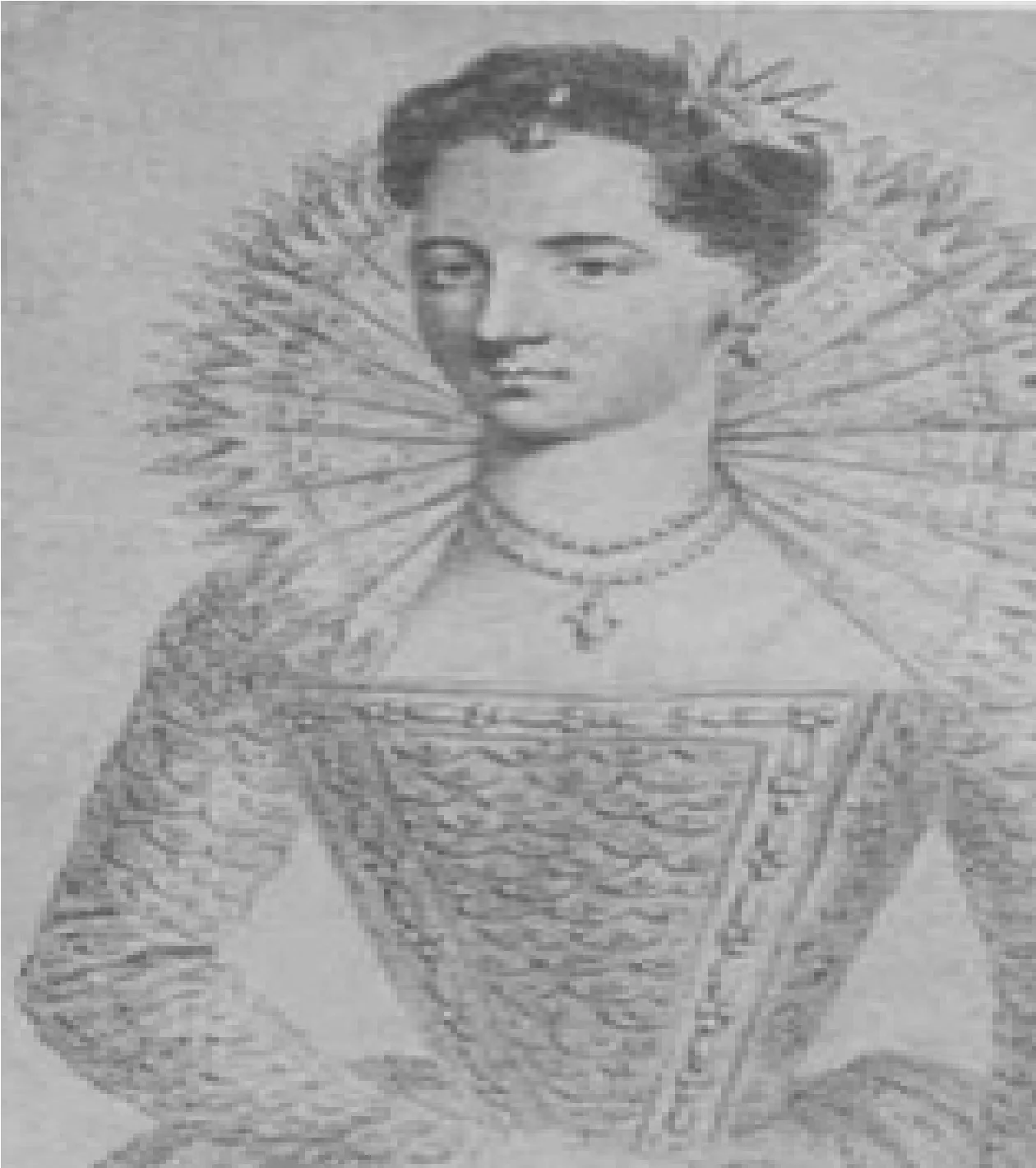
These disparate drawings seemed to have been sketches of Douglas Howard:
Lettice Knollys might have seemed nicer at first; she certainly does not seem to have been prettier. Portrait artists seem to have disagreed whether she started out with bright carrot-red or dark yellowish blonde hair. This portrait seems to seek the middle ground and show her hair as red-blonde. There is general agreement that her hair was frizzy and, though sometimes powdered stark white like her Japanese contemporaries', her skin was florid. She sat for several portraits, some very badly drawn, all agreeing that she was a fashion victim..Her main attraction was probably that she was Elizabeth's cousin.
Robert Dudley, Earl of Leicester...Scott implausibly imagined him posing like this for Amy, at home. He may have been conceited enough, but he wouldn't have had those decorations during her lifetime. As a fifth son he wasn't expected to rise much farther up the social ladder than Amy, whom Scott calls "a poor knight's daughter."
Robin, in real life, inherited Kenilworth Castle. He never lived there. He sold it to a friend for seven thousand pounds, of which less than half was ever actually paid; the title was thus still his, and passed to his widow when he died, and the widow sold the castle for four thousand pounds. Robin's portrait was done when he was a teenager; no positively identified portraits of him as an adult survive. He went to sea and had a long and adventurous life as an explorer, writing a memoir that sold well.
Posted
on September
18, 2015 Categories
Book Tags
English
history,
Tudor
period