Showing posts with label clothes. Show all posts

Wednesday, December 4, 2024

Something I Wish Would Come Back into Fashion

What I'd most like to see come back into fashion is the idea of classic clothes that can be worn until they wear out. 

Each season could have a couple of fads, and people who care about such things would remember that e.g. sweaters with poodle motifs instead of reindeer had been the fashion of a certain year. 

Otherwise, men could wear trousers and shirts, with vests, jackets, sweaters, or coats according to the weather. Women could wear skirts down below the curve of the leg, cut full enough not to interfere with power-walking or running, either as one-piece dresses or as two-piece suits, also with top layers according to the weather. People who felt bored with these basics could wear the fad of the season, but this would be perceived as childish and would put the fad wearers a step down, not a step up, from fad ignorers. Apart from special gear for work or sports, few people would really need to buy clothing after age thirty.

Further, to help everyone separate our opinions of people's work or their character from our opinion of their clothes, everyone in church meetings or in courtrooms could put on robes that would cover all other clothing. This would no longer be the privilege of the choir and preacher or the judge alone. Robes would be kept in the church or courthouse and handed out for the day.

It would feel more worthwhile to make clothing for oneself or others, by hand, and more handmade clothing would probably be worn. It would be less profitable to mass-produce stacks of faddy clothing no one would ever wear, and fewer resources would be wasted in that way. Fads might be easier to sell if only one of each fad item was sold in a town or neighborhood, so that people who really wanted to be the one with the purple vest would wait in line to buy it for a high price, and others would have to settle for standard-cut purple shirts. 

Because fad items were so overpriced, people would be likely to want to keep them  after the fad had passed. This too might reduce waste  Marketing this approach to fashion would probably require a general sense of contempt toward the idea of wasting money on fads, but the fad items might come to seem justified if they were especially flattering to their owners, or recalled happy memories.

Wednesday, October 11, 2023

The Most Creative Halloween Costume I've Worn

Well, that's an easy question from Long And Short Reviews, this week. What is the most creative Halloween costume I've worn? I've...not. 

My parents agreed on most religious matters. They were whole-Bible Christians. They disagreed on one point: Mother had been taught that "any church is better than none," Dad thought there shouldn't be different denominations but, since there are, he didn't want to be affiliated with one. That sort of thing was why he got so little use out of a degree in theology. Anyway I was christened Episcopalian, received my first spiritual instruction (very confusing) from the Worldwide Church of God, became a Christian in the Lord's Covenant Church (if you've heard about them you've heard that they were racists; they weren't, in the sense my generation meant, but they did believe we should study the whole Bible because Western Europeans were descendants of Abraham), was baptized in the Seventh-Day Adventist church, later hung out with Quakers in Washington, went to Berea College which is Unitarian, and have mostly behaved like a good oldfashioned Southern Baptist in my home town. But one thing those different groups have in common--apart from the Unitarians and some of the Episcopalians, they don't do Halloween. 

There are other ways and occasions for children to "dress up." 

One summer when both of us were very bored, I found some sort of yellow string or yarn and handed it to my brother. "Now you have a yellow shoelace. Now put a smile on your face and you can be Ronald McDonald." We never ate at McDonald's but we'd learned the jingle. My brother looked in the mirror, and a yellow shoelace did not make him look like Ronald McDonald. He borrowed the shoes Dad wasn't wearing and a wig Mother had given me in case I ever wanted to practice hairdressing. He still didn't look much like Ronald McDonald but now he definitely looked like a clown. He clomped happily outside, leaving me to enjoy, as I recall, Spanish for Beginners. No such luck. "You started it!" Mother said. "Go out and snap a picture." Everyone in my family understood the urge to curl up with a book.

For serious dress-up occasions Mother could always do better than the other kids' mothers. The Girl Scout council always had an International Festival where each troop was assigned a Member Country and told to study some country where they had some organization like the Scouts, dress up in some approximation of its traditional costume, bring in something based on a recipe from the target country, and, if possible, learn a song. The troop leader knew nothing about India but handed out stick-on beads and said "Everybody wear a forehead jewel and wrap up in a bed sheet." 

"Hah!" said Mother. "You don't remember the Indians who lived at my parents' house, but you remember the ones who bought the big house from us, don't you?  Well, they gave you a sari for your wedding day, but since you'll probably marry an American you might as well wear it now. And with that sari you'll not be wearing any plastic beads from the drugstore. Most of the time they just put a dot of paint on their foreheads, but with this sari you will wear a real forehead ornament made of gold and pearls." The sari was white silk brocaded with gold thread. All the older people were duly impressed, and all the little girls naturally teased me about being Indian, or maybe a Gypsy, for years. /byt ut was hyst as wekk tgat tge saru git ibe wearubgm becaysem bt tge tune I married a man of Indian descent, the sari was long lost. It was in a whole shipment of things that were stolen by a sleazy shipping company. 

I didn't like the clothes in the stores when I was a kid. Of course good little whole-Bible Christians didn't wear miniskirts. The maxiskits of the 1970s looke dbetter, but were skimpy and hard to walk in. What we wore was, mostly, jeans. When something "dressier" than jeans was required, well, it was possible to do things in those dowdy pants suits of the 1970s, but I didn't think even the good-looking teacher at my school could posibly feel pretty in a pants suit. 

So, as a child, I had exactly one dress that I liked. One year Mother dressed and groomed a runner-up Miss California who came back and thrust her red paisley gown at Mother. "I never want to see it again! Cut it down for your kid!" So Mother did and, for once, I had a dress with enough skirtage to suit me. I have always loved a swishy skirt. That dress was the base for a few dress-up costumes, like the school Bicentennial Fetival for which I got into the spirit of things by making my own sunbonnet and apron, but there was nothing especially creative about it. 

Hgh school homecoming week was an excuse for some people to get very creative with their costumery. One yer the Principal felt called to give us a lcture: "If you want to hae a 1950s Day, do it right. We did not wear things skin-tigt int he 1950s..." I wore my usual jeans with one of Dad's shirts. I remember wearing jeans and taking some home-grown produce to peddle in the cafeteria for Farmers Day, erstinh the tackiest pants suit in the closet for Teachers Day, but I certainly didn't go in for anything as extreme as the Boys' Beauty contest where the boys dressed up as girls. 

The costumes I've worn since high school have been, if anything, even lamer. For a few occasions I used to wear a dashiki-type shirt, green jeans, whatever sort of beads or pendant I'd managed not to lose at the time, and a Jimmy Carter campaign pin, and calling it a hippie costume. It was about as hip as anything I saw people actually wearing in the 1970s  After some housemates, mindful of the image of the house, charitably caused that costume to disappear, I found a cheap nylon prom dress with a hoop skirt at a charity store, one year.

As a child I was interested in clothes, but couldn't get the ones I wanted. As an adult I've been more interested in other things. I've not even sewn since high school. I knit. 

I had of course read Marabel Morgan's remarks on the topic of putting on little private costume parties at home. I saw absolutely nothing wrong with that, especially when we were in a city with so many good charities to support. My husband saw nothing wrong with it, either, but he was a tactile thinker more than a visual thinker. He did like being greeted at the door with a cool foot bath or a warm pair of slippers, but he honestly didn't care what I was wearing. Oh well. I'm glad the costume parties worked for the Morgans anyway. `

As a child I could always spend an hour dressing up my model horses. Maybe that's why I've never felt any urge to dress up a living animal. Most animals hate that. They already have all the clothing nature intended them to wear. `

Friday, September 23, 2016

Monet Blanket and How to Knit Something Like It (Photo Essay)

I'm chuffed to have finally finished a summer-long project, a full bed/couch-size blanket knitted in scraps that echo the colors in two batches of hand-dyed yarn a flea market buddy gave me ten or fifteen years ago...and lots of knitting memories. I didn't buy a single skein of yarn to make this blanket.

Here's the blanket itself, spread out across three chairs...unfortunately close to a patch of sunshine, which allows the colors to show but also spoils the picture a cheap cell phone can take...


Even the cheap cell phone can do better than that, and it will, with photos of individual portions of the blanket.

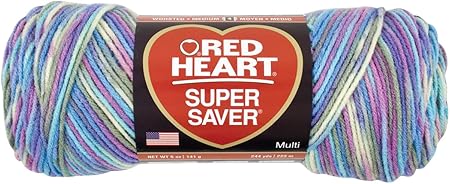
The borders were durable Red Heart acrylic...

Red Heart  Super Saver Economy Yarn, Monet Print

(It's been sold, but here's what I'd knitted with the batch of "Monet" multicolor-fleck Red Heart when it first came on the market.)

Kates Sweaters 385.JPG

And here it is in the border of the blanket, above a band of Red Heart solid blue.


I made and sold the blue jacket before I had a digital camera; here's the yarn:

Red Heart Yarn Super Saver 0381 Light Blue 7 oz
Here's the first pattern band, in the sequence in which they were knitted, above the border. (In order to get the borders to match I knitted both borders first, then continued knitting from what was actually the border band knitted second until it was long enough to join to the band knitted first.) Here I used up small scraps of solid colors as contrasts to the first scrap of hand-painted wool.


The multicolor yarns that coordinated so well with each other, and with Red Heart's "Monet" fleck, were Cherry Tree Hill handpainted wool and mohair. The company still offers unusual hand-dyed yarns but now they focus on lighter-weight "Broad Band" yarns that form stripes--nothing like the blanket-weight fleck yarns that formed dots, when knitted, for which the company was known in the 1990s. Check out...

http://www.cherryyarn.com/wordpress/

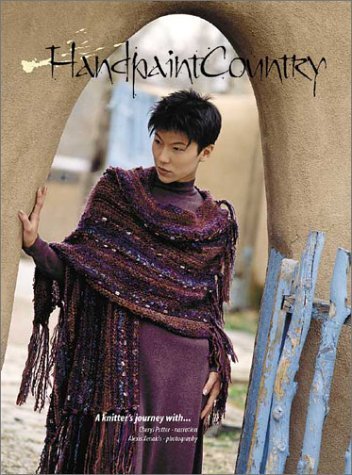
And here's a nice Amazon link...the founder of Cherry Tree Hill yarns wrote a book featuring patterns designed to highlight lots of other fancy handpainted yarns, as well as her own. Few of the yarns shown are still available, but you'll get lots of ideas about how to use ombre, fleck, and broad-band multicolor yarns that are available now.


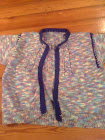
The coordinating multicolored yarns became this jacket:

photo (5).JPG

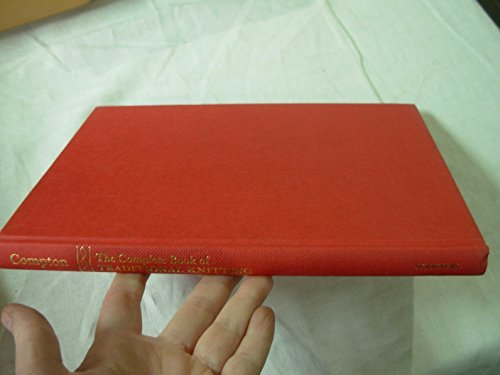
From the scrap bin I pulled out balls of solid colors and a couple of other multicolor yarns that blended naturally with the Monet and Cherry Tree Hill yarns. The patterns alternated garter stitch with texture and color patterns found in Rae Compton's Complete Book of Traditional Knitting; my copy still has the decorative paper cover, but here's the book's Amazon link:


You can find the patterns I used in the first third of the book, but why even bother? If you use blanket-weight yarns that knit up to (on average) 4 stitches per inch, 200 stitches will cover one person, couch, or "twin size" bed or cot, very nicely. Allow 10 stitches at each end of each row for garter stitch borders. This leaves approximately 180 stitches for your "canvas." All the patterns in the book can be repeated a few times within 180 stitches. Plug in your own pattern choices in between garter stitch bands and borders to get a unique blanket of your very own.

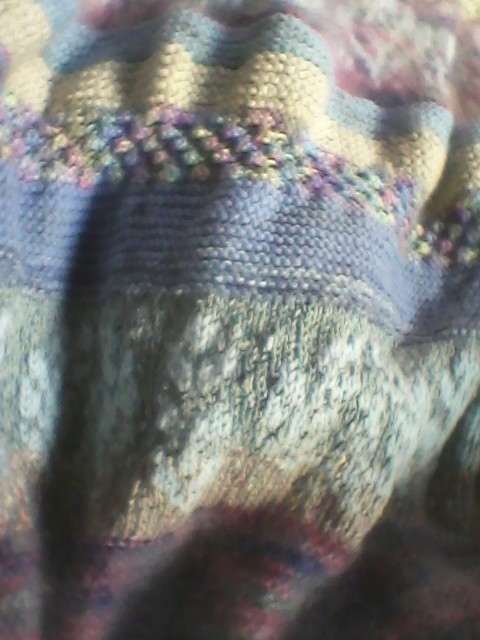
Here's the next section of knitting, in which you see the Cherry Tree Hill mohair, at the bottom of the picture in the band of garter stitch. This was followed by more of the light blue, contrasting with the gray cotton I used to knit the Paper Bag Cap (photo below); more of the Monet appears in the blackberry stitch band.


At this point, in order to show the colors, I stepped in front of the patch of sunlight and photographed the blanket from the side. Here's the next part of the knitting, in which Red Heart light blue and Cherry Tree Hill mohair are knitted together in the fairisle pattern.


That shades-of-green yarn was used in a jacket I still have for sale...a photo (and description and buying information) should appear here soon.

Here's the final section of patterns I knitted before joining to the top border you see above.


These yarns, and more of the "Monet" yarn, also appeared in the Faded Ribbons Jacket


Some of the other yarns in all of these multi-yarn projects were also Red Heart acrylic, and some were other acrylics (I've forgotten). One unusual yarn that appears in the blanket and the Faded Ribbons Jacket, I remember, was a single skein, bought at an end-of-season sale, of Chelsea Silk (blended) pale blue fleck yarn from Tahki Yarns

The blanket can be purchased online for $100 (plus $2 per online payment). It's approximately 50x75" (it will stretch slightly in use and shrink slightly when washed); big enough to cover a couch or twin bed. Wool and mohair sections may feel prickly, but these are top-quality wool and mohair yarns, handmade, with minimal chemicals, so a lot of people who think they're allergic to wool won't react to them. (I've knitted with these materials draped down over my bare legs, so I know for sure they don't contain enough acid residues to trigger that nasty hyper-acidic reaction with human skin even in summer.) The parts that will cuddle around your face as you sleep are acrylic anyway. This blanket should turn snow for several hours, and supply warmth for patients taking blood pressure medication. 

Friday, May 13, 2016

Terrific T-Shirt Sale

I don't often do this, even for the U.S.O., but this is a sweet deal on a U.S. "colors" T-shirt. (Note that the proportions are different, so technically it's a "colors image" rather than a flag. If the U.S.O. and the troops approve, who's to quibble?)


2016 FOURTH OF JULY T-SHIRT
It's here! Limited-edition 2016 USO Forth of July T-shirt.
GET YOUR T-SHIRT »
Donate $25 by M‌ay 26
The Kroger Co. will match all gifts, up to $250,000!

SUPPLIES ARE LIMITED
* From M‌ay 1 – M‌ay 26, your donation will be matched dollar for dollar, up to $250,000, by

[Kroger logo]

Friday, April 15, 2016

Funny Fantasy Football Shirts

(Blogjob tags: comic T-shirt imagesfantasy footballfunny football shirtsindividual designs for T-shirtsNFL starssports souvenirs. I later learned that the client had complained to the agent that he'd wanted more different links. Sorry, Mike, you get what you pay for; this is $5 worth of online research.)

Here's a guest post I wrote for another site, by which it was rejected...so, just to make sure the reasons didn't include plagiarism, the whole world gets to know what I wrote. Does it belong in the "Crafts" category? Of course! Designing T-shirts is a craft!
The site was about fantasy football. For those who may not be familiar with this sport, here's our Amazon book link:
Yes, you can actually Google "funny sports shirts," or "funny football shirts," or (fill in the blanks). If you're not too busy Twittering, you can even search the Net for funny football shirt designs during commercial breaks in a game. Or, if you think your web site really needs to consider this fascinating topic, you might spend an hour or two searching for the shirts that make you chortle.
Your results may vary. One reason for that is that people can interpret the word "funny," and even the word "football," in different ways. This article is, for obvious reasons, primarily about football in the NFL-fantasy sense.
Also, it's about shirts that are funny in the sense that someone who's not even a serious football fan would be likely to smile upon seeing these shirts. Some football shirts are funny to people who share a certain memory or attitude. There's nothing wrong with that, but these shirts are funny to someone who, if invited to draft a fantasy football team, is likely to start with Steve Young, Jerry Rice, and Doug Williams--it's a fantasy, so why can't they be on the same team with the Mannings, Brett Favre, and Tim Tebow? (At the fantasy football site I wouldn't have needed to explain...fantasy football is played by drafting a team of current players and then comparing their current performances.)
First, the Fantasy-Specific Football Shirts.
"Don't drink and draft fantasy football." Draft your team first! Any drinking buddies who don't get this have had too many and should switch to coffee now. These shirts come in a wide range of sizes, styles, and colors; if your friends like this message, there's a different, individual look for everyone. The link shows a white, 100% cotton, high-end man's shirt style. Long sleeves, short sleeves, cheaper shirts, ringers, hoodies, even a woman's stretch-to-fit polyester-blend shirt, and 41 colors, are also available.
"Fantasy football: it's not a game." Someone who really wants to talk to you can always ask, "Then what is it?" Other people can just smile at the novelty of a shirt message that's not advertising a product. This shirt comes in a lighter weight, finer grade of cotton than the standard T-shirt, in six "unisex" adult sizes and twenty different colors.
"Don't act like you're not impressed with my team (FFL)." Fellow fantasy football fans will get it. People who aren't fantasy football fans can ask you to explain it. This shirt comes in a heavy, durable grade of cotton, in five "men's" sizes and fifteen colors.
For high school footballers who still have the muscles, even if you use them in boring grown-up ways now...
Zazzle will print this motif on men's, women's, or children's shirts, but you can see why they chose to display it as a muscle shirt. If you have ripped muscles like the model's, explaining that you now get your workouts on a job or at a gym, and play fantasy football, will get an appreciative chortle from muscle admirers. If you don't, explaining that your sport is fantasy football will get a sympathetic chuckle from just about anybody.
(There are dozens of "Fantasy Football Loser" shirt motifs, too, for those seeking sympathetic smiles. Among those who appreciate the element of chance in the sport, "Fantasy Football Champion," "Fantasy Football Commissioner," "Fantasy Football King/Queen," and similar motifs should also get smiles.)
For Fantasy Football Gals...
This designer also has a basic "Fantasy Football Chick" shirt, if you check out her Zazzle store. Something about the female symbol with the football in it just struck me as... "eye-opening." The fabulous thing about Zazzle shirts is that you can order them in any size, any style, and almost any color you can think of--cheaper or pricier, sleeveless, long-sleeved, to fit men, women, or children.
Fantasy football puts an I in "TEAM" for men too. The only reason why this design is listed "for women" is that the designer chose to offer it in women's (stretch-to-fit) sizes only. It's available in six sizes and twelve colors.
(Sexier "Fantasy Football Female" and "Fantasy Football Loser" shirts are out there. Some women think they're funny, and wear them...but probably not in public. An "I rosterbate after games" motif that really is funny, but might confuse and upset certain high school teachers, was not included in this list. This article considers only shirts that would not get a teenager sent home from school or banned from the mall.)
For Football Fans Everywhere...
"If you want me to listen to you, talk about sports." Fair warning to those who don't really want to talk to you, and a witty way to invite those who do. Movieshirtguy has designed other "If you want me to listen..." shirts too. These come in "unisex" sizes (six of them) in eighteen colors.
Just the basics about how to be a football fanatic...available in men's, women's, children's, and even maternity shirts, all sizes and lots of different colors (including camouflage). I like the basic black, standard-fitting man's style best but it's available in almost any style you can think of, including pajamas and a grill apron!

Wednesday, March 2, 2016

Thriftshopping: Bargains, Fun, and Fashion in Three Easy Steps

(Reclaimed from Blogjob, where the tags were charity storefashionable clothes in charity stores,quality of clothing in charity storessecondhand clothes,shopping as an act of charitywardrobe building in charity stores.)

(Topic credit: +Andria Perry in the discussion of https://blogjob.com/groceryshoppingwithcoupons/2016/02/28/save-more-money-2-clothing-and-more/ . Image credit: a charity known for organizing excellent stores, and other good works.)
"S/He buys all her/his clothes at secondhand stores" may suggest (to older people) someone who is very badly dressed. If you don't have a lot of time and money, it may seem that that's the effect you'll get by thriftshopping for clothes, because the selection is usually limited. Over time, however, it's possible to build a wardrobe of upscale classic clothes entirely by shopping at the resale stores that support charitable causes.
There was a time when a "fashion blog" featuring pictures of what was in my closet would have been quite the hot ticket. As a Bright Young Thing I was considered well dressed--and I always shopped for causes. That time is over. I'm no longer twenty-five years old, and the look that works for me is no longer the height of fashion. I can explain what worked for me, but finding ways to make it work for you will still be up to you.
First, it helped that I'd absorbed a certain level of "fashion/beauty consciousness" as a child. Apart from what the Madison Avenue Misogynists are trying to palm off on women in a particular season, style rules differ because most people can achieve more than one look that they may like. As a top-heavy young woman in Washington, D.C., I considered the fashion looks that worked for Barbara Bush, Dolly Parton, Marla Maples, Rekha, and Meredith Baxter-Birney. Then, being in Washington, I generally bought the sort of styles that worked for Mrs. Bush. Even if you are a top-heavy young woman, that might not be the look you want. The point is to have an idea of what you do want.
The next step is to find it in secondhand stores. If you're committed to buying everything you wear in aid of a good cause, you may have to wear compromises for a year or two even in a city, but you will eventually get the wardrobe you want. I'm not talking about "the 'exclusive' style that only Mary and Jane are wearing this year, and the store has only two left, one in each color, and this color is mine and I want it." (That may or may not ever turn up in good condition in a charity store.) I'm talking about a reasonable number of shirts, jackets, skirts, trousers, sweaters, dresses, overcoats, etc., that work for you and won't scream "this year" when worn again next year, or next decade.
Look for quality and condition. When a dress shirt costs only $2, you might not mind that threads are already starting to break and pull out on the inside, especially if you're going to wear it under a jacket anyway, but over time you will notice that the $3 shirt whose seams were solid has lasted longer and given more satisfaction. As a general rule, anything made from rayon or polyester is worth buying, even on a dollar-a-bag clearance sale, only if you're planning to use it in some sort of craft project rather than actually wear it. Natural materials are almost always best. Pretentious neighborhoods (Chevy Chase, Maryland, comes to mind) may frown on charity stores; nice neighborhoods (Bethesda, Maryland, comes to mind) tend to have great charity stores, where rich people share and circulate treasures collected around the world.
Over time, you may notice that certain labels tend to recur in your favorite bargain clothes. They will probably be upscale labels, no matter how casual your style is.
When you have a choice between something that's fashionable right now and something that's less fashionable but that suits you, as a general rule the item that suits you is the one that will give more satisfaction. Even if you hang out with people who take fashion seriously, and they tell you you look like a ghost from the past, at least you'll be a happy ghost. However, all rules have their exceptions. If you're going to spend time with someone who feels less confident about his or her self-image than you do, thriftshopping gives you the option of varying your look to include something that suggests that you're trying to look like, rather than upstage, this client or friend.
How do you get the time for all this thriftshopping? It helps to start early--as a student, if possible. I did odd jobs that often gave me a half-hour or an hour to kill in neighborhoods that have good charity stores. Which neighborhoods those are will depend on your city and your preferred charities. If you can get a part-time or occasional job providing day care for a child or patient who enjoys thriftshopping too, you're really in clover.
After finding good stores, the third step is knowing when to stop. Charity stores sell a little bit of everything. Young "nest builders" need a little bit of everything to replace the hand-me-downs, borrowing, or lack of things they want. Because buying things from a good charity store is a way of supporting a good cause, it can be addictive. I'm generally in favor of a reasonable level of hoarding, but if you have more than 100 complete outfits for each season, have so many "decor" items that you're starting to stack ceramic pieces in layers on the floor, or have the supplies needed for more craft projects than you could reasonably plan to finish if you worked on them daily until your hundredth birthday, it's probably time to donate some merchandise to your favorite charity store and just send them money instead of shopping...or else open a charity store of your own.

Thursday, April 30, 2015

In an Unexpected Manner

(Reclaimed from Bubblews, where it appeared on July 22, 2014. Image credit (same shirt, different sizes): Puravida at Morguefile.com.)


Although this true story was brought to mind by the question at the end of Myqute 's horror story, www.bubblews.com/news/4771340-horror-the-fortune-teller039s-warning , this one's in a completely different mood...

Years ago, I was invited to a house party that lasted all winter. My boyfriend invited me, and his sisters invited their boyfriends, to stay at their parents' house in the city where we were working. His parents were professional foster parents and even had a foster grandchild that winter, and it must have been quite a winter for them, not being able to walk through a twelve-room house without stepping on a sleeping bag. Somebody would start a load of laundry before dawn, and the last load would be dried around midnight.

One evening somebody read a horoscope out of the newspaper. Somebody else pointed out that that was supposed to have been a message for the day that was now over. Then we all started checking what was supposed to have happened to us during the past day.

My horoscope said, "You could lose property in an unexpected manner."

Uh-oh! I didn't have much to lose! But I checked, and I didn't seem to have lost anything.

Next morning I started dressing for work. Something didn't feel right. I double-checked. Yes, something I'd put on was the same brand and color it had been before, but somehow the garment had grown a size overnight.

At least it hadn't shrunk. I went to work as usual. Nobody seemed to notice.

A few weeks later I wore the same outfit again, and one of the other young women in the house said, "Oh, that's what happened!" She had bought the garment I was now wearing--same brand, same style, same color, same store--laundered it, and thought she'd taken it out of the laundry. Needless to say, she'd got mine and I'd got hers. And since mine was a size too small for her, and she still had the receipt, she'd returned it to the store, where it was no longer in stock, and she'd bought something else instead.


How many times since then I've read what the horoscope in the newspaper predicted for some day that's already past, and seen no connection at all! But just once, on a day when we were all laughing at the irrelevance of our horoscopes, my horoscope's prediction came true...in a most unexpected manner.

Monday, April 27, 2015

Fashion and Child Labor

(Reclaimed from Bubblews, where it appeared on July 3, 2013. Image credit: Pippalou at Morguefile.com.)


After reading this Bubble...
bubblews.com/news/968403-unseen-side-of-nike-adidas-dkny-giorgio-armani-and-etc


I typed a comment that was apparently too long for this system. The computer ate my comment. So I'm posting these thoughts as a separate post.

Most U.S. citizens have noticed that the clothing "fashions" and household products we buy are produced in factories overseas. Most of us have even heard that many of these factories use child labor. Remember when TV hostess Kathie Lee Gifford launched her designer label, then self-exposed and expressed her horror at the conditions under which her fashion designs were being mass-produced? Kathie Lee may have recoiled in horror, but designers who aren't primarily TV stars are still working with the same system today. Most of us knew this, at the same time that we've noticed that there are fewer and fewer semi-skilled labor jobs for Americans who would prefer to work with their hands rather than with computers. We just tend to avoid thinking about it.

Some American writers who've tackled the topic of child labor (and/or underpaid adult labor) have concluded that it's not all bad. As John Stossel observed on his TV show, in his newspaper column, and in his book: When children are employed in factories, they're not being forced to earn even lower wages in even more appalling "jobs" such as begging, prostitution, and picking pockets. 

Young Americans tend to think that it's horrible and abusive if anyone suggests that American children might be doing something besides playing, going to school, and watching television. (Some American children, themselves, think an opportunity to do meaningful work would be fun and cool--much more interesting than another soccer game or TV show. Of course, their exposure to meaningful work has not involved sweatshop labor.) So what are they to think about children growing up in countries where "letting children enjoy their childhood" has never been the quasi-religious cult it is for many Americans? Either "That's terrible, somebody ought to stop it, but I have no idea who or how," or else, "We can't hope to understand these foreign cultures."
I don't pretend to understand foreign cultures. And I do think that, as long as the options open to a poor family include making children either factory laborers or professional pickpockets, factory labor is better. But I'd prefer to buy clothes and housewares that were made in the U.S.A., by Americans, who were earning living wages...not necessarily the inflated wages some unions have urged them to demand, but wages on which they could bring up children.

Friday, April 17, 2015

Care of the Hand-Knitted Sweater: Classic Wool

(Reclaimed from Bubblews, where it appeared on February 5, 2014. Photo credit: Victoria Cooley. More about the wool sweater shown here at http://priscillaking.blogspot.com/2012/11/hand-painted-jacket.html.)


Wool is basically the fur of soft, cuddly animals, and is best washed as you would wash an animal. Adjust the water in the sink to about body temperature, add a mild soap like Woolite or Eucalan, and gently swish the wool through the water without stretching or rubbing. Squeeze out soap. Rinse thoroughly by running water, as close to body temperature as possible, slowly through the wool. It’s important to rinse out all the soap; soap will irritate the skin and make you think you’ve become allergic to your wool sweater. Squeeze out the water and, working quickly but gently, spread the wool back to its original size and shape and secure it while it dries. You can use a box of straight pins to hold the wool against a big piece of cardboard, buy special wires called “Blockers” to construct reusable adjustable frames for each of your wool garments, or even buy boards cut to the shapes of socks, shapes, or mittens, on which to dry wool pieces. (Wool berets were traditionally stretched over a dinner plate to dry. Wool stocking caps are best dried on a wig block.)

Some wools are treated with chemicals that reduce shrinking and matting—a little—when the wool is machine washed. Gena Greene tries to avoid these wools since these chemicals also irritate the skin of anyone who tries to wear them. All wool, regardless of how many harsh chemicals have been soaked into it, will shrink if not stretched out to shape while wet. All wool will also mat or felt up if it’s wrung, rubbed, or squeezed together. 

Because cleaning wool is such a chore, we recommend not wearing large wool garments next to the skin. Coats and blankets don’t need to be washed as often as shirts do. Wool is supposed to smell like a clean, healthy, cuddly animal.

An alternative method of cleaning wool, misleadingly called “dry cleaning,” was used in the twentieth century and is still practiced in some cities. We don’t recommend it. The chemical fluids used to remove odors seldom completely cleaned the wool, frequently harmed the cleaners, and never did the environment any good. You may, however, be able to find a professional wool washer who will clean a wool sweater with the care it deserves.

Friday, April 3, 2015

Care of the Hand-Knitted Sweater: Easy-Care Acrylic

(Reclaimed from Bubblews, where it appeared on February 5, 2014. Image credit: Tori Cooley, of the sweater available here.)


Yesterday I made it all the way to the computer center...and the Internet connection was "down." I sat here for six hours, watching the little circle slowly rotate backward to indicate that the browser wasn't getting anywhere, and retyping old material from the very back of the backlog for easy posting here. Because I wasn't able to post yesterday's Bubbles yesterday, my plan for today is to post yesterday's five Bubbles even before going to "Notifications," then post today's five bubbles toward the end of the day...so here's the first piece in a series about caring for hand-knits. 

Many Greensleeves sweaters are made of pure acrylic yarn. Most of this yarn is top-grade Wintuk, Sayelle, Dazzle-Aire, Red Heart, or comparable name-brand acrylics. These yarns are almost indestructible. They will hold their shape and color through years of machine laundering. They feel comfortable, although extremely thick and warm, next to the skin. The colors may be subtle and tweedy, but will not fade. The life expectancy of a top-grade acrylic sweater remains unknown. Most will last long enough to be handed down to the next generation.

Sometimes acrylic yarns that aren’t top-grade have some sort of special appeal. The color is still part of the fibre and won’t fade, but the yarn may need a little extra care. If acrylic loses its shape it will stretch, and it won’t shrink back easily—or at all—so it’s good to avoid hanging sweaters on hangers, and to pulling on wet acrylic material. 
Although some knitters and wool shops sometimes try to market the more expensive natural materials by acting as if nobody they knew would ever wear anything made of acrylic yarn, the majority of people who've actually bought Greensleeves knits have bought acrylic.

Monday, March 23, 2015

Book Review: 10-20-30 Minutes to Sew

A Fair Trade Book

Title: 10-20-30 Minutes to Sew
        
Author: Nancy Zieman

Author's web site: http://www.nancyzieman.com/blog/
        
Date: 1992
        
Publisher: Oxmoor House
        
ISBN: 0848711181
        
Length: 144 pages including graphics; many full-color photos
        
Quote: “Who uses minutes has hours to use; who loses minutes whole years must lose.”
         
Time-saving tips and simple techniques give those who love to sew time to test the truth of this clever saying. Of course, some of the tips involve buying sewing notions, as it might be from Nancy’s Notions, Ltd...then again, those notions might prove useful. Do you need to see things, not hide them in drawers, yet want them contained in a bin where they won’t fall all over the floor as you lift one thing out? Maybe everyone knows that transparent plastic storage bins are available, now, but did everyone know that in 1992?
        
Tips that don’t involve buying things are pretty predictable too—plan and measure first, keep those scissors sharp, cut multiple layers when possible. However, there are some tips in this book that my grandmother didn’t know, like this valuable information on page 17: “ink marks” (from marking pens) “may reappear many years later...Also, the heat of an iron will set the marks.” Have those new air-soluble pens been around for enough years for anyone to know whether their stains may reappear, too, or is this a problem only with regular felt-tips?
         
Some of the sewing tips are likely to be appreciated by anyone for whom you sew, like a quick trick to curb the tendency of a rounded collar to roll upward. Others may be less appreciated. Don’t bother with that “speedy sport pocket,” and cut those all-in-one side pockets at least twice as deep below the side opening as the diagram suggests, if you want to make a garment for a person who actually uses pockets. (Don’t skip the pockets, either, if you’re sewing for a person like me; I classify anything that doesn’t have good, deep, secure pockets as Pajamas.) Those zippy zipper tricks and wash-out buttonhole patterns, on the other hand, might be perfect shortcuts to garments people can actually enjoy wearing.
        
There’s also a section on making clothing with a serger as “the ultimate time-saver.” Sergers are strange, futuristic machines designed to join fabrics by something more like knitting or crochet than like ordinary straight seams. The results can be decorative; the book shows examples of how lines of contrast-color serging can be used like embroidery. I must confess I’ve never actually seen anyone use a serger, although I’ve seen factory-made garments with serged seams.
        
Special tips are offered for sewing with knitted fabrics and inserting (or replacing) elastic. One super-brilliant trick is to insert one (or more) tucks of elastic into a waistband, so people whose size is subject to change, especially pregnant women, can let in and take out the elastic without your needing to replace it. Another chapter offers special tips that involve extra accessories, special needles and presser-feet that you can snap into the machine for special effects.
        
Information for raw beginners appears, rather awkwardly, after all the tricks for serious hobbyists. How to read a pattern (always save the envelope), how to pin fabric together, how to press seams...it’s true that knowing these things saves a lot of wasted sewing time, but shouldn’t they have been placed at the beginning? Oh, we reviewers always have to find something to gripe about.
        
Since this book is 17 years old, you might wonder about the accuracy of the information that you can order any or all of these gadgets, and/or catalogues of new ones, from Nancy’s Notions at 1-800-833-0690. I did. I dialled. Not only is the store still open, but some poor lady with a flawless U.S. accent was still answering the phone at 8:30 p.m. (I’d been sure I’d get a recording.) When I explained that I’d seen the number in an old book, she quickly offered, “Would you like to order a new book?” The store now exists at Zieman's blog, linked above, as well. Book and store are recommended to all who like to sew.

10-20-30 Minutes to Sew has been out there for a while and is not particularly rare. We can offer it as a Fair Trade Book: $5 for the book + $5 for shipping to salolianigodagewi @ yahoo.com, we will send $1 to Zieman or a charity of her choice. We also recommend browsing her web site; Zieman has indeed written some new books that you can order directly from her to show respect. 

Thursday, March 12, 2015

Book Review: Techniques for Casual Clothes from Threads

Title: Techniques for Casual Clothes from Threads
        
Author: Threads magazine writers

Threads web site: http://www.threadsmagazine.com/
        
Date: 1994
        
Publisher: Taunton Press
        
ISBN: 1-56158-071-6
        
Length: 95 pages including many graphics and index; subscription card sheet
        
Quote: “Comfortable, casual clothes...are what we wear most of the time. There’s no better reason to sew than to make such personalized favorites.”
        
For serious crafters, this book needed an announcement more than a review. Threads is a magazine that’s always packed with informative articles about all the textile crafts. Each article explains a technique and gives a few examples of how to use that technique. Usually the magazine avoids full-sized pattern pages or stitch-by-stitch instructions; writers assume that you’re familiar with the basic techniques of the craft and can figure out how to copy the example piece, or make something different with the same technique, with just a thumbnail sketch of a shape to fold and stitch, an embroidery stitch method or knitting or crocheting stitch pattern.
        
This book is a collection of articles reprinted from Threads in the 1980s and 1990s. The articles reprinted are “Straight Line Design,” “Marvelous Melton,” “Making Great Strides: how to put a perfect pleat into a straight skirt,” “Buttoning Up,” “Making a Kilt,” “Hand-Felted Jackets for Kids,” “Sophisticated Stenciling:a simple way to print on fabric and clothing,” “The Embellished Vest,” “Clothes to Live In...in one flat-fell swoop,” “Sew Yourself a Sweater: sewing machine solutions for handling textured knit yardage,” “Who Needs Calvin Klein: how to draft and construct a pair of authentic jeans,” “Sewing Workout: fabrics and techniques for constructing stretchy activewear,” “Tips for the perfect Shirt,” “Embroidery with Texture,” “Two Jackets in One: reversibility,” “A Surprising Turn of the Pleat,” and “Sewing the All-Weather Raincoat.”


If you’re not a regular reader of Threads, you may be wondering, “Yes, but can I use these articles?” Some of them, like “Straight Line Design,” in which you tack squares and rectangles together to make drapey shirts, unfitted jackets, and baggy britches, should be easy enough for anyone who can hem a skirt and sew on a button. Sewing a raincoat will be more of a challenge. The explanations will help. If you have not done much sewing you'll probably need help to use the articles.

Collections from magazine archives, like this one, don't qualify as Fair Trade Books. However, Techniques for Casual Clothes is slim enough to fit into the same package with a Fair Trade Book, with no extra shipping charge. To buy it here, send $5 for the book + $5 for shipping to salolianigodagewi @ yahoo.com.