Showing posts with label health care reform. Show all posts

Thursday, January 5, 2023

Mark Warner on Medical Care Legislation

From U.S. Senator Mark Warner, D-VA: 

"

Friends,As the father of a Type 1 diabetic, I know firsthand how health costs – especially those related to diabetes – can skyrocket. These bills aren’t optional, and they’re not something you can just choose to cut back on – month after month, you’re on the hook for whatever that insulin costs.And it’s not just insulin. The costs of other prescription drugs, premiums, vaccines, and other care can really stack up. I’ve worked hard across my time in the Senate to lower health costs for all.This year, we’re seeing some returns. I was proud to support the Inflation Reduction Act, which will cut costs where it countsIt extends expanded premium subsidies, which keep health care costs down for all covered through the Virginia marketplace. It also caps insulin at $35/month for those covered by Medicare prescription drug plans. Across Virginia, 74,425 insulin users will directly benefit from the insulin cap. (If you receive your insulin through a pump covered by Medicare’s durable medical equipment benefits, this provision will also take effect for you starting on July 1 of this year!)It isn’t just insulin though – throughout the next several years, new provisions to prevent price gouging will go into effect. In September, Medicare will announce the first 10 prescription drugs that they’ll be able to negotiate prices on – and this program will expand over the next several years, lowering costs at the pharmacy. By 2025, seniors will also enjoy a cap of $2,000/year for all their prescription drugs – meaning folks won’t be stuck spending tens of thousands for medicines they need to survive.Additionally, all recommended adult vaccinations are now FREE for those on Medicare, including the shingles vaccine! More than one million Virginia seniors will now be able to get vaccinated totally free of cost. Most doctors’ offices and many pharmacies offer this important vaccine, so read more about eligibility through the CDC.If you want a full look at when all the changes we passed in the Inflation Reduction Act will take effect, find a great timeline here. A lot of work remains – I’d like to see many of these provisions extended to folks who are covered by a range of insurances, not just Medicare. I’ll keep pushing for progress.

Sincerely, 


Wednesday, August 14, 2019

Morgan Griffith on Medicare For All

From U.S. Representative Morgan Griffith (R-VA-9):

"
Monday, August 12, 2019 –                                
Socialized Medicine: Not What the Doctor Ordered
A proposed socialized medicine program run by the Federal Government, which Democrats call Medicare for All, is enjoying time in the spotlight, partly due to its strong support among Democrat presidential candidates and the new majority in the House of Representatives. The House’s bill for socialized medicine enjoys 117 cosponsors as I write this column, over a quarter of the entire House.
If this legislation were ever signed into law, devastating consequences would ensue for health care.
First of all, it does not even pretend to make the same promise President Obama made about Obamacare, that “If you like your plan, you can keep it.” This socialized medicine plan would not let you keep your insurance. That would include the employer-sponsored insurance over 158 million Americans currently have. It would also rule out the private insurance many seniors have through Medicare Advantage.
Instead, everyone would be forced onto government plans with limited options, putting the government now squarely in the middle of the relationship between patient and doctor.
Patients would certainly be made worse off by this intrusion.
So would doctors. Medicare currently pays them rates that are lower than in the private market. A study by the Mercatus Center, affiliated with George Mason University in Virginia, found that Medicare for All would reduce reimbursements for doctors by 40% compared to what they earn from reimbursements by private insurers. Such a severe cut would deter talented people from entering or remaining in the medical profession.
Hospitals would also lose revenue if all their services are reimbursed at Medicare’s current rates, which could make a difference in how many services they offer or even if they are able to remain open at all.
In April, the New York Times ran a story on the harsh fate awaiting many hospitals under Medicare for All:
Some hospitals, especially struggling rural centers, would close virtually overnight, according to policy experts. Others, they say, would try to offset the steep cuts by laying off hundreds of thousands of workers and abandoning lower-paying services like mental health.*
Lee County and Patrick County currently lack hospitals. It is true that they closed without socialized medicine becoming a reality, but if it did, those hospitals would have a more difficult time reopening and the ability of hospitals in some of our other jurisdictions to stay open could be threatened as well.
The universal coverage promised by socialized medicine’s proponents is meaningless if patients have nowhere to go for treatment.
These problems are not hypotheticals. My mother, who is 89 years old, needed ten months to find a primary care doctor who will accept Medicare. Her new doctor made an exception to take her, as he was already treating someone in the family. But when she called earlier in the year, his office had said no to taking new Medicare patients.
Already, some physicians have left the medical field due in part to low Medicare reimbursement rates. They could not sustain their practices at those rates. Medicare for All can’t be a serious solution when Medicare in its present form doesn’t serve all whom it should.
Britain’s National Health Service is often held up by socialized medicine advocates as a model, but one need not look far to find its dire flaws.
When I was studying at Scotland’s University of Edinburgh on a stipend, I stayed in the city’s Tollcross section, a less well-off neighborhood. My apartment was across the hall from an older couple named Finch. Mr. Finch at the time was waiting on heart surgery for a condition diagnosed in February or March, yet the surgery wasn’t going to happen until the following October.
After I returned home, I learned that he had the surgery but died within two years. His family was convinced the long delay between diagnosis and surgery weakened him; they believed he would have survived if he had been treated when diagnosed. In the United States, the same surgery would have happened within a week.
Constituents inform me frequently about their problems with the present health care system, and I recognize that serious reforms are needed. I have worked on them throughout my time in the House of Representatives, and I will not give up my efforts. But we must be wary of the “cure” socialized medicine offers.
I am committed to real health care reform that promotes affordability, access, and choice without diminishing our freedom to make decisions or forcing us to send more of our hard-earned money to Washington.
If you have questions, concerns, or comments, feel free to contact my office.  You can call my Abingdon office at 276-525-1405 or my Christiansburg office at 540-381-5671. To reach my office via email, please visit my website at www.morgangriffith.house.gov.

*“Hospitals Stand to Lose Billions Under ‘Medicare for All,’” New York Times, April 21, 2019
"

Tuesday, September 18, 2018

Morgan Griffith on Knowing the Cost

From U.S. Representative Morgan Griffith (R-VA-9):

"
Monday, September 17, 2018 –                                
Bipartisan Health Care Legislation
Health care policy touches on some of the most important and personal decisions people make. From my vantage point on the Health Subcommittee of the Energy and Commerce Committee, I continue to look for ways to improve health care in the Ninth District.
Health care policy revolves around quality, availability, and affordability. All three of these goals can be promoted by the use of telehealth, in which medical services are provided remotely through electronic and telecommunications technologies. I have long supported telehealth as a solution to some of the challenges faced in Southwest Virginia. In rural areas like ours, telehealth can provide access to treatments that patients would otherwise have to travel far to receive, if they receive it at all.
Recently, I joined with several of my colleagues on both side of the aisle to introduce the Reducing Unnecessary Senior Hospitalizations Act (RUSH) Act. Our legislation would expand telehealth’s use in skilled nursing facilities. Rather than require seniors to be transferred to hospitals, it would allow for telehealth to be utilized to treat Medicare recipients in place at these facilities when appropriate.
By embracing opportunities created by telehealth, the RUSH Act would reduce risks for seniors and save money for taxpayers.
As part of a September 13 hearing on improvements to Medicare, I was able to discuss our bill with Dr. Timothy Peck, the founder and CEO of Call9. His company has achieved success bringing telehealth into nursing homes, treating seniors experiencing a health episode there rather than transferring them to hospitals.
He testified that Call9 can treat patients in place roughly 80% of the time. Those seniors can be treated at the time of their emergencies rather than go through the ordeal of completing an ambulance ride and waiting to see an emergency room physician. In addition to saving the time and cost of an ambulance ride, these seniors are spared the stress and confusion of a ride accompanied by blaring sirens. Further, they are spared bright lights and the possibility of a bed in the hallway at the emergency room.
Current law, however, prohibits Medicare from providing reimbursements for telehealth, inhibiting his company from expanding, especially to rural areas. The RUSH Act would encourage his operation and others providing similar services to go into nursing homes in rural areas or that depend heavily on Medicare. As I pointed out in the hearing, seniors in these homes deserve the same quality of care as those who live in urban or wealthy areas.
Support for telehealth has brought together Democrats and Republicans.
Some measures to lower prescription drugs prices also unite both parties. Everyone recognizes that people are paying too much to have their prescriptions filled.
The issue is a tangled one, but I believe transparency is an essential part of untangling it. That’s why I am an original cosponsor of the Know the Cost Act, which would ban the practice of “gag clauses.”
Gag clauses may be imposed by pharmacy benefit managers (PBMs) on pharmacists, prohibiting them from telling patients about cheaper out-of-pocket alternatives to their prescriptions covered by insurance.
This is unfair. Patients and pharmacists should have the freedom to fully consider their options when filling prescriptions.
The Energy and Commerce Committee heard testimony on September 5 from a pharmacist affected by gag clauses, and Democrats and Republicans both recognized their negative impact. When the Know the Cost Act was introduced, it had ten sponsors. I was one of five Republicans and five Democrats.

It passed the committee unanimously on September 14. I believe this bipartisan cooperation will produce solutions to help bring down prescription drug costs.
"

Friday, August 31, 2018

Obamacare: Tim Kaine Gloats

From this web site, a prod with a sharp stick to certain squishy members of Congress whose mandate was to destroy Obamacare and, if possible, punish the insurance companies for allowing anyone even to suggest that Americans could be forced to buy into gambling rackets.

From U.S. Senator Tim Kaine, this bit of gloating:

"
I'm thrilled that we recently passed legislation in the Senate that supports health care priorities that are critical to Virginia. From funding cancer research, to protecting the Affordable Care Act, to helping states administer substance abuse treatment, to combatting Alzheimer's, the bill includes key wins that will help make Virginians healthier.

Specifically, the legislation fully funds the Gabriella Miller Kid's First Pediatric Research Program to work towards a cure for childhood diseases. In 2014, Congress passed bipartisan legislation I championed to create this program, named for 10-year-old Gabriella Miller of Loudoun County who passed away from cancer in October of 2013. We've now allocated $63 million for this important research that will help save lives. I'm grateful that my colleagues joined together again this year to honor Gabriella and her inspiring work as an advocate for pediatric disease research through passage of this legislation.

I'm also relieved that we were able to stop language from being included that could have further damaged the Affordable Care Act. Instead, the bill helps protect Medicare, Medicaid, and the ACA. These vital programs have been a lifeline for so many Virginians, and I'll keep doing everything I can to preserve them.

You can read more about the bill here >>
Health care is a right, and I remain committed to improving the health care system for all Virginians.
Sincerely,
"

Those who claim to have been representing me deserved this. And worse.

Tuesday, June 5, 2018

Morgan Griffith on the Patient's Right to Know

From U.S. Representative Morgan Griffith, R-VA-9, with a loud "amen" from the choir. (When my late husband needed an antibiotic in the hospital, he was too sick to explain why, but not too sick to remember to insist I buy it with cash. It was expensive at the neighborhood pharmacy--and twice as expensive when the hospital added it to insurance.)

"
Drug Prices, Gag Clauses, and Sunlight
High prices for prescription drugs affect the pocketbooks of many residents of the Ninth District. Even with health insurance, people have trouble paying for their prescriptions.
Many factors affect what a person pays when he or she fills a prescription. There isn’t a silver bullet that will take care of this problem, but I believe more transparency is essential to helping address it. As the late U.S. Supreme Court Justice Louis Brandeis wrote, “Sunlight is said to be the best disinfectant.”
One of the most egregious ways in which lack of transparency results in higher drug prices is the so-called “gag clause.” Sometimes a person can save money by paying cash for a prescription rather than relying on health insurance. But gag clauses imposed by pharmacy benefit managers (PBMs) in contracts can prevent pharmacists from telling customers that they could save money.
This is an unfair practice. Prescription drugs are difficult enough to pay for even when you have all the information on the table.
There are efforts at the federal and state level to bring sunlight to drug prices and end the practice of gag clauses. In the House of Representatives, I am an original co-sponsor of a bill introduced by the only pharmacist in Congress, Congressman Buddy Carter (R-GA). This bipartisan bill, H.R. 5343, the Prescription Transparency Act, would prohibit gag clauses at the national level. It has been referred to the House Energy and Commerce Committee, on which I serve.
As the Trump Administration has also taken aim at drug pricing, Centers for Medicare & Medicaid Services (CMS) Administrator Seema Verma recently noted that her agency views gag clauses as “unacceptable and contrary to our efforts to promote drug price transparency and lower drug prices.”
In Virginia, state Delegate Todd Pillion introduced a bill during this year’s legislative session to prohibit gag clauses in provider contracts entered into, amended, extended, or renewed on or after January 1, 2019. This bill passed the General Assembly and was signed into law by Governor Northam.
Ending gag clauses would be a positive step toward greater transparency and, ultimately, lower prices for prescription drugs.
"

Friday, May 25, 2018

Morgan Griffith on the Right to Try

From U.S. Representative Morgan Griffith (R-VA-9):

"
There’s a saying about not making the perfect the enemy of the good. I thought of that saying recently when I voted for the Senate’s version of “right to try” on May 22.
Regular readers of this column know that I am a staunch supporter of the concept of “right to try,” which would allow patients facing life-threatening illnesses to access experimental treatments. Throughout my time in Congress, I have introduced bills to implement it at the federal level.
Recently, vocal support from the Trump Administration made the possibility of “right to try” becoming federal law more likely than ever. I worked with my colleagues on the Energy and Commerce Committee and other supporters of the idea in the House of Representatives to craft a bill that we believed would give “right to try” the best opportunity for successful use.
I believe the bill we produced had the most promise. It put into law the right of terminal patients to attempt new treatments at their own risk, but it also included patient protections to promote the successful use of this right. The House passed the bill in March by a vote of 267-149. Thirty-five Democrats supported it.
The Senate had passed its own “right to try” legislation last year by unanimous consent. I did not think the quality of the Senate bill matched the House’s version. Since “right to try” passed the Senate without opposition last year, I believed we would be able to work out a compromise that would clear both chambers. In the Senate, however, Minority Leader Chuck Schumer (D-NY) blocked the way to sending such a measure to President Trump’s desk.
Ultimately, we had to pass the Senate version to enact “right to try” this Congress. While I still believe the bill could have been better, I voted for it. Improvements to the law can be made later, but desperately ill patients can get another chance for treatment now.
"

Friday, May 11, 2018

Tim Kaine Clings to Obamacare

From U.S. Senator and Bitter Clinger Tim Kaine (D-VA):

"
I’m deeply troubled by the news that health care insurers are proposing raising premiums on Virginians who receive their health insurance through the Affordable Care Act individual market. What’s worse is that I know we could have taken action to avoid such drastic increases. Over the last year, the Trump Administration and members of Congress from his party have weakened the Affordable Care Act. When they eliminated the individual mandate, reduced the enrollment period, continually called for its repeal, and cut off cost saving reduction payments, they helped to worsen significant instability in prices, and Virginians are bearing the brunt of this concerted effort.
It’s very important that we not only act in ways to preserve the Affordable Care Act, which brought our nation’s uninsured rate to historic lows, but also make it better. We need to pass the bipartisan legislation we’ve put forward to stabilize the health care market and make sure Virginians have affordable options for health insurance. And then I hope Congress will take up my Medicare-X bill to provide low-cost, high-quality care in every zip code, boosting competition. This bill would build on the Medicare framework to establish a public insurance plan offered on the individual and small business health exchanges, allowing Americans to choose among the existing private insurance plans or a public one. It would be particularly beneficial in rural Virginia, where often there are limited options and the prices are too high.
What we need to do is work together to give people more options that are affordable. It’s time to strengthen – not weaken – our health care system for all.
Sincerely,
"

[nice signature graphic] Senator Tim Kaine

Official editorial comment: Could Nick Freitas ask for better publicity than this? The more people refuse to participate in insurance gambling rackets, the better the chance that poor people will have access to decent medical care again by the time I'm old enough to need it...the way poor people did have access to decent medical care, before the insurance mafia took over, back when I was able to pay for medical tests on a busboy's wages.

Friday, April 27, 2018

Even More Condolences, Senator Carrico

From Virginia State Senator Bill Carrico (R-40):

"
Senator Ryan T. McDougle (R-Hanover), Chairman of the Senate Committee on Rules, announced Tuesday that the Senate of Virginia would reconvene the 2018 Special Session at noon on Monday, May 14.

The Senate will convene to refer House Bills 5001 and 5002 (the "Caboose Budget" and "Budget Bill" respectively) to the Senate Committee on Finance, which will meet immediately upon recess of the Special Session to consider those measures.

“The schedule we are announcing today will give the Senate the best opportunity to have the most current and complete information on the Commonwealth’s fiscal outlook as we craft a final budget agreement,” noted Senate Majority Leader Thomas K. Norment, Jr. (R-James City). “We anticipate Secretary Layne will be prepared to update the Committee with revised revenue projections as we begin our deliberations.

"Governor Northam and the House have advanced plans to extend Medicaid benefits to able-bodied adults under the provisions of the Affordable Care Act. While their plans are embedded in their respective budget proposals, Senator Hanger and Senator Wagner have advanced outlines of expansion proposals that are markedly different from the Governor’s and the House’s.

“It is our intention to consider the implications of all proposals when the Senate Finance Committee meets. To ensure Committee staff has the opportunity to fully vet any proposals prior to our meeting, we are asking senators with alternative proposals to submit them by May 7. Senators with budget amendments unrelated to Medicaid expansion should submit them to the Committee by that date, as well.

“With complete information on the state’s revenue outlook, and with a full understanding of the implications and ramifications of each of the respective Medicaid expansion proposals, the Committee will be able to act in the best interests of Virginia.”
"

Official comment: Bankrupting individual States is not the way to prevent the bankruptcy of the United States' federal budget. We need to repeal Obamacare, trim Medicaid, and focus on reducing unnecessary costs added to medical care (by allowing the insurance industry to run the medical care system for the insurance racket's own profit). Face reality, Democrats. Even if youall sincerely believe that entrapping people in welfare dependency and/or insurance gambling rackets is good, or pardonable, you can't seriously believe that dragging people into Richmond in May is a humanitarian act.

And, Virginia Republicans? Unfortunately our cities have been packed with people who may be in Virginia for the express purpose of exhausting our treasury, or may sincerely believe that exhausting the treasury and raising taxes is the only way they can help those other people. We are a "red state" but we need to acknowledge this infusion of alien "blue" in our voting public, and get to work educating them, using our Conservative Hearts. There's a lot of "conservative" thought in Spanish and Islamic culture. We need to start there. Think in self-defense-strategy terms, using hostile energy against the hostility. The way to "flip" the endless-immigration-and-overcrowding strategy is to stop rejecting foreigners, meet them with real Virginia hospitality, and show them that in fact we're the ones who are not exploiting them for bad purposes.

Tuesday, April 17, 2018

Condolences, Senator Carrico

This web site recognizes valid arguments on both sides of this issue, and the position of this web site is that the State Senate is right. We need to abolish Obamacare (in every State, actually); we need to move away from all handouts based on the unsustainable ideal of "from each according to his ability, to each according to his need," which rewards "needing" at the expense of productivity and thus drags everyone down. We need to develop plans for promoting more financial responsibility and self-sufficiency, decentralizing and downsizing all government programs, and--without relying on handouts of untrustworthy medical care!--shift more older people away from plans based on "I'll 'retire' and the government will take care of me after a certain predetermined date" to "I'll work as long as I'm able and plan the rest of my life based on what I've personally earned, saved, and arranged for myself."

Medical care providers can be expected to kick and scream if told that they ought to be--as lawyers, lawyers, "trained sharks," are--public-spirited enough to extend a certain amount of decent-quality free service to those in real financial need, pro bono publico. But they ought. If a lowly massage therapist whose maximum hourly fee was $50, for (after some experience) a maximum of two hours in one day, can offer free service to the poor on Saturdays, you know doctors can do that too. I did; I took the risk of limiting myself to providing only my best quality service in order to protect myself from being sued, and I was never sued. I'm willing to go to Richmond or Washington and call other health care people out on this if necessary. Mandating that would be a first step toward restoring sanity to our medical care system, cutting out the huge inflation of prices that the insurance gambling racket is sucking out, and making it feasible for ordinary people to pay for most medical care out of their own private wages and/or savings account, the way it was when I was young enough to panic and rush to doctors while able to walk.

"
April 11 - Special Session
The General Assembly returned to Richmond this week to begin the process of completing work on Virginia’s 2018-2020 Budget.

The differences between the proposed spending plans by the House and Senate remain what they were when the regular session concluded just over a month ago. There is still more than $3 billion in revenues separating the two proposals. The House’s plan still includes Obamacare’s optional Medicaid expansion and a new tax on hospitals to pay the state’s share of the funding for that provision. And, the House’s plan still spends additional revenues intended for healthcare to increase spending in areas entirely unrelated to healthcare.

Much of the news coverage related to the continuing budget impasse has, predictably, focused on the politics of the differences. A minority of House Republicans joined with every House Democrat to approve a budget that would fully implement Obamacare in Virginia, while every Republican senator (along with four Democrat senators) voted to approve a budget based on existing revenues without expanding Medicaid.

Although there are many differences between the House and Senate approaches to spending your tax dollars over the next two years, the implications of those differences on the people of Virginia has not received the same level of scrutiny.

Reducing the differences to “Obamacare” or “Medicaid expansion” accurately pinpoints the key to the current disagreement. But, what does Medicaid expansion really mean?

When you read about Medicaid expansion, that policy is referring to an optional feature of Obamacare that would give Medicaid benefits to able-bodied adults who are currently not eligible for the program. If this policy were to be enacted, it would not increase benefits for any of the 1.3 million Virginians currently covered by Medicaid.

Medicaid currently reimburses hospitals, healthcare providers, and physicians who accept Medicaid patients for a portion of the expense of providing care to around 650,000 children in low income families and about 360,000 who are the caregivers or parents of those children and pregnant women. It also covers around 260,000 individuals with disabilities and 80,000 elderly patients.

What Medicaid expansion would do is increase by about 30% the number of those eligible for the program. Virginia’s taxpayers would be required to pay 10% of the expense for those additional patients by 2020, as well as bear the expense of the administrative costs related to any “requirements” it placed on eligibility. And, President Trump’s proposed budget phases out funding for Medicaid expansion, meaning that 10% expense could become a lot higher very soon.

That is the crux of this impasse. Virginia has to identify over $300 million to cover its portion of fully implementing Obamacare by expanding Medicaid. The House’s proposal does this with a new tax on hospitals. But, that tax will not likely cover the growth of the expense of this program, which averaged nearly 9% annually over the last decade. Under its current provisions, spending on Medicaid accounts for 23% of the state’s General Fund. In 2007, it only represented 14%.

Virginia shouldn’t expand Medicaid – unless we are prepared to increase taxes or significantly reduce what we pay for public schools, higher education, public safety and other core government services.
"

Tuesday, March 6, 2018

Bill Carrico on Virginia's Budget

From Virginia's State Senator Bill Carrico:

"
State Budget Update
Last week at Virginia’s Capitol, the House and Senate approved their respective versions of the Commonwealth’s 2018-2020 Biennial Budget. .
As many news accounts reported, those two budgets take very different approaches to funding Virginia’s priorities over the next two years. I want to tell you a few facts about the Senate plan, for which I voted.

The Senate budget plan provides over $565 million in funding for our public schools. Responding to the Joint Legislative Audit and Review Commission’s (JLARC) report on Improving Early Childhood Development Programs in Virginia, the Senate plan increases per pupil funding for the Virginia Preschool Initiative.
To advance economic development and job creation, the plan provides funding for a new custom workforce recruitment and training incentive program at the Virginia Economic Development Partnership. It prioritizes expanding broadband access, devoting $8 million over the two-year period to that goal. It also invests additional $1.4 million in the Enterprise Zone program for job creation in high unemployment areas like Southwest Virginia.
The Senate plan also prioritizes healthcare (see more below). Its behavioral health package spends $73 million over two years. The plan expands same-day access at Community Services Boards, includes support for diversion programs, and provides the funds for 56 new beds at Western State Hospital. It also adds 825 waiver slots for intellectually and developmentally disabled Virginians.
Why, then, are some claiming that the Senate budget “cuts” spending? It is because the Senate budget is not being compared to the current budget, but to the budget proposed by former Governor McAuliffe as he was leaving office. And, the McAuliffe budget was built upon the inflated revenues that accompany Obamacare Medicaid expansion. Doing this gave McAuliffe the opportunity to highlight dramatic increases in government spending just as he was planning to spend a lot more time with Democrat activists in Iowa and New Hampshire.

The Senate budget is a conservative budget, entirely consistent with Virginia’s long-standing record of producing balanced budgets with the funds we have. Conservative, however, is not the same as severe. Our public schools will be receiving more money over the next two years than they did over the last two. The same applies to public safety and law enforcement, healthcare, and higher education.
My Thoughts on Medicaid Expansion & Health Care
The Senate has approved legislation this session that will make healthcare and health coverage more affordable – without expanding Medicaid. In an editorial this week, even the Richmond Times-Dispatch called the Senate’s healthcare package “good ideas for health care.”

More than any other issue, healthcare has dominated the media coverage of the 2018 session. Specifically, Governor Northam’s efforts to adopt Obamacare’s optional Medicaid expansion. Under Obamacare, Medicaid, which was designed to be a healthcare safety net for impoverished children and mothers, the disabled, and some who needed long-term care, would be extended to able-bodied adults as a substitute for insurance.

Senate Republicans are taking a very different approach. We are advancing a healthcare package of our own, one focused on lowering the cost of coverage and the cost of care. With affordability a top priority, we approved several bills that will increase insurance choice for areas with only one carrier, expand the low-cost catastrophic care coverage option, and increase the number of waivers for intellectually and developmentally disabled Virginians.

Senate Bill 844 would allow more Virginians to opt for less expensive “short term” coverage plans. It would also place requirements on health insurers to offer plans in more areas of Virginia. The bill will help to reduce costs and expand options for consumers.
Senate Bill 935 would expand the availability of group insurance plans, allowing more Virginians to participate in insurance “pools.”
Senate Bill 964 would allow more Virginians to qualify for catastrophic health coverage plans, which provide essential health benefits. These plans are a lot less expensive than the plans available on the exchanges, but are currently available only to those under the age of 30. This legislation removes that age limit, making the plans more widely available – and bringing affordable coverage to more Virginians.
Senate Bill 915 sets priorities for healthcare funding, including waivers for Intellectual and Developmentally Disabled Virginians. There is a current backlog for these waivers of more than 3,000. This bill also prioritizes funding to increased mental health and substance abuse treatment. Effectively, this bill is a roadmap to how Virginia should allocate and prioritize future healthcare expenditures.
Our package has won widespread, bipartisan support. The four bills noted here were approved without a single dissenting vote in the Senate, a rare feat on an issue that has become very contentious.

As your Senator, I believe it is part of my duty to make decisions that not only benefit Virginia and its people today, but also ensure a fiscally sound future. Considering all we know now, adopting Obamacare’s Medicaid expansion now would betray that responsibility. I am sticking with the Senate budget plan, which is conservative, sustainable, and fiscally responsible.
How Can I Serve You Better?
It is an honor to represent Southwest Virginia, so I am always looking for ways to better serve you. Please do not hesitate to reach out to me with your questions, comments, and suggestions. You can contact my office by phone at 804.698.7540 or by email at district40@senate.virginia.gov.
"

Friday, February 16, 2018

Tim Kaine's Pro-Trump E-Mail

I won't get through most of this week's e-mail, but when I read the first three lines of this e-mail from the Office of Senator Tim Kaine I said, "Whoa! This is the best pro-Trump statement of the week." Anything that abolishes Obamacare is good!

From U.S. Senator Tim Kaine (D-VA):

"
Just when we thought it couldn’t get worse, President Trump has doubled down on his attacks on our health care. His budget would repeal the Affordable Care Act and cut Medicaid by hundreds of billions of dollars. His administration continues to take actions that destabilize markets and drive up premiums. It’s even more outrageous that President Trump is undermining these important health care programs just 2 months after passing a $1.5 trillion tax cut for the wealthiest and corporations.
Over 50 years ago, Medicaid was created based on the principle that our nation has a duty to provide for the health care needs of its citizens, especially for elderly and low-income individuals. Since its founding, this critical safety net has improved the lives of millions of seniors, children, people living with disabilities and low-income families. And since the Affordable Care Act was passed in 2010, over 20 million Americans have gained access to health care — many of whom could not previously afford it. We cannot let the Trump Administration reverse this vital progress.
Especially given Trump’s threats to health care, it’s all the more important to not only protect the progress we’ve made, but also to pass legislation that will strengthen our health care system for the future, like my Medicare-X health care bill. Medicare-X would give people the option to buy a public insurance plan, delivered like Medicare but with the benefits of the Affordable Care Act. Americans could compare the existing private insurance plans with the Medicare-X public plan and choose the best health insurance for their families. This plan would initially be offered in rural areas and other counties with one or no insurers and then expand to every zip code in America by 2023. In 2024, it would be available for small businesses as well.
I hear it from Virginians all the time: They want more affordable choices when it comes to health care, especially as premiums rise due to President Trump’s reckless health care actions. I believe Medicare-X is a practical plan to help bring stability to the health insurance market and give people more choices at a lower cost when it comes to their health care.
I’ll keep working to fend off attacks on our health care, and move forward with legislation that makes our system stronger than ever before.
Sincerely,
"

Thursday, January 25, 2018

Tim Kaine Thinks CHIP Is a Solution

Editorial comment: The position of this web site is that bringing insurance gambling schemes into children's medical care is vile. Not only should our taxes not be funding it; it should be a crime. That's why I don't share the sense of triumph Senator Kaine seems to feel over having reauthorized a "Children's Health Insurance Program." Within six years, anyone qualified to be a U.S. Senator ought to have worked out a complete overhaul of the system guaranteeing that no child in any State will ever be subject to medical "coverage" and oversight by ignorant third parties--that any medical care children need will be determined by the children, their parents, and their doctors, and financed on a cash basis, with any payment gap filled in by payments directly to the doctors in a way that excludes any possibility of third-party profiteering.

This web site doesn't care so much if adults want to gamble with their own money, although this web site does believe insurance gambling is the main reason why U.S. voters and taxpayers aren't able to pay for their own medical care (as most of us used to be, even on busboys' wages). But bringing children into an immoral, unethical, unsustainable...and asking the taxpayers to fund such...! !!!!!

From U.S. Senator Tim Kaine (D-VA):

"
This week, we passed a six-year reauthorization of the Children's Health Insurance Program (CHIP). That means 66,000 kids in Virginia who rely on CHIP can finally get some peace of mind knowing their coverage won't be taken away. I'm relieved Congress reached a bipartisan agreement to reauthorize this critical program, but the delay to get to this point was unacceptable.
Months of uncertainty brought fear to so many families who depend on CHIP for care and medications. Throughout the fall, we called on Republican leadership to bring a bipartisan CHIP bill to the floor, and for months it never happened. Congress needs to do better.
As these families get letters informing them that they'll continue receiving care under CHIP, I'm proud that Senator Mark Warner and I could be part of the solution. I will keep working in the Senate to protect health care for families and kids across Virginia, and for making changes that give Virginians better, more affordable health insurance options.
Sincerely,
" [his signature graphic, which Google claims is not secure, and I suppose hackers may be attracted to such things]

Friday, January 19, 2018

Morgan Griffith on Children's "Health Insurance" Programs

...Misses the point, this time. Children do not need medical insurance programs. They need their parents to provide good health care, and doctors to be ethical and provide any medical care children may require on a cash basis, with society at large chipping in to pay any remaining expenses after parents have had a year or so to raise the cash. I am sooo tired of politicians allowing "the health care debate" to be about insurance, which is garbage cluttering up the debate. Medical care should be immediately affordable, directly to patients, and third parties who try to cash in on parents' concern about their children's health should...well, I wouldn't mind a law mandating that they should be hanged or drowned!

Anyway, here's the e-mail from Congressman Griffith, R-VA-9:

"
CHIP: The Rest of the Story
Yogi Berra is said to have commented once, "It's déjà vu all over again." I think I understood what he meant after I, along with the Republican House majority, voted yet again on January 18 to fund the Children’s Health Insurance Program (CHIP). This is the third time I have voted for an extension of CHIP and the second time the entire House has done so, in addition to two times the House passed short-term funding to keep the program running while waiting on the Senate to act.
Considering the widespread support this program has in both parties, it is amazing that we had to vote so often to fund it, or that this extension’s future still remains unclear. But a lack of cooperation from the Democratic minority in the House and the Senate has brought about this unfortunate situation.
Further, it is perplexing that Virginia’s senators have not been vocal about getting this done since former Governor Terry McAuliffe said in December that CHIP funding in Virginia runs out on January 31. That deadline may have moved into February or early March as a result of the last funding continuing resolution (CR).
Funding CHIP has traditionally been a bipartisan priority. The House Energy and Commerce Committee, on which I serve, began work on legislation to extend funding well before it was set to expire last year. The Republican majority sought to fund this program responsibly through spending offsets so that it would not add to the deficit and national debt. The offsets we sought are hardly objectionable for anyone who thinks supporting children’s health insurance should be a priority.
For example, as I previously noted in this column, one of the “pay-fors” would require Medicare beneficiaries with incomes over $500,000, or $875,000 for a couple, to pay more of their premiums for Medicare Parts B and D. This is over $500,000 in income, not assets, so savings themselves or the family farm would not count, and this amount is ten times the median household income of the Ninth District.
However, the minority party chose not to make that well-off person pay a little more in order to fund CHIP. As the clock ticked, they delayed again and again without offering any solutions of their own. Those of us in the majority on the Committee believed we could not wait on their cooperation any longer, so we passed a bill to reauthorize CHIP on October 4, 2017. That’s right, over three months ago.
After this vote, the minority indicated they were willing to come to the table and asked that House leadership delay putting up for a floor vote the bill that had passed out of Committee. Leadership accommodated them because they did not want to make the issue partisan. An issue that traditionally has gathered widespread bipartisan support.
During this time, former Governor McAuliffe sent a letter to the Virginia congressional delegation calling on us to act immediately to fund CHIP. As I pointed out in a letter responding to him at the time, he would have been better off asking the minority on the E&C Committee, as they were the source of the delay. Ultimately, the recalcitrance of the minority forced us to press ahead with a floor vote on CHIP without a bipartisan agreement. On November 3, with the support of most Republicans and just a handful of Democrats, the House authorized five years of funding for CHIP.
The House did its job, but the Senate has not. It still has not put on the floor an extension of funding for CHIP, whether the House bill or its own.
A recent reevaluation of the cost of CHIP by the Congressional Budget Office (CBO) drastically lowered their predicted cost of a CHIP extension. Accordingly, under the rules in Congress, based on the CBO prediction, a CR to fund the government included six years of CHIP funding. On January 18, the House of Representatives voted on this CR. Once more, most Republicans voted for this package and most Democrats voted against it. As I write this, Democrats in the Senate are also threatening to vote against this measure that funds CHIP for six years.
I am frustrated that anyone would play politics with CHIP (and other issues like military funding), but unfortunately that is exactly why we are in this situation today. It’s long past time for this to end.
If you have questions, concerns, or comments, feel free to contact my office. You can call my Abingdon office at 276-525-1405 or my Christiansburg office at 540-381-5671. To reach my office via email, please visit my website at www.morgangriffith.house.gov.
"

Friday, December 15, 2017

Tim Kaine on the Cost of Medication

Editorial comment: The position of this web site is that in order to talk seriously about lowering the cost of prescription medication, or any other form of medical care, we have to start by cutting out the middlemen who add no value--beginning with the whole insurance industry. Therefore, we reserve judgment on whether Senator Kaine is serious in this e-mail.

From U.S. Senator Tim Kaine (D-VA):

"
This week the Senate Health, Education, Labor, and Pension (HELP) Committee held a hearing to discuss the high cost of prescription medication and strategies to lower costs for Americans. I regularly hear from Virginians who ask what can be done to bring prices down.
During the hearing, I said that patients who depend on medications shouldn’t be treated like hostages by pharmaceutical companies. It’s time for the Senate to seriously consider commonsense proposals like letting Medicare negotiate the best possible price of drugs to cut costs for nearly 41 million seniors enrolled in Medicare Part D. We have to increase transparency in the pricing system and ensure people never have to struggle to afford a medication they need.
Sincerely, [signature graphic]
"

Thursday, November 30, 2017

Tim Kaine Just Doesn't Get It

This web site hopes that U.S. Senator Tim Kaine (D-VA) has been completely chaste and monogamous all his life...because any older man with whom anybody disagrees seems to be attracting accusations of long-past sexual misconduct, these days, and is the position taken in this e-mail ever disagreeable. How bitterly the Senator clings to that individual mandate to participate in insurance gambling schemes! Anybody'd think he owned stock in one of those insurance companies that are ruining the U.S. medical care system...

From Senator Kaine:

"
This week, the Senate will vote on a Republican tax bill that will do serious harm to Virginia families and businesses. I’ll be voting no, but we need your voices now more than ever to stop this bill from becoming law.
Tax reform should prioritize the middle class and small businesses, but this bill is all about giving a massive tax cut to the those at the very top and large companies. Independent analyses has also shown that it will raise taxes on millions of middle class families, add $1.5 trillion to the deficit and would lead to 13 million fewer Americans having health insurance by repealing the Affordable Care Act’s individual mandate. This isn’t how we should be doing tax reform, and the process by which this bill is being jammed through the Senate is disrespectful to the interests of the American public.
This tax reform bill will have a lasting impact on the American economy and every single person in Virginia. It’s important we get this right and not do irreparable harm to millions of families and small businesses who don’t deserve to be stuck with higher taxes for years to come.
Sincerely,
" [signature graphic]

Friday, November 17, 2017

Tim Kaine Likes the Individual Mandate

Yet another reason not to vote for U.S. Senator Tim Kaine (D-VA):

"
This week House Republicans passed a tax bill that will hurt middle class families and small businesses. As the Senate considers a similar bill in the coming weeks, here’s where I stand.
I have major issues with proposals in the Republican tax plan. Their plan tilts benefits heavily to the wealthiest few, while estimates indicate millions of middle class families and small businesses will face a tax hike. It would be particularly bad for Virginia by repealing or limiting important provisions to the Commonwealth, such as the state and local tax deduction and the Federal Historic Tax Credit, a program that has brought investment and helped renovate historic buildings in Virginia towns and communities. The bill is also a deficit buster; three former defense secretaries have said that this tax plan jacks up the national debt so much that it would make it harder for the Pentagon to make future investments in our national defense. Lastly, Senate Republicans have decided to include a provision that would repeal the Affordable Care Act’s individual insurance mandate, which would cause higher health care premiums for Virginians and an estimated 13 million fewer Americans with insurance.
This isn’t how we should be doing tax reform. I would support a bill that prioritizes middle class Virginians and small businesses, but this plan does the opposite. Republicans should drop this partisan effort and work with Democrats on a bipartisan tax reform bill.
Sincerely,
"

[nice signature graphic that didn't paste: Tim Kaine]

Wednesday, November 8, 2017

Tim Kaine, Gambling Scheme Salesman

This is part of the public record. Regular readers will know, it's NOT here because this web site endorses, in any way, the use of taxpayers' money for U.S. Senators or even their student interns to spam people with e-mails like this one from U.S. Senator Tim Kaine (D-VA):

"
Open enrollment for health insurance through the Affordable Care Act (ACA) has begun. Plans and prices change every year, so whether you have coverage or not, now is a great time to make sure you’re signed up for the plan that best fits your budget and health needs. Many people who enroll in health coverage through HealthCare.gov qualify for financial help to make their monthly premiums more affordable.
The ACA open enrollment period ends on December 15th for coverage beginning January 1, 2018. Get covered today by visiting www.healthcare.gov to see what options are available to you and your family.
Sincerely,
Signature of Senator Tim Kaine
Senator Tim Kaine
"

Tuesday, November 7, 2017

Morgan Griffith on Children's Health Insurance Program

As regular readers know, the position of this web site is that the U.S. Congress ought to defund all subsidized insurance programs and force the U.S. medical system back onto a cash basis, so that at least some people would have a hope of being able to pay for what they use and the system wouldn't collapse under its own weight. U.S. Representative Morgan Griffith (R-VA-9) is here speaking for many Republicans in the Ninth District, but not for us:

"
On November 3, a vast majority of Republicans and a handful of Democrats in the House of Representatives passed a bill authorizing for five years funding for the Children’s Health Insurance Program (CHIP). There has been a lot of discussion in recent weeks about the future of this program, which provides health coverage to targeted low-income children and pregnant women in families above the income threshold for Medicaid eligibility but without health insurance. Considering this heightened interest, I think it’s important to set the record straight about CHIP’s current status.
The House Energy and Commerce Committee, on which I serve, made authorizing CHIP a priority. In this bill, we also included for two years reauthorization of Federally Qualified Health Centers, commonly known as community health centers. We found ways to fund this reauthorization without increasing the colossal national debt. For example, one of the “pay-fors” would require Medicare beneficiaries with incomes over $500,000, or $875,000 for a couple, to pay more of their premiums for Medicare Parts B and D. Please note that this is over $500,000 in income, not assets, so savings themselves or the family farm would not count. This proposal simply asks that seniors who are still bringing in a considerable income, in fact more than ten times the median household income of the Ninth District, pay a little more. I agreed with very few of President Obama’s proposals, but he actually included this measure in each of his budget proposals for fiscal years 2013-2017, and this one strikes me as an acceptable way to avoid further strain on our national finances.
When the reauthorization bill came to the floor, however, most Democrats voted against the Children’s Health Insurance Program.
Throughout negotiations over advancing CHIP funding, congressional Democrats refused to accept these proposed offsets. The clock ticked away, and at their request, we delayed the floor action on the bill in the hope that an agreement could be reached. In the meantime, as pressure to assure that Children’s Health Insurance Program and Federally Qualified Health Centers funding would continue, Democrats outside the Beltway like Terry McAuliffe urged us to move forward and pass a bill.
Although the authorization for CHIP expired on September 30, most states have a buffer period. In fact, the Medicaid and CHIP Payment and Access Commission projects that Virginia has CHIP funds until March 2018.
The delay in reauthorizing CHIP didn’t occur because anyone wanted to do away with children’s health coverage. It occurred because some of us offered a plan to fund CHIP in a fiscally-responsible way, which others didn’t like but refused to match with a fiscally-prudent proposal of their own.
In CHIP’s 20-year history, the program had always garnered strong bipartisan support, and we sought in good faith to continue this tradition. It is unfortunate that most members of the minority did not agree. But the House has passed a bill funding CHIP.
It is now up to the Senate to act.
If you have questions, concerns, or comments, feel free to contact my office. You can call my Abingdon office at 276-525-1405 or my Christiansburg office at 540-381-5671. To reach my office via email, please visit my website at www.morgangriffith.house.gov. Also on my website is the latest material from my office, including information on votes recently taken on the floor of the House of Representatives.
"

Thursday, September 28, 2017

Tim Kaine Likes Obamacare

From U.S. Senator Tim Kaine (D-VA), whose opinions are his own, and fully explain this web site's support for Ed Gillespie:

"
Today, we can breathe a sigh of relief. Republicans decided to scrap a vote to repeal the Affordable Care Act and dismantle Medicaid. The “Graham-Cassidy” proposal would have taken care away from millions of Americans, weakened protections for those with preexisting conditions, and raised premiums for Virginia families. It would’ve also made drastic cuts to the core Medicaid program that’s a lifeline to hundreds of thousands of Virginia’s children, seniors and people with disabilities.
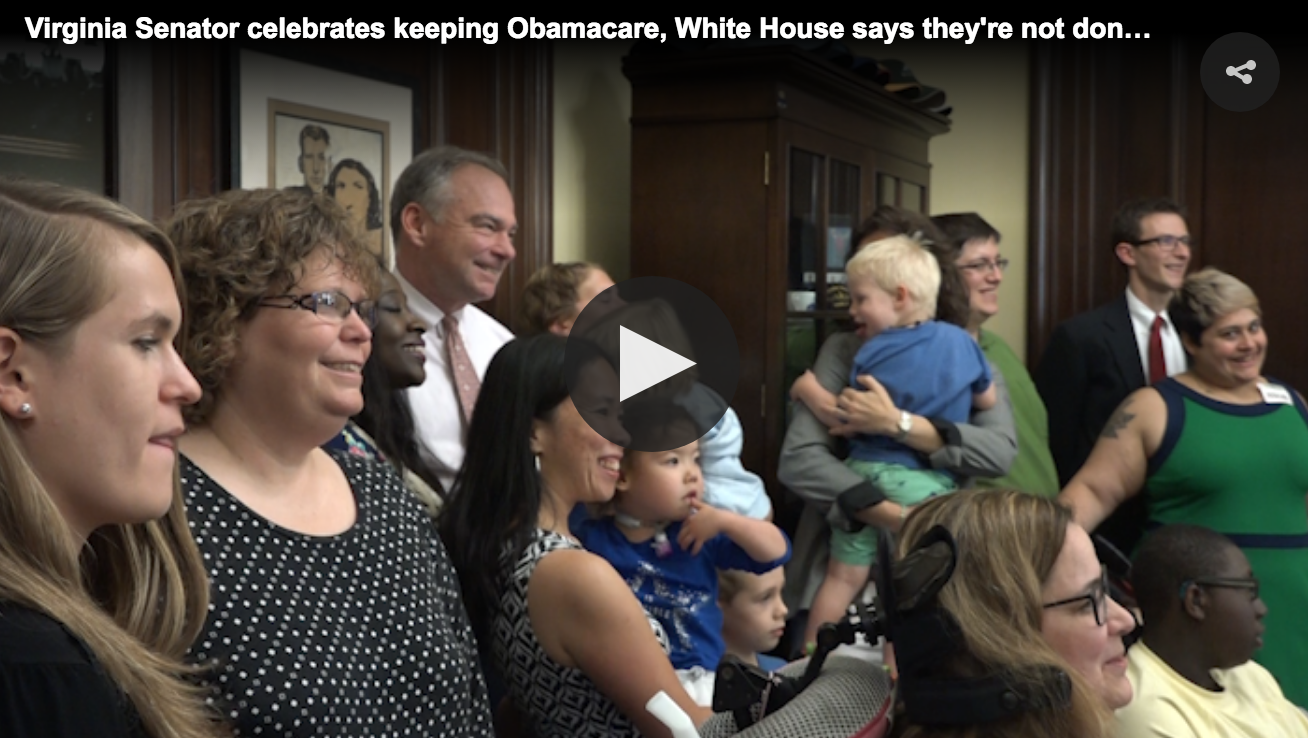
I met with Virginia parents and their children this week in my office who would have been affected by this proposal. They call themselves the “Little Lobbyists” and the group is an example of the countless Americans who have made their voices heard in the fight to protect health care. The Graham-Cassidy proposal may have been stopped for now, but I’m going to keep speaking out against attempts to cut Medicaid and repeal the Affordable Care Act. We should be working across the aisle to improve health care for all Americans, not take it away.
"

Tuesday, September 26, 2017

Morgan Griffith Faces Challenges

From U.S. Representative Morgan Griffith (R-VA-9); this web site has no foreign policy; members of Congress are required to legislate on foreign policy. Pray for your Congressmen, Gentle Readers...

"
Healthcare and Foreign Affairs
Healthcare Update
Due to its arcane rules, the Senate faces a September 30 deadline for voting on a plan to replace Obamacare that requires a simple majority, not a 60-vote supermajority, for its passage. Current efforts center on the plan put forward chiefly by Sens. Lindsey Graham (R-SC) and Bill Cassidy (R-LA).
The House of Representatives passed a bill to repeal and replace Obamacare months ago, and it was frustrating to see the summer slip by with no movement on this issue by the Senate. If it manages to act by the end of the month, the House will have no options beside yes or no on the Graham-Cassidy plan. This makes it impossible for us to follow normal process and have a conference committee on the differences between the two houses. This is not a good way to legislate.
Challenges Around the Globe
The 72nd Session of the United Nations General Assembly convened in New York in September. Among the world leaders who addressed the meeting was President Trump, who gave an important speech outlining how his “America First” policies would guide U.S. relations with other nations.
While much attention was paid to the leaders who participated in the General Assembly, some who weren’t there were instead engaged in activities of deep importance to the United States and its allies.
Russian President Vladimir Putin did not attend the General Assembly. Instead, he attended a large-scale military exercise in the western part of his country and in Belarus. The exercise likely involved more troops than Russia publicly claimed, and they practiced with state-of-the-art equipment.
The exercises rightly unnerved Russia’s neighbors along its western border, including Estonia, Latvia, Lithuania, and Poland, which have long been targets of Russian power and suffered under decades of Soviet domination.
Chinese President Xi Jinping also was not present at the United Nations, as his country’s Communist Party Congress nears. Under his tenure, China has widened its reach around the globe, both economically and militarily.
In the South China Sea, through which an estimated one-third of global shipping travels, China’s expansive territorial claims put it at odds with several other countries, including the United States. With attention focused on other hot spots, China has asserted itself more in this region. Previously, it had built islands on reefs in dispute for military airbases. This year, China has bullied other countries to stop them from engaging in commercial activities such as drilling, in particular Vietnam. This past summer, it reportedly threatened to attack Vietnamese military bases if that country didn’t stop a gas-drilling project. Vietnam complied and ordered the project to stop.
North Korean dictator Kim Jong Un didn’t appear at the U.N., in keeping with his regime’s rogue character. Despite its isolation, his country poses a growing danger to the United States and allies in the Pacific. North Korea continues testing nuclear devices and missile systems that could deliver nuclear payloads. A nuclear-armed North Korea destabilizes the Korean Peninsula and alters the balance of power in Asia. It could strike the United States and allies such as South Korea and Japan or sell its weaponry to other rogue regimes or terrorist groups.
To increase pressure on North Korea, President Trump issued an executive order on September 21 imposing new sanctions on the country’s trade and financial sectors. By undercutting North Korea’s economy, it may have difficulty funding its nuclear program and have to come to the bargaining table, but China will have to truly participate in the sanctions for this to happen.
The activities described above each challenge the security and prosperity of the United States, although in different ways. North Korea is an avowed enemy of the United States, and the recent developments in its nuclear program are the latest in a series of provocations. The Trump Administration recognizes the gravity of this threat. Other countries need to as well. Trying to “be sweet” and placate the North Koreans hasn’t had a positive effect, so President Trump is right to take a tougher stance.
As for Russia, its military drill along the western border offers an uncomfortable reminder of its Soviet and imperial past. It should be discouraged from acting on any dreams to restore its empire. China, in contrast, is a rising power, but its rise should not be aided by bullying tactics in an area that has great importance to our economy and the economy of the rest of the world.
U.S. diplomats have a lot of work to do, but a lot is at stake.
If you have questions, concerns, or comments, feel free to contact my office. You can call my Abingdon office at 276-525-1405 or my Christiansburg office at 540-381-5671. To reach my office via email, please visit my website at www.morgangriffith.house.gov.
"