Showing posts with label organic food. Show all posts

Thursday, April 16, 2026

Wal-Mart, What's in the Corn?

"Roundup Ready" corn, I was glad to learn, is a stupid mistake of the past. One of the most deservingly detested GMO crops of all time, this strain of corn was produced by splicing genes from Escherichia coli, bacteria often blamed for "food poisoning," into corn so that the corn plant survives heavy spraying with glyphosate. 

How was it possible not to know that this was a bad idea?

In the 1990s US-based Monsanto held a patent on glyphosate. However, the first "Roundup Ready" corn was tested overseas, on poorer people who had less legal recourse than US citizens. The corporation knew the corn was likely to make people sick. Well, it did. E. coli is more often fatal to a larger minority of the population than COVID-19 ever was. The company kept testing, sickening whole towns in the Philippines and elsewhere, until they found a strain of E. coli that seemed relatively weak. The genetically modified corn was then drenched in glyphosate from before planting right up to harvest time, and it made people sick, though usually not as acutely as E. coli itself did. 

So-called corn allergies weren't common before the 1990s. They became common in the 2010s, when the original patent expired and chemical manufacturers were selling glyphosate at competitive prices. Most of the "allergies" were probably glyphosate sensitivity. By 2020, food producers were looking for corn that was neither sprayed with glyphosate nor bioengineered to be sprayed with glyphosate. Corn-based foods became relatively safe to eat. Southerners rejoiced that we could safely make cornbread with Martha White, White Lily, and similar beloved corn meal brands, once again. Those of us who were gluten-intolerant (probably fewer than a tenth as many Americans as went gluten-free and found that not eating glyphosate-soaked wheat relieved their chronic conditions) were getting tired of rice being the only grain we could eat, and started buying canned and frozen corn again. Because stores had had a hard time selling canned corn in the 2010s, it had become very economical. 

A large amount of the corn raised in the United States is still Roundup-Ready and still treated with glyphosate. It was so treated even when Bayer, which now owns Monsanto, released a glyphosate-free brand of "Roundup" herbicide spray "for farm use." In 2024 and 2025 customer complaints caused the formula for this chemical disaster to be changed. Some small farmers, unaware of the changes, bought Roundup-Ready corn, sprayed it with Roundup, and got a small part of what they deserved as the glyphosate-tolerant plants died of exposure to diquat, dicamba, or other poisons. This year, bitter clingers are getting their glyphosate back, and we must all try to laugh when they describe their wives and daughters giving birth to babies with useless eye stalks flopping out of bare sockets in little bare skulls. 

(One of my cat Silver's Seralini kittens was born like that. Mercifully it never breathed. I pickled it in alcohol with the intention of exhibiting it in the Friday Market that summer; the next strain of COVID kept the market from reopening and eventually I burned the body.) 

Those still clinging to glyphosate know by now that even the US government has agreed that the stuff promotes cancer and aggravates just about every chronic condition known to humankind, including the ones that ought to be fully controllable by merely modifying our lifestyle in such a way as to give up all social eating for as long as we live. They know, although they may try to pretend otherwise. The more arrogantly they bray about "the (outdated, disproven) science," the more certain we can be that they know. They deserve no pity. Real farmers, who have been struggling to do without glyphosate and other poisons since at least 2018 or 2020, deserve sympathy and support, as do the old people who are now dying from cancer after years of trying to believe that glyphosate was safe and effective and the symptoms they had after spraying it were unimportant, but the bitter clingers to glyphosate deserve to be denied treatment when they develop cancer.

But the corn monocroppers are clinging, and they are getting away with it, because the majority of the corn grown in the US is either not used as food for humans, or else processed in ways that seem to eliminate most glyphosate residues. Before it has soaked into plants or plant parts glyphosate is pathetically soluble, easily washed into the water supply where it does no "good" to the lazy farmer after just a little shower of rain; when corn is made into high-fructose corn syrup or monosodium glutamate, those processes apparently get rid of the glyphosate inside the kernels.


Photo from New York Animal Agriculture Coalition, by way of Google.

Corn meal is made from "field" corn, which is less sweet than "sweet" corn even when fresh. Hard corn ("field" corn or popcorn) is not usually eaten fresh, because everyone would rather eat sweet corn on the cob. Hard corn contains niacytin, a "bound" form of niacin that should in theory be nutritious but isn't. Niacytin not only fails to be digested as niacin but makes it harder for the body to digest niacin from other sources. Traditionally Southerners loved our cornbread because corn, unlike wheat, grows well in the South and because most of us got enough niacin from other sources that the niacytin was not a problem. By the twentieth century, however, severe niacin deficiencies were appearing in poor people who ate cornbread alone or with cheaper, fattier, less nutritious meat. A campaign was launched to sell the idea that cornbread should always be made with at least half wheat flour, to reduce the niacytin content and add digestible niacin to the bread. 

Researchers now know that an even better way to use hard corn is to process the dry, hard corn kernels in ways called "nixtamalization," which break down and unbind the niacytin. Traditional nixtamalization involved soaking dried corn in a mix of water and wood ashes, which loosened the outer layers of the kernels and produced grits. 

Sweet corn, however, needs little processing. In addition to containing more sugar, sweet corn contains a rich variety--and variety is the word, because the mix varies widely among different ears of corn, but in any case there's a lot--of B-vitamins, including niacin, not niacytin. 

I started mixing Wal-Mart's store brand of canned corn with canned beans and peas. This added variety, fibre, and flavor to what I'd been eating through most of the 2010s, which was rice, onions, and garlic, and sometimes for variety rice, garlic, and onions. Not all beans were safe to eat after 2020; garbanzos, which I particularly liked before 2010, were especially likely to contain glyphosate residues, even if the beans hadn't been sprayed themselves, probably because they were raised in between crops of wheat, in glyphosate-saturated soil. Being a walking glyphosate detector, I found that Bush's pinto beans were reliably safe, as were Bush's butter beans. Black beans and crowder peas were less reliable. Wal-Mart's store brand of green peas, pinto beans, corn, and tomatoes seemed glyphosate-free, or close enough not to trigger my hair-trigger reactions. 

Various combinations of any of these legumes with corn and/or tomatoes and/or some sort of meat made satisfactory meals for me between 2021 and 2025. The corn could be store-brand canned corn, or cornbread made with Martha White or White Lily corn meal, or corn chips. (The Wal-Marts near me all stocked both brands' "self-rising corn meal," with salt and baking powder added, and "self-rising corn meal mix," with salt, baking powder, and a generous share of white wheat flour added. In practice, people who have learned to distrust wheat usually snapped up the wheat-free corn meal so that, nine times out of ten, I didn't find it on the shelf.) I usually bought a case of a dozen cans of canned corn and one or two bags of chips on each shopping trip to Wal-Mart and felt that that yielded a good mix of hard and sweet corn in the diet. I also bought vitamin supplements with all the B-vitamins.

But in 2025 I started to notice that after eating Wal-Mart's canned corn, my tongue felt sore and swollen. That is, of course, an early warning sign of a B-vitamin deficiency or imbalance, including niacin deficiency...if it becomes chronic. But it didn't become chronic. Nor did the vitamin supplements affect the symptom. My tongue, and mouth generally, felt irritated for about twelve hours after eating the canned corn--not at other times. Drinking water helped. Vitamin supplements didn't help.

Regretfully, I stopped buying the canned sweet corn and replaced it with more cornbread (other stores did better at keeping wheat-free corn meal on their shelves). Cornbread with a can of chicken chunks drained in around the edges of the pan, and a can of pinto beans and a can of tomatoes warmed on top of the bread, makes a delicious panada, everyone I ever feed agreed. Children love the sweet undertaste in a bowl of cornbread and milk. Corn chips also soak up the juices from the canned goods, and/or whatever raw vegetables go into a taco salad, in a satisfactory way.

But the last couple of times I've done a taco salad with Wal-Mart's store brand corn chips, the "Original" kind that look like Fritos, I've had the tongue and mouth irritation. I didn't have it before. And don't try to tell me it's because I've eaten too many corn chips in the last five years--I may have done that, but the "White Corn Tortilla" chips did not have the same effect, nor did the cornbread made with Martha White corn meal. What's being sprayed on the corn, Wal-Mart? 

* * * * * 

A primer on why we never need to spray anything on corn...Corn was actually the first crop that rebounded when my family broke the Vicious Pesticide Cycle. Strawberries were close behind.


This is how we eliminate weeds from cornfields. It costs about $15 at Tractor Supply Company. Cheaper and more expensive versions are available, there and at most other hardware stores or department stores that have a garden department--including Wal-Mart.


(Photo from Walgreens by way of Google.) This is how we eliminate corn earworms. We can buy knee-high stockings or use the washed foot ends of laddered tights. We tie the foot part of the stocking around the bottom of the developing ear of corn. When the baby corn earworm tries to gnaw its way in through the corn shucks, it gets a mouthful of nylon and decides to go somewhere else. Its chances of starving or being eaten by a bird, or wasp, or bigger insect along the way are high. Although aggressive (not strong enough to do any damage to a human, it will bite and kick with all its puny might when picked up; it will also eat another corn earworm if it can) the corn earworm has no effective defense against predators, and would never have been much of a nuisance to farmers had the farmers not fallen into a Vicious Pesticide Cycle that destroyed the corn earworm's natural predators.


(Photo from Wikipedia.) This is how we eliminate corn borers (cobworms). All of these little beetles, and a few dozen other species, can be called ladybirds, ladybeetles, or ladybugs, because monks who noticed how useful they were in the garden dedicated the whole genus to Our Lady Mary, the Mother of Jesus. (You can identify the one plant-eating species in the family, the Mexican Bean Beetle, because it is yellow-green instead of orange, amber, or red.) Ladybeetles and their larvae are best known for eating aphids but they eat other nuisance insects too, if the other insects are small enough, which corn borers are. Stop poisoning your insects and watch your corn borers disappear.


(Photo from the Audubon Society by way of Google.) This is how we eliminate corn cutworms. They like to hang around near my home so I think of them mostly as mosquito eaters, but they'll take just about anything to feed their babies, which often happen to hatch at the time of year when corn is vulnerable to cutworms. (The one photographed above appears to be bringing home a beetle--not a ladybird, possibly a Soldier, Net-winged, or Burying Beetle.) Lots of other birds like cutworms, too. Again, stop poisoning the insects and watch the cutworms disappear.

And when we eliminate the borers, we automatically get rid of the worst kind of fungus that infests corn, too...although glyphosate actually promotes the growth of human-toxic Fusarium mold.

Thursday, March 19, 2026

Grandma Bonnie Peters' Gluten-Free Recipe: Garbanzo Salad, Soup, or Spread

Garbanzos are most often planted, in the United States, as cover crops in between wheat growing seasons. Because wheat is the hardest of all crops to weed, the one that gave people the idea of trying just to poison the field so weeds couldn't grow, garbanzos tend to be loaded with pesticide residues. 

Before glyphosate many people formed a prejudice against garbanzos, thinking they were allergic to these "chick peas" themselves. Since 2010 a different set of people may have thought we were allergic to garbanzos and to so many other things. The good new is that the majority of those people aren't even allergic to wheat. They have been reacting to glyphosate. 

When garbanzos have not had chemicals sprayed on them, and not grown in chemical-poisoned soil, they've always been a good healthy food, full of nutrients, to which very few people are allergic. They do need to be fully cooked, which takes a few hours, and used in a diet that includes plenty of water. Like all legumes they react with the acid in our bodies to form gas bubbles that are harmless, but annoying, if we're not well hydrated.

Grandma Bonnie Peters started cooking gluten-free vegan food before 2010, and never adjusted to the horrible new reality that the diet that had restored her health had become toxic in its own way, with glyphosate. All the vegetables in this recipe tend, even today, to be full of glyphosate. 

We still need a ban on this poison. Chemical companies are still fighting tooth and nail to prevent our getting one. We need to fight back. Identify farms that use glyphosate. Publicize where those farms are located, so that everyone can refuse to buy anything from those farms. In the local area, everyone should also avoid speaking to, or touching, or working with, or trading with, or meeting in any social group, the farmers who are still bitterly clinging to glyphosate. If people agree to do this consistently there will be no need for violence or for additional government regulations. 

The Bitter Clingers to Glyphosate are not decent human beings. We stop treating them like human beings. They have become things--walking vats of toxic waste. They have no place in human society. Make them know it, and within a year they should be begging people to accept payment for holding their "farms" for the seven to ten years the land will need to recover from the Vicious Pesticide Cycle, while the Bitter Clingers move to basement apartments in cities and do menial work that feels penitential to them, and pray daily that people will show more empathy toward them than they have shown toward other people. 

If and when this strategy works, then this recipe will stop being a sad memory and become an actual recipe we can use, as it used to be.

Gluten-Free Vegan Garbanzo Salad, Soup, or Spread all begin with the same ingredients:

2 heaping cups cooked garbanzos (2 15-16-oz cans)

1 bell pepper

2 carrots

2 celery sticks

2 T chopped parsley, or more

½ cup chopped English walnuts

Optional seasonings: salt, pepper, lemon juice, onion, garlic, etc., as you like, but taste the dish before seasoning. It’s flavorful all by itself.

Method for Gluten-Free Garbanzo Salad

Clean and chop the raw vegetables. Toss with nuts and garbanzos. Serve on plates lined with lettuce. Garnish with radishes when they’re in season. Pass salt, pepper, lemon juice, and/or mayonnaise. 

Alternatively, break up green leaf lettuce, romaine, or other salad greens; toss them with the salad, and serve in bowls.

Method for Gluten-Free Garbanzo Soup

Heat the garbanzos in a generous amount of water and/or broth, adding the chopped peppers, carrots, and celery while bringing the liquid to boil. Simmer until the vegetables are soft. Sprinkle in parsley and nuts.

Method for Gluten-Free Garbanzo Spread

Cook the garbanzos, but leave the other vegetables raw. Grind everything, including the parsley and nuts, with a few spoonfuls of broth in a blender or food processor. Season as you like. Lay a piece of rice bread or corn bread, or lettuce, on a plate. Carefully spread the vegetable mixture thickly over the bread, and eat with a fork.

Truly gluten-free bread, by definition, doesn’t make the kind of sandwiches you can hold in one hand and eat while doing something else. Some gluten-intolerant people can use bread thickened with potato and tapioca starch; some breads of this type can be used for sandwiches. Gluten-tolerant people can, of course, spread the mixture on wheat bread. 
 
GBP advertised vegan meals, and she herself was one of the people who thrived on the no-added-fats school of vegan cuisine. She would never have added even a teaspoon of oil to any of these dishes. I don't think they need oil either, but some people might  want to add a teaspoon of flaxseed oil for essential fatty acids or sesame oil for flavor. Some gluten-free people might even spread this vegetable spread on a piece of boned and flattened chicken.

Tuesday, February 7, 2023

Health Food Tip #2: The Freezer Is a Friend

From an ecological viewpoint, the deep freezer is not an ideal way to store food. For one thing, while older ways of preserving food didn't rely on continuous use of electricity, the deep freezer does. For another thing,  nobody who is plugged into a central grid really has a continuous supply of electricity, so if more food is stored in a freezer than can be consumed during the day or so it takes to thaw, the extra food is wasted. 

This web site does not recommend buying or using a big deep freezer as a way to store a year's supply of food. Real preppers know that the most probable disasters for which they're prepping all begin with disconnection from the power grid. 

However, most houses and flats come with refrigerators. Most of those refrigerators come with a small built-in freezer compartment, with just enough room to store what you could nibble on over a week or two, or use up in a day or two if necessary. This is the freezer that is your friend when you start trying to work a diet program for better health. 

You look at those menu lists and immediately think "Obviously those dietitians don't have normal jobs. All they do all day is cook. That's how they can suggest fresh omelets for breakfast, fresh-broiled fish with a big vegetable salad for lunch, and turkey chili with freshly cooked beans for supper. No working parent with an eight-year-old, a three-year-old, and a job that demands 'face time' at the office three days a week, could possibly eat that way. That is why everyone grabs 'fast food' and 'convenience food' and why 'health food' plans can't really work. The capitalist system has got us. I'm doomed never to find out whether this diet would cure my viral arthritis or Long COVID or irregularity or whatever else, because I can't afford to make a full-time job of cooking the way a lot of doctors and rich retired patients eat at expensive camping retreats at Santa Rosa." 

First of all, as camping retreats go, especially those attended by flocks of doctors who are on call to make sure nobody goes into insulin shock as the adult-onset-diabetes patients make the transition off insulin, the McDougall food-as-medicine retreats are fantastic bargains. You're in an earthly paradise, you're feasting on California's freshest produce, and one of the charming couple rowing or playing tennis with you and your partner is an M.D. who's there just to give you free advice if you need it. If you enjoy travelling, camping, meeting new people, and/or being in California, a McDougall retreat is a treat that's hard to beat.

But say you're in my situation when I had to do a drastic health food diet. You're still growing, you're a single "parent" or even a literal single parent with a baby, you're working 35 hours a week in the city and another 25 hours a week at home, your symptoms are acute pain and intense fatigue accompanied by depressive moods, and when you rush home from the office to the stack of work on your desk at home, even in winter you're not inclined to spend time baking bread. 

Here's what you can do. There has to be one day when you're at home and you decide what you do. Failing to carve out one day when you're accountable only to God is a sin. In the United States the goal has been for everybody to have at least two days for themselves every week, one when they go to religious meetings and one when they do their own chores and errands. If your schedule does not have room for that, you need to correct your schedule.

During this time for personal work, consult your menu plan for the week, and cook what you need to cook. Divide it into serving portions, and freeze what you're going to eat for the rest of the week. 

Cooking time can be made into quality time with the family, also. If you've been socialized to pay attention to others in a very conspicuous way, facing them at a 180-degree angle and staring into their faces, you might be surprised to find out how much easier it is for some people to talk when you're doing something side by side instead of staring at their faces. This may be when you find out whether the teenager really doesn't like school because she's all that far ahead of her classes, or because she's a witness to a crime. 

Cooking time can also be a way to help others deal with their emotions about the fact that you're not eating something they eat. Continuing to cook what they eat is a way to show that you're not judging them or planning to make them follow your diet plan. Being able to cook meat dishes for other people while you go vegan, or bake wheat bread for other people while your diet is gluten-free, can also be very empowering. Food sensitivities can actually set up a mild form of physical addiction that has withdrawal symptoms. 

If there are teenagers in the family they may want to eat everything all at once. Most people reach their full height some time in the teen years, but their bones and internal organs continue growing into their mid-twenties. All this growing they are doing is what makes teenagers so moody. Some days they don't have much appetite, and some days they're bottomless pits. Their appetites reflect some sort of nutrient need, which can be enormous, so if possible it's good to buy extra supplies and cook extra food for them to devour. Things that are on a health diet plan are usually good things for teenagers to fill up on; they can benefit from the trace minerals in all those vegetables. Freeze portions for them too, and mark the freezer containers so that the teenagers know when they've eaten all the "whoever" portions and must not eat the portion marked "Pris's Lunch for Tuesday." 

Some foods freeze better than others. There may be dishes on your diet plan that, in order to taste right to you, need to be cooked when they're eaten. The only real nutritional difference between breakfast, lunch, and supper is that most people digest the "heavy" foods, fats, proteins, and complex carbs, most efficiently earlier in the day. If the only meal where you have time to assemble a fresh salad, omelet, etc., is breakfast or supper, you can probably get the benefit of eating that dish at that time of day.

Some foods actually taste better, to a majority of testers, when they've spent some time in the freezer allowing flavors to mingle. Beans and bananas may be easier to digest when they've been thoroughly cooked, then chilled or frozen, then reheated.

Some families find that the "Fix It and Forget It" plan of spending one day a week, or even one day a month, cooking and then reheating frozen home-cooked food on other days is an efficient plan for everyone, especially if different family members are on different diet plans. There are cookbooks and web sites dedicated specifically to identifying dishes that freeze well. The McDougall and Sinatra diet plans rely on recipes in this category.

Jethro Kloss's early "elimination diet," which eliminated many foods from the diet and reintroduced them by ones, advised eating just one thing at each meal. One fruit or vegetable, steamed or boiled if necessary in a minimal amount of water, with minimal salt. This is still the preferred approach for building immunity because it makes it easy to identify food items that your body is not currently digesting. It's also the way vegetables tend to be prepared for freezing--very lightly cooked to slow down spoilage if things thaw before they're eaten, then frozen in such a way that they'll need further cooking to reach the level of softness or "doneness" to which many peopleare accustomed. Those little packets of frozen corn, peas, potatoes, etc., are generally more expensive than whole raw foods, but may be cheaper at some times of year. Onions and garlic, which are generally considered immune system boosters, are easier for some people to tolerate when they've been finely chopped, parboiled, and frozen. 

Wednesday, May 8, 2019

Survival Food Weekend Part 2: May Be

This is the post about wild plants that may be edible in May, but weren't the most appetizing things growing in my not-a-lawn last weekend, if they were growing at all.

I won't bore you with all the preliminary warnings from Part 1. If you need warnings, read Part 1. But I will respond to a comment from a local lurker about the "spring tonic" effect. During the early twentieth century some of us absorbed a positively fetishistic ideal of "regularity," an idea that everybody should Do Numbers Two and Three exactly once a day between breakfast and going to work, and that, for that reason, workplaces should make it as difficult as possible for anyone to Do Number Three...like putting ten toilets in little compartments, all separated from one sink with an inadequate supply of paper towels. (Naming no local fast-food joints, here.) We as a society need to overcome this. Reality is that humans are not all that "regular," so the places where they work should be designed to minimize the unpleasantness of being in the same room, not maximize it. The whole obsession with "complete elimination immediately after breakfast" has the smell of something popularized by cheapskate factory owners, with a little help from control-freak schoolteachers.

For celiacs, any self-cleansing, flushing effects we notice feel like a wonderful relief from the toxins eroding our insides. The first time I did a low-fat, low-carb, mostly-veg diet (in the city, with supermarket vegetables including white rice) I remember it, and people who worked with me may still remember it, as a six-week "high" during which I felt like leaping out of bed at 6 a.m. to sprint a mile before breakfast. Well, I was only half grown at the time. Adults are usually calmer, although we can still feel "high" on relief from sluggishness.

The "mild diarrhea" of the flushing effect may be inconvenient; it's not the sickening, even life-threatening, kind of diarrhea produced by food poisoning or Norwalk Flu. If you nibble mindfully and stop when the flavors of wild plants stop tasting deliciously different to you, you may not even make an extra trip to the bathroom, and if you do, it won't feel any worse than you normally feel after breakfast. At worst you'll feel thirsty...many people are living with the dragging effects of chronic dehydration anyway. "Regularity" will return in a few days whether you continue eating lots of juicy fibre-rich vegetables or not.

But for those people--all the ones I know are White, and currently at least forty years old--who "don't like that feeling" of needing to use the bathroom two or three times in one day, I'd say, most of the discomfort is in your minds. Those of you who are baby-boomers, though not necessarily even one year older than I am, tend to be the ones of our generation whom others point out as "that old" rather than "that blond/e" or "that one in the...", and certainly not "that friend of yours, you do know s/he is older than s/he looks don't you?" If you want to side-step cardiovascular disease and other things that your elders blamed on "aging," and look, feel, and work as if you were ten years younger...talk to your doctor, but a naturopathic physician, like our e-doctor John McDougall or GBP's real-world Dr. Cote in Tennessee, will probably tell you just to work through it once. The "high" of more efficient digestion, usually higher metabolic rate, that baseline cheerful mood that annoys people who don't enjoy it themselves, improved resistance to infections, and the youthening benefits of a face lift without having to pay for one, will (typically) last if you continue eating juicy fibre-rich unsprayed veg. There can be medical reasons why people can't do this, which are none of my business...I'm only glad that, most of the time, it works for me.

Now, on to the plants...

1. Cress. This is another name for two different plants that actually peaked in March, or even February; by now field cress is dormant and watercress, if not cut back, has gone to seed. In the February thaw, when the leaves are fresh and juicy, the peppery kale-like taste of cress is a delight. Watercress can be eaten raw if you're sure sheep or cattle have not been grazing upstream. Field cress is best cooked. Recipes usually recommend using watercress, and often recommend cutting off the stems--both plants' stems can become tough, like parsley stems.

Field cress is what my elders called "creasy greens." I have found it, and bought it, canned in supermarkets like spinach. It pops up in ploughed fields, often starting during the January thaw, reaching its prime in February or March, then going to seed and dying down before ploughing time around the first of May. If it doesn't pop up in your field, Amazon is currently offering seeds:

Earthcare Seeds Upland Cress 1000 Seeds... "Creacy Greens" (Barbarea verna) Non GMO - Heirloom

Watercress is sold in upscale supermarkets for outrageous prices, or picked out of local spring branches during thaws in winter. Since most of the plant is underwater, each time a freeze kills the top leaves, the plant sprouts fresh new leaves. A person who really liked watercress and didn't live downstream from any cattle raisers could keep watercress sprouting new leaves in a spring branch most, if not all, of the year.

2. Plantain. There's another species (narrow or Lance-leaf Plantain, Plantago lanceolata) that's also edible, but Broadleaf Plantain (P. major) is more useful in some ways. Leaves are juicy but fairly tough; they can be cooked and eaten if you're hungry, but don't have much flavor. Dried seeds can be crushed and used like flour or meal, and will stretch flour or meal out if you need more bread, but nobody raves over them either. (The writer known as George Orwell did mention their being nibbled as a snack in the 1890s and revived as survival food in the 1940s.)

Grote weegbree bloeiwijze Plantago major subsp. major.jpg
Photo donated to Wikipedia By Rasbak - Own work, CC BY-SA 3.0, https://commons.wikimedia.org/w/index.php?curid=210595

I prefer to save plantain for its medicinal uses. It can be either crushed and rubbed on irritated skin, or stewed and the water used to wash irritated skin, for soothing, cooling relief. For insect stings, the best treatment is of course to learn to get along with insects; this is not always possible, so if you are bitten or stung, washing with plantain cooking liquid is the best treatment I've found.

3. Morels. Mycologists have reconsidered the species names for these mushrooms...(Warning, before you scroll down to the picture: one of their many nicknames is "the ugly ones")...so let's just say there are about a half dozen different species, some of which appear in the same woods at the same times, and the biggest, latest-blooming kinds sometimes do pop up in May. Some years, but not this year. In this year's unusual weather, I may have looked at the wrong time, but I didn't find a single morel.

Morel Mushroom Spores in Sawdust Mushroom Seed Spore Grow Kit From WV

This is one of the two kinds I've found in May, always in Maryland. They may be the commonest kind overall; they don't grow near the Cat Sanctuary. Our most numerous species are narrower, and grayish rather than brownish, and they appear in April or sometimes even March. However, for those who want to try starting their own mushroom patch, a company in West Virginia is offering "starter kits" of spores and sawdust you can at least try to start anywhere.

The kind I've found close to home in May are even bigger than the one in the photo, with wrinkly heads two or three inches long on a stalk that can be equally long. The biggest of all the morels, they have a distinct cone shape and blackish-gray color, especially at the top of the cone. From the cone shape one of their nicknames is "Christmas Trees." Some years they do pop up in the not-a-lawn, nourished by the chestnut logs at the foundation of the oldest part of my home. Not this year.

Two blog posts from years when I did find these mushrooms:

https://priscillaking.blogspot.com/2017/03/march-23-links-with-cat-sanctuary.html

https://priscillaking.blogspot.com/2013/04/phenology-flowers-butterflies-mushrooms.html

One year I had morels to sell and nobody bought them. This year three people asked to be on the list for morels, and I didn't have them.

4. Chickweed. Because of its small size, people who aren't very hungry have tended to leave this early spring green for the chickens. It sprouts right up after frost and has a nice mild leaf-lettuce-like flavor. By May, if it's not subsided it's gone to seed. It is one of the early greens our ancestors nibbled to stave off scurvy, though, and is especially welcome during the January thaw.

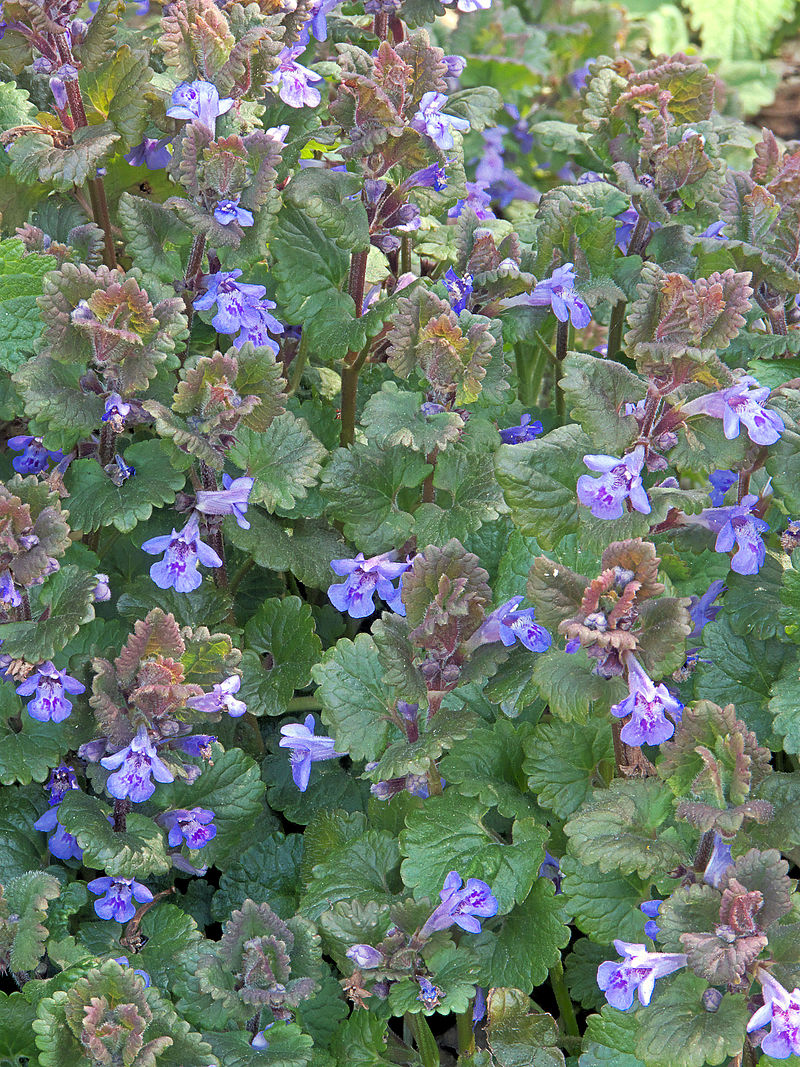
5. Ground-ivy. For a mint this first flower of spring is remarkably dry and dull. It's noticed for its pretty little flowers rather than its smell or taste. Euell Gibbons reported that English people had tried using it to flavor fermented drinks, perhaps many times if the number of cute nicknames they gave it is any indication, but it never really took off. He gave some recipes in which he used it, but raved more about how the Renaissance English would probably have called a man who bothered with "Gill-over-the-ground" something like "Euell-pick-by-the-hedgerows."

In Europe, where at least ground-ivy can't be called invasive, varieties with rounder, greener leaves are commonly used as greens in salads drowned in dressing. Presumably those varieties are juicier than the soft, dry, triangular leaves of the ground-ivy I've always in lawns and ex-lawns. It's safe for human consumption if not poisoned, but is reasonably considered a weed in pastures, since cows and horses can't digest it.

Glechoma hederacea, Hondsdraf (1).jpg
Though colonies like this one are accused of choking out native wildflowers, Virginia wildflowers usually seem to out-compete ground-ivy. The freshest leaves at the top are purplish as shown, and the flowers range from pinkish to bluish lavender. Photo donated to Wikipedia By Rasbak - Own work, CC BY-SA 3.0, https://commons.wikimedia.org/w/index.php?curid=10128264
If I were going to eat ground-ivy I'd eat it in March. By last weekend, the few surviving stalks were relatively tall (some over six inches), gone to seed, and either turning yellow or showing mold spots from old age--a most unappetizing wild crop. In late March and early April it was fresh and pretty.

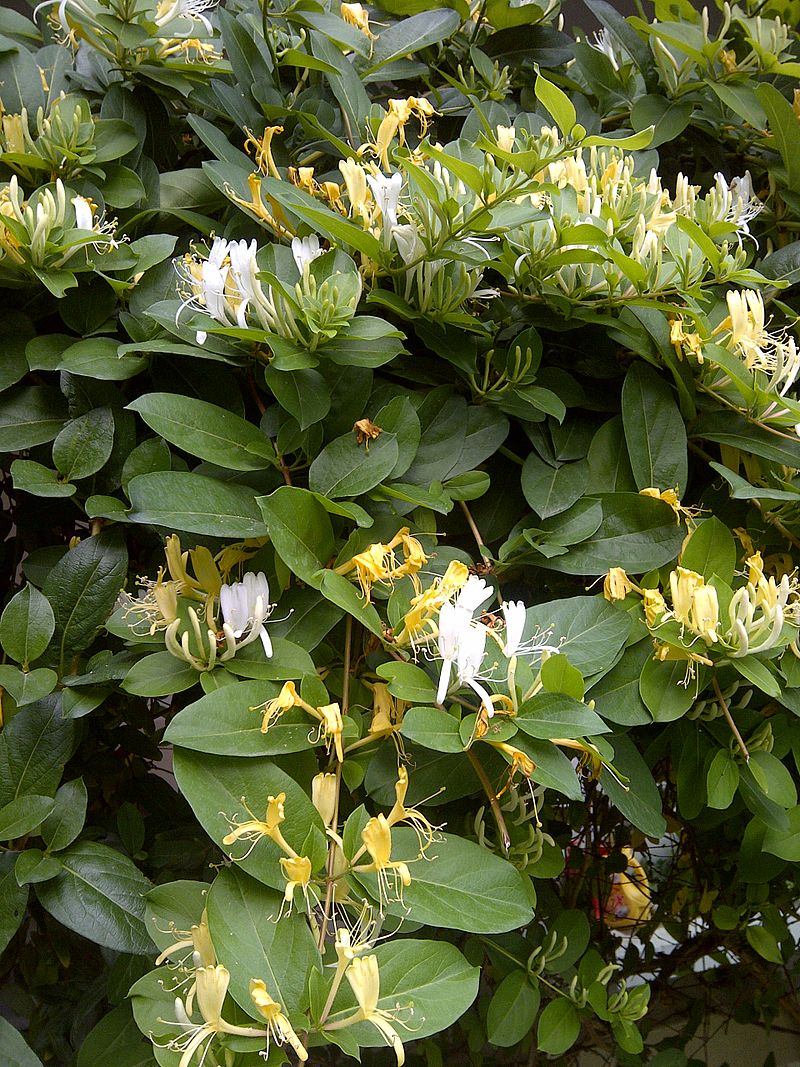
6. Honeysuckle (japonica). The super-sweet nectar, when this nuisance vine blooms (typically in June), is a moral lesson for children. The one little drop in each blossom offers all the sweetness your mouth could possibly want. If you gathered a pint of blossoms and squeezed out a spoonful of nectar, it would taste disgusting.

Honeysuckle-2.jpg
Photo By Aftabbanoori - Own work, CC BY-SA 3.0, https://commons.wikimedia.org/w/index.php?curid=32297970

In May, honeysuckle consists of stringy vines, which can be used to make ropes or baskets, and leathery leaves, for which I've never found a use. Some cows and goats will eat them, though.

The main excuse for Lonicera japonica in North America is that helps check soil erosion on a steep bank, and, although it will spread to orchards and woodlots, where it's a nuisance that can pull down trees, it's not as bad as kudzu or cinnamon vine. Many people enjoy the sight and smell of honeysuckle. If you're one of them, please be neighborly and keep your honeysuckle in its place.

7. Strawberries. The old orchard still has a few feral strawberries--not enough to sell, but enough for a delicious snack. Some years the fruits appear in the first week of May. Not this year. The leaves are edible too, but in May, when tastier leaves are abundant and berries aren't far away, who'd eat them?

8. Sassafras. This fragrant native tree has two main uses. (Most often seen as a small shrub, it can, with time, care, and good luck, grow into a full-size tree.) Roots perfume the house (whether or not you brew them into tea, which my parents did, some years, but I've never done). Juicy, sweetly bland leaves contain a thickening agent, which remains effective when the leaves are dried and crushed, known as filé. I often pick a leaf or two if I walk past the young trees that grow on some of the private roads near the Cat Sanctuary, usually to eat raw. I did not happen to walk those roads last weekend.

For those who don't know, a choice collection of sassafras images and fun facts is at https://www.augustaga.gov/1630/Sassafras . I thought of copying their image of three of the more common shapes of leaves typically found on one tree, then thought "But why deprive readers of all those other good pictures? They should see the whole collection."

9. Smilax. Also known as "green briar" for obvious reasons, and "blaspheme vine" for reasons that become obvious if you get tangled in it, this native nuisance plant grows near but not at the Cat Sanctuary. (While some plants in the genus Smilax are luxuriously leafy, our native species is most easily identified by lots of bare, prickly stalk with visible prickles in between its little green leaves.) I didn't walk through the woods where it grows, either. It used to grow in the orchard, though...I can now smile, remembering how Dad gave it the axe.

Euell Gibbons ate smilax, whose nicknames include both "cheeses" and "bread-and-butter," and reported that it didn't taste like either of those things. It didn't taste like any favorite food. It's edible, though, if you're hungry or just want to get rid of it. As with most wild plants, eat the young tender parts and avoid eating too much. One wild food blogger reports that eating "a lot of raw ones gave me a stomach ache."

10. The Brambles. This is the English name for a large group of plants in the genus Rubus, which have thorny stems and pretty five-petalled flowers like roses, but fruits, unlike roses, consisting of several soft seeds wrapped in sweet juicy flesh that grow in clumps. Some of the dozens of species botanists recognize are called raspberries, blackberries, boysenberries, dewberries, and wineberries. Several varieties grow at the orchard, where some invaded and some were deliberately planted. When I pick them, I pick whatever fruits are ripe for the picking that day. Friends usually get an assortment of blackish-purple, bright red, and yellow berries, of which the biggest and reddest started their life inside papery husks and are technically wineberries not raspberries. Sometimes I've found a berry by the end of May but basically the brambles at the Cat Sanctuary bear fruit in June.

Brambles generally have a three-year cycle. The first year you see just the thorny stem and leaves, often in the way while you're picking berries. The second year that stem bears fruit, while the stem that bore fruit the previous year may or may not put out leaves. Third-year stems grow down into the ground, put down new roots, and send up next year's new stems. The plants can travel a great distance over the years, and the challenge is to keep yours in your own orchard, as they may not be welcome in the neighbors' field. However, I've welcomed the ones that have made their way to me.

Wineberries have a ferocious look. I was alarmed, too, to find them sprouting among my raspberries! But the fruit is completely safe to eat, and the stalks are no harder to handle than raspberries. Their stiff hairs are there to discourage insects; they're harmless to humans.

If you buy these plants from Amazon (https://amzn.to/2VolJHn), please keep them in your own garden or orchard. Those stalks scare nervous people unnecessarily. They're not native, and can seem like an Invasive Nuisance to people who are too timid or ignorant to appreciate the berries.
One year a neighbor listened to the guys down at the garage, who knew nothing, and had a computer in the shop mind you, but didn't want to admit their lack of information and look it up. They opined that the plant and berries were deadly poisonous. Little my fainthearted neighbor knew, when he sprayed poison on his wineberry bush, that he'd eaten wineberries and liked them. "Roundup," or whatever else he might have sprayed, even vinegar, is much more toxic than wineberries are.

It's possible to eat the leaves of these brambles--but why? The leaves have been cooked and eaten, or dried and infused into tea, by people who were desperate, usually further north. Some people hoped, based probably on rumors that were based on someone's experience of dehydration or dietary deficiency, that raspberry and blackberry leaves would have medicinal value. They seem to have little if any. In the North, in winter, raspberry-leaf tea may have been the best source of warmth, water, and astringent mild tannins, some people could get. In Virginia even bears can find food in the woods on all but the very worst days of winter, so nobody needs to eat the bushes that produce those delicious berries.