Monday, March 20, 2023

Butterfly of the Week: Atrophaneura Horishana

At least this week's Atrophaneura species has one consistent name. The name is only occasionally a bit, well, gender-confused. Butterflies themselves are seldom gender-confused (though that can happen) but there is confusion about whether Latin adjectives, which agree with what they modify, should be used in masculine, feminine, or neuter forms. The Aurora Swallowtail is usually called Atrophaneura horishana but sometimes one finds Atrophaneura horishanus. Since horishana and horishanus aren't really Latin words, only the naturalists who registered them as species names for various lifeforms know what they mean or describe, so only those naturalists know what their grammatical gender in Latin ought to be. And they didn't tell us. These names were given to several different species and seem to have meant "found in eastern Asia." Horishan seems to have been the name of a neighborhood, though Google doesn't identify it as the current name of a place now. When scientists have quibbled about the name or classification of horishana, they've argued that it might be considered a sub-species of Atrophaneura nox.


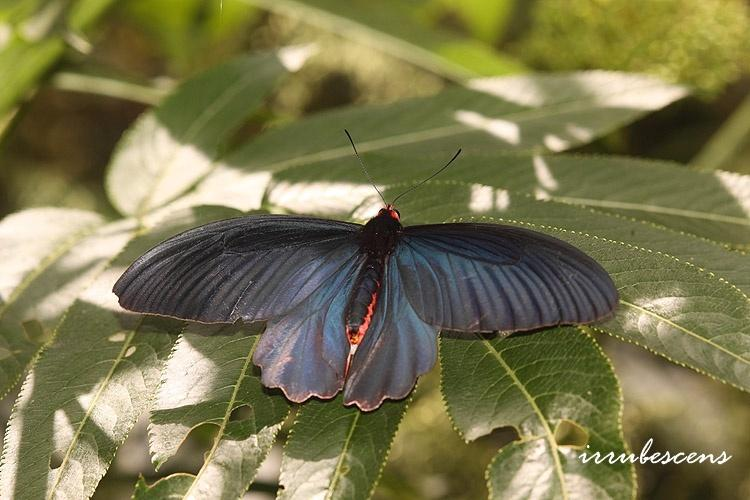
Image donated to the Encyclopedia of Life by "irrubescens." As shown, the butterfly's hind wings are deeply scalloped but don't have real "tails." The color is determined by gender and affected by lighting. These butterflies can look black and bright red, or black and pink, or black and white. The black wing veins are constant whether the fore wings look black, blue, gray, brown, or white. The undersides of of the hind wings always have black dots on a background that may look red, pink, orange, or white. Females show black dots on the upper side of the hind wings too; males don't. The sides of the body are red; from below the head and abdomen look red, the legs and thorax black.


Same place, same species--different individual. From above the whole male butterfly can look blackish. The female's hind wings show her spots on a pink or white background above, pink or red below. The male's patches of black on red may look more vivid because of the solid dark color above.. 

They are found only in forests among the mountains, and are threatened by deforestation in the name of "development." An additional threat comes from the sale of butterfly carcasses for "collections." Butterfly bodies are like wild birds' feathers. They often drop at the feet of people who know where to look, gifts from Nature to those who might want to keep these souvenirs, but when people collect these pretty things they encourage idiots to go out and kill healthy animals. We should never pay for dead butterflies. 


Museum specimens fade fast.

Getty Images, however, currently demands $500 for that site's best photo of a live horishana. Meh. We never have to pay that much for a picture, either. All the photos here are free for non-commercial use, though you would have to pay to use these pictures on things you intended to sell.

This video shows Atrophaneura horishana flitting and sipping in Taiwan, where they live. Like the other Atrophaneuras, they can move their fore and hind wings independently. As they sip nectar, their fore wings fan frantically while the hind wings are almost still. 


The butterflies are not terribly rare; they are beloved emblems of Taiwan. As this video spells out more clearly, the Wo Xiong "butterfly valley" is a tourist attraction. People go out of their way to film, photograph, and draw these butterflies. Images of Atrophaneura horishana have been used on postage stamps, gifts, and souvenirs. Taiwan is proud of the diversity of butterfly and other wildlife species on the island, and encourages "ecotourism" with butterfly, frog, dragonfly, and other wildlife photo contests. That's why there are so many good clear pictures of living Atrophaneura horishana for everyone to collect.


Well, they are big showy tropical butterflies. The wingspan is typically about five inches, up to six and a half inches. Females are bigger than males, and more likely to have lighter-colored wings. In Taiwan, where the even bigger Birdwings are found, that's not considered gigantic (though it is about the size of North America's Giant Swallowtail), but it does catch the eye.

The butterflies normally fly only once a year, in July and August. They like flowers with lots of tiny florets. Taiwanese government writers aren't shy about encouraging visitors to snap their own shots of black-and-red butterflies fluttering above white and pale-colored flowers: https://www.trimt-nsa.gov.tw/htmlpage?code=2-1-3-12&culture=2 .


This female's colors, and the colors of the flower she's visiting, show why the species' main English nickname is "Aurora," colored like the dawn's early light. They're also called Highland Swallowtails and Red-Bellied Swallowtails. In the video above, where a butterfly flies toward the camera, the bright red underside of the abdominal section is especially prominent in contrast to the dark thorax..

This blue-white-and-pink color scheme is typical of the female of the species. This is a mother butterfly. She lays her eggs, which look like little yellow beads, by ones on either of two species of Aristolochia vines. The vines are inedible to most other animals and make the butterflies indigestible to most animals that try eating them.


The hatchling appears to be eating the shell from which it hatched. Caterpillars who do this usually continue to eat their cast-off skins as they grow and molt. Since they have a strong appetite for the skin of their own kind, they are likely to eat skins they didn't shed, too, and too bad if a sibling was living in the skin at the time. 


The caterpillar is like several other young Atrophaneuras. The upper surface is textured to be hard for birds to bite into. Reddish and blackish pigments metabolized from the Aristolochia vines the caterpillar eats give the caterpillar a dark drab color rather than separating into clear pathes of color. A white belt stripe is clearly visible. The individual shown is feeling stressed, fully extending its osmeterium, which looks like the tongue of the snake the spots on its humped back suggest. The osmeterium releases a strong odor. To humans it smells fruity and not really unpleasant. To birds it seems unappetizing.


The color scheme seems designed to suggest a large unhealthy bird dropping. A caterpillar of this size can't really hide from birds so the next best thing is to look as nasty, relative to birds' taste, as possible.


The caterpillar doesn't need us to think it's pretty or nice, either. 

The pupa literally hangs by a thread from the underside of a leaf, where it seems to benefit from a resemblance of a withered leaf.


Sunday, March 19, 2023

Book Review: Bedtime Bible Story Book

Title: Bedtime Bible Story Book

Author: Jesse Lyman Hurlbut

Publisher: Barbour

Date: 1989

ISBN: 1-55748-264-0

Length: 510 pages

Quote: “This great world of ours is very old; so old that no one knows when it was made.”

It takes a certain rashness to try to improve on “In the beginning God created the heavens and the earth.” The quote above is Hurlbut’s effort in that direction. From it I think the whole book can be fairly judged.

Children love bedtime stories and don’t insist on their being especially well-written ones, so this fat, flimsy paperback (the front cover fell off my copy) may be the bargain it was marketed as being. One thick book, light enough to read in bed, summarizes all the kid-friendly stories from Genesis to Revelation.

If you can get Arthur Maxwell’s Bible Story, or Elsie Egermeier’s Life of Jesus, or The Children’s Bible, you’re almost certain to think they’re more attractive Bible story books than this one. Children do like the colorful pictures in those books.

However, the line drawings by Kathy Arbuckle may be this book’s best feature. Children love making pictures colorful, and if a child who frequently visited me had reached the stage of being able to color in its own drawings, the drawings in the more advanced children’s coloring books, traced maps, etc., with reasonable fidelity to the lines, I might offer that child this book as a reward. The line drawings are excellent for coloring in.

Some children may prefer a Bible story book they can decorate for themselves to one with beautiful museum-quality paintings reprinted in it.


The Practices of Humility

Probably the reason why the fourteen practices of humility attributed to Teresa of Calcutta aren't discussed in Richard Foster's Learning Humility is because they're familiar to Christians. Since not all readers of this web site are Christians, perhaps the list is worth reposting here:

1. Speak as little as possible of yourself.
2. Mind your own business.
3. Avoid curiosity.
4. Do not want to manage other people's affairs.
5. Accept contradiction and correction.
6. Pass over the mistakes of others.
7. Accept blame when innocent.
8. Yield to the will of others.
9. Accept insults and injuries.
10. Accept being slighted, forgotten, and disliked.
11. Be kind and gentle, even under provocation.
12. Do not seek to be specially loved and admired.
13. Never stand on your dignity.
14. Choose always the hardest. 

A personal blog, by definition, is always speaking of somebody's self. I do try to focus on things I do, think, recommend to others, rather than just me-me-me, but then again this web site does take the place of letters to some people whose questions might be more about "me" than about the books and butterflies. Beyond that, some people's questions about this web site may be answered by studying the list. Some of these practices I believe are valuable, and try to copy, even on the Internet. 

Some others I believe can easily become harmful. They have their times and places. "Pass over the mistakes of others" is certainly a good rule for editors reading the Internet! Things that I spot and pounce on when I see them printed on paper, I try to avoid letting myself see when people are typing directly onto a computer screen. I try to minimize the amount of time I spend looking at screens, to scan things quickly and print them off it they seem worth reading. Typing on a keyboard built for bigger hands than I happen to have, I feel my fingers hitting letters in the correct order, but then when I print out the blog I see all the times when I hit the letters at an angle and the computer didn't display them, or I hit the letters but the keys were jammed...These things happen when people are typing on computers, and in the interest of reducing damage to everyone's eyes we need to pass over them. When we're being paid to get text printed in a Real Book, that's a different matter. The less one passes over, the more valuable one's editing skills are.

"Accept blame when innocent"? Sometimes I think this may be a good thing. Sometimes questions of ethics and how "innocent" one really is come into play. Suppose I go back to college (again) and work on a project with a lot of seventeen-year-olds. I don't proofread the parts of the paper we agree that they should write, say. I think they're old enough to take responsibility for their own spelling. The prof doesn't liiiike me, maybe he disapproves of people his parents' age taking undergraduate courses, and in discussing why he gave our group the lowest grade he emphasizes that "Even with a professional editor on their team this group managed to submit a paper containing 19 misspelled words, including three instances of 'writting.'" Maybe I should have proofread the paper. Maybe I should not have expected that seventeen-year-olds would at least have corrected "writting." 

And then again, sometimes I think it's a positive sin to enable some people to maintain a pernicious habit of projecting blame onto others when they know very well what they did wrong. Men need to know that any attempt to blame or find fault with a woman is heard as meaning that all the blame belongs entirely to the man. If the man suggests that the woman is to be blamed for anything resembling incompetence, that needs to be recognized as a part of a pattern of hatespeech--women can say "idiot girl," as Black people can use the N word, but men should have to say "I fail to understand." I don't think it's good for anyone that any woman put up with that. kind of hatespews.

"Blame America first" is another pattern that I don't see accomplishing any good. "The price of America's freedom is whatever people in some other country are griping about today" is a meme that needs killing. If people in that other country are poor because they experimented with a socialist or otherwise totalitarian government, admitting that needs to be a requirement for any financial aid. In fact, if we could just face up to the harm socialist programs have done even here, it'd be a good thing to make all foreign aid conditional on poor countries' progress beyond socialism. We deserve some blame for having adopted unsustainable socialist programs under conditions that created the misbelief that any of them could work, but when countries have adopted socialist policies they need to face and learn from that mistake.

Then there's the all-purpose "blame racism" that some people want to use as the get-out-of-jail card in games that don't even have a "jail" square. on the board. Racism is blameworthy because it is a bad thing. Racism is not the only reason why you can't always get what you want. Before starting to blame racism, find proof that racism is operating. Sometimes the person who voted against admitting the Black guy to the club is Black, too. The willingness of non-Black Americans to endure blame for racism, when they don't practice it, should probably always have been even lower than it was. That it is getting lower, now, outside of a small but vocal political minority group, is probably a good thing.

There are also individuals whose habits of self-justification are...the sort of thing this web site does not discuss, at least not in any detail, anyway. One relative, long dead, long ago drove me to a personal policy of "If X says I or anyone else was to blame, assume that all blame belongs to X until X has admitted where X went wrong." I don't think X ever actually did ram a parked car and immediately start scolding the nearest child for distracting X with that tired, sleepy look, but if I'd been told that X had done that I would have believed the story. 

And what about "Yield to the will of others"? Wasn't that where Adam went wrong, in the Garden of Eden? Yes. Wasn't not doing that what Noah did right? How many Bible stories are about the value of ignoring the mistaken advice of other humans and obeying the guidance of God? (Most of them.) 

When a question has no moral implications whatsoever, when it's just about whether the person who wants an extra stop can wait another fifteen miles or the typefont should be Georgia or Garamond, I'm all in favor of yielding to the will of others. I am usually the sort of person you have to needle an opinion out of. Do I want to watch the "Family Feud" rerun or the "Gilligan's Island" rerun? Left to myself I'd watch neither; since I've chosen to be with you I'm more interested in what you want to watch, and why, and how you react to it, than I am in any TV program. If you have a little family drama going on where Tracy allllways teases you to switch from one show to the other and you're counting on me to be the guest who wants to watch your show, you really need to explain that to me ahead of time, because as a guest I don't feel entitled to tell you what to do with your TV set. Neutrality on that sort of thing is part of my personal practice of humility. 

And then again there are times--quite a lot of times--when the issue is moral, and in that case my personal practice of humility requires me to be willing to "Dare to be like Daniel! Dare to stand alone!"

Everyone wants to "Be kind and gentle" but this pleasant thought becomes horrible when we think about  the range of meanings it can have. Some people find it cruel and harsh that we don't support, or even join them in, behavior that may be very harmful. Christian-phobics claim to feel terribly abused and oppressed, even if we don't say a word to them, by the thought that we probably disapprove of some of their personal habits. Toxic friends might want you to come in later, make more mistakes, gain more weight, or otherwise do worse at something than they do, so that at least their record's not the worst. I like to be kind and gentle but I've learned that that can't be priority number one.

And, as for "Choose always the hardest"? Some people have a brainquirk known as masochism. It can take stranger forms, but the classical example of masochism is following a religious tradition that keeps you constantly berating and punishing yourself for your shortcomings. Do a fast! Did you cheat and eat something? No? Did you think about food? Scourge yourself for being a sinner! Freud, who was not a Christian and didn't know Christians nearly as well as he thought he did, thought all Christian teaching and practice was all about masochism. He was wrong, right? About Christians and about so many other things and people Freud was just wrong. Jesus did warn us that sometimes the best thing to do may be the hardest but He never said anything like "choose always the hardest." 

In fact, Christianity often guides us to choose the easiest course of action. If you are not already an addict, which is easier: save money and stay sober so that eventually you go into old age as a sober healthy person, or scrape up the money to buy drugs, sneak around trying not to let people notice that you're taking drugs, get busted and spend time in some sort of "negative place" (as in the opposite of any place you ever intended to be), go through the misery of withdrawal, go through the horrors of bad trips and side-effect reactions, and eventually face old age as a drunkard or druggie? Getting sober may not be easy, but staying sober from the beginning is by far the easier way. 

Practicing Christian discipline is not the same thing as being happy, but it can be hard to tell the two apart. A good Christian obeys the law and thus stays out of trouble with the police, courts, and prison system. A good Christian makes healthy choices and thus avoids a lot of the health problems other people have. A good Christian pays up front and thus avoids having to worry about debt. A good Christian is kind and fair with other people and thus has few enemies. A good Christian does good, mindful work and thus is likely to earn promotions when employed in other people's business, or dominate the market while in business for perself. The Christian life is not primarily about the pursuit of health, wealth, a happy family life, a brilliant career, and after age 30 always looking ten or twenty years younger than other people your age, but in the absence of other factors living a Christian life is likely to lead to all of those things. Whereas drinking and gambling, cheating and stealing, treating people badly, and generally "living like the devil," can reasonably be described as "choosing the hardest" kind of life.

Friday, March 17, 2023

Morgan Griffith's New Job

Editorial comment: Congratulations! 

From U.S. Representative Morgan Griffith, R-VA-9:

"

Committee on House Administration

Thanks to the new Republican majority, this Congress my committee responsibilities have expanded. Along with serving on the Energy and Commerce Committee, in January I was selected by Speaker Kevin McCarthy as one of eight Republicans to serve on the Committee on House Administration.

While not well known, the House Administration Committee has a significant portfolio.

Part of our job is focusing on Capitol Hill, overseeing the daily operations of the House of Representatives.

Since the beginning of this Congress, our biggest priority has been to restore regular order to the House, which the Committee hasn’t done since 2017.

This includes bringing greater transparency and accountability to House operations. We’ve had hearings to review each committee’s budget requests for the Congress, to ensure efficient use of House resources. We’ve also given individual Members the opportunity to testify on issues under our jurisdiction and provide feedback on how we can make the People’s House more effective.

The Committee is also striving to make the House more open and accessible to the American people by completely reopening the Capitol complex. With the pandemic largely behind us, it’s time for Americans to once again have the chance to engage with their Representatives in person.

House Administration is also tasked with overseeing Capitol security, including lapses in security on Jan. 6, 2021. In fact, we recently announced that the Oversight subcommittee, of which I am a member, is launching an investigation into the January 6th Committee, created by House Democrats last Congress. We will be reviewing not only security failures on that day, but also whether pertinent information about the riot was omitted in the Committee’s examination.

The Committee also has broad jurisdiction over our federal elections. While our role is limited, we do provide oversight over the Federal Elections Commission and Election Assistance Commission.

The Committee also has two joint Committee under its jurisdiction, which is a committee that consists of both Senate and House members. I am a member of the Joint Committee on Printing, which oversees the operations of the U.S. Government Publishing Office (GPO). It serves, by law, as the principal printing organization for Federal agencies.

Recently, the Republican members of the Committee gathered in the Capitol for a retreat, where we spent two days discussing each of our responsibilities as Members of the Committee and our goals for the next two years,

One of my favorite activities during the retreat was visiting the Library of Congress, which is under the jurisdiction of the Committee. Founded in 1800, the Library of Congress is one of the largest libraries in the world, containing approximately 173 million items.

While there, we toured the Preservation Directorate and Conservation Division of the Library, responsible for the conservation of the library’s paper-based special collections.

We were shown fascinating pieces from our country’s founding, including George Washington’s Commission as General of the Continental Army and Thomas Jefferson’s original rough draft of the Declaration of Independence, written from June 12-27, 1776. Also, Francis Scott Key’s original draft of the Star-Spangled Banner.

We had a chance to view a couple items belonging to Abraham Lincoln, including his second Life Mask (made two months before his death, plaster was placed on Lincoln’s face to preserve his likeness) and notes for his Second Inaugural Address. We were also shown the contents of Lincoln’s pockets from when he was assassinated at Ford’s Theatre in April 1865.

This opportunity was particularly special for me as I have spent many years collecting antique paper and at one point was a dealer of antique paper. A few years ago, I reached out to the Library of Congress to inquire about a book I inherited from my grandmother. Though the library had one copy, they requested to come to my office to see the book in person.

A favorite piece in my collection was an 18th century printing of recent Acts of the Assembly and a discussion on the Alien and Sedition Acts. I have since donated this piece to the Library of Virginia (Virginia’s version of the Library of Congress).

Now that it is open again, I encourage anyone coming to D.C. to visit the Library of Congress where you can see incredible mementos from our country’s founding and throughout our history.

You likely will also stop at one of the Smithsonian Institution museums, which also falls under House Administration Committee jurisdiction.

If you have questions, concerns, or comments, feel free to contact my office. You can call my Abingdon office at 276-525-1405 or my Christiansburg office at 540-381-5671. To reach my office via email, please visit my website at www.morgangriffith.house.gov. On my website is the latest material from my office, including information on votes recently taken on the floor of the House of Representatives.


" 

Book Review: The Grand Expedition

Title: The Grand Expedition 

Author: Emma Adbaige

Date: 2018

Publisher: Enchanted Lion

Length: 28 pages

ISBN: 978-1-59270-245-9

Illustrations by the author

Quote: "Iben takes a jump rope, too. 'In case we need a lasso!'"

How old are the narrator and her smaller brother Iben? Three and four years old, I'd guess. All by themselves, without adult help, they're allowed to set up a little tent in the back yard and stay out in it until a mosquito bites one of them. The narrator feels it necessary to specify what people do in the bathroom, too. They don't have, or want, any adults teaching them anything about real hiking or camping. Their idea of an expedition is to stay outside for an hour or two. 

Do children want to read about children as childish as these two? While they're at the sitting-on-someone's-knee-and-being-read-to stage, as Iben and his unnamed sister appear to be, children enjoy almost anything that is read to them.  If they have room to act out any physical movement that takes place in the story, they're delighted. A story that encourages them to walk out into the yard and then back into the house might appeal.

Adults, for whom children have become cute, like stories about very small children just as they are. Children, whose survival instincts are screaming at them to outgrow being cute and become competent as fast as possible, tend to prefer stories about children who are a little more mature and competent than themselves. A picture book where the main character has not had the benefit of an experience the child audience had just yesterday will be tossed aside, "for babies." When I was four years old I was not much more of an outdoorsman than Iben and his sister, but I wanted books that taught me more, not books that stopped where I was. When my brother was four years old and had a seven-year-old to keep up with, he was a more competent outdoorsman than Iben and his sister. I suspect either of us would have dismissed The Grand Expedition as "a baby's book" at any age beyond two.

For me, the specification of why the narrator goes to the bathroom would be the deal breaker. I think children need encouragement to keep such details to themselves. However, one reason why children's books have so often featured such idiotically anthropomorphic animal characters is the contemptuous way children tend to reject stories they see as aimed toward children younger or less competent than they are. If you read aloud to a child who thinks it's amusing to talk like a Judy Blume character, you might try this book as a corrective. "Aren't those two little town children babyish and ignorant? All they do is sit in their tent reading a book. They don't even watch for birds. That's the kind of child who says things like 'need to poop' instead of 'want to come back inside," might work on children who are five or six and have learned a few key outdoor skills like killing their own mosquitoes.

If you prefer not to encourage uncharitable displays of contempt toward children a year or two behind yours, there are sillier cartoon books (The Berenstain Bears Camp Out, We're Going on a Bear Hunt) written for children just beginning to read. There are more substantial books about camping and nature too (Boy Scout Handbooks and Girl Scout Handbooks for a start, and it's a mistake to underestimate young nature lovers' willingness to read grown-up field guides once their eyes have developed enough that they can see the letters). 

Much as I'd like to say that all of the books Enchanted Lion sent me for review are classics every child should enjoy...I think this one has some value, but the time window when it's likely to be enjoyed is very narrow. If you've not seen your grandchildren in the last week or two but they seem about the ages of the rug rats in the (terribly cute) pictures, they're probably too old for this book. 

There is a secondary time window for this book. Adults tend to love Lisa Adbaige's lifelike-cartoon-style drawings. Adults will be charmed by the fact that, for the whole afternoon during which this story takes place, the little white-blond (Swedish) moppets are alone with their white-blond Dad, and don't see this as a novelty. Mother presumably has her own job, and nobody worries about her being out of the house all day. For some adults that may seem like a very fresh and liberating motif in a children's book. For some adults this book would make a lovely gift.

Dogs for Local Lurkers, and Others

We've had two cat posts, so it's time for a post about dogs...

Last year this web site hoped to be able to recommend a dog for the position that had been vacated by my four-legged friend Cocoa. The position involved minimal hunting, light security guard work, and a lot of looking after an old man and attracting people to stop and chat with him. It was a good job for a good dog, and it would have been pleasant if Petfinder had helped. 

But that did not happen. Urban animal shelters do attract perky, friendly, clever small dogs, because many people find that, living in the city, they can't keep a dog at all. Rural animal shelters attract dogs that are harder to place. 

Today the Petfinder page for Kingsport does list two basset hounds and two beagles, but it's dominated by the kind of dogs that get into shelters just because they are more active and healthy than the humans who thought they wanted to live with these dogs: seven retrievers, seven of the dreaded "pit" bull terrier, three Staffordshire bull terriers (thought to be slightly calmer), four Australian Shepherds, three Australian Cattle Dogs, three German Shepherds, a Weimaraner, a Rhodesian Ridgeback, a Doberman, a Rottweiler, and two coon hounds. And a Chihuahua.

People look at these dogs and think "Ooohhh, Marley," or Barkley or Lassie or some other TV-star dog. Then they get the dog home and notice some things they should have considered sooner. Big dogs need a lot of food, a lot of brisk exercise, a lot of scooping after, and sometimes a lot of payments to vets, and if the situation goes bad it can go very bad very fast. German Shepherds, Dobermans, Weimaraners, even Australians are beautiful dogs that make wonderful pets but if they're treated badly enough they can kill humans. To their credit they almost never do kill humans, but if it came to a real fight they could.

Terriers are terrific if you have a rat problem. The name comes from French and refers to these dogs' tendency to dig into the ground to destroy rats' dens. Terriers can be cute and clever and friendly and loyal and quite the perfect pets for people who treat them right. Even pit bulls. But they're stubborn little beasts, very strong for their size, and they can do a lot of damage if pushed into a real fight with a human, too.

Retrievers are generally good-natured, more likely to turn fat, lazy, and sickly than to turn vicious, but although retrievers aren't the very biggest dogs, the messes sick ones make can seem immense. 

Many times I've had people of good will tell me, "You really ought to have a good, loyal dog to travel with." At least four times the dog they were offering was a German Shepherd, the breed most often recruited as a police dog in the United States, and one of the breeds most often recruited as a service dog for people with various disabilities. At least once the half-grown dog in question had obviously decided she liked me, and I liked her, too. At least once the person was offering to rescue a pup for me from people who weren't bringing it up right, in whose custody it wasn't going to live to grow up--and it didn't. Because I couldn't afford to bring it up right, either. 

The love of a good dog is too precious to waste. I wish more of the humans in my part of the world were fit to own a good German Shepherd, or even a good retriever. If you're not, you're not.

Even a coon hound--which has to be about the easiest of all dog breeds to keep--goes through a good deal of Alpo relative to a poor Internet writer's income, but if I were going to adopt one of the dogs on the local Petfinder page today, I'd look at the coon hounds first. I've known and loved some coon hounds. They're hardy, healthy, mostly self-maintaining pets. Despite the cheerful friendly dispositions of the individual coon hounds I knew well, they're not a breed evildoers want to underestimate, either. Raccoons are fierce little predators, no matter how cute they look, and the dogs that were bred to get rid of them had to be brave and tough too. 

People whose living quarters, or budgets, or level of commitment to their dog, or all three, are very small should not underestimate very small dogs, either. Cat-sized dogs can, like cats, get enough exercise to stay healthy indoors; they're not big enough to stop a determined evildoer, but they can certainly raise an alarm. 

Today's Petfinder picks are cat-sized--under 15 pounds. For new readers, the purpose of these Petfinder posts is to encourage pet adoption. If you don't live in the area and/or can't adopt an animal, but you agree that the photo shown is cute, share it with everyone you know. Somebody out there just might adopt the animal, or might go into the shelter and find an animal they considered even cuter.

Zipcode 10101: Ginny from New York


Believed to be a cross between Chihuahua and Schipperke, Ginny weighs only ten pounds. She's described as shy at first, but friendly and cuddly once she gets to know people, with no serious health or behavior problems.

Zipcode 20202: Squishy from D.C.
   

The adoption fee looks like a lot of money for not very much dog, but if you want a 13-poud dog they do say the fee includes all the veterinary care this 13-pound dachshund is likely to need. They say he's a good pup whose basic training is not complete. Dogs are slow learners about things that aren't part of their instincts, like not making puddles in the house, so it may be just as well if your house is the very first place the little fellow learns not to mark as his territory.

Zipcode 30303: Farrah Pawcett from Atlanta 


Thought to be about ten years old, this little Shih Tzu may have some sight and hearing loss but seems to get around comfortably enough. Her health and behavior are described as good, not perfect. Again, her "adoption fee" is steep but is said to cover a large vet bill. 

Thursday, March 16, 2023

New Book Review: Sato the Rabbit

Title: Sato the Rabbit 

Author: Yuki Ainoya

Date: 2021

Publisher: Enchanted Lion

Length: pages not numbred

ISBN: 978-1-59270-318-0

Illustrations by the author

Quote: "One day, Haneru Sato became a rabbit. He's been a rabbit ever since."

No he's not, the child reader or listener can see and may say. He's a boy in a rabbit suit. So his adventures in this book (and two following volumes) are in the genre known as Magical Realism. He doesn't find out about the way things really work; he has a good time fantasizing about the way they might work. Instead of learning how to raise watermelons, he fantasizes being small enough to climb into a watermelon end and float out to sea, eating melon as he goes. He imagines using one half of a walnut as a bed and the other half as a bath. It's that sort of book.

It's not hard to write a review of a picture book that contains more words than the actual book. It seems, however, like overthinking the matter. Picture books are loved because the pictures are pretty or funny or cute, and these pictures qualify.

If you are, or a child to whom you read is, in the mood for whimsical fantasy adventures, then you will enjoy this picture book, and you might want to collect the further adventures of Sato. 

Butterfly of the Week: Atrophaneura Hedistus

This week's butterfly is another one that's been given different names by different scientists.

It's a Swallowtail, so at first scientists put it in the genus Papilio.

It's one of the dark-winged, red-bodied group of Swallowtails, so it was transferred to the genus Atrophaneura.

It's one of the windmill-shaped Atrophaneura, so it's now usually placed in the genus Byasa.

The species name is hedistus, but some scientists aren't sure that it's a distinct species. Some consider it a sub-species of Atrophaneura dasarada. 

As the confusion about its name may suggest, not much is really known about hedistus. It's another big, showy butterfly found in China and Vietnam. The one description I found consists of comparisons with dasarada: 

"
[male and female]. Like P. dasarada ; the tail in length and colour as in P. d. melanurus, i.e. longer than in Indian specimens of P. dasarada and without a trace of a red spot ; the wing slightly less wide between the lobe in front of the tail and the second lobe behind the tail ; in front of the large white patch a large rounded spot, the last three submarginal spots red, the one in front of the tail paler red than the posterior two ; on underside these three spots and the anal one bright red, and below apex of costal vein a small white spot. Head and body deeper red than in P. dasarada. Scent-organ as in P. dasarada. The main difference is in the harpe, of which the anterior process is short and the apex much pro- longed obliquely downward (PI. VI. fig. 12). As in P. d. melanurus from Hainan the harpe is decidedly of the dasarada-type, it would be very singular if in Yunnan dasarada it deviated very considerably. For that reason I regard the single specimen here figured as representing a species distinct from P. dasarada.
"

[That's from https://archive.org/details/novitateszoologi34lond/page/165/mode/1up?view=theater .It was "Jordan, 1928," and almost every other online source of information about this species refers back to this description.]

Pictures given for this species resemble, if they're not the same as, this one. The photographer credited is Ta Tsien Lou--I think. Search engine hits for Atrophaneura hedistus tend to be checklists, several posted in languages I don't read. No one seems to have been able to photograph this butterfly alive.


A more detailed description is available, for a price, at https://www.tandfonline.com/doi/abs/10.1080/00305316.2001.10417288?journalCode=toin20 , This specialized study explains the microscopic differences specialists look for, including the shaping of the tail ends that prevents crossbreeding for some insect species. The appearance of hedistus on the list of species suggests that its tail end has a different shape from dasarada. I'm not paying to look at photographic documentation of that. Some things entomologists do are things normal humans do, and some are things for which the entomologists are being well paid.

Many international organizations agree that, because this butterfly is somewhat rare, it needs protection, but not enough is known about it to say whether it's endangered or not. Vu Van Lien argues that, because its habitat in Vietnam is known to be in forests that are being destroyed, this species or sub-species can be considered endangered in Vietnam. 

Vu Van Lien's paper is available to the public at https://core.ac.uk/download/pdf/235210924.pdf. Is that a real scientific study? Yes. English is clearly not Vu Van Lien's first language. Simple counts of species of butterflies caught, identified, and released in many places would be middle school projects, which would need to be reviewed and verified by grown-up scientists only if the students found a large unexplained variation from counts done before. In the area VVL was studying, this seems to have been the first count done by professional scientists, to which subsequent counts will be compared.)

This Chinese study lists the rare species Byasa hedistus as a potentially valuable pollinator in Yunnan. Exactly how many species it pollinates, or what else may pollinate those species, remains to be learned; but the Atrophaneura swallowtails are generally pollinators.

The life cycle of this species (if it is a true species) has yet to be studied,  It probably starts out as a little round bead textured with droplets of aristolochic acid, from which emerges a humpbacked caterpillar that eats some sort of vine other animals can't eat and metabolizes the phytochemicals in this vine into some sort of fruity-smelling, bird-repelling odor, but this is not positively known. Its whole life span from egg to adult may be two months or ten weeks, but again, this is not positively known. It would not be the first animal species to go extinct before its habits and life cycle had been scientifically studied.