Book Title: Midnight Rising
Author: Tony Horwitz
Author's web page: http://tonyhorwitz.com/
Publisher: Henry Holt & Company
Date: 2011
Length: 290 pages of text, 55 pages of endnotes, 3 pages of image credits, 15-page index
Illustrations: maps, old photos and drawings
ISBN: 080509153X
Quote: "Viewed through the lens of 9/11, Harpers Ferry seems an al-Qaeda prequel: a long-bearded fundamentalist, consumed by hatred of the U.S. government, launches nineteen men in a suicidal strike on a symbol of American power. A shocked nation plunges into war."
As all Washingtonians know, Harpers Ferry is a picturesque, slightly touristy but mostly unspoiled, mountain town whose distinguishing features include a quaint old railroad that still runs passenger trains to and from D.C. While waiting for the train back to the city, you may read, talk, or knit, but you can't not notice the dramatic mountain and river view. To some people, including Horwitz, it seems "spooky." If a place has the right to be haunted, Harpers Ferry has...
Fair disclosure: my primary reason for reading this book was to find out how many of the nineteenth-century images of Harpers Ferry were drawn from the railroad station (several) and how much the view has changed (not terribly much). For me, the scenery is enough of an attraction, apart from the history of this town.
However, Harpers Ferry's big tourist attraction has been the history of the act of "Northern Aggression" that, as all Southerners know, really started the Civil War. Our ancestors wouldn't have fired on Fort Sumter if a megalomaniac, but not legally insane, Yankee hadn't attacked Harpers Ferry.
After 150 years, although the issues over which people were fighting even before 1860 seem surprisingly current, it's hard to take the old war rhetoric seriously. Horwitz has a good time at the expense of both sides. Many things people said and wrote even in the early nineteenth century can be clearly identified as either Green or Greedhead, and Horwitz shares some choice expressions of Greedhead thinking in the Old South. Not only did Southerners suffer from their own form of collective megalomania, or empire-building, as they envisioned a future in which their descendants would continue to exhaust the land and move on; while the best thinkers in the South understood that slavery was self-doomed, there were idiots who blithered in public about the need to evangelize and spread the benefits of slavery...
Meanwhile, in the North, several people who were indeed the best writers in their communities, if not the best thinkers, fell under the spell of John Brown's charismatic megalomania. Frederick Douglass kept some sensible reservations about Brown and his scheme. Amos Bronson Alcott, Henry David Thoreau, and Thomas Wentworth Higginson did not. (For those who've been wondering what possessed Emily Dickinson to call a writer so inferior as Higginson her "master," it seems likely that his freedom to act as well as write may have been his attraction.) Alcott called Brown "the manliest man" he ever saw, a "Christian brave and true"; Thoreau raged against his sentencing that Brown "could not have been tried by a jury of his peers, because his peers did not exist," and Louisa May Alcott effused, "Living, he made life beautiful,--Dying, made death divine."
Midnight Rising offers other glimpses of historical figures. Those acquainted with Wise County, Virginia, may particularly appreciate the mini-biography of then-Governor Henry Wise incorporated into this book. The story also has walk-on parts for James Buchanan, Herman Melville, Robert E. Lee, T.J. "Stonewall" Jackson, William Lloyd Garrison, and many more people whose names readers should know.
John Brown seems to have considered himself a Christian; it was just that Christ's warning that "those who take the sword will perish by the sword" seems not to have meant much to him...Horwitz tries to avoid passing moral judgment on Brown's act, to remain objective and simply trace its connections to other events in history. He hands over the job of concluding the story to Langston Hughes, whose poem ends, "Perhaps / You will recall / John Brown." You will, indeed.
Dozens of books had already been written about the Harpers Ferry raid, including a memoir by Osborne Anderson (a survivor) and a biography of Brown by W.E.B. Dubois. Did the world, or even the Harpers Ferry tourist business, really need another one? Well...adding Horwitz's talent to the body of existing books on the topic couldn't hurt anything. If you're going to read only one book about Harpers Ferry, I can't claim to have read enough of the others to say that Midnight Rising is "better" than they are, but it's a good read--written clearly and cleanly enough to make a challenging book for a bright middle school student, while still holding the interest of adults.
Showing posts with label Appalachian Mountains. Show all posts
Showing posts with label Appalachian Mountains. Show all posts
Friday, October 23, 2026
Wednesday, August 19, 2026
Book Review: The Four-Story Mistake
Title: The Four-Story Mistake
Author: Elizabeth Enright
Date: 1942
Publisher: Holt Rinehart & Winston
ISBN: my copy has none
Length: 177 pages
Illustrations: drawings by the author
Quote: "There were thirty acres of land that went with the house, and a sample of everything delightful, short of an active volcano and an ocean...brook, woods, stable, hollow tree, and summerhouse."
After the fictional Melendy family's New York brownstone caught fire, the old lady the children learned to appreciate in The Saturdays invited them to spend the summer at her beach house. Then she helped their father sell the brownstone and buy an old farmhouse in the Adirondacks where the children could explore the things that really interested their author. The Four-Story Mistake is the name of their new home (meant to be four storeys, it was built only three storeys high by mistake). Here they discover architecture, antiques, and history, especially the Victorian Era that most interested Elizabeth Enright.
They don't lose their own interests. Actually, they grow in them. Mona, whose fifteenth birthday apparently occurs during the time frame of the book, qualifies for a paid acting job in a 1940s live-production radio soap opera. (It could have happened, back then.) Thirteen-year-old Rush gets a tutoring job. Meanwhile, they discover the secret room where the Victorian papa tried to wall off the memory of his runaway daughter, ride to school on antique bicycles, and will be cruising around, by the end of the book, in a surrey with fringe on top.
Of course, this book is a piece of its own historical period too. It's not just that the Melendys are Christians, in the bland unobtrusive way mainstream publishers expected at the time. It's that when they raise money by putting on talent shows, or even find a genuine diamond in the brook, they rush into town to buy...war bonds!
Some children enjoy learning new words from context clues, in phrases like "their swelling necks and biceps," "a light shining vertically through the rain," or "junior prima donnas temperamenting around the house." These children may or may not have been formally identified as gifted, themselves, but they also enjoy reading about the gifted and talented Melendy family; they're the ones who kept these books in print for forty years.
Perhaps family members who can explain concepts like war bonds and gramophones to eight-year-olds are in shorter supply than they were in the 1970s. Perhaps, too, the three later volumes in this four-book series gave me more pleasure than the first ones because they have a strong regional flavor; they're about the Appalachian Mountains all right, and there's not a coal mine or a moonshiner in this book. (There's a moonshiner in Then There Were Five, though.) Still, this is a classic book by a Newbery Award author. Every child deserves the opportunity to discover Enright's books.
Tuesday, July 28, 2026
Book Review: Small Wonder
Title: Small Wonder
Author: Barbara Kingsolver
Author's web page: http://www.kingsolver.com/
Date: 2002
Publisher: Harper Collins
ISBN: 0-06-050406-2
Length: 264 pages plus foreword and acknowledgments
Illustrations: drawings by Paul Mirocha
Quote: "I began this book, without exactly knowing I was doing so, on September 12, 2001."
After the physical attacks by Al-Qaeda on September 11 came the long siege of emotional terrorism by People Who Are Part of the Problem (Without Knowing It), which began, in the newspapers, on September 12. It was a weird season for writers. Even comedy writers were asked to write about The Tragedies, not because they had anything to say that anyone else didn't know, but so that certain newspapers could print All September 11 All The Time.
The emotion I remember feeling in the last third of the year 2001 was irritation. So much that was being said and written about the situation in the United States, or even in Washington, showed such total ignorance about what the people I knew were actually thinking, feeling, doing.
Real memories: The autumn of 2001 was beautiful, with day after day of picture-perfect weather. Grass had grown over the graves where my father had been buried in January and my husband's brother in November. Cormorants moved into the Anacostia Waterfront Park. Some creep mailed anthrax culture to a few personal enemies at the same time that a nasty strep infection was going through the D.C. schools. Despite strep throat my husband and I went to Stitches Fair and Knit Out.
Some reverberations from The Tragedies did reach us. We turned down a trip to Ireland because the airlines had become so tiresome. We discussed a Caribbean cruise, then ended up actually going to a memorial service for a friend who died of cancer in California. First we laughed at W Bush's advice to patriotic Americans to spend money ("What did you do in the War on Terrorism, Daddy?" "I charged!"), and then we did some serious thinking and writing about the benefits of buying locally produced items, which did not include the China-made flags other people were buying.
Barbara Olson, whose books I'd cited in research writing, was on one of the planes that were hijacked. That was sad, but the losses of personal friends and relatives and the well-earned success of another friend's book (the book parties started in January) took up more of our emotional energy.
I mention this because it resonates with some of the essays in Small Wonder. Kingsolver was not a newspaper wage slave obliged to crank out a certain number of words about yesterday's headlines before breakfast. She had lots of things to say that other people were not saying. She was writing about pollution and conservation, wildlife and child life, fiction, nonfiction, poetry, being a successful novelist, foreign aid, national parks, pesticides, the "locavore" eating plan, going to Japan, the Columbine tragedy. She mentions in Small Wonder that she felt only about as sad, when John Kennedy (junior) died, as she imagined Caroline Kennedy would have felt if a member of the Kingsolver family had died. And some people were outraged. How dare people be more emotionally involved with their own lives than with the public events blaring out of the TV.
The four "September 11" essays in Small Wonder are, to my mind, dreadful...but then all of them were. They were products of a very bad idea: the idea of cheapening the real grief and anguish some people were feeling by ramming phony anguish down the nation's throats until mass nausea set in.
The other essays in Small Wonder are Green and/or literary. They contain some opinions I don't support, but they also contain so many useful facts and quotes that I bought this book for reference purposes anyway. The natural history pieces are beautiful.
There is one inexcusable mistake in this book. Kingsolver is a native of Kentucky. After living in the West for several years, she moved to Virginia. She doesn't want to name the town in Small Wonder. I won't name it either, although I know which town it is...but it's not Appalachia. In Kentucky "Appalachia" may mean the mountainous half of the state, but in Virginia it is the name of one particular town. Kingsolver has been here long enough to know.
There is also some very good writing, research, and thinking in this book. There is, for example, the discussion of genetic modification on pages 93-108. I've read longer and shorter, older and newer, essays on this topic. From time to time I've even contemplated writing one. I remain unconvinced that a better essay on genetic modification can be written. If you've not made a study of this topic, Small Wonder is an excellent place to begin.
I completely agree with Kingsolver on genetic modification. I completely disagree with her on the place of cats in our ecology. So I can tell you that it's possible to enjoy her writing even if you're reading it to use her facts for the purpose of further research intended to refute her interpretation of the facts. Small Wonder and this writer's other books are recommended to anyone who is not frightened by numbers and who appreciates a well-rounded, realistic, humanitarian approach to science.
Tuesday, September 30, 2025
Book Review: Grief Hollow
Title: Sour Roots
Author: Shawn Burgess
Date: 2022
Quote: "With each step they took, the forest grew darker."
In an unspecified deep, dark, creepy part of the Appalachian Mountains, worse things than mold and rot haunt a place soon to be known as Grief Hollow.
One of them is a nameless "fallen woman" who, over years of living alone with grief, shame, and revenge, has transformed into a nightmare creature in the general category of what mountain people used to call Boogers. (The word is probably of Celtic origin, but during some war or other it was deliberately confused with "Bulgarian" and words for what were supposed to be that country's bad habits.) Traditional Boogers were emissaries of the Devil who came to lead sinners to their judgment. They didn't need to look worse than ugly, sooty humans. The only description of them usually given is that they were black (from spending time in the Eternal Fire) and ugly. They led or carried people away to a gruesome fate.
This one, however, seems a bit more like the "Dogmen" of more recent urban legends from further west. The look of a "Dogman" has been explained as based on a view of a bear with a disease that can cause bears' fur to fall out Bears occasionally stand and walk on their hind feet. A bald bear on its hind feet looks a bit like a naked human with a dog's head, only bigger than either human or dog. It might be willing and able to eat a human alive. It would have leathery skin, black if it were the Appalachian Mountains' black bear, and lots of teeth and claws. If it made a sound, the sound would probably be a growl or snarl. That's how Westerners describe Dogmen. It's also how Shawn Burgess describes the resident of Grief Hollow in the 1920s.
In addition to the "honey" whose humanity died in Grief Hollow long ago, whose sole purpose for existing is to get revenge on him, the man who abandoned her has a brain-damaged son, a ladylike but minimally competent wife who's doomed to spend her life keeping her son out of sight, and two little daughters whose idea of rebellion is playing in the forest. Where, in the first chapter, first the children hear a malevolent whisper that they've "come home," then they find themselves running--feeling that they're being chased--toward a crumbling house, and then something with black leathery skin and a lot of teeth and claws eats them.
Meanwhile a turned-out sharecropper (in the Deep South they were usually Black, but in the mountains they were more often White) wanders past Grief Hollow. There a grieving father insists that he be hanged for the murder of the little girls of whom only bloodstained scraps have been found. After all, he's clearly not intelligent and he doesn't know the names of the places he's wandered through. The father wants to vent his feelings on somebody. It's not as if the sharecropper will be missed.
Drawing energy from the children, the monster from Grief Hollow shows herself to their mother and brother. Just describing what she's seen gets the mother declared insane. The brother, who's never been given credit for intelligence, blathers about "the lady from the mist" being his friend...
The grief will grow from these sour roots for another hundred years, and three volumes, if you want to read them. If you like horror fiction, you probably will. The story is told vividly but tastefully, by the special standards applied to horror fiction, and points to Burgess for leaving the usual moonshiners and outhouses out of this story.
Friday, August 1, 2025
Bad Poetry: Scab
For the Poets & Storytellers United, a poem about scabs. A scab is a crust of dried body fluids over a wound, or a strike-breaking worker.
A strike was meant to be a blow
if only wounding profit.
If workers thought job paid too low
they simply would walk off it,
and this was felt as "bleeding" labor,
money, all away,
and bosses tried to hire a neighbor
to fill in that day.
And so this man was called a scab.
It wasn't meant to injure,
until the striking laborers' gab
added gall and ginger.
A skilled coal miner's pay was low;
work, dangerous and hard.
How far below could wages go
on a day labor yard?
So scabs could easily be despised
as lowest of the low
though, when disasters traumatized,
to scabbing men would go.
Those times are gone to come no more
and who would call them back?
So Hollywood said "Mining lore
a scab's viewpoint doth lack."
And someone wrote an eighties movie
simply called The River
and said "Mel Gibson's young and groovy!
He'll make girls' hearts quiver,
and for the boys, bring Spacek in,
and show them having sex
(from shoulders up) with sweaty skin
in scabs' grim little shacks."
Mel Gibson played a noble-hearted
man who saved his farm
by scabbing; Sissy'd not be parted
from him, but risked harm
and left the kids behind to meet him
in his pine board shanty.
From that day on, reviewers treat them
as poison, not eye candy.
Gibson's his own producer now.
Spacek's career was charred.
Bygones are bygones, you'd avow,
but bitterness dies hard.
(The River (1984) is currently available to watch online--for a fee.
In 1983 the producers looked for a real Tennessee town that looked weatherbeaten but not hopeless. The farm scenes that ended up in the movie were shot in Tennessee. For the town, people said "They wanted Clinchport; too bad they didn't come out before the flood." Gate City wanted to be used as the scene of the movie--though we don't actually have a river. The producers didn't think my town looked weatherbeaten enough but finally agreed that a short stretch of a back street could be made to look down-at-heel when wet. So you can see an unflattering view of part of my town, with some real local people in the crowd, in the scene where Mel Gibson goes to the bank after the flood.
We never were a mining town. People I knew liked The River and Gibson and Spacek and the whole foofarah of having a film crew in town. Those who remember 1983 still do.
People who belong to unions, e.g. the reviewers on Rotten Tomatoes, haaaated the movie and have never forgiven those who made it.
I'd never claim that it was a great movie, no suspense, no comedy, not even a car chase, strictly a reenactment of some long-gone scab's apologia, but what pretty scenery it has!)
Friday, July 25, 2025
Ode to John McCutcheon on the Occasion of His 45th Record Album
This week's Poets & Storytellers United prompt calls for odes, in a classical metric pattern if we can manage it, to things and people that deserve celebration.

Fair use of a photo McCutcheon posted on YouTube.
As a young Northern singer drifting southward,
You helped record the songs of our very eldest,
First in Kentucky, then here in Virginia.
Nobody knew your name.
Then Malcolm Dalglish showed his handmade dulcimers
(Forty-eight years ago?) at a summer festival.
You said they seemed the most logical instrument;
So your career began.
When Jimmy Smith aired a Dalglish recording
On AM radio in the nineteen-seventies,
Old people said, "What pretty, funny music!
We've never heard before."
The awkward wooden trapezoid, crisscrossing
Strings over bridges to give different notes to each,
Some say, yields sounds as raucous as a circus
And clear as angel's harp.
Smith aired the first tune from "Wind that Shakes the Barley"
In between Christmas and Inauguration
Day, 1980. It was not familiar;
It sounded fresh and new.
Where the artesian well below Clinch Mountain
Pours down its little babbling, gurgling branch-creeks,
Fiddle and dulcimer find inspiration,
Echoing natural sound.
Soon you were called "King of the Hammer Dulcimer."
Soon you gave yearly concerts in the Capital.
Proudly I told my dates for each year's concert,
"He lives in my home town."
You gave free concerts at the children's story hour,
Children and parents, at the public library.
Asked why, you told a TV interviewer,
"Some day I'll be a Star!"
Years came and went, and fashion passed us by,
Us fusion folkies of the 1980s.
People remember only synthesizers
And banging back-beats, now,
Of years when we did guitar variations
Of Bach cantatas, classical fugues on themes
From ballads, ragtime, even Broadway show tunes--
Music both cheap and fun.
Yet you still sing, and people pay to hear you,
Not only your own generation, either.
What never sold well never has been sold out.
Your music's still your own.
--------
You can't hear a lot of McCutcheon's music free of charge on YouTube, and for some reason the recordings don't sound the same there. This song from the "Wind that Shakes the Barley" album sounds as if it was recorded from a 33rpm LP played at, maybe not 45, but 40rpm. On the record (and in real life) his voice might have been classified as tenor, not treble. On the other hand you get a sepia-toned photo of the back yard of the house where he used to live, a mile or two up the road from my house, between forty and fifty years ago.
To hear this canny Scotch-American's music as it really sounds, you have to pay for a recording, even the digital kind. They are worth paying for. He had to wait a few years to get the rights to the Internet address "folkmusic.com"...anyway, that's the current place to buy his records.
And if he's been a slow steady seller rather than the rock star he joked about becoming, he is well off enough to be inviting fans to join him on a riverboat cruise up the Danube next summer.
The part that always makes me chortle is when people who never lived here talk about the hammer dulcimer being part of some old Appalachian Mountain tradition. The instrument is ancient all right; similar instruments are portrayed in old Asian and European art, and one of them may well have been in the band described in the book of Daniel in the Bible. Here and there a dulcimer was even brought to the United States, or built here, before 1890. However, it's a large clunky thing that takes skill to build, string, and tune, and it didn't become popular until it was mass-produced, along with autoharps and zithers, and sold by Sears Roebuck.
Most people would not consider this a logical way to build an instrument...
So it did not exactly sweep through the Appalachian Mountains--before the radio craze in the 1920s, mountain towns were isolated, each one its own subculture, so any generalization based on what was observed in one town was never accurate for the next town down the road in any case. In many parts of the mountains churches seemed to be competing to have the strictest rules, and many churches had rules against spending money on such frivolity as musical instruments. The dulcimer was not greatly admired in the early twentieth century. It was derided as a "lumberjack's piano." Nobody in my town had bought one. People who played instruments played guitar or mandolin, violin or cello, organ or piano, or some sort of wind instrument in a school or military marching band. Then the accordion was brought back from Germany as an early twentieth century fad. The only thing dulcimers reminded anyone in my town of, back in the Carter Administration, was the trickling of a mountain stream. The dulcimer was not one of our old traditional instruments when McCutcheon recorded "The Wind that Shakes the Barley." But it is, by now.
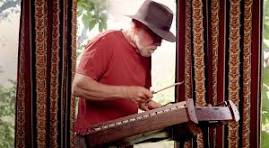
Fair use of a more current photo from PBS.
Thursday, July 17, 2025
Vanishing Words
I just happened to see a column in the Powell Valley News about some endangered phrases the author's elders used to use. Part of our hillbilly dialect that outsiders never got quite right, because the point was that, before radio and television, people talked the way their elders did and there was not necessarily one consistent pattern of "dialect" even for an individual town. Which of these things, Steve Roark asked, have readers heard someone say? Do we ever use any of them nowadays?
1. "Daub" for a quantity, probably in between a dab and a blob, of something daubed onto something else with a knife, like butter or jelly. "I like a daub of jelly on a biscuit." I've heard it, but not thought of it as regional, just as a word that sounds somewhere in between dab and blob, all of which are smaller than a glob.
2. "The devil of" something: Possibly related to the Irish use of "devil of..." to mean "never a bit of...," but more often used to mean "a difficult," or even "a large." Heard on a record by Ralph and Carter Stanley where they told old jokes: "I don't know how to get to Little Rock, but there's a devil of a big rock down in Pap's old pasture." (Note that this was a comedy routine with men from Virginia making fun of people in Arkansas...but yes, I heard people say "the devil of" in that sense in casual conversation.) "I had the devil of a time trying to finish the project on the computer with all the Microsoft 'updates'."
Also heard: "a devil's washboard," meaning a rough road. The Devil's Bathtub, a deep round pool in a mountain stream, was named before the Gate City Blue Devils but, so far as I know, it's a unique place name rather than a generic phrase.
"Blue devils" was an old slang phrase for alarm and despondency in the nineteenth century. Since all slang references to the Devil were classified as profanity, "blue devils" was politely abbreviated to "the blues," which then got to be the term for a genre of music felt to express that sort of mood. Then in the World Wars, first a French and then a Canadian military group were nicknamed "Blue Devils." Duke University's team was nicknamed in their honor and several high school teams wanted to be nicknamed by association with Duke University.
"The devils' own" (whatever) is extremely difficult and disagreeable, something that seems as if it were invented to torment human beings.
3. "Dew poisoning": Nobody I knew ever used this phrase seriously. Water-borne bacteria can cause infections and an infected skin would on the foot was blamed on walking through heavy dew. "Mountain Dew poisoning" would be a clever phrase for hypercaffeination or for the effects of drinking home-brewed alcohol, but it's not in general use in either sense.
4. "Dinner" for the midday meal: Still used, though I've heard it explained in elitist terms that "dinner" meant the main meal, farm laborers ate their dinners at midday, while landowners and the bourgeoisie at their dinners after the day's work. In practice I think people say "breakfast, dinner, and supper" or "breakfast, lunch, and dinner" according to which their elders said. The job status thing may or may not be reliably correlated with the word usage.
5. "Dinner on the ground": a picnic. Roark associated it with Decoration/Memorial Day. I've heard it associated with summer "camp meetings" where members of various churches used to take up to a week of vacation time in or near woods, praying, studying the Bible, singing, catechizing converts, and mainly keeping cool during what was expected to be the worst heat wave of the summer. "All-day meeting with dinner on the ground." The original idea was that the meal was brought out in a hamper and set on a tablecloth, or sheet or blanket or whatever people had, spread on the grass, and people sat around the cloth to eat. "Dinner on the grounds," carried out from a restaurant or served from a vehicle or vehicles, eaten on the chairs or bleachers available, is more often seen and heard these days but it's a variant.
6. "Disgust-es" for "disgusts": Yes, some people make a point of enunciating the "sts" combination in this way. If something disgust-es you, is it more disgusting than something that merely disgusts you? I don't know; people I know don't make this distinction.
7. "Done" for "already" or "completely": I think all of my elders used this one, especially (with a hint that the phrase had once been considered funny) "They'd done done it." "I've done finished it."
A variant form, also apparently considered funny at one time, was "He'd done'ready done it."
8. "Dog" or "dogged" used as a less offensive substitute for "damn/ed": Even my oldest elders thought of this as an outdated phrase most likely to be put in the mouths of fictional comic characters. Mark Twain's characters say "dog my cats!" and no doubt some people in the mid-nineteenth century really did. I grew up saying "darn/ed." I've felt funny about saying things like "that darned commercial" ever since I said it in front of a child I used to baby-sit, and the child repeated it in the presence of its mother, a church lady, who didn't dare to scold me (I didn't go to their church so couldn't be expected to know anything) but got up and spanked the child. (And anyway, darning is mending and ought to be used in reference to things that are worth preserving.) On the blog I say "dang," and, in contexts where it really is the proper usage, "not worth a daam"--the coin that was worth less than the cost of making it. In real life, before becoming an aunt, I sometimes said "damn/ed," but not often.
9. "Doins," "doings": Technically includes all the things people might have been doing, but used especially of a gathering. I've heard this one, less often over the years.
10. "Dope" for soda pop: Several older neighbors used to say this. It referred to the fact that the original formula for Coca-Cola included a bit of cocaine, which the company says hasn't been used since the 1890s. "Dope" then came to be used to mean an addict, or any stupid person ("The boys/girls at my school are a bunch of dopes"), and "Coke" came into use, probably peaking before I was born, to mean any soda pop. When a character in a 1950s novel went to the drugstore with friends or a date for "cokes" some of them were probably sipping Sprite or Grapette.
11. "Drag up" or "draw up" a chair to join a group: More likely to be expressed as "take a seat" or "get (oneself) a chair," but not unknown. Probably less common because public gatherings are less likely to take place in a large room with folding chairs leaned against the wall, taken out and unfolded as people come in.
12. "Draw out" for "remove the infection": Less common because the treatment is less common. A poultice containing a topical antiseptic, or something people hoped would work like one, was applied to an infected skin wound before injections of antivenin, antibiotics, or antihistamines became available.
13. "Dreamt" for "dreamed": Used when people want to sound quaint. Up into the nineteenth century we find some authors writing "he dreamed" but "she had dreamt," and others using "dreamt" as both simple past and past participle. "Dreamed" became more fashionable about a hundred years ago and used to be one of those words that identified people who were and were not following linguistic trends.
14. "Dreckly" for "directly," but used ironically in the sense of "at some unspecified future time, not necessarily in this year," in contexts like "I'll oil that squeaking hinge directly." Some people may have been more likely to mean "directly" in the original sense that they were moving in the direction of doing whatever-it-was when they said "di-rect-ly" instead of "dreckly," but this is uncertain. Many people who were attracted to this use of "directly" seemed to me to be procrastinators in any case.
15. "Druther" for "would rather": This was a status indicator but I'm not altogether certain how it worked. Generally the less educated said "ruther," those calling attention to their education said "rah-ther," but I'm not sure whether it was the middle class, the real flat-heeled aristocrats, or both who traditionally said "rather" like "lather." (One of my fence-sitting habits is alternating between saying "rather" like "father" and like "lather.")
"Had one's druthers," meaning "had one's first choice," is sometimes found in written English and was sometimes used by my elders.
16. "Dull as a froe": I've never heard this. I've never heard "froe" used in casual conversation. It was a tool used to split wood. Roark explains that it was traditionally dull-edged. My elders split wood with an axe, hax, hatchet, sometimes a chisel; they didn't have the specific old-time tools called froes. I did know that a froe was an old-time tool, but not one my elders used or talked about.
Both "froe," the tool, and "fro" meaning "from," were used before a curly hair style was called an "Afro" or 'fro."
17. "Dusky dark": for dusky, crepuscular, twilight, gloaming, the time between sunset and dark; if people I knew used this they probably thought they were quoting a poetic phrase. About a hundred years ago there were a lot of songs sentimentalizing this time of day, the time when sweethearts were allowed a good-night kiss if they made it reasonably quick. My elders knew and sang a lot of those songs but their everyday word for this time of day was probably either "sunset" or "getting dark."
Wednesday, April 24, 2024
History Will Be the Judge of Songs That Confuse Children
Mixing two prompts, just because it can, this web site considers the way the folk process has actually enshrined some of the best mondegreens--the ways people reinterpret unfamiliar or unexpected words in song lyrics they hear "wrong."
A song that simply confused me when I was a child was a popular song of Young Romance: "I'll build you a castle at the end of the rainbow."
Clearly derived from this song by Bing Crosby:
--which is what Google offers for the song title, what I heard was actually
I heard it on an old record around the same time I first read Alice in Wonderland--I must have been about four years old, too young to make much sense even of that nonsense novel. Alice, you may remember, used the phrase "fly into a passion" where we might say "throw a tantrum." I'd heard the word "passion" before--something to do with churches we did not attend, and a word found in popular songs. I thought that song was one of them. That was what increased my confusion to the point where I asked an adult what a passion was, exactly, and was told it was a word four-year-olds didn't need to know. Or "Maybe you meant 'passing'?" my mother suggested, and led me off into a discussion of the ways "passing" can be used in English, which was useful. At some point I asked what the singer was promising to build in the song "As Long as I'm Dreaming," and some adult explained the word "mansion," which was also useful. I had to figure out the different, though related, meanings of "passion" for myself.
And the adult who assumed I'd heard "mansion" was confused, too, because in the digital stereo version the word is, unmistakably, "castle." But in the 1960s I listened to the record several times; the record wasn't new, and it did sound more like "mansion" or "passion." My family also heard Porter Wagoner as singing "But dreaming of bluebirds will wake you each morning; the garden of roses will wither in June," lamenting the disappointment of waking up from his happy dream...
Nobody was building a passion as a sort of nest for someone to fly into, but consider the history of an old popular song that was originally titled "The Pale Aronatus." It would not have been the song the little girl had learned to sing in Jane Eyre. It probably was a derivative; "Maud Irving," the author of "Pale Aronatus," seems to have been a derivative songwriter, specializing in singable doggerel versions of songs from the less-than-classical opera of Jane Eyre's time.

Scientists never called this "blue-eyed tulip" Aronatus, but florists who wanted to sound educated might have done. Maud Irving, who might have been nicknamed "Maud the Fraud" by anyone who guessed what he was using as a pen name, might have thought that was a classy name for it. Anyway his song portrayed the girl with now fashionable ringlets of raven-black hair loading her head with roses, lilies, myrtle, and tulips. Maybe people would be so busy marvelling at this walking--or, she at least daydreamed, dancing!--flower show that they wouldn't even notice her bloodshot eyes.
More about Maud Irving, aronatus, and other things related to "The Wildwood Flower":
The folk process did lots of different things with this song. Few if any people knew what an aronatus was, or how to pronounce the accented vowel. The flower became an amaranthus or an amaryllis, or, apparently by someone's mis-hearing "amaryllis," "lyder." (What was a lyder--pronounced like "leader"? Google lists it as a man's name, with possible origins including herr as "boss" or even "leader," or a variant form of a German word related to "lout" and meaning something like "good-for-nothing." It seems never to have been recorded as the name used for any flower. A.P. Carter wrote it down, and his wife and sister-in-law sang it, in good faith that somebody Out There thought it was a kind of flower.) "Pale" is recorded as an original variant form of "pole," as in "palings" or "palisades," but people seem to have accepted it as either a description of the lyder, whatever that was, or a reference to some other pale-colored flower. In any case, when the Carters wrote down "the pale and the lyder" as other things the girl was planning to stick in her hair, they added a recognizable flower to make some sense out of the line: "the pale and the lyder, and iris light blue."
Roses, lilies, myrtle, two unknown wild wood flowers for which she'd made up her own names, and an iris? Even if her raven-black hair is the thick, strong kind sometimes called Cherokee, which is difficult but not impossible to force to form ringlets, nobody could load all of those flowers onto one head, nor do they all bloom at one time. So she's looking forward to a long, busy party season in which she'll decorate her hair with all the different flowers in the garden, as they bloom, one after another. Now we have a good mental image of the girl and can move on to her plans to party.
Myrtle, by the way, could have been understood to mean vincas, the most popular varieties of which are light blue.
And another version that might very easily have come between "pale amaryllis" and "the pale and the lyder" might have given the girl a traditional English name, which was in use where the Carters lived: she might have been "Poor pale Amaleta with eyes of light blue." Old name dictionaries list many variants of Amalie, Emily, and Amelia that were used about a hundred years ago--Amalina, Amelinda, Amelita, and my home town had a real local character whose name was Amaleta, whom the Carters might even have met. The real-world Amaleta was born around 1920, when this name was no longer trendy, so she might have been named in honor of some older person, or from the song as it might have been sung around 1920. If A.P. Carter's source heard and sang the song as calling the girl "pale Amaleta," that would explain how the Carters got to "the pale and the lyder." People at https://groups.google.com/g/rec.music.folk/c/KceW6M1LHoo?pli=1 seemed to want to hear "amanita," which was not (often, if ever!) used as a name, but some form of "Amaleta" is a solid possibility.
Or maybe someone heard the song as calling her "pale Angelita." Spanish language and culture were considered romantic in the early twentieth century, and the Carters weren't purists about preserving only British folk songs.
Or, possibly, "amorita," "little love," which I've not found in local use. I suspect locals would have associated this name with the Amorites in the Bible--barbarian enemies--but it was used in other places where English was spoken in the nineteenth century.
Various Googlers also propose "paling althea," "pale amaretto," and "pale angelica" (if pronounced by Italian phonetic rules, though the English pronunciation was better known), if you read through the discussion linked above. I suspect the trail of mondegreens leads from "aronatus" through "amaranthus," "amaryllis," and either "Amaleta" or "Angelita."
Someone in that group speculated that future generations may sing the line as "the pale enchilada, and rice is taboo"--so on the way to the dance the girl stops at the local Mexican restaurant? O-kay...Anyway that's a nice lead-in to another song that had my whole family confused. You may recall that we were the family who liked Jim Reeves because he pronounced every word of every song so clearly that they could be understood even on early monaural recordings. With one exception.
How exactly do the untold memories fade? We used to debate whether it sounded more like "fade, taboo" or "fade from view." We never thought of "fade to blue," which is what Google now offers. I still can't make up my mind, but I like "fade to blue."
Now we should all be confused enough for a lyrical nonsense poem:
You put me here in prison, and no doubt you're going to kill me.
You have driven me completely, even violently insane.
I went to eat an amanita, hoping it would fill me
And distract me from your fickleness, which causes me such pain,
Or perhaps would be a deadly one and horribly would kill me--
But I ate some other mushroom, and it has destroyed my brain,
And I never will admit remembering how the choice did thrill me,
For then I'd lose my defense and be re-tried as being sane.
(Who cares what the speaker did to whom? Has he not raved enough?)


Sunday, December 10, 2023
Local Christian Book Review: A Second Chance for Sugarplums
Title: A Second Chance for Sugarplums
Author: Emily Dana Botrous
Date: 2019
Quote: "She was coming home to get away from one man, not to get mixed up with another."
But when one is young and cute it takes considerable determination to keep young men from getting themselves mixed up with one's life. No sooner does Alexandria decide to leave the jerk who's lived with her long enough to be sure and is still refusing to have the wedding already, than her high school sweetheart, the only other man she's ever loved, plops into the seat next to hers on the plane back to the Tri-Cities Regional Airport...
Tri-Cities? Can it be? YES! It can be; it is! This small town romance is about a fictional town like the ones in my corner of Virginia. Probably most like Clintwood, because it's called Claywood.
And oh, how it rings true...even and especially the perception that common-law marriage, the commitment that (in my opinion) makes a wedding into a real marriage, is a big bad sin. Allie let herself be guilt-tripped into living with her boyfriend in the big city and probably alienated him by feeling guilty about doing that.
I just know that some reader is going to say "Yes, but she suffers and repents! If you'd only repented, perhaps God would have blessed you!" If a critical number of local lurkers really want to read my personal testimony on that subject, that can be arranged. I wrote the first draft of this review with my personal testimony in it, then decided most readers just wanted to know about the book.
Back to the book, then. Yes, its delightful local atmosphere features a realistically stubborn, disagreeable old relative. Alexandria's own relatives love her and are glad to have her back, but paying jobs are scarce, and the one Alexandria finds sets her up as a personal assistant to the very same prospective mother-in-law whose hostility drove her off to Miami in the first place. Because this is a romance, the mother-in-law is much less disagreeable than her type normally are in real life, but I'll let that pass. The image of a yuppie bank employee "temporarily" helping a geriatric patient get on and off the toilet is so, so true to local life.
Because they're only 24 and 25 years old, Alexandria and her high school boyfriend are still single and, if anything, more attractive to each other than ever. They're still very active in the local church, where her father preaches. Her future mother-in-law is a renowned cook; Alexandria is a mediocre one, but that comes to please the older lady. But the boyfriend's aunt who used to make oldfashioned sugarplums at Christmas is gone. Nobody else cared for sugarplums, or learned how to make them. Can Alexandria and his aunt's daughter follow the old recipe and make sugarplums like the aunt's?
I thoroughly enjoyed this romance. The author states clearly that the characters are fiction, and they are. Not only are their identities fictional; their good fortune, and the niceness that makes them deserve it, are peculiar to characters in romance fiction. At the same time their moral sense, their determined character, even the expressions they only occasionally use, are so utterly typical of the Blue Ridge Mountains that, for me at least, the atmosphere in this book more than makes up for its being merely a romance. For a genre that's expected to consist of predictable, even cliche, fiction this book contains a remarkably high proportion of freshly observed, timely, insightful truth.
Friday, September 29, 2023
Bad Poetry: Things That Feel Like Home
Nothing is just for show here, nor for fashion.
Things are just as they are, and people, too.
Things last their time; aren't wasted to conform.
Whatever says "Conform, do as I say"
is likely to be laughed right off the mountain.
Some days I wear things my grandparents wore.
I like long skirts, flat shoes, and knitted shawls.
I like a road that favors mules or horses
above those unsustainable, faddy motors.
The horses are gone now; they could come back.
A lot of things are gone, but could come back:
the places where the children used to play,
the friendly horses, cows, the little goats,
the chickens. The molasses making. Bees
still buzz around the old beekeeper's hives.
Water still spurts from the artesian well.
The fields could be reclaimed, not ploughed but terraced
with straw and woods earth and perennial crops.
I like the flybush, red in late September,
pink lady's-thumb that tastes like raw green corn,
the purple dogwood leaves, the yellow poplars,
the mints that grow wild all around the springa.
I like the terrapins and salamanders
and crawfish that hang out around the creek,
the cardinals that tend the privet hedge,
the way I see, each time I step outdoors,
a nature story begging to be written.
There used to be more people, nicer people,
but home is what you have when people die.
Sunday, April 2, 2023
Morgan Griffith on US HR 1, the Lower Energy Costs Act
The E-Newsletter is long; editorial response is below. From U.S. Representative Morgan Griffith, R-VA-9:
"
The Lower Energy Costs Act
House Republicans recently passed H.R. 1, the Lower Energy Costs Act. By numbering this legislation as H.R. 1, Republicans recognize that unleashing American energy is one of Congress’ top priorities and critical to the wellbeing of the American people and our economy.
In 2020, under President Trump, the United States achieved energy independence. According to the U.S. Energy Information Administration, the U.S. produced more petroleum than it consumed, the first year since at least 1949. Unfortunately, this energy comeback was short-lived.
On his very first day in office, President Biden began enacting policies to counter the energy achievements made in the last Administration, ones that severely hampered domestic oil and gas production. As a result, the American people have experienced exorbitant energy prices.
The Biden Administration made permitting new fossil fuel and nuclear energy projects very difficult. The New York Times recently reported that even thousands of renewable energy projects are delayed due to the current regulatory landscape.
In parts of Virginia gas prices reached record highs, close to $5 a gallon in June 2022. The price of residential heating oil hit an all-time high in November, costing Virginians $5.52 per gallon.
This has been especially burdensome for low-income households; some families in the 9th District have had to choose between paying their energy bills to keep their homes heated during the winter and other necessities.
We can do better.
H.R. 1 incorporates 25 individual pieces of legislation from across three different standing House committees to address the energy issues we have experienced over the past few years.
As a member of the Energy and Commerce Committee and the Energy Subcommittee, I have been proud to be one of the people working to make H.R. 1 a good bill.
H.R. 1 aims to increase domestic energy production and alleviate some of the cost increases at the pump, by reversing Biden’s anti-energy policies.
It includes legislation to disapprove of Biden’s canceling of the Keystone XL pipeline, which cost the United States 11,000 American jobs and could have had a positive economic impact of between $3.4-9.6 billion. The additional oil would have been cheaper to transport to American refineries by pipeline, rather than moving the oil by truck or train. This would have kept gasoline prices from rising as much.
The legislation also requires the Department of the Interior to resume lease sales on federal lands and waters and repeals many restrictions on the import and export of natural gas, including LNG.
About half of the homes in the United States use natural gas for space heating and water heating. Included in H.R.1 is legislation to repeal President Biden’s natural gas production tax. This tax has played a hand in increasing household energy bills across the country.
H.R. 1 reforms the country’s permitting process through changes to the National Environmental Policy Act (NEPA) permitting process. These changes will streamline federal environmental reviews for all sectors of our economy by ensuring that NEPA review challenges are substantive and by setting deadlines for completion of the NEPA reviews.
This energy package also repeals Section 134 of the Clean Air Act, relating to the greenhouse gas reduction fund. This $27 billion ‘green bank’ was implemented as part of the so-called Inflation Reduction Act to advance the bad policies of the Green New Deal.
The legislation also addresses our need for domestic production of critical minerals. In the left’s rush to green energy, America has become too reliant on volatile Chinese supply chains, and in some cases, the use of slave labor. The Department of Energy reported that, among other things, China controls 80% of the world’s rare earths production and refining which is needed to manufacture wind turbines and 60% of lithium refining needed for electric vehicles and battery storage.
I believe in an all-of-the-above energy approach, including renewables, but it shouldn’t be at the expense of our national security. This legislation boosts the mining and processing of hardrock minerals, including critical minerals needed to ramp-up production of renewable energy components, maximizing our domestic energy production. It also requires the Department of Energy to identify resources that are particularly vulnerable to supply disruptions.
Unfortunately, before the House passed H.R. 1, President Biden threatened to veto the legislation, to the detriment of all Americans.
Hopefully the Senate will work with us to get a bill that helps Americans by lowering energy costs.
If you have questions, concerns, or comments, feel free to contact my office. You can call my Abingdon office at 276-525-1405 or my Christiansburg office at 540-381-5671. To reach my office via email, please visit my website at www.morgangriffith.house.gov. On my website is the latest material from my office, including information on votes recently taken on the floor of the House of Representatives
"
Editorial response:
We can do better than fossil fuels and nuclear energy, too, in the Ninth District.
We have lots of sunshine. Well, we get plenty of rain too--but we do get enough sunshine to generate electricity from solar collectors.
We have lots of paved parking lots that people would like to have sheltered. With solar collectors? Why not?
We have lots of old farmhouses with lots of outbuildings, all of which have roofs, all of which roofs could be supporting solar collectors. Some of these buildings are no longer in use for their original purposes--especially the tobacco barns!--and could be used as battery sheds.
We have too many store and office buildings that have cheap, flat roofs that hold water and sag, and often leak, and badly need to be capped with roofs that slope and drain off water. Big roofs. That would hold lots and lots of solar collectors.
Almost every needy family, almost every retired couple, almost every business in the Ninth District, has an untapped source of energy...enough to meet our own requirements, and to sell to people in the cities who don't have roofs or pavements of their own. We should be Virginia's leading producer and exporter of CLEAN energy.
APCo should be sending us monthly checks, and sending Pepco and Dominion bills!
Regulations that seem to make this difficult are the work of protectionist corporate interests. We need a sensible conservative Congress to cut through those regulations like a hot knife through a stick of butter.
You, Mr. Griffith, know your way around by now and should be in an ideal position to slash through the red tape and put the Point of Virginia at the front of twenty-first-century technology. And the retirees, the business owners, and the working parents of the Ninth District will love you for it.
Subscribe to:
Posts (Atom)


