Friday, May 15, 2026
The Obligatory Long Poem About a Greek Legend
Thursday, March 30, 2023
Movie/Book Review: Ten Things I Hate
Years ago, a Blockbuster Evening inspired me, the next morning, to list ten things to hate about this low-budget remake of The Taming of the Shrew. Why waste a review? Those who remember Ten Things I Hate About You may at least get a chuckle out of this list of ten things to hate about Ten Things I Hate About You.
The book was written by David Levithan. I didn’t buy it, but in the unlikely event that this review makes anyone want a copy of it I could get it from Amazon.
1. There’s more than one male character in Shakespeare’s Taming of the Shrew. There’s also more than one male character in Ten Things I Hate About You, but, since all the teenaged male actors except the star look, talk, and act alike, we have to see them as a crowd to be sure.
2. There are only two substantial female characters in The Taming of the Shrew. To round out the cast, two girl characters have been added to Ten Things I Hate About You. Katerina gets a best friend who is nice but stupid, just like Bianca. Bianca, here played as even a dimmer bulb than Shakespeare made her, gets a worst friend whose wattage is almost low enough to excuse her nastiness, but not quite. So, there are three kinds of teenaged girls: dumb, mean, or both. Even in a farce, teenaged girls deserve more options than this.
3. All the older characters in The Taming of the Shrew are stupid clowns, but by and large the young characters are polite enough to ignore this fact. (There are exceptions.) Mostly it’s the audience who get to laugh out loud. In Ten Things I Hate About You, this instructive bit of social commentary disappears. There’s no pretense of courtesy or even civility toward the older generation. The teenagers use up all the laughter at the adults, and leave very little for any adult viewer to enjoy.
4. In The Taming of the Shrew, no explanation is given for Katerina’s character. She’s a foul-mouthed, bad-tempered, spoilt brat who beats her sister up just because she can. I've known real people like that, and think Shakespeare's play did a good job of showing what can be done about these people if they live to grow up outside of prison. In Ten Things I Hate About You, Kat becomes human, but wimpy: she’s depressed because she’s a rape victim. Recently. Shakespeare’s Katerina would have clobbered anybody who laid an unauthorized finger on her.
5. The movie looks consistently weird. The Taming of the Shrew is supposed to take place in Italy . All the characters are Italian. Although Ten Things I Hate About You is set in the United States, all the actors look Italian-American, except for Katerina and Bianca (who look Swedish-American) and Petruchio, here “Patrick Verona” (who looks Irish-American), and Bianca’s worst friend Chastity and one of the teachers, who are African-American. There might be legitimate reasons for characters having either Italian names or Italian faces but not both, and there might be casts of actors gifted enough to overcome this dissonant effect if they had to work around it; unfortunately, neither of these possibilities is fully realized in Ten Things I Hate About You.
6. The names and stage business allotted to Bianca and Chastity would be a cute reminder of Cher and Dionne in Clueless if they were the only reference to Clueless in Ten Things I Hate About You. Unfortunately, this is not the case. The second-rate remake refers to the brilliant remake constantly…to the extent that my husband, who hadn’t watched or read Clueless, had no idea where the verbal, non-slapstick comedy was found (or why I was laughing).
7. The Taming of the Shrew is a farce with no pretensions to redeeming social value or positive role models, though underneath the slapstick comedy the basic idea of how to help Katerina act like a normal adult with some empathy for other people can actually work. Ten Things I Hate About You is a farce with delusions of redeeming social value (the “statement” that rape victims are often depressed) and delusions of positive role models (who constantly insult all the older people they know and wreck their property). These delusions are an insult to the audience.
8. The Taming of the Shrew has a plot that suggests, but does not require us to watch, scenes of gross violence or major property destruction. Everybody wants to marry Bianca, nobody wants to marry Katerina, local property transfer rules don't allow anybody to marry Bianca until some poor man has married Katerina, and Katerina refuses to marry anybody. While Petruchio undertakes, on a bet, to marry Katerina, Lucentio sneaks in and marries Bianca. Petruchio avoids fights with Katerina by abusing everyone else, ripping up new clothes, throwing food on the floor, and generally being a bigger jerk than she is. This spoils Katerina’s attempts to get her way by abusing weaker people and forces her to learn an unconvincing submissive act, which, in her case, is an improvement. Although Lucentio and Bianca are in love, they soon run into problems; Petruchio and Katerina, neither of whom knows anything about love, come to terms that allow them to live together.
In Ten Things I Hate About You, virtually all of this plot disappears behind the violence, property destruction, and general misbehavior. Bianca’s date–one of the generic Italian-looking boys–mistreats her, Chastity turns on her, it’s her turn to get depressed, and there’s also a brawl. Neither Bianca nor any of the male supporting characters gets an adventure of his or her own. Bianca doesn’t even end up with a date for the prom.
9. The Taming of the Shrew was, as noted above, about Italians. There was no obvious reason to bring African-American characters into Ten Things I Hate About You. (Black actors could just have been there, unexplained--y'know, people sailed around the Mediterranean coast then, too--as in real Renaissance Italy.) Assuming that the director just happened to know a couple of African-American actors who were about as talented as the rest of the cast, one might have expected that at least one of the two would get a decent part; say, Kat’s dull but supportive buddy. One would be wrong. The Black man plays a burnt-out, stressed-out, hopelessly incompetent teacher who turns every scene into a stereotyped racist-sexist rant. The girl is cast as tacky, two-faced Chastity. Right. This is a stupid, obnoxious, tacky, racist movie that misrepresents White American consciousness to an insulting degree, and as a legally White American I find it deeply offensive.
10. After viewing Ten Things I Hate About You, we went on to view a violent action-adventure movie about Ku Klux Klan idiots, in which fake blood and blank cartridges were extravagantly used. That videotape contained a money-back guarantee: any convincing portrayal of a bigot is inherently offensive but if, after watching the whole movie, viewers found the movie offensive, they could write to the producers and get their money back. That movie did not make me want to complain and get the money back. It wasn’t in either of my preferred movie genres—lighthearted comedies, and sweet family stories filmed in scenes of scenic beauty—but it didn’t offend me. Ten Things I Hate About You did.
Need the snarkiness stop here? Why? A Buzzfeed writer found ten plot details to hate about Ten Things I Hate About You but, since she apparently enjoyed the movie, she used them to construct the plot for a sequel. Somewhere, somebody may actually make this movie.
And here, courtesy of Thesuccess at Morguefile, is a movie-watching cat: www.morguefile.com/archive/display/944775/
Blogjob tags were "Shakespeare, comedy."
Wednesday, March 15, 2023
Historical Personages to Read About
Monday, December 26, 2022
Book Review: The Prose Reader
Title: The Prose Reader
Author: Kim & Michael Flachmann
Publisher: Prentice-Hall
Date: 1999
ISBN: 0-13-095406-3
Length: 688 pages
Quote: “The essays in the Prose Reader continue to represent a wide range of topics.”
That’s what’s not to like about this book. Compared with other essay collections, it’s both thin and tinny. In a frantic effort to be “inclusive” the editors have weighed this book down with essays more than half of which are about the Politics of Identity. Though it would not have been possible for any collection of essays in the 1990s to have any credibility if it didn’t include any of Shelby Steele’s, and thus the essays about the Politics of Identity don’t all add up to “Feel guilty about people like me and throw money at us, which, of course, will make it very hard for you to like or respect any of us, but we don’t care because we only want your money.” But they come close. This book is p.c. to the point of pain.
That still leaves room for some good essays. A few were even written before p.c.-ism had fettered the Muses in America. There’s an essay by Ray Bradbury on putting up a front-porch swing, one by Russell Baker about being a “news boy,” Jessica Mitford’s exposé about the mortuary business, Judith Viorst’s plausible (but wrong) defense of “little white lies,” and Annie Dillard’s reflections on meeting a weasel in the woods. There is, of course, the “controversial” piece in which Shelby Steele dares once again to admit that many Black Americans have earned their own money, and would rather be respected, and perhaps even liked, than have guilt money pushed at them.
Then there’s page after page after page of recent p.c. drivel, and any college student who can find The Best American Essays in the school library will know just how many better essays were not included in this book in order to make sure they were exposed to the arguments for censorship and all the literary grandchildren of Countee Cullen who narrate one personal story and set it up as a plea on behalf of a demographic group. Cullen’s poem (another little kid called him a racist name, and “I saw the town of Baltimore from June until September; Of all the time that I was there, that’s all that I remember”) was terse and memorable, even if some critics found it whiny, but now efforts to be “inclusive” are filling libraries and school textbooks with imitations of it in prose, and some of them would be long even if there weren’t so many of them.
I’ll say this as a woman. Though not a minority group in real life, we’ve been artificially treated like one in the professions, oppressed as badly as any and more than some. The documents of our struggle ought to be in every public library, as well as the academic ones. We ought to remember the names of our activist foremothers, and, whether or not we agree with them on all points, appreciate their contribution to whatever success we’ve enjoyed. (And it behooves all humans who feel in any way discriminated against to read the history of the early Christian Church and the history of the Black American civil rights movement.) But a person whose best, most interesting statement is a statement to the effect that person belongs to a demographic group—are you serious?—is by definition an uninteresting person.
Women writers have had some advantages other “outsider” writers might not have had, in getting our work recognized at all. One reflection of our success is the fact that the Flachmanns’ selection of exemplary essays by women includes more essays about something other than “I Am A [insert demographic group]: This Is How You Are Supposed To Feel About Me” than their selections of exemplary essays from any other demographic. Three! Count them! Three whole essays about things women have learned and thought about something beyond themselves! Hurrah for us!
Except that, actually, people from other demographic groups have written well about topics beyond themselves, and the Flachmanns just haven’t bothered to discover their essays. Which says something about them, I’m sorry to say. When you are doing a computer search for “best essays by [demographic group] authors” you’re likely to find more of the “me-me-me-and-my-demographic-identity” than of the essays people actually write for their own demographic group. Arguably it may be asking too much of college students to expect them to read the nonfiction People Different From The Students write for People Like The Writers. I know I’ve found Wole Soyinka hard to follow; I’ve enjoyed Salman Rushdie partly because I had special help with his cultural references; I think people who have trouble following Gandhi, Thoreau, or Wendell Berry probably don’t need to be in college, but many of the young have been very poorly prepared... I also know that very few college students find V.S. Naipaul or Anne Morrow Lindbergh, for two, hard to follow; students my age liked Andrei Codrescu and Salman Rushdie, and I’d guess that the young still do; I’d expect most students to enjoy Alfian bin Sa’at’s Malay Sketches. (Not only is Dorothy Sayers still remarkably readable, but I suspect she would have agreed with my point here.) It’s not as if you had to get into studies of doctrinal controversies within minority religious groups and appreciate, e.g., Hyveth Williams' Seventh-Day Adventist apologetics, to find good writing in English by people who are neither White nor male. And actually, if the purpose of a collection is to illustrate good writing techniques, how much difference should it make if the writers were White and male? Francis Bacon and John Bunyan wrote some essays that illustrate good writing techniques better than some of the uninspired recent examples in this collection…
End of rant. Because I’m turned off by the p.c.-ism in this book a person might imagine that I didn’t enjoy reading it. I did, actually. Several of the better essays in this ; collection were old favorites. Some of the ones that were new to me, I enjoyed. It’s just that I’ve read so many essays that were better than…well, let’s pick on Lewis Sawaquat’s contribution to The Prose Reader. It was new to me. It’s not a bad personal essay. I enjoyed reading it. Only when I went back to write this review did I find myself thinking “…and what is this me-me-me-and-my-demographic thing doing in the place where a hard-hitting ecological study by Marilou Awiakta ought to be?”
If you are a serious student or teacher of nonfiction writing, what this book has to offer that A Rhetoric of Argument, the Norton Anthologies, and the Best American Essays haven’t done better is the analyses of writing techniques. You probably know that personal essays are generally rated lower than the impersonal kind. You probably don’t care; personal essays tend to be fun reads. If a step- by-step analysis of how a personal essay is put together works for you, get this book. I would not recommend that teachers use it as the primary textbook all students are required to buy. I’d recommend that teachers keep it in the library for all students to read.
Oh, wottha...I'm known for brutal honesty, so I'll say it outright. You want to compile a really inclusive anthology of writing from different demographic groups, you have to read a lot of different writings, not just Google "essays by X kind of writers." I don't think the Flachmanns did their homework before they published this book.
Today's music link: Comes highly recommended by young correspondents. It is the duty of the old to try to keep up with the major trends in pop culture, although we're probably not meant to get into them. I can't say this song converted me to fanatic fandom but I do think the young singer has a good voice: https://www.youtube.com/watch?v=mMeVxTPmTDY .
Sunday, November 27, 2022
E-Book Review: The Gospel in Dostoyevsky
Thursday, October 13, 2022
Book Review: Of Other Worlds
Author: C.S. Lewis
Date:
Publisher:
ISBN: none
Length:
Quote:
C.S. Lewis didn't write a great number of short stories, nor did he write a great number of essays about short stories. He did not anticipate this collection being printed. His secretary packed up what was left, unpublished, after his death, and rushed it into print.
That's obvious as you read this slim collection of the stories and essays-about-stories that he did write. Two of the essays and one of the stories are unfinished; three or four of them make the same points in almost identical words; three cite one source. And if Lewis had anticipated his four good independent short stories printed together, one after another, I'm sure he would have Done Something About the way they seem to make a point that Lewis did not try, or admit intending, to make.
I think Of Other Worlds does appeal, and should appeal, to serious fans, collectors, and students of Lewis, and/or science fiction, and/or Christian fiction. I doubt that it ever was or will be anybody's favorite of Lewis's books. If you can't afford a complete collection, this is probably the volume you can most easily get along without. I've read it more than once and enjoyed it, but not in the way I enjoyed The Screwtape Letters or The Allegory of Love.
What is to be liked in Of Other Worlds, given that it's not nearly as solid as any of the books Lewis finished, nor the collections of short articles he intended to put together into books?
1. First there is, pre-Bettelheim, a spirited, ringing, and soundly logical defense of imaginative fiction. Lewis read stories about our world as it is, whether presented as factual or as fictional, and liked them, and quoted them, and taught them to students. He wrote stories about any kind of world except our "real" one. He didn't think much of his narrative exercise, the diary printed as All My Road Before Me after the lives of the people mentioned in it had ended. He did better with the future world he knew wasn't going to be the real future in his Space Trilogy, the past he knew wasn't real in Till We Have Faces, and the alternative dimensions in The Screwtape Letters and Narnia. Because he was unable to gratify his emotional "needs" in the real world and was retreating into fantasy to compensate? What needs, the well paid, securely employed, world-famous, and more or less happily married, professor might have asked, did the psychological school of literary criticism imagine those to be? He began with unusual, interesting dream images and let his beliefs about the real world guide those images to say things about the real world. Most of what was being written about fiction and "creativity" in the early twentieth century was so discouraging and (thank Heaven) so wrong that in the 1960s even Of Other Worlds must have come to some people like rain in a killing drought. Lewis felt the need to make the same points about speculative fiction to several different audiences. If they become repetitious in a single book, that is because they were points that badly needed to be made.
2. There's a memorable discussion of science fiction with Kingsley Amis and Brian Aldiss, produced by tape recording rather than writing. Although the sound of these three voices together was undoubtedly a treat for millions of fans around the world, none of the three is really at his best. Whisky is mentioned several times in the discussion and, although the three writers don't get drunk, they do seem to lose the thread of whatever they might have planned to say for publication. The jokes they exchange at the end may conceivably have been fresh and funny in the 1950s, and may even have been retired for so long by my generation that they might seem fresh and funny to the young. Of such jokes, surely, Lewis was thinking when he wrote about "some pretext in the way of Jokes" being dragged into conversations where the real cause of smiling and laughter is the pleasure people take in being together.
3. And then there are Lewis's four short speculative-fiction stories.
Lewis was not, in fact, a woman-hater, nor was he more of a sexist than most men of his generation; in some ways he was less of one. He was a shy, "neurotic," unattractive man who married late, but apparently quite happily. More than most of his contemporaries he denounced the "femi-ninny-ty" that became fashionable in the early twentieth century, where women apparently got away with all kinds of things by appealing to the sexist stereotype that it was "feminine" to be scatterbrained and vaguely mannish to be logical, reasonable, or right. To the careful reader his few comments on the fate of Susan in the Narnia books, on the way real women scholars encourage poor Jane in That Hideous Strength to "have no more dreams. Have children instead," and on the young lady in "The Shoddy Lands," are rather clearly and carefully saying something more like, "Girls, please don't play dumb and fashionable if your goal is to impress men--that act does not impress this man!" rather than "I don'tlike young women." For a man who grew up in a period that frowned on any opportunity for writers to observe more than a few individuals of the opposite sex, Lewis managed to delineate several types of women he found likable and attractive, and several types he didn't.
This being the case, it's unfortunate that in the four short stories we find:
1. The image of the "world" in Peggy's shallow, narrow, self-centered mind, in "The Shoddy Lands," intended as a warning to writers of all kinds but using a female fashion victim as bad example;
2. The self-selection for undesirable women, in "Ministering Angels," where just one young astronaut briefly imagines that sharing interplanetary travel with prostitutes might be fun until he gets a look at the two hopeless cases the older astronauts could have warned him they'd get. One is a gender-confused "crank" who appeals somewhat to a "gay" astronaut, but frustrates even him by preaching that sex should be as "separate from pleasure" as "any other injection." The other is a broken-down, diseased, old drunk nobody wants to touch. For of course no prostitute with a viable career on Earth would volunteer to ply her trade on Mars...
3. The painful metaphor in "Unimagined Things" where rejection by a real woman "turns a man to stone" and sends him to the moon, where he meets a Gorgon.
4. And then there's "After Ten Years," the never finished short story that seems likely to have grown into a long story, about Menelaus and Helen of Troy. Lewis was fascinated by the Greek and Roman writers who hint that Helen was desired for her beauty and pedigree alone, that her personality and character were somewhere between tiresome and horrible. She was supposed to have been half human and half swan; swans are not the most lovable birds.
Here is no shimmering alien image of what femininity might mean if separated from womanhood, as in Perelandra; none of the wiser women, scholars or just old wives, as in That Hideous Strength; none of the smart, lovable girls--Lucy, Jill, Polly, even Susan when she was being Lucy's big sister rather than a debutante--from Narnia; none of the "ugly," "mannish," profoundly sister-lovable femininity of Orual in Till We Have Faces, surely among the best female characters ever written by a male author; none of the praiseworthy types of women briefly discussed in the poems and religious writings, and certainly nothing like the favorite cousin Lewis always wished his "gay" friend would fall in love with, who haunts, if she doesn't stalk, the autobiographical writings. Here are none, in short, of the kinds of women Lewis did respect and admire.
Here is the kind of thing that happens to writers. You write a short study about one kind of person you find obnoxious or ridiculous, another, and another, and then if you allow these pieces to be published someone exclaims "You just don't like that kind of person...'women' or 'men' or 'old people' or 'young people' or..." In fact you do like some of that kind of people very much. If you notice and correct for this in time, you and perhaps your readers are in for a treat as you set out to write about a son, daughter, parent, lover, or friend whom your other characters might love, who is recognizably not your own, not even your own as you want him or her to be. Lewis, not having planned to publish his short stories together, unfortunately had not written a short story with a nice female character in it, and the result...Peggy, the Thin Crank, the Fat Drunk, the Gorgon, and Helen of Troy. Oy.
I think even Walter Hooper would have thought better of publishing that if he had thought longer. He tried later to bind the same unsatisfactory collection of stories together with a draft for a novel Lewis himself had discarded as unsalvageable, with even more dismal results.
If you've read enough of Lewis's books to read the four short stories, together, as making the statement "Short stories are not exactly this writer's metier" rather than any combined statement about people, the three finished ones are satisfactory short stories. All aspiring writers should, perhaps especially, profit from "The Shoddy Lands."
So...perhaps Of Other Worlds shouldn't even have been published in the form it was, but it's been published, and, now that it is...I've never felt sorry that I bought a copy. I'm sorry, if anything, that Lewis didn't live longer and write more short stories or essays about short stories.
Tuesday, September 27, 2022
Which Planet Are You Under?
Friday, January 13, 2017
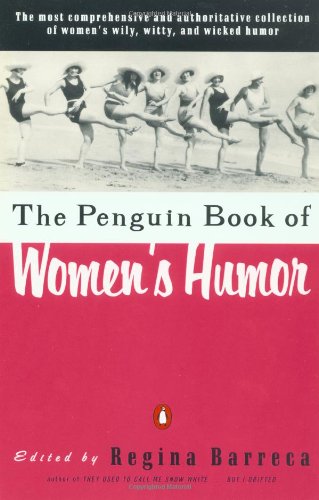
Book Review: The Penguin Book of Women's Humor

A Fair Trade Book
Title: The Penguin Book of Women’s Humor
Date: 1996
Publisher: Penguin
ISBN: 0-14-017-294-7
Length: 649 pages of text, 7 pages of credits
Quote: “It must be built not of carved stone and stained glass, but of some cheap, easily combustible material which does not hoard dust and perpetrate traditions. Do not have chapels. Do not have museums and libraries with chained books and first editions under glass cases.Let the pictures and the books be new and always changing. Let it be decorated afresh by each generation with their own hands cheaply. The work of the living is cheap; often they will give it for the sake of being allowed to do it.”
This little burst of temper (by Virginia Woolf in Three Guineas
Tragically, like other obvious symptoms of psychosis such as self-mutilation, delusions of “hearing voices,” and identifying with famous people living or dead in more than a whimsical or metaphoric way, the urge to purge is commonplace enough to form whole communities of sick, angry, violent people. Barreca identified Woolf’s screech as humor, which it may have been.
Barreca knows (as did Woolf, when she was closer to a normal state of mind) that useful social changes, like the idea that women deserved equal pay for equal work, are made by preserving and carefully studying history, and even statistics. Violent upheavals, urges toward purges, are characteristic of sick and dying creatures—including sick or dying civilizations. Before the urge to gut libraries and curricula, to replace studies of historic documents with “studies” of celebrity gossip, had really become conspicuous, perhaps people could agree that it was so preposterous as to be funny.
But that’s only one paragraph among 649 pages of every kind of comic and satiric writing, most of which has never been taken seriously and so remains hilarious.
The mood of the 1990s, as well as Barreca’s personal political bias, becomes obvious after one has read all the way through this book a few times. Each individual selection is funny, to men as well as women. In the belief that he was using listening and muscle relaxation to keep stubborn hypertension from turning into cardiovascular disease, my husband had me read most of this book aloud to him, a few pages at a time. It didn’t keep his hypertension from finally becoming recognizable as multiple myeloma, and he said a few of the one-liners sounded more peevish than funny, but by and large he enjoyed The Penguin Book of Women’s Humor. It takes a good long time to have drained enough of the laughter-producing (and therapeutic) value out of this book that you notice a bias.
Nevertheless, some bias does appear after you’ve stopped laughing and begun analyzing. Barreca was part of the twentieth century’s left-wing feminist movement. Penguin’s assignment would have required her to pick the pearls out of the historic books by women to which Penguin, the paperback reprinter, had acquired rights; this means that some “conservative” and “domestic” women writers, e.g. Jean Kerr
But, although you might have laughed more often and more heartily over McGinley’s essays than you did over Linda Stasi