Friday, August 16, 2019

Glyphosate Awareness Newsletter 5: We're Winning Whether I Am or Not

The Glyphosate Awareness Newsletter is published weekly by Priscilla King, c/o Boxholders, P.O. Box 322, Gate City, Virginia, 24251-0322. It’s available free, in plain text as an e-mail or attachment. Printed or audiocassette versions are available for the cost of production. (Audiofiles are free to anyone who can convince me that s/he is blind and can’t read a document aloud using widely available software.) Reprinting, recirculating, and sharing this information at the reader’s own expense is encouraged, provided that all sources of material are credited.

1. WEB SITE? LET’S HOPE EVERYBODY WAS AT THE LAKE LAST WEEK

For about six months, Glyphosate Awareness did not need its own separate searchable web site. People could just scroll down the hashtag page on Twitter. However, (1) by now enough content has been posted to the hashtag that many devices can’t scroll back that far; and (2) we need a newsletter because we can’t depend on Twitter. Some Tweeps have indicated that you’re writing books or compiling databases. That will be most useful; I’m sure I’d prefer that someone else built the official web site, as much as some of you would. This is not about money or “glory.” We need one big searchable site for all things glyphosate-related. It should be objective, not identified with any individual or organization, since most of us have our own opinions about other things that are separate from Glyphosate Awareness. Some of you have probably done more work than I have with this topic. You’re certainly welcome to add what I’ve assembled, so far, to what you have—but why should each of us invent a separate wheel?

2. I ALMOST DIDN’T EVEN DO THIS NEWSLETTER

Because I’ve been sick all week since last Friday’s roadside poisoning. All I’ve eaten since Sunday has been greens and peaches, and even that didn’t help because, of course, the vapors that caused me to wake up sneezing settled on the greens and peaches too! Celiacs are tough, because we have to be, to survive at all; we keep working through sickness until our shredded intestines finally burst. It’s said to be a very yucky way to die, though a quick one.

3. GOVERNMENTS THAT CONTINUE TO MISS THE POINT

The national governments of Brazil, Canada, and the United States continue to condone poisoning their citizens and a large part of the world’s food supply.  


https://nsadvocate.org/2019/08/16/province-announces-another-summer-of-glyphosate-spraying-for-rural-nova-scotia/

https://beyondpesticides.org/dailynewsblog/2019/08/epa-refuses-to-approve-labeling-that-discloses-roundup-glyphosate-as-a-carcinogen/

Bayer’s current site for testing glyphosate and “Roundup-Ready” GMO crops is in Puerto Rico, where locals report the array of symptoms contact with glyphosate is known to cause. In the Obama Administration they used the Philippines.

https://www.youtube.com/watch?v=5wXw_P7iugw&feature=youtu.be

Trump personally encourages the government of Colombia to do this too.

https://colombiareports.com/trump-urges-aerial-fumigation-as-he-certifies-colombia-as-cooperative-in-war-on-drugs/

It’s easy to blame and hate Trump personally for this. Too easy. We need to bear in mind that glyphosate got out of hand in the United States during the Obama Administration—it’s not a Republican-versus-Democrat issue. Corporations routinely “give” money to all promising candidates in order to claim that the winner is in their debt. None of the multitude of D presidential hopefuls, for instance, has a serious plan for banning glyphosate.

https://foodtank.com/news/2019/08/opinion-2020-democratic-candidates-on-key-food-and-agriculture-issues/

However, Thailand’s Ministry of Agriculture and Cooperatives reports a plan to ban all use of glyphosate, chlorpyrifos, and paraquat (how many U.S. Tweeps remember paraquat?) in Thailand within a year.


And Kenya’s Tea Development Agency warns farmers not to use glyphosate, although it’s sold to them legally under the brand name “Glycel”:

https://www.standardmedia.co.ke/article/2001338331/tea-farmers-warned-over-use-of-herbicide-on-health-fears

4. THREATS

On Twitter, Glyphosate Awareness spotted a tweet from Europe saying “Yes, buy glyphosate and your house will never burn down.” This was apparently an ill-considered joke about someone who set fire to a house while trying to control weeds naturally by burning them. However, we are informed that when individuals who have large homogeneous Twitter followings have posted anti-glyphosate tweets, they’ve received death threats. We should probably regard those who express pro-glyphosate opinions as potentially violent; spraying poison is inherently a violent act, and those who do it probably are willing to do worse things.

5. “WHITEWASH” HEADS FOR REPRINT

Whether it’s inquiring minds who want to know, or Bayer goons buying up copies to make this book unavailable, Carey Gillam’s book Whitewash has sold out on Amazon. It’s due for a second printing already!


6. WHAT TO DO ABOUT THE BAN ON WARNING LABELS IN CALIFORNIA

Well...when I was in a feminist activist group, along with our primary activity of raising money for a rape crisis center, we all used to carry around stickers to slap onto ads, magazines, etc., warning people “This offends women.” One thing we might consider is slapping stickers onto store shelves, doors, etc., warning people that glyphosate/Roundup causes tissue damage that most definitely promotes the growth of cancer. Those stickers could include clips from that document in EPA’s glyphosate archive, with the photos of emergency patients.

More usefully, we could print less disturbing messages on postcards and mass-mail them, especially to St. Louis. We could have pretty pictures, if only free stock pictures of flowers, butterflies, children and animals, on one side and a message like “People are becoming less tolerant of the use of glyphosate, which can harm or kill butterflies (puppies, children, songbirds, honeybees, etc.). Don’t buy or use Roundup or other ‘herbicides’,” on the other side. Or a list of Bayer brands sold in the area on one side and  “You’re invited to join the Bayer Boycott” on the other side. Here’s that list again, in case anyone wants to print it.

https://www.bayer.com/en/products-from-a-to-z.aspx

7. DEAD ISSUES USED AS SMOKESCREENS AGAIN

When a right-wingnut commits a homicide-suicide in Texas and a left-wingnut commits one in Ohio on the same weekend, the common issue is not “gun violence as a partisan political issue,” the way some very tacky Democrats want to suggest. The common issue is “homicide-suicide as a reaction to any of a specific group of stimulant drugs”—which is what the commercial media don’t want us to think about, since some of those drugs happen to be very profitable as legal “prescription medication.”

Gun bans don’t save lives; they cost lives. However, gun shops thrive on political debates about gun bans. Republicans agree to reopen the long-dead debate, even threaten to cave on bans on specific models, because doing that pleases some of their supporting business owners. If I were still being sponsored by an active firearms dealer I might get into this issue, but frankly, Scarlett, you’re in a lot more danger from glyphosate than you’ve ever been from guns. And if you seriously want fewer guns made and sold, try reacting to the gun ban debate with “Snore.”

8. ST. LOUIS: OCTOBER 10

We need boots on the ground in St. Louis between now and October 10, says Carey Gillam:


9. WE ARE STILL WINNING, GENTLE READERS!

I personally feel overwhelmed. Some of you may, too. I personally wonder whether Glyphosate Awareness is going to be my last battle; all I can say is that, if it is, I’d rather go out fighting the poison that may be killing me than just sitting there and taking it like a good little rape victim. Some of you may feel that way, or you may feel too sick or too tired or too brainfogged, already. But the facts are out, and the facts are going to win, whether or not any of us is around to see that happen.


Carry it on.

Thursday, August 15, 2019

What's Statesploitation?

Quick summary: a new word for any scheme where a few people who are highly motivated by financial gain exploit the state for money at the expense of the majority.

Because I happened to find Jim Babka's e-mail fairly high in the morning pile, and because I'm a word-nerd who's interested in observing which neologisms (newly invented words) catch on and which don't, here's JB's explanation of statesploitation, with links to his web site:

"

In that message, I promised to introduce a "FAR OUT" new strategy. Today, I deliver. But it requires the context of a quick story...

Several years back, libertarian heroes Carla Howell and Michael Cloud placed initiatives on the ballot. Twice, they sought to eliminate the state income tax in "Taxachusetts." In between, they gave the voters a chance to cut the state sales tax in half.

All three initiatives lost. And the reason it happened is why I'm writing to you today.

Every libertarian recognizes that State programs are a raw deal. Some of them are cancerously bad. And none of them can match the potency and social peace offered by voluntary solutions.

Yet the programs ALWAYS grow!

And they grow faster when they fail!

Why? That's an incredibly important question. I'm glad you asked.

The answer lies in the CAP [Collective Action Problem]...

     Concentrated benefits defeats dispersed costs.

It's a question of motivation. The people who receive taxpayer largess are better organized and funded than the taxpayer's themselves. In Carla and Michael's story, it was the Teacher's Union. The union spent millions to defeat these ballot initiatives.

The unions represented the concentrated benefits side, so they expended tremendous effort to protect their state scheme.

I choose to focus on Michael and Carla's End the Income Tax proposal because in most cases, the cost and likelihood of success are so low that "rational apathy" sets in. Why bother? But in this case…

Would the taxpayers have saved enough to make it worth it to them to invest in the fight?

Libertarians scream, YES!!!

And therein lies a key difference…

Despite the huge payoff of no income tax bill, the people of Taxachusetts lacked the vision to see what libertarians already understand.

Obviously, Carla and Michael marshaled several impressive arguments to make their case. Yet their case failed to resonate. Why?

Consider a farmer with fantastic seeds. If he has bad soil, his harvest will fail. In this metaphor, impressive arguments are seeds. But the readiness of the public to appreciate these arguments is lacking. The seeds land in infertile soil.

We must enrich and prepare the soil. The public mind must be enriched to comprehend what you and I already grasp.

Downsize DC's radical new strategy will apply a lesson from price theory. Typically, the cost of an item is key to a buying decision. But many taxpayers don't seem to know (or care) about the price when there's a political program is involved. Worse, they fear that their neighbors or the poor will be adversely affected…

It's up to us. We will show everyone why they're getting a raw deal from the politicians.

But unlike the clinical analysis of our movement's think-tank past, we'll connect with them emotionally. Let's return to Carla and Michael's ballot initiatives to show how we'll do it...

Remember, the teachers union spent millions to defeat them. Why is this detail important?

They were the Concentrated Benefit side of the equation. So what? Is there some significance to that?

The public schools are, first and foremost, a jobs program. Schools not only employ teachers and janitors. They also employ an army of bureaucrats, a union apparatus, and a ton of vendors. There's a great deal of money at stake.

It's notable that the teachers union is the entity which so visibly put up the fight. Have you ever seen their contracts?

Earlier this decade, a school teacher told me about a union meeting at an inner-city school district. The union polled its members to rank the ten issues that were most important to the teachers in their upcoming contract negotiations.

Schools are for kids, right? But not one single issue involving educational improvements was included on the list. Instead, all the items were about various employee benefits.

Isn't it amazing that the children's needs didn't even crack the top 10?

Listen, I'm not picking on teachers! I firmly believe that good teachers will ALWAYS have opportunities, even if we completely ended the district, public school model. The kids aren't gonna disappear! They'll still need to be educated. And this isn't about teachers...

The teacher union story isn't unique. Every State program is a concentrated benefit - a job and/or contracts scheme.

EVERY-SINGLE-PROGRAM is...

Statesploitation - A scheme where the few benefit at the expense of the many

     ...usually with inferior results to voluntary alternatives.

So let's return to Taxachusetts one final time with a theory on why the teachers union defeated Carla and Michael's end the state income tax ballot initiative, because...

There's something really significant I want to be sure you don't miss about this case.

The benefit was so seemingly self-evident, so concrete. Everyone was going to save thousands of dollars per year. It was so clearly in the best interest of the taxpayers (the dispersed) who vastly outnumbered the union members (the concentrated).

Why did the taxpayers act against their own interests?

They still thought *the price MIGHT BE too high*. In other words..
.
They thought the loss (of schools) was going to exceed their benefit (money in their pockets).

This is true every time we have this concentrated benefits vs dispersed cost battle.

We libertarians require a strategy that exposes the... 
  1. The true high cost of statist schemes
  2. The economical alternative of voluntary action
Downsize DC's new Statesploitation initiative will address the high cost of state schemes. (We have a plan for the second item too.)

Statesploitation is an unusual word. I made it up! Words are funny. Here's another really strange word: Lasagna. It's not pronounced as it's spelled, and it tells you nothing about what it is. It's only obvious because you're familiar with it. No marketing "expert" would've invented it.

Still, chances are, your mouth just watered.

Statesploitation has the word "exploitation" at its root, and that's on purpose. Others have riffed terms like sexsploitation and blaxsploitation (Google 'em if you don't know what they are). The point is, we want everyone in America to learn this word because, once they do, it'll induce an emotional response...

     Someone is taking advantage of us and we can do better!

You or I can blather on all day about how much a given program costs. And if you've done that more than once, you know it doesn't move people. Their eyes glaze as we describe baseline budgeting and the effects a program has on the National Debt. I've never seen this approach change a mind.

But being exploited by a political machine? We're betting that'll irritate people and reframe the debate on a number of issues.

We will want your help to get everyone in America to learn and even love the word statesploitation. It will take time and effort.

We'll measure to see how frequently this term is being used.

That's our plan. We're not quite ready to start. As I told you in the last message, we have...
  • a new website
  • new "email Congress" software
  • other things to put in place
also told you, those steps are paid for!

What is not covered is the outreach we'll need to do in order to be successful. And we need your help to build up that fund.

Thank you for your support,

Jim Babka
Founder & President
DownsizeDC.org, Inc.
"

Wednesday, August 14, 2019

Morgan Griffith on Medicare For All

From U.S. Representative Morgan Griffith (R-VA-9):

"
Monday, August 12, 2019 –                                
Socialized Medicine: Not What the Doctor Ordered
A proposed socialized medicine program run by the Federal Government, which Democrats call Medicare for All, is enjoying time in the spotlight, partly due to its strong support among Democrat presidential candidates and the new majority in the House of Representatives. The House’s bill for socialized medicine enjoys 117 cosponsors as I write this column, over a quarter of the entire House.
If this legislation were ever signed into law, devastating consequences would ensue for health care.
First of all, it does not even pretend to make the same promise President Obama made about Obamacare, that “If you like your plan, you can keep it.” This socialized medicine plan would not let you keep your insurance. That would include the employer-sponsored insurance over 158 million Americans currently have. It would also rule out the private insurance many seniors have through Medicare Advantage.
Instead, everyone would be forced onto government plans with limited options, putting the government now squarely in the middle of the relationship between patient and doctor.
Patients would certainly be made worse off by this intrusion.
So would doctors. Medicare currently pays them rates that are lower than in the private market. A study by the Mercatus Center, affiliated with George Mason University in Virginia, found that Medicare for All would reduce reimbursements for doctors by 40% compared to what they earn from reimbursements by private insurers. Such a severe cut would deter talented people from entering or remaining in the medical profession.
Hospitals would also lose revenue if all their services are reimbursed at Medicare’s current rates, which could make a difference in how many services they offer or even if they are able to remain open at all.
In April, the New York Times ran a story on the harsh fate awaiting many hospitals under Medicare for All:
Some hospitals, especially struggling rural centers, would close virtually overnight, according to policy experts. Others, they say, would try to offset the steep cuts by laying off hundreds of thousands of workers and abandoning lower-paying services like mental health.*
Lee County and Patrick County currently lack hospitals. It is true that they closed without socialized medicine becoming a reality, but if it did, those hospitals would have a more difficult time reopening and the ability of hospitals in some of our other jurisdictions to stay open could be threatened as well.
The universal coverage promised by socialized medicine’s proponents is meaningless if patients have nowhere to go for treatment.
These problems are not hypotheticals. My mother, who is 89 years old, needed ten months to find a primary care doctor who will accept Medicare. Her new doctor made an exception to take her, as he was already treating someone in the family. But when she called earlier in the year, his office had said no to taking new Medicare patients.
Already, some physicians have left the medical field due in part to low Medicare reimbursement rates. They could not sustain their practices at those rates. Medicare for All can’t be a serious solution when Medicare in its present form doesn’t serve all whom it should.
Britain’s National Health Service is often held up by socialized medicine advocates as a model, but one need not look far to find its dire flaws.
When I was studying at Scotland’s University of Edinburgh on a stipend, I stayed in the city’s Tollcross section, a less well-off neighborhood. My apartment was across the hall from an older couple named Finch. Mr. Finch at the time was waiting on heart surgery for a condition diagnosed in February or March, yet the surgery wasn’t going to happen until the following October.
After I returned home, I learned that he had the surgery but died within two years. His family was convinced the long delay between diagnosis and surgery weakened him; they believed he would have survived if he had been treated when diagnosed. In the United States, the same surgery would have happened within a week.
Constituents inform me frequently about their problems with the present health care system, and I recognize that serious reforms are needed. I have worked on them throughout my time in the House of Representatives, and I will not give up my efforts. But we must be wary of the “cure” socialized medicine offers.
I am committed to real health care reform that promotes affordability, access, and choice without diminishing our freedom to make decisions or forcing us to send more of our hard-earned money to Washington.
If you have questions, concerns, or comments, feel free to contact my office.  You can call my Abingdon office at 276-525-1405 or my Christiansburg office at 540-381-5671. To reach my office via email, please visit my website at www.morgangriffith.house.gov.

*“Hospitals Stand to Lose Billions Under ‘Medicare for All,’” New York Times, April 21, 2019
"

Belated Tortie Tuesday Post: Charlie and the Hummingbird

I slept badly on Friday night--kept waking up sneezing. This is often an indication of some sort of pesticide vapor drift. I went into town anyway, feeling sluggish and grumpy. A lot of people who usually come to Friday Market didn't, although the weather was that perfect "sunny and 75" (degrees Fahrenheit) their favorite radio station often blares songs about. One claimed to have come to market, then felt too bad to shop and gone back. It was a sluggish and grumpy market; another day when all good cheer seemed to be imported from Tennessee.

Some booksellers have been discussing the question of whether it's possible to sell vintage fiction in hardcover editions that have lost their paper jackets. I had a few to test my theory that it is. A lady picked up a copy of a football player's memoir, They Still Call Me Assassin. "Assassin?" she murmured.

"Do you remember when that guy used to play football?" I murmured. Most people in my home town wouldn't, because "The Assassin," Jack Tatum, retired just about the time my town started picking up TV channels that broadcast NFL games. He reminisced about O.J. Simpson and Larry Csonka, and wisecracked about Jerry Rice.

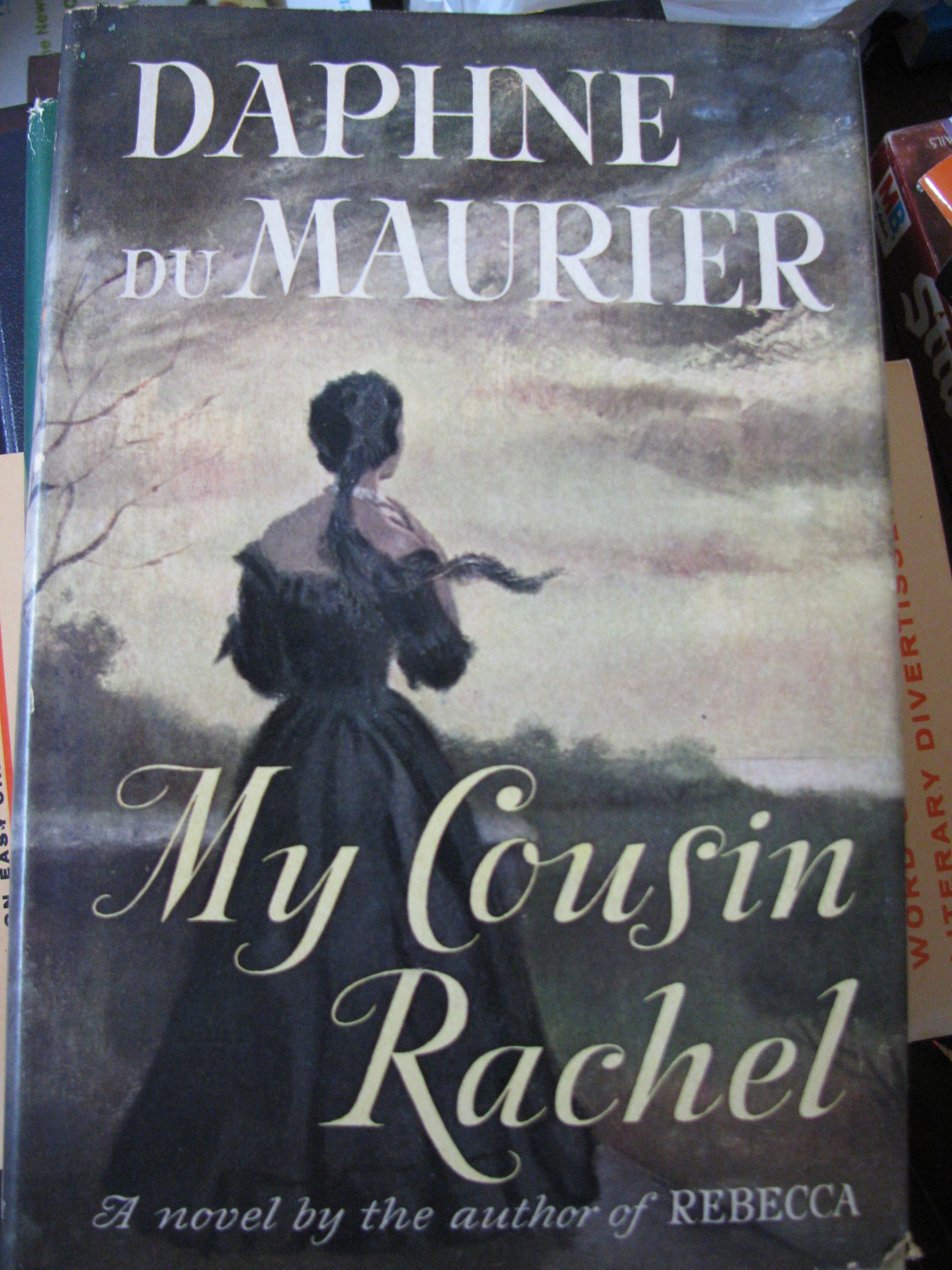
I happened to have a copy of one of Daphne Du Maurier's other novels, My Cousin Rachel, that had lost its jacket. "This is the novel of suspense I brought this week," I said. This is what the jacket would probably have looked like.


So she took both books and walked away looking pleased. My Cousin Rachel sold well enough that its resale value isn't high, but for anyone who likes clean, romantic novels of suspense it's a bargain. For anyone who wants to resell rare books, Jack Tatum's second memoir was the bargain. It did not sell well in its own time; no use showing a picture of it here because Amazon doesn't even have one. It's become a collector's item.

Well, first I found a fabulous deal on some of the blue yarn I want for the Anti-Bullying Blue Hats display, two extra-large shopping bags full. Then a person who was stuck in per own store was wanting to know whether people were moving in or out of another store, which was on my way. I walked a block up the street, found that they were moving out, and had three more bags full of old books thrust upon me. I also wanted to bring home some provisions for the weekend. This was going to be quite a load to carry. I asked a retired person who likes to get out and drive, when not feeling too ill. "Not driving today," person said. "I think I've got flu. Everybody in the building seems to have it."

I flagged down a younger person who was driving in the right direction, we took advantage of a sale on Route 23, and on the way back I could see what had given me such an unpleasant night and probably given the whole retirement project their "flu." There might actually be some sort of virus making the rounds. I know what you're thinking, since I mentioned someone being sick within minutes after drinking a V-8 in last week's status update, and it is not Norwalk Flu. If that person had had Norwalk Flu I would have smelled its unmistakable odor, person would not have been fit to drive home, and I would have had some symptoms during the last week. But all those older people might have had some sort of "summer cold." Maybe they had a summer cold. Funnily enough patches of vegetation along Route 23 were starting to brown out from glyphosate spraying. What a coincidence.

A body is a system, so tracing causes and effects is not as simple as people want to imagine. Someone shared, after I'd tweeted a bit about exactly how our cats Traveller and Bisquit died, that their symptoms--especially coughing up froth--sounded like algae poisoning. Dogs can show that symptom, and sometimes die, after drinking stagnant water contaminated with some kinds of algae. Cat Sanctuary cats normally drink out of a fast-moving stream that has never contained visible algae. But then somebody else shared that glyphosate can promote the growth of the kind of algae that make water undrinkable...The fact that some of these things are only secondary effects of a glyphosate poisoning episode does not mean that glyphosate didn't cause them.

I'm disgusted by our Environmental Protection Agency's caving on the question of those "glyphosate causes cancer" labels. It is virtually impossible to prove that anything is a sole or even a primary cause of cancer; there's still some debate about X-rays and DDT as well as cigarettes. (For what it's worth, the major carcinogen in cigarettes is not the tobacco but the bleached white paper.) However, glyphosate causes tissue damage on contact. People who breathe the vapors may sneeze or cough blood from the respiratory tract. People who eat or drink contaminated food may form bleeding ulcers, and they can be massive and bleed heavily, all along the digestive tract from the lips down. People who get glyphosate on their skin may get a mild rash or form huge bleeding lesions. Any or all of these things PROMOTE THE GROWTH of cancer, although these and the other glyphosate reactions people are having may be even more likely to cause death before cancer has time to grow.

I don't expect to die from cancer of the colon. If we don't get a serious glyphosate ban, I don't expect to survive long enough for that to happen. I've had celiac sprue for most of this year with only a few days between episodes. Celiacs for whom the sprue reaction becomes chronic usually die when the intestines stop repairing themselves and become "leaky" enough to cause blood poisoning. It's not a pleasant way to go but it is fast; people are usually going about their daily routines up to the last week or so.

I had celiac sprue all weekend. Still have it at the time of writing.

Still going about my weekend routine, I went out in the front yard and burned the trash. While the pages of a magazine that was in too bad condition to resell were burning, I heard a peculiar sort of sound. It mght have been a bird or a cat.

"Who said that?" I asked the cats. Samantha and the spring kittens seemed to have nothing to squeak about. "Where's Serena?" I asked the cats. Serena popped up from behind a bush. I watched the flames die and turned to go back indoors.

Serena pointed to a tiny damp kitten squirming about on some pressed-down dayflowers, a little ginger tom with a long tail. It reminded me of a stuffed toy of my childhood. "Is your name Charlie? Charlie Dale Lion?" The kitten's ears weren't open yet. Serena, however, was nonverbally saying, "Yes, you can call him Charlie if you like. Now come and let me show you another thing."

I followed Serena to the porch. She scratched vigorously at a chair. "You're saying the chair is blocking the way to your nest? You want to put Charlie in your nest?" Serena agreed. I moved the chair. Serena scratched at a bag. I moved the bag. Serena chirped appreciatively and disappeared into the nest where she'd reared the spring kittens.

I went back into the yard and kept an eye on Charlie, shooing flies and mosquitoes away from him. Though too young to see or hear, he could smell; he followed traces of his mother's scent on me and thus began following me around about a square foot of crushed dayflowers; we've bonded. Presently I heard a loud buzz. A wasp's or hornet's threat display? No, it was the hummingbird, watching this unusual human and cat behavior in between sips from the jewelweed.

I say "the" hummingbird. For years I only ever saw one. One day last summer I sat out in the driveway in a visitor's car, with a good view of the jewelweed, and saw that "the" hummingbird had a mate and family. I still don't know where the nest is, whether they're rearing babies again this year, or even--thanks to my astigmatism--whether it was Mr. or Mrs. Hummingbird who flew up to look at the kitten and me. I thought how conveniently nature times these things: although the hummingbirds don't eat insects, as the cardinals do, they do pollinate the pretty jewelweed flowers, during the weeks when the cardinals are mostly hiding. The cardinals usually don't let other songbirds hang around the Cat Sanctuary, except when we've had house wrens who were willing to stay closer to the house than the cardinals do.

I saw the Isodontia wasp. I saw the new Chlorion aerarium who's taken the place of last spring's office-mate Jade--Jadeite, of course. I saw Polistes carolina and a lonely little Polistes fuscatus. There weren't very many flies and mosquitoes, although the cardinals and most other songbirds keep a low profile in August. It was another humid but otherwise perfect afternoon.

Sunny and 75
Sunny and 75


Usually the birth of four kittens takes most of a day but, within two hours, Serena came out, still a "big fat cat." She hadn't bulged a great deal before giving birth and didn't look much thinner afterward. Looking damp and triumphant, she let me place Charlie in the nest with his classic calico sister and two black-and-white kittens of undetermined gender. All four have long tails.

Burr was with us all weekend too, a proud and devoted social cat...grandfather? Father? Surely not. Could Burr be the father of four healthy long-tailed kittens? In any case there was no question of his doing them any harm, as there is with some tomcats. Burr's main interest is in Samantha but he is another tomcat, like his great-grand-uncle Mac, who protects kittens.

I wondered whether glyphosate had anything to do with the sudden and rapid birth of these kittens. If so it doesn't seem to have harmed them--yet. They all dried off looking exactly the way newborn kittens are supposed to look: eyes closed, ears curled in, coats fluffy but sparse, every claw sticking out of every little bare paw.

I went online again yesterday and today. Storms roiled around the area. Internet connectivity comes and goes, or comes up showing as "limited." I saw the person who'd complained of "flu" on Friday driving again today. So far, I've not heard of any casualties of this glyphosate poisoning episode. But either the rain's not washed the poison out of the air, or it's washed into the local water supply; I've not noticed any evidence that I'm recovering from it, myself, either.

The kittens, the estivating songbirds, the friendly insects, the hummingbirds, the other animals and human children who were born this summer need your help, Gentle Readers. Spread Glyphosate Awareness everywhere. Spread it especially to St. Louis, Missouri, if you know people there.

Friday, August 9, 2019

Glyphosate Awareness Newsletter 4: Separate Web Site?

The Glyphosate Awareness Newsletter is published weekly by Priscilla King, c/o Boxholders, P.O. Box 322, Gate City, Virginia, 24251-0322. It’s available free, in plain text as an e-mail or attachment. Printed or audiocassette versions are available for the cost of production. (Audiofiles are free to anyone who can convince me that s/he is blind and can’t read a document aloud using widely available software.) Reprinting, recirculating, and sharing this information at the reader’s own expense is encouraged, provided that all sources of material are credited.

1. GLYPHOSATE AWARENESS NEEDS A WEBSITE

Wouldn’t it be great if people could ask “Which studies mention glyphosate reactions that include vomiting?” or “Which study mentioned ‘diarrhea, nasal discharge, and death’ as the most common glyphosate reactions in rabbits?” and all of us could, at any time, say “That’d be page 3 of Study A and page 157 of Study B...” instead of thinking slowly and grumpily, as even I now do, “Meh, I think that was an older study someone shared in October or was it November?” Computer systems like Microsoft Word, Blogger, Weebly, and arguably even Wordpress could be doing those searches now. My Blogspot does it, in a clunky way—it’s a blog, it pulls up the comments rather than the actual studies. Twitter was doing a fine job of documenting everything we’ve ever shared with the #GlyphosateAwareness hashtag, for the first six months or so...but that’s a lot of tweets, and by now scrolling back through them is likely to crash people’s browsers.

We need one place where people can find links to all the scientific documents we’ve been collecting and sharing over the past year. Ideally people could go to a web site, type in search terms, and pull up the studies that include those terms right away. Just one or two clicks would empower anybody to print out the information most useful to them. At the bottom of the page we could even index song lyrics, video presentations, cartoons, and other fun stuff for those whose computers are set up to process it. Would anyone like to offer their expertise to build such a site?

2. BRAZIL SELF-SABOTAGES

Brazil’s President Bolsonaro promises greedheads he’ll roll back what restrictions on the use of poison sprays, the destruction of the rain forest, and the encroachment on indigenous people’s territories, Brazil has had so far. Does the world need more tribal homelands turned into favelas...to produce more alleged food that’s unfit for consumption by humans or even by domestic animals? https://www.rt.com/news/465348-brazil-pesticides-regulation-banned/

3. “ORGANICALLY GROWN” GMO?

The U.S. Department of Agriculture’s current Undersecretary of Agriculture, Greg Ibach, thinks the words “organically grown” and “genetically modified” can be used to describe the same things. He needs education. https://www.organicconsumers.org/news/should-gmos-be-allowed-organic-food-usda-sparks-debate

4. HOW GLYPHOSATE AND/OR CHLORPYRIFOS HARM FISH

Two scientists in Argentina have e-published a study documenting how exposure to these “pesticides,” separately or together, harmed one species of wild fish. This study is still breaking news; it’s not been printed yet and you may have to pay or subscribe to see the whole document for a few more weeks. The short version is already online at https://www.sciencedirect.com/science/article/pii/S004565351931522X?via%3Dihub and at https://www.ncbi.nlm.nih.gov/pubmed/31310974 .

5. CHILDREN’S BODIES CONTAIN MORE GLYPHOSATE THAN ADULTS’

A disturbing study in California finds that, for families that consciously avoid glyphosate exposure, children’s bodies contained more glyphosate than their parents’, possibly due to exposure to sprayed schoolyards and glyphosate-tainted school food. https://sacramento.cbslocal.com/2019/07/24/weed-killer-roundup-kids-epa-higher-levels-parents/

6. CONTINUING NEED TO FOCUS ON ST. LOUIS

Although Bayer’s lawsuit in St. Louis is being delayed, giving us a little more time to spread Glyphosate Awareness there, a deleted tweet suggests we may need more attention to security than I would have thought. Here’s what’s been made “unavailable” at Twitter:
https://pbs.twimg.com/profile_images/993422500620062720/SNcNpZ1B_normal.jpg


Replying to
Yep, buy some #glyphosate and your house will never burn down.
3:21 AM · Aug 6, 2019

The context of this tweet was a careless effort to burn weeds near a house that caused a fire in Europe, but Bayer certainly has not demonstrated any noticeable sense of ethics in fighting to lower people’s awareness of how harmful Bayer products are.

Please reach out to anyone you know in St. Louis, reminding them that Bayer’s value as an employer will depend on Bayer’s ability to switch to non-poisonous technologies that can replace that foolish old idea of spraying poison on the soil. Safe weed-steaming or weed-boiling technology does not need to be limited to those who can afford robots, although what I’ve been nagging the tech companies about, all this time, is tiny skinny robots that can nip in between closely-packed stalks of wheat and similar-looking “tare” weeds. Gardeners could be using hand-held attachments with heating elements that allow water flowing through the garden hose to be hot enough to wilt a targeted weed. Bayer could be paying scientists to engineer safe, durable versions of this technological development, which was at least marketed as safe for installment in U.S. home water lines in 1983.

Until Bayer shifts its focus to developing safer physical, rather than chemical, ways to control nuisance species, we’ll all need to keep using this link to make sure we’re not buying any of these products: https://www.bayer.com/en/products-from-a-to-z.aspx .

7. LAKE ERIE REACTS TO GLYPHOSATE POLLUTION

Several Ohio scientists have been studying the effects of glyphosate, among other pollutants, on Lake Erie and the Maumee River; they think glyphosate is to blame for “toxic algae bloom” effects. https://www.ecowatch.com/glyphosate-sprayed-on-gmo-crops-linked-to-lake-eries-toxic-algae-bloom-1906543478.html

8. THERE SHE GOES, FORMING HYPOTHESES AGAIN: GLYPHOSATE AND KIDNEY DISEASE

Three U.S. researchers, including Stephanie Seneff, report on the evidence that supports their hypothesis that glyphosate is causing outbursts of chronic kidney disease among highly exposed populations. I’ve not even printed and read this long impressive-looking study myself, yet. I’m putting it off for the weekend. Glyphosate Awareness can’t afford a cash reward, but we’ll certainly tweet congratulations to anyone who can spot a mistake in this document: https://www.mdpi.com/1660-4601/16/15/2734/htm .

9. LET’S SHARE THE GOOD NEWS

Glyphosate Awareness has been wary of advertising food products that we’ve found safe to eat. Main reason: as long as brands aren’t held to standards that require all food sold under a brand to be verifiably 3-G-Free, food safety depends on the unreported, untraceable fate of specific individual fruits, nuts, greens and grains. Things labelled “organic” and “gluten-free” can and often do contain enough glyphosate to cause adverse reactions. Often this contamination is the result of drifting vapors, and the farmer who has worked hard to raise a field of peanuts that contain no gluten, glyphosate, or GMO is profoundly discouraged to learn that, because some idiot half a mile away felt a need to poison a daisy, his peanuts are still unfit for human consumption.

Large corporations that trade with several farmers can try to deliver 3-G-Free food. I’d like to call out Lundberg Farms (my mother says “We used to know those Lundbergs”) , and Riviana Foods (the parent corporation of Zatarain’s, Mahatma, Success, and other branded rice products) for really working to keep 3-G-Free rice in American supermarkets. I’d like to commend Ben & Jerry’s, too...but I can’t because, although Ben and Jerry and their pals in Vermont have done what they could, B&J ice cream is in fact poisoned. Ben and Jerry have no way to control this. I’ve been in contact with Planters and M&Ms, the makers of my favorite road foods; they have made a real effort to keep Planters Cocktail Peanuts and M&M chocolate candies 3-G-Free; this summer, they’ve failed. I can’t feel really confident about how long I’ll be able to enjoy Riviana rice either.

However, a Canadian correspondent (who didn’t mention being celiac) wanted to call out the Karma Cooperative in Toronto for at least trying, and, so far as he can tell, succeeding in delivering 3-G-Free beans. Cheers! I like his idea, at least. Let’s continue to commend those who at least try to keep edible foods in the food supply. This will allow those of us who find ourselves in the vicinity of Toronto to look for the Karma Coop, those of us whose supermarkets stock Riviana rice products to try all of those, and so on.


...and let there be more of these links in subsequent Newsletters and on the Glyphosate Awareness page.

Many American farmers are going to have a difficult transition ahead. There’s no use blaming politicians but it has been observed that the current administration has made some policy decisions that aren’t likely to help.The real problem is that the more we poison nuisance species, the more we lose natural predators and breed “super” resistant nuisances, so when a farmer stops spraying poison, the local ecological reaction will be a nightmare. Let’s do what we can to help farmers go through the first nightmare year, sell what few edible crops they can produce, and get back on track for succeeding years, by all means. Though I will maintain that they should’ve paid more attention to my father when he was saying this in 1971.

10. GOING GREEN IS GOOD FOR BIRDWATCHING

“Really? That’s news?” Here’s a formal study that quantifies the obvious: When we stop poisoning nuisance species, one of the first things we notice after the plague of nuisance species is the richness of cute little songbirds around us. https://non-gmoreport.com/articles/studies-find-organic-farms-benefit-birds-and-bees/

11. OATS, PEAS, BEANS, AND BARLEY? NO!

Grains and legumes are ripening across North America and Europe, and once again farmers are spraying glyphosate on them as a “desiccant” to force apparent ripening of whole fields at once, allowing maximum yield from only one picking...and, of course, making these foods toxic. Most people should be able to eat oats, peas, beans, and barley. Even celiacs should be able to eat oats, peas, and beans. Well, news flash: This year, once again, we probably won’t be able to eat these things without becoming sick, or sicker, as the case may be. This link documents how a site hypocritically called “Keeping It Clean” instructs farmers to poison canola crops; similar instructions have been circulated for many other crops including all the “dry” ones like grains, nuts, and beans. https://keepingitclean.ca/uneven-maturity


There’s no link for this tidbit, but...in warm climates, some of us may still have a chance at growing a few legumes, at least sprouting them, in our own homes, if we can get unpoisoned seeds to work with. 

Tuesday, August 6, 2019

Status Update: Good News, Phenology, Glyphosate Awareness

Despite the warnings on and off, all last week, as usual Gate City caught the annoying but harmless edge of the Severe Storms. We had some wind. We had some rain. We did not have a tornado, another Code Red heat wave, or even more flooding. While temperatures in town rose above 90 degrees Fahrenheit in the afternoons, they dropped back into the 60-65-degree range at night.

Wind and rain did not necessarily have anything to do with the demise of the male Eacles imperialis moth who fell out of a tree on Jackson Street. As this web site has noted, the big silk moths don't eat after emerging from their cocoons. They've done all the eating they're going to do, and can live up to a week, during which they can find mates if they're lucky--that's nature's way of keeping them from becoming pests. I don't know how lucky this moth had been but his ragged, faded wings might have been a whole week old.

Wind and rain did, however, blow some caterpillars out of their trees in the orchard. The one I recognized was a baby Tiger Swallowtail, only about an inch long, still drab-colored enough to be mistaken for a bird dropping, active and healthy and moving quite rapidly in search of another tree. Adult Lepidopterae active at the Cat Sanctuary included several Vanessas and a few Desmias. Over the course of the weekend I was drooled on by a friend's dog, and one little Desmia perched on my ankle, slurping up the wet doggie drool.

And, my wasp friends of early summer having died of old age, I noted the first applicant for Jade's position of office mosquito killer over the weekend. She was smaller than Jade, iridesced more of a metallic green than a bluish "jade" green, and had a longer waist. While looking up Jade at the Bug Guide site I'd read the pages about the various species in the genus Isodontia who all look pretty much alike, but are slightly smaller, longer-waisted, shorter-tailed, bigger-headed, and less bluish than the Steel-Blue Cricket Hunter. Their common name is Grass-Carrying Wasps; they mix grass straw with the mud in their nests, especially plugging up holes in wood with clumps of straw when they move into the borings of carpenter bees. Since many carpenter bees have bored into the siding at the Cat Sanctuary I'm sure this Isodontia wasp is a resident of the house, albeit unlikely to make the office her home.

And I think Google noted my comments on the confusion at some insect identification sites last week, because when I searched for a good image of Isodontia to show you, just now, what Google pulled up first was Ohio State University's copyrighted PDF of common wasps, ants, bees, and sawflies. If you allow for the way each species is magnified to fill up its space, so that a centimeter-long harmless Sweat Bee looks as big as a three-inch-long venomous European Hornet, this is a lovely site anyone trying to identify their "native pollinators" should see:

http://wildlife.ohiodnr.gov/portals/wildlife/pdfs/publications/id%20guides/Pub5488_Bees%20and%20Wasps%20of%20Ohio.pdf

The OSU page confirms my observation that "solitary" daubers, like last year's office mates Cobalt and Shimmer, actually (prefer to) live in couples. Males are so much smaller that humans haven't always recognized them as the same species as the females, who like to carry their mates about, sometimes during the mating act, and may bring food to the males who hang around the nests.

But what about Isodontia? Here's a video showing how they may wad up all the straw they bring into their nests inside a cranny, or leave little tufts hanging out as the cranny fills up...

http://bugoftheweek.com/blog/2013/11/11/window-wasps-the-grass-carrying-wasps-iisodontiai-spp

As the blogger known as Michael J. Raupp says, these useful wasps are uninterested in stinging humans. The one I saw didn't even bother with a threat display. It's likely that we've had Isodontias at the Cat Sanctuary in other years and that this year, after the paper wasps have stopped dominating the space and making them nervous, is the first year I've made the time to notice that some of them make more threat displays than others. I grew up thinking that no dauber actually stings but all daubers are nuisances who constantly make threat displays. I was wrong. The family is very diverse--and very useful to humans. There's even a species whose favorite food is stinkbugs; scroll down that OSU page to see them.

Isodontia species can be hard to distinguish. I. philadelphica sounds the most likely to be what I saw: dark, without brownish legs or red or yellow markings, slightly iridescent, reflecting light with more of a blue-green, true green, or even bronze-green gleam than a blue-violet gleam, and having noticeable body hair (when not magnified). Google is not showing me a free photo for I. philadelphica. What's on the Internet for public use is a closely related and confusible species, I. mexicana, which is usually described as flat black but can iridesce blue or green. There's also I. apicalis, with a faint but noticeable halo of whitish body hair, and I. auripes, black with bronze-brown legs. They all have the same body shape, and are all basically black but capable of reflecting blue-green light like a chicken's tail feathers under some lights. The office light has one blue-white fluorescent tube and one yellowish-white "natural-looking" fluorescent tube, so is likely to bring out bluish iridescence on surfaces that might not show it outdoors. (Some other grass-carrying wasp species are red, yellow, or marked with combinations of black, red, and yellow; mine definitely isn't one of those.) I still don't know which species I have.

Here is a photo of I. mexicana, showing that this species typically look brownish black in sunshine, also showing the sort of tassel of grass I sometimes see sticking out of wood around the Cat Sanctuary for what that's worth.

By Pjt56 -- Own work, CC BY-SA 4.0, https://commons.wikimedia.org/w/index.php?curid=81047424

Around 5:30 p.m., sitting on somebody's front porch, in between singing old songs I heard a commercial blaring out of a TV inside the house: "Attention farm workers! If you have used 'Roundup' and have been diagnosed with cancer or Non-Hodgkin's Lymphoma..." Glyphosate lawsuits have moved into prime time.

Around 8:30 p.m., another day, I was indoors watching somebody's television. "Attention farm workers!" blared the commercial. Turning down the commercial, the TV owner said, "I still have some "Roundup." I guess I oughta throw it away."

"Why not take it back and ask for a refund? It's hazardous material."

"But I've already used some of it," said my poor but honest host.

We are winning, Gentle Readers.

I'm still sick--ate a cucumber and a tomato from the garden of someone who swore they had never sprayed their garden, on Friday, and then on Sunday, making matters worse, I ate some potato chips.

And one evening somebody broke out a bottle of V-8 juice. My father and I used to love V-8; we didn't buy it often because we had our own vegetable garden and juicer at home, but for a treat when we were in town, or after Dad went blind and moved into town, we used to drink V-8 instead of soda pop. I passed on the V-8 this time, though, because I knew at least some of the eight vegetables in the mix would have been sprayed with glyphosate. One bold soul drank a whole glass of V-8, though. Ten minutes later he was out on the porch trying to get it back out. Sales of fruit and vegetables are down in the U.S. because one of the non-celiac reactions some people have to high levels of glyphosate is vomiting.

When will it be safe to eat much of anything we did not personally raise? I don't know. Can't happen soon enough. Planters Cocktail Peanuts (not their other products) and M&Ms have been my two safe road food options for a long time, after years when batches of those were contaminated and tweets in which the manufacturers promised to watch for glyphosate poisoning. Lately I've had celiac reactions to both, again; the batches currently in stores are not safe. I don't know for sure about anything. Current batches of some flavors of Zatarain's rice and unflavored Success Brown rice, and Swanson's canned chicken, have not made me sick. Other Zatarain's flavors and store-brand canned chicken have done."Organic" labels may or may not indicate that any given batch of any given food is safe. Even what's grown at the Cat Sanctuary probably contains traces of glyphosate from vapor drift, although that's the only food I can really trust not to contain enough glyphosate to make me sick, and the only food I could confidently recommend to other people.

But things will get better if we carry on--leaving any food that can't be verified 3-G-Free to rot in the stores, teaching farmers that the cost of spraying any kind of poison on food can easily exceed the cost of weeding, and even picking off insects, by hand. And, of course, boycotting all Bayer products until Bayer abandons the "pesticide" business and focusses its team of chemists on the real challenge of building robots that can weed wheat.

Simple visual sensors allow robots to spot many weeds in some crop fields--they can "see" grass as something that does not belong in a lettuce bed. Putting robots on long legs allows them to be small enough to move between plants yet too big to be swallowed by birds...though that wouldn't work with wheat. But wheat looks like grass, grows in dense patches like grass, is infested by weeds in the grass family, and needs to be weeded by something that can detect the chemical difference among weeds that look just like wheat even to human eyes. There has to be a way to build robots that can weed tarnel grass (the biblical "tares") out of wheat, without leaving chemical residues in the wheat.

Any fool can poison plants, and until they're banned from doing so by law any fool probably will poison plants. What should interest Real Scientists is getting the weeds out of wheat fields without poisoning the wheat. It certainly ought to be possible, given the current state of robot technology. It may not be cheap, but it is certain to be more profitable than glyphosate.


Despite the popularity of Star Wars' C3PO, the weeder robots our century needs probably won't have an "android" look. But more expensive weeders marketed to home gardeners could be fabulous...what little girl wouldn't love gardening with a corps of stylishly dressed Weed-Whacker and Bug-Zapper Barbies, each one programmed to destroy a different pest?

Friday, August 2, 2019

Glyphosate Awareness Newsletter 3

The Glyphosate Awareness Newsletter is published weekly by Priscilla King, c/o Boxholders, P.O. Box 322, Gate City, Virginia, 24251-0322. It’s available free, in plain text as an e-mail or attachment. Printed or audiocassette versions are available for the cost of production. (Audiofiles are free to anyone who can convince me that s/he is blind and can’t read a document aloud using widely available software.) Reprinting, recirculating, and sharing this information at the reader’s own expense is encouraged, provided that all sources of material are credited.

1. THE SURPRISINGLY HARD THING ABOUT NEWSLETTERING

...is to stop reading news stories and write the flippin’ summary already. I apologize. This is a short letter in any case, because it’s August...so...

2. THERE’S NOT A LOT OF ACTUAL NEWS

More people are joining the Glyphosate Awareness movement. More lawsuits are going to court. Bayer is blustering. Pesticide-addicted “farmers” are kicking and screaming as people increasingly demand that they stop poisoning the food supply. What else is new? It’s hard to be patient, to remember that many of these people don’t use the Internet and don’t have access to the facts we’ve been posting and sharing for more than a year.

We can fix that...and you don’t have to send me money to fix it, either. In fact I’d prefer that you not send me money. You know more people whom I don’t know. Your name has more credibility with people who know you than mine would have, since these people don’t know me. You’re encouraged to share this newsletter with your own neighbors at your own expense! Or, if you don’t want to take the time to copy, mail, e-mail, etc., you could just send money to Glyphosate Awareness Newsletter, c/o Boxholders, Gate City, Virginia, 24251-0322. Whichever. Spreading Glyphosate Awareness is something you’re doing for your own benefit, not mine.

Anyway...

3. GLYPHOSATE (AND DICAMBA) BREED SUPER-GERMS...TUMMYBUGS!

We knew glyphosate is one of the antibiotics whose overuse has been breeding MRSA, methicillin-resistant Staphylococcus aureus, which has complicated the recovery of so many sick people in hospitals during the last ten years. But this New Zealand study confirms that both glyphosate and dicamba (Spectracide), separately or together, breed more virulent, harder-to-treat strains of salmonella and Escherichia coli. https://www.canterbury.ac.nz/news/2018/new-study-links-common-herbicides-and-antibiotic-resistance.html .

4. HOW LONG DOES THE LOCAL DAMAGE LAST?

Alabamans debate the precise amount of ongoing damage Monsanto did to the town of Anniston: https://www.buzzfeednews.com/article/harrietwashington/monsanto-anniston-harriet-washington-environmental-racism .

5. GLYPHOSATE BECOMES A GYNECOLOGICAL ISSUE (THOUGH ALSO A UROLOGICAL ISSUE)

FIGO (Federation International of Gynecologists & Obstetricians, or equivalent spellings in several European languages) identifies glyphosate poisoning as a women’s/reproductive health issue. “Whether scientists are reviewing increased rates of cancer, neurodevelopmental disorders, pregnancy outcomes, or birth defects, there is evidence to support the effect of chemical exposures on health.https://sustainablepulse.com/2019/07/31/global-womens-health-federation-figo-calls-for-phasing-out-of-glyphosate-herbicides/#.XUSCGdTyvs0

6. MORE ROOM FOR COMMENTS AT EPA WEB SITE

Here’s my comment: https://www.regulations.gov/document?D=EPA-HQ-OPP-2009-0361-2392 . “Anonymous” evidently means from outside the EPA network. You’re welcome to share your “anonymous public comments”! To post your comment, go here: https://www.regulations.gov/document?D=EPA-HQ-OPP-2009-0361-2340 .(You’ll note that “Comments must be received on or before July 5” has been extended to “Due Sep 3.”)

7. GLYPHOSATE/CANCER VICTIMS NOW INCLUDE PROFESSIONAL ATHLETE

Former Pittsburgh Steeler Merril Hoge discusses his lawsuit with People.com : https://people.com/health/former-steelers-player-merril-hoge-suing-maker-of-roundup/ .

8. BAYER RETREATS TO MONSANTO’S OLD HOME GROUND: CALL TO ACTION

This is not just “One more lawsuit, fourth verse same as the first...” Bayer wants to be prosecuted in St. Louis, rather than California, because St. Louis is the home of Monsanto. Lots of people’s reaction to the glyphosate lawsuits there, Bayer hopes, will be “My father worked for Monsanto...” or “My business needs those Bayer people...”In the next week or two you Gentle Readers need to strategize: https://twitter.com/careygillam/status/1156251856785551365

Admittedly a lot of people have hated both Monsanto and Bayer, for good and sufficient reasons, for a long time. For some people this has been part of a more general feeling about privately owned corporations, generally, and some people are thinking, “Yesss! Shut down the factories, put the office staff in jail, and nationalize those ratbags’ ill-gotten gains!”

Those are not the people we need to activate in St. Louis next week, Gentle Readers.

It might be a good thing for St. Louis (consider the undisputed details from Anniston, above) if Bayer were taken over by new stockholders with Glyphosate Awareness, who could order the company to move away from making poisons to making something relatively wholesome like weeder robots. It would not be a good thing if Bayer were simply shut down, leaving a lot of people in St. Louis unemployed and damaging their local economy.

It would also be better for a lot of us if Bayer were actually kept in business...as a corporation deeply in debt, indentured to pay a lot of people a lot of damages over many years.

Bayer will undoubtedly be telling folks in St. Louis that our goal is to wreck their local economy, probably to leave their hardworking fathers (who probably have grotesque chronic diseases they blame on their ages) homeless and their children dependent on welfare meals served in miserable public schools with smashed windows and blah blah blah on.

We need to get out the word to folks in St. Louis that our goal is to maintain their local economy by keeping people employed on more worthwhile projects than making poison. Bayer’s legal obligation is not primarily to keep human beings healthy but to make its stockholders wealthy. We need to explain to people that the goal of a glyphosate ban is to keep the Bayer Boycott from bankrupting the stockholders, to get Bayer turned around and on a track to some sort of ethically tolerable business that can keep the children of St. Louis in good schools. And able to benefit from those good schools because they’re not sick from glyphosate poisoning.

Those of you who know people in St. Louis need to reach out to them now and talk in detail about how, if they don’t impede the glyphosate ban the whole world needs, Bayer just might be pushed forward to the cutting edge of twenty-first century robotic technology, rather than stuck in an old technology that’s rapidly becoming useless to farmers at the same time it’s being shown to be harmful to every living creature that’s ever been studied.

Since I don’t know people in St. Louis I’m about to wrap up my work week. On Tuesday, when I come back on line, I look forward to seeing the hashtags “Glyphosate” and “StLouis” linked on Twitter and in e-mails, and reading about how youall have been activating your friends there.


We’re winning, Gentle Readers. Pass it forward!