Monday, May 12, 2025

Belated Post for 5.7.25: Favorite TV Shows and Why

I've thought about you while I've been mostly offline, Gentle Readers...The Long & Short Reviews question for the first week in May was "What are your favorite TV shows, and why?"

Watching television is not my favorite thing. When huge-screen TV's were in fashion, my husband's ex had thought she had to have one. When she and treatment for the kind of cancer he never had had bankrupted him, and she threw him out, she dumped the big TV on him. He said he had watched sports when he couldn't avoid being at their home with her, but when he wasn't trying to shut her out he seldom bothered to turn the TV on. 

We were compatible, I said. I once rented a furnished room that came with a TV set. I watched TV only when friends were appearing on it. So I used the TV as a hat rack for six months before discovering that it didn't work. 

We did watch television a few times, though. During election years we watched the debates; we watched the Olympics, and an hour or two of coverage of the horror that was New York City on September 11, 2001. One year when a friend had become involved with a bill we watched the Virginia legislature in session--from Maryland. But we didn't watch anything regularly on television. Everyone knew the news was better covered in the morning Washington Post. Back then it was, if not a frank and unbiased paper, a much better one than it is now. 

I had watched enough television to have formed this low opinion of it, as a child. In primary school we actually used to have a game called TV Tag. When tagged you had to name a television program and when and where you'd watched it. You hadn't watched TV in our town; it wasn't yet available. People who hadn't travelled just had to be "it" when tagged. I had travelled enough that, though slow enough to be tagged easily, I could avoid being "it" for more than half an hour. I had liked "Lassie," and "Romper Room," and some of the Lawrence Welk and "Hee Haw" shows my parents tolerated when we stayed at motels that had television, or with Grandmother. I had not liked Julia Child. I had liked Flip Wilson but my grandmother didn't like him, thought his "The devil made me do it" jokes were antichristian, and would turn off the TV if he was on. 

 "Sesame Street," "Mr. Rogers' Neighborhood," and "The Electric Company" came out later. I enjoyed the whole two hours of children's TV. Mother said they were regressive. Sometimes after watching some skits she'd say they were too regressive even for my brother, and tell us to go outside and play. Sometimes as an alternative my brother liked to watch "Superman," which I thought was regressive. Both of us liked the Saturday morning cartoons and would spend whole Saturday mornings watching them, one summer when we were in California and could watch television any time, before the'rents found a house with no television set and Mother started taking us to Seventh-Day Adventist church meetings instead. 

 Early in my teen years my home town finally started picking up TV broadcasts from NBC in Bristol. I baby-sat for children who were allowed to watch reruns of "I Love Lucy" and "Looney Tunes" that were broadcast before "Sesame Street," "Mr. Rogers' Neighborhood," and "The Electric Company." I still enjoyed the "educational" kiddie shows. Mother still said that even for the children I baby-sat, the youngest of whom was three years old, they were probably too regressive. 

At the church college I attended TV was controversial. The school offered degrees in broadcasting, with internships at an affiliated radio station, but the program was all about radio. Many Seventh-Day Adventists, like my parents, were proud of being too frugal to have a TV set in the house. There were no "good," meaning SDA, TV preachers. There was a television set in a common room in each dormitory, though not in the parlor where visitors might have watched, and some people even watched things like the final episodes of "MASH" and "Little House on the Prairie." I didn't. I hadn't watched enough of those shows to miss them though I had happened to catch the original broadcasts of the first three episodes of "Little House on the Prairie." 

 When I came home with mononucleosis, my parents and sister were managing the estate of Dad's rich uncle, who had just died, in Clinchport. There wasn't much to do out there but watch NBC on the rich uncle's black-and-white television. "Little House on the Prairie" and "Dukes of Hazzard" reruns in the morning, "Looney Tunes" after school, "Wheel of Fortune" and "Jeopardy" in the evenings, and sometimes "Highway to Heaven" or "Family Ties" after those. I watched quite a lot of television that year. It seemed interesting. A year later I recognized that, for me, finding even those TV shows interesting was a symptom. 

 In my twenties I became a social TV watcher. I didn't like any show enough to want my own TV set, or turn one on if it was furnished with a room, but I'd sit through what friends were watching. So I watched the Orioles lose an entire season of baseball games. I watched Colonel North explain how his job required him to be a good liar, but he was now going to tell the truth, so he said. I watched Ivan Lendl and Vitas Gerulaitis stretch one tennis match out for an entire day because daaang they were good; watched Martina Navratilova win matches faster. (At some point I realized that I'd never actually watched either Arthur Ashe or Billie Jean King win a match.) I watched a few horror shows with a friend's son, one based on a novel by Peter Straub, and one based on the idea that nobody liked being crawled on by the cicadas that were swarming in Washington at the time; it was about mutant insects that looked more like roaches but made a sound like cicadas, and they used this sound to summon others when one of them caught someone sleeping, and they crawled into the person's ears and ate the brain. 

Cable TV was a huge fad in my late twenties. At this period I had a boyfriend, and the opportunity to practice living with him in a wholesome family environment. His parents, who were professional foster parents, positively encouraged me and his sisters' boyfriends to spend days and nights at their house--making sure we were compatible enough to get married, and also getting lots of free baby-sitting. They had color TV sets and cable subscriptions in every room. We watched MTV, "Beavis and Butthead," lots of ball games and NASCAR races, reruns of the shows I hadn't watched before. The TV programs seemed interesting when norovirus went around and I had an actual fever. The family's behavior was much more fun, though. 

 Then after those years when weeks went by without my husband's turning on his big-screen TV, I came home as a widow. Mother had bought the big house in Kingsport with the original "hi-fi stereo color TV" in its cabinet. I don't think she ever turned it on. My home, tucked away in a fold of the hills, never has had a television set in it, and if I have any say in the matter it never will; I like its being TV-free. 

From time to time, though, I visit people who think the only decent thing to do is share with guests the benefit of their cable TV subscriptions. I watch a ball game, or NASCAR race, or "western" rerun, or game show. I stay awake by knitting, and chat with these people during the commercial breaks. One friend likes to note how many of the young, good-looking actors in favorite rerun shows have died old by now. One likes to laugh along with Steve Harvey, who I'll agree is funny. One used to like gospel music programs. I miss her. 

I suppose my favorite program is "Jeopardy." I wish more of the cable TV subscribers I knew watched it. And I miss Alex Trebek. A lot of TV stars I liked have died old by now--Anjelica Huston, Michael Landon, and of course Lucille Ball and Desi Arnaz were dead when I was watching them on reruns as a baby-sitter, and Fred Rogers, and many more whose names would come to mind if I thought about them. I don't miss them; they were old and they left lots of videotape behind. I do miss Alex Trebek, because "Jeopardy" is still entertaining but it's not the same without him. So I suppose  "Jeopardy" with Alex Trebek must have been my all-time favorite TV show.
First Links of May

It's both a rainy day and a Monday. I'm still in McDonald's. Something called a router was supposedly installed at the house. It was supposed to be a new router to go with the new cable that's been strung up. The computer does not recognize it as a router. Someone was supposed to come out and find the reason why on Friday. Did not come out, despite the dispatcher having "verified" all the contact information. The odd jobs man was looking for a five-dollar job this morning, so into town I came. 

Animals 

Gorgeous butterfly photos, including some rarities, and one of those Common Jays we recently studied.


Glyphosate Awareness 

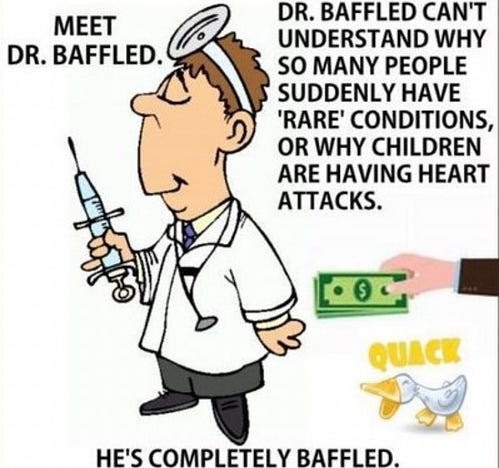
If you or someone you know has a chronic condition that involves bleeding, and your doctor doesn't test samples for glyphosate, this meme is for that doctor:


We should never give money to Dr. Baffled.

(Google says it can't search for the origins of memes at McDonald's. Something about their special server blocks some links; which ones changes from year to year.)

Gross Enough to Ruin Your Whole Day 

Some things should not be recycled. Drinking water is one of them. Unfortunately, if you don't live in mountains your drinking water probably is recycled, but some municipal water treatment plants are taking it to a whole new depth. If you're not feeling well the headline is probably all you want to read.


Inflation 


So,  since Trump took office, what price has dropped?

And the rest of us are paying even higher prices to fund this show of fake sympathy for welfare recipients? Wrong answer. The store needs to lower prices for everyone.


Poetry 

As a dangerous person with bad hair, a more fashionable than tasteful dress, AND ugly blue athletic shoes, I needed this reminder to behave as well as this much eye-offending will allow!


For those who loved or hated Ezra Pound:

Book Review: Tardy Bells and Witches' Spells

Title: Tardy Bells and Witches' Spells 

Author: Sarina Dorie 

Date: 2018 

ISBN: 978-1986003605 

Quote: "Magic wasn't real--because if it was--that would mean I was a witch." 

Clarissa is a witch. Her magical affinity may be sex, or interpersonal relationships. She may never find out because her magical destiny is so horrific. Brought up by a nice suburban garden witch, she's actually the daughter of Loraline, alleged to be the most wicked witch ever; if she ever uses her magic it's likely to kill people who are close to her. She spends her childhood wondering why she's drawn to magic and witchcraft when her family discourage her interest, then hanging out with a wizard friend who thinks she might have some magical powers beyond just enhancing his, and then--when her older sister, the water fury, tries to kill her and the wizard helps her escape and they confess their crushes on each other, so Clarissa's emotional energy is high--summoning a tornado that...well...fulfills a prophecy Clarissa has heard about earlier in the book. 

 The cover of this book is the disappointment. It promises to be about a School for Wayward Witches. It's not. Clarissa is told that the school exists, but she's not allowed to go there. However, the school is part of a longish series. If you like the fantasy world in which this novel is set, you'll want the series and you'll undoubtedly read about the school there. 

This is a series written primarily for adults who can still relate to young adult characters. The author promises at least one story about Clarissa as an adult, but this is a story about her childhood and high school years. There's no explicit sex in this book, though there is an explicit scene where teenagers snuggle up in bed resolutely not having sex. There may be some in other books in the series. Sympathetic characters die. There's no clear alliance of good witches against bad ones; there are lots of different witches, most more or less ethical, each serving per own interests. There's good and bad, but Clarissa is clearly told that she can't simply choose to be a good witch or a bad witch, but must meander through life making one choice at a time.

Butterfly of the Week: Graphium Evombar

Graphium evombar, found on Madagascar and the Comoros islands, is yet another tropical Swordtail that reminds North Americans of our Zebra Swallowtail...only it's as pale as our small springtime Zebras and as big as our dark late-summer ones. It is sometimes called the Madagascar Swallowtail or Madagascar Swordtail. 


Photo by Randrudland, taken in November. There's a tradition that living butterflies are photographed with their heads toward the top of the page. Some butterflies just haven't heard of the tradition. 


Photo by Sabrewing, taken in Madagascar in December.

By US standards this is a large butterfly...


Photo from eBay.


,,,But in its tropical habitat, it does not look very big. Photo by Margaretstevens.

Evombar was, according to Boisduval (1836), what local people called this species. He did not know, nor has anyone since reported, why it was called that or whether the word evombar had other meanings. Google does not show a meaning for evombar in the Malagasy language; in the language of Tananarive, properly spelled Antananarivo, it's typical for a word to be properly spelled with a few more syllables than are pronounced when the word is used. 

Males and females look very much alike. 


Photo of an egg-loaded female, considering where to lay an egg, by Charles J. Sharp. These butterflies are thought to live on plants in the genera Artabotrys and Uvaria but so far no species has been formally documented as a host plant. Nobody seeing a butterfly in egg-laying mode has watched where she placed the eggs and whether the caterpillars survived on the plant. Opportunities for local people to become famous are abundant.

All evombar eclose with long tails but not all individuals keep their tails. This is one species in which the primary function of the tails seems to be to break off when grabbed by predators. 

Found all over its native islands, it is classified as a common species in no immediate danger of extinction. Comoros specimens differed from Madagascar specimens enough that the Comoros butterflies are classified as subspecies viossati, but no online source explained what the difference was. 

The species generally lives in forests. Individuals, mostly males, come out in the sunshine to sip from puddles. Females spend most of their time looking for suitable leaves to lay eggs on, and mature males spend most of their time following females. Immature males probably do some composting of brackish water in order to get the mineral salts they need to mature sexually. Females probably prefer to get all their mineral salts from contract with males, and may sit at the edges of males' "leks" to wait for a male to leave the group and flit off with them.

The life cycle of this species has, however, yet to be documented. Madagascar fascinates naturalists with the variety of island-specific life forms still found on the island. Apparently larger, stranger, and more endangered species have distracted attention away from  Graphium evombar

Caterpillars apparently have the same shape as other Graphium larvae with bristly spines in the first instar shrinking down to little warts on older caterpillars. 

Pupas apparently have a dead leaf shape like other Graphium pupae, perhaps more irregular than some other species.

Adults usually fly in November and December.

Sunday, May 11, 2025

Book Review: Joy and Tiers

Title: Joy and Tiers 

Author: Mary Crawford 

Publisher: Diversity Ink 

ISBN: 978-1-945637-41-4 

Quote: "Artists like me spend days, weeks, and sometimes months making decorations for their cakes."

Heather the cake artist will soon stop scolding Tyler the Army reservist. This is a mostly sweet Christian romance. Nobody evangelizes in the book; everyone is already a Christian. Heather's dear friend Tara's Christian wedding, pre-scheduled in an earlier volume (there's a series), will take place in this book too.
 
Also, at the behest of a relative in the military service, no doubt, there's a somewhat surprising chapter encouraging wives to send "boudoir" pictures of themselves to their husbands overseas. Meh. I can't say I recommend sending even face pictures through the Internet. They can be digitally manipulated. Anybody who might be compromised by "old pictures of you" or "of your wife" might find such pictures spliced into videos, and probably not just the kind that publicize what we want to keep private, either. Hackers can find more profitable uses for photos than mere pornography, though they can easily splice a snapshot from a family party into a porn video with animals. However, brides don't have to be professional models to give bridegrooms a private collection of printed photos...I'll stop there.

Friday, May 9, 2025

Book Review: Creep

Title: Creep 

Author: Lou Yardley 

Illustrator: Neil Fraser 

Date: 2021 

Quote: "Angus had jumped at the chance to join the army." 

After a short period of service the young man returns home and finds a mysterious vial that seems to be saying "Drink me" in his pocket. If he drinks it, he's warned, he'll cease to be human. So he drinks it and turns into the type of goblin known as a Creep. In his fictional world goblins eat humans.

For me the gross-out factor is too high to qualify the story even as horror. Just yuck. If you want to prove your toughness by reading books that make other people say "Eww ick," Creep is for you.

Thursday, May 8, 2025

Book Review: Nerd in Shining Armor

Title: Nerd in Shining Armor 

Author: Vicki Lewis Thompson 

Date: 2003 

Publisher: Random House (reprinted by Ocean Dance) 

ISBN: 978-1-946759-35-1 

Quote: "[T]hey were in Honolulu scratching for a living, but at least Genevieve was working for Nick Brogan's company and hoping Nick would ask her out." 

This is a romance in the classical sense. There's a love story, all right, both for Genevieve and for her twice-divorced Mama Annabelle, but the classical meaning of a "romance" as distinct from a "novel" was that a romance features fantasy adventures that couldn't possibly happen in the real world. 

 Such as characters leaving Hawaii by plane, crashing the plane on a small island that they suspect may be in the Leeward Islands chain, and having everyone who was looking for them find them on the first try. Some islands probably are "leeward" from Hawaii but the Leeward Islands are in a different ocean... 

Anyway: Genevieve is a Tennessee hillbilly, transplanted to Hawaii. Her age is unspecified but in 2003 her taste in movie stars definitely tilts back toward the 1980s. She's also familiar with her mother's 1950s favorites and likes Nick because he resembles Cary Grant. Unfortunately for her Nick is not the sort of character Cary Grant usually played. 

Jack, the office nerd who is completely color-blind, trusts other people to tell him how badly the plaid shirts he likes clash with everything else he wears, and has been known to forget about dates in the excitement of a computer project, discovers his inner nice pirate (you know, the kind of pirate who ties a girl up only when they've already had sex a couple of other ways and want to try something new) while rescuing Genevieve from Nick and the baddies looking for Nick. 

It will all end happily, and comically, though for several chapters at the beginning of the book most of the jokes are outdated stereotypes about Tennessee hillbillies.

Wednesday, May 7, 2025

Book Review: Cast and Caught

Title: Cast and Caught 

Author: Katharine Sadler 

Date: 2023 

Quote: "I've gone...to a fishing lesson in a town I swore I'd never return to." 

Goldenrod (Goldy) Weston is a nice, discreet young Southern Lady. She's helping with a fundraiser for a preschool when she signs up for the fishing lesson; later she'll take her fly-fishing instructor for dance lessons to help with a fundraiser for a small business. 

She's a succesful novelist. The only trouble is, her genre happens to be "erotica."She started writing it to relieve her feelings about men after her father called her bad names and her former fiance backed out of the wedding. Goldy likes sex--enough to have intimidated her ex. 

Her father is a well-known "con artist." When he became well known, he left his daughters, having insulted each one in a different age-appropriate way that hurt because he hadn't been a verbal abuser before. They're all still non-speaking to him and they're all still single, at the beginning of this book. 

 It's a romance in the best Harlequin Temptations tradition...now you know where to find the torrid bedroom scene. (Men, that means before the quarrel and reconciliation, about two-thirds of the way through the book.) It's a little more detailed than the bedroom scenes in the Harlequin Temptations of my adolescent years, with liberal use of vulgar words for the parts of the body it's vulgar to mention outside of a medical clinic. Are there messages to young women that are more empowering than "Everyone should enjoy sex and feel free to tell the whole world all about it"? Yes. Would a book that presented those messages qualify as a romance? Probably not. 

 Anyway, you know how this must end. Everyone in Goldy's small town will find out exactly what she's been doing in the city. The only people who really mind will be tiresome types she never wanted to talk to. The male lead will end up, like any good competitive Southerner, competing with Goldy to see who can propose first. 

 Relationship advice rating? 7 out of 10. Full marks for recognizing that small town gossip, though vicious, subsides when a new scandal comes along and that the people gossipped about often have more supportive friends than the ones doing the gossip have. If you have money, or even better if you can raise money for others, you can epater les bourgeois bountifully, be called a high-spirited rich brat, and be loved. What about the chance of Goldy having a good marriage without some sort of reconciliation with her father? I don't know that it couldn't happen, nor do I know that it could. 

Comedy score? 8 out of 10. I laughed out loud several times, though the scene where Miss Holier-Than-Thou and her little darling catch Goldy's dog chewing on an adult toy Goldy and her instructor fished out of the river would have been improved by the author's having decided whether the object is made of rubber or plastic (it's described as both). 

Fidelity to genre rules? 10 out of 10. If you liked Harlequin Temptations or Silhouette Desires, you'll probably love Cast and Caught.

Tuesday, May 6, 2025

Book Review: Anny in Love

Title: Anny in Love

Author: Barbara Wright 

Date: 2024 

Publisher: Onslow Square 

ISBN: 979-8-9904036-1-1 

Quote: "William Makepeace Thackeray, author of Vanity Fair...died unexpectedly on Christmas Eve." 

It was 1863. He was survived by two daughters and a certifiably insane wife, and, because he had never remarried, his funeral was gate-crashed by a crowd of prostitutes. Wright tells us that it had become customary for women not to attend funerals so that they wouldn't find out that kind of thing about their fathers and husbands... 

What was wrong with Mrs. Thackeray? There's little overlap between psychiatric diagnoses of the 1860s and those in use today. Wright characterizes her in terms that suggest the tired old "Brilliant creative people are susceptible to ballooning-brain autistic disorders" theory. (Brilliant creative people are the ones who learn to work around autistic-type disorders, and other disabilities. There's a correlation between intelligence and becoming famous as having worked through or around disabilities, not one between intelligence and having disabilities.) Mrs. Thackeray was certified on the basis of things like throwing herself and dragging her children into deep water where they nearly drowned, tearing out her own hair and her children's. She was also Irish; she may have had the really rather rare combination of genes that seems to allow classic schizophrenia to develop. In any case, Wright clearly concluded after studying the evidence, Mrs. Thackeray was genuinely dangerous to herself and others, not one of the women (and Irish people) who were declared insane merely because they were inconvenient to someone. 

Wright thinks William Makepeace Thackeray honestly loved his wife and daughters. Wright suggests that Anny and Minny Thackeray worried about having inherited "insanity" from their mother, and, since they hadn't done that, about having passed it on to Minny's daughter, Laura Makepeace Stephen. 

 What was wrong with Laura Stephen? Wright characterizes her as a classic case of autism, just functional enough that it must have broken her aunt's heart when Laura grew big enough to be dangerous and had to be put in an institution. In historical fact, Anny's mother and niece lived quite a long time in the institutions where they were kept, and Anny visited them whenever she could, though she wasn't always sure they knew. 

 The title of Anny in Love may seem ironic while you're reading the book. In a period where upper-middle-class women weren't supposed to cultivate any marketable job skills or do any kind of paid work, Anny was a writer just like her Papa. (Only not, so far as anyone has yet tried to claim, anywhere near as good.) She wasn't rich, beautiful, or sentimental. Young men left her alone. In the 1840s and 1850s "fat" was not automatically heard as meaning "ugly" or "repulsive." Thackeray called Anny fat, presumably in contrast to her sister Minny as being thin, but in their case Minny was skinny and tubercular. Anny was sturdy and strong; the scant evidence available indicates that she was ordinary-looking, but not obese. 


Portrait of Anne Thackeray Ritchie from Wikipedia.

Minny married first. Anny was the unmarried aunt who took care of sickly Minny and the one of her babies that survived, brain-damaged Laura Makepeace Stephen (no, not Stephens). Anny lived "in love" of her family with never a suitor in sight until she was old enough to create a scandal by marrying a much younger man--a relative of hers, at that. If she "fell in love" with him, as may have been the case, she concealed it well. She knew how to say no when she wanted to, so, Wright seems to conclude, when she said yes she must have meant it.

Anyway, because the Thackerays and most of their friends were literary types, they left enough details of their lives to make an enjoyable fact-based novel. When Wright describes the characters exchanging witticisms at a party, she's likely to be quoting the ones noted in their letters, diaries, or even published work. The result is fun to read and seems reasonably accurate. 

Monday, May 5, 2025

Butterfly of the Week: Lesser Jay

Graphium evemon follows Graphium eurypylus on alphabetical lists, and also--this is rare!--in a logical progression. These two species look alike. They look like some other species, too. They resemble each other enough that people who call G. eurypylus the Great Jay call G. evemon the Lesser Jay (or Blue Jay). And the names are even linked in ancient literature; Evemon was the father of one of the characters called Eurypylus.


Photo by Dhiviyaah, illustrating how vivid the iridescent wing scales can look at the right angle to a bright light. Their color is an effect of light. Even this colorful fellow probably fades to black and white in some lights, and sometimes the blue-to-white patches can even iridesce pale pink--as in other photos taken by Dhiviyaah at the same puddle (Selangor, Malaysia, in April).

Greater and lesser? Some subspecies of eurypylus are much bigger than evemon; some are about the same size, with a wingspan between two and three inches. Males are more likely to look blue-black and pale blue, females to look blackish-brown and white or cream-yellow. Females are not consistently so much larger than males as to make size a reliable guide to sex. The most reliable indicator of these butterflies' gender is that only the females lay eggs.

It is found in Malaysia and nearby countries. It tolerates human company and is said to be common in Singapore. The question of how much more human overpopulation this butterfly might be able to survive, however, vexes butterfly enthusiasts in Singapore:


It is an active, fast-moving species, most often photographed at puddles and on stream banks where it achieves a relatively restful state while sipping water. 


Photo by Hix, Brunei, April. This species is often found in mixed flocks including other Graphiums and other types of butterflies. The butterflies who hang out all day at a puddle usually of brackish or polluted water, slurping up those mineral salts as part of nature's filtration system, are all males of different species. The groups are often joined by a few females, who typically stay on the edges, don't drink much, but look for potential mates. In some butterfly species the females are ready to lay eggs upon eclosion while the males have to spend a few days absorbing mineral salts before they can mate; this gives females the options of mating with older males who have mated before and are less fertile, or waiting for males their own age to mature. Women can so relate.

Its genome has been mapped:


All butterflies need some water but young male Graphium evemon are somewhat conspicuous for the amount they take in, and excrete, at a time. They need to takein a certain amount of mineral salts after eclosion before they can mate. Their bodies extract these mineral salts from large quantities of brackish and/or polluted water. The butterflies can be observed sucking up water, squirting out tiny streams of used water from the back ends, and drinking more without leaving the puddle. They don't mind sharing a puddle with any number of drinking buddies, of their own species or several others, but other butterflies soon learn to avoid their back ends. (Most of their drinking buddies seem to be the same size, or smaller than they are. Can butterflies think "How clever of me to be able to squirt pressurized liquids past my smaller neighbor's face," and "How nasty of him to be able to squirt pressurized liquids past my face," or is that kind of thinking peculiar to humans?)

Here is a video of Graphium evemon and some other butterflies in their natural environment, flitting and sipping.


This blog notes that in Singapore evemon is easily confused with doson or sarpedon, and in Malaysia all three can be confused with four more species. Evemon's most recognizable feature is the black bar along the front edge of each fore wing, which forms a continuous angled line with the bar along the inside edge of each hind wing when the underside of the wings is showing.


They are pollinators; they sip flower nectar. When considered as a tongue, the proboscis of Graphium butterflies is long, but it's shorter than some other butterflies' probosces. These rather large butterflies feed on rather small flowers.


Photo by CatalinaTong, showing that, although it's considered tailless, this Graphium sometimes shows what looks like an attempt to grow tails. But it never really can be said to have tails on its hind wings. Photo taken in September, in Singapore.


Photo by Buffypon. In common with some other Graphiums, evemon seem attracted to objects that show a bright blue-green or green-blue color. In addition to the one below (Indonesia, July) photo galleries like Inaturalist show these butterflies flitting around green garden hose, blue-green scrubbing pads, even scraps of green-blue plastic waste. 


Or moving human feet, Photo by Sohkamyung, who snapped several photos of this butterfly fluttering around the shoes of a person walking. Singapore, March. For a Singaporean butterfly watcher it's startling to hear Americans use "jay" and "albatross" to refer to birds rather than butterflies (https://butterflymuse.blogspot.com/2013/08/it-bird-no-it-butterfly.html). This photo reminds me of another usage of "jay" that was more common in the nineteenth century, to mean a country fellow who didn't know his way around the city. Walking out into traffic was "jaywalking." It got some "country jays," as this kind of behavior probably gets some butterflies, crushed flat on roads.

Subspecies are identified as albociliatus, evemon, eventus, hetaerias, igneolus, and orithia

Albociliatus means "white-haired":


Photo of albociliatus by Zdenek Hanc, showing the white hairs all along the area where wings join body, as well as in the male's scent folds.

Names like albociliatus are sometimes found as albociliatum, albociliatis, albociliata, etc., because in Latin the ending of a noun or adjective tells where it fits into a sentence. In the US the scientific names are "correctly" used without changing the endings, but sometimes people do. Cotton, however, objected to albociliatis


Cotton's comment on how to tell this subspecies from Graphium eurypylus or G. doson:

"
I should also mention that there is a 3rd very similar species in Laos, which is absent from Thailand, Graphium evemon albociliatus (Fruhstorfer, 1901). This is very similar to G. eurypylus in that the mark at the base of the hindwing underside is joined in a Y with a red bar near the costa (unlike G. evemon from Sundaland, which lacks the red mark). G. eurypylus and G. evemon can be distinguished by checking the lowest submarginal spot on the forewing upperside (cell CuA2). In G. eurypylus it is paired, whereas in both G. evemon and doson there is only a single spot (or sometimes a very small second spot) - this only applies to the upperside. Note also that the underside of G. eurypylus often has a pinkish sheen when fresh, not present in the other two species.
"

Harvard's Museum of Comparative Zoology currently insists that this subspecies should be called Graphium albociliatus, a distinct species, based on the work of Page and Treadaway (2014).

Of Graphium evemon evemon, the original  or "nominate" subspecies, Boisduval wrote that it was what many collectors actually had and thought was G. eurypylus

"
55 — Papilio Evemon, Boisd.

Un tiers plus petit qu' Eurypilus , auquel il ressemble beaucoup. La bande commune verte proportionnellement un peu plus large sur le bord interne des premières ailes ; trois des traits linéaires de la cellule discoïdale remplacés par des lâches de la même couleur ; bord extérieur du repli abdominal des secondes ades garni de poils bruns. Dessous des ailes Inférieures constamment dépourvu de lunule rouge sur le bord d'en haut , les taches marginales de ces mêmes ailes notablement plus grandes en dessous qu'en dessus , et presque cunéiformes. Le reste comme dans Eurypilus.

Java, Sumatra. — C'est cette espèce que plusieurs collections possèdent sous le nom d'Eurjpilus.
"

Rothschild didn't even mention size as a critical distinction between eurypylus and evemon, possibly because he was thinking of one of the smaller subspecies of eurypylus:

"
Distinguished from P. etirypyhis axion Feld., of which it has been often considered to be a mere aberration, by the black costal streak on the underside of the hindwings within the white median band being always united at the subcostal nervure to the black band which runs along the abdominal margin, and being devoid of the costal red spot; further, by the scent-organ within the abdominal fold of the male being reduced to a small streak, which is only visible when the fold is wholly opened out. On the upperside of the forewings the spot near the apex of the cell in front of the lower discoidal nervule is very seldom present : out of over eighty specimens I find it in one specimen only, and there it is minute.
"

Eventus is the Latin word that became "event"; it was used to mean "outcome," "results," "fortune," and Bonus Eventus, "good results," was sometimes worshipped as a god. The images and cult of Bonus Eventus seem to have been adopted from a Greek cult of Agathodaimon, "good kind spirit." He was a latecomer to the Roman pantheon, not mentioned in their "classic" literature.


Photo of eventus by Eunicekong95, Malaysia, July.


Photo by LC Goh, showing how similar Graphium evemon looks to Graphium doson evemonides

Hetaerias meant "others" in Greek. This subspecies apparently looked like "the others" because they have larger dark and smaller light spots on their wings.

Igneolus means "little fire" in Latin. Some sources, like IndiaBiodiversity, lump igneolus, albociliatus, and the recently proposed subspecies lebar, back into eventus


Photo from IndiaBiodiversity.org, where it is identified as igneolus, albociliatus, lebar, or eventus, which the site maintains are synonyms.

Orthia or orithia or orithya meant "standing" in Greek (from orthos, "straight") and was the name of a temple and school dedicated to Artemis at Sparta. Scholars think Orthia, a winged animal figure, started out as a different goddess than Artemis, who was portrayed as a young woman, but their cults and lore merged. A ruder explanation of Orthia had to do with the school's reputation for discipline through whipping, such that the students might have preferred standing to sitting...


Photo by Jamiun, showing Graphium evemon orthia on the right and G. bathycles bathycloides on the left. 


Photo of orthia by Danita Delimont. Like a Zazzle design, it can be printed onto puzzles, mugs, and other objects you can order from


Photo of orthia by Darrell Gulin, probably available as wall art: 


The life cycle of this species is not well documented online; most digital records are photos of males lekking at puddles. Most of the photos below come from Horace Tan's Blogspot blog, ButterflyCircle.blogspot.com. 

Naturalists imagine that Graphium evemon may be symbiotic with more than one species of plant in the Annonaceae family. It is known to feed on Artabotrys wrayi in Singapore. 


Eggs are laid on new shoots of leaves, timed so that the caterpillars generally emerge just as the leaves do. Eggs may be laid on either the upper side or the under side of a leaf, and caterpillars may eat from either side. 


Hatchlings are black and show a "belt" of lighter color around the humped back. Bristles are stiff hairs that may make the caterpillar harder to swallow, not spines loaded with venom; in later stages the bristling spines reduce to little warts, but the tail end remains forked.


Photo by Big-simonchan. The caterpillar looks like other Graphium caterpillars, using the "sick bird's dropping" and "just part of the leaf" types of camouflage. 


On molting the caterpillars eat their own shed skins. Some Swallowtail caterpillars' instinct to eat their own empty skins is offset by an instinct not to bite another skin of their own species that is still occupied, so they have the survival advantage of being able to huddle in groups of siblings where each individual is relatively less likely to be eaten by a predator who finds the groups. Some don't have this instinct not to eat their siblings, and in some species a bigger caterpillar may actively chase down a smaller sibling or cousin. All we know about evemon is that so far all caterpillars found have been solitary.

Caterpillars are brown through most of their active lives. The last caterpillar skin of the individuals studied was green, and the pupa was green, attached to a green leaf where it looked like a dying leaf. This tropical species usually pupates for nine days, but sometimes remains in the pupal stage for about six months, apparently designed to survive winter if it happened to be in a place that had a  winter.

Thursday, May 1, 2025

Books I'd Like to See Readers Discover

Long & Short Reviews invited book bloggers/reviewers to share our lists of books we'd like to see young people discover. This is one of the weeks when everyone will probably want to visit every reviewer's post! In order even to think about a top ten list, I need to get four items out of the way... 

1. Everyone should read the sacred scriptures of their own faith tradition. And if they feel capable of reading the sacred scriptures of other traditions, as well, that would be a good thing. And if they can learn the original languages in which these sacred texts were written, that would be better still. Sacred scriptures are now published in the same shape as ordinary books but they're not ordinary books, are not read like ordinary books...This is a list of ordinary books. 

2. Lots of people have sentimental attachments to the picture books and "primers" with which we learned to read. We enjoy sharing these books with younger people. The first books I was positively known to be reading, as distinct from reciting from having heard adults read them aloud, was the four-volume set of Disney movie stories that Roy Disney published as a memorial to Walt; they didn't have huge print and tiny vocabularies, so for most children they'd come after the very first books. My brother came along in time to enjoy Hop on Pop and my natural sister started with the Arch Books versified versions of Bible stories, then progressed to the big-letters-and-easy-words paraphrases of Bible stories in Volume 8 of The Book of Life. We still had those books when The Nephews came along, Guess what I most enjoyed sharing with them. But I don't think people who already know how to read need to go back to Hop on Pop, or even Disney. Though some of my favorite books were addressed to children, the ones on this list range from "over the heads of people under age 16, or maybe age 25" to "lock this book in a storage barn when middle school children come to visit." 

(Note that not all reviewers interpreted "youth" as "generally between ages 15 and 30." Some posts do recommend books for beginning readers.)

3. Some classic works of literature are on school reading lists, which spoils the enjoyment of them for many people. Shakespeare intended people to shudder at Macbeth, not sit around discussing the phrases that have fallen out of use and writing tedious little essays about how this play teaches us that murder is a bad thing (which we already knew). I would like to see people in their twenties revisit those reading list books, for themselves, and discover why so many people have liked these books for so long. This list is not about reading list books--at least, not the ones that were published before 1950 and were on reading lists of the 1970s and 1980s. I don't know what new books some teachers may be putting on reading lists these days. I will say that, if you plodded through Huckleberry Finn in some classroom and hated it, you might enjoy reading Mark Twain's other books. And Shakespeare's other plays, too. And, for all I know, Herman Melville's other books. 

4. Sharing books across generations works both ways! Aunts, librarians, etc., traditionally want to share the fun by reading books younger people like. Parents and teachers are missing a lot of fun if they don't take this approach, too. One of the reviewers participating in this link-up actually said something like "I just want to see young people reading...anything." Yes, for the sake of the future of writers and booksellers, we all want that, and we also need to know what they like and why.

So, some books that have been out for a while, are in most libraries, and are fun to discover or to watch someone else discover...at whatever age the person may be. Well, after age 16 or 18 anyway. Ten novels for adults that came to mind first, not necessarily my "top" ten, alphabetical order: 

1. Margaret Atwood, The Handmaid's Tale 

The difficult part is remembering that the kinky sex is only put in to get attention, that this is really a story about what's certain to happen within a few years after any society really does "go paperless" or "go cashless." When trading on identity becomes compulsory, inevitably some people will use it to punish, oppress, or enslave other people. Public-spirited people always carry cash. 

2. Charlotte Bronte, Shirley 

After publishing their uninspired Nice Girl poems, the Bronte sisters wrote Wuthering Heights and Jane Eyre and then, having survived long enough to have got the sentimental "romance" fantasies out of her system, Charlotte Bronte wrote Shirley, which I find wears better than either of the first two novels. Shirley is well off, and the only improbable thing she does is hold out for a really congenial husband. (Oh all right, I discovered the intellectual stimulation of Shirley in my mid-thirties, so for "youth" I'll propose Douglas Adams' Hitchhiker's Guide quintet as an alternative.) 

3. Pearl S. Buck, The Good Earth 

Pearl S. Buck was brought up by expatriate hillbillies living in China. (At the time no one would have called them hillbillies; around the turn of the twentieth century, when that term was coined by a North Carolina newspaper, it was used to mean shiftless people as distinct from hill farmers. Hillbilly pride came along after Buck's lifetime.) The people she knew, other than herself and her parents, were Chinese. So she wrote this novel about Chinese people.at the time and place she remembered them. Change the historical setting and it'd be a good, realistic novel about a lot of other times and places, including ours...but writing about America would, at the time, have taken more research for the author than writing about China. If this be cultural appropriation, make the most of it.

4. James Cabell, Jurgen 

When I was in grade nine, my English test scores so intimidated my teacher that about all she did was hand me a list of books a college teacher had told her everyone should read in high school. The list contained old favorites--English translations of the Odyssey and Iliad, Don Quixote, Huckleberry Finn. It contained classics I had yet to discover--Shakespeare, Milton, Austen, Melville, the Brontes. And it contained Jurgen, which wasn't in libraries under its own name, but a longish excerpt was in an anthology and gave me the idea. My first reaction was "What's this doing on a reading list? It's funny--and naughty! Did that old professor even realize how naughty it is?" Then eventually I read the whole book, and knew. The message of Jurgen is that a commitment not to make unwanted babies is not necessarily subject to any confusion with any effort to achieve "spiritual chastity" during the fertile years of a normal healthy life. There are a lot of other ways to have fun. Exactly what they are is left to the imagination. If readers are in a condition to benefit from this book, they can figure it out. An additional message the book clearly demonstrates: discretion is the better part of naughtiness.

5. C.S. Lewis, Till We Have Faces 

 By mashing up the Bible's mythic tale of Job and the Greeks' myth of Psyche, Lewis obtained probably the best female character ever written by a man. I don't know how many "youth" have lived long enough to absorb the main point of his story, but they ought at least to be able to admire his achievement. 

 6. George Orwell, Animal Farm 

Probably more fun if you've read enough early socialist writing to know what the animals are misquoting, but fun, and true, in any case. 

7. Ruth Ozeki, My Year of Meats 

 Jane has a good job, a real opportunity to show her talent by producing nice wholesome TV documentaries about food. The problem is that every time she tries to shoot a pro-beef documentary she learns about another thing that's wrong with the commercial meat industry. How do we react to the discovery that a fabulous job opportunity may not qualify as Right Employment? 

8. Marge Piercy, Woman on the Edge of Time 

 This novel was about the most depressing trends of its time and anticipates the most depressing trends of ours, but what stays with you is the author's vision of a better alternative. (And I apologize to one of my sisters to whom I described it as a cautionary tale about a woman who likes too many different men too much and ends up in a mental hospital, during that sister's boy-crazy stage. It's that, too, but it's much more.) 

9. John Kennedy Toole, A Confederacy of Dunces 

 Readers like it because it's funny. Young readers are supposed to benefit from it because it's about what becomes of people who don't work their way through college. And in the 1980s some people loved the fact that it contains at least five characters who are frankly and positively homosexual, though none of them is developed beyond the surface social personas in which they identify their sexuality by acting out stereotypes in a bar. I'm not sure whether Toole ever worked out the proportions of sympathy to revulsion in what he felt for these characters, or for the other characters, but what I appreciated at age nineteen was his skewering the callous way the Old Left exploited homosexual Americans...I was just starting to notice their exploitation of feminists. 

10. Alice Walker, The Color Purple 

The first few pages of this modern classic are disgusting. This was not the way Black American families lived in the 1920s; in fact, as an adult, Celie learns that it wasn't even the way her dysfunctional family lived. She didn't tell lies in her letters to God, but she repeated things she'd been told that weren't true. What makes the story a classic is not its this-too-shall-pass, "Celie had a worse life than yours and look how well her life turned out," message to the despondent young, though I'm not sure  whether that message has ever been better expressed in a novel. It's certainly not the way Celie copes with her husband's cheating by seducing his other woman, which Alice Walker admitted was something she tried, in real life, and found not to work as well as she'd hoped it would when she was writing fiction. It's the honesty of the social/political message. Walker was and still is pretty far to the left (despite having a Real Liberal mind). Her friends would have liked it if her book had been another piece of Socialist Realism in which the characters either stayed miserable under the no-good capitalist system, or were saved by the leftward "progress" of the Roosevelt Administration. But it's not, and they don't. Gloria Steinem raved over the story of Celie's recovering self-esteem, and Walker mildly corrected her saying that the story was mostly about Celie's spirituality, but along with those things Celie improves her life by making useful things and selling them for personal profit. Reality has that tendency to promote capitalism. The trick is to keep our capitalism "enlightened," and Celie does.

Petfinder Post: Sunday Was Bulldogs Are Beautiful Day

Beauty is in the eyes of the beholder. My eyes see collies as beautiful, police dogs as beautiful, hounds as beautiful, setters as beautiful, retrievers who are not overfed as beautiful...bulldogs as...well...some people do like them. Some people, unfortunately, decide they don't want to make the investment in training their bulldogs, which is why the poor dogs land in shelters through no fault of their own. So this week we shall celebrate bulldogs.

On the cat side...Manx cats were bred for a lethal gene; bulldogs were bred for a gene that few people call beautiful, but that is at least functional, giving the dogs an advantage in hunting and fighting. However, Manx cats and bulldogs have that sturdy, stocky body shape in common. When they're at the right weight or even when they're too thin, they still look wider than cats and dogs of other breeds. So this week we shall celebrate Manx cats. 

Zipcode 10101: Tippy from Nutley 


Some nuttiness went on in the creation of Tippy's web page. Are we talking about a male or female cat, with no tail or a short tail, Manx or Siamese? Well...there are some American Short Hair cats with a few remote Manx and a few remote Siamese ancestors, notably our Queen Cat Serena, and it's a wonderful genetic combination. Tippy is thought to be about two years old, described as friendly and "talkative," and, as shown, super-cute. I'd want to see that this cat is actually in the shelter before I invited strangers to annoy people I knew by asking for "references," but...have you seen a more perfect Stumpy Manx?

Zipcode 20202: Miara from Flint Hill 


Unfortunately Miara and her brother Micah have fallen into the hands of control freaks, but maybe having to feed these cats while they look for an idiot who's willing to use Facetime will cure them. The freaks, I mean; nothing seems to be wrong with the cats. Well, they have the lethal Manx gene and shouldn't breed, but that's not a problem. They were pets. They lost their humans. Their loyalty now seems to be to each other, so they have to be adopted together. Typically Manx cats love only one "person" (human or cat) and let everyone else know it, but they are polite to everyone and will be charitable if they have to live with an Emergency Backup Human. 

Zipcode 30303: Juniper from Ellijay


She's at the county shelter. Or she was. They recommend you call or e-mail to verify that she still is, unless of course you're interested in adopting a different animal who needs a home too

(Speaking of which...Years ago this web site featured a desperate-case Manx kitten called Bunny 2, who was blind and had various other disabilities, but seemed to have some fun in life following her healthier sister, Bunny 1, everywhere. They said they'd only release the kittens together. Then they let someone take Bunny 1 and leave Bunny 2 to...Seriously disabled Manx cats usually die, which usually seems like a rare instance of Nature's mercy, but apparently poor little Bunny 1 is still hanging in there in a shelter. She has problems. She is messy. She will always need lots of attention. I'm not sure that keeping her alive is all that humane, but it's being done.


Zipcode 10101: Herby from Montclair 


Not much of a web page, but what can you expect from paid city government workers. 

Zipcode 20202: Rhonda from Bethesda 


Despite her blood sport genes, Rhonda is described as a lovable lap dog who's good with other dogs. They mention her having some "special needs," other than a firm and loving hand. 

(How was it possible to pick this photo? The DC shelters are on to me. They've noticed that most shelter dogs aren't pedigreed show-quality specimens of any breed, and that many people are more likely to rate a dog's picture "appealing" when it minimizes the bulldog features if the dog has any. This was the cutest picture that made it clear that a good part of Rhonda's DNA is BULLDOG. But still...those puppy dog eyes, that eager gait!)

Zipcode 30303: Coco from Decatur 


Her foster humans have spent most of two years giving this two-year-old dog a good basic education. She weighed 66 pounds, last time they checked, and has a decent report card. 

Last Links of April

So the computer worked better without it on some tasks, but the Internet never came back on. I didn't want to prod the sponsor about it, though it's their money that's being wasted. (This is a correct use of "their"; the sponsor is more than one person.) On Monday I e-mailed the company. They didn't answer because duh, they didn't know how to reply to an e-mail without filling in a webform with information that should never be on a computer. This morning I went in and talked to them. They admitted that the sponsor had told them to fix what needed fixing, but they hadn't done it because the sponsor hadn't filled in a webform with information that should never be on a computer, so they didn't know where to go. I looked over my cheekbones at the person in the office and said, "The same place they went the last time." She typed fast and allowed as how the tech support person in the office today did remember how to find the only Internet service line in the neighborhood, which is listed in the name of a person from a different town, so it's the only account in that name they've ever had. Seriously. White Men From Town. I ask you.

Anyway, here are the links from Monday's online reading that Google had cached, so I could read them at home and share them with you today, in case you've not seen them already.

Censorship 

I wasn't able to listen, and this one was recommended by some people whose views on nutrition do not necessarily agree with Grandma Bonnie Peters' or mine. Well, every body is different. We have to do what works for us and not take the easy way of imagining that one diet works for everybody. Though, when unpoisoned vegetables are available, a balanced diet that's heavier on the veg than many people wish it were has tended to work best for most people.


Funny 

Reasonable precautions about reading at work or school or any place where you're trying to look serious. (I'll admit having done one of these things.)


Mental Health

With one of those sighs that can be heard as more than a huff or a hiss, I commented that Arianna Huffington had mentioned this in How to Overthrow the Government in the 1990s. And George Peters had let me point out on a FacTape that the Clinton White House featured four well-known examples of the side effects of SSRI antidepressants: Janet Reno started twitching, George Stephanopoulos went asexual, Vince Foster started throwing around accusations and (may have had some help) committed suicide, and--most dangerous of all--Tipper Gore became a "cheerleader for Prozac." This was celebrity gossip twenty-five years ago and still, today, only we the technorati know...

Well, if you're among the technorati, this post is worth scanning anyway. Updated with fresh and powerful new facts.


Politics, Malicious

Laughing at this is probably mean, but so is Hogg.


And then there's this one....Left-wing demonstrations used to have the same trouble some recent right-wing demonstrations have had, with guys who don't know what's going on just looking for a rumble or maybe a chance to vent some personal anger. I would hope it's the troublemakers, more than the Democrats, who provide an example of criminally insane behavior at D demonstrations.