Showing posts with label free printable knitting pattern. Show all posts

Monday, December 18, 2023

Book Review for 12.13: Blocked (Issue 6)

Title: Blocked (e-magazine)

Editor: Neil of Uknitted Kingdom

What is Blocked, and does it interest you? You've not seen this magazine in bookstores or wool shops, so I probably need to introduce the whole zine...

Right. Once upon a time, Ravelry.com was the knitting site. I visited a few times, downloaded a few free patterns, appreciated that favorite patterns from some favorite designers' books were there, and then made little time to visit Ravelry. I don't usually knit while online, unless the connection is down. And I've never felt a need to join a knitting circle, either. Many knitters do; knitting can be done as meditation to help give the verbal part of the brain a rest, or as an anchor to keep us awake while the verbal brain is reading or listening or watching something else, and some knitters prefer that that "something else" be someone who can help them figure out when they've made mistakes. I never formed the habit of talking about my knitting and have to prod myself even to mention it online, having figured out that, without good quality photos, it's unlikely to sell online.

But I was not pleased by recent news from that site. Knitting is one of the things that can serve the purpose, for women, that spectator sports serve for men: giving almost any two women a common interest they can discuss, regardless of age, background, politics, religion, nationality, even language.  Well, it can. We all know how men can be sitting around, commuting, waiting for things, not very happy about being where they are, and a "good," clean, close game comes on the radio or TV. Instantly they forget that they're not friends and not happy about being where they are, and start cheering, joking, slapping fives. If they do happen to favor the same team, and that team wins, a whole train lights up like a fireplace! How'bout them Dawgs! Women could use knitting to fill that same social need...

...But at Ravelry they didn't. Someone whose knitting was acceptable was blocked for posting pro-Trump comments. Well, a lot of knitters did really like Hillary Rodham Clinton. I liked her, myself--not enough actually to vote for her, because no matter how iconic she is her politics do not represent mine, but enough not to pick fights with her fanatical fans; enough to respect the fact that many knitting circles are Hillary fan clubs. But of course I don't hate Trump either. I dislike him, as most Washingtonians did when he was a Democrat and was merely a tacky new neighbor spoiling favorite views with ugly new buildings, but I do recognize that he's a human being who's done bad things and good things like everyone else. Some knitters appear to be unable to break out of that mindset of judging and hating other women who are different from themselves. I find that very sad. 

So the pro-Trump knitters stormed away from Ravelry and swirled around various social media sites during the more-than-a-year when "reliable Internet access" was an oxymoron in my town. When I came back, most of those sites were dead or dying. There was a handcrafts site devoted specifically to craft items with Religious Right motifs, as having been down-rated at Etsy, and there was a social forum for knitters. I joined the forum. One of its active members was Cezanne Pellett, who tipped me off to Blocked.com, an edgy knitting zine that's for all sorts of people who have been treated like outsiders, at Ravelry or wherever else. 

Compared with Knitty, Blocked is...new. Raw. It reminded me, first, of some of those pulp-paper crafts magazines that lasted a year or less. On closer consideration, and in view of the fact that Blocked has already outlasted the pulp-paper mags, it reminds me more of those rare collectible early issues of Knitter's Magazine. Knitter's would soon become the leader of its field, but it too went through a raw, new, obscure stage when, although each project was professionally photographed, it still printed rather too high a proportion of articles to projects. 

It's a zine not a mag. Projects are credited by screen names rather than real names. Despite several nice, normal ads for yarns and shops, which make it free to read if you print it yourself, there are still appeals for donations. Content is on the edges of several people's boundaries--not so much pro-Religious-Right as anti-censorship, generally, with awareness that the people being censored these days often are Religious Right. 

Issue #6 is Christmasy, with the crocheted Santa Claus hat on the cover and a half-dozen Christmas-themed coasters to knit inside. Projects are small and simple. If you download it today, you can knit or crochet something cute before Christmas morning. In addition to the hat and coasters, other projects are also easy to knit, in Christmas colors, all-winter-long colors, or whatever colors you like. There's a bulky cowl, a pair of long slouchy socks to knit in thicker than usual sock yarn, a scarf and two shawls to crochet, an historic hat design (as easy to knit as crochet, but it may work better in crochet), and stash-busting coffee mug holders (I would only ever knit a coffee mug holder in brown). One article offers the helpful suggestion that knitting or crocheting super-bulky projects will help make the stash of leftover yarn disappear faster. Another rants about a less than satisfactory online store; another rants about COVID vaccines. Another article discusses the "Brexit" controversy and the current state of British import and export taxes. There are helpful directories of pattern testers and craft videos, and an obnoxious cartoon featuring bare navels and decapitation. There is NOT ONE SINGLE SWEATER PATTERN IN THE MAGAZINE! That's the way today's young and cheeky knitters knit. Only cute little accessories! They're still moving too fast to feel cold!

There's a claim that someone has whined that Blocked is racist. That one invites a whole paragraph of elaboration on the general theme of "Bah humbug." Knitting is not racist, exactly--it has North African roots, and is practiced on every continent--but the revival of knitting as a craft and fashion, in the 1980s, was indeed a rich White arty liberal baby-boomer thing. Diversity meant that an occasional older or younger knitter (Elizabeth Zimmerman, Lily Chin) or a man ("gay" like Fassett or Xenakis, or knitting in solidarity with a wife and/or daughters like Huber, Jones, Rutt, Bourgeois, et al.) slipped in, and er um yes "Chin" is a Chinese name and, oh, er, wait, the Bourgeois were Canadian weren't they? So knitting was international, right? The knitting universe wanted diversity, but it was well into the 1990s when Melanie Falick's Knitting in America irked me by featuring exactly two older women in the crowd of rich White arty liberal baby-boomer women. "I want to write a big glossy coffee-table book," I growled, "about Shirley Paden and the Hubers and Elaine Rowley and all the other knitters who do not fit into Falick's little mold!" But at Stitches Fair we just didn't meet enough of them. Knitter's was actively working to help the knitting universe diversify, bringing in visiting knitters from different countries...but they were all fairly rich, even if some of them had quaint exotic accents, and the ones who really became known in the US and UK had to stay, at least no further away than Canada. Too bad. But let's be very clear: Nobody discriminated against Shirley Paden, or Lily Chin, or Kaffe Fassett. Far from it. The knitting universe saw their first few brilliant designs and bowed at their feet. Most knitters are still rich White arty liberal baby-boomer women but they love the fact that knitting, itself, is global and cross-pollinates itself continually by bringing in fresh influences from faraway places. When African or South American knitters have brought in their wares, what happens is that they tend to sell out fast and go home, rather than stay and try to sell another big glossy coffee-table book of knitting patterns that will probably lose money.  

Oh, well. Nobody bought Knitter's for the articles, clever and informative though some of those were. What made Knitter's were the patterns, and Blocked offers some good patterns for the whimsical little projects the young are knitting and crocheting today. If you want to be a trendy knitter, read it. If you want to be a Real Liberal, send the Free Speech Union some money. 

Thursday, April 6, 2023

How to Knit Mandie's Dress

(Reclaimed from Blogjob) 

This Barbie-type doll’s knitted dress was inspired by the cover drawing on Mandie and the Schoolhouse’s Secret, by Lois Gladys Leppard. (All the covers of the “Mandie Books” feature interestingly complicated Edwardian-style children’s clothes.) This dress features a big collar, knitted separately, full skirt, long sleeves, and snug waist. It slips on and off…but this doll’s arms and hands are a little more flexible than some Barbie dolls’, so choose your model carefully.


(Now, obviously, you could sew a more authentic replica of Mandie’s outfit in very fine woven cotton, with embroidery floss for the ribbon trimmings…but the idea with this whole series of dolls has consistently been to use up scraps of widely available craft-type yarns, rather than to achieve the perfect period look.)

To knit this outfit as shown, you’ll need:

  • About 1 ounce of Red Heart Super Saver yarn in purple

  • About 2 ounces of Simply Soft yarn in rose 

  • US#8 knitting needles, or the size that give you a gauge of about 4 stitches to the inch

Although this is a small, cheap project that should be accessible to children who know how to knit, it uses some fairly sophisticated knitting skills. If you are a beginning knitter, ask the nice ladies (and gents) at your local yarn shop for help with this project.

  1. Begin with the skirt by casting on 48 stitches in purple. Leave a tail for sewing.

  2. Immediately break purple, leaving another tail for sewing. Attach rose and work 4 rows garter stitch.

  3. Still in rose, work 20 rows stock stitch, ending with a purl row.

  4. Next row, *K 2, k2tog* across the row. Purl back on 36 stitches.

  5. Next row, *K 1, k2tog* across the row. Purl back on 24 stitches.

  6. Next row, *K2tog* across the row.

  7. Next row, *P 1, p2tog* across the row.

  8. Change to purple and work 4 rows garter stitch on these 8 stitches.

  9. Change to rose and increase in every stitch across the row. (This is a slightly bloused “shirtwaist” dress, as worn by little girls, not the painfully tight waist as worn by fashion victims in the generation before Mandie’s.)

  10. Next row, *P 1, increase in next stitch* across the row.

  11. Work 2 rows stock stitch on these 24 stitches.

  12. Next row, divide and shape the front by K 12, turn. P 12, turn. K 5, slip 2, K 5, turn. P 5, slip 2, P 5, turn. K 4, slip 4, K 4, turn. P 4, slip 4, P 4, turn. Put these stitches on a holder, and leave a tail for grafting.

  13. Rejoin rose yarn to the remaining 12 stitches and work 6 rows stock stitch for the back.

  14. Graft 4 stitches on each side and bind off the 4 center stitches of front and back.

  15. Now for the sleeves: With rose, cast on 12 stitches.

  16. With purple, *K 1, k2tog* across the row, then K back across 8 stitches.

  17. With rose, work 2 rows stock stitch.

  18. With purple, work 2 rows garter stitch.

  19. With rose, *inc in 1st stitch, k across the row, inc in last stitch.* Turn. *Inc in 1st stitch, p across the row, inc in last stitch.*

  20. Work 10 rows stock stitch on these 12 stitches. Bind off. (You can either bind off directly into the armhole, or bind off and sew the sleeve into the armhole; if grafting a bound-off edge onto another knitted piece is a new skill you want to practice, this is a good place to practice, since the collar covers the shoulders.)

  21. Make the other sleeve.

  22. For the collar: With purple, cast on 12 stitches. You can mark them with stitch markers or loops of thread if that helps you think of them as four sections of, at this point, 3 stitches each. Work 2 rows garter stitch.

  23. Change to rose and *inc in 1st stitch of each section, k to last stitch, inc in last stitch of section* 4 times across the row. You now have 20 stitches.

  24. Turn and *inc in 1st stitch of section, p to last stitch, inc in last stitch of section* 4 times across row. You now have 28 stitches.

  25. Work the next 2 rows as the previous 2 rows, thus ending with 44 stitches.

  26. Break off rose. With purple, increase in each stitch across row to 88 stitches.

  27. Knit another row (garter stitch) as in row 23.

  28. Bind off these 96 stitches loosely, still working increases in first and last stitch of each section–thus actually binding off 104 stitches.

  29. Join the side of the diamond shape you have formed, attach the neck edge to the neck edge of the dress, and tack the collar down to the dress at front and back waist (and wherever else it may want to stick up).

  30. Carefully ease the dress over the doll’s head, then ease her arms into the sleeves and, finally, stretch and ease the waist down to the doll’s waistline.

(Blogjob friends, this article was suggested when I signed up for a new advertising program. If you’re seeing ads that look relevant to this article, rather than relevant to something else you read about last week, then Prosper Ads is working. I signed up for free and saw an ad for Red Heart yarn there, and, how felicitous, happened to have a doll dressed in the stuff right on hand. If you want Prosper Ads too, feel free to use this link: http://prosperent.com/ref/417223 .)

Posted on November 4, 2015 Categories CraftsTags 1900s, Barbie doll, crafts to share with children age 8-16, fashion doll, knitting, Mandie Books, Red Heart yarn, Simply Soft yarn, Smoky Mountains 

Wednesday, May 29, 2019

Knitting the Sestina Afghan

First I read a book by Kenneth Koch called Rose, Where Did You Get That Red.


Among other poetic topics, Koch explored with students the odd fact that, for him, the phrase "red rose" was so worn-out it didn't bring an image of a red rose to his mind, although "yellow rose" did. So he played with other ways of writing about roses, as in the title of his book.

He also played with poetic forms, trying to steer the kids away from familiar rhymes. (Perhaps he forgot that, for children, "The moon shone bright / on the warm June night" is still interesting.) One poetic form he invited children to play with was the sestina.

This traditional poetic form is relatively long and very hard to use well; for that reason, nobody expects it to be used very well. If you can assemble a sestina that makes sense in any way, cheers, you've made a sestina. In Renaissance Europe sestinas had rhyme--often all 39 lines had to rhyme with each other--and meter--the most "classical" meter for the language, and they were usually about Romantic Love and/or flattering the poet's sponsors or hosts. In the modern United States sestinas can include anything that has 39 lines, each of which lines ends with one of six words, in order.

Kids can do sestinas about as well as adults do. To prove this, Koch had classes of children, some still learning the primary colors, fill in the blanks and write sestinas in which the lines ended with six color names: pink, aquamarine, green, blue, purple, red; red, pink, purple, aquamarine, blue, green; and so on for the full 39 lines. He included about a dozen of these poems in Rose. Though none of them is among the Best Poems Ever Written in English, each of them does describe a child's world in vivid, colorful images.

I read these sestinas--years ago--and thought, "One of these days I will knit those colors into an afghan, and write my own sestina about it." So last Christmas I found the yarn on sale, knitted the afghan, and wrote the sestina. Here is...

THE COLOR SESTINA (for Kenneth Koch)

I picture roses red as well as pink
or yellow. I can picture aquamarine
buttercream icing roses, with mint green
leaves, buttercream, on a cake that’s blue
vanilla. And the platter, of course, purple.
I wouldn’t bake it, though. I’d prefer red

in berries, cherries, on a cake, to red
of roses. Garden roses can be pink.
Most flowers in that pink-to-blue-to-purple
range are blue where I live. Aquamarine
is rare in nature, unlike green or blue.
Nature will juxtapose bright blue with green

with plenty of brown and grey, and shades of green
to make a backdrop for anything that’s red.
The trees are mostly green, the sky some blue
or other, except sunrise or sunset pink.
Blue and green paint blend to aquamarine.
Blue and pink mix to tint the violets purple,

and likewise iris, hyacinths, snowballs, purple,
a shade that’s lovely against any green.
But nature seldom mixes aquamarine.
Many times nature mixes white with red;
hence flybush, roses, rhododendrons’ pink.
And air itself always takes on a blue

tinge, whether light or dark or faded blue,
that soft and modest blue that shades to purple
in flowers that are purple, blue, or pink.
Nature can go almost too far with green.
Nature is usually temperate with red.
A few birds’ eggs are sometimes aquamarine

and the gem itself, of course, is aquamarine.
Nature mostly favors true blue or no blue.
Nature’s never minded mixing shades of red,
but spares the overall use of red or purple.
If one, why not a hundred shades of green?
Roses, azaleas show a single pink.

Hardly anything is really aquamarine.
The sky is rarely just one shade of blue
but a rose is often just one shade of red.

Then I knitted the blanket. Though shown here on a single bed, it's big enough for two people to snuggle under, or for one to wrap up in like a sleeping bag.


Then I wrote an article about how to knit your own Sestina Afghan. I offered it to a printed magazine that had asked for crochet patterns. They made an offer on this knitting pattern, then decided they didn't have room for it after all. So I'm publishing it here for copyright purposes. The instructions below were written with new, occasional, or very young knitters in mind:

1. Choose a size and shape. I knitted 14” squares to make a full-sized bed/couch cover. You might knit 6” squares to make a crib blanket, or 8x12” rectangles to make a kid-sized bed cover.

2. Choose yarn. Here are six options:

* Red Heart Supersaver acrylic is easy to find in aquamarine, blue, green, pink, purple, and red. I used 14 ounces of each color to make 39 14” squares.

* Cotton is available in bright colors too. Knit cotton squares separately to wash out surplus dye before sewing them together. One 50-gram skein of a cotton yarn like Sugar’n’Cream is more than enough to make a 6” square. Use the extra yarn for sewing.

* If you don’t live near a wool shop, you can find wool yarn in six colors at a wool spinner’s website. Ask how much wool you’ll need for the blanket you want to knit.

* You can change the colors in your Sestina! For a luxurious, sophisticated, non-scratchy blanket, use six shades of undyed Shetland wool.

* The Philosophers’ Wool Company sells undyed yarn that picks up bright pastel colors when it’s simmered in unsweetened Kool-Aid. This process is explained in Fair Isle Sweaters Simplified.

* You could use only one color and repeat six different stitch patterns, instead of colors.

3. Choose a stitch pattern or patterns. Just knitting every stitch in every row makes an interesting, colorful blanket. If you use different patterns, knit the first and last two stitches in each row in the first strip, making a garter stitch border.

You could crochet some or all of your squares. I didn't, but you could. Crocheting generally makes a denser fabric that takes more yarn than knitting.

4. Check your gauge by knitting about 30 stitches and 30 rows. Multiply the number of stitches per inch by the number of inches you want across your squares (or rectangles). Cast on that number of stitches. I cast on 54 stitches in pink to make a 14" square.

5. Make a pink square. On the next right-side row, change to aquamarine. Make an aquamarine square above the pink square. Then add a green, blue, purple, and red square. Bind off in red.

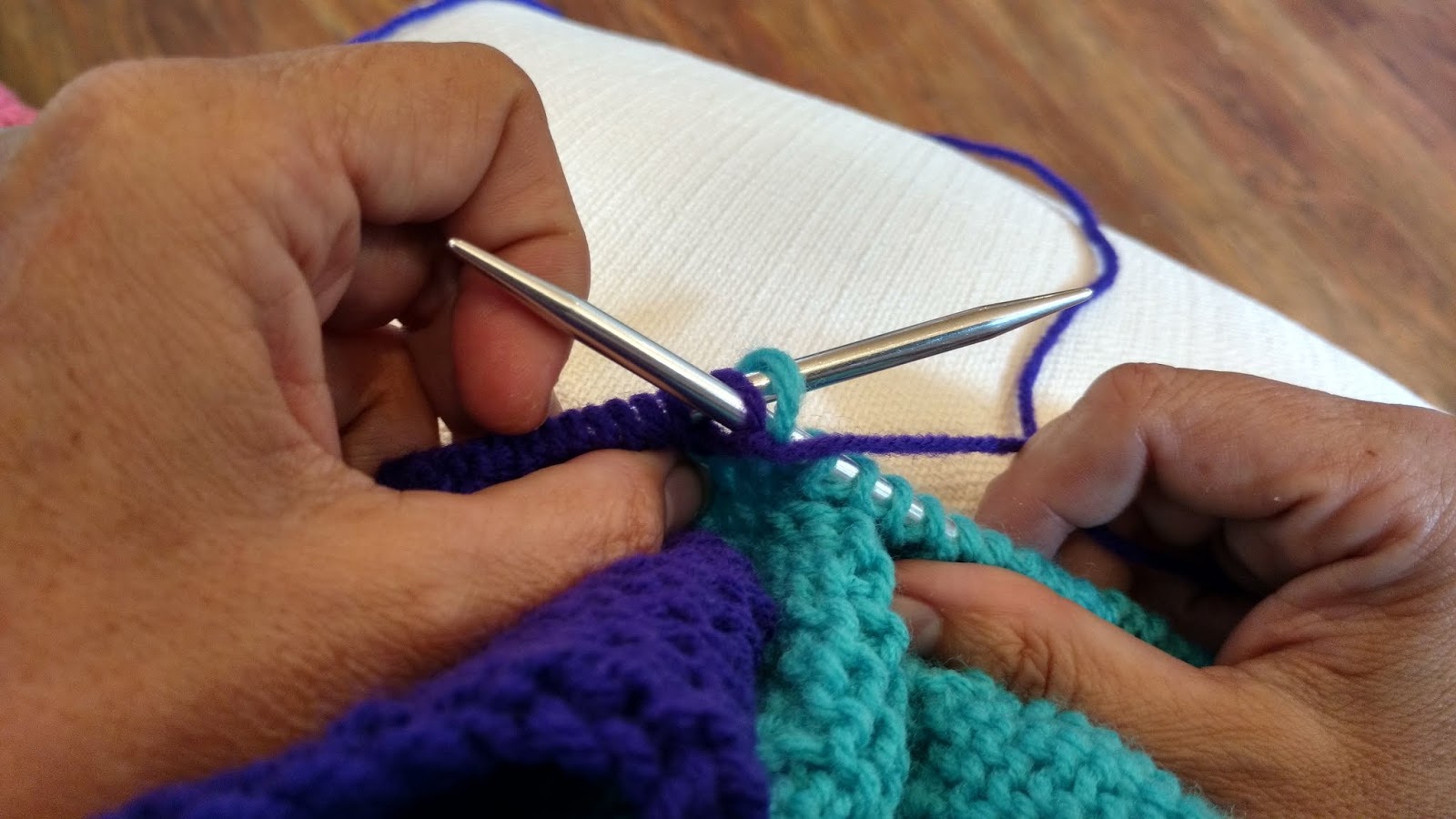
6. Hold the strip with the pink square nearest to you (“at the bottom”), right side facing up. Attach red to the cast-on loop at the right side of the pink square. Cast on as many stitches in red as you did in pink. Work across these stitches until all the red stitches are on the right-hand needle and you come to the bottom edge of the pink square. Each two rows of the garter stitch border at the right side of the pink square form a “bump” of yarn. Beginning at the top, run the left-hand needle through each bump.


The bumps form a line that's perpendicular to the cast-on or knitted row from the next square, on which you're now working. 

7. Now turn your work so the working yarn is facing you, and slip one of those loops of pink yarn onto the left-hand needle. Use the right-hand needle to purl this loop together with the first stitch in red. Knit the next stitch in red. Finish the row. Repeat this procedure to join each wrong-side row of the red square to the edge of the pink square as you go along. When the red square is complete, change to pink and join every wrong-side row of the pink square to the aquamarine square.


8. Work the remaining squares in the same way, in order:

(1) pink, aquamarine, green, blue, purple, red

(2) red, pink, purple, aquamarine, blue, green

(3) green, red, blue, pink, aquamarine, purple

(4) purple, green, aquamarine, red, pink, blue

(5) blue, purple, pink, green, red, aquamarinne

(6) aquamarine, blue, red, purple, green, pink

9. Now make three more squares in a separate short strip of aquamarine, blue, and red. Fold two of these squares together and sew up both sides. Fold the third square over to form a pouch pillow.

10. Use remaining yarn to decorate the edges of the blanket. Knit, crochet, or embroider a border around each edge. Embroider flowers, initials, or other motifs if you like.

RESOURCES

Here are some books that explain more about the techniques I used in the Seamless Sestina Blanket:

How to cast on and knit: (The Usborne Guide to) Knitting, by A. Wilkes and C. Garbera. (This is not the prettiest first book of knitting, but it's the most concise and likely to be the best bargain. Well, likely...I just checked...the hardcover first edition, which is what I have, is listed for $280 on Amazon. Consider this paperback reprint.)


Or: Kids Knitting, by Melanie Falick


How to use math to design anything you want to knit: Knitting Without Tears, by Elizabeth Zimmermann


How to dye wool with Kool-Aid: Fair Isle Sweaters Simplified, by Ann and Eugene Bourgeois. (Note that Kool-Aid was not used to make the cover sweater. You use quite a lot of Kool-Aid to dye wool in bright pastels.)


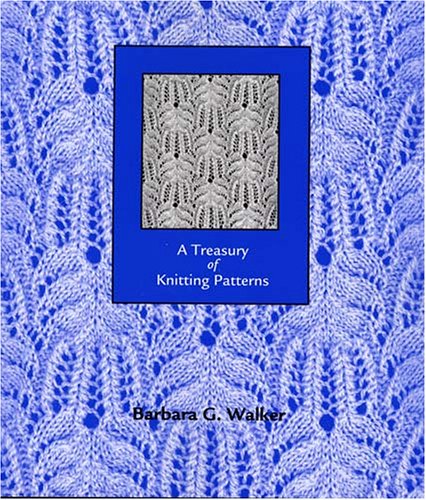
How to knit lots of different patterns: A Treasury of Knitting Patterns, by Barbara Walker. (This is actually the first book in a set of four.)


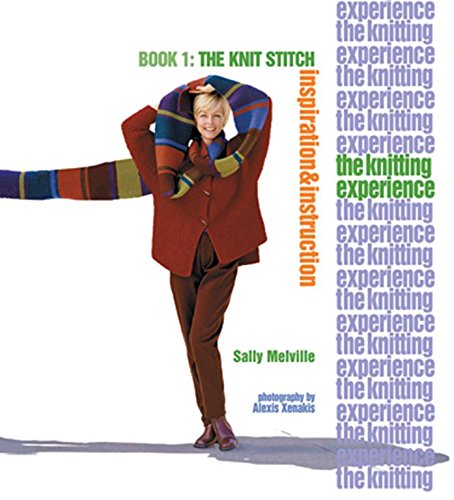
How to knit seamless pieces by knitting into the bumps, or, failing that, how to sew washed cotton squares together invisibly: The Knitting Experience, Book 1, The Knit Stitch, by Sally Melville


Here are some yarn spinners’ websites:

Red Heart acrylic: https://www.redheart.com/yarn

Philosopher’s Wool: https://www.philosopherswool.com/

Brown Sheep wool and mohair: http://www.brownsheep.com/

Jamieson & Smith Shetland wool: http://www.shetlandwoolbrokers.co.uk/

Alafoss Iceland wool: https://alafoss.is/


Lion Brand spins lots of different kinds of yarns. Their selections vary from year to year, sometimes including good cottons and wools as well as Vanna's Choice acrylic. Their prices depend on how much you order, so stores that sell yarns tend to be able to resell yarns at a better price than the company gives online shoppers for just a few skeins of yarn. After viewing the selections at www.lionbrandyarns.com, compare prices with www.michaels.com.

Monday, October 17, 2016

Book Review: The Ghost at Dawn's House

A Fair Trade Book


Title: The Ghost at Dawn’s House (Baby-Sitters Club #9)

Author: Ann M. Martin


Date: 1988

Publisher: Apple / Scholastic
ISBN: 0-590-25164-3

Length: 148 pages

Quote: “‘We’re creeping ourselves out, you know. This is just a silly storm.’ ‘I know,’ said Mary Anne, ‘but it’s fun to creep ourselves out.’…I couldn’t wait to start!”

In this early installment of the Baby-Sitters Club series, Dawn’s mother and Mary Anne’s father are still renewing their long-ago friendship, so Dawn and Mary Anne don’t yet live in the same house. Dawn lives in the sort of big old house that just might have a secret passage. During episodes of New England weather, California-born Dawn likes to imagine that there is a secret passage, possibly holding treasure, possibly inhabited by a ghost.

In this book, the Baby-Sitters and Dawn’s brother Jeff find that there is indeed a secret passage. And it contains some old things…nothing very valuable or exciting, all by itself, until the old things start moving around when none of the kids admits having been in the passage.

The Ghost at Dawn’s House proceeds to become one of the standard “ghost stories” of the twentieth century, where ghost activity turns out to have a rational explanation, usually (if the stories were aimed at children and did not feature Nancy Drew or Scooby-Doo) involving another kid who needs love and understanding and a ride on someone’s bicycle, or something like that. To preserve some semblance of suspense I won’t say who that kid is or what symbolizes love and understanding for that kid.

What else can I say about the Baby-Sitters Club books that I’ve not said already? I’ve reread and reviewed many of them, this year, because I’ve been dressing Storybook Dolls to go with several volumes in the series. (I never was determined enough to collect the whole series! There are BSC books I’ve never read.) The version of Dawn I currently have is not, in my mind, a real triumph, since I used a pale-pink-and-white-flecked yarn instead of knitting tiny narrow stripes of pink and white, but it represents the basic Barbie-type doll jeans-and-shirt outfit…I think I’ve published the instructions somewhere else, but I’ll recap here for fellow knitters:

1. To make jeans or any kind of trousers for any adult-or-teenager-shaped doll approximately 12” high, cast on 12 st for a waistband. (You could cast on 10 or even 8 st if the doll has a super-slim waist, but that would make it hard for a child to pull the trousers on and off the doll.) Knit 2 rows (1 g st ridge) on these 12 st.

2. Increase 1 in every st across row to 24 st. Purl back and stock st for 10 rows on these 24 st.

3. Divide for the legs and work 2 groups of 12 st separately for 20 rows.You may reduce each group of 12 st to 10 st for skinny jeans, or inc to 14 or 16 toward the bottoms for bell-bottoms.Whatever. At the end of these 20 rows, work 2 g st ridges (K 4 rows) to stabilize the hems, cast/bind off, and sew up the legs, then sew up the front (or back) fly. You may tie the ends of yarn in a neat little bow, or run a strand of yarn through the waist for a belt.

4. To make a baggy shirt with narrow stripes running around the body, you need 12 st on the front and 12 on the back of the doll. Sometimes I co 24 and g st the required length to the armhole—in this case from about the mid-thigh point—and sometimes I co 12 and g st one side of the shirt at a time.

5. From the armhole on, the sides of the shirt must be worked separately. For short sleeves, co 4 at the beginning of 1 row, k 12, turn, co 4, and k back across these 20 st. G st 3 ridges (K 6 rows) on 20 st. Next row, k 7, bo 6, k 7.

6. If you knitted both sides of the waist in one piece, break yarn and join to the rem 12 st and work the front of the shirt similarly. Shaping the neck is optional; it’s done by working the last g st ridge as follows: first row, k 9, s 2 wyib, k 9; second row, k 8, s 4 wyif, k 8. Now find a third needle—one size larger is usually fine—place the two needles holding the two sides of the shirt together, bind off 7 together, bo 6 for the front neck, bo last 7 st, and neaten ends.


If you knitted only one side of the waist, after working the k 7, bo 6, k 7 for the last row of the back, turn and k 7, co 6, k 7. Continue down the front—again, neck shaping is optional—and join the sleeves by binding them off tog. Join the sides of the waist as you go.

To buy a doll dressed to match a book jacket, send $20 per doll + $5 per book + $5 per package + $1 per online payment (up to $100) to either address at the very bottom of the screen.

To buy Fair Trade Books, send the $5 per book + $5 per package, and you could fit at least eight BSC books into a package, + $1 per online payment if applicable, and we'll send $1 per book to Ann Martin or a charity of her choice.

Thursday, February 18, 2016

How to Knit Cher Horowitz's Coat

(Reclaimed from Blogjob, where I tagged it as: Clueless TV series tie-in novelhand knittingknit for Barbie dollknit for fashion dollMaxie dollnovels by H.B. Gilmour and Randi ReisfeldRed Heart Light & Lofty yarn.)

Although elaborate costumes from historical novels are interesting to knit for dolls, Barbie dolls are a twentieth century phenomenon and can seem most at home in twentieth century styles.
The model shown below is actually "Maxie" ...the one with realistic human-type feet, rather than stubs designed to lock into stands, although Maxie's feet are still smaller than a real human's would be and don't really allow her to stand up unsupported. Anyway, as a blonde teenage-type doll she seems a good match for a book from the series that began with Clueless. 
Here's an authentic Maxie doll from 1989. At the time of posting, clicking on this image will open a page where you can buy this vintage doll:
Here's the book, with the link you can use to buy it from the person who posted the image:
On the book jacket, H.B. Gilmour's character Cher is wearing a silky summer blouse, the kind of thing you could actually wear in Southern California. The human's outfit would, in real life, be a super-lightweight machine-knitted jersey fabric. The yarn I had in a matching color was a chunky boucle yarn called "Light & Lofty." Right...so what the doll is wearing is the fun fur coat to match the thin shirt, or dress, or whatever, the character's wearing in the picture.
To my surprise, it is still possible to buy "Light & Lofty" yarn. Here's where you can check out the colors that are currently available...I see a pearly, blue-toned white, but not the pale blue I used, which I bought more than ten years ago.
If you can't find "Light & Lofty" you can use other blanket-weight yarns, although most of them will be less textured and will give less of a fun-fur effect. The gauge I got is closer to 3.75 than to 4 stitches per inch; if you get 4 or even 4.5 stitches per inch the coat will still fit any 11-1/2 to 12" adult-shape doll, but may look more like a tunic than a fun-fur coat. Two ounces (50 grams) of yarn will be plenty.
This coat is worked from the shoulders down, in two pieces which I joined as I went along, thusly:
  1. Cast on 24 stitches.
  2. First row (right side): knit all stitches. Second row (wrong side): knit 2, purl to the last 2 stitches, knit 2. Repeat these 2 rows 3 times more: 8 rows altogether.
  3. Bind off 6 beginning next 2 rows, and work all rem st in stock st (K on right-side rows, P on wrong-side rows).
  4. Bind off 1 beginning next 4 rows.
  5. Work 8 rows even on 8 st.
  6. Change to garter stitch (K all st on right-side and wrong-side rows) for 10 rows more. Bind off.
  7. You have now made the back half of the coat. Hold it with the right side facing you, and pick up and knit 10 st from the cast-on edge along the right shoulder and sleeve. Turn, purl 8, and knit 2.
  8. Turn. Knit 10, increasing in the last st. Turn. Purl 9, knit 2.
  9. Turn. K 11, inc in the last st. Turn. P 10, k 2.
  10. K 12. Wrap yarn 5 times around the needle, then pick up and knit 10 more st from the cast-on edge along the left shoulder and sleeve. Turn. K 2, P 8, working the last P st together with 1 of the wrapped loops in the middle of the row.
  11. Turn. Knit 1 st through the back of the next wrapped loop. K 10. Turn. K 2, P 9, working the last P st together with the next wrapped loop. Repeat these 2 rows again, thus using up all the wrapped loops.
  12. K 2, P 10. If the center st is slack, pick up a loop and purl it through the back loop together with the center st. P 10, K 2.
  13. Picking up 1 from each of the 6 bound-off st from the back half of the coat and working it together with each of the 6 st, bind off 6 beginning next 2 rows, thus joining the sleeves.
  14. Work the next 4 rows in stock st, binding off and grafting the first st of each row.
  15. Work 8 more rows stock st, picking up a loop at the side edge of the back of the coat and working it together with the first st of each row.
  16. Work 10 more rows g st, joining the first st of each row to the corresponding row of the back of the coat in the same way.
  17. Bind off, grafting the first and last st to the bound-off edge from the back of the coat.
On the book jacket, Cher wears hair ornaments that match her shirt or dress. You'll have enough yarn left over from a skein of "Light & Lofty" to make hair ornaments, necklaces, belts, or even spool-knit socks/boots, to match the coat, if you want them.
P021816_1608
(Update: This doll, and also a doll dressed to match Dionne (the character on Cher's left on the book cover), have already been sold. To order dolls dressed to match this or other books, not limited to children's books if you are or know a grown-up Barbie collector, send $20 per doll and the specifications you want to either address at the very bottom of the screen. To purchase any Clueless novel as a Fair Trade Book, send $5 per book, $5 per package--I can squeeze six or eight of these paperbacks into a package--and $1 per online payment, and we'll send $1 per Clueless novel to Randi Reisfeld or a charity of her choice.)