Showing posts with label doll. Show all posts

Friday, April 7, 2023

Book Review: Ginnie and the Mystery Doll

Title: Ginnie and the Mystery Doll

Author: Catherine Woolley

Date: 1960 (Morrow), 1965 (Scholastic)

Publisher: Morrow (hardcover), Scholastic (paperback)

ISBN: none, but click here to see it on Amazon

Length: 156 pages

Illustrations: line drawings

Quote: “In your mother’s old diary she says something about a doll that her Uncle Frank brought her from Paris. Is that the doll in the parlor?”

From the years when the commercial media were hard-selling “femininity” comes what must be the ultimate girly-girl mystery novel. Two middle-school girls spending the summer on Cape Cod help a nice old lady who needs extra money find the family treasure in her heirloom doll collection. There are moments of suspense—fear that the treasure has been lost. There is no sex (a few male relatives get speaking parts, but the girls solve the mystery without any “help” from boys), no violence, no danger of anyone’s being hurt. The only danger is that the girls will be embarrassed by failing to solve the mystery, and you know that won’t happen.

(Per the recent discussion of G.K. Chesterton’s almost-all-male fictional world…I wouldn’t put Catherine Woolley’s novels in the same class with Chesterton’s, either.)

Woolley wrote a whole series about Ginnie in the 1950s and 1960s. They were nice, wholesome stories about nice, wholesome little girls who never got into any trouble or danger. They helped nice, wholesome little girls relieve the boredom of long bus rides to consolidated schools, rained-out recess periods, and spending days in bed with the “childhood diseases” against which vaccines hadn’t been invented yet. They don’t seem to have been anyone’s favorite books. They weren’t endlessly reprinted, as the wholesome adventures of Trixie Belden, Nancy Drew, the Melendy Family, Beany Malone, or the Boxcar Children were reprinted; Ginnie may never have become any child’s best imaginary friend, as the characters in the more popular series did. Nevertheless, the books met a need, and they can still meet that need for any child who still has it.

According to the mass media, the need that used to be met by trivial storybooks like the Ginnie stories is now being met by electronic gadgets. I’m not sure that this is true. Books are cheaper than the “plug-in drugs” we’re told that today’s children crave. Keeping and rereading old books is better for the environment than plugging a TV or computer into the wall. Recycling electronic devices is mostly done overseas, so few Americans have noticed yet, but the recycling process for old TVs, computers, batteries, etc., is even more toxic than producing and recycling paper. Books are easier on the nerves of parents, teachers, and classmates than noisy electronic gadgets. And, given the choice, some children actually prefer to use their imagination to read, reread, and rewrite stories rather than passively watching TV. Parents should not be too hasty to overlook light reading as entertainment for today’s children.

What do you do if a child hasn’t discovered the pleasure of books yet? First of all, if the child is under age ten, I recommend backing off. Some kids (usually boys) are slightly farsighted at this age; their eyes can focus on the page long enough that they learn how to read, but their eyes quickly grow tired of holding this close focus, so they minimize the amount of time they spend reading. This is natural and normal and has nothing to do with the child’s intelligence…if the child is allowed to outgrow it in peace. If mental blocks are set up, or glasses are forced on the child, then not having been an early reader may do permanent harm. Data about the possible damage done by exposure to blinking electronic boxes may still be questionable or inconclusive, but TV, computers, and video games definitely are not good for children’s eyes (or even adults’ eyes)—the question is how much harm they do.

If I knew that a child was able to enjoy reading, I might try a very soft sell of the idea of sharing a book an older relative used to enjoy. Instead of being afraid that the child would be reading about a time, place, or lifestyle different from her or his own, I’d encourage that. It builds the child’s imagination, helps the child understand the differences among people in the real world, gives the child a sense of history, and may even help the child understand the difference between desirable and undesirable “social change.”

However, I wouldn’t expect boys to like Ginnie and the Mystery Doll, and if a girl named this book as a favorite I might try to open a conversation about what she likes about it (the calmness, the serenity, the absence of boys) and whether overindulgence in a taste for calmness and serenity might be what causes the unfortunate old lady to become dependent on visiting children for financial help.

Maybe it’s because of its soft, serene, feminine atmosphere, too, that this book is becoming a bit of a collector’s item. 

Posted on November 5, 2015 Categories Book Tags 1950's, children's story, doll, gentle fiction, mystery novel 

Thursday, April 6, 2023

How to Knit Mandie's Dress

(Reclaimed from Blogjob) 

This Barbie-type doll’s knitted dress was inspired by the cover drawing on Mandie and the Schoolhouse’s Secret, by Lois Gladys Leppard. (All the covers of the “Mandie Books” feature interestingly complicated Edwardian-style children’s clothes.) This dress features a big collar, knitted separately, full skirt, long sleeves, and snug waist. It slips on and off…but this doll’s arms and hands are a little more flexible than some Barbie dolls’, so choose your model carefully.


(Now, obviously, you could sew a more authentic replica of Mandie’s outfit in very fine woven cotton, with embroidery floss for the ribbon trimmings…but the idea with this whole series of dolls has consistently been to use up scraps of widely available craft-type yarns, rather than to achieve the perfect period look.)

To knit this outfit as shown, you’ll need:

  • About 1 ounce of Red Heart Super Saver yarn in purple

  • About 2 ounces of Simply Soft yarn in rose 

  • US#8 knitting needles, or the size that give you a gauge of about 4 stitches to the inch

Although this is a small, cheap project that should be accessible to children who know how to knit, it uses some fairly sophisticated knitting skills. If you are a beginning knitter, ask the nice ladies (and gents) at your local yarn shop for help with this project.

  1. Begin with the skirt by casting on 48 stitches in purple. Leave a tail for sewing.

  2. Immediately break purple, leaving another tail for sewing. Attach rose and work 4 rows garter stitch.

  3. Still in rose, work 20 rows stock stitch, ending with a purl row.

  4. Next row, *K 2, k2tog* across the row. Purl back on 36 stitches.

  5. Next row, *K 1, k2tog* across the row. Purl back on 24 stitches.

  6. Next row, *K2tog* across the row.

  7. Next row, *P 1, p2tog* across the row.

  8. Change to purple and work 4 rows garter stitch on these 8 stitches.

  9. Change to rose and increase in every stitch across the row. (This is a slightly bloused “shirtwaist” dress, as worn by little girls, not the painfully tight waist as worn by fashion victims in the generation before Mandie’s.)

  10. Next row, *P 1, increase in next stitch* across the row.

  11. Work 2 rows stock stitch on these 24 stitches.

  12. Next row, divide and shape the front by K 12, turn. P 12, turn. K 5, slip 2, K 5, turn. P 5, slip 2, P 5, turn. K 4, slip 4, K 4, turn. P 4, slip 4, P 4, turn. Put these stitches on a holder, and leave a tail for grafting.

  13. Rejoin rose yarn to the remaining 12 stitches and work 6 rows stock stitch for the back.

  14. Graft 4 stitches on each side and bind off the 4 center stitches of front and back.

  15. Now for the sleeves: With rose, cast on 12 stitches.

  16. With purple, *K 1, k2tog* across the row, then K back across 8 stitches.

  17. With rose, work 2 rows stock stitch.

  18. With purple, work 2 rows garter stitch.

  19. With rose, *inc in 1st stitch, k across the row, inc in last stitch.* Turn. *Inc in 1st stitch, p across the row, inc in last stitch.*

  20. Work 10 rows stock stitch on these 12 stitches. Bind off. (You can either bind off directly into the armhole, or bind off and sew the sleeve into the armhole; if grafting a bound-off edge onto another knitted piece is a new skill you want to practice, this is a good place to practice, since the collar covers the shoulders.)

  21. Make the other sleeve.

  22. For the collar: With purple, cast on 12 stitches. You can mark them with stitch markers or loops of thread if that helps you think of them as four sections of, at this point, 3 stitches each. Work 2 rows garter stitch.

  23. Change to rose and *inc in 1st stitch of each section, k to last stitch, inc in last stitch of section* 4 times across the row. You now have 20 stitches.

  24. Turn and *inc in 1st stitch of section, p to last stitch, inc in last stitch of section* 4 times across row. You now have 28 stitches.

  25. Work the next 2 rows as the previous 2 rows, thus ending with 44 stitches.

  26. Break off rose. With purple, increase in each stitch across row to 88 stitches.

  27. Knit another row (garter stitch) as in row 23.

  28. Bind off these 96 stitches loosely, still working increases in first and last stitch of each section–thus actually binding off 104 stitches.

  29. Join the side of the diamond shape you have formed, attach the neck edge to the neck edge of the dress, and tack the collar down to the dress at front and back waist (and wherever else it may want to stick up).

  30. Carefully ease the dress over the doll’s head, then ease her arms into the sleeves and, finally, stretch and ease the waist down to the doll’s waistline.

(Blogjob friends, this article was suggested when I signed up for a new advertising program. If you’re seeing ads that look relevant to this article, rather than relevant to something else you read about last week, then Prosper Ads is working. I signed up for free and saw an ad for Red Heart yarn there, and, how felicitous, happened to have a doll dressed in the stuff right on hand. If you want Prosper Ads too, feel free to use this link: http://prosperent.com/ref/417223 .)

Posted on November 4, 2015 Categories CraftsTags 1900s, Barbie doll, crafts to share with children age 8-16, fashion doll, knitting, Mandie Books, Red Heart yarn, Simply Soft yarn, Smoky Mountains 

Friday, January 19, 2018

How to Knit a Dress for a Skipper Doll

Here's the pattern for a doll outfit I designed, knitted, and sold years ago. The article appeared on Associated Content; in case anyone has a "Barbie's Little Sister" doll and wants to knit a new dress for it, this pattern works. 
This dress was inspired by another costume shown on the cover of Lois Gladys Leppard's "Mandie books," this time Mandie and the Dangerous Imposters. In real life, the dress would have been made of woven cotton, and the dark blue and white dots would be smaller than they come out when knitted in "worsted weight" yarn.


Supplies for Making Skipper Doll Dress

* A Skipper-type doll, shorter and thinner than Barbie

* Less than half a skein of Red Heart, Simply Soft, Vanna's Choice, or similar yarn in three colors: shades of blue, or light blue; dark blue; white

* Three knitting needles, the size that gives you a gauge of 4.5 stitches per inch. Gena Greene used #8. (The third needle can be one size larger or smaller. If it's smaller, slip stitches onto it while binding them off; if it's larger, use it to make the actual bind-off row.)

Method for Making Skipper Doll Dress

1. With white yarn cast on 40 stitches.

2. Work 4 rows garter stitch (knit all stitches on every row).

3. Work 2 rows stock stitch (knit one row, purl the next row).

4. Change to dark blue and work 2 rows garter stitch (g st).

5. Knit 1 row in dark blue.

6. Purl back *1 light blue, 1 dark blue* across the row.

7. Knit 1 row *1 light blue, 1 white.*

8. Purl back in light blue.

9. Knit 1 row *1 dark blue, 1 light blue.*

10. Purl back *1 white, 1 light blue.*

11. Knit 1 row in light blue.

12. Repeat steps 6-11 once.

13. Shape skirt: *purl 1 st light blue, purl 1 st dark blue, purl 2 sts tog in light blue, purl 1 st dark blue, purl 1 st light blue, purl 2 sts tog in dark blue* across row.

14. Knit 1 row *1 light blue, 1 white.*

15. Purl 1 row light blue.

16. Shape skirt: *knit 1 st dark blue, knit 2 sts tog in light blue* across row.

17. Purl back *1 white, 1 light blue.* Cut white yarn.

18. Knit 1 row in light blue.

19. Purl back *1 light blue, 1 dark blue.*

20. *Knit 2 together" across row in dark blue.

21. Knit back across the row (1 row garter stitch for waistline).

22. With dark blue, *purl 1 and knit 1 in the same stitch* across the row.

23. Knit back across the row.

24. With light blue, cast on 8 for sleeve. Knit these 8 sts. Knit 10 sts from the dress body. Cast on 8 more sts for the other sleeve.

25. Using light blue, but picking up dark blue yarn and carrying it on the wrong side when you come to it, knit 2 for cuff, purl 22, knit 2.

26. Turn work and knit 2 with light blue for cuff, then *knit 1 st dark blue, knit 1 st light blue* to last 2 sts, knit 2 with light blue.

27. Knit 2, attach white yarn and purl back *1 white, 1 light blue* to last 2 sts, knit 2 with light blue.

28. With light blue knit 2 for cuff, knit 10, slip 2 with yarn in back, knit to end.

29. With light blue knit 2 for cuff, *purl 1 light blue, purl 1 dark blue* for 9 sts, slip 4 with yarn in front, repeat pattern for 9 sts, knit 2 sts for cuff.

30. With light blue knit 10 sts, bind off 6 sts, knit 10 sts.

31. With light blue knit 2, purl 8, cast on 6, purl 8, knit 2.

32. Work 4 rows in pattern just as in steps 26-29. Cut dark blue and white.

33. Put top of dress together: holding right sides together, bind off 8 sts of sleeve together with the 8 sts cast on when you began the sleeve. Work across the row in light blue.

34. Again holding right sides together, bind off 8 sts of sleeve together with the 8 sts cast on when you began the sleeve. Knit across the row (g st) in light blue.

35. You still have 10 sts left from the back of the skirt. Slip stitches as needed so that the right sides of the waist and skirt are facing each other with the two pieces on two needles. Use the third needle to bind them off together. Tuck in any ends of yarn.

36. Turn the dress right side out and put it on the doll.

Thursday, December 21, 2017

Book Review: Claudia and the Clue in the Photograph

A Fair Trade Book


Title: Claudia and the Clue in the Photograph (Baby-Sitters Club Mystery #16)

Author: Ann M. Martin


Date: 1994

Publisher: Scholastic

ISBN: 0-590-47054-X

Length: 153 pages

Quote: "I was especially fascinated with the facade of the old Stoneybrook bank building."

For an art project Claudia snaps lots of photographs of the bank building. Then they learn that one of the bank's employees has been misplacing or misappropriating money, and in Stoneybrook, where even the thirteen-year-old Baby-Sitters have a bank account, there's a lot of money to be stolen. Claudia, the artist and Nancy Drew fan, suspects a man who's wearing two watches, one of which doesn't work.

On the Lost Planet of Nice, where Stoneybrook is, even bank robbers are likely to be nice people who have gone wrong. I can't believe the solution to the mystery would play out in such a simple, instructive way--in front of meddling children, at that!--on Earth, but in the Baby-Sitters' world it probably happens all the time. BSC mysteries are almost as cozy as Encyclopedia Brown's use-your-general-knowledge-to-catch-Earth's-Least-Competent-Criminals mysteries.

Hmm...this is the third of three BSC books this web site has reviewed lately, and all three feature Claudia. There's a reason for this. Children don't always go for the fashion dolls who look like them; some children think Barbie is supposed to be blonde, and some have a real collector's instinct to acquire one of each of as many types of fashion dolls as possible. There is, however, a local market that calls itself "Indian Mountain," where anything that fits into the Cherokee/pioneer/frontier-days theme seems to sell. Claudia Kishi is Japanese-American, in the books, but since fashion dolls don't really look all that much like humans of any type, for doll buyers there it seems to be all the same thing. Dolls with long black hair, tan skin, and dark eyes sold...and since then I've received more books to match to that type of dolls. 

Although you can certainly get secondhand copies of Claudia and the Clue in the Photograph for less than $10 (or $11 online), that $5 per book, $5 per package, $1 per online payment, system is what funds this web site's Fair Trade Books system. When you pay this price, first of all you get to fill a box for $5, which makes it cheaper for you to buy eight or ten BSC books from this web site and pay one $5 shipping charge than it would be to buy eight or ten BSC books from different sellers on Amazon and pay eight or ten separate shipping charges. Then, for each book you order for which we can locate a living author, we send 10% of the total cash price to that author or a charity of her or his choice. So, if you buy eight regular BSC novels or mysteries, or ten BSC books including some of the skinnier "Little Sister" books, Martin or her charity gets $8 or $10; if you buy only one, Martin or her charity gets $1. 

As regular readers remember, it's also possible to order dolls dressed to match a book for $10 per doll; if you choose that option, you could order up to four BSC dolls and books for a total of $65 (U.S. postal money order to Boxholder, P.O. Box 322) or $66 (Paypal payment to the account you get by e-mailing salolianigodagewi) to the appropriate address at the very bottom of the screen. From that $65, Martin or her charity would receive $6.50.

Monday, August 21, 2017

Book Review and Knitting Pattern: Karen's Doll

A Fair Trade Book


Title: Karen’s Doll (Baby-Sitters Little Sister #23)

Author: Ann M. Martin

Author's web page: http://www.scholastic.com/annmartin/

Date: 1991

Publisher: Scholastic

ISBN: 0-590-44832-3

Length: 95 pages

Illustrations: drawings by Susan Tang

Quote: “I carefully untied the ribbon. My new baby doll might want to wear it later.”

Two of Karen’s grandparents went to England, and what they brought Karen was a special, expensive, one-of-a-kind souvenir doll. One of Karen’s two best friends went to the hospital, and, since children under age twelve aren’t allowed to visit even child patients at the local hospital, Karen let her stepsister Kristy deliver the new doll to her friend. Kristy is a very responsible teenager, the founder of the Baby-Sitters Club...but she’s not perfect. The casual speech she makes when she presents the doll to Karen’s friend Nancy leads Nancy to believe that the doll is a present to keep. Karen’s parents blame Karen for “losing” the doll. Karen blames Nancy for wanting to keep the doll.

Of course, this is all taking place in the Lost World of Nice where the Baby-Sitters Club live, so you know there’ll be a happy ending. This book is recommended to all BSC collectors and to anyone who had not yet read the Baby-Sitters Club stories.

Here’s how I did the doll that goes with this book:

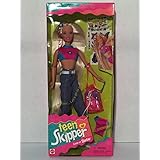
1. In the world of Barbie, the doll that most resembles Karen on the cover of the book was a Skipper doll (Barbie’s little sister). Although Skipper is shorter and thinner than Barbie, they’re close enough to the same size that the knitted version of that roomy sweatshirt and jeans Karen wears in the cover painting will fit either Skipper or Barbie...but I found a Skipper with thick blonde hair, an irregular part, side curls and a ponytail.

Product Details

(I'm not sure that that's exactly the same version of Skipper I used, since the dolls I recycle to match children's books are always secondhand and seldom reach me with any clothes at all, but it's close.)

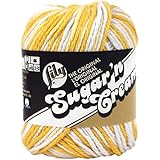
2. For the shirt, use less than an ounce of any yellow craft-type yarn. I used Sugar’n’Cream yellow and white ombre because I had some in the scrap bin. The last time I looked, some Wal-Mart stores still had this yarn on their shelves. Use the needles with which your gauge comes closest to 4 stitches per inch.

Product Details

3. Cast on 10 stitches. Knit two rows (one garter stitch ridge).

4. Increase at each end of the next row, to 12 stitches, and purl back on these 12 stitches (2 rows stock stitch, or st st).

5. Work another 8 rows in st st.

6. Cast on 10 at each end of the next row. This makes ordinary long sleeves for Barbie, or too-long sleeves that need to be rolled back, as shown on the book cover, for Skipper. The first and last two stitches at each end of these rows form the cuff. You now have 32 stitches. On these 32 stitches, onright-side rows knit every stitch, and on wrong-side rows knit 2, purl 28, knit 2, for 4 rows.

7. Next row, knit 15, skip 2 with yarn in back, knit 15. Next row, knit 2, purl 12, skip 4 with yarn in front, purl 12, knit 2.

8. Next row, knit 13, bind off 6, knit 13. Next row, knit 2, purl 11, cast on 6, purl 11, knit 2.

9. Work the next 6 rows as in step 6.

10. Fold the piece up so that the cast-on edge of the sleeve is parallel with the row you are knitting. Work each of the 10 sleeve stitches by placing your right-hand needle through one of these cast-on stitches, then knitting the first stitch on the left-hand needle, then passing the loop from the cast-on edge over this stitch, repeating the process so that there are two stitches on the right-hand needle, and passing the stitch you knitted first over the stitch you knitted afterward, thus binding off the top and bottom of the sleeve together. Knit the remaining 22 stitches. Turn, and bind off the top and bottom of the other sleeve together. Purl the remaining 12 stitches.

11. Work 9 rows stock st on these 12 stitches, but when knitting the first and last stitch of each right-side row, work them together with the corresponding stitch from the front of the sweater. Decrease 1 at each end of the tenth row of stock st.

12. Work 1 garter stitch ridge on these 10 stitches, working the first and last st together with the first and last stitches in the g st ridge on the front of the sweater.

13. Loosely bind off, working the first and last st together with the first and last sts int he cast-on row.

14. For the collar, cast on 8 stitches. G st 2 rows (1 ridge). Inc each end of the third row, stock st 2 rows. Inc each end of the fifth row, g st 2 rows. Bind off loosely. Sew the first 2 cast-on stitches into 3 cast-off stitches on side front neck edge, the next 4 into 6 cast-on stitches on back neck edge, and the last 2 into 3 cast-off stitches on the other side front neck edge. Collar will stand up and roll slightly. Tack down each end of collar with a French knot.

15. For the jeans, I used Red Heart light blue acrylic yarn, again because I had some in the scrap bin. Most stores that sell craft yarn have Red Heart light blue acrylic, and it’s usually the cheapest of the tolerable craft yarns they have, but feel free to substitute any light blue yarn that knits up to 4 stitches per inch. Dolls’ knitwear doesn’t need to be washable or breathable, as humans’ does. If you find rayon yarn of an appropriate color and weight at your favorite charity store or bazaar, not that I’m recommending that manufacturers experiment with rayon yarn, but dolls can wear it.

Red Heart  Super Saver Economy Yarn, Light Blue

16. Cast on 10 stitches. Knit two rows.

17. Increase in each of these 10 stitches, then purl back across 20 stitches.

18. Work 10 rows stock st on 20 stitches.

19. Knit 10 stitches, turn, purl back, and work another 18 rows stock st. Measure as you go. The way I knit, 20 rows is always the standard length for Barbie’s or Ken’s jeans and long enough for turned-up cuffs on Skipper’s after step 20 is complete. Your row gauge may vary.

20. Work 2 more g st ridges. Bind off.

21. Work the remaining 10 stitches to match the first 10 stitches.

22. Sew up inseams and front fly, and knot the ends of your sewing yarn together with the cast-on end at the waistband.

23. Some finishing touches for perfectionists: (1) Use either yarn or scraps of woven material, in white (as shown) or any color that resembles a human skin tone, to make a baby doll about 2” long. If you choose white, you can use scraps from an old handkerchief, bed sheet, or T-shirt, and add pink or tan highlights with paint or Magic Marker to create a difference between the doll’s skin and its white smock. Use pure white yarn or scrap fabric to make a sleeveless smock, gathering it to fit under the arms.Make French knots in blue or brown for the eyes. Satin stitch or work simple fringe for short black hair.

(2) Wrap a bright pink rubber band or scrap of yarn around Karen’s ponytail.

(3) If you’re making the doll for an adult’s or older child’s collection, shape fine wire to resemble Karen’s glasses. If you’re making it for a young child, let the child decide whether or not you draw on glasses. Since the doll I used has slightly oversized eyes, to me she looks as if she’s wearing big round corrective glasses already.


Tuesday, May 16, 2017

Book Review: Madeline

Title: Madeline


Author: Ludwig Bemelmans

Date: 1939 

Publisher: Simon & Schuster

ISBN: recent reprint 978-0-14-056419-6

Length: pages not numbered; I count 42 pages of text/illustration

Illustrations: paintings by the author

Quote: “To the tiger in the zoo Madeline just said ‘Pooh-pooh’.”

Does anybody not remember this picture book? It’s a short story about a little orphan who is so cheerful at all times that, when she has appendicitis, the other eleven orphans want to have their appendixes out too.

I remember getting a twenty-year-anniversary reprint edition when I was just old enough to read the words. My mother didn’t like it. Who wanted to read about a lot of stupid children who all wanted to be sick just because one of them was? I didn’t, I decided. Also Miss Clavel’s nunlike costume looked more than slightly like the costume of the Wicked Fairy Maleficent in the Disney picture books I had. So I was in a minority of baby-boomer girls who did not like Madeline. But most of us did, and most children still do, like this easy-reading picture classic. 


What most people loved about Madeline was not, of course, the foolishness of the little conformists, but the hasty, cartoonish, yet very recognizable scenes from downtown Paris. It’s fun to match the scenes of the orphans’ daily walks to real pictures. There were several sequels, and fans could find famous tourist attractions in those books too. 

The copy I physically own is available with a matching Storybook Doll (online price $20); other guaranteed gently-used copies are available online for $10. The whole set of seven slim books should fit into one package for a total of $40. 

Wednesday, June 8, 2016

Book Review: Chronically Crushed

A Fair Trade Book


Title: Chronically Crushed 

Author: Randi Reisfeld

Author's web page: http://authors.simonandschuster.com/Randi-Reisfeld/707115 claims that a page for www.randireisfeld.com exists, although it's not working today

Date: 1998

Publisher: Pocket Books

ISBN: 0-671-01904-X

Length: 147 pages

Quote: "Amber...was fully brimming with unbridled confidence. 'Tyler...Tyler Sheffield wants me. Cannot, in fact will not, live without me'."

The narrator is, of course, Clueless heroine Cher Horowitz. In all things Clueless a good half of the joke is on Cher for being a self-centered, immature teenybopper, yet Cher is actually one of the brightest and best in her rich-but-ignorant school. Amber is one of the kids who are even more clueless than Cher. (In the movie credits, she was "Nose Job Girl.") Cher and her best friend, Dionne, count Amber as their worst friend, never miss a chance to beat her in any competition, make fun of her and score off her almost constantly, and she's almost dumb and bratty enough to deserve it...yet they did bond as children, and, in a high school social "crisis," they're there for her. And Dionne, the one who has a long-term steady boyfriend, has even been suspected of having some latent common sense.

In the cover picture, Amber is on our left, Cher in the center stage she monopolizes so well, and De is on the right. You can tell them apart because Amber usually makes the most egregious fashion mistakes, but in this book they're all modelling the correct way this web site recommends wearing high-heeled shoes...always in a bedroom, never on the street.

Clueless sequels were all based on plots from classic English novels, adapted to a contemporary high school setting. Which classic novel featuring a heroine whose friends save her from a designing fortune-seeker is this one? There are a few to choose from...anyway, it's high school in the 1990s, so the danger facing Amber is the humiliation of spending a whole weekend at a snob school where her host might be merely using her to make a statement to his ex-girlfriend. Might be, might not be...will Cher and De find out in time to save Amber from embarrassment, and, if so, how?

The whole story is being played for laughs, California style, so no points for guessing how it ends up, but I chortled several times along the way.

If you buy it from the Amazon bookseller who first uploaded the image, in theory I get a small commission, and I'd love to test how well the system works these days. To buy it directly from me, send $5 per book + $5 per package to either of the addresses at the very bottom of the screen. (Scroll past the blog feed.) That "per package" shipping fee means you could throw in five or even seven more Clueless books for a total of $35 or $45 respectively, and I'll send $1 per copy to Reisfeld or a charity of her choice. (Not all of the Clueless books were penned by Randi Reisfeld. The first, and some say the best, were written by the late H.B. Gilmour. If you buy a boxfull, I'll stretch a point in aid of Reisfeld's charity.)

Last winter I designed a doll outfit to match another Clueless book...

https://blogjob.com/priscillaking/2016/02/18/how-to-knit-chers-coat/


...Knitters can still find the instructions on Blogjob. That unique doll, together with a buddy dressed like De on that book cover, was sold last week. I'll dress dolls like Cher, Amber, and possibly De from this book cover, too, if you want them; each outfit will be unique (you can't see much of De's outfit in the picture, but you can see the shade of green and we know Cher and De always wear 1990s teens-only miniskirts) and, assuming dolls 12" high/tall/long or smaller, each outfit will cost $10 online.

Tuesday, February 23, 2016

Book Review: Irma's Big Lie

(Reclaimed from Blogjob, where it was tagged: chapter book for middle school readerschildren’s bookchildren’s story,middle school social life,stories about dollsstories about girlsstories about honesty.)

Title: Irma's Big Lie (originally The Bad Times of Irma Baumlein)
Author: Carol Ryrie Brink
Date: 1972
Publisher: Macmillan
ISBN: none
Length: 134 pages
Illustrations: drawings by Trina Schart Hyman
Quote: "She took so long to answer that Judy said, 'Don't you have anything?' Then Irma said (and she was surprised to hear herself say it), 'Yes, I have the Biggest Doll in the World. She's as tall as I am.'"
(Topic credit for this one goes to +Kimberly Dalessandro , who mentioned Irma's Big Lie as a childhood favorite in a comment on another novel about middle school children. I hadn't had a copy for sale, but I did remember having read and liked this one in grade four.)
Irma isn't even much of a doll collector; she's more interested in living people and animals. But she's new at this school, and since Judy has so many siblings and pets, Irma feels a need to claim to have something, in her home, besides a great-aunt, great-uncle, a live-in couple who seem almost as old as her elders, and a father who's busy trying to revive the great-uncle's store. Even Irma's mother thinks the great-uncle's home is boring.
At first the lie seems to work. Judy accepts Irma as an interesting person; they become friends. There's only one problem. Irma, having fended off inquiries with a description of a fabulous doll like nothing she's ever seen, has to find such a doll (and show it off at school) before her new school friends realize what a whopper she's told...and she has only fourteen dollars to spend.
Irma could, of course, get creative and make the doll she's described--from rags, or cardboard--but she doesn't know how, and her big lie just keeps growing as the other girls want more details about this doll. And then Irma sees the doll she's described. The fictions writers imagine are often suggested by things we've half-noticed when we saw or heard them somewhere. Nothing like the doll Irma has described is in her great-uncle's department store for sale as a doll, but there is such an object in the store...
In the end, what Irma's done is not unlike what an Internet Portal does. Blogjob blogs market all kinds of things that the bloggers may or may not actually have to sell. To write this review, I went over to the part of the local library that's still a library, or half of one, and looked at a vintage hardcover copy of The Bad Times of Irma Baumlein, showing all the signs of having been enjoyed by middle school readers for forty years. (I remember it as a new book; some of the pencil marks here and there were mine.) What I can sell you ($5 per book, $5 per package, $1 per online payment) won't be the copy at which I'm looking now; nor, if I were to sell this book in real life, would it be the copy in my home, which belongs to The Nephews now. I'm actually fantasizing, as Irma did, about being able to give you something I don't have. The difference is that I know the thing, the book (by whatever title or binding), does exist and I can get it for you.

Thursday, February 18, 2016

How to Knit Cher Horowitz's Coat

(Reclaimed from Blogjob, where I tagged it as: Clueless TV series tie-in novelhand knittingknit for Barbie dollknit for fashion dollMaxie dollnovels by H.B. Gilmour and Randi ReisfeldRed Heart Light & Lofty yarn.)

Although elaborate costumes from historical novels are interesting to knit for dolls, Barbie dolls are a twentieth century phenomenon and can seem most at home in twentieth century styles.
The model shown below is actually "Maxie" ...the one with realistic human-type feet, rather than stubs designed to lock into stands, although Maxie's feet are still smaller than a real human's would be and don't really allow her to stand up unsupported. Anyway, as a blonde teenage-type doll she seems a good match for a book from the series that began with Clueless. 
Here's an authentic Maxie doll from 1989. At the time of posting, clicking on this image will open a page where you can buy this vintage doll:
Here's the book, with the link you can use to buy it from the person who posted the image:
On the book jacket, H.B. Gilmour's character Cher is wearing a silky summer blouse, the kind of thing you could actually wear in Southern California. The human's outfit would, in real life, be a super-lightweight machine-knitted jersey fabric. The yarn I had in a matching color was a chunky boucle yarn called "Light & Lofty." Right...so what the doll is wearing is the fun fur coat to match the thin shirt, or dress, or whatever, the character's wearing in the picture.
To my surprise, it is still possible to buy "Light & Lofty" yarn. Here's where you can check out the colors that are currently available...I see a pearly, blue-toned white, but not the pale blue I used, which I bought more than ten years ago.
If you can't find "Light & Lofty" you can use other blanket-weight yarns, although most of them will be less textured and will give less of a fun-fur effect. The gauge I got is closer to 3.75 than to 4 stitches per inch; if you get 4 or even 4.5 stitches per inch the coat will still fit any 11-1/2 to 12" adult-shape doll, but may look more like a tunic than a fun-fur coat. Two ounces (50 grams) of yarn will be plenty.
This coat is worked from the shoulders down, in two pieces which I joined as I went along, thusly:
  1. Cast on 24 stitches.
  2. First row (right side): knit all stitches. Second row (wrong side): knit 2, purl to the last 2 stitches, knit 2. Repeat these 2 rows 3 times more: 8 rows altogether.
  3. Bind off 6 beginning next 2 rows, and work all rem st in stock st (K on right-side rows, P on wrong-side rows).
  4. Bind off 1 beginning next 4 rows.
  5. Work 8 rows even on 8 st.
  6. Change to garter stitch (K all st on right-side and wrong-side rows) for 10 rows more. Bind off.
  7. You have now made the back half of the coat. Hold it with the right side facing you, and pick up and knit 10 st from the cast-on edge along the right shoulder and sleeve. Turn, purl 8, and knit 2.
  8. Turn. Knit 10, increasing in the last st. Turn. Purl 9, knit 2.
  9. Turn. K 11, inc in the last st. Turn. P 10, k 2.
  10. K 12. Wrap yarn 5 times around the needle, then pick up and knit 10 more st from the cast-on edge along the left shoulder and sleeve. Turn. K 2, P 8, working the last P st together with 1 of the wrapped loops in the middle of the row.
  11. Turn. Knit 1 st through the back of the next wrapped loop. K 10. Turn. K 2, P 9, working the last P st together with the next wrapped loop. Repeat these 2 rows again, thus using up all the wrapped loops.
  12. K 2, P 10. If the center st is slack, pick up a loop and purl it through the back loop together with the center st. P 10, K 2.
  13. Picking up 1 from each of the 6 bound-off st from the back half of the coat and working it together with each of the 6 st, bind off 6 beginning next 2 rows, thus joining the sleeves.
  14. Work the next 4 rows in stock st, binding off and grafting the first st of each row.
  15. Work 8 more rows stock st, picking up a loop at the side edge of the back of the coat and working it together with the first st of each row.
  16. Work 10 more rows g st, joining the first st of each row to the corresponding row of the back of the coat in the same way.
  17. Bind off, grafting the first and last st to the bound-off edge from the back of the coat.
On the book jacket, Cher wears hair ornaments that match her shirt or dress. You'll have enough yarn left over from a skein of "Light & Lofty" to make hair ornaments, necklaces, belts, or even spool-knit socks/boots, to match the coat, if you want them.
P021816_1608
(Update: This doll, and also a doll dressed to match Dionne (the character on Cher's left on the book cover), have already been sold. To order dolls dressed to match this or other books, not limited to children's books if you are or know a grown-up Barbie collector, send $20 per doll and the specifications you want to either address at the very bottom of the screen. To purchase any Clueless novel as a Fair Trade Book, send $5 per book, $5 per package--I can squeeze six or eight of these paperbacks into a package--and $1 per online payment, and we'll send $1 per Clueless novel to Randi Reisfeld or a charity of her choice.)