Title: It's the Stupidity, Stupid
Author: Harry Shearer
Author's web page: http://www.harryshearer.com/
Date: 1999
Publisher: Ballantine
ISBN: 0-345-43401-3
Length: 104 pages
Quote: "I'd like to thank the voters and politicians of America for making this book both possible and necessary. You know who you are. Sue yourselves."
If the title It's the Stupidity, Stupid, does not instantly recall Bill Clinton's campaign slogan, "It's the economy, stupid," to your mind, you are too young to appreciate this book. If it does, and you were in Washington during the Clinton years, you've heard all the jokes in this book. Otherwise, there may be some chance that Clinton jokes (and fun facts) exist that you've not heard, and this book is where you'll find them.
Harry Shearer was not originally one of the people who hated Clinton--or, more accurately, hated that Clinton had become President. It took a lot of redneckery to prompt a Democrat to write this compendium of Clinton's mistakes as a sort of study of How the President of the United States Should Not Behave.
Of course, the problem with writing political satire is that one has to beware of alleged facts that can't be proved. Shearer writes, "FDR, whose marriage may yet turn out to be the template for the Clintons' (he and Eleanor both had girlfriends)..." Having made a serious study of the Clintons at the time, I automatically think: Not quite. "Girl friends" means those of the primary school and neighborhood park crowd who happened to be girls; all normal Americans had girl friends, at least when they were little girls or boys, or their children were. "Girlfriends," in the sense of female bedmates, has never been proved. Eleanor Roosevelt had lesbian admirers and tried to be kind to them, but surviving documentation proves only that Mrs. Roosevelt rejected certain lesbian propositions.
Unfortunately for Clinton fans, most of the facts in this book have been verified. And Shearer's presentation of them is funny, and more tasteful than a lot of the comedy that was floating around Washington in the 1990s. So, if you like Clinton jokes and haven't already read this book, read it for the chuckles and the memories.
Showing posts with label 1990s. Show all posts
Showing posts with label 1990s. Show all posts
Wednesday, August 19, 2026
Sunday, April 12, 2026
Book Review: Sources of Strength
Book Review: Sources of Strength
Author: Jimmy Carter
Date: 1997
Publisher: Random House / Times
ISBN: 0-8129-2944-6
Length: 241 pages plus indices
Quote: “Although I began teaching Sunday School classes when I was eighteen years old, I’ve retained...transcripts of entire texts only during the past twenty years. I asked Karl Weber, a fine editor, to help me choose some of the more interesting ones...abbreviated...down to a few pages.”
That’s how the 52 brief chapters of this book came to be written. Although they’re not written in the Bible-study-workbook format to which Southern Baptists, Seventh-Day Adventists, and perhaps some church members are accustomed, each one contains enough Bible references that if you dig up your own nuggets of religious knowledge you’ll get quite a course of Bible study out of Sources of Strength. Former President Carter was always been known for his bland and mild public personality; if you want more salt’n’pepper on your daily Bible studies, the original texts and classic commentaries will supply that too. What the book tries to convey is a sense of what you’d hear if you’d visited the Maranatha Baptist Church where, Carter modestly admitted, Sunday School classes taught by a former President of the United States became quite a tourist attraction.
Carter’s politics were considerably to the left of many Southern Baptists’—consider Jerry Falwell. I have to say that while I read Sources of Strength I kept thinking, “Methodist...Methodist...” but no, Carter was still a Baptist. Right-wing Baptists may have wondered about this. Studying his Sources of Strength won’t convert you to the left wing—it may in fact inspire you to be more active on the right wing, if that’s where you feel at home—but it will help you understand what’s going on in the minds of left-wing Christians. Christianity is timeless, and cannot be truly divided between the “wings” of passing political reactions to specific times. We need to let the quest for real truth reunite us, even if we have disagreed sharply on political questions.
The texts he chose for study will be familiar to long-term churchgoers. I’m thinking now of my late “Aunt Dotty,” a family character who sustained some permanent brain damage from cancer treatment at age 50, but retained a good memory, and announced around age 55 that as a lifelong churchgoer she felt as if she ought to have graduated from Sunday School. Aunt Dotty learned a great deal in her ecumenical life; she remembered most of it into her late eighties. I don’t want to endorse the Catholic understanding of what makes us remember some Christians as saints, but in her way I think Aunt Dotty was that kind. I mention her because I had the thought, reading Sources of Strength: “Is this a book for people who come to churches as tourists? Is there anything in here for Aunt Dotty?” The answer to both questions is yes. Yes, it’s written partly for those who visit celebrities’ churches as tourists, and yes, there’s at least one lesson that might have had something new to offer even Aunt Dotty. It’s too late to ask her, but I think Carter’s story of how he reconciled himself to a personal enemy will be fresh for most Christians.
Although it does contain a couple of Carter’s long original poems, overall this book is well edited, easy to read, and warmly recommended to all Christians and to all historians studying the 1970s.
Monday, September 25, 2023
Book Review: Adrian Mole the Lost Years
Book Review: Adrian Mole, the Lost Years
Author: Sue Townsend
Date: 1984-1994
Publisher: Soho Press
ISBN: 1-56947-015-4
Length: 309 Pages
Quote: “No letter from Sarah Ferguson today.”
“Not lost enough,” says a caricature of Margaret Thatcher on the cover of this book. I beg to differ. This book contains a short reprint from True Confessions of Adrian Albert Mole, most of Adrian Mole from Minor to Major, and all of Adrian Mole, the Wilderness Years.
Adrian Mole is the definitive nerd-as-opposed-to-geek. Theoretically intelligent enough for all sorts of opportunities, he tends to defeat himself, in real life, by his overwhelming real-world stupidity. He’s the sort of guy who’s invited to do a radio talk, where his lack of money and fashion sense won’t be held against him, and promptly tells the folks in radio-land that he’s wearing a shirt from a rummage sale, over a T-shirt with a message that embarrasses him, and “executive striped trousers” and “designer training shoes.” He’s the sort who reads a passage on clichés in The Complete Plain Words and notes that his writing style needs to improve “by leaps and bounds.”
In The Secret Diary of Adrian Mole, Pandora Braithwaite was his academic rival. In The Growing Pains of Adrian Mole, she was his first girlfriend. Though not quite as perfect as Adrian has always thought her, she’s destined to go further than he, in life, and will be elected to Parliament while Adrian is still relying on his mother to finish his first book manuscript . (For a recipe book, Adrian’s first deliberately published work will show a remarkable degree of feminist consciousness.)
Meanwhile, Adrian’s diary should appeal to anyone who enjoys the blog genre. He dutifully reacts to the news items of each year of his fictional life. His reactions vary from standard-TV-viewer to unique. He forms a crush on Sarah Ferguson, without losing his feeling for Pandora, and sends her a poem pleading, “Don’t marry Andy...Come to Leicester, come to Leicester, marry me!” He dutifully visits Bert, the senior citizen he met when he and the other thirteen-year-olds had to do community service projects (for school, not as a punishment). There’s a chortle on every page, and the laugh is usually on Adrian, but none of his friends or neighbors is beyond ridicule.
If you use out-loud laughter as a painkiller and mood elevator, keep a copy of at least one Adrian Mole book handy at all times.
Tuesday, August 29, 2023
Book Review: Everything Nothing Someone
Title: Everything Nothing Someone
Author: Alice Carriere
Date: 2023
Publisher: Spiegel & Grau
ISBN: 978-1-954118-29-4
Length: 288 pages
Quote: "I had to go looking for her to find out what she wanted. By the time I found her she didn’t seem to care why she had called me in the first place."
Alice Carriere's mother, the artist known as Jennifer Bartlett, made her art and her name out of what may have been "Prozac Dementia." The 1980s saw a specific manifestation of this disorder that was called "Satanic Panic," in which brains seeking explanation for the nerve pain and muscle cramps the drugs caused drew their inspiration from a purported memoir called Michelle Remembers, describing ritual torture at the hand of Satanist cult groups. No sane mind would have made up such horrible accusations, but no solid evidence for the stories the patients told was found. The writer of Michelle Remembers recalled, for example, having had devil horns surgically implanted on her head, but she didn't have horns, or scars where they might have been implanted and then removed. She did have headaches.
Were there Satanists in the 1980s? Yes. Was one of their major groups based near the church college I attended? Yes. Did I know Satanists personally? Yes. Did they do horrible things to each other, to animals, or to people they claimed as friends? Yes--they took drugs, they shared drugs, they broke their opposite-sex friends' hearts and drove their same-sex friends mad with grief and worry, and the whole purpose of their cult seemed to be to torture their parents. They weren't very nice to the schools and employers their parents hoped would set them on the right path in life, either. And some of them did "sacrifice" animals; and two of them were the drug manufacturers the young property owner later to be known as David Koresh evicted from Mount Carmel House. But did they use children in sadistic sex rituals, or did they merely become unfit parents if they sobered up enough to be allowed to rear their young? Mostly the latter. I wouldn't put it past some of them to have tortured children but I suspect most of them were just too stoned to do much more than, perhaps, share drugs with children.
That Jennifer Bartlett could never substantiate her hair-raising stories may prove that the Evil Principle takes care of its own, or it may prove that Bartlett's memories were drug-induced...whether her parents, her doctor, or people on the street supplied the drugs. Anyway, she demonstrated the pattern of mental illness known as dissociative mental disorder, and trained her child to dissociate too. The drugs young Alice so willingly took, mostly prescription drugs, definitely helped the mental illness along.
"Alice" was an interesting choice of a name for her daughter. Alice Roosevelt Longworth and Alice in Wonderland were the best known characters associated with this name, but then there were Go Ask Alice and Through the Broken Mirror With Alice, two young adult novels that were written to encourage my generation to say no to drugs. One novel was said to exaggerate the dangers of drugs, one to exaggerate the hope that drug users could "just say no" and sober up and be mentally healthy again.
Alice Carriere was rich but both of her parents had been just a little too arty and avant-garde in the 1970s. Both were drug-damaged, though little Alice remembered them trying to stick to legal drugs in front of their child. Alice might have shown some damage of her own even before she started experimenting with recreational drugs.
Too Much Anger Too Many Tears, by Janet Gotkin, was an important book written to warn my generation about the dangers of the psychiatric "medications" used in the 1960s. As Gotkin recalled, she was the typical high school star student who gets into a good college and realizes that, though she is gifted, her gifts are unexceptional. She found this discouraging. She went to a psychiatrist and asked for pills to help her feel better. She kept records of the pills she was given. They did not help her feel better, to put it mildly. Gotkin was born early enough in the twentieth century to find a husband who didn't midn that she'd disqualified herself for any responsible job. Her husband, not her psychiatrist, guided her to the saving insight that what she was feeling was not in fact a mental illness but "plain old ordinary human despair." Gotkin, eighty years old at the time of writing, dedicated the rest of her life to helping women reclaim their right to sanity without these dangerous drugs.
But by the 1990s Too Much Anger seemed outdated. The new psychiatric medications seemed so much safer...
Those who fail to learn form the past are doomed to repeat it and so Everything Nothing Someone is a newer, livelier version, with more sexual titillation and more of the glamour of wealth, of Too Much Anger Too Many Tears. Alice took all the pills her doctors offered, and felt sicker and sicker, and narrates it all with the fascinating insouciance only a very young person with very old money--and a touch of dissociative mental illness--could ever achieve.
This memoir is not for the squeamish. It contains details of a roundworm infestation in a human (Alice) and septic wounds left by inability to heal from surgery (Jennifer) and other medical horrors, all with that weird, detached voice that reads like a US version of 100 Years of Solitude. That makes it much more fun to read than Too Much Anger was, but the message is the same.
Using drugs in hope of destroying a damaged portion of the brain and retraining the brain to use healthier neurons is, at best, a long shot in the dark. People who feel that their minds are falling apart are more likely to reclaim their sanity without drugs. While doctors who hand out pills to help people feel happier, sexier, calmer, or more energetic may have better intentions than people who sell drugs on the street, there are much safer and more effective ways to feel happier, sexier, calmer, or more energetic.
Wednesday, June 14, 2023
Movie Review: The Case of the Frozen Addicts
(This was a long time ago...I watched the movie version of The Case of the Frozen Addicts at Berea College, before I'd read the book. Most of the movies, even documentaries, screened there were options on the checklist of cultural enrichment events to attend. This specific film was required for a class and, perhaps for that reason, the final section wasn't shown.)
The part I wrote in 1991:
Several “frozen” drug
addicts were admitted to hospitals in California after using a
designer drug. The identity of the drug designer was known, but
police had been unable to arrest him under existing laws. He had
claimed that he was using acetone and ethyl alcohol to manufacture
hand lotion or Sno-Cones. Since no other proof beyond the folly of
these alleged experiments was found, the drug designer continued to
manufacture new recreational drugs, not yet ruled
illegal . Severe brain damage was found in the frozen addicts,
producing lack of muscle control and inability to communicate.
The frozen addicts showed a
pattern of brain damage also found in Parkinson’s Disease—a lack
of dopamine in the substantia nigra of the brain. A similar pattern
had been found in a student in Bethesda, Maryland, who had been
trying to synthesize a substance called MPPP at home. The substance
he produced destroyed his substantia nigra and produced symptoms like
those of Parkinson’s Disease. MPPP was found to cause “freezing”
effects in rats, but the “freezing” was only temporary. It was
then hypothesized that the student had inadvertently made MPTP, which
has no effect on rats. Traces of MPTP were found in analysis of the
MPPP synthesis. The student had collected documents relevant to the
manufacture of MPPP and MPTP. Research found that MPTP induces
symptoms similar to Parkinson’s Disease in monkeys, though not in
rats. Following these findings, the price of MPTP leaped from $11 to
$9,000; a drug known to be deadly to humans even in small doses
became much more valuable to drug users.
About one out of forty North
Americans today may develop Parkinson’s Disease. Symptoms begin
with muscle tremors and progress to paralysis caused by lack of
dopamine in the brain. Experimental patients were given L-dopa to
help replace dopamine in their brains. This was not an ideal
solution; some patients had to take the drug every two or three
hours, and some became more disabled by side effects including
involuntary muscle movements and hallucinations.
Symptoms resembling
Parkinson’s Disease appeared in monkeys and in humans who inhaled
or even had skin contact with MPTP. However, the F.D.A. did not
require that new drugs be tested on monkeys—only on rats—and MPTP
had been distributed as a cure for Parkinson’s Disease.
The cause of Parkinson’s
Disease remains uncertain. No genetic component for the disease has
been found. Exposure to manganese can lead to Parkinson’s Disease,
suggesting that the cause is environmental. All Parkinson’s disease
patients show a depletion of cells in the substantia nigra of the brain. About 80%
of these cells are dead when patients display symptoms. Some brain
cells die naturally with old age; most patients are elderly. It is
believed that, in patients who develop Parkinson’s Disease,
additional cells have been destroyed by chemicals in the environment.
These chemicals may come from conversion of other substances to
something similar to MPTP as these unknown other substances are
metabolized from the patients’ diet.
Researchers found that MPTP
itself is harmless until it is metabolized, as it is in humans and
monkeys but not in rats, into a chemical called MPP+. MPP+ has also
been commercially marketed—as an herbicide called Cyperquat, a name
influenced by its chemical similarity to another herbicide called
Paraquat. In Quebec, a map of the incidence of Parkinson’s Disease
was identical with a map of the use of these herbicides and of pulp
and paper ills. It is possible that the MPTP-like substance that
promotes Parkinson’s Disease is absorbed from foods and drink
and/or from cigarettes.
Researchers in San Francisco
found that the chemical that converts MPTP into MPP+ is the natural
biochemical MAO (monoamine oxidase). Dopamine-receptor stimulants
such as pargyline block this effect of MAO. MAO inhibitors such as
deprenyl are sometimes used to slow the progress of Parkinson’s
Disease, but are known to have undesirable side effects, especially
in combinations with other medications or even foods.
Current research (as of 1991)
has found that PET scans may help identify Parkinson’s Disease at
an earlier stage, before symptoms develop. It is believed that either
replacement of dopamine-producing cells, or use of MAO blockers, may
be used to prevent the development of symptoms.
The doctor who first
identified the source of the “freezing” effects in the frozen
addicts is working on a “designer drug bill” to make it illegal
to synthesize dangerous new drugs.
The California drug designer
was arrested for possession of PCP, and has developed early symptoms
of Parkinson’s Disease.
This documentary film moves at
the pace of a popular movie, and contains enough drama and irony to
appeal to anyone interested in neurochemical research. The suspected
link between pesticide use, pollution, and Parkinson’s Disease
suggests that a happier ending may someday be written...whenever
North Americans are willing to put human life ahead of commercial
convenience. Insecticides have in some cases helped humans survive
long enough to get ahead of more immediate threats to human life, but
since plants are easy to remove from places where humans don’t want
them, and removing plants is in most cases merely a matter of
convenience or potential profit, one thing Frozen Addicts may
inspire viewers to do is stop using any kind of herbicides.
A follow-up note after I'd read the book:
At the time of writing, author Oliver Sacks saw fetal tissue transplants as the most promising source of treatments for Parkinson's Disease. Christians might have told him that this hope was likely to be disappointed. Though fetal tissue is widely available, healthy fetal tissue is obtainable only by extreme violence, since healthy women do not willingly surrender healthy fetuses. Experiments showed no benefit that could justify even the use of voluntarily aborted fetal tissue in medicine.
Prevention still seems to be the best cure for Parkinson's Disease. We need to ban all outdoor spraying of any chemical more toxic than water. Since cyperquat and paraquat don't kill enough humans fast enough to be useful in war, a ban on all production or use of these and any similar chemical would probably be a good idea.
Thursday, May 11, 2023
Movie Review: The Africans
I watched this educational film at Berea College. Berea required all students to attend Cultural Events and write about them. I tried to write things about these events that would be fun for someone who hadn't been there to read. As some of The Nephews are in or considering colleges, I think posting a few notes on the Cultural Events of our day may give The Nephews an idea of the kind of letters I want to receive.
College students' blogs about shopping, games, lovers' quarrels, and how cool it was to watch La Picadora confuse the teacher into three minutes of silence, are not nearly so interesting as blogs about what the teachers are actually trying to teach them and how they, the students, are taking it...This was a movie about geography. I was supposed to be reporting on it for a music teacher. Sometimes that sort of mix-up makes reports more interesting.
Would it have been more interesting if I'd noted who the narrator was? Probably. Even when I was young and cute I never was perfect.
THE AFRICANS: A TRIPLE
HERITAGE
The Africans: A Triple Heritage opens with the image of a signpost covered with dozens of signs pointing in all directions. This symbolizes the variety, conflict, and confusion the narrator finds in contemporary African cultures, which he says have all been shaped by three major influences.
During the discussion of the first influence, traditional African civilizations, the narrator purposely misquotes John 1:1, “In the beginning was the water, and the water was with God, and the water was God.” This reflects Africa’s longing for water and the significance of the Nile River in ancient Egypt, but to Christians it’s offensive.
Traditional African music and dance feature very briefly in the discussion of traditional cultures. Neither the music nor the dance last long enough for this observer to identifiy a pattern. Complex drumming and colorful costumes flash past our ears and eyes.
Other aspects of traditional African cultures discussed include close ties to nature, the economic importance of women, and a lack of interesting exploration beyond one’s own tribal territory. Human beings are believed to have originated in Africa, to be “more native than cattle or maize,” so civilization itself is a legacy of early African cultures—especially Egypt, the home of Moses.
The second influence on modern African culture was Islamic culture, which might also be called African in the sense that the Arab Peninsula was once connected to Africa. Although the Muslim countries are the homes of traditional music and dances, the only music that is really considered Islamic, and exported to other countries, is traditional “cantillation” of prayers, scriptures, and hymns/poems. A short fragment of one “song” illustrates Islamic music in Africa. It is sung without accompaniment by one voice. I recognized the Arabic words “God is great...by the grace of God” and guess that the rest of the words are also Arabic, probably from the Koran.
Although Muslims use and participate in casual translation from the Koran for teaching purposes, a true translation of the words of the Prophet is considered impossible. Those who want to understand the Koran learn Arabic. The film does not discuss the ways in which this Islamic cultural tradition has both promoted and prevented literacy and literature in Africa. When boys, and less often girls, have had the opportunity to study the Koran and Muslim-approved books, Islam has exposed them to a rich body of literature in many languages. When elementary education has come from non-Islamic sources, it has been viewed as "corrupting" the students.
The most important aspect of Islamic culture is of course the words of their Prophet, with all that they involve. “Never send to know for whom the muezzin tolls: he calls for thee.” The muezzin, a religious official, summons everyone to prayer five times a day. Prayer is uttered with the face toward Mecca, so a side effect of this rule was the invention of the compass. Islamic Africans are not always punctual in business but they are punctual in prayer.
One feature of Islamic culture that is clearly shown, but not discussed, in the film is the strict rule of modesty. Women cover their hair, and sometimes their faces; men's jackets and shirts completely cover the tops of their trousers.
The third influence on contemporary African culture is “Western” culture from Europe. (The background music in this film is mostly European-type, but is never featured enough for any piece to be identified.) European food, love of natural beauty, “Western” clothing, the building of “citadels of authority,” and the use of European languages represent the European influence on Africa.
Although the narrator certainly displays a love of natural beauty, he disapproves of European food—especially meat, and most particularly pork. In some traditional African religions and philosophies animals were believed to have souls, to be “brothers” to humanity, and to be “sacred” or “unclean.” (A tenor voice sings a simple repetitious tune in a language I don’t recognize, accompanied by percussion and electronic keyboards.) Europeans felt free to kill their “brother” creatures for science or for profit. (An elephant is shot; as it falls, it is surrounded by other elephants, who touch it and vocalize over it very much like humans who can hardly believe that one of their group has been injured. Then a soprano voice sings a slow, high-pitched, descending melody as if mourning for the elephant.) For Muslims, no animals have good or bad souls or sacred natures, but the pig is unclean. Yet, for European money, Muslims will touch, handle, and butcher the pig. They then do a special ritual of “cleansing” before they can pray or enter a mosque. (At this point, there is no music; the narrator’s voice echoes grimly in the silence.) This section of the film is carefully structured to convey more of the narrator’s feelings than his words express.
The last portion of the film digresses away from Africa’s heritage and focusses on Africa’s ecology. The forest was traditionally said to be the sacred place of ancestral spirits. Under European influence, many forests were destroyed. As Europeans sought asylum in their churches, Africans sought it in their forests, but “the forests have no refuge.” Deforestation dries and sterilizes the land. It can be said that “the ancestral spirits are displeased” as precious watercourses dry into blowing sand. Famine results from the destruction of forests and thus of farmland. “Taking up the White man’s burden” has not solved the problem; White men have generally been more ready to take up their neighbors’ wealth than to take up any burden of alleviating their neighbors’troubles. The narrator suggests that traditional religious beliefs, which at least preserved some ecological awareness, might be preferable to those versions of science and Christianity that ignore the ecological impact of “development” on the land.
In conclusion, the narrator says, Africa’s land and heritage must be preserved, for since Moses was drawn out of the Nile River, the Jewish, Christian, and Islamic world owe the beginnings of their faith to Africa.
In my opinion this film is a good example of the filmmaker’s art, and the narrative might even be a good piece of literature, but I find it impossible to write about in terms of music. More use of African music might have distracted from the narrative point, or merely have cost more than the filmmaker could afford.
Monday, October 17, 2022
Book Review: Best American Essays 1997
Title: Best American Essays 1997
Editor: Ian Frazier
Date: 1997
Publisher: Houghton Mifflin
ISBN: 0-395-85694-9
Length: 219 pages, plus 6-page list of other outstanding essays
Quote: "An essay is a person talking...Wandering is acceptable in an essay."
If Ian Frazier had been writing for the blogosphere, he might have said: Essays are what blog posts want to be when they grow up. Both forms start with something, anything, the writer wants to tell people something about: a flower, a news item, a departed relative, a slang word, an odd scrap of history. From there, a blog post grows into a quick thought splashed up on the writer's web site, where clunky formatting-for-the-screen contributes to its casual, even raffish effect. Blog posts can't always aspire to the title even of writing practice; often their sole purpose is to tell friends, "Yes, I'm alive, still at a school or office or other place that has a computer center, clicking and clattering on."
Essays, on the other hand, have been polished for printing in a respectable magazine where they receive the psychological benefits of justified margins and indented paragraphs and, best of all, that solid, unblinking, electronic-free form, equally accessible wherever there is light. That alone would make essays a better experience for the reader, even if they weren't well enough written to deserve it...and many of them are. Where blogs offer immediacy, connection, the chance for the reader's comments to shape a blog post into a future essay, essays offer completeness and authority.
All of the essays gathered in each volume of the Best American Essays collection are well written. All are, additionally, evergreen; topics and references remind us when they were originally written, and some of them were written as news, but if they're collected here they've been transferred from the category of "news" to the category of "history." In this 1997 collection, Debra Dickerson's New Republic essay describes the aftermath of a 1995 assault; Frank Gannon's Harper's essay describes a game children used to play, inspired by a short-lived TV series in 1966; Cynthia Ozick's New Yorker essay describes the store her parents kept in the 1930s; Gay Talese's Esquire essay observes the formal meeting of Muhammad Ali and Fidel Castro in 1996. The understanding was that all of these essays would be read after the writers' lifetime, that each would become a piece in future readers' mental mosaic of times past.
Best American Essays have a first person, but this first person is not always the subject; in some years--not this one--the subjects of some essays were historical studies. Many Best American Essays are character studies, often of writers' elderly or departed relatives; this volume contains "Notes on My Mother" and "My Father," as well as the family business story ("Drugstore Eden") and "Dinner at Uncle Boris's," and most of the other essays contain traces of family-story too.
Best American Essays are for adults, in the good way. They're not obscene; most aren't too violent or explicit for children to see; a precocious reader might, at six or twelve or eighteen, enjoy the anecdotes scattered through the pages. They are for literate people, reasonably well informed on a variety of topics or willing to become so, with at least the equivalent of a good high school education, a fair bit of life experience, and a longer attention span than the commercial media expect their audience to have. A full range of ages and generations are represented but--I say this as one who discovered the Best American Essays around age thirty and has kept several volumes around the house since--even for adults, these tend to be books to grow into. Or: if you keep them around for ten years or longer, then reread them, you'll still enjoy them, because on second, third, fourth readings, when the ones that made the most vivid impression on the first reading seem a bit familiar, you'll be better prepared to appreciate the ones that didn't grab your attention the first time.
Monday, February 21, 2022
Book Review: Cher's Furiously Fit Workout
Title: Cher’s
Furiously Fit Workout
Author: Randi Reisfeld
Date: 1996
Publisher: Pocket Books
ISBN: 0-671-00322-4
Length: 163 pages
Quote: “We are totally the bomb. Of course, we do
have that little annoyance known as high school to contend with.”
Cher Horowitz is a type of character, the narrator whose faults are obvious to everyone but herself, that had always before been done much better in the U.K. than in the U.S. Jane Austen’s Emma was very young, self-centered, a fashion victim, helping a friend impress a rich husband, trying to impress one rich man and not realizing that she’d already made quite an impression on a different one, almost but not quite failing to achieve the wedding that was every fashion victim’s dream in the 1820s. Well, as some movie producers realized in the 1990s, if Emma were a contemporary Bright Young Thing she’d still be in high school. The producers ran with this idea, got excited, got carried away and almost let it run them off their feet—but authors H.B. Gilmour and Randi Reisfeld rescued them with the unprecedented creation of Cher Horowitz, the embodiment of the concept of “gilding fine gold and painting lilies white.” Cher was Emma plus the stereotypes of Teen Princess and Jewish Princess and blonde and California Girl. In real life it’d be hard for anything to be such a self-parody and live—but in the movie and the TV series, Gilmour convinced us that there just might be a golden girl as pampered, as sheltered, and as clueless as Cher, and she might be a lovable child at heart.
She’s exasperating. She says and does things that
make you just know the reason why she has school friends has to do with Daddy’s
deep pockets, and want to say to the adults in her life, “Spanking was not
always altogether bad.” And at her sweetest she’s merely a naïve little girl.
She’s not a real heroine, nor destined ever to be one. She’s a caricature,
meant to give us an opportunity to laugh at the golden Teen Princesses of our
schools....but gently.
There is something
lovable about the chutzpah of a high school girl even aspiring to be a Teen
Princess without having a steady boyfriend. And having adventures that end
happily, with Cher achieving at least part of her goal, and still being uncoupled. If you’re looking for teen heroines who
stand on their own two feet, there’s Menolly inDragon Singer, Hermione in Harry Potter...and...and...well, there’s
Cher Horowitz in Clueless.
In this episode, Cher is still in grade ten, and
teetering on the verge of being left out. Her very best friend, De, played by
the young Stacey Dash, has decided to reconnect with her Black heritage (by
buying books by Toni Morrison and Maya Angelou, of course; no slumming for
these kids). Her second-best friend, Tai, has taken a volunteer job. Even her
worst friend, Amber, makes a bid for attention in her own right by running for
class president. Cher, feeling a need to call attention to herself, decides to
make an exercise video. But it’s hard to motivate her friends to stop preening
their sleek little selves long enough to do actual exercises.
Like the rest of the series, this is a self-parody
with a happy ending.
Those who look for political or at least social
overtones everywhere will find a few. Cher’s circle of school friends represent
all the major ethnic minorities; in addition to Cher and Amber being Jewish, De
being both Black and Jewish, and De’s boyfriend Murray and his pal Sean being
Black, their other school friends have Chinese, Japanese, Iranian, Hawaiian,
and Spanish names, and of course the little boy whose name was Christian, in
the first book or two, was “gay.” Cher even has a grandmother who still
remembers how to cook chicken soup, and Murray’s always annoying De by trying
to talk and dress like a rapper. These kids, as epitomized by De’s quest for
self-understanding through bestsellers, feel some sense of ethnicity, but their
real identity is strictly Beverly Hills. There were kids like that in 1996;
there still are. And as long as Americans accept any sense of obligation toward
any “historic victim groups,” kids like them will, five years later, lap up the
benefits. They’re so sleek and pretty and poised and prepared, if they don’t win any competition they ever
enter, they’ll just know it’s because
of prejudice against their ethnic-minority heritage.
But for now they’re all just kids, and they’ll succeed in making a juvenile exercise video, giving readers lots of opportunities to laugh at their follies along the way.
Wednesday, May 23, 2018
Book Review: Adrian Mole the Wilderness Years
Title: Adrian Mole the Wilderness Years


Author: Sue Townsend
Date: 1993
Publisher: Methuen
ISBN: 0-7493-1683-7
Length: 277 pages
Illustrations: line drawings by Caroline Holden
Quote: “Pandora has been mine since I was thirteen years old and I fell in love with her treacle-coloured hair...She only married Julian Twyselton-Fife to make me jealous.”
Adrian Mole is beloved on both sides of the Atlantic Ocean but his life history is not exactly the same. This volume, containing Adrian Mole's reactions to the Gulf War, was initially withheld from publication in the U.S., then revised...Meh. He doesn't say anything about the U.S. Army that wasn't being printed in U.S. newspapers, but perhaps it's ruder coming from an Englishman.
A. Mole’s basic problem is that he never learns to think beyond the end of his nose. He’s also a blue-collar boy trying to maintain a white-collar lifestyle, an introvert growing up during a cultural War on Introversion, a late-blooming word-nerd, shy, and clumsy; but those things wouldn’t annoy people as much as Adrian does if he weren’t so selfish. He doesn’t think he’s selfish, tactless, or rude. That’s the trouble. He can’t see anyone else’s point of view at all. He doesn’t know why his signing his name “A. Mole” is funny.
It’s typical of Adrian Mole that, a few months after receiving a letter warning him to stop annoying an editor with his dreadful first novel (he had asked the busy editor to photocopy it for him and send the copy back), he sends the same editor the clunky first scene of his first play.
It’s also typical that he never really gets over Pandora, the yuppie extrovert teenager who joined him in the sort of consensual underage sex act real teenagers got up to in the 1980s. In his way he’ll always love Pandora, and she’ll always be fond of him, such that she even persuades her husband to rent him a room, but no woman could ever enjoy much of his company for very long and Pandora never intended to try. Adrian Mole is sensitive, but only to his own feelings.
And it’s also typical that, at the height of his infatuation with a waitress who has a degree in engineering and wants to be an architect, he takes her home to meet his mother and cracks a joke about her not having “built so much as a Lego tower since university.”
I had the U.S. book and recognized the U.K. book as a rarity at a book sale, and bought it to compare the two. Having compared, I can say that, if you already have one book and aren’t a collector, you’d probably rather spend serious money on something different; there’s not all that much difference between the two versions. If you’ve not already read one version or the other, and you want to laugh, you should definitely read the diaries of Adrian Mole. In a place where others won’t notice your laughing out loud.
To buy this volume or the rest of the series, send $5 per book, $5 per package, plus $1 per online payment, to the appropriate address at the bottom of the screen (details are in the "Greeting" post). The Adrian Mole books were published in several editions of different sizes. There were eight volumes altogether, and at least four will fit comfortably into a $5 package.
Friday, May 18, 2018
Book Review: The Best American Essays 1997
A Fair Trade Book


(Amazon has annoyed me lately, but it made me laugh with the computer-generated note that "There is a newer edition of this book: The Best American Essays 1998." Wrong, computer! Each year's Best American Essays collection contains fresh new essays selected by a different writer.)
Title: The Best American Essays 1997
Editor: Ian Frazier
Date: 1997
Publisher: Houghton Mifflin
ISBN: 0-395-85694-9
Length: 226 pages
Quote: “Like other activities I enjoy, writing essays is something I would rather do than talk about...I recently learned, however, that for decades now I have been mispronouncing the name ‘Montaigne.’ Though the correct pronunciation has since been explained to me, I am still rather hazy on it. It’s not like ‘champagne’—or not like the way I pronounce ‘champagne.’ This discovery has chastened me, and caused me to shelve the whole history-of-the-essay opening, due to lack of qualifications. I will add that I am glad to have worked Montaigne in so early, and gotten him out of the way.”
Ian Frazier, whose first books were collections of comic essays, goes on to say that he liked some of the essays reprinted in this book because they were funny, others because “what’s funny about them coincides exactly with what’s sad,” and others that were angry or painful but had “a strong intention elegantly followed through” so that, he felt, “The reader finishes each in a heightened and lively frame of mind.”
Do even booksellers review The Best American Essays collections, or do we announce them? I’ll say this: I prefer short nonfiction, with a personal quality but with something in it beyond me-me-me—which is to say, essays—to short fiction. I’m more likely to look for writers’ full-length books after reading their essays than after reading their short stories. I think the public library system made a great mistake by discarding and discontinuing this series.
The Best American Essays are adult books, in the best sense: books that engage an educated adult’s brain in the pleasure of learning something new. Their reading level is above the ninth grade level mandated for “family” newspapers (the ones that don’t hold writers down to a sixth grade level); they don’t explain every joke or reference; the writers often relish obscure words; they expect you to recognize Frazier’s remarks on Montaigne as funny because you’ve read at least translations of at least a few of Montaigne’s Essais. They’re dense with information packed into small print, not broken up by graphics, text boxes, or other visual clutter. They expect readers to be people who enjoy reading and learning. They’ve disappeared from the public libraries, not because they didn’t circulate, but because stupid people don’t like the idea that people who are not stupid enjoy reading and learning.
The essays are always presented in alphabetical order; in 1997 the writers of Ian Frazier’s choice were Hilton Als, Jo Ann Beard, Roy Blount, Bernard Cooper, Louis de Bernières, Debra Dickerson, Richard Ford, Frank Gannon, Dagoberto Gilb, Verlyn Klinkenborg, Natalie Kusz, Naton Leslie, Thomas McGuane, Cullen Murphy, Cynthia Ozick, Lukie Chapman Reilly, Luc Sante, Paul Sheehan, Charles Simic, Lauren Slater, Susan Sontag, Gay Talese, Le Thi Diem Thuy, and Joy Williams.
I think Als’ essay is the weakest, a story supposedly about his mother but really about a sexual fantasy that probably appeals to nobody but him, but even it has some felicitous phrases. Dickerson’s lament for a wounded nephew is the most painful to read. Talese’s report on the late-in-life meeting of Muhammad Ali and Fidel Castro is the least funny; Roy Blount’s thoughts on being a Southern writer are the funniest. Joy Williams’ consideration of overpopulation, “Against Babies,” is the most outrageous. Your reactions may vary.
What can you learn from a book published in 1997 about what people, many of whom were old at the time, were thinking? (Most of these essays are not about news stories from 1997; some are mostly about historical events that occurred even earlier than 1897.) You can learn that history, science, literature, philosophy, and art haven’t changed at all. These essays were collected for the pleasure each one gave the reader, and, by and large, they still do. Reading them is like a leisurely lunch with each of twenty-some interesting people, old and young, male and female, American and foreign. The stories they tell are about times and places where you’ve not been and, in some cases, they’ve not been either (many essays are about historical research). I may be oldfashioned but I think this by itself is enough to make the Best American Essays valuable: They give readers, some of whom may be the type of person who is not really boring so much as just very young, a sense of how much of a world there is out beyond the end of your nose, how much more there is to think about than me-me-me-and-my-little-feelings. If you happen to be interested in Slater’s best-case experience of Prozac Dementia (she knew pseudomemories might form, and was able to watch them like a movie) or Sante’s discussion of European food or Thuy’s description of twentieth century Vietnam, so much the better; if you’re not, particularly, well, you’ve not lost much time and they are interesting people.
Ian Frazier is still alive and writing, so this is A Fair Trade Book: When you buy it here, $5 per book, $5 per package, $1 per online payment, we'll send $1 to Ian Frazier or a charity of his choice. Three more books of this size can nestle beside The Best American Essays 1997 in a package, and if you happened to choose Frazier's early books, Coyote v. Acme , Nobody Better
 , and Great Plains
 , Frazier or his charity would get $4.
, Nobody Better, and Great Plains, Frazier or his charity would get $4.Monday, April 23, 2018
Book Review: Gossips Gorgons and Crones
A Fair Trade Book


Title: Gossips Gorgons and Crones
Author: Jane Caputi
Date: 1993
Publisher: Bear & Company
ISBN: 1-879181-05-3
Length: 351 pages plus index
Illustrations: several black-and-white photos, drawings, and cartoons
Quote: “[N]uke is frequently meant as a synonym for f**k. A sexually sadistic attack or obliteration is always implicit in the phrase ‘f**k you.’”
This was axiomatic in 1993. Many would like to believe that the feminism of the 1970s accomplished its goals and moved on. This would have been pleasant if true, but no; just weeks after the #MeToo witch hunters tried to apply current social mores to a previous generation’s social behavior, the world saw a half-grown snotboy threaten an older woman who’d been very kind to him with “a sexually sadistic attack or obliteration,” and the so-called feminists of the Undead and Extremely Confused Left actually swarmed in to attack...her. The mind squirbles. Clearly there is still an ongoing need to resume the feminist thought of the 1990s (which publishers were promoting right up to September 2001, at which point they all decided they “needed” to print more war propaganda and drop all other non-required reading).
I’m not sure, though, whether Gossips Gorgons and Crones is the best place to begin. For those who’d been keeping up with Caputi’s reading and thinking, this book represented a valid step forward,around the Lavender Menace (cooptation of feminist groups and activities by homosexuals and the sexually-confused-yet-sex-obsessed; yes, it did destroy women's groups and enterprises), past the blather of Goddess Theology, into “eco-feminism” and antinuclear activism. For those who missed that whole era of thinking and writing, this book may not even be intelligible.
Jane Caputi is best known for her collaboration with Mary Daly on the hilariously incisive Wickedary
 , a book of radical feminist
wordplay. What would a book written in Wickedary
vocabulary look like, some readers wondered...Jane Caputi wrote one. In
addition to the Wickedary, Caputi’s
thought and language refers back to the work of “those thinkers whose writings
have most instructed and inspired me: Paula Gunn Allen, Gloria Anzaldua,
Marilou Awiakta, Mary Daly, Andrea Dworkin, Bell Hooks, June Jordan, Robert Jay
Lifton, Catharine MacKinnon, Barbara Mor, Diana Russell, Leslie Silko, Monica
Sjoo, Alice Walker, and Barbara Walker.” If you’ve read at least one book by
each of those authors, you won’t necessarily agree with them or with Caputi,
but you’ll understand what she’s saying in Gossips
Gorgons and Crones. Otherwise, statements like the introductory remarks on
page 17—“In the second part, inspired by the Gossips, I embark with you on our
journey, scathingly assessing the sexually abusive practices and beliefs of the
nuclear fatherland...”—may not make much sense to you.
I’ve never heard from the majority of what the computer tells me are this web site’s readers. I generally write for The Nephews, to a lesser extent for their mothers; and while I believe the “feminist herstory” of Women’s Literature between 1960 and 1990 needs to be preserved in libraries, I would like to think that young men could afford to skip most of it. (“The Nephews” is a collective name chosen to anonymize a mixed group but, yes, more of them are nephews than are nieces.) The thing about the feminist writers Caputi’s list cited was that, although many of them seemed reasonably fond of their husbands and of their sons, they were always writing in combat mode against sexist “male thought.” They always used words like “fatherland” to imply things like “land where unfit fathers failed either to share with or to provide for the rest of the family.” It was possible, even for sympathetic readers even at the time, to see a name like Lifton’s on the list, and instead of thinking, “Well, he was an old left-wing Greenie,” think “How did he get into that crowd? Did they make him wear a dress?”
Right. The first rule for understanding this book: When Caputi means to include men she’s not casting as enemies, in terms like “thinkers” or “survivors” or “people,” she ignores their gender. When she uses male-gender words, she’s confronting her enemy. “Patriarchal” never means “pertaining to a male elder, or elders, whose wisdom and fairness have won respect,” but always “characteristic of a society that devalues women and young people.” “This man” never refers to a supporter observed at a demonstration, always to a hostile counter-demonstrator. Even “our hero,” in a summary of a TV drama, is necessarily a sarcastic term for a male character who sings “I would die for you” but “was never in any such danger”—Caputi would not use it to refer to, e.g., Lifton.
Got that? A little more grammar and vocabulary may help the young deconstruct and understand that introductory passage:
“Female Powers are returning to our sphere.” (We are learning to show more respect to women.) “It is imperative that we welcome, honor, and face these Powers now journeying toward us.” (The “Goddess Spirituality” crowd are a primary audience for this book.)
“I first conduct a brief survey of the terrain of patriarchal nuclear myth and metaphor.” (The first of the four main sections of this book documents some images of, and writing about, nuclear bombs in pop culture.) “[P]hallocentric associations with the bomb have been insinuated into our consciousness through everyday imagery, particularly in the areas of sexuality and divinity.” (Egocentric, narcissistic men seem to worship the power of nuclear bombs to attack and obliterate things in ways onto which they project sexual sadism.)
“In the second part, inspired by the Gossips, I embark with you on our journey, scathingly assessing the sexually abusive practices and beliefs of the nuclear fatherland.” (The second section discusses some feminist reactions to the observed tendency for men who disrespect women to disrespect the Earth, animals, and one another also.) “The Gossips whisper to us of the magical Powers of language, motivating us to shed the ordained role of the living dead and to become, instead, psychic activists.” (This Wickedary language may be useful; it sure is fun!)
“In the third part, we arrive at the abode of the Gorgon and there find ourselves facing the unfaceable.” (The third section discusses some of the theoretical possibilities that have been imagined for a nuclear holocaust.) “We reconsider patriarchal definitions of knowledge and taboo, finding surprising and even shocking connections between female Powers and nuclear technologies.” (Can feminists use or benefit from the fear nuclear holocaust inspires?)
“In the fourth part, guided by the Crone, we visit the house of the Grandmothers.” (The fourth section raises the point that we’re all growing older, and we’re all going to die, in any case.) “There we envision our participation in a cosmic change of life.” (What if either nuclear winter or the fear of nuclear winter reduced everybody to an equal level of helplessness, the way disease, disability, and death do?) “We contemplate the workings of Chaos in the evolution of human history.” (Toward the end I, Caputi, admit that this is a book of questions and speculations rather than answers. No one really knows what the future may bring.)
It is possible to read this book, sift out Caputi’s left-wing extremism, admire the audacity of her conclusion (imagine a scholarly book facing both uncertainty and mortality! !!!!!), and even find more hopeful uses for her Green-feminist philosophical insights...but it helps a great deal, toward that goal, to be a woman who remembers the same history and read the same books Caputi did. It also helps to have acknowledged uncertainty and mortality a long time ago. For me, the fourth section of this book is not so much intimidating as it is inconclusive. My mind goes, “Yes? We’re mortal; that’s axiomatic. Everything we think, write, plan, and do is about what we do with the little time we have. We’re uncertain; that’s also axiomatic. Everything we think, write, plan, and do is about how we use the little understanding our brains can absorb during the little time we have. Now, what is Caputi proposing to do about all this?” She’s not making very positive or concrete proposals, but then I remember how very brave it is for Humanists to face these two truths that Christians hold to be self-evident: that we don’t know everything, and that we’re going to die. Humanism generally prefers to deny both of these principles.
How relevant is her analysis of the pop culture of disrespect, the line of thought that positively upheld nuclear technology and other abuses of the Earth, rape and child abuse, violence and sadism, as manifestations or even celebrations of manhood? Weren’t most of the nuclear weapons dismantled, others acknowledged to have been fakes all along, and have not humankind as a whole agreed that we don’t need to monkey around with nuclear technology any more?
Not quite so fast, reality warns. Consider the way young women are embracing their “right” to be taken seriously as workers and thinkers while dressing like bimbos, and more power to them for that, but consider the discouraging way a few of them can still be persuaded to whine and moan about their “right” to have abortions (rather than, e.g., proclaiming that non-reproductive sexual expression is every bit as satisfactory as the procreative kind, and, if a woman doesn’t want a baby, moreso). Consider the way a left-wing bully-boy still defaults to “F—you” as a threat/insult when he wants to show extreme ingratitude to a woman older than his mother—and the left-wing “buzz” doesn’t even demand that he grovel before Womankind. Consider how, even though right-wingers aren’t known for their deft use of political “spin,” the right wing didn’t even surge forward to demand that the whole focus of attention immediately shift from “ignorant children whining for gun bans, which they don’t realize would put them in greater danger than they are” to “ignorant boys in howling need of a lesson in respect for women.”
The capacity of Humanity for living and not learning is astounding. Consider, in the context of the Hogg idiot, how even after the thirty-year experiment with a gun ban for private citizens in Washington, D.C., which demonstrated fairly conclusively that people who consent to “gun control” are doomed to be shot down at the leisure of the violent, young people are drivelling about how much safer they think they would feel if the gun ban that had made them targets at school were extended to cover their whole town. Feelings can be very misleading; people die with silly grins on their faces. But perhaps it’s time for young people to remember what violent people do if they really can’t drive a few miles and get firearms: They build bombs.
So, although Jane Caputi’s peculiar way of replying to all the little wormboys who fantasize the male sexual act as a threat of torture and death now reads, even to those who liked this book in 1993, like a nostalgically long-ago inside joke...it’s time somebody picked up this line of thought and reworked it in with current pop culture and language the young can understand. One way or another, the male mind has to be brought up against the fact that women don’t have to be intimidated by the threat of rape. Women can counterattack. Any reference to the male sexual act as other than mutual, consensual, even offered as an act of reverence to the chosen lady, needs to evoke a shrill and scornful chorus of “If you want to keep it, buddy, keep it to yourself.”
(That was a filk I wrote about twenty years ago...the verses and tune are available, but, for contract reasons, not on this web site, and not free of charge.)
Violate the Earth with bombs...what about nuclear winter? Violate the air with pollution...prepare to do a lot of coughing. Violate women, in any way...what Freud thought you always thought women were going to do is not, in fact, something women particularly want to do, but if you really push it, guys, we can. Jane Caputi’s message in Gossips Gorgons and Crones is one the young desperately need, whether their little minds can take it in directly from her book, or not.
Jane Caputi is still alive and teaching so this one is a Fair Trade Book. Buy it here for $5 per book plus $5 per package plus $1 per online payment and, though other sellers may offer lower prices per book, this web site will send $1 to Caputi or the charity of her choice. Additionally, this web site will add at least one and possibly two or three more books, of comparable size, to the same $5 package, so the total price for the same number of books may be a better deal than those other sellers offer...and if the authors of those books are still alive we'll send them or their charities $1 each, too.
(Eventually, when I've closed all those other windows, a Paypal button for this specific book will appear here.)
(Eventually, when I've closed all those other windows, a Paypal button for this specific book will appear here.)
Tuesday, February 27, 2018
Book Review: Pigs in Heaven
A Fair Trade Book


Title: Pigs in Heaven
Author: Barbara Kingsolver
Author's web site: http://www.kingsolver.com/
Date: 1993
Publisher: Harper Collins
ISBN: 0-16-016801-3
Length: 343 pages
Quote: “You can’t adopt an Indian kid without tribal permission.”
In The Bean Trees , teenage Taylor Greer came of age by adopting an abandoned baby on a road trip. The baby didn’t look like Taylor and the novel was also about the refugees who eventually agreed to stand in for the baby’s unknown parents so that Taylor could legally adopt the baby from them. The baby had a vaguely Native American look. Taylor, being from Kingsolver’s part of the world (eastern Kentucky), was lucky enough to have some verified Cherokee ancestry. Her friends were South American but, a thousand miles away from Cherokee country, they could pass as Cherokees for adoption purposes. Taylor was all set to tell baby Turtle, when Turtle started talking, “I’m part Cherokee, too, although I look White; your father had more of a typical Cherokee look, like you.” And that, she and Kingsolver imagined, was as far as it needed to go. Ethnicity—where we came from—is interesting; individual identity—where we’re going—is what matters. Right?
Wrong, it turned out, legally. Kingsolver was urged to write a novel about how much of a commitment Taylor would really have to take on, to rear Turtle as a Cherokee.
In Pigs in Heaven, Turtle is six years old when she witnesses an accident, makes the TV news shows, and gets into trouble. A character called Annawake (yes, that’s an old Cherokee name) notices that Turtle not only has a Cherokee look but was adopted around the time a Cherokee baby went missing. With a little neighborly snooping, Annawake finds out Turtle’s real name and origin. Baby Dear really did come from Heaven, which is, like Hell, the name of a town in the United States, and the Cherokee community in Heaven, Oklahoma, want Turtle back.
At times the Cherokee characters in Heaven act like real “pigs,” which is not entirely without real-world basis, but The Bean Trees was a feel-good story and so is this sequel. Everybody turns out to be related and they all end up well enough supplied with money, relatives, and other worldly benefits that Taylor and her mother, too, feel a bit like “pigs in heaven.”
The Bean Trees was a fresh, delightful novel partly because it affirmed that a young woman can find her mature self through mother love rather than romance. Taylor had a vague idealistic crush on someone else’s husband; his marriage was solid, boys her own age had vague idealistic crushes on Taylor, but Taylor ended up on her own, enjoying single motherhood so much that dating seemed almost superfluous. That’s one half of a coming-of-age story. (Yes, it happens. I came of age as an asexual adoptive mother-substitute myself.) In the second half the young person rejoins the community; Pigs in Heaven fits that pattern. Taylor might not have thought she’d need a husband, a stepfather, and dozens of cousins to help raise Turtle, but she does. As a Cherokee Turtle is entitled to know all her cousins back to the seventh generation—and know them well. To keep her, Turtle’s adoptive mother and grandmother have to become active members of the tribe.
How do you reclaim your Cherokee identity, if any? “Just show you come from people on the Census Rolls from back in the 1800s,” if you do. “It’s not a country club,” a character says in this novel.
Meh. Membership in a tribe is about sharing the experiences of a group of people; at this point in world history, usually a disadvantaged group. Membership entails duties. The Cherokee are one of the few groups that can still be described as “tribes” that have become rich enough to attract would-be members looking for benefits more than obligations. Banished from the woods and hills they loved, they were ironically vindicated by the discovery of oil on the Oklahoma reservation. Thanks to the tribal ethic of sharing wealth they are well-off (though not necessarily rich). Because of this, lots of people thought they’d like to be Cherokee. Because Cherokees were more resistant to European plagues than other Native Americans due to an old Cherokee custom of systematic outbreeding, lots of people outside the tribe are part Cherokee. As a result the Cherokee Nation have to ask more and harder questions of the Wannabee Tribe than some other established “tribes” do. “If you want to have Cherokee Elders, why? What do you have to offer them, and why aren’t you offering it to the elders with whom you grew up?” The process can feel like joining a country club.
For practical purposes...well, all the family names in Dad’s family tree are on the Census Rolls from the 1800s, but those people weren’t my direct ancestors. They were my ancestors’ cousins. Arguably those Cherokee crossbreeds who accepted dual citizenship in the 1700s, lived in White settlements, spoke English at home, belonged to Christian churches, and weren’t ordered to leave east Tennessee in the Van Buren administration, were sellouts whose descendants have no right to reclaim their Cherokee identity. My home town is full of such descendants, I’m one of them, and I grew up comfortable with being legally White, except now and then when I run across a White bigot and want to make sure the bigot knows I am biracial. There’s a whole town of us here, many with blue eyes and some even with red hair. More of the people I know prefer to be biracial allies who are loyal to some, not necessarily all, Native American causes, rather than try to join any tribe. I can believe Taylor would be willing to reclaim her Cherokee identity because Turtle is still a clingy six-year-old, but if a mere boyfriend were urging her to do that I’d expect her to replace the boy.
And even for Turtle’s sake...is Taylor the sort of character who can live in a tribe? Taylor has enjoyed being alone with Turtle all those years, and her mother was starting to worry that too much independence can lead to a lonely old age. By the end of Pigs in Heaven I can believe that Taylor’s happy with all those new-found relatives and obligations, for now, and her aging mother really seems to need a lot of relatives to grow old with, but I’m still wondering whether Taylor’s restless young soul will be ready to burst out of Heaven before Turtle is in high school.
Well, that was part of the purpose of this novel. The Wannabee Tribe should shrink.
Along the way, this being Barbara Kingsolver, we get vivid scenery, interesting dialogues, memorable characters, generally a full package of entertainment. There's a top-heavy waitress who collects Barbie dolls and tries to look like a living one, a tired woman who justifies making second-rate beadwork because she's only part "Indian," a boyfriend who adores Taylor but, when he cheats...
The book is PG-rated, by the way. By U.S. standards Kingsolver is often considered a relatively clean mainstream novelist, but there are bedroom scenes; the one where Taylor's boyfriend cheats to block out his worries about Taylor and then tries to justify what he's done by telling the Other Woman that of course he's going to tell Taylor covers several pages. There's also some low-key violence, mild to moderate use of Formerly Unprintable Words, and some immoral behavior. I would not diiiie of embarrassment if The Nephews found this book in my home, but then they're old enough to know that sometimes novels show us people behaving in ways authors have observed that real people do behave--and regret it afterward.
To buy it here, send $5 per book, $5 per package, plus $1 per online payment, from which we'll send $1 to Kingsolver or a charity of her choice. The Bean Trees would fit nicely into that $5 package.
Tuesday, February 20, 2018
Book Review: The Gettin Place
A Fair Trade Book
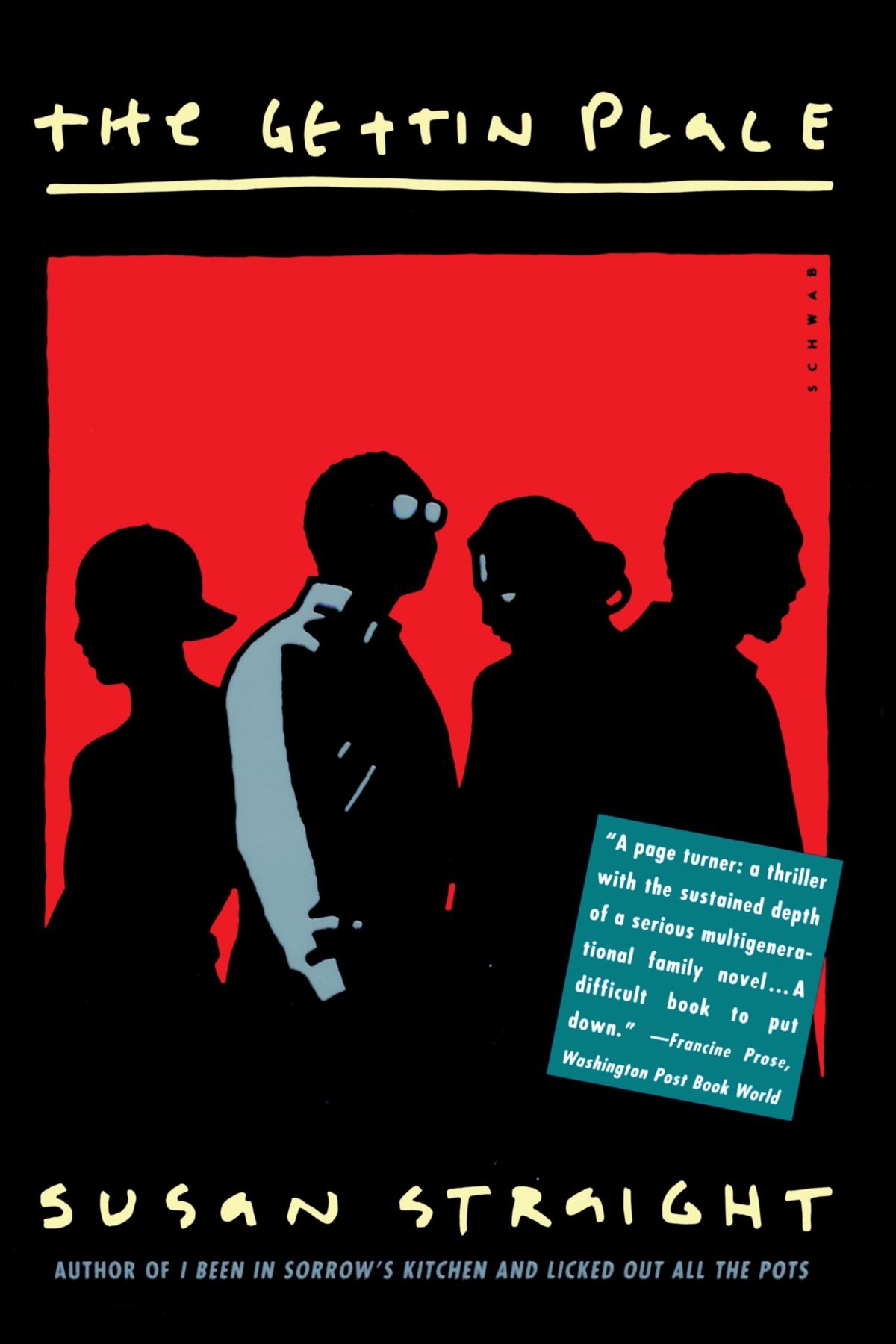

Title: The Gettin Place
Author: Susan Straight
Author's web site: www.susanstraight.com
Date: 1996
Publisher: Hyperion
ISBN: 0-7868-6086-3
Length: 488 pages
Quote: “The wafting smell must have been the dream again, the dream of Tulsa burning, the same ashen days he’d been seeing in his sleep for...Seventy years.”
Hosea Thompson survived race riots as a boy in Tulsa. As the riots in Los Angeles start waves of violence through the small towns nearby, he’s not always sure whether he's seeing current reality or post-traumatic-stress flashbacks. He and his wife have bought a small farm in southern California, kept it going, and brought up children and grandchildren. Some of those descendants will die in the course of this novel; some are already dead, and one who’s been missing will come home. Only together will the three generations of Thompsons solve the murder mystery. (The Gettin Place is a novel, but at the center of its plot is a murder mystery.)
The Gettin Place received good reviews. Washington Post’s David Nicholson called it “a triumph,” reading it as “a portrait of a young [B]lack man trying to find his way...with...acceptance of responsibility.” That would presumably be Hosea Thompson’s son Marcus, although he’s not all that young. Marcus’s nephew and student, Mortrice, is also trying to find his way; just because he's a teenager he helps the adults solve the mystery, but his story is hardly triumphant. The story begins and ends with Hosea, but if readers prefer to identify with Marcus and read it as his story, they can. They might even identify with one or more of the women in the family: the Thompson women are as stalwart as their men. The drug culture has reached the Thompsons, leaving one man and one woman with drastic brain damage, but even they are memorable survivors.
One of them has survived a real horror story, which Straight mercifully keeps offstage. The part of the story we read is more than enough. The Ariel Castro news report shows that, yes, hatecrimes against women still occur at this magnitude.
Some of this web site’s readers may like The Gettin Place because the notion of “eminent domain” comes into it, and although Straight wasn't able to give that plot element a really satisfactory ending, at least she shows us a greedhead land-grabber getting what all greedhead land-grabbers deserve.
Some local readers might ask whether this novel about southern California was a nostalgia trip for me. It wasn’t. I have no sense of nostalgia about any part of California, and don’t remember the southern part well enough to say how well Straight brings that landscape to life—although she certainly brings a landscape to life, and convinces me that she’s writing about a place where she’s actually lived and known people. The story, however, strikes lots of ideological resonances with me. Strong women seek freedom from oppression beside, and together with, their men. One of those men even overtly separates himself from “landless boys” who’ve failed to learn responsibility. Land should be passed down through a family, not bought up and “redeveloped” by greedheads. Natural beauty and honest work do more than psychology or psychiatry to help people with traumatic stress. Teenagers who reject family ties in favor of “peer-group relationships" get stabbed in the back—in Mortrice’s case, literally shot in the back (he survives, that time).
This is an “adult,” in the sense of “adolescent-mentality-bait,” or R-rated, novel with lots of violence, digusting language, at least three offstage rapes, and an onstage relationship that includes premarital sexual intercourse. Gritty contemporary reality, here. We’re not told whether the Thompsons consider themselves christian but there’s little evidence of specifically religious influence on their lives. nevertheless, the healthier Thompsons do take a good solid stand for traditional values, including sobriety—and loyalty to the family members who fail to uphold those values. If you like either Ishmael Reed or Alice Walker, you’ll consider The Gettin Place a feel-good book.
Still undecided? Check out her web site, and consider buying her new books as new books, by all means. This web site's Fair Trade Books program promotes older books and sends 10% of their price to the writers or their favorite charities, as a gesture of encouragement...but buying writers' new books is even more encouraging. Anyway, The Gettin Place is A Fair Trade Book: when you send $5 per book, $5 per package, plus $1 per online payment, via U.S. postal money order to Boxholder, P.O. Box 322, or via Paypal to the address you get from Salolianigodagewi, as shown at the very bottom the screen (whew!), we send $1 to Straight or the charity of her choice. One more book of similar size will fit into the $5 package; if it's Been in Sorrow's Kitchen we'll send $2 to Straight or her charity.
Subscribe to:
Posts (Atom)


