Showing posts with label Southern States. Show all posts

Monday, June 8, 2026

Book Review: The Night Singers

Title: The Night Singers

Author: London Clarke

Date: 2024

ISBN: 979-8224802265

Quote: "If you want to find the secrets of the universe, think in terms of energy, frequency and vibration. - Nikola Tesla"

When bad writers have come to the end of their idea, and their readers want another story, they turn to ChatGPT. When good writers are in that situation, they do some research.

London Clarke did some research about a beautiful, tourist-friendly island. Islands led to the islands in the Odyssey. The islands in the Odyssey included Aeaea, Wailing Island, and the Sirens, for fear of whom Odysseus put wax in his men's ears and made them tie him to his ship's mast. The Sirens' magical song led to sound vibrations and a machine that some people think may stop the progress of cancer, at least for a while, with sound vibrations...Add the basics of a gothic horror/romance tale--the young woman who's immature and maybe a bit masochistic, too, enough to do exactly what she's been warned not to do, and the young man who seems not merely "grumpy" but unapproachable because of a terrible secret in his past--and you have the main plot elements in this book, tied together as only London Clarke can tie. 

It's not a retelling. Riff (short for Robert Isaac Franklin) is not Odysseus, the clever Greek who was able to reclaim his men and walk away from Circe. He is almost as young as Callisto (not Calypso), who takes upon herself to rescue him from a diabolical recording contract enforced by demonic creatures with punk hair and tattoos...

The details of their premarital sex act aren't spelled out in detail but there's no room for doubt that premarital sex takes place. There's also some explicit violence, though in the reality of the story, the characters who get stabbed, bashed with oars, and so on aren't human and deserve worse than they get. 

If you're looking for a Southern Gothic horror romance with movie potential, this book is for you.

Thursday, April 16, 2026

Book Review: Kathy Sue Loudermilk I Love You

I'm sorry, Gentle Readers. Microsoft ate up my reading time today. You get reviews of vintage books this weekend. I hope to bring in some reviews of new nonfiction next week.

Title: Kathy Sue Loudermilk I Love You

Author: Lewis Grizzard

Date: 1979

Publisher: Warner / Peachtree

ISBN: none

Length: 336 pages

Quote: “There was something special about Kathy Sue Loudermilk. Even at eight, she made a tight sweater seem much more than a woolen garment.”

Fun fact about this book: “Loudermilk” is a family name actually used by real people. Not all of them live in Georgia.

Kathy Sue Loudermilk I Love You introduces several repeating characters Grizzard caricatured in his comic columns over the years, giving them unlikely names like Weyman Qanamaker and Cordie Lou Poovey. It also introduces real people, some of whom are known to history only through Grizzard’s serious columns. For many readers, the publication of this book also introduced Grizzard.

At the time of writing, Grizzard was still supporting the railroad industry against the trucking industry, supporting Jimmy Carter against anybody, and, he claimed, sincerely shocked that anyone could question anything General Lee ever did.

Women were extremely touchy about anything that sounded sexist. Grizzard wrote some columns that deliberately stated, exaggerated, an unenlightened point of view, apparently to generate controversy, attention, and sales. (Women who worked with him said he didn’t act that way in the office, nor did he write that way in his serious columns.) On the other hand, his ex, Kathy Lewis, wrote a comic expose about “life with Lewis” called How to Tame a Wild Bore. The book did not portray Grizzard as either especially wild or as especially boring, but as your basic selfish, immature young man who is not really ready for a serious relationship.

Whereupon women who feel that there’s nothing wrong with being an immature young man—only with sharing any serious activities with one—took Grizzard’s books to our bosoms. The books, not the aging boy who wrote them. He died young, apparently without a bosom on which to lean.

In Kathy Sue Loudermilk, Grizzard claims that he was threatened with bodily harm after writing a column that blamed refrigerated biscuit dough for divorce and suggested that wives should get up in time to mix biscuits from scratch. Bodily harm? Well, yes...you see, it was still 1977; due to discrimination, women did not yet have the more feminine and empowering option of writing their own syndicated newspaper columns suggesting that husbands who wanted to stay married should get up in time to mix biscuits from scratch too.

And Southern Ladies, even those of us who were only ten years old at the time, just laughed and laughed. I mean, biscuits, people. Baking-powder biscuits were invented by people who didn’t have time to cook,. Baking-powder biscuits do not require the cook to have his or her eyes completely open. Just dump a reasonable amount of self-rising flour into a bowl, add milk until it feels like biscuit dough, press it onto a pan, cut out biscuit shapes, and bake it for fifteen minutes in a hot oven. Making biscuits from scratch is actually quicker than making them from refrigerated dough, since by making biscuits from scratch you can avoid getting biscuit dough on your fingers and taking the time to wash it off. Men can make biscuits. If you have a gas or electric oven, biscuits take no more energy or intelligence than cereal.

It’s this kind of confusion that makes Kathy Sue Loudermilk more than a nostalgia trip. Oh yes, there’s plenty of nostalgia in this book, with detailed inventories of the kind of traditional Southern-fried convenience store that still exists, in some communities, even now, and columns about the great ball games and Nashville songs of yesteryear, and bleeps. Does anybody over age 35 not miss bleeps? (Bleeps were electronic sounds used to protect the ears of the upper class from any trashy language uttered within range of a live broadcast; hence “bleep” could be, as on three pages of this book it is, substituted for any rude word.) Part of 1970s pop culture was missing 1950s pop culture. But Kathy Sue Loudermilk is not merely a sentimental look at the 1950s; it’s the way the 1970s actually were. Some things were nicer back then, and some were not.

This book is fondly recommended to anyone who’s not already read it.

Sunday, April 12, 2026

Book Review: Sources of Strength

Book Review: Sources of Strength

Author: Jimmy Carter

Date: 1997

Publisher: Random House / Times

ISBN: 0-8129-2944-6

Length: 241 pages plus indices

Quote: “Al­though I began teaching Sunday School classes when I was eighteen years old, I’ve retained...transcripts of entire texts only during the past twenty years. I asked Karl Weber, a fine editor, to help me choose some of the more interesting ones...abbreviated...down to a few pages.”

That’s how the 52 brief chapters of this book came to be written. Although they’re not written in the Bible-study-workbook format to which Southern Baptists, Seventh-Day Adventists, and perhaps some church members are accustomed, each one contains enough Bible references that if you dig up your own nuggets of religious knowledge you’ll get quite a course of Bible study out of Sources of Strength. Former President Carter was always been known for his bland and mild public personality; if you want more salt’n’pepper on your daily Bible studies, the original texts and classic commentaries will supply that too. What the book tries to convey is a sense of what you’d hear if you’d visited the Maranatha Baptist Church where, Carter modestly admitted, Sunday School classes taught by a former President of the United States became quite a tourist attraction.

Carter’s politics were considerably to the left of many Southern Baptists’—consider Jerry Falwell. I have to say that while I read Sources of Strength I kept thinking, “Methodist...Methodist...” but no, Carter was still a Baptist. Right-wing Baptists may have wondered about this. Studying his Sources of Strength won’t convert you to the left wing—it may in fact inspire you to be more active on the right wing, if that’s where you feel at home—but it will help you understand what’s going on in the minds of left-wing Christians. Christianity is timeless, and cannot be truly divided between the “wings” of passing political reactions to specific times. We need to let the quest for real truth reunite us, even if we have disagreed sharply on political questions.

The texts he chose for study will be familiar to long-term churchgoers. I’m thinking now of my late “Aunt Dotty,” a family character who sustained some permanent brain damage from cancer treatment at age 50, but retained a good memory, and announced around age 55 that as a lifelong churchgoer she felt as if she ought to have graduated from Sunday School. Aunt Dotty learned a great deal in her ecumenical life; she remembered most of it into her late eighties. I don’t want to endorse the Catholic understanding of what makes us remember some Christians as saints, but in her way I think Aunt Dotty was that kind. I mention her because I had the thought, reading Sources of Strength: “Is this a book for people who come to churches as tourists? Is there anything in here for Aunt Dotty?” The answer to both questions is yes. Yes, it’s written partly for those who visit celebrities’ churches as tourists, and yes, there’s at least one lesson that might have had something new to offer even Aunt Dotty. It’s too late to ask her, but I think Carter’s story of how he reconciled himself to a personal enemy will be fresh for most Christians.

Although it does contain a couple of Carter’s long original poems, overall this book is well edited, easy to read, and warmly recommended to all Christians and to all historians studying the 1970s.

Thursday, March 19, 2026

New Book Review: The Lingering Dead

Title: The Lingering Dead (formerly Souls of the South)

Author: Philippa Wozniak (formerly Louise Philips)

Date: 2026

Quote: "Sometimes...a house chooses its owner."

Although it's a reissue, what I received was an advance reader's copy of a shiny new edition of this book. 

This is a ghost story. The humans who are alive in the 1930s, when the story takes place, are being moved around by the humans who died during or after the Civil War. If that kind of stories completely destroy your suspension of disbelief, read something else. That's what's not to like about this book
Otherwise it's a classic Southern Gothic story with a sweet, sassy heroine who's in danger of various kinds, sometimes rescuing herself, sometimes being rescued by a handsome hero, and a present-time Miss Louisa who is benign and a ghost Miss Louisa who the present-time Miss Louisa insists is up to no good, and a tangled line of inheritance. Is Ted a Yankee with more money than good sense, who might buy the cotton mill but won't be able to run it, or is he the long-lost rightful heir? The living characters don't know. The ghosts do. And what about the woman who may or may not have been killed before she was placed on the bed beside Ted in the hotel room? 

You'll laugh at the cliches. You'll like Savannah and, as it becomes clear that she's not who she seems to be, enjoy her quest to find out who she really is. You might even manage to like Ted, who seems less conceited than many heroes of romance. If you're not put off by the active ghosts, you'll probably enjoy this book.

Tuesday, February 24, 2026

Book Review: Don't Sit Under the Grits Tree with Anyone Else but Me

Book Review: Don’t Sit Under the Grits Tree with Anyone Else but Me

Author: Lewis Grizzard

Date: 1981

Publisher: Warner Books

ISBN: none

Length: 289 pages

Quote: “First, go out to your grits tree arnd pick a peck of grits.”

Grits are the peeled inner hearts of corn kernels. (Ever tried to peel a corn kernel? Traditionally it was done by soaking the corn in wood-ash lye.) Lewis Grizzard wrote many fact-based columns, some of which are reprinted in Don’t Sit Under the Grits Tree, but his “True Grits” column (page 83) is pure nonsense. There are other silly columns scattered through this book, like the advice from “Dr. Feelbad” for hypochondriacs, or the “Drinkin’ Wine” column, which seems intended to sound as if Grizzard had drunk a lot of wine before writing.

Then there are the serious reactions to actual news, like the column Grizzard, who otherwise couldn’t quite forgive Ronald Reagan for having run against Jimmy Carter, wrote after President Reagan was shot. Some people thought Grizzard did “goofy” better than he did sincere columns about people he admired or missed, but he wrote plenty of sincere columns. This book contains columns on behalf of dog owners who ran afoul of new leash laws, people who were out of jobs and money, writers whose books Grizzard wanted to launch, and several tributes to athletes and local celebrities.

Knowing that Grizzard was suffering from the hereditary condition that killed him, and refused to try to buy time by practicing better health habits, lends a special poignancy to the articles he wrote in defense of unhealthy pleasures. “Take This Salad Bar and Shove It.” “White Bread or Bust.” “Refill Time in Heaven.” These are the essays of a thirty-year-old man who, at forty, would be writing that a good bowel movement had become more satisfying and memorable to him than sex was; in his early fifties he would be dead. He always knew it. Like P.J. O’Rourke’s eco-hog persona, Grizzard’s junkfood-hog persona is best appreciated as a way of whistling in the dark.

The fact that many of these columns are more than thirty years old, by now, lends a touch of nostalgia to the cover of my copy, which identifies the book as “The New Bestseller.” It’s a nostalgia trip for all who ever voted for Jimmy Carter, drove a 1957 Chevy or wanted to, yelled “How’bout them Dawgs” in a crowd or wanted to, thought “nekkid” deserved to be considered a separate word from “naked,” copied Richard Petty’s mustache and glasses or dated a man who did, doubted that any word processor would ever work as well as a Royal Standard typewriter, or found it necessary to tell someone what Slim Jims are.

If you have not had these Southern-Preppie-baby-boomer experiences, but would like to grow up to avoid foot-in-mouth moments like Joe Biden’s claim that FDR did press conferences on television, reading Grizzard’s books will help. For many people in cyberspace, books like Don’t Sit Under the Grits Tree may provide the same sort of pleasure that reading Dorothy Parker, Will Rogers, and “Pogo” cartoons give me. And until time machines become reality, there’ll never be a more enjoyable way to study history. Therefore, this book is warmly recommended, not only to those who get all the references, but perhaps especially to those who don’t.

Wednesday, December 24, 2025

Book Review: The Southern Heritage Company's Coming Cookbook

Title: The Southern Heritage Company's Coming Cookbook

Author: staff of Southern Living magazine

Date: 1983

Publisher: Oxmoor House

ISBN: 0-8487-0603-X

Length: 143 pages including index

Illustrations: many photos

Quote: "[C]ompany's on the way! Let's give them a real Southern welcome."

If you need something fancy to put on the table at this critical time of the holiday season, this book is for you. Here are fine and fanciful--and not cheap--recipes that are easy to prepare.

This book represents a transition point in its publisher's history.

Real "heritage" menus and recipes tend not to be very popular these days. One reason may be that the relative prices of different food items have changed. Plain corn meal used to be cheap home-grown fare, served with resignation or defiant pride by poor people; now it's a specialty item. Oranges used to be special treats, available north of Florida only during the Christmas holidays; now they're available, if not always very good, all year. People whose grandparents used to "have to" eat "weeds" such as burdock now think of gobo as a new, special Japanese thing, and may not recognize that it's basically the same plant they try to kill when it appears in their gardens.

Another reason is that even the Atkins Diet recommends less fat and fewer calories than Grandma might have served in good conscience. Today's Southern Living magazine now emphasizes Cooking Light. Less butter in the biscuits, less grease in the gravy, and less sugar in the coffee, are important new rules. A hundred years ago most Southerners spent enough time working on the farm to burn off all the extra calories they could get, nobody expected retirees to live very long, and Southern cooking was rich, sweet, and buttery. Now that more of us commute to office jobs, the demand is for low-calorie cuisine.

The recipes in the Company's Coming Cookbook can't be called "light" but they're not as heavy as some of Grandma's recipes. Very few call for a cup of butter, or insist that lean meat be completely covered in bacon while it's being roasted in lard.

Some of them also call for what used to be specifically Southern ingredients like rice, pecans, and oranges...on the other hand, these items are now sold in supermarkets almost everywhere. This is not the book to consult for specific regional treats like sorghum gingerbread, pawpaw pudding, ground-cherry pie, fried morels, or field cress.

Vegetarianism is not a Southern tradition. "Seasoning" cooked vegetables with a chunk of fat meat is a Southern tradition, although it's not mandatory. Because corn and rice grew in the South better than wheat did, because sugar was often rare, and because cheesemaking was traditional in only a few Southern families, this book does offer a good number of wheat-free, sugar-free, and cheese-free dishes. Several are dairy-free, too. There are also lots of substantial vegetable dishes that can be served as vegetarian entrees, but there aren't any completely vegan menus. As usual, people on special diets need to select and adapt recipes, but they'll be able to use this book.

Sunday, November 23, 2025

Book Review: Island of Lost Things

Title: Island of Lost Things

Author: London Clarke

Date: 2025

Quote: "They, of course, though we were having a hot night of sex.  I couldn't possibly tell them I was picking glass out of his wound..."

Ridge and Lainey go together like a mountain ridge and a country lane. This story is a new achievement for London Clarke: not horror, but a sweet Christian romance. But its atmosphere is murky, because for the first twenty years they're not doing what some Christians call "walking in the light they have." 

How many times people think "If I'd been in that situation with that person..." and fail to imagine why the person they envy was in that situation. At that particular point in their relationship Lainey and Ridge had been hanging out on the beach like the old school friends they are, but not spending whole nights together. She spent the night with him because a call from the child he's never been fit to rear upset him, and he got drunk and smashed glass into his hand. By the time Lainey picked out the splinters Ridge had passed out. Lainey stayed to watch that he didn't choke before he woke up.

At first she was a nice girl from a good family, though it was an adoptive family, and he was a troubled boy with an abusive stepfather. Then she had a bachelor's degree, and instead of going on to a master's degree she stayed at home and worked with the uncle who had filled in for her father, as a mechanic, while he was becoming a rock star. Then the drugs and alcohol he used to support his "star" career got ahead of him, and she was sad but sober while he was drunk. Then.... 

The suspense in this story is wondering when these two will admit that, while telling themselves they can't be a couple, they've been best friends and Partners for Life since college. For a romance Island of Lost Things is an excellent study of friendship. 

Some people may subtract points, and some may add points, for Clarke's having the characters talk about "the way we were raised" instead of their "personal relationships with Jesus." Can Ridge and Lainey consistently make better choices without God's help? Doubtful. Can their prayers for God's help take place behind doors, just as their sex lives, most of their sins, and their digestion do? Yes. In a novel that leaves what people eat, what each individual body part is doing when they're in bed, and whether they have hangovers after getting drunk, to the readers' imagination it seems appropriate that their prayers are also left to our imagination; we don't know which denomination sponsored the college. This is not a Sunday School book. Going back to the way they were raised almost certainly includes becoming regular members of a church but we're not told which one. So, probably not Evangelical.

The effect of not focussing on the specifics of their faith is to make the story accessible to readers of any faith tradition. The characters happen to be Christians. They happen to live on the Carolina coast. A character who's tried being a nun but not succeeded, and a Christian college with a zero tolerance policy for marijuana, are part of the setting, like sand dunes and Spanish moss. Nobody in this book is going to tell readers "If your religious background is something else, you should reject that and become a Christian now." 

So, just about anyone who is interested in a romance that stirs up feelings of empathy rather than carnal passion is likely to enjoy this book. (Carnal passion comes into the story...as one of this couple's obstacles to True Love.) Prospective readers' question was probably "Can Clarke do tender affection as well as she does horror?" and the answer is YES. 

Wednesday, July 30, 2025

Book Review: Time for Death

Title: Time for Death

Author: Christie Silvers

Date: 2021

Quote: "We always have fun when we go out to Fosters Cemetery."

Canonical vampire stories are about amoral people, but show them bound by a strict moral code, even if they ignore it. Rick, the boyfriend who says the line quoted above to Liz, the protagonist, is pretty much a lawful good character. It's only Liz's chaotic allure that inspires him to take her to the cemetery to have sex on strangers' graves. 

That's where they meet the vampire who seduces Liz and injures Rick, after building his strength by killing a couple of their friends.

Liz is, to stay within this web site's contract, a piece of work and a half. The B word will probably come to readers' minds. It's not just that she describes, in detail, doing what would make babies if she were fully human with three different men in this story. It's the way she cheerfully lets Rick and also Chad, and would let Susan if it came to that, be hurt so that she can fully enjoy Marcus the vampire. The enjoyment of a canonical vampire, as distinct from a tamed Twilight-type vampire, includes killing him--if you can. 

For those who want to read more about that kind of character, yes, there's a series. Liz will roll on, hurting more people, in more books. Vampires will be reduced to sludge after humans are slaughtered in each story. The sacred act of bringing a new life into the world will be profaned. Repeatedly. And Liz will "love" and kill additional men, besides Rick and Chad.

It's the sort of fantasy Freud liked, because he understood it: For readers who feel that they have no power, it may be gratifying to imagine having exaggerated,  unnatural kinds and amounts of power, and using it in ways they know are wrong, thereby justifying their powerlessness in real life.

Sunday, July 13, 2025

Book Review: Scarred

Title: Scarred 

Author: Roe Braddy

Date: 2020

Publisher: Amazon

Quote: "There would  be no fraternizing with anyone of the opposite sex on Sundays--especially a boy like Edward Proctor...that finds it fit to work on Sundays."

Yes. The United States' Great Depression lingered even after the war in some areas, such as the part of Alabama where this story takes place. Even a middle-class family's life was anything but the stuff of which Harlequin or Hollywood "romances" were made. For a really poor family like these fictional Proctors, not only did poverty seem inescapable, not only did some people's frustration turn into violence, but neighbors who might have helped them judged them instead. 

Ed works when and where he can, and Mavis quietly, discreetly, notices his muscles. Mavis's mother wishes Mavis liked somebody more upscale, but the older man who "could almost pass for White" is quietly, discreetly homosexual and the preacher Mavis's mother would love to claim for a son-in-law is a real creep. Mavis could only have gone to public school, so she must have met other boys besides Ed, but none of them stands out in her memory. She has a general idea that Ed's father is abusive, as well as poor, but that only makes Ed's good intentions seem more impressive to her.

They've had enough of a modest, even Victorian, friendship for Mavis's mother to have ordered Mavis to be "cordial, but no more," when she meets Ed in town. Then Ed disappears. Mavis wonders if he's lost interest. Ed tells us up front what he's ashamed to tell Mavis through most of the story: he lost patience and hit his father back, and his father deliberately scarred his face with a knife. He's been told he's ugly because he has a dark complexion. Now, with a deep infected wound on his face, he believes it.

But Mavis still cares about him, and the way she shows it gets both of them packed off to Pittsburgh to marry each other or not--so long as they don't come home. 

The romance genre has historically shied away from real poverty, despite the popularity of "Cinderella." Poverty is not romantic. Rich characters are romantic, or, at most, middle-class characters who are so brave and so cute that readers/viewers can imagine that, if they don't marry for money, they'll earn some in a few years--the young doctor struggling to pay off loans, the teacher with the disabled parents and younger siblings to support. Roe Braddy convinces us that really poor young people can be romantic, too, in a different way. No chocolates or candlelight in this short novel--when food is mentioned, it's authentic period dishes readers will probably find a gross-out--but they're still "in love" and they'll still live more or less happily ever after.

Apart from Mavis's mother's belief that everyone needs to go to church every Sunday, Ed and Mavis are Christians, themselves. They perceive it as God, though they're told that it's a friendly porter, who seats a midwife with medical supplies in her bag near them on a train. They pray. This novel would trigger Christian-phobics...and, although nobody evangelizes in the book, rightly so. It portrays Christians living up to the best standards of their faith tradition.

Thursday, July 10, 2025

Bad Poetry: On Being Southern

Just another failed contest entry...

The thing we can’t forget is that we are
a Minority like all those other races.
Divide and conquer: enemies would like
us all lined up on sides, knowing our places.
No matter how many may be, like Joycelyn Elders,
ready to testify that color never
did them much harm; how many, like Doug Wilder,
found that, if anything, color served them better
than Whiteness would have done.Our enemies
prefer us stuck in the memories of the dead
(fair fighting not being among the legacies
of their ancestors): stuck and thus defeated.
“Are you a Bigot?” they ask, if you’re White.
“Are you a Victim?” they ask, if you’re Black.
Because the Southern way was always to fight
with honor, at all costs, few of us take
the obvious way out: “What do you steal?
Which gang are you in? Been mugged yet today?”
though that is what the Northern  States are known for;
but at least, being Protestants, we may
refuse the guilt of others. If we write
about being Southern and being white,
may write about our work, our family, art
or music, landscapes, football, fishing, cars,
tennis, or politics—what we’ve really done,
which probably was not lynching anyone.
Even if we chose a neighborhood in a city
where neighborhood is not a matter of birth,
still, all neighborhoods contain some for whom we pity
the neighbors; for whom we pity the whole Earth.
Wherefore my people, if we want to feel guilty,
forgetting pseudo-guilt for long-gone sins,
have sins to repent of, all our own, in plenty:
stealing candy as children, driving under the influence
as adolescents, coveting neighbors’ wives
or husbands as adults, spending too much money,
working too late, then taking home office supplies
as compensation, calling strangers “honey,”
leaving the children too long with the nanny,
wasting people’s time with tedious chatter,
driving when we ought to walk. These matter,
these sins which, duly forsaken, make the world better.
We have our own sins to confess but our enemies want
us to wallow in others’ guilt through our wasted days.
Let us renounce the old hypocritical cant
of guilt for the dead past, and mend our own ways.
Have you sold slaves? Have I? Of course not. More
to the point, have we looked down upon the poor?

Tuesday, April 15, 2025

Book Review: Mermaid Mayhem

Title: Mermaid Mayhem

Author: H.P. Mallory & J.R. Rain

Date: 2023

Publisher: Rain Press

Quote: "[S]cales were already pressing slowly to the surface of my skin. They did that when I dried out.,"

The narrator of Mermaid Mayhem is a mermaid who can maintain human form as long as she stays damp, so she likes the humidity in Louisiana and takes a job there, searching for other fabulous beings who may be being held prisoner in the swamps.

We never do learn her real name; her magic is stronger than those of her family, so they've sent her away, and she's changed her name to "Marina Estuary." The nickname "Eerie" stuck to her after a past adventure on Lake Erie, so her detective service is "Eerie Investigations."

The client is a vampire. The prime suspect is a were-gator. Other characters in the book include witches, imps, nymphs, faeries, a "bliss angel," and various shapeshifters. The plot is more about what each of the characters can do, according to the laws of this fantasy world, than about any real-world information that helps to solve the mystery. If you think this mash-up of fantasy and mystery is fun, run don't walk. The book has sequels and both authors have written other fantasy novels. 

Sunday, March 23, 2025

Book Review: Promise Kept

Title: Promise Kept

Author: Jodi Allen Brice

Date: 2021

Quote: "Everything she owned was in her car."

Heather is one of those young people who grow up as wards of the state and often, when they reach the official cut-off age for foster care funding, have no property and no skills. Heather's luckier than most; she's inherited a car and some personal paraphernalia. She packs up and drives off to a small town where someone is advertising for a caretaker for an old lady.

Not many older people today can afford a full-time live-in caretaker--the best chance always was to keep the house and make room and board part of the salary--and there's tremendous pressure from greedheads in the "health care" industry to let some tax-funded insurance plan pay for a visiting day nurse "who's been vetted by an agency and has appropriate training," whether the agency is honest, the training is necessary, or we'd rather let a student earn a room in our home, or not. (But the greedheads' plan is that none of us will have a home. More money can be sucked out of the taxpayers if we're hustled into tax-subsidized apartments where we'll be ill more often and die faster.) Heather really is lucky. Not only does she meet one of the few old ladies who still has a home and can offer Heather a room of her own, but they're congenial and begin to bond.

What makes this romance sweet is that it's mostly about Heather's bonding with the last, best foster mother she will have. Heather is young and pretty. Hormones will do their thing. A young man who thinks he's just looking out for his dear, kind old neighbor, making sure she's not being taken advantage of, is actually noticing Heather's charm and beauty and good character. When his suspiciousness is not stressing Heather out, she likes him, too. You know where this has to go. By the end of the book they'll be going to church together. But first Heather will convince people in the little town in Mississippi that they can like and trust a stranger from Atlanta, and will find a permanent job and home of her own so she can afford to take her time. 

For young romance readers this story may be aspirational. For seniors being bombarded with info-mercials about retirement projects, it's recommended reading.

Tuesday, November 5, 2024

Book Review: Needy Little Things

Title: Needy Little Things

Author: Channelle Desamours

Date: 2025. See below.

Publisher: Wednesday (St. Martin's)

ISBN: 9781250334824

Quote: "My mind is an endless loop ofthe immediate or future needs of the people around me. Tangible, everyday items...usually."

(If this book's not been published yet, how can I have read it? I read what's called a galley--a mock-up of a book, distributed to writers, proofreaders, and reviewers. The idea is that corrections can be made to the galley before the book is published for sale, but the book is close enough to its final state for reviewers to start telling people how good it is. I received a galley of this book in exchange for an honest review. As a story about twelfth grade students learning about a grim part of recent history and sharing a dangerous adventure, it's good.)

Sariyah is a psychic, of sorts. She's constantly distracted by the felt needs of people who aren't close to her; she's not too good at recognizing the needs of her family or really close friends. The barrage of "needs" gives her migraines when she spends time around people. Her parents insist on her going to school, despite her obvious desperate need for homeschooling. She's due to graduate this summer but there's some doubt about her being able to graduate.

One of Sariyah's best friends is one of Atlanta's missing children and teenagers. (That's a long-running news story that's largely dropped out of the national newspapers because it's not news any more.) When another friend goes missing, too, Sariyah realizes how little she knows about her close friends. 

Props to Channelle Desamours for giving Deja and her stepfather a problem that's more common in real life, less common in fiction, than the cliche of stepfather-molesting-daughter, Props, too, for inventing a fresh psychic talent; Sariyah and her gift/curse don't bother about people's deep emotonal needs, but focus on "needs" like chewing gum, hair gel, and potting soil, Mixing thesee elements gives readers an original story, with the prospect of a sequel or a series, that raises awareness of Atlanta's problem. And extra props for the girl who notices an attraction to a boy and pushes it aside, thinking "I don't need to deal with a silly crush right now.' There are teenagers like that, though for years publishers refused to print books about them.

The plot takes a twist I find hard to believe. A character who's seemed sane suddenly freaks out and goes into psychotic mode. Would that have happened in real life? One should never say never; maybe a similar incident made the local police blotter, but what's not to like about this book is that you might not find the character's mental breakdown, and fortuitous accident, believable. 

Otherwise the story is believable and the characters are sympathetic. The content of the story is a little more intense than "a fun read," but family love and friendshp earn the sort of ending they deserve. 

Publishers send galleys to reviewers when they think there's a high probability that we'll agree that stores, schools, and libraries may want to order a book in advance. Well, I do. This book is scheduled to be available in stores in February 2025. If you have a store and want to do a Black History Month display in February, order now; I think you'll be glad you did.

Thursday, August 15, 2024

Book Review for 8.2.24: Afraid of the Dark

Title: Afraid of the Dark

Author: H.P. Mallory

Date: 2014

Quote: "I almost felt as if the house and I were buddies."

Retired building contractor Hank thinks Peyyton's house is beyond hope. He's retired at forty-eight because his first wife died in an accident on oen of his construction sites, so he doesn't want to work with Peyton either. But she's an attractive divorcee who obviously misses sharing a bed, though she insists she does not miss her husband.

Fortunately Peyton flies all her red flags, confiding to Hank about her istory of drug use, the ex's having helped her sober up as a sort of mission project and apparently identified sobriety with being a quiet church lady, her urge to reclaim her inner party animal. It's not the house that's beyond all hope. It's Hank.

But, romantic though sharing a job can be, they find things in the old house that distract them from their mutual attraction. Someone papered some of the walls inside the house with reports of a series of murders committed about a hundred years ago. As Peyton saves the papers and reads the story, she starts dreaming about a charming French-American policeman from that time period. He flirts with her and encourages her interest in the house's history. This leads Peyton into a Ouija board session, in which the board spells out the victims' names and then goes into a countdown that supposedly indicates that a malevolent spirit is trying to get at the living people present. So she rushes out to start a "cleansing" ritual, buying a "gris-gris" bag from a punker who seems to despise her for not being a voodoo practitioner already--embarrassed by own lack of knowledge, I'd guess. But, before the cleansing, she goes out to dinner with Hank...

To find out how the cleansing ceremony goes, readers will have to buy the next book. To find out how Hank and Peyton resolve their differences and get married, they'll have to buy the five-book series.

If you're willing to suspend disbelief in ghosts and voodoo, otherwise this short novel has much to recommend it. Mallory wrote like the published professional she wanted to be, ten years ago, and has become by now. Thehistorical mystery is fact-based. The characters are credible,. The atmosphere is delightful. Of course, the novel's being reviewed by a person who fell in love with a co-worker on a construction site doesn't hurt anything, but I tried to exclude that from consideration. I really tried. Like Hank tries to keep a level head about Peyton and her house, in the novel, I tried.

How you feel about cliff-hanger serial fiction is, of course, up to you. 

Monday, June 24, 2024

Butterfly of the Week: Zebra Swallowtail

This week we consider the official State butterfly emblem of Tennessee, the Zebra Swallowtail. Unlike the South American Kites, so many of which are so little known, a great deal has been learned about the Zebra Swallowtail. Much of the information available has been learned in my lifetime. In fact one reason why the Zebra remains my favorite butterfly, to the extent that I have one, is that it serves as a reminder to scientists to be cautious about thinking they know more than they do. Basically everything I learned about this butterfly in college has turned out to be wrong.


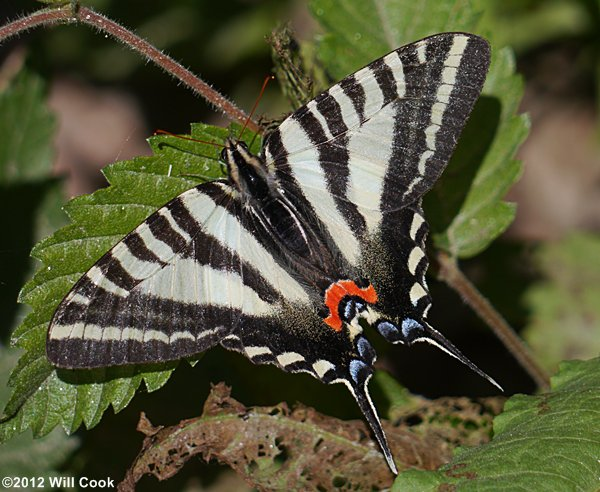
Photo from carolinanature.com, where the author mentions that this individual was found in Virginia. Bodies are mostly black above, mostly white below, with stripes along the sides. Antennae are brown to amber. Wings are vividly striped, making the Zebra hard to ignore, but the stripes vary, as does the size of the butterfly. Hind wings always have tails, often very long tails, when the butterflies first eclose, though one or both tails may be lost later. The proboscis, the long hair-thin hollow tube that is a butterfly's tongue, is long in proportion to the butterfly's head but still much shorter than some Swallowtail butterflies' probosces are.

The Zebra was my favorite species because, among the early spring butterflies I watched, it seemed to have the "just right" attitude toward humans, neither pushing itself forward nor hiding but calmly letting itself be watched. If more information about the butterfly had been available to me, I might not have liked it so much. Zebra Swallowtails behave nicely toward humans but they are asocial and do not behave very nicely toward one another.  

Other Swallowtails have gone through a few name changes as scientists decided the genus Papilio was too full and needed splitting up. The Zebra Swallowtail holds a record. It was first named Papilio marcellus n 1779. Since then, people have given it the genus names Boreographium, Eurytides, Graphium, Neographium, Protographium, Iphiclides, Iphidicles, Cosmodesmus, and Protesilaus, and the species and subspecies names ajax, abbottii, annonae, broweri, carolinianus, cubensis, floridensis, lecontei, nigrosuffusa (or nigrosuffusus), pricei, telamonides, tockhorni, and walshi.  

Recent changes in the genus name amount to quibbling. The Kites resemble an Asian family of small long-tailed swallowtails, the genus Graphium. Some scientists thought the Kites belonged in the genus Graphium. More scientists disagreed, and debated whether the Kites might have evolved earlier than the Graphiums overseas (Protographium) or later (Neographium). The position of this web site is that living things have evolved and are still evolving, within the range of what is possible for their genotype--what is called microevolution--and Zebra Swallowtail populations give an especially clear and pretty example of microevolution, every year, but if mutant individuals in one species have ever evolved into anything more different than a subspecies or race--which would be called macroevolution--nobody has documented it. Trying to guess how one species might have evolved out of another species is unscientific and not a very useful way to pass time. With the species name Boreographium, however, we come to a name change proposed for valid scientific reasons. Boreo means North, and the Zebra Swallowtail is the northernmost of the Kite species. 

Eurytides is a nice descriptive name when read as coming from the Greek words eury eidos, "broad shape," comparing the Zebra Swallowtail's wings with the Zebra Longwing's. It can also be read as "son of Eurytus." Ancient Greek literature records at least three characters called Eurytus. One was a war hero, one a king renowned for his skill in archery, and one was remembered mainly for having a son called Clonus. 

Several characters in Greek literature had names that include the word eury, "broad, wide." It seems to have been understood in the philosophical sense, used in combinations like Euryale, "wide sea," Eurybe, "grand strength," Eurydice , "wide judgment, universal law," Eurymachus, "wide battle," and Eurynome, "broad realm."

Iphiclides means "son of Iphicles" in Greek. It's not used as the name of a character, though Iphicles was Heracles' little brother and people might have been proud to claim him as an ancestor. Iphiclides is the genus name of the Eurasian Scarce Swallowtail, which has white wings with black stripes. Iphidicles at least started out as a misprint. 

Protesilaus was a hero of Greek literature. According to the Iliad, the troops he commanded had been warned that the first man who disembarked at Troy would be killed in the battle. Protesilaus, whose name comes from protos, "first," and Laos, "the people," deliberately chose to go first and be killed as a sacrifice for his men. His father's name was Iphiclus, possibly a descendant of Iphicles, and his name has been preserved as the species name of another Kite Swallowtail.

Cosmodesmus seems to be the Greek words kosmos, "the universe, creation," and desmos, "band, connection," but Google doesn't find it as a character name in ancient literature. It's the sort of name that might have been invented for a character in eighteenth or nineteenth century fiction, but Google doesn't find the reference. 

Some of the species names reflect the tradition of naming Swallowtail species after characters in literature. Marcellus was a popular name in ancient Rome; among the historical characters called Marcellus were some early Christians. 

Ajax was a warrior in the Trojan War story.  His father's name was Telamon, so he was sometimes called Ajax Telamonides in the Iliad. Linnaeus called the Zebra Swallowtail Papilio ajax, and some people have used "Ajax" as this butterfly's English name.

Of the other names given to this butterfly, abbottii, broweri, lecontei, pricei, tockhorni, and walshi all commemorate people; carolinianus, cubensis, and floridensis obviously refer to places where the butterflies were found (though cubensis may have been recorded in error); annonae describes the plant family that includes its food plant, and nigrosuffusa ("suffused with black") describes the autumn brood as distinct from the spring or summer brood. 

The plethora of proposed species names for this species reflects its variability. We shall, if we live so long, meet another North American butterfly whose reaction to temperature produces even greater variation in color patterns, but a majority of individual butterflies conform to either one color pattern or the other. Zebras seem almost as variable as the larger animals for which they're named. Today scientists prefer to remember that, as early as 1973, some scientists were expressing doubts that what are now recognized as the three general ranges of temperature-determined looks ever were separate species. 

The butterfly that left egg on the scientists' faces made news around the world. "Protographium Marcellus" is a band name. Zebra Swallowtails occasionally flutter through pop culture, too; photos and paintings of them are sold as posters, and they are sometimes printed onto various objects at Zazzle (there are about a half-dozen Zebra images at my Zazzle store, PriscillaKnits). 

Basically, individuals that have lived through some freezing weather are smaller and lighter in color, likely to be described as white butterflies with black or brown stripes. Those who have never been cold in their lives are larger and darker, likely to be described as black butterflies with pale green stripes. In between these extremes is a full range of intermediate sizes and colorations. The length of the "swallow tails" also varies according to temperature; longer tails tend to accompany bigger, darker wings. Body hair also varies; bigger individuals can have hair rather than scales all over their hind wings as well as bodies, while smaller ones look sleek and smooth. Males have scent folds on the inside edges of the hind wings, so especially hairy wings may be typical of male butterflies, though my sources didn't discuss gender differences in the hairiness of this species. 


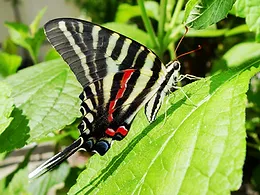
Photo from keysmoths.com. This furry animal was found on an island south of Florida.


Photo from carolinanature.com. This smoother specimen is typical of Zebra Swallowtails found in the Carolinas, Virginia, Tennessee, and further north.

In Florida, the seasons, to the extent that the Florida peninsula has seasons, produce a white spring brood, a greenish summer brood, and a black autumn brood every year. Further north, the bigger and darker forms are seldom seen. All Zebra Swallowtails in Virginia look closer to the spring brood in Florida than to the other two broods; nevertheless, their size and color vary enough that they have been believed to be distinct subspecies rather than temperature-related variants. 

Into the 1980s, the three broods observed in Florida were generally thought to be three distinct species, despite a 1973 study that opened questions about this. They are three different generations in the same family lines, but they look like three different species.

Individual variations are visible, not only between our spring, summer, and autumn broods but between siblings whose host trees grew at different altitudes. You can take eggs laid by a big, dark, southern autumn butterfly, put them in the refrigerator or freezer for varying amounts of time before they hatch, and get a range from the smallest/palest to the biggest/darkest butterflies. This clearly shows that the look of Zebra Swallowtails does not qualify as a subspecies difference.


Photo from keysmoths.com, which notes that Zebra Swallowtails don't live and breed on the Florida Keys, but stray onto those islands often.

Males and females look pretty much alike, with enough individual variation that the only real way to tell the sex of a Zebra Swallowtail is to observe its behavior. (They recognize each other by scent; humans don't notice their scents.) The hairy patches on the hind wings usually look more conspicuous in males, but are also influenced by temperature.. In some, not all, photos of couples, one butterfly is just noticeably larger and less vividly colored than the other; I found one photo where a pair had been examined under a microscope and the slightly larger and less colorful butterfly, conforming to the usual rule for Swallowtails, was female. Both sexes sip clean water and flower nectar. Zebras who show an interest in polluted water are usually but not always male. Neither is particularly shy; neither is particularly interested in licking sweat from human skin, as composter species often are. They don't seem to mind being watched, but don't fly up in watchers' faces in the threat display some other large butterflies make. Males are more likely to seem "hyperactive" as they flit about in the sun, hoping to meet females. Couples do not always make it obvious which is male and which is female but, after mating, females spend most of their time looking for suitable places to lay eggs.  All butterflies who lay eggs are females but occasionally one finds a female butterfly doing something other than laying eggs..


Photo from lazynaturalist.com. This couple are mating face to face; the female is almost entirely hidden behind the male.

Zebras can be a challenge to photographers. Like most Swallowtails they tend to flutter their wings even while eating, making it hard to snap a good clear shot. The secret is to persist. Swallowtails are most likely to spread out their wings in cool weather when they are warming themselves in the sun. Clear shots of the underwings are most easily obtained when a butterfly is drinking deep, focussed on sucking up nectar; Swallowtails fan their wings when they start to eat or drink, but may slow down or stop the wing movement when they find something good to the last drop. Because it's hard to get clear photos of them, yet the butterflies are locally common and pretty and popular, every wildlife photographer seems to want to publish a photo of a Zebra Swallowtail. Wikipedia had to thin their collection. Wikimedia Commons has thirty beautiful photos in the category "adult butterfly sipping nectar from a flower" alone.


Observing these behavior patterns, Michael Q. Powell was able to snap a rare, clear portrait of a Zebra Swallowtail's face. Furrier individuals can have long eyelash hairs all the way around the large compound eyes. Lots of photographs of eastern Virginia butterflies can be seen at https://michaelqpowell.com .

Another way to get clear photos of butterflies is to find them near the end of their shot lifespans. They fly for a few weeks, and then some seem to feel tired and sit down on the ground and wait for thir hearts to stop, while others drop suddenly to the ground and lie dead. An unusually vivid photo essay with close-up shots of small, commonplace things, including some Swallowtail butterflies, is at https://reinventingclaire.com/tag/eurytides-marcellus/ .

At all stages of their lives Zebra Swallowtails exist in a symbiotic relationship with their host plant, the pawpaw tree, Asimina triloba. (Georgianature.com mentions that science now recognizes a few different species of pawpaw in the Southern States, and Zebra Swallowtails can live on at least four of those.) If you want to see one or two Zebras three times a year, plant one of these native shrubs. The trees and butterflies find it easiest to thrive in the Southeastern States, fairly close to streams. They are known to live as far north as Pennsylvania, Ohio, and Nebraska, but they're rare in the northern part of their range. The butterflies sometimes stray into Michigan and Ontario but are not believed to breed there. 


Photo from MarylandBiodiversity.com. This summer Zebra shares the Monarch's taste for milkweed blossoms with many other insects. Zebras have shorter probosces than most Swallowtails, which limits them to feeding on relatively smaller or shallower flowers. Many people mention their taste for white clover. I often see them pollinating violets. Their favorite flowers also include blueberry and blackberry blossoms. The spring generation sometimes fly in time to pollinate redbud trees.

But they especially pollinate the pawpaw flower, which has little appeal to other butterflies. They rarely stray very far from a pawpaw tree. 


Asimina triloba flower photo from elizabethswildflowerblog. Along the Gulf Coast a few other species of Asimina grow. Some of them have more colorful flowers. Triloba flowers usually look black but in a strong light, as here, they show dull red.

Generally Zebra Swallowtails like to be the only one of their sex and species in the neighborhood. An adult butterfly's life revolves around producing the next generation of its kind. Zebras like to make sure their next generation will have adequate food--a healthy pawpaw tree, or main limb of one, for every caterpillar. In most places you never see more than two of them together. In places where pawpaw trees are very abundant, however, people have photographed small groups of males sipping water from the same puddles. 


Photo from Butterflies Of America.


Photo from MarylandBiodiversity. Since Zebras don't compete with other butterflies for food, we might expect that they'd be more comfortable with drinking buddies of other species than with other Zebras, and so they seem to be. Though their habits are generally cleaner than Tiger Swallowtails', both sexes in both species sip clear water, sometimes at the same puddles. Zebra Swallowtails seem to have very little social instinct, but do participate in the group flapping behavior Tigers do when the crowd at a puddle is disturbed. (However, when a mob of butterflies rise from their puddle and flap around a larger animal who might be a predator, if a butterfly is bold enough to fly at the intruder's face, it will be a Tiger or a Silver-Spotted Skipper.)


In eastern Virginia, Thisbiolife documented quite a large lek. Were these butterflies all reared in cages and released together? In many species immature males hang out in groups called leks, where they compete and cooperate, evade or fend off predators, and wait to grow up and find mates, together. It's not at all unusual to see Tiger Swallowtails in large leks, but usually one finds either one or two Zebras in a large lek of a more gregarious species such as Tiger Swallowtails or Spring Azures.

Male Zebras are not as positively attracted to nastiness as butterflies of composter species often are, but I have seen them choose, among otherwise equally desirable puddles, a puddle downhill from the dung and carrion that attract the composter species. Females, like other Swallowtails, can usually get their minerals from the males, but occasionally visit polluted water themselves. Both sexes drink fresh water and flower nectar.


Photo by Rogue Taylor, donated to Inaturalist. Zebras aren't usually attracted to human sweat, but possibly this one was, or perhaps a sweet drink had been spilled, a flower brushed against...?

Zebra Swallowtails generally have three generations each year, which can be called the spring, summer, and autumn broods. When they breed, as they occasionally do, in the Northern States there may be time for only two broods. In all regions spring butterflies tend to be smaller and lighter than autumn butterflies. Spring butterflies in Pennsylvania have wingspans just over two inches, typically two and a half, while autumn butterflies in Florida have wingspans up to four inches. I think of Zebras as our smallest Swallowtails--in Virginia--but, further south, they can be bigger than our Tiger Swallowtails/ Sources that give a narrower size range are likely to be talking about their local populations.. Wingspans over three and a half inches are normally seen in southern Florida.

Spring butterflies have pupated through the winter, which means they are likely to have survived being frozen solid. They probably don't remember being frozen and don't seem emotionally affected by it, but the experience has affected their growth. They are delicate sprites who don't look as if they'd be able to crossbreed with the big hairy individuals who were their parents. Nevertheless, their offspring will be bigger and darker than they were, and the autumn generation will be bigger and darker than the summer generation. The species microevolves around the range of individual variation for its species within each year. 

According to the photo evidence at Inaturalist, Zebra Swallowtails can mate back to back, side to side, or facing each other around a twig. The back to back position allows one butterfly to enfold the other's wing tips between its own; the side to side position allows them to look to predators like one oversized butterfly. They spend some time together; one photographer was able to snap four clearly focussed photos of one pair from different angles. If a third butterfly is in the neighborhood, it may approach the couple, who seem resolutely to ignore the gawker. 

Mother butterflies look for fresh, tender leaves for their young to eat. They fly around a tree (or a sprout that is trying to become a tree) and check the size and shape before testing leaves with their feet, which seem to have a sense of taste. Meena Haribal and Paul Feeny have identified a specific chemical scent that tells the butterfly which leaves will be ideal for her eggs to hatch on. The larger leaves on mature pawpaw trees can be thick, dry, and tough and contain more of the mildly toxic acetogenins (biochemicals) than the caterpillars need to eat. Zebra Swallowtail caterpillars are well camouflaged and able to evade being seen, but may be least difficult to find on the new leaves at the tips of branches on sprouts hardly taller than humans. 

The infant butterfly hatches from an egg laid on a pawpaw leaf. Eggs look like little round beads, pale green at first, ripening to amber as the caterpillar prepares to emerge. Eggs, caterpillars, and chrysalides are almost always found on the underside of a pawpaw leaf.


Photo from Butterflies of America.

The caterpillar's first meal is the shell from which it emerged. Mother butterflies are usually very careful to lay each egg on a separate tree, or at least a separate limb of a mature tree. (Despite triloba being sometimes called "the tall pawpaw," it's hard for me to describe them as tall or large trees. Beside the buckeye, maple, sycamore, willow, and poplar trees that grow nearby, even the taller triloba are small trees.) 


Photo from mdc.mo.gov. 

Newly hatched caterpillars have mostly black skins with some pale brown stripes and some bristles, and have a humpbacked look that becomes more pronounced as they grow up. 


Photo from Butterflies Of America. This hatchling is peering about in its shortsighted way. The glossy black surface of the head, visible here, is the top and back part analogous to a helmet. The small group of working eyes, found close to the mouth on the same side of the animal with its feet, don't work very well for long-range vision; Vincent Dethier observed, speaking mainly of moth caterpillars, that all the caterpillars whose vision had been tested seemed to qualify as "legally blind," apparently not seeing further than about a yard ahead. Caterpillars approach and avoid us with such disregard for us as persons because they are not able to see us as persons, and species more curious than Zebra Swallowtails--which tend to stay in one place and concentrate on eating--probably have to crawl about on us in order to satisfy their curiosity about what kind of trees we are. 

Most caterpillars' skins, after the very first one, are green to match the leaves they live on. Some have a mottled grey color produced by black and white crosswise pinstripes. A few are brown. At close range all of these colors can be seen as patterns of fine horizontal stripes. All Zebra Swallowtail caterpillars have yellow-orange osmeteria, very large and colorful in proportion to the size of the caterpillars. They don't merely put out their "stink horns" and smell unappetizing; they may actively rub the osmeterium and the mouth, alternately, against a perceived enemy. 


This photo, also from Butterflies Of America, shows a caterpillar in a state of righteous indignation, probably because a researcher keeps prodding it with straws. To a hungry spider the odor those"stink horns" release may be toxic as well as disgusting. The caterpillars try to touch an attacker with the osmeterium, smearing the rancid odor the osmeterium secretes all over their enemy. During this display they also vomit, smearing undigested plant material full of acetogenins over the enemy. A kind person will not subject a caterpillar to this kind of stress merely for display. It gets rid of most of the ants and spiders that occasionally attack the caterpillars. It seems to be less effective on the wasps and flies that lay their eggs on caterpillars' back ends.  Damman found that the osmeterium is more effective in spring than in late summer.

Acetogenins keep vertebrate animals, like deer or humans, from eating pawpaw leaves; they have emetic properties. Their effect even on contact with smaller animals seems to be even more undesirable. Like most Swallowtail caterpillars, Zebras are harmless to humans because we feel no interest in eating them. 

Zebra Swallowtail caterpillars continue to eat their own shed skins throughout their caterpillar lives, and lack the instinct to avoid eating the skins of their own species if the skins are not their own or are still occupied by a sibling. In nature they almost never see their siblings. If you rear these caterpillars you must prevent their meeting one another. Bigger siblings often pursue and eat smaller siblings when these caterpillars are not isolated. Their host plant could not afford to allow any overpopulation of this species. 


Photo by Sara Bright. 

Pawpaw trees bear a soft, bland fruit, "Nebraska Bananas," which most people find delicious, but some people have allergy-type reactions to it. Very few animals try to eat any part of the pawpaw tree except the ripe fruit. As with bananas, the fruits can be eaten while their peels have that nice clean look, but are easier to digest when the peels turn black.

In some places, however, a third party may join the symbiotic relationship  Zebras thrive on fresh new pawpaw leaves; late summer caterpillars may be at a disadvantage since the leaves available to them are older and tougher. Sometimes a pyralid (borer) moth caterpillar attacks a tree branch. Its ravages stimulate the tree to put out its reserve leaves, just in time for the Zebra caterpillars to eat the new leaves. This treatment seems as if it would be hard on the trees, but trees can spare a few leaves in late summer, so even this arrangement seems to work for the benefit of all concerned.


Photo by Donald J. Hall. This unsightly mess attracts Zebra Swallowtail caterpillars but is not caused by them. Zebra Swallowtail caterpillars have none of their parents' appeal--they're sluggish, ugly little stinkers who don't even like one another--but the one who made the mess is the smaller, duller caterpillar lurking inside the little "house" of sand, bark, dirt, and silk. 

As it matures, the caterpillar's humpbacked shape increases to the point where it looks more like its future chrysalis than butterfly caterpillars usually do.


Photo from Butterflies of America. This is the most common type of caterpillar.


Photo from Butterflies of America. This is the most common type of chrysalis.

The pupal skin has a dead-leaf look, light green or light tan, The caterpillars pupate on the undersides of pawpaw leaves, where few predators care to look for them. Pupae tend to match the colors of the leaves to which they attach themselves. Autumn chrysalides are often light brown like dead leaves; summer and autumn chrysalides are sometimes green and dark brown like damaged leaves; spring and summer caterpillars usually stay green while pupating. 


Close to the time for eclosion, this butterfly, photographed at Davesgarden.com, can be seen through its chrysalis. Wings and legs will stretch out after eclosion but the tongue is close to its full size and forms a black line down the middle of the body.


Wings remain wet and crumpled for some time after eclosion as the butterfly finishes the task of growing into its adult body. Photo from davesgarden.com.