Showing posts with label property rights. Show all posts

Sunday, July 5, 2026

Book Review: Horses Heartaches and Hope

Title: Horses Heartaches and Hope

Author: Brooks Wright

Date: 2023

Quote: "Should've come back sooner."

When Jemma loses her parents and comes back to their ranch, she wishes she'd never left. The ranch can be made profitable enough that she doesn't need to bother with her job in the city. (Props to Wright for mentioning this extremely important factor in come-back-to-the-old-home-place stories.) She has old school friends here; she didn't have close friends in the city. And of course one of her old friends has grown up into an attractive man. Who admits, in the course of the story, that he was a pest at school because he had a crush on her. He got over his crush when Jemma went to the city, married a girl who stayed in their home town, and lost her and their baby. Now he and Jemma begin to bond because both of them feel angry at God, because of these untimely deaths. 

This is a sweet romance, so you know...but, along the way, the plot takes a more suspenseful twist when men begin harassing Jemma, demanding that she sell or leave her property. Kudos to Wright for adding a real storyline to a short genre romance; I think she could have handled it better, anyway.

It's a serious issue. We as a nation have yet to recover from a time when women weren't considered competent to manage their own property. We've mandated respect for women's bank accounts but we have yet to pound into the heads of too many people, even decent people who may believe their intentions toward female land owners are good, that women have the same legal right to own land that we have to own money. 

The weekend before writing this review, I aggravated a chemical reaction that I already knew was going to be nasty--and it's being nasty as I write--by commandeering someone's employers' flatphone and documenting illegal poison spraying around a mountain spring...which was done not to prevent the spring branch silting up, which has been prevented by me if at all since the guilty person acquired a claim to the spring, but purely and entirely to harm me. To my disgust, the person with the flatphone failed to provide any emotional support but went into a panic attack, yipping "Come back, let's go, let's get out of here," as I photographed the evidence of the crime. Person was obviously more afraid of the criminal than of failing to do per duty and help prosecute the crime. 

We need to be saying to those who don't unequivocally support women's property rights: Have you a beard and call yourself a man? 

We need to be demanding that politicians stop babbling about the so-called "right" to be done horrible wrong, through abortion, and take a firm stand in support of women's right to own real estate.

We need to be telling those who are still drivelling about "reparations" for the long-gone past that "reparations" need to be made first and foremost to women, and need to begin with all real estate being owned by women, with men as co-owners who may have a claim on profits but can't inherit land in their own right, for a few hundred years. After all, good men would not want to be seen out of their homes or job sites alone, lest they raise suspicion that they might be involved in hatecrimes against women. 

Well, for a start, "reparations" to the dead being a silly idea in any case, we can begin by telling men that it's our property, private and public, and if we live on it and know what's going on they should not try to take over what we do about crimes committed on it but should follow our directions, living in fear of giving any slightest suggestion that they think their testosterone poisoning makes them more competent than we are. We can begin by reminding men that although they are more likely to have the mechanical talents to work on cars, their testeria and twitchiness keep them from being more competent even to drive cars, as a class.

Reading this novel so soon after seeing an old friend flake out on me, I wished something would happen to Tate so that Jemma would have to manage the ranch by herself for a few years before she found a husband. Oh, nothing fatal--maybe his first wife wasn't dead yet, after all? Until women have resolved serious questions about our basic civil rights, even an appealing husband can be More Of The Problem. Tate shows the right attitude but he functions, in relation to Jemma's real story, as a crutch that's not going to be available to most people in her situation and is not part of a satisfactory solution. 

Fortunately or unfortunately, this novel's "story arc" follows the cheap-genre-romance timeline rather than the grand-sweeping-epic-romance timeline. Jemma solidifies her title to her own property by marrying a man. All very well for women who like men, who are of course the huge majority of all women, but it fails to make a much needed statement about women's right to own, manage, and occupy land all by ourselves.

Anyway, politics aside: sweet Christian romance, reasonably likable characters, spiritual enlightenment as a plot element. If you like a story that has those features, you'll like this book.

Friday, November 24, 2023

The Land Is Not for Sale

Well, no, actually it was not a very happy Thanksgiving Day. Off-and-on rain kept the Professional Bad Neighbor busy spraying poison on acreage he's bought, legally, in the daytime, and on my hedge, criminally, after dark. Relatives prudently gathered at someone else's house. 

All night I had those pseudo-cardiac symptoms; my heartbeat sped up and slowed down, pounded and barely beat, like that poor little late-summer kitten Serena had. Serena brought him to me before she'd even finished cleaning him, said "Do what you can," and moved on, not showing much hope. The kitten was born alive, sort of, but his little heart never found a steady rhythm. It beat harder and less hard, faster and slower, for a few hours while the kitten uttered his first squeaks and took his first creeping steps. He took a few kitten-naps; I could see his heart beating irregularly while he rested. And then his heart stopped altogether.

My heart recovered its steady rhythm. It's done this before. I do not have cardiovascular disease. It is a reaction to chemicals that are sprayed along roads. If I knew which one, I'd probably be posting research about that one too. What killed the kitten might have been a reaction to the same chemical. 

I went into town to see if a payment had come in. It had. I thought I saw a friend's car parked beside her storage barn. It was not her car. It belonged to a former neighbor with notions of real estate speculation in his head. Neighbor acted very, very neighborly, offered me a lift all the way home, and even started trying to carry in a sack of kibble, to get a good look. 

Yes, my home is begging for renovation. Yes, the last man I cared anything about was a builder. Yes, we had plans to remodel it, which aren't going anywhere until my neighborhood is rid, I mean to say cleaned, of the Professional Bad Neighbor. It's no use buying more hardware to repair surface damage just so a Professional Bad Neighbor can creep around on the next moonlit night and damage it again. Yes, not only is the exterior of the house a wreck, with the rain gutter hanging down to bear witness to the morning I saw a pole hanging from it and, looking out the window, saw the pole being manipulated by someone in a truck that had the shape of the Bad Neighbor's, and the raw edges of wire showing where the fence has been cut, and the effects of illegal poison spraying showing especially in the hedge but also in the orchard...not only that, but also the yard is booby-trapped. It's perfectly all right by me if the Professional Bad Neighbor steps on a board with a nail sticking out of it, or better yet falls face-down on one. No, that's not the way I'd like my home to be, but it is external and temporary; it'll be easy enough to change.

"Nice place up here." There are things people with notions about real estate speculation can't keep from saying. They react to the Cat Sanctuary as predictably as lonely men react to C-cups; they all but literally drool. "But isn't it a long walk for you? Wouldn't you like to sell it and move into a place closer to town?"

I would not. 

For one thing, women who live alone in town tend to encounter even more harassment than women who live at the far end of roads maintained to discourage motor traffic. And, until we get a good tight law about spraying any kind of chemicals into the air, they're exposed to even more pollution. 

For another thing, keeping the house means that, in another thirty or forty years when I do expect to want younger people in the house all the time, I'll have something to offer them; by that time the Professional Bad Neighbor will undoubtedly have died, and the old home place should be a good healthy place for children. The house needs work; it won't take the sort of young people I'd be willing to share a house with very long to get that work done. Then they will have a pleasant place to live, and can decide whether they want to maiantain it as a tourist attraction--for its historic value--or keep it private.

And meanwhile, I am not yet seventy years old and still have the biblical right--even the duty--to remarry if the right sort of man presents himself, and the old house is a test. For the right sort of man it will be a positive attraction, as it was for my Significant Other. For the other kind, it will be an effective repellent. The right sort of man does not want to be close to town, does not want to be able to drive a show-off sports car right up to the door, does not want to be able to see neighbors without going out and looking for them. The right sort of man understands that physical work is what tells bodies, even in the presence of the longevity gene, to keep rebuilding themselves rather than breaking down. The right sort of man intends to enjoy maintaining a house and land, and working for other people too, until he and I are at least eighty and preferably ninety years old. 

Men who had symptoms other people noticed, with coronavirus, might be eligible to share the rest of my wholesome rural life. Men who were seriously ill with Long COVID, like the Professional Bad Neighbor, are the ones who should be thinking about "little places in town," and if they want me to do errands and housekeeping for them, they'd better have more to offer than their "little places in town." 

Obviously it's not likely that a man I'd want to marry, now, could exist. Then again it was extremely unlikely that either the man I did marry or the one I wanted to marry could have existed; the odds seem to have been heavily against most of my ancestors doing most of what they did, and were against my doing most of what I've done, and that includes finding men that you certainly don't meet every day. So if my "being alooone" is so important to you relatives, focus on finding another improbable man for me to marry.

It has often occurred to me, as I let the cool mountain breeze blow the mind-pollution of townspeople's conversation out of my head, that people who have coveted the house and land really ought to have started planning sooner.

If I'd been offered a job, preferably the one I wanted in the town library, right out of high school. If I'd been able to rent a "little place in town" when I was at the age for that sort of thing, so that my parents hadn't made the decisions about my going to college. If an employer had paid me to go to a public school and take courses relevant to my "career" working in town. If I'd been close enough to where I wanted to be that I didn't feel homesick, earning money and being treated like an adult, instead of working in the city with no career goal except to move back home. If I'd been allowed to yuppify enough to have been compatible with that dear, sweet, kind, congenial, intelligent, child-and-animal-loving, and even good-looking yuppie from Kingsport that I seriously considered marrying, instead of kissing and saying goodbye because we were taking different roads in life. If I'd become one of the "insiders" in what the rest of the county describe as the Gate City Clique, and they really do operate very much like a middle school clique...I might have grown up to be that sort of person, if I'd started at a formative age. 

I might have grown up to be a yuppie. And a Republican. And the size of most of my school friends who got those nice steady lifelong jobs in town. And so satisfied with a comfortable, rewarding life that I'd feel ready to retire at age 65, and die at age 70, as a friend who lives in town says she does. I might have given up the idea of being a writer, or settled for writing a nice, bland, predictable column for a church or local paper. I might now be all that it implied by the label "White." A real White Woman From Town. Dressing and decorating my nice house in town in the latest fashion, driving everywhere because who has time to walk across town to the post office; not only taking my trench coat in case of rain, but wearing it all day because I'd feel cold, in the kind of weather today's has been. I might even have found enough occasions to "make up" my face to have ever got used to the frankly icky sensation of having paint on my face.

But no. While I was too young and unformed to shove back, other people shoved me onto the road my life's taken. I was only allowed to go to college if it was one that cost too much for me to form the habits of shopping or eating in restaurants, where I formed the habits of doing odd jobs and supporting urban missions instead. I was not offered a job I could do while going to a more affordable college. I have yet to be thanked for not driving, though Heaven only knows how many townsfolk's lives I've saved. I've been harassed and discriminated against for walking into town and, though most people in town neither harass nor discriminate against anybody, they've not made me feel that my help was greatly needed or appreciated. I have found that all good long-term relationships, business or personal, begin when people feel at least as much need for my help as I do for theirs. It takes a certain amount of "please" and "thank you" for me to feel much interest in another person. I've loved and been loved by good men, and am not really interested in the sort of "relationships" second-rate men have to offer. And so, at my official cyberspace-entities-age-by-decades age of fifty (plus), I find absolutely no reason to want to be in town for a minute longer than it takes to do a job or an errand. Not even my own town; though most other towns are noisier and more polluted than mine. 

And then, too, cousins who are older and taller and stronger failed to step up and maintain the family tradition on our ancestral land. I'm afraid--and I am afraid, I'm not looking forward to it any more than poor old Prince Charles was looking forward to being an orphan and King of England--I'm only a relative or two away from being the head of the clan. Temptations to settle for what seems like an easier life of conformism in a "little place in town" might not work for me if another relative weren't up here carrying on in the ways our elders taught us. 

Knowing how to use new, fragile, unsustainable things like the Internet, the power grid, and the internal combustion engine; but also knowing that it's more important to know how to do without them.

Knowing that it's better to be free and live in a cave than to feel like a prisoner in, and of, even the nicest house in town.

Accepting our Whiteness, but never forgetting that we're not only White and we're not From Town.

Those things need to be done and, though our elders might have tried to prepare other relatives to do them, I happen to be the one for whom it worked. Probably because, unlike some cousins, I was not offered a nice smooth yuppie life in time to be tempted by it. I finished high school just a year and a half too early, and now it is forever too late. 

For those friends and relatives who just "didn't want to take sides" because "after all, it can't be best for even a family of only women and children to be aloooone in the woooods!", their time might be more profitably occupied in finding the sort of man who would want, and deserve, to share my home and life. Admit that I'm not a "young girl" any more, that I know my own mind if I know anything, and that you've been stubborn and silly to expect that I'd marry anyone whose life plans didn't fit nicely in beside mine. 

I'm not really alone; most of The Nephews are young adults by now, and some of the men are pretty big and strong. Do they need to move in with me? Certainly not until they want to. Whenever one of them has had some success in a job person can take to wherever person chooses to live, and wants a good wholesome place to bring up children at a healthy distance from "the corruption that is in this world," the place is here. Meanwhile, fat old men who have done themselves enough damage to have had "Long COVID" should avoid coming within sight of the Cat Sanctuary. Some of The Nephews are physically related to me, Old Wrymouth, Disgrace to the Clan. They inherited the same super-senses we did...when we were their age. Your sight has dimmed, your strength has diminished, and both your marksmanship and your driving have deteriorated to the point where, if your nephews really had any use for you, they'd be taking the guns and the keys away. 

I am afraid (actually, in this case, I am sadistically delighted) that nothing good can be expected from the old age of a Professional Bad Neighbor who has chosen evil, Wrymouth. Even if he was once "the smart one," and came to hate me because I was also presented to the outside world as "the smart one" before he was full-grown. It's bad enough to have outlived our elders in the normal course of events; it's worse to have lost first a husband and then a lover to cancer, and a brother to misadventure...it must be utterly miserable not to have had a family long because, not only did one do them wrong, one did every one of them in. 

Real estate speculators annoy me, Wrymouth, and you had best not try selling any acreage to them. This particular ridge is for the direct descendants of the man who surveyed the town of Gate City and chose the place that is naturally most desirable for himself and his heirs. You are not one of the few. I recommend you try to persuade one of the family you tried to "run off" to take the land you've been able to "run anyone off" of. If you make the land a gift, pay all processing fees to register the transfer as final, and pay the one who accepts the land a monthly stipend for the time it will take to undo your damage, and then get your miserable carcass out of Virginia, you might be able to resolve matters in a way that won't harm whatever nieces and nephews you still have. I think New Orleans is the place for you to spend your old age. It is a good long way from here, and also it is a place where, every time you take a drink of water, you will be moved to pray that a dozen people upstream from you have been Good People, like me, and not evildoers like your loathsome self.

The land is to be either inherited or bestowed as a gift. It is to be owned by those of the family who can best use it, which means, of course, sharing it with the rest of the family. It is not for sale in the ordinary sense. Some exchange of benefits may take place when titles are transferred between family members but no bank, and no real estate agents, are to be involved. 

The land is for people who walk, not drive. It is for people who know better than to open a door that is closed unless they see a note telling them how long they should expect to wait, and inviting them to wait indoors. It is for people who know one another's animals, even the chickens--by name--and lead them home if they stray. All of the land is for all of the children to enjoy. None of the land is for people who value money higher than land.

The land is not for sale, Wrymouth. Perhaps you have been told to your face, by now, that "These Colors Don't Run." Perhaps you have been asked questions about the basis for the charges against our short-term neighbor from Mexico, or the very mysterious illnesses of the old beekeeper and of Grandma Bonnie Peters. There will be more of those questions, Wrymouth. There may also be questions about the mysterious sudden death of the young tree pruner. We don't run. You start running!

No real estate speculators need to inquire about the land the surveyor claimed for himself.

There is not enough gold in California.

There are not enough diamonds in Kimberley.

There is not enough oil under the Persian Gulf. 

There is not and will never be enough money to buy good land from good people. You may go home and rue the day you crossed the path of one of them.

Thursday, March 23, 2023

Were the Former Days Better Than These?

This is a reflection on history, not a sermon, but it begins with a quote from the Bible. Ecclesiastes 7:10: "Say not thou, What is the cause that the former days were better than these? for thou dost not inquire wisely concerning this." 

Did one generation really have a better time to grow up than another generation did? 

Should baby-boomers envy or pity the first children of the new millennium?

Well...who were our grandparents? Did they immigrate through Ellis Island, live in slums, work in sweatshops, and die young? All of my grandparents owned land but none of them was rich. One had been in the Great War, had been gassed, and always coughed and seemed alarmingly unhealthy, though he never actually had tuberculosis and lived to a reasonably old age. One developed diabetes just as insulin treatment was being developed; it was anyone's guess whether she'd live or die even with treatment and once, before treatment, she was pronounced dead. 

It was very important to some of their elders that most of my elders were, if not ministers, at least teachers, or if not teachers, at least lawyers. They didn't have to practice the professions. If female they could have babies instead, male or female, they could have farms, and on both sides of the family both male and female relatives did construction work. But it was a big status symbol, a hundred years ago, to be qualified to do some work as a teacher, lawyer, or minister. Also, if a man didn't want to fight in the World Wars, it was useful to be a minister. One of my grandfathers scorned that, went to Germany instead of Bible college, and spent the next fifty years coughing. The other one earned a law degree, was offered a job, was assigned the task of defending a criminal who he decided was guilty and deserved the full penalty of the law, and never practiced law again. He described himself as a cowboy.

In the "Roaring Twenties" much was written by and about the "flaming youth," whose poet was Edna St Vincent Millay and whose poem was,

"My candle burns at both ends;
It will not last the night.
But ah, my foes, and oh, my friends,
It gives a lovely light."

They "roared" around spending their money on fads and "riotous living" because they didn't have much reason to expect to get old. The 1920s were plague years.  Some of what was written during that period documents how people tried to retreat into "Positive Thinking" and Christian Science, denying how nasty and short many lives were. Other writing faces up to things. The diaries that went into Rita Sims Quillen's novels document the ravages--some small towns had already been decimated by typhoid fever, some by influenza; mine was hit hardest by tuberculosis. Young people would see a friend, apparently well, working, and then the next time they went into town they'd hear how the person had died. Orphans were numerous, and were presumed to be better off if they could stay with any osrt of relative, even a distant relative who might overwork, underfeed, cheat and/or molest them, rather than in a church- or state-run orphanage. People who survived the 1920s were tough and hardy. 

This generation of my family was lucky indeed. Dad's father was the eldest of a total of fifteen babies, ten of whom lived to be teenagers. Though their father "started late" as a husband and father, having been born some time around 1850, he lived well into the 1940s, and the children born between 1890 and 1920 were all said to look like him. Ten of the fifteen lived to be teenagers; nine lived to be parents; eight were active grandparents when I was growing up. That kind of survival rate was not come by easily and, in hindsight, it seems to correlate with the family rules of etiquette that I heard derided as being silly and snobbish. The, er um, toffee-nosed members of my family kept a distance from townsfolk, didn't touch anyone in public, didn't sit or stand close enough to touch if it could be avided, didn't visit other people at home, didn't share other people's food, and lived to carry a lot of their town friends' coffins at a lot of funerals.

Mother's parents lived out West where sparser population avoided the plagues, but weird weather made farming unprofitable. They had a song, "This is not home; we only stay'cos we're too poor to move away." If they could sell their "Dust Bowl" farms and move anywhere else, they would. Grandfather gave up being a "cowboy" and became a "back East" farmer in Indiana. Then the T.V.A. commandeered the whole farm-and-market town where Mother grew up, flooded it, and turned it into a lake. Grandparents moved into a city and, being too old for more active employment, bought a boardinghouse near a university and became the houseparents at "The International House." As a teenager Mother always shared her room with an actual roommate and never knew from which country the next older girl would come. Not that the grandparents were pushing Mother to move out.

Mother's parents were more conservative, politically, than Dad's. (Dad's father and his siblings lived communally, when young, and liked the idea of small-scale voluntary "communism," or communalism.) The association of conservative politics with racism, even then, was a local thing. In some places people wanted segregation, in others they didn't. Mother's parents detested bigotry. To them every boarder they took in was a foster child. Some thirty-year-old graduate students want foster parents and some don't. Both of my parents were especially close to two of Mother's foster brothers who came from different parts of India. Neither of them ever planned on having a son-in-law of Indian descent, but they accepted my husband, melanism and all. Because the grandparents believed that "God hath made of one blood all nations" and argued back when people said they shouldn't rent rooms to Black students: "We take students as we find them, individually. X and Y are as nice as any other students. Nobody minds having them in the house." There was real, legitimate fear that Black people might have tuberculosis because some Black ghetto neighborhoods had been especially hard hit. Not everyone trusted the tests that showed all the university students to be TB-free, but my grandparents did.

So although Dad was "legally White" and his grey eyes were generally accepted as validation of Whiteness, yes, the'rents grew up aware of race issues. If you're White you might think a decade before the 1970s was "better" in the United States than the years after 1970. If you're Black, probably not! I knew people who remembered having to board city buses through the back door because, even after antibiotics for TB were developed, there was still fear that Black TB carriers might breathe on the White passengers in the front section. Or "When you, as a member of the Board of Regents at this Black college, go to call on our White sponsors, always go to the back door like a deliveryman." Ick.

Similar considerations might affect your perception of different decades as times to be female. Mother didn't remember the 1940s as a bad time to grow up female and top-heavy. She had respectable parents and protective foster brothers. She told me about only three attempts at date rape, one aggravated by a stated intention to mutilate her face, and felt lucky because she escaped the physical acts of rape and mayhem each time. She grew up accepting that it was normal that teen romance would involve that sort of thing. If you were pretty and popular and talented, even your admirers couldn't be expected to show any real liking or respect for you. 

For people who married each other in the absence of liking or respect, doctors used to prescribe "tranquillizers." Later on the shellshocked veterans and battered wives of the 1950s became the twitching, incoherent, "typical" homeless population of the 1980s. People who tried to help populations that became homeless because of inflated property values, workforce reductions, and similar simple-lack-of-money situations thought the homeless experience would drive anyone bonkers, but actually the typical psychiatric profile of a homeless person was someone reacting to the specific side effects of specific prescription drugs. So the 1940s and 1950s weren't a very good time to look for psychiatric help, either.

Nevertheless my parents remembered the 1930s' Great Depression as a happy time of innocent childhood in the care of loving parents, and even the 1940s' War as a time when, well, they were a great deal better off than many people their age, because the war was fought in Europe and the Pacific Ocean.

Mother said she always wore shoes, because tetanus vaccination was not yet known to be effective and tetanus was already known to lurk in Indiana soil. Dad always had shoes, but in warm weather, like most kids his age, he was allowed to save shoes for special occasions--like church--no need to wear shoes to school. School books were handed down until they literally fell apart, and "We always hoped to get books with the backs already torn off, because you could roll them up, stick them in your pockets, and have your hands free" when they took those books home to study. For his generation as for mine, taking books home to study was an embarrassment anyway; homework was assigned but any reasonably bright person did it during the down time in the classroom. Everyone they knew was aware of luxuries they couldn't afford, but everyone had adequate food and clothing. Taking charity from the church or welfare from the state was a disgrace. People who had any self-respect did odd jobs or sold things, if they needed money, and asked neighbors to do odd jobs or sell them things, if they wanted to help. People recognized handouts as a curse to those who give and those to take, trading as the way people prevented poverty.

Eleanor Roosevelt blathered about the poverty in "Appalachia." In my home town people said, well, Appalachia was another town, more than a day's walk away. Dad learned about real poverty when he got to Germany. All boys his age at least claimed to want to go to Germany and stomp on Hitler. Many of them did go to Germany, but by that time Hitler had already killed himself and the problem for Army officers was to limit "fraternization" between GI's and the widows, orphans, and grandparents who were still alive. Everywhere our troops were sent in Europe they found people trying to rebuild and recover, felt empathy, hoarded their own rations and gave treats to orphans when they could. For years afterward they told my generation to eat our vegetables because somewhere a poor orphan wanted those vegetables.

I may have heard more about orphans than the average baby-boomer. Dad earned a B.S. in engineering, but he finished his degree in Florida, at a school that was accredited only in Florida, so his diploma didn't yield any relevant job offers in places where he and Mother wanted to live. His elders wanted him to have a graduate degree in one of "The Professions" so he became a Reverend Doctor of a little church in California, but, like the grandfather who never practiced law, Dad never took money for preaching, nor did he perform weddings or baptisms. The church in California appealed to Dad because, after determining that a man had read the Bible, they officially accepted his right to teach whatever understanding of the Bible he had reached, or support any other churches he could in conscience support, as long as he sent some money to the church's official mission in Mexico. Dad apparently sent money to the orphanage in Mexico every year, but he certainly wasn't going to show any favoritism for Mexican orphans over any other orphans. He was on mailing lists, when I was growing up. Our house was full of appeals on behalf of orphans around the world. Dad kept the letters and photos to share with adults who might send money, of course, but he shared them with us children first. "See, here is a little girl just like you, only because she's lost her parents and she lives in India, she doesn't have a room full of toys or a closet full of pretty clothes like you. She has to stand in line and wait for a bowl of rice every day. That's all. Just the rice. No milk and sugar. No shelf of books, either. If she's lucky she might be able to read a few school books at some sort of school, some year. When you feel like complaining about what you have, just remember little Suri here." 

My brother and I often played "school," as children. We were going to have a big boarding school, bringing in other adults as needed of course, and take in all of those orphans. We got tired of hearing about them, but we wished them well, and wanted to feed them all the green beans and zucchini they supposedly wanted, and share our books and toys with them. 

So, were the 1960s or 1970s good times to grow up in? Of course they were. I was there. I remember it well. People my age were young, we adjusted our expectations to our time and place, and most of us were healthy and eupeptic. 

"The air's hazy with pollution," I used to hear from one anti-car elder or another. (It was not part of any religion or enforced on younger family members, but in the 1940s all of one branch of the family above about age fifteen had taken a vow to resist the fad for motor vehicles, and some still rode and drove horses.) "You'll never see as clear a view as we used to know. The ground's been so polluted, with filth and chemicals and broken glass, it's not safe for you to go barefoot the way we used to do. Oh, the mess they're making in Vietnam where your cousins are is likely to keep 'escalating' on into a real war, with Russia, and bombs and poison gas everywhere. You, young man, might have to go overseas and get killed. You, young lady, might meet the man you want to marry, and then he'd have to go overseas and get killed. And then there's this drug thing, I pray youall can keep clear of that, but there are evildoers who will feed young people drugs. Oh, this is a terrible time to be young. I might like to be younger and healthier again, but I wouldn't trade places with you!"

But for those who were actually young, living with devoted parents, it was still a good time to be young. Miniskirts were not for me, the parents said, and I didn't feel inclined to argue. On occasions too dressy for jeans and T-shirts I wore the new fashion, stitched by Mother at home, from remnants on sales at the fabric store: the polyester leisure suit. Let's just say that, when women my age started buying our own clothes, we didn't even consider polyester. It got to be a bad joke, fast. 


There was abundant food for angst when baby-boomers were growing up. When we were feeling teen angst we could always blame the headline news. Much of their contents was blameworthy, Heaven knows. Most of it did not directly affect our lives. I remember reading some of the headlines, watching the TV news clips (my town didn't pick up TV broadcasts until 1977, but for anti-car people my parents spent a lot of time on the road). Sometimes it seemed unreal, a joke; I'd hear a grown man wailing about the fact that the Vice-President's given name was "Spiro," as if he were to blame for that. We thought that was a hoot. I remember a night in a motel we spent cackling about it. Every time the laughter started to fade Dad would think of something else to say that had the name "Spiro" in it and we'd laugh like loons again. You had to be there. Life lesson learned: if other people are determined to put somebody called "Spiro" into public office, you might as well laugh as cry. (For the very young: the real problem was not his name, but his attitude toward my generation, which was unsympathetic, especially to our complaints about useless dumbed-down pre-choice schools and the mess in Vietnam. He wasn't going to help with those problems.)

Some of my generation's angst was just plain silly. "Never trust anyone over age thirty," my generation was exhorted by a lad who was close to that age himself. Hello? My mother was thirty years old when I was born. She agreed that human beings are frail and fallible, to be trusted only to a certain degree, but I did know I could sleep in a car when she was driving it. 

(Some of the disparity between what the media reported about generations of Americans, and what Americans actually saw, had to do with the fact that human generations aren't all one length. In my father's family the generations are mostly thirty years apart. Early marriage was legal, though it seems always to have been a low-status indicator, in Virginia so some families' generations are eighteen or even fifteen years apart. You might expect that people who postpone marriage until they're thirty would have one child or none, but in reality, sometimes they have ten or more. Then if an older child, usually a daughter, marries at twenty, an aunt or uncle might be born in the same year as a niece or nephew. I have a young second cousin who was born just a week before his eldest nephew was. I remember giving him extra prezzies so he could have the pleasure of being an uncle, handing things down to his nephew...)

The 1980s were definitely better than previous decades to be a young woman who needs to start paying bills before she's finished a suitable degree for a job she wants to keep. We were entrepreneurs. We were "accidental managers." I was so lucky, when I called other people to do the jobs I didn't have time to do, they were all friends and got along and kept the network going even when I was out of town. Business was so much more fun than being bored housewives, especially for those of us whose doctors thought a baby-free life was a wise choice. 

The 1980s were definitely not such a good time to be a kid, in one way. Mothers working rather than being bored housewives meant nobody at home in suburban neighborhoods during the day, nobody kids could call for help. Before the 1980s it was understood that children between ages five or six or so and fifteen or so are perfectly competent to look after themselves, and their parents' homes, in ordinary circumstances and need only to be able to call on an adult to help in emergencies. Kids played outdoors, alone or in packs, and earned a quarter here and a dollar there doing odd jobs, and even baby-sat real babies who needed to be sat beside. In the 1980s most of the hysteria about child molesters came from the pseudomemories formed by early cases of Prozac Dementia, but some of it was real. Kids could not be allowed to carry their own keys, let themselves into their own homes after school, play or study or watch TV until a parent got in from work, because in most neighborhoods parents could no longer say "If anything is really wrong, say if you come home and the house is on fire, just go to the Vanzettis' house down the street." Mrs. Vanzetti wouldn't be at home either. After-school activities had been a bit of a yuppie thing, sometimes bewailed as taking away free time or study time, for my generation. For the next generation they became obligatory. 

The whole twentieth century was not a good time to be an introvert, actually. Among many false and harmful ideas Sigmund Freud made popular was the one that extrovert tendencies ought to be indulged or encouraged. The history of civilized societies had formerly consisted, to a considerable extent, of teaching extroverts to act like human beings, speak when they're spoken to and not before, keep their word and be on time for any plans they've made, not expect to be entertained or talked to when people have not made plans that include them, stick to a budget, control their appetites, take the time to do things right, generally not become social pests. Freud "cured" the "neuroses" of "repressed" extroverts by encouraging them in self-indulgent behavior. From this came an idea that society as a whole would be saner if everybody acted like self-indulgent extroverts. Now those of us who didn't want to yap at people who had other things to do, "forget" plans, "drop in on" people who weren't prepared to be visited, get drunk, get fat, go bankrupt, spread diseases, "grab hamburgers" instead of cooking good meals, have unwanted babies and/or abortions, or generally mess up our lives by acting like out-of-control extroverts, were told we were the ones who were "neurotic." Civilization probably can recover from this, and I say the sooner the better, but the cost to what should have been our better minds has been enormous. The deterioration of the arts...don't get me started. The discovery that introversion is an hereditary physical trait, with its implication that discrimination against us in business is as evil as race discrimination, and even that extroversion needs to be recognized as a sort of mild disability since it comes from incomplete neurological development of the part of the brain that includes the conscience, has yet to reach its full effect on society but its effect has certainly been good.

My generation as a group loathed racism and generally eradicated it, which is why malcontents continue to scream about it. If you didn't vote for Barack Obama, or agree with his politics, you still had to admit that he was a class act. He looked presidential. It is possible for a triracial person to look presidential! Previous generations didn't see that. We do. We even think it's possible for a "pure" Black person like Ben Carson to look presidential. In a recent presidential election, the fiscal conservative vote was split between Cruz and Carson. Cruz. Not an English name. Candidate Cruz spoke good English but there was a time when ethnic-minority White candidates weren't considered presidential either. In that way I think real improvements have been made.

And of course we liked computers. The slight gain in I.Q. scores produced by increasing cultural sophistication (more people grew up with books and bank accounts, so more people learned about those things at earlier ages) was nothing to the discovery that, when people are exposed to computers at an early age, they take to computers intuitively and develop apps that the previous generation of engineers couldn't even imagine. Obviously I think computers are delightful toys, and so do my e-friends, or we wouldn't be doing things like blogging. Equally obviously, the wrong uses of computers are already myriad, threatening to become more so, and computers may yet be used to lead us into World War III or a Frankenstein world, Orwell's world, either of Margaret Atwood's equally gruesome future-to-be-avoided worlds, or who knows what might even manage to be worse

Today's young people...I don't know. Like us, they seem to want to work out their own solutions to their own problems. Like us, they have things to blame their elders for, and things to thank us for. 

Young people have always been clueless and had immature personalities. This has not changed. We see them--for most older people, this "them" includes all younger people except our own children and grandchildren, and for some it includes them too--and think they look like wretched messes. This is an indication that it's time for the exercise in humility, or humiliation, known as Sharing Those School Yearbooks With the Kids. We were clueless, had immature personalities, and looked like wretched messes at that age, too. 

Hey, at least I'm consistent. I didn't think much of the crop of nineteen-year-olds coming up into college when I was twenty-five. I don't think much of the current crop now. I didn't think much of myself when I was nineteen, either. If anything I've come to feel more empathy for nineteen-year-olds now that I'm out of danger of being mistaken for one of them. I just think the first few years of adulthood, when people are just beginning to figure out how they're going to be adults, are a horrible stage of life that people who don't have to be that age, or be the parents or teachers of people that age, should charitably try not to notice. But I do see encouraging signs that The Nephews and most of their friends are going to be worthy heirs of their elders. 

There may be exceptions. I don't see the current King of England as having much chance of living up to the Queen's record on much of anything. Then again, most of the past Kings of England couldn't be favorably compared with Elizabeth II either. And the problems facing the King are greater than, but do not include, being young.

People who are nineteen today do not have the educational opportunities people who were nineteen had in 1980, no. This web site has already considered the monstrous overgrowth of college debt. If the young earn college degrees and are offered jobs in the traditional way, they'll be lucky to pay off their debts and be able to look for a house of their own around the time the women become too old to have children. There are ways the brightest will be able to work around this, and for those who've read Charlotte Iserbyt's book on what some educationists hope the current education system will lead to, there are ways to take advantage of the work-arounds and avoid the worst consequences Iserbyt describes. 

One thing my generation need to think about, with which I'd like to stop for today...actually leads us back to the Bible, although this is not meant to be a religious post. Non-Christians are free to think of the Bible as merely an influential historical document, here. The Bible describes a system of land management that minimized poverty for as long as people abided by it. Of course, when they adopted a monarchy, it took only a few generations for a corrupt monarch to foul up the system and all but destroy the nation; but, apart from that, the system worked. 

And this is how it goes: When the nation of Israel organized itself, an agreement was reached--we are not told by what procedure--dividing the available land among the founding families. Note well, although "the stranger" who passed through ancient Israel, renting or working for or married into the old families, had rights and was to be treated with respect, there was no suggestion that "the stranger" needed to be equal with those who had inherited property. Land could not, ever, be finally sold as long as any descendants of the original owner were alive. Land use could be sold for up to fifty years at a time but, every fifty years, all titles reverted to the heirs of the original owner. All land was privately owned but every Israelite had some land rights, because their culture would have punished any landowner who let relatives "starve at his gate." 

And yes, people were motivated, not to starve or otherwise get rid of their elders or other living people, but to limit the size of their families. That was one reason why the book of Proverbs suggests that a young man might be tempted by a neighbor's wife (the situation is described in such specific terms that readers probably knew whom Solomon had in mind) and that he should be faithful to his own wife and...Proverbs 5:19 may have sounded more like a poetic phrase in Hebrew than it does in King James' English, how could it not, but it also describes one of the really reliable methods of birth control. 

We may not need to open this topic for national discussion (what the Left really fear is not that it might be "racist" but that it wouldn't be "racist" enough) but one thing we can do, today, is select young people who appreciate the benefit of one home, their base for life even if they rent it out and live somewhere else for a while. If we don't have children or grandchildren who qualify, adopt some who do. Then, instead of selling our own homes to move into "care homes" if we get old enough, entail our homes to them, let them move in and provide the security we need unless and until we actually need medical care, and leave them the security of owning houses and land. The economy can do without realtors very much better than children can do without decent homes where they can play, and keep pets, and cultivate gardens.

Tuesday, July 24, 2018

Tom DeWeese on Community Planning

From Tom DeWeese...ends up with a request for funding, which I'm sharing, because I was so glad to receive a political e-mail that was about an ongoing political issue, as distinct from some person! As regular readers know, the American Policy Center is a legitimate online news site.

"
In the Bayou of Alabama there is a beautiful, small, quaint village called Bayou La Batre.

Boat building is the major industry of the community. Shrimp boats. Sailing boats. There are ten to fifteen ship yards. These supply the jobs, the economy, and the tax base.

This little community is the seafood capital of Alabama and every year the community sponsors the “Blessing of the Fleet.”

For over two hundred years, the folks of Bayou La Batre have lived quiet, happy, productive lives.

But we live in a time of massive upheaval in this nation. There are dangerous forces operating in every community, in every state legislature, in our federal government and on the international level. Those driving the upheaval are private, independent non-governmental organizations (NGOs). They include planning groups, land trusts, environmental organizations, and the like.
These forces have their own agenda – their own vision of how the rest of us should live – whether we want to or not.

Of course, they usually enforce these ideas based on the scare tactic of environmental protection. It’s emotional and most people are afraid to oppose such plans.

To get their way, they partner with the power of government to create rules and regulations to force their agenda on us – usually funded by federal grants that are actually our own tax dollars.

Private property rights, free enterprise and individual choice have no place in this powerful reorganization of our nation. Control of the land and dictating how people are to live on it is the goal.

Well, last year these forces targeted little Bayou La Batre. A typically easy target because it has few resources to defend itself against the rich and powerful NGOs.

This time their scheme called for transforming the town to “Eco-tourism.”

What is Eco tourism you ask?

It means land locked away from development. It means that every fly, snail darter and mosquito has more rights than the people who own and live on the property.

The NGOs prepared an entire “visioning” plan outlining the town’s future, that would mean lots of rules and regulations that were never there before. In other words, Bayou La Batre was about to be locked into a time warp, restricting growth, destruction of property rights and denial of freedom of choice for the residents.

To keep the residents calm the new plan called for “grandfathering in” the existing ship building companies. However, the small print told the truth. If a ship builder’s property happened to be severely damaged or destroyed by a hurricane, flood, or fire – they were forbidden to rebuild. Instead the property would be taken over and used for the Eco-tourism plan – perhaps becoming a bistro for the tourists.

But this time the NGO plan met opposition.

There were people in the town who knew the game being played against the residents. THIS WAS AGENDA 21 IN ACTION!

How did they know? One reason was because some of the local folks had been to one of my speeches in Mobile a couple of years ago. There they learned first hand what Agenda 21 was all about.

They contacted me for ideas on how to fight back. We had long talks on the phone. Then, using American Policy Center (APC) information, they went to work. After some initial opposition from local government officials, including the mayor, the activists were able to convince them that the new plan was going to be the death of their wonderful town.

Even though the NGO’s came armed with powerful government connections, detailed plans, and the grant money, the local city council and the mayor rejected the plan in a unanimous 7 – 0 NO vote!

I wanted to tell you this story because as I travel the nation teaching people about the threat of Agenda 21 too many of them believe it can’t be stopped. They fear that the NGOs and planners are just too powerful.

I want you to know that is not true! It can be stopped. You can save your town and your property rights.

This is what the American Policy Center is all about. This is what I do! I travel and speak. I write. I teach. I alert.

APC has produced some of the most effective tools to help local activists learn the truth about Agenda 21 and take action to stop it.

There is only one thing that limits my ability to organize across the country and stop the Agenda 21 assault. Funding.

APC is not a large, wealthy organization. We are small, yet incredibly effective. We make every dollar count! No fat. No waste. Every dime goes into our fight.

Will you help me expand that fight against these powerful - but beatable -Non-governmental organizations and planning groups that are using federal grant money and the UN international agenda to destroy our nation of freedom?

I’m asking if you will today send $25, $50 or even $100?
DONATE NOW
The UN and its NGO shock troops thought you and I would do nothing as they destroyed our culture and system of government. We are proving them wrong! We stopped them in tiny Bayou La Bartre. APC can do it in your town.

Yours in Freedom,

Tom DeWeese
"

Thursday, May 31, 2018

Book Review: The MacLeod Place

Title: The MacLeod Place


Author: William H. Armstrong

Date: 1972

Publisher: Coward McCann

ISBN: none

Length: 188 pages

Quote: “If they ever decide to finish that highway along the mountaintop, all these cussed up-and-down roads will be straightened out.”

And the home of seven generations of MacLeods will be destroyed. The active generation of MacLeods, Torm and Logan, were killed in The War. The grandfather, Angus, who is bringing up young Tor MacLeod, won’t have much left...

William H. Armstrong had just achieved fame with a novel called Sounder, about a Mississippi sharecropper’s son and dog waiting grimly while the sharecropper serves time in jail for having stolen the Christmas ham they enjoyed. One can imagine his friends in Virginia asking, “Why don’t you write about our poor people?” So in The MacLeod Place he documented how the federal land-grabbing that built the scenic Blue Ridge Parkway, and specifically the Skyline Drive, caused as much pain to as many children as unequal pay and sentencing did in Mississippi.

The story naturally includes a lot of Virginia history. Angus’s explanation of “new ground” is much nicer than the way my elders described the Clearing of the Forests, though believable. His oral history of his ancestors' experience of slavery rings true. His sheep-keeping lore is informed by Armstrong’s own sheep farming experience. Angus’s history includes the often overlooked Mennonites, too; in the end the MacLeods’ friendly relations with a nearby Mennonite settlement are what save their family from emotional collapse.

As in Sounder, Armstrong’s voice can be oldfashioned and ornate. Angus feels that “time was running a fast race even at the snail’s pace of a man trailing behind a plow.” Not all of his generation agreed that Hemingway’s style was better than Bryant’s. Since my grandparents could sound like Angus, I find Armstrong’s style quaint but pleasant. It does remind me, though, that although the publishers tried to blur it into a could-be-happening-somewhere-now kind of story, this story is taking place in the 1940s; Angus’s “Pa” was running the family farm in 1859; Angus was probably born in the 1870s or 1880s, Torm around the turn of the century, young Tor about 1930.

What hurt this novel’s sales was not the perfectly appropriate oldfashionedness of Angus MacLeod, but the fact that it’s not a feel-good story. Like Sounder, it’s a protest against social injustice. Characters suffer, survive, and achieve a reasonably happy ending, but the point of the story is that the things that cause them to suffer ought not to have happened. Sounder’s Human shouldn’t have gone to jail and Tor MacLeod shouldn’t have had to give up a single corner of the MacLeod Place. The reaction of our chattering class is instructive. Sounder called out people it was fashionable to blame: those racist trash Virginians prefer to imagine living only in places like Mississippi or Alabama or big cities up North. More, more, the (mostly left-wing) chattering class cried. So Armstrong gave them a novel that calls out the greedy federal government, specifically the Roosevelt Administration so many older Virginians so loathed because stories like The MacLeod Place were true. The silence of the Literary Left was deafening.

Armstrong admits that Angus made mistakes too. Profoundly introverted and self-directed, Angus is too busy with his own work to verify that his farm is scheduled for destruction, to talk with other farmers who do or don’t want to sell their farms and determine whether a reasonable compromise would satisfy everyone (as it probably would have done). Tor, young and optimistic, wants to imagine that adults will naturally reach a happy compromise; he thinks his grandfather’s dislike of noisy motors  is oldfashioned, and secretly looks forward to the day when he’ll have the right to farm the MacLeod Place with tractors. Nevertheless the greedheads in the federal government completely ignore the protests of Angus and likeminded farmers, claiming that “many” (how many?) want a highway to run all the way along the mountaintop, all through the most valued farms, where litter and petrochemical residues will wash down into all the towns below.

A different novelist might have written a longer, richer, more densely textured story with some insights into the lives of the people who didn’t join Angus’s first protest in time to make a difference. I suspect there was a good bit of Armstrong’s personality in Angus. Armstrong prefers to focus on only the one man and the one boy, with only cameo roles even for their closest friends. It works, as it worked in Sounder, because these novels were written for self-absorbed teenagers. We see why even Tor thought his grandfather’s activism was too much, too soon, right up to the moment when he realizes that in historical fact it’s been too little, too late. We’re left to fill in from our own store of understanding not only why some of the neighbors didn’t join Angus’s petition, but how Tor would have been studying at school how this whole story was exactly the sort of thing his ancestors came to America and put all that work into farms like the MacLeod Place to avoid.

Our ancestors didn’t want to be either victims or profiteers from any “law of eminent domain.” The melodrama to which that evil “law” leads should never have been dramatized in an American story. It has already been written in the history of ancient Israel (see 1 Kings 21 through 2 Kings 9, inclusive), where King Ahab, the definitive coward, having mortgaged his wealth to boost The Economy, offended God and humankind by seizing just one little vineyard, and how this led to the violent deaths of his whole family and the ultimate collapse of his country. We failed to purge “eminent domain” out of our law in the United States, and it may yet destroy our civilization.

Ironically, because The MacLeod Place is a grim wake-up call that too many left-wingers ignored, Sounder now reads like something long ago and far away, but The MacLeod Place is remarkably similar to contemporary stories like Little Pink House. If you’re going to read one of Armstrong’s books, The MacLeod Place should be the one. White Americans particularly need to know that, although cultural misunderstandings and racist bigotry were real too, everything that greedheads like Martin Van Buren were allowed to do to Native Americans is something that the current incarnations of their greed would be delighted to do to fellow White, English-speaking, nominally Christian Americans. Without improving our federal law with a provision like, “Government may claim the right of first refusal when private property is sold, but may never under any circumstances seize the homes of law-abiding citizens,” none of us is really secure in our own homes.

Never a big seller, The MacLeod Place is now a collector's item. To buy it here, send $10 per book, $5 per package, and $1 per online payment to the appropriate address. (Postal money orders to Boxholder, P.O. Box 322, Gate City, Virginia, 24251-0322; Paypal payments to the address you get by writing to Salolianigodagewi @ yahoo; or use the Paypal button below, if you see one.) Shipping charges are separate because packages may contain more than one book. For example, Sounder, Sour Land, and The Mills of God would fit into the same package with The MacLeod Place; or, alternatively, you could scroll down and find books by living authors you might want to support.
Actually, buying a book from this web site gives you the right to pick other books from Amazon, of which this web site may not have been aware, and order them and post your own reviews of them here...within reason. (You could order Fifty Shades of Grey or The Turner Diaries and post favorable comments about those non-Google-approved titles here, but I'd have to edit out extended quotes or graphic details.) You could add all kinds of things to the package when you buy one vintage book from this web site.

Tuesday, February 20, 2018

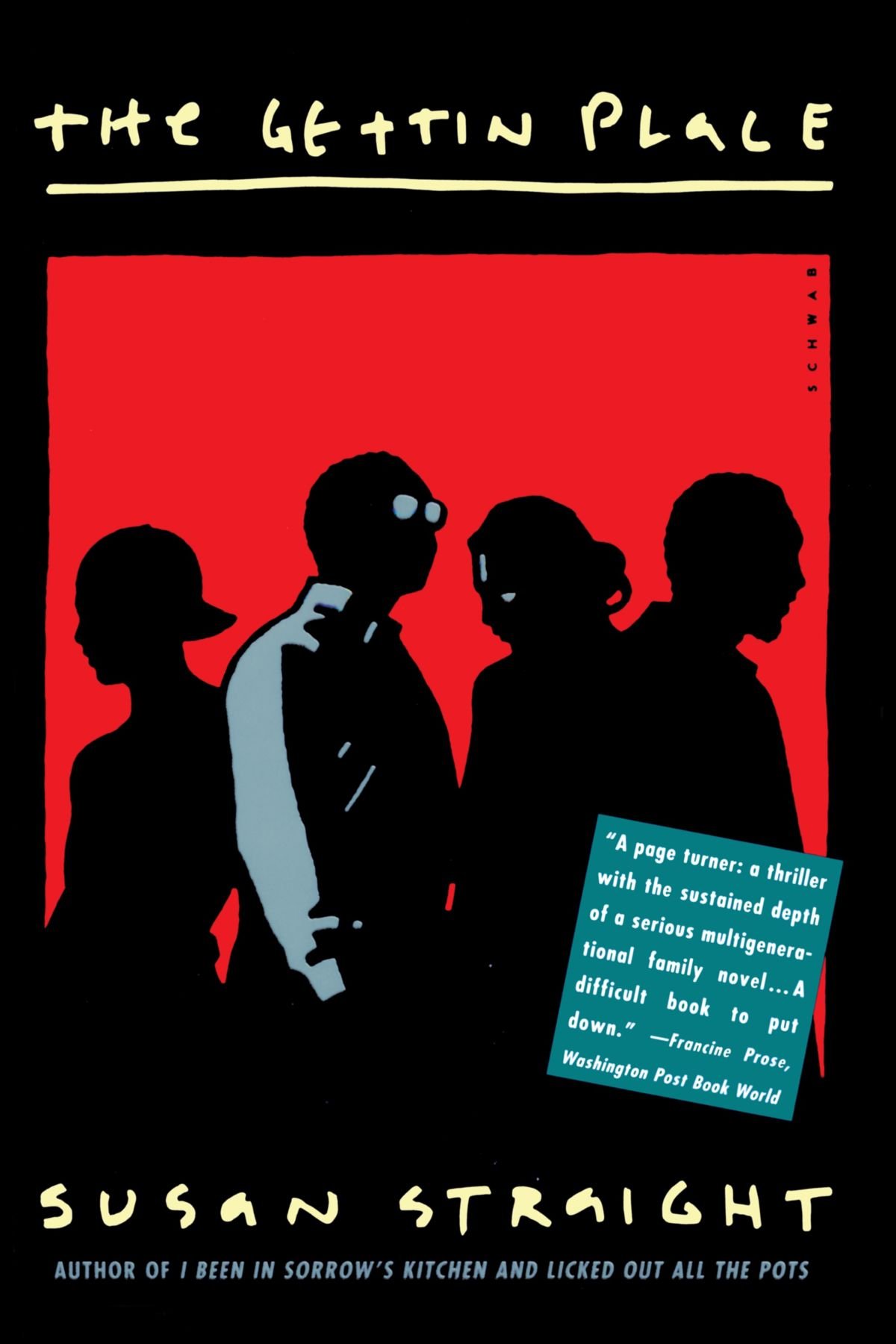
Book Review: The Gettin Place

A Fair Trade Book


Title: The Gettin Place

Author: Susan Straight

Author's web site: www.susanstraight.com

Date: 1996

Publisher: Hyperion

ISBN: 0-7868-6086-3

Length: 488 pages

Quote: “The wafting smell must have been the dream again, the dream of Tulsa burning, the same ashen days he’d been seeing in his sleep for...Seventy years.”

Hosea Thompson survived race riots as a boy in Tulsa. As the riots in Los Angeles start waves of violence through the small towns nearby, he’s not always sure whether he's seeing current reality or post-traumatic-stress flashbacks. He and his wife have bought a small farm in southern California, kept it going, and brought up children and grandchildren. Some of those descendants will die in the course of this novel; some are already dead, and one who’s been missing will come home. Only together will the three generations of Thompsons solve the murder mystery. (The Gettin Place is a novel, but at the center of its plot is a murder mystery.)

The Gettin Place received good reviews. Washington Post’s David Nicholson called it “a triumph,” reading it as “a portrait of a young [B]lack man trying to find his way...with...acceptance of responsibility.” That would presumably be Hosea Thompson’s son Marcus, although he’s not all that young. Marcus’s nephew and student, Mortrice, is also trying to find his way; just because he's a teenager he helps the adults solve the mystery, but his story is hardly triumphant. The story begins and ends with Hosea, but if readers prefer to identify with Marcus and read it as his story, they can. They might even identify with one or more of the women in the family: the Thompson women are as stalwart as their men. The drug culture has reached the Thompsons, leaving one man and one woman with drastic brain damage, but even they are memorable survivors.

One of them has survived a real horror story, which Straight mercifully keeps offstage. The part of the story we read is more than enough. The Ariel Castro news report shows that, yes, hatecrimes against women still occur at this magnitude.

Some of this web site’s readers may like The Gettin Place because the notion of “eminent domain” comes into it, and although Straight wasn't able to give that plot element a really satisfactory ending, at  least she shows us a greedhead land-grabber getting what all greedhead land-grabbers deserve.

Some local readers might ask whether this novel about southern California was a nostalgia trip for me. It wasn’t. I have no sense of nostalgia about any part of California, and don’t remember the southern part well enough to say how well Straight brings that landscape to life—although she certainly brings a landscape to life, and convinces me that she’s writing about a place where she’s actually lived and known people. The story, however, strikes lots of ideological resonances with me. Strong women seek freedom from oppression beside, and together with, their men. One of those men even overtly separates himself from “landless boys” who’ve failed to learn responsibility. Land should be passed down through a family, not bought up and “redeveloped” by greedheads. Natural beauty and honest work do more than psychology or psychiatry to help people with traumatic stress. Teenagers who reject family ties in favor of “peer-group relationships" get stabbed in the back—in Mortrice’s case, literally shot in the back (he survives, that time).

This is an “adult,” in the sense of “adolescent-mentality-bait,” or R-rated, novel with lots of violence, digusting language, at least three offstage rapes, and an onstage relationship that includes premarital sexual intercourse. Gritty contemporary reality, here. We’re not told whether the Thompsons consider themselves christian but there’s little evidence of specifically religious influence on their lives. nevertheless, the healthier Thompsons do take a good solid stand for traditional values, including sobriety—and loyalty to the family members who fail to uphold those values. If you like either Ishmael Reed or Alice Walker, you’ll consider The Gettin Place a feel-good book.

Still undecided? Check out her web site, and consider buying her new books as new books, by all means. This web site's Fair Trade Books program promotes older books and sends 10% of their price to the writers or their favorite charities, as a gesture of encouragement...but buying writers' new books is even more encouraging. Anyway, The Gettin Place is A Fair Trade Book: when you send $5 per book, $5 per package, plus $1 per online payment, via U.S. postal money order to Boxholder, P.O. Box 322, or via Paypal to the address you get from Salolianigodagewi, as shown at the very bottom the screen (whew!), we send $1 to Straight or the charity of her choice. One more book of similar size will fit into the $5 package; if it's Been in Sorrow's  Kitchen we'll send $2 to Straight or her charity.

Monday, January 8, 2018

Book Review: The House of Thirty Cats

A Book You Can Buy From Me

Book Title: The House of Thirty Cats

Author: Mary Calhoun

Date: 1965, 1970

Publisher: Harper & Row (1965), Pocket Books (1970)

Length: 214 pages

ISBN: 067142064X

Illustrations: pencil drawings by Mary Chalmers

Quote: "You can still have a house of many cats!"

Once upon a saner time, back when I was a child, this sweet little children's story was the complete guide to owning cats, helping cat hoarders, and dealing with cat haters. What's changed is that too many people failed to read the book, and too many communities listened to the cat haters.

Miss Tabitha Henshaw is a kind old lady who's getting just slightly "strange" after years of living alone and feeding stray cats. About thirty of the cats are pets, although only three old ones and the mothers of new kittens live in the house.

Only one cat is a troublemaker, and although today any vet would recommend neutering as the cure for all his personality defects, Miss Tabitha can only try to modify his behavior with love and indulgence. This leads to fights, detonates the cat hater, and motivates the town council to decide that Miss Tabitha must relocate the cats or let them be put down.

Sarah, the child heroine, tries hard to place cats with compatible people. (Her forming friendships with different kinds of people in her community is the real focus of the story.) In the end, however, the neighbors realize that the best thing for everyone is to leave Miss Tabitha and her cats in peace, especially now that they have human friends of all ages committed to keeping a neighborly eye on Miss Tabitha.

This book is warmly recommended--not only as a memory of the way Americans used to behave, but as a vision of the way we could and should behave now. Non-interference, rather than trying to make other people fit into our idea of well-being, is the key to peace.

(Pause for squeals from the Humane Pet Genocide Society: "Ooohhh, ooohhh, but those cats haven't been surgically sterilized!" The position of this web site is that there are valid medical reasons why cats should be sterilized. We regretfully remember a Cat Sanctuary that had forty cats, almost all adoptable, unaltered and living in and around one house. That's overcrowding--and we watched all of the adoptable, overcrowded, vulnerable cats succumb to an infectious disease. Overcrowded cats, like Miss Tabitha's, can benefit from a little herd-thinning by adoption and selective sterilization. However, we believe that across-the-board surgical sterilization is a valid plan, not for any natural animal, but only for cat haters.)

To buy it online, send $5 for the book, $5 for shipping, $1 per online payment, and Mary Calhoun (still living, according to the Harper web page) or her favorite charity will receive $1. (Yes, many people who are 91 years old still have favorite charities.) You may find a better bargain on Amazon but other dealers won't be paying Calhoun. I wasn't able to open what's alleged to be her web page; that means that payment will have to be forwarded from Harper via real mail, which will take longer, unless somebody out there can find her online.

Wednesday, June 3, 2015

Morgan Griffith: It's About the Constitution

From U.S. Representative Morgan Griffith's E-Newsletter:

"It’s About the Constitution

The Constitution – Still Relevant

The Senate debate on collecting all our phone data has been interesting.  Hopefully the American people have a better understanding of their rights and of the importance of the Congressional power to check the Executive branch.
Government Control of Water – An Update

On May 27, the Obama Administration announced it had finalized its Clean Water Rule, commonly known as the Waters of the United States (WOTUS) rule.

Proposed by the Environmental Protection Agency (EPA) and the U.S. Army Corps of Engineers, this controversial rule redefines the scope of waters protected under the 
Clean Water Act.  In doing so, it vastly expands EPA’s authority over various wet areas.

According to 
U.S. News and World Report, “The Clean Water Rule reportedly upholds exemptions for agriculture.  However, some tributaries that may be dry for prolonged periods but feed larger waterways when flooded will be covered by the new rule, federal officials said.”

In other words, a dry branch that only gets water during a gully washer or a spot in your yard that gets squishy during “prolonged” rain could now be subject to EPA regulation and control.

Many mines are being shuttered, and now the EPA wants to control our land as well.  It is my opinion this taking, if not paid for by the federal government, is 
unconstitutional.”

Also, it should be noted the American Farm Bureau Federation says the changes to the final rule are little more than window dressing.

Others share my concerns.  Last May, I joined 230 Members of Congress from both sides of the aisle in urging the EPA and the Army Corps of Engineers to withdraw their overreaching WOTUS rule.  More recently, on May 12 of this year, the House of Representatives passed the 
Regulatory Integrity Protection Act (H.R. 1732), which would require the EPA to withdraw this rule.  I supported this bill, as did 24 House Democrats.  Additionally, 3 Democrat Senators have joined 27 Republican Senators in signing on in support of a different bill that also would restrict the WOTUS rule.

I remain opposed to the WOTUS rule, and will continue working to fight this and other overreaching EPA actions.
The Constitution and Obamacare – An Update

Last week, a U.S. judge held the first major hearing regarding the lawsuit brought about by my colleagues and I in the House involving Administration actions in the implementation of the Obamacare health care law.  We believe the Administration has unlawfully bypassed Congress while implementing Obamacare.  As 
Reuters notes, “At issue are executive changes authorizing Treasury payments to healthcare insurers without the funding being agreed by Congress and delaying implementation of the law's employer mandate, which required employers with more than 50 employees to provide healthcare coverage.”

The Administration last week argued this lawsuit should be dismissed, contending the House lacks standing to sue.  “So it is your position that if the House of Representatives affirmatively voted not to fund something ... then that vote can be ignored by the administration, because after all, no one can sue them?” asked Judge Rosemary Collyer of the U.S. District Court for the District of Columbia.  “I want you to explain ... why it's not an insult to the Constitution?,” she also said.

Judge Collyer had not decided on the standing issue before her last week, nor did she say when she expects to rule.  Regardless, as a Member of the House of Representatives, it is my sworn duty to protect the rights and freedoms afforded us by our Constitution, and to steadfastly defend our system of checks and balances.  It doesn’t matter whether I like the law or whether the President likes the law.  Once passed by Congress and signed into law, it is the President’s job to faithfully execute the law unless changed by Congress.
A Government Gun Registration List?

More than two thousand bills have been introduced this Congress.  Some of these bills might earn my support.  Others I would certainly oppose.

Consider the recently-introduced 
Firearm Risk Protection Act (H.R. 2546).  According to the Washington Times, “…The Firearm Risk Protection Act would subject gun owners to a $10,000 fine if they ignored a mandate for liability insurance before obtaining a weapon, The Hill reported Friday.”

This bill is a backdoor way of creating an 
unconstitutional” government gun registration list.  Put simply, I would strongly oppose and fight against this legislation.

If you have questions, concerns, or comments, feel free to contact my office.  You can call my Abingdon office at 276-525-1405 or my Christiansburg office at 540-381-5671.  To reach my office via email, please visit my website at www.morgangriffith.house.gov.  Also on my website is the latest material from my office, including information on votes recently taken on the floor of the House of Representatives."