Wednesday, January 6, 2021

Fix Facts First: Feelings Follow

In the 1990s a series of books about how "men" were supposedly interested in the facts of a situation, while "women" were only interested in their emotional feelings about it, was madly popular. I found the popularity of those books hard to believe. I picked one of them up, read the writer's explanation of how he won a typical argument with his wife, and expected to read that his wife had moved across the continent and taken out a restraining order to keep him from ever speaking to her again. 

From time to time it surprises me when I talk to a woman who does like to blather about her emotional moods, regularly, even when what she's emotional about isn't even Romantic Love. I know a few men like that and I know a few women like that but it's obvious to me that this interest in naming emotions is not an attribute of "women." It is not produced by sex hormones. It is a learned social behavior. 

For an honest discussion of the possibilities, in a large group of educated people (mostly but not all women), I've found none better than the one that started on Live Journal at https://ozarque.livejournal.com/532409.html?view=comments#comments and went on for several days thereafter.

The blogger known as Ozarque posted a link to an article in Oprah Winfrey's magazine in which a young woman, describing how she'd learned not to talk about her own emotions, self-identified as "suffering from empathy deficit disorder" and described herself consciously practicing asking her friends about their emotions after having made a flippant, insensitive reply to a dear friend.

It would interest me very much to read my readers' reactions to Amanda Robb's article and/or any of the comments on it at ozarque.livejournal.com. 


Though it's obviously correlated less with actual sex than with society's gender stereotypes, the question of how we typically respond to friends' expressions of emotions is part of the Myers-Briggs personality descriptions. "You should be grateful for an offer like that!" is the extreme TJ reaction to the friend who's having mixed feelings about being offered a high-salaried job the friend doesn't want. "But I sense that you're not completely happy with that offer?" is the extreme FP reaction. 

For whatever reason--I suspect it's because one of the "dimensions of personality" Myers and Briggs measured is physically predetermined, and the other three are learned--I've only been able to claim one letter on the Myers-Briggs personality chart. I am at least a solid Introvert. I alternate between Sensing and iNtuitive, Thinking and Feeling, Judging and Perceiving, in different situations, enough that I've never been able to identify with one side of those distinctions more than the other. 

One preference I do have, though, is for not wasting any time blathering about what people are "feeling" about situations that call for changes or responses in the real objective world. 

Part of the reason for this probably has something to do with the way, obviously an oldfashioned way, I primarily understand and use the words "sympathy" and "empathy." Any recent dictionary will tell you that empathy is the ability to understand that other people have feelings, even sensations of pain when their fingers are bitten, which babies don't have but children gradually develop around age ten or twelve. (People want to believe their children are developing empathy earlier than that; most people are wrong.) But when I was learning to read, "empathy" was a bit of a neologism, an awkward new coinage used mostly by psychologists in clumsy explanations of how they didn't feel any sympathy for the convicted criminal, etc., etc., but they were able to wield the professional skill (or tool) they called "empathy," which allowed them to believe that he felt some sort of thing and thus understand him better than the people screaming that the criminal had no feelings. You didn't want people feeling "empathy" for you. If you noticed someone seeming to be exercising "empathy" in a conversation with you, that was proof that he was an enemy, and justification for anything you did to block his manipulative plans.
"Empathy" is a much nicer word than it used to be.

"Sympathy," on the other hand, never really changed but it seems to be less favorably perceived than it used to be. Sympathy is feeling someone else's pain, at least in a theoretical way, whether because you really have a sentimental belief that you will (or ought to) bleed if your friend is cut, or because you have an interest in your political ally's success, or anything between those extremes. This used to be considered mostly a good thing, even when "sympathy" was used in figurative ways like the Luscher Color Test's instructions to "choose the color you feel the most sympathy with." It seems to be more cynically perceived now. 

Like most Highly Sensory-Perceptive people I feel sympathy, easily and often. I think of the pena ajena I felt while my husband was watching for news of his friends in New York in September, 2001. I tried watching the news with him for about an hour, but during the fifth replay of the footage on which the person in the orange jacket ran out choking and collapsed on the pavement I said, "If we can't do anything to help those people, we can at least not look!" I think that's probably a diagnostic example of how HSP introverts express sympathy. 

Though being HSP introverts does not absolutely guarantee that people will be nice; the flip side of the capacity to feel pena ajena, pain of others, is the capacity to feel Schadenfreude and enjoy the thought of other people's suffering. I don't remember positively relishing the idea of Saddam Hussein being hanged or Osama bin Laden being shot, but I have always chortled at the joke where bin Laden wakes up in the afterlife and finds himself in the custody of seventy large, indignant Virginians.

As a middle-sized child, beginning to develop empathy, I remember verbalizing the sympathy I really felt for a visiting relative. "Poor Aunt A, it's too bad that after waiting all year to go on that hike she sprained her ankle in the first hundred yards." I remember being told by my Drill Sergeant Dad, "Yes, it is too bad, but don't keep talking about it the way Aunt B and stupid people like her do--it only makes things worse!" I remember thinking about that. I don't remember feeling moved to repeat words about the reasons why other people were obviously not happy, again. 

In the psychological jargon of my youth this kind of experience was puffed up into WOUNDedness, and efforts were made to get everybody emoting about how HORribly that SENsitive INNOCENT CHILD they used to be had been HUUUURT by those COLD, unCARing...and at that point I used to have reactions like "Oh, sit on it." I was not the one who was wounded on the day Aunt A sprained her ankle. Aunt A was. Aunt A was another cheerful practical adult who focussed on the facts rather than wailing about her feelings. My father was the way the Army used to want sergeants to be, which wasn't always the way anyone else wanted anybody to be; he could be verbally abusive but on that day he was helpfully explaining how I could avoid aggravating Aunt A's distress. As a young woman I didn't like Dad, but I hadn't noticed any of the people who were so judgmental about his ways of thinking and talking loading up bundles of clothes and furniture for the family whose house had burned down, either.

This kind of impasse was neither scientific nor therapeutic so, in the 1990s, Daniel Goleman's Emotional Intelligence offered a great improvement in our collective understanding of how people process their emotional reactions. When we cry or rage or do little happy dances, different neurons in our brains are firing than when we sit down calmly and plan our response to a situation. Different emotional reactions activate different neurological circuits, which are probably not exactly the same for any two people, but generally the left frontal lobe of the brain is involved in calm planning, while the right side of the brain is more involved in emoting. 


So we have the phenomenon of people not actually feeling an emotion at all, even when they react to things that seem as if they would cause some sort of emotional reaction. There may even be a low-grade physical stress reaction, but, on a brain scan, the part of the brain that "feels angry" or "feels afraid" is not activated by the thing the person denies feeling angry or frightened about. Sometimes this ability not to feel inconvenient emotions is positively desired, and conditioned by systematic desensitization.

Being a child of the 1960s, I grew up feeling, all right, and fully in touch with my feelings, no inhibitions about crying or swearing or doing happy dances, but also understanding that "maturity" and "intelligence" had a lot to do with the ability to think through situations rather than wallow in mere feelings about them. 

Some situations have no solutions, like bereavement. When loved ones die I think nature intended us to cry. Daily, if that feels appropriate. Real tears, bellowing and howling, if those feel appropriate. 

Other situations do have solutions and, although it's hard to blame people who feel sad or scared or angry or frustrated or whatever when they find that a door is locked, it's also hard to see any benefit in acting out or talking about such emotions when we can just insert the key. 

Drill Sergeant Dad was more vocal about it than Mother was, but actually both of my parents had nice healthy Thinking, Judging, and Acting reactions to many of the situations that left other people their age bogged down in Feeling. All the older people I wanted to be like seemed to have such reactions, when I was growing up. Babies cried outside doors. Adults found keys. 

I don't remember being hurt or wounded or punished for having been a baby. I do remember that, like all healthy children, I wanted to be more like an adult and less like a baby every day. My experience thus consisted of positive rewards, from myself and others, for strategizing rather than agonizing. If nothing else, when I thought rather than emoted, I had the pleasure of feeling more mature, which is always a nice reward for a child.

It was heartening to see the comments in the Live Journal discussion from other women who are as old as I am or older, were exposed to more sexist stereotyping, and still had never been taught whatever it is that allegedly allows some women to feel "validated" when people sit down and talk about their little emotional feelings. 

I can't imagine what that would even feel like. "I was offered a job I don't really want." "I was fired from a job I don't really need." "I've been awarded a trip to Europe." If I were the one saying each of those things, I'd want a sympathetic friend to ask, "So what are you going to do?" I'd probably be talking to this friend because person had some sort of relevant experience, or could give me more information to use in deciding what to do. I might say "What would you do?" I might say, "I don't know--it depends partly on whether X is still required for..." I do not want to waste a single minute repeating words like "sad, glad, mad." 

In a large number of situations where people have wanted to deflect a more useful conversation to a useless exchange about emotional feelings, what I was feeling was fully justified dissatisfaction with them and their work. Attention all employees: if someone is dissatisfied with your work, you should not say "I know you're feeling..." It is not your place to think about what the customer might be feeling! Bleep you think you are?! You work for a company that packs two different right shoes in different sizes in a box where a matched pair ought to be! Stop distracting yourself with presumptuous fantasies about being some kind of psychotherapist and put your mind, such as it is, on your job

Then there's the situation where the person--stereotypically this person would be Japanese--is pretending to feel such terror of disturbing my feelings that person really does disturb my feelings. I do not really mind being told that the table that seats eight has already been reserved for lunch today. I would obviously prefer that it be available, but if it's not, so what? We eat somewhere else today; we visit your restaurant some other time. I find it very annoying when someone backs and fills and stalls as if I were the Lord High Executioner. I start to wish I really could order that person's head cut off. The table is already reserved or it isn't, but trying to "soften" the news that it is reserved comes across as "I'm really ashamed of my dishonesty but I don't think you're 'important' enough to deserve a reservation." Even in Japan, all cultures have unhelpful aspects, and evasiveness is one of them.

C.S. Lewis knew people, presumably in the philosophy department at the university, who sat around scrutinizing their own happiness until they realized they weren't feeling happy any more. This is possible, if we are foolish enough to sit down and scrutinize happiness. 


Self-consciousness, obsession with me-me-me and my little feelings, is never a very pleasant thing to feel. Self-consciousness takes away enough of a really pleasant feeling to spoil it, but adds enough to an unpleasant feeling to make the unpleasantness spill over. Suppose I'm waiting for a bus; say, a Metrobus in Prince Georges County, Maryland. This is moderately unpleasant because the bus routes in Prince Georges County cross railroad tracks; since the trains no longer run on schedules, no more can the buses, and so nobody in Prince Georges County can be assured of making a connection or getting to work on time. This unpleasantness has annoyed people, not enough to make them build bridges over the railroad tracks, but enough to make them look for places to live other than Prince Georges County, for many years. To think that two and two are four, and neither five nor three, the heart of man has long been sore and long 'tis like to be. I must have some reason for being in Prince Georges County; nobody would be there without some reason. Dissatisfaction with a fundamental aspect of Prince Georges County is the sort of thing that might produce some subliminal level of irritation, for me. My blood pressure is not hypertensive but it might be a few points higher than usual. I'm not howling and gnashing my teeth but a wrinkle in my forehead might be more conspicuous than usual. Or it might not. I don't really mind this level of dissatisfaction because, if left alone, it will soon pass. But suppose you are the kind of horrible person who never leaves these things alone, and you plop down on the bench beside me gushing, "Smi-yul! What's wroooong? You look so unhappy." Presto! I'm unhappy all right--about people who let their idiot relatives roam in public. I'm not even wasting a glance on you. "Police? A person is harassing me at the bus stop..." 

Here are some tips that might help people who feel tempted to tell other people that they look a certain way: 

1. The body cannot give a false message. The body does not, however, stick to one topic. If it looks to you as if someone is feeling something they're not verbally expressing to you, it can be healthy to assume that what they're feeling is some sort of physical reaction or process you don't want to know about. It may even have something to do with the literal meanings of the S-word or the F-word. You need to understand that most of the things other people feel are Not About You.

2. If you keep probing lower levels of the human mind, as Freud told us long ago, you get to a repressed unconscious desire to kill everyone of the same sex and make babies with everyone of the opposite sex. Many think it's possible to probe even lower than that and get to an unarticulated desire to kill everyone, though some think the mind, at this level, does not think beyond the person immediately in front of the face. Do not probe for hidden motives. Probing may lead you to the urge-to-kill level faster than you expected, especially if you were hoping for the urge-to-make-babies. Surface-level communication is good. Accept the answers you get on the surface level.

3. If you find the way you think people look interfering with your ability to hear what they say, try doing your talking by phone. You get more relevant nonverbal cues from listening to the voice than you get from looking at the face. 

4. When people worry about the emotional moods of other people (who are not actively venting emotional moods on them, not bellowing that it's all their fault, e.g.), the bottom line is selfish. It is "I want to feel more reassurance that this person liiikes me." Some people claim to find this endearing, although some of those people also enjoy being sadistic about it, making the insecure person work for crumbs of reassurance. Personally, I find it tedious. If your own internal sense of your relationship with your Maker does not give you a solid sense that you have a right to exist in this world, possibly you do not have one, though more likely you only feel that way because you're feeling guilty about something you did, possibly manipulating and cheating someone. Whatever. Work out your own sense of self-worth somewhere else. 

"But I want to be closer to people, to get to know them on a deeper level. I don't feel satisfied by just doing a job and getting paid, just passively and negatively not being a bad neighbor. I want intimacy in my life." The only way to get intimacy in your life is to build close long-term intimate relationships with specific, selected people. These relationships are not based on "You're so attractive" or "You're single, so you ought to feel as lonely as I do" or "You're not in my social clique, so I feel sorry for you." They are based on the trust you've built up by doing things together for years. The fact that you're pushing for more intimacy is off-putting and likely to prevent that intimacy from ever developing in a relationship with me. Possibly you can, however, deepen your relationship with a family member or an old friend who has already found some reason to care about you. 

Some of the examples the Live Journal bloggers offered seem especially counterproductive. One commenter mentioned "'Are you upset?' when I'm visibly upset." Ick. In my vocabulary, emotions can be irked, annoyed, peeved, miffed, irritated, aggravated, and other things that stop short of real anger; although, in my vocabulary, anger is a natural emotion more often than it's a Deadly Sin. People might just be angry if they've missed the bus. 

For some people, I know, it's the other way round. Some people have been taught that we should only say "angry" when the natural emotion has been encouraged to grow into the Deadly Sin. I was taught that the people who only ever admit feeling annoyed when the bus is late, because if they were angry they'd be running for office on a platform that left room for the introduction of laws requiring that bus drivers who don't comply with schedules must be shot, are practicing dishonesty. I suppose they might be considered honest within a social group where everybody used words that way, and hypothetically such a group might exist, somewhere.

Anyway, in my vocabulary, what are upset are apple carts, stacks of cans in stores' displays, houses of cards, sometimes tables, often plans, and quite often stomachs. A person might be described as "upset" after a collision, or an earthquake. People standing on their own feet are not "upset" except, by extension, when their stomachs are. So "upset" doesn't mean "annoyed"; it means "nauseated." I can picture the blogger waiting for a bus in Prince Georges County, Maryland, and feeling annoyed because the blogger has lived in places where buses ran on schedules. Up comes the blogger's tiresome friend asking "Are you upset?" and I think of a certain early Stephen King movie...I've never actually felt able to answer "Are you upset?" properly, but I'd cheer if the blogger could. People who say things like "Are you upset?" deserve to have other people's breakfasts dripping down their shirts.

Supposing we can set aside "upset" as strictly a linguistic concern, another serious reason why we should never, never, never poke at people's unstated "feelings" is that most rational adults feel quite a number of emotions on which we don't act. We feel that the animal that attacked the smaller animal deserves to be roasted alive over a slow fire; we think that the more aggressive animal might do better as someone else's only pet, and put it up for adoption. We feel that it might be fun to drive away in that car that doesn't belong to us, eat that high-calorie food, sleep all day and worry about the job we were supposed to do today some other time, and all kinds of things that we think would not actually be fun in real life. The only purpose of poking at such "feelings" is to aggravate them. The person who aggravates the anger, envy, avarice, lust, sloth, gluttony, or arrogance into which these "feelings" might lead us is our own personal Satan, our spiritual enemy, and needs to be firmly rebuked and cast out.

The question then becomes whether we should, or whether I believe we should, give people opportunities to talk about the emotions they do want to talk about. Some feelings do deserve to be shared and communicated. Feelings of annoyance and dissatisfaction are less likely to grow into a Deadly Sin when they can be quickly communicated, acted on, and resolved, when the cause of dissatisfaction is removed. Among people whose grief is neither overwhelming nor unbearable, sharing memories of a departed friend seems to help us feel that we have "said goodbye." Reminiscing, generally, is informative and entertaining. It might be beneficial if more of us talked more about feelings of admiration, affection, topophilia, gratitude, or public spirit than we do. The case for talking about feelings seems hardest to make with regard to feelings of worry and anxiety, but even then, at some times, for some people, talking about really silly fears and worries can help people see how groundless their fears are, and overcome them. 

Personally, I'm not so firmly committed to the TJ side of things that I'm not willing to listen when people want to talk about their feelings. I just don't want to poke. If people really want to talk about the mix of emotions they feel for their loved ones, Romantic Love or the love of grandchildren, few people have been made artificially ashamed of feeling that sort of thing, and most people will talk about that kind of feelings if they're not firmly discouraged. This can hardly be the kind of feelings Amanda Robb thinks she ought to encourage her friends to talk about. No; what she found herself feeling relieved when a therapist encouraged her to talk about were feelings of insecurity, inadequacy, confusion, childishness--the sort of thing that may offer some sense of relief to the person talking about them, but rarely if ever offer any effective solution to any problem.

Sometimes I indulge people who want to blather about that sort of feelings. Usually I prefer to help them move through that state of mind as quickly as possible, because it is not a useful state of mind. 

Highly Sensitive People are, of course, emotional, by definition. We feel intense, rich, complicated emotions. We do not, however, share the curious belief that emotions need to be "validated" by anyone other than the person feeling them. Really interesting emotions might deserve some solitary reflection. Emotions about behavior someone else needs to change might be worth expressing to that person. Otherwise, an interesting conversation might include expressions of emotion, but would not be about the emotion. 

I can, however, understand why some bloggers had harsh things to say about Amanda Robb's un-empathetic reactions, as described by her. "I've been fired."--"Wow, you'll have a great story to tell at the party..." ??? 

I can understand the Totally Unsympathetic Response or Lack of One as a way to create more emotional distance from a person one really doesn't consider a friend. "I'm in love with you! I'll die of a broken heart!"--"That's nice." 

I think I would at least check the facts before assuming that a friend worth keeping thought losing a job would make a good story. That's empathy, as defined in modern dictionaries: the ability to imagine that the friend might be feeling pain, using my mirror neurons. But I can also imagine that, if this person is someone I really enjoy having as a friend, person might want some time for quiet reflection before going to the silly party. What's hard for me to imagine is whether, or how, person might want to be "therapized" with what I'd consider idle and tedious questions like "How do you feeeel about that?" 

For me, empathy at least begins with catching myself starting to say something like, "So, I heard you were shipwrecked and had to paddle a lifeboat with two young children in it for thirty-eight hours before you were rescued!" and toning it down to, "So, do you have stories to tell about your year in the South Sea Islands?" Person may want to spend time saying things like "...and then I felt thrilled because we'd been rescued, and eager to get back home, and tired like I've never been before, but also I felt sort of embarrassed when they gave me an official island name that means 'Captain'..." Then again, person may not. 

It's only in Writing and Editing Mode, when I see the "She looked out the window and felt..." kind of thing, that I suggest replacing all the descriptions of "feelings" with concrete actions that communicate the "feelings" to the reader. 

Non-HSPs tend to like to believe that our mirror neurons are reliably mirroring the same thing other people are feeling. The mirror neurons exist; there are apparently some people for whom they don't work efficiently, but for HSPs they do. We can hardly watch an actor pretending to have an injured knee without feeling some stiffness in our own legs, or else some harsh judgment of the actor. Learning to lower the intensity of the emotional signals, work through those left frontal lobes, is one way we cope with what some "total empaths" claim is an overwhelming burden of emotional input from other people.

What we, as well as they, often need to learn is that in spite of the general patterns our mirror neurons recognize, we really don't and can't know what other people feel. Everybody has a reasonably similar set of muscles in the back, for example, and everybody feels great inconvenience if one of those muscles is damaged. Everybody does not, however, feel that inconvenience through the same kind and number of sensory neurons. If you touch a non-HSP's back and ask the person how many of your fingertips are touching per skin, most non-HSPs have almost no idea at all. HSPs feel each fingertip separately even when two fingers are close together. HSPs have more nerve endings, in the back and everywhere else. 

This "extra" sensitivity helps HSPs work through and around some kinds of difficulties that disable non-HSPs and can produce a certain insensitivity... "She's never known any kind of pain worse than childbirth," wails the HSP blogger as a friend prepares for surgery. "It's only thirty-five miles!" growls the HSP employer whose employee's car can't be driven home. "My knee hurt, but I wanted to stay in the game," recalls the HSP athlete, "and now they tell me the kneecap's broken." Non-HSPs literally have no idea how it feels to be able to breathe their way through childbirth or play the last quarter of the game on an injured leg. They're missing some of the nerves we use to control muscles and blood flow, to reduce our perception of pain, which is still intense. When non-HSPs recover from illnesses and injuries they're not able to participate consciously in their own healing process. Even when we tell them about meditating to get our blood pressure down or breath control to work through pain, they do not and probably cannot understand. 

We do not, in fact, feel the same things. When non-HSPs and HSPs are exposed to the same stimulus, one feel "pressure on the back" and the other feels "three fingers pressing into the flesh around the inner angle of the left scapula." One sees "a line of fine print" or "a grey blur at the bottom of the page," and the other sees "Copyright Brand X Inc. 1992." 

Now about that terribly important "feeling" non-HSPs are probably really thinking about no matter how many other feelings they have to talk about to get there: I, personally, don't liiike them. Never have, never will. They shouldn't have wasted their time. There. I may care about them, wish them well, do what I can to help them, but I do not like the behavior of blathering about "feelings" nor has it ever led to a feeling that the people who do it are like me in any way. Fellow HSPs' perceptions are different one from another's, too, but for me it's been easier to live or work with blind HSPs than with non-HSPs.

And in some cases it's been easier to communicate with a dog. The proportion of experiences or of "feelings" dogs and humans can share is a small one. Still, at least dogs accept that humans are not dogs, and were never meant to be dogs. This makes dogs much more lovable than the sort of non-HSPs who can only bond with friends by "sharing all the same feelings." 

The myth that all humans have the same feelings and can bond by sharing them was very important to some religious groups (and substitute-for-religious groups, especially in psychotherapy) in the late twentieth century. It is not, however, supported by facts. What it's led to has been the neurological research that has determined that we do not, in fact, feel the same things. So not only does "talking about feelings" not unify humankind, but it can become a trigger for envy and resentment. 

Which is why most of my Zazzle designs feature the motto that's been the most helpful single saying I've used in my lifetime:

FIX FACTS FIRST: FEELINGS FOLLOW. 

Whether or not people are able to share or understand each other's emotional feelings, most of the really uncomfortable ones have to do with facts in the real world that almost everyone can agree that we perceive. This means that, when the facts of the situation have been changed so that everyone is satisfied, the unpleasant feelings just disappear. 

Google and Zazzle aren't getting along too well at the moment so I'm not even going to try to upload any of the official Zazzle images of my "Fix Facts First" Collection. Click here: 


These designs weren't meant to be beautiful; they were meant to help remind the people around us not to bog down in unhelpful discussions of the feelings people have about the facts they want to change.
Post settings
Labels
No matching suggestions

Eighties Sweaters Are Back: 1.6. Salish, Canadian, North American

The last major ethnic traditional influence on 1980s knitting is the development the traditional gansey took on the coast of British Columbia. (Though Eighties knitting was fascinated with ethnic traditional textiles generally, and books about knitting in Peru, China, and Japan were also published, the remaining installments in this series will discuss "new" influences on 1980s knitting.) In the nineteenth century a mission school teacher from Scotland showed her students how to knit ganseys. They learned the general idea from her and proceeded to reinvent it into a radically different type of jacket, soon to be known as "the Indian Sweater" (according to one Canadian poet, "No garment suits us better / For working in the cold") or, more generally, the Canadian sweater.

What made these sweaters "Indian"? 

a. Since they weren't made in India they might be more properly described as Salish or Cowichan. What makes a sweater really Salish or Cowichan is having been designed and knitted by a member of that ethnic group. 

b. The Salish and Cowichan people were accustomed to dressing in fur and leather, and did not share the British idea that sweaters needed to be as "fine" as possible. They knitted super-bulky snowproof sweaters of thick, quickly homespun wool. What mainland knitters seldom copied accurately was the extreme bulk and stiffness of the knitted fabric--on much of the continent, those would have been excessive anyway. A typical Salish sweater was knitted at three stitches to the inch, but from wool that most knitters would have knitted up to two or fewer stitches to the inch.

c. Even the parts of the sweater that didn't contain pictures were sometimes worked in two different yarns to produce that a heavy, snowproof fabric.

d. The authentic "Indian sweaters" were three-color designs: undyed black or brown wool, undyed white wool, and a heathered gray or beige wool made by spinning the white and colored wools together. 

e. Influenced first by traditional totem images and then by what sold to visitors, Salish knitters usually knitted a big picture, usually of an animal, into each jacket. Traditional Salish animal images were stylized rather than realistic; this makes them much easier to reproduce in bulky knitting. Some traditional sweaters featured geometric patterns. 

f. Some Salish sweaters were knitted as pullovers, though few people find them easy to wear indoors. Most opened down the front, and as the technology came onto the market, increasing numbers of Salish sweaters were made with front zippers.

g. Most authentic Salish sweaters also featured a distinctive style of collar. It could be described as a shawl collar but it's much closer around the neck than a typical shawl collar.

Was the Canadian sweater tradition the same thing as the Salish sweater tradition? 

Of course not. As the style spread back east and south, knitters designed their own bulky two-layer jackets, with or without big cartoon-like pictures. Traditional geometric patterns from Fair Isle and Scandinavian knitting were often used. Bulky acrylic, as well as wool and other animal fibres, was so popular that Patons used to call its bulky acrylic yarn "Canadiana." Cotton, which absorbs moisture and thus doesn't turn snow as well as wool or acrylic, was less favored for winter jackets in Canada, but as people got used to the bulky sweater look, cotton pullovers became popular all over North America. 

People who wanted to wear sweaters indoors as fashion statements more than "for working in the cold" tended to prefer that their sweaters not be snowproof, and as the style spread south, knitters were often inspired to make more elaborate, lifelike pictures with lightweight dyed yarn. At this point the category of "Canadian traditional" blurred into the category of "witty knitting," which was also madly popular in the Eighties. Fusion was very much an Eighties thing.


Like most U.S. knitters I've always been attracted to the fact that classic Canadian-type sweaters can be made with cheap, widely available yarn. If that yarn is either Red Heart or Canadiana, the sweaters will never look expensive, but they will look good--for their kind of thing--even if they've been fished out of the lake and machine-laundered, for many years. The only problem is that they are very very warm.

"Save the Whales" was the most distinctly Eighties sweater I ever made. The idea of a picture of an orca bordered by geometric bands is Salish. This particular orca does not have the traditional Salish shape; it was graphed from a photo in England, where the sweater was designed and sold in English wool yarns, and was a large man's size. (Oversized sweaters were an Eighties and Nineties fad.) My contribution was redesigning it in U.S. acrylic yarn to fit a medium woman's size. It passed the test for a Canadian-type sweater: when worn in falling snow, it formed a barrier between the crust of snow that stuck to the outside and the well insulated wearer inside. It also passed the test for an Eighties sweater, with its classic 1980s motif! I will never make another sweater just like this one but I will use other patterns from this collection of Eighties-to-Nineties designs in aid of the original charity...


These picture motifs are from Maine, actually. Pictures (and the chicken-wire stitch on the chicken sweater) were designed by Chellie Pingree. 


Helene Rush published these and many other picture motifs for Maine sweaters while living in Maine. But she was born in Canada. The pictures, like the knitter, have crossed the border many times.


The shape of this square patchwork sweater was actually designed by a Canadian, Ann Bourgeois, and it's a classic, big, snowproof sweater with room for layers of lighter shirts and sweaters underneath. AB knitted her mandalas and I knitted mine. 


(I'm not sure why Blogspot refuses to line pictures up neatly. Of things that bloggers might have hoped would be fixed by all the tweaking and breaking-of-what-never-needed-fixing at this site, I see that this is not one.)

Books to look for

1. Shirley Scott, Canada Knits, is an authoritative study of the history of the Canadian sweater. It is not a pattern book, though published patterns for many of the samples shown are easy to find, or used to be.


2. Patience Horne, Patons Book of Knitting and Crochet, is where to find some of them. Many traditional knitting patterns were circulated by yarn manufacturers; Patons sold a lot of yarn and patterns in Canada, and this book includes some vintage picture knitting patterns. (However, most of the knitted garments are designed to be made with lightweight yarn.)


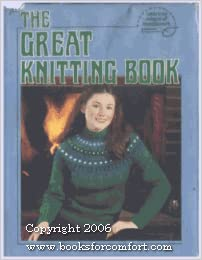
3. American School of Needlework, The Great Knitting Book, includes those iconic Mary Maxim picture knits with the horse and the deer in knit-by-numbers realism. 


4. Priscilla Gibson-Roberts, Salish Indian Sweaters, gives a thorough study of the history of these sweaters, profiles of some currently active knitters, many picture patterns, and detailed instructions for knitting the pictures into your own Salish-inspired garment (or blanket). The book came out in the Nineties but Gibson-Roberts had published articles in magazines, and sample patterns, for this type of sweaters throughout the Eighties.


5. Ann and Eugene Bourgeois, Fairisle Sweaters Simplified. Again, the book was not in stores in the Eighties, but the styles and colors were in the knitting magazines of the Eighties. In this case the wool, the knitters, and the idea of knitting fairisle stitch in chunky wool, are 100% Canadian Content. 


6. Ironically, while Sally Melville may be Canada's best known knitter, she's not known for traditional designs. Though her first full-size book does contain several patterns for snowproof knits with two layers of thick wool and/or acrylic yarn, and some of them even look like waterfowl and maple leaves, SM's knitting has generally explored new or unusual techniques and this book's no exception. Several patterns in this book, including the cover sweater, are designed to be knitted in one color and then inlaid with woven-in contrast colors.


Blogspot is showing me the link but not the book picture. Anyway I'd like to try something new here...Amazon builds collection pages for popular authors. This link should take you to the Sally Melville book collection: https://amzn.to/2XgpQUA .

However...I hate to be a spoilsport, but...serious pattern hoarders will recognize a Sally Melville sweater as something that was still new, if not unique, after the Eighties. The rest of the world will not give a flying flip, of course, but if you were to tell me a SM design was an Eighties Sweater I'd laugh.

7. So, if you'd rather be more authentically Eighties than authentically Canadian...in the Eighties chunky picture knits were also identified with Maine, and relatively small and cheap pattern books printed in Maine and New England were selling well. And they're also becoming hard to find (and, at the moment of typing, to display on Blogspot). Incredibly, Amazon doesn't even show a page for Helene Rush's classic Maine Woods Woollies, sales of which in the mid-Eighties helped convince publishers that knitting pattern books were worth marketing. The two children's sweaters pictured above, with the moose and pine tree motifs, are variations on patterns in Maine Woods Woollies. Amazon does show a page for More Maine Sweaters, the 1987 sequel that applied the same knitted pictures to adult-sized garments, and for Head to Toe, a 1993 collection that applied them to accessories only. 

8. Also popular in the late Eighties, growing into a real industry in the Nineties, was Chellie Pingree's North Island Designs company. The book series began with Maine Island Classics, which includes both the chickens and the boat motif shown above. According to Amazon the whole series is way overdue for reprinting, with most volumes "not available" and three-figure prices for copies of the volumes that are available. 

9. Then there were the Huber family's Country Knits venture. Steve and Carol Huber started out with an antique business that sold Early American textiles. Carol designed sweaters with motifs inspired by their antiques. Most of the sweaters had a standard shape; the interest was all in the colorwork. Though the densely printed books always encouraged knitters to use up whatever scraps they had, the Hubers seemed to work with the Columbia-Minerva yarn company and their business seemed to decline with that company's. Only one of the original four books still has an Amazon page, and the price per copy shows that anyone who's kept a copy in decent condition expects a good profit on it. 

Who knew those rather cheap and flimsy paperback pattern books would become so valuable? Though I'd never pay $700 for one pattern book it is worth mentioning that I once sold a single sweater I'd knitted from a Helene Rush design for $880. 

Book Review: How to Tell the Birds from the Flowers

Book Review: How to Tell the Birds from the Flowers


Author: Robert Williams Wood

Date: 1917 (Dodd Mead), 1959 (Dover)

Publisher: Dodd Mead / Dover

ISBN: 0-486-20523-1

Length: 54 pages

Illustrations: woodcuts (and calligraphy) by the author

Quote: “You never hear the Crocus croak.”

The blurb on the Dover edition tells us that Robert Williams Wood was a leading physicist in his day. By 1959 he had become “the late” Professor Wood, and his daughter’s introduction to the Dover edition describes it as “the simple, whimsical humor that was so characteristic of my father.”

“Simple, whimsical humor” pretty much describes this collection of cartoons and poems that play on the names of various plants, birds, and other animals in this “Manual of Flornithology.” We learn the differences between the Burr and the Bird, the Roc and the Shamrock, the Eel and the Elephant, the Elk and the Whelk, and many other pairs (and one trio) of creatures we would never have thought were much alike before...except that Wood has managed to draw them so that each pair looks sort of alike.

The California Quail is said
To have a tail upon his head,
While contrary-wise we style the Kale,
A cabbage-head upon a tail.
It is not hard to tell the two,
The Quail commences with a queue.

It should go without saying that all the jokes are clean enough to share with your grandmother...except that, if you’re my age and lucky enough to have a living grandmother, she probably remembers them. How to Tell the Birds from the Flowers was a bestseller in its day, reprinted 28 times between 1917 and 1932. Even the parents of people my age probably remember this book. Not that they will necessarily mind having a new copy to share with their grandchildren.

Tuesday, January 5, 2021

Tortie Tuesday: The Cats' Holiday Feasts

Some readers may remember that on Boxing Day I tweeted enthusiastically about going forth to do my duty and buy post-Christmas markdowns. 

This is not, of course, the proper meaning of Boxing Day. 

Boxing Day is officially known as St Stephen's Day. In churches that observe saints' days, it was felt proper to celebrate the first Christian martyr on the day after celebrating the birth of Christ. 

Stephen's story is told in the book of Acts, chapters 6 and 7. He was not the most tactful preacher. Possibly he would have had a longer ministry if he'd stuck to waiting on tables. His speech establishes that he was Jewish, so he knew he was insulting his own tribal elders by identifying them as spiritual "sons" of the sinners who persecuted the Hebrew prophets. Anyway, his vocation of distributing food to poor old people happened to provide a religious association for the old English custom of decluttering the house after receiving presents from friends, by giving things you didn't want to those who had less. 

Up into the nineteenth century it was commonplace for people to have only one overcoat, one pair of shoes, etc., and although working people dressed in layers many had only one complete outfit, at a time. Even in the twentieth century some people still had a custom, when they got a new coat or pair of shoes, to donate the ones they'd been wearing to charity. The day after Christmas was for boxing up and redistributing the goodies or, since most people didn't get new coats every year, just boxing up small gifts and coins for anyone who had less than they had. In London working men and vendors used to make it easier by carrying their own boxes from customer to customer. 

Boxing Day gifts were not exchanged, like Christmas gifts; the transfer of goods was supposed to run only one way. So inevitably arose a sense that things that weren't quite nice enough for Christmas gifts could be bought cheap and given away on Boxing Day. This brings us to the modern observance of Boxing Day in most English-speaking countries as, primarily, a day for marked-down prices, gift returns, and a high volume of small transactions that generally leave merchants richer. People like Scrooge really would notice a lower-paid co-worker like Cratchit approaching and growl, "He wants a Christmas Box."

Sadly, although frugal American shoppers can stock up on half-price sweets and baked goods, toys, "gift" books, calendars, knitted accessories, and wrapping paper, really useful midwinter purchases like portable heaters, Coleman Fuel, rock salt, PVC pipe, and tissues for the holiday flu rarely appear on the Boxing Day sale racks.

Anyway I had called for a car pool, too late, it turned out, to join one going to Kingsport, but not too late to join one coming back from Kingsport, and the Boxing Day revellers had even packed up a bag for me. 

Er-herm.

Harrumph.

There is nothing wrong with giving prezzies to people outside your immediate family, but you will be thanked more sincerely if you make some attempt to find out what they can use. This is not necessarily what has been most deeply discounted on Boxing Day sales. 

Prezzies packed up on the spur of the moment, at a Boxing Day sale, are usually at least a source of honest mirth. Those gloves! In what foreign sweatshop did anyone imagine that that's the size and shape of Americans' hands? Giving the matter some thought, I remembered noticing that one of my richer cousins has hired a driver who has unusual hands--bigger than most of my male relatives' hands, but with shorter, thicker fingers. More than once in the past year the cats and I have seen his odd-shaped hands reaching out to drop off a sack of kibble. If anyone can wear those gloves, he can. Oh well, it may not be usual to give prezzies to your cousins' employees, but I know of nothing in the Bible or the Constitution that forbids it. One only has to be Scroogey enough to warn all the other relatives' employees not to expect anything. This driver has hauled enough heavy things for us to deserve a pair of gloves...if only everyone else he knows hasn't bought all the other pairs for him! Isn't using up the harvest of Boxing Day shopping fun?

Serena, now a much larger and more opinionated version of the sassy kitten shown below...


...and Silver, now also much larger than she was in this baby picture, but still a sweet and obliging junior cat...


...and Sommersburr, whom I am not officially feeding, and who spends only about half the time here, but my cats insist that he's still a Resident Cat and must be fed if he's here at mealtimes...have had quite a merry Christmastide, which is the old traditional word for all the holidays people can celebrate about the end of the year. 

Pre-Christmas charitable fundraising apart, the only one I observe, most years, is New Year's Day. For those who think New Year's Day is celebrated by drinking things that people of Irish and Cherokee origin know Nature intended us to use to clean furniture, here are some things my immediate family often if not always did on this occasion:

* Stay up till midnight to see the new year officially come in.

* Try to eat twelve raisins, separately, chewing each one into at least two separate pieces, while the clock is striking. 

* Blow horns, ring bells, and if children of the appropriate age are involved, dance around waving sparklers, and shout "Happy New Year!" to the world.

* Group hug, sing "Auld Lang Syne," and kiss at least one of the people beside you.

* Those who wake up on time get to choose whether to sing "All Ye Mountains Praise the Lord" right away, or wait until others are fully awake.

* Choose up to ten wishes and/or resolutions (any combination). Try to do something that, in some small symbolic way, represents each one during New Year's Day. This means people go their own ways all day. However...

* At least one person's wishes and/or resolutions will probably include grilling and/or baking something festive.

This year, I have to admit, was not among the more festive ones I've celebrated. Being the oldest living member of the immediate family makes the passage of time suddenly seem less worthy of celebration. I had in mind someone with whom to commiserate about this, and of course, where we live, at this time of year, the sort of warm sunny day when he comes out does not be happening. 

But the cats celebrated.

PK: Cats, if you sang, which I'm glad you don't, would you have a holiday song to sing for these holidays?

Serena: Purr-course!

We wish you a meowy Christmas,
also Boxing Day, also Hanukah,
likewise Festivus, and also Kwanzaa,
and a happy Mew Year.

No need to bother with the Pop-Tarts;
we like crackers, we like sausages;
only the possum likes Pop-Tarts,
and he was not here.

But we did like those little sausages,
likewise peanut butter crackers,
but especially those little sausages;
we could eat those all year.

And the gloves ought to fit the driver,
if he is someone else's driver;
people ought to thank a driver
on holidays, and all year.

And the humans like knitted blankets
better than cheap sweatshop blankets,
meaning cats get that fluffy blanket
when new kittens come here.

And we all love little sausages,
all three of us love little sausages,
but there was only one tin of sausages,
and there are three cats here.

Oh we wish you a sausage fishmas,
and sardine day, and also liverwurst,
likewise Ben & Jerry's Festivus,
and good sausage all year!

Monday, January 4, 2021

Book Review: Tell It Sister Tell It

Title: Tell It Sister Tell It 


Author: Stella Parton

Date: 2011

Publisher: StellaParton.com

ISBN: 0615443141

Length: 222 pages

Illustrations: black-and-white photographs

Quote: "Stella, why not write an inspirational book about your own life?"

As might have been expected, the title of this book has two meanings. It's a line from a gospel song, and Stella Parton's autobiography is a Christian book. It's also a book about being a sister.

Stella Parton's peculiar mix of advantages and disadvantages in life included, most conspicuously, being Dolly Parton's sister. Did that boost her singing career? As she explains in the book, actually, in some ways, it hurt. Even beyond the predictable "They only invited her to sing because she's Dolly Parton's sister so you know her show won't be worth watching." At one point the family worried about having two singers competing against each other, and tried to steer Stella back to waiting tables so she wouldn't compete with Dolly. 

They did grow up singing together--Stella fantasizing about performing with Dolly and another sister as "The Parton Sisters." And they didn't distract attention from their similarities, as John Michael Talbot and Terry Talbot or Loretta Lynn and Crystal Gayle did, by performing in different genres that required different costumes and hairstyles. Life didn't even hand them, as it did Joan Baez and Mimi Farina, all that different vocal qualities. You can tell which Parton sister is singing if you've listened to both of them for a while. Newbies can be excused for mixing them up. Relatives could even be excused for thinking Stella's competition could have hurt Dolly's career.

Well, this is Stella Parton...

https://music.youtube.com/watch?v=MMABXrhw0Ho&list=RDAMVMMMABXrhw0Ho

...and this is Dolly:

https://music.youtube.com/watch?v=LQjMCKq87N0&list=RDAMVMLQjMCKq87N0

Now you know, if you didn't. The sisters look about as much alike as they sound. As a musician's memoir, Tell It Sister Tell It really ought to have a soundtrack, and it does, but the album is sold separately. Just to give people a full range of recording formats, of course.


In addition to lyrics or partial lyrics for the songs, the book contains some reminiscences about the music industry, about Stella Parton's career, about her childhood, and about her son. You expected those. It also contains some plain language about the moral and religious teaching that kept Parton's career ticking steadily along in Dolly Parton's shadow, and some appeals for the causes Parton supports, which would probably have been cut if the book had been published by a conventional press.

In 2012 I didn't go to Parton's book party at the Roberts Family Bakery Cafe. The Roberts Family had not yet invited me to be the scruffy writer in residence so I heard about the party, from someone who had probably stumbled into it at the last minute perself, in a reproachful "A real local interest blogger ought to have gone to that party and bought a book" sort of tone. It took repeated invitations to get me into the cafe: from what I heard, the cafe didn't always have that "free refills on coffee, cream, and sugar" policy. That came after the place had become profitable. Knowing that I'm a slow writer, I didn't feel that Pigeon Forge, Tennessee, is all that local. Still, I do like both Partons' music, so I borrowed a copy and then, finding it a livelier read than the usual celebrity-memoir soap opera, dug up the money to buy one. 

If you think of celebrity memoirs as fluff, you too may be surprised by this one. Publishers urge celebrities to tell all about their dysfunctional relationships, because sex (and violence, if the celebrity can remember any) supposedly sells. Then they urge celebrities not to say anything of any consequence (or interest) about their beliefs or concerns, because that might be too controversial for the celebrity's audience. Never mind the share of the audience who are disgusted by the divorce dramas and might be more interested in the memoirs of celebrities who ever confessed having a serious thought in their heads. 

As a result of this publishing tradition, a lot of celebrity memoirs read as if they'd all been written by one hack writer, which some of them really were. Not this one. There are some expressions of sibling rivalry but the younger sister really starts "telling it" when she discusses sexual predators in the music industry, domestic violence, how it's possible for a Christian to reconcile her faith with singing in nightclubs, disability issues, jealous envy, funerals, miracles, and other things the conventional publishers wouldn't have wanted her to tell us about. 

If you're not going to be shocked to find out that Stella Parton claims homosexual friends, and you don't already have this book, you should get it. Local readers may buy a physical copy from me at the usual discount rates. Others can buy both book and record from Amazon, since they're still "in print" as "new" items, which means Parton gets her share of the profits. 

Sunday, January 3, 2021

Book Review: Wake Up America

Title: Wake Up America


Author: Tony Campolo

Date: 1991

Publisher: Harper Collins

ISBN: 0-06-061302-5

Length: 188 pages

Quote: “Has the spirit of idealism departed from our collective consciousness without our being aware of it?”

Before he wrote this book, Anthony Campolo was a college teacher. I was one of the students who heard his call to us to be "radical Christians," the kind of Christians he studies in this book. It is thanks to his influence on the church in the 1980s that I still describe myself as a radical Christian. 

(This statement of identity is crucial to understanding the political content that sometimes pops up at this blog. Radical Christians are political creatures but our focus is on Christian teaching and practice first, without partisan loyalty to any of our fallible fellow mortals. We support people who are doing what we believe to be the right thing. For some radical Christians that may mean consistently voting for or against one party. For me it does not.)

So much for personal loyalty and gratitude to the author. You want to know about the book. Right.

Although Anthony Campolo’s sixteenth book sold well, many people still quote the title without having read the book. Some are referring to Robert L. Preston's 1973 book, Wake Up America: It's Later Than You Think, or to any of several other new books that have sunk themselves into oblivion by copying the title of a successful earlier book. Preston made "Wake Up, America" a slogan among the people who would later form a political bloc known loosely as the Religious Right. 

And this book might be better placed on the Religious Left. Campolo addresses an audience who were saying, “There must be deep spiritual reasons why democratic capital­ism has won.” In the first chapter he cites the way TV commercials try to appeal to viewers’ emotional needs. He quotes Herbert Marcuse and Martin Luther King; his examples of better ways to meet emotional needs than buying consumer goods include Dietrich Bonhoeffer, Jimmy Carter, and the Liberation Theology movement. Although my impression after reading several of his other books is that Campolo tried to address (and unite) Christians on both “wings,” the only contemporary right-winger who rates honorable mention in this book is Charles Colson.

The comparison that comes to mind, at this point, is with a non-religious, business-oriented book that was also very popular in 1991. The male author claimed to be trying to address, and support and inspire, women in the audience too. I previewed the book at a library and didn’t buy a copy, but as I recall every one of its 250 pages contained at least one quote, and of those quotes only two were ascribed to women authors. Hmm...

Christians occasionally forget that Jesus never belonged to a twentieth-century political party. We don’t really know what He would have said to any twentieth-century political party, because He addressed an audience that had no way to imagine twentieth-century politics. For His audience, monarchy seemed clearly to have won over democracy. No political party owns the spirit of Christ; all parties are equally entitled to try to represent Him. However, the “radical Christians” on the left used to accuse right-wing Christians of acting as if Christianity were all a matter of working out the correct interpretation of doctrine, or at best meditating on Bible texts and contemplating the cosmos, rather than actively doing anything in this world.

In Wake Up America, Campolo doesn’t mention until page 44 that he’s also met people whose theology might be called “conservative,” even fundamentalist, but who have noticed that the Bible tells us more about what Jesus did than about which side He took in the theological debates of the day or how much time He spent in meditation. Jesus did not call all of His disciples to trek around the countryside with Him and the Twelve—a small group of female followers seem to have followed them only on shorter travels in and between a few nearby towns, and older disciples, like the family in Bethany and Joseph of Arimathea, seem to have kept their homes and jobs with Jesus' blessing. But He did call them to do things, beyond just exposing themselves to a sermon once a week.

In Wake Up America, Campolo mentions charitable organizations led by Southern Baptists earlier and more often than he mentions Baptist churches. Descriptions of what these Baptists are doing alternate with descriptions of what left-wingers like the Sojourners are doing. Stories about Mennonites alternate with stories about Nazarenes; stories about Evangelicals alternate with stories about Catholics. Campolo seems to have forgotten his brush with Seventh-Day Adventists, although there are some “radically Christian” S.D.A. too. Campolo does not, however, spell out in this book that he is more concerned with the successes of Christians who’ve “awakened” to the need to act as Jesus acted in this world than with counting how many of the ones he’s met belong to theologically “liberal” and “conservative” denominations. He’s addressing the left side of his audience, perhaps at the right side’s expense.

His stories are, nevertheless, inspiring, and by now it’s an interesting exercise to follow up on the stories he tells. How many of these groups and people are still active after all these years? All of them are, according to their web sites: 

Sojourners: sojo.net

Habitat for Humanity: habitat.org

Deliverance Tabernacle: deliverancetabernacle.org

Evangelical Association for the Promotion of Education: www.tonycampolo.org/eape

Prison Fellowship: prisonfellowship.org

World Vision: worldvision.org

Value of the Person: valueoftheperson.com .

Which ones are best serving Christ, and which have turned aside into political or emotional "work," you may judge. Current reality is that Christian-phobics actively interfere when anything organized as a church offers anything but feel-good blather.

Despite the imperative mood of the title, the text of this book is not imperative. Campolo seems to have deliberately avoided writing anything that could make readers feel as if he were standing in front of them and asking, “What are you doing?” He describes what other people have been doing and how he has reacted to it. If you want encouragement to support someone else’s active ministry or organize one of your own, here it is. There is no “call.” The book ends with observations, not questions or exhortations. If you’re a sociologist reading this book as a sociological or historical study, that’s all the book really demands of you. If you’re a Christian seeking inspiration, you’ll probably feel it. 

Friday, January 1, 2021

Petfinder Links: Beagles

Happy New Year! It's a holiday! It's also a Friday, and it would never do to start the New Year without the Friday Petfinder Post bringing you at least three of the cutest pictures of adoptable animals in the Eastern States. 

Beagles are very lovable dogs. In real life they're neither as big nor as clever as Snoopy was in the "Peanuts" cartoon, but they do seem to be thinking things like "Sometimes it's fun having a cold wet nose" and "I do a lot of complaining but actually I love my home" and "It's supper, super-duper-supper tiiiime!" Most of the time they're gentle, friendly, and cooperative, which is how it's been possible for cats who've lived with me to herd them into cages--that's happened twice! Beagles do not always know what's going on but they're usually willing to play along with your game and find out. This is why it's a good idea to keep them close to you, or securely enclosed when they're not close to you. 

It's possible that some of these beagles and similar small hounds may have been petnapped. This is a concern with shelter animals. There are dotty people, like one who petnapped a kitten from some friends' house in Maryland, who steal someone's pet because they've lost one and then abandon the one they've stolen. Those are rare. There are also Humane Pet Genocide Society zealots who deliberately entice animals away from loving homes because, in their confused minds, all domestic animals ought to be kept indoors. Those are more of a problem in my part of the world. Finding out exactly how an animal came to a shelter is always the adopter's responsibility. Beagles tend to be so good-natured that they can be easy to petnap, so this post is a good time to mention the need to make sure that shelter pets are in fact homeless rather than stolen.

1. Zipcode 10101, New York: Beatrice from Brooklyn 


Should we ever pay $500 for a shelter dog? Should we share this link with elected officials and demand a nice tight ceiling on animal adoption fees at shelters where homeless animals are going to be put down, or donated to medical science? Growlgrowlgrowl. Sometimes idiotic adoption fees are listed online to scare off bad people, when the animal is actually free to a good home. On the theory that there are too many homeless beagles in America for anyone to be seriously demanding $500 to spare the life of one of them, I'll go ahead and feature New York's cutest shelter beagle picture. Beatrice is described as a playful and smart puppy in the process of being housebroken. Click or paste: https://www.petfinder.com/dog/beatrice-50180815/ny/brooklyn/louies-legacy-animal-rescue-ny920/ .

2. Zipcode 20202, Washington: Sam from Fairfax 


Sam was a hunting dog for years, then put in a shelter when he (or his human, or both) had to retire from hunting. In view of the number of beagles in D.C. shelters I don't think the $475 adoption fee this place advertises should be legal, either. They say it includes neutering. Hmph. I suppose it's what the market will bear; a good dog can be worth a lot to people. Beagles always seem to be cheerful animals but this one just looks as if he wants to get out of that narrow little cage and go home with you. Click or paste: https://www.petfinder.com/dog/sam-50167426/va/fairfax-station/homeward-trails-animal-rescue-inc-va210/.

3. Zipcode 30303, Atlanta: Pippy from Atlanta 


Quite an armful for her foster human, Pippy is described as a friendly dog who enjoys cuddling and being close but isn't clingy, gets on well with cats, and seems to be housebroken. Considering how much spaying and all the vaccines dogs seem to need cost these days, that $250 adoption fee might be serious. Despite the pose that makes her look as big as Snoopy in the cartoons she's reported to weigh only 22 pounds. Click or paste: https://www.petfinder.com/dog/pippy-50149128/ga/atlanta/orphan-annie-rescue-ga680/ .

Bonus: Zipcode 40404, Cricket from Lawrenceburg 


This Kentucky pup has been "sponsored" so the right person will be able to adopt her. Isn't that a good idea? Shouldn't more shelters that have hundreds of animals in a category be using it? Cricket is described as "a very sweet young girl. Very vocal and very energetic." Click or paste: https://www.petfinder.com/dog/cricket-sponsored-50053811/ky/lawrenceburg/anderson-humane-society-ky21/ .


null

Book Review: Bushwhacked (Reclaimed from Blogjob)

Happy New Year, Gentle Readers! Let's start this year off right with a book review. Amazon has yet to integrate the two accounts to which these book links connect, but you should feel free to use them, anyway. Starting with a lively, readable piece of history that was written as news...
Title: Bushwhacked

(click or paste: https://amzn.to/3hEFnHe)
Author: Molly Ivins with Lou DuBose
Date: 2005
Publisher: Random House
Length: 305 pages of text, 40 pages of references and index
Quote: “There are countless subjects on which George W. Bush might have pleaded ignorance in 1990, but a failing oil business was not one of them.”
As a Texas columnist, Molly Ivins attracted national attention by writing like everybody’s favorite aunt: outspoken but not mean, a consistent Democrat but willing to commend or criticize people on both sides. She liked Ann Richards—there were obvious temperamental affinities. She ripped Bill Clinton for messing with Texas, and she ripped W Bush for letting him.
When W Bush campaigned for President, Ivins teamed up with Lou DuBose to write the warning biography Shrub. Though unchallenged on important facts, and unsympathetic to W’s campaign, Shrub failed to convince readers who were tired of Clinton tackiness that W was anything worse than rich, Republican, and blond. How pleasant it would have been if his administration were now remembered for nothing worse than that! Shrub didn’t warn us of the real danger of a W Bush administration. I have to admit that, although I had foreseen that W might become a “Walking Target,” I didn’t anticipate the terrorist attacks of 2001 either. Few if any people expected the people who hated W Bush to be quite as nasty as they were. I expected that W would be assassinated, Cheney ruled medically unfit, and another president appointed in the tradition set by Gerald Ford.
Anyway, when W was reelected, the two disappointed Democrats wrote this chronicle of the other problems with the Bush administration. Oddly enough their faultfinding ignores what most of us liked least about W’s terms: the war. They managed to find 305 pages of domestic disagreement with W Bush.
Partisan? Ivins was always partisan; even her Clinton-bashing book was titled You Got to Dance with Them That Brung Ya. Readers who want to get a complete set of the facts of any historical period need to read what’s written from all sides.
For instance, another example of Ivins’ and DuBose’s wit, which the publishers liked enough to put on the back jacket, was “Republicans win elections in the ‘red states’ in the center of the country, where cattle and chickens are produced and slaughtered...Republicans use the USDA to pay off their contributors in the red states. The result of that crude electoral calculus is laissez-faire food-safety policy whenever a Republican is in the White House. (If you must eat while the Republicans control the White House, both houses of Congress, and the judiciary, you might want to consider becoming a vegetarian about now.)”
I find this analysis of facts that are true, so far as they go, so clever that I could almost momentarily forget how big food-producing corporations buy Democrats, too. (See Jim Hightower, If the Gods Had Meant Us to Vote They Would Have Given Us Candidates.) One of the minor scandals of Bill Clinton’s years as governor of Arkansas was the cronyism that allowed Don Tyson to go on selling chicken, although the birds were cruelly treated and disease-ridden, their litter was dumped into inadequately filtered drinking water, and Tyson was once prosecuted for trucking out chickens that had had bricks of cocaine jammed up their back ends...while the chickens were still alive. (Don Tyson's heirs identify as Christians, but complaints of fowl abuse continue to plague this company.) In Bushwhacked Ivins and DuBose complain only that W Bush, due to cronyism, allowed Lonnie Pilgrim to go on selling meat from disease-ridden turkeys. For those who were aware of the sordid facts behind Tyson chicken, the Pilgrim’s Pride story brings the score to 1-3.
Actually, in the long and ugly history of corporations selling food you wouldn’t want your dog to eat if you knew the facts, both political parties have racked up lists of failures to enforce the rules much longer than this...but we still needed this book, because none of the Republicans who so gleefully exposed Bill Clinton’s failures had any interest in discussing the dangers of eating Pilgrim’s Pride turkey. The more you read about corporate food producers, the better vegan food will look to you. If it weren't for glyphosate, going vegan now would be an excellent idea.
Bushwhacked is recommended to anyone interested in the history of the turn of the century. If not always complete or balanced, it’s eminently quotable. Ivins and DuBose really tried to make the boring Enron and Halliburton stories a good read, and probably came closer to doing so than any other writer ever did or ever will. They documented examples of pre-recession poverty, the shortcomings of the school system, and similar domestic problems for which Democrats tend to think there ought to be a simple solution involving federal funding.
I doubt that Bushwhacked contributed a great deal to the election of President Obama, but for those who want the history beyond the headline news of the first five years of this century, Bushwhacked is an informative source and an entertaining read.
Molly Ivins unfortunately no longer has any use for the dollar she'd get if any of her books, mentioned here or not, were still Fair Trade Books. However, if you send $5 per book + $5 per package to either address at the lower left-hand corner of the screen, you could squeeze at least one of Jim Hightower's books, which are still Fair Trade Books, into the package along with Bushwhacked.
Book review cat...again? Why not the chicken? (Blogjob demanded a picture in every post, and I hadn't learned how to insert Amazon links when this post first went live.)
 
chicken2