Monday, July 8, 2024

Web Log for the Holiday Weekend

On Friday I was trying to put together a few links to post on Sunday, when Chrome started running very very slowly. At first the other browsers seemed to do a little better, except that I didn't give the other browsers inside access to Blogspot. Then the storm broke and the whole Internet went down. On Saturday Gate City had limited Internet access--one or two tabs at a time would open, but no audio, no video, and only a few small pictures could be seen. Duffield, I'm told, had no access at all. Connections continued to be very feeble all weekend. Nature intended people to visit their relatives, go to the lake, watch fireworks, that sort of thing. Nature sort of forced some of us to do those things. From time to time I'd pass by an Internet connection and check it. As of Sunday night the Internet is still running at about ten percent power.

On Friday Blogspot was one of the tabs that wouldn't open. I had enough tabs open to confirm a pattern: simple things, like blog posts and short articles that contained text only, would open; pages that contained a lot of coding, like the inside of Blogspot and like any page with big pictures or audiovisual content, would not. I was able to work on a copy-editing gig, with breaks to read poems and short simple blog posts, but not visit fora, or listen to music, or do research. By Sunday evening, Blogspot is opening but not running smoothly. So, well, a few links anyway. Regular posts will resume...I can't say when. I am aware of obligations to sponsors and readers, but serious heat and humidity are here, my neighborhood's been poisoned, and my Internet connection's been fried. I have opened the tabs for the next butterfly post but the server's not actually connecting to most of them, so even that's being delayed. Indefinitely. I will do that, and likewise some long-awaited (at least by some writers and publishers) new book reviews, when I can. There will be a Petfinder post but it may not be Tuesday. There will be Long & Short Reviews and Poets & Storytellers United posts but they may not be linked up, and may not appear on their regular schedule. 

I have to figure...McDonald's has its own server and may have a stronger connection, this week, but every computer person in Duffield is likely to be at McDonald's. If I can do some online work closer to home, going to McDonald's and taking up bandwidth that Duffielders need would be cheating. 

Food 

Simple recipes for baked desserts, with funny stories: 


I don't remember just when I started being allowed to help cook--mostly stir together things dumped into the mixing bowl to produce breads and cakes. Mother had an electric mixer but used it only to beat egg whites. Using it to beat batter was Cheating (1930s rules). The tool of choice for beating batter was a child. The batters a child would beat a few hundred strokes, counting out loud, were the sweet ones into which the said child could dip a spoon. We had that Betty Crocker Cook Book and used it.

The first thing I was taught to cook "all by myself," to be able to cook while Mother was recovering from the birth of my natural sister, was cornbread:

1. Your father is in charge of the wood stove. It should be as hot as possible. Remember not to touch it as you are probably wearing the kind of clothes people wore around 1970, which were different forms of spun plastic, and melted easily.

2. Pick a baking pan, If using an 8-9" round or square pan dump 2 cups white cornmeal into mixing bowl. If using the 9x13" pan, 3 cups. Melt 2 tablespoons butter in the pan.

3. Stir in 1 teaspoon baking powder per cup of meal, and 1 teaspoon salt. For extra "health food cooking" points, omit the salt. 

4. Tilt the baking pan to coat with butter and drop the rest into the meal mixture. Mix to distribute evenly through the bowl.

5. Pour in 1 cup of milk. Into the milk crack 1 egg. Stir the egg into the milk, then combine evenly with the meal and add water until it feels right. Usually you use a little less liquid than meal, but this depends on the humidity of the air and should be determined by touch.

6. Pour into the hot buttered pan, slam it into the oven, close the door tightly, and bake until the smell of baked bread fills the house. The hotter the oven, the less baking time. Faster baking is better but, realistically, a wood stove tends to maintain a moderate to slow oven. 

Real buttermilk was often in the refrigerator, since we made our own butter by shaking cream in a clean canning jar, and if you have real buttermilk you can substitute plain baking soda for baking powder and buttermilk for milk. This gives a distinctive flavor and texture that some people prefer. If, alternatively, you have "self-rising" cornmeal, with the baking powder and salt mixed in, you can skip step 3. These are the only variations that can properly be called cornbread. Dozens of other things can be made by varying this recipe further; they are not cornbread.

Biscuits are made the same way, but with wheat flour instead of cornmeal. Biscuit dough is more cohesive than cornbread dough and can be cut into rounds and squares before baking. Biscuits can be held in the hand while eating, but slices of cornbread are transferred to bowls, at the table, to which children add milk and adults add tomato juice. This is eaten with a spoon.

Either cornbread or biscuit dough may be made thinner with extra milk or water and cooked on top of the stove as pancakes. These are served on plates. Cornmeal pancakes may be topped with molasses or tomatoes. Wheat flour pancakes may be topped with molasses, maple syrup, or any sweet fruit topping and/or butter. 

Adding either flour or sweetening to cornbread dough was something Northerners were supposed to do, therefore ridiculous. Mother, who grew up in the North, never did anything so Yankee-ish as to adulterate cornbread with flour or sugar. Leaving out the salt was as low as she'd go. Baked desserts were, however, normally made with flour, sometimes eked out with oatmeal; making gluten-free cakes with cornmeal was downright hippie-ish, when I started experimenting in my thirties. And one thoroughly Southern great-aunt liked to experiment with multi-grain breads, adding oatmeal, rye flour, or other ground-up grains to her cornbread. I don't remember anyone else raving over these results or trying to copy them, but they disappeared fast enough and nobody accused the great-aunt of being Yankee-ish. 

As a gluten-free adult I do all kinds of innovative things with cornmeal. Use a can of fish, beans, or vegetables, or a cup of soup, in place of the milk. Add onions, sage, and pepper to cornbread dough. Use cornmeal to make banana bread or similar sweet "quick" breads. Bake cornbread in a deep dish and pour vegetables and/or beans and/or meat over it like an instant tamale pie. Bake a layer of meat sandwiched between two layers of cornbread dough. I would probably have thought these variations were disgusting at the age when I started making cornbread and biscuits.

Poetry

Seasonal: 


This is what we call a testerical male. In this case it's been pounded into his testosterone-poisoned head that the price of sharing a yuppie wife's income is doing his share of household chores, but in his mind he's still thinking that he's doing "women's work," that his floor is supposed to be scrubbed and his laundry done while he's out of the house. It's a sickness some men get. It needs lots of chore therapy.


Politics (Election 2024)

Yes, it's possible for the Trump haters to be obnoxious enough to generate sympathy for Trump. Though one of Trump's more obnoxious traits is his reliance on his haters. He works haters. I don't think a person should depend on the "I can't be all that bad, because look at the kind of creeps who hate me" dynamic; I think Trump does depend on it. But, crumbs, look at the kind of creeps who hate him.


The only thing Trump's ever had in common with Abraham Lincoln: being hated by snobs.

The only thing he's ever had in common with Andrew Jackson: deliberately baiting those snobs.

But he has, through no merit of his own, had one thing in common with Ronald Reagan: both of them stayed out of war with Russia. Though credit for that needs to be given to the people, here and also in Russia, who either realize that war is never a good idea, or at least recognize that war between the US and Russia would be a spectacularly bad idea. 

Risking a "hot" war with Russia is a D specialty but the party as a whole can't be blamed for it; most Ds aren't that bad. It has to be blamed on a small select group of Ds who are well past draft age, probably never had children, and particularly hate young men. A typical D would probably be willing and able to throw these aged lousy creeps into the solitary prison cells where they belong. Joe Biden is older and less alert than the typical D.

Politics (General)

Exactly. There's little if any actual revival of fascism or feudalism but there is an increasing awareness that nations are better off when the citizens are informed and independent and free to do their own thing. And people who fret about "inclusivity" need to start including that in their plans--plans to grow up and let other people grow up, get medical help if they can't control their control cravings, stop screaming that free markets don't correct themselves and strip away the protectionist regulations that keep the free market from self-correcting. If we really want all people to enjoy equal rights and freedoms, that's the way it's done. 


I clicked over to X last week. I can't say I recommend anything I saw when I clicked to see what was making the name "Candace" trend, but ohhh, the dogpile of misogyny and even racism that spewed forth when Candace Owens dared to express some "moderate" thoughts. I think Owens might do well to work with a professional speech writer; she said some things that were easy for haters to pounce on, things that made her sound "too young." I think Owens' haters should be identified as individuals who have lost all claim to any moral high ground. It's one thing to be young, get carried away, and overstate expressions of love, loyalty, even indignation. It's another thing to be infantile  and kick and scream "I hate you!" 

What is the matter with left-wingers who can't say things like "Candace Owens certainly is Black, and American, and female, and young, and also gifted. We wish she were in our party. As things are, we owe respect to her as a human being even if we end up voting for someone else"? 

Why is it so easy for right-wingers to say things like "Joe Biden has always been more a figurehead than a leader, and the strain of it has been visible throughout his presidency. He should retire. His performance in the CNN Debate against Trump was that of an aging champion, but even if his gift for oratory had been as great as Ronald Reagan's, his presidency has been something nobody wants to extend for one more day. We owe respect to him as a human being even if we end up voting against him and the party he rode in on"?

There is a depth to left-wing hatespews that's just not there in right-wing rhetoric. Right-wingers do of course make fun of left-wing politics and the way left-wing ideas fail left-wing politicians. Right-wingers may never get tired of remembering that Biden's earned the lowest approval rating ever recorded of a sitting President of the United States, that Mrs. Obama struggled visibly with her weight and diet, that Bill Clinton got someone's clothes dirty, and so on. Have right-wingers ever even pretended to doubt that Biden and Clinton are still White, or the Obamas Black? Even if Rush Limbaugh did enjoy letting his audience bicker about whether he meant to say "Hillary Rodham Clinton is not loyal" or "Chelsea Clinton is an awkward adolescent," even if there are Republicans who rate themselves repulsive enough to suggest that sex with them would be the worst thing they can wish on Joe Biden, "conservatives" just don't spew out the kind of hatred that seems to roil continually beneath so much recent talk about "inclusivity." 

I'm wondering whether that's because all humans, even extroverts, are just hard-wired to feel better when they're not following religious dogmas that have been clearly shown to be harmful to humankind, the way Socialism has. Whether left-wingers' bitterness is a product of long-denied, unconfessed, unforgiven, festering guilt.

Butterfly of the Week: Eurytides Orabilis

This week's butterfly is Eurytides orabilis, a small Kite Swallowtail found in Central and South America. Because its white, yellow, green or cream-colored wings have wide black borders, with one wide black stripe down the underside and one stripe (in isocharis) or just a tab (in orabilis orabilis) of black down the upper wide of the forewings, it's sometimes called the Thick-Bordered Kite. E. dioxippus might be said to have a better claim on that name, since its borders are typically thicker, but calling orabilis the Colombian Kite doesn't make things much clearer as dioxippus is also found in Colonbia, and is more common. Orabilis seems always to have been rare.

The black border is even wider on the hind wings, covering the scalloped outer corners of the wings above the long black tails. The wingspan averages about two inches. Males and females look alike.


Photo by rtshaw80. This species has not been photographed as often as some Kites. Most web sites use photos of museum specimens, which fade to black and white although living butterflies can be vividly colored. The species was discovered only in 1872,

The name orabilis is a Latin word for "capable of being entreated," listed but not often used as a woman's name (sometimes thought to be the origin of the name Arabel). It is not to be confused with horribilis, "capable of causing horror, horrible." However, it's hard to see the relevance of either word to butterflies.

The basic E. orabilis is found in Costa Rica, Panama, and Guatemala. The subspecies E. orabilis isocharis is found in Colombia and Ecuador. 


Photo by Luis Miguel Constantino. The southern subspecies isocharis, "equal grace," has stripes both above and below on the forewings. 

As in many Swallowtail species, females eclose with a full load of eggs and may have to wait a few days for males to mature enough to mate. Young males hang out in groups near shallow water, drinking water from wet sand. Females flit around the edges of these "leks" from time to time, checking out the males, until males are ready to flit off with them. After mating, males fly high and wide, often above the treetops, while females fly around plants in the genus Guatteria, placing one egg on each chosen leaf. They may be found at any time of year. 

Although this species is listed among the attractions of some popular parks and preserves like the Piedras Blancas in Colombia, records of observations look like "1 sighting in July, 2 sightings in October," and so on. Most of the Kites are host-specific and cannot overpopulate, which makes them sparsely distributed when the population is stable at optimal levels. Good clear photos of orabilis are "rarities" because there can be a maximum of one caterpillar in a tree, and only a few of those caterpillars will become the butterflies who place a maximum of one egg in a tree for the next generation.


Photo by Hholbrook

Though not common, the species seems not to be threatened.

Eggs are said to resemble little white beads.

Caterpillars are described as grayish at first, maturing into green skins with black spots. They have the usual humpbacked look that conceals a yellow osmeterium

Digitalized sources didn't even offer a description of the pupa or the process of pupation. A generation of these butterflies may be three to four months long. Not much is positively known about them. There is room for scientists to add to the world's collection of knowledge.

Wal-Mart Cheated by Own Chatter-Cheat. Hoot.

At some point during the long holiday weekend some of us went to Wal-Mart. Fireworks were popping outside. Store employees were blaring at people to shop fast and get out--the store would be closing in another hour. Obviously they wanted to go out and watch the fireworks rather than watch the cash registers. At any given time only one employee was actually tending a cash register. 

As usual I placed one item at a time on the counter and watched to see that Chatty Cathy scanned each item only once. As often happens, Chatty Cathy found this terribly distracting and intimidating.

These yappy cashiers always claim that they feel a need for reassurance that they are human, and that that's why they chatter like monkeys. Learning to work in silent dignity like a human being might help them feel more secure in their species identity. Their body shapes look human to me, but they need to work on specifically human skills like being able to concentrate on their job instead of fretting about the little status displays that are of such concern to dogs and monkeys.

Though clearly not Highly Sensory-Perceptive, "Cathy" was able to see that I was intentionally withholding eye contact and watching the cash register. A smarter or nicer girl would have taken this as a tactfully silent reminder to her to focus on her job and not try to play the chatter-cheat game--distracting the customer from "mistakes" in her own favor. Cathy compulsively displayed the lack of a healthy sense of shame by persistently chattering, even running around the end of the counter and having to be told to stay in her place. Blessed with enough sadism to enjoy watching how badly extroverts can humiliate themselves before they just shut up and act like human beings, I watched the cash register more closely, expecting to catch Cathy trying to cheat me anyway. 

A fully human mind can accept that, when people sign contracts to work as employees in big chain stores, they are entering an unequal relationship with the stores' customers. Their emotional feelings, and particularly their self-esteem, are of no importance to the customers. We think it's good that they are employed, we prefer letting them add up purchases and make change to letting machines do it, but their social lives are of no interest to us. They need to conduct their social lives on their own time. Finding people who care about their feelings is up to them. As customers we care about finding what we want to buy, paying for it without being cheated, and taking it home.

But something goes wrong in the fetal brains of people like Cathy. Lacking clear senses of who they are and what they're meant to be doing, their consciousness beats about in what seems to be continual fear that other people are going to attack them. Their social status displays are bids for control of situations in which they need, instead, to work through their fear of not having control. They badly need to learn to deal with the fact that other people are not interested in them. They tremble visibly with frustration when customers break up the bad thought pattern many stores allow them to form while working as cashiers, "I can manipulate this person into making conversation with me as if I were the person's equal, while at the same time cheating the person out of money; I don't have to feel afraid of this person because I'm so clever--enough to cheat the person even if I don't need and don't take home the money."  

It is indeed unfortunate for humankind that people with that kind of brains are born. In any case, this thought pattern needs to be broken up. If Chatty Cathy can be helped, it will be by replacing it with a more helpful thought pattern like, "I can live with the fact that this person is completely uninterested in me. I can find my own friends on my own time."

Cathy's hands trembled and her voice rose as she continued to try to force the distracting conversation and I continued not to open one. In her anxiety Cathy forgot to count the items she'd scanned and, in fact, cheated Wal-Mart. I had made it really easy for her by buying canned goods in bulk--half a dozen of each kind--and, finding empty boxes on the shelves, packing twenty-four cans in two boxes. Cathy scanned only twenty-three cans...and the can she failed to scan was the most expensive item that she had undoubtedly planned to scan twice. 

Well, everyone wanted to go out and watch the fireworks, including the wheelchair shopper waiting behind me. I figured I'd take the receipt home and explain Cathy's problem to store management at their web site. 

What a pity Wal-Mart has chosen to add more annoying cookies to walmart.com this summer. The site worked for me in May but this morning it didn't work. 

Oh, well, I could always tag Wal-Mart on Twitter. I typed "x.com" into the browser bar. X has added cookies that kept it from working, too.

Attention Wal-Mart. Attention X.com. I have not changed any settings since the last time I used your sites. Either you have added new cookies that violate previous contractual restrictions, or your sites are generating that message because the sites are too cluttered to get through the storm-damaged local server. You need to strip your sites down, remove invasive cookies and memory-hogging screen clutter, and keep your sites accessible to people from communities that value privacy. Try cleaning up the graphics, making sure nothing moves, blinks, or pops. 

Anyway...When we unexpectedly take home more than we have paid for from a locally owned business, of course, we go back to the store, explain the situation, and pay the manager what we owe. 

When it's a big chain store...many people would say, "Never mind! It's free money!"

This morning I think I'll just post it on the web site and see whether any Wal-Mart managers care about their stores' image enough to thank me for explaining the situation. If they do, I'll send them the receipt and the $1.82.

Thursday, July 4, 2024

Rejecting Biden: What's Race Got to Do With It?

Last month (5.28.24 p. A5) the Kingsport Times-News harmfully misrepresented Black women writers and/or Biden supporters by printing a disgraceful piece of misunderstanding on the part of Cynthia Tucker.

Cynthia Tucker, perhaps wilfully, misunderstands White American voters in the same way most fiction writers misunderstand opposite-sex novelists: Grossly overestimating the amount of time people different from themselves spend thinking about, well, them

What seemed to set her off was that a Virginia school board voted to restore the names of schools named after Confederate officers. This is not a "race" issue, either, though it could be made into one. Since it would make a long diversion here, let's just say that Tucker obviously didn't spend enough time with the life and letters of General Lee in school, nor has she given much thought to the level of strife among different ethnic groups in North America at this period, and she seems to have yet to read Thomas Sowell's history of how ethnic minority groups have been treated, worldwide. The Civil War was not about race or slavery, though slavery was a test issue. It was about local self-governance, as is the local school board's reclaiming the right to name the schools.

For poor self-obsessed Cynthia Tucker, reclaimng the names of those schools is "growing bolder in racism." It is not. Everything is not about Cynthia Tucker! And my concern is that, because Cynthia Tucker's self-focus reads like whiny narcissism and nobody likes whiny narcissism, giving articles like Cynthia Tucker's a public platform may actually be building a resurgence of racism. 

Let's put it this way. The young people collectively known to cyberspace as The Nephews are a mixed lot; some look White, some really are nothing but White, some look Black. I love them impartially and don't care to try to understand how anyone else might be able not to see their wonderfulness, impartially. But what that means to me is that I expect everyone to appreciate that the Black ones are not whiny narcissists like Cynthia Tucker. If any of The Nephews, Black, White, or other, were saying "resurgence of racism," I'd expect the story to be about a business that refused to serve Black people and what they were doing to take it down.

Why is Trump judged less unfavorably than Biden? Tucker asks, and in her self-obsession she "has seen clearly" that it's all about racism. 

Never mind that both Trump and Biden are White. Both are old men; as such, both grew up thinking and talking about non-White people in a different way than we do now. Biden may have been more genteel about it because of his background--but what that means in practice is that Biden had to think less about non-White people, because of his background. Nobody can be blamed for thinking a gentleman is nicer than a person-who-is-not-and-will-never-be-a-gentleman. That opinion has been echoed around the world for three hundred years. The fact is that, beyond appointing some non-White people to prominent positions (which Trump also did), Biden's policies have done more damage to non-White Americans than Trump's have. Politeness is good but Biden is the one who politely let Black people's parents' little Mom-and-Pop business be shut down. Non-wealthy people, even Black people who are really keeping it real, notice things like that.

This is why the Ds can't win the popular vote merely by replacing Biden with a younger D who endorses the same polices Biden did. They have a strong chance if they can reclaim Candidate Kennedy; if they nominate, e.g., Kamala Harris, they're dead. The party's current policies are just too dysfunctional to win votes. Kennedy's willingness to look at prickly issues that other Ds prefer to ignore  enjoys wide bipartisan support and might claim enough swing votes to beat Trump. Party-liners who aren't strongly opposing censorship, reconsidering the United Nations' failures and its claim to any further support from us, and standing up to Bayer, Lilly, Merck, and Pfizer, can't beat Trump even if tey are not only young but also pretty. Ds need a candidate who will vigorously repudiate Biden's mistakes, not in a spirit of contempt for Biden or scoring off their "enemy," but in a spirit of correcting decisions that failed to serve anyone, anywhere, well enough to be continued.

Reclaiming the names of schools is about a pathetic token attempt to reclaim local control of the said schools. Choosing between the two old White men--the three old White men if we count the one who's most aware of the real issues of concern to Americans, and also most likely to live another four years--is not something sensible people can do as if choosing a real feminist or a real Black American, or anyone who really had the interests of women, Black people, lefthanded people, Catholics, celiacs, or any other special interest group in mind. 

We have a choice among White men who are all about themselves and, if anything, their heirs. I pity anyone who imagines that Trump is motivated to do anything on behalf of anyone whose name is not Trump, but in that he's a few points ahead of the other two. Kennedy may have good intentions toward, but has not been able to unify, people whose name is Kennedy. Biden has been credibly accused of unspeakable crimes toward one other person whose name is Biden, and of criminal conspiracy with another Biden. 

I'm blessed with one candidate who represents me on one issue, which happens to be my top-priority issue. Many people are less fortunate in this year's election. If they're voting their interests as part of a large demographic bloc, they're voting on which candidate has done and is likely to do the least harm to their bloc. 

"Elites"? Who are they, and who cares? I'm afraid that, if you're reading this on a computer, you are "an elite." I make that judgment call based on the number of things I don't have to explain to you that I would have to explain, at great length, to the people who use the Internet just to watch videos and the people who don't use it at all. I don't believe voters are terribly concerned about "the elites" but they are concerned about Biden's willingness to let the United Nations dictate that the United States should be like the backward nations of the Old World and regress toward tyranny. They don't want censorship. They don't want to be told to spend a month celebrating a Deadly Sin. They don't want to be told what to eat, drive, say, watch, read, or think.

"Skepticism over Biden's handling of the economy" is not necessarily too tactful a phrase, given that the larger portion of responsibility for the economy belongs to Jerome Powell. Let's just say that the voters can tell that the economy is not doing well. They're out of work. The locally owned businesses in their neighborhood are shutting down. The prices of things are higher every time they go to the store. These conditions have never helped an incumbent candidate. Or party.

Concerns about the ages and conditions of all three candidates are valid but, of the three, Biden has had the most conspicuous lapses in public. All three men's voices are weak points. Kennedy's is permanently fried. Trump's tenor, almost treble, voice and negative-status-indicator accent sound the strongest of the three, on the whole, but they're far from being assets. But Biden, not necessarily through any fault of his own, looks by far the most likely of the three to collapse, during any given public appearance. It's not that any specific number of birthdays makes a person "too old" for anything the person may want to do. It's that Biden looks as if any day now, any day now, his soul shall be released. This did a lot to temper the criticism of him in even the opposition papers, but it can't be kept from working against him in the election.

Biden's vice-president's no help. Many Americans are still prejudiced, even bigoted--only not in the obvious way Cynthia Tucker imagines. It's not simply about "race" or color. 

Voters have, on the whole, kept our opinions of Kamala Harris to ourselves. That does not mean they are favorable opinions. Still, whether voters merely think Harris wouldn't be a good President or actually hate her or fall somewhere in between, their prejudices--preconceived notions--about Vice-President Harris are very different from their prejudices against (a) Kanye West, (b) Sarah Palin, (c) a blue-eyed blonde English-speaking woman who wants to immigrate to the US without following the standard procedure, (d) a more typical looking Tex-Mex student at a community college, and (e) a Black single mother who is juggling different part-time jobs and still relying on handouts to pay the inflated expenses of living in a city these days. 

Prejudice about money, against those who have either much more or much less than oneself, are much harsher and are taken much more seriously than prejudices about physical looks. Many White Americans are sincere admirers of various Black American celebrities. They are awestruck--and uncritical--about Clarence Thomas; they wish they or their wives looked like Halle Berry; they'd be absolutely delighted if Tiger Woods moved into their block or Karine Jean-Pierre sat down beside them at the beauty parlor. They would not trust any of those people, because their prejudice tells them not to trust rich people, but they would admire and emulate any or all of those people's achievements and would want to cultivate them as acquaintances.

On the other hand, those voters still clutch their purses when they see an ordinary young man across the street, and some of them may clutch tighter if the young man is Black. They still make the assumption that even young children from poor families or neighborhoods are dirtier, rougher, slower to learn and more likely to steal than rich kids are, though in fact most children are dirty, rough, and likely to steal and some rich children are very slow learners. If they hear that someone is or has been unemployed for more than a year, they want to believe that the person is unemployable, even if they know the real reasons why the person is unemployed. 

At no time in history have human beings ever had particularly warm and fuzzy feelings about people perceived as pushing or sneaking into a place far from their home in the hope of making more money there than they could at home. At a few times in history governments have encouraged immigration; even then, the masses have not exactly welcomed immigrants. Prejudice against immigrants may be moderated by factors like the perception that Scandinavian immigrants in the late nineteenth and early twentieth century were going to raise wheat on the prairies (i.e. stay well away from the established resident population, unless individually invited to visit) and offer some security against indigenous populations'  understandable rancor. Prejudice aainst immigrants is heightened by factors like inflation, a high cost of living, crowded cities, and a perception that one's children are likely to be poorer than one's younger self was; thus it doesn't really matter who's crossing our southern border now. Blond, English-speaking immigrants from former Soviet Socialist Republics maybe less conspicuous than Black, French-dialect-speaking immigrants from Haiti, but people who don't welcome immigrants (who are in a clear majority) don't care what immigrants look like, actually; they just want them to stay at home. 

Trump's exploitation of prejudice against immigrants is gratuitous; he could beat Biden without it. It is ugly; it may even be based in Trump's view of his own parents and grandparents. It is offensive to Americans who see themselves as belonging to old families and/or well off and/or liberal and/or well educated and/or members of subcultures that value hospitality. It is other bad things as well as these, but it is not racist. People who identify as Black, Brown, and Red see themselves as threatened by undesirable immigrants, some of whom are White. People who have immigrated legally, or whose parents or grandparents have done, are among the loudest opponents of illegal immigration--and Trump is one of them. 

If Cynthia Tucker had frankly indulged n the normal sort of pearl-clutching "Trump is so tacky" comments the upper middle class make about Trump generally, and specifically mentioned his exploitation of people's justified concerns about immigration, that would have been both reasonable and natural and, at the same time, a novelty in this country's history. It would be an instance of a well-off daughter of an established, upper-middle-class if not positively landed, family deploring the vulgarity of a loud, working-class son of immigrants...except that Tucker happens to be Black and Trump happens to be White. That might even have been interesting.

But no, Little Miss All-About-Me had to claim that Trump's campaign is all about immigration, that his position on immigration equals racism, and that people support Trump because they are racists. If Cynthia Tucker's goal had been to demonstrate that Black women aren't worth educating because what they and anything they write will always be so stupid, she'd be throwing herself up against a solid wall of evidence, but this article would have done as good a job as can be done.

Opposition to immigration is coming from people whose parents immigrated from the same places the current immigrants are leaving. It is being expressed toward people of the same physical type, the same ethnic type, the same language group, as the people against which it is directed. When the demographic types of immigrants are mentioned as a basis for opposition to immigration, the image that arouses the most opposition is of groups of young White men. There probably are people who oppose immigration by one physical type more than they oppose immigration by another physical type, but the majority of anti-immigration feeling is directed toward all immigrants impartially.'

Trump does not particularly need the pointa his campaign scores by engaging with actual issues rather than whining "Anyone who disagrees with us is a racist." For the sake of maintaining a two-party system the Ds need to show some initiative in facing issues of concertn to today's voters, like upholding individuals' rights to privacy, choice, and freedom of speech. 

During the Clinton Administration one of the smartest women in the D Party, Arianna Huffington, blew the whistle on corporate censorship regarding the role of Lilly's moxt profitable product in homicide-suicides. Earlier this week one of the smartest men in the Clinton Administration, Robert Reich, made the claim that the proliferation of bureaucratic agencies under D aministrations was necessary to protect America from tyranny by rich businessmen. Very well; let the Ds rally around the candidate who's been willing to stand up to Bayer, Lilly, Merck, and Pfizer, and let those agencies justify their existence by cracking down on those corporations' bids for censorship and global tyranny.

If the Ds were able to unite around Candidate Kennedy they still have a hope of being able to offer a positive alternative to Trump...instead of doing all the bad things Ds claim to fear that Trump will do, only less competently than Trump would do them.

Wednesday, July 3, 2024

My Thoughts on Social Media

This week's Long & Short Reviews prompt is...an easy one to rush through. What are your thoughts on social media? Regular readers know my thoughts on social media.


When individuals use social media in a natural, un-manipulated way, they create their own experience--for better or for worse. Usually it's easy to make it "for better." If you've made it "for worse," e-die and come back with a new screen name. Claims that people's feelngs are terribly hurt by social media turn out to be pretexts for censorship, which is what makes social media less than a good thing.

When social media are manipulated so that individuals are not communicating naturally with each other, they lose their social value and become just one more channel for the greedhead corporations that ought to know we're not interested in their messages. If we wanted to see and hear what big corporations want us to see and hear, we'd be watching television. 

So, allow any kind of censorship beyond the basic, individual-user-activated "screen out images of naked bodies," and a social media site is dead.

So, if social media companies want to monetize their sites, they have to stick firmly to their principles and tell the corporations, "By interacting with unfiltered individual content, you have a chance to communicate with people who aren't willing to watch television. If you want censorship, or if you think censorship is ever acceptable, do not use this site." 

That's the only rule that has a chance of keeping social media alive.   

Tuesday, July 2, 2024

Web Log for 7.2.24

First a rant, then the actual links...

Book Funnel 

This morning's e-mail prompts a sharp rap on the knuckles to Book Funnel for the way they've been marketing new writers.

The promise: "Follow this mathematically charted model of what's worked for a few Amazon writers in the past, and you, whoever you are, any young person who was bored enough during the COVID panic to write a batch of novels that fit the recommended word count, will be as successful as a few Amazon writers (who got there first) have been. And Book Funnel will help--relentlessly promoting all of you Book Funnel writers through a 'newsletter' system that uses you to market one another..."

The reality: A few people did happen to have, at the time when the people who wanted to read rather than write through the COVID panic were spending their money, a half-dozen manuscripts of different lengths that could be marketed as a series or collection, struck it lucky. Then the rest of these writers were dumped into a worked-out field. Most of them were young and had not been sitting on a box of fairly well finished, polished, maybe even previously published, manuscripts for good genre fiction for thirty years. They had to write that half-dozen related novels and novellas and novelettes in just a few years. Some of them even ran out of ideas and turned to their computers for automated help. And nobody can keep up a really good "newsletter" with a new book promotion every single day. That's what this web site has tried to do with the Link Logs, and as the Link Logs have shown, there's just not going to be a predetermined number of words, links, or new book recommendations every day. 

So Book Funnel tries to fill in the gap. "We'll send out daily newsletters in your name, and fill in new book promotions, if you just sign our automated e-mails!" And inevitably that means that the daily newsletters are spam. Readers write back to writers, "Oh, how nice, you discovered this other writer that I discovered first! Isn't per book delicious!" and the writers find themselves typing "LOL! That's nice, if you liked that book I seemed to be recommending this morning. I've never actually read it." And inevitably the day comes when what Book Funnel makes these writers appear to be promoting is something written by ChatGPT. At which point some readers, justifiably annoyed, flag the writers as spam.

Here's the deal, Book Funnel. Some people who are very good writers, who have "retired" from the jobs where they got the material they wrote about (because even they were not born with those books inside them), and who are still full of energy and at the top of their game, and who have supportive families and superlative communication skills and extraordinary HSP eyes, and who happen to enjoy computers and blogging/newslettering, have done that mix of full-length books, short books, shorter stories or articles, and an excellent, interactive, daily blog or newsletter. Not many people. It's taken a really rare combination of talent and timing. 

There will never be another Piers Anthony.

There will never be another Suzette Haden Elgin.

There will never be another Scott Adams.

Other people can do something similar to what they've done, but not just any other people. It's not the only way to be a writer or a blogger. It's not necessary. Which is fortunate, because the ability to follow their writing/blogging model is not common. It's certainly not to be expected from young writers (like most  of the Book Funnel crew) who are still learning what God put them in this world to write, nor from slowly "emerging" writers (like me) who have learned their material and are still writing their books. 

When Piers Anthony or Suzette Haden Elgin or Scott Adams was buckling down on a new book, they pre-posted a lot of material that looked suspiciously like their first few short stories and articles, on their blogs, and let their blog-gifted friends keep up the interaction at their web sites. When younger or newer writers are buckling down on a book, our blogs just flounder. Or else, like Matt Drudge, we write just one book and decide book writing's not for us, then after a few years decide that since blogging does not directly pay it's not for us either, and go back to teaching or selling insurance or whatever. Or, like Glenn Beck and Arianna Huffington, we've always been leaders of "writing teams" and we let the teams do the blog, from which we fade out fast. Or, like MOTUS, we can afford to spend years hosting a great (never monetized!) blog, building friendships with people who can run the blog for us when our age starts to show--and never do write a book. Or, like me...I wrote a full-length book in the first few months of the COVID panic, started showing it to publishers, then realized that everybody and their goldfish was trying to peddle a book right now and the Amazon marketing strategy was likely to work better for me if I waited a few years and wrote a few more books before I started flogging my books around on Amazon--and, I can't really say fortunately but it did relieve the pressure, my mother went ahead and died so I didn't have the "must have a printed book my mother can take to the beach and show off" motivation nagging at me. Very very rarely does everything in the Amazon e-book marketing model come together all at once. And that's okay. Other schedules of producing short pieces, short and long books, and blogs/newsletters or other Internet social life, don't make as much money for Amazon as fast, but they probably make more money for more of the writers who do produce books, and they may well make better books. 

Especially when the writers are so young that the reason why they can't keep up with Amazon's model is that they're still giving birth to their babies. For mercy's sake. It may not be what most of the people who've finished a novel in high school or college want to hear, but the general consensus of humankind throughout the ages is that most people, even if male, first learn from the experience of rearing their children and then write good books. That a brilliant book is occasionally written by a young person, but even if the young person is Shakespeare, the person's best books come from a fullness of life experience that blazing young talent does not have. Yet. A writer's reputation can rest on a blaze of early talent like Wuthering Heights or the poems of John Keats, if that's all there is time for in a terribly short life, but building a real literary corpus can be said to start at age forty. Or fifty.

I just read an e-mail about a young woman's struggle with the temptation to give up all literary ambition altogether, because a new baby was calling her away from the pressure to crank out more of her exceptionally insightful, genre-transcending romances and Book Funnel wasn't waiting for baby to grow up. Meanwhile readers were recognizing that Book Funnel had been using her private e-mail account, while she was giving birth mind you, to crank out spam...It doesn't turn me against Book Funnel altogether, but it does make me reach for a metaphorical ruler to whack Book Funnel's marketing team's grubby little hands. 

Shame on you little eager beavers. If you don't know anything about the way writers and books develop, learn from someone who does. That particular girl wrote better than average romances because she was already putting her limited life experience into them. Let her get some more life experience. She has more, and better, books in her than a marketing model can dream of. They will be shaped by the experience of rearing and educating that child. 

So she's not a blogger. She does not have to be a blogger. Most of the great writers of this world were not bloggers. Many of them weren't even good letter writers, and of those who were good letter writers, like C.S. Lewis, many saw correspondence as a chore they wished they didn't have to do! 

Most readers don't read, especially not on computer screens, at the furious pace of a marketing model based on a few exceptional writer-bloggers' success,...any more than most writers write at that pace. When a daily blog or newsletter is not personal and interactive, it does the writer's image more harm than good. You should have known better than to try to push that

The traditional rule was one good full-length book per year (or one great one every two to five years), a couple of short pieces per year, a probably too hasty book tour per year, and hope that the writer would at least answer letters while having a life during the rest of the year. It probably worked better for more people than the e-marketing model does. Arguably teaching a class every day was reasonably analogous to a daily blog or newsletter, but (a) many writers had retired from teaching), and (b) teaching a class paid, if not well, a great deal better than writing a blog or newsletter ever has done. Bloggers and newsletter-ers have to earn a living while grinding out our daily unpaid posts. Not all of them can be quirky retirees who own a house in the woods and eat the weeds out of the garden in between crops.

And the great newsletters, like Elgin's pre-blog newsletters, or John Holt's or George Peters', came out every month, or two months, or three months, not every dang day. People just don't have all that much news. Link Logs where I faithfully pasted in a link to everything worth reading that came in the e-mail became repetitious: why would people read my blog if it was serving as an index to someone else's blog when they could read that person's blog for themselves? So the Link Logs are sparser than they used to be; I still recommend the same blogs but I'm no longer willing to link to the same sites every day, and that inevitably means fewer links. Some young novelist, who can't sit around reading e-mail at per readers all day because person has to teach a class and then come home and cook and clean and spend time with young children...Seriously, Book Funnel. What went wrong? What were you not thinking?

The basic idea of having writers agree to mail out newsletters that support and recommend one another's books was excellent...if Book Funnel had accurately estimated the amount of news and new book endorsements that can reasonably be expected of writers, and the number of new writers readers want to follow and the amount of time those readers have to spend on their newsletters or blogs. You don't want a daily word count for newsletters, Book Funnel. Daily blog posts are for people who've retired from daily full-time jobs, who've already written lots of short exercises and journal entries and poems and such that can serve as advertising for polished articles or books we might want to write; young working parents are doing very well if they can manage either a short blog post, maybe just a link or a photo or a quote, or a few pages toward a book, every day, and should not be asked to try to do both. 

And readers aren't necessarily going to want to read every writer's daily post anyway. Writers who can keep up a daily blog post usually post on different topics. Some people may be congenial enough to want to read about all the stuff that interests our favorite writers--Anthony's comedy, science fiction, nonfiction, and porn; Elgin's science fiction, linguistics, art, music, regionalism, activism, and recipes; Scalzi's fiction, nonfiction, food, music, cats, and whatever else; Pbird's philosophy, religion, word studies, politics, and fiction; Elizabeth Barrette's fiction, poetry, nonfiction, spirituality, politics, gardening, and recipes; and maybe some of this site's readers really do read all the book reviews, nature posts, Petfinder posts, politics, Glyphosate Awareness, recipes, Bad Poetry, Link Logs, and even the knitting posts, for all I know, but I certainly don't expect anyone to do. I like Blogspot because it shows trailers that give readers a fair idea of what's in each post, whether we want to open and read a blog post or just think it's nice that people are still alive and blathering on about things we don't really want to read. Even when bloggers can do a daily blog or newsletter we have to expect that most of our readers are going to be weekly, or monthly, readers. Our own mothers reach a point, probably early in an online writer's career, where they can't even try to read every word we write. When newsletters stick to a theme, the more substantial the theme and newsletter are, the more likely it is to be monthly or even quarterly rather than daily. You can expect a warble about drinking enough water or doing some exercise every single day; if you're looking for the McDougalls' level of medical and nutritional and culinary research, you expect to be grateful for a monthly or bimonthly newsletter. And there are FOUR McDougalls.

Back off already, Book Funnel. For young authors of genre fiction, monthly newsletters are probably ideal. And resist the urge to allow any automated content to plug into it. A blog that posts automated content, except as an occasional joke, is a dead blog. A newsletter that dumps automated content into people's e-mail is spam. The good Book Funnel writers I've discovered here, Fern Cooper, Karen McSpade, Audrey Walker, Emily Dana Botrous, C. Gockel, et al., are too good to have readers turned against them by anyone pumping spam through their e-mail. Their careers are starting well if an unrealistic marketing model is not used to run them completely off their feet.

Well, that's enough words, before readers even come to an actual link, to make a generous Book Funnel daily newsletter. But I don't do it every day, or try to. Yesterday I rushed through what time I spent online because I had things to do in real life, and I spent most of my online time, as I often do, "backstage"; in the case of yesterday, I spent most of my online time at Library Thing. Today I had the luxury of a few hours to spend as much time engaging with as many e-mails as the e-mails seemed to justify. E-mail does not provoke that many words from me every day. Nor would anybody want to commit to reading them, even if it did. 

Censorship 

The smoking gun! The proof: Biden's un-American! If censorship isn't a felony, it should be! Right? Sorry, Gentle Readers. Too much election chatter.


Glyphosate Awareness


Meme from GMO Free USA. This week, the EPA is taking comments on dicamba. GMO Free USA has a sample comment you can edit; when it opens to my computer their form fills in my contact information, but if you go to https://gmofreeusa.salsalabs.org/dicambabasf/ you can find a clean form for your own use. Or go directly to epa.gov and type in a brand-new comment of your very own. This one is about dicamba. I suspect the EPA already know that some of us are all about neonics, permethrin, or glyphosate but it's nice to stick to the subject.  My comment mentions that no herbicide ever has been or will be more efficient than plain old hot water...scald the unwanted plant to death, and actually encourage the valuable plants we don't want to harm.

Music

Since this web site now has a butterfly theme, why not check out Wu Fei's butterfly-inspired guzheng piece. Since the Red-Spotted Purple is a composter species I'd be inclined to explain the incident in less romantic terms, but whatever floats the composer's boat...

How Many Problems Do Cats Solve?

Words of wisdom for the week!


Of course, some of us live in insanely crowded little apartments where even a litter of four social cat siblings won't feel that they have adequate room to grow up. This is a problem beyond the ability of cats to fix. You must fix it for yourself. Lose no time.

But, for rural people, truer words were never memed.

How much space do cats need? Enough to feel satisfied with their territory. Female cats who are pets may feel that one lap per cat, with a good-sized house and yard, suffices. Male cats usually prefer to range through about a square mile of territory without encountering other male cats; if they do, they'll probably fight for status. Social cats of both sexes will share space, but even after neutering male cats usually share the perception of most humans that male cats stink. (All but themselves, of course. Each male cat is convinced that he smells nice. Unfortunately he is alone in this belief.) \

At a house of reasonable size, with a yard of reasonable size, the Patchnose Cat Family have seemed to thrive by the half-dozen. 

I've visited Cat Sanctuaries where other cat clans throve for years at larger population densities, but I've also seen large cat clans ravaged by diseases. Generally a dozen cats at one address, say three cats per human, is pushing the envelope. With normal cats, two per human may be setting up conflicts.

Reasonable people of good will, however, should try to maintain one cat per adult lap in any living situation. In situations where this would result in crowding, such as large apartment blocks, reasonable people of good will are highly motivated to get out.

Here are some of the most photogenic cats in the Eastern States who are highly motivated to help humans solve problems, including the problem of living in a horrible apartment block where surviving even a few hours' power outage requires heroic efforts. Bonding with a cat will motivate you to find a house in a decent neighborhood where the cat can prowl outdoors as nature intended...and where a child can expect to have friends rather than have to join a gang, and where people can move out of the way of a flood or fire...

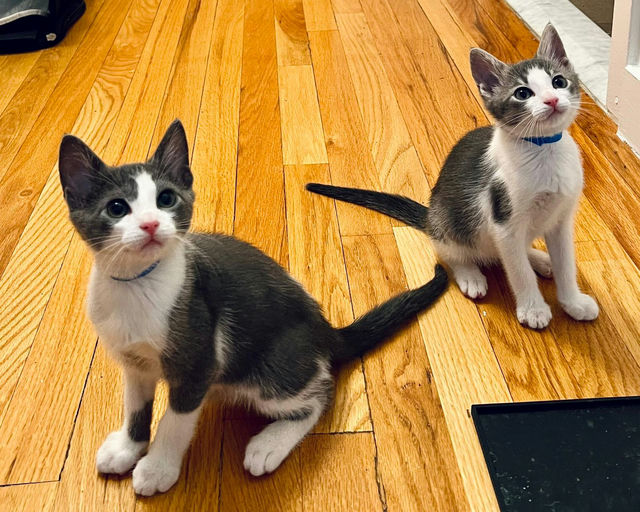
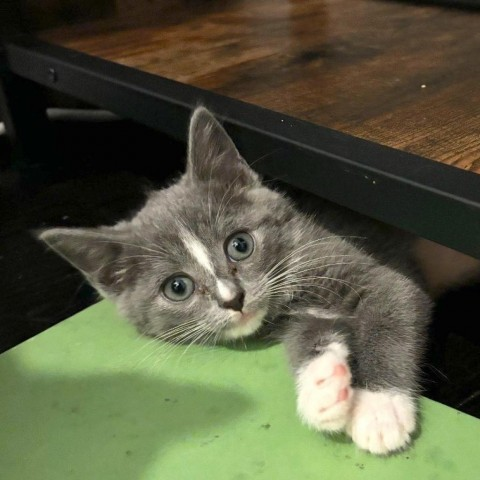
Since the last cat photo contest featured pale calico cats like Dora, here, in the interests of fair representation, are pairs of gray kittens like her brothers Drudge and Dilbert. 

Drudge and Dilbert have unusual coats--their gray color is the "blue" that's really a pale shade of black, and their having a long-haired father and a Manx great-great-grandfather means their coats are super soft and fluffy. They look gray, above, but most of their hair is actually white; they're white below, and even in the grey sections above, the undercoat is white--only the long outer hairs are grey. If you collected the fur they'll shed in spring for a few years, and spun it, the yarn or thread would be white with a faint tinge of gray. This is a minority color pattern but it turns up fairly often on Petfinder.

Drudge and Dilbert have, at this stage in life, the sort of slim build and wedge-shaped head that makes people say "What a pretty kitten. Is SHE..." They are very attractive looking animals, and I'm 99% sure that both of them are HE's. 

In good faith that they will be promptly claimed, neutered, and allowed at least some indoor privileges when they grow up, they're being raised as cuddly pets. Dilbert has the charming habit of turning back for a last caress, as if to say "Thank you," when the little guys go outside in the morning and when meals are served. Drudge is less obsessive about it. His favorite "fighting" move may reflect his perception of humans, as he stands on his hind legs and raises his forepaws over the sibling on whom he's about to pounce...but he likes a cuddle, too, when he's played long enough and is ready for a nap.

If they don't know their names, I'm afraid it's my fault. They do know that "Drudge" and "Dilbert" are things humans say when interested in them, but as they look just alike from some angles, both of them have been called by both names often enough to have convinced them that humans aren't intelligent enough to recognize cats by name. 

I don't know exactly how fluffy the coats of cats on Petfinder are going to be. I didn't exclude the more common grey tabby color, either. Drudge and Dilbert do have very faint tabby stripes, as even black cats do; you can see the stripes in a bright light.

Perhaps the more important question is whether a shelter pet will seem to be nonverbally saying "Thank you" when you feed it, pet it, let it come in or go out...and yes, some of them do. Some male kittens seem to have a sense that they're going to have to be twice as adorable as their sisters are, to have a chance to survive in this world, and they try.

Zipcode 10101: Dizzy & Dude from NYC


Very little information about these little guys is available but they do have that faded Tuxie look, just like my little guys. Are they adorable? Hello, they are spring kittens. 

Zipcode 20202: Keeley from DC


Each kitten has its own web page, but this is the most photogenic of a litter of six kittens, one of whom was born to a different mother and just sort of merged into the family. They've been given names commemorating Ted Lasso: Ted, Coach, Roy, Rebecca, Phoebe, and this is Keeley. Born in April, they're as young as shelter kittens can legally be at the time they're adopted separately from their mothers. So far they all seem to have delightful personalities. You will be asked to pick two. 

Zipcode 30303: Ari & Aya from Fayetteville 


Little is known about Ari and Aya. It's tempting to guess at a story by looking at them--somebody wanted kittens, kept the females, and dumped the little stinkers-to-be out at the shelter. What a cliche, but it happens. Well yes, however unfortunately, they're both male. However, they have that "mixed hair," not very long but super soft and fluffy. You'll have to promise to have them neutered in any case, and this tends to make male cats easier to live with.

Monday, July 1, 2024

Book Review: With a Blighted Touch

Title: With a Blighted Touch

Author: J. Todd Kingrea

Date: October 2023

Publisher: BHC Press

ISBN: 978-1-64397-363-0 

Quote: "I've been to doctors ever since the...blackouts started...They can't find any cause for them."

But when Kit's blackouts occur, at the same time, someone who has touched him dies. Kit's still a young man, a failed musician, an addict, and two of every five people in his high school class are dead. Kit grew up in the fictional town of Black Rock, below Blackpoint Mountain, where kids love to repeat the legends about the charred black stones and the sour-smelling whitish fungus that grows in the area, "the blight," being part of some primordial curse associated with a spirit of death trapped in the scorched rocks. 

Kit's always half joked about being cursed. When he lets his memories reopen, he remembers that the evil spirit of Blackpoint Mountain chose him, when he was a child. Black Rock is one of those little towns where all the families are old, all the old families have some sort of sick secret, and then there's that family who are really nasty. Kit had been getting the worst of a fight with some of them after school when the spirit told him that he'll never know when, or which one, but for all his life, he'll be subject to blackouts during which someone who's touched him will die.

Before he remembered this Kit touched a nice, friendly old school friend, the divorced mother of two daughters. So he has to confront his old enemies, find the ancient book, and face the embodiment of death in the cave, to protect these friends.

All the archetypes best loved by horror fiction fans come out and dance in the Great Smoky Mountains, in the summer of 2011. Including the innocent person who naively sets the stage for some sort of return, or recurrence, in the 2020s.

I read it with a chortle, as I read the main plot of Anne McCaffrey's Pern books, at the effects continually scrubbing mold off things can have on the imagination...but if you want something to make the hairs on the back of your neck stand up, this horrid tale, with its funguslike zombie children and its school bullies who grow up to worship demons, is for you. 

There are things like that. They are found wherever humans are found; they are humans' archetypes. The forms they take in your city neighborhood are familiar. What forms might they take in the scenic hills where you vacation? J. Todd Kingrea knows. Stephen King (who's not noticeably related to me) ought to appreciate his mix of terror, horror, and gross-out.

Butterfly of the Week: Eurytides Oberthueri and/or Philolaus

Is Oberthuer's Kite Swallowtail really a distinct species? It's rare, if it is. Three specimens have been found in two distinct places, Honduras and Mexico. Very little about Eurytides, or Neographium, Protographium, or Protesilaus oberthueri, has been published. If it is a distinct species, it's very similar to E. (or N. or P.) philolaus, of which it's often considered a subspecies. This web site will compromise. We'll consider oberthueri and philolaus together in one post. For those using older lists in alphabetical order, we'll come back to orabilis next week.


Photo by SilvanoLG, documenting that philolaus form large flocks.

In 1906, Walter Rothschild discussed the perplexity entomologists were in about the species of Zebra Swallowtails. He thought ten species, including celadon, arcesilaus, epidaus, and bellerophon, might eventually turn out to be subspecies of Zebras, and discussed them as "the marcellus group." What he called Papilio philolaus was in that group, the Dark Zebra. Its antennae are black rather than amber, but may be "feebly tawny at base." Its legs are pale green. Its tiny claws are shorter than the Zebra's. Its wings usually show black and pale green stripes in patterns slightly different from the Zebra's; some females are almost all black and show only faint shadows of these stripes.


Photo by Juancarlosgarciamorales1, showing a typical male philolaus looking very similar to a large, dark, Southern Zebra Swallowtail. (Wingspans range between 3 and 4 inches.)

The upper wings can be almost entirely black.


Photo by Escalante-Pasos.

Oberthueri differed from philolaus in having a translucent stripe, as well as white stripes. The dark stripes were paler or more translucent, also, and the hind wings narrower. The drawing labelled "Oberthueri" in Rothschild's Novitates Zoologicae looks remarkably like marcellus.


So does the museum specimen here:


Photo from InsectNet.

Some think oberthueri was a natural hybrid between philolaus and one of the paler Kites, probably agesilaus. Many hybrids are "mule" species in which disparate genes inhibit reproduction. That would explain why more oberthueri have not been found. "Mules" recur predictably if and when the same species hybridize; they don't mate with each other and produce a second generation of "mules." Biolib lists oberthueri as a hybrid:


But philolaus is fairly abundant. Usually considered a Mexican species, it strays north into the Western States every few years and is found on checklists for southern California and Arizona butterfly watching. In southern Texas it can even be considered native.

Its variability, and the family resemblance of all the Kites, have given philolaus many names. Apart from the ongoing discussion of whether the genus name ought to be Papilio (everyone now agrees that that genus was overcrowded), Eurytides, Protographium, Neographium, or maybe Protesilaus, people have called the species or various possible subspecies ajax, felicis, niger, nigrescens, philenora, plaesiolaus, scheba, vazquezae, xanthicles, and xanticles. Currently xanticles, the southern type, is recognized as a subspecies.


Photo by Sabrewing, explaining that philenora business. Well, yes, if she didn't have those long tails, and had that blue gloss on her wings, she would look a bit like Battus philenor. The name philenor or philenora is traced to the Greek words for "loves her husband." Butterflies don't form pair bonds but she undoubtedly cares as much about her mate as any other butterfly does. (If butterflies, male or female, get more than one opportunity to mate, they will, and the older ones who have mated before will look for young partners who have not.) 

She might look enough like B. philenor to fool a bird, though. The dark Southern subspecies, with yellow spots on the upper wings, are the form for which the name scheba was proposed. Bible stories were generally considered too "sacred" to be included in the general category of ancient literature, but Belqis, the Queen of Sheba, who made a state visit to Suleiman Bin Daoud of Israel, was a character in Arab and African literature too. When male Swallowtails congregate at puddles, their social groups, or leks, are visited by females. Female butterflies are not there to negotiate terms of international trade, but then, male writers have always fantasized that that wasn't why Belqis visited Suleiman either. 

Xanthicles is one of those European names that combine two words more or less randomly, without regard to any meaning the resulting phrase has. Xanthos is the Greek word for light-colored, blond, yellow, dun; one web site points out that light brown and red hair were also considered "light-colored." Cleis is the word for fame and glory. The name Xanthicles or Xanticles appears in ancient literature, though not as the name of a major character in any story. Eurytides (or Protographium) philolaus xanticles has a yellow color, rather than blue-green, in its light-colored sections. 


Photo by Andreshs.

Bright yellow color is the distinguishing feature of the subspecies xanthicles, but it fades quickly. Older butterflies and museum specimens are brown and tan, rather than black and yellow. The yellow color may shade to off-white or pale green on the underside of the wings. 


Photo by camilojotage. Though this large mixed flock of Swallowtail and other butterflies is not unusual, its clear focus is, because philolaus and other swallowtails fan their wings almost constantly, even while sipping water from wet sand. 

Why do they flutter so much? To cool off? Possibly, though other butterflies survive without spending their energy this way. To confuse predators? Probably, though, again, other butterflies get by without this behavior. To preserve inter-butterfly space at a crowded puddle? Likely, though they do it when they're not crowded. To advertise themselves, scenting the air with an odor humans don't seem to notice, giving females an idea of how many of the males at the puddle are ready to mate? Possibly, though female Swallowtails, most of whom are ready to start unloading their eggs when they crawl out of their chrysalides, would probably find males and wait for them to mature anyway. To make themselves more of a challenge and thus more interesting to photographers? Probably not, although the behavior has that effect, and it may benefit the butterflies. The true answer may well be "because they can." 

Video of a large flock, fluttering, while wind rustles nearby plants:


Though not economically important, it is popular enough to have appeared on postage:


Photo from Avionstamps.com.

The few photos available of couples of this species show that they can mate face to face, each clinging to one side of a twig. Females then flit off to the bushes to lay eggs, and males return to their leks and wait to another chance to mate. 

Caterpillars have that humpbacked Swallowtail look, the fleshy "horns" of the forked osmeterium tucked away on their upper backs. They have pairs of white blotches that can form stripes running for part or all of the length of a black or green body.


Photo by Thibaudaronson.


Photo by Karla_bal30. 


Photo by Tristan_menant-leclercq, documenting their tidy habit of eating their outgrown skins. Various arrangements of black, white, and olive green patches are possible for this caterpillar. The overall effect seems to be in the look-like-a-bird-dropping category of survival strategies for caterpillars.

Caterpillars eat shrubs in the Annonaceae family, the family that includes North American pawpaw trees. How many different species of leaves they can eat, or how their selections affect their looks, is not documented.

Neither egg nor chrysalis photos are available online at the time of writing, though Inaturalist has some clear long-range photos of females flitting among host plants and palpating leaves.

The life cycle of these butterflies has not been fully documented. Adults fly between March and September, and are most often seen in May.