This is the post about wild plants that may be edible in May, but weren't the most appetizing things growing in my not-a-lawn last weekend, if they were growing at all.
I won't bore you with all the preliminary warnings from Part 1. If you need warnings, read Part 1. But I will respond to a comment from a local lurker about the "spring tonic" effect. During the early twentieth century some of us absorbed a positively fetishistic ideal of "regularity," an idea that everybody should Do Numbers Two and Three exactly once a day between breakfast and going to work, and that, for that reason, workplaces should make it as difficult as possible for anyone to Do Number Three...like putting ten toilets in little compartments, all separated from one sink with an inadequate supply of paper towels. (Naming no local fast-food joints, here.) We as a society need to overcome this. Reality is that humans
are not all that "regular," so the places where they work should be designed to minimize the unpleasantness of being in the same room, not maximize it. The whole obsession with "complete elimination immediately after breakfast" has the smell of something popularized by cheapskate factory owners, with a little help from control-freak schoolteachers.
For celiacs, any self-cleansing, flushing effects we notice feel like a wonderful relief from the toxins eroding our insides. The first time I did a low-fat, low-carb, mostly-veg diet (in the city, with supermarket vegetables including white rice) I remember it, and people who worked with me may still remember it, as a six-week "high" during which I
felt like leaping out of bed at 6 a.m. to sprint a mile before breakfast. Well, I was only half grown at the time. Adults are usually calmer, although we can still feel "high" on relief from sluggishness.
The "mild diarrhea" of the flushing effect may be inconvenient; it's not the sickening, even life-threatening, kind of diarrhea produced by food poisoning or Norwalk Flu. If you nibble mindfully and stop when the flavors of wild plants stop tasting deliciously different to you, you may not even make an extra trip to the bathroom, and if you do, it won't feel any worse than you normally feel after breakfast. At worst you'll feel thirsty...many people are living with the dragging effects of chronic dehydration anyway. "Regularity" will return in a few days whether you continue eating lots of juicy fibre-rich vegetables or not.
But for those people--all the ones I know are White, and currently at least forty years old--who "don't like that feeling" of needing to use the bathroom two or three times in one day, I'd say, most of the discomfort is in your minds. Those of you who are baby-boomers, though not necessarily even one year older than I am, tend to be the ones of our generation whom others point out as "that old" rather than "that blond/e" or "that one in the...", and certainly not "that friend of yours, you
do know s/he is older than s/he looks don't you?" If you want to side-step cardiovascular disease and other things that your elders blamed on "aging," and look, feel, and work as if you were ten years younger...talk to your doctor, but a naturopathic physician, like our e-doctor John McDougall or GBP's real-world Dr. Cote in Tennessee, will probably tell you just to work through it once. The "high" of more efficient digestion, usually higher metabolic rate, that baseline cheerful mood that annoys people who don't enjoy it themselves, improved resistance to infections, and the youthening benefits of a face lift without having to pay for one, will (typically) last if you continue eating juicy fibre-rich unsprayed veg. There can be medical reasons why people can't do this, which are none of my business...I'm only glad that, most of the time, it works for me.
Now, on to the plants...
1.
Cress. This is another name for two different plants that actually peaked in March, or even February; by now field cress is dormant and watercress, if not cut back, has gone to seed. In the February thaw, when the leaves are fresh and juicy, the peppery kale-like taste of cress is a delight. Watercress can be eaten raw if you're sure sheep or cattle have not been grazing upstream. Field cress is best cooked. Recipes usually recommend using watercress, and often recommend cutting off the stems--both plants' stems can become tough, like parsley stems.
Field cress is what my elders called "creasy greens." I have found it, and bought it, canned in supermarkets like spinach. It pops up in ploughed fields, often starting during the January thaw, reaching its prime in February or March, then going to seed and dying down before ploughing time around the first of May. If it doesn't pop up in your field, Amazon is currently offering seeds:


Watercress is sold in upscale supermarkets for outrageous prices, or picked out of local spring branches during thaws in winter. Since most of the plant is underwater, each time a freeze kills the top leaves, the plant sprouts fresh new leaves. A person who really liked watercress and didn't live downstream from any cattle raisers could keep watercress sprouting new leaves in a spring branch most, if not all, of the year.
2.
Plantain. There's another species (narrow or Lance-leaf Plantain,
Plantago lanceolata) that's also edible, but Broadleaf Plantain (
P. major) is more useful in some ways. Leaves are juicy but fairly tough; they can be cooked and eaten if you're hungry, but don't have much flavor. Dried seeds can be crushed and used like flour or meal, and will stretch flour or meal out if you need more bread, but nobody raves over them either. (The writer known as George Orwell did mention their being nibbled as a snack in the 1890s and revived as survival food in the 1940s.)
I prefer to save plantain for its medicinal uses. It can be either crushed and rubbed on irritated skin, or stewed and the water used to wash irritated skin, for soothing, cooling relief. For insect stings, the best treatment is of course to learn to get along with insects; this is not always possible, so if you are bitten or stung, washing with plantain cooking liquid is the best treatment I've found.
3.
Morels. Mycologists have reconsidered the species names for these mushrooms...(Warning, before you scroll down to the picture: one of their many nicknames is "the ugly ones")...so let's just say there are about a half dozen different species, some of which appear in the same woods at the same times, and the biggest, latest-blooming kinds sometimes do pop up in May. Some years, but not this year. In this year's unusual weather, I may have looked at the wrong time, but I didn't find a single morel.


This is one of the two kinds I've found in May, always in Maryland. They may be the commonest kind overall; they don't grow near the Cat Sanctuary. Our most numerous species are narrower, and grayish rather than brownish, and they appear in April or sometimes even March. However, for those who want to try starting their own mushroom patch, a company in West Virginia is offering "starter kits" of spores and sawdust you can at least try to start anywhere.
The kind I've found close to home in May are even bigger than the one in the photo, with wrinkly heads two or three inches long on a stalk that can be equally long. The biggest of all the morels, they have a distinct cone shape and blackish-gray color, especially at the top of the cone. From the cone shape one of their nicknames is "Christmas Trees." Some years they do pop up in the not-a-lawn, nourished by the chestnut logs at the foundation of the oldest part of my home. Not this year.
Two blog posts from years when I
did find these mushrooms:
https://priscillaking.blogspot.com/2017/03/march-23-links-with-cat-sanctuary.html
https://priscillaking.blogspot.com/2013/04/phenology-flowers-butterflies-mushrooms.html
One year I had morels to sell and nobody bought them. This year three people asked to be on the list for morels, and I didn't have them.
4.
Chickweed. Because of its small size, people who aren't very hungry have tended to leave this early spring green for the chickens. It sprouts right up after frost and has a nice mild leaf-lettuce-like flavor. By May, if it's not subsided it's gone to seed. It is one of the early greens our ancestors nibbled to stave off scurvy, though, and is especially welcome during the January thaw.
5.
Ground-ivy. For a mint this first flower of spring is remarkably dry and dull. It's noticed for its pretty little flowers rather than its smell or taste. Euell Gibbons reported that English people had tried using it to flavor fermented drinks, perhaps many times if the number of cute nicknames they gave it is any indication, but it never really took off. He gave some recipes in which he used it, but raved more about how the Renaissance English would probably have called a man who bothered with "Gill-over-the-ground" something like "Euell-pick-by-the-hedgerows."
In Europe, where at least ground-ivy can't be called invasive, varieties with rounder, greener leaves are commonly used as greens in salads drowned in dressing. Presumably those varieties are juicier than the soft, dry, triangular leaves of the ground-ivy I've always in lawns and ex-lawns. It's safe for human consumption if not poisoned, but is reasonably considered a weed in pastures, since cows and horses can't digest it.
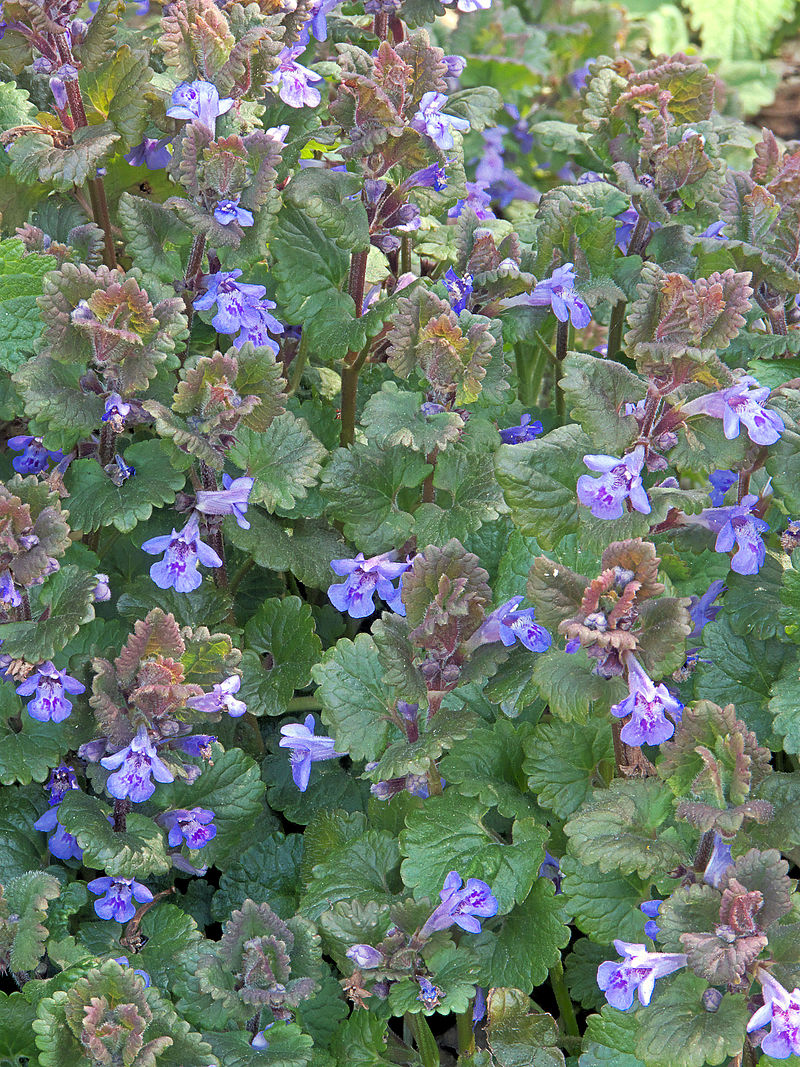 |
| Though colonies like this one are accused of choking out native wildflowers, Virginia wildflowers usually seem to out-compete ground-ivy. The freshest leaves at the top are purplish as shown, and the flowers range from pinkish to bluish lavender. Photo donated to Wikipedia By Rasbak - Own work, CC BY-SA 3.0, https://commons.wikimedia.org/w/index.php?curid=10128264 |
If I were going to eat ground-ivy I'd eat it in March. By last weekend, the few surviving stalks were relatively tall (some over six inches), gone to seed, and either turning yellow or showing mold spots from old age--a most unappetizing wild crop. In late March and early April it was fresh and pretty.
6.
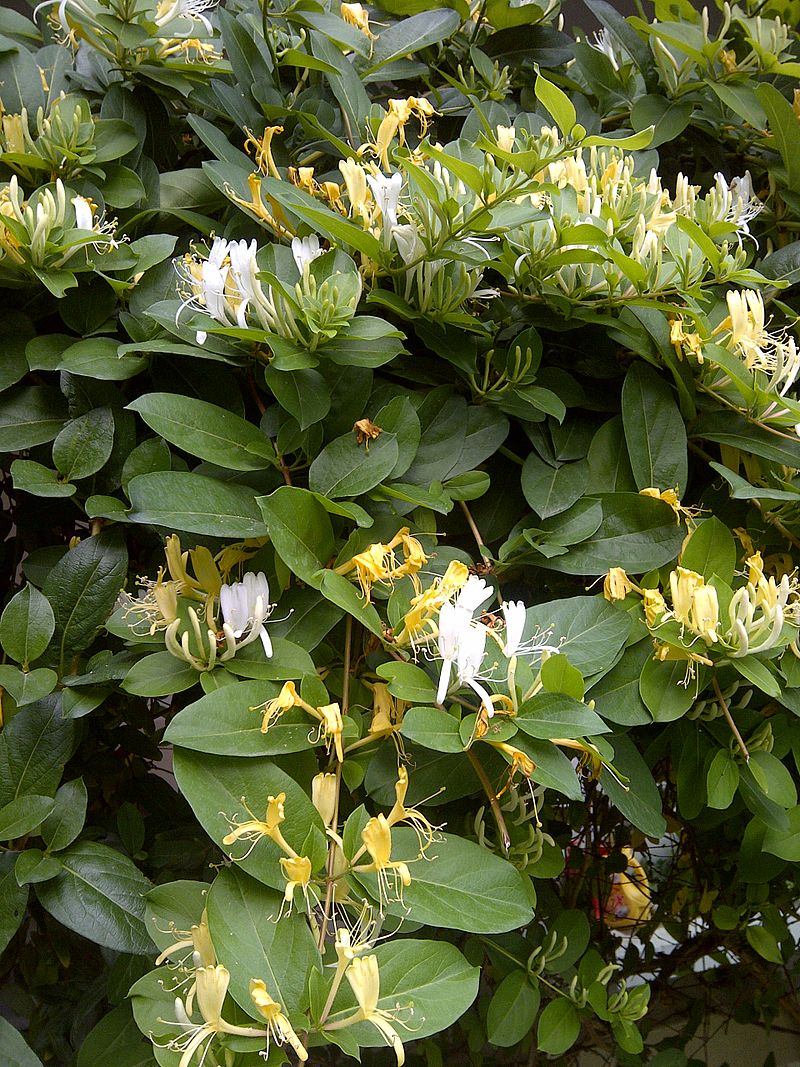
Honeysuckle (japonica). The super-sweet nectar, when this nuisance vine blooms (typically in June), is a moral lesson for children. The one little drop in each blossom offers all the sweetness your mouth could possibly want. If you gathered a pint of blossoms and squeezed out a spoonful of nectar, it would taste disgusting.
In May, honeysuckle consists of stringy vines, which can be used to make ropes or baskets, and leathery leaves, for which I've never found a use. Some cows and goats will eat them, though.
The main excuse for
Lonicera japonica in North America is that helps check soil erosion on a steep bank, and, although it will spread to orchards and woodlots, where it's a nuisance that can pull down trees, it's not as bad as kudzu or cinnamon vine. Many people enjoy the sight and smell of honeysuckle. If you're one of them, please be neighborly and keep your honeysuckle in its place.
7.
Strawberries. The old orchard still has a few feral strawberries--not enough to sell, but enough for a delicious snack. Some years the fruits appear in the first week of May. Not this year. The leaves are edible too, but in May, when tastier leaves are abundant and berries aren't far away, who'd eat them?
8.
Sassafras. This fragrant native tree has two main uses. (Most often seen as a small shrub, it can, with time, care, and good luck, grow into a full-size tree.) Roots perfume the house (whether or not you brew them into tea, which my parents did, some years, but I've never done). Juicy, sweetly bland leaves contain a thickening agent, which remains effective when the leaves are dried and crushed, known as filé. I often pick a leaf or two if I walk past the young trees that grow on some of the private roads near the Cat Sanctuary, usually to eat raw. I did not happen to walk those roads last weekend.
For those who don't know, a choice collection of sassafras images and fun facts is at
https://www.augustaga.gov/1630/Sassafras . I thought of copying their image of three of the more common shapes of leaves typically found on one tree, then thought "But why deprive readers of all those other good pictures? They should see the whole collection."
9.
Smilax. Also known as "green briar" for obvious reasons, and "blaspheme vine" for reasons that become obvious if you get tangled in it, this native nuisance plant grows near but not at the Cat Sanctuary. (While some plants in the genus
Smilax are luxuriously leafy, our native species is most easily identified by lots of bare, prickly stalk with visible prickles in between its little green leaves.) I didn't walk through the woods where it grows, either. It used to grow in the orchard, though...I can now smile, remembering how Dad gave it the axe.
Euell Gibbons ate smilax, whose nicknames include both "cheeses" and "bread-and-butter," and reported that it didn't taste like either of those things. It didn't taste like any favorite food. It's edible, though, if you're hungry or just want to get rid of it. As with most wild plants, eat the young tender parts and avoid eating too much. One wild food blogger reports that eating "a lot of raw ones gave me a stomach ache."
10.
The Brambles. This is the English name for a large group of plants in the genus
Rubus, which have thorny stems and pretty five-petalled flowers like roses, but fruits, unlike roses, consisting of several soft seeds wrapped in sweet juicy flesh that grow in clumps. Some of the dozens of species botanists recognize are called raspberries, blackberries, boysenberries, dewberries, and wineberries. Several varieties grow at the orchard, where some invaded and some were deliberately planted. When I pick them, I pick whatever fruits are ripe for the picking that day. Friends usually get an assortment of blackish-purple, bright red, and yellow berries, of which the biggest and reddest started their life inside papery husks and are technically wineberries not raspberries. Sometimes I've found a berry by the
end of May but basically the brambles at the Cat Sanctuary bear fruit in June.
Brambles generally have a three-year cycle. The first year you see just the thorny stem and leaves, often in the way while you're picking berries. The second year that stem bears fruit, while the stem that bore fruit the previous year may or may not put out leaves. Third-year stems grow down into the ground, put down new roots, and send up next year's new stems. The plants can travel a great distance over the years, and the challenge is to keep yours in your own orchard, as they may not be welcome in the neighbors' field. However, I've welcomed the ones that have made their way to me.
Wineberries have a ferocious look. I was alarmed, too, to find them sprouting among my raspberries! But the fruit is completely safe to eat, and the stalks are no harder to handle than raspberries. Their stiff hairs are there to discourage insects; they're harmless to humans.
 |
| If you buy these plants from Amazon (https://amzn.to/2VolJHn), please keep them in your own garden or orchard. Those stalks scare nervous people unnecessarily. They're not native, and can seem like an Invasive Nuisance to people who are too timid or ignorant to appreciate the berries. |
One year a neighbor listened to the guys down at the garage, who knew nothing,
and had a computer in the shop mind you, but didn't want to admit their lack of information and look it up. They opined that the plant and berries were deadly poisonous. Little my fainthearted neighbor knew, when he sprayed poison on his wineberry bush, that he'd eaten wineberries and liked them. "Roundup," or whatever else he might have sprayed, even vinegar, is much more toxic than wineberries are.
It's possible to eat the leaves of these brambles--but why? The leaves have been cooked and eaten, or dried and infused into tea, by people who were desperate, usually further north. Some people hoped, based probably on rumors that were based on someone's experience of dehydration or dietary deficiency, that raspberry and blackberry leaves would have medicinal value. They seem to have little if any. In the North, in winter, raspberry-leaf tea may have been the best source of warmth, water, and astringent mild tannins, some people could get. In Virginia even bears can find food in the woods on all but the very worst days of winter, so nobody needs to eat the bushes that produce those delicious berries.