Showing posts with label 1880s. Show all posts

Wednesday, March 11, 2026

Book Review: Three Men in a Boat

Title: Three Men in a Boat

Author: Jerome K. Jerome

Date: 1889, 1957

Publisher: Penguin (1957)

ISBN: none

Length: 185 pages

Quote: “George and Harris and Montmorency are not poetic ideals, but things of flesh and blood—especially George, who weighs about twelve stone. Other works may excel this in depth of thought...but, for hopeless and incurable veracity, nothing yet discovered can surpass it.”

Was that one of the jokes? Who can say? This is a plausible story of three Victorian English gentlemen, and a dog, on vacation in a rowboat.

Jerome K. Jerome was another of those English humorists whose jokes are accessible to American readers. By current standards his jokes may be on the long and indirect side. He spends a page or two describing a scene in the favorite clichés of Romanticist novels and essays, the river singing the little song it’s sung so many thousand years and our thoughts half sad, half sweet, and so on, and then throws in a chunk of “incurable veracity”: “Harris said: ‘How about when it rained?’”

If you want to laugh out loud, Jerome will help. If you don’t...this may not be an ideal book for reading in school.

Many funny things were written in the nineteenth century, although too many comic writers felt a need to make it clear that they were joking by writing in tedious “dialect,” which could not ever have been much fun to read. Why has Three Men in a Rowboat worn so much better than Artemus Ward (I made a samizdat copy of his collected works, with standard spelling, and it’s still pretty funny) or Orpheus C. Kerr (a satire, superficially in favor of expanding government, in the voice of a fictive office seeker) or the other books and writers sampled in Mark Twain’s Library of Humor? Possibly because Jerome’s thought was ahead of his time. Several passages, though written in Victorian English words, sound like something you might read or watch on television today.

“The first list we made out had to be discarded...the upper reaches of the Thames would not allow of the navigation of a boat sufficiently large to take the things...George said... ‘We must not think of the things we could do with, but only of the things we can’t do without.’...with reference to our trip up the river of life generally. How many people, on that voyage, load up that boat...with a store of foolish things which they think essential...but which are really only useless lumber. How they pile the poor little craft mast-high with...expensive entertainments that nobody enjoys, with formalities and fashions, with pretence and ostentation...It is lumber, man—all lumber! Throw it overboard.”

“I...told them that they had better leave the whole matter entirely to me. They fell into the suggestion with a readiness that had something uncanny about it; George put on  a pipe...and Harris...lit a cigar. This was hardly what I intended. What I had meant, of course, was that I should boss the job, and that Harris and George should potter about under my directions.”

“That china dog that ornaments the bedroom of my furnished lodgings...I do not admire it myself...even my landlady herself...excuses its presence by the circumstance that her aunt gave it to her. But in 200 years’ time it is more than probable that that dog will be dug up...with its tail broken...and put in a glass cabinet. And people will pass it round and admire it...and speculate as to how beautiful the bit of the tail that is lost no doubt was.”

And so on. And the message of the story...readers probably wouldn’t have said it has one, if Jerome hadn’t said in his introduction that it has...the message of Three Men in a Boat was a sort of introduction to a large part of the advertising we see now.

The three men and dog spend ten fine long summer days on the Thames and are then glad to go back to their jobs, just like yuppies today. The concept of a summer vacation was new in the nineteenth century. Schools closed in summer, and all right-minded students undoubtedly looked forward to the long summer break between terms, but parents and teachers had agreed to schedule this break so that students could help harvest crops. Traditionally everyone old enough to work had been expected to work at least ten hours a day, six days a week, and give thanks that in Europe and North America employers were expected to concede either Sundays or Saturdays as days of rest. (In Muslim countries only Friday morning was so reserved; after services at the mosque, people had to go back to work.) 

The Industrial Age offered the ideal of equalizing at least the proportions of labor and leisure time among rich and poor people. Jerome’s generation fretted about the impending “problem of leisure”: if the working class had to work only eight hours a day, apparently they would need to be “educated” to use all that free time on something other than getting drunk, oversleeping, and having too many children. The idea of vacation travel was developed to address the urban middle class’s growing awareness that living in crowded cities was bad for their health. Hence the opening scene, in Three Men in a Boat, where the three men (who identify as “young” and are obviously healthy) complain of feeling “bad,” “run down,” and having all the symptoms mentioned in an ad for over-the-counter medicine. People who had been taught that “Wilful Waste Makes Woeful Want” weren’t likely to get into “vacationing” until they’d been convinced that they needed a change of pace, for their health.

The message? “Be a good writer, and eventually someone will pay you to take a vacation trip and write about it.”

Sunday, March 31, 2024

New Book Review: Apple of His Eye

Title: Apple of His Eye

Author: Kimberly Burkhardt

Date: 2023

Publisher: Kimberly Burkhardt

Quote:  "God had done nothing except punish her...First her child and then, a year later, her husband."

The widow Roberts' given name is Faith, but she's close to losing it in the spring of 1888. Harvey Roberts was distant and secretive in the year before he died. Now a greedy neighbor wants her land, an old friend is in town, and t save her land from the greedy neighbor she agrees to marry her old friend Caleb on condition that it will be a marriage in name only. Caleb agrees to that, feeling confident of being released from the agreement soon. He's come to town as a "Pinkerton" man--a proto-police detective--with an agenda that includes proving that the greedy neighbor has hired the man who murdered Harvey Roberts. 

This is a sweet romance with no explicit sex. Still it's written in a tactile enough way that some women might want to hide it from the kids. Recommended to married women who want to rekindle specifically tactile, voluptuous feelings. 

Thursday, April 22, 2021

Book Review: The Tall Woman

Title: The Tall Woman 

Author: Wilma Dykeman

Date: 1962

Publisher: Wakestone (and others)

ISBN: 0-9613859-1-X

Length: 315 pages

Quote: "Lydia said softly, 'I never asked for easy, Mama.'"

Trigger warning: This classic of American Women's Literature is not a comedy, in form, but a biography. When a novel has the form of a biography the character may succeed, and her or his successes may be both satisfactory and laughable, but the happy ending is often "Then the character died old, regretted by all, and his or her heir was..." The time frame of the story simply exceeds that of the main character. The time frame of The Tall Woman exceeds that of its protagonist, Lydia McQueen.

In 1962 books that emphasized women's height often addressed baby-boomers who had been so unladylike as to grow taller than their fathers were, and after assuring those girls that there were enough overgrown young men out there to go around, they spent most of the space available talking about how to look shorter (stripes, shirts and skirts in different colors, skirts that reached exactly to the knee). The Tall Woman broke that rule; though Lydia is apparently the tall skinny type, according to the jacket drawing, the story is not about how she copes with her body shape but about how she copes with crises, brings up children, appreciates the differences among most of her neighbors and eventually beats the one really unlikable neighbor she has in a political dispute. It's a feel-good story.

One of the things I've regretted in life was that, though Wilma Dykeman Stokely was still teaching at Berea when I was there, I didn't demand to be admitted to her class. However, apart from the history in this novel about the late nineteenth century, there's not all that much to discuss about The Tall Woman; the story is easy to follow. It reads like a family legend and, going by its dedication, probably is one. Lydia is as lovable as Elvira Ware in Jubilee, as admirable as Mary Peters. 

Despite its appearance on some school reading lists, this is a novel that can be read for pleasure. It's almost sex-free (we read about the children, not about their begetting) and less violent than many novels about this period (Lydia does kill a bear). It won't embarrass adults if the children read it, at all. It will repay attentive reading; Lydia's relationships with each of her neighbors have their own nuances, and the pleasure of the irony rests on your willingness to remember those nuances.

Tuesday, April 3, 2018

Book Review: Castle Barebane

Title: Castle Barebane


(Amazon is trying to steer you to a paperback book that doesn't look like this one. No worries.)

Author: Joan Aiken

Date: 1976

Publisher: Viking

ISBN: none

Length: 277 pages

Quote: “When they die...all their cash comes to Kirstie and a devilish great barracks of a place up in the wilds of Lammermuir called Ardnasomething. Castle Barebane, the locals call it—it’s falling to bits.”

Thus Nils Hansen introduces to half-sister Val Montgomery the house where he’s about to send her to look after his children, just in time for a lot of other people’s personal drama to run together into an action-adventure story.

British fiction for adults, Margaret Atwood once observed, tends to reflect ideas of “class.” Nils’ wife Kirstie, and Val’s fiancé Benet, belong to the lower upper classes of Victorian society in Edinburgh and New York respectively. Nils and Val are upper working class. Both write for newspapers; their parents were divorced, and the place Nils has rented for his family in the city is dreadful. Kirstie’s relatives weren’t happy about her marriage to Nils; Benet’s relatives want to prevent his marriage to Val, and rather early in the story Val begins to agree with them. Benet’s relatives want Benet to marry his cousin, and although that seems like a sufficient reason for Benet to persist in pursuing Val, to me, it doesn’t to Val.

So, to give Benet’s cousin another chance to alienate his affections, Val sells her editors on the idea of her writing a travel series, goes to Scotland...and can’t find Kirstie. Come to that, she can’t find Nils where she was told to meet him, either. The children have moved in with some not very nice neighbors. Val takes them up to Castle Barebane, where she has some qualms about leaving them with (their unacknowledged great-aunt) Elspie, and makes some new friends while looking for clues to where Nils and Kirstie might be. We don’t read the story we’re told she’s publishing in New York , writing a few pages every night about her study of Scotland, but that we’re told it’s being published and paid for while we see what Val is actually doing each day makes a withering comment on Victorian travel writing. Her real itinerary includes no visits to tourist attractions and no research...

The “they” whose heirs Kirstie is are her great-aunts, Lady Stroma and Lady Honoria. In his later years Kirstie’s great-grandfather had a secondary relationship, not recognized as a proper marriage, whose product was Elspie; as a result Elspie is paid for living in Castle Barebane as “housekeeper,” but not paid enough to maintain it in good condition. Elspie lacks her older half-sisters’ polish and education, but to Val she seems strangely free from resentment. This is because Elspie, “wintry,” “auld and snell,” but only “approaching her seventies,” is the Real Romantic Heroine.

Both the local doctor, who helps Val see that her niece is not stupid but merely brain-damaged, and a friendly Scottish editor, appeal to Val more than Benet ever did. Val likes having three men friends and will pick one to marry at the end of the book, but Elspie is the one who’s “in love” and has been for longer than Val’s been alive. Val is not the romantic type. She’s what the 1976 blurb writer called neurotic; though not anxious or phobic Val likes her job and feels no urgent need to resign and become a full-time nanny until she can have a baby of her own...yes, even in 1976, women were being told that “normal” mental health meant thinking of our jobs as just ways to pass the time until we could become full-time baby factories...Val doesn’t think she even likes children—but all novels by Joan Aiken contain at least two particularly likable children, and in this one readers get to watch Nils’ children winning the affections of their standoffish aunt.

The blurb writer failed to count Val’s nephew among the “four men destined to change [Val’s] life.” Nephew Pieter is only a little boy, after all. Neither did the blurb writer count Nils. Besides the doctor and the editor, the other two are Elspie’s lover and Nils’s friend, Nuggie Reydon, who seems like an ordinary jerk at first but quickly shows himself to be even worse.

Aiken’s writing style is extraordinary, more appealing even than her famous father’s. Conrad Aiken was a very serious writer of capital-L Literature, which hasn’t worn well but was considered great in its time. Joan and her sister Jane wrote mere genre fiction, avoiding competition with their father, but both wrote their genre novels in ways that both met and transcended their genres. Joan Aiken’s historical romances display and usually exceed the requirements for history, romance, and suspense, while also featuring generous amounts of topophilia, irony, insight, wit, adorable children, and an English stiff-upper-lip version of what I like to call Irish cheerfulness. It’s hard to like fiction and not like hers.

Even some of Joan Aiken’s mystery/suspense novels qualified as gentle fiction—but Castle Barebane does not. It rates PG-13 for violence, with a serial murderer who, Val cheerfully assures Benet’s worried relatives, targets “a particular class of women,” but that class includes “the actress...the friend of Nils” and Val’s association with Nils is enough, all by itself, to get her mistaken for one of that class. In addition to the Fallen Women three sympathetic characters are murdered, one “onstage,” and a whole gang of thugs are steered into fatal misadventures (as per Hollywood convention that really nice characters mustn’t soil their hands by killing even baddies who are trying to kill them).

The blurb accurately describes the novel as “outrageously cheerful improbability”; though the quick humane ends for the murderers are even more improbable than the wholesome middle-aged romance, the cheerfulness amidst bleak realities is credible. After all...the cities are dark, grim, polluted, and full of crime, but Val and friends move quickly to the country. Castle Barebane’s “air of neglect and decay” is boosted by its “smell of damp and mould, and the bitter cold,” “uneven floors,” “warped woodwork,” and “aged towels and tablecloth...of the very finest woven damask but in so tattered and frail a state that every prick of the needle seemed likely to start a new rent,” even before the thugs start “wrecking” the furniture, but the coast and hills are beautiful even in winter. And Val, while losing a few relatives she’s never liked much, is a young writer with three boyfriends and two publishers—how can she keep from singing?

I only wish Joan Aiken still had a use for the dollar she'd get if this one were a Fair Trade Book, but it can be added to a $5 package with at least one and probably more books of comparable size. To buy it here, send $5 for the book, $5 for the package, plus $1 for online payment, to the e-mail address you get from salolianigodagewi @ yahoo, or send $10 by U.S. postal order to P.O. Box 322, Gate City, Virginia, 24251-0322 (the post office will collect its own surcharge).

(When will I get back to the job of adding Paypal buttons to this site? It may take a while; I prefer to shut down other web sites and applications when I open Paypal. Buttons will come, though.)

Friday, November 3, 2017

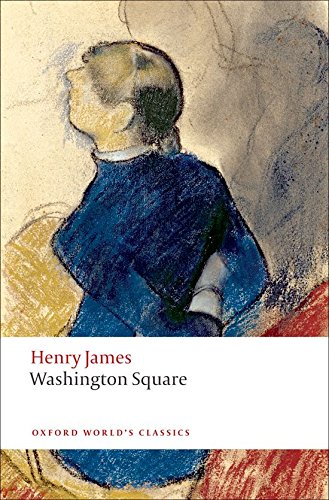
Book Review: Washington Square

Title: Washington Square


(I don't agree that this jacket picture suits this book at all, and it's not the one on the cover of the book I have. Click here to see Amazon's selection of other editions with different covers. The one I physically own isn't shown, and the one I'd like to recommend, the Dover Thrift edition, has one of those interactive images that can't be pasted onto Amazon Associate sites.)

Author: Henry James

Date: 1881, 1959

Publisher: Bantam (1959)

ISBN: none

Length: 162 pages

Quote: “A dull, plain girl she was called by rigorous critics—a quiet, lady-like girl, by those of the more imaginative sort.”

One of the harder fictional plots to write is the Antiromance, the story of how two young people met, felt attracted to each other, and then, for whatever reason, left each other alone. To remember or imagine the hormonal attraction is to want it to be an indicator of True Love. It is much easier for a writer who wants to affirm the completeness of a character's uncoupled life to kill off the Person the Protagonist Didn't Marry, rather than to admit that carnal commotion has nothing in particular to do with True Love, that it's possible to feel intensely attracted to someone you never for a minute imagine you'd really want to live with.

I recently commended the novel Avalon for portraying, to those willing to let themselves see it, two young people whose attraction to each other makes them lifelong friends but never a couple; they feel stronger physical attractions to other people, and act on those, and they have other interests and adventures as well, yet their friendship is part of their story. They separate, love other people, and live happily ever after. It is hard to write a novel that way. Anya Seton pulls it off by making her two characters interesting people—the sort of people who wouldn't be truly compatible with each other for very long, but whom readers would like to know, if not to marry.

In Washington Square Henry James sets himself the more difficult task of portraying two unattractive characters, selfish bores who can't be imagined as good spouses for anybody, and communicating that their not marrying is a Good Thing. James' audience were interested in the idea of eugenics, the idea that at least unhealthy people—and, some thought, unattractive or non-White people—should never have children. James gave them a pair who couldn't really be called “defective” but whom no innocent child deserved to have for parents.

It is possible to follow the story because the other two main characters are interesting, albeit flawed. Catherine, the anti-heroine, is a “large,” “plain,” badly dressed, inarticulate, but sincerely devoted child-at-heart, who happens to have inherited a substantial income from her long-dead mother. Morris, the anti-hero, is “in love” with Catherine's money but not “in love” enough to invest a little time in winning the respect of her overbearing father. Dr. Sloper, the father, is at least intelligent—enough to keep Morris at bay long enough for Catherine to realize how false Morris is, though not (as he thinks) intelligent enough to keep Catherine from realizing how much he underrates her. Mrs. Penniman, the doctor's widowed sister, is selfish as she can be, a steady source of bad advice that she hopes will make the young people miserable in such a way that they'll be emotionally dependent on her and thus furnish entertainment through her prosperous but empty old age. Dr. Sloper wants to keep Catherine from marrying Morris, even though he correctly guesses that Morris is the only man who'll ever propose to her. Mrs. Penniman wants to “help” them achieve an unhappy marriage.

Of these four characters it's possible to say (as Mark Van Doren did) that Catherine is the only one who shows any sincerity or unselfishness at all, and thus the only one who deserves a happy ending. Perhaps it's not possible for male readers to admit that she gets one. Women can make that admission. Catherine is one of those truly unfortunate people whose intelligence, probably in the normal range, is constantly overshadowed by their “brilliant” relatives'. James shows us that she's not really stupid but that, if she did have any kind of talent, she has no idea what it might be. The only sort of career for which she's been allowed any preparation at all is as a “society lady”; for this she has no talent, and it's probably a good thing that being single at thirty allows her to support the arts and charities in peace. It's hard to imagine anyone being a good husband to Catherine—Morris wouldn't be—and, therefore, easy to say that her happy ending consists of not needing a husband's money.

Among novelists whose work has been published long enough to have been rated by more than one or two generations, Henry James rates high. Among novelists in that category who rate high, he's the one I've always enjoyed least. But lots of people like his style, and even I like Washington Square. If it's not possible for James to understand how happy it's possible for a woman to be when she freely chooses to reject a man about whom her late father was right, it's certainly possible for women readers to enjoy the irony of a man recognizing that a woman may be better off without a man.

This book is not at all hard to find. To buy it here, send a U.S. postal order for $5 per book plus $5 per package to Boxholder, P.O. Box 322, Gate City, Virginia, or send a Paypal payment for $5 per book, $5 per package, plus $1 per online payment to the e-mail address you get by e-mailing salolianigodagewi that you'd like to buy this book. At least five and possibly seven books of this size will fit into one $5 package, so please feel free to add other books to the package...you're not actually limited to books reviewed at this site, although, if you do choose from the (by now quite long) list of books labelled "A Fair Trade Book" at this site, you'll be encouraging a living writer, or writers. You can add any real book Amazon offers, as long as the books can be squeezed into the package.

Tuesday, October 3, 2017

Book Review: The Last Waltz

A Fair Trade Book


Title: The Last Waltz

Author: Nancy Zaroulis

Date: 1984

Publisher: Doubleday

ISBN: none

Length: 402 pages

Quote: “There is no family so secure that scandal cannot touch it.”

And in the late nineteenth century, when a few American women—who thought themselves well off—devoted their whole lives to the pursuit and display of social status, scandal really hurt. The Last Waltz is about one of those families.

Mostly it's about two women, Isabel and Marian, who meet in their late teens and grow “old” (by pre-twentieth-century standards) together. Both have “married well” in the sense of having married rich men who can give them liberal allowances of money to maintain the levels of extravagance they need to hold their social positions. (Isabel's husband is a standard-run snob-and-bore; Marian's is a 1980s caricature of 1880s sex phobia. They also have a friend, who answers to the name of “Pussie,” whose husband's gift to her is a then-fatal sexually transmitted disease.) Both are profoundly unhappy with their husbands.

At one point in the novel, Isabel says that what she really wants for one of her children is a life of freedom from all the burdens of “a social existence,” but when that child elopes and goes West to have that sort of life Isabel and Marian feel devastated.

It's interesting to note, reading this 1984 novel in 2017, how much research went into crafting these fictional steel-magnolia types as historically plausible in everything but the way their lives echo the trendy concerns of the 1980s. We're supposed to feel sorry for characters who aren't having lots of sex and enjoying every minute of it; Victorian sex phobics reinterpreted as stifled homosexuals would have appeared in a novel written around 1994; Victorian sex phobics reinterpreted as genuine asexuals (which was how they presented themselves) would be cutting-edge now, likely to appear in novels like The Last Waltz by 2014. If this novel had been written either earlier or later, Isabel and Marian might have taken more interest in “How the Other Half Lives”--Social Darwinism was a trendy idea in the late twentieth century, but so were charity-theme social events. Their ignorance of global history, and ability to ignore technological progress, are plausible given their characters but might have made them seem more narrow-minded than the average “society matron” of the 1880s. Their lack of spirituality or religion, ditto...and although there were a few Victorian “society ladies” who could describe a dress in less than a full paragraph, a Victorian lady who didn't carry around and identify herself with some form of needlework must have been a bit of a freak.

It's a study of the period, albeit a study shaped by twentieth century Women's History courses, but it does eventually form a plot. A “society gentleman,” of the type who was told at the time that he was No Gentleman but a Cad and a Bounder, is murdered. Masses of “society ladies,” Isabel and Marian tell us, had motives for wanting him dead. Whodunit? Isabel is accused and proved innocent, and another character's suicide might be an admission of guilt, but Marian is never quite certain.

The intention of The Last Waltz seems to be to cause readers to reflect, “Hmm...my great-grandmother didn't keep a diary but she seems to have had more fun than that.” Having a life was an option even for Victorians burdened by wealth, and did not always require a young person to “run away” to sea or with a circus. The biographies of Victorians like Florence Nightingale, Lottie Moon, Theodore Roosevelt, Laura Ingalls Wilder, or David Livingstone, show that even rich Victorians could always let the “society ladies” write them off as eccentric and/or provincial, and proceed to have all sorts of adventures. 

A favorite theme among the post-Victorian “Progressive” generation was, however, the claim that working-class Victorians had more fun than wealthy ones. This was occasionally true, as was the claim that rich Victorians still tended to die horribly young, but the undisputed fact was that poor Victorians were more likely to die younger from not yet preventable causes like tuberculosis. Silly, snobby social rules were enforced on rich Victorians largely by fear of diseases. In real life it would have been a lucky Victorian who reached the age of fifty with only one horrible memory of only one friend, like poor old Pussie, literally dissolving into pus. Those families with ten children and fourteen hired servants all went into quarantine together, during the epidemics of infectious diseases, and surviving family members might have watched three or four close relatives die within a month. Wearing all black, or black and white, was recognized to mean that an early Victorian was in mourning, but so many Victorians hardly found time to wear colored clothes that, for Isabel's and Marian's generation, black and white came to mean “formal” rather than “mourning.”

As I read my reactions kept vacillating between “This might be taken from the writer's grandmother's confession” and “This is a baby-boomer's fantasy of resurrecting her grandmother at a 1970s feminist consciousness raising session.” I'm still unsure to what extent Isabel and Marian are each of those types of fictional character.

Anyway, here's a relatively attractive pair of Victorian “society matrons,” “Yankee Ladies,” bustling and flouncing around the fashionable parts of the fashionable Northeastern cities, genteelly not mentioning any part of the history of their world except their own well-repressed misery. I'm not sure I believe them but I enjoyed reading about them more than I usually enjoy reading about fictional discontented rich people. Their 400-page story is not such a page-turner as to be hard to set aside at the end of your commute, and should amuse you through several train rides.


Nancy Zaroulis is still alive and writing, though not blogging, according to Bing, so this is a Fair Trade Book. When you buy it here, for $5 per book, $5 per package (at least two books of this size would fit into one package), + $1 per online payment, this web site will send $1 to Zaroulis or a charity of her choice.