Showing posts with label Western States. Show all posts

Sunday, February 8, 2026

Book Review: A Marine's Promise

Title: A Marine's Promise

Author: Autumn Grace

Date: 2025

Quote: "You're the one Nate mentioned in the will."

The late Nate, a Marine, willed the care of his farm, including his widow and six-year-old son, to his buddy Luke. Luke is willing to live in a "guest house" and work on the farm as if he were a mere employee, so we know he deserves Emily's respect--even admiration. But can she love another man so soon after losing Nate's?

It's a romance. Of course she can. Unless someone brings back the "tragic romance" genre, there'll never be any suspense about a romance. The question is whether readers can believe that the characters' relationship could lead to a happy ending in real life. I think this short e-book moves a little faster than True Love, but Grace certainly delivers characters who are sympathetic enough that readers want them to live happily ever after.

Tuesday, January 20, 2026

Book Review: Refuge

Title: Refuge

Author: Terry Tempest Williams

Date: 1991

Publisher: Vintage

ISBN: 0-679-74024-4

Length: 304 pages, including a bird checklist

Quote: “The understanding that I could die on the salt flats is no great epiphany. I could die anywhere.”

When does a young, healthy, happily married birdwatcher look at a favorite bird refuge and think about her own death? When family members, old and young, are dying. Terry Tempest Williams wrote, “I have known five of my great-grandparents intimately,” before years when one funeral followed another and “At thirty-four, I became the matriarch of my family.” The good news is that Refuge is not exclusively about mortality. It’s also about birds, and natural events that threatened the bird refuge, and a mother in her early fifties who doesn’t expect to have grandchildren but, if she does have them, wants them told that she is “the bird’s nest beyond the waterfall.”

Mrs. Tempest, the author’s mother, was one of a lucky few. After a diagnosis of breast cancer, she lived more than ten years before cancer appeared in a different part of the body. Observing the impact her cancer had on the rest of the family, Mrs. Williams thought that individuals don’t get cancer; families do. This observation moved past its intended meaning and became literally true as other relatives developed cancer.

The slow, painful death scene in Refuge is not allowed time to dominate the reader’s memory. The book moves us on. Bereaved people normally go through a stage of wanting to blame someone for the loss; Mrs. Williams found that blame for her extended family’s years of funerals could be assigned reasonably.

A popular protest song refers to “gentle, angry people...singing, fighting for our lives.” Terry Tempest Williams was such a person; Refuge is a gentle, angry, True Green book. It’s recommended to all who appreciate good nonfiction writing; and to all who care about the environment; and to all who think that environmentalism may be turning into a religious cult; and to all who have living parents, and need to be reminded to enjoy them while they can. 

Friday, December 5, 2025

Book Review: Her Forever Cowboy

Title: Her Forever Cowboy

Author: Danae Little

Date: 2019

Quote: "Was it really too much to ask him to play with their son?"

She married the cowboy of her dreams, a few years before this novelette starts. They have a two-year-old who's pulling down her stretch-waist postnatal pants while she's trying to start the turkey. Baby, postnatal chronic fatigue, and the tendency of married life to start to feel real, have come between the couple; the stress of the family holiday party brings them close to a quarrel. She drives out into the snow to pick up the packaged eggnog he craves, wrecks the car, and wakes up in the hospital thinking she's there to give birth to the two-year-old. The year is 2019, she confidently tells the nurse. The year is 2021.

We know it really was 2019 because there's no mention of how COVID panic would have been affecting the hospital in 2021. 

Anyway this is a sweet romance. A police officer who's always wanted Noel, the wife, for himself wants to believe that Dave, the cowboy, had nobbled the brakes because he was going to leave Noel for another woman. Noel doesn't know whether that's a valid theory or not. Instead of getting angry and telling Noel she's disloyal or "being unreasonable" or projecting her own bad faith onto him, Dave does the detective work to convince Noel that he's innocent. That Dave is capable of thinking as rationally about the matter as Noel is, instead of blowing up in an angry tantrum, proves that he's a keeper. Baby is about to become a big brother at the end of the book.

If you're attracted to reasonable, intelligent men, you'll want this book and you'll want to check out the series that follows it. 

Thursday, July 24, 2025

Book Review: Cowboy Has Another Chance

Title: Cowboy Has Another Chance

Author: Raleigh Raine

Date: 2023

Quote: "You have to let the Sheriff handle this!"

This is a fun read but it has just a bit of the feeling of a modernization of an older romance. The story seems to be contemporary; the plot and dialogue, about a century old. There's nothing wrong with retelling old stories but it's nice to tell them in your own, fresh voice.

Anyway: Kit Cassidy is being harassed by the McShanes because he refuses to sell his ranch to them. They want to consolidate all the local ranches and urbanize. (Clearly a plot to which I can relate. No McShanes are killed in this story; I wouldn't have minded if they had been.) One reason why Kit's clinging to his ranch is that the woman he loved, Erica, went away to university and then started dating a McShane. Kit has reached the point where he charges out alone to face at least two armed and dangerous McShanes, but they anticipate his action and escape. 

Erica comes back to the neighborhood. The mutual attraction remains. Erica still doesn't want Kit to be in a "Spirit Competition," an old-style set of rodeo attractions now mostly dropped or banned; there's talk of banning it because the competition is so dangerous. Kit has to raise some money to keep McShanes from being able to buy out his ranch, so he competes. Everyone knows who's the man for Erica at the end of the show. You knew that too; there's no suspense about a sweet romance.

It's corny as all get out, but if you like Western romances where the characters reveal themselves by actions other than kissing, you'll enjoy it.  

Monday, November 25, 2024

Book Review: Harbinger of the Rose

Title: Harbinger of the Rose

Author: Bonita Clifton

Date: 2023

Publisher: Cozy Corner

Quote: "You plan on dressing up and scaring...the kids this year?"

The character to whom this question is addressed is one of those people who grow up not fitting the names they were given as children. He's called Colt, but he's a big man who needs only the fur suit to play "Smokey the Bear." But no, at the Halloween party where two of his friends fall in love, he doesn't need to dress up. Campfire stories are told, and then the happy campers slip into a time-travel adventure--or was it only a dream? Did they all dream about the same thing?--in which a folk hero scolds someone for telling his story wrong and an  historical escaped convict threatens the single woman, whom the single man can conveniently rescue. 

It's a fantasy, part of an interlinked series of fantasies about the same characters. I didn't get into it. Some people probably do. The romance is tasteful, with some kissing. The book is short, a possible choice for those who need to read something in time to write a last-minute book report. 

Sunday, September 15, 2024

Book Review: Shattered Identity

Title: Shattered Identity

Author: Betsy Love

Date: 2024

Publisher: Lovelight

Quote: "Obviously, he thought I was someone else."

How unlucky is it to see your double? Usually it all depends on how visible your double is to everyone else. Hallucinations of seeing your mirror image as a person on the street, often seeing the person vanish on being recognized, are part of a rare, fatal brain disorder. Simply meeting the person who looks like your long-lost twin, who may in fact be a distant cousin, is usually good for a little harmless confusion. Famous people often pay their doubles to stick around and provide useful confusion; the easiest way to dodge the paparazzi is to let them follow the double around for a few hours. But what happens if everyone else sees your double before you do? 

Two young women staying at a tourist hotel in Mexico notice people behaving strangely toward them. Amelia is rich, involved in lucrative but murky family business, and engaged to Brent, who somehow manages to care more about her than about her money, even though we see her acting like a spoiled rich brat. Savannah is well off, involved in a church where women outnumber men, and worried that at twenty-four she's not found a member of the church to marry; she's come to Mexico to have fun with her best friend and forget about men. 

And it's not only Brent who speaks to Savannah as if they'd ever properly met. Someone is stalking Amelia; someone wants her belongings, though they don't seem all that valuable on the surface. Brent's intolerable ex-wife and her more likable but not necessarily more ethical mother have followed him and Amelia to Mexico. Worse yet, so has Amelia's stepbrother, whom neither Brent nor Amelia trust. When Brent's ex grabs him, Brent pushes her away. She falls down, skins her knee, and complains bitterly. She's not a nice girl at all--she sneers at Amelia being a goody-goody, which is not how Amelia's presented to readers--and Brent can think of lots of people who might have murdered her, when she's found murdered. Because everyone knows he shoved her, however, Brent finds himself the prime suspect.

Both Amelia and Savannah find their vacation experience so creepy that they want to take the very next plane back to the States. When they find themselves boarding the same plane, a lot of the mysteries clear up. Amelia wishes she'd stayed with Brent; Savannah wishes she'd stayed with her friend Haley. But they're on the same plane with each other. Brent and Haley will follow on other planes.

The plane the twenty-something women are on crashes.

The woman who survives has a concussion  She doesn't know which one of the look-alikes she was. Nobody seems to remember which one was wearing what. Recognizing a ring he gave his daughter, Savannah's father takes the concussed woman home from the hospital as Savannah. 

But she has no memories of being Savannah. She doesn't remember being anyone else, either, but she doesn't seem to have grown up in a Christian family. 

The plot may not otherwise seem very "Christian," but both Brent and the woman with the concussion learn to pray as they work their way toward a meeting that will reveal, once the question has been broached, which of the doubles the concussed woman really is. 

Meanwhile, a handsome young man accepts the concussed young woman as Savannah and wants to be her boyfriend. He seems so understanding about the concussion she indisputably has had, and the Christian values she may remember having as she recovers, keeping the relationship wholesome. It's almost like a brother-sister relationship. He wants to be part of her family and help her redecorate her room in her childhood home. Readers know he's interested in doing this because he wants to investigate her room. The concussed woman feels something for this man, and agrees to marry him just because he seems so nice, but she's not sure whether what she feels is attraction or, perhaps, some new symptom of her oncussion.

Sweet romance quickly turns into action-adventure toward the end of this full-length novel. If you like suspense in a sweet romance, you will enjoy Shattered Identity. 

Thursday, August 15, 2024

Book Review for 8.7.24: Code of the West

Title: Code of the West 

Author: Zane Grey

Date: 1934

Publisher: Harper

ISBN: 0-06-100173-2

Length: 359 pages

Quote: "Georgiana May...on her way to Arizona to be cured...of a slight tendency toward tuberculosis and a very great leaning toward indiscriminate flirtation."

Whew. Define "testosterone poisoning" and give an example: Code of the West. Granted, the popular romances of the early twentieth century were all pretty terrible. When I read the kind of fiction that sold when my elders were looking for relationship advice, I'm not so surprised that so many of them earnestly advised my generation not to read novels at all.

But even against that field of awfulness, Grey's reaction to "feminine rant about equality with men" stands out. It's such an egregious example of Masculine Rant that it deservesd to be on high school reading lists. Classes could be marched out to the field, boys accused of excessive or non-consensual eyeballing could  be forced to read lines from the book aloud before being pelted with whatever the cafeteria staff know better than to try to feed the students, and all boys would then kneel down, place their foreheads on the ground, and repeat in chorus, "We're sorry. We're sorry., We're sorry., For all our lives we'll be sorry."

So little Georgie, who played kissing games at parties back in Erie, comes out to spread tuberculosis to Arizona. People did, back then. In a protracted and tedious beginning, Teacher Mary has a little fun with her recent graduates, leading them to believe the sister she's asking one of them to meet at the stagecoach stop might be ten years older than Mary is. Only Cal volunteers to do the decent thing; the other boys go out, though, to nobble his car. They all discover at once that Georgie is ten years younger than Mary. It starts to sound as if it was being written to fill up a minimum word count, but Zane Grey was better than that; he is setting up subplots for a man's version of a Romance. Cal falls n love with Georgie. She's seventeen; he's not much older. He's still the youngest in a large family of older brothers and cousins who have spet their lives Keeping the Child In HIs Place. He can relate to Georgie's adolescent rebellion.

Its most obvious form is being a fashion victim. In the 1920s, after the serious feminist demand for civil rights had gained serious ground came a generation of frivolous girls who thought that what they'd gained was the right to paaar-tay. Georgie's blonde hair is bobbed, and not only do her skirts show her knees but her stockings leave those knees bare to the cactus. That by itself wouldn't be so bad as the corresponding fad the Arizona boys have picked up, in the War: they don't drink alcohol, but they smoke cigarettes! But a generation's refusal to hear what women might actually have been saying had created a "code," according to which Georgie's conformity to unflattering fashions advertised... immodesty!

Modesty, the virtue of not calling attention to oneself, has always been hard to define. In a social circle like the school at Erie from which nobody even asks if Georgie bothered to graduate, modesty might have required that unflattering display of banged-up knees. Not that Georgie would have noticed; she really does lack modesty. What some people don't want to admit is that her lack of modesty does not by itself equal a lack of chastity. Georgie refuses to see any connection between bare knees and making unwanted babies. Well, there's not actually much of one, but if your house is not for sale you don't put  "for sale" sign in the yard.

Anyway Georgie moves in with Mary and is bored. Nobody would propose that a t.b. case would consider a job, but also, at this period, despite documentation that women did work, there was serious opposition to their being paid enough to live on. Mary was probably working twice the hours a man in her position would have worked, and taking home half the wages. Georgie has a serious issue to rebel against, but all she sees is a chance to rebel against the older generation's exaggerated ideas of modesty. She wants to teach Arizona teachers the "latest" dances, the "African" influence of jazz, and introduce makeup, and kissing games!

And of course everyone else is so stifled by those tattered shrouds of misguided "modesdty" that nobody can tell Georgie, in plain English: Kissing games weren't a great sin against chastity in Erie, but they were and are a sin against sanitation. Cal has a real crush on Georgie. Everyone gives it the status of True Love, which Cal might be capable of feeling some day, if he doesn't die of tuberuclosis first. The other boys who flirt, dance, and smooch with Georgie are thinking less of her for not latching on to Cal. Bid Hatfield, a big burly lout who runs with that crowd, has already "insulted" ("code" for groped, if not raped) one of Cal's sisters, and though the brothers haven't said anything to aggravate the sister's violated modesty they're not merely jealous of Bid's apparent attractiveness. Bid is the type who really might decide to "ruin" Georgie and introduce Vice to the little town of Tonto, Arizona. Wouldn't be the first place where lack of respect for women's rights allowed that to happen.

(Do we need a few generations of equal abuse for men? I hope not, but...hit the ground, boys. For all your lives you'll be sorry.)

Some days, Georgie rides around with Cal, learning why real country people always cover their kknees. (Daisy Duke was pure comic fiction.) Grey was on familiar ground, now, writing about the beauty of some parts of Arizona. He dwells on that theme whenever he gets a chance.

Funnily enough...I'm not calling Zane Grey a liar, because other people have photographed and painted all that scenic beauty in Arizona. But I have been in Arizona. Several times. It looked like this.


Mile after mile after mile. And there was always a general agreement that everyone wanted to get out of Arizona as fast as possible. I think one of the main selling points for the idea of air travel was the fear held by many people in Texas and California that YOUR CAR MIGHT BREAK DOWN IN ARIZONA...

But the settlement of Tonto, which does not exist as a town, may have been imagined as existing in what became the Tonto National Park, which is near a watercourse and is the source of many of those "scenic beauty of Arizona" photos.

So Georgie enjoys the scenery and the horses and being a useless pampered dilettante, and Mary is too kind to tell the poor little thing how badly Georgie is cramping Mary's life. The "code" forbids people to talk about things that matter. Money is not talked about. Work is seldom talked about. Sex is not directly talked about. Cal's older brother Enoch, however, wants a wife, and Mary wants a husband, and Georgie's in the way. Mary won't leave her alone; Georgie has no income and apparently no job skills, so she can't go somewhere on her own; Enoch doesn't want her living with him and Mary--so their marriage will just have to wait. 

So all the other young men go along with the dumbest practical joke they've ever played. Why should Cal feel "heartbroken" by the thought o Georgie kissing Bid? Is he afraid of Georgie? What he needs to do is give her a good scare! Get her on to his horse, ride fast to the house he's been spending his time building, bully her into saying "I do" in front of the "Parson," then let her have it: "Mrs. Cal Thurman, I want my supper!"

It works, sort of. Cal throws a screeching, scratching Georgie across his horse, rides fast, and realizes how stupid this prank was when Georgie bumps into an overhanging branch. The lads chortle that she's been adequately "scared" when, barely conscious, she gasps "I do," but Cal will always know she's concussed.

What makes the story worth reading is that Cal understands the situation of a man who has hit a woman all too well. Even incultures that denied women's civil rights, the law of nature has always been: If a man hits a woman while he is awake, for the rest of his life he will never be able to go to sleep with a reasonable expectation of waking up. Far from laughing about having "scared" Georgie, Cal lives in fear of her. Georgie agrees to stay on his little homestead, and do some of the work--there's enough for her to do. Work actually agrees with Georgie. She even starts growing again! She enjoys Cal's company as much as she always had. But he knows that she thinks he hit her, and he leaves his rifle with her and locks himself in an outbuilding, every night, as simple life insurance.

Mary is delighted that Georgie's eloped. Woen teachers' contracts in the early twentieth century often specified that the job would terminate if there were any suspicion of the teacher doing anything like dating. Sometimes things like being seen in an ice cream parlor with a brother were specfied. Enoch and Mary have been quietly eying each other for years. When they hear that Georgie and Cal have eloped, Enoch wants the wedding to be one week after Georgie's. Mary thinks one month after, during the school holidays, would be in better taste. 

So Georgie pretends to be happy with her farce of a marriage until Mary is safely married. Then she can think about her horrible future as a domestic servant in a town where few people can afford one, and she's known to have a Disease. Most of her wages will be paid in the form of "room and board." She will not be well fed. If she really needed to grow another inch, she won't have the chance. The small change that's saved up in her bank account will probably be paid directly to anyone she accepts as a husband. Then she can go on doing domestic drudgery, only without any claim on pocket change as wages. Yes. Women of her generation had more serious things to think about than short skirts and jazz dancing.

Why doesn't Georgie rush forth to embrace her fate? Why does she stay in a beautiful new house, cooking and cleaning and clearing brush, with the best pal she's ever had? Could it be True Love?

"No," the reader will growl, "it could not. They're not even full grown. It might, at best, be Puppy Love."

Well, it's not as if they have a lot of years to enjoy or suffer from it, anyway. Very few people who had tuberculosis in the 1920s survived long enough to be cured with antibiotics in the 1950s. If this story had a base in fact, Grey imight have felt free to publish it when he did after receiving the news that the model for Georgie had coughed up her lungs in, say, 1932.

But it's a romance. She'll have a blissful remission. Cal will convince her that her concussion was an accident, she'll have recovered without noticeable permanent brain damage--not that much she had much of a brain in the first place--and Cal will at least get to have sex with the vampire who's already draining his life. The other young men will enjoy a few good years of cigarette smoking and safe-in-the-sense-of-monogamous sex before they all start coughing blood, too. None of them will ever know why...

God. People. 

Book Review for 8.6.24: Town Called Fury Judgment Day

Continuing the print fiction reading binge...

Title: Town Called Fury Judgment Day 

Author: William W. and J.A. Johnstone

Date: 2007

ISBN: 978-0-7840-2878-8

Length: 216 pages

Quote: "The whites had done nothing to them. But just the fact that they existed was a thorn in Soaring Hawk's--and Lone Wolf's--side."

However unfairly treated, Native Americans were not all uniformly nice people, any more than European immigrants were. So here is an oldfashioned "western" where all the Apache characters are thoroughgoing baddies. All they are there to do is kill White men. Lots of shootouts, arson, murder, and mayhem follow until, in order to save the town of Fury, Sheriff Jason has to fight a duel with Lone Wolf. Jason's wife and sister also take wounds, but, unlike most real Western towns of that time, Fury has a doctor whose patients survive being stitched back together.

Oh, and a happy ending for Jason's sister involves dumping a husband she despises--not watching him grow into a man she can respect, nor yet losing him in the way Victorian families tended to lose weak members. 

I was not thrilled by J.A.'s addition to the Johnstone corpus. Some "western" readers may like it.  

Book Review: Maid of Honor Meets Best Man

Title: Maid of Honor Meets Best Man 

Author: Willow Finn

Date: 2024

Quote: "Caleb had already arrived...with plans to have the bridesmaids and groomsmen meet."

Caleb and Stacey are an unusually generous couple. They've rented large, spacious accommodations for a week of fun and games in exchange for their friends doing more than stand in the church with them at the wedding ceremony. It's almost as if they think Maverick, the sensible organized best man, and Maria, the chattery, impulsive maid of honor, need to get to know each other. But of course nobody would expect people so different, even if both of them do seem to enjoy organizing the party for everyone else, could like each other...not, at least, unless the person is a serious believer in physical attraction as an aid to True Love. 

It's a sweet romance so you know how it will go. Maria has a sort of job, helping a friend make and sell designer purses, but nothing she can't do online if she happens to fall in love. We don't see her working or having a life of her own. We see all the details of organizing a wedding and a week-long party, shared by a couple who we can believe are going to become Partners for Life--possibly in a wedding-planning or travel-planning job. 

I've found other stories and characters by this author more appealing but, if you like planning social events, you'll love this one. Some readers have been waiting for the Idaho setting, too.  

Sunday, March 31, 2024

New Book Review: Apple of His Eye

Title: Apple of His Eye

Author: Kimberly Burkhardt

Date: 2023

Publisher: Kimberly Burkhardt

Quote:  "God had done nothing except punish her...First her child and then, a year later, her husband."

The widow Roberts' given name is Faith, but she's close to losing it in the spring of 1888. Harvey Roberts was distant and secretive in the year before he died. Now a greedy neighbor wants her land, an old friend is in town, and t save her land from the greedy neighbor she agrees to marry her old friend Caleb on condition that it will be a marriage in name only. Caleb agrees to that, feeling confident of being released from the agreement soon. He's come to town as a "Pinkerton" man--a proto-police detective--with an agenda that includes proving that the greedy neighbor has hired the man who murdered Harvey Roberts. 

This is a sweet romance with no explicit sex. Still it's written in a tactile enough way that some women might want to hide it from the kids. Recommended to married women who want to rekindle specifically tactile, voluptuous feelings. 

Thursday, March 28, 2024

New Book Review: My Billionaire Cowboy in Boots

Title: My Billionaire Cowboy in Boots  

Author: Eliza McJames

Date: 2023

Publisher: Eliza McJames

Quote: "You're Alex for the chef position?"

Chef Alex needed a job fast, so she was willing to be the cook for a dude ranch. Emily, the manager's ex-wife, thought it might be fun to send the ranch the first and only female cook they've taken on a cattle drive in more than a hundred years. Colt, the manager, thinks it'll be a headache to have just one woman on the trail with a few dozen men, but he doesn't need to be sued for discrimination, so when Alex insists she can do the job, he hires her. 

This is a romantic comedy so you know how it will end, but there will be wisecracks, comical scenes, sweet talk and kisses, and a bit of detective work along the way. Also horses. If you find the Western States romantic, you will love this book. 

Friday, March 22, 2024

New Book Review: Rescued by the Grumpy Doctor

Title: Rescued by the Grumpy Doctor 

Author: Sophia Clark

Date: 2024

Publisher: Sophia Clark

Quote: "People enter marriages of convenience all the time, for reasons far less noble."

Emily wants a new husband to make the old one go away. Jake wants a wife to make his father stop nagging him about his need for one. She proposes a short-term marriage of convenience first. He's reluctant at first, because he likes Emily and her brother as friends, but there is an undeniable physical attraction...

Can this marriage survive the in-love-with-sex stage? We are not told. Romance novels are marital aids and this one is for those who want to remember falling in love with sex. Explicit enough to attract bad things to your browser, it describes how Jake's emotional heart is won through the discovery that being young and full of hormones feels good in lots of different positions and a few fantasy scenes. 

Hmm. Attractive woman proposes to him, gives him time to think about it as women traditionally do, then hardly ever gets into a long conversation unless making babies is involved and just falls in love with his body? Did a man suggest this plot outline? Who knows, but this is the kind of romance novel a couple might share. 

Wednesday, March 20, 2024

New Book Review: My Brother's Best Friend Again

Title: My Brother's Best Friend Again 

Author: Willow Finn

Date: 2024

Publisher: Willow Finn

Quote: "I yelled at him a few years back that I didn't want to hear anything about Brigham."

Growing up in a small town, Brigham and Bailey were childhood friends. Their families were close. His sister is still her good friend, and her brother is still his best friend. So, in high school, they tried being a couple. But another girl also fancied Brigham, and when he announced that he wanted to break up, on Valentines Day, Bailey assumed he wanted to date her.

Now they're all grown up, but still single. Bailey likes the way Brigham's grown up, and the feeling is mutual. Can she believe that there was a valid reason for their breakup that won't stop them being a couple now?

Well, of course she can, because this is a Sweet Romance. Recommended to anyone who wants to relive the feelings of making up after a lovers' quarrel. 

Friday, March 15, 2024

Book Review: The Sculptor's Knife

Book Review: The Sculptor's Knife 

Author: Penny Silverbrook

Date: 2024

Publisher: High Mountain 

Quote: "I'd like to get another quick look around the gallery."

Little does Jasmine know that that quick look around the gallery where her paintings have been entered in an art competition will make her the last person known to have seen the statue that's about to be stolen, or that that will make her the one who has to clear her own name by finding out who stole it...or that solving the cozy art theft mystery will lead to someone being murdered. But readers don't have to meet the character who is murdered, and are assured that he deserved it.

Jasmne is not an amateur detective and, refreshingly, doesn't pretend to be. It's possible that solving this mystery will be enough for her. The author promises "another book in the works" but doesn't say it will have Jasmine in it. 

Wednesday, March 13, 2024

Book Review: Tilly and the Grump Next Door

Title: Tilly and the Grump Next Door 

Author: Grace D. Miller

Date: 2023

Publisher: Grace D. Miller

Quote: "I would've loved to see him smile. But that wasn't going to happen."

For a full week after she spills coffee on her new boss in the elevator, Tilly won't see him smile. Then they start to bond when it turns out that they're also renting flats in the same building, and he looks adorable when he smiles at his six-year-old son. Then they fall in love. It's a sweet romantic comedy, so we know where this is leading. The office politics is the part that strains belief, but "romance" has historically meant that the details of the plot don't have to make perfect sense. 

For women who don't mind a romance involving a single father, but prefer that the heroine fall in love with the father more than the child, this short sweet romance is recommended.

Monday, March 11, 2024

Book Review: Saving Her Fake Fiance

Title: Saving Her Fake Fiance 

Author: Betsy Hayes

Date: 2023

Publisher: Betsy Hayes

Quote: "He's been unconscious for a long time, which can have...a risk of short-term amnesia."

He's got short-term amnesia all right. His father's not sympathetic to illness, his jealous brother is the one who caused his concussion, and he's living with a gorgeous blonde who says she's only his fake fiancee and she's not supposed to tell him anything because that might interfere with his recovering his own memories. 

There are only 51 e-pages in this "sweet romance," formatted as one chapter, with the clear hint of a full-length novel forthcoming. I acquired my copy in the Booktober Blitz. It's possible that the full-length novel is available by now. How do you feel about the practice of sending out the beginnings of full-length books as e-books? 

Friday, January 19, 2024

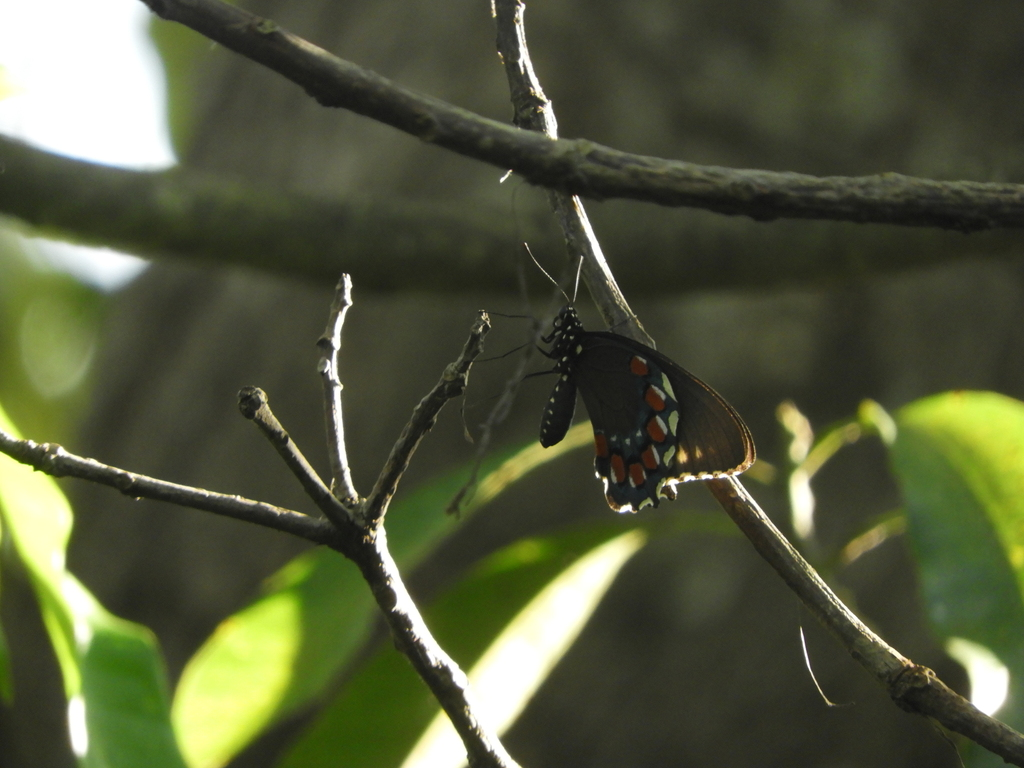
Butterfly of Week 1, 1.1.24: Pipevine Swallowtail

Better late than never, Gentle Readers. I can't even blame the time it took to write this study of the popular Pipevine Swallowtail on browser updates, weather-related connection disruptions, and other cybergarbage. There is a lot of good, informative material on the Internet about this species. Research at the level it takes to produce a short article about a more obscure species could easily produce a book about philenor. I sat down to write this post on Thursday evening, and here it is, well past sunset on Friday night.

And the next butterfly on the list is also well known, well documented, and furiously popular. at least in the Western States. But this one's popular in the East as well. 

For at last we've come to a North American butterfly, and a beloved one--Battus (or Papilio) philenor, the Pipevine Swallowtail. If Americans have any interest in butterflies, we probably know this one. To know it is to love it. "Extraordinarily beautiful," science writers enthuse. It's most common in the southern tier of States, but has been seen in southern Canada, is fairly common in Mexico, and is found as far south as Guatemala. 


(Photo of Battus philenor philenor donated anonymously to Butterfliesofamerica.org.)

Bloggers like them. Quite a gallery of photos of philenor and other species has built up at 


It's easily confused with a few other American swallowtails in much of its range, though--because a few species that are less toxic to birds mimic philenor. As a child I learned to confuse Pipevine Swallowtails, Spicebush Swallowtails, dark female Black Swallowtails, and dark female Tiger Swallowtails, all of which my elders referred to as "black Swallowtails," because their base color is black. Tiger Swallowtails were clearly different. Their affinity for some of the larger "black Swallowtails" could not be ignored; my brother reported that a teacher had told him that Tiger Swallowtails mated with "black Swallowtails" to produce "Royal Swallowtails"--by which they meant the male Black Swallowtail, which has more yellow and less black on its wings than the Pipevine Swallowtail and its mimics. This is the kind of thing that drove the old naturalists to drink and Latin. Common names are useless and misleading, they said. To talk accurately about living creatures we should use Latin names.


(Photo of Battus philenor hirsuta donated anonymously to Butterfliesofamerica.org. Not all of the subspecies hirsuta show the purplish iridescence seen here, even in the same light, but the bodies do look thicker and blacker than other philenor because they have dense, fluffy fur. This subspecies' name at least makes sense: hirsuta is Latin for hirsute, or hairy.)

So they named this beloved butterfly, originally, Papilio--Latin for "butterfly," Linnaeus having regarded the Swallowtails as the quintessential butterflies--philenor, Greek for "lover of her husband," an ideal rather than the name of a character in ancient literature. Very scientific. Very objective. Butterflies don't form pair bonds, and at least half the species are male.


(Photo of Battus philenor acauda from Butterfliesofamerica.org. Acauda means "tailless," though this Yucatan subspecies usually has a vestigial "swallowtail." Rothschild described the vestigial "tails" by saying that "the tail has become a tooth.")

Then, some years later, after many species of butterflies had been named Papilio something or other, scientists chose different names for genera that might actually be able to hybridize, and arbitrarily named the group that includes philenor after Battus, an ancient king whose name is probably related to our word "battle" and probably meant "warlord," or a shepherd in an ancient cautionary tale who shared the same name. Right. So in Latin this butterfly is the Warlord Who Loves Her Husband. It's not the butterflies who are gender-confused...


(Photo of Battus philenor insularis from Efrenbiologia, Isla Clarion, August 2016, showing that the genders are confusible to humans. Some males are much bluer than females, and some couples look about the same. Since the butterflies smell each other's scent they don't seem to be confused at all. Insularis, of course, means "of the islands," the Tres Marias Islands and Nayarit.)

In Spanish "Swallowtails" are Mariposas de cola golondrina, and this species are simply azul, the Blue Swallowtails. Some people like to call them Blue Swallowtails in English, too.


(Photo of Battus philenor orsua from Sineadgmz, Mexico, January 2024, donated to Inaturalist.org. Orsua is a family name; no source explained whose or why.)

All Pipevine Swallowtails eat pipevine, the North and Central American species of (you surely guessed it) Aristolochia, while they are caterpillars. They are most often found in warm forest country where these vines grow, and are occasionally seen almost everywhere. They're not all alike; if you get a good look in a good light you may be able to tell which of a pair is male (his wings are usually a brighter iridescent blue) and even identify the five recognized subspecies. Butterflies of the Pacific Northwest says that "The amount and shade of blue varies with individual, gender, age, angle, and intensity of the light," and describes the shading on the outer underside of the hind wings as "metallic" or "Mylar blue" with "persimmon red," black-rimmed spots. The upper side of the hind wings, when visible, can appear like a flash of bright sky blue, with a border of white spots. The body is black, sometimes with an iridescent blue sheen in males, fading to gray more typically in females. They are one of several butterfly species that can look different depending on the temperature in which they grew up, though philenor don't vary so widely as to have been mistaken for separate species. When Battus philenor philenor survive pupation through a frosty winter in the northern part of their range, according to the University of Kansas' Manual of Kansas Butterflies, they mature with smaller wings and furrier bodies and look more like Battus philenor hirsuta; but the California subspecies look "hirsute" all year. 

In addition to the other Swallowtails in its range, Battus philenor also seems to be a "model" for the Red-Spotted Purple and Diana Fritillary. Far less toxic to birds, they can be mistaken for philenor from a distance and thus discourage birds from eating them too. The blue color delights the human eye but its purpose seems to be to warn birds, "You do not want to eat me."

US-based search engines actively favor US over foreign sites, with amusing results when one is searching for documents about a multinational butterfly species. B.p. philenor, the original and most common subspecies found in Florida and Texas, is abundantly documented online. B.p. hirsuta is well represented. B.p. acauda, usually found in Mexico and Central America, is less documented, and it can be hard to find photo documentation of the subspecies orsua and insularis, native to islands and found in some parts of Mexico. Google seems positively averse to displaying documents of orsua and insularis in Spanish and tries to drag you back to better sponsored documents of B.p. philenor in Texas even when you've typed "battus philenor in mexico" into the search bar.

Subspecies acauda can have quite a distinctive look, with different spots on the underside.


Photo by Alex_cb, Quintana Roo, August 2023, donated to Inaturalist.org.

The upper side may be more likely to look black and white , though this subspecies can also flash "cobalt blue" hindwings in the right light.


Photo by D99, Quintana Roo, November 2017, donated to Inaturalist.org.

The species had been recognized and written about even before Linnaeus. The earliest naturalists gave it some of those sprawling, inconsistent Latin names Linnaeus set out to simplify. It was Papilio eques trojanus philenor in 1771, when Linnaeus used that name, which he later shortened. "Butterfly Trojan-Horse Lover-of-her-husband"? "Trojan Horse" might have referred to its confusibility with mimic species. 


What Linnaeus knew about philenor in 1771. Digitized images of these very old studies are preserved at funet.fi; this screenshot was taken by Dennis Walker at socialbutterflies.com. 

By the 1890s, when Walter Rothschild wrote his description of this species, he couldn't resist speculating about how the different Battus species had evolved into one another. His ramblings can be found at https://archive.org/details/novitateszoologi13lond/page/509/mode/1up?view=theater. He didn't actually know what might attack these butterflies, but he was full of theories about what :must" now or "must have" once eaten them, to explain the facts that most of them have "swallow tails" but some don't, and most look relatively smooth but some look very furry. He didn't even bother to mention their size range, except to mention that the first generation to fly in spring are smaller than their offspring who fly in summer. (Wingspans can be up to four inches, though three inches is probably more common. Some individuals' wingspans are barely over two inches. However, some South American individuals have reportedly had wingspans up to five inches. In places where they coexist with Tiger Swallowtails they're likely to be described as "smaller and bluer" than the bolder, more familiar female Tigers.)

Rothschild's article mentions, with a nugatory question mark, Reakirt's having classified philenor as a Pachliopta. In fact the mostly South American Battus Swallowtails are similar in many ways to the south Asian Batwings, but their bodies are black, not red. However, though forewings and hindwings move together when they fly, philenor's flitting-and-sipping behavior does show a very limited counterpart to the Pachliopta species' ability to move their fore and hind wings independently; they can keep their forewings moving to maintain balance in the wind while holding their hind wings open to display their social status (see below) to one another. Scientists now describe the similarities among Battus, Pachliopta, Atrophaneura, and other genera by putting them in the "tribe" Troidini, the Aristolochia-eating butterflies.


Photo donated to e-butterfly.org by Billtebird, showing the forewings raised and fluttering while the hind wings remain spread out and relatively still. The butterfly and flower are probably moving together in the wind. This exposes the hind wings to light at different angles and shows the other butterflies that this one's not fading to gray or green.

As with other Battus, the forewings are long and the hindwings can be hidden when the butterfly comes to rest; they can look almost like the Longwing family.


Photo by Dandewild at e-butterfly.org. 

And when do they fly? Rothschild didn't say, but the fact is that at any time of year a Pipevine Swallowtail is probably flying somewhere. There are distinct generation groups during a year in places where the species is active all year. In some parts of Mexico they're found in winter; in the Northern States and Canada they're found in summer. Here's a chart showing when to look for them in your State or province:


More recently, since the butterflies are common in countries that can afford to fund scientific research, many peculiar studies of them have been made. It has been formally determined, for example, that females who are carrying more eggs focus more intensely on finding places to lay eggs and are less choosy about where they lay their eggs than females who have already unloaded some of their eggs are. The eldest caterpillars in one brood thus have to take what they can get in the way of a home, while the younger siblings' homes are likely to be carefully selected. Older siblings may grow up as a family group of a dozen or more, while younger siblings may be solitary.

Another topic of serious scientific study has been the extent to which philenor search visually for the right leaf shape when looking for vines to lay eggs on. It turns out that the butterflies do look for the right leaf shape. In places where they have a choice of different Aristolochiae with longer or wider leaves, a butterfly who has laid her first few eggs on one of the two possible food plants is likely to look for other vines of the same species. However, the final decision is determined by palpating the leaves with her feet, which contain receptors for chemicals the butterflies probably sense as tastes. By walking on a plant a mother butterfly can determine whether it will taste good and be nourishing for her caterpillars when they hatch.

Mark Rausher, who studied butterflies' use of sight to find the kind of plants on which to lay eggs, went on to study the biochemical properties they seem to look for. This study is new enough that you may need to buy it if not reading it at school. (This web site was founded partly for the use of students and has determined, over the years, that a a significant part of our readership does come from schools, as is shown by the decline in readership when schools close. This web site warmly encourages high school readers to nag your school libraries to offer more scientific journals instead of cartoonish video games.)


Speaking of school libraries, some of them are now offering free printable PDF copies of the pricey Swift Guide to the Butterflies of Mexico. 


And some scientists have identified (some of) the biochemicals mother philenor butterflies look for:


Color is a factor in adult butterflies' nectar-seeking preferences; they like pink and purple. They visit white, yellow, and red flowers too, but tend to visit pink and purple ones first. This is primarily a pollinator species, but, as in many Swallowtail species, males drink mineral-heavy, brackish water and females prefer, if they can, to meet their need for dietary minerals by contact with males. Philenor are generally less attracted to dung and carrion than some Swallowtails, but males do like fresh horse and cattle droppings


Photo from CarolinaNature.com, donated by Will Cook.

A study found that Battus philenor normally pupate for either 11 or 12 days, and almost always emerge from the pupal shell at sunrise. 


A study found that the butterflies like to perch, at night, in small uncrowded groups. In addition to this badly formatted study supplied to the Internet by the Smithsonian Institution, this observation has been documented in a Youtube video that I found blurry and hard to watch, despite some nice clear still shots of individual butterflies sleeping motionless, wings spread out to catch the sunlight at sunrise, perched on tall grass and flowers on the prairie.


Sleeping in small uncrowded groups starts in late caterpillar-hood, when individuals often leave their food plants and spend the night somewhere else--where they expect predators won't look for them, no doubt. For caterpillars they can move fairly quickly, tapping their antennae on the surfaces ahead and beside them as an aid to navigation. Caterpillars do have working eyes, not on the sides of their heads where the jaw muscles and camouflage markings are likely to be, but down near their mouths; species tested were found to be very nearsighted, seeing less than a yard ahead. Humans who are so nearsighted are "legally blind," so the resemblance of a caterpillar tapping the path with its antennae to blind people tapping the ground with white canes is not only superficial. Toxic and relative bold though they are, they are vulnerable while resting at night, and awaken with a visible start.

Being so creatively ugly, of course, the caterpillars can give humans a start when the places they choose for resting away from their food plant are humans' homes. This photo of a caterpillar on a narrow window frame makes it look as if the house is being invaded by an alien monster. Actually the caterpillars tend to pupate while they're less than two inches long.


Photo by Lfelliott, Columbia, Missouri, July 2019, donated to Inaturalist.org.

Colors have been chemically analyzed:


Some of the color variations that are possible at all life stages for this species may be hereditary; some are produced by climate conditions; others may be produced by variations in the quality of their diet. 


The social effects of these butterflies' colors have also been studied. (Butterflies are most fertile the first time they mate. Female Swallowtails actively watch males, preferring virgin bridegrooms and watching for fresh young males to mature, since females in many species are fertile when they crack their pupal shells but males have to wait for hours or days to become fertile. Males whose iridescent scales have been deliberately worn down by researchers had a hard time finding mates. The researchers weren't sure whether the females thought the worn-looking males looked too old, looked like a different species, or--a possibility the researchers didn't mention--looked too damaged. When we see a man with a part of his normally visible surface scraped off, do we think "He's handsome" or "He's ugly," "He's old" or "He's young," or do we think "Oh dear, what happened to him?" Too many of these studies are done by guys.)


Photo by Kelly Jacobs on Pinterest. He looks fine to humans, but is that blue on the greenish side?
Young males hang out with other guy-butterflies, showing off and sometimes competing to hold the highest territory on a hill. When they fly toward each other, nobody ever gets hurt; what they're threatening to do is embarrass each other by showing superior size, speed, and skill. (As Walt Kelly observed, a butterfly is an adult caterpillar, and might not want to admit it is completely harmless--but it is, anyway.) They chase each other away from their territories and chase females, too. If a female is interested in a male, the chase was found to last, on average, about half a minute before the couple mated. The benefit of earning a degree in entomology is that you get paid to hang out in places where you can see things like this. The cost is that you actually have to watch and count things like this...


Gatherings of male Swallowtails aren't always territorial displays. Since several species of male Swallowtails like the same mineral salts, they often become the core of a large mixed group of drinking buddies that includes several smaller species as well. 


Photo by Jeff Pippen from North Carolina.

Female Swallowtails visit these groups to check out the males, but males can't always rely on females to start the courtship process. They may spend many minutes flying around females, showing their colors and scents, before getting a favorable response or losing hope of one. They will mate more than once in their short lifetimes, if they can.

In this initially confusing photo from AnimalDiversityWeb, a Pipevine Swallowtail and a Tiger Swallowtail, both apparently old males, seem to be drinking from the same wet sand:


To humans the Pipevine Swallowtail may resemble a female Tiger the Tiger Swallowtail chased when he was younger. Since butterflies recognize each other by scent, the Tiger Swallowtail is unlikely to make that mistake. They're just two old fellows fading away together, the Tiger with half his left hindwing gone. The female Tiger, bigger and more colorful than the Pipevine Swallowtail, cleaner and more polite than her mate, has presumably flitted off into the woods to lay her eggs in the tops of tulip poplar trees.

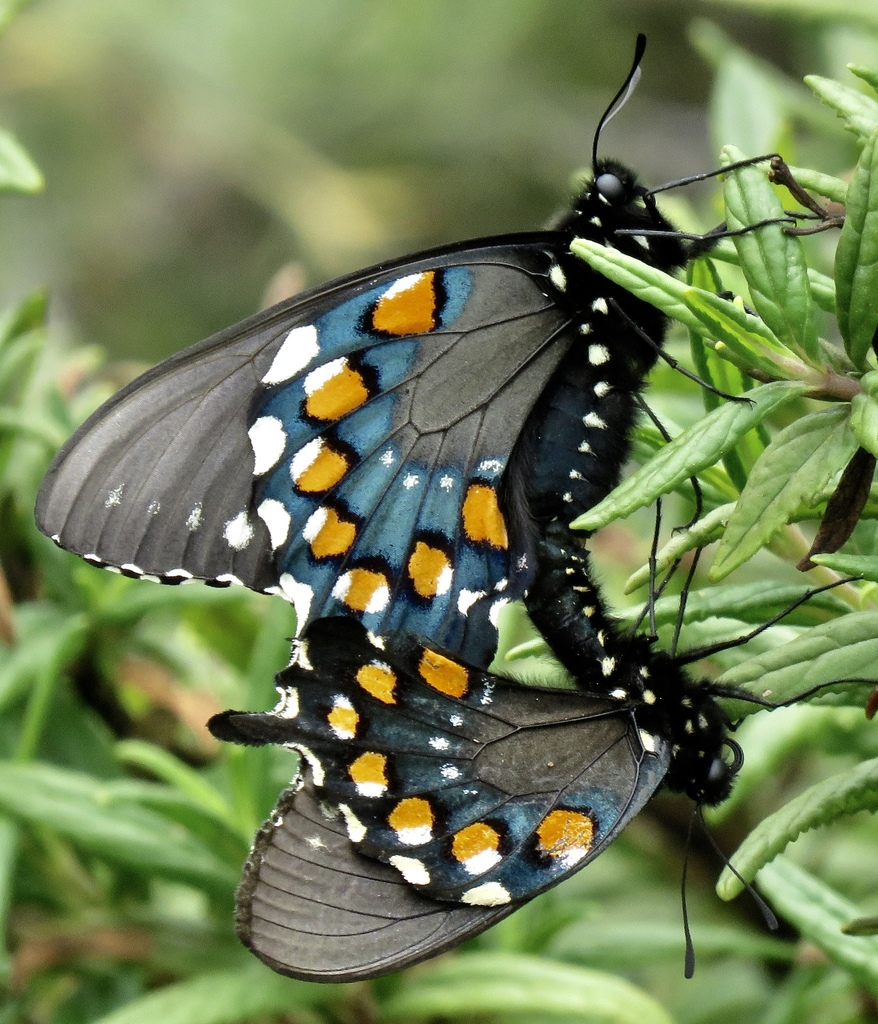
In many Swallowtail species females are bigger than males. In philenor some photographs of couples show no size difference, and the rule that males have darker black and brighter blue colors doesn't always hold true either. Below, the one with the egg-stuffed body shape is also the one whose wings show more blue.


Photo donated by Robberfly to Inaturalist.org: subspecies hirsuta in Sausalito (California) in March 2019.

In fact, one study suggests, male philenor hindwings iridesce more "true" blue before mating and a greener shade of blue after mating. Since butterflies don't form families, males will try to mate again right after their original mate flits off to look for lots of different vines on which to distribute her eggs, but these matings are likely to be less fertile--so females avoid those secondhand males.


Females can look grayish or brownish (as can males, in some lights--it's really hard to tell, except that the ones you see laying eggs are female) but only in a reddish sunset light can they iridesce purple, as in this photo. I suspect Bill Hubick of having used a colored light to enhance this beauty:


As she sips from the Monarch's favorite flower, does she fantasize about being a queen? No, that's a strictly human fantasy. Two more views of Madame Butterfly at https://www.billhubick.com/photos/butterflies/pipevine_swallowtail.php .

Males' fluttering around females displays their blue color from as many different angles as possible, ensuring that females can pick out those true blue colors:


Their DNA has been studied:


Encouraging the appropriate (preferably native) host plants and not spraying "pesticides" outdoors have been found effective in checking local population declines. Butterfly populations come and go, as their microscopic predators follow their population trends, so it may be good for the species overall if the local population shifts from one neighborhood to another every few years. When an overall decline was confirmed in California, conservation efforts seemed to help:


But beware of introducing exotic Aristolochia species. There are some Aristolochias that philenor can't eat. Occasionally a female will lay a few eggs on an exotic vine that will actually be toxic to her caterpillars.


This Aristolochia elegans can become an invasive nuisance in Florida and California. Philenor caterpillars hatched on it will not survive. It's native to Brazil, but Google didn't show any species of Swallowtail butterfly that could eat it. When introduced into Australia it was blamed for killing the Richmond Birdwing butterflies there.


This Aristolochia serpentaria, a.k.a. snakeroot or birthwort, is the primary food plant for Battus philenor in the Eastern States. Photo from Mary Lee Epps at the Virginia Native Plant Society, vnps.org. Its flowers are smaller and harder to find than those of the invasive nuisance species but, if you look closely, they have a similar little burst of dark reddish color inside;


Aristolochia macrophylla, a.k.a. pipevine or Dutchman's Pipe (and most Aristolochias seem to have been sometimes called birthwort), is another food plant for Battus philenor philenor.


Aristolochia californica is the natural food plant for Battus philenor hirsuta. 


Aristolochia pentandra is the natural food plant for Battus philenor acauda. 


Aristolochia or Isotrema tomentosa is another plant some Battus philenor can eat.

These photos were selected for showing both leaves and flowers. In real life Aristolochia vines consist of a lot more leaves than flowers, and people often don't recognize them because, while stepping over vines in the woods, they never notice the flowers. The University of Florida offers more detailed information about the plants these caterpillars can and can't eat. 


When newly eclosed butterflies stretch out their wings for the first time, females contain considerably more aristolochic acid than males. Over the next ten to fourteen days, as they mature, reproduce, age and die, males remain as toxic as ever while females become less toxic. Apparently the female's extra dose of aristolochic acid goes into the eggs. She keeps enough to remain toxic to birds all her life.


Some sources claim that in the Philippine Islands this species is believed to bring bad luck. Well, it would be bad luck if this American butterfly became an invasive nuisance in the Philippines and displaced native Atrophaneuras, some of which are rare and endangered, so that belief might make more sense than many superstitions do.

How do people get these butterflies to perch on their fingers? When the air drops below a certain temperature, all butterflies go into hibernation mode. If gently picked up and carried into a warmer place, they will wake up slowly on your hand, looking as if they were asking themselves what the bleep is going on, but not injuring themselves in a frantic effort to escape. Their instincts tell them to let themselves warm up, quietly, and they'll soon be able to fly away. So they rest calmly on your hand, absorbing warmth, stretching their long legs and tongues, fanning their wings, and giving you time for a photo or video shoot before they fly away. 


Caterpillars don't seem to see far enough ahead to be able to see that a human is a living creature; when they crawl around on us they're probably trying to figure out what can have so many different textures and odors. Butterflies do see us as entire living creatures, but they don't seem to understand the concept. If we grab them or box them in, we're predators and they'll tear themselves to pieces trying to escape from us. If we sit still, some male butterflies may actually think traces of soap and sweat on our skin taste interesting, and may stroll around licking us. (Female butterflies won't be interested unless we happen to be holding something like a juicy melon rind.) If they wake up from hibernation mode to find themselves sitting on our fingers, and we hold still, they'll continue waking up with the semblance of serene faith it seems to require for anything as fragile as a butterfly to live.

It's easy to attract a philenor family to a shady corner of the garden, according to MyGardenerSays.blogspot.com. If unable to transplant a native Aristolochia vine from the woods, you can probably buy A. fimbria as a ground cover from a garden shop. It' has attractive white-veined, pale green leaves and a nice symbiotic relationship with these butterflies. The caterpillars seem to eat it all up. Then it grows back. Then the next generation of caterpillars seem to eat it all up...The blog post goes on to discuss other plants and butterflies that coexist with philenor in the blogger's part of Texas.


Eggs are most often described as orange-red, sometimes orange or amber, and sometimes even burgundy. Like the eggs of other Troidini, they're little round beads textured with drops of aristolochic acid that protect the eggs from being eaten by ants.


Photo by Ansel Oommen, Bugwood.org. 

Hatchling caterpillars...


Photo from thedauphins.net .Photo essay showing the full life cycle at http://www.thedauphins.net/id111.html .

Caterpillars are most often black or a dark purplish color fashionistas call aubergine (it literally means eggplant-colored, but is used to refer to a brighter shade than actual eggplants). However, as Birdgal5 documented in this photo (May 2008, Folsom, photo donated to Inaturalist), even young ones can have the minority bright red coloring. Whether caterpillars look black, aubergine, brown, or red may depend on how much light they've been exposed to; since most of them live in the woods, on the undersides of vines, they see relatively little sun and look black.


If, and only if, you eat too much red licorice and want to turn yourself against this candy, click here. I am not agreeing with the blogger's claim. I'm only saying that thinking about it is a good way to form an aversion to red licorice. Or cinnamon "red hots." Or lipstick!


Despite their dragonlike look (and they can chomp, if not hard enough to puncture the skin at least hard enough that you could feel the pinch), these caterpillars are harmless to humans--unless a human, perhaps an infant, was foolish enough to swallow one. Aristolochic acid has been consumed by humans for medical purposes but its effects aren't pleasant. If you weren't looking for relief from something even less pleasant, you'd regret having ingested this plant toxin. It raises pulse and respiration to a degree reported to involve dizziness, nausea, and violent expulsive contractions, as in its old herbal name "birthwort." Modern obstetricians usually prefer other chemicals even to speed up the birth process. Even Klaus Schwab would never recommend that anyone eat zis "bug."


Nelruzam, who photographed this one for Inaturalist.org in Sonoma County in June 2017, might have put the camera too close or chosen to photograph a caterpillar who had already been disturbed. The animal is making its threat display--osmeterium ("stink horns") out, tentacles down. (The other tubercles are just warts, but the tentacles have some voluntary movement.) Caterpillars have been video-recorded tapping each other's tentacles, sometimes apparently waking up a sleeping sibling who jerks away as if nonverbally saying "I'm fine! Leave me alone!" Tentacles down and horns out, however, are thought to suggest to a bird that the caterpillar just might be some sort of bird-eating lizard. 


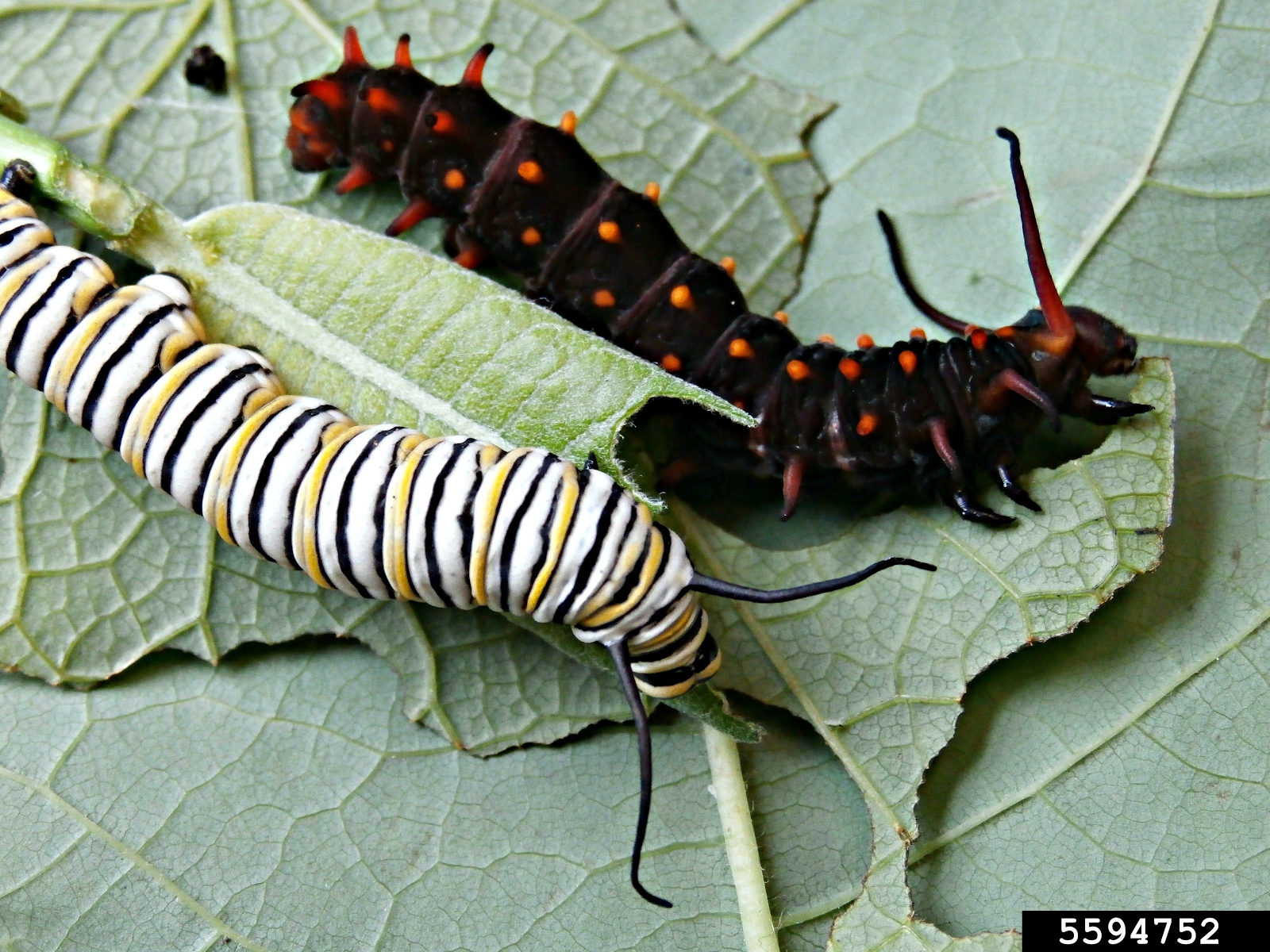
This scene, not found in nature, was staged by Ansel Oommen, Bugwood.org. A Pipevine Swallowtail caterpillar, munching away at a pipevine leaf, has been posed next to a Monarch caterpillar, munching away at a milkweed leaf. Though very different the caterpillars are similar in size and have similar tentacles. Both are completely harmless to humans, crops, livestock, and gardens...unless swallowed.

The tentacles, some researchers say, may help the caterpillars find edible leaves:


In natural conditions Monarch caterpillars never grow up in family groups, have no social instincts, and are likely to try to eat one another if they do meet. Several of the larger caterpillars behave this way; it's one way nature keeps them from overpopulating and destroying their host plants. In nature, however, philenor often grow up in small family groups, as butterflies often lay the first few eggs in clusters, and siblings get along very nicely, lined up in rows eating one leaf when they're little, spreading out so each one can gobble a leaf of its own as they grow bigger. In captivity, especially if they don't find good fresh leaves to eat, they become confused and can start to "bite and devour one another." The best way to rear these butterflies is to protect their host plant outdoors and watch them grow up naturally.

Though toxic to most predators, philenor caterpillars have one unusual predator: ladybugs (ladybirds, ladybeetles). Ladybug larvae usually eat aphids but they can survive eating a small, young philenor caterpillar. According to https://mdc.mo.gov/discover-nature/field-guide/pipevine-swallowtail-blue-swallowtail, when larvae of these species meet, the beetle larva is likely to bite the caterpillar. The caterpillar can bite back in self-defense, although it's not known to eat beetle larvae. Which creepy-crawly will win the biting fight? Usually the one that is bigger at the time. Mature caterpillars are much bigger than ladybug larvae. Hatchling caterpillars are not.

People have, as Pedromariposa has, made video recordings of the caterpillars stripping leaves off these vines. This is one of the Swallowtail species that have enough sense not to eat their siblings; butterflies try to give each of the younger siblings in the brood a foodplant of its own, but some of the first few eggs may be placed in a group on one plant, producing restless but nonviolent family groups:


People have taken time-lapse photos of how the caterpillar achieves that funny-looking chrysalis...not quite as grotesque as some of the tropical Battus and Atrophaneura chrysalides, but still, it's a weird-looking process. 


Chrysalides are usually pale brown, as in the video. But Tashawidow watched a philenor hirsuta caterpillar develop this bright green and yellow chrysalis in Redding, California, in May 2020:


Spillane found a brown and a green chrysalis side by side in Sausalito in January 2021...these caterpillars made little attempt to seek cover before entering the most vulnerable stage of their lives. (Both photos from Inaturalist.)


After eclosion (emergence from the chrysalis) the butterflies fly for up to two weeks. Art Shapiro, who ought to know, claims that they can live as long as a month after eclosion--but apparently few do, because everyone else says their adult lifespan is two weeks.