Showing posts with label Canada. Show all posts

Thursday, July 23, 2026

Bad Poetry: Go West, Rain

"Though our traditions served us well,
No longer must we wait
On them," said the young fool in the north.
"Now we have glyphosate.

Instead of burning strips of pine trees
We might easily sell,
We'll kill all other things but pines
That dry and burn so well."

And so they did, that spring. That summer
Miles of pine trees burned;
The smoke lay heavy on the land.
Yet autumn soon returned.

Fools don't learn. That's what makes them fools.
Next year they did the same.
For many miles away, folks choked
On smoke. They were to blame.

"Though glyphosate is killing people,
We can spare some numbers,"
The old fool in the south said. "Onward
The Economy lumbers!

Let more old folk die younger! Let
The young produce more babies!
And have a War, to thin the herd!
And..." you know. Christian? Maybe his

Claim to conversion's real, but his brain's
Not attuned to the Spirit,
And he must be struck down and blinded
So that he can hear it.

Is poison worse if made in China?
So he bloviated.
Who sells you poison's not your friend.
Hunched in his web, he waited

To see more spraying in the north
Bring back the choking pall
Of smoke that drifts from north to south.
Then, well known for his gall,

He blamed the north for fouling air
People breathe in the south,
And, far from help to fight the fire
Before the south's own drought...

Forgive us, Lord, both south and north.
The east has too much rain,
While once again a deadly drought
Has gripped the central plain.

Please waken people in the north,
Convict them of their sins,
And westward blow our surplus rain,
So everybody wins.

(Cut-off point for tired eyes)

For those who've not been paying attention...These are just some popular links from Google. If you dig you can rake up even muckier stories, conspiracy theories, etc. I don't want to bother. This is a legitimate news story the CBC, the BBC, Reuters, etc., have covered, but not publicized well due to their Trusted News Initiative mandate to smother stories about what's wrong with sponsors' profitable products under layers of celebrity gossip and silly quibbles. The big US news outlets have tried to avoid this story altogether. Ignoring it's not going to make it go away.

Canada's spraying glyphosate on the old forests that might be considered among its great treasures:

 
Canada's claim on reciprocal help to fight its ensuing wildfires:


Trump's un-neighborly and hubristic response to that claim:


The Cat Sanctuary is currently in one of those weather patterns, described in old British and Western European folklore, where rain on (local lore disagrees on exactly which day) a certain day in early July indicates that more rain is going to fall on every one of the next forty days. In the US this rain usually occurs as part of thunderstorms. The lights didn't go out yesterday or last night but I unplugged the computers, just in case, four times. One day last week, by chance, rain didn't fall on the Cat Sanctuary itself but we could see it a few miles away. Tennessee had floods the weekend before last. New York City had floods last weekend. We could spare a little of that rain, and how gladly we would, if it were in our power to send a good natural water-bombing to Canada.

But who knows? If Canadians confess and renounce their sins, show a healthy distrust of those in the US and China trying to sell them more of the poison that plays such an obvious role in this sudden explosion of wildfires, maybe God will help us all with a helpful weather pattern. It's worth trying.

This poem was provoked by last weekend's Poets & Storytellers United prompt. Google's blog feed has been malfunctioning recently so I received the link only on Monday night. The poem that came to mind seemed topical enough for a Thursday post here, so here it is. I'll try to post a more cheerful poem to the PSU link-up on Friday, as well as the one on Substack.

Friday, April 10, 2026

New Book Review: Barking Orders

Title: Barking Orders

Author: Roxy the Cattle Dog

Date: 2026

Publisher: Ironia Press

Quote: "Humans think they're in charge. Adorable, really."

Roxy is a bossy but goodhearted Black Heeler. She lives with her "upright mammals" in Toronto, where her talent might seem wasted. Bred to guard and herd cattle, she uses her talents (as she seems to see it, in this short book written from her point of view) to fend off the incursions of deliverymen and direct humans away from party dinners long enough for her to gobble up some of the savory treat food. But obviously her humans are getting dinner party stories and now at least a "concept book" out of her adventures...which include her "mission" to cheer up her human when he's sad, too.

The only thing you might not like about this book is that it's the sort of short "concept book" that works best when the scant text fills in around lots of pictures, and my advance review e-copy did not have the pictures. It's funny. Caution is advised about eating or drinking while reading this book. And at 125 pages of short sentences in generously sized type, it'd be an excellent choice for reading in bed after injuries other than broken ribs. 

The author promises a sequel, also to be called Barking Orders. I'd recommend at least adding a number, if determined to repeat the title, to help book buyers and sellers keep track of which volume they've already read or sold. If you like funny dog stories, you will want the sequel.

Friday, January 9, 2026

Book Review: Contes Jaunes

Title: Contes Jaunes

Author: Gérard A. Dubé and Andrée Soucie-Dubé

Date: 1986

Publisher: Guérin

ISBN: 2-7601-0077-4

Length: 176 pages

Illustrations: many colorful drawings

Quote: “Contes jaunes rassemble une variété de textes conçus spécialement pour l’initiation à la lecture chez les débutants.”

In other words, this is a French Canadian first grade reader. It will also work for home-schooled students, or students at schools that are enlightened enough to offer language immersion programs in the primary grades.

It might be too juvenile for high school students learning French. This is the sort of book n which dogs playing in the snow are shown not only sitting on sleds and making snowmen, but sitting down in a human position. There’s a Chicken Little story in which what hits Petit Poussin on the head is an apple, and the wise old owl tells him to eat it up quickly before someone else does. And Frère Jacques, and a French version of “This little piggy,” and similar nonsense.

In an ideal world, adult readers would be eager to share this book with children. We don’t live in an ideal world. We live in a world where, after France balked at supporting our war with Iraq, the few U.S. libraries that stocked children’s books in French discarded their collections...even when the communities the libraries served included Haitian, Algerian, and Ivorian immigrants. Still, one can hope that American adults will recover their senses. French may be less of an international language than it once was but it’s still the language in which many of the world’s great books were written.

Friday, October 24, 2025

Book Review: Magpie Goblin Word Boy

Title: Magpie Goblin Word Boy

Author: V.R. Friesen

Date: 2022

Publisher: Dimmare

ISBN: 978-1-7774062-7-1

Quote: "Magpie's first collection was rings...he'd leave every third one for the crows."

I cheated. This is not really a Halloween book. It's about a more serious kind of horror. In its unlikely post-apocalyptic world, the law of gravity has been amended, at the same time that large numbers of humans have died. Survivor children roam in packs of orphans in active competition with the "biggies" who compete with them for food. There's an extensive series following different characters at different times of this fictive world's history. This is the short introductory e-book where we meet just a few of the characters who will appear later on as teenagers or adults. Different friends and competitors call the protagonist Magpie and Goblin and other names; this is the story of how he earns the name of Word Boy, a potential rebuilder of civilization. 

Word Boy and his acquaintances don't seem to know that their environment was once called British Columbia, but there are clues, like the magpies that don't live in most of North America. 

Friesen is "voicey" enough to satisfy anybody, even on the poetic side, and those who enjoy haunting dystopia stories probably will want to buy the rest of the series. 

Wednesday, December 25, 2024

Book Review: Decker & Joy

Title: Decker & Joy

Author: Elle Rush

Date: 2016

Publisher: Deidre Gould

Quote: "A year after hanging out his shingle as a private investigator, his dream of being hired as a private detective was dying a painful death."

Then Decker the detective is assigned to track an espionage device, disguised as an Elvis doll, that's been mysteriously lodged in the walls between a "Pure Bred" pet store and a store called "Kitten Caboodle" that sells pet toys and screens adopters for actual pets. There is no store that humanely cares for rescued animals without control-freaking. Joy, the control freak who runs "Kitten Caboodle," would like to keep all four of the kittens she has for sale, pardon me, pricier "adoption," but at least she makes it hard for people to "adopt" them. Joy lives in an apartment where she's not allowed to have a pet of her own. She likes Decker, though, and so do the kittens. 

It's a sweet Christmas romance so we know where this is leading. Well, not quite. A company in Winnipeg is actually setting up meetings between potential couples whose names remind people of Christmas carols. Decker and Joy are single. Will they become a couple? Will they move to Winnipeg as a couple? Do people who've been given Christmas-carol names adapt more easily to a place where at least all their Christmases will be white, and probably most of their other holidays as well?

Is this what it takes for employers in Winnipeg to hire people?

The writer known as Elle Rush, we are told at the end, is based in Winnipeg. So maybe she would know. 

Anyway, it's a cute, funny, clever romance. I laughed. Enjoy it, or just enjoy the thought of it, as you like. Merry Christmas, Gentle Readers. God help us every one.

Monday, December 9, 2024

Book Review: Fighting Happily Ever After

Title: Fighting Happily Ever After

Author: Elena Aitken

Date: 2020

Quote: "A wedding planner who didn't believe in love!"

It is possible to feel that you're laughing at the three couples of clueless young people in this book more than you're laughing with them. They spend a lot of time crying and worrying about things no one else would take seriously. All's well in the end, of course, even if one of the three couples end up not marrying each other...guess which one? 

Not Hope and Levi; they're already married, and Hope has no regrets even in the middle of a difficult pregnancy. So, will Faith or...wait for it...Stephanie be married at the end of the book? Aitken undertakes the challenge of adding suspense to a romance novel. Though you know there's going to be a sequel in which the other one will be married, anyhow.

Faith is afraid to love anyone (does this ever happen in real life?} because, as a teenager, she discovered that her happily married parents did fight. Worse, her lifelong boy friend, Logan, whose cousin Levi is married to Faith's twin sister Hope, is one of those little boys who express affection by teasing and needling little girls. 

We as a culture need to do something about this. Little boys are becoming baby-daddies before they learn that little girls never did like to be teased. Who knows how many children might have a chance to grow up in unbroken homes if nobody had told their fathers that it was acceptable or even cute to annoy little girls. We know little boys mature slowly and develop empathy slowly, so we need to be teaching them...first by exposing them to domestic animals who could teach them, before they meet girls of their own size. "That hen/dog/cat told you to back off. You didn't. You deserved that little nip. When anyone tells you to back off, you must back off. Likewise, when people tell you to stop talking to them, you must shut your mouth up tight, and when they tell you to leave them alone, you must leave them completely alone, not even looking at them. No means No. No is not negotiable. If you ever do meet a person who says No when she means Yes, which some people used to do a long time ago, you will just have to teach her to do what she says, say what she means, because one thing leads to another." And then when they meet little girls, we need to enforce this. "Did you see her move back away from you? Did you hear her say 'Leave me alone'? LEAVE HER ALONE. If you want to talk to her because you like her, don't do things that make her not like you. You must not even look at her until she talks to you. Don't ever speak to any person who is not looking at you and smiling. If you have to scream for help, raise your face toward Heaven and don't look at any individual person until someone speaks to you! In a civilized country this will keep you out of prison; in some countries it will save your life." 

Arguably the world needed a Canadian novel that shows how close a character comes to losing his True Love by teasing, because, a hundred years ago, Anne of Green Gables...lived in a different world. We need to make that absolutely clear. Delightful character. Different world. 

Anyway, even at paperback novel length, Aitken manages to weave in a secondary plot. Faith and Logan are not just fake dating, but fake living together, in order to attract Stephanie Starz (does even Hollywood give actors stage names that bad, in real life?) to Faith's business for the movie-star wedding of the decade. Anyone could have told them that either fake or real living-together-as-a-couple-before-marriage is no way to promote a wedding business, though if only some more of either family were living in the house, to support the claim that they were living-together-not-as-a-couple, maybe... 

But Stephanie is too young to think through these things, just like Faith and Logan and Hope and Levi, so she's sure that being married at the place where twins met their True Loves will bring her marriage good luck...well. She and her fiance have some living and learning to do, too. And, to find out which couple Aitken thinks are ready for marriage right away and which couple need to think it over, you'll just have to read the book.

I laughed...even though sometimes I was laughing at characters crying. Elena Aitken has sold a lot of romance novels, many featuring the romantic appeal of rural or small-town Canada, though they sell on this side of the border too. This novel is part of a series that's done reasonably well too. If the fake living together (yes, it does tempt them into bed together) doesn't put you off, you're likely to enjoy this novel and want the rest of the series. Aunts are supposed to recommend sweet wholesome romances where we never see unmarried couples undressing each  other. Sorry. But I did laugh.


Tuesday, November 26, 2024

Book Review: A Match Made for Thanksgiving

Title: A Match Made for Thanksgiving

Author: Jackie Lau

Date: 2019

ISBN: 978-1-989610-02-2

Quote:  "Why is it so difficult to have a one-night stand?"

Duh.

Lily Tseng has been told she's boring, so she decides to make herself more interesting to other idjits like the wormboy who told her that. She puts on a skimpy dress, goes to a bar, and tries to pick a man for a one-night stand. Instantly Nick Wong pops up. Having much in common--both have some Chinese ancestry, both spend time in Toronto, both feel excited by saying the same formerly unprintable word, and both like Nanaimo Bars--they proceed straight home for the one-night stand and, unlike real people who have one-night stands, immediately fall in love. But they have flopped into bed, drunk, first.

Well, it's not a sweet romance. It's not a romance I'd want to read on Thanksgiving Day. (And there's some intentional ambiguity about which Thanksgiving Day is being celebrated; neither the Tsengs nor the Wongs seem to care about the history, but they'll be thankful when their thirty-something children make them grandparents, they have made clear.) 

If you like an explicit romance with frequent mentions of body parts and a formerly unprintable word, plus close-knit families and the promise of three more siblings' holiday-theme romances, this one's for you.

Wednesday, October 16, 2024

Book Review for 10.10.24: Mistaken Gifts

Title: Mistaken Gifts

Author: Elena Aitken

Date: 2018

ISBN: 978-1-927968-48-2

Quote: "Would you believe she came tromping through the snow in tiny little heels and then gave me attitude because she was slipping and sliding and falling in the snow?"

Yuppie Eva (Andi's friend from Unexpected Gifts) and cowboy Jeff meet when Eva is asked to organize Andi's wedding at the Castle Mountain Lodge, where she and Colin met. Eva has just dumped a boyfriend., To forestall Andi trying to find her a new boyfriend while she and Andi have more urgent things to do, Eva is fake-dating an acquaintance of Andi's, a "gay" man. 

When Andi and Eva brainstorm ways to make Andi's wedding memorable, one idea sticks in Andi's mind. She wants to ride down the "aisle" on a white horse. She and Eva have seen the perfect horse on the ranch where Jeff works. Eva goes to make the arrangements and discovers that what she has in the way of boots are useless in actual snow. She scolds Jeff for not clearing the walkways. Jeff thinks she's cute when she's mad.

After lots of misunderstandings involving Eva's fake date and a pretty, predatory Hollywood agent who has signed Jeff up for a part, you know how this story is bound to end. If you like tasteful "contemporary adult" romances set in the Canadian Rocky Mountains, here is one more you'll want to read.

Book Review for 10.7.24: Unexpected Endings

Title: Unexpected Endings

Author: Elena Aitken

Remember Andi and Colin from Unexpected Gifts? That novel skipped lightly from the Declaration of Romantic Love to the happily-ever-after epilogue. There was time for another lovers' quarrel before the formal proposal of marriage. That could have been an extra chapter or two in the original novel, but it was first published separately, as a short e-book. Andi listens to a friend who has not found True Love (yet) and almost dumps Colin.

Canadian Content. Sweet romantic comedy. Rocky Mountain scenery.  I think volume 3 of the box set ought to have been kept in volume 1 where it belongs, chronologically, but if you're going to read the series you'll want to read it as a separate mini-book. If you buy the box set you can consider it "free."

Book Review for 10.3.24: Hidden Gifts

Title: Hidden Gifts

Author: Elena Aitken

Quote: "'Hidden  gifts'....'They're the best kind.'"

Morgan has always felt called to be around children. She's earned a degree in the subject. But when she learns that she can't have children of her own, she doesn't want to work with children for a while.

That's until Ella, the daughter of a single father who works with her at the Castle Mountain Lodge, is plopped down at the "Cubs' Club," the lodge's guest daycare facility. So far this season Ella is the only child there. Morgan was working somewhere else, but the manager sends her to the Cubs' Club because of her education. She's stuck. Despite her reluctance to be there, Morgan and Ella bond.

Her bond with Ella even makes Morgan reconsider Ella's father, Bo, a playboy type who's turned her off by bragging, "I don't do relationships." Bo has never wanted to spend two nights in a row with one woman, but something about being a father, watching his daughter bond with a woman who'd make a good stepmother, affects his hormones and...

It can happen. It's not to be relied upon. Humans' pheromone receptors and responses are weaker than the lower animals'. As a species we cannot reliably determine whether or not a given child is ours; a woman may know that she's given birth but, if the child's been adopted, after a few years  Men's ability to spot their own offspring is even feebler: the ancient Romans may have allowed a mother's husband to claim or disown an infant, but the ritual of his claiming the child had to have been understood as a commitment to rear the child, not a positive ability to know whether or not he was its biological father. Nevertheless, in some dim unconscious way, biological fathers do seem to be better fathers--more likely to spend time with the children, less likely to abuse or molest them--than stepfathers are. It's almost a cliche in fiction, because it's so often true in real life, that people burdened with emotional complexes about how badly their fathers treated them feel a great relief when they find out that those men weren't their fathers.

Anyway, watching Ella play and snuggle with Morgan starts that long-forgotten record of "Isn't She Lovely" playing in Bo's mind. Suddenly he wants to marry Morgan, although he's panicky with fear that marriage might not always be one big emotional "high."

It makes one wonder: If Bo had been disciplined enough to stay with Ellas mother when Ella was born, would he have fallen in love with her, too? Would she have survived? (We're not told how or why she died, but apparently she and Ella were very poor.) Or would things have been even worse when Bo realized that marriage, fatherhood, love, and life itself for that matter, is not one big emotional "high"? Everybody enjoys the emotions of a romantic comedy; paradoxically, we're likely to enjoy them more often in real life if we understand that they're not going to last long, that a good life offers occasional bumps of "high" and "low" in a baseline of unemotional general contentment.

You have to pity people like Bo and Morgan, trying to get through this world with only emotions to guide them. If you enjoy reading about the good times in such people's lives, here is a story about those.

Did I mention Canadian Content? The lodge is on the north side of the border; this whole series is solid Canadian Content. It's well written, and has sold well n Canada. It's pleasant reading in any country.

Book Review for 10.2.24: Unexpected Gifts

Title: Unexpected Gifts

Author: Elena Aitken

Publisher: Ink Blot Communications

Quote: "Blaine and I, we're over."

This has to be the ultimate revenge romance fantasy. Andi and Blaine had a baby together before the official engagement was even announced. From Andi's point of view, Blaine dumped her. (His story is that he hid away from her because he couldn't deal with the situation.) Andi's buddy Eva, the voice of sex-worshipping pop culture, urges Andi to find another man. Blaine's old pal Colin, who has begun to notice that their friendship reflects Blaine's immaturity too, is willing, but he's still at the one-night-stand stage of social development. When Andi tells Colin she's outgrown that stage, Colin accepts that. When Andi worries that she's lost Colin by being too much of an adult for him, and tries to tempt him, Colin spends the night "just cuddling" with her, not even having safe sex. And so, when Blaine turns up at Christmas, counting on holiday spirit (and spirits) to put his relationship with Andi back together, Andi gets to watch both men suffer for a few hours, but you know what's coming next.

Anyone in search of a good revenge fantasy will enjoy this novel. Is there anything to enjoy beyond the revenge element? Well, there's a comedy scene where a character who's always lived in Canada learns to skate...and there are several sequels about Andi's and Colin's friends. I received a review copy of the first "box set" of five stories in the series. There's another "box set" by now.  Some of the stories involve Christmas at a Rocky Mountain ski lodge, and some involve summer camping there.

Friday, September 6, 2024

Book Review: Return to Qualicum Bay Cove Prequel Qualicum Bay Cove Sisterhood

Title: Return to Qualicum Bay Cove Prequel Qualicum Bay Cove Sisterhood

Author: Victoria Michaels

Date: 2022

Quote: "This inspirational romance series which explores divorce, discovery and renewing relationships shows the power of family and the bonds between sisters."

But this "prequel," Volume 0 in the series, doesn't show those things very much. It's about how the youngest sister, Morgan, made a mistake and kissed a snake. It all started when she acted on passion and flopped into bed before marriage. She and Drew fell in lust and married each other. Then he wanted her to drop out of school and work two jobs during the slow start of his business. Then her parents refused to give him her inheritance before they died. Then he was always out, working overtime and sleeping around.  Behind Morgan's back, he kept asking her parents to let him spend her inheritance until, out of concern for Morgan's future, they cut her out of the will. Morgan has no material inheritance, only a few souvenirs. Drew wants a divorce. And full custody of the children. To whom he says he's sending child support, but somehow he finds a way to recover the money from her account while her utilities are disconnected and the bank threatens to repossess her house.

But there's hope. Morgan finds a job in the town where her sisters inherited the beach resort, moves into a flat where her son and daughter get to share a room for the first time, and promptly meets a single man who's delighted to hear that she's going through the divorce process. 

Actually, because the first few chapters of this short novel have been so explicit about exactly what Drew and Morgan used to do while blissfully moaning the F-word (no, not F******k), there is some room for suspense about what's about to happen in Volume 1. Will the author try to convince us that Morgan can attract a decent man by flopping into bed with him too, or that Morgan has reformed, or at least smartened up, and will save the big flop until after the ceremony? This is not a sweet romance; it's the "adult contemporary" kind. F-bombs will probably pepper the rest of the series too.

If you enjoy reading, on multiple pages, about how babies are made, you'll enjoy this book. If you find yourself thinking irritably that all babies are made the same way, you may still be dealing with the shock of realizing that a geezer like Tim Walz was born after your cut-off date, which I imagine would make almost anyone temporarily asexual...oh, don't mind me. I'm just in a hurry to delete this book off my computer before all the references to body parts start attracting really disgusting ads. If you buy these books, you may want to hold out for printed copies.

Did I mention that the story is set on the west coast of Canada? It is. So that the east coast doesn't feel left out or anything, the nice guy Morgan meets is from Newfoundland. 

Sunday, June 9, 2024

Book Review: Love Beyond Age

Title: Love Beyond Age 

Author: Stephanie Tyo

Date: 2022

Publisher: Stephanie Tyo

Quote: "Quinn and Jasper stepped forward into their future together, ready to face the unknown and forge a new path, hand in hand."

That's the way several sections of this book end, whichever of her two men Quinn is facing the unknown with. Quinn is a psychology major from the small town of Cornwall, Ontario, where we're told her author lives with two teenaged daughters and no mention of a husband. When she goes to university in Kingston, she moves into an apartment with James, a somewhat older man she met in Cornwall. She's "in love" with James but, having shacked up with him without a commitment, and knowing nothing about his background or past except that he seems well to do, she's also attracted to her classmate Jasper. All of them are psychology majors at the same school. When James reveals the secret of his background, Quinn leaves him and takes up with Jasper. James is initially angry, but not too angry to stay around, and Quinn eventually goes back to him.

Well, why not? This novel is sheer fantasy. James's big secret is that he's achieved immortality, and a council of his fellow immortals have banned all "relationships," not only marriage, between immortals and mortals. They promise James and Quinn difficulties. Quinn develops cancer. James petitions "the gods" in Egypt to grant Quinn immortality, and this time, because of the couple's "love," they do. 

Must every novel be Christian? Not necessarily; not every reader is. But Tyo's literary sins are not limited to adopting a minority religion for her literary world. They include the wordiness, with lavish use of cliches, that tell readers that ChatGPT or some similar plagiarism software was involved in the creation of this book. Tyo's plot is not conventional and may have been the product of original thought, with ChatGPT used just enough to yield Amazon's recommmended word count for a stand-alone novel. Still, the book reads like ChatGPT

By posting a review of this book I suppose I'm boosting its signal a bit, but when a book is a romance, whose value consists of its author's ability to show how human beings resolve their differences and remain "in love," and its conversations have that chatbot feeling (James and Quinn have a conversation about books that sounds like a series of quotes from the "literature" textbook), that book is not really recommended to anybody. I received a free review copy. If I'd paid for this book, even on a dime-a-dozen clearance sale, I'd feel cheated.

Thursday, March 7, 2024

Book Review: The Homecoming

Title: The Homecoming 

Author: Sienna Knight

Publisher: Sienna Knight

Quote: "Nice to know I was still a point of gossip, I supposed."

Growing up in a small town (presumably in Canada, though she doesn't say exactly where), Penelope didn't feel like the queen bee of high school even before she got drunk and left a party with the boy of her dreams. She doesn't remember exactly what happened. She thinks she may have "slept with" him, but what he remembers was more gossip-worthy than that. Penelope's mother made explicit porn videos in which she apparently had sex with lots of different men. During their drunken evening together they watched those videos. And Seb, although he liked Penelope and didn't consciously want to hurt her, was so shocked and thrilled that he shared this tidbit with everyone at school.

Is this the same mother who's grown old, fat, and prosperous so contentedly with the same old, fat father Penelope's come home to? Penelope tells us she doesn't look like either of them. Was she adopted? She doesn't say. She's too busy spelling out her emotions to be clear about the facts here. Do men grow old, fat, and prosperous with wives who prostitute themselves on live video

Or do they modify digital images so that it looks as if their faithful wives are doing all kinds of things ("I never knew your mother could bend that way," a schoolmate sweetly sneered to Penelope. Isn't that likely to mean that in real life she never did?) that never really happen? Did the couple amuse themselves by faking videos where they apparently did everything they could think of with anyone whose digital photo they fancied, and laugh all the way to the bank? That was certainly a fantasy many late baby boomers shared, though I never personally knew anyone who got rich with it.

Anyway Penelope is too mortified to explain these things. She just works diligently on reporting missing livestock and Girl Scout cookie sales for the small-town newspaper until she's promoted to reporting "bigger" stories and travelling to other small towns. (Penelope was fired from her job at a big city newspaper after complaining about office sexual harassment. She doesn't want to believe that there are men who want to prove themselves as decent as other men are sleazy, but she's working for one of them.) Will Seb prove himself worthy of a second chance, seeing as how she's liked him all these years anyway? Or will she meet someone else in the next small town?

What's not to like? There are too many novels called Homecoming already; both the one that grew into television's "Waltons" and the one that grew into the Tillerman Family Saga deserve to stay in print. A second edition titled Penelope's Homecoming could fix that. 

The actual novella certainly leaves a lot of the story to the reader's imagination. If that's your idea of what makes a short, sweet romance fun to read, this Homecoming may be for you.

Friday, January 19, 2024

Butterfly of Week 1, 1.1.24: Pipevine Swallowtail

Better late than never, Gentle Readers. I can't even blame the time it took to write this study of the popular Pipevine Swallowtail on browser updates, weather-related connection disruptions, and other cybergarbage. There is a lot of good, informative material on the Internet about this species. Research at the level it takes to produce a short article about a more obscure species could easily produce a book about philenor. I sat down to write this post on Thursday evening, and here it is, well past sunset on Friday night.

And the next butterfly on the list is also well known, well documented, and furiously popular. at least in the Western States. But this one's popular in the East as well. 

For at last we've come to a North American butterfly, and a beloved one--Battus (or Papilio) philenor, the Pipevine Swallowtail. If Americans have any interest in butterflies, we probably know this one. To know it is to love it. "Extraordinarily beautiful," science writers enthuse. It's most common in the southern tier of States, but has been seen in southern Canada, is fairly common in Mexico, and is found as far south as Guatemala. 


(Photo of Battus philenor philenor donated anonymously to Butterfliesofamerica.org.)

Bloggers like them. Quite a gallery of photos of philenor and other species has built up at 


It's easily confused with a few other American swallowtails in much of its range, though--because a few species that are less toxic to birds mimic philenor. As a child I learned to confuse Pipevine Swallowtails, Spicebush Swallowtails, dark female Black Swallowtails, and dark female Tiger Swallowtails, all of which my elders referred to as "black Swallowtails," because their base color is black. Tiger Swallowtails were clearly different. Their affinity for some of the larger "black Swallowtails" could not be ignored; my brother reported that a teacher had told him that Tiger Swallowtails mated with "black Swallowtails" to produce "Royal Swallowtails"--by which they meant the male Black Swallowtail, which has more yellow and less black on its wings than the Pipevine Swallowtail and its mimics. This is the kind of thing that drove the old naturalists to drink and Latin. Common names are useless and misleading, they said. To talk accurately about living creatures we should use Latin names.


(Photo of Battus philenor hirsuta donated anonymously to Butterfliesofamerica.org. Not all of the subspecies hirsuta show the purplish iridescence seen here, even in the same light, but the bodies do look thicker and blacker than other philenor because they have dense, fluffy fur. This subspecies' name at least makes sense: hirsuta is Latin for hirsute, or hairy.)

So they named this beloved butterfly, originally, Papilio--Latin for "butterfly," Linnaeus having regarded the Swallowtails as the quintessential butterflies--philenor, Greek for "lover of her husband," an ideal rather than the name of a character in ancient literature. Very scientific. Very objective. Butterflies don't form pair bonds, and at least half the species are male.


(Photo of Battus philenor acauda from Butterfliesofamerica.org. Acauda means "tailless," though this Yucatan subspecies usually has a vestigial "swallowtail." Rothschild described the vestigial "tails" by saying that "the tail has become a tooth.")

Then, some years later, after many species of butterflies had been named Papilio something or other, scientists chose different names for genera that might actually be able to hybridize, and arbitrarily named the group that includes philenor after Battus, an ancient king whose name is probably related to our word "battle" and probably meant "warlord," or a shepherd in an ancient cautionary tale who shared the same name. Right. So in Latin this butterfly is the Warlord Who Loves Her Husband. It's not the butterflies who are gender-confused...


(Photo of Battus philenor insularis from Efrenbiologia, Isla Clarion, August 2016, showing that the genders are confusible to humans. Some males are much bluer than females, and some couples look about the same. Since the butterflies smell each other's scent they don't seem to be confused at all. Insularis, of course, means "of the islands," the Tres Marias Islands and Nayarit.)

In Spanish "Swallowtails" are Mariposas de cola golondrina, and this species are simply azul, the Blue Swallowtails. Some people like to call them Blue Swallowtails in English, too.


(Photo of Battus philenor orsua from Sineadgmz, Mexico, January 2024, donated to Inaturalist.org. Orsua is a family name; no source explained whose or why.)

All Pipevine Swallowtails eat pipevine, the North and Central American species of (you surely guessed it) Aristolochia, while they are caterpillars. They are most often found in warm forest country where these vines grow, and are occasionally seen almost everywhere. They're not all alike; if you get a good look in a good light you may be able to tell which of a pair is male (his wings are usually a brighter iridescent blue) and even identify the five recognized subspecies. Butterflies of the Pacific Northwest says that "The amount and shade of blue varies with individual, gender, age, angle, and intensity of the light," and describes the shading on the outer underside of the hind wings as "metallic" or "Mylar blue" with "persimmon red," black-rimmed spots. The upper side of the hind wings, when visible, can appear like a flash of bright sky blue, with a border of white spots. The body is black, sometimes with an iridescent blue sheen in males, fading to gray more typically in females. They are one of several butterfly species that can look different depending on the temperature in which they grew up, though philenor don't vary so widely as to have been mistaken for separate species. When Battus philenor philenor survive pupation through a frosty winter in the northern part of their range, according to the University of Kansas' Manual of Kansas Butterflies, they mature with smaller wings and furrier bodies and look more like Battus philenor hirsuta; but the California subspecies look "hirsute" all year. 

In addition to the other Swallowtails in its range, Battus philenor also seems to be a "model" for the Red-Spotted Purple and Diana Fritillary. Far less toxic to birds, they can be mistaken for philenor from a distance and thus discourage birds from eating them too. The blue color delights the human eye but its purpose seems to be to warn birds, "You do not want to eat me."

US-based search engines actively favor US over foreign sites, with amusing results when one is searching for documents about a multinational butterfly species. B.p. philenor, the original and most common subspecies found in Florida and Texas, is abundantly documented online. B.p. hirsuta is well represented. B.p. acauda, usually found in Mexico and Central America, is less documented, and it can be hard to find photo documentation of the subspecies orsua and insularis, native to islands and found in some parts of Mexico. Google seems positively averse to displaying documents of orsua and insularis in Spanish and tries to drag you back to better sponsored documents of B.p. philenor in Texas even when you've typed "battus philenor in mexico" into the search bar.

Subspecies acauda can have quite a distinctive look, with different spots on the underside.


Photo by Alex_cb, Quintana Roo, August 2023, donated to Inaturalist.org.

The upper side may be more likely to look black and white , though this subspecies can also flash "cobalt blue" hindwings in the right light.


Photo by D99, Quintana Roo, November 2017, donated to Inaturalist.org.

The species had been recognized and written about even before Linnaeus. The earliest naturalists gave it some of those sprawling, inconsistent Latin names Linnaeus set out to simplify. It was Papilio eques trojanus philenor in 1771, when Linnaeus used that name, which he later shortened. "Butterfly Trojan-Horse Lover-of-her-husband"? "Trojan Horse" might have referred to its confusibility with mimic species. 


What Linnaeus knew about philenor in 1771. Digitized images of these very old studies are preserved at funet.fi; this screenshot was taken by Dennis Walker at socialbutterflies.com. 

By the 1890s, when Walter Rothschild wrote his description of this species, he couldn't resist speculating about how the different Battus species had evolved into one another. His ramblings can be found at https://archive.org/details/novitateszoologi13lond/page/509/mode/1up?view=theater. He didn't actually know what might attack these butterflies, but he was full of theories about what :must" now or "must have" once eaten them, to explain the facts that most of them have "swallow tails" but some don't, and most look relatively smooth but some look very furry. He didn't even bother to mention their size range, except to mention that the first generation to fly in spring are smaller than their offspring who fly in summer. (Wingspans can be up to four inches, though three inches is probably more common. Some individuals' wingspans are barely over two inches. However, some South American individuals have reportedly had wingspans up to five inches. In places where they coexist with Tiger Swallowtails they're likely to be described as "smaller and bluer" than the bolder, more familiar female Tigers.)

Rothschild's article mentions, with a nugatory question mark, Reakirt's having classified philenor as a Pachliopta. In fact the mostly South American Battus Swallowtails are similar in many ways to the south Asian Batwings, but their bodies are black, not red. However, though forewings and hindwings move together when they fly, philenor's flitting-and-sipping behavior does show a very limited counterpart to the Pachliopta species' ability to move their fore and hind wings independently; they can keep their forewings moving to maintain balance in the wind while holding their hind wings open to display their social status (see below) to one another. Scientists now describe the similarities among Battus, Pachliopta, Atrophaneura, and other genera by putting them in the "tribe" Troidini, the Aristolochia-eating butterflies.


Photo donated to e-butterfly.org by Billtebird, showing the forewings raised and fluttering while the hind wings remain spread out and relatively still. The butterfly and flower are probably moving together in the wind. This exposes the hind wings to light at different angles and shows the other butterflies that this one's not fading to gray or green.

As with other Battus, the forewings are long and the hindwings can be hidden when the butterfly comes to rest; they can look almost like the Longwing family.


Photo by Dandewild at e-butterfly.org. 

And when do they fly? Rothschild didn't say, but the fact is that at any time of year a Pipevine Swallowtail is probably flying somewhere. There are distinct generation groups during a year in places where the species is active all year. In some parts of Mexico they're found in winter; in the Northern States and Canada they're found in summer. Here's a chart showing when to look for them in your State or province:


More recently, since the butterflies are common in countries that can afford to fund scientific research, many peculiar studies of them have been made. It has been formally determined, for example, that females who are carrying more eggs focus more intensely on finding places to lay eggs and are less choosy about where they lay their eggs than females who have already unloaded some of their eggs are. The eldest caterpillars in one brood thus have to take what they can get in the way of a home, while the younger siblings' homes are likely to be carefully selected. Older siblings may grow up as a family group of a dozen or more, while younger siblings may be solitary.

Another topic of serious scientific study has been the extent to which philenor search visually for the right leaf shape when looking for vines to lay eggs on. It turns out that the butterflies do look for the right leaf shape. In places where they have a choice of different Aristolochiae with longer or wider leaves, a butterfly who has laid her first few eggs on one of the two possible food plants is likely to look for other vines of the same species. However, the final decision is determined by palpating the leaves with her feet, which contain receptors for chemicals the butterflies probably sense as tastes. By walking on a plant a mother butterfly can determine whether it will taste good and be nourishing for her caterpillars when they hatch.

Mark Rausher, who studied butterflies' use of sight to find the kind of plants on which to lay eggs, went on to study the biochemical properties they seem to look for. This study is new enough that you may need to buy it if not reading it at school. (This web site was founded partly for the use of students and has determined, over the years, that a a significant part of our readership does come from schools, as is shown by the decline in readership when schools close. This web site warmly encourages high school readers to nag your school libraries to offer more scientific journals instead of cartoonish video games.)


Speaking of school libraries, some of them are now offering free printable PDF copies of the pricey Swift Guide to the Butterflies of Mexico


And some scientists have identified (some of) the biochemicals mother philenor butterflies look for:


Color is a factor in adult butterflies' nectar-seeking preferences; they like pink and purple. They visit white, yellow, and red flowers too, but tend to visit pink and purple ones first. This is primarily a pollinator species, but, as in many Swallowtail species, males drink mineral-heavy, brackish water and females prefer, if they can, to meet their need for dietary minerals by contact with males. Philenor are generally less attracted to dung and carrion than some Swallowtails, but males do like fresh horse and cattle droppings


Photo from CarolinaNature.com, donated by Will Cook.

A study found that Battus philenor normally pupate for either 11 or 12 days, and almost always emerge from the pupal shell at sunrise. 


A study found that the butterflies like to perch, at night, in small uncrowded groups. In addition to this badly formatted study supplied to the Internet by the Smithsonian Institution, this observation has been documented in a Youtube video that I found blurry and hard to watch, despite some nice clear still shots of individual butterflies sleeping motionless, wings spread out to catch the sunlight at sunrise, perched on tall grass and flowers on the prairie.


Sleeping in small uncrowded groups starts in late caterpillar-hood, when individuals often leave their food plants and spend the night somewhere else--where they expect predators won't look for them, no doubt. For caterpillars they can move fairly quickly, tapping their antennae on the surfaces ahead and beside them as an aid to navigation. Caterpillars do have working eyes, not on the sides of their heads where the jaw muscles and camouflage markings are likely to be, but down near their mouths; species tested were found to be very nearsighted, seeing less than a yard ahead. Humans who are so nearsighted are "legally blind," so the resemblance of a caterpillar tapping the path with its antennae to blind people tapping the ground with white canes is not only superficial. Toxic and relative bold though they are, they are vulnerable while resting at night, and awaken with a visible start.

Being so creatively ugly, of course, the caterpillars can give humans a start when the places they choose for resting away from their food plant are humans' homes. This photo of a caterpillar on a narrow window frame makes it look as if the house is being invaded by an alien monster. Actually the caterpillars tend to pupate while they're less than two inches long.


Photo by Lfelliott, Columbia, Missouri, July 2019, donated to Inaturalist.org.

Colors have been chemically analyzed:


Some of the color variations that are possible at all life stages for this species may be hereditary; some are produced by climate conditions; others may be produced by variations in the quality of their diet. 


The social effects of these butterflies' colors have also been studied. (Butterflies are most fertile the first time they mate. Female Swallowtails actively watch males, preferring virgin bridegrooms and watching for fresh young males to mature, since females in many species are fertile when they crack their pupal shells but males have to wait for hours or days to become fertile. Males whose iridescent scales have been deliberately worn down by researchers had a hard time finding mates. The researchers weren't sure whether the females thought the worn-looking males looked too old, looked like a different species, or--a possibility the researchers didn't mention--looked too damaged. When we see a man with a part of his normally visible surface scraped off, do we think "He's handsome" or "He's ugly," "He's old" or "He's young," or do we think "Oh dear, what happened to him?" Too many of these studies are done by guys.)


Photo by Kelly Jacobs on Pinterest. He looks fine to humans, but is that blue on the greenish side?
Young males hang out with other guy-butterflies, showing off and sometimes competing to hold the highest territory on a hill. When they fly toward each other, nobody ever gets hurt; what they're threatening to do is embarrass each other by showing superior size, speed, and skill. (As Walt Kelly observed, a butterfly is an adult caterpillar, and might not want to admit it is completely harmless--but it is, anyway.) They chase each other away from their territories and chase females, too. If a female is interested in a male, the chase was found to last, on average, about half a minute before the couple mated. The benefit of earning a degree in entomology is that you get paid to hang out in places where you can see things like this. The cost is that you actually have to watch and count things like this...


Gatherings of male Swallowtails aren't always territorial displays. Since several species of male Swallowtails like the same mineral salts, they often become the core of a large mixed group of drinking buddies that includes several smaller species as well. 


Photo by Jeff Pippen from North Carolina.

Female Swallowtails visit these groups to check out the males, but males can't always rely on females to start the courtship process. They may spend many minutes flying around females, showing their colors and scents, before getting a favorable response or losing hope of one. They will mate more than once in their short lifetimes, if they can.

In this initially confusing photo from AnimalDiversityWeb, a Pipevine Swallowtail and a Tiger Swallowtail, both apparently old males, seem to be drinking from the same wet sand:


To humans the Pipevine Swallowtail may resemble a female Tiger the Tiger Swallowtail chased when he was younger. Since butterflies recognize each other by scent, the Tiger Swallowtail is unlikely to make that mistake. They're just two old fellows fading away together, the Tiger with half his left hindwing gone. The female Tiger, bigger and more colorful than the Pipevine Swallowtail, cleaner and more polite than her mate, has presumably flitted off into the woods to lay her eggs in the tops of tulip poplar trees.

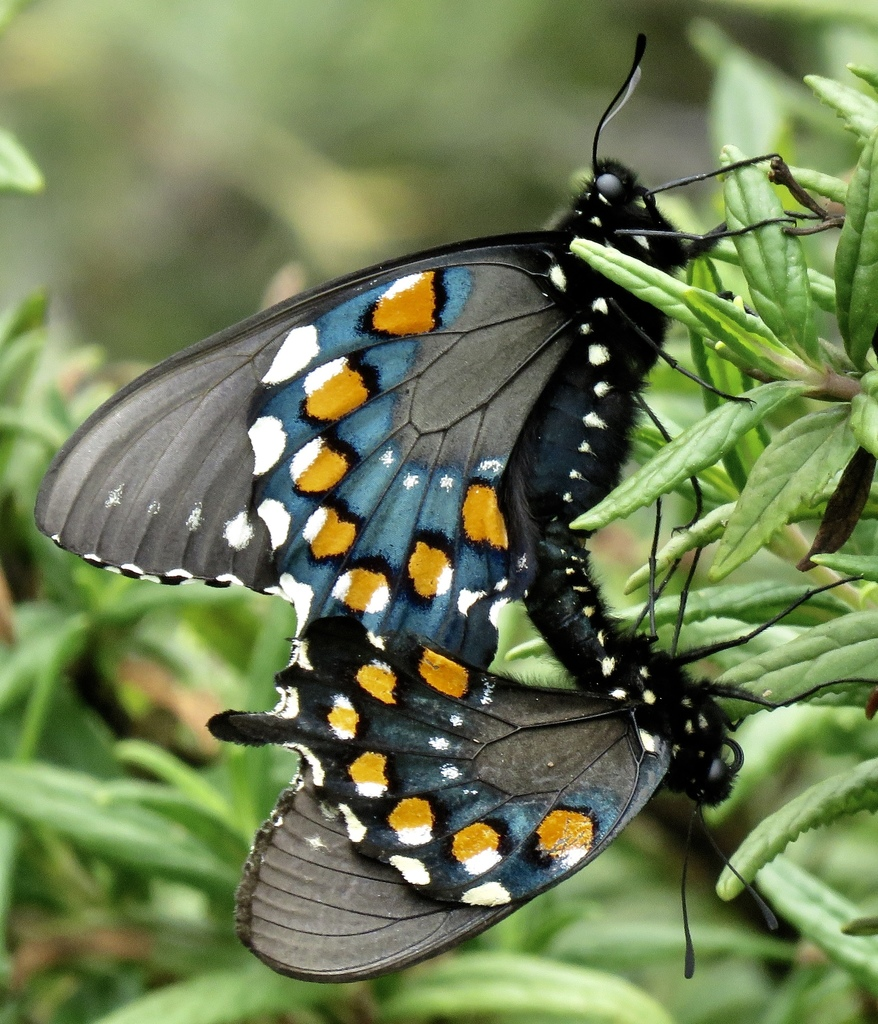
In many Swallowtail species females are bigger than males. In philenor some photographs of couples show no size difference, and the rule that males have darker black and brighter blue colors doesn't always hold true either. Below, the one with the egg-stuffed body shape is also the one whose wings show more blue.


Photo donated by Robberfly to Inaturalist.org: subspecies hirsuta in Sausalito (California) in March 2019.

In fact, one study suggests, male philenor hindwings iridesce more "true" blue before mating and a greener shade of blue after mating. Since butterflies don't form families, males will try to mate again right after their original mate flits off to look for lots of different vines on which to distribute her eggs, but these matings are likely to be less fertile--so females avoid those secondhand males.


Females can look grayish or brownish (as can males, in some lights--it's really hard to tell, except that the ones you see laying eggs are female) but only in a reddish sunset light can they iridesce purple, as in this photo. I suspect Bill Hubick of having used a colored light to enhance this beauty:


As she sips from the Monarch's favorite flower, does she fantasize about being a queen? No, that's a strictly human fantasy. Two more views of Madame Butterfly at https://www.billhubick.com/photos/butterflies/pipevine_swallowtail.php .

Males' fluttering around females displays their blue color from as many different angles as possible, ensuring that females can pick out those true blue colors:


Their DNA has been studied:


Encouraging the appropriate (preferably native) host plants and not spraying "pesticides" outdoors have been found effective in checking local population declines. Butterfly populations come and go, as their microscopic predators follow their population trends, so it may be good for the species overall if the local population shifts from one neighborhood to another every few years. When an overall decline was confirmed in California, conservation efforts seemed to help:


But beware of introducing exotic Aristolochia species. There are some Aristolochias that philenor can't eat. Occasionally a female will lay a few eggs on an exotic vine that will actually be toxic to her caterpillars.


This Aristolochia elegans can become an invasive nuisance in Florida and California. Philenor caterpillars hatched on it will not survive. It's native to Brazil, but Google didn't show any species of Swallowtail butterfly that could eat it. When introduced into Australia it was blamed for killing the Richmond Birdwing butterflies there.


This Aristolochia serpentaria, a.k.a. snakeroot or birthwort, is the primary food plant for Battus philenor in the Eastern States. Photo from Mary Lee Epps at the Virginia Native Plant Society, vnps.org. Its flowers are smaller and harder to find than those of the invasive nuisance species but, if you look closely, they have a similar little burst of dark reddish color inside;


Aristolochia macrophylla, a.k.a. pipevine or Dutchman's Pipe (and most Aristolochias seem to have been sometimes called birthwort), is another food plant for Battus philenor philenor.


Aristolochia californica is the natural food plant for Battus philenor hirsuta


Aristolochia pentandra is the natural food plant for Battus philenor acauda


Aristolochia or Isotrema tomentosa is another plant some Battus philenor can eat.

These photos were selected for showing both leaves and flowers. In real life Aristolochia vines consist of a lot more leaves than flowers, and people often don't recognize them because, while stepping over vines in the woods, they never notice the flowers. The University of Florida offers more detailed information about the plants these caterpillars can and can't eat. 


When newly eclosed butterflies stretch out their wings for the first time, females contain considerably more aristolochic acid than males. Over the next ten to fourteen days, as they mature, reproduce, age and die, males remain as toxic as ever while females become less toxic. Apparently the female's extra dose of aristolochic acid goes into the eggs. She keeps enough to remain toxic to birds all her life.


Some sources claim that in the Philippine Islands this species is believed to bring bad luck. Well, it would be bad luck if this American butterfly became an invasive nuisance in the Philippines and displaced native Atrophaneuras, some of which are rare and endangered, so that belief might make more sense than many superstitions do.

How do people get these butterflies to perch on their fingers? When the air drops below a certain temperature, all butterflies go into hibernation mode. If gently picked up and carried into a warmer place, they will wake up slowly on your hand, looking as if they were asking themselves what the bleep is going on, but not injuring themselves in a frantic effort to escape. Their instincts tell them to let themselves warm up, quietly, and they'll soon be able to fly away. So they rest calmly on your hand, absorbing warmth, stretching their long legs and tongues, fanning their wings, and giving you time for a photo or video shoot before they fly away. 


Caterpillars don't seem to see far enough ahead to be able to see that a human is a living creature; when they crawl around on us they're probably trying to figure out what can have so many different textures and odors. Butterflies do see us as entire living creatures, but they don't seem to understand the concept. If we grab them or box them in, we're predators and they'll tear themselves to pieces trying to escape from us. If we sit still, some male butterflies may actually think traces of soap and sweat on our skin taste interesting, and may stroll around licking us. (Female butterflies won't be interested unless we happen to be holding something like a juicy melon rind.) If they wake up from hibernation mode to find themselves sitting on our fingers, and we hold still, they'll continue waking up with the semblance of serene faith it seems to require for anything as fragile as a butterfly to live.

It's easy to attract a philenor family to a shady corner of the garden, according to MyGardenerSays.blogspot.com. If unable to transplant a native Aristolochia vine from the woods, you can probably buy A. fimbria as a ground cover from a garden shop. It' has attractive white-veined, pale green leaves and a nice symbiotic relationship with these butterflies. The caterpillars seem to eat it all up. Then it grows back. Then the next generation of caterpillars seem to eat it all up...The blog post goes on to discuss other plants and butterflies that coexist with philenor in the blogger's part of Texas.


Eggs are most often described as orange-red, sometimes orange or amber, and sometimes even burgundy. Like the eggs of other Troidini, they're little round beads textured with drops of aristolochic acid that protect the eggs from being eaten by ants.


Photo by Ansel Oommen, Bugwood.org. 

Hatchling caterpillars...


Photo from thedauphins.net .Photo essay showing the full life cycle at http://www.thedauphins.net/id111.html .

Caterpillars are most often black or a dark purplish color fashionistas call aubergine (it literally means eggplant-colored, but is used to refer to a brighter shade than actual eggplants). However, as Birdgal5 documented in this photo (May 2008, Folsom, photo donated to Inaturalist), even young ones can have the minority bright red coloring. Whether caterpillars look black, aubergine, brown, or red may depend on how much light they've been exposed to; since most of them live in the woods, on the undersides of vines, they see relatively little sun and look black.


If, and only if, you eat too much red licorice and want to turn yourself against this candy, click here. I am not agreeing with the blogger's claim. I'm only saying that thinking about it is a good way to form an aversion to red licorice. Or cinnamon "red hots." Or lipstick!


Despite their dragonlike look (and they can chomp, if not hard enough to puncture the skin at least hard enough that you could feel the pinch), these caterpillars are harmless to humans--unless a human, perhaps an infant, was foolish enough to swallow one. Aristolochic acid has been consumed by humans for medical purposes but its effects aren't pleasant. If you weren't looking for relief from something even less pleasant, you'd regret having ingested this plant toxin. It raises pulse and respiration to a degree reported to involve dizziness, nausea, and violent expulsive contractions, as in its old herbal name "birthwort." Modern obstetricians usually prefer other chemicals even to speed up the birth process. Even Klaus Schwab would never recommend that anyone eat zis "bug."


Nelruzam, who photographed this one for Inaturalist.org in Sonoma County in June 2017, might have put the camera too close or chosen to photograph a caterpillar who had already been disturbed. The animal is making its threat display--osmeterium ("stink horns") out, tentacles down. (The other tubercles are just warts, but the tentacles have some voluntary movement.) Caterpillars have been video-recorded tapping each other's tentacles, sometimes apparently waking up a sleeping sibling who jerks away as if nonverbally saying "I'm fine! Leave me alone!" Tentacles down and horns out, however, are thought to suggest to a bird that the caterpillar just might be some sort of bird-eating lizard. 


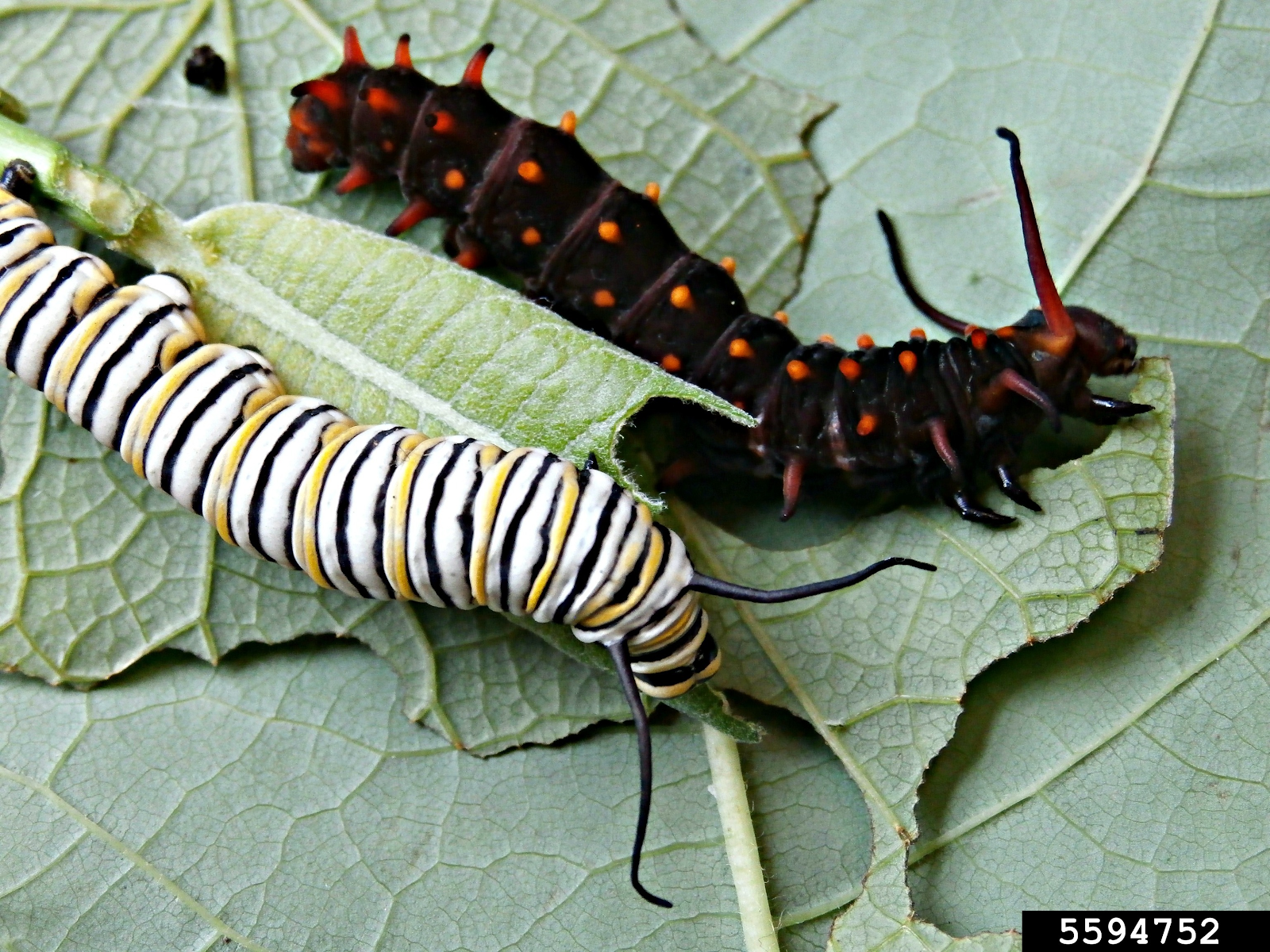
This scene, not found in nature, was staged by Ansel Oommen, Bugwood.org. A Pipevine Swallowtail caterpillar, munching away at a pipevine leaf, has been posed next to a Monarch caterpillar, munching away at a milkweed leaf. Though very different the caterpillars are similar in size and have similar tentacles. Both are completely harmless to humans, crops, livestock, and gardens...unless swallowed.

The tentacles, some researchers say, may help the caterpillars find edible leaves:


In natural conditions Monarch caterpillars never grow up in family groups, have no social instincts, and are likely to try to eat one another if they do meet. Several of the larger caterpillars behave this way; it's one way nature keeps them from overpopulating and destroying their host plants. In nature, however, philenor often grow up in small family groups, as butterflies often lay the first few eggs in clusters, and siblings get along very nicely, lined up in rows eating one leaf when they're little, spreading out so each one can gobble a leaf of its own as they grow bigger. In captivity, especially if they don't find good fresh leaves to eat, they become confused and can start to "bite and devour one another." The best way to rear these butterflies is to protect their host plant outdoors and watch them grow up naturally.

Though toxic to most predators, philenor caterpillars have one unusual predator: ladybugs (ladybirds, ladybeetles). Ladybug larvae usually eat aphids but they can survive eating a small, young philenor caterpillar. According to https://mdc.mo.gov/discover-nature/field-guide/pipevine-swallowtail-blue-swallowtail, when larvae of these species meet, the beetle larva is likely to bite the caterpillar. The caterpillar can bite back in self-defense, although it's not known to eat beetle larvae. Which creepy-crawly will win the biting fight? Usually the one that is bigger at the time. Mature caterpillars are much bigger than ladybug larvae. Hatchling caterpillars are not.

People have, as Pedromariposa has, made video recordings of the caterpillars stripping leaves off these vines. This is one of the Swallowtail species that have enough sense not to eat their siblings; butterflies try to give each of the younger siblings in the brood a foodplant of its own, but some of the first few eggs may be placed in a group on one plant, producing restless but nonviolent family groups:


People have taken time-lapse photos of how the caterpillar achieves that funny-looking chrysalis...not quite as grotesque as some of the tropical Battus and Atrophaneura chrysalides, but still, it's a weird-looking process. 


Chrysalides are usually pale brown, as in the video. But Tashawidow watched a philenor hirsuta caterpillar develop this bright green and yellow chrysalis in Redding, California, in May 2020:


Spillane found a brown and a green chrysalis side by side in Sausalito in January 2021...these caterpillars made little attempt to seek cover before entering the most vulnerable stage of their lives. (Both photos from Inaturalist.)


After eclosion (emergence from the chrysalis) the butterflies fly for up to two weeks. Art Shapiro, who ought to know, claims that they can live as long as a month after eclosion--but apparently few do, because everyone else says their adult lifespan is two weeks.