From U.S. Representative Morgan Griffith, R-VA-9, editorial comment below:
"
Friday, January 20, 2017 –
Hail to the Chief?
The peaceful transfer of power from one president to another is among the most splendid features of our republican system. On fifty-seven occasions, every four years beginning with George Washington in 1789, a president has taken the oath of office. Many were sworn in after heated campaigns, amid economic troubles, or during terrible wars. Some differed sharply in style and belief from the men they replaced. Whatever the circumstances, all took the oath of office and were honored by the title of president.
The peaceful transition of power is rare in many parts of the world even today. Our nation is about to witness such a transfer again, which should be a reason for celebration by all Americans. The ritual of the presidential inauguration transcends individuals and parties and is part of what makes our nation unique.
This history makes what is happening this January 20th disappointing. Over sixty members of Congress have announced plans to boycott Donald Trump’s inauguration.
According to the Congressional Research Service, some congressmen stayed away from Richard Nixon’s second inauguration in protest of the Vietnam War, and a handful of members refused to take part in the first inauguration of George W. Bush. But this particular boycott is unprecedented, as dozens of members are not only refusing to take part in the ceremonies, but are issuing statements to the press assailing the incoming president as “illegitimate.” I believe this development degrades our Republic and the institution of the office of the president.
The idea of republican government is that laws govern, not men. The Constitution created the office of president, set procedures for choosing who occupies it, and gave it certain powers. The honor given to the president does not stem from his own qualities, but the qualities the office has been given under our laws.
Whatever our opinion of the people who occupy the office, we owe the office itself respect. This is true across our system of government. As a lawyer, I did not always like every judge I encountered. However, when I heard “all rise” and the judge in the black robe entered the courtroom, I stood. He or she had been given an office of trust under our laws, and that office deserved my respect.
When Thomas Jefferson was sworn in for his first term in 1801, the nation had just experienced a heated campaign which had been decided in the House of Representatives. He acknowledged the tensions lingering from the election, but called on all Americans to set aside their views of the individuals involved. Jefferson knew that our institutions were more important, and stated in his first inaugural address:
"During the contest of opinion through which we have passed the animation of discussions and of exertions has sometimes worn an aspect which might impose on strangers unused to think freely and to speak and to write what they think; but this being now decided by the voice of the nation, announced according to the rules of the Constitution, all will, of course, arrange themselves under the will of the law, and unite in common efforts for the common good."
Much has changed in the more than two hundred years since Jefferson’s first inauguration, but his words on how our system works still offer guidance for our day.
Donald Trump was elected “according to the rules of the Constitution,” and so all Americans, Democrat or Republican, should “arrange themselves under the will of the law.”
I was not a fan of President Obama and was disappointed that he was reelected. Nevertheless, as a congressman, I believed it was my duty to attend his second inauguration in 2013. So I sat there and did my duty to the Republic.
Absent an illness in my family, I will be at the inauguration of new presidents rain or shine, out of respect for the Republic and its institutions.
If you have questions, concerns, or comments, feel free to contact my office. You can call my Abingdon office at 276-525-1405 or my Christiansburg office at 540-381-5671. To reach my office via email, please visit my website at www.morgangriffith.house.gov. Also on my website is the latest material from my office, including information on votes recently taken on the floor of the House of Representatives.
"
Editorial comment: In view of the mob scene Washington becomes during inaugurations, and of today's weather, I'm glad I'm not a Congressman! Cheers to those who participate in making it an orderly event...
President Trump was a spoiler candidate all the way, and shame on the Republicans who didn't see that--but his appointment by the electoral college makes him as legitimate as Presidents Hayes and W Bush were. A little faith in our nation and its constitutional system seems indicated here.
Showing posts with label Election 2016. Show all posts
Showing posts with label Election 2016. Show all posts
Friday, January 20, 2017
Thursday, November 3, 2016
Vote for Sale: Open Bidding
(This post is strictly about the writer known as Priscilla King, individually, and reflects absolute zero input from any other person involved with this site in any way.)
I never thought I'd even consider selling my vote. I never thought I'd think of that as an ethically tolerable thing to do.
I never thought I'd be forced to choose between two candidates who appear about equally undesirable for the same dang reasons, either. W Bush and Al Gore did look a bit like a matched pair of bookends, but at least they appeared to be backed by different crowds. Clinton and Trump are an ill-matched pair of mouthpieces for...her husband and his best buddy in Washington just happen to be the same guy, and for the murky crowd behind him. Both of them should have been disqualified even to run, neither could get elected dogcatcher in my town, and neither represents me politically, or ever has, in any noticeable way. And then there's the other guy, completely out of it...
I can and will vote for a U.S. Representative on Tuesday evening, but I can only vote against the worst two of three presidential candidates, and I'm honestly not sure which two those are.
So, Gentle Readers, you have a choice:
(1) Do nothing--in which case I'll vote my conscience and write in "Ben Carson," or maybe "Andrew Jackson," as a statement about the national debt/economy issue, or maybe "Sneaky Pie Brown ," or even "broccoli."
(2) Send money to this web site, and indicate which candidate you most want to vote against. Note that salolianigodagewi is a valid Yahoo address (someone checks it about as often as e-mails seem to be reaching it), but not a valid Paypal address; we use Saloli the Message Squirrel to verify that you're not a spammer and send you the Paypal address. This makes postal money orders much faster; by now the local post office staff recognize real-life manifestations of Priscilla King. I'll compare total funding received by 5 p.m. NYC time on Tuesday, and will then vote accordingly.
Is this unethical? Honestly, no worse than what I'll do if you don't buy my vote--either flip a coin, or cast a meaningless vote against two of the presidential candidates just in order to be able to support our man Morgan Griffith, which I will do regardless of funding.
So, local lurkers..."Happy Days Are Here Again"! Ask your elders why that song is relevant!


I never thought I'd even consider selling my vote. I never thought I'd think of that as an ethically tolerable thing to do.
I never thought I'd be forced to choose between two candidates who appear about equally undesirable for the same dang reasons, either. W Bush and Al Gore did look a bit like a matched pair of bookends, but at least they appeared to be backed by different crowds. Clinton and Trump are an ill-matched pair of mouthpieces for...her husband and his best buddy in Washington just happen to be the same guy, and for the murky crowd behind him. Both of them should have been disqualified even to run, neither could get elected dogcatcher in my town, and neither represents me politically, or ever has, in any noticeable way. And then there's the other guy, completely out of it...
I can and will vote for a U.S. Representative on Tuesday evening, but I can only vote against the worst two of three presidential candidates, and I'm honestly not sure which two those are.
So, Gentle Readers, you have a choice:
(1) Do nothing--in which case I'll vote my conscience and write in "Ben Carson," or maybe "Andrew Jackson," as a statement about the national debt/economy issue, or maybe "Sneaky Pie Brown
," or even "broccoli."(2) Send money to this web site, and indicate which candidate you most want to vote against. Note that salolianigodagewi is a valid Yahoo address (someone checks it about as often as e-mails seem to be reaching it), but not a valid Paypal address; we use Saloli the Message Squirrel to verify that you're not a spammer and send you the Paypal address. This makes postal money orders much faster; by now the local post office staff recognize real-life manifestations of Priscilla King. I'll compare total funding received by 5 p.m. NYC time on Tuesday, and will then vote accordingly.
Is this unethical? Honestly, no worse than what I'll do if you don't buy my vote--either flip a coin, or cast a meaningless vote against two of the presidential candidates just in order to be able to support our man Morgan Griffith, which I will do regardless of funding.
So, local lurkers..."Happy Days Are Here Again"! Ask your elders why that song is relevant!
Thursday, October 27, 2016
Virginia Ballot Questions
From Chuck Angier, forwarded by Patricia Evans:
"
Please pass this along, get the word out, and put someone in each precinct informing the voter of this critical amendment!
"
"
Please pass this along, get the word out, and put someone in each precinct informing the voter of this critical amendment!
From Chuck Angier
Sandy Level, VA
As I travel around the state, I am amazed at how many informed and engaged friends are STILL UNAWARE that there are 2 Virginia State Constitutional Amendments on the ballot. I wish to address Question 1, a “Right-to-Work” (RTW) amendment.
Question 1 on the Virginia ballot will be:
"Question: Should Article I of the Constitution of Virginia be amended to prohibit any agreement or combination between an employer and a labor union or labor organization whereby (i) nonmembers of the union or organization are denied the right to work for the employer, (ii) membership to the union or organization is made a condition of employment or continuation of employment by such employer, or (iii) the union or organization acquires an employment monopoly in any such enterprise?"
Click èHERE for the full text of the legislation.
Background
Thanks to laws already on the books, Virginia has, for the most part, ALWAYS been an RTW state, but those laws can always be tampered with or retracted by any fickle General Assembly. By elevating the law to the status of a Constitutional amendment, it will be protected from such fickleness.
My take
Setting aside for a moment my opinion of unions and how they’ve decimated otherwise prosperous communities (oops, my bad), this issue is quite simply an issue of liberty. ALL have a right to negotiate gainful employment without being impeded by the state or any organization. ALL have a right to pursue new and better opportunities without hindrance. On the flip side, employers also have a right to negotiate for productive labor without fear of being impeded by the state or any organization.
To me, the simple interpretation is:
1. No employee shall be forced to join or pay dues to an organization as a condition of employment or continued employment
2. No employer shall be forced to hire union members
RTW states have consistently been more prosperous than non-RTW states.
I am offended that MANY, especially on the national level are vehemently opposed to Right-to-Work because it is so “destructive” as shown by one particularly abrasive video from Mrs. Clinton:
If you need more convincing, check out the 45 goals of Communism as read into the Congressional Record on January 10th 1963, particularly #’s 32 through 37 or so
Better yet, Read “The Naked Communist”
Best – Listen to “The Naked Communist”…the audio version is updated as of early 2016
I WILL ALWAYS FAVOR LEGISLATION THAT FAVORS PERSONAL LIBERTY!
Unfortunately, as I understand it, the Federal government has terms for Federal contractors that often compromises the rights of employees and employers to come to their own terms, ALL THE MORE REASON THAT VIRGINIA NEEDS TO VOTE “YES” ON QUESTION 1!
Opposition?
In an October 15th Editorial, the Richmond Times-Dispatch claims that it has always supported RTW BUT not this time. The RTD (and organized labor) opinion provides a weak argument that the RTW amendment only addresses PART of the current legislation and excludes SS 40.1-61 which forbids employers from demanding abstention from unions. This very exclusion is sufficient to protect the employee from demands as set forth in 40.1-61 because SS 40.1-61 is still on the books! Duh!
Here’s a taste of what the opposition is up to and below is an excerpt from a position statement on the matter from the Madison County Democrats (highlights added)
On June 13, 2016, the Madison County Democratic Committee voted unanimously to approve the Virginia AFL-CIO‘s resolution in opposition of Virginia Republicans’ union busting “Right to Work” Amendment (2016) which are nothing more than blatant efforts to enshrine an existing law that is designed to infringe upon the rights of workers and stifle our collective voices. If passed, this amendment would continue to force hard working Virginians to accept jobs that don’t pay a living wage.
Wow, now THERE’S a glittering jewel of colossal ignorance! Gimme a break!
There is so little knowledge of this crucial question on the November ballot. Please pass this along, get the word out, and put someone in each precinct informing the voter of this critical amendment!
I will use “heroes” to describe all of the “killed in the line of duty” mentioned in the proposed amendment above.
Virginia is a Dillon rule state thus much of what localities can and can’t do is dictated by the state.
The proposed amendment grants to the localities the option of offering real property tax exemption for the survivors of fallen “heroes”
I favor any legislation that grants liberty to the localities, so I will probably vote “YES”, BUT….
If it prevails and Pittsylvania tries to implement an exemption, I would oppose it pretty strongly for the following reasons:
1) Can’t we come up with something better than this?
2) Don’t we already have systems in place to compensate survivors of fallen heroes?
3) Wouldn’t “survivor” and “line of duty” (among other terms) be subject to interpretation and or challenged by those that might feel cheated?
a. As another example, what about a hero that is permanently and expensively disabled. Might the burden on the survivor be greater than if the hero had passed?
b. What about survivors of armed services members killed in the line of duty? (maybe there’s something already on the books)
4) Won’t there be constant challenges by selfish to get the same exemption
5) Won’t there be other special interest groups vying for the same treatment?
So…As I write this, I am talking myself into a “no” vote so now here’s where I stand
An unenthused “yes” for the amendment (but it could go downhill)
A passionate “no” for Pittsylvania if they try it.
You deserve to know that I know, my position is contrary to most of those of you that I hang out with.
You’re welcome to share any or all of this in any way you wish.
Chuck Angier
Sandy Level, VA
cangier@fairpoint.net"
Friday, October 21, 2016
Extra Chance to Register to Vote
Just in case someone out there knows someone who needs this information...thanks to the ACLU for sharing:
"
Yesterday, a federal judge ordered that the deadline to register to vote in Virginia for the November 8 election be extended through today, Friday, October 21.
This is because the state Department of Elections website failed during the days leading up to the original registration deadline of this past Monday. If you are already registered, there is nothing you need to do. However, if you were affected by problems with the online portal while trying to register, or even if you just forgot and missed the deadline, you have all of today and tonight to register.
Here's how:
Voting in elections is one of our foundational rights as Americans, so highly valued because it is preservative of all of our other rights. Don't take your right to vote for granted. If you haven't already, please register to vote today and participate in the November 8 general election. The future of your civil liberties depends on it.
"
(Can this post use an Amazon link? Why not? Google + does run on pictures...)

"
Yesterday, a federal judge ordered that the deadline to register to vote in Virginia for the November 8 election be extended through today, Friday, October 21.
This is because the state Department of Elections website failed during the days leading up to the original registration deadline of this past Monday. If you are already registered, there is nothing you need to do. However, if you were affected by problems with the online portal while trying to register, or even if you just forgot and missed the deadline, you have all of today and tonight to register.
Here's how:
- Go to your local voter registrar's office by 5 p.m. You can also do this at some other government offices.
- Print and complete a paper form, and send it by mail postmarked today, Friday, October 21.
- Visit vote.virginia.gov and complete your registration online by 11:59 p.m. tonight.
Voting in elections is one of our foundational rights as Americans, so highly valued because it is preservative of all of our other rights. Don't take your right to vote for granted. If you haven't already, please register to vote today and participate in the November 8 general election. The future of your civil liberties depends on it.
"
(Can this post use an Amazon link? Why not? Google + does run on pictures...)
Wednesday, September 14, 2016
Virus Karma, and the Update on Grandma Bonnie Peters
Candidate Clinton's pneumonia, and the way people are reacting to it, are bringing up three memories of different virus episodes in my life. (If you don't want to read these memories of illness and a writer who has yet to post any actual writing here, the summary is that after one day I've become very, very tired of reading snarky blog post headlines that make fun of a tough, brave, sick patient.)
The most recent one is what was happening around this time last year. I was working out of Grandma Bonnie Peters' house...and a few local lurkers know what that means. She has the big store/age room, the itty-bitty kitchen and minibath rooms, and the apartment-size living room with the office set up in one corner and the bed alcove in another corner. I was looking across the top of the computer screen and seeing my blog buddy lying miserably in bed, not sick enough to be sleeping all that time, but sick enough that talking made her cough, moving about raised her fever--and still conscious enough that TV or movies bored and irritated her. She spent two weeks like that, getting up to go to her part-time job and either to drive me home or to haggle about it: "You're not on the insurance policy and my old clunker needs special handling, so I don't want you to drive my car. I don't feel well enough to drive. Why can't you just spend the night here?"
She really wasn't well enough to drive. She wasn't well enough to walk half a block to her part-time job helping one of her geriatric friends with an hour or two of chores. I'd walk with her to and from work, trying to act like the sort of gushy female who grabs people's arms as a show of emotion, which I am not and have never been, because two or three times GBP did seem faint. Falling on the Body Shag carpet in her friend's house didn't scare her, but falling on pavement might have broken a bone. So she kept working while she was unfit to walk down the street. She doesn't like to be waited on, but having water bottles set by the bed and things cleaned up in the kitchen and bath seemed to help her.
All her life GBP has been one of the world's best drivers. After her eightieth birthday her reflexes and night vision finally started to decline. I'd spend one night, two nights, without going home to feed my cats. When I went home they'd all have gone off foraging in different directions, and I'd spend half of my sleeping and private time tracking down my cats. I couldn't even call them on the notes they recognized; I had bronchitis too. I'd croak "Here, kitty, kitty," and start coughing. I was fit to walk one mile, maybe--not nine. It got to the point where I'd take her keys, and the bag to which they were clipped, and say "You can be the driver or the passenger, and you're welcome to spend the night at my house, but I need to go home, by car, now."
During the third week GBP went to the doctor and was told that she had viral pneumonia, with a few complications and no cure but to live through it--or die of it, as the case might be. I merely had "more of a cold than a flu-type virus," so flu shots or Tamiflu wouldn't have helped me either. I'd start to feel better on Saturdays at home, then pick up more virus from GBP and feel my temperature climbing again.
So she made a tough decision. "Either move in as a full-time caregiver, or go home and don't come back. I'm selling the car; if there's enough money I'll pay the company to try to put in an Internet connection at your house." Neither she nor her car was up to any more "commuting." Since I wasn't up to any more ten-mile hikes as long as I was coughing or running up fevers, there was no alternative...although I didn't want, and of course didn't get, an Internet connection at my house.
Technically I wasn't leaving GBP alone. She has a renter upstairs: hearing loss is only the beginning of a long list of reasons why I wouldn't trust the renter to look after a goldfish, but the renter has looked in on GBP every day or two. But it was a Long Hard Winter. I'd get through a couple of nights without coughing, then get chilled or exposed to some sort of germ and start doing those deep, painful, bronchitis-type coughs again. GBP became unable to work and used the car money to survive the winter, during which she fell and broke bones at home, twice...but in spring she went back to her part-time job. Everybody was up and down with the virus, active people for only a few days at a time, but most of us several times, all winter long. After one year I think we've finally recovered from that "cold."
We had a similar virus in my part of the world in the early 1980s. I had had "just a cold" in December of 1982. Then the Big Wet Snow fell. In 1982 my neighborhood was full of very old people who were snowed in without electricity. Schools and businesses shut down because every able-bodied active citizen needed to shovel paths to the senior citizens' doors, make sure they had wood fires and food and so on. Oh, how joyful I felt, riding a surge of adolescent-convalescent energy, chopping and shovelling and taking great deep breaths of crisp, clean, ice-cold air, all day long. Around midnight I started to feel as if that icy air had turned into fire. That round of bronchitis lasted into June of 1983. Age determines how people react to flu, but not how they react to some other kinds of virus.
Now that third memory...that one was flu, in January of 1989. George H.W. Bush had just been inaugurated as President. He was slightly younger, slightly taller, and physically tougher than Ronald Reagan, but, due to American stereotypes about blond men with tenor voices as distinct from dark men with baritone voices, President Bush had become defensive about "the wimp factor" during the election. Then, just after the inauguration, he had to cancel a speech! In spite of all the doctors who fight over a chance to consult with anybody in the White House, "old" President Bush was reacting to what was inevitably tagged as "White House Flu" in Washington. Oh, what a wimp, jeered the mean people.
Not that we had to have been in the White House to come down with it. For about two weeks after President Bush cancelled that speech, Washington was one sick city. Offices were lucky if one person staggered in to work each day. I was lying on the couch, fighting the flu, when my housemates and I heard that a local "personality" was going to replace the President's speech with a snarky little act about sickly, wimpy, "old" Presidents...and, next news break, that the local "personality" was going to do no such thing, because he was down with the flu.
From the couch, we gave feeble, fluzly little cheers. One of my housemates was a yellow-dog Democrat, but this wasn't about politics; it was about tackiness. Good ol' Karma, that well-known she-hound, had caught up with him!
Karma should only bite everybody who makes fun of older people who have a worse time with the flu than...y'know what, by all reports, President Bush shook off the White House Flu faster than several of my generation did. It would be pleasant to report that there was a noticeable correlation between the severity of our symptoms and whether or not we'd sneered at President Bush, but actually it was flu, and the correlation did go by age. Washington is a young person's town, chronically undersupplied with elders, and it lost a lot of the elders it had in 1989.
Now, Candidate Clinton admits she has pneumonia. As mentioned in yesterday's Link Log, everything I read about this pneumonia, yesterday, sounded more like what GBP and I had. Washington is not all of five hundred miles from Kingsport. Virus travels. I feel for Mrs. Clinton. Somehow I'm imagining her entire staff, campaign, security, and domestic, doubled over with deep painful coughs; most of them are younger than she is, but with this kind of virus teenagers get bronchitis; if they don't pay attention to their bodies' warnings, teenagers can get pneumonia.
Bill Clinton, with his heart? Candidate Trump, at his age? News people who are managing to look the way my generation grew up expecting them to look, on TV, but they're between the ages of 40 and 70 too? I'm not thinking about politics here. I'm thinking that, if Candidate Clinton's pneumonia is what went around my neighborhood last year, this is going to be one sick election, literally, on all sides. I'm feeling sorry for all of'em. Campaigns, by definition, allow a sick candidate or campaign staffer to spread virus all over the continent. Corrupt as they are...guilty consciences do not boost immunity, and who knows how many extra coughs guilt may inflict on people in political circles, but they're all in for a Long Hard Winter.
Arguably the Trump family, and/or whoever actually bought my e-mail address from however many Republican e-friends and have been spamming me with the bills in their names, deserve pneumonia...let's not go there today. Elizabeth Warren, or whoever had the gall to send me an e-mail suggesting that I send money to the Great American Faux? If any of the Trumps, or Elizabeth Warren, or even the better funded Tea Party 'zine editors, had any sense of honor they would have sent me some money by now, but that's a separate rant.
The good news: Anybody out there who's making fun of anybody else's pain...will deserve whatever this virus has to offer them. This one doesn't even go by age. Sic'em, Karma!
![Karma's a Witch: Karma's Witches #3 by [Jordan, Lanie]](https://images-na.ssl-images-amazon.com/images/I/518lR6q65OL.jpg)

(Poll: I've not read anything that Amazon offered when I searched for a "karma book" to link to this page. Do you have an opinion about which link best fits this post?)


The most recent one is what was happening around this time last year. I was working out of Grandma Bonnie Peters' house...and a few local lurkers know what that means. She has the big store/age room, the itty-bitty kitchen and minibath rooms, and the apartment-size living room with the office set up in one corner and the bed alcove in another corner. I was looking across the top of the computer screen and seeing my blog buddy lying miserably in bed, not sick enough to be sleeping all that time, but sick enough that talking made her cough, moving about raised her fever--and still conscious enough that TV or movies bored and irritated her. She spent two weeks like that, getting up to go to her part-time job and either to drive me home or to haggle about it: "You're not on the insurance policy and my old clunker needs special handling, so I don't want you to drive my car. I don't feel well enough to drive. Why can't you just spend the night here?"
She really wasn't well enough to drive. She wasn't well enough to walk half a block to her part-time job helping one of her geriatric friends with an hour or two of chores. I'd walk with her to and from work, trying to act like the sort of gushy female who grabs people's arms as a show of emotion, which I am not and have never been, because two or three times GBP did seem faint. Falling on the Body Shag carpet in her friend's house didn't scare her, but falling on pavement might have broken a bone. So she kept working while she was unfit to walk down the street. She doesn't like to be waited on, but having water bottles set by the bed and things cleaned up in the kitchen and bath seemed to help her.
All her life GBP has been one of the world's best drivers. After her eightieth birthday her reflexes and night vision finally started to decline. I'd spend one night, two nights, without going home to feed my cats. When I went home they'd all have gone off foraging in different directions, and I'd spend half of my sleeping and private time tracking down my cats. I couldn't even call them on the notes they recognized; I had bronchitis too. I'd croak "Here, kitty, kitty," and start coughing. I was fit to walk one mile, maybe--not nine. It got to the point where I'd take her keys, and the bag to which they were clipped, and say "You can be the driver or the passenger, and you're welcome to spend the night at my house, but I need to go home, by car, now."
During the third week GBP went to the doctor and was told that she had viral pneumonia, with a few complications and no cure but to live through it--or die of it, as the case might be. I merely had "more of a cold than a flu-type virus," so flu shots or Tamiflu wouldn't have helped me either. I'd start to feel better on Saturdays at home, then pick up more virus from GBP and feel my temperature climbing again.
So she made a tough decision. "Either move in as a full-time caregiver, or go home and don't come back. I'm selling the car; if there's enough money I'll pay the company to try to put in an Internet connection at your house." Neither she nor her car was up to any more "commuting." Since I wasn't up to any more ten-mile hikes as long as I was coughing or running up fevers, there was no alternative...although I didn't want, and of course didn't get, an Internet connection at my house.
Technically I wasn't leaving GBP alone. She has a renter upstairs: hearing loss is only the beginning of a long list of reasons why I wouldn't trust the renter to look after a goldfish, but the renter has looked in on GBP every day or two. But it was a Long Hard Winter. I'd get through a couple of nights without coughing, then get chilled or exposed to some sort of germ and start doing those deep, painful, bronchitis-type coughs again. GBP became unable to work and used the car money to survive the winter, during which she fell and broke bones at home, twice...but in spring she went back to her part-time job. Everybody was up and down with the virus, active people for only a few days at a time, but most of us several times, all winter long. After one year I think we've finally recovered from that "cold."
We had a similar virus in my part of the world in the early 1980s. I had had "just a cold" in December of 1982. Then the Big Wet Snow fell. In 1982 my neighborhood was full of very old people who were snowed in without electricity. Schools and businesses shut down because every able-bodied active citizen needed to shovel paths to the senior citizens' doors, make sure they had wood fires and food and so on. Oh, how joyful I felt, riding a surge of adolescent-convalescent energy, chopping and shovelling and taking great deep breaths of crisp, clean, ice-cold air, all day long. Around midnight I started to feel as if that icy air had turned into fire. That round of bronchitis lasted into June of 1983. Age determines how people react to flu, but not how they react to some other kinds of virus.
Now that third memory...that one was flu, in January of 1989. George H.W. Bush had just been inaugurated as President. He was slightly younger, slightly taller, and physically tougher than Ronald Reagan, but, due to American stereotypes about blond men with tenor voices as distinct from dark men with baritone voices, President Bush had become defensive about "the wimp factor" during the election. Then, just after the inauguration, he had to cancel a speech! In spite of all the doctors who fight over a chance to consult with anybody in the White House, "old" President Bush was reacting to what was inevitably tagged as "White House Flu" in Washington. Oh, what a wimp, jeered the mean people.
Not that we had to have been in the White House to come down with it. For about two weeks after President Bush cancelled that speech, Washington was one sick city. Offices were lucky if one person staggered in to work each day. I was lying on the couch, fighting the flu, when my housemates and I heard that a local "personality" was going to replace the President's speech with a snarky little act about sickly, wimpy, "old" Presidents...and, next news break, that the local "personality" was going to do no such thing, because he was down with the flu.
From the couch, we gave feeble, fluzly little cheers. One of my housemates was a yellow-dog Democrat, but this wasn't about politics; it was about tackiness. Good ol' Karma, that well-known she-hound, had caught up with him!
Karma should only bite everybody who makes fun of older people who have a worse time with the flu than...y'know what, by all reports, President Bush shook off the White House Flu faster than several of my generation did. It would be pleasant to report that there was a noticeable correlation between the severity of our symptoms and whether or not we'd sneered at President Bush, but actually it was flu, and the correlation did go by age. Washington is a young person's town, chronically undersupplied with elders, and it lost a lot of the elders it had in 1989.
Now, Candidate Clinton admits she has pneumonia. As mentioned in yesterday's Link Log, everything I read about this pneumonia, yesterday, sounded more like what GBP and I had. Washington is not all of five hundred miles from Kingsport. Virus travels. I feel for Mrs. Clinton. Somehow I'm imagining her entire staff, campaign, security, and domestic, doubled over with deep painful coughs; most of them are younger than she is, but with this kind of virus teenagers get bronchitis; if they don't pay attention to their bodies' warnings, teenagers can get pneumonia.
Bill Clinton, with his heart? Candidate Trump, at his age? News people who are managing to look the way my generation grew up expecting them to look, on TV, but they're between the ages of 40 and 70 too? I'm not thinking about politics here. I'm thinking that, if Candidate Clinton's pneumonia is what went around my neighborhood last year, this is going to be one sick election, literally, on all sides. I'm feeling sorry for all of'em. Campaigns, by definition, allow a sick candidate or campaign staffer to spread virus all over the continent. Corrupt as they are...guilty consciences do not boost immunity, and who knows how many extra coughs guilt may inflict on people in political circles, but they're all in for a Long Hard Winter.
Arguably the Trump family, and/or whoever actually bought my e-mail address from however many Republican e-friends and have been spamming me with the bills in their names, deserve pneumonia...let's not go there today. Elizabeth Warren, or whoever had the gall to send me an e-mail suggesting that I send money to the Great American Faux? If any of the Trumps, or Elizabeth Warren, or even the better funded Tea Party 'zine editors, had any sense of honor they would have sent me some money by now, but that's a separate rant.
The good news: Anybody out there who's making fun of anybody else's pain...will deserve whatever this virus has to offer them. This one doesn't even go by age. Sic'em, Karma!
(Poll: I've not read anything that Amazon offered when I searched for a "karma book" to link to this page. Do you have an opinion about which link best fits this post?)
Wednesday, August 17, 2016
Writing "Kylene Has Two Children"
So, here's that lame and nerdy piece of prose about a piece of fiction that's not even available for youall to read, yet. Because the fiction won't go live for another four or five months, and I posted something about the ideas in it...here are the notes on the story. Spoilers, but I'd like some of the bright and witty young things at Reason.com to read this blog, and I'd like them to understand where I'm coming from with my reaction to that recent interview with Gary Johnson.
In July, I entered a contest I don't expect to win, writing a piece of science fiction from prompts proposed by a client. I wrote the story for my own growth as a writer. None of my own speculative fiction has been as science-driven as “Kylene Has Two Children.” The assignment was like, wow, Jules Verne stuff, I never thought I'd be able to write Jules Verne stuff, but yes, with new technology...!
(By "Jules Verne stuff" I've always meant the kind of science fiction that's actually useful to practicing scientists, engineers, technicians, etc. Often the best fiction in this category isn't all that interesting from a literary point of view--Jules Verne is widely regarded as unique in that respect, and some question even his place in the literary canon--but as science it's awesome.)


In July, I entered a contest I don't expect to win, writing a piece of science fiction from prompts proposed by a client. I wrote the story for my own growth as a writer. None of my own speculative fiction has been as science-driven as “Kylene Has Two Children.” The assignment was like, wow, Jules Verne stuff, I never thought I'd be able to write Jules Verne stuff, but yes, with new technology...!
(By "Jules Verne stuff" I've always meant the kind of science fiction that's actually useful to practicing scientists, engineers, technicians, etc. Often the best fiction in this category isn't all that interesting from a literary point of view--Jules Verne is widely regarded as unique in that respect, and some question even his place in the literary canon--but as science it's awesome.)
The purpose of this
story was not to present a vision of mine, but to give a fictive body to the client's. That
kept it out of my own alternative world, for sure. The specifications included (1)
a story written to be shared with city councils and mayors, (2) set in the near
future, (3) in a city, (4) where “5G Wireless” technology (5) would radically
change the way people thought of ability and disability, (6) in, overall, a good way. This is the kind of
thing the client probably had in mind at first:
This is the kind of thing that
kind of thought brings to my mind:
So the real-world story is about how all that cognitive dissonance was mixed, shaken, and stirred into a piece of
science fiction.
If you spend much
time in cyberspace, you know that those specifications meant science fiction about improvements in gadgets of which clunky
primitive forms already exist. I chose to focus on “future generations” of
three types of electronic devices that help people compensate for three
physical conditions that have been seen as handicaps or disabilities:
1. Handscreens:
Optacons and Readers already convert printed words from a hard computer screen into
touchable patterns on a soft screen or audible words played through speakers.
My Handscreens of the future use soft screens to display touchable, moving,
three-dimensional images. People who’ve become accustomed to “seeing” what’s
ahead of them through a Handscreen can use one to “see” the street and walk
down the street without a cane.
2. Wheels: These
mobility boosters have corrected some of the features people don’t like about
Segways and other stand-up scooters. About one meter square and two meters
high, they have sturdy zip-on roofs and walls, bench seats with storage space,
super-efficient pedal-and-solar-powered batteries, sensor-activated brakes that
prevent crashes, and GPS steering options. They can be hooked together;
children go to school in a chain of Wheels called Schoolwheels.
3. Stunners and
Belts: In this fictional future, women refuse to let femaleness be made a
“disability.” They arm themselves with remote control switches that activate
taser-like devices wired into the non-removable Belts men are required to wear.
Of course, to discourage abuse, Stunners also activate siren sounds and summon
emergency responders. Nevertheless, if a little girl “Belts” little boys who’ve
been staring at her toys, adults tell the boys they shouldn’t have been
staring.
(What about little boys and homosexual molesters? I seriously, scientifically believe that homosexuality is a way living creatures react to overcrowded living conditions, so there wouldn't be much of it left in this fictive world.)
(What about little boys and homosexual molesters? I seriously, scientifically believe that homosexuality is a way living creatures react to overcrowded living conditions, so there wouldn't be much of it left in this fictive world.)
When the focus of
science fiction is on gadgets, the next question is likely to be “How did the
characters get from a world like ours, where these gadgets don’t exist, to one
like theirs, where they do?” There are several traditional answers. My
preference has been “By being in an alternate universe,” which the structure
imposed on this story ruled out. Optimistic science fiction, like Ozarque’s,
often postulates that humans are evolving into a more enlightened species; in
order to explain very much, that kind of science fiction needs to postulate
several centuries of progress, nothing “in the near future.” Fantasy, which Stephen Hawking made the category for stories set on “other sides of a
multidimensional universe,” simply postulates a world different from ours, for
readers to take or leave alone, according to what they consider the story
deserves.
When I picture the
kind of changes 5G Wireless is likely to make in a world like ours, which has
war and rape and pollution in it, I have to say that overall a 5G Wireless
cloud would be a bad thing. That kind of technology could be a good thing only
if we postulate a world where people have learned to be much nicer, more respectful of everyone’s
privacy, than humankind as a species are today.
In our world, the
kind of people who are charitably called intellectuals and introverts, or less
charitably nerds, geeks, freaks, wonks, or “creatives,” are (often) much nicer and more respectful of everyone’s privacy than the
average human is. We may or may not seem shy and awkward, or just “different,” or
maybe just very polite and charming (because we listen) at parties. We are,
however, able to car-pool, share machinery and appliances, even share houses
and flats, because we have a certain hard-wired sense of respect for one
another that many other people seem to lack. We are the people who are likely
to design and build 5G Wireless gadgets, which is dangerous, because we do not
instinctively think the way those other people who are likely to want to use
those gadgets think. For example, if
Stunners and Belts technology were available to us, a few little girls would
test it once, at school, but most of us could get through our entire lives
without ever actually using it; it really would be just a way to eliminate rape-terrorism from the world, not a way to
replace it with taser-terrorism.
So how, in one human
generation, can you get from a world where polite, respectful, intellectual
introverts have generally had a lot of sand kicked in our faces, to a world
where polite, respectful, intellectual introverts are either the entire
population or the norm that other people try to emulate?
Masses of science
fiction stories have selected for one type of population or another by
postulating that a lot of humans are colonizing different planets. That, too,
seems to be further ahead of us than “the near future.”
Another way to
achieve a nicer, more respectful society is simply to reduce population
density—by any means necessary. All humans want to control their own immediate
surroundings; as long as there’s room for people just to back away from one
another, they can sustain love and loyalty. This reaches amusing proportions in
ancient literature, where if the scholars are translating the words correctly
we read that partners stayed “together” for eighty years, or maybe eight
hundred years (sometimes the meaning may have been that their families
maintained an alliance for that long), but during much of this “togetherness”
they were living a hundred miles apart. But don’t knock it; good distance makes
good neighbors.
The easiest way to
thin the population “in the near future” would be either a plague or a war. A
war might open up more space among people but would not select for a population
who were more respectful of interpersonal boundaries. I postulated a plague
that was especially deadly wherever people were living in crowded conditions,
so cities, especially, were opened up to become more congenial environments for
people with a good sense of interpersonal space.
When I think “city” I
automatically think of my city, which is Washington, D.C. Washington is unique
because it’s the home of the federal government. This complicates city
government issues, so the story needed to be set in a more generic city. A
generic city all Washingtonians have visited is Baltimore. I think of
present-time Baltimore as a city that features two ways of creating lots of
interpersonal space: beautiful old houses with big gardens for rich people,
rotting-out slums where nobody wants to be for poor people. In the future Baltimore of the story the
plague has expanded the effects of both of those features of the city.
People think of each
other as neighbors and townsfolk whether they can actually see one another’s
house from their own front door or not. They’re glad to claim any neighbors at
all, because these people are plague survivors. Kylene is blessed with two
living parents, one of whom, her father, is famous. Most other adults she
knows, including her husband, lost their parents long ago.
There’s room in this
post-plague world for people to lack things they need—although Kylene
doesn’t—but it’s not because of limited space or resources. People work for
what they need; they don’t meddle; their primary weapon doesn’t do any
permanent damage, and their big crime problem, which is not really a focal
point but is mentioned in the story, injures people but doesn’t kill them.
(Schools and workplaces still do regular blood screening for the plague, and
for other things. All self-respecting high-tech worlds have instant blood
screening…so they have markets for freshly stolen blood.) And most adults are
orphans.
Within this setting,
I’m sorry to say that the plot is a cliché, the kind of thing science fiction
writers do when we’ve used up most of our time working out the setting and just
dropped in a piece of public-domain boilerplate, at the last minute, where the
plot needs to go. If science fiction is about adaptive technology for people
with disabilities, doesn’t the plot have to
be about how someone with what would be a disability, in our world, was
actually an advantage because it made our protagonist familiar with the gadget
s/he uses to save the other person or the planet?
The disability I
chose to focus on is blindness, because that took the least research; cataracts
run in my family and microphthalmia runs in a friend’s family (as it did in Lois Henderson ’s family). So first we have old grandpa Kyle, who could see
colors with one eye when he was younger, wanting to try the latest Handscreen
that uses temperature to indicate colors. When he tries it he finds it
distracting, frustrating—which is the way my father used to react to every new
adaptive device people used to offer him. He worries that he may have an
additional disability, but in time he learns to use his new gadget. Kylene
doesn’t bother about the color feature because she’s never seen colors at all.
She hears color terms like names. That person is Helen Hsiu because she said
her name is Helen Hsiu. The toothbrush is green because Trevor said it’s green.
Kylene “sees” with her fingers, and she’s able to “see” the road, “see”
people’s faces, and work as a librarian, with her Handscreen.
’s family). So first we have old grandpa Kyle, who could see
colors with one eye when he was younger, wanting to try the latest Handscreen
that uses temperature to indicate colors. When he tries it he finds it
distracting, frustrating—which is the way my father used to react to every new
adaptive device people used to offer him. He worries that he may have an
additional disability, but in time he learns to use his new gadget. Kylene
doesn’t bother about the color feature because she’s never seen colors at all.
She hears color terms like names. That person is Helen Hsiu because she said
her name is Helen Hsiu. The toothbrush is green because Trevor said it’s green.
Kylene “sees” with her fingers, and she’s able to “see” the road, “see”
people’s faces, and work as a librarian, with her Handscreen.
’s family). So first we have old grandpa Kyle, who could see
colors with one eye when he was younger, wanting to try the latest Handscreen
that uses temperature to indicate colors. When he tries it he finds it
distracting, frustrating—which is the way my father used to react to every new
adaptive device people used to offer him. He worries that he may have an
additional disability, but in time he learns to use his new gadget. Kylene
doesn’t bother about the color feature because she’s never seen colors at all.
She hears color terms like names. That person is Helen Hsiu because she said
her name is Helen Hsiu. The toothbrush is green because Trevor said it’s green.
Kylene “sees” with her fingers, and she’s able to “see” the road, “see”
people’s faces, and work as a librarian, with her Handscreen.
Because Kylene was
born totally blind, and her father had dedicated his active life to building devices
that would turn most kinds of physical disability into minor nuisances, in the
story there’s relatively a lot of attention to this idea being part of Kylene’s
relationship with her father. Some readers may need to be reminded that this does not mean she’s closer to her father
than to her mother; her parents are still married, living with each other not
with Kylene. Kylene’s father is a celebrity, so she’s accustomed to talking
about him and his work. Her mother is a private person, so all Kylene says about
her mother is that she’s there. Her mother’s name is Michi. Did I leave that in
the story? I forget; now, looking seems like cheating.
In my mind Kyle has a
gene for partial albinism, or leucism, which produces the coloring that also
runs in the family from whom I learned about microphthalmia; Kyle was born with
white-blond hair, which turned reddish-blond as he grew up, and he has pale blue
eyes and pale, sensitive skin. (That’s a separate gene, but both genes are common in northern Europe.) Trevor
inherited Kyle’s coloring. Michi has black hair, still more black than white at
seventy, and dark eyes, and eyelids with epicanthic folds. Kylene looks like a
Japanese-American with whom I shared a flat in the early 1990s, a throwback to
a European ancestor, with medium brown hair and freckles. (I didn’t think my
flatmate looked Japanese at all until I saw a similar body shape and gait, from
behind, and thought it was my flatmate, and then saw that it was another Japanese-American
woman, older, whom we didn’t know; Michi looks like her.)
The other characters are similar. They have a mix of names that’s typical of the Baltimore telephone directory. Some of them look “typical” for the ethnic types their names suggest, some don’t. Kylene doesn’t necessarily know or care. She’s learned the way people describe her famous father and learned that her son inherited a similar look. She recognizes most people by their voices and the way they move.
The other characters are similar. They have a mix of names that’s typical of the Baltimore telephone directory. Some of them look “typical” for the ethnic types their names suggest, some don’t. Kylene doesn’t necessarily know or care. She’s learned the way people describe her famous father and learned that her son inherited a similar look. She recognizes most people by their voices and the way they move.
Kyle’s working
partner, Rayvon, died of the plague. Kyle survived, got rich from an invention
they worked for together, and insisted that Rayvon’s child, Bernice, share the
money. In my mind Rayvon was, and Bernice is, Black. Kylene may have heard them
described this way but it didn’t mean much to her. How did that happen
in color-conscious Baltimore, where even into the twenty-first century
emergency responders would still ask whether an emergency patient was Black or
White—and prioritize their responses accordingly? One change the
plague produced was that people think of themselves as neighbors fighting an
enemy, the plague, together, rather than ethnic groups whose ancestors didn’t
treat each other well.
Another change is
that, because crowding was associated with the plague, it’s become normal for
both parents to be sterilized whenever a baby is born. People think having more
than one child in a house is perverse and dangerous. So although Kylene doesn’t
think of Bernice as Black, she also doesn’t think of Bernice as her sister. She tells us that her parents wanted them to think the main difference between
them was age—but people don’t talk about having brothers and sisters any more.
“Kylene has two children” has become a startling thing to hear, a way to
provoke questions about how that happened, just like “Heather has two
‘Mommies’.” The default explanation would be twins, and some parents of twins
would try to arrange for one twin to live in a different house as they grew up.
Since city government
was specifically suggested by the client, we attend a town meeting and learn
that Baltimore’s town meetings have become similar to the ones Takoma Park used
to have, which were fun. City government business is taken care of fast, no politicking, lots
of consensus, and then the people who’ve attended the meeting reward themselves
with a party. Anybody can “prepare” for the meeting by
reading/viewing/listening to the history of the material on the agenda. Anybody
who’s prepared can speak and vote. Other people, including the children, just
go to meetings for the food, music, and socializing.
One detail in this
future Baltimore was a bit of a private joke of mine. In real life I went to Shoemaker
Elementary School, and kids from other schools used to joke: “So what kind of
shoes do you make?” In the 5G Wireless world, most adults “tele-work” and most
school subjects are taught online from people’s homes, thus minimizing traffic
and conserving resources and so on. Kylene does most of her work as a librarian
from home, interacting with library patrons on screens. The children go to school one day every two weeks. That’s the day when they do the things
school children actually do in groups—sports, music, and shop. Trevor reports
to his parents about the shoes he worked on in shop class at school, and his
mother wonders what Colonel Shoemaker would think of the students actually
making shoes at school. In this world where humans have been selected for
niceness and intelligence, more of the survivors might have gone to Berea College, or at
least they’ve absorbed Berean ideas about scholarship being compatible with
useful labor and schools supporting themselves through profitable industry.
Some other things I
wanted people to recognize from real present-time Baltimore. They still have
those big wide avenues downtown, those big old city buildings…and even though
people have moved in, planted hedges, and tried to reclaim it, Douglass is
still a mean street...and although they've finally agreed on a better verse to sing, the state song is still a variant of "Maryland My Maryland."
But the biggest
change we see at the city council meeting is that everyone is aware that trying
to control other people is a disease, a disability. People like Kyle and Rayvon
have made it true, as our "Left Hand Man" likes to say, that most of the time
things like blindness or loss of a leg are “inconveniences” more than
disabilities. The human nervous system can adjust and compensate for many kinds
of damage, even brain damage. Technology is one more way we compensate for
physical disabilities. The real disabilities that prevent people from being
able to live and love and work are mental disabilities, like a nasty,
controlling personality…
To me it seemed
obvious, although to some readers it might not, that the little girl who stuns
the boys for looking at her stuff has Problems that have something to do with
an abusive adult. I think that to any feminist of my generation who reads the
story, that part of the plot is probably just so dead obvious it hurts, and to some other readers it may
even seem obscure. I don’t know whether my middle-ground approach to telling
the story reaches, or misses, both sides.
Anyway, if you’re one
of the readers who automatically think, “That hypervigilant, defensive little
girl must be a victim of some sort of abuse! Why don’t people rush in and
intervene?” the answer is that people know that rushing in is not an option.
It’s been tried, and even if there’s a small chance that the girl might be in
danger and a hasty, intrusive intervention might save her life, there’s a large chance that she’s not in danger
and would be more harmed than helped by any intrusion.
So the nasty
character gets enough rope to hang himself, as the generation before mine used
to say. He presents a sort of revive-socialism manifesto at the city council
meeting. Kyle the famous inventor tells him off. Because people are proud of
Kyle, and they remember that socialism was a bad idea, they give Kyle a
standing ovation and mutter about watching
the nasty guy in case they might be
able to help him. What happens when they start watching him is, to me, just the way this plot always has to go. If I’d taken more time I might have
thought of a more creative variation. I didn’t. Almost up to the deadline I was thinking about the gadgets and the society where they'd be good things.
Anyway, people who
don’t read a lot of science fiction don’t mind the clichés as much as science
fiction fans and critics do. I did not write the story for Ozarque, Diane Duane, Pamela Dean, Neil Gaiman, or Elizabeth Barrette; I don't expect to live long enough to write science fiction up to their standards anyway. I wrote it for people
who read more law and politics than fiction. My excuse was that to them it might
still sound fresh.
Being an introvert,
thus prone to second thoughts, I’ve had second thoughts about this story for
this audience. Washington is full of introvert policy wonks, but most actual politicians are extroverts, who may
still exist in Kylene’s world but who'd be severely constrained by its social
mores. I think that even if total introverts from our world could visit
Kylene’s world, people might seem, well, aloof to us. It’s not only that Kylene
has never actually seen anyone’s eyes; it’s that distance between people is
part of her plague-survivor culture. Keeping a healthy distance, in her world,
is not just an introvert/extrovert comfort issue. It could still mean survival.
People try not to bring up two children in one house, they try not to have two
households on one acre of land, and they don’t touch when they dance. That was
the only way I could see humankind, in just one or two generations, evolving
the kind of sense of boundaries I think people would have to have in order to
be able to use 5G wireless technology in a healthy sustainable way. It’s not
produced by the technology; it’s an
element of the story that I believe has to be there in order to prevent the
technology producing tyranny and/or war. It’s the best possible way I think
this story could happen, but I’ll admit it’s harsh. I'd rather see more caution about the technology than live in Kylene's world.
Because all of our
electronic communication technology has brought people closer together in some
ways, it’s forced us to develop more rigid and restrictive senses of boundaries
in other ways. My grandparents’ generation didn’t have telephones; they didn’t
do a lot of visiting in each other’s houses—they wrote a lot of letters—but
they felt a need to keep some part of their home ready to receive drop-in
visitors at any time. If an accident occurred on the road, people would try to
get the victim to the nearest house and send for the nearest doctor. By the
time I came along, that didn’t happen any more; if an accident occurred, people
would look for the nearest telephone booth and call for an ambulance—and it was
unpardonably rude to drop in at a friend’s house without even a phone call
first. Now the relative prices of land phones, cell phones, e-mail and text
messages, are causing friends to re-negotiate the rules of etiquette. Friends
who could and did talk for hours on land phones know better than to waste half
a minute on social pleasantries when calling on cell phones.
In order for wireless
technology to coexist with a healthy, peaceable society I think it will
inevitably force more of this kind of re-negotiation of social boundaries. We
already have GPS technology that can tell a delivery truck driver exactly how
to get to the appropriate entrance to our place of business. We have people
working on the idea of building self-steering vehicles that, e.g., someone who’s
been drinking could just program to
take him or her safely home, or a friend could. When we think about this, many
of us have a reaction like, “How do I keep my home out of the GPS system? How can I make sure that, if someone tries
to use GPS to find me, GPS will redirect that person, and/or vehicle, drone, bomb,
to a police station?”
In the story “Kylene
Has Two Children” I didn’t raise the question of how harmful wireless
technology might be to people living in a city that’s wired into a wireless
cloud. There’s a reason for that, too. I think that’s a valid question, but it
won’t be answered “in the near future.” In the story I’m postulating that, if
constant exposure to the cloud is going to do Kylene any harm, it will take
long enough that noticing it will be part of Trevor’s generation’s story. I’ll
be greatly surprised if 5G wireless emissions do more harm to my generation, as
a demographic group, than aging would have been likely to do anyway; we just
won’t have been exposed to them long enough. The millennial generation, the
generation in which a lot of men are called “Kyle,” will be the ones who build
and use most of this stuff. The “guinea pig” generation whose experience reflects the long-term health risks of
using it would be Trevor’s generation, and in a 7500-word story I didn’t
try to work out which of them are the control group who grow up outside the
cloud, although I think there needs to be such a group—maybe self-selected as
the people who choose not to live in the wired cities. That’s a problem for
the young to work out among themselves. Even without a plague, few of my
generation will be there to see how much harm a wireless cloud is likely to do.
What we’ve always
needed to work on, and what the young need to continue to work on, is that
sense of respect for other people’s boundaries. Too many of us grew up hearing,
“Don’t be shy! Why let other people ignore you? Reach out and touch someone! What
a pity and a shame if anyone’s allowed to be lonely! Let other people have the
pleasure of knowing you!” when we should have been hearing, “If other people do
have feelings ‘just as you do’ then most of them, most of the time, are
concentrating on living their lives and do not want to be interrupted. If
anyone does want you to ‘reach out and just say hi,’ that person is probably a
bore—if not Mr. Stranger Danger himself! What a pity and a shame if anyone
doesn’t have the opportunity to make his or her own choices about how much s/he
wants to connect with other people. Let other people invest some effort in
convincing you, and themselves, that
they want to know you.”
We all need to become
“shy” as we think about wireless cloud technology. We need to bear in mind that
most people don’t want any of their
personal affairs to become part of an information cloud that might someday get
scrambled into an entertainment broadcast on the other side of the planet…and
those who do are either very stupid, or trying desperately to sell
something…and if they have to try all that hard to sell something, there’s
probably a reason. We need to realize that most of the people currently living
on this crowded planet feel that they’re already well enough connected to other
people and don’t need more gadgets just to increase this connectedness. If you
don’t already know that e-mail consists of 80% spam (unwelcome garbage) and 15%
bacon (legitimate news of which you needed only the headlines), you’re not a real cyberspace entity
yet.
In Kylene’s
post-plague world, so few people are still alive, and so many have or are
developing physical, er um, inconveniences, that wireless technology is a
wonderful thing. People really can think of Handscreens as something blind
people use to “see” their grandchildren, rather than something sales pests use
to annoy blind people or terrorists use to kill them. How can you not say the
sooner the better? But if we hope to build that kind of world, we need to work
harder on becoming the kind of people who can live in that kind of world…the kind
who understand that, no matter how much we may need to increase sales, no
matter whether we’re physically hungry or in need of expensive surgery or
maintaining our web sites from homeless shelters, we can’t sell our kind of
product to our kind of people by spamming anybody, ever.
A world where it even
occurs to anybody to try to raise
money through a bogus personal appeal to a stranger (“This urgent last-minute
appeal just for you, Cash!” pleads a spam e-mail addressed to “Cash Customer”)
is a world where it’s more important for more people to get our home addresses
out of the GPS system than to get our vehicles into it. I'm sorry, because I liked the idea of the goodies of Kylene's world too, but I think we need to work on our society before we adopt those goodies--even if prototypes for early forms of some of the gadgets are already being used in our real world.
Tuesday, July 12, 2016
Morgan Griffith on Breaches of Security
From U.S. Representative Morgan Griffith, R-VA-9:
"
I am heartbroken by ongoing violence in our nation, including recent attacks in Bristol and Dallas. As of this writing, little is known about the attack in Michigan. The perpetrators of these events are ultimately responsible, but we must all look within ourselves, work to rise above tensions, and be reminded that violence is not the answer.
My heart is with those killed or wounded and with their loved ones as I continue praying for peace, comfort, justice, and a greater understanding.
Transparency, Accountability, and Bias: The Case for a Special Prosecutor
Reports revealed that during her tenure as Secretary of State from 2009 to 2013, Hillary Clinton used a personal email account for government business and stored emails on a private server in her home. Clinton later turned over many emails to the State Department for review but revealed that she deleted over 30,000 that she and her lawyers claimed were personal communications.
In March 2015, Representative Trey Gowdy, Chairman of the House Select Committee on Benghazi, formally requested that Clinton turn over her private server in a letter to her lawyer.
In July 2015, this issue was referred to the Department of Justice (DOJ) following evidence that classified information was transmitted through this email server. Clinton then decided to turn over her server to the DOJ in August of that year. The matter was then referred to the Federal Bureau of Investigation (FBI) to probe whether Clinton and her staff compromised classified information.
At a recent general press meeting and in a letter to Attorney General Loretta Lynch, I joined several other Members of Congress in calling on the Attorney General to appoint a Special Prosecutor to take control of the investigation.
When President Richard Nixon had his secretary erase 18 minutes of a White House recording that was of his making regarding the break-in of the Democrat Headquarters at the Watergate building, a special prosecutor was appointed.
Why not now?!
This is particularly important because of United States Attorney General Lynch’s conduct during the investigation. As the nation’s chief prosecutor, she met privately with former President Bill Clinton, the husband of the target of the investigation, mere days before the FBI announced its recommendation that the DOJ not bring charges against Secretary Clinton.
In my opinion as one trained as a lawyer, this conduct creates an “appearance of impropriety” which is unethical behavior. Therefore, I believe a special prosecutor should be appointed to investigate.
Even if the Lynch/President Clinton meeting was innocuous and their conversation involved “grandchildren, golf, and their respective travels,” borrowing from POLITICO, this shows a clear connection between the subject of the investigation and the arbiter of a decision that is supposed to be independent. If you are close enough with a person that they will board your airplane to discuss families, you are too close to make an independent legal determination on a case in which that person’s family, specifically that person’s spouse, is involved.
My representative when I was growing up was Congressman M. Caldwell Butler. When evidence of an attempted cover up of the Watergate break-in became clear, particularly the erasure of evidence in the form of deleting part of a tape recording, Congressman Butler did not hesitate to do the right thing. He didn’t stop to worry about whether the wrongdoer was a Republican or a Democrat. Instead, he was one of the six Republicans on the Judiciary Committee to split with the Republican party and vote affirmatively to impeach President Nixon on July 27, 1974.
But even before the vote on impeachment, and with circumstances similar to those Secretary Clinton now faces, there were special prosecutors appointed. Secretary Clinton deleted certain emails which may have contained evidence. In Nixon’s case, certain audiotapes were deleted which may have contained evidence.
And for those too young to have lived through the Watergate scandal, tape recording then was as high-tech as emails and servers are today.
The similarities and the ironies in the cases of Nixon and Clinton cannot be overlooked.
Now as was the case then, the American people deserve transparency and accountability, not something that smells of political bias and what appears to be a classic conflict of interest. Additionally, now as was the case then, whether or not the subject of the investigation did something wrong is not a Democrat or a Republican issue.
Only a special prosecutor can make a decision regarding Secretary Clinton’s actions separate from the political and personal conflicts of interest issues.
Investigations must – and will – continue, because there are still lots of unanswered questions. Unfortunately, this is not the first incident that has undermined public trust in our federal government during the current Administration’s tenure. This disturbing lack of transparency and disregard for national security is unacceptable.
"
Fellow Americans, do any of you not remember exactly how ironic this story is getting?
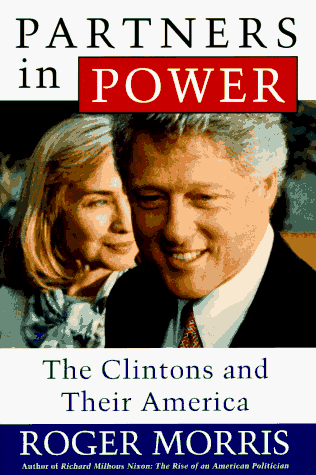

Roger Morris remembers future Secretary Clinton as a young law student whose "big break" involved helping prosecute President Nixon. One of those students who think using bad language is "liberated," she stood out in people's memory by threatening to "nail" the Nixon team in an egregiously unladylike hiss...I don't often add book links to other people's contributions to this site, but the irony in this story is too rich for young readers to miss.
"
I am heartbroken by ongoing violence in our nation, including recent attacks in Bristol and Dallas. As of this writing, little is known about the attack in Michigan. The perpetrators of these events are ultimately responsible, but we must all look within ourselves, work to rise above tensions, and be reminded that violence is not the answer.
My heart is with those killed or wounded and with their loved ones as I continue praying for peace, comfort, justice, and a greater understanding.
Transparency, Accountability, and Bias: The Case for a Special Prosecutor
Reports revealed that during her tenure as Secretary of State from 2009 to 2013, Hillary Clinton used a personal email account for government business and stored emails on a private server in her home. Clinton later turned over many emails to the State Department for review but revealed that she deleted over 30,000 that she and her lawyers claimed were personal communications.
In March 2015, Representative Trey Gowdy, Chairman of the House Select Committee on Benghazi, formally requested that Clinton turn over her private server in a letter to her lawyer.
In July 2015, this issue was referred to the Department of Justice (DOJ) following evidence that classified information was transmitted through this email server. Clinton then decided to turn over her server to the DOJ in August of that year. The matter was then referred to the Federal Bureau of Investigation (FBI) to probe whether Clinton and her staff compromised classified information.
At a recent general press meeting and in a letter to Attorney General Loretta Lynch, I joined several other Members of Congress in calling on the Attorney General to appoint a Special Prosecutor to take control of the investigation.
When President Richard Nixon had his secretary erase 18 minutes of a White House recording that was of his making regarding the break-in of the Democrat Headquarters at the Watergate building, a special prosecutor was appointed.
Why not now?!
This is particularly important because of United States Attorney General Lynch’s conduct during the investigation. As the nation’s chief prosecutor, she met privately with former President Bill Clinton, the husband of the target of the investigation, mere days before the FBI announced its recommendation that the DOJ not bring charges against Secretary Clinton.
In my opinion as one trained as a lawyer, this conduct creates an “appearance of impropriety” which is unethical behavior. Therefore, I believe a special prosecutor should be appointed to investigate.
Even if the Lynch/President Clinton meeting was innocuous and their conversation involved “grandchildren, golf, and their respective travels,” borrowing from POLITICO, this shows a clear connection between the subject of the investigation and the arbiter of a decision that is supposed to be independent. If you are close enough with a person that they will board your airplane to discuss families, you are too close to make an independent legal determination on a case in which that person’s family, specifically that person’s spouse, is involved.
My representative when I was growing up was Congressman M. Caldwell Butler. When evidence of an attempted cover up of the Watergate break-in became clear, particularly the erasure of evidence in the form of deleting part of a tape recording, Congressman Butler did not hesitate to do the right thing. He didn’t stop to worry about whether the wrongdoer was a Republican or a Democrat. Instead, he was one of the six Republicans on the Judiciary Committee to split with the Republican party and vote affirmatively to impeach President Nixon on July 27, 1974.
But even before the vote on impeachment, and with circumstances similar to those Secretary Clinton now faces, there were special prosecutors appointed. Secretary Clinton deleted certain emails which may have contained evidence. In Nixon’s case, certain audiotapes were deleted which may have contained evidence.
And for those too young to have lived through the Watergate scandal, tape recording then was as high-tech as emails and servers are today.
The similarities and the ironies in the cases of Nixon and Clinton cannot be overlooked.
Now as was the case then, the American people deserve transparency and accountability, not something that smells of political bias and what appears to be a classic conflict of interest. Additionally, now as was the case then, whether or not the subject of the investigation did something wrong is not a Democrat or a Republican issue.
Only a special prosecutor can make a decision regarding Secretary Clinton’s actions separate from the political and personal conflicts of interest issues.
Investigations must – and will – continue, because there are still lots of unanswered questions. Unfortunately, this is not the first incident that has undermined public trust in our federal government during the current Administration’s tenure. This disturbing lack of transparency and disregard for national security is unacceptable.
"
Fellow Americans, do any of you not remember exactly how ironic this story is getting?
Roger Morris remembers future Secretary Clinton as a young law student whose "big break" involved helping prosecute President Nixon. One of those students who think using bad language is "liberated," she stood out in people's memory by threatening to "nail" the Nixon team in an egregiously unladylike hiss...I don't often add book links to other people's contributions to this site, but the irony in this story is too rich for young readers to miss.
Wednesday, June 29, 2016
Dare Bet for Candidate Trump
Because it's beginning to seem possible that this web site will be persuaded to endorse Trump, and because the trolls and the crybullies have apparently persuaded Scott Adams to disable the comments on his site...here are my top three reasons for being an "anti-Trumper":
1. Trump has always come across as a jerk. I don't mean merely a New Yorker. "Killer" Ron Halvorsen, the boxer turned preacher, built a career on being a working-class Noo Yawkuh wit de accent an' orl, and I was a member of his church for four years.


So I'm not talking about an accent that I find amusing, or a manner that gives me the pleasure of feeling overprivileged. I mean that Trump comes off as a rich jerk with a long record of taking advantage of anyone who's disadvantaged in any way, in business "deals," specifically including widows and disabled veterans.
2. There are those who believe that anyone who wants to declare bankruptcy instead of paying a debt should be required to sell off all his/her assets, including motor vehicles, television sets, and any garment or piece of furniture that has or ever had a market value higher than $100, and if the creditors want to be mean there doesn't really need to be any legal provision for letting non-payers of debts keep the shirts on their backs. I am one of those people.
3. I'm not even sure that I'd call Trump sexist. Men who believe that a man who lies only to women, as it might be by vowing to "forsake all others until death doth them part" and then marrying younger women, repeatedly, is a man whom other men can trust, are sexist. I don't see Trump that way. I see his obnoxious behavior toward some women as having a certain unavoidable sexist odor, but I see his behavior toward some men as being equally obnoxious. I see him as an equal-opportunity selfish jerk who's likely to cheat and/or betray anybody. I mean...without even being an elected official he's already used eminent domain to take advantage of private citizens. (The position of this web site is that that ought to be made a felony, incurring deportation at the minimum.)
Note that, although Scott Adams has presumably got into this with a lot of "anti-Trumpers" who parrot the "Trump is a crazy racist" meme (while threatening the lives of Trump supporters? ???)...this web site has never, ever, accused Trump of being "crazy." This web site does not use "crazy" as an all-purpose insult-word, first of all. Secondly, I don't think it's rational to describe a successful Bankruptcy Billionnaire as anything but intelligent. Evil, perhaps; despicable, certainly, but very intelligent...sort of like my late husband's late ex-wife, or like the late Osama bin Laden. Acknowledging intelligence doesn't mean we like or approve of a person. It can mean recognizing one of the very few people who really qualify to be hated, and regarded as enemies, by intelligent people of good will. It can also be a way of acknowledging our debt to those who successfully oppose someone who's both evil and intelligent, which is always what's going on when I acknowledge that Hitler (before the drugs) was perceptive and intelligent and able to latch on to good ideas for his evil purposes...I'm not admiring Hitler, I'm admiring Churchill.
And, racist? I think that's like "sexist." Trump is, indisputably, White and male; he was those things in the bad old days when people thought those things should automatically confer privileges on a person; he wants those privileges, for sure. But, I repeat, he's not stupid. By now he knows better than to expect to get away with overtly relying on race or gender as a disadvantage for the other person, and he's seen that people who are neither White nor male can be serious competitors.
(This web site is partial to tangents, so that "Fauxcahontas" tangent might as well be addressed here, just to get it out of the way. Elizabeth Warren is neither a relative nor otherwise comparable to Pocahontas. She won the nickname "Fauxcahontas" by falsely claiming Cherokee ancestry in order to get the benefit of affirmative action. Warren's alleged basis for this claim was her cheekbones, which, it was later determined, she inherited from Swedish ancestors. Interestingly, Trump has claimed Swedish ancestry, but his grandfather was German. The confusion seems to have been traced to the grandfather; Trump may have honestly believed he's Swedish-American, as President Obama may have believed he was part Cherokee, just because people don't expect their parents to lie to them about these things. Telling children the family name is Swedish during a war against Germany, to protect those children from being beaten up if they admitted their name was German, is less despicable than denying your heritage merely in order to cheat needier students out of allegedly need-related scholarships. Still, Trump would be well advised to let the whole "Fauxcahontas" meme drop. This web site will curate it...you're welcome.)
The question that may decide the election is whether Trump can change--or appear to have changed--his selfish-greedhead-arrogant-lying-cheating-scheming-jerk qualities. Is he capable of a genuine spiritual experience? I don't know; frankly I'm inclined to doubt it. If, as some studies suggest, extrovert personalities are produced by a defective conscience, then it's either impossible or incredibly difficult for any extrovert to have much of a spiritual experience. And Trump's not just any extrovert egomaniac; he's demonstrated to the world that he's motivated largely by money, and he's made a lot of money being an extrovert egomaniac. That camel going through the eye of that needle will have an easier time than Trump becoming a Christian.
So, more to the point: is Trump capable of wanting to be President badly enough to pursue a spiritual experience, renounce selfish ambitions, and actually serve as a President dedicated to serving the will and interests of his constituents? I don't know about that, either, but it's easier to believe than that Trump is capable of being a serious Christian. He does have the natural ability to go to church, make Christian noises, avoid being alone with a young woman, abstain from any kind of private business "deals," and put his personal life on hold for four years, just as other Presidents have done...if he really wants to do that. I'm not convinced (yet) that he does really want to do that; but it's possible that he might.
I still think the best-case scenario would involve...I'm not going to propose a running mate for Trump, because I don't really wish the stigma of inheriting the Presidency on any politician I like, and I certainly don't endorse any deliberate attempt to shorten anybody's life, even Trump's, in any way more direct than encouraging the person to campaign for or serve as President. I will limit myself to observing that it's impossible for Trump to choose a running mate on the traditional "life insurance" basis, Spiro Agnew being dead. But if Trump carries on with the campaign, and yells and goes red in the face often enough, and if just about any of the other Republican candidates happens to be Vice-President when the inevitable happens...
Oh right, Big Fat Ugly German-American Jerk, #BankruptcyBillionnaire . Convince me that I'm wrong, if you can. Prove that you are capable of admitting you've made enough money on sleazy real estate deals and selflessly serving the will and interests of the Republican Party, if you can. That's the dare. This web site's support is the bet.
http://blog.dilbert.com/post/146605145036/persuasion-update-clinton-vs-trump
1. Trump has always come across as a jerk. I don't mean merely a New Yorker. "Killer" Ron Halvorsen, the boxer turned preacher, built a career on being a working-class Noo Yawkuh wit de accent an' orl, and I was a member of his church for four years.
So I'm not talking about an accent that I find amusing, or a manner that gives me the pleasure of feeling overprivileged. I mean that Trump comes off as a rich jerk with a long record of taking advantage of anyone who's disadvantaged in any way, in business "deals," specifically including widows and disabled veterans.
2. There are those who believe that anyone who wants to declare bankruptcy instead of paying a debt should be required to sell off all his/her assets, including motor vehicles, television sets, and any garment or piece of furniture that has or ever had a market value higher than $100, and if the creditors want to be mean there doesn't really need to be any legal provision for letting non-payers of debts keep the shirts on their backs. I am one of those people.
3. I'm not even sure that I'd call Trump sexist. Men who believe that a man who lies only to women, as it might be by vowing to "forsake all others until death doth them part" and then marrying younger women, repeatedly, is a man whom other men can trust, are sexist. I don't see Trump that way. I see his obnoxious behavior toward some women as having a certain unavoidable sexist odor, but I see his behavior toward some men as being equally obnoxious. I see him as an equal-opportunity selfish jerk who's likely to cheat and/or betray anybody. I mean...without even being an elected official he's already used eminent domain to take advantage of private citizens. (The position of this web site is that that ought to be made a felony, incurring deportation at the minimum.)
Note that, although Scott Adams has presumably got into this with a lot of "anti-Trumpers" who parrot the "Trump is a crazy racist" meme (while threatening the lives of Trump supporters? ???)...this web site has never, ever, accused Trump of being "crazy." This web site does not use "crazy" as an all-purpose insult-word, first of all. Secondly, I don't think it's rational to describe a successful Bankruptcy Billionnaire as anything but intelligent. Evil, perhaps; despicable, certainly, but very intelligent...sort of like my late husband's late ex-wife, or like the late Osama bin Laden. Acknowledging intelligence doesn't mean we like or approve of a person. It can mean recognizing one of the very few people who really qualify to be hated, and regarded as enemies, by intelligent people of good will. It can also be a way of acknowledging our debt to those who successfully oppose someone who's both evil and intelligent, which is always what's going on when I acknowledge that Hitler (before the drugs) was perceptive and intelligent and able to latch on to good ideas for his evil purposes...I'm not admiring Hitler, I'm admiring Churchill.
And, racist? I think that's like "sexist." Trump is, indisputably, White and male; he was those things in the bad old days when people thought those things should automatically confer privileges on a person; he wants those privileges, for sure. But, I repeat, he's not stupid. By now he knows better than to expect to get away with overtly relying on race or gender as a disadvantage for the other person, and he's seen that people who are neither White nor male can be serious competitors.
(This web site is partial to tangents, so that "Fauxcahontas" tangent might as well be addressed here, just to get it out of the way. Elizabeth Warren is neither a relative nor otherwise comparable to Pocahontas. She won the nickname "Fauxcahontas" by falsely claiming Cherokee ancestry in order to get the benefit of affirmative action. Warren's alleged basis for this claim was her cheekbones, which, it was later determined, she inherited from Swedish ancestors. Interestingly, Trump has claimed Swedish ancestry, but his grandfather was German. The confusion seems to have been traced to the grandfather; Trump may have honestly believed he's Swedish-American, as President Obama may have believed he was part Cherokee, just because people don't expect their parents to lie to them about these things. Telling children the family name is Swedish during a war against Germany, to protect those children from being beaten up if they admitted their name was German, is less despicable than denying your heritage merely in order to cheat needier students out of allegedly need-related scholarships. Still, Trump would be well advised to let the whole "Fauxcahontas" meme drop. This web site will curate it...you're welcome.)
The question that may decide the election is whether Trump can change--or appear to have changed--his selfish-greedhead-arrogant-lying-cheating-scheming-jerk qualities. Is he capable of a genuine spiritual experience? I don't know; frankly I'm inclined to doubt it. If, as some studies suggest, extrovert personalities are produced by a defective conscience, then it's either impossible or incredibly difficult for any extrovert to have much of a spiritual experience. And Trump's not just any extrovert egomaniac; he's demonstrated to the world that he's motivated largely by money, and he's made a lot of money being an extrovert egomaniac. That camel going through the eye of that needle will have an easier time than Trump becoming a Christian.
So, more to the point: is Trump capable of wanting to be President badly enough to pursue a spiritual experience, renounce selfish ambitions, and actually serve as a President dedicated to serving the will and interests of his constituents? I don't know about that, either, but it's easier to believe than that Trump is capable of being a serious Christian. He does have the natural ability to go to church, make Christian noises, avoid being alone with a young woman, abstain from any kind of private business "deals," and put his personal life on hold for four years, just as other Presidents have done...if he really wants to do that. I'm not convinced (yet) that he does really want to do that; but it's possible that he might.
I still think the best-case scenario would involve...I'm not going to propose a running mate for Trump, because I don't really wish the stigma of inheriting the Presidency on any politician I like, and I certainly don't endorse any deliberate attempt to shorten anybody's life, even Trump's, in any way more direct than encouraging the person to campaign for or serve as President. I will limit myself to observing that it's impossible for Trump to choose a running mate on the traditional "life insurance" basis, Spiro Agnew being dead. But if Trump carries on with the campaign, and yells and goes red in the face often enough, and if just about any of the other Republican candidates happens to be Vice-President when the inevitable happens...
Oh right, Big Fat Ugly German-American Jerk, #BankruptcyBillionnaire . Convince me that I'm wrong, if you can. Prove that you are capable of admitting you've made enough money on sleazy real estate deals and selflessly serving the will and interests of the Republican Party, if you can. That's the dare. This web site's support is the bet.
http://blog.dilbert.com/post/146605145036/persuasion-update-clinton-vs-trump
Tuesday, June 28, 2016
Does It Matter if Trump's Been Born Again?
Doug Giles' extremely annoying web site (well, it's called Clash) shared the news that James Dobson is introducing Donald Trump as a born-again Christian.
http://clashdaily.com/2016/06/dear-america-important-trump-born-christian/
How important is this information to me? Depends on how important it is to The Donald.
If his growing in the faith includes reading Bible passages like 1 Kings 21, which basically explains why the use of "eminent domain" is always evil and wrong and will bring disaster on a nation that allows it, and the dozens of texts that talk about defending the rights of, restoring the property of, and generally encouraging "the widow and the fatherless," then Trump's newfound faith will lead him to be the sort of President I can agree that this country needs.
If that happens, then I'll be able to agree with some of my favorite Republicans, including one of the very best sponsors this web site ever had. I'd guess that Grandma Bonnie Peters would be able to agree with them, too, and this web site would no longer be riven to its core by the most-followed news story of the year.
And I'm sure everyone is familiar with "eat my hat" stunts by now, but I'd design, make, and eat an original hat, and upload the pictures.
On the other hand Trump's rebirth could be just another public relations moment, to which the whole world knows he's addicted, and it might result in no official policy changes whatsoever. Frankly, that's what I'd expect of Trump.
But I'm willing, yea eager, to be convinced that I am wrong--that Trump has learned from the sins of his past, repented, and been reborn as a defender of the rights of all individuals, most especially of poor individuals as against wealthy ones.
(Should this post get an Amazon link? Why shouldn't it? From the world's leading exponent of born-again Christianity...)

http://clashdaily.com/2016/06/dear-america-important-trump-born-christian/
How important is this information to me? Depends on how important it is to The Donald.
If his growing in the faith includes reading Bible passages like 1 Kings 21, which basically explains why the use of "eminent domain" is always evil and wrong and will bring disaster on a nation that allows it, and the dozens of texts that talk about defending the rights of, restoring the property of, and generally encouraging "the widow and the fatherless," then Trump's newfound faith will lead him to be the sort of President I can agree that this country needs.
If that happens, then I'll be able to agree with some of my favorite Republicans, including one of the very best sponsors this web site ever had. I'd guess that Grandma Bonnie Peters would be able to agree with them, too, and this web site would no longer be riven to its core by the most-followed news story of the year.
And I'm sure everyone is familiar with "eat my hat" stunts by now, but I'd design, make, and eat an original hat, and upload the pictures.
On the other hand Trump's rebirth could be just another public relations moment, to which the whole world knows he's addicted, and it might result in no official policy changes whatsoever. Frankly, that's what I'd expect of Trump.
But I'm willing, yea eager, to be convinced that I am wrong--that Trump has learned from the sins of his past, repented, and been reborn as a defender of the rights of all individuals, most especially of poor individuals as against wealthy ones.
(Should this post get an Amazon link? Why shouldn't it? From the world's leading exponent of born-again Christianity...)
Tuesday, February 23, 2016
Endorsement of Ben Carson
Here's what I posted at Change.org's sister site, Changepolitics.org, where you too can create an account and endorse your favorite presidential candidate:
First of all, due to the birthplace question for Cruz and the sincerity question for Trump, I think Ben Carson really is the most viable candidate in the Republican Party now.
Secondly, I think he's relatively conservative on financial issues, very "conservative" in terms of personal lifestyle, and quite "liberal" and "enlightened" about people and social issues. He practices modesty and chastity but wouldn't discriminate against people whose personal choices are not sanctioned by the church. He doesn't want to cut the budget nearly as much as Rand Paul would have done, but isn't calling for more taxes and spending either. He's willing and able to work with military advisors if we have to go into war, but he's generally a man of peace. This is a combination America needs.
Thirdly, I've been saying for about a year now--the Democrats' big problem is that they let their youngest solid candidate be President first, and now their remaining candidates are too old for the job. I think the Republicans should rally behind their oldest solid candidate too. People call Marco Rubio "the young one" and Rand Paul "the junior senator." Those Senators will probably have other years to run for President if they work with Dr. Carson and build their resumes right now.
And I'm not saying I'd vote for anybody just because s/he worked at the hospital that did so much for a child I loved, or belongs to the church I'm most likely to attend, or wrote books I've recommended to students in search of a role model...but none of those things hurts!
[Update: I hit the "share" button, and Google + automatically pulled up my kitten image. We can do better than this. Why not a clickable link you can use to buy Dr. Carson's book?]


First of all, due to the birthplace question for Cruz and the sincerity question for Trump, I think Ben Carson really is the most viable candidate in the Republican Party now.
Secondly, I think he's relatively conservative on financial issues, very "conservative" in terms of personal lifestyle, and quite "liberal" and "enlightened" about people and social issues. He practices modesty and chastity but wouldn't discriminate against people whose personal choices are not sanctioned by the church. He doesn't want to cut the budget nearly as much as Rand Paul would have done, but isn't calling for more taxes and spending either. He's willing and able to work with military advisors if we have to go into war, but he's generally a man of peace. This is a combination America needs.
Thirdly, I've been saying for about a year now--the Democrats' big problem is that they let their youngest solid candidate be President first, and now their remaining candidates are too old for the job. I think the Republicans should rally behind their oldest solid candidate too. People call Marco Rubio "the young one" and Rand Paul "the junior senator." Those Senators will probably have other years to run for President if they work with Dr. Carson and build their resumes right now.
And I'm not saying I'd vote for anybody just because s/he worked at the hospital that did so much for a child I loved, or belongs to the church I'm most likely to attend, or wrote books I've recommended to students in search of a role model...but none of those things hurts!
[Update: I hit the "share" button, and Google + automatically pulled up my kitten image. We can do better than this. Why not a clickable link you can use to buy Dr. Carson's book?]
Wednesday, December 16, 2015
Republican Debate: Reflections and Links
On the way home last night I passed by the home of some Republicans who said, "Come in and watch this." The "bottom card" Republican debate was just wrapping up. I had the opportunity to see the nine leading contenders for the Republican presidential nomination.
They didn't have to drag me in by the elbows. They didn't even have to bribe me with food. I write about these people; I was glad to have the chance to study their nonverbal communication on TV. However, let's just say that a debate about terrorism, foreign policy, and war, in which the candidates seemed to be competing to show how hawkish they can be, has to have been the debate I've been least qualified to judge since...oh, say 1976, when I fell asleep during the first half-hour.
Hawkishness is the main reason why I've never identified as a Republican. (So help me. Reince Priebus's e-mail inviting me to declare myself one came in while I was typing this. I filed it. I'm a fiscally conservative, socially liberal Independent.) I'm not a bleeding heart; I'm not saying we can just love ISIS into becoming decent human beings. There is such a thing as a justified war. Nevertheless, however idealistic or naive or girly it may be, my idea of a justified war is not carpet bombing. It's more like Faulkner's "You whip the big ones and I'll whip the little ones."
If I vote to send our young people to war, then I'm accountable to the country, to the extent that if the Tashfeen-ghoul hadn't written herself off, our military would have the right to shove a pistol into my hand and say, "Don't put it on the conscience of some nineteen-year-old boy that he had to kill a woman," and it would be my duty to blow Tashfeen's precious little hidden face to bits. Unless she was quicker on the draw and killed me first. And spend the rest of my life, if I lived, looking over my shoulder for relatives of hers, too. (This attitude toward war might not realistically be the best use of our national resources, but it is a dang fine way to keep older people from getting enthusiastic about sending the young to war.)
I don't like the idea of carpet bombing even though I know that, in cultures that take blood feuds seriously, the babies I want not to blow up are likely to grow up thinking it's their duty to kill Americans. How many Arab-types are we going to have to kill? Where will it end? Was this really a culture we wanted to declare war on, back in the 1990's? We need a change from the present administration, but...must it be merely a switch back to the one before?
I'm puzzled by the polls asking who "won" the debate. Nine people talking in two-minute soundbites? How can you say one of them won? What's the point system here?
* I think the one who had the opportunity to say the most good things, although he stumbled and sputtered on a few of them and probably deserves to lose a few points for saying some of them out of turn, was Ted Cruz.
* However, the one I'd most like to vote for is still Ben Carson. Even though, when he called for a moment of silence, I was thinking "Senator for Maryland, please," and when he complained about not getting as many questions as Cruz and Rubio got, I was thinking, "Let's Talk About Whining ," and when he talked about a doctor having to do things that hurt children, I was thinking, "Ouch. Ouch. Owwwch." On the whole I think he has the most realistic, levelheaded, balanced, fiscally conservative and socially liberal plans, and (despite the gaffe about the scholarship) the highest individual credibility. And it doesn't hurt anything that, unlike the other candidates, he can't count on being even more qualified eight years in the future. I think some of the other candidates have more natural talent for debating; that doesn't make them better candidates. My only question about Dr. Carson continues to be whether he wouldn't really prefer being U.S. Senator for Maryland.
* The one who raised my opinion of him furthest was John Kasich. I hadn't seen or heard much of him before; in the last picture I'd seen he still had dark hair, and I didn't recognize him with the grey growing in. He's a good debater, and worked in what ought to be all Republicans' mantras (bringing the jobs home, building coalitions) more efficiently than any of the others.
* The one who lost the most points, in my opinion, was Marco Rubio. How can any human being support the Patriot Act? If you can't fight crime without spying on people, and thereby also making it possible for our national enemies to spy on those people, you should leave fighting crime to someone who has a better strategy. I like Senator Rubio. In some ways I liked him better on television; his boyish grin reminds me of Terry Kilgore's, so there was that "You go, homeboy!" emotional thing going even though he's not my homie. I think his support for the Patriot Act was incongruous with what he said in American Son , unworthy, and evidence that he's still very young and has a lot of time to get his act together.
* Carly Fiorina is a class act. A real trouper. She's the least qualified of the candidates and appears, on paper, to be a token, but I'm impressed by her natural talent. But also...as I'd say to former Vice-President Cheney, as I've said about Hillary Clinton and Joe Biden...she's been ill. Americans get overwrought when their President has a cold, or spends six hours in bed for routine surgery. Being thin, with a narrow face, is great for anyone who's going to be on television, but the sound of Candidate Fiorina's voice, plus her thinness, makes her seem brittle. I'd have serious concerns about her surviving four years in the White House. I think she should be running for a seat in Congress, where she can take a day off now and then.
* Rand Paul...well...I think his looks work against him with a lot of people, and that's too bad, because he's a good man, a good writer, a reasonably good Senator, and he was speaking for me throughout the debate. Don't real Republicans hear the compassion, or don't they want a President who has compassion? I want to vote for him. I don't think this is the year, though, because of something one of the Big Fat Jerk candidates said during a moment of unparliamentary cross-talk. He is still a junior Senator who hasn't sponsored a major successful bill. No fifty-something wants to hear "Wait, do a lower-paid job, be a supportive apprentice to an older person who's doing the job you'd like to do now," as I well know, but...I keep coming back to, "Senator Paul undoubtedly has time to rack up experience points. Let the oldest candidate go first, please."
* Jeb Bush...meh. I've been saying we shouldn't elect him because, if we do, we'll have a war. Seems like a lot of people want a war, anyway. Well, if they do, Jeb Bush is their man. He has connections in the U.S. military, the C.I.A., and also in the Arab world. He can give us another expensive, yet "successful," war against another tiddly little Middle Eastern country. If that's what we as a nation want, or what some other country, naming no names like China, Russia, France, or Germany, wants to push us into...It's not what I want. If Republicans want war, they want Jeb Bush, and I'd trust him to get us through a war with less damage than any of the Democrats, for sure. I respect him. I'd support him. I would so much rather respect and support him in any other situation than another war with blood-feud-minded Arab-types.
That leaves two Big Fat Jerks who should, in my opinion, just go home and be quiet. The less I have to say about either of them, the better I'm pleased. A big, beefy guy has to work harder than is really fair to come across as a thinker and leader we should respect, rather than an ox. The fatter of these two candidates came across as an ox with a vicious streak. What he was doing, standing in the place where Governor Huckabee (who is a good debater) should have been, I cannot imagine. Yankee bigotry against Southerners, I suppose.
The mouthier one...made me angry, because I was not the only person these Republicans had invited to watch the debate. Another guest, who's been a good wife to one of my cousins for many years, had totally fallen for the #BankruptcyBillionnaire's line of hogwash. How do you feel when you see a well-known liar in the act of deceiving a less informed person whom you like? It would be a violation of this site's contract to tell you what I was thinking. A censored version would be "What a boon to humankind it would have been if this lousy creep had been born without a tongue."
Lying is a job skill that's highly valued in some circles in Washington, as Colonel North told us back in the 1980's. I lived in Washington and can say, as sincere praise, that my husband was an honest, trustworthy man who had good lying skills. In wartime lying is an especially valuable skill; the Bush clan have superb lying skills, and why deny that that's one of their big assets. So there may be those who imagine that Trump's vulgar, self-interested lies, e.g. his wedding vows, indicate a talent a presidential candidate ought to have. I think there's a world of difference between the self-interested lies a man tells when he's greedy for sex or money, and the public-spirited, disinterested lies a better kind of man--the kind who's relatively honest about sex and money--tells when the truth might cost his country lives in war.
However, I noticed something about Trump's lying skills during the debate. Some of youall must have noticed this too, although so far no correspondent seems to have mentioned it. A practiced liar learns fairly quickly to control visible mannerisms that tell us whether he's lying or not. Controlling his voice is all but impossible--in order to keep his voice from rising a few tones when he's lying, a liar just about has to have convinced himself that the lie he's telling is true. Skilled liars choose words carefully in order to say things that are at least half true; unskilled liars (who aren't ordinarily dysphasic) often blurt out words that give away their lies. When the Rump was booming on about carpet bombing, his voice was low. He really wants to kill masses of people, including babies. When he was saying "Not...out of the question" in reply to the question about whether he'd run as a spoiler if not nominated as a Republican, his voice rose noticeably. He is not seriously campaigning as a Republican. He is a spoiler.
And Trump also...despite his ability to deceive people whose fears and/or social class consciousness have been manipulated, or who want the financial rewards of being his temporary wife or employee...he also lacks professional-grade lying skills. He not only let his voice tell me that his pledge not to run as a third-party spoiler was an out-and-out lie; he also worded his reply in a way that should have told everybody that. He gives himself away, when he's lying. He's not C.I.A. material, and in wartime, when lying is justifiable and necessary, he'd be a disastrous President.
Those are my thoughts. However, in academic debates where honesty is not in question, the traditional scoring method is different from a random observer's reflections. Academic debates are scored based on facts. Several of the Republicans stumbled over words during the debates; some of them misspoke--and in academic debates, misspeaking costs you. So here, fed to this web site by Glenn Beck's merry band of fact checkers, is a quick list of the Republicans' errors of fact:
http://www.theblaze.com/stories/2015/12/16/ap-fact-check-republican-debaters-go-astray/
They caught Ted Cruz in more errors than the others because Ted Cruz made more significant statements of facts than the others; this factor should be weighed into any scoring process youall care to use.
Here's Reason.com's pick of the highlights:
https://reason.com/reasontv/2015/12/16/vegas-gop-debate-3-best-and-worst-moment
Katie Pavlich's report interests me because her reactions were so different from mine:
http://www.townhallmail.com/gnwqcfhkqqldckqkdkcghdjttmdttkmhnngfpclnmntlyt_zswmzbmmwrw.html?a=&b=
A lot of the polls are still going on today; more reports will undoubtedly show up in tomorrow's Link Log under Politics.
They didn't have to drag me in by the elbows. They didn't even have to bribe me with food. I write about these people; I was glad to have the chance to study their nonverbal communication on TV. However, let's just say that a debate about terrorism, foreign policy, and war, in which the candidates seemed to be competing to show how hawkish they can be, has to have been the debate I've been least qualified to judge since...oh, say 1976, when I fell asleep during the first half-hour.
Hawkishness is the main reason why I've never identified as a Republican. (So help me. Reince Priebus's e-mail inviting me to declare myself one came in while I was typing this. I filed it. I'm a fiscally conservative, socially liberal Independent.) I'm not a bleeding heart; I'm not saying we can just love ISIS into becoming decent human beings. There is such a thing as a justified war. Nevertheless, however idealistic or naive or girly it may be, my idea of a justified war is not carpet bombing. It's more like Faulkner's "You whip the big ones and I'll whip the little ones."
If I vote to send our young people to war, then I'm accountable to the country, to the extent that if the Tashfeen-ghoul hadn't written herself off, our military would have the right to shove a pistol into my hand and say, "Don't put it on the conscience of some nineteen-year-old boy that he had to kill a woman," and it would be my duty to blow Tashfeen's precious little hidden face to bits. Unless she was quicker on the draw and killed me first. And spend the rest of my life, if I lived, looking over my shoulder for relatives of hers, too. (This attitude toward war might not realistically be the best use of our national resources, but it is a dang fine way to keep older people from getting enthusiastic about sending the young to war.)
I don't like the idea of carpet bombing even though I know that, in cultures that take blood feuds seriously, the babies I want not to blow up are likely to grow up thinking it's their duty to kill Americans. How many Arab-types are we going to have to kill? Where will it end? Was this really a culture we wanted to declare war on, back in the 1990's? We need a change from the present administration, but...must it be merely a switch back to the one before?
I'm puzzled by the polls asking who "won" the debate. Nine people talking in two-minute soundbites? How can you say one of them won? What's the point system here?
* I think the one who had the opportunity to say the most good things, although he stumbled and sputtered on a few of them and probably deserves to lose a few points for saying some of them out of turn, was Ted Cruz.
* However, the one I'd most like to vote for is still Ben Carson. Even though, when he called for a moment of silence, I was thinking "Senator for Maryland, please," and when he complained about not getting as many questions as Cruz and Rubio got, I was thinking, "Let's Talk About Whining
," and when he talked about a doctor having to do things that hurt children, I was thinking, "Ouch. Ouch. Owwwch." On the whole I think he has the most realistic, levelheaded, balanced, fiscally conservative and socially liberal plans, and (despite the gaffe about the scholarship) the highest individual credibility. And it doesn't hurt anything that, unlike the other candidates, he can't count on being even more qualified eight years in the future. I think some of the other candidates have more natural talent for debating; that doesn't make them better candidates. My only question about Dr. Carson continues to be whether he wouldn't really prefer being U.S. Senator for Maryland.* The one who raised my opinion of him furthest was John Kasich. I hadn't seen or heard much of him before; in the last picture I'd seen he still had dark hair, and I didn't recognize him with the grey growing in. He's a good debater, and worked in what ought to be all Republicans' mantras (bringing the jobs home, building coalitions) more efficiently than any of the others.
* The one who lost the most points, in my opinion, was Marco Rubio. How can any human being support the Patriot Act? If you can't fight crime without spying on people, and thereby also making it possible for our national enemies to spy on those people, you should leave fighting crime to someone who has a better strategy. I like Senator Rubio. In some ways I liked him better on television; his boyish grin reminds me of Terry Kilgore's, so there was that "You go, homeboy!" emotional thing going even though he's not my homie. I think his support for the Patriot Act was incongruous with what he said in American Son
, unworthy, and evidence that he's still very young and has a lot of time to get his act together.* Carly Fiorina is a class act. A real trouper. She's the least qualified of the candidates and appears, on paper, to be a token, but I'm impressed by her natural talent. But also...as I'd say to former Vice-President Cheney, as I've said about Hillary Clinton and Joe Biden...she's been ill. Americans get overwrought when their President has a cold, or spends six hours in bed for routine surgery. Being thin, with a narrow face, is great for anyone who's going to be on television, but the sound of Candidate Fiorina's voice, plus her thinness, makes her seem brittle. I'd have serious concerns about her surviving four years in the White House. I think she should be running for a seat in Congress, where she can take a day off now and then.
* Rand Paul...well...I think his looks work against him with a lot of people, and that's too bad, because he's a good man, a good writer, a reasonably good Senator, and he was speaking for me throughout the debate. Don't real Republicans hear the compassion, or don't they want a President who has compassion? I want to vote for him. I don't think this is the year, though, because of something one of the Big Fat Jerk candidates said during a moment of unparliamentary cross-talk. He is still a junior Senator who hasn't sponsored a major successful bill. No fifty-something wants to hear "Wait, do a lower-paid job, be a supportive apprentice to an older person who's doing the job you'd like to do now," as I well know, but...I keep coming back to, "Senator Paul undoubtedly has time to rack up experience points. Let the oldest candidate go first, please."
* Jeb Bush...meh. I've been saying we shouldn't elect him because, if we do, we'll have a war. Seems like a lot of people want a war, anyway. Well, if they do, Jeb Bush is their man. He has connections in the U.S. military, the C.I.A., and also in the Arab world. He can give us another expensive, yet "successful," war against another tiddly little Middle Eastern country. If that's what we as a nation want, or what some other country, naming no names like China, Russia, France, or Germany, wants to push us into...It's not what I want. If Republicans want war, they want Jeb Bush, and I'd trust him to get us through a war with less damage than any of the Democrats, for sure. I respect him. I'd support him. I would so much rather respect and support him in any other situation than another war with blood-feud-minded Arab-types.
That leaves two Big Fat Jerks who should, in my opinion, just go home and be quiet. The less I have to say about either of them, the better I'm pleased. A big, beefy guy has to work harder than is really fair to come across as a thinker and leader we should respect, rather than an ox. The fatter of these two candidates came across as an ox with a vicious streak. What he was doing, standing in the place where Governor Huckabee (who is a good debater) should have been, I cannot imagine. Yankee bigotry against Southerners, I suppose.
The mouthier one...made me angry, because I was not the only person these Republicans had invited to watch the debate. Another guest, who's been a good wife to one of my cousins for many years, had totally fallen for the #BankruptcyBillionnaire's line of hogwash. How do you feel when you see a well-known liar in the act of deceiving a less informed person whom you like? It would be a violation of this site's contract to tell you what I was thinking. A censored version would be "What a boon to humankind it would have been if this lousy creep had been born without a tongue."
Lying is a job skill that's highly valued in some circles in Washington, as Colonel North told us back in the 1980's. I lived in Washington and can say, as sincere praise, that my husband was an honest, trustworthy man who had good lying skills. In wartime lying is an especially valuable skill; the Bush clan have superb lying skills, and why deny that that's one of their big assets. So there may be those who imagine that Trump's vulgar, self-interested lies, e.g. his wedding vows, indicate a talent a presidential candidate ought to have. I think there's a world of difference between the self-interested lies a man tells when he's greedy for sex or money, and the public-spirited, disinterested lies a better kind of man--the kind who's relatively honest about sex and money--tells when the truth might cost his country lives in war.
However, I noticed something about Trump's lying skills during the debate. Some of youall must have noticed this too, although so far no correspondent seems to have mentioned it. A practiced liar learns fairly quickly to control visible mannerisms that tell us whether he's lying or not. Controlling his voice is all but impossible--in order to keep his voice from rising a few tones when he's lying, a liar just about has to have convinced himself that the lie he's telling is true. Skilled liars choose words carefully in order to say things that are at least half true; unskilled liars (who aren't ordinarily dysphasic) often blurt out words that give away their lies. When the Rump was booming on about carpet bombing, his voice was low. He really wants to kill masses of people, including babies. When he was saying "Not...out of the question" in reply to the question about whether he'd run as a spoiler if not nominated as a Republican, his voice rose noticeably. He is not seriously campaigning as a Republican. He is a spoiler.
And Trump also...despite his ability to deceive people whose fears and/or social class consciousness have been manipulated, or who want the financial rewards of being his temporary wife or employee...he also lacks professional-grade lying skills. He not only let his voice tell me that his pledge not to run as a third-party spoiler was an out-and-out lie; he also worded his reply in a way that should have told everybody that. He gives himself away, when he's lying. He's not C.I.A. material, and in wartime, when lying is justifiable and necessary, he'd be a disastrous President.
Those are my thoughts. However, in academic debates where honesty is not in question, the traditional scoring method is different from a random observer's reflections. Academic debates are scored based on facts. Several of the Republicans stumbled over words during the debates; some of them misspoke--and in academic debates, misspeaking costs you. So here, fed to this web site by Glenn Beck's merry band of fact checkers, is a quick list of the Republicans' errors of fact:
http://www.theblaze.com/stories/2015/12/16/ap-fact-check-republican-debaters-go-astray/
They caught Ted Cruz in more errors than the others because Ted Cruz made more significant statements of facts than the others; this factor should be weighed into any scoring process youall care to use.
Here's Reason.com's pick of the highlights:
https://reason.com/reasontv/2015/12/16/vegas-gop-debate-3-best-and-worst-moment
Katie Pavlich's report interests me because her reactions were so different from mine:
http://www.townhallmail.com/gnwqcfhkqqldckqkdkcghdjttmdttkmhnngfpclnmntlyt_zswmzbmmwrw.html?a=&b=
A lot of the polls are still going on today; more reports will undoubtedly show up in tomorrow's Link Log under Politics.
Subscribe to:
Posts (Atom)


