Showing posts with label antidepressants and violence. Show all posts

Thursday, August 24, 2017

Official Statement on Charlottesville Incident

Much as it might have liked to, this web site has not been able to remain unaware of the violent incident in Charlottesville, in which a visitor from Ohio rammed people with a car. Neither was it able to ignore the violent incident in Alexandria, earlier this summer, in which a visitor from Illinois shot at members of the U.S. Congress and severely injured Congressman Scalise of Louisiana. This web site will now present an official statement, thusly:

Fellow Virginians, when our scenic and historic tourist towns are invaded by homicidal maniacs, we need to ignore their babble and focus on sending them back where they came from.

Whether homicidal maniacs' babble appears to be coming from the Left, from the legendary "alt-right," or directly from Uranus, they don't need to be doing it here.

And although it certainly is instructive to note how the Left squeals for an end to "divisive" talk about politics when a left-winger goes berserk, then blames the Right when an (alleged) right-winger does the same...it would be more useful to ignore these maniacs' babbling, test their blood, and identify the real source of their violent insanity.

Wednesday, July 5, 2017

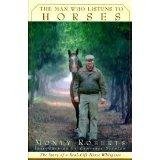
Book Review as Palinode: The Man Who Listens to Horses

A Fair Trade Book


Title: The Man Who Listens to Horses

Author: Monty Roberts

Date: 1996

Publisher: Random House

ISBN: 0-679-45658-9

Length: 259 pages

Illustrations: black and white photo section

Quote: “I’m waiting for his ear to open onto me, for him to start licking and chewing, and them for him to duck his head and run along holding it a few inches off the ground.”

(A palinode is something written to retract something the author wrote before. In the original review of Monty Roberts' later book Horse Sense for People, I said that I hadn't read Roberts accusing his parents of the horrific physical abuse that people were saying he had falsely accused them of. In memory I may have confused The Man Who Listens to Horses with Shy Boy or Horse Whisperer, because The Man Who Listens to Horses contains accusations that Roberts' father was not only an abusive parent but also an unfit police officer. A reader didn't complain, but gave me a copy of this book. Although the earlier review has been corrected, this review is still a palinode.

http://priscillaking.blogspot.com/2017/01/nitpicking-book-review-or-introvert.html )

Big and dangerous though horses are, they are a prey species, not a predator species. Monty Roberts is famous throughout the English world for having demonstrated that horses reliably use the same body language deer use. Humans are built to use a different body language, but we can learn to use bits of grazing animals’ body language to communicate with horses, deer, and other prey animals without threats and violence.

My parents made a choice that might have been shaped by money concerns, but was soundly based in philosophy. First they—I don’t remember needing much pushing but they certainly encouraged—my brother and me to be “into horses” from the cradle. The majority of the books bought for us were horse stories and, long before we were old enough to ride, books about the care and training of horses. The majority of the toys were model horses. When my parents rented houses where we couldn’t be encouraged to spend afternoons hanging out with horses, they cultivated friends who could help expose us to horses. We heard lots of stories about Mother’s parents having met and bonded because both of them were noted “horse people,” as the most famous one of their ancestors had been.Yet, even when boarding a pony, we were never given a saddle, bridle, or even a halter. The idea was that horses should be friends not slaves to humans (I learned a lot of new words in English from My Friend Flicka, at age seven). If humans had any business telling horses what to do, we wouldn’t need tools but would just be able to ask our big dumb friends to lend their strength to our purposes, and they’d do it, because they liked us. This is true but it works better for some people than for others.

I liked horses, and still do, and spent many pleasant afternoons hanging out with horses. (All horses know that there’s safety in numbers, so, once convinced that other animals aren’t going to attack them, most of the time most horses like to hang out with almost anyone of any species; they particularly appreciate cats who chase mice, and humans who swat flies. Many horses bond with smaller pets--even chickens, and definitely including children.) I did not learn their language intuitively, as my brother did. I did not reach the point of being able to climb on to a neighbor’s untrained Morgan and ride bareback, as my brother did. (I did once suggest to the pony, who’d had a few years to recover from an injury, that she might carry me around a field. The pony lowered her head so that I slid off harmlessly.) I don’t think my brother, who was younger, could have explained how he did what he did if anyone had asked him. I did observe, when I read about Monty Roberts, that he was doing some of the same things my brother used to do..and he’d lived long enough, done those things long enough, to be able to explain them to clueless, “not really horsey,” animal lovers like me.

I had skimmed this book at a public library years before I read and reviewed Horse Sense for People; my own copy of The Man Who Listens to Horses was supplied by a local lurker after that review went live. When I checked other reviews of both books online, however, I had noticed that several people reacted unfavorably to The Man Who Listens to Horses, accusing Roberts of having “lied about” his father, Marvin Roberts.

Well, the son’s an old man known to have used certain memory-altering prescription drugs, and the father is dead, so there’s no way the truth will ever be known, but I have to say that, of the two books, I greatly prefer Roberts’ later one. Both contain the same general information about horses. In his later book Roberts expounds on using that information in relationships with humans—a philosophy of nonviolent, ethical, egalitarian communication that everyone ought to be reading, studying, and practicing. I hate to think of that information being covered up by prejudice...I have to say, though, that in this book, which is meant to be a memoir (accurate or not) rather than a philosophical discourse, Roberts comes across as a less likable person.

The diabolical thing about Prozac Dementia is that it’s very hard, unless a patient has written an extensive memoir before using any of that class of drugs, to sort out the real memories from the pseudomemories. Pseudomemories reported by patients who become violent often involve violent abuse; pseudomemories reported by equally demented but nonviolent patients, like Lauren Slater, can be peaceful and pleasant, as if the patient had actually lived someone else’s life along with his or her own. The more a patient knows, before taking antidepressants, that pseudomemories are a common side effect, the easier it is for a patient, like Slater, to sort them out and be able to appreciate the pseudomemories as fiction. In this best-case outcome, the patient may have brain damage sufficient to produce insanity, yet remain sane and competent. The cancer survivor I’ve nicknamed “Aunt Dotty” lived with drug-induced hallucinations, sometimes annoying but more often entertaining everyone with her “spirit voices,” and remaining competent (and intelligent) despite that trace of “dottiness,” for more than thirty years.If there were more honest discussion of dementia as a side effect in the news media, probably more people would want to work through their depression without psychopharmaceutical “help,” but also more of the people who want antidepressants would be harmlessly “dotty” rather than a constant risk for sudden violence.

 In The Man Who Listens to Horses Roberts claims that his father was not only abusive, but a brutal racist who beat a suspect to death mainly for being Black. He doesn’t have a photograph of that—well, there wouldn’t have been one if the incident happened. He does have an old publicity photo of his father posing with Joe Louis and another local police officer. The picture isn’t flattering to any of the three men. Roberts claims that his father harbored hateful thoughts toward the champion boxer. Roberts also describes a different photo—four men, with his father’s arm around Louis—than the one reprinted in the book. Roberts also claims that Louis treated then-young Roberts as a child, saying, “Hit me,” which Roberts says he was afraid to do until Louis grabbed his little hand and knocked it off Louis’s muscular shoulder, then pretending to fall backward and saying “Now you can claim you knocked out Joe Louis.” Which if any of these incidents really happened? Does the photo with the five men in it really exist; was a different photo used in the book because it was lying closer to the front of a file folder? Nobody will ever know.

Roberts’ memories of physical abuse are, however, congruent with the general pattern of Prozac Dementia. For many patients who have not previously had a lot of physical pain, the drug-related pain centers around the crotch and triggers pseudomemories of rape or sodomy. Roberts, however, had painful spine injuries from his years as rodeo rider and Hollywood stuntman, and the abuse he remembers features heavy blows to the spine. He did, in fact, survive many heavy blows to the spine, and some surgeries...but when people with Prozac Dementia have real injuries, their pseudomemories tend to be congruent with their real injuries.

So does Roberts have Prozac Dementia, or was his father a real Jekyll-and-Hyde type who merely seemed almost as kind and gentle as Monty Roberts does, to other people, while privately...Men like that are as real as Prozac Dementia, and it’s not inconceivable that Monty Roberts himself, as well as his father, might have tendencies in that direction. All we know is that both Marvin Roberts and Monty Roberts were able to keep wives, friends, and horses loyal to them for years.

Part of Monty Roberts’ end of that loyalty is probably what’s intended by his saying relatively little about his wife and children in his memoir. Happy memories of animal friends (deer and horses) alternate with not-so-happy memories of humans. Several friends are mentioned only in passing. A nasty lawsuit gets a long chapter, with detailed memories of the “craziness” of the client for whom manic-depressive mood swings were apparently only the beginning. Anyone who has actually spent a night in jail because someone else was being a vindictive piece of pollution can be expected to remember that piece of pollution without affection, and no web sites have been dedicated to the vindication of Hastings Harcourt’s reputation, but...do readers really need these memories? Roberts’ “Other people are cruel to animals and only a few human beings are decent” theme strains a bit here.It may be true, and there may at the time have been someone in California who needed to read all of Roberts’ side of the story, but most readers are likely to wonder why Roberts chose to burden us with memories that are neither pleasant nor instructive to read; wouldn’t these pages have been better filled out with more anecdotes about Roberts’ work in horse movies some of us might remember?

And the animal stories in this book aren’t as well told as they are in Horse Sense for People; less information, overall, and more noticeable repetition. This is the book where the stories are organized in chronological order. Comparing some memoirs with their authors’ philosophical books, I find that some stories work better in chronological order; Roberts’ stories, on the other hand, seem to work better when they’re told in a more concise format with the intention of supporting points in his discourse.

Let’s just say I would have liked this book better if there’d been more about the stunts and movies and less about the people who may or may not have been as nasty as this book makes them sound. Horse Sense for People lacks the deer story, but otherwise seems like the book this book was trying to be. The Man Who Listens to Horses reads like the draft that should have been reconsidered and revised for a few more years.

This is not meant to dispute that Roberts’ accomplishments have been awesome and his philosophy of total nonviolence, of respecting the choices even of animals, deserves much more attention than it’s received. It’s meant to say that Roberts is not primarily a writer, never was, and he did a better job with his material after he’d had a few years to reflect on the shortcomings of his first book.  

So, if you can have only one book by Monty Roberts, get Horse Sense for People. If you’re a serious fan of his or student of human/animal communication, get both books.

The Man Who Listens to Horses is a Fair Trade Book, and would probably fit comfortably into a package alongside Shy Boy and Horse Sense for People for a single $5 shipping charge, bringing the total to $20 ($5 for each of the books) plus $1 per online payment, from which this web site will redirect $2 to Roberts or a charity of his choice. If you buy just one book, the total will be $10 via U.S. postal money order or $11 via online payment, from which Roberts or his charity will get $1.

Tuesday, January 17, 2017

Nitpicking Book Review (or Introvert Liberation Movement Statement): Horse Sense for People

A Fair Trade Book

Title: Horse Sense for People


Author: Monty Roberts

Author's web site: http://www.montyroberts.com/

Date: 2001

Publisher: Viking/Penguin

ISBN: 0-670-89975-5

Length: 220 pages including endnotes and appendices

Quote: “No one has the right to say ‘You must or I will hurt you,’to any creature.”

Monty Roberts was the son of a traditional horse trainer. There's some controversy about some things he's said about his early life, even a book about whether his claim that his father was abusive is a lie...I wonder whether the alleged abuse might even have been a Prozac pseudomemory...but this book doesn't claim that Marvin Roberts was an abusive father. I mention this issue because it is a childhood memory of Marvin Roberts having snubbed Monty Roberts that I pick on as the "bunk" in this book. I think it's a valuable and enjoyable book but it needs a bit of debunking.

Repelled by the conventional wisdom that “horses are wild, dangerous beasts that must be broken into submission,” Monty Roberts set out to demonstrate that these big, dangerous animals can instead be persuaded to become humans’ friends. Hence his success as “the Horse Whisperer.”

In my opinion Roberts’ contribution to human knowledge has been tremendous. It seems unlikely that the first humans who domesticated horses thought “Here is an animal at least ten times bigger than I am—obviously the first thing to do is to tie it to a tree and beat it into a state of ‘learned helplessness’.” Humans who depended on that method have, in fact, always muttered about people—usually socially disadvantaged people, Native Americans or Gypsies, sentimental rich ladies or idealistic teenagers—who somehow, it wasn’t faaair, made friends of horses.

There was a belief that, since horses had to be “broken” and bullied into recognizing their legal owner, making friends with horses was a kind of witchcraft practiced by horse thieves. There was also a genre of legends about “crazy” horses that would die fighting or fleeing from anyone who tried to “break” them, a hopeful fantasy that some of those horses could be “gentled” by a friendlier approach, as in My Friend Flicka. Before Horse Whisperer became famous, we all knew that there were people (my brother was one) who had made friends with “unbroken” horses and ridden them, bareback, just as there were people who made pets of feral cats, but we thought they’d just been lucky. Roberts was the first to identify and document the nonverbal communication that allowed him to “join-up” with almost any horse, anywhere. Horses aren’t the brainiest animals on Earth but they do have a rudimentary nonverbal “language,” which humans can learn and use. Roberts not only proved that that language exists, but wrote a “first dictionary and grammar” of it.

If you have just a little experience with horses, I highly recommend The Man Who Listens to Horses; this is one case where the movie might even be useful. I’m not nearly as horsey as my brother was and thoroughly enjoyed reading Roberts’ documentation of what my brother used to get right and I used to get wrong…
Anyway, Roberts says in this book that management types told him they wished they knew the secrets of “human whispering.” After a little thought he realized that his approach to horse training was part of the philosophy behind his approach to human relationships…so he could indeed write a book about “human whispering.” This is it…a book of radical nonviolence.

People who think they don’t like the “libertarian” philosophy are likely to be reacting to the devil-take-the-hindmost egoism in books like The Fountainhead, where the blonde claims she liked being raped. (Well, it’s fiction; Rand would have heard that women like that existed…) It’s always possible to find enough people for a party, even a political party, who want to practice aggressive egoism, but that’s not really libertarian. Far from it. Libertarianism is a philosophy of nonviolence. It has room for disagreement about how forcefully people choose to defend themselves against violence, but basically a libertarian philosophy is opposed to saying “You must or I will hurt you” to any person (not all libertarians recognize non-humans as persons).

Of course, communication among humans is more complicated than communication between a human and a horse. That’s the trouble with Horse Sense for People. It was written in 2001, when much recent research about brain differences was still being done, and it doesn’t go far enough.

Roberts obviously hadn’t read much, at the time of writing, about the permanent physical differences that not only distinguish introverts from extroverts but indicate that extroversion may need to be reclassified as a sort of brain defect. Roberts grew up, like all Americans his age, with a vague idea that introversion was a weakness that kept people from communicating and working together, rather than an asset that helps people to communicate and work together in a smarter, healthier, more rational way than extroverts’ fears and neediness usually allow.

I’m going to pick on one small point in a book that makes many points about various aspects of human communication, because it really seems like “horse sense” to me and I’m surprised that Roberts doesn’t see it. Humans who suffer from extroversion often have a big emotional need to vocalize whenever they see other humans, whether or not they have anything to say. It’s one of those annoying neologisms, but in this post I’d like to call this behavior “greeding,” to emphasize the difference between meaningless, annoying vocalization and the kind of “greeting” that opens an actual human conversation. Some introverts learn to participate in greeding rituals, and some even form emotional attachments to the idea that participating in these rituals is a very good, generous thing to do because (if they think about it and face the reality) it’s unnatural and unpleasant. Nevertheless, Jesus warned Christians not to “love greetings in the marketplaces.” (Three separate Scriptures: Matthew 23:7 and Luke 11:46, as well.)

Self-accepting introverts, whose families and primary culture groups did not demand greeding behavior, are bewildered by it. Many people think that greeding is “friendly” behavior. When we consider its effects—distracting people from their own thoughts, sometimes interrupting real conversations, and measurably raising everyone’s blood pressure—it’s hard to find anything about greeding that can really be said to express good will toward the other person. Some specific greeding rituals undoubtedly do express friendship, but greeding, generally, is a hostile behavior. In terms of cross-species animal behavior studies, greeding is a “threat display.”

“You must reassure me that I’m human!” is the real meaning behind the “hi, hey, hi, hello,” that doesn’t open a conversation. (Extroverts apparently live in some doubt about their species identity, possibly because in some ways, especially in greeding rituals, they do react more like dogs.) My mother’s theory about “outgoing” children was that they’d all been bottle-fed, prematurely weaned, and brought up in day care centers. Greeders do not, in fact, want to become real friends to the people for whose attention they’re greeding. They don’t want to join the conversations or participate in the thought processes they interrupt. They are trying to fill some sort of deep-rooted emotional need. Maybe a lack of intensive mother-infant bonding really is what compels these pathetic people to demand that co-workers, neighbors, or total strangers take the time to tell them that they’re human. I have to wonder, though, whether who’s anyone in that much doubt about it is fully human.

“I was walking down Main Street…I was about ten,” Roberts recalls. “I looked ahead and saw my father walking directly toward me. As he approached, I said, ‘Hi Dad!’ but he looked at me and kept walking…I shouted loud enough for the whole neighborhood to hear, but he just kept walking. I returned to school, hurt and puzzled, trying to figure out” why Dad hadn’t participated in that mindless-greeting routine typical of extroverts and dogs. When asked, “He looked at me and said, ‘I didn’t have anything to say to you.’ I let it go, because I guess that was an answer; by then I knew it would achieve nothing to point out that I had not been asking for a conversation…merely an acknowledgment of my presence…A parent refusing to acknowledge the presence of his child is like an animal refusing to allow a newborn to drink from its udder.”

If all or most humans were afflicted with extroversion that might be true. As it is, however, many humans feel no need for “acknowledgment of our presence.” How do introvert parents succeed in bringing up children who don’t feel a need to exchange greetings, without making those children feel like infants deprived of milk? My best educated guess would be that several forms of nonverbal communication are involved.

(1) The parents provide attention and affection when the children aren’t screaming for those things.

(2) Both parents and children are able to perceive each other’s presence, and each other’s awareness of their presence, without interrupting whatever they’re doing to belabor it. When family members walk past each other, some subtler form of nonverbal communication establishes that they’re not going to collide; there’s no need to stop, make noises, or sniff each other. 

(3) Other aspects of the family relationship reinforce the basic idea that we-the-people-who-don’t-do-greeding are more familiar, nicer, more trustworthy etc. etc., than those-other-people-who-do-greeding.

But what was happening in the 1940s when Monty Roberts was about ten years old? North America was in the middle of a cultural war on introversion. Instead of being told the truth, “Whether or not you’re ‘smarter’ in terms of math or formal logic you are more perceptive and/or better able to use what you know than the average person, likely to live longer, and much easier for other nice quiet people like yourself to like being around,” introvert children were being told, “Oh dear, something is terribly horribly wrong with you! Why do you want to read or build things or spend time with animals when you could be running around playing games like aaalll the other children? What horrible thing happened to make you such a freak?” 

As I read this anecdote, I imagine Marvin Roberts thinking, “All these years I’ve brought my child up to be a person who never speaks unless he has something to say, and there he is, yapping at me in the street like a spoiled dog!” Yet another example of the many ways the campaign to “sell” extroversion alienated people whom nature intended to be friends…Neither Monty Roberts—who can hardly be perceived as an extrovert—nor his Dad seems ever to have been able to acknowledge the violence external influences wrought on their relationship. Fortunately, because most introverts are truly awesome human beings, they did remain on speaking terms.

The belief that everybody could be happy if we just agreed to act like extroverts was common among Roberts’ audience; he didn’t have to argue at length in favor of greeding rituals. Why does it seem extraordinary to me that he supports them, or tolerates them, at all? Because this is a book about Horse Sense for People.

Dogs invented greeding rituals. Their social lives do require reciprocal noise-making, sniffing, and a whole dance of communicative gestures. The only alternative to participating in these elaborate rituals is a fight.

Cats also have greeding rituals. Their rituals are usually silent and seldom take up anything like as much time as dogs' greeding rituals, but cats go through a full ritual every single time they see each other. Again, not participating in the greeting routine is likely to mean a fight.

Horses, as Roberts has made a career of explaining, have very subtle, nonverbal displays that acknowledge one another’s presence without greeding. It’s not entirely clear whether horses always do anything consciously to acknowledge each other’s presence. The way to approach a horse without anyone fighting or fleeing is simply not to act like a predator.Beyond that, communication with any individual in the herd is optional and occurs when horses have something to “say.”

The difference in greeting behavior across species, in fact, seems to support a generalization. Elaborate greetings—threat/deference displays—are typical of predator species. Extrovert humans are thus closer to predatory animals, and introverts to non-predatory animals. Herbivorous animals are easily startled into flight when they meet anything that might be a predator, and the herbivores and insectivores vary from having a wide range of possible social relationships that humans can identify (as horses do) to leaving room for doubt whether they notice that their siblings are alive (as many insects do), but herbivores don’t have extensive greeding rituals. After a long separation horses do have ways of saying “Old friend! Where have you been so long?” that are unmistakable even to humans, but in everyday situations a flash of an eye or twitch of an ear is as far as the “acknowledgment” routine gets.

I can’t blame Roberts for having been told, “Something must have hurt your feelings terribly when you were a little child to allow you to grow up so [insert up to a dozen different disparagements for non-extroverts]. What did your parents do?” (Often there was a deliberate effort to “gaslight” over emotional traumas at school and focus on often purely theoretical traumas of earliest childhood.) I can’t blame him for remembering this day when he tried out a greeding display he’d learned at school, and been discouraged, as possibly contributing to his capacity for independent thinking. (Jonah Goldberg has found evidence that the purpose of the whole war on introversion probably was to try to reduce the incidence of independent thinking.) Considering how few other humans had his “horse sense” about horses’ nonverbal communication, I am in fact awestruck by Roberts’ ability to communicate with horses. But I’m also…astounded by his failure to extrapolate data. Roberts’ continuing to endorse greeding rituals between humans, rather than disparage or discourage them, is an example of really successful gaslighting.

Indirectly, Roberts does acknowledge the reason why conscious, self-accepting introverts may no longer agree with the old claim that “at least” greeding is “a harmless little thing we can do that makes others feel good." On pages 65-66 he reminisces about a horse who was ruined for life by playing a part in a Disney movie. In the movie the horse, then a little colt, was encouraged to rear up and rest its forelegs on humans’ shoulders. Once the colt became an adult horse, of course, it could no longer be indulged in this behavior…and although the behavior was unnatural and dysfunctional, the horse wasn’t able to understand that it had to change just one behavior pattern so that its relationships with humans would be rewarding again. That horse never trusted people who wouldn’t let it rest its forelegs on their shoulders and, since no human who wants to live can allow a full-grown horse to do that, the horse became a real mental case, never able to trust or work with anybody during its short adult life. Acting out one cute little scene for one cute little movie made a valuable horse into a monster. 

For introverts who are tired of being bullied into acting as if we shared a brain defect we don’t share, indulging extrovert acquaintances in a little social display sets up similar unrealistic expectations and turns a mentality only slightly more sophisticated than a horse’s into a monster of “needy” bullying. Give this type of not-fully-humans the greetings they demand, and the next minute they demand that you convert to some bizarre religion, or maybe sleep with them, or give them all your money, or participate in the pretense that anybody would want to be like them. Even after retraining they’re likely to remain “chronically distrustful and mentally unstable.” No matter how hard people have tried to mistake it for “love,” extroverts’ compulsive urge to reach out and grab for control of others’ attention is fundamentally violent.

Meanwhile, Roberts’ fundamental philosophy of human relationships is consistently typical of introverts’ nonviolent mind-sets and orientation toward showing trust and respect by leaving other people alone. Roberts describes a football coach who yelled at students to “treat [the other team]…like…the worst people on earth…Knock him down and give him a knee in the ribs as you get up.” Roberts’ response, “Young players can…respect their opponent, play the game hard, but live within the framework of the rules.” Did one really need to be a football fan, in 2001, to remember Jerry Rice popping up and saluting the much bigger guys who’d knocked him down? Whether Roberts remembered Rice’s performance or not, his readers did.

“The…company will only work efficiently when those within…the team can justifiably trust one another….It is critical…[that] each employee is utterly confident that he or she will be treated in a fair and honest way.”

“The fact is that horses run slower when they are whipped than when they are not…[Horses] do love to race, and I love racing. But we should take the whips out of racing…because they are ineffective.”

“[C]leaning the stalls…was one of the most distasteful aspects of the entire horse industry…I told the team that I would clean and bed ten stalls. the men would time me. I would ask them to double the time that it took and to work out what their wage would give, given that amount of time. This would allow them to calculate the price per stall…Since they decided that the two men would do all the work that meant that each would receive $1300 per month. Mucking stalls instantly became a cherished position” (after wages calculated from an hourly rate were converted to a performance-based rate, allowing an instant pay rise).

For parents, Roberts recommends writing out behavior contracts on a blackboard, or whiteboard: “Child will not spit for a week…parents will take child to [wherever].” If a child’s behavior is very undesirable, contracts can be punitive; one parent made a quick decision, when a child failed to supply animals with water, that all other behavior contracts and household privileges began with the child’s filling the horse’s water trough—using a human-size cup. Contracts allow parents to set rules about behavior without physical force or the kind of emotional drama that can feel more abusive than a simple spanking to the child.  

Roberts addresses family and office management issues more than academic or political ones, but it’s easy to extrapolate applications of his “horse sense” philosophy to any kind of social relationship. In political terms, they’re very close to Jim Babka’s “voluntaryism.”

If you're already familiar with this approach to human relationships, then you may not need Horse Sense for People, although it contains some nice horse stories (and one horrific, possibly Prozac-enhanced, story about one of Roberts' clients). If not, you should read it--noting that this is not the book that contains any of the "lies" for which Roberts has more recently been blamed. It's been out long enough to be offered as a Fair Trade Book on this web site's usual terms: $5 per book, $5 per package, $1 per online payment, to the address at the very bottom of the screen (down below the giftcard links; this web site does not encourage Amazon giftcards as payments, but can take them). You could fit at least one more book of this size into the package; if that book was, e.g., Shy Boy you'd send a U.S. postal money order for $15 (paying the surcharge directly to the post office) or Paypal payment for $16 for the two books, and from that we'd send $2 to Roberts or a charity of his choice. 

Thursday, December 29, 2016

Book Review: Sometimes I Wake Up Grumpy

A Fair Trade Book


Title: Sometimes I Wake Up Grumpy and Sometimes I Let Him Sleep

Author: Karen Scalf Linamen

Author’s Twitter page: https://twitter.com/karenlinamen

Date: 2001

Publisher: Fleming H. Revell

ISBN: 0-8007-5745-9

Length: 153 pages plus 4-page preview of forthcoming volume

Illustrations: digitally manipulated cartoon image by Steve Björkman

Quote: “When you find yourself in emotional crisis...here are fourteen ways to feel better.”

Karen Scalf Linamen writes a comedy column, but she wants us to know she’s a depressed clown. She writes about the fun and funny things that have helped her survive her mood swings. She has something extremely important to say to women who struggle with depression.

And to the people who care about them. I bought this book because the drawing on the front cover reminded me of a former flatmate whose actual name happened to be Mona...which fitted her so well that giving it to her as a nickname would have seemed cheap and cruel. In an academic way I understood exactly what Mona had to moan about. She was being slowly crippled by an incurable disease. In practice, although her natural personality was quiet, warm, perky, and fun to have around, she was turning into the sort of hag who comes in from work and whines, “It’s stifling in here! Why didn’t you at least open a window! You never think about me!” So you open the window that faces down into the big pine tree, while she’s freshening up in the bathroom, and just as the fresh piney breeze blows across your desk she comes out and whines, “It’s freezing in here! If that draft doesn’t bother you, you might think about me!” One of the great spiritual victories of my life was that I never threw Mona out that window...but I loved her, and missed her after she was forced to retire at 35.

Those of us who find ourselves living with someone like Mona, or like Karen Scalf Linamen, may understandably feel that anything that makes them less of a pain to be around would be a good thing. So there is this tendency in our culture to think that serotonin-boosting antidepressants, which counteract the depressive mood swing with a mild “high,” have to be a good thing. Several people who’ve used antidepressants—often briefly, for shock, as Tipper Gore did—have become positive “cheerleaders” for these drugs. The only trouble is that so many people who use these antidepressants for more than a week or two develop some sort of neurological side effects....from asexuality to muscle spasms to violent insanity.

Actually, if Mrs. Gore had stopped to think about it, the Clinton Administration provided a real paradigm of what happens when people use Prozac and its “chemical relatives.” I don’t know whether Janet Reno had used a serotonin booster, but the premature parkinsonism that made her face look so grim in certain TV clips is one of the most common side effects these drugs have, and it hurts. George Stephanopoulos described the other very common side effect that he had, in All Too Human—back pain so severe that America’s most eligible bachelor temporarily lost all interest in sex. And while the facts of his last day on earth seem suspicious, we know for sure that Vince Foster used antidepressants a few weeks before he began making vague ungrounded accusations and then, apparently, shot himself; because about one out of ten users of antidepressants develop violent insanity of a paranoid-schizophrenic type, it’s entirely possible that, if one or two other men did go into the park with Foster and did shoot him, even that might have been his idea.

Linamen adds yet another Prozac-prospect image to our mental gallery. What if you take the drug, you’re able to quit while you still have some money and sanity left, the physical agony of withdrawal passes...and leaves you still depressed? (Dr. Kathleen Desmaisons has built her career (see www.radiantrecovery.com ) on that situation.)

Take one consideration with another, and whether you’re the depressed person or the friend or relative of one, you’ll realize that natural mood elevators like the ones discussed in Linamen’s books are a lot safer than antidepressant medications. People who are genuinely out of their minds with depression may need to be medicated and hospitalized until they stop trying to kill anybody, but people who just radiate unjustifiable gloom need to focus on finding natural relief for what they feel. Linamen can help.

A theory that works for many psychiatrists is that some of us simply inherit a tendency toward “serotonin deficiency” that needs continuous treatment with serotonin-boosting medications, but, as Peter Breggin reminded us, nobody has ever actually proved that “serotonin deficiency” exists as a whole separate disease. Serotonin deficiency is an effect, not a cause, of stress, grief, guilt, and general dissatisfaction with life. 

Chronic serotonin deficiency may also be produced by other hormone imbalances like thyroid deficiency, adrenal exhaustion, alcohol intolerance and the “sugar sensitivity” that indicates the presence of the alcohol intolerance gene in abstainers, endorphin deficiency produced by a sedentary lifestyle, or any number of ovarian conditions that aren’t fully understood but may be triggered or aggravated by pregnancy. Or by allergies...people don’t even have to have conspicuous “allergy symptoms” in reaction to innocuous “triggers” like food or pollen in order to have subtle, chronic allergic-type reactions to chemicals, molds, and foods of which they’re genuinely intolerant. Or virus infections: the way most of us feel a few hours before “coming down with” a cold or flu seems similar to the way some people feel for months or years before being diagnosed with AIDS or cancer. In some cases, while natural mood-boosters are at least harmless Band-Aids for a broken arm, serotonin boosters may even aggravate the real problem.

So, if you are or know someone who seems depressive in any way, it’s hard to recommend books like Sometimes I Wake Up Grumpy warmly enough. Obviously a collection of humor columns is no substitute for consulting a doctor, but the role model Linamen offers, trying to work through her mood swings without going back on drugs, is wonderful.

Where can you and/or your friend find a doctor who’s qualified to address the real problem, rather than just handing out pills? Obviously this will depend on what medical tests reveal. If the problem is something like chronic mold exposure or lactose intolerance, moral support is all you’ll need. If it’s myasthenia gravis or a highly fatal kind of cancer, mood swings are the least of your worries. And if medical tests lead to a diagnosis of “no major medical problems, just ordinary depression,” then it’s appropriate to let books like Sometimes I Wake Up Grumpy guide the depressive person to find out what the feelings are trying to tell him or her.

Sometimes I Wake Up Grumpy is especially good for those who’ve been burned by other “Christian” books about emotional self-help, many of which are actually written from the non-Christian, non-biblical perspective of the Christian Science sect. Too many books on the market assume that happiness is the normal state of being, even in a mortal world, and normal mental health means being able to convince oneself that one is happy all the time. For most people this isn’t true, and those of us who do manage to make our normal (neutral) emotional mood look “happy” to other people are more actively obnoxious than the depressive types. The “Christian” hype in “Positive Thinking” books and sermons is especially annoying to those who’ve read the Bible, not just selected texts wrenched out of their context but the whole Book, and realized what a “negative” (in the incorrect sense of “pessimistic”) book it is—how many of the great saints Jesus did not “want for a sunbeam.”

Sometimes I Wake Up Grumpy is one Christian book that will not tell you it’s somehow a sin to feel what you feel, or even pretend that it’s “unspiritual” to want to make changes in the real world around you rather than trying to pretend you’ve “accepted” every bad thing in life. Sometimes Jesus wants us for a thunder clap or a gale-force wind, to confront and overcome evil...whether it’s the evil effect you have on yourself by unconsciously eating things your body isn’t able to digest, or the evil effect the mold in your basement may be having on everyone in your family and not just the obvious “allergy sufferer,” or the evil effect your children’s teasing may have on your family relationship, or who knows what else. And Linamen, blessed may she be, actually admits this. Sometimes what our feelings have to tell us is that something outside ourselves is not right and needs to be changed.


Linamen also keeps it light. Women could even share this book with their children. Like Jean Kerr’s books, Sometimes I Wake Up Grumpy is definitely addressed to mothers, and contains some jokes their children won’t get, but it also contains funny stories children can enjoy and nothing likely to do children any harm, so there’s no need to hide it from the kids. You could read them the stories about how Linamen’s children, being a little more childish and ignorant than your audience, did these things that probably weren’t meant to hurt their Mommy’s feelings but they did...as a tactful suggestion that your audience might want to try to be more protective of their Mommy’s feelings. The language is that simple. Kids don’t have to know what PMS is to appreciate a story about what kinds of childish games make adults happy and what kinds make them grumpier.

(With this in mind, and some matching yarn in my stash, I actually dressed a doll to match the cover drawing and sold the copy of this book I reviewed as a family book, years before posting this review!)

Linamen is still alive and Tweeting, so Sometimes I Wake Up Grumpy is a Fair Trade Book. Buy it here for $5 per book, $5 per package, and $1 per online payment, and we send $1 to Linamen or a charity of her choice. She's written several other books of similar size; some of them are or should be still available as new books. (Click here to see the latest list.) Six or eight would fit into a package; if you want six of her older books you'd send this web site $35, or $36 as the case might be, and Linamen or her charity would get $6. 

Thursday, December 8, 2016

Tepid Book Review, with Rant: Life Is Not a Stress Rehearsal

A Fair Trade Book


Title: Life Is Not a Stress Rehearsal

Author: Loretta LaRoche

Author's web page: http://www.lorettalaroche.com/

Date: 2001

Publisher: Broadway / Random House

ISBN: 0-7679-0665-9

Length: 219 pages plus 3 pages endnotes

Quote: “We wake up, probably in a room that has some sort of electronic climate control and enclosed windows, because who would dare take the risk that we might get an unscheduled breeze?”

Loretta LaRoche was blessed with good timing. She was a counsellor during the Age of Therapy. When the “health management” racket decided to replace counselling with instant prescriptions for feel-good pills (that unfortunately happen to induce violent insanity in three to ten percent of users), LaRoche had the credentials and the grandmotherly image she needed to shift into comedy, helping people fight the emotional effect of stress by laughing at it. Hence the jacket photo, in which her combat vest sports a phone, computer mouse, calculator, calendar, stopwatch, correction fluid, Swiss Army knife, assortment of writing tools,  tube of sunblock, and everything else she could stick onto it.

While the gadgets LaRoche wore for the jacket photo have gone out of style, the frantic pace with which some people approach life has not. If anything it’s become worse.

I blame this frazzle effect on the craze for increasing population density in the cities, where some people think everything needs to be happening. Normal people reflexively react to crowding by stepping away from other people. When stepping away from one person only puts us too close to another person, normal adults can tell ourselves to behave rationally, but we can’t be really comfortable until a healthy level of interpersonal distance has been achieved. While detaching our attention from our sense of stress, telling ourselves that the crowded situation is acceptable, helps us cope with crowded conditions, at the same time our reptilian brains continue to prepare to fight or flee. Often this preparedness generates flashes of emotion that we may rationalize in one way or another, but that are really about the fact that too many bodies are occupying too little space.

I think most of the “road rage” and miscellaneous frenzy we observe these days is the result of crowded conditions. It’s not natural for humans to stand still, or sit still, as long as they’re within touching distance of people they're not trying to touch. “Office building managers say that the reason windows don’t open is to protect people from jumping out…Maybe they should look at what’s going on inside that makes people feel that they want to jump out a window,” LaRoche says. She’s thinking of the obvious verbal abuse and backstabbing that go on in many corporate offices. I wonder, though, whether even that overt hostility toward co-workers is just another symptom of the same basic problem: too many people working in one building. Maybe Jack falsely claims credit for Joe’s idea and Jane deliberately delays the report Mary needs because they don’t like working in a “bullpen” or cubicle maze with those people; but maybe, too, when Joe and Mary aren’t in the office, the sensation of being trapped in between strangers upstairs and downstairs and out on the street still pushes Jack and Jane to want to jump out of windows.(Extroversion, a tendency to cope with chronic internal emotional conflicts by constantly, aggressively seeking to control others, is present in some extremely sick minds.)

LaRoche not only doesn’t reach this insight in Life Is Not a Stress Rehearsal; she deliberately clutches at “solutions” that, toward the end of this book, are dead wrong for at least half of humankind. The result is a very witty description of a problem that ends with an incredibly unhelpful attempt at a solution.

For much of the book, while she’s skewering the stunata or meshuggeneh or just plain duh in turn-of-the-new-century U.S. culture, she’s right on. Trying to be or seem just like other people (camouflage, for safety in a crowded environment) is a source of stress. Trying to convince ourselves that we’re important to a corporation (to which we’re not important, anyway) by dragging out jobs so that we can make sixteen hours a day “billable” is a source of stress. Paying three times as much for the fashionable brand of something (when the cheaper version may be better) is a source of stress. Trying to be available to everybody all the time by leaving cell phones connected and then programming them to go to voice mail is a source of stress…and mutual annoyance. Watching inane television instead of actually having fun is a source of stress. LaRoche is observing efficiently, in this part of her book, and reporting wisely and wittily. She doesn’t understand why so many of the people she sees are doing such stupid things, but she can’t miss the fact that they’re doing them, and she does a good job of channelling the grandmother who, she convinces us, would have told them just to stop the stupidity.

But then…tragically, LaRoche wants to stop where her grandmother stopped. She doesn’t raise the question whether, if her grandmother had been young in 2001, the influences that produced the stupidity of my generation would have made her grandmother stupid too. Or would Grandma Fran have defied those influences and, in 2001, actually been happy? LaRoche is funny, but she does not sound funny in a happy way. She sounds frazzled by other people’s frazzlement.

One part of her evident confusion seems to be the “Mars and Venus” blather with which our pop culture burdened itself in the 1990s. Human beings are not built in identical gender-types like Barbie and Ken dolls. We are individuals. Somewhere out there are a man whose nurturing underside is warmer and fuzzier than mine, and a man whose hunter-type skills are further below mine than his nurturer-type talents are—and I’m still a Real Woman, Strictly a Female Female, and both of them are still Real Men too. 

But the media gave us, just in case it might have been news to somebody somewhere, these reports that some people did not feel sexy when they were doing their jobs. Well, unless you’re a porn star, you’re not supposed to feel sexy on the job. You’re supposed to be sexy in your own private bedroom, and the rest of society is not obligated to listen to any further details. If some baby-boomers were not feeling sexy in their bedrooms, either, this might have been because, in 2001, people born in 1946 were reaching an age at which many people are postsexual.

Need it be mentioned that, although I’ve not been a great success at making money, I was more successful at making money than at making babies, and although my husband was very good at making money (and even at shooting targets) he was also very good at bonding with children. It’s probably true that HSPs compensate for being more shy as teenagers by having more fun in bed, longer, as adults. Left to ourselves HSPs would probably never have wanted to torture non-HSPs with this information but, whenever I’ve met an eighty-year-old who still had any noticeable sexuality, it was always a fellow HSP. What attracts me to people, as people, is being able to work with them as synergistic partners, which is what C.S. Lewis described as philia love. Gender polarity is involved in what Lewis called eros love, which is also interesting but which, in the absence of philia, I’ve always managed to ignore. 

I can imagine a few things that might be less sexy than John Gray’s descriptions of a “Mars and Venus” marriage...stomach flu? Root canals? Suffice it to say that, ridiculous as “Sensitive New Age Guys” used to be, and I say this as a woman who once waited six hours for a whiny little boy trapped in a 250-pound, 35-year-old body to turn up crying real tears because he’d failed to allow enough time for the usual volume of traffic, guys who think “I’m so different from you that I can’t possibly be your friend” is going to make a favorable impression are even worse. If you’re all that different from me, please find a member of your own species with which to mate.

But crowded living conditions are not helping anything. In animal populations, an early effect of overcrowding may be hyperfertility and hypersexuality, as individuals react to high doses of other individuals’ sex pheromones. Next, a more reliable effect is the appearance of behavior that tends to lower the birth rate: more sterility in individuals that mate normally, more asexuality, homosexuality, transference of sexual impulses toward anything and everything but reproducing more of the species.

If you are a reasonably humane animal raiser, the appearance of genuine homosexuality should indicate that it’s time to thin the herd now. Animals have a limited range of behavior displays that humans are able to recognize, so same-gender "courtship displays" that aren't really sexual are normal in some social animal species. Forced homosexuality, in which two animals forced to live celibate lives in the same space set up something resembling a “couple” relationship, is sometimes found in very social species. Real homosexuality is a natural animal reaction to conditions that are unsafe for the whole colony. That we currently have a loud, noisy minority of “gay” activists, in the human population, need not cause fear or hate toward the “gays” themselves but it should cause concern about our society.

Now that the baby-boomers are indisputably aging and a lot of young people are coming out as asexual, we need to think about what happens next when animals continue to live in crowded conditions, when sexual aberrations fail to thin the population fast enough. Two further developments are possible, and not mutually exclusive. Viciousness, violence, especially attacks by adults on the very young, and cannibalism are one possibility. Plagues and mass deaths are the other.

Postsexuality is normal for the generation that’s now between the ages of 50 and 75. Asexuality and homosexuality in the young are the non-species-specific reflections of the kind of stress whose human-specific reactions LaRoche has been describing and expressing in Life Is Not a Stress Rehearsal. If differences of temperament allow us to overlook the human-specific, individual-emotion-shaped reactions, my interpretation of the data is that wide-scale sexual aberrations should be ramming it into our brains by now: We need to reduce population density by every ethical means necessary, and we need to do it fast.

Young couples should be taking a pledge: One child or none. (If you want a big family, you can always adopt.)

Cities should be banning the construction of office buildings more than three storeys high or houses on lots smaller than one acre.

Immigration should be…not so much forbidden by laws that are expensive and dangerous to  enforce, but intensely, unrelentingly discouraged by all communities with any noticeable incidence of unemployment, road rage, suicide, abortion, or “sexual minorities.”

People should be abandoning cities, pulling down surplus buildings, living in houses with generous private green space and well-maintained fences that block out the sight and sound of their neighbors.

Business should be conducted primarily from home, taking advantage of technology to limit face-to-face meetings to once a week, or maybe once a month.

International organizations that have published “agenda” documents calling for an increase of population density, in any part of the United States, should be recognized as having committed subtle acts of war, and treated like the enemies these acts have shown them to be.

Why do I say that these are obvious solutions to the problems LaRoche has described so well in Life Is Not a Stress Rehearsal? Because I tried them, because in Washington a whole lot of us Bobos tried them, and to the extent individuals can do them, they work. You don’t even have to agree with them to feel them working. If you’re feeling stressed, spend more time alone, and you’ll feel less stressed. (Sometimes telling my coevals this is exactly like telling teenagers that, if they’re showing every possible symptom of sleep deprivation after sitting up late last night, they need just to lie down and relax, and they’ll feel less angry / restless / spacey / depressed / anxious / whatever.)

Nevertheless, LaRoche closes her book with a big display of active resistance to insight. “[A]mong many of the groups that tout spirituality…we are told…that we have to look inward, we have to heal ourselves, we have to become more self-aware and self-actualized. We’re told ‘you can’t love another until you learn to love yourself.’ I think…[t]he truth is often just the opposite: You can learn to love yourself by loving other people!” LaRoche rants on page 206. (Most psychologists would say that we learn to practice love by observing other people practice love.)

On page 208, in denial of actual scientific data, “It’s been proven that married people live longer than single people.” (Actually, the numbers proved that married men live longer than single men. Single women who don’t have a few specific diseases live not only longer, but healthier, lives than married women—on average. Older women who’ve been married only once are more likely to survive a first heart attack longer than older women who are single or divorced, but complications of childbirth, domestic abuse, and sexually transmitted diseases make celibacy seem obligatory for younger women to maintain good health…if they go by statistics.)

“[P]atients who are socially isolated are twice as likely to die than (sic) those with social interactions.”  (It’s true that, for almost any group of sick patients, the ones who receive and enjoy visitors are likely to live longer than the ones who don’t. This is a correlation, not a causation. While it’s hard to study this in any large-scale objective way, anyone who visits sick patients notices that the ones in the worst physical condition tend to be less interested in social interactions.)

“We’re missing real human connection…It seems to us that the way our grandparents lived lacked privacy,” LaRoche says on page 209. “Doors open all the time; people running in and out…” (She’s describing her grandparents, not mine. One thing that stands out when I consider the way my grandparents lived is how they balanced family intimacy with privacy. They had a whole set of rules of etiquette to offset the fact that they had more children than bedrooms.)

“But the fact that they had people around them all the time made their lives saner,” Laroche continues on page 210. Did it really? In the 1990s we all heard a lot about how much warmer and chummier Latin-American subcultures were, relative to Anglo-American subcultures. Latinos touched more often, stood close enough to smell each other’s breath, etc. etc. Hello? Was that really a point anyone wanted to emphasize if they wanted more touching and chumminess? Anglo-Americans consistently average longer healthier lives, higher test scores, and higher incomes…so we should be more like the demographic group that score lower? ??? The lifestyle of “The Sopranos” is saner than…what?

“We need to fill our lives with untidy, invasive, knock-on-the-door-unexpected relationships that help prove to us, every minute of the day, that we are cared for,” LaRoche gushes on page 212. (Thus showing that she’s never experienced an orderly, mutually respectful relationship that not only proved to her that she was cared for but also enriched her life. I have, and I’m not going back: that’s the only kind of relationship I want.)

On page 213 she vents the frustrations of an undisciplined, mentally-undiapered extrovert. “I…run into people who talk about ‘loving everyone unconditionally’—but never stop to say good morning!...I know of a major figure of new-age thinking, someone who preaches love and understanding, who has it written into his speaking contracts that the limo driver who picks him up at the airport is restricted from speaking to him.” (Yes, LaRoche…a way we build love and understanding is that we learn not to disturb others, to understand that the speaker needs time to focus on the speech he’s about to make, to recognize that the people at the convention need to reflect on what they just learned at the seminar more than they need to comfort your screaming inner infant.)

On page 214 LaRoche tries to add “Say ‘hello’ whenever you see someone you know. And if you dare, even when you see someone you don’t know” to a list of “basic rules of civility” that include things like “Wait your turn,” “be punctual,” and “If you take the last cup of coffee, make a fresh pot.” (This is so deeply wrong…the older rule of civility was, in fact, “Speak when you’re spoken to and not before,” and specific details included things like “In public places, unless it is really necessary to scream something like ‘Fire!’ or ‘Thief!’ that the whole town needs to hear, speak softly, don’t mention anyone’s name or discuss any personal matter, and don’t stop moving unless and until you agree to move to some place more suitable for conversation.” It is rude to interrupt anyone’s thoughts, much less an actual conversation, just to parrot-squawk “Hello” when you have nothing to say, merely because you need reassurance that you exist.)

So is LaRoche really that rarity, a natural-born extrovert whose brain has developed enough to be able to communicate with healthy, mature introvert minds? It’s hard to say. Many of those who joined the effort to normalize extroversion, in the twentieth century, were in fact self-hating introverts whose extrovert act was a classic Freudian coping mechanism used to suppress grief or other intense “problem” emotions. 

On page 217, LaRoche says, “Fight the urge toward privacy. It’s overrated! Privacy leads to isolation, and isolation leads to loneliness.” On pages 217-218, she expands, “[W]hen you get a group of people together…[y]ou see laughter, you see boisterous behavior, you see people having fun.” When people are so unhappy as to be incapable of having fun, they can mistake “boisterous behavior” for having fun. Probably only about one-third of humankind, and even within that group only the biggest and strongest individual involved in any given act of “boisterous behavior,” actually experience “boisterous behavior” as fun. Most of us, given the chance, would rather be doing something calmer, quieter, more orderly, more useful, and more beautiful. Genuine cases of extroversion—which the data suggests with increasing clarity is a form of brain damage—are not given the chance. Self-hating introverts have stopped giving the chance to themselves.

Solitude is a good thing. The loneliness of bereavement is not pleasant, but there is something worse…the compulsive attempt some people make to replace the person they’ve lost with any old body they can find. Widows who’ve imagined that any husband would be better than none, especially, have learned otherwise—sometimes when they’ve acquired AIDS, sometimes when they’ve been murdered outright.  

So I’m willing to sell Life Is Not a Stress Rehearsal, but only with a warning: If you consider yourself “lonely,” recognize LaRoche’s final chapter as channelling Where Grandma Went Wrong and Created All Those Other Problems. Pity poor old Loretta LaRoche, cut off from happiness with her real self by hoarding all that social clutter of unsatisfactory relationships, and don’t let yourself end up like her.


If you want to laugh at the stress factors and stressed-out behaviors LaRoche skewers in the first 87.5% of the book, and also buy it as a Fair Trade Book, send $5 per book + $5 per package + $1 per online payment to either address at the very bottom of the screen. (Actually, if you want to risk online payment, you'd ask Saloli the Message Squirrel to send you the correct Paypal address; I recommend U.S. postal money orders anyway, not least because I don't have to worry about collecting a surcharge for those.) 

"Fair Trade Book" means that when we sell a gently used book by a living author, we send 10%, typically $1 per book, to the author or a charity of her choice. Yes, we'll sell you new books by living authors at the full publisher's price, and for those we'll also send 10%, often $2 to $5, to the authors or their charities. You can even mix up Fair Trade Books by different living authors and we'll send the appropriate amount of money to each author or his/her charity. 

(Yes, I do think the number of different ways I've found to explain this web site's "Fair Trade Book" label is proof of my ability to write up fresh, original, non-spun content for clients' business sites...but what do you readers think? Should it go in a sidebar somewhere?)

Thursday, October 13, 2016

Scary Story Part One: The Grim Reaper

Here’s that scary story Terribleminds suggested—the first 1000 words of a 3000-word tale. I’ve started by introducing a character that really does scare me: a classic victim of Prozac Dementia. (Notice how I’ve placed him at a good healthy geographical distance from myself!) Next week some other Terrible Mind will have to tell us how he gets into the party, since he is not and has never been a student at this college, and what he does there, while I’ll have to figure out what someone else’s scary character does to make that character’s situation even scarier than it already is. During the week after next these stories will reach their gruesome ends…

Blake studied the effect of the hoodie in his bathroom mirrors, then cut out the back of the hood. It’d take three regular hoods to give his costume hood the right shape. It’d take three or four shirts to piece out the sweatpants to make the long robe. Blake didn’t know how to make the seams neater, but he liked the effect of a robe patched together with messy seams, dangling ends of thread, a tattered, even decayed effect. If that wasn’t the way people expected the Grim Reaper to look, it would be by next November.

He didn’t know how long he’d planned to celebrate this Halloween as the Grim Reaper. He thought it started when he’d been tortured in front of the Introduction to Household Wiring class.

Blake had reported that incident to Dr. Klein right away. The next time he saw Klein he’d asked whether his psychiatrist had followed up on his report, and Klein had told him that, according to City College records, there was no course called Introduction to Household Wiring, nor had Blake ever been enrolled in a class at City College. Then why, Blake said, did he continue to have pain, stiffness, cramps, and scars—couldn’t Dr. Klein see the scars?—where Professor Porrua had attached the wires? Klein admitted she could see scars on the arm Blake had put through the window the night the police removed him from his parents’ home, but that was all. Klein was a slimebag.

Blake remembered how Porrua—apparently known by some other name to the college staff, who insisted there was no Professor Porrua—had jabbed the pointed wires into his flesh and lighted him up like a lamp. Everyone jeered. The girl with the grayish-greenish fish eyes, the one who’d also told him that the name “Blake” came from an Anglo-Saxon word that meant either to bleach or to blacken, to discolor—that girl had been sitting in the front row and had laughed with her mouth wide open, food stuck between her teeth, gurgling like a drainpipe. The guy his mother used to think he should have wanted for a buddy, or at least wanted to be like, Martin Hewlett, had come up front and spat in his face as the bell rang and the others left the room.

Blake hated them one and all, especially that whole phalanx of goons who looked just like clones of Martin Hewlett, blond, skinny, tan, and broad-shouldered, with big wide mouths full of perfect teeth. Then again he also hated blacks, on principle, because he’d read how they hated whites; Blake hated whites too, despite being white. He also hated the girls for crowding into all the programs, even the Electricians’ Assistants programs, and raising the academic standards. He also hated all Chinese people for being Chinese, all other Asian people for being the next thing to Chinese, and all Mexican people for looking so much like the Chinese. That was why he really liked what that slimy fish-eyed girl had said, once he thought about it. Removing the color! Taking out any and all kinds of color! That’d be him all right. At the City College Halloween costume party he’d take out all the different colors. Everybody there, or as many of them as possible.

He giggled as he pieced a long triangular section of one of his hoodies in between the slit-open legs of the sweatpants, because he’d just remembered that people who made clothes, like his slimy crafty sister who was married in Armonk, called that kind of patch a “gore.” He wondered how much of the gore he planned to leave on the floors of City College would get onto the gores of his Grim Reaper robe.

Blake had heard people speak of the Grim Reaper carrying a sickle, but that, he knew, was not the correct word. What the Grim Reaper carried was a scythe. Blake had looked around, failed to find a real scythe at a price he could afford, and decided to go with a silly little plastic version. In the end the distraction factor was what he liked about his toy scythe. Anyone looking at the harmless little strip of hollow gray plastic that could never be mistaken for a real blade would be unlikely to notice what made the handle of Blake’s scythe so special.

A rotary saw with teeth an inch deep, its motor camouflaged by the layers of duct tape that held it below the little hollow plastic handle of the scythe, was what made the scythe so special. After Blake sawed up the slimebags of City College, politely withdrew to the men’s room, and sawed off his own head, everyone in the city would remember Blake and his scythe for a long, long time.

As he sewed and glued the edges of the hood to the grinning skull mask Blake remembered all the long-buried memories that he’d started to recall only after being tortured in Introduction to Household Wiring. His mother’s husband, who was not his real father at all, had sexually abused him for years before passing him around at a party. He’d completely blanked out the years he’d lived with some sort of relatives—who his mother really irritated him by denying were relatives, or even people she knew—in Minnesota, where he’d become a good speed skater before the fall and the broken knee. (Dr. Klein said neither of his knees had ever been broken, the lying slimebag. Why did his knees hurt the way they did if he hadn’t overstrained the one on which he’d hobbled around while the other one was broken?)  He’d thought he’d been depressed because of his grades and test scores, but in fact, he now remembered, his grades and test scores had dropped after the broken knee, and having to quit the speed skating program and move back to this city, which he hated.

He was going to leave his mark on the city, though…