Tuesday, January 10, 2017

Book Review: Victoria Victorious

Title: Victoria Victorious


Author: Eleanor A. Hibbert (1906-1993) as Jean Plaidy

Date: 1985

Publisher: Robert Hale / Putnam

ISBN: 0-609-81024-3

Length: 549 pages

Quote: “Albert and I clasped hands and looked at each other in wonderment. Everything is going to be perfect for ever more, I thought!”

Three of the most prolific English women novelists in twentieth-century libraries, Philippa Carr, Victoria Holt,  and Jean Plaidy, were the pen names of a single woman. In real life her name was Eleanor A. Hibbert. As Carr she wrote novels, as Holt she wrote Gothic romances, and as Plaidy she wrote novelized biographies of famous European women. Victoria Victorious is one of those.

So, first, the warning. This is not a real biography based entirely on documentation. Queen Victoria and the people she knew wrote (and saved) hundreds of letters, stories about them leaked into the newspapers, and Victoria even allowed a few biographies of her departed friends to be published during her lifetime, so there’s no shortage of documentation, or of real biographies. If I really wanted to know something about Queen Victoria, I would have read the real biographies, and not just the section of Lytton Strachey’s biography that was in my high school literature book. I read Victoria Victorious first because it was on sale for a good cause and because I was lazy. I would probably have enjoyed the fiction more if I’d read straight facts first.

The U.S. paperback edition contains study questions. One of the questions suggested for studying Victoria Victorious is: what made Victoria victorious? In what way? Over what? This is an interesting question to bear in mind while you read this book, because Queen Victoria was an icon for tradition, domesticity, stability, security...even stuffiness; her life was not characterized by conflict, but this was not perceived as a personal victory of her own so much as a profit of the success Britain had been enjoying for centuries. Plaidy, however, gives Victoria an internal conflict between wanting the publicity of being Queen and wanting to be alone. It’s possible to read Victoria Victorious as a story about the quest of an introvert (LBS, not HSP) for the balance between privacy and publicity that suits her.

The great challenge to any biographer of Queen Victoria must be finding a way to describe Prince Albert that doesn’t turn readers’ stomachs. Albert’s parents’ life was rather scandalous, and Albert seems to have chosen to make his life a perfect model of temperance and rationality, so some readers might be able to pardon his piosity...until the biographer has to address the question of his opposing his wife’s using an anesthetic during childbirth (women were meant to suffer), or dismissing a tutor the young Prince of Wales liked (obviously the tutor wasn’t beating the boy enough). By the standards of my generation he was a repulsive man who lived far too long. How, then, is a writer to present the documentation that Victoria claimed to have loved him?

Without studying the primary documents in any depth, I would have considered her alternatives. Unwillingness to take a vow of perpetual virginity meant that she had to marry someone of royal blood, which at that point in European history meant a cousin, if not an uncle. She had a few other male relatives who were available, and her beloved uncle, Leopold of Belgium, told her Albert would probably be the best of the lot for her to marry. This was probably true, because European royalty had by this time become appallingly inbred; some of the others were or became insane, and some infected their wives with sexually transmitted diseases. At least Albert didn’t have those liabilities.

Plaidy, however, chooses to emphasize Albert’s unlovable qualities. In the framework of a memoir Queen Victoria might have written just after the turn of the century, she lets her fictional character based on Victoria keep repeating what a perfect husband Albert was while consistently remembering only the scenes that would have prompted any other woman to throw something at his head. Her fictional version of Prince Albert constantly addresses Victoria (who was three months older than he was) as “my child” and cheerfully makes peace, after every little disagreement, by putting all the blame entirely on her. The price of peace is self-blame, and Victoria pays it. “He was so good,” the fictional Victoria agrees with this fictional verbal abuser, forty years after his death. “He was a saint. He was right. He always was.” Only at the end of the book does she admit any “disloyal thoughts” like “But was he perfect?”

It’s an interesting fictional device. If you think about it, it’s almost interesting enough to motivate you to read a real biography and look for any evidence that supports this view of the royal marriage.

After the real Prince Albert died, for the next twenty years the real Queen Victoria retreated into Deep Mourning. She wore only black clothes, maintained a mourning atmosphere in the palace, and showed a clear preference for people who were “sensitive” enough to wear black when they visited her. The Prince of Wales moved out and set up his own household, a more cheerful place. The younger children married early and moved out too. Victoria still did her “work” of consulting with the Prime Ministers and signing documents (Plaidy suggests that she didn’t even read them; historians have described her reactions to some of them), and the palace was still well guarded, but the Queen had lots of time to mourn in solitude.

Was her prolonged mourning exacerbated by guilt? Was she consciously aware of having hated Albert or wished he would die, even though she never said so? Or did she just like having some time, each day, to be alone? In a period when people really tried to believe that natural feelings were meant to be suppressed, how can we tell? What is known is that people actually complained. Why did the country still have a Queen, if she wasn’t going to stage any glitzy ceremonies? Eventually Victoria was persuaded to make appearances wearing rubies, diamonds, and ermine trimmings on her black clothes, and celebrate a Silver and then a Diamond Jubilee. Were these compromises signs of a victory over excessive grief...or evidence that Victoria had found the balance between privacy and publicity at last?

And meanwhile, what about the country? Plaidy takes some liberties here, to make her point. Her fictional Victoria reminisces about her feelings about the Prime Ministers, as men, but doesn’t go into any detailed explanations of any proposed legislation they discussed; there are only very brief and detached “memories” of times when Britain actually went to war. The real Victoria might have felt that legislation was more Parliament’s achievement than her own, but somehow I suspect that that obsession with “I liked him...I didn’t like him” tells us more about Plaidy than about Victoria, that the real Queen Victoria would have been able to tell us more about what went on in Parliament, as well as “I hadn’t thought I would like him, but by that time I did.” 

Actually, the pattern of “I hadn’t thought I would like him (or her), but I did” gets to be a running joke.  Introverts typically don’t commit even to liking anyone right away. Apart from Prince Albert, the babies, and the staff of the brand-new royal residence at Balmoral, every new acquaintance Plaidy’s Victoria mentions making is someone who’s there to replace someone she did like, and misses. Her main objection to new people is always that they’re not the person they’re to replace. This emotional reaction continues throughout the book, but she learns to recognize it and take it less seriously as she matures. So there is a valid reason for Plaidy to let her character say so much about it; I merely wonder whether this is the way the real Victoria would have remembered the Prime Ministers.

The part of Victoria Victorious that overlaps with the part of Strachey’s biography I studied sounded familiar as I read it. I happen to have kept the old literature book, so I looked it up. Strachey: “Then she reappeared, and gave a significant order: her bed was to be moved out of her mother’s room.” Plaidy (page 130): “I said to her, ‘Lehzen, my bed is to be removed from my mother’s room.’” Strachey’s account of this period of Queen Victoria’s life moves faster, is more tightly written, summarizes facts in one clause where Plaidy expands them into several scenes, but this resonance of factual details persists throughout this section.

I also spotted resonances with other works of fiction in Victoria Victorious...the kind one expects to see when an incident is factual, but was used in fiction until it became a cliché. As a child Plaidy’s Victoria saved her pennies to buy a big doll, and was taking it home when she saw a beggar who looked so pitiful that she returned the doll and gave the beggar her money. “Like Sara Crewe,” I immediately thought, although of course Sara Crewe kept her doll but gave the beggar the bread. Victoria’s half-sister was sent out of town, and one of their governesses was dismissed, because the sister had been talking to a commoner. “Like several thousand young ladies in cheap romance novels,” I thought. The clichés persist, too.

And of course Plaidy’s Victoria never mentions finding out about the tortured laborers in the Congo, and quickly loses her early interest in child laborers in England. To give the real Victoria credit, the child laborers were Parliament’s problem, but the real Victoria would probably have remembered when some legal protections were conceded to them. The fictional Victoria quickly shows disillusionment with all “reforms,” but the real Victoria presided over several of them and even supported some. Plaidy makes the Queen’s Whig/Liberal sympathies strictly a matter of personal feelings for the group in which she made more friends first; the Queen was supposed to be above politics. I’m not sure how accurate this interpretation was. The real Queen Victoria wanted to be “good,” and although her zest for life could border on greediness (even and especially when it came to mourning), by and large she was “good.” I would have welcomed more attention to the question of how her understanding of “goodness” related to the social reforms that took place during her reign. Perhaps there’s not enough historical evidence to support an answer.


To whom is Victoria Victorious recommended? To readers more conscientious than I’ve been. If you read the nonfiction biographies of Queen Victoria first, you’ll be in a better position to evaluate what Plaidy did in this novel. If not, if you read it strictly as a novel, it will be long. Plaidy’s intended audience seems to have been the reader who is so fascinated with this period that the novel could hardly contain too many scenes imaginatively reconstructed in lifelike detail, or give enough of a sense of how all those charming formalities slowed things down. I’m not sure how many readers like that exist, or how many of them use the Internet...but if you’re one of them, this book is for you.

It is not a Fair Trade Book. If you buy several books, by this author or a mix of different authors, from either address at the very bottom of the screen, $5 per book + $5 per package + $1 per online payment adds up cheaper than buying the books directly from Amazon. If you want only this one book, you might as well buy it directly from Amazon (I've sold the copy I physically owned at the time of writing), unless you particularly want to support this web site. If, however, you want to buy one or more Fair Trade Books and slip this one into the package, you'll be helping us encourage living writers.

Monday, January 9, 2017

Book Review: Someone Slightly Different

A Fair Trade Book 


Title: Someone Slightly Different

Author: Judy Frank Mearian

Author's web page: https://www.linkedin.com/in/judy-frank-mearian-017234a9

Date: 1980

Publisher: Dial

ISBN: 0-88037-8371-X

Length: 197 pages

Quote: “[I]t’s not like being different because you’re the best at something or the smartest or the richest or something. This is weird different.”

What Marty means is not “weird” in the sense of “mysterious, inexplicable, eerie,” but “less desirable.” What she’s complaining about is, specifically, that her father has moved out, her mother is driving a taxicab, and—in the small oldfashioned town where the doctor will still come out and diagnose Marty’s flu-type symptoms as scarlet fever—people still whisper about the divorce, and kids tease Marty about it. 

Mearian’s decision to write Someone Slightly Different in the first person is unfortunate; although there were and still are plenty of twelve-year-olds who use words as inexactly as Marty, and the novel sounds like a middle school kid talking, Marty never does clear up exactly what she means. She gives enough details that adults can guess, but not necessarily enough to help middle school readers understand what she’s trying to say.

The action in the book occurs when Marty’s mother wishes for the functional equivalent of “a wife” and Marty’s grandmother moves in. With her grandmother at home, Marty can invite friends over after school again—even a boy, whom (another indication of how small and oldfashioned her town is) nobody mistakes for a “boyfriend.”

At this point some Electronic Age readers may be thinking, “In 1980?” and here I stand to testify that, yes, because Someone Slightly Different is set in Kentucky, these details are not anachronistic. TV hadn’t completely taken over the cultures of small towns, especially in the mountains. Twelve-year-olds who wanted to be teenagers and talked about sex were not considered “mature,” but simply vulgar and undesirable; nice girls and boys could be study buddies. Doctors still made house calls if a patient was sick enough, and still diagnosed a mild, generalized strep infection as scarlet fever. And most people who vowed to love and honor each other until death did them part seriously intended to do so...and, in the absence of TV constantly screaming at them that most marriages failed, most people actually did. Marty’s fictional life is less fortunate than most of ours, but her home town and culture have much in common with mine.

This is not, of course, absolutely entirely good. Marty’s grandmother brings with her two elderly cats, Cynthia and Friend. When Cynthia dies, Friend and the grandmother mourn. Marty decides to surprise them with a new kitten. When she wavers, she’s told that the owner of the kitten’s mother has threatened to drown the kittens if they’re not adopted fast. When the grandmother recommends spaying cats as an alternative to killing kittens, neither Marty nor this horrible man even recognize the word. That also used to happen. If I'd written the novel I would have tried to arrange for the owner of the kitten's mother to get drowned; I didn't write this novel.

The blurb on the jacket of this book promises that the grandmother is “remarkable.” No, that’s not meant to be what a normal, non-gifted, twelve-year-old would say. It is what an adult victim of ageism would say. In 1980, not so much in small mountain towns where active senior citizens dominated social life, but in mainstream U.S. culture, there was a perception that after age fifty, if not age forty, people were supposedto be disabled or act as if they were. Actually, although Marty’s grandmother’s drinking bourbon and watching horse races are Kentucky Things that might have raised eyebrows in other states, she’s a pretty generic grandmother—recently retired, free to give up conformism, only occasionally complaining about arthritis, and very fond of her grandchild. If a great-grandmother, age 85 or 90 instead of 55 or 60, had been doing the things Marty’s grandmother does in Someone Slightly Differentthat would be remarkable. 

Marty’s grandmother is, however, fun to know, and will definitely help give young readers a more realistic sense of what “two mommies” families are like than Heather Has Two Mommies did. (Realistically, families that consist of two women and one or more children are more likely to be parts of one extended family—mother and grandmother, mother and aunt, aunt and grandmother, and so on—than to be a lesbian couple who wanted to be mommies.) This book was of course written to give children of divorce some positive expectations about living with one parent and one other relative, and might still be useful for some children in that situation.


This book was not a bestseller; my copy, discarded by a library, was apparently checked out three times in ten years. It’s a nice little story about a nice little girl that will entertain other girls (possibly boys) for a day or two. Adults who grew up in small towns might enjoy reading it, once, with a child, before talking about things that have changed; people who’ve lived with one of those peculiar-looking but clever and lovable Siamese-mix cats will appreciate the character of Friend. I’d be surprised if it became the “very favorite” book anyone read over and over, but some readers will enjoy it.

Judy Frank Mearian is still alive, although writing novels about the sort of grandmother she wanted to be in 1980 was not her primary career. Therefore Someone Slightly Different is a Fair Trade Book: if you send $5 per book + $5 per package + $1 per online payment to the address at the very bottom of the screen, we send $1 to Mearian or a charity of her choice. If you buy as many additional books as fit into the package--in this case three more books--you pay only the one shipping fee, which often adds up cheaper than buying the books directly from Amazon.

Sunday, January 8, 2017

Book Review: Rekindled

A Fair Trade Book


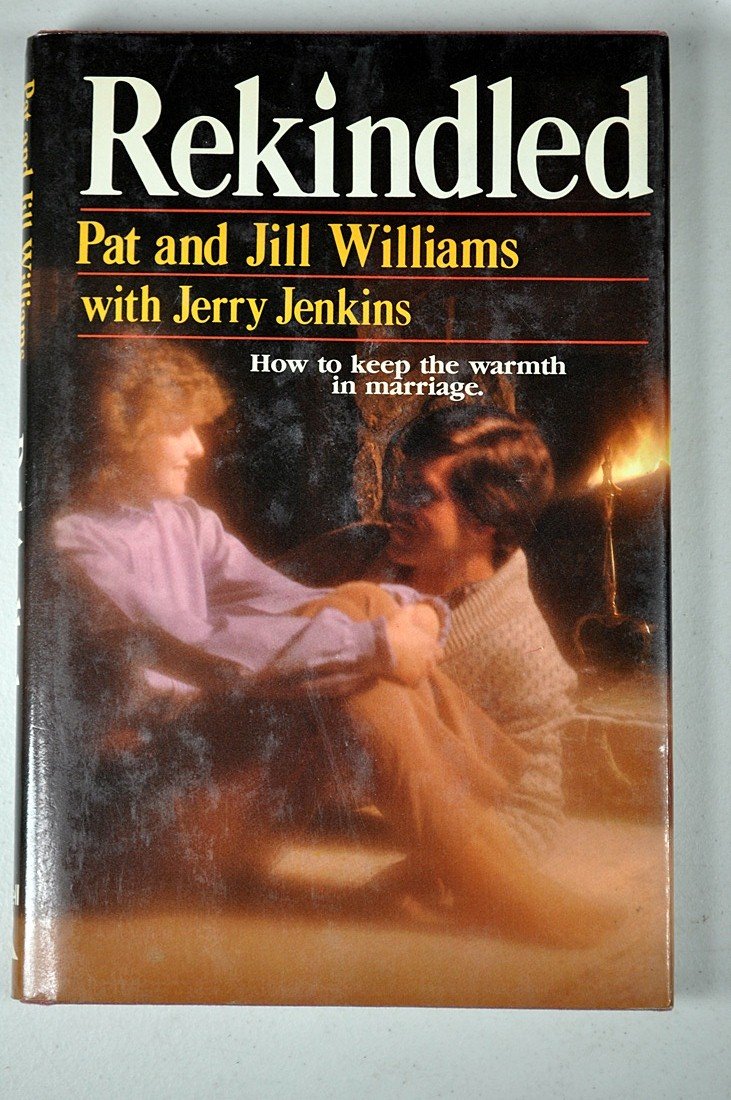
(Multiple editions are available; this Amazon graphic link shows the photo on the cover of the paperback I physically own, although it's a photo of the hardcover first edition.)

Title: Rekindled

Author: Pat and Jill Williams and Jerry Jenkins

Pat Williams' web site: https://patwilliams.com/bio/

Jerry Jenkins' web site: http://www.jerryjenkins.com/

Date: 1985

Publisher: Revell

ISBN: 0-8007-1417-2

Length:160 pages, including discussion questions

Quote: “It would be an understandable error to assume that identifying with the love and marriage of a professional sports executive and a beauty queen might be impossible…But they are…people with problems like everyone else.”

(And how! First the review of the book I own and am willing to share, and then I'll discuss the "sequel" of the authors' biographies...)

Sure enough, after ten years Jill decides, “I hate this marriage. It’s boring me to death….I don’t even know if I ever loved you,” and starts reciting “the countless complaints she had registered for so many years, never having felt she had really gotten his attention long enough to get any response.” Her complaints are almost generic. “We never do anything together unless it’s something you want to do…why can’t you remember…the special days?...You never touch me unless you want something more. You never say nice things to me in front of people…You never really listen. You either interrupt or don’t let me talk at all.”

To which Pat cluelessly replies, “I know you’re the girl God picked out for me.” Well, duh. Ten years after an official passage out of  “girlhood,” he might’ve noticed she’s a woman.

They were such typical young people. They hardly knew who they were going to grow up to be. They wanted to be free to act out their hormonal impulses. When they met each other, recognized each other as “catches,” found out that they were practicing Christianity in similar ways, and finally admitted a mutual physical attraction to each other, they expected that to be enough to make them Partners for Life. As is so typical, it wasn’t.

People who invest heavily in the sports industry are more than just fanatical fans. Their business requires them to become obsessed. Jill felt neglected.

Many women would feel honored and “liberated” if their husbands asked them to handle the family finances. Jill felt “very put upon.”

Guys who enjoy playing sports are likely to think that being a professional manager, coach, or sponsor would be the perfect job. Pat felt disappointed

They had conversations like:

“Can’t we do something together? Anything?”
“Okay. I was going to go to the Phillies game tomorrow. Wanna go?”
“Why does it always have to be something you want to do. Let’s go to The Nutcracker Suite.”
“I can’t think of anything I’d less rather do.”
“See? We always do what you want to do…” etc. etc.
“Okay, all right, we’ll go to The Nutcracker.”
“Really? You really want to?”

Pat didn’t mind if Jill did the things she wanted to do by herself. Jill felt that she “had too much freedom.”

And then Jill came down with major depression, in a totally typical way. To her doctor, she presented a textbook case of emotional frustration with her marriage and a physical illness. (Luckily, the physical illness was identified right away.)

The position of this web site is that it’s crucial for depressive people to understand that, no matter how many frustrated emotions they have, or how justified their discontent is, the primary reason why they don’t feel any pleasant emotions any more is physical. Fix facts first: feelings follow means that if you really hate your job, you need to change jobs. It also means that if you not only hate your job but also can’t sleep at night, can’t wake up in the morning, don’t enjoy meals, don’t feel much pleasure with your children or pets or the beauty of nature, don’t feel like taking any exercise, and aren’t doing anything “creative,” your problem may have nothing to do with hating your job; you might need anything from a vitamin supplement to major surgery but, if the fact of your disease can be “fixed,” you may find that you love your job as much as you did when you chose it. Most of the depressive people I know haaate this piece of truth, because what it means for them is that they need to exercise before breakfast and take control of their carb cravings, but it’s still true.

Jill was luckier. She had a “blood disease” that was dramatic enough to get her attention, that responded (for the time being) to specialized, expensive treatment. She respected her disease and her doctor’s advice, and cooperated with her treatment plan much better than many people whose depression would be easier to cure.  But, meanwhile, as she blamed Pat for her emotions, she seemed to him “as though she’d been run over by a truck,” and Pat “was panic-stricken…My reaction was, have I done this?”

Jill had, by her own account, become a chronic verbal abuser. Pat was toughing it out because the emotional pressure at his job was even worse. Chronic verbal abusers probably deserve to be left, but Pat, somewhat miraculously, wanted to keep Jill…even while illness was still aggravating her moods. “Jill had napped most of the afternoon, yet, even so, was on her way to bed early. Pat struggled with…the frustration over her not even lookng at him…regret that at times he had treated her the same way, though without the same reason.”

This produced a good example of what had already, by the 1980s, become a rare genre: the true romance story told from the male perspective. In the 1970s some women carried on about wanting the “right” to blather about their sexual “needs” and desires. By the 1980s women were making so much noise about their sexuality that the commercial media had become obsessed with a new stereotype of the shy, wary, defensive, or downright commitment-phobic man. Pat Williams, however, decided to rebuild his marriage and win his wife back. He read a book by Dr. Ed Wheat and set out on a plan of “blessing, edifying, sharing, and touching.”

And, as of the time of writing, it worked. Jill returned to life.

The one thing it’s possible not to like about a story like the Williams’ is that readers’ mileage may vary. If Jill’s depression had been associated with lactose intolerance, she might have “fallen in love all over again” within a week, rather than months. If it had been associated with one of the rare sudden-death forms of lymphoma, she might have died a few days after admitting she felt depressed. And if guilt over the fact that she’d fallen in lust with a younger man or decided to sell out for a richer one had been involved, seeing how lovable her husband could be might or might not have kept her from committing adultery and/or leaving. All husbands get some good results from taking the time to express sincere love for their wives, listen to what we say we want, and do that…but some husbands get better results than others.  

So, Rekindled is recommended for anyone who is or may someday be married. Mileage may vary, but this book does explain how to put the right fuel in the tank.

Now, about the rest of the story...

The authors stayed together for more than ten years after writing this book. Our e-friend Jerry Jenkins also helped them write a sequel, Keep the Fire Glowing. and a 1995 updated edition. Possibly the 1995 edition was written in a spirit of hubris. Possibly Pat Williams was starting to feel his own medical problems. In 1996 the couple divorced.

One of the issues in the Williams' marriage had been adopting other children (as well as their own four). They had a total of eighteen children when they divorced. Pat Williams remarried and currently lists his second wife as the "mother" of "their" nineteen children (she had one from her own first marriage). He currently describes himself as a "motivational speaker" rather than a Christian speaker. For audiences, "motivational" is probably good enough; he worked with winning athletes for a long time and has enjoyed an awesome remission from multiple myeloma.

Jill Williams seems to be keeping herself out of the public eye.

If a couple write a book about saving their marriage from one potential disaster, and then fail to save their marriage from another disaster, does that discredit their book? Some readers think so:

http://whitemail.blogspot.com/2013/01/why-i-wont-be-buying-any-of-pat.html

Or does it simply show that even their results could vary? If someone writes a book about whatever allowed him or her to survive one illness, injury, etc., and then dies from some other medical problem later on, does that discredit the first book? When Pat Williams dies, from whatever it may be, will that invalidate the fact that autologous marrow transplants (transplanting healthy marrow from the patient's own body to replace damaged marrow) have bought many years for many patients with multiple myeloma?

Personally...of the three co-authors of Rekindled, Jenkins is my favorite. Nevertheless, the idea of the husband doing the work of "rekindling" the marriage (while he was still able) pleases me enough that I still recommend that couples at least read this book, and try. Jerry Jenkins no longer needs a dollar, but I'm still willing to offer Rekindled as a Fair Trade Book. Send this web site (addresses at the bottom of the screen) $5 per book plus $5 per package for shipping plus $1 per online payment, and we'll send $1 to Jenkins or a charity of his choice.

Friday, January 6, 2017

Book Review: How to Be a Gentleman

A Fair Trade Book 


Title: How to Be a Gentleman

Author: John Bridges

Author's web page: http://johnbridges.com/

Date: 1998

Publisher: Rutledge Hill / Nelson

ISBN: 1-55853-596-9

Length: 150 pages

Quote: “A gentleman is someone who makes others feel comfortable.”

Well...that’s the usual modern usage. C.S. Lewis, who sometimes called himself a dinosaur, used to object to this usage. In Britain “lady” (masculine counterpart: “lord”) and “gentleman” (feminine counterpart: “gentlewoman”) referred to two specific positions in the feudal social hierarchy. American authors used to insist that these words don’t mean anything in a democracy. If they did, the U.S. equivalent of “gentleman” would be “a man who has inherited some property, including a farm and rental property” and the equivalent of “lady” would be “a governor, a member of Congress, a Supreme Court justice, or (by courtesy) the wife or daughter of one.”

There is ancient and honorable precedent for using these words, loosely, to mean anyone who has learned the sort of manners used by the most admired holders of these positions; the first book that encouraged all who read or heard it to behave like gentlemen dates back to the sixteenth century. Lewis argued, irrefutably, that this usage added nothing to the language. 

The case can be made that even in the United States the distinction may be worth preserving. A man whose parents spent their whole lives paying rent may do whatever he does as competently as a man whose parents owned land; he may live by the same moral standards, or by higher ones; he may earn more money and invest it in better things. He has still grown up with a different outlook on life than the landowners’ son has. He can learn the manners the landowners’ son learned, and as a matter of courtesy he probably will, but for him they may always feel like a "second language." Usually it won't make a difference; sometimes it will.

But how far need we carry this quibble? In this book Bridges, editor of the Nashville Scene, describes the behavior of men of the currently active generation who were generally agreed to be polite in Nashville. He’s not as verbose and witty as Judith Martin (“Miss Manners”), nor does he meander into either the formalities or the relationship counselling that enlivened Martin’s books. His book is strictly about the casual courtesies that even young people still appreciate today. A man in search of practical, man-to-man advice on this topic can safely consult How to Be a Gentleman, a book designed for convenient reference anywhere...it fits comfortably into a trench coat pocket.
Reading How to Be a Gentleman wouldn’t do a woman any harm, either; for that matter, this is a book that can be shared with children. Probably one needs to be a man to use tips like “If a gentleman shaves at the health club, he always rinses out the sink.” One does not have to be any particular age or gender to use tips like “If he must leave the theater in the middle of the performance, he does not say anything and does his best not to stop on toes.” A majority of the tips in this book fit into the second category.

So this book can be recommended, with some reservations, to anyone at all...but it was really designed, even to its shape and color, to suggest a graduation, back-to-school, or similar present for a male student.

If you want the most up-to-date edition, as shown in the photo link, it'll cost you new-book prices: $15 per book, $5 per package, $1 per online payment. If an older edition will do, send $5 per book, $5 per package, $1 per online payment, to either address at the bottom of the screen. If you want to compare the three popular editions of this book, you'd send $15 for the new one and $5 for each of the older ones plus $5, plus the optional $1 for Paypal if you don't go to the post office and pay their fee directly to them, for a total of $30 or $31. (Because this is a small book, you could add at least three more thin books to the package for $45 or $46.) In any case, Bridges being a living author makes this a Fair Trade Book, which means we send $1 per copy of his book that we sell to him or a charity of his choice. 

Thursday, January 5, 2017

Vindictive Book Review: Rockville Pike

A Fair Trade Book, Albeit About a Town Where I'm Not Sure That Fairness Ever Existed


Title: Rockville Pike

Author: Susan Coll

Author's web page: http://susancoll.com/

Date: 2005

Publisher: Simon & Schuster

ISBN: 0-7432-4477-X

Length: 319 pages

Quote: “Rockville Pike...had once been a dusty Indian trail. It was later packed with ten-inch-deep flint rock in a process known as ‘piking.’ The Great Road, as it was called...was plagued by traffic problems even back...when James Polk and Andrew Jack­son were among the travelers.”

Disclaimer: It is theoretically possible that an honest and decent business has been set up in Rockville, Maryland, at some time since I've been there. I wouldn't know. This book exploits a stereotype...and when I was there the stereotype was solidly based in reality, and wasn't funny.

When the Pike required a more specific name, it was named for the sleepy little town at the head of Rock Creek, which had rather lackadaisically been designated the seat of Montgomery County...probably for its central location. In the nineteenth century Rockville, like the rest of Montgomery County, was a section of farms surrounding a tavern and a post office. (The post office was already losing mail, or letting mail be tampered with, in the 1850s when ex-slave Ann Maria Weems was waiting for letters.) As Washington began to sprawl in the mid-twentieth century, Rockville “developed” into a rather remote and downscale suburb. At exactly what point it became “The Devil’s Town,” I’ve never been able to determine; researchers like the ones who helped Susan Coll with Rockville Pike wouldn’t have such information.

Let’s just say that in the 1980s, when “Bob Levey’s Washington” column ridiculed people who wanted to identify “White Flint” or “North Bethesda” as a separate community, Levey may have believed that they were evading an image problem based on relatively low property values, power outages, and sporadic bus service. Those things were part of Rockville’s image, but there was more to it than that. "Everyone in town wants to bring you down" was more than the usual teen-romance pop lyric.

Ask any young person who’d hoarded a few minimum-wage paychecks to buy anything—a car, a stereo, a piece of furniture—at any of Rockville’s discount stores. First of all they’d say the store personnel had been churlish. (Coll, page 206: “One could only guess that a person walking around with a cache of hundred-dollar bills had either come from the race­track or had just sold a kilo of crack cocaine.” Or cashed a paycheck at a liquor store because the person wasn't earning enough to have a bank account...I remember it well.) 

Then, whatever it was, even if it was the pair of stockings I once bought on the allegedly upscale White Flint Mall, it fell apart before the purchaser expected to have had it long enough to give it a rating. Or worse. (Coll, page 205: “It was a....chandelier...retailing for about $3,000. We had a reproduction at the store that we sold for about $250. It was a China Electrical Corp. special and it looked almost exactly the same, although the quality of the crystal, not to mention the wiring, left much to be desired.” And did it, like the tape player I once bought at a mad one-day sale at a Rockville store, tend to catch fire?)

And so it’s possible to say that the protagonist of Rockville Pike is altogether believable, at the same time that it’s believable that she bears no resemblance to any specific individual living or dead. Coll’s comic anti-heroine, Jane Kramer, is the sort of idiot narrator for which Sue Townsend and Helen Fielding are famous...and her real-life inspiration is: the Rockville stereotype. Or, at least, the one of several Rockville stereotypes whose awfulness can be made funny. Kramer’s Discount Furniture Depot sells garbage, and Jane knows it, but all she can be expected to do about it is whine ineffectually to her father-in-law that maybe if they sold better furniture they might not be losing so much money. ("Kramer's Discount Furniture Depot," yes. Washingtonians know it's not Kramerbooks, which was actually a relatively decent downtown D.C. store owned by a Rockville man, and they know it's not Marlo--Maryland's Lowest Discounts Furniture--but it has deliciously familiar echoes of both.)

The only two of her son’s school friends whose names Jane remembers are part of the drug business that really made Rockville infamous. The Kramers accept that this is part of their community. Jane’s son admittedly looks like one of the Satanists who cinched the title of "the Devil's town" for Rockville, but Jane thinks he’s just a music student who’s into the Goth look...not that he tells her everything; Jane hopes he’s sober. Jane doesn’t get out much. A failed writer, she’s dug herself so deeply into the “housewife” role, despite her mediocre sales and office work at Kramer’s, that she doesn’t feel able to talk to people and make friends any more. Jane and her family are about as badly victimized by characters who embody the stronger stereotypes of Rockville as anyone else is. We can feel sorry for them.

The front cover identifies Rockville Pike as a comedy, and Coll delivers; although her material could easily get serious, as in The Watsons Go to Birmingham, it stays light and whimsical even when Jane passes out naked on a divorced male acquaintance’s bed. Given every opportunity to mess with Jane’s body, the sleazy  guy prefers to mess with her mind, but is too polluted himself to do this in worse than a fumbling, funny way.

One of the main comic motifs in this book is that Jane is convinced her husband is cheating, and even tries to cheat on him to pay him back. My opinion is that this motif has been beaten to death in fiction; all possible adultery stories have been beaten to death, and no new adultery story can be either funny or moving. We need a 500-year moratorium on adultery in comic fiction. Fortunately, in Rockville Pike the adultery story takes second position to the primary comic motif, which is how Jane, frantically rationalizing her cheating other people in business, succeeds in cheating herself. Though not too subtle for any reader likely to recognize the names of Presidents Polk and Jackson, the comic study of the Kramers’ dishonesty is not too overt to be funny either. It is right on.

I put off reading this novel for years because I was afraid it would have a good strong sense of place. It has. Reading it gives me the feeling, not merely of being back in some part of Montgomery County’s look-alike sprawl—strangers can hardly tell downtown Rockville from downtown Bethesda, Silver Spring, or Gaithersburg by looking—but of being specifically in Rockville. All Giant Food stores have many points of resemblance, but I know it’s that Giant, and although they didn’t pay Coll to print the name another scene definitely takes place in G Street Fabrics, and on and on. And frankly, although Washington’s other downscale suburbs have their appeal, I didn’t want to imagine myself in Rockville. 

Finally, on one cold damp winter day, I opened the book and was pleasantly surprised by the way it affected my mood. The weather here on the far end of Virginia was foul but at least, I thought, looking up happily between chapters, I was not sitting in traffic on Rockville Pike.

Part of the sense of place, in the peculiar case of Rockville, is the way Jane and Leon Kramer are practically postsexual and have abandoned all hope of becoming rich (it costs a lot of money just to hang on to their house and store, so they make a lot, spend a lot, and always feel poor), but still perk up and show signs of motivation to get out of Rockville. At the end of the book this will happen; all the suspense and much of the humor lies in finding out how they get out, where they go, and how long they stay.


If your mood is low and you’re looking for someone to look down on...you’re not the only kind of reader who is likely to enjoy this book. If you enjoy Townsend and Fielding, and older comedies like Gentlemen Prefer Blondes or even Joseph Andrews, you’ll like Rockville Pike, too.

I've already sold the copy I physically owned at the time of first writing, but I'll still sell copies obtained from Amazon as Fair Trade Books: You send me $5 per copy + $5 per package + $1 per online payment, if you add enough books to the package it adds up to less than buying six books separately on Amazon, and I send $1 to Susan Coll or a charity of her choice. 

Wednesday, January 4, 2017

Book Review: The Unanointed

Title: The Unanointed


Author: Laurene Chinn

Date: 1958

Publisher: Crown

ISBN: none

Length: 314 pages

Quote: “Don’t underrate the boy who goes to David. David has need of a kinsman with your gifts of common sense and reliability.”

Such a kinsman was Joab, the army commander of King David of ancient Israel.

As Chinn mentions in the foreword, the historical books in the Bible tell us a lot about Joab’s public life, but little about his private life. This novel attempts to fill in the gaps. What history has survived three thousand years is incomplete and confused, but mostly Chinn has tried to stick to the facts available—apart from deliberately changing a few names and stories for purely literary reasons. The Bible mentions that three of David’s eight official wives had been married to other men. Priests had to be their wives' first husbands; one of the legal precedents David set was that kings could not only marry widows and divorcees but, if the woman were not divorcees, contrive to make them widows. Chinn changes another wife's name and gives her a fictional romance with Joab, to heighten the dramatic tension inherent in a close relationship between the two most powerful men in their country.

Reba (Chinn's name for the character whose real name was recorded as Ahinoam) was "in love" with Joab when they were all a gang of young outlaws wandering around the border country. They couldn't afford a wedding, but you know how delinquent youth are. Then, when David became king, Reba's influential relatives wanted her to be a king's bride. The Bible tells us nothing about the real Ahinoam but it does tell us that the real David did not set a great value on monogamy, and that when they grew up Ahinoam's son raped one of David's other children, the daughter of Maacah. Chinn postulates that this act might have seemed less vile to a young man who was hostile and sullen only to a normal degree if that young man knew that he was not really David's son, and thus no relation to David's and Maacah's daughter at all. In such a case the attraction might even have been mutual and the sex act consensual--in the Bible, Tamar did go to attend Amnon when he claimed to be ill. In The Unanointed, Joab and Reba are the parents of Amnon, and they remain loyal to David even after David has had Amnon executed for his crime.

Ancient Hebrew had specific words not only for “uncle,” “nephew,” “brother-in-law,” and other family members, but also distinguished between maternal and paternal relatives of various degrees. (Your mother’s brother was considered to be a whole different type of relative than  your father’s brother, and so on.) Nevertheless ancient Hebrews used the words for “brother” and “sister” to address or refer to anyone they loved--including their mates and children. Chinn doesn’t try to adapt this linguistic quirk into English but, instead, adapts the confusion by using “cousin” to mean any relative; David is in fact Joab’s uncle, but they address each other as “cousin.”

Other deliberate changes make this novel an unreliable illumination of history. “A few familiar figures” (from the Bible record) “were omitted and their essential acts ascribed to others in this story,” and “The building program ascribed to David was in part the work of Solomon.” Some of the changes are trivial; others could be said to falsify the story. The Bible historians tell us that David planned the building program, and wanted to carry it out, but interpreted things—possibly real-world concerns about time and money and so forth, possibly dreams or solemn rituals of divination—as indications that  God wanted the building to be done by a Man of Peace. If I, personally, attempted to write a novel about David of Israel that saw him through middle age, I’d work with the documented fact that, although all of his killings except the arranged death of Uriah were justifiable under the law, David himself felt stained and spiritually degraded by having taken human lives; he wanted one of his sons, who never had to go to war, to be remembered as the “Sun-King” of Israel’s brightest, most prosperous period. I find this one of the more interesting data about David. Chinn chooses, for her own reasons, to ignore it. For all I know she may have done this in order to retell a true story about some other person, in some way not disclosed to the public; all I can say is that she’s left with a weaker story.

The Unanointed may have been marketed primarily to Christians, but its characters were not Christians and Chinn doesn't try to Christianize them. They are ancient Palestinian Semites. Since modern terms based on the old name “Semites” are being bandied about again, I reiterate, and The Unanointed illuminates, that it means any of the people we now usually call “Middle Eastern.” They all evolved from the same ancestors. Religious Jews who try to follow the teachings of Moses lived, then as now, in close relationships with agnostics, atheists, and Pagans. The cultural atmosphere was more like Bedouin Arab culture than like modern American or European Jewish culture. David, whose name may even have been a nickname meaning “The Beloved,” was “beloved” of the Bible historians partly because he was sincerely religious (though not always willing to live by his beliefs). Many of the people around him were not. The story of David and his family is not, therefore, a Christian story, nor could it be.

It’s not a secular story, either. It's a story based loosely on the history of a religious man—but modern religious language is inherently confusing. At this period of history the term “Jew” did not exist even in its original meaning of "member of the tribe of Judah as distinct from the other tribes of Israel"; the Talmud had not been written, nor had most of the events that shaped Jewish culture and religion occurred. David’s spirituality, a vital part of his story, is hardly even Jewish in the modern sense. It’s closer to being Jewish than to being anything else, but even though David belonged to the tribe of Judah, we have to wonder how much he would recognize in modern Judaism.

Here, in any case, is an historical novel that explores the meaning of loyalty. Chinn put more than fifteen years of research into it; when she chose to misrepresent facts, she knew which facts she was misrepresenting and why. The result is not history. How good it is as a serious psychological novel about men’s friendship, you’d do better to ask a male reviewer.

As fiction, it’s readable, tasteful, the sort of thing adults didn’t mind seeing teenagers reading in 1958. I think perhaps some of those adults would have done better to worry more about deliberate distortions of historical facts than to worry about erotic scenes or bad language, but in view of the number of novels that wallow in vulgarity as well as falsehood I suppose The Unanointed rates better than many historical novels. I, having read it once, feel no interest in reading it twice, but others may find it more emotionally engaging than I do.

Laurene Chinn has not had any use for a dollar in a long time. This web site has to charge $5 per book + $5 per package + $1 per online payment, so if you're not buying other books here you can get this one cheaper directly from Amazon. If you are buying other books here, however, you pay only the one $5 shipping fee for as many as I can fit into a package; since that would include three other books of the same size you might get a better deal by buying The Unanointed here after all.

Tuesday, January 3, 2017

Book Review: The Time of the Witch

A Fair Trade Book


Title: The Time of the Witch 

Author: Mary Downing Hahn

Author's web site: http://www.hmhbooks.com/features/mdh/

Date: 1982

Publisher: Houghton Mifflin / Avon

ISBN: 0-380-71116-8

Length: 171 pages

Quote: “I know you’re not happy about the divorce, but there’s nothing anyone can do to change it.”

But what if there is something someone can do...something even worse than the divorce? When their divorcing parents send Laura and Jason to stay with their aunt, two of the aunt’s neighbors seem to think something can be done. Laura’s aunt insists that witches can’t change things by casting spells, but the town's two flakiest characters, Maude and Twyla, seem to believe otherwise. Both Maude and Twyla describe themselves as witches. Twyla, the nice witch, doesn’t try to control other people’s lives and marriages. Maude, the wicked witch who’s always had a grudge against Laura’s grandmother, tells Laura she can do something...and maybe, Mary Downing Hahn seems to be saying, she does something to bring the parents together. Maybe she causes Jason to come down with meningitis.

Hahn cleverly blurs the question of whether she thinks it’s possible that Maude made Jason ill, by her spell-casting ritual or by any other means, in order to emphasize her point. Laura can’t understand why her parents want a divorce, but she has to try to “accept” it and be happy with it (at some time in the twentieth century, for some people, happiness became a duty rather than a pleasure). There is no ethical way to prevent the divorce.

I can’t say that I’m happy about this view of divorce; that it makes The Time of the Witch a book I would give to my niece and nephews. Granted, sometimes divorce really is the only way modern society has to deal with people who would not have been allowed to live in traditional societies. If I knew a little boy whose father had abused him, or his mother or his siblings or his grandparents, I’d give him a book that says that nothing can be done about divorce.

But in this book the clue we’re given to the parents’ divorce is that Daddy thinks he would rather live with another woman than with Mommy, and although that kind of divorce is common these days, it can be prevented. Not, of course, by the children. By the other woman, who could have said, “I will not let you leave your wife for me. If you leave her, I’ll move out of town.” Or by Daddy, who could have said, “I made a vow to the mother of my children, and I am going to keep it, even if the only way I can leave this other woman alone is to quit my job and take one that pays less for a while.”

Maybe it’s better for children to try to “accept” divorces than to try to play counsellors to their parents, but my feeling is that, if adults were a little less willing to “accept” divorces, a lot of divorces would never become final. I have seen no harm, and much good, done when adults say to friends, “The vows you took said ‘until death do us part,’ not ‘for as long as I feel like it.’ Yes, 'until death do us part' can be hard. Hard things are useful like flint and beautiful like diamonds. Are you an honorable man or woman, or not?”

Sometimes it doesn’t even hurt to go into particulars, if we know them well: “I know that both of you have done things that caused a lot of guilt, that you have become fat and depressed and you feel that you’ve hit a dead end on the job. Guilt can be a factor in that kind of problems. A counsellor who believes that ethical principles are real, who can help you think about ways to make restitution and receive forgiveness instead of just trying to get away from the feeling of guilt, might help both of you.” 

This may not be what we would say to every divorcee we know. We need to be tactful and understand that sometimes “irreconcilable differences” is the only way someone can bring herself to say “S/He is a serial murderer.” Still, we don't need to put up with nonsense about adults being unable to resist every physical attraction they feel.


Given that Hahn hasn’t given her fictional couple any grounds for divorce other than an extramarital physical attraction, hasn’t mentioned anything about Daddy and Mommy fighting all the time or going to doctors or having trouble with the police, is this really a book about divorce I would recommend for middle school children? It is not...for the ones who are struggling with ethical issues. It is a book about ethics that I would recommend that high school readers read critically, or else it’s a trivial horror story that I would recommend for a Halloween sleepover party. And yes, although the vocabulary is accessible to children, the story is told well enough to give adults a healthy shudder; anyone who’s seriously afraid of Maude has other emotional issues, but a little real horror at where meddling and manipulation can lead, at the idea of degenerating into a moral equivalent of Maude, won’t do us any harm.

Monday, January 2, 2017

Book Review: Never Sniff a Gift Fish

A Fair Trade Book


Title: Never Sniff a Gift Fish

Author: Patrick F. McManus

Date: 1983

Publisher: Holt

ISBN: 0-8050-0031-3

Length: 217 pages

Quote: “For the most part...they confined their merriment to a few chortles, saving the belly laughs for the embarrassing predicament that my lack of coordi­nation invariably lands me in.”

The twenty-eight stories in this volume first appeared in magazines like Field and Stream, Outdoor Life, and Audubon. They are, however, parodies of the Boastful Outdoorsman genre. McManus tells us about his adventures hiking, camping, fishing, and so on, and often has useful advice to share with would-be outdoorsmen, but rather than being presented as “One day perhaps you’ll be as clever, tough, and skilled as I was on this occasion” his stories are usually cast in the form of “How ridiculously ignorant I was on this occasion.”

Example: The story that launched McManus’s series of books, in the 1980s, was the title piece of another book, The Night the Bear Ate Goombaw. In this one McManus claims that as a little boy, on one of his first camping trips, he didn’t have a proper sleeping bag, so he bundled up for the night in someone’s old fur coat. He wasn’t proud of this moth-eaten antique so he tried not to unpack it until other campers, especially his little friend’s grandmother (Goombaw), were all tucked into their sleeping bags. During the night he woke up and stumbled outside in the tatty old fur, and for some reason Goombaw, who had also felt the urge to step out of the tent, kept screaming that there was a bear. He kept dodging around, speechless with fear, and apparently this bear stayed right behind him for...longer than you’d believe this confusion could possibly have lasted, in real life, but you get the point.

Other inhabitants of McManus’s world are preposterous too; in this book we meet a college dean who “was not smart enough to mull” as he smoked his pipe, students protesting “Poverty, War, and Mashed Turnips in the Commissary,” McManus’s old childhood pal Retch Sweeney (when they bought their first car, Sweeney told the junkman “It don’t need fenders”), his rich pal Fenton Quagmire (whose “cabin is a three-bedroom, shag-carpeted, TV-ed, and hot-tubbed villa”; many embarrassments happen to him), his older mentor Rancid Crabtree (“Smoked carp tastes just as good as smoked salmon when you ain’t got no smoked salmon”), and a few dozen more. None of them ever gets to be dumber than McManus.

If one reads too many of these stories too quickly, one can get the impression that McManus characters are all lined up outside a door, clamoring, “It’s my turn to do something dumb next!” In a world whose creator and narrator steps out to the kitchen for a quick snack just so a neighbor can ask his wife whether McManus knows anything about muzzle-loaders, just so Mrs. McManus can say “He’s in the kitchen loading his muzzle right now!”, people would have to derive some sort of inverse status from the silly things they’ve done.

However, the consequences of their foolishness are always hilarious, even when they’re framed as advice rather than narrative. For those who were disappointed, or even surprised, that the overwhelming majority of Virginians do not want elk introduced to our neighborhoods, I recommend the preliminary exercise for would-be elk hunters on page 188. “From among your fellow workers, select one who weighs approximately one hundred pounds—about the weight of a hindquarter of an elk...Do not, I repeat, do not indicate that you have chosen her because she bears any resemblance whatsoever to the hind­quarter of an elk. Then have her ride you piggyback while you step from floor to desk top, leap to a chair, step over the back of the chair and  onto the floor...This exercise, obviously, is intended to prepare you for the task of packing out a hindquarter of an elk you were stupid enough to shoot.” Laughing at the idea of yuppies doing this exercise in the office just might dislodge whatever rocks or other alien matter in the head made it difficult to understand the simple assertion, “Virginians have no use for elk.” Actually McManus is an Idahoan, but even there the usefulness of elk is virtually confined to comedy.


Who should read this book? Anyone who wants to laugh. It’s addressed primarily to men, but women laugh at it too. After about age nine, so do children.

Age 83 at the time of writing, McManus doesn't have an active web page (he retired, and his assistant "archived" https://web.archive.org/web/20150212020730/http://patrickfmcmanus.com/ ) but fans have generated a few web pages for him. The stories have been indexed at http://mcmanusindex.com/ , adapted into stage-storytelling "one-man plays" at http://mcmanusplays.com/ , and video-recorded to Youtube at http://www.youtube.com/user/mcmanusplays .

The books were popular enough that they're still currently easy to find at prices that fit into this web site's standard pricing ($5 per book + $5 per package + $1 per online payment). This may change; they are going into collector price ranges fast since McManus has retired. I'm not particularly keen on the idea of books becoming more valuable after authors have no use for the money, but while authors are merely in retirement I suppose the inflation of prices for books like McManus's classics may serve a good purpose. Buy as many of them "new" on Amazon as you can while McManus can still benefit from sales. This web site will, however, sell used copies while they're available, noting that four paperback copies will fit into a package for $5, which may make our prices cheaper than those you might find directly from Amazon, and if you bought four vintage McManus books at one time you'd send us $25 (or $26 online) and we'd send $4 to McManus or a charity of his choice.

Sunday, January 1, 2017

Book Review: Margaret's Story

Happy New Year, Gentle Readers. No, of course I'm not online, but this web site just wanted (you know how web sites want things!) to start the New Year with a Christian book review...

Title: Margaret’s Story


Author: Eugenia Price

Date: 1980, 1982

Publisher: Harper & Row (1980), Bantam (1982)

ISBN: 0-553-22583-9 (1982)

Length: 423 pages

Quote: “Even if I’m an old, old woman by the time I manage to wipe that stricken look from his face, I’ll do it.”

Just six years after this first expression of interest in the older, widowed neighbor, Lewis Fleming, Margaret Seton married him. It was 1838, at the height of the Romantic Era, when it was considered desirable for men to express grief, love, and fear, and from the written history of these people (who were real) Eugenia Price infers that Lewis did have a stricken look and Margaret kept it off his face, most of the time. Their story is true; the facts of the novel are part of the history of Florida. Price filled in the conversations.

Margaret’s story, reconstructed from the way she actually told it, is not about romantic passion, although she  married for love and had seven children. (Victorians did that sort of thing; they just didn’t talk about it.) Her story is primarily about her life’s work of raising her stepchildren, having seven children of her own, and operating an inn—mostly in partnership with Lewis, who died only a few years before she did. Later her children kept the inn open, and at the time of writing it was still open to the public as an historic landmark.

Being a novelized biography rather than a novel, Margaret’s Story does not have a very suspenseful plot. Margaret lived through interesting times and had as melodramatic a Civil War experience to tell about as any of her generation. Price, being a Christian, is perhaps particularly interested in the scenes in which Margaret was dutiful to, and comforted by, her Christian faith; although she didn’t impress others as being exceptionally pious or preachy, the real Margaret took her religion seriously, even to the point of not hating Yankees. (Although Price lived in the South after achieving literary fame, and dutifully studied and wrote about Southern history, she was born and brought up in the North, and seems to have been especially attracted to historical Southern heroines who refused to hate Yankees.)


Recommended to those who enjoy a realistic degree of romantic Old South atmosphere, Margaret's Story is unfortunately no longer a Fair Trade Book. It's available in three sizes. The larger-sized editions are going into the collector price range, so if you need a big solid book with large clear type, you need to ask for it and pay for it. For the standard $5 per book, $5 per package, $1 per online payment, you get the smaller paperback edition; if you also want the previous two volumes in this family's story, send a total of $20 or $21, thus paying only the one shipping charge for all three books.