Friday, November 18, 2022

Temporary Sam and Other Golden Retrievers

My parents were a little too old to be hippies and a little too decent to have been beatniks, but they did believe in the educational value of travel. Let's just say that that slot on my bingo card was full before I was old enough to vote. I lived in fear of the'rents' wanderlust. There I'd be, looking forward to a nice quiet vacation on the little farm that wasn't producing anything yet, wondering which new books I was going to discover in the town library and which relatives were going to visit us, and Dad would burst out at dinner, "We've never ridden across Canada yet!" And then for several days the possibility of spending the summer in a rented van, or on a Greyhound, breathing stale air and trying not to be sick, just to be in a different place, would loom over the whole vacation. Mother was good at dampening ideas about spending a year in Australia but she was more likely than Dad to pipe up with equally vacation-ruining ideas about getting to know relatives in Denver, or maybe Hawaii. 

On one of these junkets the parents had rented a house and sent us children out to explore the neighborhood from a kids'-eye view. We walked a mile or two away from our rented base, and as we walked back a large dog who had barked peaceably at us, on the way into town, bounded out of a front yard and came lolloping behind us.

"Maybe he's a stray and he can be our dog," my brother said hopefully, putting his arm around the dog, who wagged and wriggled at this attention.

I didn't think the dog was a stray. "He looked awfully comfortable at that house. We'd better stop and ask the people who live there if he's their dog."

"He looks awfully comfortable with me too," my brother said, as we concluded that, though people seemed to be living in the house, none of them was at home. It was true. Anyone would have thought the dog had lived all his life with us.

Anyone but our parents. "Where did you get that dog?"

"He was lying on the porch of #123 Pine Street when we went into town, and then he followed us home." I didn't have to mention that this behavior had seemed to be encouraged by the petting and praising the dog was getting just for sticking close to my brother. So I didn't. The'rents had their own eyes to see such things.

"Well, come in and have supper, and then you can walk back to #123 Pine Street and see if he'll stay there, now that he's satisfied his curiosity and seen that there's nothing for him to eat here. He's a temporary dog."

There was no meat, because we were mostly vegetarians, but there was cornbread. We seldom did let Mother's cornbread get cold. Both of us had pockets.

"Here, Temporary!" The dog recognized good cornbread when he smelled it, and followed my brother around the yard. "Temporary, sit down." The dog sat. "Come on, Temporary, heel." The dog walked at my brother's heel. "Can you shake hands? Roll over? Beg?" The dog seemed to have had no higher education.   

"That's enough! Somebody must be worried about that dog! Take it back to Pine Street now!'

We went back to Pine Street. The dog didn't have to be told to follow. 

"Sam!" A nice lady was in the front yard at #123 Pine Street. We explained that we had not intended to dognap her Sam, but if she ever got tired of Sam we would like to have him back.

"He is a nice dog, but he's not very smart," she told us. "He follows people, bicycles, cars. He's likely to get run over."

For the rest of our stay in that town we were careful not to call or encourage Sam to follow us, but he always seemed ready to follow if encouraged. I heard my brother refer to him as "our Temporary Sam" and "good ol' Temporary Sam."

But before we left that town, the big lovable dog started walking with a bad limp. "He ran out chasing a a car, and it stopped at a light. You might say he caught it," said the nice lady.

It was a different time. It did not occur to us children to question how an adult treated her dog. It would not have occurred to our parents, either. Obviously Sam's job was to rush out at anyone who invaded the yard, looking big and dangerous, even if the greatest danger was that he'd knock down someone whose face he was trying to lick. Anyway the yard had a fence around it. The fence was not all of three feet high. Before his injury Sam could jump four feet without even trying. 

Now, of course, most towns have actual laws. Retrievers are big enough to be dangerous--mostly to smaller pets. They tend to be gentle, amiable dogs. A few things, like their names and "Let's go" and "Come here," they learn easily; things that fit into their mental scheme of life. Other ideas, like "By 'heel' I mean stay at my heel even if there are squirrels to chase" and "Stay out of that filthy water" and "Don't roll on that stinky, maggoty roadkill!" do not fit naturally into the retriever brain and are extremely difficult to teach. Even after being hit and hurt some retrievers' instincts may continue to tell them to gallop companionably after passing cars. 

Marley and Me was about a golden retriever. The Book of Barkley was about a Labrador retriever, a closely related breed. They're called retrievers because one trick they learn easily is, if they see a duck or anything else hit water, to dive in and retrieve it and bring it back to their human, in their mouths, without even messing up its feathers. They love swimming and have to be dragged past water unless they're allowed to dive in. Their other specialties include eating things no reasonable animal would eat, and being sick, and galloping about and running into people, and dripping on rugs. They seem to stay puppies forever. They are very friendly and easy to bond with if you choose one as your new (used) dog.

Any new (used) dog can be a source of joy, as this photo essay shows...


There's a reason why retrievers are often, why try to be tactful about it, sold, apart from the fact that most of them are so good-natured they'll enjoy new human companions as much as they did the old ones. They know a difference but they don't seem to hold grudges. But, beyond that, they are fairly large, impulsive, messy dogs. If you want a dog who will walk with you past a watercourse and not jump into the water, climb out through the muddiest possible edge of the water, and shake water, mud, and loose hair onto you, you might want a different breed. Most retrievers just love to get wet, partly because of the weight advantage it gives them in deciding where they and the humans at the other ends of the lead should go. Lifting a wet, wiggly retriever is a special experience; in this case "special" does not mean "tidy" and people with bad backs should probably look for smaller dogs. And big dogs need a lot of food, some of which has to be of animal origin. 

And also, it's not that they're not protective--they can be--but a problem for some people is that retrievers aren't over-protective, don't see every visitor as a threat. To them the friendly repo man who's there to take the car away, or policeman with a warrant for someone's arrest, is just another visitor. They expect a party, with exchanges of food that may include things they can eat, to ensue when they lead these wonderful new people to meet their humans. Their barks say "What fun!" and if they do grab someone's arm, their renowned "soft," sensitive mouths make it obvious to the person grabbed that they're showing affection. They're more likely to chomp their own humans than an unwelcome visitor. Retrievers can bite, seriously, but they seldom do. 

However, if you let yourself bond with a retriever, you'll agree that the worst thing about them is that their life expectancy is only about ten years. Though they tend to be extroverts who like any human who puts up with them, they do get to know and love their own humans.

There's no guarantee that these adoptable dogs are Golden as distinct from Labrador or Chesapeake Bay retrievers. All three breeds are closely related, with similar looks and personalities, though golden retrievers are sometimes considered the most puppylike, and black ones are more likely to languish in shelters (because they fade into the shadows and attract less attention). These are just retriever-type dogs with yellow coats. 

1. Zipcode 10101: Zeke from North Carolina Is Currently Staying in New York
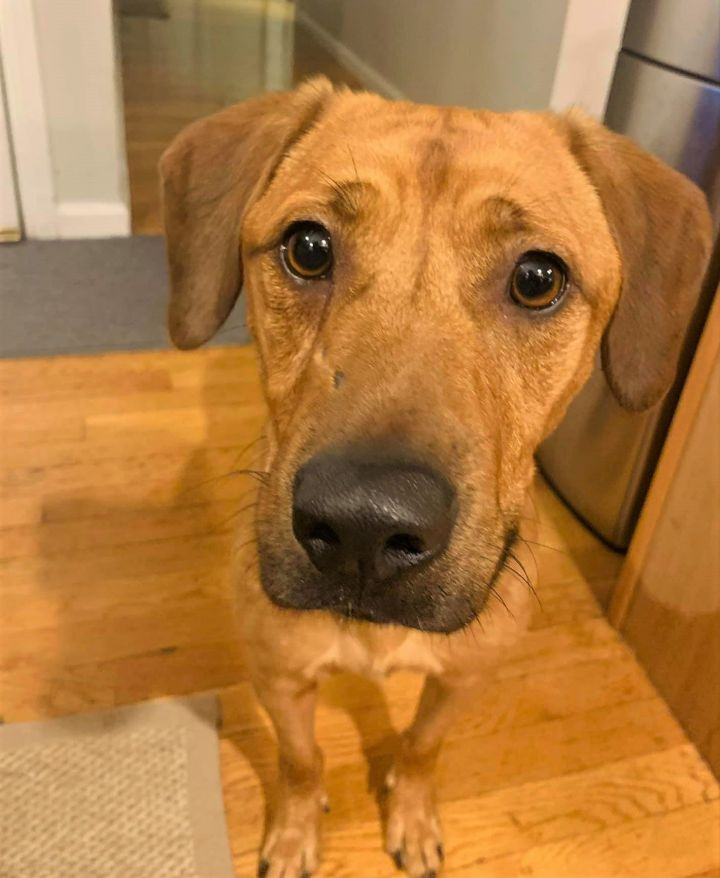

Despite that "Old dogs, and children, and watermelon wine" vibe, Zeke is just a pup, about a year old at the time his web page (https://www.petfinder.com/dog/zeke-nc-52584698/ny/new-york/rescue-dogs-rock-nyc-ny1274/) was last updated. He was moved to New York for treatment for life-threatening gunshot wounds. In his peculiar case, this web site agrees that it's probably a good thing if his new home is hundreds of miles away from his old home. Retrievers don't form prejudices and seldom hold grudges, but there are things even they probably remember. With humans who are not trying to kill him Zeke is described as "a snugglebug" who welcomes friendly attention. He is a follower, recommended to families with a confident, well trained senior dog. He has run up vet bills. 

2. Zipcode 20202: Chimmu from India Is Currently Staying in Maryland 
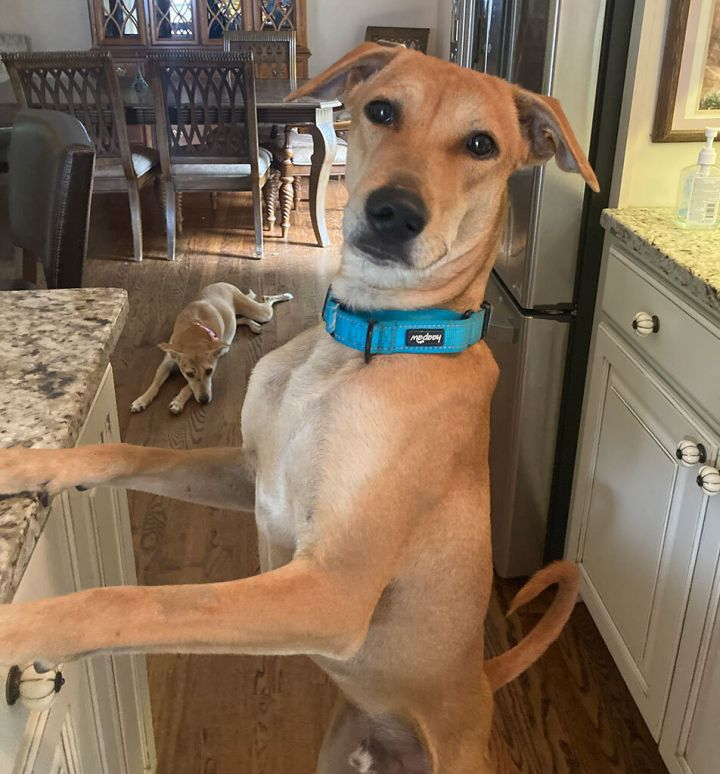

He was a street dog, according to his web page (https://www.petfinder.com/dog/chimmu-courtesy-post-52710440/md/bowie/spca-humane-society-of-prince-georges-county-md-md21/). Good Hindus never abuse animals but the ones who are not earning their keep on farms can be badly neglected. Chimmu's mother was noticed fighting over food for her puppies. The puppies were rescued and Chimmu was brought back to Maryland with his foster human. Young and teachable (not two years old yet), he's quickly adjusted to being a house pet. He seems to be another beta dog, most likely to learn rules or commands by following the example of a senior dog.

3. Zipcode 30303: Champ from Cumming 


The bad news: If you visit his web page, https://www.petfinder.com/dog/champ-11973-58701434/ga/cumming/furkids-animal-rescue-and-shelters-ga170/, you'll see that Champ is very thin for a retriever. And this is not because he's still growing, like the pups above. He's been ill and will need to keep reporting to his vet for treatment for a while. The good news: Because the shelter is eager to move him and his vet bills to a new home, his adoption fee is low. relative to the market rate. He's described as a typical retriever, well trained in some ways with ample room for improvement in others, recommended to families with a nice fenced yard. 

Thursday, November 17, 2022

Book Review: The Empty Land

Title: The Empty Land

Author: Louis L’Amour

Publisher: Bantam

Date: 1969

ISN: 0-553-25306-9

Length: 182 pages

Quote: “Matt Coburn is a fine man, and maybe the best hand with a gun I ever did see…He has nerve, but most of all he has judgment…and I don’t like what this can do to him. You can’t run a town like this without killin’, an’ I don’t wish for Matt Coburn to kill anybody else.”

Too bad. Matt Coburn, the protagonist of this novel, is going to have to bring law and order to the tough little town of Confusion anyway. There are, L’Amour explains, real “Confusion Mountains,” and the characters he brings to the town of Confusion are fictionalized from records of real outlaws…except for Madge Healy. This is one “western” novel with a heroine as tough, improbable, and lovable as her hero. Madge travels with outlaws and has collected a lot of money on the stage, but seems, at least so far as Matt finds out, to have avoided the usual sexual abuse and social “ruin” that shortened most of her colleagues’ careers at this period. At the beginning of the book she’s married; if people don’t think much of her husband, they respect her marriage. By the time Matt gets to know her, if both characters have lost their “innocence,” at least they’ve learned to respect each other.

Not that the conventions of “a good clean western” with lots of fighting and little or no kissing are going to be violated. L’Amour knew his audience.


Butterfly of the Week: Cretan Festoon

Here's another small member of the swallowtail family. Despite its obvious resemblance to the other Festoons, some of which do have small swallowtails, Allancastria cretica (a.k.a. Zerynthia cretica and, two hundred years ago, Thais cretica) has rounded hind wings.


This one hardly seems bigger than the white clover blossom. It has the same range of color variations the other Festoons have, with some individuals almost all white, some showing more black or charcoal-gray than this one, and some bright orange-yellow. Females seem more likely to show creamy or yellow color above than males are. Really bright yellow individuals are rare, and are traded among museum collections. Undersides of the wings may look drab rather than white. 


A gallery of different live snapshots illustrates the variety of color patterns at https://lepiforum.org/wiki/page/Zerynthia_cretica .

Is it really a separate species, or just another sub-species of Allancastria cerisyi? Experts disagree. It's found only on Crete, where it can eat either of two species of pipevine, one called birthwort and one called Cretan birthwort. Without being sure whether it's a species, scientists can't begin to agree whether it's an endangered species, but like most butterflies its survival depends on the survival of the wild plants with which it coexists in balance.

The butterflies fly in spring. Females carefully place one egg on one leaf of each available host plant. 


From these eggs emerge little hungry caterpillars. Nature keeps many of the swallowtail species from overpopulating in a rather harsh way. The caterpillars always eat their own shed skins, including the shell of the egg from which a new-hatched caterpillar has emerged. This gives them an appetite for the skin of their own species and they don't seem to have any counterbalancing instinct not to harm their siblings. Without seeming to have any idea what they're doing, if they meet one another while they are caterpillars most swallowtails will eat one another alive. 

Not that they're particularly appetizing, or easy to ingest. The caterpillar's bristles suggest, but don't mimic, the branching spines of some venomous caterpillars and of many non-venomous mimics. They still seem meant to be discouraging to hungry birds.


It is crawling on a pipevine stalk. The butterfly's wingspan and the caterpillar's length can be over two inches. . 

Like several large butterfly caterpillars, larval Festoons may defoliate their host plants just before pupation, but this doesn't seem to harm the plant. 

 In autumn, the caterpillar pupates, shedding its warning-colors skin and adopting camouflage. It gets through the winter disguised as a broken twig. 


Not very well, to my eyes, but apparently the birds on Crete have learned that it's not good to eat, even if they can still see the shape of a caterpillar. Nice trick for those who can do it.

Wednesday, November 16, 2022

Book Review: Daily Candy A to Z

Title: Daily Candy A to Z

Author: staff of “Daily Candy” column

Publisher: Hyperion

Date: 2006

ISBN: illegible

Length: 314 pages

Illustrations: color drawings by Sujean Rim

Quote: “After introductions, skip the obligatory ‘So what do you do?’ and talk about something fun instead.”

What’s to like about this book? It’s not especially funny and one would hope that it’s not especially informative, consisting as it does of advice most people at least used to pick up in grade nine. It does have cute, clever pictures of fashionable clothes and stuff. If you want a visual style guide to what was considered cool or cute in 2006, here’s one.

What’s not to like? Although this book tries to be fresh and witty, it’s neither. If you received it as a gift at any age after twenty-five, you might want to reconsider whether the person who gave it is a friend. It’s very basic, general advice for college freshmen. There are more complete and useful collections of that. This book showed twenty-year-old girls what the fashionable junkfood to put on the coffee tables at parties looked like, just in case they had never gone to any parties where they might have picked up ideas, but told them nothing about how to change a tire or a printer cartridge, hem new curtains or a ripped-out coat, or be prepared for the emotional problems the shelter experience leaves on p.c. rescued pets.

What’s really to hate? Itsy-bitsy teeny-weeny print…in pale ink on glossy paper, yet. It’s not as if the producers of this book needed to squeeze a lot of words onto a page. They didn’t. They chose the tiny type just to discourage readers with any sort of eye problem, especially older readers. I’m no fan of the big clunky print that nonverbally screams “Did not take the time to finish writing a book of this bulk,” either. I like 8-point type myself. Parts of this book appear to be 6-point, which nonverbally screams “Desperate to get adults to look at this by making them wonder what we’re saying to kids,” only eye problems don’t necessarily correlate with age. I can read this book, at 50, though it’s not easy or fun. Quite a few college students cannot. The ability to focus on extremely small print is determined more by hereditary factors than by any kind of merit, so I’m left to wonder what the message was intended to be. “We’ll tell you about charm but we ourselves, other than Sujean Rim, have none of it”?

Meh. I wouldn’t have spent actual money on it but, as the free book added to a bag at a charity sale, I found it (sort of) cute.

Mark Warner Has Big Plans Too

Editorial comment: See what I mean? Exploitation is bipartisan.

From U.S. Senator Mark Warner (D-VA):

"

Friends,Today is an important day for Virginia – we are celebrating the one-year anniversary of the Bipartisan Infrastructure Law!In just a year, this law has started making real improvements in the lives of Virginians. If you drive, use airports, travel on public transportation, go across bridges, drink from old water pipes, access the internet in a rural community, or live near abandoned mine lands there’s a pretty good chance this law has already or soon will improve your life.In the last year, we’ve announced funding to remove lead water pipes, make our roads and bridges safer and stronger, improve our airports, invest in public transit, expand broadband access, and lower internet costs. In Southwest Virginia, we’ve put forward millions to reclaim abandoned mine lands and better connect Appalachian highways to interstates. We’ve started huge projects that are good for Virginia’s economy, like expanding shipping channels in Hampton Roads to increase trade and business, and also working on flood control. We’re constructing pedestrian bridges across the Potomac to decrease congestion in NoVa! Around Richmond, there have been major highway funding announcements. Children all across the state are also going to get to school in newer, low-emission school buses.No matter where you live, no matter where you travel, there are projects that are going to make a difference for you. While billions of dollars of funding have already been announced, this law is phased in over 10 years, with new grants available to Virginia every year – so next year (and the year after and the year after and the year after) I’ll have more good news to share about what this historic law has accomplished for you and for all Virginians.A year out, the infrastructure law is also an important reminder that in an often polarized political climate, there are still lawmakers willing to work across the aisle and find compromise to get things done for Americans. I was proud to be one of the lawmakers tapped to lead these negotiations, and I’ll always work across the aisle any time I can to get real solutions done for Americans.If you’re interested in learning more about what this law has already accomplished for Virginia, I have a series of graphics and videos explaining more details. If you ever want to share your thoughts about an issue that’s important to you, you can send me an email any time using the form on my Senate website. You can also follow me on FacebookInstagram, and Twitter. I look forward to hearing from you.

Sincerely,

"

 [that signature graphic Google doesn't like]

Tuesday, November 15, 2022

Book Review: The Man from the Broken Hills

Title: The Man from the Broken Hills

Author: Louis L’Amour

Publisher: Bantam

Date: 1975

ISBN: 0-553-10827-1

Length: 217 pages

Quote: “[M]esquite was nearly always a sign that water was near.”

Milo Talon, protagonist of another book by this author, is now a grown-up outlaw seeking revenge…and society’s “redemption,” and a chance to Settle Down. In this book he meets two young women. One of them, we’re told, will marry another man who’s behaved like a good western-novel hero in this book. The other one, he’ll be seeing again soon, indicating that the author had a sequel in mind.

Everyone who’s studied English Literature at school is officially obligated to laugh at the focus on brawling and shooting in “westerns” and the conventions. Those other men the protagonist feels obliged to kill may die, obligingly, toward the end, or escape in order to come back and be killed in a sequel, or get themselves killed by accidents (especially the kind that reveal how unworthy of life they always were), or (occasionally) save themselves by revealing new information and helping the protagonist. They never, ever win a fight with the protagonist. The protagonist is never in mortal danger, though he can be wounded, in order to explain how he missed killing an adversary the first time or to show his heroic fortitude by winning a fight even with an injured leg. /And so on.

Now that the paperback “westerns” of the mid-twentieth century are collectors’ items, it’s generally acknowledged that a lot of writers did That Sort Of Thing worse than Louis L’Amour. Though the commonplaces and conventions of his books were news items, L’Amour did draw inspiration from actual history, and was as unlikely to commit an anachronism as to commit a grammatical error. He saw himself as an historian catering to an audience looking for one particular kind of story, but insisted he found most of his plots in real newspapers from that audience's favorite period. So his novels, like this one, are considered among the best of the genre.

Morgan Griffith Offers Big Plans

Editorial comment: We see why this news was delayed till after the election. I once took a vow to join a human chain, if necessary, to protect Wise County's National Forest land from this kind of desecration. (A nuclear reactor is desecration of the entire Point of Virginia, as the Congressman well knows.) If he wants to meet me face to face, that'll be a good place to look.

Not that this is a partisan issue. The sad thing is that I'm sure the other candidate would have rolled over and played dead for an even rawer deal. This is entirely about money.

"

Moving Into Our Economic Future

Virginia’s Ninth Congressional District has enjoyed a number of new project announcements this autumn focusing on our economic future. Not only will some of these projects bring jobs and investment, but they will involve our region in exciting new fields.

On October 3, Governor Youngkin unveiled the 2022 Virginia Energy Plan, which outlined an all-of-the-above strategy for powering our Commonwealth. On October 14, he came to Wise County to highlight a part of the plan with direct meaning for Southwest Virginia. That part of the plan is the location of a commercial small modular nuclear reactor (SMR) in our region, the first in the United States, in the next ten years.

SMRs are a next-generation technology that brings the advantages of traditional nuclear power without some of its drawbacks. Nuclear generates clean energy, and it does so reliably, without the variability of solar and wind. However, the large scale of traditional nuclear plants makes them unsuitable to certain sites. SMRs, as their name indicates, require a smaller physical footprint, an advantage for hilly terrain such as Southwest Virginia’s, and can be assembled at a factory and transported to a site.

Virginia has the assets to lead the way on SMRs. The nuclear power industry can draw its workforce from our universities with nuclear engineering programs, including Virginia Tech. One of the world’s major nuclear companies, BWX Technologies, is headquartered in Lynchburg. I have visited its facilities in Lynchburg and Erwin, Tennessee.

When Governor Youngkin held his event in Wise County to talk about SMRs, an event I attended, we spoke about the project on an abandoned mine land site. As someone who has led efforts to renew and reuse such sites through bringing federal funding to Virginia via the Abandoned Mine Land Economic Revitalization (AMLER) Program, I am excited by the possibility that land with an energy heritage may be used to house energy technologies of the future.

As this project moves forward, residents of Southwest Virginia should be assured that all safety protocols will be adhered to and that the land selected for the site will be tested for its suitably. Nuclear power will be a valuable and reliable component of an all-of-the-above strategy, which will not exclude fossil fuels.

While we look to the future of nuclear power with SMRs, progress is being made on other energy fronts in Southwest Virginia as well. October also brought the announcement that Wise County would be the site of the Energy Discovery, Education, Learning & Technology Accelerator (DELTA) Lab.

The Energy DELTA Lab, a collaboration between the Virginia Department of Energy, the Southwest Virginia Energy Research and Development Authority, and InvestSWVA, will provide a location for new energy technologies to be tested, developed, and moved toward the commercial market. It was developed through a $975,000 AMLER grant. This site could be for energy what Menlo Park was for Thomas Edison as he invented world-changing technologies like the light bulb and brought them to commercial markets.

In Tazewell County on October 25, I participated in an economic development announcement of a different sort. Blackstone Data Services will be locating in the Bluestone Business and Technology Park, bringing an investment of $18 million over ten years and creating five new high-tech jobs.

The site will host a data center for cryptocurrency mining, which is based on blockchain technology. Cryptocurrency is still a developing field and has had its ups and downs. It is likely here to stay, and projects such as this one will help make it more secure.

Economic growth requires an ability to adapt, to recognize what the future holds and prepare to meet it. I believe these projects that have been unveiled will keep us in competition with other parts of the country and the world beyond. They offer the prospect of new jobs and investment as well as diversification to give our regional economy a broader base.

Growing the economy is a team effort, with the private sector, non-governmental organizations, and government at the local, state, and federal levels each an essential part. I am committed as your Congressman to using the resources I have to usher in the economy of the coming decades.

If you have questions, concerns, or comments, feel free to contact my office. You can call my Abingdon office at 276-525-1405, my Christiansburg office at 540-381-5671, or my Washington office at 202-225-3861. To reach my office via email, please visit my website at www.morgangriffith.house.gov. Also on my website is the latest material from my office, including information on votes recently taken on the floor of the House of Representatives.

Monday, November 14, 2022

Book Review: How Not to Die Young

Title: How Not to Die Young

Author: Joan Gomez

Publisher: Stein & Day

Date: 1972

ISBN: none

Length: 224 pages

Quote: “It may be that you are ignoring something that needs a doctor’s attention. It mayb e that you have habits that are potentially lethal if you don’t alter them. It may be that you are worrying too much.”

Here, presented in an awkward negative way, is a summary of what we knew about health in 1972. No revolutionary changes have been made but the information in this book has been much refined, improved, and elaborated. I would agree that this was an outdated book that libraries could have replaced by 1982, but apart from the section on ulcers it’s still good common-sense advice. (Today doctors offer more efficient cures for ulcers caused by Helicobacter pylori, though they remain strangely blind to the super-efficient cure for the ones caused by glyphosate pollution, which is to eliminate glyphosate from the air, water, and food supply. Glyphosate-induced ulcers were not a widespread disease in 1972.) Most of the general books that have displaced this one are less complete; to get this much information about the incidence, causes, and cures of common diseases today you probably have to read several books with more specific information about each one—because more information is available now than was available forty years ago.


Another Article That Doesn't Say What Some People Claim

It's always fun when articles in expensive scholarly journals reach the age at which the public can read them free of charge. By clicking here, you can download a free copy of this article from the Journal of the National Cancer Institute


It's a pretty authoritative study that seems to contradict an earlier study, accepted by the United Nations' public health officials but not those of the United States, that pronoounced glyphosate to be a "probable carcinogen." Citing stacks of other interesting studies, Andreotti et al. report that a statistical study found only weak correlations between glyphosate exposure and several types of cancer, with the exception of myeloid leukemia. There was a stronger correlation between glyphosate exposure and myeloid leukemia. Also, most of the glyphosate-exposed cancer survivors had been exposed to other carcinogens. 

Does that mean glyphosate is not a carcinogen?

Wouldn't it be pleasant if our bodies could only suffer from one kind of damage at a time? /Wouldn't it be fair? You have a broken arm, so you can't have a broken leg. You are too much Thanksgiving dinner, so you can't have food poisoning. You used to smoke cigarettes, so glyphosate couldn't have had anything to do with your having lung cancer.

Bosh.

Any naturopathic doctor will tell you that, actually, the causes of symptoms are more likely to be "all of the above" than to be "either/or." The person with the broken arm is more likely to have a broken leg, from the same accident or a later one, because the person's bones aren't as hard as they ought to be. The person who ate too much turkey is more likely to have ingested more of the bacteria that cause food poisoning. The person who used to smoke cigarettes has done some damage that makes it easier for cancer to develop in per lungs, and glyphosate may add to that damage and speed up the growth of the cancer. 

The Andreotti team's results don't contradict the results of other glyphosate studies. They fit right in with the pattern observed in studies of immediate, often minor, glyphosate reactions: Most individuals will show some sort of adverse reaction, but most individuals will not show one of several specific reactions, because glyphosate reactions are such individual things. 

Glyphosate reactions aren't even necessarily determined by the method of exposure. It seems logical that skin lesions would form when glyphosate makes contact with skin, respiratory symptoms would result from inhaling glyphosate vapors, and gastrointestinal symptoms would result from eating glyphosate-tainted food. To some extent that's what we observe, but it's not perfect. If you have a chance to watch a crowd of unsuspecting people react to glyphosate vapors you'll see quite a few bolting toward bathrooms rather than coughing and sneezing, though you'll see plenty of coughing and sneezing, probably some asthma...and also possibly some narcolepsy, some vertigo, some mental confusion and/or mood swings. People will complain of "having a bad day" with chronic conditions as arthritis, thyroid failure, or neuromuscular diseases flare up. People will feel tired, or will suddenly notice that weather that seemed perfect before exposure feels terribly hot or cold. There is probably a disease condition that glyphosate does not seem to mimic or aggravate but I'm not sure what it might be. Glyphosate reactions among people who don't have Hansen's Disease don't seem to resemble Hansen's Disease, but has anyone observed the reactions of people who have Hansen's Disease?

Before a decision was made that cancer patients should sue Bayer first because they were generally the patients with the lowest life expectancies, people already knew that most people who have glyphosate reactions don't get any kind of cancer. Most people do have unpleasant glyphosate reactions, though many don't recognize what they are reacting to. Most people never get cancer. Even most smokers don't get cancer. The "real cause," the necessary cause without which cancer can't get started however badly the tissue has been damaged, may turn out to be a virus--but that doesn't mean we can ignore the extent to which tissue damage increases the risk of cancer.

There being no question that glyphosate does damage human body tissue, the question is whether, in addition to promoting the progress of cancers affecting the skin, eyes, nose, mouth, digestive system generally, and lungs, glyphosate also increases our risk of developing bizarre, obscure forms of cancer like multiple myeloma. (Weak but positive correlation.) And what Andreotti's data actually tell us is that it does. Especially, for reasons unknown, myeloid leukemia.

Though the gall with which Bayer and other corporate shills defend glyphosate, the insolence of their quibbling style of debate, is truly astounding, rest assured, Gentle Readers, that both in this world and the next, people who are apparently motivated "just to watch [others] die" tend to find themselves in places where they don't want to be. 

Sunday, November 13, 2022

Book Review: The Christmas Sweater

Title: The Christmas Sweater

Author: Glenn Beck

Publisher: Simon & Schuster

Date: 2008

ISBN: 978-1-4165-9485-7

Length: 284 pages

Quote: “The Christmas sweater sat on the top shelf of my closet for many years.”

This started out as a true story. The true story was commonplace, so Beck tightened it up, made it stranger. What he ended up with is a visionary tale of how an ordinary twelve-year-old boy, who (reasonably enough) resented getting a sweater for Christmas instead of a bicycle, learns about the virtue of gratitude. Both time travel and angels are involved.

It's a well written, moving novel.

I expected a reiteration of a life lesson for aunts, which this aunt’s stayed close enough to her inner child not to need. Teenaged fashion victims exist here and there, but no right-minded child ever wants to receive something to wear for any gift-giving occasion. Clothing is basic. Children expect clothing to be supplied by adults. Even if a hand-knitted sweater is appreciated as a show of love, it’s still a basic item, not a present. (And if children’s metabolism happens to run high, they think of winter gear as yucky bundles of heavy lumpy itchy stuff people force them to put on when they’re not cold, and it’ll be many a long cold day before they even want to look at a sweater under any circumstances.) For Christmas, birthdays, baptisms, graduations and other accomplishments, children expect and deserve things to have fun with. Between a bicycle and a sweater there’s no contest. Any child would rather have the bicycle.

What The Christmas Sweater delivers, however, is the spiritual testimony of a grown man, disguised as a story for adults about a child. I’m not sure about the propriety of fictionalizing spiritual testimony but I respect this encounter with a layer of “soul” Beck doesn’t usually bare.

Would I share this book with a child by way of preparing the child for the news that, regrettably, its parents are so penniless and desperate that they can’t buy the child a real present, and so insecure that instead of explaining their financial desperation they’re going to try to pass off food or clothing as a present? Meh. Read it yourselves and consider any children you know who may be in such a situation, but I say any right-minded aunt would buy, make, or hand down a real present for the parents to give to that child. (I learned this from my “Aunt Dotty,” the best aunt ever.)


Limericks About Poems

Sometimes I go back and read the contest and challenge posts at classicalpoets.org after the pages have filled up and been closed to further comments. 

During my scheduled offline time this weekend I read the limericks submitted to a challenge: Summarize a well-known poem in the form of a limerick.


The limericks appear as comments on the challenge, interspersed with actual comments by fellow versifiers. As this site is read all around the world, some replies come from students of English as a Foreign Language. Some people post severe criticism, even of these students' work, because this is the site for poems that follow strict traditional rules. There are lots of other sites for Bad Poetry (T.M.), which usually follows some traditional rule or other, but not strictly, and Free Verse, which has no rules.

Since the challenge was long over I didn't plan to write a limerick for it, but as I read some of the revisions people made of their own and others' imperfect limericks, more revisions started coming to mind.

I don't believe Tennyson's "Lady of Shalott" was meant to be a limerick. I believe it was based on a true story, possibly because I read it for the first time shortly after David Vetter died. (Those who can stand to look at John Travolta may enjoy the movie made about his short life: click here.) Some people really do have to live in quarantine or not at all. 

Words that do justice to serious thoughts tend not to make good limericks. Like the senryu, which has the form but not the substance of a haiku, a serious thought can be expressed in the form of a limerick and the words will still read as a serious poem. The solemn hymn "Jesus, I Will" barely misses being a limerick; it misses by being too serious, not because the first verse couldn't end with "Jesus, I dare." 

So it's no wonder that the student who tackled "The Lady of Shalott" failed to produce any resemblance to a limerick at all, but why carp when it's so easy to write something that comes closer, I thought. And with that thought the Bad Poetry began. 

Limerick for the Lady of Shalott and Her Doomed Love for Sir Lancelot 

Immune-compromised lady of leisure
At the sight of the knight felt such pleasure
That she took the boat ride
Into town, where she died;
How could he know what desperate measure...

Limerick for Wilmot Earl of Rochester, Dropped from the Literary Canon for Being Too Angry 

Ever brimming with bile and with spleen,
Even pleasure brought rages obscene
To this grouch for the ages.
Perusing his pages,
Today's grouch cries, "How splendidly mean!"

Limerick for Robert Frost and His Dust of Snow 

In the forest no peace did he find
Until, from his stress nearly blind,
Flushed from hemlock, a crow
On his head shook down snow,
And the snow cooled his head and his mind.

Limerick for Emily Dickinson and Her Metaphoric Tipple 

My liquor of choice is not brewed!
It's my hermitess' privilege 'tude.
As I shun the vile mob
Like a consummate snob,
I find pleasure in being a prude!

Limerick for Frost and His Yellow Wood (Yes, I'm sure this is a different image than Frost had in mind, but his actual words don't rule it out...)

Though the woods are still yellow, he's walking
Like a hunter a nuisance deer stalking.
At a fork in the road
The path that looked less trode
Made a difference. How? He is not talking.

Limerick for Frost and "Nothing Gold Can Stay," Which Is Already Shorter and Better Than a Limerick, Making This Challenge Hopeless 

The poem here that suffered most cost
Was a pretty one by Robert Frost.
Though the whole world may love it,
One making fun of it
Gave up and in anger was lost.

Two-Tailed Limerick for E.E. Cummings Playing With His Manual Typewriter 

I see the first robin of spring.
To others he says not a thing.
Me? I'm trying to type
What the critics call tripe,
And both of my shift keys are missing,
And from pain I hallucinate. Ding! 

(I wasn't hallucinating this weekend. At least. But I felt pretty bad...one might as well laugh as grump.)

Friday, November 11, 2022

Book Review: The Saugus Book

Title: The Saugus Book 

Author: Thomas F. Sheehan

Date: 1984

Publisher: Golden Quill

ISBN 0-8233-0388-8

Length; 134 pages

Quote: "Sheehan, reluctant at trigger pull, dreamer..."

In the last and longest poem in this book Sheehan describes himself, or at least his younger self, a soldier in the Korean war in 1951. Even here the subject of the poem is not so much himself, though, as his differences from two buddies and his bond with them. This is not an overly introspective book, despite occasional insights into the poet's psyche.

Primarily this book delivers what its title promises. Taken as a whole, this book is a tribute to the town of Saugus, at the northeastern corner of Massachusetts; its scenery, its people, its industry.


It could also be described in terms like "The Manly Art of Poetry." Sheehan's generation hadn't heard that poetry was something women did better than men. They assumed men would do poetry better than women and, though mostly untrue, this belief liberated them to write as well as they could, and gave modern poets more topics to write about.

Some of Sheehan's poems describe the same Atlantic beaches with the same focus on visual details that I associate with early Sylvia Plath. Whether her poems were "better" is a matter of literary opinion as well as any resonance in thought created by gender. I prefer Plath's beach poems because they are sound-conscious enough that I hear them as poems; I call Sheehan's pieces poems because he does, out of courtesy, but I hear them as well-polished prose. Other comparisons with Plath come to mind (they were born about the same time, though Sheehan lived longer, and in the same part of the country; they studied the same poems and poets at school). Each wrote a long poem for three voices. Plath's was a long conversation set in a maternity ward. Sheehan's is a set of three short stories told by each of three soldiers in Korea. If you like understatement and detachment, you'd prefer Sheehan's three-voice poem.

The difference is not so much that one poem or poet is better so much as that Sheehan chose different topics than Plath did. Both poets wrote about New England landscapes. Sheehan also writes about drinking with male friends in pubs, about spending daddy-time with his children, about minerals, architecture, carpentry, and of course about the war...about his experience of life as a man. 

There's emotionality (a man at a grave mourns "Spring from the grave, James! / Spring! Spring! Oh James, come up," and Sheehan says in his own voice "And I am a brother to all who are dead. / We all wear the rags of war") but Sheehan seems to have learned the valuable skill of routing thoughts through the logical part of his brain and thus withholding energy from his emotions. In the real world I see this detachment as correlated with age, not with gender; for me the (young) female hormone cycle was an incentive to cultivate detachment, but Sheehan's generation liked to think of it as a male thing.

If I'm belaboring this point, it's for The Nephews and any other young men who may read this review. We live in a strange time for male poets. After getting out of schoolrooms where they were constantly struggling to keep up with the faster-growing girls, encountering a "guy culture" (especially the "Black guy culture") of encouragement to give up any interest in writing or poetry as being female things, they now get onto mailing lists that relay calls for content to female, ethnic-minority, or sexuality-identified writers, but no interest in anything White male writers might produce. The publishers already have their lists of White male writers. They all have somebody like John Grisham or James Patterson or Neil Gaiman as a flagship author they spend all kinds of time and effort to keep in the headlines, a dozen or so other male writers who are successful enough to inherit the flagship position if necessary, a felt need to wave about books by writers in the categories that used to be discriminated against, and neither space nor energy left over for encouraging new White male writers. White male poets? Surely you jest. They had a few of those on their lists, Randall Jarrell, Ted Hughes, but who's gone into a bookstore and asked for one of their books lately? Dead White male poets fill up most of the required reading lists; that they do is partly due to discrimination in their favor, so heavenforbidandfend anybody should encourage a living White male poet. It might look like more discrimination.

This does not mean that White male poets, like Sheehan, don't have things to say, contributions to make to English Literature. It merely means that they now have to work harder than everyone else does to persuade the world to listen to what they have to say. And it's worth the effort. The world needs poems about construction work as much as it needs poems about paintings in museums.

The Saugus Book has been out long enough to be offered free on Kindle as a sort of trailer for Sheehan's more recent books. He is now 93 years old and still writing poems. You'll probably enjoy them. 

If It's Not "Biosafe" They Didn't Have to Say It Was

Guest post from Luan Van Le

Luan Van Le, 347-921-1466, info@gmofreeusa.org

Toxin Free USA Sues REI Outdoor Clothing Company for Kids’ Jackets Containing PFAS Chemicals


 Washington, DC, Nov 10, 2022 — Toxin Free USA, a nonprofit dedicated to consumer protection and education, filed a lawsuit against Recreational Equipment, Inc. (REI), an outdoor clothing and equipment retailer, alleging deceptive marketing of its Kids’ Rainwall Rain Jackets.

REI represents itself as a company where with each purchase, a consumer is “choosing to steward the outdoors, support sustainable business and help the fight for life outside.” It has also stated, “Bluesign®-approved materials conserve resources and protect the health of the environment, workers and wearer (your kid!)”.

Lab testing revealed high levels of organofluorine, which is an indicator of perfluoroalkyl and polyfluoroalkyl substances (PFAS), a class of toxic chemicals that studies have linked to cancer, autoimmune disease, thyroid disease, liver damage, decreased fertility, birth defects, hormone disruption, obesity, decreased immunity, and high blood pressure. Studies also show PFAS, which are also known as “forever chemicals”, do not break down naturally in the environment, bioaccumulate in human bodies, and can be harmful at ultra low levels.

“As a mother, I’m appalled that REI would present its products as safe. It’s very disappointing that a company that promotes environmental activism would make products with highly toxic chemicals, damaging the environment. With each passing month, the scope of PFAS contamination grows. These chemicals are found at dangerous levels in water and farmland throughout the country. REI’s products contribute to untenable PFAS pollution and they must stop immediately,” said Diana Reeves, Executive Director of Toxin Free USA.The REI suit, filed under the D.C. Consumer Protection Procedures Act, seeks to end REI’s deceptive marketing. Toxin Free USA is represented by Richman Law & Policy.

Read the full complaint here. [Content warning: PDF format will be readable with some browsers, not others. Worth reading if you can.]

###

GMO/Toxin Free USA is a 501(c)(3) nonprofit advocating for a clean, healthy food system and environment, non-toxic consumer products, and educating consumers about the hazards of GMOs, synthetic pesticides and other toxins. www.toxinfreeusa.org.

How to Post Something Without Dumping a Grump on You

Well I'm feeling very grumpy. It's a serious problem. I'm sitting at the computer thinking "No, I don't want to do this. No, I don't want to do that. What I want to do is sleep through as much of this reaction as possible." 

I have a Professional Bad Neighbor who has wasted a lot of glyphosate on some land he's never tried to farm or landscape, just trying to make me want to sell out cheap. Before that he spent years leaving dead animals where his own deceased wife's nephew would have to drive over them. Anyway he sprayed "Roundup," with its distinctive patented scent, somewhere directly upwind of me about 5 p.m., just before leaving. 

So I am feeling grumpy about my own ideas, and about my own laptop, and about the weather forecast of "rain coming" that didn't arrive fast enough. Obviously you don't need to share my thoughts.

So here, in solidarity with Jeanie the Marmelade Gypsy's Human, is a link to a concert by John McCutcheon, who lived in Gate City for a few years. I'm managing to feel grumpy about that--who is that white-haired grandpa on the screen, and where is the skinny redhead who used to entertain the tots at the town library? but afaik everybody likes McCutcheon's performances. He's recorded about one album per year, for a total of 43 albums. I have all the ones that came out first as LP's; a few songs here were new to me. Enjoy.


(Visit themarmeladegypsy.blogspot.com/2022/11/10/ for Jeanie's comments on a McCutcheon concert.)

Thursday, November 10, 2022

Book Review: Best Friends for Never

Title: Best Friends for Never

Author: Lisi Harrison

Publisher; Little Brown

Date: 2004

ISBN: 978-0-316-70131-0

Length: 197 pages

Quote: “I bet you couldn’t go an entire month without wearing the same outfit twice.”

Claire Lyons still wants to be in Massie Block’s clique, the “Pretty Committee,” though she doesn’t actually like Massie—who could? She takes Massie’s bet because it’s obviously by way of an initiation challenge. Luckily for Claire her flabby, frazzled parents don’t mind buying enough clothes for a growing child to have 22 completely different outfits.

At this point the adult reader may want to shake all four of the parents involved. “Hello? Why are you letting the side down? Not only the tastes but also the sizes and shapes of teenagers change so fast that, if they have 22 outfits, they may not wear each outfit twice before they’ve outgrown it. The important thing about dressing teenagers is not allowing them to form silly phobias about secondhand clothes. They can be fashion victims when they’re earning their own money.”

But Harrison lets the girls roll on. Alicia’s always threatening Massie’s dominance of the clique. To maintain her position Massie announces the first “boy/girl” party for her schoolmates in grade seven. The parents let her do this provided that (a) Massie and Claire host the party together, and (b) they invite the whole grade.

At this point the adult reader may want to shake Claire’s and Massie’s parents even harder. “You want the whole seventh grades from two schools in your house at one time? What were you drinking? Boy/girl parties for teenagers need about one chaperone per two teenagers, because it’s the adorably innocent half-grown ones who are likely to get into serious trouble, so if all four of you can attend this party your daughters can invite two more couples. Parties for the whole school should be given on the school’s grounds and responsibility.”

The Pretty Committee decide to dress up for their costume party as Dirty Devils in grungy shirts and micro-miniskirts. Going to school in their costumes, they provoke the teachers to consider imposing a school uniform on the O.C.D.S. girls. The girls demand the right to design their own uniforms, with the winners being chosen by vote, and the resulting fashion design contest leads to, in the next book, the Pretty Committee going to New York as Teen Vogue models, which leads to Claire, the blonde, being offered a role in a movie…stay tuned. At least, if you enjoy this book, you’ll want to stay tuned. If you find the satire more savage than amusing, dislike the Pretty Committee, and want to tip the parents right out of their trendy Adirondack chairs, you might prefer to look for a more wholesome teen novel—the Baby-Sitters Club are actually older than the Pretty Committee, believe it or not.

Blessed is the teenager whose parents recognize the behavior of the Pretty Committee as the sort of thing that happens when teenagers aren't being given responsibilities and taught marketable job skills. Most schools seem to have cliques of horrible children whose large allowances and lack of responsibilities do leave them "free" to think about little else besides competitive displays of extravagance. If Claire and Massie had to come straight home from school to tend their vegetable gardens before being allowed to work through a long list of enriching projects at their own pace, they would be healthier, happier, and nicer children. 

Butterfly of the Week: Eastern Festoon

This week's butterfly is Allancastria cerisyi, the Eastern Festoon. (A festoon is something that drapes or droops about in a decorative way, as do these mini-swallowtail butterflies.) The genus was also called Zerynthia, so as we consider butterflies in alphabetical order, the Festoons have jumped from the back to the front of the line. An even older genus name was Thais.

A. cerisyi looks similar to A. caucasica. It is found at lower altitudes and more southerly latitudes. As with caucasica, individuals can look different depending on hereditary and environmental conditions, but cerisyi is a little bigger than caucasica and has been a little better documented. It is found near the Mediterranean coast in Greece, Macedonia, Turkey, Romania, and Israel, between March and July. 


Photo By Frank Vassen from Brussels, Belgium - Eastern Festoon (Zerynthia cerisyi), Lesvos, Greece, 12.04.2015, CC BY 2.0, https://commons.wikimedia.org/w/index.php?curid=43769442 .

The most commonly seen and photographed type of this butterfly is white with black and red spots. They can be yellow rather than white, and can have more black and red. As with caucasica, some individuals look more black than white. On some individuals the red spots run together and form a band of red. Some individuals have a red spot at the top of the hind wings, where the wings overlap. .


Photo from Insects.pro

Though often found and photographed by people who look for them, this species is somewhat rare, and is protected by law in Israel and some other countries. 

As with caucasica, the "swallowtail" points at the corners of the hind wings may form short tails that stick out separately from the wings, or merely markings on the borders of the wings--and either way, as seen on the individual above, they may be bitten off by predators. The wingspan is two to two and a half inches. The tails add only a millimeter or two to the length of a wing, if that much.

A. cerisyi hatch out of round, pale greenish eggs stuck to the undersides of food plants. They can eat any of four species of vines in the genus Aristolochia. 


Photo by Andrea Baruzzi.

Caterpillars can be gray or black, with yellow-orange bristles. The skin on the sides may match the skin on the back, or have contrasting stripes of yellow or white. They have a slightly humpbacked look like the full-sized Swallowtails. 


Photo by Diego Reggienti. 


In between the stiff branching bristles the caterpillar has shorter, softer hairs, and even as an adult butterfly it will look less smooth than most butterflies, though not quite as furry as caucasica

They pupate in winter and emerge in spring. The pupae are drab and look like boring, broken little curled-up dead leaves.