Publisher: Coward McCann & Geoghegan (1944), Pyramid (1973)
Wednesday, November 5, 2025
Book Review: Green Dolphin Street
Publisher: Coward McCann & Geoghegan (1944), Pyramid (1973)
Wednesday, March 19, 2025
Book Review: The Reason Why
Monday, February 24, 2025
Book Review: Ice Mage
Friday, November 29, 2024
Book Review: The Witch Who Couldn't Spell
Sunday, September 22, 2024
Book Review: Stones on the Pathway
Sunday, April 7, 2024
Book Review: Once a Thief
Tuesday, February 13, 2024
New Book Review: Freja Ennobled
Sunday, October 15, 2023
Book Review: Against the Wind
Friday, September 15, 2023
Book Review: The Opoponax
Title: The Opoponax
Author: Monique Wittig
Translator: Helen Weaver
Date: 1964 (French), 1966 (English)
Publisher: Les Editions de minuit (1964), Simon & Schuster (1966)
ISBN: 0-913780-15-4
Length: 256 pages
Quote: “She writes...OPOPONAX and a colon and then, can change its shape. You can’t describe it because it never has the same form.”
For Catherine LeGrand, “opoponax” is not a plant but the word that sounds like the name for her adolescent rebelliousness. Apparently, in Wittig’s mind, her fictional antiheroine Catherine is going to grow up to be one of Les Guerillères, the de-individuated collective protagonists of her more famous novel. However, Les Guerillères is a fantasy; L’Opoponax is a realistic story about not-very-nice Catholic middle school girls.
Since I generally prefer nonfiction to novels anyway, it’s only fair for me to tell you that people who like and respect fiction said good things about The Opoponax. From a literary viewpoint, what the book accomplished is “to use nothing but pure description conveyed by purely objective language.” Within the narrow constraints of this writing-exercise form, Marguerite Duras pronounced it “a masterpiece”; Natalie Sarraute saw it as evidence of a real talent that “in ten or twenty years” the world would recognize.
What about Catherine and her little friends? If you think that “the violence of the girl underworld” is either natural, or a healthy reaction to the oppressive convent school rules, Catherine is a heroine because she “refuses to give up her violence.” If you think that the children’s abnormal violence and nastiness is an unhealthy symptom of overcrowding, Catherine is a horrible little brat and her story is an uninspiring, even degrading, study of brutalization.
Wittig chose the form of this novel in order not to take sides. We share Catherine’s perceptions of sight, sound, sensation, a healthy delight in French poetry, and the hormonal mood swings that prompt her to write “I am the Opoponax,” identifying herself with a symbol of perversity, sin, and Satan. For a child who instinctively loves the discipline of classical poetic form, we may feel, a happy ending must involve outgrowing this sense of perversity, but Wittig refuses to show any suggestion of how, when, or whether Catherine will ever succeed in defending her ego boundaries well enough to become a poet or a friend, much less a wife or mother. At the end of the book she’s still a child, perceiving other children and sometimes going along with what they’re doing, but forming no bonds and having nothing to give.
This ending leaves me with an unpleasant suspicion that the story is autobiographical, that Wittig was still stuck in adolescent rebellion when she wrote it, and that that’s why she wrote those annoying long lists without commas.
Nevertheless, it’s recommended to anyone interested in placing Sartre and de Beauvoir in their historical context, or in reading the original French text with an approved translation on hand for reference.
Tuesday, September 12, 2023
New Book Review: Oh My Dog by Peri Taub
Wednesday, August 23, 2023
Book Review: Atomic
Wednesday, July 26, 2023
Book Review: Shadow of a Lady
Author: Jane Aiken Hodges
Date: 1973
Publisher: Coward McCann & Geoghegan
ISBN: none
Length: 312 pages
Quote: “Helen might well have grown up in a state of ignorance worthy of a Rousseau heroine, if the vicar’s sister had not intervened.”
Helen, who thinks for herself enough to read such shocking stuff as Tom Jones and A Vindication of the Rights of Woman, admires that scandalous woman who becomes Lady Hamilton, and grows up to achieve a love life of her own that would be equally gossip-worthy if people didn’t conspire to help her keep it all hushed up. Her husband prefers male bedmates but manages to give Helen a son, and she manages not to flop into bed with her True Love before she’s free to marry him.
Set close enough to the “Regency Period” of English history to entice readers of “Regency Romances” onto new ground, Shadow of a Lady moves its central characters to Italy, where they’re closer to less familiar historical details, and plenty of them: political intrigues, naval battles, erupting volcanoes. Some things remain constant. Men wear knee breeches; women wear flimsy “Grecian” gowns. Everyone worries about Napoleon. Letters take months to arrive, if they arrive. Sexual ethics has a double standard—low for both sexes. Soldiers get cannonball wounds. Husbands crave male heirs. Readers, however, get to meet a different royal family.
By and large the adventures are tastefully narrated. Feelings are expressed more by meaningful looks and things left unsaid than by explicit details. The word “rape” is used (it happens to Helen) but Hodges assumes that readers who need to know how this crime is committed already do. Adults will know exactly why Helen doesn’t want her son to spend much time with Price and Merritt, but children are free to imagine that she thinks they’ll teach the boy picturesque eighteenth-century swearwords. There aren’t even a lot of swearwords in this book.
If you’re a person who generally doesn’t care for novels about adults, this one won’t win you over, but people who like Regency Romances like Shadow of a Lady.
Thursday, July 6, 2023
Book Review: Lays of Ancient Rome
Title: Lays of Ancient Rome
Author: Thomas Babington Macaulay
Date: 1838, 1912
Publisher: Longmans Green (1912)
ISBN: none
Length: 191 pages
Illustrations: black-and-white drawings by J.R.Weguelin
Quote: "'Where,' Cicero mournfully asks, `are those old verses now?"
Scott's literary ballads were selling well. Macaulay wanted to cash in on a trend when he wrote four long ballads that attempt to replace the ones Rome had lost by Cicero's time, and two more about more recent history. Thus his little book of "lays." "Lay" was deliberately chosen as an archaic word for a ballad. The book was a bestseller and was on school reading lists for many years before teachers decided the word "lays" was too distracting for high school audiences.
So it's one of those classic books that one can't review so much as announce. I have a copy, a solid library-bound 1912 reprint with lots of charming pictures. The horses aren't very well drawn, but the people and places are. The print is large and clear; the paper is glossy and mold-resistant. It is a public library discard, but public libraries are so recklessly throwing away their classics and nonfiction that that hardly even makes a difference any more.
What you'll love about Macaulay's Lays: They are literary ballads--too long to be really singable--but they positively beg to be read aloud, chanted, even sung.
"And how can men die
better
Than facing fearful odds
For the ashes of their fathers
And the temples of their
gods?"
Macaulay warned readers, at length, not to rely on these ballads as history. Like the European folk ballads that were being collected and printed, they're based on legends. Facts may have been deliberately falsified, or garbled. The first Lay, and best known, deals with the legend of Horatius defending the narrow bridge over the Tiber river. Roman historians agreed that the man and the battle existed. They agree that the bridge was narrow but not whether the attackers had to cross is by ones, by twos, or by threes. Horatius, anyway, volunteered to defend it, either alone, with two friends behind him, or with one friend on either side; historians disagree. They also disagree on what happened after the rest of the Roman army broke the other side of the bridge, whether Horatius (and friends?) scrambled or swam back to the Roman side of the river, or was (or were) killed. Macaulay suspects that the historians were getting their facts form those long-lost ancient ballads, in which different versions might have ended the story differently. He chose the version that he thought made the best story.
These are clean, crisp, vigorous ballads, too, written for marching rather than slow-dancing tunes. They have always appealed to people who were tired of reading about Romantic Love.
What's harder to like is Macaulay's frankness about the horrors of war. There was a belief that, since wars had to be fought, boys had to be educated to think of gory battles as part of life. The climactic scene of each ballad is a violent death.
"On Astar's throat
Horatius
Right firmly pressed his heel,
And thrice and four times
tugged amain
Ere he wrenched out the
steel."
That's a verse I thought Google could handle. They get bloodier than that. Each of the five complete ballads contains verses that describe violent deaths in enough graphic detail to violate this web site's contract.
Sunday, May 28, 2023
Book Review: Suppose We Are Israel
Title: Suppose We Are Israel
Author: James S. McGaw
Publisher: America’s Promise
Date: not shown (a reader of one of my copies thought 1902, which was the publication date of a hardcover book this booklet cites)
ISBN: none
Length: 16 pages
Quote: “If we are Israel, then God has…kept faith with Abraham.”
Why was there ever an Anglo-Israelite Identity movment? Given the New Testament teaching that all sincere Christians are adoptive descendants of Abraham, why did adult Christians ever feel a need to prove that physical descendants of Abraham might have populated the west coast and islands of Europe? For some ministers in the twentieth century, the Anglo-Israelite controversy was enough to move their radio broadcasts out of competition for Sunday morning slots and thus attract audiences who were in real churches on Sunday morning…but why did anyone need the Anglo-Israelite Theory to be more than a “hook” into history?
(History does not, in fact, either prove or disprove the Anglo-Israelite theory. The hypothetical wanderings of the “Lost” members of the ten northern tribes of old Israel involved people who wrote down very little history. Abundant evidence suggests that some European Christians could be physically related to their favorite Bible characters, but does not positively prove that they are. Some, not all, Jewish men inherit Y-chromosome DNA that has not been dispersed throughout Europe.)
The Rev. Dr. McGaw wrote this pamphlet in support of the full-length book Judah’s Sceptre and Joseph’s Birthright, which argues for the Anglo-Israelite theory, which became an important part of his faith and the faith of several Christians in the late ninetenth and early twentieth centuries.
At this period in history, growing religious tolerance allowed Christians to admit that while God had promised to bless the heirs of Abraham in this world and the next, Jews were still being herded into slums, barred from owning land or entering many trades and professions, blamed and persecuted for doing the work the law allowed them to do, and generally not receiving the blessings promised to the children of Abraham. Western Europeans were receiving those blessings, especially if they had migrated to North America. This observation was actually being used to “debunk” the Bible. Christians who chose to debate in favor of the Bible wanted an explanation of why the blessings seemed to have been transferred to the “adoptive” heirs. Anglo-Israelite theory was that explanation. It taught that the British Isles and the nations along Europe's Atlantic coast might have become the homes of physical descendants of Abraham. If so, the prophecies of blessings for Abraham's descendants had already been fulfilled.
Today's DNA studies, and Modern Israeli history, suggest a different interpretation. Abraham had other sons and grandsons besides Israel. If a genetic quirk that is still peculiar to Jewish men is not found among British men, that suggests that any undocumented physical connection between "Anglos" and Israelites that may have existed failed to transfer whatever was special about Isaac's descendants to any British "race" (tribe). Instead, the special blessings promised to Israel as "Judah's sceptre and Joseph's birthright" may be yet to come. McGaw's argument is still interesting, but it may be wrong.
There were schools of Anglo-Israelite or Euro-Israelite thory that were used as excuses for hating Jews. Other schools of thought used the theory as a base for friendly outreach to Jews, as McGaw does in this pamphlet, thanking a Jewish friend for referring him to Judah’s Sceptre and Joseph’s Birthright. The pastor who talked most about it to my parents, when I was growing up, used it as a reason to encourage Christians to study the whole Bible, look up their family history, and of course tune in to his radio broadcasts. McGaw specifically says that “there is no place here for race pride” in the sense of arrogance or bigotry, but “for appreciation of the gifts bestowed by God upon us as a race.” (He used “race” in the old sense of “people claiming descent from a common ancestor.” For him Celts and Saxons were different “races” from Italians.)
Historically the more benign versions of Euro-Israelite theory seem to have predominated, because Hitler and Mussolini didn’t try to exploit it.
The comments—relevant and otherwise—handwritten in my copy of this booklet show a late twentieth century, skeptical reader’s reaction. Many whole-Bible Christians do not feel that Anglo-Israelite theory is a necessary base for studying the whole Bible. The reader concluded, “Bible says ‘a mighty angel will preach gospel to all Earth.’ (Men love lies for gain & fame.)”
For myself, I don’t know how typical I may be…My first conscious commitment to Christianity occurred while my family were involved with the Lord’s Covenant Church. We were whole-Bible Christians. I am a whole-Bible Christian. I am comfortable with a truth that seems to make many people uncomfortable: we don’t know everything, nor will we know everything. I don’t feel a need to believe any theories about ancestors who left no records of who they were, much less what they believed.
What I do know is that following the teachings of the whole Bible is self-rewarding, enough that any reasonable person might want to live as an adoptive heir of Abraham. The Bible makes clear, and the L.C.C. taught, that individuals from any ethnic group might choose to make this commitment, as did Ruth, and the rules about separation from unclean foreigners no longer applied to them. In any case the Ishmaelites (Arabs), Edomites (descendants of "red and hairy" Esau, generally understood to meant northern Europeans), and descendants of Abraham and Keturah (Africans and Indians) are clearly identified as descendants of Abraham who were destined to follow the descendants of Jacob, or Israelites, into material wealth and spiritual prosperity.
In the ancient prophetic vision it may have mattered whether people were "Nordic," or true White, light-haired and hairy-skinned, like Esau, or "Mediterranean," dark-haired and smooth-skinned, like Jacob. It never mattered in the sense that one type was more valuable as human beings: Jacob and Esau were born as twins, and both were loved. It would not have mattered in the sense that anyone's human potential was limited by ancestry, but it may have mattered in the sense of a prophet's having foreseen a certain individual doing a certain thing. The church has not received such a "key" to the understanding of any prophecy, but it ma receive such a "key," according to the prophecies themselves, in due time.
In Heaven our ancestry may matter...a little, if there are ceremonies in Heaven, in the order of precedence on formal occasions or suchlike. As far as salvation and morality are concerned it doesn't matter. Anyone who senses the vocation within may be adopted as a spiritual heir of Abraham and enjoy the benefits of living by the whole Bible's teachings. If we are Abraham's heirs physically through the children of Keturah, whom Abraham didn't have time to teach much, or through Esau, who was less favored ("hated") because he lacked spiritual sensitivity, or through Ishmael or not at all, God still knows us by our own names and can bless us as God chooses.
Meanwhile the English-speaking countries have certainly enjoyed blessings beyond the rest of the world. So if others still want to support their whole-Bible Christian practice with McGaw’s claim that it is their duty to claim the birthright of their British ancestors’ “race,” or races, this book is for them. Otherwise, it is an historical curiosity.
Thursday, May 4, 2023
Book Review: Rat Scabies and the Holy Grail
Author: Christopher Dawes
Date: 2005
Publisher: Hodder & Stoughton / Thunders Mouth
ISBN: 1-50625-678-8
Length: 322 pages
Quote: “[T]he man who sits up there with Johnny Rotten and the ghost of Sid Vicious in the very highest of the high chairs of punk rock infamy was, quite literally, on my doorstep.”
Probably not altogether by accident, music journalist Christopher Dawes found himself living across the street from a semi-retired punker who became famous as "Rat Scabies." The two became friends, and one day Scabies proposed a treasure hunt in France. The real purpose of the hunt was to find out how an obscure, probably crooked, French priest had gone from poverty to extreme wealth about a hundred years ago. Some reasonable explanations are discovered but, because they find it interesting, Dawes and Scabies report at length on the little international community of people who believe the priest might have found ancient treasure—possibly the treasure of the Merovingian kings who were supposed to have possessed the Holy Grail.
References to the Indiana Jones movies, which I’ve managed to avoid seeing, are scattered thickly throughout this book. Whenever someone does something bizarre there seems to be an Indiana Jones tie-in. There are also coded texts in Latin, references to a wildly speculative historical study called The Holy Blood and the Holy Grail, and lots of visits to the kind of obscure attractions of France—intermittent springs, natural and human-enhanced rock formations, mountain landscapes in which medieval minds traced mystic symbols—that interest me more than resorts and museums. Neither Dawes nor Scabies speaks French fluently, so there’s also the plausible detail that all the people they talk to are fellow English-speakers, that they’re never told as much about an attraction as they might have been told.
They don’t come home wealthy, but they have a book-worthy series of comic, scholarly, and sometimes dangerous adventures. And, along the way, those of us who’ve never liked punk rock get a look at a real punker. Behind the atonal music and grotesque makeup, Scabies turns out to have matured as a gentleman, a scholar, and apparently a decent husband…quite a surprise for those who’ve assumed that all the original punkers must have OD’d or committed suicide by now.
Do I believe even as much of this preposterous story as Dawes claims is true? I think, on the whole, I do…because I’ve read The Holy Blood and the Holy Grail and talked to people who are into that kind of thing. They’re quirky, but real, and this is the sort of thing they get up to. They’re well worth knowing for about as long as it takes to read a 322-page account of some of their adventures.
Rat Scabies and the Holy Grail is recommended to those who like adventure, comedy, and/or medieval history.
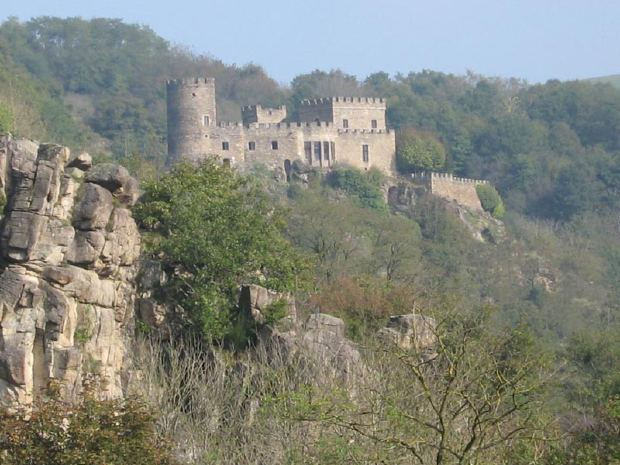
Medieval French castle from NicH at Morguefile: www.morguefile.com/archive/display/185626
Posted on September 30, 2015 Categories A Fair Trade Book, HistoryTags humor, medieval Europe, punk rock music
Thursday, March 23, 2023
Book Review: The Trumpeter of Krakow
Title: The Trumpeter of Krakow
Author: Eric P. Kelly
Date: 1928, 1942
Publisher: Macmillan
ISBN: none
Length: 218 pages
Illustrations: color plates by Angela Pruszynska
Quote: “He was the trumpeter of the Church of Our Lady Mary, and he had taken solemn oath to sound the trumpet each hour of the day and night...until death.”
According to the legend that takes up the first six pages of this book, this thirteenth-century trumpeter faithfully popped out on the tower, like a clock cuckoo, to serenade the invading Tartars. They shot him, and for another two hundred years the traditional tune was played in an incomplete form, in his memory. This is, however, the fictional story of a fifteenth-century youth who “reconstructed” the last notes of the tune...having plenty of adventures along the way.
Much historical research, and many quaint medieval details, went into this rather ponderous narrative. The author’s intrusive voice (“A five in the year 1407 had swept through this street...it was not until late in the 1490’s that the authorities compelled the students to live in university buildings”) occasionally clashes with his intention to describe scenes as if they were happening now (“Joseph noticed that there was still one more floor above them...As the light from the lantern fell upon his face, Joseph drew back”).
The story is plausible historical fiction, with gangs and ruffians, treasures, alchemists, spies, fires, and a king who arrives at the last minute to thwart the gangster who’s been trying to steal a treasure our hero’s family are guarding for the king. The ending may remind some adult readers of Steinbeck’s Pearl.
As an historical tale, The Trumpeter of Krakow has been appreciated by adult readers, but it’s written in the style of a particularly inspirational kind of adventure story for middle school boys, who should find it a challenging read. It’s a simple story with two distinctly bad characters, half a dozen thoroughly nice ones, and two fools. Polish words and names are explained, although the phonetic system that would allow English-speaking readers to read the story aloud is not explained, in the text. Contemporary children don’t seem to read it, but it won a prize as a children’s story in its day and is often shelved with the children’s books in libraries.
Usually recommended to those interested in Polish or Renaissance history, The Trumpeter of Krakow deserves consideration by anyone who likes fictional adventures. The color plates in my 1942 copy aren’t great art, but they have a certain Renaissance Faire charm, and may interest anyone interested in adding a Polish or Eastern European character to a Renaissance Faire.
Tuesday, March 21, 2023
Book Review: How War Changed Rondo
Friday, March 10, 2023
Book Review: Don't Cry for Me
Book Review: Don’t Cry for Me
Author: Klara Jarunkova
Translator: George Theiner
Date: 1963 (Slovak), 1968 (English)
Publisher: Four Winds / Scholastic
ISBN: none
Length: 287 pages
Quote: “Being sick in bed with a temperature is great. Just one evening with 104 and you get whatever it is you’ve been longing for.”
What readers liked about this school story from Soviet Czechoslovakia was that Olga is just like the fourteen-year-old heroines of Betty Cavanna, or even Judy Blume. That would also have been what they disliked about it. Olga’s dreams, crushes, mood swings, rebellions, and love of the younger children she baby-sits have a European cultural flavor, but in the end they’re about as mundane as those of American fourteen-year-olds.
Even the beatings? Well, actually, yes; in the United States too, in this period, many parents and teachers believed in corporal punishment. Adults were always threatening to beat kids black and blue, and actually giving them a whack with a wooden spoon, in the 1960s. Although the warmer climate, richer diet, and genetic diversity in the U.S. seem to have lowered the average age of puberty; American adults usually displayed some qualms about hitting a fourteen-year-old...but then all the fourteen-year-old girls in my class wore adult-sized bras, and most of us were taller than a few of the teachers.
In the course of Don’t Cry for Me Olga hangs out with her friends and relatives, defies her father and persists in baby-sitting the otherwise unsupervised children of the trashiest couple in the apartment building, tries to become a real artist, indignantly rejects the attention of unsuitable older men of sixteen, eventually has a sweet chaste age-appropriate romance with one, goes skiing with relatives, worries that her parents might get a divorce, feels guilty about the probability that she’ll do better than her friends on the competitive examinations that determine which kids go to high school and which to vocational courses, gets her hair cut, and makes a happy ending where she finds one.
Who shouldn’t cry for Olga? Maybe it’s the trashy couple’s children, when the mother, a prostitute, finally attempts suicide and the children are finally offered places in an orphanage; Olga won’t be baby-sitting them any more but at least (she hopes) they’ll have regular meals. Maybe it’s the teenaged girl readers who might not have realized that a teen romance that reaches its natural end can be part of a story that has a happy ending. Or maybe, just possibly—oh, how subversive this thought would have been in 1968!—it’s the English-speaking readers who are shown that, although Olga and her friends aren’t quite as well off as teenagers in the English-speaking world, their lives aren’t altogether miserable. Even behind the Iron Curtain.
Times have changed, and this novel is certainly no longer a story about what living in Czechoslovakia is like today, but some readers may enjoy it for its historical interest. And there may even be a few radical, subversive, artistic high school girls who appreciate the adult perspective Olga takes in narrating the realistically happy end of her first romance. Editors used to doubt that girls who could accept that their first hormone reaction was less than True Love existed, but they did, and they do.
Wednesday, January 18, 2023
Book Review: The Little World of Don Camillo
Title: The Little World of Don Camillo
Author: Giovanni Guareschi
Translator: Una Vincenzo Trowbridge
Publisher: Farrar Straus
Date: 1950
ISBN: none
Length: 205 pages
Illustrations: cartoons by the author
Quote: “‘And anyway it was not as God’s priest that I beat you up but as my political adversary. Anyhow I did it in a moment of weakness.’ ‘Besides this and your activities in that devilish party, have you any other sins to confess?’ Peppone spilled them out, but all in all Don Camillo found nothing very serious.”
The little world of Don Camillo and his frenemy Peppone, Guareschi said in one of many reprints of his best known book, was a fictional village similar to his home town. People would quarrel and fight as if they could settle their differences in a trial by combat, but they fought “fairly, without hate,” held few grudges, and were generally goodhearted and generous. So Camillo, the priest, and Peppone, the Communist (but he hadn’t gone far enough in his studies of Marx to give up being Catholic), constantly disagreed about local politics, but never forgot that they’d been friends when younger.
In the late 1940s, Guareschi said, the incidents that suggested these stories were news items. Sometimes he’d think of a variation on a news story that would be funnier, then decide that it couldn’t happen, then read another news story in which it did happen. Would Peppone really shoot at a plane while someone in it was dropping anti-Communist leaflets? Peppone wasn’t quite mean enough to do that, but Guareschi went ahead and wrote a story about such an incident after reading that a local Communist demagogue had indeed shot down a plane from which anti-Communist leaflets were being dropped.
Are these characters stereotypical Italians? Perhaps, but few Italians seemed to mind. After all, the stereotype of Italians includes being cheerful and goodhearted, and Camillo and Peppone are portrayed as brave, honorable veterans who had each other's backs during the war.
“If there is a priest anywhere who feels offended by my treatment of Don Camillo,” Guareschi wrote, “he is welcome to break the biggest candle available over my head. And if there is a Communist who feels offended by Peppone, he is welcome to break a hammer and sickle on my back. But if there is anyone who is offended by the conversations of Christ, I can’t help it; for the one who speaks in this story is not Christ but my Christ…the voice of my conscience.” In later volumes he said that the Christ with whom Don Camillo has long imaginary conversations is to be imagined as the one in Don Camillo’s head, but of course a fictional character’s “self-talk” is his author’s too.
This was the first collection of Don Camillo stories to be printed as one volume. Though the stories were printed separately, not as a serial story, the last few can be said to give the book a climax and a denouement.
Monday, January 16, 2023
Book Review: The Golden Book All Paris
Title: The Golden Book All Paris
Author: Giovanna Magi
Publisher: Casa Editrice Bonechi
Date: 1998
ISBN: 88-7009-191-0
Length: 128 pages
Illustrations: full-color photographs
Quote: “Writing a brief historical outline of Paris is no easy task: few cities have been so involved in great events which have changed the course of history.”
So, although there’s a sketch of the city’s history, no fear, this is mostly a photo album of Paris. Of course choosing what to include in the photo album is never an easy task either. Everyone agrees on the Eiffel Tower, the Arch of Triumph, and the Mona Lisa painting reprinted on the back cover. Beyond that, much depends on which of the pictures the visitor snaps come out best. (One way real progress has been made: with a good digital camera you can snap all the pictures you need to save only the ones that come out well.)
People who’ve been to Paris will start listing things that ought to be in the photo album and aren’t in this one, no doubt, but almost every one of these 128 pages contains premium-grade eye candy. Magi hardly needed to bother translating the text into English but she wrote nice, clear notes in English, too, if you can pull your eyes away from the pictures long enough to read them. If she’d chosen the title she would probably have chosen a better one. The Golden Book is a series of travel picture books printed by the publishers. Each book is “all” pictures of one popular destination or another.
If you’re a fan of “Wordless Wednesday” photo blogs, you might want to collect the whole series…though these Italian Golden Books are in no way connected to Whitman’s cheap, popular “Little Golden Books” for children.