Showing posts with label 1960s. Show all posts

Sunday, August 23, 2026

Thursday's Book Review: A Spell Is Cast

With apologies, Gentle Readers. Actually I do know what came over me, and, after this coming week, it's unlikely to come over me again. It's a one-time, off-blog job.

Title: A Spell Is Cast

Author: Eleanor Cameron

Date: 1964

Publisher: Little Brown & Company

ISBN: none

Length: 271 pages

Illustrations: drawings by Beth and Joe Krush

Quote: "Cory felt her heart lighten. She felt it quicken with excitement at sight of the gulls wheeling high up, being blown in the wind and then planing down on still wings."

Cory has always lived with her mother, mostly in New York City. During the time frame of this family romance, a spell is cast over Cory by the new pleasures she discovers at her grandmother's house on the northern California coast. Not only does she discover cliffs, caves, seabirds, boats, and beaches; she also meets interesting people her own age (unspecified, but apparently between twelve and fifteen) and bonds with the woman her uncle ought to have married.

Of course, Fergie and Andrew, the elderly hired couple whose names started to sound newly ironic around the time this book went out of print, claim that a spell was cast on Cory from the very beginning. She's enchanted because she happens to be lefthanded, and her name sounds like the word they used for this quirk in Scotland, "cawry-fisted."

Then there's the vague sense of pleasant wonder that Eleanor Cameron had such a way of weaving into her novels. Cory's uncle and his girlfriend would probably have been reconciled in any case. In 1964 anybody who played a musical instrument would probably have played the old tune "Greensleeves." Because this is an Eleanor Cameron novel, the adult romance has to be restarted when Cory hears each half of the former couple playing "Greensleeves" and thinks people who know such a lovely tune just have to be meant...Female readers seem to have forgiven Cameron's heroines, especially Julia Redfern, for this kind of self-dramatization.

The Krushes add their own kind of enchantment with their lavishly detailed drawings of old houses, cars, and costumes. Their line drawings were sketchy, almost cartoonlike, and for shading they simply scribbled with the side of the pencil, yet you could pick out any object the Krushes drew from a group of possible real-life models. This team had such a unique talent that even fellow illustrator Elizabeth Enright contributed two books (about a 1960s family who discover and restore a well preserved 1890s neighborhood) to the list of Krush-illustrated books. A Spell Is Cast sold well in the 1960s and 1970s and is probably one of the easier Krush-illustrated books to find...but it's not cheap.

This book is recommended to anyone who wants to recapture the spell this book cast over girl readers in middle school. As an adult romance, its plot may be a bit thin...or it may re-enchant romantic types' inner children enough that they'll forgive this book for having more scenes of childish wonder at beaches than scenes of grown-up passion. The passion is there all right; it's just family-filtered.

Book Review: The Merry Widow

Title: The Merry Widow

Author: Grace Nies Fletcher

Date: 1970

Publisher: William Morrow & Company

ISBN: none

Length: 245 pages

Quote: "This title was thrust upon me involuntarily by a television MC in Baltimore who was introducing me as the author of my book, What's Right with Our Young People?"

The author of In My Father's House and Preacher's Kids goes on to say that the bumptious young man first said she "looked like a schoolteacher," and then, thinking that that didn't sound "pretty" enough," rushed on to report that her extensive travels after her husband's death made her a "merry widow." Mrs. Fletcher admitted that this phrase is a bit self-contradictory, but then, she always had believed in the healing benefits of merriment. She had travelled widely with her husband, and refused to stop travelling without him.

So she wrote this book, not as a straight travel guide nor as a straight memoir, but in hopes of amusing other senior citizens. Possibly, she thought, inciting them to enjoy their retirement more, whether they were coupled, widowed, or single.

Like Mrs. Fletcher's other books, this one is entertaining, with dry little jokes: "The saddle was wooden with a thin sheepskin thrown over it, and when I leaped astride and felt for the stirrups, there weren't any."

"After we'd wandered about shrine-hunting for a few hours, we finally took a taxi and discovered that the directions should have been exactly reversed. Polly, who had lived here before, shrugged. 'He had to tell us whether he knew the way or not. Otherwise he would have lost face.'"

"Even the mosquitoes at Penang are polite...They don't boast, as the Bangkok ones do, 'I'm going to bite, I'm going to bite, I'm going to bite!' The Penang mosquitoes simply do their stuff and fly away, and live to bite another day."

Writing The Merry Widow seems to have cheered Mrs. Fletcher up. On the Fletchers' last flight together, the plane bumped, and she tells us that, knowing her husband had only a few days left, she "thought how pleasant it would be to die together." Still, inevitably, those of us who are born with an inclination toward merriment find it on the other side of grief. The mishaps of travel become funny. The lighter sides of work, books, people, float back into consciousness. Eventually laughter even stops dissolving into tears every time we realize that someone is no longer here to share the joke. At which point, if you were Grace Nies Fletcher, you would write another book.

The readers Mrs. Fletcher had in mind for this book were probably senior citizens, mostly female, who would have found the Red Hat Society too brassy. By now, however, the ideal reader for The Merry Widow might be anyone who's interested in the tourist attractions of Europe and Asia and would enjoy comparing the way these places are now with the way they were in the 1960s

This book is becoming hard to find; when the review was first posted Amazon had pages for another book, and of course a music score, with the same title, but no page for this one. Now it has a page, but no guarantee that the actual book is in stock anywhere as many buyers and sellers are pulling away from Amazon.

Tuesday, May 19, 2026

Book Review: The Heart of a Woman

Book Review: The Heart of a Woman

Author: Maya Angelou

Date: 1981

Publisher: Bantam

ISBN: 0-553-22839-0

Length: 272 pages

Quote: “I was not crying because of a lack of love...I was mourning all my ancestors.”

Some people are natural bachelors. Possibly Maya Angelou was one. In Singin’ and Swingin’ and Gettin’ Merry Like Christmas, her marriage to “Tosh” Angelos ended almost as quickly as it began. In The Heart of a Woman, while starring in a play, Angelou jilts an African-American man, marries an African man, and divorces him. Despite the grief for her ancestors she feels in Ghana and the panic she feels when her teenaged son is injured in an accident, she likes being on her own.

This fourth volume of Angelou’s memoirs contains more celebrity gossip than the first three books together. In this book, she’s a rising star whose social circle includes Billie Holiday, Lorraine Hansberry, James Baldwin, Harry Belafonte, James Earl Jones, Miriam Makeba, Martin Luther King, Malcolm X, Hanifa Fathy, and of course her short-term husband, Vusumzi Make, who was also a celebrity in Ghana. But the story covers the years from 1957 to 1967. These people are still fairly young, and none of them knows which of them will become famous.

Her son, Guy Johnson, is now mature enough to become an interesting character. Possibly the liveliest story about him in The Heart of a Woman is the one in which Angelou goes to a bully’s house, shows a teenaged gang a pistol, and promises that if the gang harasses Guy she won’t leave so much as a cockroach alive in their homes. For a mother, the gangsters, have to admit, she’s a tough “mother.”

Angelou also describes the most controversial and confrontational phase of her life. Banned from joining the Army because she’d attended an “un-American” night school, Angelou is now old enough to take a political stand—on the extreme left, of course. In The Heart of a Woman she does not directly address the charge often made against Dr. King, that he “was a Communist” (which might have been hard to prove), but does discuss some of the evidence on which the charge was based. The groups with which they worked supported Cuba, and when Khrushchev and Castro met in New York City, Guy declares that “the meeting...is the most important thing that could happen. It means that, in my time, I am seeing powerful forces get together to oppose capitalism.”

“All the [B]lack struggles were one, with one enemy and one goal,” and although many of the people involved would have defined that goal as equal civil rights, there were those who felt that reclaiming their African heritage meant reclaiming tribalistic or socialistic political systems. As Angelou describes these scenes, people singing “O Freedom” in protest of outrages did not take time to debate whether they were more concerned about the freedom of each individual or the “freedom” from economic opportunities and responsibilities that socialism claimed to offer.

In the lives of many people at this period, a conflict could be observed. Angelou is typical. Her actual focus was consistently, unmistakably, on the freedom of the individual, as exemplified in her marriages and divorces. At the same time she was working with organizations whose actions, when effectual, tended to promote bigger, more invasive government. It’s hard to blame Angelou, Martin Luther King, or any of their colleagues for this observed tendency when the historical fact was that people dedicated to the socialist religion were actively working to steer almost every organization that existed in a leftward direction. Even the superficially patriotic service organizations were being steered away from any concern with individual liberties and toward a quasi-religious reverence for the United Nations. Change-oriented groups, like those working toward civil rights, were being steered toward a position that was not really liberal at all, but far to the left. It would be unreasonable to expect, even today, that activists of Angelou’s generation would ever really denounce socialism. In the 1960s Angelou had been persuaded that socialistic or totalitarian tendencies were part of “Blackness”...and yes, within their demographic, she and Dr. King represented the moderate, peace-seeking, Christian, and patriotic side of things. Socialism has a morality of its own that seems compatible with Christian morality. In the mid-twentieth century the first "Communist" countries were still claiming economic success; supporting a peaceful transition toward a socialist dictatorship could still seem like altruistically supporting help for an oppressed class, although, after desegregation, the United States had never really had one.

Extremists in the civil rights movement were attacking the laudable efforts to overcome racism that Angelou recounts in Singin’ and Swingin’. Malcolm X was saying, “Any White American who says he’s your friend is either weak...or he’s an infiltrator.” There was some truth in this; friendliness and neighborliness are “weak” bonds compared with kinship and marriage. In the 1960s thousands, if not millions, of White Americans were seeing and saying that segregation was stupid, that it wasn’t always even possible to tell on which side of a color barrier an individual belonged, that maintaining separate schools was a waste of money and maintaining separate hospitals could amount to killing emergency patients. They (the generations before mine) were voting for desegregation. We (the older generation and also mine) rejected the idea of being offered unfair advantages on merely demographic grounds. White Americans did indeed support the civil rights movement, whether they were public figures making public statements like Eleanor Roosevelt, or rich people donating money to organizations like Shelley Winters, or neighbors sponsoring “deserving” college students like Joycelyn Elders. Still, this was “weak” support in the sense that it reflected a general feeling about how the world ought to be, rather than their own personal struggle for survival. As in the old joke about producing a country breakfast, the hen was involved, but the hog was committed.

Under such abrasive influences, Angelou admits, she backslid,. She played an unsympathetic character in a show that “became such a cruel parody of [W]hite society that I was certain it would flop.” In practice “Blacks in the audience reacted with amusement” or “coughed or grunted disapproval. They were embarrassed at our blatancy...Whites loved The Blacks.” The actors “howled in our dressing room. If the audience missed the play’s obtrusive intent, then the crackers were numbly insensitive...if they understood, and still liked the drama, they were psychically sick, which we suspected anyway.” It did not occur to the actors (they were young) that paying for tickets to this show might be a way White theatre-goers tried to express respect, support, or even apology.

So, when a White woman feels the need to tell Angelou that she and her friends have seen the play several times because “we support you,” Angelou snarls, still in her hateful character, “How many Blacks live in your building? How many Black friends do you have? I mean, not counting your maid?” The supporter “turned to leave, but I caught her sleeve. ‘Would you take me home with you? Would you become my friend?’” Not surprisingly, the supporter doesn’t feel friendly any more. No doubt she went home to tell her friends that in real life that young, cute actress they all admired was a real jerkette.

Young readers will shake their heads, wondering what was wrong with everybody in the 1960s. I don’t blame them. Something was wrong with Americans in the 1960s: almost all of us were choking on a huge tangled mess of lies about what “race” was and meant. Progress has been made. It did not flow steadily forward without a backward step.

But in this book Angelou is still making progress. She learned for herself that “strong” relationships could not be based on race alone, that a real African like Make was even less of a treat to live with than a White American like Angelos.

There are readers, and I am one, who still find these parts of The Heart of a Woman annoying. I don’t believe in a demographic approach to friendship. For me, personally, the High Sensory Perceptivity genes may dictate whether someone can become my friend or not; the skin color genes are irrelevant. When I lived in and near Washington, D.C., where the majority of people are African-American, then most of the people with whom I worked and several of my friends were African-American. I now live in a small town where very few people are Black, and I’ve never felt any desire to trail after them just so I could still claim to have an active friendship with someone who looks different from me. Friendship is a personal, individual thing, determined to some extent by chance, not by a desire to be politically correct. Still, rereading the scene where Angelou stayed in her nasty character and alienated her fan, I feel like yelling at her: “How many White friends do you have? Would you take me home with you?” Seriously, I know that that’s not the way friendships begin, and so did Angelou, even in 1964. She must have been very, very tired. But the scene is still annoying to read.

There are also parts of this book that tell us more than some people, probably including Guy Johnson, wanted to know. Angelou describes Make as physically attractive. The detailed description of the sensations of physical attraction caught the attention of several of the people who supplied blurbs for the Bantam edition. This is not a smutty book, but it’s a very sensual book...not the kind of book a young student wants his (or her) mother to write.

The Heart of a Woman is recommended to those who want to look back at history, who can stand a little annoyance just for the sake of appreciating the amount of progress that’s been made in fifty years. It’s also recommended to fans of any of the celebrities mentioned, who will appreciate these glimpses of these people before most of them became famous. It’s also recommended to anyone who’s read the first three volumes of Angelou’s memoirs and wants to read the whole sequence. It’s also recommended to the general (adult) reading public, because the parts that are not annoying or embarrassing are a good read.
 

Friday, January 16, 2026

Folsom Childhood Blues

(A DVerse writing prompt earlier in the week asked for poems inspired by the song "Folsom Prison Blues." That link-up has closed, so this post is being linked at https://dversepoets.com/2026/01/15/its-open-link-night-and-our-live-session-is-just-around-the-corner/ .)

Los Anglos generally think that Johnny Cash owned that song, and he certainly did sing it well, but a fun fact (that I actually learned later, in college) was that it was written for and recorded by Freddy Fender, who had been in the Folsom Prison for longer than it took to do a concert. I wanted to give this post a link to the Fender version, which los Mexicanos y los Indigenes in California consider the classic version. I did not find such a link. Here is a version by Los Hermanos Mendoza that comes closer to Fender's version than to Cash's.


The town called Folsom, California, has more attractive features than the prison. It has Folsom Lake and various parks and trails, not all of which lead to the lake. It has a library, schools, stores, hotels and all. It has a business district, now considered historic, where my mother once leased a shop. It has residential streets like this one, where we didn't live, but our street looked more like this than like any other public-access photo on Google; the street had four lanes, and the house we rented for almost two years was made of red bricks. My brother was born in Folsom.

All images came from Google.)


Folsom, California, is a pretty place.
If you are a child, it's best that you not show your face.
Gravel's all lots of people have even in front yards.
Play in the back where you're safe and fenced and barred.


Playing with the gravel, look up at the fence.
Ten-foot square on either side is all the land she rents.
The fence is made of redwood like trees that touch the sky.
Somewhere trees are still living; you might get there by and by.


Grass in front of this house will raise welts on your skin.
Sun will make your nose bleed. You might as well stay in.
Worst thing in the front yard is the traffic roaring through.
Drink and drive, smash people's cars just like they might smash you.


(One way to tell that that's not Mother's car is that she never parked hers across a cul-de-sac like that. It was sitting inside our driveway when the drunk driver ran out of the road and smashed it.)


The haze of all those cars' exhaust hangs in the morning air,
Corrodes the brains of people who had not one cell to spare.
Oh I want to get out of Folsom while I am still alive.
If we stay here any longer I might never see the age of five.


Well, the baby is behind bars just so that he doesn't fall.
Even baby likes to smash his bottles on the wall.
(That's why babies' bottles are made out of plastic today.)
Oh get us out of Folsom town, and take us far away.

(To be fair, a lot of people liked living in Folsom, and still do. But I don't think those people were four years old. If they were, they hadn't lived on a farm when they were three years old.)

Friday, June 28, 2024

Book Review: Who Wants Music on Monday?

This post originally appeared here on Blogspot with some links that rotted and needed to be removed. Without those links, it seems timely, so here it is again. What I forgot to put in, while putting in five links none of which is useful any more, was that this was one of my very favorite books in high school. If the high school librarian had done as most of the grade school teachers did and let everyone pick a book off the shelf to keep, this would have been my pick.

Title: Who Wants Music on Monday?

Author: Mary Slattery Stolz

Publisher: Harper & Row

Date: 1963

Length: 267 pages

What a disappointment being a parent must be, Cassie muses, midway through this book. You look forward to your children's being a comfort and a joy, and then you get...a son like Aaron. Or a daughter like Cassie.

Cassie, the skinny introvert artist in the family, is what her older brother calls "absolutely letter-perfect honest about everything in life," and Who Wants Music on Monday is to some extent the story of how she develops enough private feelings to understand the value of tact. Cassie enjoys some immunity to high school crushes because her older brother is the object of her idealistic love--idealistic not in the sense that she thinks he's perfect, but in the sense that she wants to be the perfect, adoring sister. At the beginning of the story boys have yet to notice that Cassie is a girl.

However, in the course of the story, Cassie notices a boy, Aaron, and he notices her, at about the same time...and then Lotta, the fluffy blonde middle child in the family, develops a crush on this boy too. After all, they have things in common: both of them are employed as entertainers at children's parties.

All late bloomers, younger sisters, and girls who've deliberately chosen to hang out with friends who seem more popular or sophisticated, will love what happens next. (If your friend or sister is nicer than Lotta, the story is still a delicious warning to her.)

Let's just say that at the end of the story Cassie has three solid friends outside the family, one of whom is Aaron, and Lotta has some growing up to do. Lotta thought she was popular. And mature.

What's not to love? Well...at fourteen, I remember being disappointed that there's not much music in the book. In 1963 teen novels were selling like hotcakes and publishers were trying to tag each one with a unique, clever title. "Who wants music on Monday?" is a throwaway line uttered when the mother and aunt are eating lunch in a restaurant that advertises live music, but doesn't have a band on Mondays. This is not a book about music or musicians. If anything it's a book about differences.

Mary Slattery Stolz was one of the best authors of the late twentieth century. She specialized in stories about sensitive, introspective young people, partly because they allowed her to call readers' attention to the thoughts and feelings of the adult characters too. Cassie tries to understand why her parents seem to prefer Lotta's way of being a teenager to her way, and why her Irish-American father (who's never actually been in Ireland) is prejudiced against both of her brother's very nice roommates (one's an English expatriate and one's African-American).

Writing about sensitive, socially conscious characters also made Stolz's young adult novels real period pieces. Sometimes the factors that date the books aren't the ones that seem meant to place the books in time. Fluffy pale yellow sweaters have come back in and out of fashion since 1963, and had even, as one Amazon reviewer suggests, been a possible time-stamp for a story set in the 1950s. What's definitely 1963 is the sense of the girls needing work, and only being eligible for gender-specific, lower-paid jobs. (Not to mention Dave's willingness to attend an almost all-White college where he's always conspicuous and sometimes a target...readers already knew about that time-stamp.)

Another time-stamp is the important plot element of Lotta's being an entrepreneur. She and one or more buddies collect small amounts of cash for supervising children's parties. Parents are willing to spend that kind of money on small, home-based birthday parties with only three to six guests. Parents are willing to hire teenyboppers to supervise the parties. One "strange," very rich and trendsetting couple even trust their seven-year-old birthday girl to entertain her little friends, and supervise three teenagers the parents haven't actually met, all by herself..."She doesn't have the sort of childhood babies cry for," one of the girls observes about this child, while another one can't get over the child's not clinging to a parent's hand--is she an alien disguised as a child?

If you want to find the political element in everything, you may enjoy remembering the trade-off. Lotta works harder than Aaron, and collects less money, even as an entrepreneur, and Lotta would definitely be stuck in a pink-collar job--perhaps, like her aunt, working her way up from cashier to floor manager or buyer if she made a "career" of doing student labor in one place all her life. On the other hand, it's ever so much easier for Lotta to open a business of her own, which has the potential of becoming the real career of her dreams, than it would be today.

Peer pressure would definitely be applied to any parent who let three teenagers supervise a party for their birthday child these days, especially if one of the teenagers was a boy. However, there are people, about the age Lotta would be if she'd been real, who still make a business of entertaining at children's parties. (When this review was originally posted, it contained an advertisement for a local couple who did that. Their web site is no longer functional. That's why the post was pulled and reposted.)

What I would like to call to your attention, Gentle Readers, is yet another social change. In 1963 the child who didn't fall to pieces, emotionally, when her parents blew off her birthday party, seemed like an alien freak. I read the book, not for the first time, in 1983 and thought, "By now everybody knows a child like that." By 1993 I'd taken a class where the professor argued that children whose parents left them in day-care-type environments, routinely, could be considered to have been blessed with precocious "social skills." By 2012 I'm afraid that the child character Ella may seem normal to young readers. And I'll bet you can't visualize her as a trim, healthy, active child, either.

When this review originally appeared, some of The Nephews were small children who had a terrible choice: their father thought they needed to be plugged in to all the current electronic fads, at his house; their mother, grandmother, and aunt agreed that they needed a place to unplug at Grandma's house. The kids loved the real world of real, physical interactions with adults, plants, animals, food, swimming pools, and so on. What made them wistful and misty-eyed was the thought of sharing comparable unplugged quality time with Daddy.

Do the children you know feel the same way? I recommend finding out before the birthday bash. Hire the clowns, by all means, and learn from the professionals along with the child. Try clowning around the house. Try baking cake from scratch, too, and playing the real-world games with the child in real time. Children become able to have more fun and remember it better as they grow up, so regularly spending summer vacation time with them almost guarantees that each summer will be the best one they ever had.

Wednesday, August 30, 2023

New Book Review: Humphrey and Me

Title: Humphrey and Me 

Author: Stuart H. Brody

Date: 2023

Publisher: Santa Monica Press

ISBN: 978-1-59580-766-3

Quote: "EVENTS IN THIS NOVEL were drawn from my real-life relationship with Hubert Humphrey or otherwise documented by credible historical accounts. Certain events, dialogue, and characters were fictionalized in service of the story, but might well have occurred as depicted."

In real life Stuart Brody was a student volunteer with Hubert Humphrey's campaigns. He still maintains that "Hubert Humphrey was an eminently good man" today. He wrote this novel, which has an authentic 1960s romance in it too, as a study of the role of hero worship, real fathers and ideal fathers and father-figures, in the life of a young man. The fictional Ray Elias has some conflicts with his real father, who dies first, and some with his father-substitute Hubert Humphrey, for whom he works and whom, of course, he also outlives. 

I think the novel shows, especially in chapters told from the fictional vice-president's point of view, that Brody is still projecting a lot of his feelings for his father onto the memory of Vice-President Humphrey. The question I would most like to ask the author is, "So, did the sitting Vice-President ever actually visit you in your dorm room, or is that the part you only wished had happened?" 

President Lyndon Johnson was...shall we say a very polarizing man? I find him utterly repulsive, but my husband, whose memories of his career were clearer, said "But he was a charmer. I can't say why, but people did seem to like him." Since I was just learning to read during the Johnson Administration, and my husband was an undergraduate at McGill, I have to give some value to his insights. Certainly the image of LBJ and his relationships with Humphrey, and other people, found in this book was a widespread one--thanks in part to Stuart Brody! The soap opera villain, J.R. Ewing, was also based largely on tis characterization of Johnson. The President who got us into Vietnam was hated in the way President Trump was hated. Like Trump, Johnson gave the nation a follow-up administration of unbelievable blunders--including allowing the price of rice to exceed the common man's ability to pay!--because some people would have voted for a dog if the other major party had nominated a dog to run against that awful person. 

Anyway, it's historical fiction about the lives of the non-voting but politically active students of the 1960s. A man would be better qualified to judge how well it's written. If you are a baby-boomer who wants a good long nostalgia trip, or a younger reader who wants to know what older people may be comparing you to when they say your generation is clueless and apathetic, you will want to read this book.

For others, it may be comforting to remember how endangered our civilization seemed to be during the Johnson Administration. That evil passed. So also may this.

Friday, June 16, 2023

Book Review: Time Traveling to 1963

Title: Time Traveling to 1963 

Author: Richard J. Thomas

Date: 2023

Publisher: Richard J. Thomas

ISBN: 9798366458412

Length: 92 pages

Quote: "[B]y 1966 the [Beatles].. decided they could no longer perform live and never toured again. The screaming drowned out the music and also made it unsafe for them to travel."

Perhaps the most surprising thing about the news items collected in this book is how many of them you might associate with years later than 1963. A lot of things that started in 1963 were still holding people's attention five, ten, or twenty years later. 

Consider the author's list of memorable books published that year. Planet of the Apes spawned a television series in 1974. Where the Wild Things Are was in use in primary schools all through the 1960s and 1970s, depending on how long it took each classroom to get a copy and wear it out. Hop on Pop is still in print today. The Feminine Mystique was recommended reading at some workplaces in the 1980s before becoming required reading for "women's history" courses. The Encyclopedia Brown books kept rolling out into the 1970s. Some of you Gentle Readers matured earlier than I did, but I read The Bell Jar in 1980, Cat's Cradle in 1983, and The Fire Next Time in 1991. 

Time Traveling to 1963 is the first (that I've seen) in a series of books intended as gifts to people born in a specific year or resources for authors writing historical fiction about it. If your characters are stuck for conversation, and it's still only September of 1963, you might have them flip on the radio and catch one of the songs that were being played in memory of a recently deceased singer like Edith Piaf, or speculate about the psychological mechanisms that caused teenaged girls to scream at the Beatles, or talk about one of the sports events that...read the book.

Because these books are full of big splashy nostalgia-inducing pictures, the three review copies from this series that the author tried to send me snagged in the e-mail and almost got destroyed as spam. They snagged in the spam-destroying mechanism, too! Once retrieved from the spam folder the e-books behaved quite nicely as PDF files in Microsoft Edge, but you'll want printed copies, anyway, to pass around and reminisce about. Every family includes someone who remembers 1963.

That would be the whole year. Most of the news items of 1963 took place before the big, heavy story in November; most of what people saw in the news media was cheerful content encouraging them to buy stuff. There's a whole chapter of "Iconic Ads." 

Monday, May 22, 2023

Book Review: Complete Book of Roasts Boasts and Toasts

Title: Complete Book of Roasts, Boasts, and Toasts

Author: Elmer Pasta

Author’s web site: http://quotepixel.com/author/elmer_pasta

Date: 1982

Publisher: Parker Publishing Company

ISBN: 0-13-158329-8

Length: 375 pages

Quote: “Say you’ve been forewarned that you will be the subject of a roast. List all your own personal characteristics and look them up here. Jot down the Boasts under each category.”

Elmer Pasta’s claim to fame was that he supplied simple one-liners like these to comedians, including Phyllis Diller and Art Linkletter, who worked his jokes into their famous performances. If you liked the sort of jokes that can still be heard on endlessly rerun TV comedies from the early 1960s, here are 375 pages of them.

Each “characteristic” (job title, hobby, relationship to the joker, feature of appearance) that could safely be ridiculed, under the rules of 1980s etiquette, here receives four comic insults (the roasts), one comic comeback line (the boasts), and one joke that may be insulting or may be a neutral silly pun (the toasts). Thus:

“APARTMENT MANAGER: ROASTS. She said she has a lush apartment for rent. I believed her when I tripped over a drunk!…” (To read the other three roasts, you’ll have to buy the book.)

“BOAST. All my apartments have nice views but there’s no overlooking the rent!

“TOAST. Here’s a toast to our apartment manager—the only way you can get her to paint your apartment is to move out!”

With a few obvious exceptions (mostly in the relationships category), the jokes are unisex, alternating between “he” and “she”; two of the other roasts cast the apartment manager as a “he.” Most of them are generic, silly, and harmless.

To anyone over age 40 (or anyone who has spent a lot of weekends watching one of the Reruns Channels with Grandma) these jokes will have a vaguely familiar ring. A few may even be too old to make sense to younger people. Do young people still recognize “a tomato with lots of lettuce” as slang for “a young woman with lots of money”? (People my age understood it, but didn’t say it—we had newer words.) Then again, if you want to participate in a “roast” and exchange comic insults with a friend, the age and familiarity of these jokes may make them safe.

According to Google, Elmer Pasta is alive and well, although his Facebook and Linked In pages are visible only to visitors who are logged in through one of those sites, which annoys me so much I’m not even willing to bother logging in to Linked In. He’s still a writer and advertiser, and some of his toasts are now available as reusable graphics. Right. Here’s the kind of e-friend I want to be to Pasta:


And to other writers whose early works I resell as Fair Trade Books. To buy the Complete Book of Roasts, Boasts, and Toasts, send $5 per book + $5 per package to either address in the lower left-hand corner of the screen. From this $10, Pasta or a charity of his choice will receive $1. If you buy four copies, send me $25, and Pasta or his charity will receive $4.

Posted on September 24, 2015 Categories A Fair Trade Book, Humor Tags pop culture


Monday, March 13, 2023

New Book Review: Charlie Utopia

Title: Charlie Utopia 

Author: Nowick Gray

Date: 2022

Publisher: Cougar

Length: 363 pages

ISBN: 9781990129230

Quote: "He had even plotted the end of his autobiography, envisioning life after fifty as icing on the cake."

Why read this novel? It's funny in a dry way, but not too funny to read in public. It's sad in a dry way, too, but not so sad as to be depressing. Mainly it's nostalgic. Charlie Utopia is a baby-boomer who lives in his utopian dreams, brings them into life in most ways--he succeeds at all the different things he wants to do as fun jobs, doesn't have to give much time to jobs taken just to pay bills, builds his own house, travels with a band, gets into all the beds he seems really to want to get into. Yet he's always just slightly depressed, because for all the self-help books he reads and all the trendy roads to happiness he follows, something eludes him.

And what that something is, is Love. Charlie's always loved himself and arranged for his own comfort. He's a decent man, and his own comfort includes doing honest work well, being a satisfactory bedmate, and providing for his one positively known child. But his good will fails to extend beyond the end of his own nose. He seems to keep track of the names of the women he's married or lived with, but beyond their different demographic profiles he's aware of very little about them, so it's hard for the reader to remember which fits into which part of his story (and that plus the philosophical fads are often the only indication of what year it's supposed to be, from scene to scene). He doesn't abuse his daughter, but he seems to know nothing about her except as baggage that comes with one of the women he's given pleasure yet failed to know. People always drift away from him and he never knows why. He has no religion. He hopes being a left-winger will appease the envious masses of people who have less than he and his friends have, but never gets to know any of them personally either. Determined to use his talents to preserve the space for the rich interior life his introvert brain needs, he fails to find the working partnership his introvert brain craves next. Many people seem to agree that he's a good neighbor, but he has no close friend, male or female.

It doesn't take 363 pages to paint a credible portrait of a man who has everything but love, so reading this book is mainly a nostalgia trip for those currently over fifty. If you have or have had a Partner For Life, you can enjoy feeling sorry for Charlie. If not, you may enjoy sharing his richly detailed life travelogue of work, thought, passion, and the sense of mild depression that sets in just when Charlie is in his workshop enjoying the other things. 

Friday, March 10, 2023

Book Review: Don't Cry for Me

Book Review: Don’t Cry for Me

Author: Klara Jarunkova

Translator: George Theiner

Date: 1963 (Slovak), 1968 (English)

Publisher: Four Winds / Scholastic

ISBN: none

Length: 287 pages

Quote: “Being sick in bed with a temperature is great. Just one evening with 104 and you get whatever it is you’ve been longing for.”

What readers liked about this school story from Soviet Czechoslovakia was that Olga is just like the fourteen-year-old heroines of Betty Cavanna, or even Judy Blume. That would also have been what they disliked about it. Olga’s dreams, crushes, mood swings, rebellions, and love of the younger children she baby-sits have a European cultural flavor, but in the end they’re about as mundane as those of American fourteen-year-olds.

Even the beatings? Well, actually, yes; in the United States too, in this period, many parents and teachers believed in corporal punishment. Adults were always threatening to beat kids black and blue, and actually giving them a whack with a wooden spoon, in the 1960s. Although the warmer climate, richer diet, and genetic diversity in the U.S. seem to have lowered the average age of puberty; American adults usually displayed some qualms about hitting a fourteen-year-old...but then all the fourteen-year-old girls in my class wore adult-sized bras, and most of us were taller than a few of the teachers.

In the course of Don’t Cry for Me Olga hangs out with her friends and relatives, defies her father and persists in baby-sitting the otherwise unsupervised children of the trashiest couple in the apartment building, tries to become a real artist, indignantly rejects the attention of unsuitable older men of sixteen, eventually has a sweet chaste age-appropriate romance with one, goes skiing with relatives, worries that her parents might get a divorce, feels guilty about the probability that she’ll do better than her friends on the competitive examinations that determine which kids go to high school and which to vocational courses, gets her hair cut, and makes a happy ending where she finds one.

Who shouldn’t cry for Olga? Maybe it’s the trashy couple’s children, when the mother, a prostitute, finally attempts suicide and the children are finally offered places in an orphanage; Olga won’t be baby-sitting them any more but at least (she hopes) they’ll have regular meals. Maybe it’s the teenaged girl readers who might not have realized that a teen romance that reaches its natural end can be part of a story that has a happy ending. Or maybe, just possibly—oh, how subversive this thought would have been in 1968!—it’s the English-speaking readers who are shown that, although Olga and her friends aren’t quite as well off as teenagers in the English-speaking world, their lives aren’t altogether miserable. Even behind the Iron Curtain.

Times have changed, and this novel is certainly no longer a story about what living in Czechoslovakia is like today, but some readers may enjoy it for its historical interest. And there may even be a few radical, subversive, artistic high school girls who appreciate the adult perspective Olga takes in narrating the realistically happy end of her first romance.  Editors used to doubt that girls who could accept that their first hormone reaction was less than True Love existed, but they did, and they do. 

Tuesday, December 20, 2022

Book Review: The Virgin of Bennington

Title: The Virgin of Bennington

Author: Kathleen Norris

Publisher: Penguin

Date: 2001

ISBN: 1-57322-179-1

Length: 256 pages

Quote: “Before I arrived at Bennington, I had no notion of its reputation on thed East Coast.But I soon learned that to many people the term ‘Bennington girl’ connoted someone who was flamboyantly (if not oppressively) artsy, bohemian, and also notoriously easy with sexual favors…I was by no means the only student who took her studies seriously. But I did feel isolated.”

This book is actually a pleasant adult read—very adult, all about work and philosophy, never a steamy moment—but it deserves some sort of award for having the Worst Title. It’s not about virgins, or Catholics, or religious art. I think the publisher was hoping to sell this book to people looking for sensational stories about any or all of those things—something like The Da Vinci Code—and those readers are guaranteed to be disappointed.

At Bennington, the author of Dakota and Little Girls in Church wasn’t exactly religious. She was just an introvert who didn’t want to go quite as far into sex, drugs, and every other mindless rebellion a kid could think of, quite as fast, as her dorm mates did. So although she didn’t actually stay a virgin for most of her college years she was nicknamed “the Virgin of Bennington.”

But that’s only a preface to explain the attention-grabbing title, not what the book is about. The sins of good writers’ youth are seldom memorable; Norris doesn’t claim to be an exception. (One married man—not named—and a few underwhelming drug trips.) So what she actually delivers to readers is a memoir of the last years of her first employer, a friend to poets, and what her employer did for writers and writing in the late twentieth century. This turns out to be an inspirational story—about poets, working to spread interest in poetry out from New York City. Elizabeth Kray, “Betty,” had been married long before Norris met her, and Norris was at least considering marriage to David Dwyer at the end of this memoir.

Since none of Norris’s books is exactly sensational, and this one’s not even religious, The Virgin of Bennington is a book for a small niche market. It’s more biography than autobiography, but a personal reminiscence rather than a formal, researched, full-length biography. It’s written in short bloggy sections arranged mostly in chronological order, with a little noticeable repetition, not much. The question it answers, in the context of Norris’s better known books, is “How did Norris prepare for the extraordinary half-monastic, half-artistic life for which she’s known? Did she ever have to work for someone else, and if so who, when, where, and why?” We learn how Kray helped prepare both Norris and the United States for Norris’s adult career.

Those seriously interested in women’s history, literary history, poems, and poets will love this story. I do. But although you can recognize the voice of the bestselling essayist in this memoir, it's also easy to see why the memoir was not a bestseller.


Thursday, December 15, 2022

Book Review: The Broken Gun

Title: The Broken Gun

Author: Louis L’Amour

Date: 1966

Publisher: Bantam

ISBN: none

Length: 151 pages

Quote: “What itneglected to mentionw as the slip I’d made during a moment of exuberance on a television interview when I said, ‘Among other things I want to find out what happened to the Toomey brothers.’”

What happened to these characters in fictive history, writer Dan Sheridan soon learns, is that their descendants have become a criminal gang in the 1960s. Sheridan is soon a prisoner at their hideout in the desert where, among other things, he has to scale that sheer stone cliff depicted on the front cover to save himself and the young woman the gang are also holding prisoner. What’s been jammed into the old broken gun is revealed at the end of the book: when loaded for the last time by one of the original Toomey brothers, Sheridan reports, that gun “was really loaded.”

Wednesday, December 7, 2022

Book Review: A Reporter's Life

Title: A Reporter’s Life

Author: Walter Cronkite

Publisher: Knopf

Date: 1996

ISBN: 0-394-57879-1

Length: 384 pages plus photo insert

Illustrations: black-and-white photos

Quote: “By the time I was six I already was taking to instant news analysis. The event was the death of President Harding.”

Walter Cronkite saw, remembered, and reported a lot of things. In this book he shares his personal take on many stories he did and did not report on radio or television, including those industries, themselves, and the production of his shows. Lots of mini-stories, many of them funny and heartwarming, some more “exciting.” As a war reporter he was allowed to fly in a fighter plane and taught to use a spare gun: “I don’t think I hit any, but I like to think I scared…those German pilots.”

He came to know many famous people well. In this book he shares a story about a former President’s marital relations just as, he claims, the former First Lady told it to him. (Hint: this was the First Lady whose hopeless voice was almost never allowed to spoil the lovely picture she always made.) Another President used to watch Cronkite’s news broadcasts and call to demand what he considered improvements. Cronkite quarrelled civilly with a sitting Prime Minister, triggered a career crisis by joking that a colleague might “already have” died in his TV show, went to Kennebunkport with the Bushes.

He'd learned early in his career to report the news in a way that seemed neutral and objective while he was biased. In this book Cronkite reveals some personal opinions: he was “conservative” about 1960s pop culture, but when it came to politics, why deny that supporters of global totalitarianism exist? Cronkite admits he was one. He still was one while writing this book.

Whether or not you agree with Cronkite’s opinions, even while airing his opinions he was still expert at finding good, inoffensive stories and telling them tersely. So his memoir is still fun to read. My guess is that, the more of the twentieth century you remember, the more you’ll enjoy reliving it with a TV icon who dominated an important part of pop culture for half of it.

Sunday, October 2, 2022

Book Review: In Spite of Dungeon

Title: In Spite of Dungeon

Author: Dorothy C. Haskin

Date: 1962

Publisher: Zondervan

ISBN: none

Length: 150 pages

Illustrations: black-and-white photos

Quote: "What they preach and teach is believed not because they can sing, 'faith of our fathers,' but because they can sing, 'In spite of dungeon, fire and sword...we will be true.'"

Faith of our fathers, living still
In spite of dungeon, fire and sword:
Oh, how our hearts beat high with joy
Whene'er we hear that glorious word!
Faith of our fathers, holy faith,
We will be true to thee till death.

Are children still taught this classic hymn, or has it been declared sexist because we used to think that adding a verse about the "faith of our mothers" would be a joke? Someone missed a real educational opportunity with my fifth grade class. When we were singing "Faith of our mothers" as a silly "opposite," we should have been directed to compose verses specifically about women who suffered for their faith. And sing them. In public.

However, when Dorothy Haskin was sent on a quick tour of Taiwan, Hong Kong, Japan, Korea, and the Philippines, with a stop in India, to interview fifteen first-generation Christians who had endured at least financial losses for their faith, she met only men. Apparently no women wanted to be interviewed, because it certainly was not that religious persecution was carried out in a chivalrous way. "Kim Joon-gon saw his wife and father beaten to death by the Communists," Haskin was told.

Names can be confusing. Haskin follows the oldfashioned rule of referring to people by the polite form of address in their country, which leaves the reader to discover that the chapter headed "Kim Moksa" (the Reverend Dr. Kim) is the one about Kim Joon-gon. Several Koreans introduced by their full names are later referred to as "Kim Si" or "Lee Si," explained as equivalent to Mr./Mrs./Miss Kim/Lee. In the chapter about "Kurumada Sensei," most references to this Japanese teacher in the text use his title and leave the reader to identify this polite phrase with a reference to "Kurumada Akiji," the old gentleman's name, on a prison list. Some other Christians adopted a saint's name, and used it in place of their original given names. Some foreign names do sound strange in English; Lee Yung-ho understandably preferred that the English text refer to him as Andrew Lee.

Anyway, the minister whose family were killed in North Korea is interviewed in chapter two. For younger Asian Christians, the sacrifices they made for their faith were subtler than literal "dungeon, fire, and sword." Matsuura Sensei, whose given name is not used in the text at all, owned a lumber mill. "The boiler man...was ready to throw himself in the fire when he thought of his mother. He has been taking care of her so he has gone to get her and they will both commit suicide," Matsuura was told. Just as he was ready to leave for a business trip, Matsuura's business went up in flames. He stopped, waited for the man and the weeping old lady to approach the fire, and gave them a direct order not to try to "make amends" by running into the blazing mill. He told his employees, "It is not the fault of the boiler man, but my fault... because I did not evangelize you...I am a Christian, but I have been too busy." Though this successful businessman took a heavy financial blow for his faith, his story (chapter six) is thoroughly cheerful.

Other stories, of individuals who sacrificed only lucrative jobs or political positions, may seem less dramatic...until you remember why these people were chosen to be interviewed. Willingness to tell Haskin their story in English was a major factor in the selection of the subjects for this book. Having reached a high level of indisputable success was a basic criterion. Haskin was not sent to interview storekeepers or taxi drivers, however devout, but business leaders, principal teachers or doctors, high-ranking political officials. These men were polite and modest, so they don't stress how, after having sacrificed one rewarding position, they found another, even better one. Neither does Haskin. The chapter heading is the punch line of at least two short, modest stories.

Despite her efforts to be polite Haskin's language has to be read with a sense of its historical context. "What kind of people" are Filipinos--"Oriental," Spanish, or American? she asks, introducing Dr. Virgilio Canlas, and answers, "They consider themselves Oriental." Six pages later, she concludes Dr. Canlas's mini-biography with "All in all, a Filipino makes a splendid Christian. His Oriental traits of native humility make good ground on which to build." Well, it passes the reversal test--sort of: "An Anglo-American makes a splendid Christian. His English traits of native..." what? Adventure-seeking? Money-making? I squirbled slightly. 

Maybe instead of reprinting this book, somebody should retrace Haskin's steps, write full biographies of these first-generation Christians now that (since they'd had distinguished careers before 1962) their stories can be regarded as complete, add some women and perhaps stories from additional countries, and use language that doesn't make modern readers queasy. A good non-denominational book on that topic, preferably written by a second- or third-generation Asian Christian, would be one I'd like to read. But, meanwhile, why let archaic phrasing ruin good true stories?

Friday, September 9, 2022

Book Review: The Boys in the Brazos River Bottom

Title: The Boys in the Brazos River Bottom 

Author: Peter L.Scamardo II

Date: 2021

ISBN: 978-1-7375404-1-0

Length: 282 pages

Quote: "The boys knew their house didn’t have twelve oak trees outside, but it did have three pecan trees."

So they called the house Three Pecans.  

This is a novel about the summer of 1969, not as it's been remembered in pop culture, but as it really felt to three teenagers living through it. In real life we weren't all in rebellion against our parents. Some baby-boomers actually liked and respected our parents. Matt/Matteo/Matthew, Josh/Giosue/Joshua, and Tommy (nobody calls him Tommaso or Thomas) Ruggirello are three of that kind. During the summer all three disagree with Papa Ruggirello. Matt even speaks angrily and drives angrily away, just burning up gas on lonely back roads until he feels sleepy enough to pull over and be awakened and escorted home by the local police force (a first cousin once removed whom he calls Uncle Frank). Yet in their disagreements they respect their Papa. (Their Mama and their one sister don't seem especially admirable or especially close to the boys, but the boys respect them, too.) 

Not that the story is a pastoral idyll. In the first scene Papa shows the boys how to tie off a calf's vestigial fifth leg without hurting the calf (they were expecting they'd have to kill it). Further on we'll see farm laborers threatening each other's lives. a patient with an infected wound tearing the wires out of his mangled hand, Matt and Josh splattered with muck while Papa rushes Tommy to the hospital, and other gross-outs. Rural life is heavenly at time and very earthy at other times. Though the closest the novel comes to a sex scene is an accusation uttered by one of the quarrelling laborers, and the closest it comes to violence is that one of the laborers has a shotgun, there's still plenty of action and gross-outs. 

Nevertheless the plot element that shapes the story is that Matt is a National Honor student, invited to choose among full scholarships to thirty-five universities. He feels almost disloyal about mentioning to Papa that he might not want to go to the Texas Agricultural and Mechanical University. Papa's first reaction is that he is almost disloyal for thinking that, but, upon reflection, Papa agrees to take the family to tour other universities, "as long as it's in Texas...and not the University of Texas." At Baylor Matt's impressed by the scenic beauty of Waco, but he's strangely drawn to the intellectualism at Rice, at the same time he's repelled by the elitism.  

There's an ironic nod to another well-known book about an Italian-American family. Mama Ruggirello doesn't own a lot of books, but reads the beginning of Gone with the Wind over and over. On the family's university tours, Mama finds a new novel to read, about people with names like theirs and their neighbors', family get-togethers like theirs and their neighbors'...only somehow the Ruggirellos get along without a Godfather. 

When I posted a short review at Goodreads, I noticed people recalling a different 1960s pop culture phenomenon--the TV show "Bonanza," which was produced between 1959 and 1973 and was also about a father of three very different sons who love and respect one another. The way the book's written, some noted, would be easy to adapt to a weekly prime time TV show. The major TV networks do seem to be ripe for another good storyline featuring a strong, wise father and three loyal sons...I don't know whether the author self-published this book with a TV version in mind, but it could work that way. 

If you like wholesome novels about credible, lovable White men doing real men's work together, you will like The Boys in the Brazos River Bottom.

Tuesday, September 6, 2022

Book Review: Why Not Join the Giraffes

Title: Why Not Join the Giraffes?

Author: Hope Campbell

Date: 1968

Publisher: Grosset & Dunlap

ISBN: 0-448-21290-0

Length: 223 pages

Quote: "Why would he be interested in the first place? Don't you know the impression your family gives rubs off on you?...And I don't want to wind up with a starving artist...I want a--a regular, ordinary life!...The kind of boy who buys you a chrysanthemum for football games, and you sit around afterwards talking about stuff by a roaring fire."

Probably the easiest way to summarize this farce is to describe it as a teen-romance version of Irma's Big Lie. That's a short review; can I throw in some more words? Why not? I've laughed at this book for forty years; I can throw in as many words as you want...

Money's getting tight in the Henderson household, with father John "Mark" Henderson between script sales and mother Helene having had another baby instead of a visual art show. (This is not, however, a family that's ever been poor. Their New York City flat is positively posh, and when Suzie talks to other kids at a nightclub she's instantly tagged "Uptown." The alert reader may surmise that one reason why the Henderson parents don't have enough money to send their kids to camp is that they seem to hand out enough of it from week to week for just about anything--faddy clothes, restaurant meals--sixteen-year-old Suzie and fourteen-year-old Sam want.)

Still, Suzie's not exactly thinking far enough ahead to be considered a gold-digger. She's not looking for a rich young husband; how icky, she's only sixteen. She's looking for the sort of nice boy who's interested in (and can afford) the sort of nice dates that interest Suzie and impress her girl friends, of whom only one, Natalie Goldman, is close enough that Suzie hangs out with her in summer. Art museums, medieval flute concerts, meals at her family's favorite restaurant, football games in fall, and proms in winter...as opposed to hanging out and playing with or listening to Sam's rock band. Suzie's the rare baby-boomer (yes, we did exist) whose favorite musical genre does not happen to be rock, though like most of us she appreciates a really good rock song.

Suzie is one of those tall, cute blondes who never have to worry much about finding a date, but in 1968 even those girls couldn't afford to relax. This was the era of an active effort to distract girls from serious competitions for grades, scholarships, or jobs, by obsessing over every detail of their appearance. Not only other teenagers but even adults are judging where Suzie fits into society by whether she puts on the Levis (in which she herself feels grungy and sexless) or the white dress (she must be on her way to be a bridesmaid!) or the pink one (that gets respectful attention) or the tight purple slacks (that make her look to rude boys "like a traffic light that just turned green"). Suzie can't just smile at a boy and expect him to smile right back. Likely he wouldn't smile right back if she weren't dressed for his social circle. Suzie has just said goodbye to last school term's boyfriend Bill, who moved to the suburbs, and now she needs to pay attention to her look in order to attract a similar sort of boyfriend, like new neighbor Ralph, instead of one of Sam's friends and admirers.

Well...Ralph. And he almost deserves it. I didn't care for Teen Romance much as a teenager, and I think my tolerance for this spoof of Teen Romance may explain why. I knew all about physical attraction, as a teenager. Usually it worked only one way, and if a person had any brain she or he kept quiet about it, and it ran its course and went away, like flu. When it was mutual it always seemed to turn out very inconvenient and embarrassing for all the kids I knew who actually achieved couplehood, who were (thank goodness) a minority; whether they just realized that during the next phase of the hormone cycle they didn't even like each other, after having told everyone they were In Love Forever, or whether they actually eloped and were stuck for...oh, pity.

In any case, by and large, the girls I knew didn't idolize teenaged boys. Some of us told friends which boys we thought were cute, meaning they didn't mind being teased about and might even want to be annoyed and disappointed by, and some of us just quietly watched the ones we thought had the potential to become attractive men in who could imagine how many years. Maybe we liked them; some of them were likable enough. What I found hard to believe that any sane teenaged girl could imagine was that a teenaged boy is, or even resembles, the hero of a grown-up romantic fantasy. A teenaged boy can be hard-working and well-meaning and polite and intelligent and a good friend but he is still, dash it all, growing. You can love sharing snarky doodles in math class or recycling aluminum with a teenaged boy, just the way he is right now; you cannot extrapolate any realistic idea of what he's going to look like, sound like, or behave like ten years from now, although you can be reasonably sure that it won't be a knight on a white horse. I remember feeling terribly clever about writing to a friend, "Abdul-Bulbul" (yes, we knew that's not a Muslim name) "has looked into the crystal ball and foreseen -- entering a courtroom with another man, but which carried the briefcase and which the ball-and-chain Abdul-Bulbul seeth not."

What I like about Ralph's and Suzie's romance is that, although the story itself is hard to believe, their relationship isn't. Ralph doesn't seem to be very intelligent in any way; he's certainly not sophisticated enough to interest Suzie for long, and he's apparently no match, as a potential musician or as a potential man, for fourteen-year-old Sam. But he doesn't need to be! Teenaged girls are not, or shouldn't be, stupid enough to set up teenaged boys as parent-substitutes, the way they're always doing in really bad teen romances. A boyfriend is not your counsellor or life coach, she says, sternly, to those of The Nephews who are in literal fact nieces. He's a boy who is, let us hope, a friend, or at least someone you won't die of embarrassment to claim as a friend after the hormone tide rolls out. What Suzie wants Ralph for is to have a nice, clean-cut-looking accessory to take up to the Cloisters for a medieval flute concert, before summer's over, and to watch an occasional football game with or dance with at the prom, after they're back in their separate schools. For that he'll do. Suzie has time to realize that what she feels for Ralph as a person, once she gets to know him, is compassion; that she's going to be even more of a "big sister" to him than she is to Sam. That's how a lot of best-case teen romances go, actually.

The plot? Frankly, even at fourteen I never believed the plot. Suzie thinks Ralph must have come to complain about the noise Sam's band are making, so in order to seem as different from Sam as possible--although they look alike--she pretends to be the baby-sitter, a much more sheltered and overprivileged girl from an even posher block--namely, Natalie's. Trying to think of a name, she thinks of Ginger Rogers and says her name is Ginger, then thinks better of it and says her real given name is Patricia...Goldman. Ginger P. Goldman. She gives him Natalie's address; he looks up Natalie's parents' phone number and tries to call Suzie every fifteen minutes until he can get her to meet his parents, because if they see that he knows a really nice, sheltered girl like her, they'll let him join Sam's band.

Naturally it doesn't take Ralph's parents long to identify this as a lie. Suzie fights back with another lie, but one she can make true--that she's a writer, like her father, doing research. All she has to do is write something someone will publish. Meanwhile, Ralph still needs to be shown up as the immature little brat he is, so the story goes on and gets goofier; Suzie buys a pair of really dreadful purple slacks that are so tight, and so cheap, they fall apart at crucial moments, and she and Natalie ask a couple of homeless boys from "the Village" to be their fake dates at a rock concert...It all ends happily, of course.

Can today's teenagers relate to Suzie's adventures? I don't know. I know this story should guarantee a nostalgia trip for anyone who's ever owned a pair of snug-fitting, garish-colored, bell-bottomed polyester slacks. It'd be fun to share and discuss it with a teenager, if any of the teenagers you know has time to read a trivial work of fiction that's neither a new fad nor a "classic" from some reading list or other. I don't imagine many of them do, so I don't imagine Why Not Join the Giraffes is a good candidate for a reprint...but it's still funny enough that we adult readers might laugh the buttons right off our own bell bottoms. Wear something newer and remember your bell bottoms while reading this book.

Wednesday, June 27, 2018

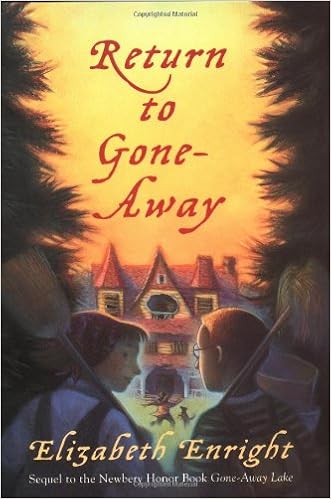
Book Review: Return to Gone Away

Title: Return to Gone-Away 


Author: Elizabeth Enright

Publisher: Harcourt

Date: 1961

Length: 224 pages

ISBN: 0152022635

Gentle Readers, I still don't feel free to take the time to upload the next batch of book reviews. I'm still hauling this laptop home every night, wearing the little thing out, and when not working on a paid job or socializing with e-friends I want to look at something that's not this screen. Maybe youall know this feeling. It'll pass, I'm sure...I can't say when.

But this morning a random tweet on Twitter reminded me...I am most likely to write a book review when (1) someone has sent me a new book for review, or (2) I've weeded a book I don't want to keep out of my collection--and only (3) I've been sitting at the computer considering what to write, and decided to write about a favorite book I've loved for a long time.

The Twit posted a picture of a little boy's review of a storybook, written on a form handed out at school. "Would you recommend this book to a friend?"--"No, because it is my favorite and I want to keep it."

This web site's book reviews can seem that way. I'm most likely to post about a book I give "ten out of ten," a book I've enjoyed every few years since the Nixon Administration, only when I've picked up a duplicate copy and put the better-preserved copy up for sale. It's unusual for me to turn to the computer right after rereading an old favorite and deciding to keep it.

Today, also, Paypal notified me of a new trick that may allow me to offer Paypal links without the bother of (1) shutting down other sites, (2) going to Paypal, (3) creating a specific product link, and (4) pasting that button into the page. Paypal does not actually care if I've listed a thousand different books I can resell for $11 online. Why would they want to store a thousand buttons? If it works, this Paypal link system will allow you to choose new or used books, or other items that may displayed here, pay with one click, and need only to e-mail salolianigodagewi to specify what you're ordering. The link will give the total amount of US$ to send, including $5 for shipping and usually $1 for that pesky Paypal fee; all you do is click and tell Paypal where to send it from (your Paypal account, linked bank account, etc.), then e-mail me about what you're sending it for.

And finally, Paper.li shared this new e-acquaintance's review of a book I first enjoyed during the Nixon Administration. This is a story about a 1960 family buying a fabulous old house in an abandoned lakeside resort town, exploring the resurgent natural environment and abandoned antiques in the other posh "summer homes" the very rich had built in the 1890s, so the children can be close to two retired friends who've come back to the summer home of their childhood to spend their last days. Lots of adventures, some funny and some scarey; delightfully detailed drawings, and a nice introduction to (by now these two) periods of U.S. history for middle school readers. What I particularly like is the indirect lesson: Nobody tells Mr. Payton and his sister Mrs. Cheever "You're too old to be living alone in these crumbly old houses, miles from town, with no phone and only an ancient clunky car blah blah blah"; the younger family just move into another crumbly house beside them. This is a happy story for seniors as well as kids.

Right. New blogging tricks begin today...let's see how they work! I promise not to post links to other people's reviews of books unless I've read the book and agree with what the other reader says about it. I fully endorse Samantha Bradshaw's review of Return to Gone-Away.

Samantha Bradshaw's review begins:

"
Return to Gone-Away is a children's book written by Elizabeth Enright, which is the sequel to the book Gone-Away Lake and discusses how the Blake family buys a house in Gone-Away. The book was first published in 1961. Plot introduction: When Portia learns of her parents buying Villa Caprice, a tumbledown Victorian house close to Gone-Away Lake, she is excited. She, her brother Foster and her cousin Julian enjoy learning about the "new" old house, with the help of elderly neighbors Mr. Payton and Mrs. Cheever.
"

To read more: https://www.thricereadbooks.com/blogs/news/return-to-gone-away-book-review

To buy it new: https://www.paypal.com/paypalme/PriscillaKingUS/16

To buy it used: https://www.paypal.com/paypalme/PriscillaKingUS/11

Add up to 5 books of similar size to the package, paying only the one $5 shipping fee for 6 books: e-mail salolianigodagewi @ yahoo to list your picks, and our Message Squirrel will send you a Paypal.Me link for the total price for your package.

If you prefer to keep payment real, send your U.S. postal money order to Boxholder, P.O. Box 322, as discussed on the Payment Information Page. Real payments never include the Paypal fee; the post office collects its own payment for the money order and postage.