Showing posts with label 1980s. Show all posts

Tuesday, October 20, 2026

Book Review: Holidays in Hell

Title: Holidays in Hell

Author: P.J. O'Rourke

Date: 1988

Publisher: Vintage / Random House

ISBN: 0-679-72422-2

Length: 257 pages

Quote: "Often the more you understand, the less you forgive."

After a few years of writing car reviews and comic essays, P.J. O'Rourke began "working as a foreign correspondent...although 'working' isn't the right word and 'foreign correspondent' is too dignified a title. What I've really been is a Trouble Tourist--going to see insurrection, stupidities, political crises, civil disturbances and other human folly."

And here is his reminder that the Awesome Eighties were a period when the major news stories were horrific, when sensitive souls avoided reading a morning newspaper or, if obliged to read one for a job, called it "The Daily Alarm & Despondency." 

O'Rourke wasn't taken too seriously: "There are...no interviews with Heads of State, or Major Figures on the International Scene. These people didn't get where they are by being dumb enough to tell reporters the truth." He didn't take himself too seriously, either: "Half the world's suffering is caused by earnest messages contained in grand theories bearing no relation to reality--Marxism and No-Fault Auto Insurance, to name two." In fact, he wasn't sure the book contained any serious content. "No matter how serious the events I've witnessed, I've never noticed that being serious about them did anything to improve the fate of the people involved...Thirty years of acting and sounding important about the Holocaust did nothing to prevent Cambodia."

He may, however, have discovered some important truths. "Trouble is fun. It will always be more fun to carry a gun around in the hills and sleep with ideology-addled college girls than to spend life behind a water buffalo." Youth and a tough, cheerful Irish temperament help. And, "There's no such thing as a race and barely such a thing as an ethnic group...I wish I could say I found this out by spending arctic nights on ice floes with Inuit elders...But, actually, I found it out by sleeping around."

How seriously can one take O'Rourke's reportage? Could he be trusted to tell us what he really saw in Lebanon, Korea, Panama, Poland, Manila, El Salvador, South Africa, Berlin, Nicaragua, or the Gaza Strip? To assess his reporting abilities, we can read what he has to say about places that we, too, have visited, where O'Rourke found trouble in the 1980s--the Epcot Center, Heritage USA, or Harvard University. When a reporter is being paid for whimsical comments like "Pants, coats, blouses and jackets were...made of imitation polyester, if there is such a thing," does he actually go into a store in Poland to check his facts? All facts reported as facts by O'Rourke that I've tried checking have checked out, but readers need to bear in mind that libraries usually shelve this book as comedy rather than history or journalism.

Sunday, October 12, 2025

Book Review: Moving Right Along in the Spirit

Book Review: Moving Right Along in the Spirit

Author: Dennis Bennett

Date: 1983

Publisher: Fleming H. Revell Company

ISBN: 0-8007-1316-8

Length: 142 pages

Quote: “Let’s keep our balance as we move along in the Spirit, at the right pace, in the right direction, at the right time, in the right way.”

In the early twentieth century, Christian groups who called themselves charismatic tended to be ridiculed as “snake handlers” and “Holy Rollers.” Snake handling was a “show of faith” always rumored to have been practiced by a really weird bunch in the next county, so far as I know, but “Holy Rollers” really did lie down, and sometimes roll about, in the aisles of churches when “slain in the Spirit” during very emotional meetings. Respectable old ladies and gentlemen who went to these churches were reliably reported to jump over pews, scream, shed real tears, and of course “speak in unknown tongues.” By the 1960s and 1970s, a more temperate charismatic movement, often concerned with “inner healing” of emotional and psychosomatic issues, took place. Dennis Bennett was a temperate charismatic writer from the Episcopal church.

Suppose, he said, a messenger was trying to deliver a message, and an enemy wanted to interfere without violence. The enemy might try to discourage the messenger. Failing that, the next move might be to try to make the horse bolt: “If only that horse...will just run like mad...then everyone will think the rider is reckless or crazy, and they won’t believe what he has to tell them!” “So...if all else fails, [the spiritual enemy] tries to get us to go out of control; to be so enthusiastic that we frighten people.”

By culture (he was born in England) and temperament Bennett seems to have been suited to this message of moderation. He warned against the claim that everyone would be healed, but argued that praying for someone to be healed would be more rational than telling people it was God’s will that they be unhealthy.

After a rather long discussion of this idea, shorter passages call for moderation of the demand that schools teach creationism as if it were fact, and a moderate approach to the experience of being “slain in the Spirit.” For those not affiliated with the church groups to whom this book was originally addressed, these chapters read like multiple long postscripts. Presumably they met a need at the time; perhaps, in some churches, they still do. 

Thursday, August 28, 2025

Eighties Nostalgia?

Recycled, or more likely reprinted, 1980 presidential campaign T-shirts? Seriously. People are wearing them. 


I question whether the real reasons have been adequately explored:

1. Some people made up their minds in 1980 and have not used them since...sort of like the way my husband made up his bed, in the 1990s, and then announced that for his back's sake he was reclaiming his Indian heritage and sleeping on the floor. Except that that decision was good for my husband's bed and back. Minds need to be used and changed.

2. Seriously, some of us felt better about voting in 1980 than we have ever felt since. W Bush was cracked up to be the candidate most likely to restore the good things about the Reagan era, but nobody seriously believed he had a hope--nor had he. I'm not sure whether even a majority of Trump voters like Trump. I don't know how many Clinton or Obama voters really liked them, either. But Reagan just had too many unfair and unbeatable advantages when it came to being liked as a President. He aged well; he looked and sounded like the grandfather every family needs. He embodied the wit and physical courage and other good things we celebrate about being Irish. He presided over a period when every young American who was willing to work or study could get a job or go to college, often at the same time, conceivably even using the job to finance the college. And he was blessed with the chance to preside over the end of the supremely boring Cold War. It was impossible not to like Reagan and, in some ways, he could even be said to deserve his popularity. Nobody will ever crack jokes about his own near-fatal medical conditions, nor shed a tear of sympathy about someone else's untimely death, so well again.

3. Prior to 1980, political campaigns weren't advertised on T-shirts. If there had been Eisenhower or even Herbert Hoover T-shirts, some people would want to wear them.

4. People who voted for the first time (or two) in 1980 (or in 1984) were in demographic fact part of a baby bust, not of the baby boom itself. Some of those people identify as freshman or sophomore class baby-boomers, some as early Generation X, depending on how old our parents were and whether we spent time with older or younger siblings. As the image of baby-boomers now looks like the age of people who were born in 1946, some people who are currently between ages 55 and 65 want it to be known that we were the very last of the baby-boom generation, and came of age in the Awesome Eighties. Of which an iconic image was the Reagan campaign T-shirt.

Pooh. The message T-shirts I owned in 1980 said "Shape Up, Shape Up, Shape Up, Super Shape" and "The Best Girls Are From Gate City, Virginia." (I had outgrown a handed-down Kareem Abdul-Jabbar fan shirt, and my brother didn't want to wear it because I'd been seen in it.) I might still wear those but I will not be buying a reprint Reagan campaign shirt. Though my first presidential vote was for Reagan. 

Not everything about the Sixties was terrific nor was everything about the Eighties awesome. The Eighties were, for example, the years when millions of us naively threw away the good old boring Ekco can openers that had been in our homes for fifty years, and bought new, trendy-looking can openers instead. Little did we know that the reason why these horrid objects looked so new and trendy was that they weren't built to open even a hundred cans before they stopped working. 

The Eighties were also years when women who were actively aggravating their cramps by wearing high-heeled, pinchy-toed shoes transitioned, in just two or three years, from furiously denying that their job performance suffered in any way at an particular time of the month to furiously demanding that everyone else tiptoe around their disabling PMS. Those were interesting years to be a husband, child, or even parent of one, not to mention actually being a young woman.. 

Also, for part of the Eighties, nobody knew exactly what caused AIDS or how to avoid it. The Eighties were the decade when we lost Arthur Ashe. The decade when it took real physical courage for Dr. Fauci not only to study AIDS but to admit that the disease interested him because he was "gay." Because he'd been brave some people wanted to imagine that he was either honorable or intelligent. In some places it still took fortitude to claim friends on the other side of the color war, too.

Name a period of time in history, whether a decade or an afternoon, and if anyone remembers it that person will be able to feel nostalgic about it. Oh, the Thirties, when so few people had any money and your parents weren't among the few, but your family were rich because this one, that one, and the other one were still alive. Ah, the nineteenth of December of 1976, when a bundle of loud noise with a wet diaper on it started to grow into Tracy Smith. And sigh, at this time last week I was admiring a huge flock of female Blue and Tiger Swallowtails, with a few hangers-on from other species, flapping around a field of thistles, and realizing that this rare and lovely sight was a consequence of declining male populations of both species; these female butterflies had time for a kind of lekking behavior because they weren't finding mates and laying eggs. This sort of thing is natural and proper as long as it doesn't interfere with enjoying, and improving, the present.

"Say not thou, 'What is the cause that the former days were better than these?', for thou dost not inquire wisely concerning this."

Sunday, June 23, 2024

Book Review: Joshua

The natural way to clear the "link rot" out of a blog would be to start at the beginning, read through the individual posts, pull down the ones that contained rotten links, and leave the ones that didn't. Blogspot was set up to make that easy, for a long time, until the change junkies messed it up and, in their frenzy to flap and squawk about "artificial intelligence," forgot to fix it. So nearly all the older blog posts are disappearing. A few are, as promised, coming back. Here's one, reposted from 2012:

Title: Joshua

Author: Joseph F. Girzone

Date: 1983

Publisher: Collier / Macmillan

Length: 271 pages

ISBN: 0684813467

Quote: "'Joshua,' a shrewd older priest said, 'do you feel this is just a peculiarity of certain individuals or the way the Church is structure?' 'I think it is probably both.'"

In the 1980s, Joshua was a controversial bestseller within the Christian book ghetto. Joshua is a new human manifestation of Jesus who's come back to check on how well Christians (and Jews) are doing with his teachings. Nobody could write a book with this premise that would not be controversial.

The most obvious point of controversy is that Joshua seems so much more ordinary than the real Jesus of Nazareth could have been. Practically every word attributed to Jesus was a brilliant aphorism, the sort of thing you'd expect to find recorded of a young, obscure rabbi who attracted attention by using more memorable phrases than other rabbis. Of course, living in a mostly oral culture, Jesus didn't have to worry about being original, nor did He; He was free to put together quotes, even cliches, in the way that would be easiest for the audience to remember and understand, and by all indications He did. But the fictional Joshua doesn't try to be either original or memorable. He mumbles. Readers won't go around repeating his words.

Irreverence, incompetence...or reverence? I think it may have been reverence. Anyone who wants to imitate a great writer or speaker can learn to copy the master's word count and rhythm and so on, to produce a credible imitation of the master. Most of us don't, or if we do we destroy those exercises after writing them, because publishing them seems disrespectful. I think it's possible that Girzone chose deliberately to present fictional Joshua as an unimpressive man, more dropout than gifted teacher, because he didn't want to seem to be making a claim either (1) that if Jesus came back to check on His followers He'd try to repeat or improve on His original mission, or (2) that Girzone was trying to channel or even imitate Jesus.

Christians aren't to be saved by Joshua, and so, while Jesus did not hesitate to teach in the temple or demur when addressed as "Rabbi," Joshua does. He teaches, but he's strictly an amateur, a dropout, a craftsman just inside the line that separates struggling artists from bums.

If you accept the premise and read the story, further controversies follow. Joshua tells a Jewish group that "God will be your Messiah." Under the rules of Jesuit sophistry, this is allowable. Would Jesus have used the rules of Jesuit sophistry? Would He have backed away from telling a Jewish audience that Jesus was their Messiah? Let's not rehash that argument here...all I meant to do was mention that this point of controversy exists between the covers of Joshua.

Then, toward the end of the book, Joshua is summoned to Rome for a formal vote on whether or not he should be censured by the Catholic church. The way the book is written, this wouldn't happen. Joshua has not identified himself with the Catholic church; the whole point of this novel is that Joshua frowns on denominationalism and is here to correct each of the denominations he visits. In real life all kinds of preachers do that, and the Catholic church does not censure any of them; it writes them off as Protestants. The summon to Rome makes sense only if we presuppose something the novel avoids saying--that Joshua was some sort of "undercover" Catholic priest or monk who'd been sent out for the purpose of "sheep stealing," enticing Protestants into the Catholic church, which the Catholic church did not officially admit doing in the twentieth century. Very controversial.

Apart from these major points of controversy, is Joshua a nice little meditation on how Christians--who are, after all, committed to imitating Jesus, to the degree that seems respectful to us--should think and behave? I think, on the whole, it is. Joshua's comments on the philosophical errors into which contemporary Christians fall are worth thinking about.

Wednesday, August 2, 2023

Book Review: Memoirs of an Unfit Mother

Title: Memoirs of an Unfit Mother

Author: Anne Robinson

Date: 2001

Publisher: Simon & Schuster

ISBN: 0-7434-4896-0

Length: 325 pages

Illustrations: black-and-white photo insert

Quote: “[T]his book...is meant for all women who have struggled with moth­erhood, with a career, with trying to do the right thing.”

Sigh. It’s not that television has stopped exploiting women’s talents and energy to cater to men’s sexual fantasies. It’s merely that television has expanded and made room for more different ones. Modern television offers not only Doris Day, Liz Taylor, and Maureen O’Hara, but more unusual fantasy figures. There was a market for fifty-year-old British redheads in black leather. Who knew? Anyway, some readers probably remember a game show called “The Weakest Link.” Anne Robinson was the British redhead who told somebody after each show, “You are the weakest link. Goodbye.”

It was, she said in her memoir, the reward for a lifetime of putting up with sexist bigotry, at first in the traditional well-off British manner of drinking self-destructive quantities of alcohol, then by getting sober and enjoying the benefits of Britain’s quiet and gradual movement toward enlightenment. I think it’s because Robinson never was a militant feminist that reading her memoirs made me feel like one.

The aggressive, angry party within feminism always got attention but, as Robinson both explains and demonstrates, it has not in fact represented “women” very often or very well. The appeals to a popular model of “biology” that’s always leaped to embrace gender stereotypes based on incredibly weak evidence, that does not in fact fit either animal behavior or human behavior as well as its enthusiasts want to think it does, reflect a basic human tendency that’s not actually all that well correlated with gender. While a few feminist theorists still bewail the process of socialization by which women are “feminized” into accepting a little denial of our aggressive instincts as the price for a cozy domestic life, in observed fact it doesn’t take any really heavy or systematic oppression to sell that deal to men, either. When disappointed by her first husband’s sexist, judgmental immaturity, Anne Robinson had no trouble finding a sweet, supportive man who didn’t mind a bit letting her climb higher up the corporate ladder than he did and support his financial irresponsibility, and in fact, she tells us, her first husband and their child appreciated good old Johnny’s just-love-me-cos-I’m-cute personality too.

While baby-boomer women were quietly sailing past men in school and on almost every kind of performance-based measurement of promotability, the commercial media were squalling at us, “But...but...but...you don’t waaant to be smart, competent, hardworking, promoted, and rich! You’ll be looonely! A biological clock” (remember those purely theoretical biological clocks?) “will go off and one day when you’re thirty-five you’ll run out of the office screaming ‘I want to stay home and have babies!’ You’ll all come down with chronic fatigue syndrome!” (I am not making this up. When a “chronic” form of mononucleosis spread through measles vaccine affected a large group of young adults in the Northern States and Canada, a short-lived theory that the men at the vaccine companies must have loved was that more women than men got the disease because women just weren’t built to take the stress of competing with men in offices or universities.)

And the majority response, the most truly “feminine” response if “feminine” means “characteristic of women, or of a majority of women,” was: Anne Robinson’s. Yes, she says, of course most women would rather have a husband than not, would prefer a husband who can support them while they stay home with at least one baby through at least five “wonder years,” probably do care more about their success as mothers and grandmothers than about their successes in work or school. And they’re still good enough at work and school to move past most of the men. And they might even be just loyal and loving enough to stay with sweet, supportive, less successful husbands. Albeit, if he’s less successful because he’s less careful with money, in separate homes where he can’t jeopardize her investments...

I expected this book to be funny. It’s not, particularly. I think I chortled audibly once while reading it. But it’s true to the way so many women seem to feel, however different from Anne Robinson we may be and however different our careers may be. I suspect that for a lot of Robinson’s generation the best laugh is going to come at the end, where she mentions the fans who fantasize about her “with a whip.” Is that not the way it goes? When you hit fifty, if you’re still trim and healthy and therefore attractive to young men, but they do notice that you’re “a little older” than they are, their fantasies kink up. They want you to be the sexually abusive nanny or teacher they did not actually have. Many of us are willing to spank a silly boy for a price, because that scenario is not sexually interesting to us...

But if you remember the history, it’s worth adding another voice to the chorus. Robinson was told she was “not actually an unfit mother,” just not fit enough to get custody of the child, because she worked (fewer hours than her first husband) and was unfaithful to their marriage (less blatantly than her first husband)—but not because she was an Irish-type genetic alcoholic rapidly developing a “drink problem,” although she was. With Alcoholics Anonymous-level candor, no bitterness or denial of responsibility, she revels in the irony that during the child’s wonder years she did give up full-time work. By being unfit to do it. She coped with sexist exploitation while young and depended on the very imperfect loyalty it spawned to keep a job during her descent to “the bottom” of self-induced physical disability. The years when she was sobering up, recovering her health, and enjoying her seniority as corporate doors opened to more women, were the years when the daughter was in school and was tactful enough not to want to hurt Daddy’s feelings by spending too much more time with Mommy.

One section of the story I did not like was Robinson’s memories of the 1980s, when she was getting paid to be frankly bitchy and she—and her employers—overdid it. Even making allowances for the defective conscience that seems to cause extroversion, someone should have told her...People can respect, even admire, news commentary that jabs and slashes at the weak points in policies and those who impose them. Robinson was a dare-to-be-trendy left-winger who provided loyal opposition for Mrs Thatcher. When the Prime Minister blithely told young people (many of whom were unemployed welfare dependents) “to buy a BIG house at the very beginning. Then they won’t have to move when they have a family,” and Robinson was the “hound” who retorted that “not everyone can afford a big house” and Mrs Thatcher replied “You’ve made some money out of houses,” that was a fair “game, set and match.” British audiences loved it. Robinson did not share the mainstream British adoration of the royal family. Well, if she didn’t she didn’t; Americans generally think it’s adorably British that most Brits like having a royal family and peers, although this web site keeps a wary eye on some U.S. citizens whose taste for things British embraces any tendencies toward British elitism. The question of how much the Queen ought to be paid just for being an admirable old lady was fair game. Robinson had a right to score whatever points she could score off that...but a half-grown girl who married too young, whose late-adolescent hormones were raging in a physically dangerous imbalance, going through all that and being a mother too, was not fair game. Robinson of all people should’ve known enough to leave Diana Spencer alone. When she confessed just a few of the things she’d said about the Princess, I wanted to take a whip to Robinson. Yes, most humans of both sexes do have some degree of mean-spiritedness, but we should all be helping one another to repress it.

So...Robinson's talent for cheerful verbal cruelty was transferred first to daytime TV talk shows and then, as she had a talent for television, to the game show that made her an international TV star. And I will say for Robinson that she does recognize that the men who steered her newspaper career the wrong way didn’t get to enjoy that piece of luck and compensation, as she did. She had to smash her way through appalling amounts of bigotry, but she avoided the trap of thinking that everything was all about bigotry, that women always get the short end...Robinson, as an individual, just happened to be able to make a demotion into a promotion. Cheers.

Wednesday, June 21, 2023

Book Review: Time Traveling to 1983

Title: Time Traveling to 1983 

Author: Michael B. Allen

Date: 2023

ISBN:  9798367220841

Length: 96 pages

Quote: "Despite having a difficult first term as Prime Minister, Margaret Thatcher, the leader of the Conservative Party, won the election by the most decisive victory since 1945, with a 144-seat majority."

Feminism was working in 1983: Women were moving into top seats without even having to identify as feminists. Justice O'Connor had settled quietly into her job; it was Prime Minister Thatcher's turn to dominate the relatively pleasant news headlines of 1983.

I remember 1983 as a year when I didn't like reading the news. Most headline news stories were still about men. They were not about President Reagan's speeches being well received or Douglas Adams' books being hysterically funny, either, although those things were happening. The men on the front pages above the folds of newspapers were mostly violent criminals. And be warned--although this series of year-in-retrospect books is wholesome historical fluff, Time Traveling to 1983 does bring that back to life. Murders and terrorists, and hunting down the last surviving Nazis passed as the good news. 

Hello, newspaper editors? Nazis were not exactly pleasant breakfast reading, even if they were being arrested, back when they were alive. Nazis became an entertaining, even kinky, stereotype only after the real ones were all dead.

Then there was the Miss America pageant of 1983, the year the pageant lost all claims to respect. White pageant-watchers said ugly things because the pageant winner identified as Black. Black pageant-watchers totally failed to support her because she wasn't Black enough. 


Michael Jackson's song about this kind of thing came later. 

While other Miss Americas toured the country making sweet, vapid little speeches about their dreams of ending world hunger and making the world a happy place for all the little children, for a year, and then went home and had babies, Vanessa Williams caught hate until someone finally dug up an old nude picture of her and demanded that she be forced to surrender her crown, because Miss Americas were still supposed to be "pure" and nudity was not considered "pure." 

(In a college class, around the time Williams was being dethroned, we read sociological studies that showed that confusion about the difference between nudity and immorality was one of the odd assortment of things that define "class" in North America. If your grandparents had college degrees, especially if the women did, you understood that the "shame" of nudity in the Bible was a social, cultural thing. If your grandparents did not learn how to read, you probably took it for granted that all nudity led directly to sexual sin, because you did have enough sense of decency not to have thought in depth about the disparity between this belief and the effect actual nudity was probably having on your grandparents by that time. This kind of thing illustrates how "class" was a matter of culture, not income, even though many things associated with the upper class happen to be expensive. Both Jilly Cooper and Paul Fussell then wrote popular books with Class as their titles. I've not read either book in years but I remember them as interesting, apparently accurate on most points, and quite reliable guides to what was fashionable in what circles in the 1980s. And, yes, the more settled your position as either an intellectual or an heir to old money, the more likely you were to say that Vanessa Williams was a lovely girl whom people ought to leave alone.) 

Thomas skips ahead to tell us that in any case Vanessa had the last laugh. She's still known as a singer and actress, and whatever happened to the other cute chick in whose favor she resigned? The history of the Miss America pageant does list a few other winners who went on to do something with their education--Diane Sawyer, Lynda Carter, Lee Meriwether, and I suppose we should still count Anita Bryant--but nowadays people urge their daughters to qualify for scholarships based on actual academic work rather than body proportions.

Sally Ride and Billie Jean King made headlines in 1983 and belong in this book. Would they have been so popular if they'd been branded by "sexual identities" rather than their legitimate identities as Anglo-American women? Probably not, but we'll never know. In 1983 we still had a quaint custom known as minding our own business. The whole idea of women's using the title "Ms" instead of "Miss" and "Mrs" came from our idea that it was pretty rude to tell the world whether or not someone was married; that might be a matter of public record but it was not the first thing a nice person wouldwant to know. I miss that rule of etiquette, now. As a matter of public record, silence about Ride's, and King's, and Michael Jackson's, and other celebrities' sexual kinks was not death even for their careers. Silence was a chance for people to like them. 

His discussion of 1983 fashions may strike people who still have a few in their closets as remarkably able to overlook the influence of Diana Spencer, and his list of typical 1983 prices is less complete than the price lists in the earlier books in this series that I've read. Lists of 1983 movies, books, and music are thorough as ever. 

As before,. I recommend buying a printed copy so everyone can look at the nostalgic photos and reminisce. This review is appearing almost six months later than it was meant to appear, because the colorful photos take up a lot of memory and snagged not only in Outlook's spam filter but in its spam-deleting program. 

Thursday, June 15, 2023

Book Review: Bloom County Classics of Western Literature

(Reclaimed from Blogjob)


Title: Classics of Western Literature: Bloom County 1986-1989

Author: Berke Breathed

Author’s web site: www.berkeleybreathed.com

Date: 1990

Publisher: Little Brown & Company

ISBN: 0-316-10754-9

Length: 250 pages

Illustrations: cartoons by the author

Quote: “[A]t seven I was scanning the ‘News Capsules’ section of the Los Angeles Times. Any head­line including the words FIRE or MURDER prom­ised something vital.”

And so Berke Breathed grew up to write a comic strip in which the characters were children and animals and the plots were headline news stories. For ten years he drew the cartoon daily. Toward the end of this book he announces the transition to drawing it weekly…in news-story mode: the plot line is that Donald Trump’s body has died, his brain has been implanted into the brain-dead body of Bill the Cat, and he’s “developing” Bloom County by firing all the other characters.

http://priscillaking.blogspot.com/2012/04/book-review-classics-of-western.html

This Fair Trade Book was discussed on the Blogspot a few years ago (and, yes, it sold). In view of its timeliness, it’s reappearing here.

In this collection we watch Quiche dump Steve because he spends some time in a body brace, Opus jilt Lola because despite his lovableness he’s just another commitment-phobic 1980s youth at heart, Milquetoast the Cockroach test everybody’s commitment to nonviolence, Oliver blow his cool when asked what led up to the Big Bang, “Deathtongue” morph into “Billy and the Boingers” and expire, the other characters banish Opus from the boardinghouse after hearing a sermon about “penguin lust,” Rosebud admit that the character “he” always insisted was male is “played by” a female (who later gets pregnant), Steve sue Santa Claus for delivering violence-promoting toys, Zygort aliens convert Steve into a Sensitive New Age Guy, Opus try to become a smoker, the kids make (and give away) a fortune selling hair tonic made from Bill’s underarm sweat, Opus attempt to rescue his mother from the Mary Kay Cosmetics test lab, and Ronald-Ann lure Opus from reenacting “Star Trek” to sipping pretend tea with her headless doll. Newsmaking people (and products) are mentioned by name every five or six pages and by implication in almost every strip.

If you don’t remember the original news stories, will you still chortle over every page? Probably. If you don’t get a joke, you’re sure to find someone who can explain it. Real cats don’t have underarm sweat glands; real penguins don’t look like Opus, either. According to the stereotype of the 1980s, Vietnam veterans like John  (the most sensible man in Bloom County) were supposed to be the drugged-out wrecks; in Bloom County that social function is taken over by Bill. But Mary Kay cosmetics, which were marketed by and to church ladies, really were “tested” by torturing animals just like Revlon and Max Factor, and there really were religious conflicts, in some Protestant families, between women (stereotypically the daughters) who boycotted the cosmetics for that reason and women (stereotypically the mothers) who wanted to support fellow church ladies’ business. If he’d had a wife or a sister, Breathed might have been able to exploit the further irony that the real reason why girls like me didn’t buy Mary Kay was that smearing any “moist” stuff on our faces aggravated our acne…unfortunately this comedic element was missing even from the full sequence that was published as Night of the Mary Kay Commandos.

However, as with Pogo and Charlie Brown, the humor of these cartoons is so universal that missing a few topical points wouldn’t keep you from enjoying the book. Steve’s “sensitive” phase was part of a trend, but it’s funny because Steve’s only lovable quality is his complete ignorance of what True Love might be. Opus’s persecution reflects 1980s fear of the influence of the Religious Right, but it’s funny because the children and animals care about each other.

Most of the people who wanted this collection already have it, and now it’s possible to get the five-volume collection of Bloom County reprints here…

http://www.amazon.com/Berkeley-Breathed/e/B000APTBDM/ref=sr_tc_2_0?qid=1444078125&sr=1-2-ent

Posted on October 6, 2015 Categories A Fair Trade Book, HumorTags cartoon, comic strip, Donald Trump, graphic novelLeave a comment


Monday, March 13, 2023

New Book Review: Charlie Utopia

Title: Charlie Utopia 

Author: Nowick Gray

Date: 2022

Publisher: Cougar

Length: 363 pages

ISBN: 9781990129230

Quote: "He had even plotted the end of his autobiography, envisioning life after fifty as icing on the cake."

Why read this novel? It's funny in a dry way, but not too funny to read in public. It's sad in a dry way, too, but not so sad as to be depressing. Mainly it's nostalgic. Charlie Utopia is a baby-boomer who lives in his utopian dreams, brings them into life in most ways--he succeeds at all the different things he wants to do as fun jobs, doesn't have to give much time to jobs taken just to pay bills, builds his own house, travels with a band, gets into all the beds he seems really to want to get into. Yet he's always just slightly depressed, because for all the self-help books he reads and all the trendy roads to happiness he follows, something eludes him.

And what that something is, is Love. Charlie's always loved himself and arranged for his own comfort. He's a decent man, and his own comfort includes doing honest work well, being a satisfactory bedmate, and providing for his one positively known child. But his good will fails to extend beyond the end of his own nose. He seems to keep track of the names of the women he's married or lived with, but beyond their different demographic profiles he's aware of very little about them, so it's hard for the reader to remember which fits into which part of his story (and that plus the philosophical fads are often the only indication of what year it's supposed to be, from scene to scene). He doesn't abuse his daughter, but he seems to know nothing about her except as baggage that comes with one of the women he's given pleasure yet failed to know. People always drift away from him and he never knows why. He has no religion. He hopes being a left-winger will appease the envious masses of people who have less than he and his friends have, but never gets to know any of them personally either. Determined to use his talents to preserve the space for the rich interior life his introvert brain needs, he fails to find the working partnership his introvert brain craves next. Many people seem to agree that he's a good neighbor, but he has no close friend, male or female.

It doesn't take 363 pages to paint a credible portrait of a man who has everything but love, so reading this book is mainly a nostalgia trip for those currently over fifty. If you have or have had a Partner For Life, you can enjoy feeling sorry for Charlie. If not, you may enjoy sharing his richly detailed life travelogue of work, thought, passion, and the sense of mild depression that sets in just when Charlie is in his workshop enjoying the other things. 

Thursday, December 29, 2022

Book Review: Southern Living 1985 Annual Recipes

Title: Southern Living 1985 Annual Recipes

Author: Southern Living magazine staff

Publisher: Oxmoor House

Date: 1985

ISBN: 0-8487-0679-X

Length: 339 pages, plus indices and space to write in additional recipes

Quote: “Even though Southern foods, generally speaking, are becoming lighter and fresher, they still offer down-home appeal with typically Southern ingredients. We are grateful to you, our readers, for sharing with us your treasured recipes.”

This was the seventh of Southern Living magazine’s big, hardcover collections of all the recipes from the magazine (sorted out from the ads, the landscaping and decorating ideas, the tour guides, the feature articles…most of the splashy full-color pictures, too, though not all of them). Some serious magazine collectors want to have them all and, though it’s not in mint condition, I have an intact copy of this early volume.

Most of my comments on the 2004 annual [LINK] were already applicable to the 1985 annual. Things that have never changed were the magazine’s goal of featuring foods that grow in kitchen gardens in the Southern States—all of them, not excluding the Southwest—without excluding contributions from readers who, no doubt for good reasons, are writing in from the North, and of highlighting a few of the minority communities in the Southern States in each collection; of featuring updated versions of traditional favorites like cornbread and pinto beans, and a few “diet” recipes (in 1985 they were a separate monthly feature) and microwave recipes, and some elaborate confections made a little less time-consuming by using prepackaged food, and some locally achievable variations on trendy recipes. About half the recipes have been contributed by subscribers; in 1985, local lurkers will want to know, the magazine didn’t print any recipes from Gate City but did print a handful from Bristol and a handful from Kingsport.

One thing that’s changed: in 1985 the magazine either wasn’t big enough, or didn’t choose to offer, a collection of recipes sent to them by grateful advertisers. Another thing that’s changed: in 1985 the magazine readers and staff liked pecans, and who doesn’t, but they weren’t yet throwing them into everything. In 1985 many Southerners’ idea of lightened-up recipes still favored butter over olive oil. All but a few of the salads (in the December section) are drowned in mayonnaise, which many Southerners do like, but not this one.

One thing that’s changed at this web site: When Amazon, blaming the coronavirus panic, imposed sales quotas on Associate and Affiliate web sites, this web site notified youall that it could pay for some of you to order a few books through this site. (I posted that in time for Christmas shopping, too.) If youall had needed the Amazon links, you would’ve bought some books here in December. You didn’t. Google made it more time-consuming to throw in the links. The memory of my late lamented blog buddy saying she didn’t want to read a blog cluttered with Amazon links, which she said didn’t work with her computer, lingered in my mind. I had more on my mind, with a new truck in the family, and the absolute worst illness I’ve ever had in my life (coronavirus is NOTHING), and the never-ending drama of wasting a lot of my “stimulus” money testing various private Internet connection plans and finding that none of them worked, than buying stuff just to please Amazon. So this review surely does look different from my review of the 2004 volume. This web site is no longer Amazon-affiliated. You don’t have to look at all those photo links.

Anyway: If you’re not a cookbook collector, you have room for only one cookbook, and you live in a Southern State, there are valid reasons why a Southern Living annual might be a good choice. These are not cookbooks for raw beginners, although they do have short glossaries for people whose grandmothers didn’t use that technique or that name for it. They are for people who already know how to scramble eggs, toast bread, put together sandwiches, chop up almost any combination of fresh vegetables for a salad, and even simmer soup that did not come in a can—the kind of thing most Southerners eat every day. These are the recipes for the fancy confections we serve at parties, which are the only kind of recipes many Southerners need to bother writing down. Even the ones identified as light, quick, and easy aren’t very; there’s no separate feature for budget-friendly recipes, and most of these aren’t very budget-friendly either, unless you have an acre of garden for “back yard” and a few pecan trees up front, as many Southerners do. So if you’re a good plain cook planning a feast, this would be the cookbook for you. The sideways stacked cakes were so quirky that they’d probably seem new again.

But when I display Southern Living annuals for sale, they’re always bought by collectors.


Wednesday, December 7, 2022

Book Review: A Reporter's Life

Title: A Reporter’s Life

Author: Walter Cronkite

Publisher: Knopf

Date: 1996

ISBN: 0-394-57879-1

Length: 384 pages plus photo insert

Illustrations: black-and-white photos

Quote: “By the time I was six I already was taking to instant news analysis. The event was the death of President Harding.”

Walter Cronkite saw, remembered, and reported a lot of things. In this book he shares his personal take on many stories he did and did not report on radio or television, including those industries, themselves, and the production of his shows. Lots of mini-stories, many of them funny and heartwarming, some more “exciting.” As a war reporter he was allowed to fly in a fighter plane and taught to use a spare gun: “I don’t think I hit any, but I like to think I scared…those German pilots.”

He came to know many famous people well. In this book he shares a story about a former President’s marital relations just as, he claims, the former First Lady told it to him. (Hint: this was the First Lady whose hopeless voice was almost never allowed to spoil the lovely picture she always made.) Another President used to watch Cronkite’s news broadcasts and call to demand what he considered improvements. Cronkite quarrelled civilly with a sitting Prime Minister, triggered a career crisis by joking that a colleague might “already have” died in his TV show, went to Kennebunkport with the Bushes.

He'd learned early in his career to report the news in a way that seemed neutral and objective while he was biased. In this book Cronkite reveals some personal opinions: he was “conservative” about 1960s pop culture, but when it came to politics, why deny that supporters of global totalitarianism exist? Cronkite admits he was one. He still was one while writing this book.

Whether or not you agree with Cronkite’s opinions, even while airing his opinions he was still expert at finding good, inoffensive stories and telling them tersely. So his memoir is still fun to read. My guess is that, the more of the twentieth century you remember, the more you’ll enjoy reliving it with a TV icon who dominated an important part of pop culture for half of it.

Tuesday, November 30, 2021

Book Review (With Value-Adding Update!): Tales of Tucson

Title: Tales of Tucson

Author: Anthony Randall

Date: 2021

Publisher: Koala T Publishing

Length: So far it’s an e-book; my copy prints to 125 pages in Word

Quote: “Fifteen hundred dollars was a cheap price to pay for a vindictive little poke at your enemy and besides it wasn’t Saul’s money he was paying with—it was never Saul’s money that he squandered.”

Well drat, blast, and bother...This is, as advertised, a laugh-out-loud comic novel that sold well in the UK and might do well in the US.

But it contains adult content. Definitely R-rated content, if not X. The characters can hardly open their mouths without uttering a formerly unprintable word and nothing is hidden from the young about what Bright Young Things such as we were used to get up to in the 1980s. 

Actually the incidence of “parties” featuring sex, drugs, and rock-and-roll sounds exaggerated and the consequences of such revels underplayed, but then again the main characters are rockers trying to launch a hopeless-sounding band, so who knows. The incidence of “jobs” where about all we did was hang out and socialize is not exaggerated. The economy was booming, we had little but youthful charm to offer anyway, and a lot of freshman-class baby-boomers really were paid to hang around workplaces looking cute.

Aunts are not always averse to that kind of thing. Most aunts did some of it at some point. Many aunts are happily married to the men with whom we did it; this is how sisterless men become uncles and some of our nieces and nephews acquire cousins.

But aunts are not supposed to recommend books with explicit sex, and this book has a good half-dozen explicit scenes in which procreative acts take place in the absence of committed monogamous relationships. And, additional trigger warnings: lots of drinking, lots of drugs, no hangovers or addictions.

Sort of a male equivalent to Eat Pray Love, this is the story of a nice, quiet, clean-living young Englishman whose girlfriend, obviously an extrovert, decided he was too quiet and clean. So, having a married sister in Tucson, he headed for warmer, drier fields and a life his ex would envy. Throughout the book he muddles through the life of a rock star, bemused but not too bewildered to make a decent show in a crisis. He even appreciates the scenery. 

(At one point he admits doing something "like Arthur." I thought "Dent, who else?" but have been reminded...just before my movie-watching-and-snogging years began, there was also a movie called Arthur. Randall recommends the movie.)

In the eighties some of us could use the office as the place to do personal chores, errands, reading, knitting, shopping, phone-calling, letter-writing, long lunches and/or snack-grazing, and also work on novels or songs or software packages or other creative outlets, and generally prepare for evenings out (or evenings at home with the family), and still get and keep a job . Anyone could spare a few hours of office time to crank out enough actual work to satisfy, even impress, a normal 1980s employer. Well, in the US, anyway. In the UK the job situation was reported to be very different so it’s hard to blame Brits like Tom, the protagonist of Tales of Tucson, for rubbing it in and exaggerating his memories of “work” in the US for his ex’s benefit. Most employers did expect most employees to stay sober and keep our clothes, at least the button-down shirts and unnecessarily warming hosiery, in place during business hours. Padded-shoulder jackets and stiff 1980s shoes could, however, be left on and under the swivel chair most of the time, even in most of “conservatively dressed” Washington. I could believe that, further south, property maintenance staff might have gone to work in shorts.

Another running, perhaps overrunning, exaggerated joke is inland Americans’ abject fascination with any foreigner (“Golly, I’ve never seen anyone like you before”). The use of rude words does vary from place to place (in Tales of Tucson the Brits use the F-word to refer to everything but what it literally means, which usually gets half a page of detailed description) and an unexpected vulgarity can raise a laugh but, in real life, the audible “tone” of exotic swearing does convey that it’s meant to express hostility. If US listeners can be deceived by a UK intonation, so perhaps can UK visitors be deceived by US hosts’ willingness to smooth over offenses and soothe bad tempers—not without judging the bad-tempered person, of course. On the East Coast most of us may have understood “bollix” to mean “make a mess” rather than, y’know, that, but the familiar word for that was close enough that we could guess what the British meant.

Are American women really undone by any male voice with a British accent? Not the ones I’ve observed. Personally I think some men have more appealing voices and accents than others and the “’Ave a good night?”—“Corr, mate” accents of Tom and his roommate aren’t on my Top Ten list, but it’s more about what they say, and what they do while saying it...what’s a misplaced H when people love each other? We do notice an unusual accent, usually ask where it came from. Some of us may be so distracted by the resulting conversation that we forget to add the price of a tank of gas to the price of a snack, though probably not the ones who keep jobs in convenience stores very long. But I’ve not personally seen any woman, even in a small town, act so overwhelmed by an appealing voice while sober as the drinkers and druggies in Tales of Tucson seem to be. That has got to be the substance abuse.

Of course, as Andrea Dworkin so pungently put it, we don’t necessarily want to be overwhelmed. Of course in the 1980s, and apparently still today, men managed to miss the point: if we took off anything beyond overcoats or shoes on the first date, it was because we’d planned to, which meant that whatever erotic acts took place were all about our hormones and indicated no special attraction and probably no respect for the man involved. There were women who fantasized about going to a party and amusing themselves, in senses beyond conversation or dancing, with half a dozen different guys and leaving with a different one than they came in with; such fantasies were mostly fuelled by vindictive thoughts but everyone had heard of someone who claimed she’d actually done it. (I had one very “liberated” housemate of whom I could have believed it, but that was not among the things she said she’d done.) But that, like the male “playboy” routines, always had that “It’s all about me and my hormones and my pleasures” vibe. Tom and friends don’t seem to notice when they’re being used with a certain degree of contempt. If those guys had actually called the gals they said they were going to call, it would likely have been, “Have we met? Oh right, I remember you, James wasn’t it, or Todd? Oh right, of course, you were Tom and the good-looking one was Seamus. Oh well, whatever. But listen, Tom, Friday night was nothing, y’know what I did with a couple dudes I met Saturday night?”

Nice quiet people who fall in love easily should stay sober on dates. A happily-ever-after relationship that begins with premarital baby-making is the sort of male fantasy in which I can suspend disbelief only in science fiction, where one can postulate sex robots. Tom might learn something from the way his longest-running relationship in Tucson involves Holly, who more or less forces him to begin as “just friends,” but the lesson seems to be lost in the hormones.

As a story, Tales of Tucson may disappoint readers who expect it to form a conventional novel with a plot. Randall gives it some suspense: will Tom’s primary employer get into major trouble, as foreshadowed in the opening scene quoted above? Will that trouble have anything to do with his employment of improperly documented foreigners, e.g. Tom and Seamus? Will he continue to employ Tom and Seamus? If not, will Tom be forced to have some sort of sex with a fat old woman who, his bandmates think, lusts after his body? If he does, will this motivate her to give the band their big financial break (and, if so, are they good enough to benefit from it?), or to have Tom deported? None of these questions is answered by the end of the book. This is a book with a lot more pot than plot, and the witticisms (and marijuana joints) keep rolling up to the final “To Be Continued.” Expect to want the next volume at the end.

It’s possible, though, that you enjoyed the 1980s (soberly) enough to appreciate a slightly rose-tinted nostalgia trip to the fine long summer days of your twenties, or thirties or forties. The frustrations that now seem funny; the difficulty of keeping a band together long enough to attract a fan base to a distinctive sound, of continuing to offer your reggae-inspired songs after your authentic Jamaican influence quits the group, of fulfilling a contract to perform for a group when your Christian influence refuses to endorse the group’s activities and, after praying about it, decides he can’t endorse your activities either, of playing any kind of rock when your drummer gets into or out of college...and that sneaking suspicion that, at its very best, your band may not be all that great and the person who called you “the next Beatles” has lost per credibility by saying that. The jobs people offer the young, and the fact that you did them. The hormone surges, and the inevitable discovery that, whatever you did, they would eventually satisfy themselves, and the discovery that hormones also make a landscape look more lovely, and make food taste better, and make it easy and satisfactory to jam with any half-competent musician anywhere. The way Tom and Seamus are always eating the best dish of something or other they’ve ever had and enjoying something more than they’ve ever enjoyed it before, because when we’re young and eupeptic all the good experiences in life do just keep getting better and better. If that’s what you’d like to be reminded of, while laughing at the way memories tend to exaggerate themselves, then Tales of Tucson is for you.

There’s a salutary hint of self-parody in the exaggerations, too. Tom and Seamus tell themselves all the women they flop into bed with, except “Call me Sunshine,” are pretty and nice. Are they really? Did we tell ourselves everyone we were dating was desirable? Were they really? What about those employers whose expectations were so low that they were planning to continue to employ us, while being pleasantly surprised if we painted over the rude words we painted on the walls? How well did we really do the painting job? What sort of influence would it have been on the music industry if our bands had stayed together and been “the next Beatles”? In the 1980s it was obligatory to describe our job experience with a certain amount of “marketing” spin—but how much spin did our experience need? It can be useful to meditate on the effects both the hormones of youth and the nostalgia of age have had on our memories.

As for the smut: When I read it I was a little old lady in quarantine for Delta COVID, 100% lustproof, and instead of being tempted to the Deadly Sin I just laughed out loud. This was not the way real Eighties dates went, at least on the East Coast. This was the way older people told us real dates had gone in the Sixties. We were exploring all the alternatives to the pleasures that could transmit HIV. But I could imagine someone who was single then, who is married now, who wants to share memories of The Way We Weren’t, having a lot of fun with this book.

So I think this X-rated story has redeeming social value for most readers who remember the 1980s. The self-obsessed young are probably protected from it by their self-obsession; they’d rather read some piece of p.c. angst inspired by The Hunger Games. Tales of Tucson should be enjoyed, on multiple levels, by people who were young in the Eighties. For us it’s a good read.

Tuesday, April 27, 2021

Book Review: Vanna Speaks

Title: Vanna Speaks 

Author: Vanna White (with Patricia Romanowski)

Date: 1987

Publisher: Warner

ISBN: 0-446-51366-0

Length: 191 pages

Illustrations: color photo section

Quote: "My publisher pointed out to me that I was a woman of mystery, because I didn't talk on the show."

At the time when the word "supermodel" was invented, Vanna White's career was going beyond "supermodel." The luckiest model in the world attracted enough attention to create a demand for a memoir while she'd hardly reached her full adult size. She may still be the only human being who's ever been paid, primarily, to walk around a giant signboard touching panels in a different designer dress every day, for almost forty years. As she's grown older feminists in the audience have demanded that she start talking on the show, but a main attraction of "Wheel of Fortune" has always been "What Vanna will be wearing." 

Could she explain the secret of her success for younger models who might want to emulate it? Of course not. It's doubtful that there ever will be another lifelong career opening for a generic blonde whose primary talent is looking good in a lot of different dress styles. Some of Vanna's dresses have been pretty controversial, but an early decision to keep the same model on the show allowed Vanna to become as iconic, almost as dearly loved by people who've been watching since the early eighties, as Alex Trebek. 

Did she, in fact, have anything to say that would have sold a book if she hadn't been famous as the ultimate fashion model? Not exactly. People wanted to know how she'd sound if she talked. The answer was blandly polite. In 1987 Vanna White was thirty years old and had had some life experience other than modelling clothes--bereavement, for one thing--but nothing she reveals in this book is very radical or controversial. The big surprise for her audience was that the things she hadn't talked about included losing her mother to cancer and a boyfriend in an accident.

Far more surprising was that, instead of fading off the scene at thirty-five as models normally do, Vanna White would go on dressing up and lighting letter panels for another, by now, thirty-four years. She is by no means the only baby-boomer who still looks as if she might be thirty or forty years old while being well past sixty, or even the only one whose splendid state of preservation has been displayed on television for all those years, but she is the only one for whom looking thirty or forty years old has been her only noticeable career skill.

Nice work, as the saying goes, if you can get it. Being Vanna White has taken some talent, fortitude, and discipline, but in this early memoir it was still mostly about luck with some mention of exercise and learning to eat sensibly. 

By this time most people who originally wanted to read Vanna Speaks have undoubtedly read it, but documentation that the Ultimate Supermodel really is older than some of their mothers may still interest the young, so here it is, complete with a solid crochet pattern you, too, can use to fill up boring backstage time with unique handmade gifts for all your friends. 

Friday, June 8, 2018

Book Review: The Granny Project

A Fair Trade Book


Title: The Granny Project

Author: Anne Fine

Date: 1983

Publisher: Farrar Straus & Giroux

ISBN: none

Illustrations: 167 pages

Quote: “However, in spite of the very real difficulties of keeping an old person in the home...as many as __% are still living safely in the bosom of their own families...We chose to study one family in particular, the Harris family, because they so neatly illustrate...so many of the problems involved.”

Thus Sophie and Ivan Harris, revulsed by the thought of their beloved Granny Harris being sent to a nursing home, volunteer not only to take over Granny’s nursing care but to write about it for their school social science project. Younger siblings Tanya and Nicholas, and of course their English father and Russian mother, are part of the project too.

U.S. readers may think of Robin Williams rather than Anne Fine when they think of Mrs. Doubtfire, but Alias Madame Doubtfire was another of Anne Fine’s tersely hilarious, edgy, iconoclastic novels for teens-and-up. She also wrote Goggle-Eyes and The Chicken Gave It to Me. That’s the kind of writer she is. Nothing is sacred.

(U.S. readers may not have realized that these stories are British, more specifically Scottish. A British blogger’s protest about the portrayal of British characters in American fiction—as rich snobs or sinister spies—brought this to mind: Anne Fine’s characters are such down-to-earth, likable Brits that when a U.S. studio made a movie of Mrs. Doubtfire they recast the whole family as Americans.)

Mothers can be so busy being yuppies that, although they always knew their ex-husbands were talented actors, they don’t recognize their ex-husbands playing grandmothers and applying for the job of baby-sitter for their own children. Parents can be so bored with being “the sandwich generation” that they let the kids take full responsibility for their own parents. The Harris children are responsible, intelligent, likable, but not exactly honest; some of their plots to deceive and manipulate their parents succeed, and others fail. In 1983 the U.S. fad for “liberated” use of bad language coincided with a U.K. fad for “talking rude”; the “British Invasion” of U.S. pop culture was reaching its natural end, and one criticism I remember hearing of new British books, in 1982, was that British publishers were allowing more offensive words in books aimed at teenagers.

And all geriatric problems come to one final solution, eventually—and in this novel that end is mercifully near when Granny Harris starts to need a lot of nursing care. If you don’t like the idea of a grandmother’s death being part of a happy ending, you won’t like this book. However, Granny Harris is old enough to be her grandchildren’s great-grandmother before she starts forgetting their names.

In families where late marriage is traditional, anyone old enough to read this book has probably already lived through at least one loss-of-grandparent that prepared them to agree that the Harris family get off easily.

In families where early marriage is traditional, and grandparents may be nowhere near even retirement age, adults may want to use discretion about which children they allow to read this book. The absence of active, healthy grandparents might give young children false ideas.

Anyone old enough to know the difference between an 87-year-old senile grandparent and a 45-year-old yuppie-type grandparent might like The Granny Project. Whether the children’s schemes and lies self-punish more than they pay off is still open to debate, but parents might enjoy discussing it with their own teenagers.

What you’ll like, if you like this book, is the realistic, sympathetic, yet comic study of what home nursing is really like. Grandmother and grandchildren really do care about each other, so the Granny Project has many moments of joy. Home care for a character like Granny Harris has its funny moments, too. The Harris children are horrible brats in some ways, but for this type of story they may be ideal; before flu brings the whole project down, they at least begin to develop real characters, while being so uncivilized (half Russian—this was the Cold War) as to suggest to child readers that they could do what the Harris brats do, and better.

Meh. I was younger than little Tanya Harris when the one of my grandparents who was disabled before she died was living with us. I loved my disabled grandmother. Once in a while I was able to do something that showed it. I wasn’t nearly as good as Tanya is in this book.

To buy it here, send $10 per book, $5 per package, $1 per online payment, as discussed at the Payment Information Page.

Friday, April 20, 2018

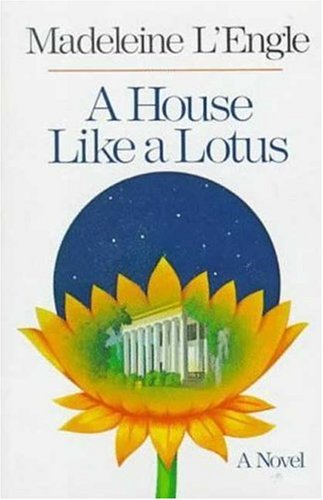
Book Review: A House Like a Lotus

Title: A House Like a Lotus


Author: Madeleine L’Engle

Date: 1984

Publisher: Farrar Straus & Giroux

ISBN: 0-440-93685-3

Length: 302 pages

Quote: “I didn’t say it would be easier without his ‘help.’”

Madeleine L’Engle said in the 1980s that she didn’t want to think of herself as either a children’s or an adults’ novelist. She wrote novels about children and novels about adults, and the protagonists, almost all female, were always like herself at some age she’d been...

A Wrinkle in Time, the first novel about angel-in-training Meg Murry, was considered a children’s book; Meg is teamed up with two other apprentice angels, her brother and her future husband, on a mission to rescue her father—and if that’s not a juvenile plot, what is? The ultimate little-kid fantasy: remaining a child while having the power to rescue an adult.

That novel was followed by Meet the Austins, in which Vicky Austin, a schoolmate, makes just one brief mention of time travel “like Meg and Charles Wallace Murry,” but isn’t in their classes and doesn’t know the details. Then came A Wind in the Door, where Meg, Calvin, and another apprentice angel from another planet travel into a structure in one of his cells to save Charles Wallace from a disease. Then, A Swiftly Tilting Planet, where Charles Wallace time-travels, and Meg, grown-up and married, psychically watches him travel, to help the right ancestors marry each other so that a foreign dictator will be born with a disposition toward peace. Then, The Arm of the Starfish, where Meg’s eldest daughter, Polly, and Vicky Austin’s future mate, Adam, are caught up in a spy story in Europe; we learn that Vicky is in between Meg's and Polly's ages. Then Dragons in the Waters, where Meg’s eldest two children, Polly and Charles, meet Simon Renier on a cruise to Venezuela. Then, Many Waters, where Meg’s other two brothers time-travel all by themselves. And—by no means finally—next in the story is A House Like a Lotus, where Polly and Charles are separated, leaving Polly alone in high school, not quite bonding with her cousin Kate or younger brother Xan, having emotional energy to pour into taking two other relationships, with teacher/friend Max and boyfriend Queron “Renny” Renier (Simon’s cousin), too seriously.

And, although all the other novels about this family were G-rated, this one isn’t even PG-13. Polly commits fornication. She doesn’t share that memory in pornographic detail, but she tells enough to leave no room for doubt that she initiated a premarital sex act. (While she was in high school and he was through college, yet.) In Polly's memory, that consensual sex act between half-grown girl and full-grown man takes place "on stage." Definitely rated R.

She did that because it was the 1980s; the so-called sexual revolution, the cultural trend that really hurt so many not-exactly-“little girls,” was not yet over. (AIDS existed and was not fully understood. L’Engle obviously started the novel with a mental image of Max dying of AIDS, then changed it to a rare tropical disease after reading that only male homosexuals were at risk...I never asked, and L’Engle never told, but I’ve long suspected from hints in and around this novel that L’Engle was writing about something that happened to one of her children and changing the genders.)

A lot of the other sixteen-year-olds at their school are having sex and getting into trouble. Pretty, popular cousin Kate “knows how to take care of herself” on dates, which means she’s handing out a lot of hand jobs. Polly is skinny and has no boyfriends other than Renny, who’s older, so her schoolmates don’t know about him. People are starting to drop hints that Polly might not really be female, or heterosexual. The hints get thicker and uglier as Polly spends more time with Max and her housemate Ursula, who are indeed lesbians, though perfectly discreet about it—when they’re sober. But one night Max gets drunk and makes a harmless verbal invitation...

I don’t think today’s readers can possibly understand the emotional weight this scene had for Polly’s contemporaries in the early 1980s. It's not that Polly can't handle her friend's lesbianism. It's that Polly's whole surrounding culture can't handle that. In 1984 the first wave of agitation for tolerance of homosexuality was generating a backlash, such that if anyone had ever even hinted that you might have homosexual tendencies, you were told you could forget about any kind of job that would bring you into contact with children, ever. In New York or San Francisco people might be proud of their broadmindedness, and in Washington there were furtive rumors about back streets in Georgetown, but in most of the Eastern States it was still believed that homosexuality was permanent and uncontrollable all right...just like schizophrenia, to which it was suspected of having some mysterious link, although the link turned out to be simply that both things were regarded with ignorance and horror.

Girls Polly’s and my age were still hearing that we were at least partly to be blamed for giving people the idea that they could ask us for sexual favors. Going out with a guy was considered to give him the idea that he was supposed to ask, or touch, although he was also supposed to stop asking or touching on command. Dates were supposed to involve endless haggling with just a tiny bit more physical intimacy being allowed on each successive date. Tedious? Oh mercy, was it ever tedious. You could just skip the whole mess until you were twenty or so, if you didn’t have a close female friend or know any lesbians, and some girls opted to do that because the dating game was such a bore.

So, what Max says, even while drunk, wouldn’t upset you or me, but it drives Polly to the absolute edge of sanity...which is how that sort of thing happened in 1984. 1984 was the year when, after I’d indignantly denied that my best friend had any more lesbian tendencies than I had, she’d quietly told me that she had had a lesbian affair with an overt lesbian friend of hers. I didn’t run out and throw myself at a young man, but I did rush out and lose my breakfast. In non-Christian novels like Shirley Jackson's Hangsaman, a friend's confession that she's a lesbian was the final horror that prompted the protagonist's suicide...

Anyway Polly is a half-grown child in an insanely homophobic society, so when Max beckons her closer mumbling “I need an affirmation of being,” Polly naturally runs out into the rainy night in a borrowed nightgown, cutting her under-protected foot, and demands that Renny help bandage her foot, telling him she can’t go home. She can’t tell her parents Max made a pass at her. Her whole social world would cave in! Because of course a lesbian invitation left a girl covered in a layer of psychic slime, and that was Polly’s fault for trusting a lesbian, and if she hadn’t had lesbian tendencies of her own she would have known better than to spend time alone with Max. It sounds crazy, but what it was was 1984. Polly is confused, but not nearly so badly as most of the older people she knows.

This is not the way we teach children about pedophiles any more...well, Max is not exactly a pedophile, and Lotus is absolutely not a book for children. It’s a novel for young adults, written with the intention of, primarily, explaining to skeptical young adults that yes indeed it was possible for a normal healthy girl with the capacity to like sex to say no. (This was a matter of intense debate in 1984.)

After that encounter that Renny says, shakenly, “mustn’t happen again until you’re a lot older,” Polly’s schedule features an unexpectedly convenient trip to a Greek island. On the island she meets Zachary, the rich, good-looking, but unreliable older boy who’s failed Vicky Austin in two moments of physical danger already, and Omio, the youngest adult in the group, who befriends Polly and rescues her when Zachary can’t, but who is married. As a virgin Polly wasn’t attracted to any of the boys at her school. On the island, “awakened” and in heat, she is attracted to both of those older men. Her story is about how and why she says no. (To herself, and to Zachary, she says no; Omio is honorable enough to have said no to himself in the first place, so he never asks.) So she does still have something to say to today’s teenagers.

Madeleine L’Engle was a Christian and had written some things for her church. This is definitely not a churchy book. The Moon by Night, in which Vicky is not particularly religious but does save herself and Zachary partly by chanting religious poems/prayers while they’re waiting to be rescued, could have been considered a Christian book. Polly claims no religion beyond a preference for Max’s agnosticism over Zachary’s avowed atheism. She does not say, even to herself, in so many words, “I like other men, but I want a monogamous marriage with Renny.” She can’t count on having that, since he’s not asked. She can only feel, in an inarticulate teenaged way, that she really doesn't want to cut off that possibility if and whenever he does ask.

I wasn’t a great deal older than Polly when this story about her was a new book. I remember snapping it up and thinking that it was a strange book for a writer like L’Engle, but that she’d got the characterization of Polly and her feelings absolutely right; I was preserving my virginity for different reasons and in different circumstances than Polly, but I was close enough to find Polly believable and satisfactory.

If you want to move beyond the clichés of romance and explore the world of hotties who know how to play it cool, A House Like a Lotus is for you. I’m even willing to overlook its use of another 1980s cliché that deserves to be forgotten—Polly’s belief that she has to go through the motions of some sort of reconciliation with Max to keep herself from being doomed to commit some sort of sexual abuse of some other person—because, after all, Max doesn’t learn that she’s about to die, get stinking drunk, and babble about affirmations of being, every day, and she is most heartily sorry; she deserves to be forgiven.

At least three editions of this novel have been printed. What I physically have for sale is a pocket-size paperback, which would fit into one $5 package along with at least seven more books of similar size. What I'm keeping is a hardcover first edition, such as would fit into one $5 package along with three more books of similar size. What Amazon will try to show you first, if you click on the book picture link, is a new edition I've never seen, but the Amazon page says it's similar in size to the hardcover edition. What you'll get, for $5 per book plus $5 per package plus $1 per online payment as usual, is whichever is available to this web site on the most favorable terms. In any case the $5 shipping charge covers as many books as I can jam into the package. Although Madeleine L'Engle no longer needs the $1 she'd get if her vintage novels were still Fair Trade Books, you're welcome to browse around and add older books by living authors to the package.