Showing posts with label 1890s. Show all posts

Wednesday, September 17, 2025

Book Review: War Is a Racket

Title: War Is a Racket

Author: Smedley Butler

Date: 1935

Length: 35 pages

Publisher: heritage-history.com (PDF)

Quote: "A racket is best described, I believe, as something that is not what it seems to the majority of people."

It's unfortunate that this retired Marine officer's book has been best remembered by left-wingers who, in the Cold War era, seized on the idea that the path to peace lay through falling into the hands of the Soviet Union just as Khrushchev said. What General Butler had to say about the corporate interests behind the wars of his day--and he ought to have known if anyone would, having been more decorated for more overseas military missions than anyone else alive at the time--and the poor compensation of veterans is a valuable historical document. This document has been made available in PDF form.

I recommend everyone read it. Just read it. Draw your own conclusions, from your own historical hindsight. If the computer on which you're reading this does not handle PDF well, e-mail to discuss the format and consequent cost of your printout. If your computer does handle PDF well, click here to read or download the mini-book free of charge.

Friday, February 10, 2023

Book Review: The Story of My Life

Title: The Story of My Life

Author: Helen Keller

Date: 1902 and many times since

Publisher: Penguin (1988 reprint) and many others

ISBN: 0-451-52447-0

Length: 218 pages

Illustrations: Braille and sign language alphabets are standard; some editions also have photos

Quote: “I like to knit and crochet. I read...I play...checkers or chess.”

Born in 1880, Helen Keller was just learning to talk when fever destroyed her sight and hearing. For a few years adults assumed she couldn’t learn anything and would have to be locked up throughout a lonely, wasted life. Then young Anne Sullivan, whose interest in communicating with the blind probably owed something to the weakness of her own eyes, undertook to try to teach little Helen finger-spelling. It seemed a hopeless task since Helen hadn’t properly learned words, but once Helen figured out that Sullivan was using signs in place of the words Helen had just begun trying to say, her frustrated mind awakened, and her education progressed fast. At twenty-one, despite doubts that she could possibly be answering all the questions and doing all the work herself, Helen Keller had a college degree and had written a book-length memoir about her education.

By the time she died in 1968 I was just beginning to notice the scarcity and poor quality of biographies of interesting women for little girls to read. Bored by Madame Curie and soon to notice the lack of solid facts in a then-popular series of “Childhood of Famous Americans” about whose childhood little was really known, I remember reading half a dozen editions of Helen Keller’s autobiography, each with some “special material”—biography, letters, biography of Anne Sullivan Macy—and finding her story about the most interesting on the “children’s biographies” shelves.

Rereading The Story of My Life as an adult, I find Keller’s Victorian Southern Lady style affected and off-putting—but she was only half grown when she wrote it, so in her memoir as in her early letters, Keller was writing as girl to girl. I didn’t find her affectations nearly as bad as those in some “children’s books” written by people old enough to know better, even when I was twelve or fifteen. Reading the edition that contains her letters, I note that even Keller’s baby sister Mildred complained about her affectations. As a teenager Keller wrote to Mildred “not to blame me for using big words, as you do the same.” Keller’s small words could also sound terribly twee, with lots of belaboring about how good and kind everyone was and what a happy little friend she was to all her correspondents, but she was a late Victorian as well as a child. Allowances must be made.

Helen Keller’s life can be summarized in a sentence, or even a phrase: “deaf-blind pioneer activist.” In a world that takes for granted that all deaf-blind children deserve access to education, Keller no longer seems the heroine she used to be. Do we still need to know the names of all her teachers, tutors, friends, every book she read and place she visited? Is it an unnecessary exercise in embarrassment to realize that, in 1890, many people thought educating any girl beyond the ABC’s and basic arithmetic was a waste of time, many more thought educating children who were either blind or deaf was a waste of time, and most thought educating anyone who was both deaf and blind was simply impossible?

While agreeing that it’s embarrassing, I’ll suggest that children may still enjoy Keller’s account of her own childhood. I know I did. I can’t say exactly why. Adults who used to worry about how to occupy the mind of a child prodigy used to poke the ideas of Braille, finger-spelling, and sign language at my brother and me; we didn’t mind pleasing adults and we enjoyed using finger-spelling as a secret code, but I remember some positive pleasure in little Helen as a storybook character that I don’t feel now. As a child I must have thought she seemed good and kind, which in fact she was. (At one point in childhood she was interested in having a Seeing Eye dog, but postponed that adventure in order for the money to be spent on sharing her dear Teacher with another deaf-blind child.) As an adult I think that, after a miserable embarrassing time of screaming and throwing things in sheer frustration, she overcompensated and became a goody-goody with no noticeable sense of humor—but children will forgive a storybook character for worse shortcomings than that if the character guides them through a good story.

Perhaps, too, my loss of attraction to Helen Keller as storybook character has something to do with having read her obscure adult writings. She grew up to become a writer. She wrote some short pieces, notably the famous “Three Days to See” article, that deserved the success they enjoyed, and some full-length books that deserved the oblivion into which they sank like stones. Her politics were Socialist, her religion was Swedenborgian, and she wrote as if people my parents’ or grandparents’ age took either of those schools of thought seriously. The ones I knew did not. Her other experience was narrowed, hard though she tried to broaden it, not even so much by her being a Victorian Southern Lady as by others seeing her as a freak. She seems always to have accepted that people were likely to buy her books merely because they saw her as a freak, and try very very hard to be a nice, lovable freak.

It remains for today’s more privileged deaf-blind authors to write vividly of their own experience, not just “seeing through friends’ eyes” on a boat ride that the leaves of trees on the riverbank were crimson and gold, but feeling the boat rock slightly when a bird perched on a rail, perhaps, or smelling the fishy mess of the herons’ roost. Helen Keller took the trouble to repeat that the leaves were crimson and gold. (She liked boats; she didn’t try to steer, but as a kid she loved to row.) Nevertheless her autobiography and letters are worth reading once, and probably the earlier in life, the better.

If I were to publish The Story of My Life with “special contents” as a book, I’d want to include “Three Days to See,” which is unfortunately missing from most existing editions. Few things are as likely to stop people taking the pleasure of eyesight for granted as “Three Days to See.”

(One of those things is, however, the subject of this week's post at michellesmirror.com, where the blogger describes how treatment for cancer has caused her vision to come and go. Strictly for brave, non-depressive readers.)

Tuesday, January 3, 2023

Sunday Book Review: Thy Kingdom Come

(This book was my holiday reading. This review should have gone live on Sunday morning...and I was too busy celebrating New Year's Day to make sure that it did; my bad. Those who don't want to read it may click on the next title below to read a regular weekday post.]

Title: Thy Kingdom Come (A Blumhardt Reader) 

Author: Christoph Friedrich Blumhardt

Editor: Vernard Eller

Date: 2011

Publisher: Plough

ISBN: not showing in e-book

Length: 258 pages

Quote: "God is now creating a new reality on earth."

Christoph Friedrich Blumhardt was, like his father Johann Christoph Blumhardt, a radical "Reformed" Protestant preacher in nineteenth century Germany. Though their influence on European Christian thought was acknowledged by authors who have been translated and published in the United States, they happened to live in a time and place that were not favorable to US publication, and remain obscure here. However, their writings were brought in by the Bruderhof group and are only beginning to be translated.

How important is it that Americans read these books? How important is it that anybody read any Christian book? Although they called out errors in their church and spoke and wrote of "Christendom" with great detachment, the Blumhardts did not want to start a "Blumhardtian" or "Bad Boll" sect; they wanted to stir up a deeper, more radical commitment among Protestants and Catholics alike. As an American with an interest in history, as I read this sampler of Blumhardt writings I recognize reactions to the same influences that shaped our home-grown denominations. Blumhardt was not apparently drawn in to the effort to trace Bible prophecies in history that shaped the Adventist movement, but he read about it. He was not overwhelmed by the charismatic movement, either, but he responded to it. He was not a Unitarian, but he sympathized with Universalism at times. He was attracted to the early socialist movement, too, though he later recognized its shortcomings and warned Christians not to put too much faith in political movements. Accordingly his thought should not seem especially novel to those of us who are already interested in radical Christianity. He will seem more like a long-lost friend, like someone who comes preaching in a foreign language that which, when translated, proves to be a message you memorized at school. 

The Blumhardts' fame in Germany owed much to an episode the family hardly claimed to understand, and seemed to find somewhat embarrassing. A woman who seemed to suffer from a mental disorder that people identified with the stories of "demon possession" in the Bible came to Johann Christoph Blumhardt to request healing prayer. After being prayed for by the church at Bad Boll for some time, she seemed to find peace, and was able to do domestic work for the Blumhardt family. The church at Bad Boll did not officially encourage people to come in search of healing but, because the troubled woman's case was widely known, the church attracted people who wanted healing, and, because of their emphasis on kindness and generosity, some people did feel that they'd been healed. Bad, "baths, springs," suggests that benefits had been claimed for the local water for a long time. The Blumhardts took no credit for any healings. In Thy Kingdom Come Christians are warned to focus on our own prayer and practice, and let God heal those who are meant to be healed. 

In this matter C.F. Blumhardt shows practical wisdom. Christians who pursue healing in an active way,  as if it could be guaranteed, tend to get into difficulties when someone is not healed. There is a real "ministry of healing" in which Christians can and should be engaged today. My mother did some things that were described as miracles. I've done some things that were described as miracles. You can and should be doing some things that some people will want to describe as miracles. We now know how to explain most of these miracles in very simple and scientific terms. If stretching or massage relieves the pressure on a tiny involuntary muscle inside your ear, you can instantly recover lost hearing without other treatment. If your chronic illness was caused by an unbalanced diet, you can feel better tomorrow, feel cured in a few weeks, and run a marathon next summer. If you were in no real danger of dying, but panicked at the mere thought of having pneumonia in your twenties, you can sweat it out overnight as any healthy young person would. And if you didn't believe that these simple treatments could work the way they can work for many people, the way they work for you may well be a miracle, requiring some sort of direct intermediation from God. But not all afflictions of the body have simple cures. Some things may be curable in the future but are not curable today. The same treatment that cures nineteen cases may do little or nothing for the twentieth case of what appears to be the same thing, and though medical science has learned many new ways to account for that twentieth patient it may or may not have found a way to help him. The man for whom Anger Busting doesn't work may be dying of multiple myeloma, in which case the complete cure of any cardiovascular disease he had will not really help him.

Blumhardt's theology is never mystical. If he did get into debates on fine points of interpretation of what the Bible teaches about the afterlife, he didn't do it in the material translated in this book. He preached for the present moment. German Christians had been understanding "the Kingdom of God" to mean Himmelreich, the Heaven-Kingdom, for a thousand years. It was trendy for Christoph Friedrich Blumhardt's generation to claim not to believe that Himmelreich existed. Blumhardt doesn't argue much about that. He allows that the Bible does teach that some sort of Himmelreich exists, but that's not his concern. The Kingdom of God that concerns him is the one Jesus wanted to set up in the hearts of those who love God, here and now--the kingdom to which we owe our primary loyalty already. Making it real, implementing its laws, is what Christians are meant to be doing.

Blumhardt did not specifically call people to live in communal households, the Bruderhofs ("brotherhoods") as organized by Blumhardt's follower Eberhard Arnold. His words allowed room for that tradition to develop. European Catholics had used their monastic tradition to solve many social problems for a long time. People with certain kinds of brain damage found peace, healing, integration, and even career satisfaction doing simple work for the local monastery. The aged, the chronically ill, and sometimes orphans and unwanted children, might be cared for by the monks or nuns. In a Bruderhof-type household, a few healthy couples can provide similar family-type care for those of their community who need help. There can be no question that this is one of the ways Christians may be called to follow Christ's example. Protestant and secular communal living is better documented in American history, but a few experiments were being made in Europe at this period too.

Without making a positive commitment to the idea that all humans must be ultimately "saved" in Heaven, Blumhardt clearly wanted to believe that they might be. There must be no anger or condemnation, he told his flock. Everyone must be treated as if they were Christ. How this was to be practiced when the group knew someone to be a thief, a lazy "sponger," or even a self-appointed "servant of Satan" with a goal of causing confusion and apostasy in a religious group, the selections from his writings in Thy Kingdom Come do not say. 

Many Protestant traditions denounce the whole idea of papacy in the strongest and harshest of terms; Blumhardt's ideals naturally led to a wistful hope that Protestant and Catholic Christians could be reconciled. Tradition may determine how much hope for this American Protestants are willing to entertain. For individual Protestants and Catholics working in the same missions it may seem not even to be reconciliation that takes place, so much as fellowship among friends who never quarrelled with each other at all.  We might be cousins at the annual family gathering. "You took A's side and I took B's side, but why talk about their problems now?" For the Catholic Church as an institution I see less hope; but can Jesus lose more to a greedy, arrogant, corrupt hierarchy of perverted men than He loses to the blasphemy of religious wars or religious bigotry? (Have we alienated all of our readers in Ireland yet? I'm talking to you...but not only to you.)

Both Blumhardts published copious amounts of written material in German but, as Eller explains, only a small sampling mostly of C.F. Blumhardt's sermons and "table talks" has been translated into English. Eller did not trust his own skills to do primary translation, but to edit other people's translations. The result is fascinating and sometimes tantalizing. In this book I find several lines that might be understood as questionable doctrine, as whimsy, as throwaway lines, perhaps as metaphors or as references to then-popular ideas or phrases. German is an "awful language" to translate into English because it lends itself so easily to such bad English, but it has a vigorous, earthy quality that can also translate into wonderfully energetic English. I suspect Blumhardt had an energetic personality too. I'd like to ask what he meant...but he died in 1917. 

For people still working through their feelings about the failure of socialist governments to deliver peace and prosperity and "social justice," I expect Blumhardt's life and work may be helpful. He was very much attracted to socialism as a movement that promised to support the growth of the Kingdom of God in this world, and inevitably disappointed by seeing how it worked in practice. He came to see, and write, that neither governments nor voluntary organizations really accomplish the sort of revolutionary change the Kingdom of God requires. It grows within the spiritual "hearts" of the faithful; it is not achieved by any program of laws, rules, or disciplines--not even programs for prayer and charity. It does still seek "social justice." It is easy to picture Blumhardt looking on the "progressives" of his day, as Jesus looked on the rich young ruler, and loving them. 

These people, as well as the Bible scholars who would like to ask exactly what Blumhardt meant by this or that remark, are going to want more of his work (and his father's work) translated if they read this little collection. The Bruderhofs are going to sell a lot of books and raise a lot of money to support their missions. And I say the sooner the better.

Wednesday, May 5, 2021

Title: American Heiress

(Here's what Blogspot was meant to have posted for the fourth of May.)

Title: American Heiress

Author: Daisy Goodwin

Original (UK) title: My Last Duchess

Publisher (US): St Martin’s Press

Date: 2010

ISBN: 978-0-312-65865-6

Length: 465 pages plus book group discussion guide

Quote: “The whole of America knows you are going to europe,t of ind a suitable consort for the Cash millions.”

Cora Cash would rather stay in the States and marry her long-term boyfriend, but he’s afraid people will despise them and think he married her for money alone. So, after disgracing herself by kissing the man to whom she would like to become engaged and having him step back, she goes to England and marries Ivo, the Duke of Wareham. But can he really love her? Can she really love him? Has she done anything but sell her body for a title?

Daisy Goodwin’s answers to these questions might fit into a Harlequin Romance, but in an effort to give this novel a little Social Relevance Goodwin gives Cora a maid, Bertha, who also marries an Englishman. Bertha has a light complexion for someone who identifies as Black. In England she’s still mostly overlooked, but for her social status as a maid rather than her alleged color, and in no time at all a nice fellow domestic called Jim is calling her his “black pearl.” Bertha’s plans for an independent life involve a little discreet theft but also a lot of honest extra work and scrimping and saving, so, arguably, she deserves to make this novel a double romance, especially after the humiliation of confessing some of her petty larceny.

Anyway it’s a nice thick double romance with a touch of trendy interracial sex and lots of historical details about the manners and styles of the 1890s, a period many people enjoy reading about more than I do. There’s a little more sex than I would like a child to catch me reading in a novel, but it’s not more explicit or likely to traumatize a child than I would like a child to discover in a nonfiction book, so reader discretion is all that can be advised. People who usually enjoy romances are likely to enjoy this one more than I did.

Wednesday, June 27, 2018

Book Review: Return to Gone Away

Title: Return to Gone-Away 


Author: Elizabeth Enright

Publisher: Harcourt

Date: 1961

Length: 224 pages

ISBN: 0152022635

Gentle Readers, I still don't feel free to take the time to upload the next batch of book reviews. I'm still hauling this laptop home every night, wearing the little thing out, and when not working on a paid job or socializing with e-friends I want to look at something that's not this screen. Maybe youall know this feeling. It'll pass, I'm sure...I can't say when.

But this morning a random tweet on Twitter reminded me...I am most likely to write a book review when (1) someone has sent me a new book for review, or (2) I've weeded a book I don't want to keep out of my collection--and only (3) I've been sitting at the computer considering what to write, and decided to write about a favorite book I've loved for a long time.

The Twit posted a picture of a little boy's review of a storybook, written on a form handed out at school. "Would you recommend this book to a friend?"--"No, because it is my favorite and I want to keep it."

This web site's book reviews can seem that way. I'm most likely to post about a book I give "ten out of ten," a book I've enjoyed every few years since the Nixon Administration, only when I've picked up a duplicate copy and put the better-preserved copy up for sale. It's unusual for me to turn to the computer right after rereading an old favorite and deciding to keep it.

Today, also, Paypal notified me of a new trick that may allow me to offer Paypal links without the bother of (1) shutting down other sites, (2) going to Paypal, (3) creating a specific product link, and (4) pasting that button into the page. Paypal does not actually care if I've listed a thousand different books I can resell for $11 online. Why would they want to store a thousand buttons? If it works, this Paypal link system will allow you to choose new or used books, or other items that may displayed here, pay with one click, and need only to e-mail salolianigodagewi to specify what you're ordering. The link will give the total amount of US$ to send, including $5 for shipping and usually $1 for that pesky Paypal fee; all you do is click and tell Paypal where to send it from (your Paypal account, linked bank account, etc.), then e-mail me about what you're sending it for.

And finally, Paper.li shared this new e-acquaintance's review of a book I first enjoyed during the Nixon Administration. This is a story about a 1960 family buying a fabulous old house in an abandoned lakeside resort town, exploring the resurgent natural environment and abandoned antiques in the other posh "summer homes" the very rich had built in the 1890s, so the children can be close to two retired friends who've come back to the summer home of their childhood to spend their last days. Lots of adventures, some funny and some scarey; delightfully detailed drawings, and a nice introduction to (by now these two) periods of U.S. history for middle school readers. What I particularly like is the indirect lesson: Nobody tells Mr. Payton and his sister Mrs. Cheever "You're too old to be living alone in these crumbly old houses, miles from town, with no phone and only an ancient clunky car blah blah blah"; the younger family just move into another crumbly house beside them. This is a happy story for seniors as well as kids.

Right. New blogging tricks begin today...let's see how they work! I promise not to post links to other people's reviews of books unless I've read the book and agree with what the other reader says about it. I fully endorse Samantha Bradshaw's review of Return to Gone-Away.

Samantha Bradshaw's review begins:

"
Return to Gone-Away is a children's book written by Elizabeth Enright, which is the sequel to the book Gone-Away Lake and discusses how the Blake family buys a house in Gone-Away. The book was first published in 1961. Plot introduction: When Portia learns of her parents buying Villa Caprice, a tumbledown Victorian house close to Gone-Away Lake, she is excited. She, her brother Foster and her cousin Julian enjoy learning about the "new" old house, with the help of elderly neighbors Mr. Payton and Mrs. Cheever.
"

To read more: https://www.thricereadbooks.com/blogs/news/return-to-gone-away-book-review

To buy it new: https://www.paypal.com/paypalme/PriscillaKingUS/16

To buy it used: https://www.paypal.com/paypalme/PriscillaKingUS/11

Add up to 5 books of similar size to the package, paying only the one $5 shipping fee for 6 books: e-mail salolianigodagewi @ yahoo to list your picks, and our Message Squirrel will send you a Paypal.Me link for the total price for your package.

If you prefer to keep payment real, send your U.S. postal money order to Boxholder, P.O. Box 322, as discussed on the Payment Information Page. Real payments never include the Paypal fee; the post office collects its own payment for the money order and postage.

Monday, September 25, 2017

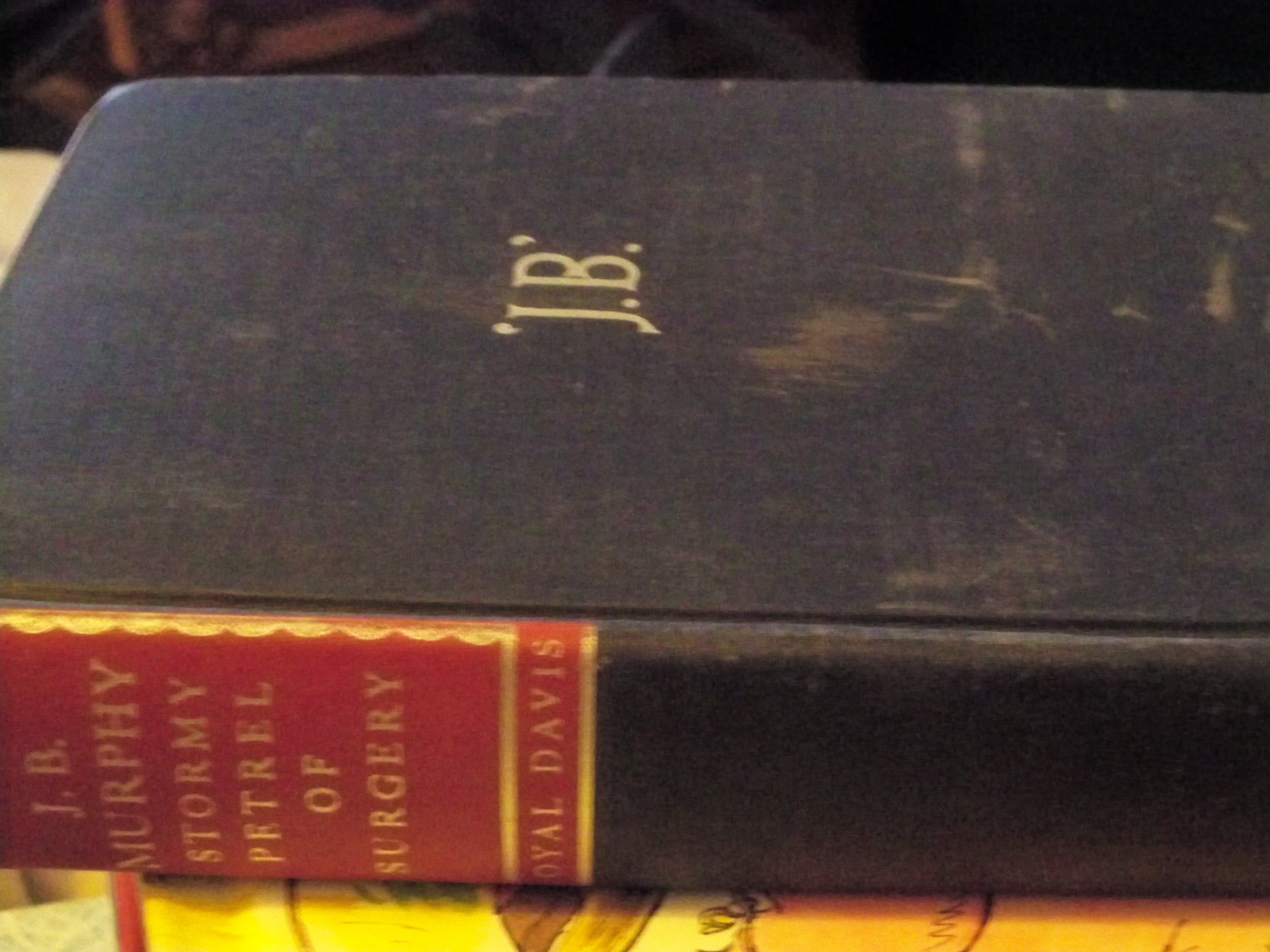
Book Review: J.B. (Murphy)

Title: J.B. (Murphy, Stormy Petrel of Surgery)


Author: Loyal Davis

Date: 1938

Publisher: Van Rees

ISBN: none

Length: 306 pages plus index

Illustration: portrait of the subject

Quote: “John Murphy...was given no middle name. This omission troubled him...[H]e asked his girl cousins for suggestions...Margaret Grimes...suggested Benjamin.”

Some time after the publication of this book, with J.B. on the front cover, Archibald MacLeish published a more successful verse drama called J.B., based on the biblical book of Job. It's possible that recent readers of Loyal Davis' book may have thought they were getting a verse drama. They're not. This is a biography of a controversial celebrity surgeon who was easily cast as both the best and the worst of the popular stereotype of Irish-Americans.

When J.B. Murphy was born (in 1857) and even when he was a medical student, a few heroic doctors had tried to correct damage to the intestines, but they always failed. Murphy invented a gadget that gave patients some chance of surviving an intestinal operation. It was called a “Murphy button” and was used to bond severed intestinal tissue back together. By 1938 the “Murphy button” had already been surpassed by newer medical technology, but it saved enough lives to make Dr. Murphy's name and fortune.

Loyal Davis (father of Nancy Davis Reagan), who worked with Murphy, traces two dominant themes through Murphy's whole biography: what was likely to be considered “good” by his fellow Catholics, and what was likely to be considered “bad.”

On the good side, Murphy showed a genuine passion for advancing medical knowledge, and if his patients didn't recover he'd jollywell know the reason why. He cured several patients who would undoubtedly have died if any other surgeon of his day had operated on them. So far as was known, he was always faithful to his sweet old Irish-born mother and to her Catholic teachings, and when his reputation was challenged he tried to “kill his enemies with kindness.”

On the bad side, there was no denying his selfish interest in worldly gain and fame. Davis presents Murphy as indisputably “on the make, on the take,” and probably also “hard to shake”--although there seems to be some evidence that the woman Murphy married for her looks and money had chosen and, to some extent, pursued him. (A woman pursuing a man was considered bizarre and comical in the 1930s.) Murphy was constantly accused of self-advertising in what were then considered unethical ways and aggressively pursuing rich celebrity patients. (He seems really to have regretted not being able to operate on President Taft; he did remove a bullet from President Roosevelt.) He was blunt, tactless, overbearing, mean-mouthed, and...is “arrogant” the word for someone who has no living equal in his field of expertise, and knows it?

As a surgeon Murphy seems to have been his generation's counterpart to Ben Carson, only with none of Carson's soothing, self-effacing manner. Davis describes him as habitually humiliating underprepared students, in the classroom and in front of patients, but the students waited for chances to be in his classes just the same. At one point his professional colleagues formally told Murphy that, in spite of their personal dislike and professional jealousy, they couldn't think of anyone else who deserved to be president of their association as much as he did.

His was that generation of shameless White men who called themselves “lords of creation,” affirmed that domineering over the rest of the world was “the White man's burden,” were proud of fighting for the title of “boss bully of the town” when they were young, used “bully” as a term of praise even after they were full-grown, believed in Capitalism and Imperialism and Social Darwinism, and seriously believed they were both meant to build Heaven on Earth and likely to do so. Humility was not a virtue of Murphy's time, and it certainly wasn't one of his own. Apparently Murphy displayed less modesty than Muhammad Ali.

But he did save lives; he taught other doctors how to save lives; and toward the end of his life, Davis tells us, Murphy knew he was dying, suspected he was dying of an infectious disease as yet unidentified by medical science, and was primarily concerned with enabling other doctors to identify and study whatever it was that was killing him. 


Medical science is not usually concerned with its own history and biography, but if you prefer biographies to novels, J.B. (Murphy, Stormy Petrel of Surgery) will probably appeal to you. Apart from a few poetic references (in 1938 everyone seems to have recognized that “Rosaleen,” cited on page one, was to Ireland as “Uncle Sam” was to the United States) Davis' style should be clear and “modern” enough for even young readers, starting from about age ten. (And, yes, although this book is Sunday-school-standard free from sex and violence, it's about surgeons; readers can expect a few healthy gross-outs.) I found it a quick, pleasant read.

What you see above is an Amazon copy of J.B. certified to be fungus-free. What I physically have is the same edition, similarly battered, not fungus-free. Real-life lurkers who are accustomed to coping with the abundant fungi of Scott County, Virginia, may buy the moldy copy for much less. Online customers will get a clean copy from Amazon, and it'll cost them, as of today, $10 per book plus $5 per package and $1 per online payment. (Two books of this size will ship in one $5 package.) 

Friday, September 22, 2017

Book Review: Many a Voyage

Title: Many a Voyage


Author: Loula Grace Erdman

Date: 1960

Publisher: Dodd Mead & Co.

ISBN: none

Length: 311 pages

Quote: “I was able to find only three recorded facts about Fannie Lathrop Ross, my heroine. These were the date of her birth, the date of her marriage, and the date of her death...There is no doubt in my mind, however, that she must have been an extraordinary woman. She would have needed to be to have lived with...Edmund Gibson Ross, past their golden wedding anniversary. Through him, in one way or another, her life was touched by almost every great national event during those tumultuous years, 1848-1889...”

I've observed more than once, in recent years, that his refusal to take sides in the American Civil War makes John Ross, of Oklahoma, one of my heroes. Enough things in east Tennessee have been named after him to show that others share this feeling. Nevertheless, in the nineteenth century another man was making the name of Ross even more famous.

Edmund Ross, of Kansas, was Horace Greeley's ideal young man. Rather than waiting for a job on Greeley's newspaper he bought his own little printing press and “went west to grow up with the country.” Abolitionist, frontiersman, “Indian fighter,” he was twice appointed territorial governor and even elected U.S. Senator. As a Senator he acted out the ambivalence many Americans felt about the Civil War at the time. Although he'd started fighting for the Northern side, in Kansas, long before the actual war started, and showed no particular admiration for Andrew Johnson's frantic efforts to show disloyalty to Tennessee, Ross didn't blame Johnson for President Lincoln's death or think Johnson needed to be removed from office. Thanks to the rules of procedure in use at the time, some blamed or credited Ross for President Johnson's opportunity to finish his term. Later, President Kennedy would list Edmund Ross among his Profiles in Courage.

Should any of the “Indian fighters” be regarded as heroes? Can that question be taken up some other day? In their own minds, by the standards of their own culture, the men who slaughtered the buffalo and the Plains people were brave. Certainly they were tough. Arguably their culture was wicked and they, individually, were its fools—the late Vine Deloria used to argue that position—but Erdman completely ignores arguments about the morality of North American immigrants' unofficial war on their host ethnic groups (and, in some cases, their cousins in those groups) in the nineteenth century. Her focus, like Kennedy's, is on Senator Ross's voting for conscience over constituents.

Loula Grace Erdman was an historical novelist popular with school librarians and book clubs in the pre-feminist mid-twentieth century. The story of Senator Edmund Ross moved her to invent a fictional character for his obscure wife. Although the fictional Fannie whose mock-biography this novel is cannot be positively identified with the real Mrs. Ross, as Erdman admitted in the endnote quoted above, history made it easy for Erdman to spin a story in which fictional Fannie comes through as a plausible, likable character. The endnote explains which of fictional Fannie's adventures seem likely and unlikely to have been similar to the real Mrs. Ross's.

But the writer can never not communicate...even when a writer like Gertrude Stein or Kim Kardashian publishes a book that communicates mainly “I'm so rich and famous that I don't have to write anything coherent to get people to buy my book.” What Erdman put into her fictional Fannie Lathrop Ross was an ideal of sanely submissive wifehood...that worked, because there are sanely submissive, passionately monogamous wives, and they behave like fictional Fannie.

Fictional Fannie is hardly docile, although she always wishes people could calm down and live in peace and harmony. She stands up to slave catchers, Civil War guerrillas, plagues, famines, and riots; after a battle she charges out to help the wounded, soothe the dying, and dispose of the dead. She's “in love” with her husband even into their old age, thanks to a generous supply of hormones (the real Mrs. Ross aged rather slowly, by nineteenth century standards, and died fairly old) and the romantic tension created by his constantly going off on adventures of his own. When tempted to disagree with her husband she's not afraid to do that, but she seems to ask herself “Do I want my own way, or do I want to be with him?” and decide she wants to be with him.

In the 1950s many wanted to believe that that was the way all women were, or ought to have been, or needed to be in order to be really happy in life...and we don't even know that it's the way the real Fannie Lathrop Ross was. The real Mrs. Ross may have been a teacher—Senator Ross went on record supporting women's rights to be fairly paid and recognized as teachers—but fictional Fannie is never employed in that profession. (The old French Socialist ideal of never-employed women being “innocent” of money was still kicking in 1960.) The real Mrs. Ross may have enjoyed travel and “frontier” living as much as Senator Ross did, but fictional Fannie is a homebody who has lost her home. As explained in the endnote, Erdman didn't even really know whether the real Mrs. Ross originally had brown hair, or whether she'd always been short; only one old, bad photo of her in her sixties survived. (In her sixties the real Mrs. Ross was short; in the nineteenth century brown hair was considered as suitable for romantic heroines as blonde, red, or black hair, and in the twentieth century many women wished that were still the case.)

So bah, humbug, I remember thinking when I read Erdman's little propaganda studies of “femi-ninny-ty” in high school. Fannie was admittedly fictional. Girls who wanted to be like fictional Fannie married early, generally got divorced early, and grew up miserable. Girls who wanted to be happy in life went to college, got jobs, and didn't let ourselves need men, even if we did eventually yield to a really choice admirer's really determined pursuit—and never allowed ourselves even to consider marriage with anyone whose life goals were different from ours. I wanted to live in my home town and not have babies; into my thirties I expected that to mean I'd never be married at all. And yet...in my early thirties, when I was finding it possible and even pleasant to live on two of the three corners of Virginia at one time, I started asking myself “Do I want to do my own thing, or do I want to be with him?” and deciding I wanted to be with my husband...in Maryland. Rereading Many a Voyage, I now find fictional Fannie believable. If not based on the real Mrs. Ross, fictional Fannie is based on some real women.


Lots of school libraries stocked Erdman's books in the mid-twentieth century. Lots of libraries have discarded them since; the copy of Many a Voyage I just reread is a discarded library book. But it may be time to reconsider whether Erdman's heroines deserve to be considered heroines after all. Maybe the real Fannie Lathrop Ross never met Jesse James, but then again the fictional encounter between those characters may have something to say to modern readers. Read or reread this book and tell me what you think.

To buy it here will cost $5 per book, $5 per package (four books of this size would fit into one package), plus $1 per online payment. The story is too long, the print too small, to appeal to most children who play with dolls, but adult doll collectors may commission a doll dressed like Fannie for an additional $10. 

Thursday, August 10, 2017

Book Review: Oscar of the Waldorf

Title: Oscar of the Waldorf


(This image is of the reprint edition; it may be a copy of a paper dust jacket that my book no longer has, but it's not the first edition, which is what I have for sale in real life.)

Author: Karl Schriftgiesser / Oscar Tschirky

Date: 1943

Publisher: Dutton

ISBN: none

Length: 238 pages

Illustrations: several black-and-white glossy plates

Quote: “Being a hotel man has been more than my job. It has been my profession...my life.”

Who was Karl Schriftgiesser? Why is this biography of Oscar Tschirky, copyright by Oscar Tschirky, written in the third person “by Karl Schriftgiesser”? Was Oscar of the Waldorf vain enough to invent a biographer in hopes of sounding more modest...or was he prudent enough to hire an assistant whose native language was English in order to produce a well-written book in English? It hardly matters now, because this is not the story of Oscar, personally. It's the story of his hotel.

Oscar and the Waldorf Hotel flourished in the “Gilded Age” between 1890 and 1930, a time when Marxism flourished as a reaction to the extravagance of the obscenely rich. Money did, of course, trickle down in its slow inefficient way. “Wealthy Willy” Waldorf Astor built his luxury hotel on the site of his father's home, in the hope that his own name would displace his father's name from history, with a mission of making himself famous by operating the most extravagant luxury hotel the world had ever seen. He succeeded, possibly because he hired a sturdy Swiss immigrant away from Delmonico's and basically put that immigrant, Oscar, in charge of stocking the hotel with the people William Waldorf Astor wanted for friends. Oscar and a full crew of cooks, waiters, cleaners, messengers, even live elevator operators, profited from Astor's dissipation of his inheritance. If they didn't become rich in the sense that Astor was rich, Oscar, at least, had no worries about retirement.

Oscar didn't chatter at the customers, he tells us. He was not the head chef, but the head waiter, or as they say in Europe the maitre d'hotel. Over the years, because he gave good service and wasn't chatty or gossipy, he did come to seem like a friend to some of the hotel's patrons. Sometimes he heard things. Once, he says, once in his lifetime, he was able to tell some of them something important enough to make him break his rule and speak before he was spoken to. Oscar had his small part in the design of the Panama Canal.

Celebrity gossip is of course the main attraction of his memoir. Most of it is bland, amusing, newspaper-style gossip. John “Bet-a-million” Gates, an early patron, wagered a hundred dollars that one raindrop would reach the bottom of a window ahead of another one (he won). Lillian Russell couldn't make up her mind whether she wanted cantaloupe or ice cream for dessert; Oscar gave her half a cantaloupe with ice cream in the center and named this dessert “cantaloupe a la Lillian Russell.” Horace Fletcher, an eccentric medical researcher who believed in eating very plain food very slowly, frustrated Oscar by ordering bread and water for lunch. When a Barnum & Bailey employee turned eighty, still on the job, the company paid Oscar to make a banquet for 400 mostly famous people into a literal circus, with trapezes overhead. Early in his career Oscar had published a book of recipes he'd collected from New York's best chefs, with the result that people thought he was a chef himself; he continued collecting recipes and encouraging chefs to invent new ones, and his “war cake” recipe appears on page 173, but most of the recipes he collected were for enormous amounts of food—and one of his favorite finds, he says, came from a prison chef and could have been officially named “Clam Chowder a la Sing Sing.”

By the 1940s, when friends urged Oscar to write this book, it appears that he had become a somewhat nostalgic and querulous old man, always missing and reminiscing about an era that had passed. In the early twentieth century conservation laws forced him to stop offering endangered wild animals as main courses. Then the World Wars forced him to curb the extravagance and comply with “shortages” and “austerities.” Prohibition forced him to ruin, in his own mind, his terrapin soup by making it alcohol-free. The Depression took all the fun out of being extravagant, and eventually his beloved hotel closed down. It reopened on schedule, but it just...wasn't...the same.

Not that he was bitter. Having invested his whole life in the hotel had its benefits. At seventy-five, Oscar could probably have retired in any place and style he might have fancied...and he chose to move into the “new” Waldorf-Astoria hotel, where he was allowed to work part-time as a greeter for as long as he wanted. (His wife, whom he doesn't embarrass by mentioning more than three times in the book, moved in with him.) That the children and grandchildren of the “old” Waldorf's early patrons kept coming back, among other things to see the institution Oscar had become, gives his memoir a happy ending.

Oscar Tschirky had no problem with extravagance, snobbery, or inflated prices, and it probably wouldn't bother him at all to know that his memoir has become a collectible book. If you don't demand the first edition, of which I can't guarantee I'll find more than one, a copy of Oscar of the Waldorf will cost $30 per book plus $5 per package (four books of this size can fit into a package) plus $1 per online payment.