Showing posts with label 1900s. Show all posts

Wednesday, September 17, 2025

Book Review: War Is a Racket

Title: War Is a Racket

Author: Smedley Butler

Date: 1935

Length: 35 pages

Publisher: heritage-history.com (PDF)

Quote: "A racket is best described, I believe, as something that is not what it seems to the majority of people."

It's unfortunate that this retired Marine officer's book has been best remembered by left-wingers who, in the Cold War era, seized on the idea that the path to peace lay through falling into the hands of the Soviet Union just as Khrushchev said. What General Butler had to say about the corporate interests behind the wars of his day--and he ought to have known if anyone would, having been more decorated for more overseas military missions than anyone else alive at the time--and the poor compensation of veterans is a valuable historical document. This document has been made available in PDF form.

I recommend everyone read it. Just read it. Draw your own conclusions, from your own historical hindsight. If the computer on which you're reading this does not handle PDF well, e-mail to discuss the format and consequent cost of your printout. If your computer does handle PDF well, click here to read or download the mini-book free of charge.

Thursday, September 14, 2023

Book Review: Anne of Green Gables

Yes. I'm still working on a long-form review of a new book that, frankly, I don't like at all; the fine art of describing the book objectively in a way that reflects an understanding that the author was writing it for people different from me, that those people will absolutely love this book but if I don't get a substantial chunk of money out of the review I'll feel that I was cheated out of the time it took to read. So meanwhile, here, free of charge, is a nice little reivew of a book of which I've sold several copies over the years, often to accompany red-haired dolls in hand-knitted dresses.

Book Review: Anne of Green Gables

Author: Lucy Maud Montgomery

Date: 1908, 1992

Publisher: L.C. Page (1908), Bantam (1992)

ISBN: 0-553-21313-X

Length: 308 pages

Quote: “A-n-n looks dreadful, but A-n-n-e looks so much more distinguished.”

Anne Shirley hardly needs an introduction. She’s a whimsical, fanciful orphan who convinces two old people (brother and sister) to adopt her, and grows up to make them glad they did. She talks too much, but apart from that she’s a lovable child.

Mark Twain called her “the sweetest creation of child life yet written.” How much does that say about her? Not much had been written strictly about child life even in Mark Twain’s time. Twain’s best known characters were young, as were Jane Eyre, Oliver Twist, and the Little Women, but they did not live what could be narrowly described as child lives—their stories carried them forward into grown-up life. How Anne compares with Heidi or Sara Crewe, or whether Mark Twain was familiar with either of them, this deponent sayeth not. Anyway, readers usually enjoy Anne.

I tend to suspect that some real-life character study went into Anne. What makes her so lovable is that, although she chatters, she chatters like a desperately lonely, needy introvert. She's not trying to control the attention of the world; she's looking for someone who can appreciate her long, deep, earnest thoughts. She's like a baby writer who's never learned to type. I think that's why people who like books always like Anne, even after they grow up and do a bit of fashionable grumbling about the commemorative statue as "the Anne that Ate Prince Edward Island.".

Meaning that our objection is that the character has become too popular. The tourist industry, not Montgomery, is the proper target of indignation. Montgomery probably never imagined that larger-than-life images of her characters would appear in ads on, for, and among buildings that would not have fitted into the “beautification scheme” Anne takes up in one of the sequels..

In view of its huge popularity this book can be recommended to two types of adults: (1) Those who need more of a reminder than “flavoring cake with liniment,” “dyeing red hair green,” or “feud with the boy she grows up to marry”; and (2) those who have lost, misplaced, or worn out their copies and need a new copy to give to a middle school girl.


Friday, May 26, 2023

Book Review: Mandie and the Invisible Troublemaker

Reclaimed from Blogjob...

Title: Mandie and the Invisible Troublemaker

Author: Lois Gladys Leppard

Date: 1994

Publisher: Bethany House

ISBN: 1-55661-410-8

Length: 173 pages

Quote: “I have a great idea, Uncle John. Why don’t you just buy my school.”

Although the Mandie Books were published by a Christian publisher, and although Mandie is being brought up a Christian who recites a Bible verse for courage and prays for President McKinley, Volume 24 is not exactly what parents think of as a Sunday School book. Mandie goes to a small, pathetic “private school” run by two old women, sisters; the sister responsible for their finances is stressed and irritable, and refuses to listen to Mandie’s truthful explanations of how the messes into which Mandie stumbles came to happen. Mandie happens to overhear the sisters talking and realize that although they can’t afford to expel Mandie, the sisters think it best to make Mandie think they’re going to expel her. She calls their bluff, threatens to leave the school, and decides it’s all right for her to break school rules on purpose since she’s being blamed for someone else’s misdeeds anyway.

At the same time, Mandie is doing what is, for a thirteen-year-old, a noble thing. Most of the girls at her school don’t interest her, although she claims to think of them as friends. Three of them she particularly dislikes. She’s sure that one of her three school enemies is taking papers to her room and tucking open jars of molasses into her bag, just to cause trouble for her. She enlists her school friend Celia to help her find out for sure before she accuses one of them. The mystery isn’t made very easy to guess, and Mandie’s self-control pays off when she finally sees the invisible troublemaker.

Still, her disrespect for the teacher is rebuked but not really repented of—and her heroic refusal to make accusations that might be mistaken is not rewarded by others, either. This is another Mandie Book that definitely reads more like a memory shared by someone who really was in school in 1901 than like a typical moralizing Sunday School story.

Though Lois Gladys Leppard no longer needs a dollar, and I still have to charge the minimum of $5 per book + $5 per package, almost any Fair Trade book would fit comfortably into the package along with this pocket-sized book. Or you could complete your collection with twelve different Mandie Books, which would (probably) cost $65. Payments may be sent to either address in the lower left-hand corner of the page.

Categories Book, Christian Tags 1900s, children's story, mystery novel


Sunday, May 14, 2023

Book Review: Rivers of Gold

Title: Rivers of Gold

Author: Tracie Peterson

Publisher; Bethany House

Date: 2002

ISBN: 0-7642-2380-1

Length: 383 pages

Quote: “The woman gently urged, ‘You wake up. You no die.’”

Rivers of Gold is a romance.

In the smaller sense of the word, which is the one most often used today, a romance is a story in which two people “fall in love.” Though the details of their quarrelling and making up may teach readers something about interpersonal relationships, the main purpose of these stories is to remind people of the feeling of “falling in love,” and thus either help hard-working wives turn their attention back to their husbands, or distract teenagers from what they ought to be doing, depending on who is reading these stories. Since there is no doubt about the outcome of these stories, and little is going on besides the couple drawing closer together, many people say that, if “romances” are not positively pornographic, they’re boring.

In the larger and more classical sense of the word, however, a romance differs from a novel in that more goes on in a romance. A novel was originally supposed to be a realistic story in which things that really happened were fictionalized just enough to allow the author to reminisce (or speculate) frankly about people’s private thoughts and motives. A romance was supposed to be a fantastic story, usually set in faraway times and places the author and reader knew only in fantasy, often dealing with the adventures of royalty, superheroes, or arch-villains, sometimes featuring speculative elements like ghosts, supernatural beings, or time travel, and usually featuring adventures that were at least unlikely. The names of the genres were originally meant to suggest the difference; for English readers a novel was meant to be like a news story, a romance to suggest the exotic glamour of Italy. A “love story” is not even a necessary element in this type of romance, though the classics of “romantic” fiction, like Orlando Furioso and The Faerie Queene, usually include more than one couple who will share adventures and be separated and be reunited before the end.

I mention this because what Tracie Peterson set out to do with her “Yukon Quest” series is a romance in the classical sense, dramatizing the broader-stage “romance” of the Yukon’s gold rush days with tales of the unlikely adventures, including love stories, that real people really had. Though Miranda, who almost froze and/or drowned in an icy river and is being urged to wake up in the opening scene, will fall in love with the scientist whose housekeeper wants her to sip spoonfuls of hot tea, we’ll read about their “romance” and the early days of their marriage along with the other adventures of their friends; the story’s not over when Miranda and Teddy take their vows. Babies will be born; toddlers’ lives will be in danger. A murderer will falsely accuse an innocent teenager and get the boy locked up until the others can prove who really killed their friend. What seem like fortunes in cheapened gold will be found and lost. Bethany House being a Christian publisher, somebody who has led a frivolous, unbelieving life will be led to profess faith in Christ. The story is fiction, and is meant to sound excitingly exotic and unlikely to us today, but it’s based on records of things that actually happened. Bethany House achieved fame with the Mandie books for children; though the setting is different this series is meant to appeal to adults who enjoyed the Mandie books.

What’s not to like? If you start here (volume three), although it’s easy to figure out that a Victorian Heroine is meeting her Rescuing Hero in the first scene, it takes a while to figure out who the other characters are and why we’re reading about them in the next several pages. It wouldn’t have been hard for Peterson to let Miranda’s happy dream, before she sips tea, include some reference to her friend Karen, or let Karen’s conversation with her husband include some reference to the certain death of their friend Miranda—but she doesn’t. Eventually, of course, all readers will catch up with the story, but I suspect I would have liked this book better if I’d started with volume one.

If the idea of a large multiethnic cast of people trying to bring the Gilded Age alive in the wilderness appeals to you, you may want the entire series. Here be steamships and washtubs, proper etiquette and concern about when the next shipment of canned fruit will arrive, passionate kisses followed by guilty soul-searching until proper Victorians can make up their minds to marry each other, sled dogs and claim jumpers, a kidnapping, a madly international celebration of Queen Victoria’s birthday, couples living in love after the honeymoon is over, enough tender moments to remind you of your courting days if you’re a grandmother, and no details likely to raise a suspicious blush if you’re reading this book in the most boring class of your school day. People who like historical romances should enjoy every page.

Friday, April 30, 2021

Book Review: Life of a Useless Man

Title: The Life of a Useless Man 

Author: Maxim Gorki (pseudonym for Alexis Peshkov)

Translator: Moura Budberg

Date: 1917 (Russian), 1971 (English)

Publisher: Doubleday (1971)

ISBN: none

Length: 240 pages

Quote: "[E]veryone called the boy Old Man. The nickname suited him perfectly."

Yevgeny, the little orphan nicknamed Old Man, is a timid little fellow who thinks the world around him ought to be nicer than it is, but lacks the courage to seek the goodness he admires either inside or outside himself. When he witnesses a homicide, he has no particular reason to report it or person to report it to. Nevertheless, he becomes a political spy, and when he learns that his duty requires him to do harm to the living people he likes best, he feels despair.

Alexis Peshkov, who chose a pen name that can be translated as "The Most Bitter One," wrote from his own formative experience in the years before the Russian revolution. Spying, corruption, appeals to the Czar that didn't lead to the results they led people to expect, are the substance of his story. They were things he presumably fictionalized from personal experience. 

Neither Czarist Russian nor Soviet publishers were willing to publish what Budberg tells us was the full text of Gorki's novel. According to her this was the first complete edition, available only in countries that were still officially enemies to Gorki's country in the Cold War, only in a language foreign to its author. Gorki was greatly admired by his contemporaries but his work was censored.

How much can you trust a novel that purports to be the first complete edition of what someone no longer living wrote, that is published only in translation? Is this Gorki's novel, or Budberg's? I have no idea. 

As a novel it's a lively, picturesque, not exactly cheerful read. Its form can be classified as either a biography or a tragedy, depending on whether or not we accept Yevgeny as a tragic hero whose fatal flaw is weakness. How can a hero be weak? If you're looking for a novel where the protagonist overcomes his fatal flaw and lives happily ever elsewhere, this is not it. If you're willing to read about the events that led up to the revolution as seen through the eyes of a weak character, this book is for you.

Friday, October 13, 2017

Book Review: Hunter's Hill

Title: Hunter's Hill


(Not to be confused with Harriette Simpson Arnow's Hunter's Horn, a greatly superior novel.)

Author: Mary Bishop

Date: 1973

Publisher: Dell

ISBN: none

Length: 303 pages

Quote: “So far as we know, Frances simply walked out of this house, and no one has seen her since.”

Around the turn of the twentieth century, Miss Eden Chase is hired as governess to Frances' daughter, who is recovering slowly from an injury. She doesn't really want to go; both her previous employer (she sees herself as a librarian not a governess) and she have been lavishly bribed, because Frances' father would like to remarry, if anyone can find Frances. Frances was spending a lot of time with a self-proclaimed count from Italy before she became a Missing Person. Nobody has been able to find either the alleged count or Frances as hypothetical countess. People are beginning to mutter that Frances may be dead.

Eden has bad feelings about the whole Hunter's Hill estate. It's all so Gothic. Frances' not suitably grief-stricken husband and daughter share the big house with a full domestic staff, the husband's brother and his wife, and an eccentric great-aunt on the third floor. People keep telling Eden very exciting things about the whole clan—any of the males might be in love with her, any of the females might be insane and dangerous, or, for that matter, so might the males, and Tony, the too-cheerful divorced or widowed husband, just might have killed Frances himself.

And Eden...isn't very bright, which may be why her previous employer was so easily bribed to pack her off to Hunter's Hill. She seems addicted to the adrenalin rush of excitement, whether it's Romantic Love or mortal terror. She's not sure she believes that Tony is “in love” with her. She's not sure he's emotionally stable enough to be anyone's lover. She's not sure he didn't kill Frances. She's not sure he doesn't plan to kill her too. She's just having a wonderful time reacting to it all.


You'll probably see the solution to the mystery and the climactic scene coming, well before page 200, but I'll leave you that much suspense at least. All I'll say is that I think Eden's survival makes this a sad story from the injured child's point of view.

Evidently other people agree with me about the unadmirability of these characters, because this book has become quite rare. In one of those outrageous miscarriages of bookselling justice for which Amazon is notorious...because it's a cheap second-rate melodrama, the best price this web site can offer online will be $210 per book plus $5 per package (eight or twelve books this size will ship in one package) plus $3 per online payment. (In real life, the copy I have for sale will cost more than other lightly used books that still smell more of paper, ink, and glue than of mold, but less than $210.) 

Wednesday, October 11, 2017

Book Review: Earthquake in the Early Morning

A Fair Trade Book


Title: Earthquake in the Early Morning

Author: Mary Pope Osborne

Date: 2001

Publisher: Scholastic / Random House

ISBN: 0-439-37116-3

Length: 72 pages of main text; unnumbered pages of foreword and afterwords

Illustrations: drawings by Sal Murdocca

Quote: "He tried to pull her out of the crack, but she was too heavy...He gathered an armload of bricks. Then he went back to the crack and handed them down to Annie."

In the Magic Tree House series, contemporary children called Jack and Annie are sent to visit interesting moments in time on behalf of Morgan le Fay, who in this series is being a Good Witch and cooperating with King Arthur by serving as the court librarian at Camelot. (Need it be mentioned that she won't send the children to explore the traditional histories that report what she did as a Wicked Witch.)

In this book, they visit San Francisco just in time to see the 1906 earthquake. The magic tree house outfits them with period-appropriate clothes so they won't be conspicuous while collecting the documents Morgan orders for her library, so Annie gets a cute sailor-collar dress just in time to get covered in dust as she falls into a crevice formed by the quake...but, protected by magic, she's not hurt and climbs out as fast as she can stack up bricks to stand on.

They try to change history by warning someone that what he's doing won't work. He ignores the warning.

They meet two generic boys who are called Peter and Andrew. In real life many brothers have been named after the brother saints, but Osborne wants the world to know these two were "based on" her nephews, also called by those names. For fictional purposes, Peter and Andrew get to be the kids who scrawled an anonymous message on a piece of wood that Osborne reports having seen in a museum.

One more odd bit of fiction in this book is based on a tidbit of real history, and since the story is so short and the ending such a foregone conclusion, I'll leave that for readers to find.

The copies of the Magic Tree House books that I have were, like the copies of the Baby-Sitters Club books, added to my personal library not so much for reading (The Nephews have outgrown them) as to suggest doll outfits. To order a doll in a hand-knitted outfit inspired by Annie's on the cover, send $10 for the doll, $5 for the book, plus the usual $5 per package and $1 per online payment. Leaving the dolls out of it, these are very small, thin books, of which twelve would probably fit into a $5 package for a total of $65 or $66. If you buy them here this web site will send $1 per book to Osborne or a charity of her choice.


Monday, September 25, 2017

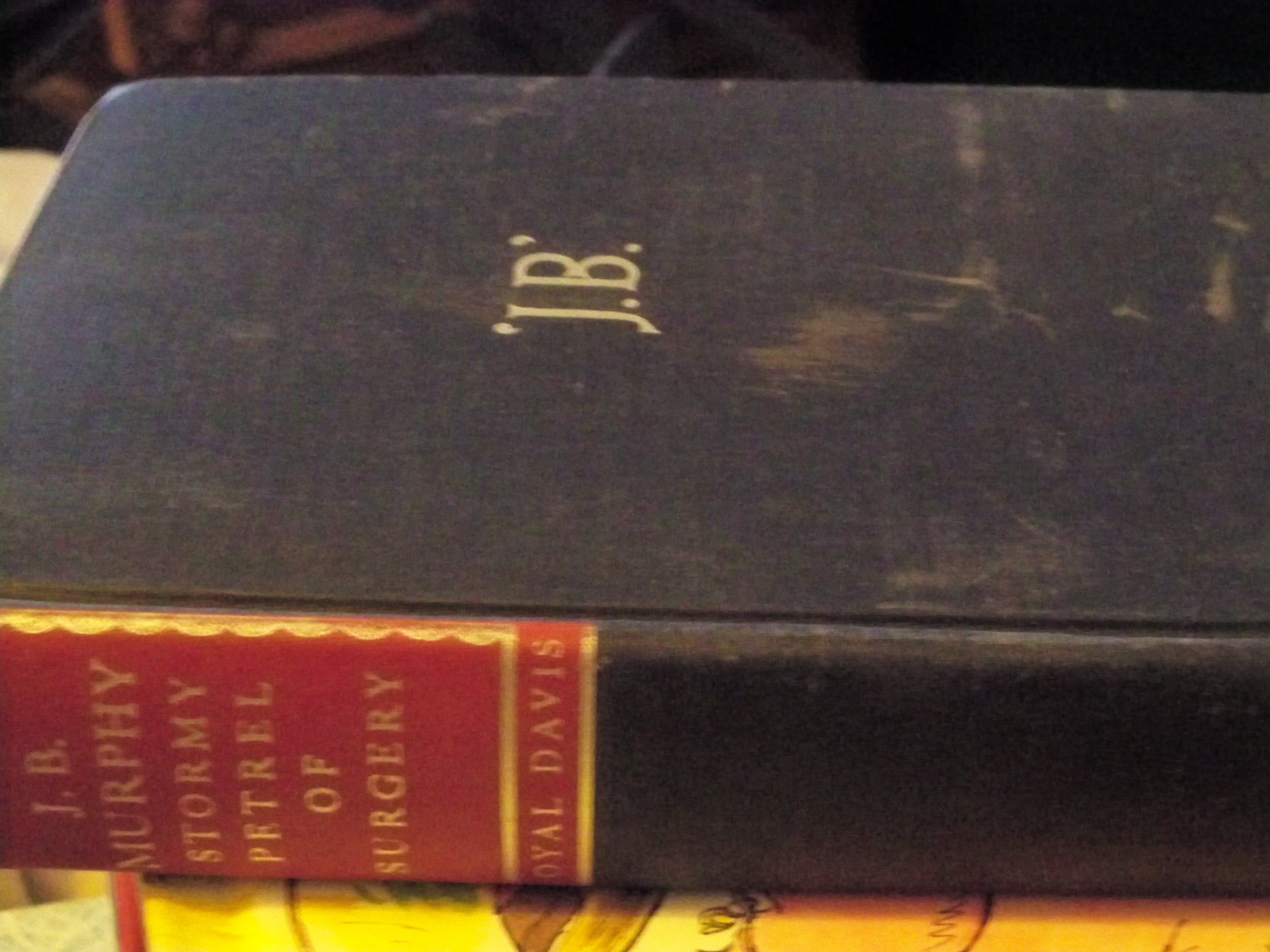
Book Review: J.B. (Murphy)

Title: J.B. (Murphy, Stormy Petrel of Surgery)


Author: Loyal Davis

Date: 1938

Publisher: Van Rees

ISBN: none

Length: 306 pages plus index

Illustration: portrait of the subject

Quote: “John Murphy...was given no middle name. This omission troubled him...[H]e asked his girl cousins for suggestions...Margaret Grimes...suggested Benjamin.”

Some time after the publication of this book, with J.B. on the front cover, Archibald MacLeish published a more successful verse drama called J.B., based on the biblical book of Job. It's possible that recent readers of Loyal Davis' book may have thought they were getting a verse drama. They're not. This is a biography of a controversial celebrity surgeon who was easily cast as both the best and the worst of the popular stereotype of Irish-Americans.

When J.B. Murphy was born (in 1857) and even when he was a medical student, a few heroic doctors had tried to correct damage to the intestines, but they always failed. Murphy invented a gadget that gave patients some chance of surviving an intestinal operation. It was called a “Murphy button” and was used to bond severed intestinal tissue back together. By 1938 the “Murphy button” had already been surpassed by newer medical technology, but it saved enough lives to make Dr. Murphy's name and fortune.

Loyal Davis (father of Nancy Davis Reagan), who worked with Murphy, traces two dominant themes through Murphy's whole biography: what was likely to be considered “good” by his fellow Catholics, and what was likely to be considered “bad.”

On the good side, Murphy showed a genuine passion for advancing medical knowledge, and if his patients didn't recover he'd jollywell know the reason why. He cured several patients who would undoubtedly have died if any other surgeon of his day had operated on them. So far as was known, he was always faithful to his sweet old Irish-born mother and to her Catholic teachings, and when his reputation was challenged he tried to “kill his enemies with kindness.”

On the bad side, there was no denying his selfish interest in worldly gain and fame. Davis presents Murphy as indisputably “on the make, on the take,” and probably also “hard to shake”--although there seems to be some evidence that the woman Murphy married for her looks and money had chosen and, to some extent, pursued him. (A woman pursuing a man was considered bizarre and comical in the 1930s.) Murphy was constantly accused of self-advertising in what were then considered unethical ways and aggressively pursuing rich celebrity patients. (He seems really to have regretted not being able to operate on President Taft; he did remove a bullet from President Roosevelt.) He was blunt, tactless, overbearing, mean-mouthed, and...is “arrogant” the word for someone who has no living equal in his field of expertise, and knows it?

As a surgeon Murphy seems to have been his generation's counterpart to Ben Carson, only with none of Carson's soothing, self-effacing manner. Davis describes him as habitually humiliating underprepared students, in the classroom and in front of patients, but the students waited for chances to be in his classes just the same. At one point his professional colleagues formally told Murphy that, in spite of their personal dislike and professional jealousy, they couldn't think of anyone else who deserved to be president of their association as much as he did.

His was that generation of shameless White men who called themselves “lords of creation,” affirmed that domineering over the rest of the world was “the White man's burden,” were proud of fighting for the title of “boss bully of the town” when they were young, used “bully” as a term of praise even after they were full-grown, believed in Capitalism and Imperialism and Social Darwinism, and seriously believed they were both meant to build Heaven on Earth and likely to do so. Humility was not a virtue of Murphy's time, and it certainly wasn't one of his own. Apparently Murphy displayed less modesty than Muhammad Ali.

But he did save lives; he taught other doctors how to save lives; and toward the end of his life, Davis tells us, Murphy knew he was dying, suspected he was dying of an infectious disease as yet unidentified by medical science, and was primarily concerned with enabling other doctors to identify and study whatever it was that was killing him. 


Medical science is not usually concerned with its own history and biography, but if you prefer biographies to novels, J.B. (Murphy, Stormy Petrel of Surgery) will probably appeal to you. Apart from a few poetic references (in 1938 everyone seems to have recognized that “Rosaleen,” cited on page one, was to Ireland as “Uncle Sam” was to the United States) Davis' style should be clear and “modern” enough for even young readers, starting from about age ten. (And, yes, although this book is Sunday-school-standard free from sex and violence, it's about surgeons; readers can expect a few healthy gross-outs.) I found it a quick, pleasant read.

What you see above is an Amazon copy of J.B. certified to be fungus-free. What I physically have is the same edition, similarly battered, not fungus-free. Real-life lurkers who are accustomed to coping with the abundant fungi of Scott County, Virginia, may buy the moldy copy for much less. Online customers will get a clean copy from Amazon, and it'll cost them, as of today, $10 per book plus $5 per package and $1 per online payment. (Two books of this size will ship in one $5 package.) 

Friday, August 18, 2017

Book Review: The Good Master

Title: The Good Master


(The 1945 reprint shown above has an especially pretty cover. What I have is the 1935 first edition, though unfortunately a library discard. What you'll get, if you don't ask for a collectible early edition, will be a more recent reprint.)

Author: Kate Seredy

Date: 1935

Publisher: Viking

ISBN: none

Length: 210 pages

Illustrations: many black-and-white drawings, two-page color drawing as frontispiece

Quote: “My dear daughter Kate...is more than delicate. She is the most impossible, incredible, disobedient, headstrong little imp. And she needs more than fresh air—she needs a strong hand!”

When authors share their own given names with their fictional characters, the stories are likely to be autobiographical. Although this book doesn’t explain the precise points of resemblance, Seredy dedicated it (emphasis original) to “the wise, kind, and tolerant good master DR. WILLIAM MANNINGER...to say: Thank you.” Whether that means Dr. Manninger was her uncle, that Seredy’s own father sent her to live with her uncle (and aunt and cousin) after her mother died and Seredy did so well on their farm that her father was willing to move back to the farm for her sake, she doesn’t say (in the book).

The story is, in any case, about a child’s happiest memories of a year on a small farm in Hungary around the turn of the twentieth century, when she’s allowed to wear something like culottes at home but is told, for special occasions, that “all nice girls wear” skirts—plural—every skirt in their closet, all at once. “Only eighteen...I have thirty-six, but I am a married woman,” her uncle’s wife complacently explains, filling the doorway with the thirty-six skirts she’s managed to stretch over each other at one time. (As a matter of historical record, some Hungarian women who lived in town, at this period, expected themselves to show off how many skirts they owned every day, and admitted that they gave themselves backaches.)

Hungary was a Catholic country at this period, but (as the Pagan writer known as Zsuzsanna Budapest later discussed at length) some old Pagan customs survived, including the family-filtered Pagan ritual in which the fictional Kate meets her uncle’s neighbors: Per village custom, on Easter all the male villagers throw water on all the young women, who are expected to reward them with a decorated Easter egg apiece as well as a snack. During the following week the girls get to slosh water on the boys in revenge, but there’s no mention of their collecting any reward. Why would there be? In real life, as the older women undoubtedly explained to ten-year-old girls like Kate when they asked questions, only women produce “eggs”...

Why Kate’s name looks English (though in some parts of Europe the name “Kate” appears to spell the name English-speakers recognize as “Katya”), but her cousin’s name doesn’t, also remains unexplained. Mainly because the token Slav in my family was christened Johnny (in his case “John” was the short “pet” form ), if I’d been the editor of this book, Kate’s cousin and new best buddy would have been called Johnny. When English-speaking children see “Jancsi” on a page, we read “Janx-ie,” not “Yahn-chie.” One of my memories of being an early-reading Child Prodigy involves reading the story of the roundup in which Kate and “Janxie” let their horses take control of the stampeding wild herd.

It’s a good story, though, even if your memory of reading it is clouded by knowing that you read it all wrong, and even if a favorite term of endearment by which adults call Kate comes out in English as...a word that, in 1935, the editor really should have realized was no longer interchangeable with “kitten.” It did originally mean a female cat, and Kate obviously understands it that way, but in the U.S. other little girls who were encouraged to read this book, as children, would grow up to have a character explain “common” as “the worst word I knew, worse even than ‘pussy’.” (That’s in Katie Letcher Lyle’s more young-adult novel, I Will GoBarefoot All Summer For You, 1973.) Presumably Seredy got away with explaining her own use of that word as a literal translation, like the rather awkward scene in which Kate is bribed to drink fresh warm milk for breakfast with the title to a white horse whose name is translated as “Milky.”

Arguably Kate’s other adventures include more cautionary tales of her scrapes than happy scenes of her triumphs. She dives off the ferryboat and nearly drowns in the current, but Jancsi happens to be already riding a horse that can wade in to the rescue. She follows a band of cheerful thieving Gypsies with the intention of helping recover the things they’ve stolen from her uncle, but panics and flees when she smells the fumes of herbs thrown into the fire, perhaps to “enchant” her into sleeping and losing the way home, and has to be rescued by her uncle instead. On the other hand, she learns to ride horses, milk cows, cultivate flowers, spin, sew, and...teach! Not only do Kate and Jancsi live too far out in the country to go to school regularly, but Jancsi hadn’t even learned how to read and write until Kate started teaching him and the laborers what she knew.

For a community to need a ten-year-old “teacher” is obviously a disaster, and Seredy moves quickly past that scene...Does it count as a spoiler if every adult reader saw the happy ending coming, probably earlier than page 112? This is not a novel of suspense; it’s a teaching story, commemorating the nicest things the Slavic immigrants at the turn of the twentieth century hoped to bring to North America.

Read as lightly fictionalized nonfiction, it’s quite a pleasant child-sized “story.” It won a Newbery Award and therefore, like other Newbery winners, has been kept in print. Reprints cost $5 per book, $5 per package (you could probably fit six books this size into a package, and Seredy wrote several), + $1 per online payment. To order a doll dressed like the cover drawing on your copy, add $10. For the European Folk Art style binding shown in the picture above, send $20 per book. Amazon isn't even showing collectors' prices for first editions that were not used and discarded by libraries. 

Thursday, August 10, 2017

Book Review: Oscar of the Waldorf

Title: Oscar of the Waldorf


(This image is of the reprint edition; it may be a copy of a paper dust jacket that my book no longer has, but it's not the first edition, which is what I have for sale in real life.)

Author: Karl Schriftgiesser / Oscar Tschirky

Date: 1943

Publisher: Dutton

ISBN: none

Length: 238 pages

Illustrations: several black-and-white glossy plates

Quote: “Being a hotel man has been more than my job. It has been my profession...my life.”

Who was Karl Schriftgiesser? Why is this biography of Oscar Tschirky, copyright by Oscar Tschirky, written in the third person “by Karl Schriftgiesser”? Was Oscar of the Waldorf vain enough to invent a biographer in hopes of sounding more modest...or was he prudent enough to hire an assistant whose native language was English in order to produce a well-written book in English? It hardly matters now, because this is not the story of Oscar, personally. It's the story of his hotel.

Oscar and the Waldorf Hotel flourished in the “Gilded Age” between 1890 and 1930, a time when Marxism flourished as a reaction to the extravagance of the obscenely rich. Money did, of course, trickle down in its slow inefficient way. “Wealthy Willy” Waldorf Astor built his luxury hotel on the site of his father's home, in the hope that his own name would displace his father's name from history, with a mission of making himself famous by operating the most extravagant luxury hotel the world had ever seen. He succeeded, possibly because he hired a sturdy Swiss immigrant away from Delmonico's and basically put that immigrant, Oscar, in charge of stocking the hotel with the people William Waldorf Astor wanted for friends. Oscar and a full crew of cooks, waiters, cleaners, messengers, even live elevator operators, profited from Astor's dissipation of his inheritance. If they didn't become rich in the sense that Astor was rich, Oscar, at least, had no worries about retirement.

Oscar didn't chatter at the customers, he tells us. He was not the head chef, but the head waiter, or as they say in Europe the maitre d'hotel. Over the years, because he gave good service and wasn't chatty or gossipy, he did come to seem like a friend to some of the hotel's patrons. Sometimes he heard things. Once, he says, once in his lifetime, he was able to tell some of them something important enough to make him break his rule and speak before he was spoken to. Oscar had his small part in the design of the Panama Canal.

Celebrity gossip is of course the main attraction of his memoir. Most of it is bland, amusing, newspaper-style gossip. John “Bet-a-million” Gates, an early patron, wagered a hundred dollars that one raindrop would reach the bottom of a window ahead of another one (he won). Lillian Russell couldn't make up her mind whether she wanted cantaloupe or ice cream for dessert; Oscar gave her half a cantaloupe with ice cream in the center and named this dessert “cantaloupe a la Lillian Russell.” Horace Fletcher, an eccentric medical researcher who believed in eating very plain food very slowly, frustrated Oscar by ordering bread and water for lunch. When a Barnum & Bailey employee turned eighty, still on the job, the company paid Oscar to make a banquet for 400 mostly famous people into a literal circus, with trapezes overhead. Early in his career Oscar had published a book of recipes he'd collected from New York's best chefs, with the result that people thought he was a chef himself; he continued collecting recipes and encouraging chefs to invent new ones, and his “war cake” recipe appears on page 173, but most of the recipes he collected were for enormous amounts of food—and one of his favorite finds, he says, came from a prison chef and could have been officially named “Clam Chowder a la Sing Sing.”

By the 1940s, when friends urged Oscar to write this book, it appears that he had become a somewhat nostalgic and querulous old man, always missing and reminiscing about an era that had passed. In the early twentieth century conservation laws forced him to stop offering endangered wild animals as main courses. Then the World Wars forced him to curb the extravagance and comply with “shortages” and “austerities.” Prohibition forced him to ruin, in his own mind, his terrapin soup by making it alcohol-free. The Depression took all the fun out of being extravagant, and eventually his beloved hotel closed down. It reopened on schedule, but it just...wasn't...the same.

Not that he was bitter. Having invested his whole life in the hotel had its benefits. At seventy-five, Oscar could probably have retired in any place and style he might have fancied...and he chose to move into the “new” Waldorf-Astoria hotel, where he was allowed to work part-time as a greeter for as long as he wanted. (His wife, whom he doesn't embarrass by mentioning more than three times in the book, moved in with him.) That the children and grandchildren of the “old” Waldorf's early patrons kept coming back, among other things to see the institution Oscar had become, gives his memoir a happy ending.

Oscar Tschirky had no problem with extravagance, snobbery, or inflated prices, and it probably wouldn't bother him at all to know that his memoir has become a collectible book. If you don't demand the first edition, of which I can't guarantee I'll find more than one, a copy of Oscar of the Waldorf will cost $30 per book plus $5 per package (four books of this size can fit into a package) plus $1 per online payment.  


Wednesday, October 19, 2016

Book Review: The Thurber Carnival

Title: The Thurber Carnival


Author: James Thurber

Date: 1957

Publisher: Random House (Modern Library)

ISBN: none

Length: 369 pages

Illustrations: drawings by James Thurber

Quote: “Thurber’s life baffles and irritates the biographer because of its lack of design. One has the disturbing feeling that the man contrived to be some place without actually having gone there. His drawings, for example, sometimes seem to have reached completion by some other route than the common one of intent.”

That’s what Thurber, age 62, wrote about himself by way of an introduction to a collection of reprints of short early pieces, including drawings.

About his drawings the most obvious thing to be said was always something like what Thurber said, also in the preface to this book: “[H]e saw, not two of everything, but one and a half. Thus, a four-wheeled wagon would not have eight wheels for him, but six. How he succeeded in preventing these two extra wheels from getting into his work, I have no way of knowing.” Thurber was not “legally blind” but always had very poor eyesight. He sketched the outlines of things as he knew them to be more than as they looked to him. That the facial expressions of the people and animals in his drawings sometimes looked hilariously appropriate, to other people, may well have been the only way Thurber learned anything about facial expressions. Often they look inappropriate—in the way that it’s not always altogether clear to which species the animals are meant to belong—and that’s part of their comic effect. For someone who actually saw so little of the world around him, who knew he’d sketched something well because other people told him so, Thurber is remembered for a remarkable number of insightful-looking drawings.

He is, of course, remembered mostly for insightful and funny short stories. Everyone of my generation, at least, remembers “The Secret Life of Walter Mitty,” “The Night the Bed Fell,” and possibly “Doc Marlowe.” Those three stories are in The Thurber Carnival with about fifty others, but although Thurber claimed to be looking forward to retirement when this book was published, some of his best work remained ahead of him. Any serious collector of American Humorous Literature will want Alarms and Diversions, Lanterns and Lances, Many Moons, The Thirteen Clocks, and The Wonderful O, none of which is in this collection, and all of Let Your MindAlone, only about a third of which is in this collection.

If there is something about Thurber that a reasonable person with a reasonable sense of humor might not like, it’s his “colored” characters. Thurber drew Black faces about as badly as he drew White ones, and noticed Black people primarily as people who spoke a different dialect of English that intrigued his word-loving ear. He didn’t hate, dislike, or despise Black people. He was, however, most likely to notice them as uneducated low-paid employees, his own or someone else’s. His intention when he wrote about somebody like Della, whose use of a word that sounded like “reeves” bemused him so that he hardly even seemed to care that she meant “wreaths,” was not to create or build stereotypes—Della’s “reeves” obviously bemused Thurber because he’d never heard anyone else say that word that way—but if he ever thought of Della as anything more than an employee who talked in a funny way, he didn’t write about it. 

Well, he was about the age of my grandfather, and he wrote for his own generation; what made Thurber special was that readers from the next two generations (in my family) or three (in the U.S. demographic scheme, generally) enjoyed so much of what he wrote, too. He generally skimmed lightly around news and political issues, although there are plenty of oblique references to those in his writing, and focussed on the funnier aspects of words and of people. This means that, if you’re willing to place a few observations about other races and nationalities, and a lot of Thurber’s observations about women, in their historical context, young people will probably laugh at Thurber’s jokes, too.

About Thurber’s remarks about women…I think the thing that redeems those is that, in real life, Thurber was a husband, father, grandfather. He lived in and wrote about a period when people seem to have been trying very hard to believe things about men and women that made it almost impossible for men and women to live happily together. Some people chose to avoid marriage for this reason; many married and were unhappy; a blessed few, like at least one pair of my own personal grandparents, had enough economic independence and/or enough social support in their churches to observe that the drivel they were hearing about “femininity” had nothing to do with their own actual observations of feminine persons in real life or in the Bible. (In fact the drivel was of French Socialist origin, but little seems to have been said or written about that.)

So Thurber observed things that inspired his short stories about couples who hated each other and were trying to get each other declared insane, his drawings of the beleaguered little man feeling that his house and wife were one big devouring monster lying in wait for him, or the man whose first wife was either lurking with obvious evil intentions or dead and stuffed on the shelf above him and his present wife. He was aware of a Problem. He didn’t preach that the solution to this Problem  involved individual family love; he was not a preacher. He did, occasionally and when he could do it to humorous effect, write about listening to the cook (if only to write about the funny way she talked), and listening to little girls (even if their own mothers leaped in to stifle the little girls’ creative whimsy), and the mysterious way Saralinda, even when she wasn’t appreciated or treated as well as she deserved, turned November into June. Thurber was not even a proto-feminist but I always got the feeling, reading his work, that he was less burdensome to feminists than most men of his age.

So it’s indisputable that Thurber is easier to read now than Will Rogers or E.B. White, and I’d guess that others will agree with me that he’s less annoying to read now than Richard Armour or Max Shulman. Read his work and tell me what you think, why not?

The Thurber Carnival is available as a Fair Trade Book. Prices vary from day to day, depending on the quality of copies available, but I can probably afford to send you a copy for the usual $5 per copy + $5 per package + $1 per online payment. You could fit a few books by living authors into the package for $5, so please feel free to scroll down and look for a Fair Trade Book to add.

Sunday, June 19, 2016

Book Review: Mandie and the Fiery Rescue

Title: Mandie and the Fiery Rescue 


Author: Lois Gladys Leppard

Date: 1993

Publisher: Bethany

ISBN: 1-55661-289-3

Length: 159 pages

Quote: "Is that the Molly whose mother works in the mill, and who lives at nine Murphy Lane?...Is she in the section that is on fire?"

Through the eighteenth and into the nineteenth century, one of the leading causes of death for young women was allowing those layers of long swishy skirts and sweeping shawls to get too close to those open fires. ("I have a bad habit of standing before the fire," Louisa May Alcott had Jo March confess; T.H. White claimed that masochism caused Victorians to stand or sit as far from the fireplace as they could bear to, but in fact, any impatience to warm and dry out their clothes could become more life-threatening than a chill.)

Nevertheless, in the climactic scene of this story, Mandie and her pals Jonathan and Celia charge into the blazing mill to rescue little Molly, a younger child they've met while taking the tour of Europe that was part of every rich American teenager's education in Mandie's day. They are, Mandie points out to the local fireman who tries to stop them, smaller than grown-up fire fighters, so maybe they can crawl into the part of the building where Molly is trapped...and in they go, without even wetting themselves down first. (Wetting down was about as much protection as real fire fighters could provide themselves, back then.)

They have, however, taken the time to hold hands and repeat, "What time I am afraid, I will trust in Thee." The fireman has, as his kind still do today, preferred to err on the side of caution. And we know this book was written by the daughter of the real woman whose improbable, but real, early life inspired the forty Mandie Books. So we know our heroes will be all right, and Molly and her mother will get out, too. To preserve some suspense, I won't say what becomes of Molly and her mother at the end.

Although Mandie has more book-length adventures than a real person of her day could have squeezed into that many years, the basic story of the blonde biracial girl from the Great Smoky Mountains, who starts out as a poor orphan, gets rescued by rich and influential relatives, and travels around the world proudly owning her unfashionable Cherokee heritage and reciting her favorite Bible verse, is the true story of Lois Gladys Leppard's mother. Mandie's adventures are fictionalized, but this base in reality keeps them from deteriorating into either a Teen Romance or a Sunday School Book. Mandie is real, and little girls (and readers who were once little girls) around the world love her.

Unfortunately, Leppard no longer needs the $1 she'd get if you bought Mandie and the Fiery Rescue from me as a Fair Trade Book, so that's no longer possible...and I still have to charge $5 per book + $5 per package for online sales. (For $10, I can dress a doll up to 12" high in a unique handmade outfit inspired by any of the characters in the cover drawing and add that to the package, bringing the total to $15; bigger dolls cost more. For $45, I'll squeeze any eight of the Mandie Books that you don't already have into a package.) If you just want to complete your collection of Mandie Books, feel free to use the Amazon photo link to buy this one directly from the seller who posed the photo, who may offer a lower price.

Wednesday, July 29, 2015

Book Review: The World So Fair

Title: The World So Fair

Author: Karen Peyton

Publisher: E.M. Hale

Date: 1967

Length: 232 pages

Quote: “Home was where you came back to from where you had been. From home you could start over—or go ahead.”

Immigrants In America seems not to be a major genre of American novels-for-children any more. It used to be, and The World So Fair is a classic example of the genre: the story of Val, Norwegian-American teen orphan, and her Aunt Siri, in old Minnesota. Long trips are taken on trains. People raise wheat. Hard work and untimely deaths happen. We know that Val will survive everything, have a good life, and probably marry well, because she is a valiant pioneer girl who doesn't demand that things go her way in order for her to be happy. The rest of the story will be, basically, atmosphere, teaching us what songs Val sang, what foods she cooked, what her first few jobs were like, what school and dating were like, even how holidays were celebrated.

Lots of families had ancestors like Val, who came to the U.S. “through Ellis Island” around the turn of the twentieth century. In 1967 the success of novels like The World So Fair depended on the number of those ancestors who were still alive and could say “Ja, this is the way things were.” A tiny bit of sentimentality was allowed—on the front cover of The World So Fair we see that Val's face was pretty in a way that was not fashionable in 1907, but was fashionable in 1967.

Novels as didactic as this one often contained plenty of foreign words, as The World So Fair does; usually they also contained glossaries, as The World So Fair should, but does not. Children thus learn when Norwegian immigrants used Norwegian expressions, but not how the expressions were pronounced or what literal meaning they had (if any). Aside from that, this is a nice, wholesome, family-friendly story about a nice, wholesome family, working through grief, holding on.

Several people in cyberspace are currently using the name "Karen Peyton." None of them seems to be the author of this novel. In the absence of evidence that the author of The World So Fair is alive we can't offer this title as a Fair Trade Book. And it's become a collector's item, with library copies selling for $10 and up, so the $15 per book ($50 if you want a hardcover copy without library-damage) does not directly benefit a living writer. However, it's a slim book and would fit into the same package with one or more Fair Trade Books for one $5 shipping charge. To buy it online, send payment to either of the addresses at the very bottom of this page.