Thursday, April 2, 2026
A Bright Side if You Look for One
Wednesday, November 22, 2023
Memes That Remind You of a Favorite Show or Movie?
If you liked these memes, check out everyone else's at http://www.longandshortreviews.com/miscellaneous-musings/wednesday-weekly-blogging-challenge-for-november-22-2023/ . I laughed.
Monday, August 14, 2023
Book Review: King of the Wind
Author: Marguerite Henry
Date: 1948
Publisher: Rand McNally
ISBN: 0-590-45316-5 (Scholastic paperback)
Length: 192 pages
Illustrations: drawings by Wesley Dennis
Quote: “[S]elect six of the most perfect steeds in the royal stables. They will be a gift to His Majesty, Louis XV, the boy King of France.”
There’s just one problem with using the history of the horse known as Godolphin Arabian, or Godolphin Barb, as an inspirational animal story for children: It’s an adult story. To make a novel for children out of it Marguerite Henry had not only to invent a little boy who not only lives with a disability but never seems to grow up or change his clothes, but also to alter the pivotal moment in the horse’s own life in such a way that the inspirational consequences have to be narrated thirdhand.
The broad outline of the story needed no changing, just a little fictional embroidery. History records that in the eighteenth century Sultan Mulai Ismael of Morocco sent six fine Arabian race horses to France for racing and crossbreeding. At the time Europeans were trying to breed fast race horses, but the fashion was for breeding big, heavy, thickset animals (of all species, actually). The preferred types of horses were the ancestors of today's Clydesdales and Percherons. Beside them even healthy, well fed Arabian horses looked small and thin. And these horses, apparently, weren’t well fed when they got to France. Apparently a greedy ship’s captain had supplied scant and poor food for the six horses and the six stable boys who travelled with them. When they got to France the boy king’s many aristocrat advisers sent five horses and boys directly back to Morocco. The palace cook being between horses, one of the bony Arabian stallions was harnessed to the cook’s shopping wagon.
Unaltered male horses aren’t the easiest to handle. Why the cook sold the Arabian horse to a vendor of firewood rather than having him neutered is one of the unanswered questions of history. Anyway, during the tough little horse’s first winter in France, an English visitor found him fallen down on the ice, being beaten by the vendor. The Englishman bought the horse, brought him back to England, and sold him. To the Earl of Godolphin, who wanted to breed race horses. The Earl did not, however, want to breed fine-boned, long-necked Arabian horses. He bought this horse as what horse breeders call a “teaser.”
Horses mate only once a year, and their preferences about exactly when and with whom they will share this moment often conflict with those of humans. The Earl, it seems, had particular problems getting visiting mares interested in his big fat male horse, and had noticed that they seemed to find the Arabian stallion more interesting. So the job of the stable boy, who history records was still travelling with the horse, was to lead the Arabian horse out to greet visiting mares before the mares were led in to mate with the Earl’s stallions.
“Stud farms” are not as idyllic as non-horsey men fantasize that they would be. Unaltered male horses do not have a natural instinct to graze peaceably in herds like cows. Nor do horses pair off and live in human-type families. Male horses fight, sometimes to the death, to select one leader who is then allowed to mate with all the females who form his herd. Young horses follow their mothers about until they reach adolescence, when the males start fighting. Most males will try to go their own way and perhaps start their own herds, if they can. But on stud farms there’s no place for them to go, so all these male horses spend their days indoors. Their instincts give them a tendency to be hostile and dangerous at best. Since their situations are not the best, from their point of view, the expectation is that they’ll become vicious, and can be handled only by teams of professionals using various restraining devices, sometimes including drugs. Nobody expects a male horse who is kept specifically for breeding purposes to be pleasant to have around. A male horse who is free to roam a pasture with a mini-herd of female and/or neutered horses and other animals is nearly always easier for everyone, including himself, to live with, and may even make himself useful, if only to one particular human friend.
The Godolphin Arabian had such a friend in the stable boy who came with him from Morocco. Who this man was, where he came from, whether he was completely unable to speak or just never learned to speak English, have been lost to history. The Earl called him Agba. Both horse and man were young when they came to England; they grew up, and the horse grew old, on the Godolphin farm.
The adolescent horse was led out to meet several females who were then bred with the Earl’s male horses before, as young male horses used as “teasers” will, he realized he was old enough to mate, too. Probably with the connivance of his human friend, he “broke loose” from the team of men who were supposed to control the male horses. He whipped the bigger, lazier, older horse in a fair fight and, as male horses do after winning a fight, mated with the female “before his handler could stop him.” The Earl was not pleased.
But he kept the mare and her colt, along with the other colts his horses had produced, and he soon saw that the lean and wiry Arabian-British crossbreed colt was faster than any of his purebred British colts. Or, it turned out, than anybody else’s. The Godolphin Arabian’s first two colts were called Lath, meaning a thin bit of wood shaved off on a lathe, and Cade, meaning the smallest young animal in a litter—and they won races under those names. The Godolphin Arabian’s third colt was called Regulus, because he was expected to win races regularly, and he did. These and the Godolphin Arabian’s other crossbreed offspring became the founders of the Thoroughbred breed. Two other male Arabian horses were imported to England. Before long, one-mile races were restricted to Thoroughbreds—descendants of these three stallions, whose offspring were then bred with one another. On one side or another the Godolphin Arabian was an ancestor to almost every horse whose name you’ve seen in the newspapers: Man o’ War, Black Gold, Native Dancer, Secretariat, Seattle Slew, Seabiscuit, Barbaro, Smarty Jones...
Horsey adults have long enjoyed the ironic history of the first Thoroughbred horses, but it’s hardly an edifying story for middle school readers. Making it one remained for Marguerite Henry to do. She did this by telling the story from the point of view of Agba, about whom the real world knows nothing, which left Henry free to invent an inspirational little story based on what really happened to children whose parents had died young and poor in the eighteenth century. Agba is taught nothing but how to groom horses. We learn with him about the body proportions required for show-quality Arabians, but mostly we see him being loyal to his horse.
In the children’s story version, the horse just eats, rests, or runs about, often carrying Agba and their pet cat, in between intervals of starvation, until he falls in love with the Earl’s youngest mare. The urge to inject an “affectional” quality to animal sexuality rings about as false as Agba’s reaction when he and the horse and the cat are banished from the stables to an isolated property down in the Fens, then brought back when the Earl sees how Lath can run. At Wicken Fen he sees only one other human being, a poacher; free to farm or fish, he doesn’t learn how to do either, but subsists on barley cooked in brackish polluted water. We can believe he might have been shy enoough to feel not much more isolated during this time than he is by his muteness all the time, but I suspect a real man would think of better rations at the Earl’s farm, new clothes, and presumably a little pocket money, before thinking about the horse’s reputation. Well, read the book. Maybe, if you’re as goodhearted as Agba, and a horse is what you have to love, you might think of the horse’s reputation first. I’ve never been sure.
Henry also gave the horse an Arabic name: one of the simplest sords in the language, Sham, “sun,” although the horse’s coat was usually described as the shade of brown called “bay.” Though, if the stable boy really couldn’t speak at all, the horse would never have answered to that name either, many Thoroughbreds don’t know their official registered names. Stable staff often give them simpler, more descriptive nicknames, often things like “Horse” or “Big Boy.” Man o’ War, the newspapers reported, actually answered to “Big Red.” The Godolphin Arabian might have had a grandiose official name like "King of the Wind," and "daughters of the wind" is a traditional name for Arabian mares, but whether the horse had a name will never be known. To the Earl his being an "Arabian" or "Barb" was distinctive enough.
In any case, most children who like horse stories like Marguerite Henry’s. Though what I currently have for resale is a reprint with only a few of the original illustrations, I recommend looking for the original if you can find it. Most of the illustrations in children’s books are badly done, included just to distract the eye, but Wesley Dennis’s horse and dog drawings are lifelike. Children who consciously study how to draw and paint animal pictures, with or without humans and landscapes in them, will want to study all of his. If you grew up with a copy of King of the Wind that had the full-page color pictures in it, a reprint with only the little black-and-white pictures above the chapter headings seems unsatisfactory somehow.
Thursday, April 13, 2023
Book Review: Dixie Dobie
Title: Dixie Dobie
Author: Margaret S. Johnson and Helen Lossing Johnson
Date: 1945
Publisher: Harcourt Brace & Company
ISBN: none, but click here to view it on Amazon
Length: 90 pages
Illustrations: several pencil drawings
Quote: “The most important animals on Sable Island are wild ponies.”
On Sable Island off Nova Scotia, as on Chincoteague, harsh conditions have caused an abandoned herd of horses to evolve into a breed of sturdy “ponies.” These ponies were sometimes rounded up and sold to people on the mainland. Dixie Dobie is the story of a Sable Island pony.
Written for grades two through four, this is a simple be-kind-to-animals story that will appeal to even younger children if they are precocious readers or if the story is read aloud to them. Sophisticated fourth grade readers might pronounce it dull. There’s no suspense, no surprise.
The pony’s first purchasers, a family called Dobie, expect “Dixie” to behave like a well trained farm horse and are predictably disappointed. Her next human family, the Bradfords, add “Dobie” to her name, take the time to make friends with Dixie Dobie, and are able to benefit from her toughness and good sense.
If it’s not the straight facts, Dixie Dobie is certainly true in essence, and predictable as it can be. There are no distracting subplots or characterizations. Like the drawings of horses, people, and landscapes that break up the text, this story is meant to communicate information clearly, not to entertain anyone with flights of imagination.
As a first book about How to Care for Your Pony, Dixie Dobie might disappoint children who imagine that the bonding process will be as quick in real life as it sounds in the story. Adults reading this story to children who are going to be living with any kind of animal may want to emphasize that, although Johnson didn’t expect anyone to sit around and read about each day, the Bradfords would have spent months making friends with their feral, independent pet.
People who seriously intend to adopt a feral horse will need more informative books than Dixie Dobie. In fact, they’ll probably need a support group. Nevertheless, Dixie Dobie is a nice first book for those people to give to young children as a pre-introduction to their new friend.
Wild pony photo from Thelesleyshow at www.morguefile.com/archive/display/977192:
Posted on October 8, 2015 Categories Book, Horse Tags feral animal, Nova Scotia, wild pony
Thursday, February 9, 2023
Book Review: 102 Favorite Audubon Birds of America
Title: 102 Favorite Audubon Birds of America
Author: Roger Tory Peterson
Date: (?) 1978
Publisher: Crown
ISBN: 0-517-53545-9
Length: 160
Illustrations: color prints of John James Audubon’s paintings
Quote: “Audubon...was the first to take birds out of the glass case and give them the simulation of life.”
Before photographs were invented, wildlife artists worked from dead specimens. John James Audubon (born 1785), like Alexander Wilson, Mark Catesby, and John Bachman, shot the birds they “studied.” They were fascinated by how easy it was to kill birds without making a noticeable dent in local populations. “Besotted” might be a better word. Though Audubon was amused by the behavior of birds he was able to catch alive, he didn’t mind eating birds he;d shot or selling them for meat, either, and might kill three dozen birds while preparing to paint two.
In Audubon’s time the Carolina Parakeet, which is now extinct, was a noisy, messy pest, and Audubon wrote that while the birds were “plucking off the fruits or tearing the grain,” a farmer could “commit great slaughter...All the survivors rise, shriek, fly round about for a few minutes, and again alight on the very place of most imminent danger. The gun is kept at work; eight or ten, or even twenty, are killed at every discharge. The living birds...return to be shot at until few remain alive. I have seen hundreds destroyed in...a few hours.” Passenger pigeons and prairie chickens were also slaughtered whether or not anyone could eat them. In pigeon season the poorest had fresh pigeon pie.
Egrets, whose “breeding plume” feathers were especially popular as hat trimmings, were slaughtered in their breeding season, so the orphaned baby egrets died shortly after their parents. Peterson’s comment on “the stench...heavy over every colony” socks it to the imaginations of readers who can remember all too easily that a healthy colony of any kind of herons always has a sufficiently strong odor.
Audubon observed closely the positions in which the birds he shot for his own use had flown, perched, sung, scolded, or threatened him. While painting he nailed and wired his specimens into similar positions. Big birds, like pelicans, great herons, and Canada geese, were posed with their heads down so they could be painted at life size, or close to it, on a 26x39” page. Some of his specimens seem to have stiffened into grotesque positions. Birds’ necks naturally form curves and angles that look uncomfortable to humans; a living heron is as good an argument as a giraffe is for the claim that the Creator must have a sense of humor, but some of Audubon’s herons were hard to believe. I have never seen mockingbirds try to fly in the position one of Audubon’s mockingbirds seems to be flying in, either.
Audubon's language could be flowery, and his article on Bachman's Warblers raises the question whether these birds ever were a true, distinct species. Marylanders who wanted to believe they had a rare, endangered, vanishing, and finally agreed to be extinct, species have paid dearly to protect the habitat of what may have been merely a variety, all along. In the name of preserving Bachman's Warblers cats have been forbidden to hunt in otherwise pleasant parts of Maryland, allowing rats to reach the top of the food chain.
Even Audubon's observations were imperfect. Mostly they are reliable even today, but we've learned more about typical bird behavior, especially the number of eggs laid in the average nest. Recent editions of Birds of America have footnotes correcting Audubon's average-brood-size counts. Audubon also through herons were solitary; they are of course solitary when fishing, which means most of the day, but they roost in great loud messy flocks. When fish are abundant, as when ponds have been stocked, I have seen a half-dozen herons fishing side by side on one sandbar, and when the shadow of a passing human did not disturb the fish it did not noticeably disturb the herons either. Most conspicuously of all, of course, Audubon mistook the young bald eagle for a separate species he called The Bird of Freedom.
Nevertheless, Audubon's paintings were magnificent, his stories about the birds he studied were often entertaining, his descriptions were precise, and with just a few explanatory footnotes his Birds of America is still a valuable reference work. More recent birdwatchers have dreamed of writing something like Birds of America for themselves, using their own observations and stories.
Today a claim might be made that David Sibley's Guide to Bird Life and Behavior, taken together with his Field Guides, have reached that goal. Meanwhile, in the 1970s, no one was better qualified to emulate Birds of America than Roger Tory Peterson, already famous as the author and illustrator of Peterson's Field Guides to the Eastern and Western North American birds and founder of the series. He probably knew most of Bird of America by heart, with its few necessary corrections, and he had stories to tell of his and his friends' observations of these birds, "hunting" with cameras rather than guns, worthy to set beside Audubon's. So he was asked to write 102 Favorite Audubon Birds of America, and he wrote it. It is of course shorter than Audubon's masterpiece, and was printed in a much smaller size, as if to say "Of course this book is only a successor,--no one would try to compete with Birds of America!"
Here, anyhow, are 102 updated "biographies" to accompany smaller prints of Audubon's paintings--a modest, affordable, coffee-table book that explains, accurately, how young bald eagles have dark coats all over, and white feathers grow in on their heads after the first few molts, when the birds are four or five years old. And many other fun facts, many quoted directly from Audubon and some of Peterson's very own.
If you like watching the birds around your house and garden, or even at the local park, and you live in an Eastern State, this book will probably meet your reference needs for several years. The birds most people most often see are here. This book does not go into the details of how experts identify the other warblers of which Bachman's might have been a mutant or crossbred form, but does provide fun facts about palmated and piping plovers, herring gulls and sooty terns, red-tailed and red-shouldered hawks, sparrows and wrens and all the other favorites.
Peterson was a cautious scientific observer. Over time, the works of cautious scientific observers seldom need to be changed--only added to.
Monday, January 16, 2023
Book Review: The Golden Book All Paris
Title: The Golden Book All Paris
Author: Giovanna Magi
Publisher: Casa Editrice Bonechi
Date: 1998
ISBN: 88-7009-191-0
Length: 128 pages
Illustrations: full-color photographs
Quote: “Writing a brief historical outline of Paris is no easy task: few cities have been so involved in great events which have changed the course of history.”
So, although there’s a sketch of the city’s history, no fear, this is mostly a photo album of Paris. Of course choosing what to include in the photo album is never an easy task either. Everyone agrees on the Eiffel Tower, the Arch of Triumph, and the Mona Lisa painting reprinted on the back cover. Beyond that, much depends on which of the pictures the visitor snaps come out best. (One way real progress has been made: with a good digital camera you can snap all the pictures you need to save only the ones that come out well.)
People who’ve been to Paris will start listing things that ought to be in the photo album and aren’t in this one, no doubt, but almost every one of these 128 pages contains premium-grade eye candy. Magi hardly needed to bother translating the text into English but she wrote nice, clear notes in English, too, if you can pull your eyes away from the pictures long enough to read them. If she’d chosen the title she would probably have chosen a better one. The Golden Book is a series of travel picture books printed by the publishers. Each book is “all” pictures of one popular destination or another.
If you’re a fan of “Wordless Wednesday” photo blogs, you might want to collect the whole series…though these Italian Golden Books are in no way connected to Whitman’s cheap, popular “Little Golden Books” for children.
Thursday, December 8, 2022
Book Review: Tales of Whimsy Verses of Woe
Friday, April 15, 2022
Book Review: Rachel Ashwell's Shabby Chic
Title: Rachel
Ashwell’s Shabby Chic
Author: Rachel Ashwell
Date: 1998
Publisher: Harper Collins
ISBN: 0-06-039208-8
Length: 210 pages
Illustrations: color photos and line drawings
Quote: “I learned to appreciate vintage and
history...I honed an ability to know what to restore and, more important, what
to leave alone.”
Rachel Ashwell financed her move from Britain to
Southern California by decorating other people’s houses, not with whatever some
department store was trying to sell (as an older generation of home decorators
did), but with her own flea-market finds.
This daring move calls for criticism on
social-political-economic grounds. That Ashwell did it was laudable. Whether
the rest of us should try to copy it is debatable, and calls for mindfulness.
Making something fashionable can be an easy way to destroy what made it
valuable. Flea markets are, primarily, FUN. They’re also a way for small
businesses to start without going into debt, and a way for the recently
unemployed or disabled or bereaved to meet a few of the sudden expenses life
has dumped upon them. This gives them a valuable place in society that depends
on their being kept accessible, cheap, and, well, fun. The idea of “an upscale flea market” is not obviously or
intentionally contrary to the idea of a good
flea market—but in effect it is. Raise the booth fees, edge out the cheap
junk that might appeal to jammy-fingered kids rather than the selfconsciously
trendy and arty crowd, and you’ve replaced a good flea market with a horrid, pretentious source of
overpriced...well...cheap junk. Because real gold will be real gold no matter
how much brass and plastic surround it, but when people who don’t have real
gold start charging the same prices for brass and plastic that they would for
gold, then people who recognize real gold have a reason to sneer at the pretentious flea market.
There’s also a tendency for slick types to finance
“really interesting” flea market businesses with illegitimate operations...one
way to recognize this happening is when the genuinely casual vendors or the
resolutely wholesome and small ones start feeling dissed or patronized. Women
tend to enter flea markets, either casually or amateurishly, to sell off things
that no longer need space in our homes: baby supplies after menopause, things a
departed friend or relative won’t be using again, things that cost more than we
ought to have spent on them in the first place and might have enough resale
value to allow us to keep the house.
When we are new both to an individual market and to flea-marketing, it’s easy
and natural to assume that a guy who’s obviously buying and selling the more
coveted items, for profit, might overtly fail to listen to us, address us as
“Baby” or “Grandma” or some similar bogus endearment as a show of lack of
respect, even try to discourage us or push us to go home before he does,
because he is a sexist jerk. Guys who act that way are, of course, sexist jerks but if we pay attention we find that
that’s not the full extent of what’s wrong with their operations. It’s always
worthwhile to find out what kind of
illegitimate business they’re up to—drugs, illegal gambling, stolen goods, etc.
Even a wholesome, low-budget market tempts vendors
(they’re numerous these days) who are in fact old, ill, and in pain, whether
they look it or not, and do in fact receive prescriptions and discounts for
medications they find it possible not only to get by without, but to resell at
a profit. They may be enabling the self-destruction of idiots who aren’t likely
to be missed, but by keeping themselves active they are replacing those idiots
with smarter, more experienced, active citizens.
Any movement toward
oh-not-just-raising-prices-for-profit-but-making-the-market-more-“upscale”-and-“professional”,
which market managers will try if they think some vendors and customers will
tolerate it, creates the financial pressure that makes pill resellers start
buying as well as selling, handling more and “harder” drugs than their own
surplus. That’s when they start trying to clear the “sweetie pie” vendors out of
the way so “the big boys” can “do business,” and when their business needs to be
shut down by the police. As these markets lose the respect of people looking
for fabulous deals on “shabby chic” china dishes, they also attract vice and crime.
Toward the end of Shabby Chic Ashwell lists her favorite (big, pricey) markets,
sources of the faded colors and antique styles that fitted into her decorating
look (which, for those who don’t recognize it, might remind them of Laura
Ashley). That’s the part of the book that could most usefully have been left
out. If those were good, legitimate markets in 1998, chances are that they’d
been ruined by 1999. Ashwell really should not have given the kiss of death to
those markets. Fortunately they weren’t even in the same States where I’ve
either shopped or sold. The focus is of course on California.
That’s a short appendix, squeezed in at the back
of the book between a discussion of cleaning and refinishing techniques and an
early-twentieth-century style “inspirational poem” at “The End.” The main 200
pages of this book are all about decorative looks. What Ashwell had to tell
people probably can be communicated better through photos than through words;
certainly her book consists more of photos than of words. We see lots of
furniture, dishes in china cupboards, books on shelves, plus some clothes
modelled by young women and children.
And, of course, colors...
I think the essential challenge for anyone writing
about colors, designing (anything) with colors, mixing colors, shopping for
colors, etc., is to acknowledge that, while you might like a particular
“palette” of colors better than others, not everyone else needs to share your
taste.
Women tend to sound judgmental about colors when
we lack training in working with different styles and palettes.
I think Carole Jackson’s biggest contribution to
the world was that her “Color Me Beautiful” system required everyone to learn to
see four general categories of colors
(with or without advanced practice in identifying “palettes” that blur the edges
between two of the big four categories). Human faces usually fit into one
category more than the others, although some people are hard to classify. In
theory all colorists would agree that a face fits into one color category. In
practice some people really do look good in colors from two or even three
categories, and trained colorists can disagree on whether to count an
individual as Spring or Autumn.
Printed color photographs can complicate matters
by nudging color tones closer together than they might have been in real life,
but it looks on the front cover as if Rachel Ashwell is one of those people.
“Her” color palette appears to be a compromise for her face. She looks like a
natural Autumn, or maybe even Spring, who likes colors that are in the Summer
palette and has built her whole look, at least when these pictures were taken,
around mixing colors that blur on the edges between the Summer, Spring, and
Autumn categories. Things are off-white, or they are pastel-colored. Most of
the pastel colors are very pale
pastels. They’re pink and mauve, but very
pale shades of pink and mauve, with brown rather than blue undertones. Or
they’re yellow, but very soft shades
of yellow that blur toward cream, ivory, and pine wood rather than lemon or
orange. Or they’re green—pale greens with visible blue overtones and quite
strong yellow undertones. Occasionally they’re true blue, but faded...like indigo-dyed denim, which is bright blue when new but always shows
its white warp threads even before the blue starts fading, or like
blue-on-white china, where some parts retain a bright true blue color but the
white always predominates.
Enough people like this cross-“seasons” group of
colors, at least in decor, that there’s an alternative school of colorists that
regard it as a primary color group in its own right. In the 1980s Leatrice
Eiseman worked with a color classification system of cool-toned “Sunrise,”
warm-toned “Sunset,” and this mix of pale colors with cream and ivory as
“Sunlight.” The “Sunlight” palette definitely lends itself to secondhand
furniture, which is often faded. It’s probably a compromise palette for almost
anybody to wear. Sunbleached furniture material is often good for several more
years of service; genuinely sunbleached clothing may not be.
Shabby Chic is
a visual guide to using Sunlight colors. They make soft, pretty combinations.
They clash with the Winter colors the majority of people wear well. Since the effect of mixing Winter colors with
softer, more “natural” (non-aniline-dyed) colors tends to be making the other
colors look faded...
Women can sound downright bigoted about the colors that aren’t their own (or, in some cases, their mothers’, or those of some other fashion mentor). In the past, when everybody did not have equal access to every color that caught their eye, various cultures evolved judgmental ways to describe colors. The intense Winter and Spring colors were dissed as “garish” or “childish”; soft Summer colors were “faded” or “washed-out,” and warm Autumn browns were “pre-soiled” or “dirt-colored” to those they didn’t suit.
Since my hand-knitting brand is
“clothing, not ‘fashions’,” I’ve not retreated back, as most retailers of
mass-produced garments have, to the bad old Waste Age custom of marketing “this
season’s colors” and purging colors that may be what someone wants from my
display. Sometimes someone twits me about this: “Don’t you have some more contemporary colors than all those 1980s [they mean Winter] colors?” I do,
but since the person has used a hostile rather than professional tone I’m apt
to hit back, “Y’mean that pre-soiled,
urban grunge look?” Actually it’s only on Winters that browns and brownish
grays look “dirt-colored.” On Autumns, of which the speaker is probably one,
brown is a vibrant color that brings out the person’s unusual good looks.
Colors speak directly to the emotional, even
reptilian, layers of our brains but it’s worth the effort of learning to see
colors with a detached professional eye. You are, for example, more likely to
get the designs of your dreams from artisans or decorators to whom you describe
your colors without making harsh judgments on theirs. Better yet, as Ashwell fortunately does in this book, show pictures. If someone has a clear, true picture of the couch and the rug and the picture on the wall and says "I want a blanket to put on this couch," we are communicating.
Ashwell betrays a habit of thinking of books on
shelves as décor items, to be judged by their covers, rather than words to be
judged by their meaning. She knows someone who finds the freshly printed colors
on book jackets too bright, so she loses the jackets and displays the
beautifully fading colors of older books’ hard covers. Isn’t that special! Ick! Actually, it depends
on the community. I both buy and sell secondhand books without paper jackets,
but some booksellers say they can’t sell them.
If a person wanted to display books as décor
items, it’s not hard to do. In fact it could be fun to do as a family project
with children. You can’t have too many book covers and it’s so easy to cut
paper to wrap around a book. You could color-code book covers to make it easier
to see which shelf a book belongs on.
You could decorate them with scenes from the book. You could play with visual
effects on your computer, printing off book jackets with colors, shading
effects, or decorative fonts. But the backs of books on a shelf are such small
areas of color that books can’t really be said to affect the color balance in a
room, unless you put a lot of color-matched covers side by side.
Actually, since most houses benefit from having
light-colored interiors that maximize the efficiency of lighting, Ashwell’s
pale color palette could inspire tweaks in any direction. Ashwell suggests
re-dyeing yellowed white fabric to a “flattering sepia.” Spoken like an
Autumn...to the majority of humankind, who are Winters, there is no such thing
as a flattering sepia. If yellowed white fabric doesn’t bleach back to white, most of us would dye it a
bright color, or maybe black. If you take design or decorating seriously, you
do this kind of “translation” automatically, and you can use and enjoy Shabby Chic. If not, you probably
wouldn’t be interested anyway.
So, in summary: If you are the kind of person who
can get the most use out of Rachel
Ashwell’s Shabby Chic, you probably don’t need it, but you’ll probably
enjoy it. I don’t think it’s an ideal first book for someone who’s new to The
Applied Visual Arts, unless that person happens to be in Ashwell’s peculiar
color niche, as described above. It
is, in any case, a gorgeous book. It’s the sort of book I like having on a
display just to show that, bristling and value judgments aside, I do understand
how those minority-appeal color palettes work...and actually I enjoy using them,
now and then, on commissions from people who look different from me. You might like it for that purpose too, or you might like it as a guide to putting together your home and/or wardrobe.
Friday, September 18, 2020
More Petfinder Links, Anyone?
It all started when I took the Laptop of Then home and looked at "cached" web pages while the Queen Cat of Then, Heather, was being encouraged to curl up and purr beside me. Heather would look at the laptop, and though she didn't mistake pictures for real things in the room or try to swat the cursor, she did seem to recognize cat pictures as images of other cats. She'd look at cat pictures and usually point her ears slightly toward them, showing mild interest, not alarm or hostility. I thought it was cute to make a post that suggested that a cat an e-friend's local shelter was finding hard to place might become an "e-friend for Heather." Publicity got that cat (a crotchety senior cat) a home, and Heather and I then started picking the cutest cat photos near the zipcodes 10101, 20202, and 30303--New York, Washington, and Atlanta.
The rule was that we, or more often just I, would look for photos of the type of animal first mentioned by an e-friend or Tweep during each online session. If the first animal content I found online came from Mudpie's Human (the blogger who started it all), I'd pick the cutest three-colored cat pictures. If it came from LB Johnson, I'd pick the most photogenic black dogs or retriever-type dogs. And so on.
The cool part was that Twitter would automatically display one of the pet photos, people would retweet the cute animal picture, and the next time I'd look at pictures of that type of animal, that one would no longer be in the shelter. (Usually. There was one beautiful cat, who looked a lot like Heather, who the shelter staff said just wasn't friendly; people who saw her picture would decide to adopt some other three-colored cat instead.) We were actually helping animals find homes! Heather really was pleased...because other people were adopting those cats, so they weren't moving in with us. Heather was a gracious Queen of a Cat Sanctuary but she had a way of looking at other cats, just to let them know who was Queen, that caused several prospective temporary residents to sprint half a mile. Even some human readers, seeing Heather's "Excuse me, I happen to be the Queen Cat here" expression, thought she looked "mean."
Nah. Miffed is the word. I never saw Heather looking seriously angry, or wanted to. She was a gentle, goodhearted cat who once lost her own kittens by trying to adopt some orphaned kittens too completely, too quickly. She was extremely social, and failed to develop some of the standard adult cat survival skills by relying on her friends to do things like supplying enough milk for all the kittens or even cleaning the fur on Heather's head. The one time she encountered a cat who really was hostile, her attitude seemed to be "Is this even possible? What can you do in such an unnatural situation--an antisocial cat!" But when she reached her full size she was a serious predator--the hunter for the family. Most other cats didn't want to mess with her. She always seemed to wish other cats well, and to understand that their well-being included plenty of space.
Heather grew older and dozier, spent more time indoors but still wanted to spend most of her time outdoors, and was eventually caught in extreme weather. She was survived by a foster kitten, Samantha Scaredycat, and a nephew, Burr, who produced our current Queen Serena. Serena really can be a tough disciplinarian, though not mean. And she's shown subzero potential for ever actually participating in any cute little rituals of helping pick out cute pictures to show on this web site. Serena disapproves of electronic screens; that's why there aren't more pictures of her, though she knows she has a pretty face and likes to be admired.
In that picture, taken before she was even half grown, Serena was asserting ownership of Samantha's Safe Place. She's usually nice about it but she is the most dominant social cat I've ever known. (Often social cats don't seem to have a hierarchy.) She loves other cats as long as they're completely submissive, subordinate followers who don't get any ideas about e.g. snuggling up to her human. Possibly that's why, on seeing a glimpse of her own reflection in a screen, Serena either moves away from a full-sized image, growling and hissing, or wants to play roughly with a miniature image such as a digital camera phone. She probably sees herself as either a hostile intruder, or a very bratty kitten who needs a lot of slapping around. No other living cat has ever replied to Serena's normal body language with equal assertiveness, and if one did, fur would probably fly.
But with humans, at least, the Petfinder links were extremely popular, and seemed to be doing some good, so I continued doing them without Heather's input until Petfinder redesigned their web site and added some cookies that the cookie-cleaning software on the Laptop of Then was not able to clean away. This made using them a violation of our Google Contract of Then: This web site's contract forbids us to use links that might adversely affect people's computers' performance, i.e. links to sites that use messy cookies.
But guess what's happened? I have a new laptop with newer cookie-cleaning software. Google has changed their coding to include newer cookie-cleaning software. I can now visit Petfinder without picking up messy cookie crumbs. That does not necessarily guarantee that everyone can, so the following Petfinder link is only a test. If it opens slowly or strangely, or the link works slowly or strangely, for any readers Out There, please let me know, and I won't do more Petfinder links.
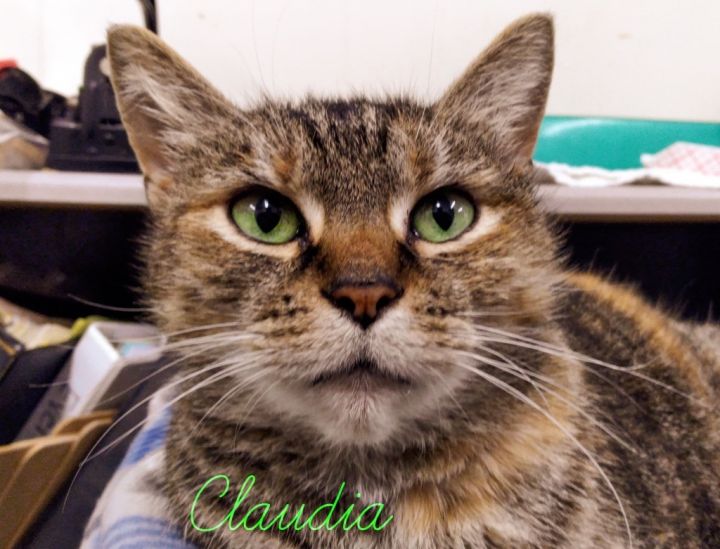
Here, in any case, is Claudia from Blountville, Tennessee, nonverbally saying "Please give me a decent home, away from this lunatic who wants to drape beads around me."
Can you resist that eyeroll? If not, click here. That shelter near the Tri-Cities Airport in Tennessee is a long drive from anywhere but it's where I found Dusty, the legendary Queen of the Yuma Cat Sanctuary, and it's where shelter staff found and documented a pair of social cat cousins whose bonding was remarkable enough to be written up in the newspapers. Claudia is a full-grown cat, which means she'll take longer to become a real part of your family than a kitten would, but also means she's already received the routine veterinary care, including spaying, necessary before you can take her home.
If I don't receive complaints from readers, the Petfinder links will return.
(For those who don't know, that straw-gray tabby coloring with patches of yellow makes Claudia what some people now call a "Torbie"--a combination of tabby and tortoiseshell. I don't know that there is a stereotype of what's considered a typical Torbie personality yet. I know our Mackerel was a big, tough, independent, sweet, super-social Torbie tom who lived in the woods and spent quality time with all the different families who loved him, and Suzie, the Queen of the Jackson Street Cat Sanctuary for many years, was a long, lean, mean-faced but sweet-natured Torbie who spent lots of time warming a sick patient's feet. So the common characteristic for both of the Torbies I've known was that they were unusually kind cats, but I don't know that that's really typical.)
Tuesday, August 21, 2018
Tortie Tuesday: Cats Thank E-Friend
"Treats? Gimmee!" said Samantha. (She said this by leaping straight up into the air and grabbing at the top of the bag. It must be remembered that Samantha spent part of her kittenhood among middle school boys who encouraged this sort of doggy manners--until she got big enough for the playful nips and scratches to hurt people.)
"Treats?" said Serena. (She said this by sitting up and giving me a junior-queen-cat look.)
"Treats? I love you I love you I love you where've you been you left us indoors far too long, don't go away any more, oh, you smell like hamburgers, did you bring me one?" said Traveller. (He said this by leaping up into my arms, rubbing against me, purring loudly, drooling, licking, and wriggling to spread as much fur as possible over my clothes. He always love-bombs me after work, but he seemed especially ecstatic yesterday because I'd gone online from McDonald's.)
"So, while the sun is shining behind the trees, can we get some recognizable snapshots of you cats showing treat appreciation, please?" I said.
"Right," said Serena. (She said this by perching on top of the carrying cage and posing as if she'd ever been taught how to pose, or seen the cheap-cell-phone camera in use, before. She has not. She is not a normal cat. At four months old, she already seems like the Ruling Queen.)
"Me too," said Traveller, bouncing onto the carrying cage. Through the cell phone camera his face showed up well against the aluminum roof of the cage. Then he realized that I was sitting down on the ground to get that nice clear picture... "A lap! A lap! Snuggle me on it! I always was a lap cat! No, don't put me back on that old cold roof, hold me on your lap! Hey, your skirt smells like hamburgers too! No, I've not finished rolling and purring and rubbing and cuddling!" He refused to pose properly. I finally got one face image that I recognized, although it's distorted. He does not have patches of white fur above his eyes. He has patches of thin black fur through which, at certain angles, in certain lights, a really shabby cell-phone camera...well...
"What was that in the shed? Oh never mind, only a cricket. You can take my picture now," said Samantha.
Compared with the other trios of cats by whom I've been owned lately--Heather, Irene, and Ivy, or Mogwai, Grayzel, and Bisquit, or Mac, Polly, and wossname their brother--these three cats are a handful of misbehavior.
Black and dark tortie cats tend to have a lot of energy. Traveller and Samantha seem to be bonding by encouraging each other to jump at things they shouldn't grab, dart into places they're not supposed to go, pull things down, and play in traffic.
Serena has a cool personality and a passion for wrestling that most people would probably read as a mean nature. She's actually a sweetheart if you understand that gentle nipping and scratching are her way of cuddling, and remembering rules and cooperating with instructions are her other way of showing affection. Still, if you define a pet as something that snuggles on your lap I don't think Serena will ever be one.
None of these cats can prove they understand words by reliably obeying commands. They're as much fun as the proverbial barrel of monkeys, and in much the same way. During this whole ten-minute photo shoot the neighbor who'd brought me home was sitting in his truck laughing. (I will admit I was also laughing.) The cats were bouncing about, racing, chasing, tagging each other, trying to grab the phone...a merry heart, and specifically the diaphragm exercise of laughing out loud (for humans), do good like a medicine, so I'm sure the photo shoot was very good for all of us.
Serena is Irene's granddaughter and has a fascinating mix of Irene's graciousness and Samantha's sass. (And Irene's mother Candice's preference for romping over cuddling.) Samantha does respond to words, in her way; she's not an obedient animal but she usually seems to know exactly what I'm talking about. Traveller at least wants to please and responds to tones of voice, if not specific words. I still miss the older generations of Serena's family...but I enjoy these cats too.
For those readers who've had to lay a beloved senior cat to rest...Heather was going on eight years old, which is old for the barn cat she theoretically was, moving in the direction of having to be the sort of mostly indoor animal my mother never wanted in the house...consider adopting a couple of bouncy-pouncy kittens. I want to emphasize "couple," even if they were born in different litters the same year. Serena's incessant chomping on my hands when I was trying to type was quite a nuisance, and apparently Trav was a similar nuisance in his original home. When they met they were obviously fascinated by each other. When Samantha and I allowed them to play together, after a period of quarantine and flea treatment, they became inseparable. As far as they're concerned, they are brother and sister. As far as I'm concerned, they're completely different from Heather, so they don't stir up memories or seem to be competing with her in my heart or anything like that. Even as a kitten Heather never acted like these three. So they're a separate experience, and great fun.
And of course, like all healthy cats, they enjoyed their treats. Thank you, Gentle Reader.
Tuesday, April 17, 2018
Book Review: The Gift Is Small the Love Is Great
Tuesday, April 10, 2018
Book Review: Lazy Liza Lizard's Tricks
Currently, to purchase these books here, you'll need to send $350 for Lazy Liza Lizard's Tricks, $200 for Lazy Liza Lizard, plus $5 for the package, to Boxholder at P.O. Box 322, or add $6 to the Paypal payment to the account you get by e-mailing salolianigodagewi at Yahoo. Both books will fit into one package, along with probably two more of similar size.
Tuesday, January 23, 2018
Book Review: Lion
![]() |
| If the book reviewed is not about Torties ("tortoiseshell," black and orange mottled cats), at least it's about felines... |
Title: Lion
![]() |
| Cartoon felines. |