Showing posts with label children's story. Show all posts

Monday, June 15, 2026

Book Review: Mommy Has a Monster on Her Back

Title: Mommy Has a Monster on Her Back

Author: Liz Long

Date: 2024

Quote: "Using my personal experience with...trigeminal neuropathy...I wanted a story that would convey how my chronic condition impacts my life and how it varies from day to day without the material feeling intimidating or overwhelming to my young son. The story I would recite to my son soon evolved into this children's book."

So Mommy's chronic pain is portrayed as a monster whose size and color vary. Now that three-fifths of us are living with chronic disease conditions whose symptoms vary from day to day, a lot of children are likely to need some sort of explanation of the chronic condition of somebody they know. Hence this book.

According to Bruno Bettelheim, small children prefer fairy-tale explanations to realistic ones because they're not capable of understanding the more accurate explanations that rely on abstract thought. I don't know that that's true. I do know that as a small child I sometimes imagined things I couldn't quite understand in fairy-tale or TV-cartoon terms. By age five I understood pain well enough not to have "needed" to think of pain as a cartoon monster. Children's ability to understand ideas like pain varies. I would guess that a child who didn't think of pain as a cartoon monster might still enjoy the "silly, babyish" quality of this story--know your students. 

Tuesday, March 17, 2026

Book Review: The Changeling

Title: The Changeling

Author: Zilpha Keatley Snyder

Date: 1970

Publisher: Atheneum / Scholastic Book Services

ISBN: none

Length: 232 pages

Illustrations: drawings by Alton Raible

Quote: “[A] changeling comes when some other creatures, gnomes or witches or fairies or trolls, steal a human baby and put one of their own babies in its place...when the babies are just a few hours old...Aunt Evaline and I think I might be a wood nymph or a water sprite.”

Martha is the shy, quiet baby sister in a family of high achievers. Ivy is the creative, idealistic baby sister in a family of tough guys and alcoholics. The Changeling is the story of their friendship, which lasts all through their school years and culminates when the girls have to find out who really committed a crime (a mean girl in their class has accused them).

It’s chick-lit; what Snyder’s son categorized as a “sad story about girls” when he demanded that she write Black and Blue Magic, a funny story about a boy. It doesn’t really fit into the stereotype of what children in any particular grade ought to be reading; too slow-paced and emotional for most middle school readers, too chaste and simply told for most teenagers. (Even in grade ten, Ivy and Martha don’t seem to think their lives need any romance.) It can be read as Snyder’s reaction to the elitist bigotry of which some Americans hadn’t even become ashamed in 1970: adults think Kelly, who belongs to a “nice” middle-class family like Martha’s, would be an appropriate friend for Martha, but Kelly is thoroughly hateful; adults think Ivy would be a bad influence, but she’s as good a friend as a little girl can be.

It is, however, the reality-based story behind Snyder’s venture into fantasy, a few years later, in Below the Root. Some readers may find these stories interesting enough to compare and contrast and consider how Snyder had developed as a writer during the years between these two novels. In The Changeling Ivy invents, Martha co-writes, and they act out as a dance, the story of the Tree People; in Below the Root the story reappears as an independent fantasy adventure. Both novels contain embedded anti-drug messages. Which way of embedding an anti-drug message in a story works for you?

For me The Changeling is also useful as a study of the two healthy introverted traits that frequently appear in females. The physical traits that produce LBS and HSP personalities hadn’t been scientifically identified yet, but it’s obvious that Martha, who is neither stupid nor hypothyroid but consistently “slower” than her siblings, has a long brain stem and Ivy, who tells stories and becomes a dancer, has high sensory perceptivity. By now my sister has managed to find educational picture books about introversion for preliterate children. Verbally talented introverts may still prefer to read a story about the adventures of two school-aged introverts, rather than a picture book aimed at younger children. So, although The Changeling was among Snyder’s slower-selling books and may not be easy to find, it’s still worth buying for an introverted little girl. 

Or for yourself, if you were once an introverted little girl (or boy) and still enjoy a simple story that’s not about adultery or murder. Like most novels aimed at child readers, it’s not complex enough to draw adults back again and again, but the plot takes enough turns to get an adult through a few hours of down time. 

Thursday, February 5, 2026

Brother Guinea

For some months now I've had sitting in a folder the Roads End Naturalists' best wildlife photos from their visit to South Africa in 2024. 


Everyone who goes there always photographs lions and zebras, so what caught my eye was the photo of a guineafowl in its native glory, strutting among the lions and zebras. 


(Photo from the Mother Earth News)

This bird is often kept with free-range chickens in the United States as a sort of watchdog, or watchbird. It is less lovable than the chickens, or even the ducks and geese. Guineas never become pets, even if they're reared indoors and snuggled and fed from your hands. They never seem to like chickens, ducks, geese, or turkeys much either. They stalk around pecking at ducks and chickens, dodging geese and turkeys. They make loud noises when they are contented, talking to one another, and even louder noises when they are startled; they really grate on the ear. 

But in Africa, long ago, people noticed that these birds could be useful when they are semi-domesticated, or domesticated to the extent that their very limited ability to learn anything new will allow. 

The story of how guineafowl could be useful developed into a folktale I've heard and read a few times. More authentic printed versions used to be available in the folktale collection sections of public libraries, before the War on Nonfiction Books started. The tale of Brother Guinea is obviously exaggerated for comic effect, but also obviously based on fact...

Once upon a time there was a good, hardworking woman who couldn't have children. Because she had no children to help her in the garden she couldn't raise as many garden crops as others in the village, and was consequently poorer than they were. Even her husband left her for another woman, who was lazy and mean-mouthed and not even pretty, but she certainly did have children. Horrible spoiled children who ran over the childless woman's property and damaged the crops in her little garden. And when the childless woman told them to stop, the mother of these brats came out and called her names. So the childless woman, through no fault of her own, felt very unhappy and, not having heard of Christ, she went out into the forest and begged the forest spirits for help.

The names of these women have been lost to history. Let's call them Righteous Rosie and Nasty Nellie. Being Africans, they lived in little round houses they had built for themselves out of wood, mud, and straw. Everyone in the village, even the children who were big enough, had his or her own house. Being married to the same man, however, Rosie and Nellie built their houses close to his, so they saw more of each other than either of them really wanted to see.

As Righteous Rosie finished venting her feelings to the trees and sat down on a rock to rest, up came a guinea fowl and spoke to her. 

"Nasty Nellie's children call me an ugly bird and chase me away," he said. "I will help you if you will help me. I want you to fix me a pen in your little house." (Everyone in the village, even children once they were big enough, lived in little round houses they had built for themselves out of wood, mud, and straw. No two people really lived together except for little babies who stayed with their mothers.) "I want you to put a perch at one side of the pen, and a dish of grain and a dish of water at the other side, so that I can be safe with you. I will go out to work all day just as all the humans in the village do. You should call me your brother--Brother Guinea. Even though I can't build a house, you will find me as good as a real brother."

If this bird could speak, Rosie thought, who knew what else it might do? So she went home and did what the bird asked. Brother Guinea went into his pen, ate his meal, drank his water, and slept on his perch all night.

In the morning he followed Rosie out into the garden and picked out weeds and insects, tilled and fertilized the ground, and had soon cultivated a few rows of soil where Rosie planted some more vegetables. She was delighted to have the help and thanked Brother Guinea as she set out his evening meal. They got on very well. Rosie raised more food to preserve and sell. 

The clothes she wore to market were worn and faded, quite embarrassing, so she bought a new dress. It came from the same place as one of Nellie's dresses, but it was obviously a different dress--for one thing it was a few sizes smaller than anything Nellie could fit into. For another thing Nellie's dress was getting old and faded, too.

One day Nellie scolded one of her children. He was behaving just as disrespectfully toward her as he did toward Rosie, and Nellie was not going to have that! The child went back to his house, thinking that it wasn't fair, that his brother was doing something that was just as bad, and their mother just liked his brother better than she did him. "I'll do something about that. I'll bring her something she likes," he thought. "But what does she like? Well, she liked that dress made of the same kind of material old raggedy Rosie brought home from market. Maybe she'd like to have Rosie's new dress. Rags are good enough for Rosie." Nellie had never taught him not to steal. He sneaked around Rosie's house and watched as she lay down to sleep. He started to sneak into the house.

"Yak yak yak! What's that naughty child doing now!" screamed Brother Guinea.

The child ran back to his own house, and did not try to steal anything from Rosie's house again. Though he was still a spoiled brat who stole food out of any garden he might happen to pass by, or more likely run through.

Rosie and Brother Guinea kept working. When the farm work slowed down Brother Guinea went back to the forest and found a wife. Rosie built a house for the family the guineafowl soon began to raise. By now most people respected the birds, and most animals respected the people, enough that the guineafowl were safe and could rear their families, which is not so easy for wild guineafowl to do.

"Who ever heard of building a house for some ugly, nasty birds," said Nellie. Actually she would have liked to have had a Brother or Sister Guinea, but none of the birds would talk to her as they all did to Rosie. 

Next season Rosie and the guineafowl family put out a big garden, planted lots of vegetables, and had a fine crop growing. Nellie's children came out to raid the garden. The guineafowl pecked and bit their legs and chased them back home. It was hard to tell whether the scratches on their legs came from guineafowl bites or from running through fields, but their legs certainly were scratched up, much more than usual. "Tend your own gardens," the guineafowl hissed as they came back to work with Rosie in their garden.

Now those horrible brats had a grievance. They caught a few guineafowl by their stringy necks and killed them before the other guineafowl drove them away. 

"We'll eat these birds and then we'll come back and get you," one of Nellie's sons threatened.

In reply Brother Guinea pecked his eye so hard that he could hardly see out of it for the rest of his days. Still, the children went home, built a fire, and roasted the guineafowl they had killed. They ate the poor birds' flesh, though they didn't think it tasted very good. 

That night the murdered guineafowl came back to life. They pecked and scratched their way out of those children's bodies. Some say the children died; some say Nellie was able to sew them back together, but they were very sorry for what they had done and never bothered Rosie or the guineafowl again.

Rosie and the guineafowl had more money than they needed. Rosie gave some of their money to poor people in the town. With some of it she bought some meat and had a big barbecue party. Her husband was sorry he had left this wonderful woman. Rosie told him to try to be a good father to his children and teach them the morals and manners Nellie was failing to teach them. Maybe he did. Maybe they even had the great good fortune to meet a missionary, though at the period of history when this story takes place it would have been a Muslim missionary. Maybe they even learned how to read.

Rosie and the guineafowl lived happily ever after, and so may all people who are kind to guineafowl.

Friday, November 28, 2025

Book Review for 11.27.25: Dias de Gatos

Title: Días de Gatos

Author: Violeta Monreal

Date: 1998

Publisher: Grupo Anaya

ISBN: 84-207-9001-X

Length: pages not numbered

Illustrations: colorful collage-style illustrations

Quote: “Que este libro os haga pensar en el valor de conocer a las personas y mirar a los gatos como amigos.”

If you’re buying this book secondhand, you might be disturbed by the bluish smudge on the long edge of the pages. Mold? Well, no; actually, for some reason, a border of blue paw prints decorates the pages of this book, and the paw prints blur on the edges of the pages.

The story is that Sofia Diaz’s attraction to cats leads her to Agata’s house. Sofia has a reasonable number of school friends; Agata is “new,” and nobody else talks to her much. Sofia, however, gets to know her because both girls love cats, and so when Agata becomes a local celebrity (by rescuing a cat), Sofia is the lucky kid who can claim her as a friend.

This simple story is worth reading aloud to primary school children who are just beginning to think about popularity. It’s also recommended to first-year Spanish students who feel ready to tackle their very first as-yet-untranslated book in Spanish.  

Friday, July 11, 2025

Book Review: Mary Anne and Miss Priss

Title: Mary Anne and Miss Priss

Author: Ann M. Martin

Date: 1994

Publisher: Scholastic

ISBN: 0-590-47011-6

Length: 141 pages

Quote: “[Jenny had] acted so prim and proper and had been so fussy about the food she ate and the clothes she wore, that we’d often call her Miss Priss.”

Four-year-old Jenny can seem more appearance-conscious than her thirteen-year-old Baby-Sitters. The Baby-Sitters feel relieved when Jenny can be persuaded to wear trousers. Then she suddenly reverts to wearing only frilly dresses and doing only things in which she can keep her dresses tidy. Mary Anne soon finds out her secret: Jenny and baby sister Andrea are working as TV models. Again.

There are more modeling jobs for babies than there are for four-year-olds. Jenny is as drained by auditions and as crushed by not being chosen as an older actress, too, and even feels jealous envy toward Andrea.

Fortunately, neither envy nor any other Deadly Sin can survive very long in the Baby-Sitters’ World of Nice. Mary Anne and Jenny’s mother decode Jenny’s fancier fashion statement fast and, since the Baby-Sitters Club books aren’t really novels so much as teaching stories about how a problem in baby-sitting can be resolved, everyone lives mostly happily ever after...although some subplots form, among Mary Anne’s half-dozen best friends, setting the stage for the next few volumes in the series.

The intended audience for these stories are in grades five through eight. The reading level might be an easy challenge for grade three. The stories are a quick, light, nostalgic read for any adults who still want one. While some publishers like to hustle books on and off store shelves for their own profit, as opposed to those of writers, readers, or booksellers, Scholastic keeps its books available through school book clubs. As a result, they report, although the Baby-Sitters Club would be older moms by now if they were real people, their adventures are still selling well. Other publishers who want steady streams of revenue could profit from Scholastic’s good example.

Sunday, November 17, 2024

Book Review: God's Love in Action

Title: God's Love in Action

Author: Kiana Jackson-Resendez

Date: 2024

ISBN: 979-8-9899419-1-9

Quote: "I've got the rhythm of love."

This quirky picture book features Isaias, "the first student" at a school where all the other students are color drawings. Isaias does some things that children should know better than to do before they go to school. The text then invites child readers to touch the book, or the computer screen, to indicate what he ought to do in each situation. Should Isaias push another child aside on his way up the slide, or wait in line behind the other child (who is a cartoon figure while Isaias is a live photo spliced into the drawing)? In between scenes Isaias dances to a refrain, "I've got the rhythm of love."

Having been a five-year-old who really did, of my own free will, "practice" for school by playing with imaginary classmates, being mindful of whether I might have bumped into an imaginary person while racing around the room, I can say that this way of presenting basic information about good manners makes intuitive sense for some children. Whether parents want to teach children to put their hands on computer screens is another question. I'd teach children to touch screens only with the special stylus or, better yet, use only electronic devices that have proper keyboards. 

The PDF e-book I received looks as if there is or will soon be an interactive version with sound and animation. I didn't get that version.

Wednesday, August 7, 2024

Book Review for 7.18.24: Books for Benjamin

Title: Books for Benjamin

Author: R.G. de Rouen

Illustrations: watercolor paintings by Uliana Barabash

Date: 2022

Publisher: R.G. de Rouen

ISBN: the e-book shows ISBN's, but they're illegible

Quote: "Benjamin...would rather read about adventures in a giant peach than eat one."

"Bookworm" is a nickname, usually for a person who reads or collects books, but also for any of several insects that eat paper. None of these insects is a worm, scientifically speaking. Some are beetle larvae, one is a moth larva, and some don't even have a wormy shape, like booklice (a.k.a. bark lice) and silverfish. Booklice actually eat mold, and the damp wood or processed wood fibre on which it grows; some other paper-eating insects also eat only the wet, moldy, or otherwise decaying parts away from books. The insects that eat vegetables mostly belong to different biological "families."

But in this thoroughly unscientific fable, Benjamin Bookworm leaves a family of "worms" who eat rotten vegetables and, after some mishaps, getsinto a library where he can live on air and read books for the rest of his days. He moves to the Library of Congress and is givent he job of stamping his smiling face on books next to the date of publication to remind himself which books he's read. If you doubt this, just look in a book and see the sidewise smile beside the...

At least the writer explains what the copyright symbol really is, at the end.

I chortled. This is not a book I'd want to read to a four-year-old every night for a year, but it is the sort of thing that belongs among the free-reading books at the back of a primary school room, or int he school library. 

Probably a perfect aunt would not buy this book for, or recommnd it to, children who use their high tolerance for "worm" stories to gross out friends or family members with lower tolerance. A surprising amount of this web site's current content reflects the fact that I've never claimed to be a perfect aunt. 

Wednesday, August 16, 2023

Book Review: The Shoo-Fly Pie

Book Review: The Shoo-Fly Pie

Author: Mildred Jordan

Date: 1944

Publisher: Knopf

ISBN: none

Length: 118 pages

Illustrations: color drawings by Henry C. Pitz

Quote: “Here she was, eight years old already, and people were always telling her she was TOO YOUNG.”

Though not a Pennsylvania German like the characters in this book, Mildred Jordan was once a little girl who was told she was too young to do things. She gathered the nerve to write a child-sized novel by telling herself that people who wrote books weren’t more talented than those who wrote short stories, but merely “worked very, very hard.”

Hard work went into her book. Mildred Jordan learned 55 new words, some technical terms and some German words, to write about a little Pennsylvania German girl who learns how to make shoo-fly pie. It makes better sense than Jordan would have realized to describe all the other farm chores first. If you, the reader, do all the heavy labor this fictional family do, first, you will have revved up your metabolism to the point where eating shoo-fly pie probably won’t make you sick, or even fat. Otherwise it would.

As a one-time diversion for children ,The Shoo-Fly Pie is less annoying than television and video games, and can be recommended as a good, challenging read. Eight-year-olds are capable of learning what “slipware” and “sgraffito” are; some eight-year-olds get tired of being talked down to by writers who assume otherrwise.

Pitz’s drawings, some of which are full-page or two-page color plates, aren’t great art but they are appealing semi-realistic pictures. In some parts of Pennsylvania red squirrels, a separate species that don’t mingle with gray or black squirrels, were the most numerous kind, and yes, their coats really are almost as bright as Pitz painted them. The aqua-blue highlights on a chicken’s wing are a fault: green or blue gloss would be visible on black feathers at that angle, but Pitz forgot the black paint. Such faults sometimes make old books and pictures more valuable to collectors though.


Monday, August 14, 2023

Book Review: King of the Wind

Title: King of the Wind

Author: Marguerite Henry

Date: 1948

Publisher: Rand McNally

ISBN: 0-590-45316-5 (Scholastic paperback)

Length: 192 pages

Illustrations: drawings by Wesley Dennis

Quote: “[S]elect six of the most perfect steeds in the royal stables. They will be a gift to His Majesty, Louis XV, the boy King of France.”

There’s just one problem with using the history of the horse known as Godolphin Arabian, or Godolphin Barb, as an inspirational animal story for children: It’s an adult story. To make a novel for children out of it Marguerite Henry had not only to invent a little boy who not only lives with a disability but never seems to grow up or change his clothes, but also to alter the pivotal moment in the horse’s own life in such a way that the inspirational consequences have to be narrated thirdhand.

The broad outline of the story needed no changing, just a little fictional embroidery. History records that in the eighteenth century Sultan Mulai Ismael of Morocco sent six fine Arabian race horses to France for racing and crossbreeding. At the time Europeans were trying to breed fast race horses, but the fashion was for breeding big, heavy, thickset animals (of all species, actually). The preferred types of horses were the ancestors of today's Clydesdales and Percherons. Beside them even healthy, well fed Arabian horses looked small and thin. And these horses, apparently, weren’t well fed when they got to France. Apparently a greedy ship’s captain had supplied scant and poor food for the six horses and the six stable boys who travelled with them. When they got to France the boy king’s many aristocrat advisers sent five horses and boys directly back to Morocco. The palace cook being between horses, one of the bony Arabian stallions was harnessed to the cook’s shopping wagon.

Unaltered male horses aren’t the easiest to handle. Why the cook sold the Arabian horse to a vendor of firewood rather than having him neutered is one of the unanswered questions of history. Anyway, during the tough little horse’s first winter in France, an English visitor found him fallen down on the ice, being beaten by the vendor. The Englishman bought the horse, brought him back to England, and sold him. To the Earl of Godolphin, who wanted to breed race horses. The Earl did not, however, want to breed fine-boned, long-necked Arabian horses. He bought this horse as what horse breeders call a “teaser.”

Horses mate only once a year, and their preferences about exactly when and with whom they will share this moment often conflict with those of humans. The Earl, it seems, had particular problems getting visiting mares interested in his big fat male horse, and had noticed that they seemed to find the Arabian stallion more interesting. So the job of the stable boy, who history records was still travelling with the horse, was to lead the Arabian horse out to greet visiting mares before the mares were led in to mate with the Earl’s stallions.

“Stud farms” are not as idyllic as non-horsey men fantasize that they would be. Unaltered male horses do not have a natural instinct to graze peaceably in herds like cows. Nor do horses pair off and live in human-type families. Male horses fight, sometimes to the death, to select one leader who is then allowed to mate with all the females who form his herd. Young horses follow their mothers about until they reach adolescence, when the males start fighting. Most males will try to go their own way and perhaps start their own herds, if they can. But on stud farms there’s no place for them to go, so all these male horses spend their days indoors. Their instincts give them a tendency to be hostile and dangerous at best. Since their situations are not the best, from their point of view, the expectation is that they’ll become vicious, and can be handled only by teams of professionals using various restraining devices, sometimes including drugs. Nobody expects a male horse who is kept specifically for breeding purposes to be pleasant to have around. A male horse who is free to roam a pasture with a mini-herd of female and/or neutered horses and other animals is nearly always easier for everyone, including himself, to live with, and may even make himself useful, if only to one particular human friend.

The Godolphin Arabian had such a friend in the stable boy who came with him from Morocco. Who this man was, where he came from, whether he was completely unable to speak or just never learned to speak English, have been lost to history. The Earl called him Agba. Both horse and man were young when they came to England; they grew up, and the horse grew old, on the Godolphin farm.

The adolescent horse was led out to meet several females who were then bred with the Earl’s male horses before, as young male horses used as “teasers” will, he realized he was old enough to mate, too. Probably with the connivance of his human friend, he “broke loose” from the team of men who were supposed to control the male horses. He whipped the bigger, lazier, older horse in a fair fight and, as male horses do after winning a fight, mated with the female “before his handler could stop him.” The Earl was not pleased.

But he kept the mare and her colt, along with the other colts his horses had produced, and he soon saw that the lean and wiry Arabian-British crossbreed colt was faster than any of his purebred British colts. Or, it turned out, than anybody else’s. The Godolphin Arabian’s first two colts were called Lath, meaning a thin bit of wood shaved off on a lathe, and Cade, meaning the smallest young animal in a litter—and they won races under those names. The Godolphin Arabian’s third colt was called Regulus, because he was expected to win races regularly, and he did. These and the Godolphin Arabian’s other crossbreed offspring became the founders of the Thoroughbred breed. Two other male Arabian horses were imported to England. Before long, one-mile races were restricted to Thoroughbreds—descendants of these three stallions, whose offspring were then bred with one another. On one side or another the Godolphin Arabian was an ancestor to almost every horse whose name you’ve seen in the newspapers: Man o’ War, Black Gold, Native Dancer, Secretariat, Seattle Slew, Seabiscuit, Barbaro, Smarty Jones...

Horsey adults have long enjoyed the ironic history of the first Thoroughbred horses, but it’s hardly an edifying story for middle school readers. Making it one remained for Marguerite Henry to do. She did this by telling the story from the point of view of Agba, about whom the real world knows nothing, which left Henry free to invent an inspirational little story based on what really happened to children whose parents had died young and poor in the eighteenth century. Agba is taught nothing but how to groom horses. We learn with him about the body proportions required for show-quality Arabians, but mostly we see him being loyal to his horse.

In the children’s story version, the horse just eats, rests, or runs about, often carrying Agba and their pet cat, in between intervals of starvation, until he falls in love with the Earl’s youngest mare. The urge to inject an “affectional” quality to animal sexuality rings about as false as Agba’s reaction when he and the horse and the cat are banished from the stables to an isolated property down in the Fens, then brought back when the Earl sees how Lath can run. At Wicken Fen he sees only one other human being, a poacher; free to farm or fish, he doesn’t learn how to do either, but subsists on barley cooked in brackish polluted water. We can believe he might have been shy enoough to feel not much more isolated during this time than he is by his muteness all the time, but I suspect a real man would think of better rations at the Earl’s farm, new clothes, and presumably a little pocket money, before thinking about the horse’s reputation. Well, read the book. Maybe, if you’re as goodhearted as Agba, and a horse is what you have to love, you might think of the horse’s reputation first. I’ve never been sure.

Henry also gave the horse an Arabic name: one of the simplest sords in the language, Sham, “sun,” although the horse’s coat was usually described as the shade of brown called “bay.” Though, if the stable boy really couldn’t speak at all, the horse would never have answered to that name either, many Thoroughbreds don’t know their official registered names. Stable staff often give them simpler, more descriptive nicknames, often things like “Horse” or “Big Boy.” Man o’ War, the newspapers reported, actually answered to “Big Red.” The Godolphin Arabian might have had a grandiose official name like "King of the Wind," and "daughters of the wind" is a traditional name for Arabian mares, but whether the horse had a name will never be known. To the Earl his being an "Arabian" or "Barb" was distinctive enough.

In any case, most children who like horse stories like Marguerite Henry’s. Though what I currently have for resale is a reprint with only a few of the original illustrations, I recommend looking for the original if you can find it. Most of the illustrations in children’s books are badly done, included just to distract the eye, but Wesley Dennis’s horse and dog drawings are lifelike. Children who consciously study how to draw and paint animal pictures, with or without humans and landscapes in them, will want to study all of his. If you grew up with a copy of King of the Wind that had the full-page color pictures in it, a reprint with only the little black-and-white pictures above the chapter headings seems unsatisfactory somehow.

Thursday, August 3, 2023

Book Review: Lunch Money

Title: Lunch Money

Buy it

Author: Andrew Clements

Date: 2007

Publisher: Simon & Schuster

ISBN: 978-0-689-86683-8

Length: 222 pages

Illustrations: pencil drawings by Brian Selznick

Quote: “Greg’s greatest talent had always been money.”

Even before he started school, we’re told, Greg enjoyed earning, saving, and eventually spending money. He started by doing his older brothers’ chores for pennies, then moved into doing odd jobs. Then one day at school he noticed how many of the other middle-schoolers had pocket money to spare when he forgot his lunch money, and started selling pocket toys for his friends’ pocket money. The principal’s reaction was to ban all toys. Greg started writing, drawing, printing, and selling original comic books. The principal wanted to ban that too, because right away a few other kids started selling their own “books,” and the principal didn’t want the school to become “a flea market.”

Andrew Clements’ greatest talent has always been writing plausible “What if a kid...?”stories that illustrate what’s not likely, but possible, if kids do what it takes...to add a new word to the dictionary (Frindle), or to become a small publishing venture. And he’s right on target. The biggest challenge kids face, when they come up with ideas for earning their own money, is that some adults really don’t want kids to have their own money.

Adults want kids to be honest and ethical. Kids want to be honest and ethical, and they also want to have and do things that appeal to them, without necessarily taking the time to “sell” some adult or other on everything they fancy. When adults cling to control fantasies, blustering that fifth-graders (and older people) “don’t need to be able to buy junkfood,”or comic books or pocket toys or whatever, some parents can boast of some success in brainwashing their kids not to want junkfood—sometimes—but even goody-goody kids who’ve tried very hard to believe that buying a chocolate bar will give them acne, and that they would want not to have acne, are still likely to think they want this particular toy, or whatever. So they might start skipping lunch and hoarding their lunch or milk money...or they might decide that, in a world where adults just don’t want them to have anything they see other children enjoying, they have a right to steal either the objects or the money they want.

I once heard a sixth-grader explain that she stole a twenty-dollar bill from an adult’s purse to buy a cross pendant necklace to show schoolmates she was a Christian.

Yes, adults can try to tighten their grip on all access to the outside world and bring up children who will really stand out, when they have to look for jobs in the outside world, as too eccentric to be employable. There are people who became unemployable to the church that had supported the rigid rules that were meant to make a virtue of an economic necessity, because they really believed that some extravagance or other was contrary to the Spirit of God. And the extravagance may be trivial, but the way their refusal to embrace it has been persecuted convinces some of these people, and convinces me, that it really is contrary to the Spirit of God.

If adults aren’t able—as Amish people are—to guarantee their children a secure position in an independent economic community where they’ll be able to earn modest livings and achieve a reasonable level of status among adults, then those adults had better not be allowed to cling to any delusions about teaching their children a “better” approach to money than good old small-scale capitalism. But unfortunately that’s become a fad these days, not even among small religious sects, but among people who consider themselves “liberal.” 

The real motive is control. “It’s so sweet and lovable and innocent when children come to you begging ‘Please, Mommy, please, Daddy’...”Yes, and when we consider the kind of skills that’s teaching those children, let’s just hope Mommy and Daddy will always be able to bail them out of jail. Some parents fantasize that they’re bringing up future teachers or doctors when they are in fact training future beggars, pickpockets, and prostitutes. The rationalization used to be keeping children out of bad company, teaching them thrift, or preparing girls to be “angels in the home." Today few people take those ideas seriously, so control-freak parents have to appeal to the political cults of yesteryear. “We don’t want Alex to grow up a greedy, money-grubbing yuppie...”

Normal healthy children do not like to go to adults begging. Nature intended them to become adults, and that is the primary goal of most things children do between, say, ages five and fifteen. They like to earn their own money and spend it as they see fit.

So, our protagonist, Greg, sees school as a place to earn money because he sees that it’s a place where children are expected, even required, to spend money and have a lot of money to spend. Adults don’t want him to earn money at school, however, because some of them are control freaks...and others are profiting from protectionist contracts.

Greg, being an Andrew Clements character, does almost everything right. His mistakes are minor and quickly corrected, so they form part of a story that’s basically about how the child reader can succeed. Greg takes a bump on the nose, realizes the teacher looking at him is having a phobic reaction, and makes a horrible little speech about how, yes, his nose is “bleeding lots of bloody, bloody blood.” The mere word “blood” makes poor phobic Mr. Z. feel so queasy that he feels a need to lie on the floor.

Er, well, actually I suspect that a sixth grade boy would be thinking in pictures, and the picture in his mind would be of what naturally happens next if people who are feeling queasy enough to lie down continue to feel even a tiny bit sicker.

But anyway Greg and Mr. Z. bond by lying on the floor and waiting for someone to press ice packs on their heads, and Mr. Z. agrees to be the adult consultant as Greg recruits his strongest competitor as a partner in producing clever, informative, nonviolent cartoon books.

That competitor is a girl, Maura. Some sixth grade boys feel physically attracted to girls in a vague way. Probably more of them feel embarrassed by the idea that talking to girls might cause them to be teased about things they don’t understand. A fortunate few have sisters and know that, in grade six, talking to a girl is pretty similar to talking to a boy—individual personalities make more of a difference than gender. Then there’s a small, in some ways unfortunate, few who do in fact have the hormone reactions most sixth grade students can only embarrass each other about. Even when students this age are shaving facial hair or wearing bras, most of them are not feeling physical attractions yet. So why Clements chose to make Greg one of the few who has “feelings” other than the basic “Do I want this person as a friend and, if so, on what terms” feeling...was probably in hopes of marketing the book to grade eight, where more students do have special physical “feelings” about some classmates that they don’t have about all the others. Some readers will like the idea that Greg and Maura will become a couple and possibly marry each other in another ten years, and some will hate it. So, trigger warning. Maybe some books should reassure kids that they’re not going to die of freakishness if they have feelings at eleven that many people start having at fifteen. Maybe adults should blame the estrogen-fattened meat.

Greg and Maura and Mr. Z. now have to convince the principal that her argument that “school is a place for learning and thinking, not for buying and selling,” is unrealistic. When students buy food, pencils and paper, maybe school jackets and sports equipment, in a school store, then school is a place for buying and selling. And what a pity the school’s decisions are made by a “council of principals” rather than a board of elected members of the community, in which there would probably be a good healthy exponent of an (enlightened) capitalist position: School stores should, in fact, set a goal of having more than half the merchandise made and sold by students and their parents. What a pity, for that matter, Greg’s and Maura’s parents leave it entirely up to a teacher to advocate for their children’s economic rights to become entrepreneurs in a free, non-protectionist market system.

If anything, I think Clements handles the control-freak principal more gently than control freaks deserve. And why the relationships between the students and their parents aren’t developed further...Sometimes writers back away from trying to write about parent-child relationships because, even as adults, the writers are still learning from those relationships. Sometimes writers don’t want people who know that the writers have stayed close to their own parents to think that the writers’fictional characters’family relationships are just like the writers’family relationships. Well. If writers were more reticent about romantic relationships, for similar reasons, the improvement in some fiction would be considerable.

I find Greg and Maura, their relationship with each other, and their relationships with their parents, a bit of a strain on my suspension of disbelief, but their experience of producing “Chunky Comics”is probably what actual sixth grade students will read this book for, and that is excellent. Selznick’s illustrations even give young cartoonists ideas for layout.


Monday, May 21, 2018

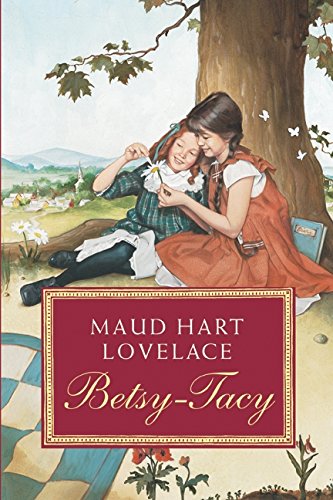
Book Review: Betsy-Tacy

Title: Betsy-Tacy


Author: Maud Hart Lovelace

Date: 1940

Publisher: Crowell (later Harper)

ISBN: 0-06-440096-4

Length: 130 pages

Illustrations: drawings by Lois Lenski

Quote: “‘Hello!’ called Betsy. ‘What’s your name?’ The other child made no answer. She jumped off the bench.”

In 1940, Maud Hart Lovelace published the first volume of a series about friendship that grows with the children involved, based on her more pleasant childhood memories. In this book, Betsy and Tacy are barely five years old. Too young for real friendship, Betsy has been prepared to think of “another child to play with” as a sort of new toy. Tacy, less carefully prepared, runs away. When she finally turns back and says “Tacy,” Betsy thinks that sounds like a nasty name Tacy’s calling her, not Tacy’s own name.

It’ll all be straightened out at Betsy’s birthday party, where the unusual happens: Betsy and Tacy really do begin to become friends. Later in the book they’ll add a third tot, Tib, and in each successive volume they’ll add a friend or two each year. Boys will be part of the crowd. Some of them will marry some of the boys. The books get longer and the children’s adventures more sophisticated, with some of them going to college and some marrying straight out of high school, but Lovelace never wrote about even the Teen Romances in ways that would confuse or upset a six-year-old reader. (Bore one? Possibly.)

Like many child readers I always seemed to prefer the volumes in this series where the kids were close to the age I was, and actually I preferred several other books to Betsy-Tacy. But eeeverybody liked Betsy-Tacy in the early 1970s; before the Judy Blume fad came the Betsy-Tacy reprints fad, and I will say I liked Betsy-Tacy better than Blume...those turn-of-the-century characters talked and acted more like the real people I knew. I still rate the Betsy-Tacy books—nice. Not great, not mind-stretching, but cheerful and wholesome and fun. So will you. So, probably, will the girls their age (or a bit younger) that you know.

If you’re in the mood for gentle fiction to share with the very young, you’ll like Betsy-Tacy, too.

To buy it here, send $5 per book plus $5 per package plus $1 per online payment to the appropriate address, as discussed in the "Greeting" post. At least four Betsy-Tacy books will fit into one package.

Tuesday, May 1, 2018

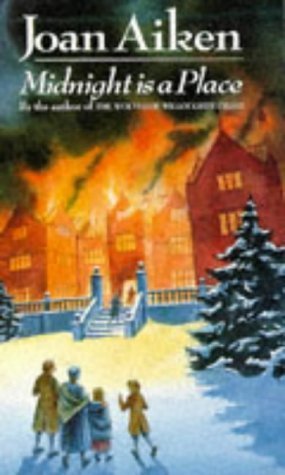
Book Review: Midnight Is a Place

Title: Midnight Is a Place


(This book has been reprinted several times. What you see is the cover design for the book I physically have for sale; I have the original hardcover edition, too, and that one I'm keeping. Since the paperback I have is showing at an unreasonable price on Amazon, the link will take you to a newer edition that's still available as a new book for a more realistic price.)

Author: Joan Aiken

Date: 1974

Publisher: Viking

ISBN: 0-670-47483-5

Length: 287 pages

Quote: “Even in good weather the park around Midnight Court was not a cheerful place.”

In 1842, in the real world, industrialization was raising British awareness of pollution and economic oppression to unprecedented levels. In Joan Aiken’s fictional alternative-nineteenth-century world, the blasted and burnt-out city of Blastburn, later to be taken over by Dido Twite’s horrid uncle, epitomizes everything Dickens’ and Disraeli’s novels railed against. (Did you know Disraeli wrote novels? If not, and if you like Aiken's and Dickens', you are in for a treat.)

Midnight Court is the ancestral manor young Lucas Bell, Anna-Marie Murgatroyd, and some equally unfortunate older people stand to inherit from the thoroughly unpleasant Sir Randolph Grimsby, who, fairly early in the book, burns down the main house rather than pay the taxes on it. Suicide turns out to be the most public-spirited thing Sir Randolph has ever done, and after some horrid experiences of child labor with employers who are trying to kill them, the children settle down to share the outbuildings, associated properties, and income from Midnight Court with the nicest adults they meet.

How the children survive and earn a living is the plot, and will not be spoiled here. Suffice it to say that yes, in 1842, real English and American children did have to work for their livings if they were orphans or even if their parents were poor, and fishing for salvageable items in the sewers, re-rolling remnants of tobacco out of cigar ends, and running machines in factories, were among the jobs actually done by children of thirteen, or even eight years old. In the United States girls, and boys under sixteen, were barred from working underground in coal mines (although children sometimes worked above ground outside the mines); in England children as young as six worked in the narrowest shafts of coal mines.

Lucas and Anna-Marie are typical of the pair of gifted children that appear like a signature in each of Joan Aiken’s novels. Usually, as here, regardless of any age disparities they are fully equal to each other—often the only real peers they have. Anna-Marie is a bit of the strain on the imagination until we remember she’s described mostly through Lucas’s eyes; to him she looks five or six rather than eight years old, then seems to become an adult, overnight, as she realizes that any comforting or nurturing that’s to be done will be done by her. To herself she’s simply herself, a young orphan who learns many things more quickly than the average child. One of those things she learns quickly is that playing mother to her older cousin is less painful than sulking and crying alone.

There were real children like that in 1842: orphans, or functional-equivalents-of-orphans, who had to become “little men” and “little women” overnight in order to survive. One week they might have had nurserymaids and tutors to look after them; the next week they were out on the street, doing whatever cooking and cleaning could be done for themselves, and, if possible, trying to latch on to nice older kids for protection from mean, thieving, bullying older kids. And adults. In Merrie Olde agricultural England such children were probably doing some farm chores, and thus entitled to some help from the lord of the manor. In the cities, or if the manor were being taken over by an unhelpful lord, they had no claim on anything from anybody. They were expected to become thieves or prostitutes or both, then subject to severe penalties if forced into even small steps in either of those directions.

Lucas and Anna-Marie are particularly lovable children. They have no legal claim on each other’s help either, nor are they legally responsible for the care of Lucas’s badly injured tutor. They help each other, and eke out their pathetic wages to pay for the care of the tutor, because they are (I suspect) idealized versions of Aiken’s own children: the way any mother would want her children to grow up. Their niceness is what gives them, and the adults who help them, a plot.

Because there were people like Lucas and Anna-Marie in our world, the idea of a Welfare State came to exist. Couldn’t democratic governments afford to set up whole offices dedicated to the care of orphans? The extent to which the Welfare State has alleviated or aggravated the sufferings of orphans remains a matter of some debate but in any case Anglo-type children no longer find themselves obliged to apply for the very nastiest jobs anyone can imagine.(In China, however, children still reportedly recycle toxic waste...)

Midnight Is a Place is fiction. For a sex-free, romance-free, kid-friendly story (although it was marketed to adults, because it contains violence) it can even be described as “Romantic” fiction—the kind of story that sold during the “Romantic Period” of English literature (the early nineteenth century): It features improbable hair-raising adventures barely survived by improbably lovable characters and a set of coincidences that give the story an improbably tidy ending. Nevertheless, the Romantic Period existed because adventures almost, if not quite, as outrageous as Gil Blas or Wuthering Heights had really happened. I can’t quite believe that Midnight Is a Place is fact-based, but then again I can’t identify at which points exaggeration has to have taken place. It could be based on someone’s real family history.

In any case, all readers are supposed to ask of fiction is an entertaining read, and that Aiken always delivered. Vivid descriptions, an all-prevailing cheerfulness in the grimmest of situations, about as much irony as anyone can stand, make Midnight Is a Place a great deal more fun to read than it would have been to live through.

To order it here won't do the late Joan Aiken any particular good; her heirs would prefer that you buy the new edition directly from Amazon. Do that if you like. If you want to support your favorite web site, you can scroll down to find other books. Or send $5 per book, $5 per package, $1 per online payment, to the usual address as shown at the very bottom of the screen; this web site makes no guarantees as to which edition will be available at that price, but so many editions have been printed, we're sure that one of them will. You'll get that one, and you're warmly encouraged to add as many other books of similar size as will fit into the package for the one $5 shipping fee. (For reference, packages generally hold up to 12 pocket-size paperbacks like the one shown above, up to 2 tall thick hardcover books like the first edition, or up to 6 of the "trade paperbacks" in which many publishers are reprinting classic children's books.)

Wednesday, September 27, 2017

Fiction: Tennis Advantage

[It's entirely my own fault that this story didn't win a contest. It was written for a Sunday School magazine that still requires printed submissions, and I didn't get it printed and mailed in time. This is not, unfortunately, a true story. It might be a true story if my real name had been Venus Williams...mercy, that woman gives me such sister envy.]

“Mom!” Sarah's tennis racket bounced off the fence. “Mom, they'll never let me win a game! It's not fair!”

“No, it's not fair,” her mother said soothingly. “Your brother and sister play tennis better than most of the teenagers in the club. You are only six. Katie! Dan!” Mother continued. “As well as you play, can't you think of a way to help Sarah win a game?”

“Oh, very well!” Katie beckoned Sarah back to the tennis court. Sarah picked up her racket. Plop, plop, plop! One after another the low, slow, easy balls bounced off Sarah's racket...

“Mom!” Sarah pounded her racket on the ground. “Now they won't even let me play a game! It's not right!”

Dan knelt down on the ground to look straight across at Sarah. “If you want to win a real game,” he said, “you will just have to keep practicing until you can play.”

“We weren't born playing tennis either, you know,” Katie said. “The first time someone served the ball to me, I ducked.”

“I practiced serving to the fence,” Dan said. “I tied a handkerchief to the fence and hit the ball onto the handkerchief. After that, I pretended Katie's blind spot was the handkerchief.”

“Dan almost doesn't have a blind spot,” Katie said proudly. “I practiced mixing up shots, because the way to beat Dan is to keep him running.”

Sarah picked up the ball and served it into the net. “I'm going to take a shower,” she announced. “After that I'm going to read.”

Later, when Dan and Katie had put away their rackets, Sarah tied a ribbon to the fence and practiced hitting the ribbon.

She did that the next day they went to the club, too, and the next day, and the next day. She asked her mother to take her to the club when Dan and Katie went to the library. She asked her uncle to buy her a round with the tennis machine when they went downtown and passed a place called the Batting Cage.

The next time they went to the club, while Dan and Katie played furiously against each other, Sarah heard another voice say, “I'm six years old.” She turned and saw a boy carrying a tennis racket.

“I'm six, too,” she told the boy. She looked up at his parents. “My name is Sarah Preston.”

“Nice to meet you, Sarah Preston.” The boy's mother shook Sarah's hand. “What do you say, Riley?”

“My name is Riley Taylor. It's nice to meet you,” the boy said politely.

“It's nice to meet you, too,” said Sarah. “Are you here to play tennis?”

Riley Taylor smiled. “I always play with my Dad. It'll be fun to play with another kid, if Dad doesn't mind.”

“I don't mind,” said Riley's Dad. “This should be fun to watch.”

Sarah served the ball. Riley slammed it back almost as fast as Katie did. Sarah ran a few steps backward to hit the ball, barely getting it across the foul line. Riley was just watching Sarah. He missed the ball. Sarah scored.

They kept playing. Riley wasn't as strong or as fast or as tricky as Dan and Katie, but he kept the game moving. Sarah ran all over the court. She hit several fouls, but she was hitting the ball almost every time it came at her.

Riley's parents started keeping score. “You're winning, you little tiger! Riley, she's going to win!” Riley's mother said.

“I don't mind if she wins,” Riley said. “Not today, anyway. It's just neat to see another kid really playing tennis.”

“It is, isn't it?” said Riley's father. “In a few years you two will be as good as those two.” He pointed to Dan and Katie.

“They're my brother and sister,” Sarah said proudly.

“How did I guess?” Riley's father laughed.

Sarah missed the ball, trying to watch Dan and Katie through the fence. After that Riley held a one-point lead for several minutes. Then Sarah picked up a few points and held a one-point lead until Riley's mother called the end of the match.

“You're really good, for a kid,” Riley said.

“You have a real talent,” Riley's Dad said. “You'll have to play with us again some time.”

Sarah went to watch Dan and Katie finish their game. Sarah watched Katie jump to hit a high ball. She watched Dan smash the ball back so low it hardly passed the net. She watched Katie drive a fast ball past Dan's left side, so that Dan hit it back with a rather weak backhand and Katie slammed a long shot to his right. She could almost imagine how it would feel to move as fast as they were moving, some day when she was as big as they were.

“Want to play?” Katie said, as their long, close match finally ended.

“Can't,” said Dan. “People are waiting. Let's have a swim before we go home.”

“Look out!” Riley's mother said as they left the court. “That sister of yours has a real talent for tennis!”

“Why would Coach Taylor's wife say that?” Katie frowned at Sarah.

“Because I beat Riley Taylor by one point,” Sarah said. “His Dad said I have to play with them again some time.”

“Guess you do have a talent, then, if Coach thinks so,” said Dan.

“Don't let it go to your head!” Katie chased Sarah into the showers, laughing. “I can still beat you.”

“Of course,” Sarah said. “You're older.”


“Don't you forget it!” Katie said. “But one day that will be an advantage for you.”

Monday, February 1, 2016

Book Review: How Fletcher Was Hatched

(Blogjob tags were children’s bookchildren’s storydog cartoonspicture bookrivalry among pets for human attentionWende and Harry Devlin.)

Book Review: How Fletcher Was Hatched
Authors: Wende and Harry Devlin
Authors' (memorial) web page:
Date: 1969
Publisher: Parents Magazine Press
ISBN: none
Length: pages not numbered
Illustrations: color drawings by the authors
Quote: “Fletcher, look at this dear chick. It’s so tiny. It’s so yellow. It’s so fluffy!”
Fletcher, a dog whose human is besotted with chickens, hatches a plot (sorry) to get himself repackaged in a giant clay egg, with a little help from his friends the beaver and the otter.
In real life, I observed a real dog in a similar situation. I had taken a job renovating an old farmhouse. A police-type dog called Penny, born at the house and adopted by some disreputable human neighbors, didn’t seem to get much of the attention and affection she wanted. Penny did not have the tough, dominant personality generally associated with her breed. For four of the six months I worked there, starting from the first day, she considered herself my dog. Asked whether I wanted to buy her, I said I couldn’t afford to keep her. All I ever did for Penny was scratch behind her ears, and she followed me everywhere.
Then the new owner for whom we were working sent some chickens out to the place. They were, he said, to be allowed to roam freely around the farm. They were purebred Game chickens, pretty birds, slim and graceful; they hardly looked like the same species as the big clumsy chickens that are bred for meat. 
At the end of the day, after washing and dressing to go back into town, I paused to look at the chickens. The dog bounded out from a shed, along a muddy track, to greet me with a hug. I didn’t hear Penny approaching; I heard a man yell at her, turned, and found myself hugging a muddy dog. “That (rude word) dog messed up her dress,” one man bellowed to another. “Wait and let her clean up—if she can.” While wiping off the mud I heard the men scolding and swearing at the dog. They knew as well as I did that that sort of thing matters a great deal to some dogs, but none of us thought we could possibly mean very much to Penny. After all, other people seemed to have been feeding her all her life.
The chickens were great fun for the next week or two, and then they began disappearing, always by threes. Three happened to be the number of disreputable human neighbors in the house where Penny lived. They told the new owner of the farm that that dog just kept sneaking out and stealing chickens.
“One dog keeps stealing three chickens at a time?” I said. Well, they had another dog who slipped out with her. “Two dogs keep stealing three chickens? For three humans?” A Game hen is just the right size to make one big meal for one fat, greedy slob of a human. I didn’t think Penny really deserved the blame, but Penny was chained, then locked in the cellar, while I was working there. 
And one day, after twenty-three chickens had been reduced to five—always subtracting three at a time (yes, additions were made before the subtractions ended), stopping only when the flock had been reduced to a mutant minority who were able to fly straight up from the ground, which most chickens can’t do—Penny was "put down."

It’s unfair to the Devlins that I had this animal tragedy in my mind before I read How Fletcher Was Hatched. Silly, whimsical stories shouldn’t have to clash head-on with real memories. Knowing that real dogs can and do feel envious of other animals who get their humans' attention, and what they do about it is not to have themselves repackaged in fake eggs, shouldn’t have to interfere even with my enjoyment of a silly cartoon-like story. We do not live in an ideal world.
Still, the cognitive dissonance between the cartoon dog story and the true dog story flashed into mind, causing me to laugh bitterly when I read at their web site that the Devlins were remembered for stepping out of the "angel fluff" school of writing for children. How Fletcher Was Hatched is pure spun sugar.

It is, of course, very cute and enjoyable spun sugar, and if either of the Devlins were still alive I would have tried to write a happier-sounding review and encouraged people to buy this one as a Fair Trade Book. But they have no further use for the dollar they'd get out of the $5 per copy + $5 per package + $1 per online payment I'd have to charge for this book...If How Fletcher Was Hatched interests you, though, you might want to add it to a package along with one or more Fair Trade Books; if you did, you'd pay only $5 for the whole package and could consider the shipping for this one free, which might make it a better bargain than you'd get from other online sellers after all.

Wednesday, August 5, 2015

Book Review: The Street of the Flower Boxes

Title: The Street of the Flower Boxes

Author: Peggy Mann

Illustrator: Peter Burchard

Publisher: Weekly Reader Book Club

ISBN: none, but click here to see it on Amazon

Date: 1966

Length: 72 pages

Quote: “We got another problem...We got four dollars and seventy-one cents more than we need!”

The writer known as Peggy Mann understood the difference between a slum and a suburb; growing up in New York City, she said, she thought that houses were “for millionnaires and movie stars.” But her husband insisted on buying a house. Well, a row house anyway, still in a slum neighborhood where “rich people's fads” such as flowers were not welcome.

“Who plants flowers on this crumby street?” scoffed nine-year-old Carlos, who was too young to join the official gang but had put his creativity to use inventing wonderful slum games, such as Traffic Tieup, in which the kids tied all the parked cars on the block together with ropes and clotheslines. (In the morning this produced “such splendid honking and shouting that two squad cars of armed and helmeted policemen were sent.”) He invented a game where all the kids whipped each other with ivy out of the new neighbors' flower boxes. Then there was a game where they threw flower petals at each other. The adults “watched the boys and laughed along with them...Rich people...should have sense enough not to show off by moving right in among the poor!”

The new neighbors revised their strategy. They paid Carlos to be their “guard and gardener.” Carlos prudently used the money to buy candy to bribe the other kids not to destroy any more flowers.

The flowers flourished. Soon the lady who liked flowers had to thin her crop and give a few flowers to Carlos. When were they going to get flowers too? other kids asked Carlos. Before he knew it Carlos was taking orders for flowers. Not knowing the correct price, he promised his neighbors flowers at a price that represented a substantial loss for the new neighbors. When the new neighbors distributed the flowers, as promised, anyway, Carlos and the kids felt obliged to make up the deficit. So they organized a street bazaar.

The children's story ends there, but the story of the story didn't. Adults found the story of slum residents actively participating in their own little “renewal project” very inspiring. The Street of the Flower Boxes was made into a movie. The movie was shown to children in schools across America...and I remember checking out this thin, easy-reading book from the library because I'd seen the movie. By that time the Johnson family had stopped blathering about their Great Society and War on Poverty. By that time, in fact, former President Johnson was dead. But Carlos is still a character primary school readers can appreciate.

Everybody has a right to enjoy flowers at their windows. Green space, even. Private homes with gardens in between them. Nobody really needs to settle for living in a barren, dirty slum. People who reclaim their right to flowers today may, tomorrow, be ready to think about going back to the land.

Peggy Mann is no longer a living author, so The Street of the Flower Boxes is not a Fair Trade Book. To buy it here will still cost $5 per book + $5 per package for shipping. If you're interested in just this one book, you can get a better deal elsewhere. If you're interested in our Fair Trade Book program, you can slip this slim little volume into the package with at least two regular-size books and send money to one or more living writers. Payment may be sent to either address in the "Contact" box at the bottom of the screen.