Showing posts with label 1910s. Show all posts

Monday, June 22, 2026

Book Review: Soul on Trial

Title: Soul on Trial

Author: Robin Cutler

Date: 2026 (second edition), 2007

Publisher: View Tree (2026), Rowman & Littlefield (2007)

ISBN: 978-0-9974823-3-1

Quote: "[W]hat might have been a small, sad tale about the death of one young man...exploded across the front pages of rural and big-city papers."

Marine Lieutenant James (Jimmie) Sutton died from a bullet in the brain. The death was reported as a suicide. Arguably it may have been one--but only in the sense that calling out the cowardice of another man, whose reply, by "fighting it out" per contemporary custom, would add two buddies and firearms to the expected fist fight, was suicidal bad judgment. 

Sutton's mother, a Catholic who believed that no one who commits suicide can go to Heaven, reported psychic messages in which Jimmie described being beaten by a "they" who "came up back of me and forced me to the ground." She did not use the word "vision" for such messages or impressions, which she had reported many times, sometimes when the messages were true. 

In spite of the inadmissible nature of her primary evidence, and the prejudice against women to which her opponents played, Mrs. Sutton eventually got an investigation that included questioning the last young people known to have seen Sutton alive and even digging up his mortal remains. The gunshot wound proved to be consistent with the claim that three other men had forced him to the ground while one shot him from behind. 

A hundred years after Sutton's death, his great-niece published the first edition of a well researched historical report on these events, including reforms made at military academies and what became of the three classmates who were involved in killing Sutton. Due to their convincing reports of mental confusion and memory loss, none was found guilty of the actual murder, but it seems likely that "conscience karma" plagued their lives. 

The "Spiritualist" or "Spiritist" movement, in which people who were losing faith in traditional church teachings accepted claims of psychic communication with the dead as scientific fact, was in active opposition to the churches of the time. Spiritualists supported Mrs. Sutton's claims and wanted to exploit them. Mrs. Sutton maintained her Catholic faith. 

The position of this web site is that we have no way to know that people don't receive psychic messages from sources beyond their own intuition--although these sources may be deceiving people about their identity, claiming to be departed friends when they are actually "deceiving spirits," as some traditional churches teach. We do know that Mrs. Sutton was a person who thought in words, and of Irish and German descent. For those who are not familiar with that combination of ethnicity and neurological "wiring," it describes people who, as Cutler observes, may "hear" intuitive warnings about loved ones so often as to become tedious. It is possible to explain these warnings as unconscious guesses that, when people are close to each other, are often right. People remember the details of an accurate premonition such as "they came up back of me and forced me to the ground" more clearly than they remember the details of other, less accurate warning messages the same person has also given loved ones. 

In any case, the Sutton story is a true mystery story, fairly described as one in which family, friends, and the victim's ghost worked together to bring the facts to light. In the nineteenth century "hazing" younger students to teach them patience, discipline, toughness, and the science of pugilism, was defended as a useful outlet for stress at least at schools for boys and men; the Sutton case was among several cases that created a demand for limits on "hazing." Freshmen are still teased and subjected to "tests" and "initiations" at many schools, and military personnel, as "fighting men," are still expected to fight, but not to the point of killing one another. 

Thursday, October 30, 2025

Book Review: Peacock Pie

Book Review: Peacock Pie

Author: Walter de la Mare

Date: 1913, 1975

Publisher: Unwin (U.K.), Faber & Faber (U.S.)

ISBN: 0-571-04683-5

Length: 115 pages

Illustrations: drawings by Edward Ardizzone

Quote: “Slowly, silently, now the moon / Walks the night in her silver shoon...”

The publication data for this book says a lot about its success. According to my 1975 copy, Peacock Pie was “First published 1913...Edition illustrated by W. Hearth Robinson, first published 1916. Edition illsutrated by C. Lovat Fraser, first published 1924...Edition illustrated by Jocelyn Crowe, first published 1936. Edition illustrated by F.R. Emett, first published in September 1941...This edition, illustrated by Edward Ardizzone, first published 1946...”

Poems that were very effective for child audiences a hundred years ago aren’t always equally effective now, though many of the poems are deliciously spooky. Some of the poems in Peacock Pie are real classics, like the silver moonlight landscape quoted above. Some need just a little explanation...

                A poor old Widow in her weeds
                Sowed her garden with wild-flower seeds...
                And now all summer she sits and sews
                Where willow-herb, comfrey, and bugloss blows...

Some are vocabulary challenges for most picture-book readers:

                The sandy cat by the Farmer’s chair
                Mews at his knee for dainty fare...
                Dobbin at manger pulls his hay:
                Gone is another summer’s day.

Some describe things today’s children aren’t forced to know about:

                Poor blind Tam, the beggar man,
                I’ll give a penny to as soon as I can.

Some merely hint at things nostalgia buffs prefer to forget. “Poor tired Tim! It’s sad for him” sounds like a taunt to be recited when a normal healthy child is feeling sleepy or sluggish, as it might be from staying up too late...but the drawing shows that Edward Ardizzone visualized the chronically tired child as starving.

De la Mare meant these poems to appeal to imagination. They will, if children understand them at all. They will definitely entice children into a different sort of world. However, it’s possible that Peacock Pie would be better appreciated as a nostalgic gift to an adult than as a picture book for a beginning reader. Children are most likely to appreciate this book if adults read the poems to them. 

Wednesday, September 17, 2025

Book Review: War Is a Racket

Title: War Is a Racket

Author: Smedley Butler

Date: 1935

Length: 35 pages

Publisher: heritage-history.com (PDF)

Quote: "A racket is best described, I believe, as something that is not what it seems to the majority of people."

It's unfortunate that this retired Marine officer's book has been best remembered by left-wingers who, in the Cold War era, seized on the idea that the path to peace lay through falling into the hands of the Soviet Union just as Khrushchev said. What General Butler had to say about the corporate interests behind the wars of his day--and he ought to have known if anyone would, having been more decorated for more overseas military missions than anyone else alive at the time--and the poor compensation of veterans is a valuable historical document. This document has been made available in PDF form.

I recommend everyone read it. Just read it. Draw your own conclusions, from your own historical hindsight. If the computer on which you're reading this does not handle PDF well, e-mail to discuss the format and consequent cost of your printout. If your computer does handle PDF well, click here to read or download the mini-book free of charge.

Wednesday, September 6, 2023

Book Review: The Lovely Lady

"Not another Gutenberg.org e-book!" someone wails. "You promised to review a book by Barb Taub!"

Patience, please, Gentle Readers. You all know Barb Taub's book is going to be hilarious. You know it's going to have an adorable, wise, yet stupid dog in it, and castles in Scotland, and travel and fun stuff and at least one coffee-snorting line per page. Some of its short chapters appeared as blog posts. I've been posting links to those blog posts. You do not really need me to tell you to buy Oh My Dog. You've probably bought it already. If not, do. I can tell you that you'll find out why the dog is called Peri.

Meanwhile, yes, what pops out of the can of pre-written reviews is a Gutenberg e-book. 

Title: A Woman of Genius

Author: Mary Austin

Date: 1912

Publisher: Doubleday

ISBN: none

Quote: “[I]f you are looking for anything ordinarily called plot, you will be disappointed. Plot is distinctly the province of fiction.”

I downloaded this book from Gutenberg.org. If you’re online, you can read, print, or download it too, paying only printing expenses. If you’re not, I’ll print a copy for you at cost.

And this novel, of course, is fiction, but it purports to be the memoir of a gifted actress and the men who get, more or less pleasantly, in her way. In many ways A Woman of Genius is the feminine of The Lovely Lady: a long, unpleasingly realistic study of an unadmirable person. Olivia is the only one who describes Olivia as a genius or her acting as art. She acts in plays, gets good reviews, quarrels with men who think theatre groups are Bad Company, is disgusted by men who make it so, and blames society for her not being “Good” in the sense of “chaste.”Her sins against chastity are, however, overshadowed by her sins against modesty, and other virtues, and other people.

In this case the resonance with the facts of Women’s History held my attention a little better than the man’s story failed to hold it in The Lovely Lady. A little, but not a lot.

Friday, September 1, 2023

Book Review: Outland

 Title: Outland

Author: Mary Austin

Date: 1919

Publisher: Boni & Liveright

ISBN: none

Quote: “There were some other landmarks I was quite as sure of at the time, but the creek makes so many turns here I could never find them again.”

I downloaded this book from Gutenberg.org. If you’re online, you can read, print, or download it too, paying only printing expenses. If you’re not, I’ll print a copy for you at cost.

It’s a fantasy—not the “high” Tolkien variety. Mona, the narrator, and Herman, her fiancé, go for a walk in the woods and encounter two mysterious tribes of primitive people who are quarrelling with each other over a legendary buried treasure. Taken hostage, they get to know the tribesmen just well enough to regret what happens to them in the end.

Though Austin describes her “Outlanders” in ways that suggest that they strayed into North America from Europe, she gives them customs, like the memory-erasing potion, drawn from Native American traditions.


Friday, August 25, 2023

Book Review: The Lovely Lady

Title: The Lovely Lady

Author: Mary Austin

Date: 1913

Publisher: Doubleday

ISBN: none

Quote: “I’ve got to be rich. I’ve just simply got to.”

I downloaded this book from Gutenberg.org. If you’re online, you can read, print, or download it too, paying only printing expenses. If you’re not, I’ll print a copy for you at cost.

So says Peter, the son of a poor widow and brother of a sister with a physical handicap. (“Disability” would be an exaggeration. Sister Ellen walks awkwardly, but she gets around.) But will his quest for wealth keep him from pursuing his dream of Ideal Romantic Love?

Frankly, Gentle Readers, as I read this e-book, I found myself increasingly not giving a daam—you know, one of those little coins that went out of circulation because their production cost came to exceed their value. A great writer might have been able to weave into this dreary study of Edwardian proto-yuppies some sort of subplot, or at least some element of comedy or adventure, that would have held my attention on the dreary infidelities of a young man who pleased me only when I reflected that I don’t have a son. Life could always be worse. One could always have a son like the very realistic, and unadmirable and unenviable, protagonist of this novel. Peter flits among the cities of the Northeastern States and Western Europe, so he doesn’t even give Austin a chance to wallow in topophilia, as she did so well.

Who should read The Lovely Lady? Someone different from me. Someone who appreciates the nuance of an authentic Edwardian novel of manners.

Meanwhile, in between dealing with power outages, Googlitches (since the latest "update" Blogspot's been going offline during the hours I've been scheduling for it), and glyphosate reactions, I'm trying to read a dozen newer books, including one by Barb Taub. Trying is the word. I really did write book reviews of a batch of Project Gutenberg e-books a few years ago, and here's one of those.


Wednesday, February 12, 2020

Book Review: Hiding Ezra and Wayland

Sad news, Gentle Readers. Goodreads is now hiding real individual book reviews just like Amazon. Amazon can get away with a little discrimination, because it's huge and commercial. Goodreads is neither.

Underwhelmed, to say the least, by typing in mini-reviews of these two novels-from-family-history, hitting "Post," and having the book's home page pop back onto the screen with a smarmy little message saying "Priscilla King, write a review of [the book I just did]!"--I don't like web sites that bark orders at readers, in any case...I'm going back to my own blog. Which Google, of course, will try to hide from people, and Goodsearch will try so hard to hide that it'll even redirect readers back to cached copies of the posts for which Blogjob paid. Goodheavens, the corporate would-be rulers of the world cried, we mustn't let people discover a blog that blows the whistle on sneaky corporate censorship on the Internet!

If the Internet doesn't pull a U-turn and require human review before even the ugliest porn images and hatespews can be censored, how long do you think it can last? Two years? Three? It's been fun, and I look forward to getting paid again for my special talent for creating decent-looking documents on manual typewriters...

Here, while it lasts, are full-length reviews of two short paperback novels. They can be read independently; they're best read together.

Author: Rita Sims Quillen

Title: Hiding Ezra

Amazon details:
  • Paperback: 220 pages
  • Publisher: Little Creek Books (February 18, 2014)
  • Language: English
  • ISBN-10: 1939289351

And the sequel: Wayland 

Amazon details:
  • Paperback: 160 pages
  • Publisher: Iris Press (September 16, 2019)
  • Language: English
  • ISBN-10: 1604542543
I'm late to the Internet today, Gentle Readers, because I started reading Wayland and couldn't put it down. I already knew from Hiding Ezra that this author is not averse to making readers cry, so I had to find out what she was going to do with this study in Human Evil...

Rita Sims Quillen is best known as a poet. No worries for those who don't like poetry; these stories are not told in the sort of lush  prose that tends to be described as "poetic." Landscape descriptions like "She also loved to go to a cool, shady bend in the little branch [creek] below the church where the trees created a canopy like walls" are as "poetic" as it gets. These novels get full marks for clear, straightforward prose that's not wordy, sentimental, or difficult to read. In fact one reviewer has quoted the first sentence of Hiding Ezra as an example of a good opening line for a novel.

They read like family history. Hiding Ezra is in fact based on family history--an old journal kept by a soldier who deserted from the Army in order to help his last few friends and relative survive a set of epidemic diseases that swept our part of the world in the 1910s and 1920s. Wayland might easily be based on another old journal.

Hiding Ezra is about the oddly enjoyable summer Ezra Teague spends hiding in a cave, leaving game near the homes of people who leave bread and ammunition near the cave. It's also about his grieving sister Eva, his faithful sweetheart Alma, and all the other friends and relatives they lose to the epidemics. It's also about Lieutenant Nettles, a nettlesome outsider from Big Stone Gap who connects with his inner decent human being after exposure to the grieving and loving people of Wayland, Gate City, and Fort Blackmore.

Wayland was the real name of one of the little rural settlements outside Gate City up to the 1940s, when it changed its name to Midway. Gate City had changed its name a bit earlier--in the nineteenth century it was called Estillville. Moccasin Gap, on the other side of the gap in the mountains formed by the Big Moccasin Creek, also changed its name, in the 1950s, to Weber City--spelled Weber, as in German, but pronounced Webber, as in English--after a radio comedy about a new subdivision: "The characters were having so much fun with their Weber City, we thought we'd have one too." In these novels place names are used as they were at the time.

When I read this novel, I enjoyed its dramatic climax, but wondered why the denouement was so long and so sad. A more tactful reviewer posted online that she wanted the story to be even longer, to resolve the new issues the denouement raises for the characters. Readers be warned. The last few chapters of Hiding Ezra are the trailer for Wayland.

In between reading the two stories, I cried. I won't spoil the denouement, I think, by explaining that I don't cry about fictional characters. No, but once when the words "rock hall" triggered a memory an 85-year-old great-uncle said, "My sister and sister-in-law used to take bread to the fellows that hid in the rock house." (Actually he used their given names, and one of them was still alive to confirm his claim.) My mother wondered if he was remembering the story she'd heard about my great-grandfather leading a party of soldiers to the nearby "rock house," a cave big enough for people to camp in. No, he said, this was in his lifetime...but he was weak and never had much to say at one time, and never mentioned the cave story again.

In my family the young spoke more frankly to the old, and asked more questions, than in some neighboring families. Still, I never asked for more details about feeding the deserters in 1918. I knew the cave was real; my brother and I had been shown how to find it on condition that we not try to get inside it. I knew Great-Aunt belonged to a pacifist church, and her sons were conscientious objectors, but her husband, Grandfather's brother, was exempt from military service because he was a minister. The great-uncle who first mentioned the story had one of those given names that commemorate a family friend's given and family names: Otto Quillen.That's all I can add to the facts behind Hiding Ezra.


What made me cry was that this story made me realize how lucky the elders were. My grandfather and eight of his younger siblings lived to ages between 75 and 99. Many of their generation did not. Physically and emotionally my elders survived by keeping a healthy distance between themselves and any friends they'd had as children...and even in the 1960s I still grew up hearing "Don't get closer to town children than you can help, don't go into town unless it's necessary, don't EVER go into a swimming pool, don't go to other people's houses and if you do don't eat or take off your shoes..." Two generations later, my extended family are still known as a stand-offish bunch. Possibly the elders' losses of friends to the epidemics had something to do with that. I've heard a lot of rot about possible kinds of "hurt" might have caused our family subculture to be so clannish, but this insight rang true. And it did hurt, briefly, wondering how many school friends my elders had buried...Grandfather was one of fifteen children, eight of whom lived to ages between 75 and 99. In another family of fourteen, six children born before 1940 were still alive in 1970.

Anyway: Ezra Teague survives his adventure, but the epidemic diseases and early deaths aren't over. In Wayland Ezra has left his daughter for his sister to raise. Eva has indeed married Lieutenant Nettles, who is now a nice guy but still insecure enough to be impressed by a stranger's show of respect. That insecurity places the Nettles family at risk when the lieutenant offers a job to a "hobo" who calls himself Buddy Newman. Newman's real name is Deel, as in Scottish "de'il," and his character is a study in Human Evil. He wants to set people against each other, ruin the reputation of a pious but sex-starved old lady, and do even worse things to little Katie Teague.

The suspense of the story is finding out whether Newman's schemes will be foiled, and how, and by which of the decent local folk. There is an interesting and thoroughly local delineation of the relative vileness of Newman, an otherwise likable hobo who has an icky relationship with a teenaged boy, a rude drunk, and a murderer. Newman is a bigot, a pedophile, and also a murderer, but his evil runs deeper than that. (The narration of his evil won't embarrass readers in front of their children but the single telling details, when they emerge, may upset children.)

Did an ancestor really keep a diary that narrated such events? At least they're not the local pedophile story I always heard: it would have been fifteen or twenty years later when the man I heard described as "an escaped mental patient" did some physical damage to a local primary school girl. And I was glad. I did not want that girl, who survived but never married, to have been the real model for Katie. (Katie is characterized as pretty much the perfect niece in Eva's diary, but aunts know to allow for another aunt's auntly perspective. I think each of The Nephews is pretty much a perfect child, too, in his or her own way.)

Once again, after the main plot has resolved itself, the last two chapters go on. I didn't cry while reading Wayland but I found the denouement somewhat sad. Others may like it but I think they'll agree that, once again, the last chapters of Wayland are a trailer for another story.

I gave both books five stars on Goodreads for Keeping It Real. These are not just another stereotype of "Appalachia," the whole mountain range, from Georgia to Nova Scotia and possibly also Britain, confused with old pictures of the coal-mining town. Anything looks grim in a black-and-white photograph. In these books we see Scott County much closer to the way it must have been, between 1917 and 1930, to have become what it's been in Quillen's and my lifetime. I'm delighted.
Monday, May 21, 2018

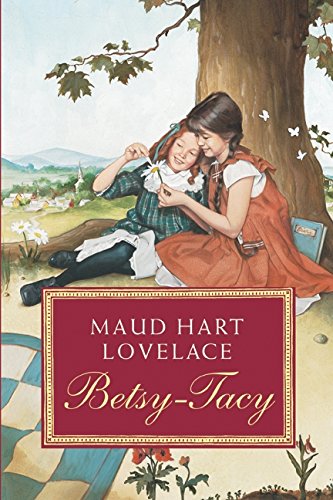
Book Review: Betsy-Tacy

Title: Betsy-Tacy


Author: Maud Hart Lovelace

Date: 1940

Publisher: Crowell (later Harper)

ISBN: 0-06-440096-4

Length: 130 pages

Illustrations: drawings by Lois Lenski

Quote: “‘Hello!’ called Betsy. ‘What’s your name?’ The other child made no answer. She jumped off the bench.”

In 1940, Maud Hart Lovelace published the first volume of a series about friendship that grows with the children involved, based on her more pleasant childhood memories. In this book, Betsy and Tacy are barely five years old. Too young for real friendship, Betsy has been prepared to think of “another child to play with” as a sort of new toy. Tacy, less carefully prepared, runs away. When she finally turns back and says “Tacy,” Betsy thinks that sounds like a nasty name Tacy’s calling her, not Tacy’s own name.

It’ll all be straightened out at Betsy’s birthday party, where the unusual happens: Betsy and Tacy really do begin to become friends. Later in the book they’ll add a third tot, Tib, and in each successive volume they’ll add a friend or two each year. Boys will be part of the crowd. Some of them will marry some of the boys. The books get longer and the children’s adventures more sophisticated, with some of them going to college and some marrying straight out of high school, but Lovelace never wrote about even the Teen Romances in ways that would confuse or upset a six-year-old reader. (Bore one? Possibly.)

Like many child readers I always seemed to prefer the volumes in this series where the kids were close to the age I was, and actually I preferred several other books to Betsy-Tacy. But eeeverybody liked Betsy-Tacy in the early 1970s; before the Judy Blume fad came the Betsy-Tacy reprints fad, and I will say I liked Betsy-Tacy better than Blume...those turn-of-the-century characters talked and acted more like the real people I knew. I still rate the Betsy-Tacy books—nice. Not great, not mind-stretching, but cheerful and wholesome and fun. So will you. So, probably, will the girls their age (or a bit younger) that you know.

If you’re in the mood for gentle fiction to share with the very young, you’ll like Betsy-Tacy, too.

To buy it here, send $5 per book plus $5 per package plus $1 per online payment to the appropriate address, as discussed in the "Greeting" post. At least four Betsy-Tacy books will fit into one package.

Sunday, December 31, 2017

Book Review: The Bluebird and the Sparrow

A Fair Trade Book (so buy it now, while it's still one!)


Title: The Bluebird and the Sparrow

Author: Janette Oke

Date: 1995

Publisher: Bethany House

ISBN: 1-55660-612-0

Length: 251 pages

Quote: "You wait until you see your new sister. She's such a beautiful girl."

And with that non-answer to little Berta's anxiety about their mother, their loving father sets Berta up for a lifetime of resenting baby Glenna.

What you'll like: One of the very sweet, sex-free, historical novels that are more about character development than romance, but manage a happy romantic ending, for which Janette Oke is famous. (She's written more than seventy of them...and she started late; I remember when Love Comes Softly was new.) 

Also, it has an international feeling. The setting is somewhere on the Great Plains of North America, but is it in the U.S. or Canada? Oke was born in Canada but has lived in both countries, and wrote a lot of novels that let readers imagine them taking place on whichever side of the border they prefer.

What I didn't like: One-dimensional Lifetime Channel character development--and romance. I can believe that something like this happened, and that some minister or counsellor remembered it the way Oke tells it. I can't believe Oke is telling us what really happened.

Berta has no talent, no vocation, very few relationships, few real interests. She wants love, yes, but if love were all she wanted in life, would she have done so well for so long without it? In real life, heterosexual people who can choose to stay single and celibate usually have a talent or vocation into which they direct the energy that would otherwise be taken up by romance. In the case studies in popular psychology books, the real passion is, like the person's real name, likely to remain private.

Although they look very much alike, Berta thinks Glenna is much prettier and more lovable than Berta is. That happens in real life. I've known several people who, as I do, rated a sibling much better looking than they were. I've not noticed it blighting any of those people's lives, the way other factors that were noticeable in the story of Glenna's birth seem to blight Berta's life. During the peak of selfconsciousness shortly after puberty, a lot of people in search of words for their hormonal anxieties do choose words like "Some other person X is so gorgeous and I'm so ugly and awkward and half-grown." Usually by age twenty this perception has matured into something like "I wish I had X's [insert feature] but I'll get by." Or the self-serving bias finds some other way to kick in. There's something liberating about saying, "I act, model, sing, host/ess, tour-guide, [insert name of job always awarded to reasonably good-looking young people]...but my sister/brother is really good-looking."

But let's say Berta is not just your typical sibling who inherited Grandma's chin, Grandpa's nose, or some other feature the other sibling was spared; she's the one who becomes a psychological case because she's managed to convince herself that she's ugly and unlovable. Not merely a sparrow to the sibling's bluebird; a warthog. I can suspend disbelief in that. Berta really has shrunk herself down to a psychological case history. Not only her relationships to her family, but her entire outlook on life and work have been dominated by this misbelief that she's ugly and unlovable. She has no saving talent to distract her from this painful belief. No-talents really are hard to love. Nevertheless people like Berta; she's offered a job, and she's competent. I find that harder to swallow.

In real life a resume like Berta's doesn't go with the attitude toward work that Oke seems to want us to accept as being Berta's: "I don't want a job, I want to be a full-time housewife, but I'll have to do a job, because I am a warthog." People who hold that belief don't get permanent full-time jobs in libraries. Too many people who are more pleasant to work with want those jobs.

Berta's work history suggests a different set of beliefs about self and work, something like, "I want to be independent and live alone. I'm not really passionate about books as such, but I like managing my own work day and might as well manage a library as a store or office." A lot of people feel that way, and if we don't think long and hard about marrying anybody, we should. Two reasonably independent people can have a beautiful partnership. One independent person and one clingy, needy person...

Berta doesn't need a husband, but seeing her mother and the senior librarian grow senile in similar ways apparently convinces her that--what? that celibacy does not prevent aging? Also, no doubt, being alive at a period when war has made any able-bodied young man a bit of a trophy persuades her to take the one life has handed to her. I don't believe Berta's initial refusal and subsequent acceptance of marriage reflects her awareness that she is lovable. I can believe Berta was a typical member of a generation in which young women were instructed to reject the first few proposals just to prove the man's sincerity. I can believe she might even have developed a fear of childbirth as a result of being in the house when Glenna was born. I can even believe that, since her admirer is an old schoolmate whom she didn't like when they were children, she wants to make sure he's learned better manners. But we're not shown any of these reasonable thoughts running through Berta's mind; just more of her lingering-adolescent self-esteem problem.

I suppose it may have happened, somewhere, that some emotionally abusive church group somewhere browbeat someone into believing s/he was unlovable and someone else into believing s/he needed to offer love to this unlovable person as an act of self-sacrifice. That might have happened--but a marriage proposal between a couple like that wouldn't sound like a romantic happy ending.

At a less extreme level, of course, I can believe that a courting couple enjoy negating each other's insecurities. "You're not a 'little kid' any more." "You look better than your sister does now." Etc. ad infinitum. But Oke seems to want us to believe that the story is about Berta's learning how to accept and express love, and that's what the story does not give us. Instead it gives us a matched pair of misbeliefs: (1) that accepting love means marriage, and (2) that for someone who's maximized personal space and minimized emotional attachments all her life, learning to express love is a matter of saying, once, that she wants to be loved. Neither of these beliefs is true; both do harm.

Oke wanted credit for writing novels that showed how Christians' character development allowed Christians to experience True Love instead of mere infatuation. Some of her novels meet that standard--see Dana's Valley. I think this one falls short. Publishers read Love Comes Softly and said "Can you give us forty more romances like this one?" and Oke pounded them out as fast as she could, all in a pleasant readable style, but some more realistic than others.

The Bluebird and the Sparrow is not a bad read, though, if you're looking for a sweet wholesome romance or a complete collection of this super-seller author's novels. It's a Fair Trade Book; if you buy it here, $5 per book + $5 per package (two of these thickish novels plus a skinny picture book, or books, for the children would fit in one $5 package) + $1 per online payment, we'll send $1 to Oke or a charity of her choice. 

Wednesday, December 20, 2017

Book Review: Rascal

Title: Rascal


Author: Sterling North

Date: 1963

Publisher: Penguin

ISBN: 0-590-44671-1

Length: 189 pages

Illustrations: black-and-white pictures by John Schoenherr

Quote: "We dug out a den of raccoons, and here is the one we brought home."

Sterling and Oscar thought their dog Wowser was digging into a groundhog's hole when the dog dug up the raccoon family. Three of the baby raccoons escaped with their mother. The boys caught one little raccoon. Sterling was allowed to keep the animal for a pet. He called it Rascal. Considering the way the boy Sterling admits he first got his hands on Rascal, he hardly deserved to have the little animal survive and mature into a lovable companion; raccoons become less lovable when they're full-grown, but for that first year Rascal followed Sterling around and trilled and snuggled just like a bigger, cleverer kind of cat.

This was in 1918, a bittersweet year for young Sterling, he recalls, writing as a mature man.  His mother was dead, his siblings grown up and moved out; his brother was in Europe, fighting the war. Wartime censorship kept Sterling, his father, and his sisters from realizing how much danger brother Herschel was in. Sterling was earning his own money by trapping and skinning wild animals, mowing, weeding, and so on, and was considered "a very competent eleven-year-old." He would soon be crippled by polio, but didn't know it yet. He had some other pets, including a crow and a skunk family, and a remote but sympathetic father who let him do things like build his own canoe in the living room. His father seems to have had more money than most of Sterling's friends and relatives.

He had some of his best childhood experiences that year, he tells us. Reluctant to lock Rascal in a cage while fresh corn was ripening, he was allowed to spend two weeks camping beside Lake Superior with his father and Rascal. His friend's horse, who was a friend of Sterling's and Rascal's too, won a horse race, and Sterling almost won a timed pie eating contest but was disqualified because Rascal helped. Ordered to keep Rascal on a leash with a collar, he visited a local craftsman and had real works of art custom-made to fit Rascal's half-grown neck. He helped save an uncle's tobacco crop in cold weather.  When the new catalogue from the trap company featured a picture of a raccoon caught in a trap, Sterling renounced trapping and hunting. And when Rascal was about one year old, a female raccoon came to visit, and Sterling took Rascal on a moonlight boat ride around the local lake...and came home alone.

Flash-forward...When I was the age of Sterling and Oscar, my parents didn't go into Gate City more than was absolutely necessary. Once or twice a month they'd let us leave school early and hang out with one of the older relatives who'd moved into town while our parent or parents shopped. I remember the afternoon Dad came up to Grandma's house, very pleased with himself for having found a copy of Rascal in a secondhand store. "As good a book as I can remember," Dad raved. "Meaning I won't like it," I thought. Sure enough it was a story about some old boy who didn't even have a sister...but then I started reading it, anyway, and I did like it. So did my brother. It became one of our favorite books.

We never attracted a raccoon, although we thought we wanted one, during my brother's lifetime. Chickens were still mostly free-range in our neighborhood and raccoons, possums, and otters had been shot on sight for many years. By 2007, when someone had a sweet but misguided idea about fostering chickens at the Cat Sanctuary, raccoon populations had recovered enough that I trapped and evicted three chicken-eating raccoons.

Then there was little Rackety...Regular readers remember the sad end of the sweet, polite little girl raccoon, Rackety. The cats and I liked and trusted her for a few years, and then she started killing kittens.

In recommending Rascal to readers I think it's obligatory to say that of course kidnapping a raccoon out of its nest is a mean, cruel thing to do. In the book Sterling didn't realize what a bad thing he was doing, but he does some growing up in the course of the book. You know that if you can afford to let baby raccoons live anywhere, you want to let them live with their mothers.

This of course means that they may become very friendly animals, in their way,but they won't be pets like Rascal who curl up on your bed at night. If encouraged an adult raccoon may hold your finger in its adorable tiny hand. Then since the raccoon's instincts are telling it to assert its territorial rights, it may chomp your finger by way of saying "I'm the boss." One of Rascal's cute tricks was grabbing a hen by the neck with each little hand--again, more of a dominance display than even a food craving. Adult raccoons can kill adult cats, and eat them if hungry. They can kill dogs, too; North says "if cornered," and the "pleasure" of a raccoon hunt is watching a big male raccoon fight a whole pack of hounds, but raccoons sometimes start these fights. If a raccoon thinks you are its private caterer, it may attack other animals who rely on you for food too. Most carnivorous animals don't actually like the taste of humans and won't kill human babies unless they're rabid or starving, but raccoons aren't wired for respectful relationships and, if encouraged to lose their fear of humans, are likely to bite even the humans who feed them.

Generally, lovable though these animals can be, everyone is best off when they don't become real pets. Some people coexist for years with raccoons who keep about ten feet away from humans and our pets, but then, if those raccoons have multiple families...Raccoons can be spayed or neutered if you really want to keep them as pets; they're less aggressive when not raising families. (This is not, however, a recommended option when raccoons have grown up wild; it wasn't something I could seriously consider for poor little Rackety. They're neither stupid enough to forget nor affectionate enough to forgive.) They are as vulnerable to infections as domestic animals are, and more vulnerable to food poisoning since they eat a wider range of foods--and non-foods. They have to be kept in cages or on leashes at all times. They can use their clever little hands to twist off lids, open locks, take things apart, and generally destroy any part of a house or garden in which they're not watched. Few if any other animals seem to be as capable of cruelty for its own sake as some humans are, but some raccoons come close; they do knowingly kill and destroy just to assert their claim to a given territory. They really are "bear-cats" that can display some of the worst qualities of both bear and cat.

But they're just so dang cute...people probably will always want to bond with raccoons, even though the happiest possible ending to those pet stories is that, like Rascal, the year-old animal may just bound off into the woods and never look back.

There's another layer of happiness to the ending of Rascal. During his year of friendship with an animal most humans consider a nuisance to be killed and skinned, Sterling learns more about the animals his generation are pushing to "endangered" status. He's looked forward to easy money from another year's trapping, but when the new catalogue advertises a trap with a picture of a raccoon caught in it, Sterling turns against the fur trade--forever, he tells us. He becomes more mindful about hunting, too. 

The real T. Sterling North survived polio and became a writer, mostly about animals and naturalists. The Wikipedia article about him needs improvement. Hoping to learn more about this author, I found an article that's not even complete; where's the list of those "many other books" he wrote, in addition to The Wolfling and So Dear to My Heart, none of which I've never found?


Rascal has been reprinted and translated many times; a Japanese version (Arasukaru) is credited with creating a market for raccoons as pets in Japan (where they're non-native and somewhat dangerous), and I personally have a Spanish edition (Pillastre). If you're not particular about which printing you get, English editions are fairly easy to find. To show support for this web site, send $5 per book, $5 per package, and $1 per online payment to the appropriate address at the bottom of the screen. Up to four books the size of the original hardcover edition, or eight the size of the "pocket" paperback, will fit into one $5 package.

Monday, September 25, 2017

Book Review: J.B. (Murphy)

Title: J.B. (Murphy, Stormy Petrel of Surgery)


Author: Loyal Davis

Date: 1938

Publisher: Van Rees

ISBN: none

Length: 306 pages plus index

Illustration: portrait of the subject

Quote: “John Murphy...was given no middle name. This omission troubled him...[H]e asked his girl cousins for suggestions...Margaret Grimes...suggested Benjamin.”

Some time after the publication of this book, with J.B. on the front cover, Archibald MacLeish published a more successful verse drama called J.B., based on the biblical book of Job. It's possible that recent readers of Loyal Davis' book may have thought they were getting a verse drama. They're not. This is a biography of a controversial celebrity surgeon who was easily cast as both the best and the worst of the popular stereotype of Irish-Americans.

When J.B. Murphy was born (in 1857) and even when he was a medical student, a few heroic doctors had tried to correct damage to the intestines, but they always failed. Murphy invented a gadget that gave patients some chance of surviving an intestinal operation. It was called a “Murphy button” and was used to bond severed intestinal tissue back together. By 1938 the “Murphy button” had already been surpassed by newer medical technology, but it saved enough lives to make Dr. Murphy's name and fortune.

Loyal Davis (father of Nancy Davis Reagan), who worked with Murphy, traces two dominant themes through Murphy's whole biography: what was likely to be considered “good” by his fellow Catholics, and what was likely to be considered “bad.”

On the good side, Murphy showed a genuine passion for advancing medical knowledge, and if his patients didn't recover he'd jollywell know the reason why. He cured several patients who would undoubtedly have died if any other surgeon of his day had operated on them. So far as was known, he was always faithful to his sweet old Irish-born mother and to her Catholic teachings, and when his reputation was challenged he tried to “kill his enemies with kindness.”

On the bad side, there was no denying his selfish interest in worldly gain and fame. Davis presents Murphy as indisputably “on the make, on the take,” and probably also “hard to shake”--although there seems to be some evidence that the woman Murphy married for her looks and money had chosen and, to some extent, pursued him. (A woman pursuing a man was considered bizarre and comical in the 1930s.) Murphy was constantly accused of self-advertising in what were then considered unethical ways and aggressively pursuing rich celebrity patients. (He seems really to have regretted not being able to operate on President Taft; he did remove a bullet from President Roosevelt.) He was blunt, tactless, overbearing, mean-mouthed, and...is “arrogant” the word for someone who has no living equal in his field of expertise, and knows it?

As a surgeon Murphy seems to have been his generation's counterpart to Ben Carson, only with none of Carson's soothing, self-effacing manner. Davis describes him as habitually humiliating underprepared students, in the classroom and in front of patients, but the students waited for chances to be in his classes just the same. At one point his professional colleagues formally told Murphy that, in spite of their personal dislike and professional jealousy, they couldn't think of anyone else who deserved to be president of their association as much as he did.

His was that generation of shameless White men who called themselves “lords of creation,” affirmed that domineering over the rest of the world was “the White man's burden,” were proud of fighting for the title of “boss bully of the town” when they were young, used “bully” as a term of praise even after they were full-grown, believed in Capitalism and Imperialism and Social Darwinism, and seriously believed they were both meant to build Heaven on Earth and likely to do so. Humility was not a virtue of Murphy's time, and it certainly wasn't one of his own. Apparently Murphy displayed less modesty than Muhammad Ali.

But he did save lives; he taught other doctors how to save lives; and toward the end of his life, Davis tells us, Murphy knew he was dying, suspected he was dying of an infectious disease as yet unidentified by medical science, and was primarily concerned with enabling other doctors to identify and study whatever it was that was killing him. 


Medical science is not usually concerned with its own history and biography, but if you prefer biographies to novels, J.B. (Murphy, Stormy Petrel of Surgery) will probably appeal to you. Apart from a few poetic references (in 1938 everyone seems to have recognized that “Rosaleen,” cited on page one, was to Ireland as “Uncle Sam” was to the United States) Davis' style should be clear and “modern” enough for even young readers, starting from about age ten. (And, yes, although this book is Sunday-school-standard free from sex and violence, it's about surgeons; readers can expect a few healthy gross-outs.) I found it a quick, pleasant read.

What you see above is an Amazon copy of J.B. certified to be fungus-free. What I physically have is the same edition, similarly battered, not fungus-free. Real-life lurkers who are accustomed to coping with the abundant fungi of Scott County, Virginia, may buy the moldy copy for much less. Online customers will get a clean copy from Amazon, and it'll cost them, as of today, $10 per book plus $5 per package and $1 per online payment. (Two books of this size will ship in one $5 package.) 

Wednesday, August 23, 2017

Book Review: The Singing Tree

Title: The Singing Tree


(What I have is the first edition acquired and discarded by the same library from which I got my copy of The Good Master. Amazon doesn't even show a page for the first edition of this one.)

Author: Kate Seredy

Date: 1939

Publisher: Viking

ISBN: none

Length: 247 pages

Quote: “But this is 1914, brother. Two generations have grown up in peace...What would anybody start a war for?”

Any nice story about Europe, such as The Good Master was, has its reverse side: Official unity as “Christendom,” as a “Holy Roman Empire,” or as a “European Union” has never kept Europeans out of their tribal wars for very long. The world now remembers 1914 as the year the biggest, deadliest war in Europe’s history broke out. Ironically, though Europe had already had some massive wars and the 1914 war was their worst up to that time, 1939...

There were reasons why this story wasn’t as popular as The Good Master. Those reasons do not include any lack of the ethnic charm Seredy portrayed so well, of the children’s pranks and scrapes and Kate’s triumphs over boys who thought girls couldn’t do things. Those things are in this volume too, but in The Singing Tree Kate and Jancsi are no longer typical, only more fortunate than most, children in an idyllic turn-of-the-century Hungarian village. Jancsi is fifteen, and though at first he’s thrilled to be called “the Young Master” and given official permission to act in his father’s place, he soon realizes that he’s been promoted because the Good Master has joined the army.

Additionally, Seredy chose to portray the kind of Europeans Americans were most likely not to like in 1939. To the lovable Hungarian Nagy family this story adds a chorus of six amusing Russian prisoners of war, selected for clownishness and love of children as much as height and muscle, six pitiful German orphans, six cats (one stray and her five kittens), and a terribly nice Jewish family for good measure. In 1939 Americans (of other than Irish descent) were willing to like English people, or French, Swedish, or maybe Swiss people, but other Europeans...not so much.

Well...as this memory-based cozy novel reminds us, there are Europeans and Europeans. I find it hard to believe that six identically lovable clowns, not related to each other, could be picked out of one load of prisoners. On the other hand, I find it easy to believe that a writer could choose to blur the stories of six prisoners and of six orphans in such a way as to make them seem like chorus lines. Kate and her aunt are too busy running the farm to get to know them as individuals.

And then...although Kate is a teenager in this book, and she even goes to a neighbor’s wedding, war knocks all the Teen Romance right out of her head. Rather than wasting her adolescent energy on clothes, “popularity,” and infatuations, she uses it to do the work of a grown woman and occasionally a grown man. Some actual teenagers, who get bored by editors’ assumption that all stories about teenagers need to feature Teen Romance, will appreciate a romance-free story about a teenager just working with her aunt and cousin on a farm. In the 1950s that was not the kind of story teenagers were supposed to like.

And also, as with Tom Sawyer and Huckleberry Finn, with Little House on the Prairie and Little Town onthe Prairie, more recently with Harry Potter...in a series of stories about children that have any realistic quality at all, the sequel to a story about children is likely to be a story about young adults. The Good Master was an idyllic story in which a grieving little girl found her “happy place.” In The Singing Tree, grief reappears even in that happy place.

So some people who liked The Good Master didn’t care for The Singing Tree. Now that you know why they didn’t, perhaps you might actually prefer The Singing Tree.

Reprints are available in abundance and will cost $5 per book, $5 per package, plus $1 per online payment; add $10 if you want to throw in a doll dressed like Kate. Amazon isn't even giving me any indication what to charge for first editions if they become available. I'm tempted to say that, as the reprints seem to be paperbacks, eight books of this size would fit into a package, but only six books of the size I physically own will ship for $5.

Thursday, August 10, 2017

Book Review: Oscar of the Waldorf

Title: Oscar of the Waldorf


(This image is of the reprint edition; it may be a copy of a paper dust jacket that my book no longer has, but it's not the first edition, which is what I have for sale in real life.)

Author: Karl Schriftgiesser / Oscar Tschirky

Date: 1943

Publisher: Dutton

ISBN: none

Length: 238 pages

Illustrations: several black-and-white glossy plates

Quote: “Being a hotel man has been more than my job. It has been my profession...my life.”

Who was Karl Schriftgiesser? Why is this biography of Oscar Tschirky, copyright by Oscar Tschirky, written in the third person “by Karl Schriftgiesser”? Was Oscar of the Waldorf vain enough to invent a biographer in hopes of sounding more modest...or was he prudent enough to hire an assistant whose native language was English in order to produce a well-written book in English? It hardly matters now, because this is not the story of Oscar, personally. It's the story of his hotel.

Oscar and the Waldorf Hotel flourished in the “Gilded Age” between 1890 and 1930, a time when Marxism flourished as a reaction to the extravagance of the obscenely rich. Money did, of course, trickle down in its slow inefficient way. “Wealthy Willy” Waldorf Astor built his luxury hotel on the site of his father's home, in the hope that his own name would displace his father's name from history, with a mission of making himself famous by operating the most extravagant luxury hotel the world had ever seen. He succeeded, possibly because he hired a sturdy Swiss immigrant away from Delmonico's and basically put that immigrant, Oscar, in charge of stocking the hotel with the people William Waldorf Astor wanted for friends. Oscar and a full crew of cooks, waiters, cleaners, messengers, even live elevator operators, profited from Astor's dissipation of his inheritance. If they didn't become rich in the sense that Astor was rich, Oscar, at least, had no worries about retirement.

Oscar didn't chatter at the customers, he tells us. He was not the head chef, but the head waiter, or as they say in Europe the maitre d'hotel. Over the years, because he gave good service and wasn't chatty or gossipy, he did come to seem like a friend to some of the hotel's patrons. Sometimes he heard things. Once, he says, once in his lifetime, he was able to tell some of them something important enough to make him break his rule and speak before he was spoken to. Oscar had his small part in the design of the Panama Canal.

Celebrity gossip is of course the main attraction of his memoir. Most of it is bland, amusing, newspaper-style gossip. John “Bet-a-million” Gates, an early patron, wagered a hundred dollars that one raindrop would reach the bottom of a window ahead of another one (he won). Lillian Russell couldn't make up her mind whether she wanted cantaloupe or ice cream for dessert; Oscar gave her half a cantaloupe with ice cream in the center and named this dessert “cantaloupe a la Lillian Russell.” Horace Fletcher, an eccentric medical researcher who believed in eating very plain food very slowly, frustrated Oscar by ordering bread and water for lunch. When a Barnum & Bailey employee turned eighty, still on the job, the company paid Oscar to make a banquet for 400 mostly famous people into a literal circus, with trapezes overhead. Early in his career Oscar had published a book of recipes he'd collected from New York's best chefs, with the result that people thought he was a chef himself; he continued collecting recipes and encouraging chefs to invent new ones, and his “war cake” recipe appears on page 173, but most of the recipes he collected were for enormous amounts of food—and one of his favorite finds, he says, came from a prison chef and could have been officially named “Clam Chowder a la Sing Sing.”

By the 1940s, when friends urged Oscar to write this book, it appears that he had become a somewhat nostalgic and querulous old man, always missing and reminiscing about an era that had passed. In the early twentieth century conservation laws forced him to stop offering endangered wild animals as main courses. Then the World Wars forced him to curb the extravagance and comply with “shortages” and “austerities.” Prohibition forced him to ruin, in his own mind, his terrapin soup by making it alcohol-free. The Depression took all the fun out of being extravagant, and eventually his beloved hotel closed down. It reopened on schedule, but it just...wasn't...the same.

Not that he was bitter. Having invested his whole life in the hotel had its benefits. At seventy-five, Oscar could probably have retired in any place and style he might have fancied...and he chose to move into the “new” Waldorf-Astoria hotel, where he was allowed to work part-time as a greeter for as long as he wanted. (His wife, whom he doesn't embarrass by mentioning more than three times in the book, moved in with him.) That the children and grandchildren of the “old” Waldorf's early patrons kept coming back, among other things to see the institution Oscar had become, gives his memoir a happy ending.

Oscar Tschirky had no problem with extravagance, snobbery, or inflated prices, and it probably wouldn't bother him at all to know that his memoir has become a collectible book. If you don't demand the first edition, of which I can't guarantee I'll find more than one, a copy of Oscar of the Waldorf will cost $30 per book plus $5 per package (four books of this size can fit into a package) plus $1 per online payment.  


Monday, August 7, 2017

Book Review: Our Own Kind

Title: Our Own Kind


Author: Edward McSorley

Date: 1946

Publisher: Harper & Brothers

ISBN: none

Length: 304 pages

Quote: “With his head propped on his elbow Willie watched his grandfather.”

The Amazon review breathlessly notes this as a "lovely history book." It is indeed a delightful historical novel, but it's not a "history book" in the sense of a nonfiction study, as the subtitle "The Irish-Americans" might suggest. This is a story, narrated in the Realist manner, mostly about a little Irish-American boy's bond with his grandfather. It's Realism, though, not Socialist Realism; its ending is a believable mix of sad and happy, regrettable and admirable.

Considerably less raw than Angela's Ashes, it still contains a mix of ugly and pretty memories. In addition to his parents and grandparents Willie lives with a rather dreadful great-aunt, the grandmother's sister, who once tried to seduce the grandfather. When Willie and friends break into a store, they're threatened with being “put away.” A passing tramp tries to rape Willie. A Jewish family live in the neighborhood; Willie copies his schoolmates and harasses them until his elders teach him better manners. Nobody's very polite about Black people, either, although Willie's family are sincere Christians who don't hate or persecute anybody—this was the historical period when “race” silliness and White Supremacy were at their all-time peak.

Whether his grandfather is teaching Willie to recite the last speech of Robert Emmett, taking Willie to the St. Patrick's Day parade, cheering for Willie while a classmate wins the medal, or mourning for a pet dog, the grandfather remains the head of the family and the hero of Willie's life. He's not a Perfect Patriarch, but he's a good one.

The story is told like a fictionalized memoir, whether McSorley's own or someone else's. I suspect it began as one. The characters act the way real Irish-Americans act, and talk the way we talk—seldom concealing their emotions, seldom taking their emotions too seriously, occasionally letting out a rude word, rarely preaching. They're aware of their private parts (in one scene a sick patient spills liniment on his) but not obsessed with them. They're forthright about which adults' relationships are and aren't sexual, but they don't burden people with further details. They laugh, cry, yell, sing, pray, and then get on with their lives. Protestant though “my own kind” of Irish-Americans were and remain, I did feel, while reading this novel, that I was among “my own kind.”

If you enjoy the first 275 pages of Our Own Kind where the grandfather is active as patriarch (and you will), you won't be entirely happy about the ending. How do memoirs about children's grandparents, told after the children are full-grown, usually end? This one's no exception. Does the grandfather's legacy to Willie make it a good ending after all? Book clubs probably had a good time debating that question. I can imagine some readers crying at the end of this book and saying “But these are the good kind of tears.”


Snowflakes, on the other hand, won't enjoy an authentic story of the 1910s. Even people of good will use the rude words for various ethnic groups. Willie gets slapped, shaken, and choked by the collar when he behaves badly. There's no hint that anyone imagined any other homosexual man being less loathsome than the one who attacks Willie. Several people die, many from tuberculosis. A teenager sacrificing high school to go to work is perceived as doing a fine, generous thing. If you grew up with grandparents Willie's age and learned to tolerate the way they talked, you'll enjoy Our Own Kind, but for some people it may be a little too real.

For me, this was one of the books a friend dumped on me. She'd bought them for their anticipated resale value and I've been trying to post as much about them as possible, to sell them quickly, because most of them did at least reach me in good condition...Most of her picks do not, apart from being vintage books in good condition, have especially high resale value. Amazon lists them above the penny-a-book range, but not in the serious-collectors-only range. I will say, though, that of the two copies my friend had acquired, I've already sold one. The local market for sweet oldfashioned stories about Irish-Americans is strong. Online, copies will cost $5 per book, $5 per package, $1 per online payment, and you could fit four books of this size into one $5 package. This web site encourages you to search for the label "A FAIR TRADE BOOK," which appears at the end of posts about books by living authors, and mix some of those into your package along with Our Own Kind.

Wednesday, July 26, 2017

Book Review: The Wheel of Fortune

A Fair Trade Book


Title: Wheel of Fortune (Volume 1)

Author: Susan Howatch

Date: 1984

Publisher: Simon & Schuster

ISBN: none

Length: 470 pages

Quote: “My parents...didn't stick to the rules, you see...and in breaking the rules they were both destroyed.”

As if 470 pages weren't enough, this novel promised to be the first in a series. (Actually, there were two volumes.) Do you want to read the series? Do you want to read volume one? I'll put it this way: I did not, even on a dime-a-dozen sale, buy The Wheel of Fortune. Someone else did. Reading it for you, I was bored witless. You, however, might not be.

As a series The Wheel of Fortune is supposed to be about how several generations of a rich British family endure the rises and falls of fortune throughout the twentieth century, rather than merely about adultery and murder. However, Howatch has (one hopes) invented a family in which everyone commits adultery and some commit murder.

The saga begins with Robert, the eldest son, infatuated with his first cousin Ginevra, whom his father is molesting. Robert's grandfather was basically homosexual, alcoholic, and abusive; his grandmother was put in a “lunatic asylum” for conspiring to help bring his grandfather's miserable life to a merciful end. Ginevra seems more sinned against than sinning but thoroughly unheroic. Robert and Ginevra eventually produce a son who may be meant to be understood, charitably, as brain-damaged. Robert also has a brother John, the allegedly handsome one, who has his own story of being miserably uptight with women of his own social class and joyously self-indulgent with a working-class woman. This brings us from 1913 to 1928.


For me, 470 pages and fifteen fictional years with these people is too much. I laid volume one aside thinking that John's story was the ickiest, but then remembered how easy Robert was to hate and how there was nothing to like about Ginevra either...the person who sent me volume one didn't want to bother with volume two, and neither did I. If, however, you like those TV “soap operas” where good-looking but unlovable people just keep on doing stupid things to mess up their lives, then you'd probably enjoy The Wheel of Fortune.

It's a Fair Trade Book: when you buy it here, you send $5 per book + $5 per package + $1 per online payment to the appropriate address, and we send $1 per book (or, in this case, volume of the two-book set) to Susan Howatch or a charity of her choice. For volume one you'd send a U.S. postal money order for $10 to P.O. Box 322, or a Paypal payment of $11 to the address you'd get by e-mailing salolianigodagewi, as shown at the very bottom of the screen. For both volumes, you'd send $15 or $16, and Howatch or her charity would get $2.