Showing posts with label funny. Show all posts

Friday, September 27, 2024

Belated Post for 9.25.24: Sense of Humor

This week's Long & Short Reviews question asked reviewers to describe our senses of humo(u)r. (I'm American, so mine is a sense of humor.) 

I think we did that before, and maybe the best way to define my sense of humor is to give some examples of things at which I've laughed, by way of explaining where I've been for the last couple of days. Not blogging much, not reading e-mail much...Partly it was weather. The wind is picking up, this morning. Both Internet and electricity are blinking on and off. I expect both to fail today.

Well...I started reading a novel. Most of the writers who have kindly sent me review copies, which are piling up a bit this week, may relax. It's not your novel. It's like a novel for boys, only the protagonist is a mature woman, and it's like action-adventure, only the adventure moves at the pace of an adventure story planned to be a five- or ten-volume series. It's not my kind of thing at all. It's not bad, for the kind of thing it is. It just leaves me cold. Female veteran fights giant space alien, ought by rights to die from the injuries she incurs, but the aliens are benign and fix her right up so in the next chapter she's good for another round, because the alien is teaching her alien martial arts Er. Um.

The idea that these space aliens might be some sort of metaphor for what Trump flatters with the name of "immigrants," which is what they'd like to be, no doubt, but they're not immigrants in the sense that my husband was an immigrant...anyway, whatever they are, that wasn't good for so much as a snicker, either. 

Then an Edge started to appear. My little town is fortuitously nestled in among some good-sized hills, which we like to call mountains, though a person needs no special equipment to climb up and down the highest one in a day. Anyway they keep off most of the bad weather. Weather maps always show some sort of weather melodrama taking pace a few hundred miles away, and explain that what we are getting is the edge of it. If the TV did not tell us that these things were Edges, we'd think they were plain old rain, as our elders used to call them. This Edge had a nasty dark yellow look and a lot of thunder about it. A few minutes after the thunder began to be heard, the lights went out. 

The idea that the weather wanted me to take a break from all these fight scenes, which didn't sound to me as if they'd be teaching a US Army veteran anything new, was good for a laugh. I curled up with a real printed book and listened to the rain on the roof. The printed book was a snarky comedy-romance-mystery-adventure novel about an advertising agency who make up ridiculous ads for ridiculous products. I laughed. 

The electricity came back before it got too dark to read. I read some e-mail. Robert Reich was wallowing in the unpardonable sin of impenitence. Hatespews about Trump, he said, are all right because Trump is so hateful. 

Well, he's wrong. Trump is very easy to dislike; almost as easy to dislike as his old buddy Bill Clinton. Murder is even easier to dislike. Let's all face the fact that most D voters don't support the party bosses' agenda, and are if anything more bigoted than R voters, but they vote for the party that offers them handouts. The disability pension vote is a solid D bloc. Many of those disability pensions are going to people with mental illness. Some of those people are using psychotropic medications known to cause hallucinations and delusions; some are taking /SSRI antidepressants known to cause pseudomemories and homicide-suicide thinking. This is not an audience that need to hear blather about "eliminating Trump" or comparisons between Trump and Hitler. This audience need to hear "We respectfully disagree with Trump." If you don't respect Trump for any other reason you should have some respect for his being able to stand up and make speeches while being eighty years old. D pundits need to stop saying anything their audience might hear as encouragement to murder. R poliicians have demonstrated too much willingness to think about keeping censorship around, and using it to pay Ds back, when what we all need to be agreeing on is that censorship harms people and enables crime. And D pundits need to demonstrate intelligence by learning to disagree without screaming hate and calling for violence. They could study many R writers and web sites for good examples. 

They could study this web site. This web site hated a lot of the policies of all three of the presidential administrations it has survived, but it has not called for violence or for hate of persons. When it has considered our Presidents as people, it has found either lighthearted chaff or positive encouragement for each one. If only because the members of this web site don't think the bad ideas of any of the three deserved the boost in popularity a martyr gives to an idea, we like to think of politicians who endorse bad ideas just being turned out to pasture, not being murdered.

The idea of D pundits putting a lid on their selfrighteousness, learning to say "We respectfully disagree" and "The weak point in this plan is..." instead of "Rs are evil, or alien, 'weird,' or in any way more 'deplorable' than e.g. Hunter Biden," was good for a laugh. If some of these people had to talk civilly or not talk at all, they really might never be able to talk at all. Picture some Ds who obviously did not learn from the good examples of Art Buchwald, Pete Hamill, Mike Royko, or even Michael Moore, getting on their TV shows or their podcasts, saying, "Trump makes me so angry I can't even talk about him without expressing my violent anger. I don't want to promote violence so..." Then they line up a collection of newspapers and printouts and suchlike, and a big roll of duct tape. Then they put the duct tape across their mouths. For the rest of the show they hold up headlines and point. That could be funny.

Anyway a visitor came up the road, and we ran to and fro, and knowledge was very little increased. I did have an opportunity to observe how to tell which neighborhood out here on the Virginia-Tennessee border people come from. If their home is a farm they say, ritualistically, that the rain is good for crops, even if their actual crops are drowning and going moldy, because that is what they say. If they live in Gate City proper they worry about leaks and mold. If they live in Weber City, which extends from the downhill side of Moccasin Creek to the Holston River floodplain, they worry about floods. Their concerns aren't funny, but the ritual in which they air them without variation, year after year, every time we catch one of these Edges, struck me as funny. Though not so funny that I laughed at people's worries. At least, not until I got home.

Then on Wednesday I was researching another butterfly story, and my attention was drawn to the vagaries of Google's algorithms. I tested the latest one by doing a search for a popular post at this web site. If you want to find a post at this web site, Google has decided, you need to open the web site and then search for the post. If you type into the search field, say, "rice biscuit bread," or "Grandma Bonnie Peters' rice biscuit bread," you will be steered to corporate recipe pages for, say, "Russian Honey Cookies." Well, the R, I, C, and E are in there somewhere, although of course any recipe identified as Russian is going to use the wheat, rye, or barley that grow in Russia; how not? But Google really wants to make sure you see links, probably more than one link if you search through more than one page of results, for those corporate commercial sites and do not see any links to any private people's or small, non-paying businesses' sites. That's not funny. I laughed, though. We might as easily laugh as cry and, having seen documentation of Google's selling out, we should probably laugh at anything that is still "top rated on Google." Definitely students should not be allowed to use search engines when writing term papers. (Bing is worse than Google about this and Yahoo is not much better. Several other search engines claim that they don't sell your search history to spammers, which may be a gain, but what they search is Google so if you want to see that other ninety percent of the search results they're useless.)

There's nothing funny about our great howling need for a new, impartial, objective, and complete search engine, but seeing Russian cookie recipes in the place where GBP's Rice Biscuit Bread ought to be was funny. I think she would probably have laughed. And she might have tried to work out a gluten-free version of those cookies.

Then the butterfly story was done and I went into town again and learned that this particular hurricane's Edge, which was still pouring rain, had generated a Real Tornado with a confirmed funnel cloud in Tennessee. The eastern third of Tennessee gets very few tornadoes and this is the very first one they've ever recorded in September. This is absolutely not funny. The tornado was far enough away that it's not draining local food banks and shelters, but we know that funnel cloud is going to be used to funnel our tax dollars into the towns that saw it. Well, that's a better use for tax dollars than most.

In town someone wanted to celebrate someone's birthday. I think that's sort of funny, for birthdays after number 25. Most people don't like to tell you exactly how much more than 25 years old they are, so why celebrate the day? A television just happened to be blaring the answer to that question. According to some game show's opinion poll, American adults think a birthday is an occasion to eat cake. Urgh. Ick. The first rule of survival, once you find out that you are not lazy, stupid, crazy, a liar, or a hypochondriac, but simply a celiac, is NO SOCIAL EATING. NOT EVER. As a celiac you have to learn what you can and can't eat, and prepare what you can eat for yourself.. You can not allow other people to feed you what they eat, because the majority of it will lead to more of that usually minor illness with symptoms you don't even want to talk about but you can't pull your weight on a job just the same. If you know people who need to be told more than twice that "celiac" means "person who does ALL of per own cooking," you just have to stop talking to them. And especially you need to stay away from birthdays. Because cake.

"You could still eat the frosting," the baker used to say when I was hanging out in the cafe. It was a BAKERY and cafe, so bleep was a celiac even doing there? Every really good cafe contains at least one underpaid, adorably scruffy writer who hangs out all day, nursing a drink and writing. What I used to be doing there was drinking coffee. When I could scrape the money together I bought their gluten-free menu offerings, and, due to glyphosate being sprayed right on food during those years, some of them made me sicker than natural wheat would have done, but I gave the baker points for trying. But although celiacs are known for eating things that are normally eaten with wheat bread by spoonfuls, and nobody thinks twice about eating a fork-load of frosting when eating a slice of thickly frosted cake, I always drew the line at ordering a dish of cake frosting.

But this cake was baked in a big-chain store and, no, I could not eat the frosting. Celiacs have to read labels. Labels are normally printed in tiny illegible type so we have to dig out a magnifying glass and read the label before eating, say, a spoonful of cake frosting. The box in which this cake came was typical. It had FOOD CITY printed all over it in large multicolor type and the ingredients printed in 6-point sans-serif type that ran right over the FOOD CITY logo. Somebody didn't want too much attention paid to what was in the cake.

And I very soon saw why not. Under the magnifying glass, the label revealed that the cake was made with, among other vile substances, propylene glycol in the frosting.

What's propylene glycol? some educated adults will ask. It's not food. You never see it even in the spice section at a store. Propylene glycol is a chemical that apparently tastes sweet and creamy, so when a no-account bakery, like the ones in some big-chain stores, wants to maximize profits they substitute propylene glycol for some of the cream, butter, and eggs. Propylene glycol is usually sold as antifreeze. The kind you're warned to keep away from pets or children, because even animals who don't like sugar have been known to lap up enough antifreeze to kill them. One or two slurps will kill a dog. 

Apparently the FDA now allows despicable people to put propylene glycol in food. When we get a competent person in charge of the FDA again, anyone known to have put propylene glycol in food will get twenty years of solitary confinement, food and water to be provided when and as relatives deliver them, and I'm not sure why their cells would need to be more than 5'x5'x5' either. 

Never buy or eat cakes from Food City. They are made with antifreeze. 

If I'd eaten that cake "just to be sociable" it's unlikely that I would have been able to chop through a healthy maple tree that was blocking the road, a bit later. A bigger, older, dead tree had fallen on top of this maple tree. Parts of the old dead tree and the whole trunk of the maple were lying right across the road. When I came home it was wet; I scrambled around the fallen tree and waited and hoped someone would drive up in a truck that had a chain saw in the back and saw up the dead tree, some time on Thursday. No one did. Finally during the last hour of daylight I went out and gave the tree twenty whacks with an axe, twenty strokes with a hand saw, repeat, and I was more than three-quarters of the way through it when a larger person finally drove up, contained his laughter--well I thought my axemanship was funny--and used his weight to break through what was left of the tree. There would have been a lot of food-grade maple sap in that tree. There is still enough good wood that a seriously frugal and Green person could make a chair out of it. It'd be a pretty chair. 

If you are not a little old lady, yourself, you should probably wait for permission to laugh, or otherwise admit that you think the image of a little old lady whacking away at a tree trunk in the rain is funny. I hereby officially state that it is. It was a warm evening and the rain felt like taking a nice shower, not having to wait till after work, but right there on the work site. You may laugh. 

So then I came home to watch the You Tube videos commemorating Candidate Harris's interview with a sympathetic TV news station. I'd been primed to expect to be laughing out loud just as she does. She thinks, or she thinks we think, that heavier taxes on the big corporations are going to fund all the handouts she wants to give the young and desperate! She thinks that's going to offset all that Bidenflation they have to deal with! She thinks those corporations aren't going to take that money right back out of the people who pay for their products! For boosters of a vaccine already associated with overnight blood clots and heart attacks, for "lawn care" that gives people a sort of simulation of a bad case of measles, for cakes made with propylene glycol instead of cream or egg, Mean Girl Tackypants thinks that taxes on big corporations don't mean that Joe Sixpack would soon be paying double the price, again? Or does she only think Joe Sixpack thinks that? Tackypants is a mean girl and what her friends have tried to excuse as a nervous giggle is in fact a mean laugh. She does not care what Joe Sixpack thinks. All she thinks about what we the electorate think is that she doesn't want to hear it. She blocks us from our web site. She wants us censored out of the social media, and the news media too. She wants to be the first Black-under-the-One-Drop-Rule female President, and the Devil take the country.

What would be a real hoot? Everybody votes against Mean Girl. If you want to show that race and sex have nothing to do with your vote, write in "Condoleezza Rice" or "Stacey Dash." If you want to make a political statement, write in the name of a politician associated with an idea you like, say "Andrew Jackson" if you want to get rid of the national debt and cut the budget tight enough to keep the nation out of debt in the future, or "James Monroe" if you want to stay out of foreign wars, or maybe "Franklin D. Roosevelt" if you think dropping a bomb on Davos might help. If you do not in fact hate Trump, or you want to vote for Kennedy, vote for Trump. If you want to express profound disgust with the whole election, you could always write in "Broccoli." In any case, let Little Miss "Buy their votes with doubletalk, then let the corporations treat them like dirt and owe them money worse than ever, apres moi le deluge!" watch the election results show her votes trailing somewhere between Richard Nixon (if you think her bright idea for stopping inflation was better planned the first time around) and broccoli. Watch that some-of-her-ancestors-may-have-been-possums grin disappear. Now that will be seriously funny. 

But no violence, of course. There is no reason why Tackypants' nieces and nephews should be deprived of an aunt. Maybe she'll be a better aunt after losing the election. Hahaha! 

Wednesday, August 28, 2024

Links to Funny Animal Videos

This week's Long & Short Reviews question asked reviewers to link to funny animal videos.

Although this web site never overburdens older browsers by posting videos, it does follow a few sites that specialize in cute, funny, fluffy things for the refreshment of the activist soul. Descriptions are provided for those who can't just click on the links and see what I'm talking about.  

Let's start with a video that was linked here in 2015. At first you may wonder what's funny about a dog bumping into things while carrying a box in front of his face. Then the light dawns. Although the dog's humans keep telling him he's "such a dummy," this dog knows exactly what he's doing. He's crash-testing a box. He's using his peripheral vision to ram the box into things without bumping his head. The joke's on the humans. They have made more than one video of this dog repeating this behavior. 


Then there's the whole "Stern Du Tube" series. These are compilations of short video clips, not all featuring animals and not all funny, but usually an animal doing something funny is in each one somewhere. The editors also like straight nature videos, especially of sea creatures swimming underwater, and sequences where humans fall down. Here's the latest episode, for those who've not seen it yet. There's a dog who's supposedly being taught to ask for an old shoe as a toy, who just knocks the man over and takes the shoe, but the sequence where I started laughing out loud is the remodelling job that is sooo not going to pass inspection. 


Actually, if you watch only the short opening sequence with the big fluffy dog, who does not look like Huckleberry Hound to me, even this Paulides video is sort of funny. For those who 've not watched them yet, Dave Paulides' videos are not funny. They tend to feature unsolved mysteries in which missing persons turn out to have been kidnapped or murdered. However, the sequence where he's trying to flatter the dog into sitting still on the set, talking about what a cool, quiet dog she is, and the dog starts barking...It's funnier if you've already seen a dozen or so of these videos where the dog does sit calmly and stoically on the set.


Dogs! Always dogs! What about the chickens? In this compilation, with the help of a pre-programmed electronic keyboard that uses a red light to show the hen which keys to peck, a hen finally learns to play a tune. 


Finally, there's the "Cat Jams" music videos. For those who've not discovered "The Kiffness," he's a musician who takes recordings of almost anything, including animal noises, and composes music around them. Is a theme emerging here? Yes, I do like funny animal videos where the joke's on the humans.

Wednesday, August 7, 2024

Funniest Advice I've Received

Prompted by Long & Short Reviews... 

It's not really funny, but the most ridiculous advice I've received recently has come from the Appalachian Power Company.

APCo has installed "smart meters." Nobody really likes them but, in a rural area like mine, people think about those poor old meter readers floundering on our icy banks in winter, overexciting the dogs some of us keep, being panicked by the other animals whose company some of us enjoy, and, y'know, if a chip in the meter can deliver the same reading of kilowatts used to the company, it's not as if we ever enjoyed subjecting the meter readers to All That.

But these "smart meters" have some vague idea of what kind of device is plugged into each circuit and they can report to the company...

Actually they could have reported to the company, in my case, "Only the office circuit has been consistently active since the smart meter was installed. Old, oversized refrigerator and deep freezer, both of which the company promised to haul off, pay for, and help replace with a decent one-person fridge, neither of which the company has ever had the gumption to touch. Toilet and water heater, plugged into inactive circuits, running on solar power only. House is several times more 'energy-efficient' than what company has been calling 'efficient homes.' Company can either admit company has something to learn from the writer known as Priscilla King, or not presume to advise anybody about 'energy-efficiency,' to avoid public ridicule," if these meters were actually very "smart."

But they're not. They are remarkably thickwitted pieces of spyware. 

So in some months, like this one, I get pieces of junkmail--at my own expense mind you--advising me to save energy by setting my air conditioner to a higher temperature. (Air conditioner? ??? Where? There's one on the porch but it was bought for resale and I'm not sure that it's ever actually run...) 

"Smart meter" reckons 40% of my electricity bill has been spent on "cooling." The Lasko fan has been running almost continuously for a few weeks, this being what is known as high summer, but seriously? It occupies 12% of the active electrical sockets, which is to say one socket. It draws fewer kilowatts than the desktop computer, its monitor, and the laptop computer--separately--and they're all plugged in more of the time than the fan is. The fan is not a solid-state appliance that sucks energy when it's not running; the computers are. Going by the difference between what even the 250-watt electric heater did for the bill in winter, and what the Lasko fan does for it in summer, I think the fan is to blame for maybe 5% of my electric bill. Though each computer and the monitor has its own little internal fan, and I suppose running those for "cooling" purposes does run up the bill in summer.

"Smart meter" also had some smartypants ideas about how to make the water heater more efficient than it is on solar power alone. 

I think there might have been a few more tips, even more irrelevant, if that one hadn't made me fall about and cackle like Candidate Dowdypants. (I try to laugh as long and as loud as possible, for health reasons, thank you very much.) Then I said to myself, "Self, you sound like a person who has never even learned that trousers are supposed to reach the tops of the shoes! Get a grip!" I got a grip on something--I suppose it was the junkmail--and thought soberly about the fact that, in previous years, when people have received these letters of commendation for low consumption of electricity, they have mysteriously been billed more per kilowatt-hour next winter. When I remembered that I had been reading junkmail, all that remained was a crumpled wad of sweat-drenched paper (I had not been holding it directly in front of the Lasko fan, which is aimed mainly on the desktop computer, pampering the venerable thing--the desktop computer I'm using today is the one my late husband built in a college workshop). 

I think APCo needs the advice I usually give writers who are tempted to try using so-called artificial intelligence: Don't. 

Wednesday, May 15, 2024

Funny Things I've Googled

Some might consider the things I've Googled "funny" in the sense of "peculiar." Apart from moths and butterflies, which Google used to say it considered funny things to look up, I have Googled, and still Google, all kinds of things for international clients. Some of these clients wanted things written for their local papers, about the news in their local communities, but they wanted these things written up by someone in the US or UK. I now have a policy of steering those clients to people in their countries who write good English; I didn't always know people in the appropriate countries. So I wrote about conditions in Davao and Nairobi and Singapore and all sorts of places where I've never been, as if I were sitting there.  

I really did reproach Google: "I don't need to look up hotels in Alexandria, Virginia. If I wanted to know about the hotel where I always stay, there, I'd call them. If I'm looking up hotels in Alexandria online, of course I mean Alexandria, Egypt."

But for the purpose of this week's Long & Short Reviews post I googled some things that struck me as ridiculous. 

1. Weasel Anti-Defamation League

I thought that the idea of an organization dedicated to improving the image of sneaky, stinky little beasts that eat chickens was funny. Google took it seriously. There are serious posts that accuse the ADL of using "weasel words" and there was a flap about someone calling a member of ADL a weasel. 

2.  Why Do Pigs Have Horns?

I was thinking of this as a nonsense question. Google took it seriously. Pigs do not grow horns in the way cows and goats do, but the tusks of male swine, which are teeth, technically, can be big and dangerous enough that some people call them horns. Growing big tusks is a male sex characteristic. Domestic swine usually don't have tusks because domestic male swine are usually neutered.

3. Does Tofu Need a Bicycle?

Google's top answer was robot-generated, obviously did not understand the word "tofu," and answered that "a unicycle can be used as transportation." Other answers interpreted the question as "do cyclists need tofu," and seriously discussed the place of tofu in athletes' diets.

4. How to Cook a Buick

Google tried "correcting" this to "how to cook a buck," as in deer, which is often regarded as a good meal when people aren't concerned about chronic wasting disease. 

Google's next answer was that it's possible to cook food in foil packets on the exhaust manifold of a Buick, or almost any other car. If you are taking a long road trip you don't have to depend on finding a good restaurant in a town. You can wrap some meat and veg in foil and grill them on the hot spot n your car. It's always prudent to check the internal temperature of meat with a thermometer to be sure nobody gets a raw spot, but a few hours' driving will get things cooked. 

Finally, as today's men see cooking less as "women's work" and more as "chefs' work," there are actually web sites for "Buick guys who cook." I didn't look.

5. Is a Crayon in Love with a Floppy Disk

Seeking inspiration, I looked for the objects on my shelves that sounded silliest, separately or together. Google offered no information about possible relationships between crayons and floppy disks. It pulled up a selection of sites frequented by middle-aged nerds who buy, sell, or make craft items with crayons and/or floppy disks, but not, apparently, both at the same time.

There was also some discussion of why a little drawing of a floppy disk should mean "save" in so many computer programs. It's a valid question. Hieroglyphic writing systems gave way, in societies that had them, to "demotic," phonetic writing systems that made sense to people who didn't know what someone was trying to draw but could just memorize a set of letters as symbols for sounds. The space taken up by all those little doodles and pothooks on a computer screen would just as easily accommodate words. Using words nstead of graphics would help language learners as well as making better intuitive sense.

Sunday, December 9, 2018

Book Review: Ramona and Her Father

A Fair Trade Book (incredible!)


(There have been several reprintings of this book. This is not the one I physically own. As usual, readers who don't insist on one particular edition will get whichever edition is available.)

Title: Ramona and Her Father

Author: Beverly Cleary

Author's web site: http://beverlycleary.com/

Date: 1977

Publisher: Scholastic

ISBN: 0-439-14806-5

Length: 186 pages

Illustrations: line drawings by Alan Tiegreen

Quote: “Girls, you might as well know. Your father has lost his job.”

Ramona Quimby has enjoyed a pleasant day in second grade and is making out a Christmas wish list when the recession of the late 1970s catches up with the Quimby family. Her father has been downsized. Her mother will have to go to work. There will be fewer treats. Her father will spend more time at home; his cigarette smoking will annoy his wife and children more; when he stops smoking to save money he’ll be grumpy and backslide.

For several of Ramona’s fans, this was the volume in which Ramona went from being a character they enjoyed laughing at to being a character they could relate to. Not all readers appreciated the transition, although, when the Henry/Beezus/Ramona books were made into a television series in the mid-1980s, the more contemporary stories in this book were featured; Henry’s carrying a big dog like Ribsy in an open crate on the bus, all by himself without adult supervision, already seemed like something that might have happened a long time ago...

Ramona thinks she’d like to help the family by earning money. How do kids her age earn money? The only way she’s seen them doing that lately is by acting in TV commercials. Ramona practices acting and gets into a mess.

Beezus has to interview an older person and write a story the person told her for a school writing assignment. Ramona and neighbor Howie decide to have some frugal fun making the kind of toy the old lady describes. More mess, and this time they mortify Beezus’s early-adolescent selfconciousness, as well, singing “99 Bottles of Beer on the Wall"—“People will think we guzzle beer,” Beezus whines.

Everything reaches a hilarious and happy ending at Christmas. (Is it fair, when the cover of the story doesn’t mention Christmas, that to the extent this book is a novel its climax involves a Christmas play? Ramona and Her Father is every bit as much of a Christmas story as The Shepherd the Angel and Walter the Christmas Miracle Dog.)

What’s the best age to read the Ramona books? I discovered Ramona the Pest when Ramona was five and I was seven; Ramona was funny enough that I didn’t mind reading about a younger child. Now I’m over fifty and, when I reread Ramona and Her Father for this review, a funny scene I’d forgotten made me laugh out loud again. Quite a few adults laugh at this series, although the Henry/Beezus/Ramona series are “chapter books” for primary-school-level readers, rather than picture books or short novels, so adults who enjoy these books seem to find it useful to explain to other adults that they’re buying the books for a child. Bosh. I won’t tell if you don’t. If you missed this series as a child and don’t have a child to give the books to, buy them for yourself and donate them to a school library after reading. They are that funny.

They’re funny enough to challenge five-year-old readers, too, to sound out words like “pumpkin” and “pajamas” and “affectionate.”

The reason why some bright children, who understand words like “affectionate” and know the letters of the alphabet, don’t curl up with books on wet afternoons is that they are going through a temporary farsighted stage that will correct itself before age ten if they’re not burdened with glasses. This bears mentioning in a review of a book by Beverly Cleary because she also wrote a book called Mitch and Amy, about fraternal twins who live in California rather than Oregon. In that story, Amy loves reading and acting out novels, and is already reading the Little House books at nine, but her twin brother Mitch can hardly spell out words...until one day he gets interested in a book and finds himself reading it.

Regular readers remember that, although we weren’t twins, my brother and I had a similar experience. I was the child prodigy who could spell out words, if not make sense out of them, in our pediatrician’s medical journals when I was three. My brother was the more “gifted” of us in some ways, but he was still reading a few pages of a long book, then asking someone to read the rest of it to him, up into age eight. Then on one rainy Saturday he picked up an adult-size novel (Zane Grey, as I recall), prepared to read six pages and try to get me to read the rest of it aloud, and just spent the whole morning reading the whole book. He’d been understanding books more sophisticated than Zane Grey for years, but eight was the age at which he became able to read a full-length book without eyestrain.

So if I knew a boy like Mitch, or even a girl like Mitch (girls grow up faster, but not always all that much faster)...I wouldn’t say anything. I’d just buy books by Beverly Cleary, Marjorie Weinman Sharmat, Jean Craighead George, Matt Christopher, and maybe Arthur Maxwell, and leave them lying about. Sooner or later a book will be funny, or interesting, or beautifully illustrated, enough to get a bright but slow-reading child to read. All books by Beverly Cleary are funny enough to be the one that changes a child’s life.

Cleary hasn't written a new book lately. I was quite sure she was dead when I typed this review into the system, but no, according to Bing, she's still alive--in between the typing of this review and its appearance on this web site, she'll be 102 years old. Awesome. That means any and all of her books, none of which is exactly new, can be bought here as Fair Trade Books: for most of them you'd pay $5 per book plus $5 per package (as many books as I can jam into the package) plus $1 per online payment, out of which this web site will send $1 per book to Cleary or the charity of her choice. Payment can be sent by U.S. postal order to Boxholder, P.O. Box 322, or, if you want to order multiple books, by Paypal to the address you get from salolianigodagewi, as shown at the very bottom of the screen. To buy this book only, here's a new-style Paypal button:


Sunday, December 2, 2018

Book Review: The Shepherd the Angel and Walter the Christmas Miracle Dog

A Fair Trade Book


Title: The Shepherd the Angel and Walter the Christmas Miracle Dog

Author: Dave Barry

Author's web site: http://www.davebarry.com/

Date: 2006

Publisher: Penguin

ISBN: 0-399-15413-2

Length: 111 pages

Illustrations: many period-reprint graphics, some in color

Quote: “My mom laughs at the commercials, especially the actress pretending to be the mother, who’s wearing a dress and pearls...when Mom drives us to school she’s usually wearing a bathrobe and hair curlers.”

A big part of Dave Barry's Christmas comedy novelette is the 1960s nostalgia. Illustrations start with Santa Claus smoking a cigarette, and continue to be period-specific to the point of parody, throughout.

Then there’s the early adolescent narrator, Doug Barnes, who is at the stage in life where he’d like to impress people by being mature and sophisticated, but the next best thing is to impress them by being silly. In a previous Christmas pageant he offered the doll representing the baby Jesus a Rolodex instead of a package representing myrrh. Though bratty at times, Doug is beginning to feel some vestiges of empathy for his baby sister and their old dog Frank, the “cross between a Labrador retriever and a Saint Bernard and an aircraft carrier” who “wasn’t doing so good...just getting too old.”

You know the sort of thing Dave Barry is going to do with this material. For details, read the book. It’s funny and heartwarming, full of love-of-dogs-and-children, as you would have expected.

Anyone who’s not already read this book would appreciate finding it in their Christmas stocking. If you buy it now, you’ll have plenty of time to read it first...but read carefully: my copy of this book was definitely not built to last.

Actually, for a novel about members of a church, in which the plot features a Christian holiday and the climactic scene takes place inside the church building, this story still manages to seem more comic than religious. Nevertheless...is the spirit of a joyful religious holiday incompatible with the spirit of laughter?


Thursday, June 14, 2018

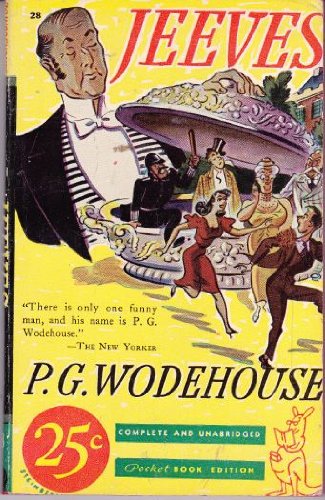
Book Review: Jeeves

Title: Jeeves


(Interestingly, Amazon reports that although several people claim to have some version of this edition, some date-stamped 1943, what some of them are actually selling is a reprint of the text scanned into a computer. What I physically have is a pocket-size paperback book printed in 1939. A computer printout might offer larger, clearer type; I'd have no problem with it but I do understand how it might disappoint someone looking for the original vintage book.)

Author: P.G. Wodehouse

Date: 1923 (U.K.), 1939 (U.S.)

Publisher: Doran (U.K.), Pocket Books (U.S.)

ISBN: none

Length: 244 pages

Quote: “Jeeves...always floats in with the cup exactly two minutes after I come to life.”

Up to 1950, before telephones took over, living alone was almost unthinkable. Bachelors normally lived with parents or siblings; anyone with a steady income hired a “companion,” and anyone without an income could make “companionship” a job.

These relationships often went wrong. Ancestor-snobbery, the idea of a servant class who couldn’t possibly be fit to inherit property, had its base in the need to keep hired companions from murdering their employers. Though the whole hierarchy of hired companions, valets, tutors, nurses, butlers, housekeeper, ladies’ maids, and others, were at the top of the servant class, often well educated and (as servants went) well paid, they could still be “ruined” by a single false accusation.

But sometimes the relationships went right. Bertie Wooster, the rich, charming, witty, immature twenty-something “gentleman,” and Jeeves, the quiet, discreet, unctuously polite, older and wiser “gentleman’s gentleman,” are a comedic parody of the best-case scenario where the employer and employee become each other’s best friends. 

Jeeves and Bertie use very formal manners to balance the excessive intimacy built into Jeeves’ job. Jeeves calls Bertie “sir” and Bertie, who naively narrates all the social blunders from which Jeeves tactfully rescues him, doesn’t seem to know whether Jeeves has a first name. They know each other’s secrets and always act in each other’s best interests. In real life they would probably have disagreed about Jeeves’ wages and social life too, but in the stories they always disagree only about fashion; Jeeves always cooperates with hardly more than a reproachful look, and always gets his way—meaning he gets Bertie to discard a tacky-looking fad item—in the end.

If Jeeves had been real, everyone would have wanted to know him, even after his natural life expectancy was over. Eighty years after his “birth” as a mature man in this novel, one of the first reliable search engines was called “Ask Jeeves.”

And this is where it starts. Jeeves begins with an episode that was also published as an independent “short” story (although it’s not very short), in which Jeeves not only spots the jewel thieves at the hotel but recovers the stolen jewels, and continues through several similar adventures until Bingo gets married. I read most of the other Jeeves, Blandings, and Psmith stories before I found this one. Knowing with whom Bingo was going to live happily ever after did not spoil the comedy of Bertie’s reluctant participation in Bingo’s love life for me.

That would be enough to say about this novel if I hadn’t found reason to disagree with the introduction to the reprint I have, on two points. Few people have read all of Wodehouse’s books—there were 97. I’ve read more than half of them, and I believe they contain evidence that Wodehouse became a target for political persecution because his first great comic character (based on a real person) made himself memorable by a political joke. I’m positive they contain evidence that Wodehouse was able to write clever, funny, lovable female characters who might have been played by Lucille Ball.

Wodehouse wrote several stories that grew into series of books. The one that launched his career was Mike and Psmith, in which Wodehouse expanded “Mike,” a sports story, into a comedy series by giving Mike a dorm mate who sought distinction by adding a silent P at the beginning of his name. Psmith introduced himself in an unforgettable scene that included the classic line, “I’ve become a socialist. It’s a great scheme. You work for the abolition of private property, and start by collaring all you can, and sitting on it,” as he staked his and Mike’s claim to the best “study” in the house. Young readers would probably have bought one of those endless series, like the Bobbsey Twins, that would have kept Mike and Psmith at school forever; Wodehouse let them grow up, and spun off their series into the Blandings Castle and Jeeves stories. The characters in these stories are part of the same fictional world and know each other slightly, but each appear as major characters in their own series. Wodehouse thought of most adventures for the large family at Blandings Castle. It’s possible that, having based Psmith on a real teenager he knew slightly, Wodehouse simply couldn’t imagine a long adult career for him—but, considering how long Wodehouse kept other characters young and how many other characters shared Psmith’s kind of cleverness if not his effrontery, it seems unlikely. I suspect Wodehouse was advised to abandon Psmith, then punished later for having written him, anyway, because Psmith summed up socialism so unpardonably well.

From time to time Wodehouse tried working a different comedic vein. There was a series of short stories told in a club restaurant where tellers and listeners are identified by their orders as “Eggs,” “Beans,” “Crumpets,” etc. There was a working-class character, Mr. Mulliner. Wodehouse wrote several stories about golf. He was also attracted to the American crime fiction genre; he wrote several comic crime parodies. The crimes mostly involved stealing paintings and jewelry, the criminals were sympathetic goofs, and although in theory Wodehouse’s criminals spoke U.S. criminal jargon with a few fashionable British slang words they’d learned from movies, while his British aristocrats spoke upper-crust British English with a few fashionable bits of criminal jargon they’d learned from movies, in practice they all sounded more like Wodehouse than like other members of either group. In any case the golf, crime, restaurant, and Mulliner stories sold, but never so well as the adventures of the British elite group that included Psmith, Bertie, and Blandings. Wodehouse kept going back, by popular demand, to that improbably extended, improbably sunny, summery prewar England where the biggest problems on people’s minds were whether Bertie ought to wear purple socks and which of the Earl’s nieces and nephews had misplaced which Blandings family treasure on purpose to manipulate which of his siblings into agreeing to what.

By and large Wodehouse’s characters paid less attention to politics as their fictional world faded further into the nostalgic past, every year. Jeeves and Blandings stories don’t mention years, but the slang and fashions and other details suggest that, just as it’s always summer for these characters, the year is probably in the 1920s, surely no later than 1940. Hostility about Psmith’s summary of socialism, however, died hard. Wodehouse was no fan of Mussolini—he made fun of an unsympathetic character who did admire Mussolini in one of his novels—but he got stuck in Italy while Mussolini remained in power, and was forced to state on radio broadcasts that, though held prisoner, he was being treated well. There was a war on. Wodehouse was banished from Britain as a traitor, falsely accused of being the person who'd broadcast really anti-British propaganda as "Lord Haw-Haw," and forced to immigrate to the United States, which his fans tried not to make too much of a hardship for him. He stayed in the U.S. after clearing his name and died old, rich, and famous, but always scorned by some people because he hadn’t jumped on the socialist bandwagon.

Later a complaint arose that he didn’t like women characters. This complaint was based on selective reading of his best-selling novels only. There’s no question that Wodehouse, having gone to all-male schools and all-male clubs, made fun of those male-bonding sites more effectively than he made fun of happy families. Bertie’s pal Bingo Little, the commitment-phobic social butterfly in Jeeves, reappears as a comically clueless but happily married minor character in both Jeeves and Blandings novels. Part of Bertie’s comic ineptitude is his fear of women. Bertie is, for all practical purposes, married to Jeeves. Wodehouse used several versions of a story in which some other young man, less afraid of women generally but still shy about approaching the one he wants to marry, heeds a bit of bad advice found in pop culture of the period: “You must take her in your arms and say, ‘My mate!’” Despite this handicap all the more competent Wodehouse heroes married.

There are even a few Wodehouse heroines. Wodehouse seems to have liked the name Sally; he gave it to at least three characters who combined Jeeves’ presence of mind, Psmith’s cheekiness, and whatever style of prettiness was in fashion that year. The Sally stories made me laugh too. One Sally became the main character in a book. But other authors wrote about girls like Sally and men like Mr. Mulliner. However much he liked writing about those characters, Wodehouse did like money. He kept going back to his male-bonded upper-crust Englishmen. He was working on a novel that didn’t seem planned to end the series, published posthumously (incomplete) as Sunset at Blandings, when he died.

Wodehouse was more justly criticized for writing, or rewriting, frivolous unoriginal stories that aimed for hilarity at the expense of Literary Merit. There's no real suspense about a Wodehouse story; you know nothing very bad is going to happen to anybody, some characters are always going to be incompetent, others are always going to have all the answers, people who are especially tiresome are going to be embarrassed, everyone will laugh and make up at the end, and three-quarters of the plot in one story may be the same as three-quarters of the plot in another story. You don't read to find out what happened, but strictly to laugh. Writing this way can be defended as a separate art form but Wodehouse didn't write, and can't be read, in the way Shakespeare, Mark Twain, or even Dave Barry wrote and can be read.

Wodehouse’s “genius” contemporary, Charles Williams, whose weirdly mystical novels show a repressed sense of humor, had a character explain uncontrollable giggling with “It’s Jeeves...it comes in a book.” Possibly Williams envied Wodehouse’s gift of literary clowning; or perhaps he wanted to avoid a pun that seems obvious to anyone who majored in English Literature. Medieval English writers did not make a clear distinction between wood, meaning wood, and wode, meaning demented. The character’s giggling when strange and alarming things are going on raises suspicions...No fear, Gentle Readers. Laughing out loud physically relieves pain and the long-term effects of stress, and if you Choose Laughter to prevent becoming wode in times of stress or pain, this long-gone author can help.

To buy Jeeves online, send $10 per bound paperback book (with "25 cents" on the cover, yes) or $5 per samizdat printout, plus $5 per package and $1 per online payment, to the appropriate address as explained on the Payment Information Page. At least seven and probably eleven books of this size will fit into one $5 package, so feel free to browse for additional books to fill the box...if you choose books by living authors, we send them money to encourage them.

Tuesday, May 29, 2018

Book Review: It All Started with Nudes

Title: It All Started with Nudes


(Amazon had a good clear image of this book's cover but, since it's a cartoon of a nude figure, this web site has chosen to use a truncated, blurry one instead. Click on it to see what the jacket drawing really looks like.)

Author: Richard Armour

Date: 1977

Publisher: McGraw-Hill

ISBN: 0-07-002271-2

Length: 158 pages

Illustrations: drawings by Campbell Grant

Quote: “Since it was hard to hang a picture on the walls of a rocky cave, the Stone Age artist wisely drew pictures on the walls instead.”

Do readers remember Richard Armour? He was America’s family humorist during the mid-twentieth century Best known for short light verses, many of which appeared in Parade (“Shake and shake the ketchup bottle. None’ll come, and then a lot’ll”), he’d written fifty-four books before this one. Seven of those books were jocular looks at history, with almost one joke per line and with titles beginning with It All Started with...In alphabetical order, his historical studies started with Columbus, Europa, Eve, Freshman English, Hippocrates, Marx, and Stones and Clubs: studies of North America, Europe, gender, literature, medicine, politics, and war.

Armour did research for these books, although he wrote them like stand-up comedy scripts. Those facts that weren’t obviously turned into jokes were said to be perfectly accurate. Teachers encouraged students to use the jokes to help remember the facts in passages like:

“According to Herodotus, it took one hundred thousand men twenty years to build the great Pyramid of Khufu. Whether the architect was still alive to collect his fee is not known.”

“The Romans invented mosaics. These were more complementary to building than many Roman portraits were complimentary to their subjects.”

“Leonardo...invented a flying machine and would have been ahead of the Wright Brothers if he had possessed one essential part—some sort of engine."

“El Greco painted religious themes religiously, but his Cardinal Guevara brings out all the meanness and cruelty of this head man of the Inquisition If the Cardinal saw his portrait and failed to have El Greco executed, he wasn’t such a bad fellow after all....He is wearing glasses in the portrait.”

“Thomas Jefferson” [invented] “the swivel chair and the dumb waiter (not the human kind).”

If his comedy could become predictable, at least Armour kept it clean. Despite the cartoon of the nude blonde on the cover, there’s not a rude word and hardly a smutty thought in this book. It All Started with Nudes would not have been a good gift for my grandmothers, who didn’t think even cartooned nudes belonged on the front covers of books, but many people who are active grandmothers now would find it nostalgically sweet and oldfashioned.

To buy it here, send $5 per book, $5 per package, plus $1 per online payment to the appropriate address (details are in the "Greeting" post). Four of Armour's "It All Started With" books would fit into one $5 package.

Tuesday, May 22, 2018

Book Review: Once Upon a Marigold

Title: Once Upon a Marigold


Author: Jean Ferris

Date: 2002

Publisher: Harcourt / Scholastic

ISBN: 0-439-57624-5

Length: 266 pages

Quote: “He’d seen how the beautiful golden-haired triplets had spent most of their time together in an extravaganza of pastel femininity while their little sister spent most of her time in solitary pursuits: reading cultivating pots of flowering plants, playing with her three small dogs.”

That’s Marigold.

Take the clichés from all the fairy tales that begin with “Once upon a time,” the fast-staling variations that begin with “Once upon a miracle,” some more puns that are even worse, sappy-ever-after Young Romance, a fairy-tale-world version of Twitter where the young couple communicate in short messages tied to birds’ legs, with a sense of humor, and you get this (I think) highly satisfactory parody of fairy-tale romance.

The person watching the princesses from a distance is Christian, an odd name for a character in a thoroughly secular story, but never mind. He’s a foundling boy being raised by a troll. The troll is definitely a member of the L.E.F.T. (Leprechauns, Elves, Fairies, and Trolls Association). For a troll he’s nice, and makes sure Christian has a good book of human etiquette to study. He anticipates that one day Christian will be presented at the court of King Swithbert, who is a bit dopey because he’s being doped by power-hungry Queen Olympia.

You know how this kind of story is required to end. If you read it, you read it for the little barbs of satirical wit in between the clichés, the overtones of Twitter, the comic Americanization (trolls are Scandinavian but Christian’s foster father has a second-generation-Yiddish-American or Noo Yawk accent), and the jokes primary school readers will love enough that they can forgive the romance.

I can imagine my younger self having giggled over Once Upon a Marigold in grade three or four, missing some of the jokes but getting enough to entertain me. The Twitter references may be there for the benefit of Ferris’ usual audience, teenagers. Adults seeking laughs for pain relief may appreciate Once Upon a Marigold too; it’s like a shorter, less violent Princess Bride. Unlike the forgettable, serious Teen Romances Ferris had written before, Once Upon a Marigold really was for everyone; it sold well enough to become a trilogy.

It would have been nice if I'd posted this review in time to offer all three Marigold books as Fair Trade Books, but I didn't. Ferris no longer has any use for a dollar and this web site's best online price is still $5 per book, $5 per package, $1 per online payment. All three Marigold books and at least one more will fit into one $5 package.

Friday, April 27, 2018

Book Review: You're Every Sign

A Fair Trade Book


Title: You’re Every Sign

Author: Phyllis Firak-Mitz

Author's web page: http://www.astrologerphyllis.com/

Date: 2002

Publisher: Health Communications

ISBN: 1-55874-963-2

Length: 362 pages

Illustrations: black-and-white graphics

Quote: “At the moment you were born, every sign of the zodiac was somewhere in the sky. The position of each sign in relation to you determines the area of your life that it influences...So you’re bound to express at least a little bit of the characteristics of each sign.”

Meh. Whether I consider this book seriously or as a joke, the best summary of my reaction is still: meh. At least it was good for lots of laughs, for me.

It was written seriously. There are people who never, even in the 1980s, considered psychotherapy; they didn’t want to admit that they had any, shudder quake, Mental Problems. Some of these people did, however, seriously consult the horoscopes in books and newspapers for advice. When a newspaper horoscope column goes beyond random platitudes (“Be kind”) or stabs in the dark (“Aries might call”), those who enjoy debunking newspaper horoscopes can demonstrate that literally years go by in between the days when any specifics those columns mentioned showed any accidental resemblance to our days, or our friends’ days. Nevertheless, as long as the general descriptions of astrological personality types resonated with these people (“See, I’m a Taurus, that’s an earth sign, and I’m very earthy”), they continued to treat their horoscopes like guidance, rather than random blather cranked out to meet a required word count.

So Phyllis Firak-Mitz organized her self-help book for people who still don’t want to talk to a therapist or counsellor, not according to “problems,” but according to astrological signs. Readers aren’t told they’re impulsive, histrionic, attention-deficient, or commitment-phobic; they’re told they’re expressing the Gemini influence on their personalities when they make and then abandon plans, ruining other people’s weekends. Firak-Mitz doesn’t tell them that they need self-discipline, or that they’re self-sabotaging; she tells them they “spread themselves too thin and lose touch with their inner core. What Geminis are learning works best is to bring everything they’ve got to whatever they’re doing at the moment. When they do that, they align with the vastness of their own nature.”

If you know a horoscope consulter whose personality could use a little help (I do; from whose library would you think I inherited this book?), you can’t blame Firak-Mitz for trying to meet this audience where they are. How much You’re Every Sign will help them is another question. As the cliché always went, they have to want to change. The person who gave me this book continues to express that annoying "Gemini influence," although Gemini is not this person's sun sign...

Even if they do want to change, how much will Firak-Mitz help to steer them in the right direction? What do you think the right direction is? I think the discussion of Aquarius, which Firak-Mitz identifies with New Age spirituality and Old Left idealism, betrays a bias in that direction. “When Aquarians remember to look upon their fellow humans as if they all are doing the best they can (and they are)...” I don’t believe the Austin bomber was doing the best he could. Do you? If you do, Gentle Readers, that is a religious belief that you hold (and I don’t). So despite Firak-Mitz’s attempt to avoid taking sides with one religion over others in her “spiritual” comments, some bias is inevitably present. It will bother some readers more than others.

There is of course another way to read anything about astrology—as a joke, for debunking purposes. You might enjoy reading this book just to see which people you know show the least resemblance to Firak-Mitz’s descriptions. You’re likely to find that, e.g., the chapter on Leo sounds like X all the way, only X’s sun sign happened to be Cancer, and it also sounds a bit like Y, only Y’s sun sign happened to be Pisces...I think the chapter on Pisces was good for the most out-loud laughter, for me (the most "fiery," macho, decisive living man I know was born under that watery sign), but it was quite a contest. Do you, too, know an annoyingly passive Aries, an obsessively focussed Aspie with a Gemini birthday, or a sloppy extrovert born in Virgo?

To buy You're Every Sign here, send $5 per book plus $5 per package plus $1 per online payment to the appropriate address at the very bottom of the screen. (A book-specific Paypal button is forthcoming.) At least one more book of similar size will fit into that $5 package, and we'll send $1 per copy of her book to Phyllis Firak-Mitz or a charity of her choice.

Thursday, March 22, 2018

For the Local Person(s) Who Bought the Coffee...

...No, not the curse, for them. (This is the utterly impersonal "them," as translated by on in French, meaning "Who cares whether they're male, female, singular, or plural.") For them, the friendly advice, which is not funny, and appears here above the curse contest story, which is funny:

The taco soup at the Family Bakery is delicious and gluten-free. The coffee is good. I like eating and drinking in the cafe where I blog. I like blogging about it, even. But, but...when you merely buy me $6 worth of stuff, as distinct from handing me $5 in cash, you don't qualify for a whole post.

I've avoided posting these thoughts in the past because some people who've wanted to buy me coffee are in fact addicts whose "program" allows them to handle giftcards not cash, and I want very much to help addicts stay sober. And others have wanted to support the places from which I've gone online as well as me, and I respect that idea too. This morning I encountered a person, or persons, who didn't want to bother buying something for cash, but nipped ahead and paid for my coffee with some sort of disgusting card...and that does annoy me: the idea of anybody being such a pawn of such an inherently unethical industry as to pay for one or even two cups of coffee with a card.


Yes, the burgeoning money-handling industry just loves to sell people that line of garbage about how everybody is using plastic now, and paying with actual cash is oldfashioned, and the banks don't like to cash your paycheck or handout check, and if a business isn't "big enough" to run on plastic you probably shouldn't trust the person with cash anyway but just take it upon yourself to buy stuff (with plastic) and give it to the person.

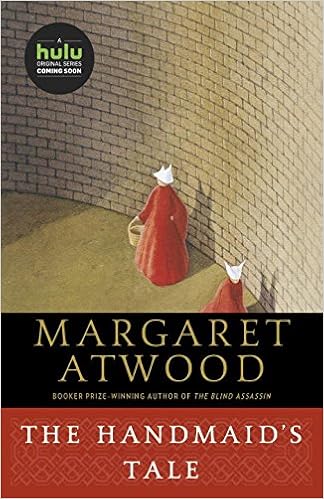
No, none of that is actually true in the real world...although the money-handling industry are working hard to make it true, and if they ever succeed, Gentle Readers, The Handmaid's Tale is going to read like a utopian fantasy. In the real world it won't be only women who are enslaved, nor will the process of enslavement take place without bloodshed. The Handmaid's Tale used the sex motif mainly to get readers' attention.

$5 in cash goes further than $6 in stuff.

$5 in cash nonverbally communicates that you appreciate what something is worth. $6 in stuff nonverbally communicates that you're claiming a right to dole out what you think I might want or "need."

$5 in cash is legitimate and respectable. $6 in stuff could in theory mean that you're a close friend and were thinking about me, but let's just say that I know that that's not the case; what it does mean is that (a) you didn't want to bother going to the bank, or (b) you didn't want to lower yourself to say "I'd like this, please, and thank you" to someone who has less money than you have, or (c) you wanted to tell people you did a big favor for some awful person who is obviously an alcoholic derelict because what other kind of person would ever walk to work on a cold morning like this one, or (d) all of the above.

And "paying" with plastic is fascist: it's a way to bloat bigger businesses at the expense of smaller ones, to "bundle" a few big businesses together with big government into a functional monopoly (which is what fascism means). Public-spirited people make the large payments to small local businesses, and peel off those one-dollar bills when they do, unavoidably, step into a big-chain store, where the store owners don't bother going to the cash register until people are waiting in line, and nobody who has either public spirit or common sense would ever use their identity to "pay" when others are waiting in line.

NICE PEOPLE LEAVE THE PLASTIC TO THE ADDICTS AND THE WELFARE CHEATS. 

NICE PEOPLE ALWAYS CARRY CASH.

So the one(s?) I have in mind get half a post, and since I have other things to write and am feeling hurried, I'll refer them to the nation's leading source of short, funny, pungent writing: the Washington Post's Style Invitational Contest.

To read the coffee-snorting post to which they sent me the link, click here:

https://www.washingtonpost.com/conversations/style-conversational-week-1272-do-not-congratulate/2018/03/22/

Last summer I was feeling sufficiently upset, in more ways than three, to compose a full-length Irish Curse. An Irish Curse is a poetic (at least in Gaelic it's supposed to sound poetic) form that goes on at some length, using parallel structures, which makes it recognizable as "formed" writing in any language. It can be goofy or ghoulish. Since I was writing about the way glyphosate reactions, if prolonged and multiplied long enough, would strangely resemble the horrors of kidney cancer, which many believe can be caused (partly) by repeated exposure to glyphosate, I went for ghoulish: this is the real stuff of which screaming nightmares are made. I'm not going to link to it; you can search this site if you really want to read a serious, horrible curse.

The Style Invitational was not asking for that; Irish Curses are long and frequently not funny. What they're asking for is a related form, Yiddish Curses, which are traditionally one-liners. If taken literally, some Yiddish Curses would not be funny, but their actual effect is usually to defuse anger by at least sounding funny if you don't think about them too long.

And here's mine, suitable for use in hatemail (not that this web site recommends actually sending hatemail) to any woman for whom "old, sick, and rich" have obviously displaced "tall, dark, and handsome":

"You should marry a 95-year-old sick patient, and he should live another 50 years, and you should live another 45."

Wednesday, February 7, 2018

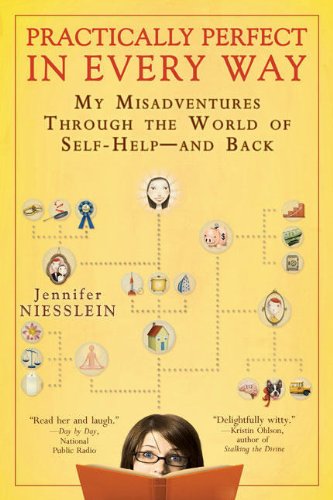
Book Review: Practically Perfect in Every Way

A Fair Trade Book


Title: Practically Perfect in Every Way

Author: Jennifer Niesslein

Author's web site: http://jenniferniesslein.com/

Date: 2007

Publisher: Putnam / Penguin

ISBN: 978-0-399-15391-4

Length: 343 pages

Quote: “I feel vaguely dissatisfied,with an unspecified yearning located somewhere in my abdomen. Am I happy?”

It’s possible that one reason why the self-help books of which she makes a diligent study don’t help Jennifer Niesslein a great deal is that, on the whole, she is happy. She edits a magazine, spends lots of quality time with her kid,and has time to wonder if she might be happier if the house were more tidy, if she had more money in the bank, if she and her husband talked more about the relationship, if she ate health food, if she went to church. So she buys these books that are probably intended for people who are positively unhappy. Most of the books offer her some useful tips for some specific things, but on the whole she feels that what they’ve guided her to do has been navel-gazing.

But she’s quite funny about it. Highlights of her survey of self-help books include a scene where she and her husband growl through a prespecified number of minutes of Talk About The Relationship, culminating with a solemn pledge to each other: “We are united against Dr. Phil. We pledge to never, ever time our conversations again. We will never use the phrase ‘Thank you for caring enough to share’...” Then there’s a “discovery” that all introverts would naturally have made before age fifteen if so many parents and teachers hadn’t joined in the implicit conspiracy to make us feel like defective extroverts: “‘Casual friends,’ I’m beginning to suspect, means that you’re stuck in small-talk purgatory forever.” Duh, right, that’s why some of us didn’t want to be voted Most Popular.

It’s possible that another part of Niesslein’s discontent is that, although she’s living in Virginia, she’s not a Virginian. Her background, lifestyle, lack of religion, and excess of politics all belong Somewhere Else. She takes up space in Virginia the way people take up space in Illinois or New Jersey, in a place that has no culture of its own, and then wonders why she seems not to be part of her community or its culture. One of the shortcomings of self-help books is that their scope rarely permits them to offer the one obvious, but also specific, piece of advice a reader needs most. For Niesslein it might be: “If you want to shun anything ‘conservative,’ if your sense of ideological purity won’t allow you to read a book about marriage without worrying that your ‘gay’ friends are left out of it, if you can’t listen to the ministers at the churches in Virginia, why don’t you just go home?”

By the end of the book Niesslein’s little boy is in school, living a more independent life, and Niesslein is devoting her time to an organization whose main goal will turn out to have been irrelevant. This kind of thing happens to people who move into places where they don’t belong and dedicate themselves to political agendas that don’t belong in those places either. Niesslein writes a cheery ending for the book, but as you read about the organization and its political goals, and think of recent news, you’ll think: Oh poor baby. Still, she seems emotionally resilient enough to get over this.

I’d like to see her get completely over it. I think we need a self-help movement for illiberal left-wingers, where they gradually desensitize themselves to their phobias of “conservative” ideas, learn to hear people out before throwing themselves into efforts to do things for others that the others don’t want or need to have done. In an ideal world that could be the topic of Niesslein’s next book.

Whatever the topic of her next book is, though, I expect it will be a good read. Practically Perfect in Every Way is a good read. Warmly recommended.

To buy it here, send $5 per book, $5 per package, $1 per online payment; three more books of this size will fit into that $5 package along with this one, and we'll send $1 to Niesslein or a charity of her choice.