Saturday, August 3, 2024

Hemileuca Juno (Post for 7.4.24)

Moths in the genus Hemileuca were traditionally named after goddesses until the list of goddess names from ancient European literature ran out. Hemileuca juno is a largish moth that seemed to rate a major goddess's name. 

Juno was another ancient "goddess" name that at least reflected an interesting process of ancient thought. After the Romans started learning to write from their Greek slaves, Juno was identified with Hera, the cheated, mistreated, longsuffering "Queen of Heaven." Before that, however, juno seems to have been an irregular variant form of genius. It may not always have been thought of as a feminine form, which would normally have been genia, but it came to be used as one. All places, people, and even interesting things (streams, hills, trees, bridges, government offices) were thought to have spirits; if they were masculine the word for their spirit was genius, if they were feminine it was juno. So Juno could mean any woman's individual personality, spirit, talents, as well as various forces of nature to which people prayed. Prayers, offerings, and shrines honored Juno of Money, Juno of Fig Trees, Juno of Birth, and on and on--even Juno of Ribbons, in charge of holding Roman robes in place, or not, and thus of helping newlyweds build intimacy..
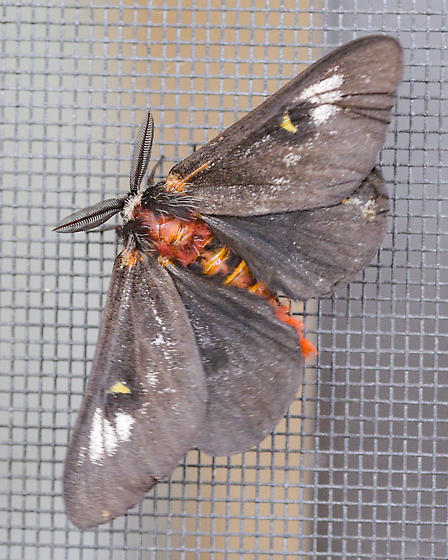

Photo by John Ashley, who says this one perched on his screen door for two or three days before emitting her mating "call" or scent, as Hemileucas do, and being surrounded by four or five males. Female Hemileucas don't usually wait that long after eclosion, so this might have been an older individual seeking a second mate, as the hardier ones do. She might have needed a few days' rest, after unloading her biggest batch of eggs, to feel that the second batch were ready for fertilization. The males would probably have ignored her if a female who had never mated before had been "calling," pumping out scent. Probably, on that day, none was. 

These moths are found from El Paso, Texas, to Sonora, Mexico, with the majority of photos available online coming from Arizona and New Mexico.  California is outside their normal range but, in the early twentieth century, they were found in San Diego County. Given the close genetic relationships among the Hemileucas, it's possible that the reason why H. juno has been rarely reported from California is that living conditions there cause these highly variable moths to look more like one of the "species" types that are normally found there--that the differences are not "true species" differences, but are produced when genetically similar moths live in different places and eat different food. It may be that environmental conditions in California cause H. juno to grow up looking like griffini or electra. Some researchers now think that only six Hemileucas have enough different DNA to be called distinct species.

Like other moths in this genus, Junos fly in the daytime and are sometimes counted as butterflies. Wings are softly colored, anywhere from light gray to black, and are usually folded  Some sources mention that females are more often black and males light gray; others document that color is not a reliable guide to sex for this species--some females are light and some males are dark. Enough of the moths look blackish that "Black Buck Moth" is sometimes listed as this species' (or type's) English name.  


Photo from EncicloVida.mx, showing how much some individuals' wing markings can look the head of a bird-eating animal.


Mason_S documented the other extreme of the color scale. This mostly white juno was found in Arizona.

At some angles the broad-shouldered body shape and tightly folded gray wings give these moths a resemblance to annual cicadas, although there's no obvious biological reason why a moth who may at least be distasteful to some predators would benefit from resembling an insect that even some humans will eat. Bodies are furry and often show bright colors. Humans don't seem to smell them, but they communicate with one another by scent. Of the distinctive scents that identify a Hemileuca's species, age, sex, and place in the mating cycle, chemical analysis has found traces of chemicals humans describe as "fresh, clean" scents among the chemicals we don't notice at all.

Females average slightly larger than males. Each forewing is between one and one and a half inches long, giving a total wingspan of typically 2.5 to 3 inches. 

Silk moths don't live long as moths. While other moths and butterflies can at least drink liquids, the silk moths have no mouths at all. They live on the food and water stored in their bodies, and they don't store much. For animals that get all their body's fuel from stored fat, male Hemileucas have a skinny body shape. Females look much thicker when they are full of eggs; after laying their eggs they look thin too. They do not always live long enough to off-load all of their eggs.


Photo by Mason_S. Does Juno's face remind you of a longhorned cow, too, or is that only me? 
Such fat as these moths do store up to live on is mostly on the thorax; the abdominal segments store the eggs and reproductive system. 

In conservation terms the species is considered "not rare or in immediate danger, but with some cause for long-term concern." Part of that cause for long-term concern is that humans aren't likely to miss a local population of Hemileucas if the local population is wiped out. Some people like the moths, or have a religious belief that we are meant to conserve all of God's creatures. Nobody likes young Hemileucas, which are commonly called stingingworms. Caterpillars are usually seen as hapless, helpless, if repulsive little animals but Hemileuca caterpillars are commonly described as "hateful," "vicious," and "evil."  

Or just as predictable pests that recur every spring: 


To be fair, most caterpillars don't seem to see far enough ahead to be able to see a human as a single living thing; Hemileuca caterpillars who drag their stinging bristles under the edges of people's clothes probably think they are exploring some sort of tree. When they're falling they curl up with their bristles out in order to land on their bristles. They know that predators don't want a mouth full of bristles. It's not certain whether they know their bristles are venomous. Each caterpillar's bristles protect it from being stung by its siblings' bristles or crushed or crowded by its siblings, even when they look like a solid mass of bristles all lined up together. It's hard to say whether they know how nasty they are.

Whatever their intentions may be, they certainly are nasty. Contact with the little monsters can cause itching, bleeding, swelling, and rarely, in a few vulnerable individuals, anaphylactic shock. If you are one of the vulnerable individuals, you probably are in the habit of carrying an Epi Pen, and should use it if a stingingworm makes contact with you. Others who first notice that they are in the vicinity of a stingingworm when it gets down their neck, inside their boot, etc., find some relief in applying ice and/or baking soda to the rash. Running sticky tape over the skin can remove any tips of bristles that may be stuck to or in the skin. Some people find additional relief in a nice trip to the mall, some in swearing, and some in putting a stingingworm in a small bottle and slowly pouring in alcohol until the animal stops quivering. 

Most people can tell by looking at these caterpillars that not touching them is a good idea. If you want to reduce the local population, a heavy stick or stone is good. Ignore any sales pitches for Sevin Dust. It can have a gratifying immediate effect on one generation of caterpillars, but as it also affects their predators, after one or two seasons "pesticides" always produce larger populations of unwanted species. This "Vicious Pesticide Cycle" is what made some normally uncommon species with low natural viability, like the codling moth "worms" in apples and the earworms in corn on the cob, into major pests. 

Some sources say that chickadees and sparrows eat baby Junos. Most of the predators on most stingingworms are smaller than the caterpillars are--tiny wasps and flies that can slip in between the bristles and lay eggs on the caterpillars' back ends, from which tiny maggots will hatch and parasitize the caterpillars. Every little bit helps. We never want to harm anything that eats stingingworms.

Nevertheless Junos have their admirers. They've been featured on record album covers...


In Neo-Pagan lore, they've been identified with Medea as a "vengeful" archetype, perhaps because the color pattern of black with accents of dark dull red suggested the image of vindictive thoughts like smoldering coals. That's in an unfinished, not properly published, document by the late Theodore Sargent. Ancient Pagan lore came from cultures where people had limited experience of the world, where they seem to have recognized only a few local species of flowers, birds, butterflies, etc. Sargent's vision was to expand this to reflect contemporary Neo-Pagans' ability at least to Google all the species on Earth. Neo-Pagans often refer to archetypes and images from around the world, and Sargent wanted to link each one to a specific species of plant and of moth or butterfly. H. juno was the only one of the Hemileucas he had placed on his list.

Moths normally fly in November but may be seen any time between September and December. Typically they eclose (emerge from their cocoons) early in the morning, mate by mid-afternoon, and lay the first batch of eggs in the evening. Males fly to where they smell a female and compete for her favors, apparently by grabbing at her or crowding up close to her until she makes a move toward one of rhem. After mating females fly about for a few minutes, presumably just to ripen the eggs if they are perched on a host plant but feel a need to fly anyway, and then place their eggs in a cluster on a twig. 


Photo by Cwmelton, who notes that it was taken in Arizona, in November, about 4200 feet above sea level. 

Most moths and butterflies probably mate only once. Those who are fortunate enough to live so long will mate again if they can; by the second day of a moth's life it is "older," and less desired as a mate, because fewer eggs will be produced and fewer of those eggs will hatch, but some silk moths mate three times or more. Moths don't expect any loyalty from their mates; if they have the opportunity to mate more than once, both males and females will prefer a younger mate/ It was not Hemileuca juno moths some researchers tested by saturating an object with the scent of a virgin female moth and watching male moths make fools of themselves, drooling over an object that didn't even look like a moth and ignoring a few actual older female moths...but probably most moths, including the females, are about that stupid.

Despite this lack of loyalty and commitment, Hemileucas are "cuddly" moths. They hold no records for snogging time--some of the bigger silk moths spend whole days cuddling--but they do spend time touching, smelling, and looking at each other before and after the act of egg fertilization. Couples often spend as much as an hour just enjoying their mates' company. Sometimes they mate face to face around a twig, the bigger moth tenderly enfolding the smaller moth's wings between (usually her) own. Mating side to side, not showing predators when they're in a vulnerable position, is perhaps typical for this species.

When the eggs hatch, next April or May, the baby caterpillars seem instinctively to know that staying in a cluster works for them. Their bristles maintain a good healthy distance between them without doing them any harm. 


Photo by Bob Barber, New Mexico, April 2006.  To them the feeling of a sibling's bristles against their own is probably comforting. They've got one another's sensitive undersides. Barber calls attention to the fact that these Junos seem to be sticking together into their fourth instar, by which time other Hemileucas would have gone off to seek their fortunes. 

Newly hatched Juno caterpillars are black. The red warts and rosettes appear later, and increasing amounts of white spotting gives them more of a grayish, bark-camouflage look as they grow bigger. They can look very similar to mesquite twigs. As a caterpillar H. juno can easily be a major nuisance--well camouflaged, covered in venomous bristles, with the flattened rosette shapes that allow the maximum number of bristles to stick in the skin of whatever the caterpillar touches. 


Photo by Bob Barber, who found it in New Mexico in May. https://bugguide.net/node/view/281210

So long as nobody tries to "control" these horrid creatures by spraying poison on them, they don't seem to overpopulate or do much damage to tree populations. They normally eat mesquite and usually leave food crops alone. They may also eat locust tree, paloverde, or cottonwood foliage; at least people have reported seeing them nibbling on these leaves. It's not clear whether they can survive on these alternate diets or, if they do, whether they will look like juno. It is known that some Hemileucas will grow up with a radically different look, and their ability to mate and produce offspring may be affected, if their diet is changed. Juno larvae who grow up to look like junos, mate with other junos, and produce healthy baby junos, eat mesquite leaves.

Just before pupation, caterpillars often explore plants and trees they don't eat, which are places where their predators are less likely to look for them. This is when stingingworms typically invade gardens and orchards. They spoil the fun of picking fruit, and they don't even eat fruit tree leaves. 

By the first real heat wave of summer they start to pupate. Unlike some of the Southwestern Hemileucas, they are said to spin cocoons, though, like those other Hemileucas, their pupation survival strategy seems to be to lie on the ground among the leaf litter and hope that nothing else notices that they are alive.

Most spring caterpillars will eclose in the fall, living six to eight months altogether, but (for no obvious reason) some Junos stay in the pupal stage for two years...or three or even four. These individuals may just be the type who want to be different. They probably also keep the family alive through years of unfavorable weather, and may improve the gene pool by carrying genes through a few extra generations. Like human eccentrics who "always want to be 'different'," they are probably more useful to their families than their families know.

Book Review for 7.7.24: Octave of Stars

Title: Octave of Stars

Author: Zephyr Thomas

Date: 2022

Publisher: ZMT Books

ISBN:  979-8-218-13164-7

Quote: "His palm might have scalded anything he touched."

Ash is a nice Christian college boy (specifically a Catholic) who just happens to have the superpower of Fire. As a restaurant cook, he can always brown things just right with his bare hands. He can do other fiery things, too; while practicing he incurred criminal charges for accidental arson. Ash is lucky to have found a flatmate, also a good Catholic, who has the superpower  of Water. People think they're a couple, but they're not; their relationship is still about finding how their powers work together. For one thing Cascadia rigs up a thermostat on Ash's bed to make sure he doesn't burn down the building in a dream.

So naturally, when Cas disappears, Ash starts looking for her. While tracing her he just happens to meet people who have superpowers of Light, Air, Seed, and other forces of nature. It turns out that Drake Frost, who has the superpower of Dark, has invented an energy prism that he claims will power the world forever, but a few of these "Stars," people with superpowers, will have to be sealed inside it for at least ten years, which they may or may not survive. 

The challenge is of course for the eight "Stars" to defeat Drake without harming anybody. They're all good Catholics; they don't want to be violent. Special effects for the potential movie include awesome visions and slapstick comedy scenes. (Not harming people does not rule out spanking them.) 

Readers will learn a fair bit about Catholic prayers and beliefs, while enjoying a uniquely wacky and delightful fantasy adventure, if they read this book. 

Book Review for 7.5.24: Braving Stars

Title: Braving /Stars 

Author: Amy Michelle Carpenter

Date: 2020

Quote: "There was only one step between me and my wildest dreams."

In this series of short stories we meet some of the people from the other planets that keep a friendly eye on the "younger" civilization of Earth, and the humans who see and interact with them. The aliens who've been preparing to spend time on Earth look almost like humans, but with orange skin tones and long flexible noses, so...odd-looking, freakish humans. 

It's unreasonable to expect a recommendation of a book based on only "sample stories"; writers who want good reviews, or star ratings, need to send out complete review copies. We're told that there will be a sweet, idealistic, age-appropriate relationship between an alien girl and a human boy. What I received tells me nothing about what Carpenter considers age-appropriate. I'd guess that, at the age the characters are, they converse and tell people they're friends, but I don't know that. Some writers think it's appropriate to put detailed information about where babies come from into books marketed to children.

Anyway, if the premise of alien observers of human civilization passing unnoticed on Earth appeals to you, this collection probably will too. I think Zenna Henderson did it better, though.

Book Review for 7.4.24: Death on the Doorstep

Title: Death on the Doorstep

Author: Alisha  Kay

Quote: "You can cast a bewitching spell on him, to make him do your bidding."

Well, it's different from your usual romantic comedy or mystery. I'm not even sure which it's meant to be. What I received is probably a small part of a longer book, although it's not explained as such.

Anyway, Sitara defied her conservative British Indian parents to marry a White man, a good friend from school. Eighteen months later he told her he "was in love" with someone else and wanted a divorce. Sitara moved out at once, but her feelings are still doing a slow burn when her parents invite themselves to spend Christmas break with the happy couple (Sitara never bothered to explain to them about the divorce). The two young women shamelessly fight over a man who doesn't sound worth that much of either woman's time. 

When Sitara walks through the instructions for a relatively sweet and simple spell, burning a letter in a lavender candle, there's a chill in the room. She sees the other woman...or does she? Has her husband's new wife committed suicide on the doorstep?

That's as far as my "book" goes. Would you ever pay for a book marketed with alleged free copies that break off after chapter three? I don't recommend it. If Alisha Kay wants to send an actual book, she can hope for a better star rating than this one's earned.

Friday, August 2, 2024

Friday Poem: If You Love Your Neighbor...

"If elected, in the first 100 days, Kamala Harris promised an Australian-style recall of all firearms in America."--News item.

Well, I don't drive. I take no handouts. Burn 
Rather than dump. Sometimes I used to sing
In aid of urban missions. I did learn
Commandments as a child. Still new days bring
New challenges in service of True Love.
We hear Mean Girl McDowdypants proclaim:
"The Constitution? What of it? Above
It, I am. All firearms I'll simply claim!"
I seem to see a street lined with young men,
Lying where they fell when shot through the back.
Crows, gulls, or pigeons make wounds bleed again.
They are all colors, but three-fourths are Black.
On a less grandiose scale I saw such things,
The harvest that the long-sought gun ban brings.

If Dowdypants ever made good her boast
I do not say she'd ever be forgiven.
Leave that to grandparents who've lost the most.
I doubt there will be dowdy pants in Heaven.
Let love and pardon wash the gutters down.
Let hope and pity enshrine those young men.
(How many'd been kissed on the innocent down
Of their soft cheeks? How many fathers, then?)
For gall, for hubris, for mere bigotry
McDowdypants has earned some sort of prize.
Could one love oneself, having done what she
Has done? Would one be ugliest to one's own eyes?
Love for McDowdypants? I think what's meant
Are prayers that she may earnestly repent.

But, love for those who've waited long to see
"A woman President! Jamaican, too!"--
I'm sure some of that still remains in me.
I'm sure some of it still remains in you.
We need not even ask their vote on Rice,
Though she was fact where Harris is the sham,
Though she was brave and loyal, at a price,
And was a class act; Harris is a scam.
We think our sense of presidential sort
Ought to rest on things weightier than size,
But, for a President, Rice was so short...
We do not hate. We do not scream "All lies."
The only way we can get through the labor
This Admin's left behind, is love of neighbor.

Book Review for 7.3.24: To Become a Witch

Did one piece of electronics really solve the connectivity problem? Will these book reviews post? Let's find out...

Title: To Become a Witch

Author: N.Z/ Nasser

Date: 2023

Publisher: Hanora Sky

ISBN: 978-1-915151-26-1

Quote: "[M]y sisters and I hiked the steep trail below the caves."

Three never-married sisters are frequently harassed and expect rudeness from men, in their small town in India, but their lives haven't been so terrible...until a family pet leads them into a cave where they discover powers through contact with an ancestral stone of magical power. But in this short story, we see why the series of longer stories is going to be about two sisters fighting an enemy group for the stone. One sister makes some selfish choices. Nothing so terrible that, in real life, she couldn't choose differently tomorrow--but magical realms don't always offer as much hope as real life does.

None of them is or will be a witch in the sense that Britain and its Colonies once used that word as a criminal charge. Their culture is different. They don't have the Old British Religion to practice nor the Christian judgment that the Old British Religion was satanic. What they're doing is pretty transparently a metaphor for claiming their legitimate property and power as older women in their own Indian culture. That kind of behavior gets labelled "witchy" and "crazy" there, too. In the Indian fantasy kingdom, it's not even labelled; it's attacked by armed troops.  

Are small acts of selfishness all that dangerous? How much do you want to know about this fantasy series, or the reality from which it grew?

Tuesday, July 30, 2024

Status Update, Continued, with White-Faced Hornets and Possible COVID

So the Internet connection was dragging along, not really connecting to any site that consisted of more than words and still pictures. It would let me read blogs, but would not open live comment sections, if they had any. It was of course moving at a pace that made my old Dell laptop, The Sickly Snail, look brisk. And then, at about 4 p.m. on Thursday, it stopped even pretending to move except between 9 and 10 p.m. Thursday night.

Meanwhile, on the Sunday--I mean 7.21.24--I ate some beans that weren't all that canned beans should be, most if not every single one I'd swallowed landed in the bucket before I'd finished the bowl, and that seemed to be the end of that, but I kept feeling draggy...and 48 hours later I was feeling something I can only describe as "just like COVID only moreso." And dry, dry, dry...because the cheerful deliveryman had not brought the water I needed to flush it out, so it just dragged on, and on, and on. The cats and I shared our last bottle of Pure Life water on the Tuesday morning.

Here let me say that I'm not blaming the cheerful deliveryman for having missed a biweekly delivery for more than two extra weeks, because if what I had was COVID, then COVID is in our town, and when original COVID was in our town this cheerful chap spent a month in the hospital, denying that what he had was COVID. He has regular cardiovascular disease too. I sincerely hope he is resting and recovering.

I spent two full days mostly lying down under a blanket thinking "Well, a fever is to sweat out," only it wasn't working because, although I was sweating through towels and sheets all right, I wasn't rehydrating. Pulse and blood pressure all over the place, no reason to any of it, chest pains, headache pains, from the Tuesday to the Saturday, at which point I was feeling better enough to form thoughts like "This is feeling like the kind of reaction people have when they try to eke out their water supply by just slowly sipping their last bottle of soda pop, more than like COVID, as such." 

I stumbled down the road on Sunday morning thinking "The cats can drink rain water if they have to, and I can get tap water in town," but one day's rehydrating was not enough for me to haul any tap water back home, so I still had to trudge back into town today to finish rehydrating. And to notify the sponsors that, although nobody is getting the Internet service for which we're paying, I have spotted another potential physical problem...on Sunday, 7.28.24, I sent the message that they weren't getting what they were paying for.

But it did help...this morning, after a day mostly drinking water and Coke in McDonald's, and then a day mostly going through the liquid contents of all the canned goods in the house at home and eating the solids if the first few bites didn't seem to be triggering a reaction, I was able to walk about a mile of the way without even carrying a stick. All COVID-like symptoms are gone. All that remains are symptoms of not eating or drinking between Wednesday and Saturday. They didn't give me a senior discount on that refillable drink cup and that annoyed me to the point where I'm now trying to work out exactly how much water and caffeine, in what combinations, I can drink. At least under the strong light in the bathroom my hair looks respectably frosty, to my eyes anyway, which may admittedly still see better than some burger-flipping kids' video-screen-frazzled eyes.

When I left the house there was still no Internet connection. The wire appeared to be where it ought to be, above the ground, parallel with the ground, all the way up the road.

A few yards below the property line, however, where the wire runs right over a wide, shallow, fast-moving part of the branch creek, I saw that the descendants of "my" White-Faced Hornets have built their nest right on what I believe to be the electrical ground wire. I could be wrong. If that's the phone and Internet line, that would explain why problems with it may be very hard to correct...

1. These are not, strictly speaking, my White-Faced Hornets. None of them ever lived on my porch or in my house. They do not know me better than they do other people. I may fear them less than most people do, but I respect them. I'm not going to move their nest until the temperature is freezing. (And I will need professional help to get at it, then.)

2. They are, nevertheless, a protected native species of animals. They are valued and protected by me, as well as by the law. 

3. They are nesting directly above water that runs down to the Tennessee River, that hundreds of thousands of people have to drink. And that water is too shallow, at that point, to offer any protection to anyone they think is a threat to that nest.

4. Anyone who sprays poison at any of those hornets is spraying it in the face of God and the law, and I will do all that can be done to enforce the laws of God and humanity in defense of our native animal species. 

5. These are by nature a very peaceable, goodnatured family--as hornets go, anyway. I will help relocate the nest onto my own property when the weather is appropriate. 

6. My uninformed guess would be that the hornets are not a problem, anyway, as long as company employees move steadily past the nest and don't disturb it. If stung, accelerate away from the nest and crush broad-leafed plantain to rub onto the skin around, not directly on, the wound. But they're not at all eager to attack people. 

7. The hornets are not, for example, likely to defend any place where any method of sabotage or wiretapping I know anything about would take place--which would be on my property. At this point cables are attached to poles well above the nest, so investigation of the cables should not disturb the hornets more than weather conditions do.

This web site will resume regular posting when possible. Due to the immense volume of e-books it has received, this web site will deliver book reviews for every day missed, when possible. Hello, I spent most of that recovery time reading Book Funnel and Kindle books. I can't promise poems, Long & Short Review question posts, or Petfinder photo contests for the weeks missed. I will deliver butterfly and moth posts and the rest of the frugal posts, though.

Belated Book Review for 7.2.24: Guardian of the North

Status update (#1): I was able to type this into Blogger and hit "post" on 7.22.24, as a test of how badly the Internet connection was working...then. Shortly afterward the Internet connection gave up all pretense of trying to work. The rest of the status update will be in another post.

Title: Guardian of the North (Descendants of Robin Hood Series)

Author: Maggie K. West

Date: 2023

Publisher: Jasmine Codex

ISBN: 978-1-7349447-4-8

Quote: "I know where he is...Fort Calmier."

Fort Calmier. That's the clue. There's nothing about Robin Hood in this novel. It's "Swords & Sorcery" all the way. The main characters are teenagers. They spend all their time practicing control of their super-powers by fighting and hiding from each other. Their powers are a rather obvious metaphor for the emotional energy of teen hormone surges. They're sent to the fort to learn to remain calm.

Robin Hood, in contrast, was cast as the hero of many human adventures, in which he and other adults fought to reclaim some of what was being stolen from them by an oppressive government. The Merry Men embarrassed the crooked Sheriff and his goons by toughness, woodcraft, marksmanship, good will, and intelligence. Identifying a "Swords & Sorcery" adventure with the Robin Hood story is bound to disappoint anyone who remembers the Robin Hood story.

In this novel Jackson, or Jack, may have days when he's not fighting a battle, but he doesn't say much about them. His story is one battle after another. People get hurt. Walls and trees get knocked down. The characters have to move form one forest retreat to another because this is supposed to be taking place in our real world, where the natural disasters the Descendants of Robin Hood constantly cause would attract too much attention.  

What are they fighting about? Mostly, it seems, they just enjoy fighting. The teenagers are there to practice, so of course they pick fights whenever they're not in bed with injuries. But the adults' differences don't seem much more momentous than that. 

I was not blown away...but this is a story with live interactive game potential, so online gamers might like it. Cheers.

Sunday, July 14, 2024

Status Update: How Bad Is Yougov?

As the first real heat wave breaks over the Cat Sanctuary...

So many days I looked at the kitten Dora and thought "She's not going to live. Heavy-duty medication for internal parasites might help her but she's not going to grow big enough to take it."

So many days, after that sort of morning, Dora was still bubbling and squeaking and bouncing about with big brother Diego at the end of the day. There was something special about those two. All healthy kittens just like to play with anything and anybody, but Diego seemed to notice that as the biggest kitten in the litter he was the one the smallest kitten trailed after, raced, chased, tried to copy, tried to out-wrestle. He seemed to be careful about playing with Dora. If their other brothers wanted to play more roughly than he did, he'd show them the rough stuff. Dora would stay in a game--chasing a stick, e.g.--up to the limit of her strength. Sometimes she walked away from a game with me. I never saw her walk away from a game with Diego.

So on Saturday morning, when Dora woke up bright and early, bounced out of her box in the office without waiting to be carried, and rushed out to do her part to keep her aunt Silver's lactation cycle going, I expected she'd rush up with the three tomkittens when the kibble was put out for breakfast. Right?

Wrong. 

The Professional Bad Neighbor drove up and sprayed poison somewhere. Sheer spite; he has to know by now that John Hinckley might have a better chance of getting a real estate deal around here than he would. I sneezed for a few minutes. When the time came to go out and dispense kibble, the tomkittens' eyes were watery, the mother cat Pastel looked bleary-eyed too, and Dora was nowhere to be found. I called her, specifically. Dora didn't always actually come when called but she did always notice being called. But surely she wanted breakfast? I called her again, and Serena, my non-demonstrative cat, came out and jumped onto my shoulder and purred and licked me. Then she jumped onto my knees and purred and cuddled. She even chomped my hand a few times in the friendly way she did when she was the office kitten, before she grew up and decided chomping humans was not a game worth playing.

She knew.

There are still a few Vespulas on the porch. The trouble with squirting alcohol and Listerine, instead of spraying poison, is that although you can saturate fungi with Listerine you have to kill insects by ones. There never were many on the porch and, when I see that they no longer even post guards around what they were starting to make a nest, I keep hoping that they've decided to move somewhere else. Even for wasps the Vespulas seem stubborn and stupid, though. I keep squirting and thinking that, although they seem to have been introduced to our ecosystem at the same time as two other unwanted species that might have moved in from other parts of the neighborhood, at least they do seem to be making a dent in the mosquito population.

What has this to do with Yougov? Hopefully I say, nothing at all. It is to be hoped that the things that made last week unpleasant are separate and discrete inconveniences. But it can be hard to tell. It remains to be learned whether the Bad Neighbor's pranks are just free-floating malice--he was one nasty little brat of a boy who's grown up to be a nasty brat of an old man--or are associated with any other haters' ill will toward me personally.

I've often posted about Yougov, the survey site. Always before I've posted good things. Good things can be used for bad purposes.

Yougov has a very good reputation--in the United States, anyway. (I've read that some of its foreign branches had bad reputations.) They don't send out spam or sell your address to spammers. They pay what and when they say they'll pay for the time you spend taking surveys. They deliver good, representative cross-sections for market surveys, product (including celebrity-image-as-product) ratings, and opinion polls. 

An election year naturally generates lots of opinion polls.

This year I've noticed a problem with the election-related polls. "To verify that you are a registered US voter," the survey authors whine, "what is the address where you are registered to vote?" Why are no warning bells going off in Yougov's office? They don't need to verify that people are registered voters. They want to know where people are registered to vote in order to manipulate election results. This can be done by legitimate means, like selecting campaign ads, press releases, and news broadcasts to appeal to the interests of voters in different districts. Or it can be done by less ethical means, like mailing out disinformation about where and how to vote, or sabotaging digital voting machines...or physically interfering with people's being able to vote.

I think Yougov needs a policy requiring that only office, school, post office or other mail drop addresses should ever be allowed on surveys. If people don't have a place to receive mail that is far from where they live, they should program their computers to remove anything that's not recognized as a workplace or post office address from the system, perhaps replacing it with a line like "Never type anyone's home address into a computer." That's a basic common-sense precaution, like "Roll up windows, lock doors, and find another place to leave children or pets, when you step out of the car." 

And they need one reminding their clients: "Any attempt to identify individual voters, such as asking even for a post office address that might be associated with voter registration information, will be reported to the police as evidence of possible involvement in election tampering and/or voter harassment."

("No such!" a client will wail. Truthfully or truthily. "All we want to do is talk to the swing voters and make sure they know what Our Candidate has done about the issues A, B, C, and D..." There used to be a place to do that in a perfectly legitimate, ethical, even mutually enjoyable way. Twitter used to be its name...before censorship. We badly need uncensored social media where people can chat and debate about whatever interests them, on their own time, in real time. Meanwhile, the crucial thing you must not do, if you want to communicate with people, is try to get information about them before you have given them--and verified that they were interested in having--the same information about you.)

Following the attempt to murder a campaigning candidate last week, I think Yougov needs to tighten the restrictions on questions that can be asked on election-related surveys. No, you don't need to know whether surveys are being taken by registered voters. Deal with it. The ones being taken by children are at least being taken by people who talk to voters. It is better to work with information that might be provided by children than it is to have information that might be used by someone who wanted to murder a candidate or his supporters.

"But it can only hurt 'conservatives' if mature property owners, who are presumably all 'conservative,' are allowing surveys to be filled in by their illegal Mexican housekeepers, who..."

Basta ya! In the first place I do not have a housekeeper, Mexican or otherwise, but if I did she would be legally authorized to work in the United States. And she would probably be a radical Christian, and we'd probably have talked about the religious reasons to support some causes the "conservatives" try to claim, and some the "liberals" do. And whether she was a legal temporary resident, as it might be a student, or a natural-born citizen of Virginia, I'd encourage her to use or acquire a legal right to vote. It's a vicious and outdated stereotype that anybody in any demographic group intentionally depends on cheap illegal foreign labor. Most of the mature property owners I know don't hire housekeepers until we acquire a disability that qualifies for a pension. Then they hire US taxpayers with, if anything, a preference for young relatives of people who want to go all the way back to Grover Cleveland and say the federal government shouldn't do pensions. Or else the really pathetic ones prefer to hire people who look like the types they used to want to date. 

In any case a criterion for any housekeeper I hire is that she must be able to explain why raising the minimum wage is likely to hurt her more than me. She's free to vote for whichever presidential candidate she thinks is most likely to avoid war, no questions asked, but she needs to be immunized to that specific political lie.

Anyway, back in June I was "selected for a survey" purportedly about how people read and react to different kinds of tweets on Twitter.The survey claimed to need access to my Twitter account to assemble a selection of "fake tweets," several of which I recognized as old tweets, from people I follow or used to follow. 

If I'd had my wits about me I would have said no, right there, because that amounted to authorizing a stranger to impersonate me. For all I know the person may be a scammer and may be using my Twitter identity to ask my Tweeps for money. Some poor idjit, undoubtedly the son of one of the legendary Nigerian scammers though I don't know whether he's still in Nigeria, has been using the name "Elon Musk" to try to ask me for money. I should probably report him but he is such a laugh...

But at the time I thought, well, none of us use Twitter much any more anyway....

So this survey proceeded to show me old tweets from individuals I followed for more than an hour. Since the contents of most of these tweets were clearly news stories from bygone months or years, and the survey said that whatever respondents "liked" or "retweeted" would show up on our Twitter pages, I made sure to pick only pictures, jokes, or quotes that hadn't gone out of date. People who followed me on Twitter used to know they could expect to see pretty flower pictures, no matter whose flowers or when they had bloomed.

Then the survey switched to a selection of old tweets from corporations I used to follow. Aye, there's the rub. The corporate accounts I followed were cut down, first, a few years ago, to newspapers and the BBC. Then after the "Trusted News Initiative" I cut out them, too. So the survey was picking old news stories from newspapers. Oy. It might have taken all night for newspaper accounts to have posted a half-dozen tweets that hadn't gone out of date. Newspapers do occasionally post an evergreen article about "How to Clean Behind the Refrigerator to Keep the Refrigerator Working Longer" or "Bird Species That Are Occasional Visitors to Local Parks," but I kept scrolling past tweet after tweet about stories that were no longer news. "Where to View the Solar Eclipse," for pity's sake. I might have retweeted that if the system had allowed me to type in a comment like "The story's old but the picture's still cool," but it didn't.

I started scrolling down whole screens full of tweets I was not about to retweet. There had to be an end somewhere. I started taking the survey at nine or ten o'clock and it was well past midnight when I finally pulled up something other than unusable tweets about no-longer-news stories. It was a sarcastic demand that I prove I was still human. In all that time I suppose some people might have been able to program a bot to scroll through the fake tweets for them. 

Then the survey closed. Say whaaat? Yougov surveys are worth a predetermined number of points that add up toward giftcards or, if you do online banking, deposits into banks. This was supposed to have been the one that paid for my next yarn shopping spree/ It hadn't even added the points to my account!

I sent Yougov a strongly worded e-mail, that night, and got on with my life. I received no reply from a human at Yougov. Over the next two or three weeks I took a few more surveys and clicked through a few screens to request a giftcard. The system was set up to encourage people to request digital e-cards. I don't buy things online, so I sent them another e-mail requesting that they just put the card in the mail as they've always done before, and mentioning that this would be a good time to add a substantial payment for the bogus survey. 

That got a human reply. "What survey was that? When?"

Since I'd e-mailed Yougov from within their system I didn't even have the copy of the e-mail I sent them. More to the point, at midday today, was that it had taken from 7 a.m. to midday for their e-mail to open because my Internet connection seems about two-thirds dead. It has ever since that storm, a week ago last Friday. By last Friday I'd checked the company web site for an explanation of why it was taking them so long to restore full connectivity. The company site gave no indication that they were aware of a problem. Whole towns lost connection for a day or two after the storm, which was understandable, but apparently during the week everyone else's connection had been restores except mine.

Mine is still failing to open the regular Windows "network & internet access" screen, just flashing a condescending little warble about how the company "tested and verified that you are able to access some web sites." Some web sites. Right. Enough for the copy editing job, which is what I've been doing with most of my online time during the past week, but not enough for serious research, not enough for listening to the "vlogs" of various blind bloggers on my list, not enough to get e-mails open within one hour...

And so it inevitably occurred to me that there might be a reason for this.

I can think of more probable reasons. I can think of trees with limbs that I've been telling company employees they needed to prune for many years. The first limb I'd cut, just to test this theory, if I were a young man with a truck equipped with a lift and provisioned with saws and suchlike, is on a walnut tree just below the house, above the road, easy to reach from a lift mounted on a truck and just about impossible to reach from the ground. Then I would follow the line and prune the others. 

I can think of a Professional Bad Neighbor who may or may not have bothered wiretapping either the old telephone line or the Internet connection line, but certainly had both means and motives. I've reported the sounds of suspected trespassing to the police before. 

But until one of those possibilities is confirmed, and I emphasize that I hope it's just a tree limb or two that the young men can get rid of in an hour or two, I can't rule out the possibility that someone who wasted so much of my time worming about in my Twitter account might have been hostile enough to have traced the Internet connection to the house, also. For the purpose of interfering with my vote.

I like Yougov. I've liked Yougov for a long time. I don't like thinking that they're to blame for anything worse than attracting boring surveys. (:Which of these brands have you ever bought?" "None of them. I don't buy that kind of thing. I don't hang out with people who do." "Which of these brands do you have a good impression of?" "Aaarrrggghhh." The kind of thing that must be expected if you eke out an Internet writer's pathetic income by taking surveys online.) 

I still think Yougov need to be reminded of the potential danger to them in allowing clients to snoop into the identities, locations, ages, of survey respondents. I want them to think long and hard about the possibility that they've allowed people with criminal intentions to find out where I live, and then I want them to redesign their system so that, if a client tries to sneak in a question like "What is your date of birth?" in a survey, the computer flashes red for thirty seconds and then displays a message like "You may not attempt to identify individuals taking these surveys. You are allowed to ask in which decade respondents were born."

Or they could simply say, "For any question you ask the respondent, the respondent is entitled to a verified answer to that question by you. So, if you ask for anyone's address, your real name and home address must be displayed in full-sized type above the quesdtion." That tends to motivate people to withdraw any inappropriate questions, online, in a hurry. 

Link Log from a Week of Half Service

It's amusing, actually. Pages won't open. Videos won't play. The button at the bottom of the screen shows full connection, but not for the private account for which sponsors are paying; only for "SCTC Wireless." It pulls up a menu for "Troubleshoot options" or "Open Network & Internet Settings." The button to open the regular "Network & Internet Settings" page does nothing at all. The button to "Troubleshoot options" pulls up a whine: "Windows tested your Internet connection and verified that you are able to access some web sites." Some, yes. Trouble is, the people paying for private connections (who I have always said should be paying entrepreneurs to manage public-access computer centers for profit) are paying for full access to any and all web sites, at any time, more than one at a time, specifically for allowing the long videos some blind and/or lazy people post to natter along in the background while we run down our to-do list of things to do with other web sites. 

Our social connections demand this, SCTC Wireless. They may expect us to reinforce their initial perception that some of these news-and-views videos are misguided, but the information from those videos, whether accepted or refuted or questioned, will be on the test of our having paid due attention to what they posted. There are a terrible lot of videos on the Internet that it's easy, probably profitable, and certainly fun, to ignore...and then there are the ones that allow normal blind people the sort of social connection George Peters was able to sustain through a terrific, even monomaniac, concentration on his cassette tapes. No, I don't "ghost" away from e-friends because they lose the ability to type. My e-friends who can type don't do that, either. 

You need to restore 100% connectivity, SCTC Wireless. You need to explain, on your customers' next monthly statements, why you disabled the sound systems built into people's computers and why, as a result, the charge for their Internet service is half or less than half what it would normally be. We know there was a thunderstorm on Friday. We know that there was some rain and lots of humidity during the past week. Those facts have their natural consequences but there's a limit to everything. Nobody should pay as much as half of the normal monthly bill for this July. 

Anyway, from some web sites, some links...and a Palinode.

Animals (the Palinode) 

Last month we had some sort of animal crisis. I'm still not sure exactly what happened. Dasher, a possum distinguished from all others by his preference to gallop rather than walk, disappeared. Some animal died in among the loose rocks below the road. My cat Silver lost her kittens and had a stiff, sore, badly swollen paw. Was it possible that Dasher had threatened the kittens and Silver had killed him? 

It was possible. I think Dasher weighs more than Silver, and runs about as fast, but she's an intelligent animal and he's a dumb one. It did not, however, happen. Dasher moved away from his residence behind the cats' sand pit in the cellar, but he's still living. Drabble, who looks like him only smaller and with a more typical possum gait, didn't move into the cellar either, although she's been fulfilling the duties of the resident possum. 

The Vespula menace? When I inadvertently touched the place where a small group of belligerent bee-sized wasps were camping, very early Wednesday morning, it was complete news to me that Vespulas lived in my part of the world. I grew up using the word "yellowjacket" to refer to a different animal. But I asked someone from a different neighborhood, two or three miles away, and got a quick summary of what I'd just learned about the genus Vespula. I remembered, also, a neighbor who said there were good bees that live in hives and make honey, and bad bees that live in the ground and only buzz and sting. So, the Vespulas are not common to my part of the world in the way bees or paper wasps are, but they have been found here before.

Meanwhile, Serena-cat nonverbally told me, she'd known about our Vespulas before I did, and though cats get some protection from their fur, insect stings hurt cats too. 

"Is that what happened to Silver's paw?!"

Silver nonverbally said it was. 

The cats did not offer any indication of whether it had been the Vespulas, or the skunk, that motivated the possums to avoid the cellar. The skunk had not sprayed the cellar. Dasher dislikes this skunk more than any previous resident possum ever seemed to dislike any previous resident skunk, anyway. 

I now think it's possible that the Vespulas on the porch are the remnant of a larger group that were in the cellar. They may have made their way to the porch as stragglers from a colony that was nearly wiped out by a skunk, guided there directly by the Evil Principle alone for all I know. If so they would have got here right at the same time with a population of biting flies we hadn't had before, and a red wasp population explosion.

There is no way of knowing who died among the rocks below the road. It was a small animal. I found three non-viable kittens in the house; cats usually have four. It is possible that Silver's original injury came from killing Vespulas; her paw showed tooth marks but I saw her bite it a few times after first noticing the swelling, as if she were trying to drain the inflammation.  Apart from the bite marks the inflammation behaved like a worst-case Vespula sting, in which repeated stings and/or different wasps aggravated what looked like one very bad wound.

"Did a man dump those insects in the cellar?"

They didn't seem to know. They wouldn't. Sommersburr used to speak to the Professional Bad Neighbor, but female cats, who know they'd be missed, don't do that sort of pointless and dangerous thing. They hide from trespassers.

Math

One of the great advantages of being from Virginia is, or used to be, that in grade five Virginia schools taught everyone that, if you must "estimate" or "round" numbers, you should always round up if the digit dropped is 5 or greater than 5. This makes estimates more accurate. "A dollar fifty-nine" is not the same as $1.50. To avoid surprises at checkout counters, it's better to think of "a dollar fifty-nine" as closer to $2.00.


Poetry

I'm not sure where this poet is reminiscing about but I do think I know why she still dreams of and misses a place, and time, in which she vividly remembers unpleasant things. Because the good things about that place and time need to be preserved, that's why. Because nobody misses the flies that bred in the old outhouse but nobody misses the stench when people use water-flush toilets right inside the house, either, and nobody who has the option of burning biomass and getting some use out of it would ever miss the idea of all those water-flush toilets dumping all that (wasted fuel) into rivers from which people in Tennessee get their drinking water, either. By remembering what was good about the past and working to preserve and restore that, we can make tremendous improvements on our present situations. 

Houses should be separated by an acre or two of woodlot; in some places that means white pines. You can't blame anyone who has to look at someone else's house, every time person opens a window, for pining for those pines.


Politics (Election 2024)

James Carville has been one of his party's more intelligent spox for a long time now. Matt Margolis has some pungent comments on his recent writing:


Y'know, in real life, I seriously considered circulating petitions to get Robert Kennedy onto the ballot as an Independent in Virginia. I've said I'd vote for our man, if only as a symbolic, some would say a wasted, vote for Glyphosate Awareness. I will, too, if Trump doesn't come forward with a specific apology for having promoted the use of glyphosate and a solid commitment to ending the same. As in, "If I am elected in 2024, farmers will be able to get some compensation for destroying existing supplies of glyphosate during February 2025, the use of any other 'pesticides' will be reduced by half in the summer of 2025, and spraying 'pesticides' will be recognized as a violent crime against persons in 2026." But I'd really rather see the Ds' best moderate on the ticket in every state, as a Democrat with a chance of actually winning. 

Nobody identified with an administration remembered for high inflation, wrecked local economies, censorship, any kind of vaccine mandates even if the vax in question weren't remembered as "clot-shots," and the threat of drafting girls as well as boys into another foreign war, is likely to beat a former president whose administration is remembered for economic revival. Biden can't beat Trump; Harris can't beat Trump; Clinton can't beat Trump; Michelle Obama can't beat Trump; if any younger White men still identify with the Party of Vindictive Discrimimation Against White Men, they're not likely to beat Trump either. If he stays with his moderate bipartisan fact-focussed base, Kennedy can beat Trump. If his party let him stay with his base while in office, he can beat Trump twice.

Wednesday, July 10, 2024

Like Shopping?

This week's Long & Short Reviews question was whether reviewers like or dislike shopping. 

I don't dislike shopping but I like a lot of other things better. I never really was the sort of girl whose idea of an afternoon's entertainment was to hang out on the mall.

I'm more likely to enjoy necessary shopping when it can be done in aid of a good cause. I don't get high on the formaldehyde odor of "new," although I don't notice any positive symptoms after exposure, as Grandma Bonnie Peters used to do, and I don't think "new" things smell nasty, as she did. (GBP once quit a job when someone put in a new carpet.) I do like the way you never know exactly what you'll find at a charity store. 

Some of the things you find at charity stores are unused end-of-season stuff from department stores, still sealed in plastic. I don't like the idea of wearing other people's shoes or underwear, but I have found shiny new shoes and underwear in charity stores. Likewise shiny new toiletries. If you really need shoes, underwear, soap, a toothbrush, etc., Murphy's Law dictates that the day you got to the store would be the day they'd sold the ones you could use...so thriftshopping teaches us to buy things in advance of need and stockpile a bit. 

Still, how much I like shopping depends on how much more I like the other alternatives available.

Today, for example, would be a good day to go shopping.

Start with the Internet connection still being feeble so that, for example, instead of showing whatever the weather's doing at the weather station, the computer has been telling me it was 84 degrees Fahrenheit and cloudy for the past six days. 

Add to that the way, in real life, the temperature even at the Cat Sanctuary has been above 84 degrees Fahrenheit before midday for most of those days.

Add to that the way, last night, after eating about a tablespoonful of pepitas that had been soaked in chicken broth so that she actually ate them with relish, Dora-kitten reacted like someone who has a serious problem with internal parasites. The seeds of plants in the cucurbit family are full of essential minerals that nourish large animals and kill any internal parasites they may have. For most of us this is not a problem. It's like getting Vitamin C shock from eating three oranges. You might or might not notice anything happening, and if you did it wouldn't be painful. When people who've been malnourished eat lots of Vitamin C they wail, and when people who've been carrying around a lot of internal parasites suddenly manage to kill several parasites at  once, they may feel uncomfortable too. 

So Dora rushed out of the office, but she didn't make it all the way to the sand pit. There was a horrible little puddle on the porch.

So then, while cleaning the porch, I rested my hand against some things I'd stacked up on the porch for storage, and something stung my finger. Something large, going by the feel--a European Hornet? I said, "Ouch," with great feeling, and then I said, "I beg your pardon, Friend Wasp," and turned the flashlight beam to see if she was still there. 

It was not a large wasp. It was a mob of horrible little things that looked like melanistic bees.

I went in and Googled them. Google said they were yellowjackets--one of a few very similar-looking, yet apparently distinct, species in the genus Vespula..

Say whaaat? I'm familiar with the large ground-nesting wasps that people I know call yellowjackets. They're not a great deal bigger than paper wasps, maybe 12mm instead of 9mm, but they make up for it in unlovableness. Paper wasps are generally peaceable animals who don't deserve their bad reputation; most of them will sting if they feel threatened, and some pack a load of venom, but their motive for approaching humans is usually to protect us from gnats or mosquitoes. Paper wasps aren't really very intelligent about solving problems, they just have awesome instincts, but they do have enough sense to recognize friends. They can be good friends to have. But the yellow wasps my friends and family know as yellowjackets just loll about in orchards, waiting for fruit to be damaged, and get drunk on fermenting fruit juice and pick fights with everybody. 

These little things had nothing in common with the yellowjackets I've always known except for their venom. The Pennsylvania science site said that, although they make themselves very unpleasant in Pennsylvania, the Vespulas earn their keep by eating nuisance insects. Considering that they're less than a quarter the size of our yellowjackets, their ability to deliver almost an equal amount of pain astonished me. Well, for one thing, at least three of them must have stung my finger at the same time to produce the sensation of having touched a large wasp. 

Google said I could try applying baking soda to the sting, or else vinegar, which suggested that neither treatment does much good. The pain, sources seemed to agree, would peak in about two hours; the swelling, in about two days. Ice, cold water, or elevating the hand might reduce the swelling. This was fine helpful information in a house without a refrigerator, I growled, and lay down to try elevating the injured hand. If I hadn't been stung I might have felt sleepy, it being four o'clock in the morning, but as things were lying down called my attention to what promised to be a very long list of things I could do without--prickly heat, and reactions to the poison in the air, and frustration with the way the feeble Internet connection refused to move from one Petfinder page to another...

...and the question of where these Vespulas, who are more black than yellow and are less logically entitled to the name "yellowjackets" than the animals I've always called that, had come from. It was not as if they were local animals that might have come to the porch during the night because their home had been flooded, or raided by a skunk. They're not local. If I'd ever seen anything that looked like really belligerent bees, growing up during the panic about the "killer" or "bravo" or "African" bees, I would have remembered. I never have. Insects migrate, but why would a ground-nesting species choose a crack in between stored objects that I move and the cats climb over every few days, when there's so much soft, well-drained soil to burrow into? 

I have a Professional Bad Neighbor who wants to motivate people to move away and sell land cheap. He's admitted this. He's been harassing people for years, getting away with stupid pranks because nobody believes a grown-up employed man would do them until they hear him admit it. His latest stupid prank of which I was aware was putting ants' eggs in people's mailboxes and mixing up their mail. The ants, which were a biting species, would hatch as the metal mailboxes warmed up in the morning sun, then die as the metal continued to warm in the afternoon sun. A lot of the Bad Neighbor's other pranks have involved cruelty to animals.

These things that people in other places call yellowjackets are not native to my part of the world. They are common, per Google, in Pennsylvania and other Eastern States. Had they been shipped on ice from the same place as the ants' eggs? 

The sun came up. I got up. I opted for a benign first strike, tucking a mothball into the crevice immediately above the Vespulas. Maybe making sure they were all dead would be the public-spirited thing, but I figured that if the Vespulas moved off the porch the skunk would probably like them. Google said skunks, and also raccoons, bears, moles, and shrews, enjoy Vespulas as much as they do our larger but lazier ground-nesting wasps. So: mothball. The Vespulas immediately started buzzing and flying about. Some of them flew in my direction. I went back inside. 

There are other things to do about wasps if you don't want to try making friends with them, which I figure is a lost cause with these Vespulas. Not spraying poison vapor into the air doesn't mean we can't squirt harmless things that kill on contact. Boiling water or steam kills a lot of things without doing a bit of harm to other things right beside them. Alcohol kills insects on contact, if you get enough coverage. Listerine, which I've used to clean some of those stored items in the past, also kills many small animals on contact. Water, alcohol, and the herbal oils in Listerine, are all natural substances that don't normally harm large animals. Liquid soap, mosquito repellent, and various cosmetics that are squirted out of non-aerosol bottles onto hair or skin...might release some chemical vapors into the air others have to breathe, so I'm not recommending them or saying I plan to use them. I'd rather just let the Vespulas go off somewhere where the skunk can enjoy them in peace.

I don't know whether Vespulas are intelligent enough to make friends with humans. Paper wasps, hornets, and mud-dauber wasps are. Bees are. What I've learned from living with those animals is that they bond with humans, or else they do not, on first meeting. When they buzz around you and make threat displays, like sitting on your arm and grooming their stingers, they're forming their judgment of what kind of animal you are. Remain calm, and they decide you're a peaceable animal that belongs in their territory, and become friends. They will protect you from nuisance insects. They may even protect you from in-laws or Jehovah's Witnesses, if they perceive that those things are disrupting the peace in their territory. 

Do they ever sting? Yes. It doesn't happen every year. The wasps in my part of the world have a lot to teach the humans about peace, as do the spiders. Once in two or three years I carelessly crush somebody, and the animal naturally enough lets me know what I've done while it struggles to save itself. Can it be blamed?  

I don't mind living with friendly wasps who have the ability to sting, any more than I mind living with cats who can scratch, dogs who can bite, or humans who can sue. (Many of the humans I know also carry firearms, but what you need to be mindful about is that they can sue.) The wasps have enough sense to know that I don't intend to provoke any unpleasantness, just as the cats, the dogs, and the humans do. 

Unfortunately my experience has been that, if your first encounter with a wasp goes wrong, it will not be a friendly wasp. I'm not willing to try making friends with the Vespulas

At this particular moment I'm giving them time to notice that the mothball is not going away, and find somewhere to go, before escalating to deadly force. I am trapped in the office, held hostage by a few dozen angry, dumb animals about the size of my little fingernail. The cats aren't pleased because it's past time for me to set out kibble and cold water for them. The air in the office is sweltering. The air outside is building up to another thunderstorm. The Internet is still...not running...not even seeping...more like dripping, drop by drop. 

This would be a good day to do some shopping, actually. If someone would drive up with a ladder I'd climb out the window and go to the mall.

Tuesday, July 9, 2024

Petfinder Post: Kitten Day

This week, various Internet groups observe "Kitten Day."

Did anyone need another reason to celebrate kittens? Don't they do a good enough job of celebrating themselves?

Today was also the first day when even the Cat Sanctuary, back in the cool green woods, logged 90-degree heat and 90-percent humidity. 

If anyone felt inclined to celebrate anything, they celebrated by drinking extra water and staying deep in the cellar. During the transfer of duties the cats reclaimed the cellar from Dasher Possum and installed Drab in a burrow in the orchard. 

There is still a lot of poisonous vapor hanging in the motionless air. Dora the Explorer had an opportunity to spend most of the night outdoors with her very devoted aunt Silver. She nonverbally said she liked staying out like a grown-up cat, but blood was dripping out the corner of her eye. ""Why is everyone looking so gloomy today?" she said. "It's only my stupid sinuses draining as usual. I can see! I can bounce and pounce like a normal kitten."

"It's good to see you're feeling bouncy," I said, "but I don't think you are a normal kitten. Over and above your chemical sensitivity, I think you may also have worms. Your stomach looks stuffed and puffed even when you've not been eating, and you're still growing very slowly. You're hardly half the size of Diego."

"Every kitten I've ever seen is smaller than Diego," Dora nonverbally said. "Anyway, I am his loyal sister. The last time you tried picking out cinnamon vines around the hibiscus bush, Diego decided to defend the vines from you. Now Diego is lolling under the porch and I say you shall not pull up his cinnamon vines."

"And I say you shall roll down the hill," I said, picking out vines with one hand and rolling Dora over with the other hand.

"Everybody is bigger than I am now," said Dora calmly, "but one day I shall rule with an iron paw! Why do you pull up cinnamon vines?"

"To stop them pulling down the Rose of Sharon of course," I said. "It's about the only flower in the not-a-lawn you lot haven't pulled down."

"We like to bend it over, let it spring back, and see if anything interesting flies out," Dora explained. "Once a cicada fell out. That was fun! We keep hoping for another cicada but, so far, all we've found are hibiscus leaf caterpillars."

"Shaking them out is good," I said. "Summer is almost over! Hear the katydids up in the orchard!"

"Does 'summer is almost over' mean the weather will be cooler again?"

"Yes," I said, "and on a day like this one that's about the best news I can think of."

"Kittens like it warm," Dora nonverbally reminded me, "although too much is too much of anything."

"Some good news especially for you," I said, "is that we have pepitas. You are going to have pepitas in chicken broth tonight. And if the e-mail is working, I am going to e-mail the vet about medicine to get rid of any worms that remain after you've eaten the pepitas."

A kitten is a very small animal. In a state of nature the odds are against its surviving. Even if it lives with humans its prospects for the first year are still touch-and-go. If it were a more rational creature, a kitten might not find so much fun in life. But it's a baby, full of growth hormones and life energy, and it always seems to be having fun, in one way or another. Pulling down flowers...chasing its siblings...throwing a twig in the air and catching it...pulling a toy to pieces...curling up against you for a nap....

Everybody really needs a kitten or a puppy in their life. Unfortunately some kittens and puppies are born in the custody of people who do not know this. Here are some very adorable and adoptable kittens. They need homes to bring fun and silliness and life energy into. Please share their photos and links with anyone you know who might know someone who needs a kitten. 

Next week we'll look at puppies. 

Zipcode 10101: Sylvie & Arthur from New York City 

'image.png' failed to upload.

If you don't see the picture, click the link. Some piece of the local Internet was fried in last week's storm and it's taken three days just to get three Petfinder pages opened. It's too hot for me to keep trying to paste in pictures and waiting to see if they've pasted properly. I think we need a law that web sites have to paste things in when we type CTRL-V or else pay a fine for wasting our time, but meanwhile, you'll see the picture I had in mind, and one more, at the link.

Her web page https://www.petfinder.com/cat/sylvie-72333848/ny/new-york/anjellicle-cats-rescue-ny488/\

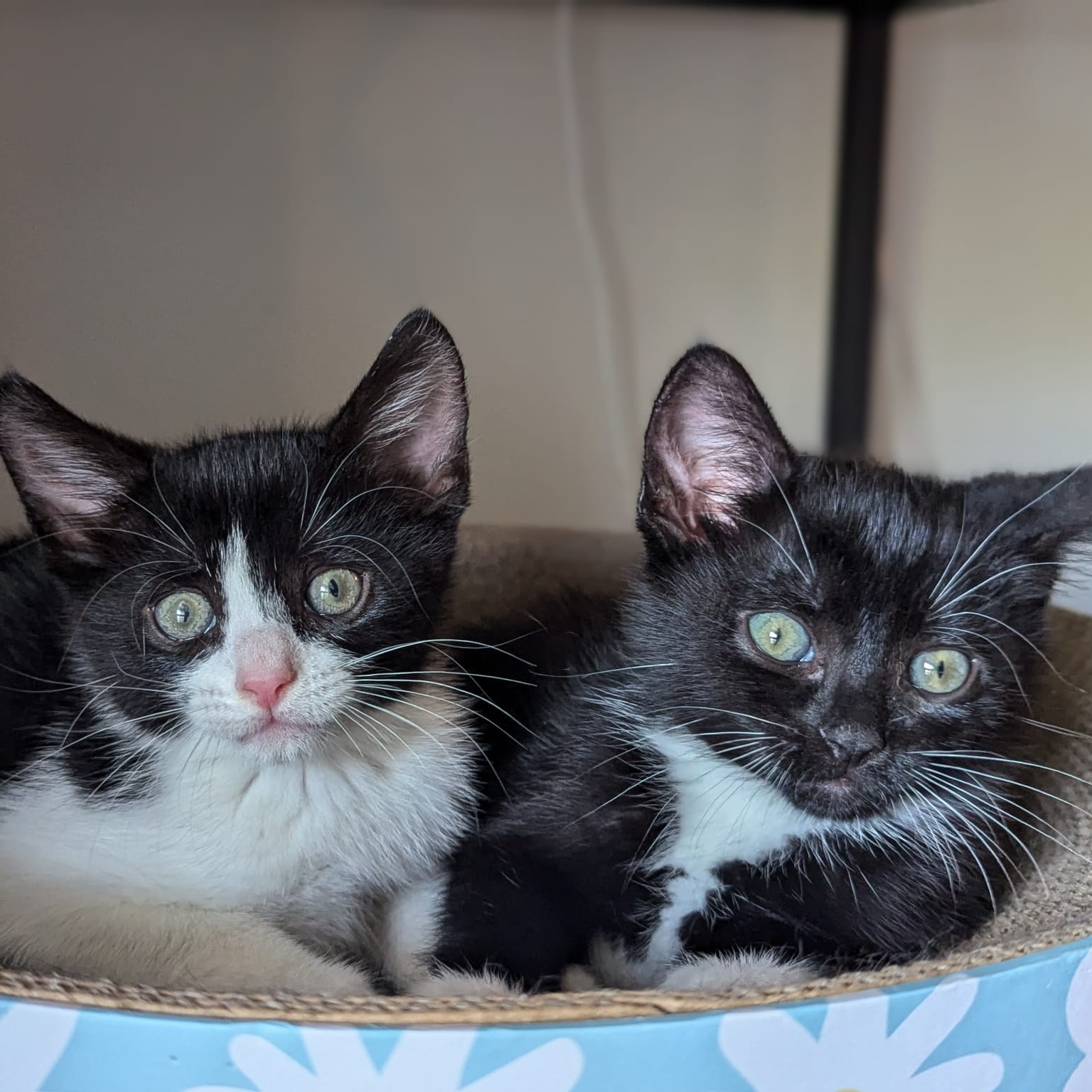
This matched pair of siblings do everything together and must be adopted together. They are true "Jellicle Cats"...

"Jellicle Cats are white and black,
Jellicle Cats (as I said) are small,
Jellicles jump like a jumping-jack..."

Black kittens with some white below are stereotypically bouncy and playful, clever, affectionate, and loyal to their humans. It's too early to say much about Sylvie and Arthur except that they were born in March, are just old enough to be on their own, and may act clingy or regressive for the first day or two as they settle in. They'll grow up fast.

Zipcode 20202: Dakota from DC 


Two sisters have web pages of their own. Dakota won the cute photo prize, no contest. Click on her web link if you're not seeing another adorable Jellicle Cat type face. Dakota has patches of black fur, white fur, and a heather mix that manages not to fade to gray. Spring kittens, the sisters spend lots of time playing, either wrestling, chasing each other, or snuggling up together for a nap. They have been in a "foster home" with other cats and dogs, and get along with the other animals while giving most of their attention to each other and their humans. 

It's nice that in English "Dakota" also means a place and/or a car, because the people who call themselves Dakota think it's ridiculous for an individual name. It's a collective form. It's like being called "Frenchmen" instead of "Francis," or "Americans" instead of "Georgia." If a human named Dakota learned to speak the Dakota language, person would want a different name. But in English we can think of it as more like being called "Dallas" or "Brittany."

Zipcode 30303: George & Miffy from Atlanta 


They have two separate web pages for one story. These siblings were rescued from an abusive human when they were tiny. They have been "declawed." They must be total indoor pets. The good news is that they've been in a more humane foster home and have learned to enjoy being indoor pets. They play together when they're left alone, squeak for attention when their human comes in, snuggle up and purr themselves to sleep. Black and white cats are sometimes stereotyped as the friendliest, purriest, cuddliest color type and George and Miffy seem to have been consistently encouraged to act the perfect stereotype. They must be adopted together.

No mention was made of whether these "declawed" kittens have lingering pains in their paws, but one shelter did say that they can't guarantee cats being housebroken. Nearly all cats naturally housebreak themselves whether they ever come inside the house or not. They don't like filth either. The question is whether they prefer a sand pit, a litter box, to wrap everything messy in a shopping bag, or to straddle a toilet seat and get rid of waste material the way humans do. However, about this time a few summers ago, our Silver cat's siblings were adopted at a very early age. I advised against it, but the adopters insisted that the kittens were needed to cheer up an eighty-year-old cancer patient who had no time to wait. So the kittens found themselves in a new place about fifty miles from their home, and although they already knew that Serena and I did not want to look at the evidence that they had learned how to excrete all by themselves, they apparently thought the patient needed to see that. Maybe they didn't like a commercial litter box. Maybe they were hoping that if they misbehaved they'd be sent home. The good news is that kittens don't like a dirty environment, so the "See what I can do!" phase rarely lasts more than 24 hours. The more promptly a litter box is scooped, the better they will like using it.