Thursday, December 5, 2024

Hemileuca Slosseri

"Shinnery oak" is one of those words that seem to have two meanings. Originally it was from the French words chene (properly written with a circumflex accent), an oak tree, cheniere (properly written with a back-slanted accent over the second E), an oak grove. Shinnery oak is a scrubby little shrub, similar in some ways to the big oak and beech trees, but much smaller. Its name sounds as if it meant something that would skin your shins if you walked or rode a horse through it. 

In fact some people use "shin" and "shinnery" in English just like chene and cheniere in French when they talk about this species. "One or two shins in the shinnery seemed completely defoliated."


 Photo from the Morton Arboretum.

Not only would these "shins" skin your shins; in spring they might be infested with large bristly caterpillars, each bristle tip on each of which contains about as much venom as a bee sting. 

Shinnery oak grows where not much else will grow; it can be good ground cover. It becomes toxic to animals that eat very much of it, though. In addition to harboring stingingworms in summer, its leaf litter shelters cotton boll weevils in winter. If the shinnery oak has reclaimed enough soil that grass will grow, and you want to raise cattle on the land, you want the shinnery oak gone. It's woody and would make good fuel, but in the twentieth century people in Texas and Louisiana had more fuel than they knew what to do with. They'd set fires to burn the shinnery oak out of a field, then sow grass and hope the grass would hold down the soil. Shinnery oak is tough stuff and evolved naturally in an area that sees lots of brush fires. The farmers tried spraying herbicides on it. That created a Vicious Spray Cycle. They tried defoliants. Shinnery oak is normally defoliated by H. slosseri, and survives. At the most recent report the farmers were trying running the brushes through shredding machines. That helps to thin it down, but the wood of even scrubby bushes in the oak and beech family is hard on blades.

There was a problem. Well, actually, there were problems, plural, but the problem that relates to our subject today is that Hemileuca slosseri lives in symbiosis with shinnery oak. Burning the shinnery oak was killing a moth, which looks almost exactly like Hemileuca maia, and its caterpillars, which look different from maia but are still unmistakably stingingworms. Getting rid of one nuisance species gets rid of another nuisance species? That's a problem?

Assuming that it wants to live--and at no stage of its life does the moth show enough intelligence to prove that it has a real preference in the matter--Hemileuca slosseri may thank religious people. Humans living in places where the local stingingworm population has died out do not miss stingingworms at all. Humans who care about keeping this species alive are likely to be people who believe that, as God's stewards, we should not allow any of God's other creatures to go extinct. 

I believe that, when we encounter stingingworms, our natural instincts are generally healthy. We should try to avoid stepping on them. Bristle tips can stick in shoes, from which they might get into cars or even houses. We should use sticks or stones. Thinning nuisance species--without starting a Vicious Poison Cycle--helps them evolve healthier tendencies to avoid humans.

However, there is concern about the possible extinction of Hemileuca chinatiensis, H. peigleri, and H. slosseri. In some parts of Texas these species are protected, as are two of the western Automeris species. So far nobody seems to have tested whether, if ordnary H. maia were raised on shinnery oak, they would look and behave just like slosseri. Once grown up, they are unlikely to crossbreed, since their reproductive parts develop different sizes and shapes, but whether this is determined by diet or by heredity seems uncertain.

The State of Oklahoma has listed both H. slosseri and the shinnery oak as species of great ecological concern. Neither was ever abundant in Oklahoma, for which one might have thought the people would have had enough sense to give thanks, but...


Nor has adequate research been done on whether, if the federal government takes a firm line on its having no constitutional authority to meddle in what takes place within a State, the farmers can reach a sensible agreement about their nuisance species. Without asking anyone else's help or permission farmers might be able to work out, like adults, where to allow shinnery oak to reclaim otherwise useless land for a few years at a time, and where to grub it out, turn the wood into chipboard, and plant grass and clover. They might even be able to avoid the monocropping that allows the boll weevil to become such a menace. Many human beings, even if male, are capable of making responsible choices if they are allowed to take responsibility. When other people are drawn into the matter, and compromises are made, they go wrong.

Of those who believe that every species has a right to exist, it took no less a name than Roger Peterson's to plead the case for shinnery oak. In this monograph Peterson described the birds and small animals that benefit from this nuisance plant, presumably as shade and/or cover in which to hide from predators.


He did not mention glyphosate among the herbicides people have tried to use to get rid of shinnery oak. They have tried it. In 1985 J.E. Slosser reported that, although glyphosate appeared to have killed the plant, shinnery oak grew back fast enough that glyphosate spraying did not affect the number of boll weevils using the shinnery. It took a nastier poison called tebuthurion to slow down the growth of shinnery oak enough to reduce the number of boll weevils crawling out of it in spring. Tebuthurion remained the chemical most often used on shinnery oak, starting a Vicious Poison Cycle that drove ignorant people to look for even deadlier combinations. Combinations of highly concentrated glyphosate with tebuthurion have been tried, too, but no other way to get rid of unwanted plants has ever been found to be more effective than digging out the roots. Which, in shinnery oak country, is not only hard labor, but also likely, if done on the scale cotton farmers might prefer, to make coastal Texas another "dust bowl." 


Peigler and Stone, when they registered Hemileuca slosseri as a distinct species, named it after J.E. Slosser in 1989. 


Slosser was still alive and wrote the definitive study of "his" moth in 2001. By that time it should have been published online, and so it was, but neither of the two science sites that have copies will let you read or download it free of charge. A search for Slosser's Biology of Hemileuca slosseri will yield a list of other documents that cite it as a reference.

Back to the moths. Hemileuca slosseri is classified as a Saturnid, a member of the Giant Silk Moth family. In that family it's very far from being the biggest and showiest member--in fact it's near the opposite end of the scale--but it's a fairly noticeable moth. Wingspans average about three inches, give or take a half-inch. The wings get their shades-of-gray coloring from tiny scales. The scales wear off more easily than most moths' wing scales do, so the moth can look translucent or even transparent.


Photo from naturalista.uy. Hind wings showing through fore wings is typical for Hemileucas

Actually the moths not only look very similar to H. maia, but also to H. artemis, H. nevadensis, H. lucina, or why not just say the majority of all Hemileucas. Peigler and Stone described typical differences in a definitive paper about H. slosseri, but these differences are slight in the most typical individuals and leave many individual moths in the "too close to call" category. H. slosseri tends to have somewhat longer, narrower, more transparent wings. 
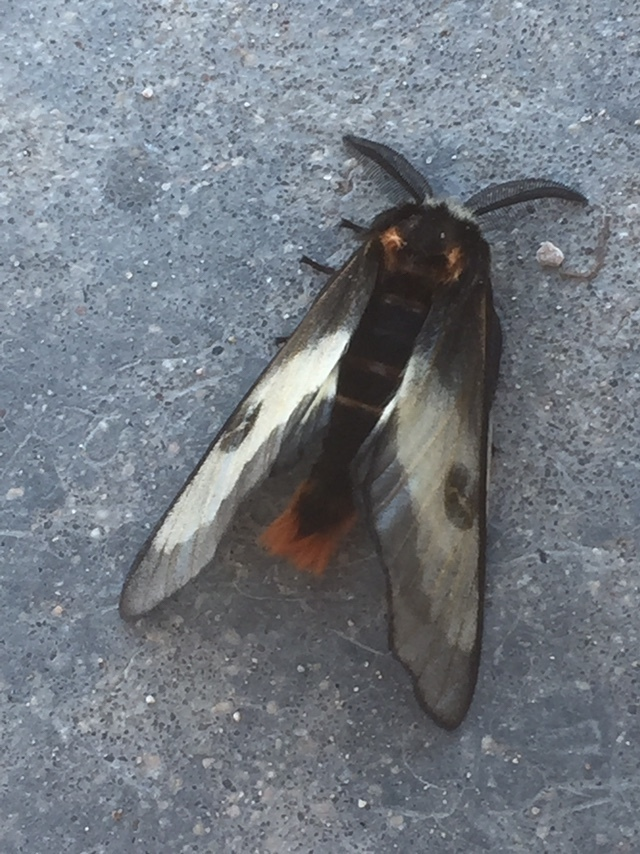


Photo by Erin_millican. This one's wings do look longer and narrower than H. maia's normally look, to me. Many individuals photographed online do not show this distinction.

Though the wings are often pale and drab, the body fur may show vivid warning colors. If this moth thinks her antennae and front leg may look like the jaws of something that can bite predators back, she's probably pleased.


Photo by Geraniumsmile.

However, DNA studies find differences between some Hemileucas that look and behave alike, greater than the differences between some that seem consistently different. Hemileuca slosseri seems to be a similar-looking yet distinct species from H. maia, but the genetic differences are small:


"The Saturniid moth genus Hemileuca (Walker)," Daniel Rubinoff asserted confidently in 2002, "represents an excellent system for examining character evolution." Even then, in his confidence that a study of the Hemileucas would yield a clear Darwinian progression, perhaps from H. oliviae to H. hera, Rubinoff refused to consider H. slosseri, H. sororia, or H. lucina. What he found was so different from what he seems to have expected as to support the hypothesis I find so easy to imagine--that the Hemileucas were Intelligently Designed by an intelligence that looked forward to a good laugh at Daniel Rubinoff's expense. That the Hemileucas have evolved, perhaps from half a dozen ancestral species, I can believe. That they or anything else evolved as facilely as the fossils Darwin arranged in an order that supports his theories, I'd need to be convinced. Why slosseri don't thrive on the big oak trees maia eat, but only on these oaklike bushes that rarely grow higher than a man's head, is the sort of questions humans may never be able to answer completely. What we do know is that their defoliation of a "shin" here and there probably limits the expansion of the shinnery. This may make slosseri the only Hemileuca that reliably does something useful for humans. 

More recently Julian Dupuis had a crack at understanding how the Hemileucas evolved:


Real Science, of course, recognizes that although trying to imagine how things came to be may be fun, it is not scientific. Real Science studies how things are. 

The number of eggs a Hemileuca moth lays in one place vary consistently in proportion to the size of the host plant she chooses. Instincts tell moths to lay fifty or a hundred eggs on a big tree, ten or twenty on a small plant. H. slosseri egg clusters have been counted containing more than fifty eggs but more often contain only ten or twenty. 
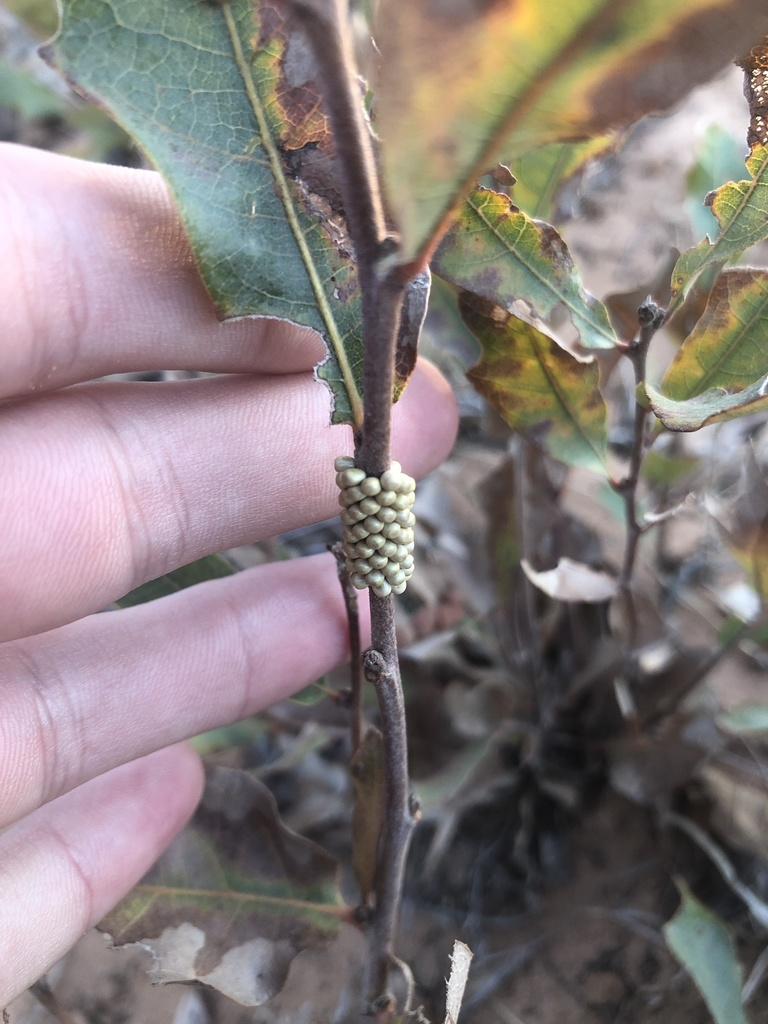

Photo by Nathantaylor.

Hemileucas don't eat the hard, dry shells from which they've just hatched. H. slosseri leave their eggshells on the twigs where they hatched. The shells are still there next spring, and another mother moth may lay her eggs close to the old shells, apparently feeling that at least the site was healthy enough to get those eggs hatched. Or she may not. The proximity of different clusters of eggs on the same twigs made people wonder about this. Moths seem to choose egg sites based on the size of the twig and availability of leaves, not showing a clear preference to lay eggs near old, hatched eggshells. However, eggs laid near fully hatched clusters of eggshells did seem to be the best placed; they were more likely to hatch than eggs not laid near a previous cluster in which all the eggs hatched. It may be that the reason why moths reuse twigs, in the first place, is that they tend to be crowded together in a small shinnery.


The life cycle is timed to fit a hot climate. Caterpillars hatch in April, when leaves begin to open, and et until June. Often they defoliate an entire shrub. Deciduous trees usually have reserves that allow them to refoliate, and since shinnery oaks are seldom defoliated by frost they usually survive the caterpillars' depredation. 


Photo from The Scale Of Nature. Two stubborn pest species are evenly matched.  

Hatchlings are blackish, like most Hemileucas


Photo by Alex_cicindela_guy.


Photo by Nathantaylor. Second and third caterpillar skins start to show yellow.

When they're old enough to strike out on their own the caterpillars are usually pale yellowish white with black and/or white bristles. In the final instar they may show some black or brown speckles on the skin, in between their bristles, or none. 
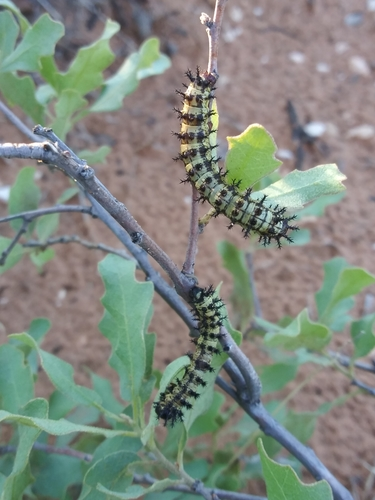

Photo from naturalista.uy.

But they can be more colorful.


Photo from naturalista.uy. This is not a species that needs to worry much about being eaten by birds, though once in a while one is

The caterpillar's body is about the same size as most of the large, not gigantic, North American caterpillars--seldom much more than two inches long, not all of three inches. It takes up more space than they do, however, because of its bristles. 

The caterpillars aren't intelligent enough to avoid their primary predator, a small fly in the genus Leschenaultia, family Tachinidae. It looks like a very small housefly but it leaves humans and their food alone. Mother Leschenaultia lay their eggs on leaves of shinnery oak. The leaves are tough and uninviting, but that doesn't matter; the little maggots aren't going to eat the leaves. They are going to sit there in the egg form, waiting to be swallowed by a caterpillar. Any caterpillar that eats shinnery oak leaves will do. In the caterpillars' digestive systems, the maggots will hatch and stay inside the caterpillar, eating most of its food, until they're ready to gnaw their way out through the caterpillars' skin and pupate in between the bristles. A caterpillar who has been parasitized by tachinid flies may live long enough to pupate but is very unlikely to survive pupation. 

To encourage tachinid flies and other natural pest controllers, simply stop spraying the field. (Yes, "herbicides" and "fungicides" can kill insects; they can kill humans too. Try transferring species that get in the way of the main cash crop into a separate field where the natural ecological balance can be preserved. Tachinid flies, and other creatures that can eat stingingworms and live, will follow the scents of leaves, blossoms, or other insects. 

So far as is known, all of the caterpillars that hatch in April pupate in June (or late in May) of the same year. When they emerge from their pupae is anyone's guess. In litters reared together under what seemed to be optimal, certainly identical, conditions some moths emerged from their pupae in November of that year and others in the Novembers of the next two or three years. 


Photo by Nathantaylor. Preparing to pupate, the caterpillar burrows into warm dry sand.

No points for guessing where they normally pupate. In the leaf litter under the shinnery oaks, along with the boll weevils. A farmer who shovels up and burns the leaf litter can rid the world of several nuisance insects at once. Hemileuca pupal shells are usually found near, sometimes attached to, the last caterpillar skin, and the bristle tips still sting. It takes more than one year for Hemileuca caterpillar skins really to brteak down into the soil. 


Photo by Nathantaylor.

Most of the males in this species seem to hatch in the first cool days of November. Females hatch at a steady pace throgh November and December. Reasons for this difference are unknown. On the surface it seems to favor the male moths' preferences, giving some older male moths a chance to mate with two or three young females. It may also reduce the reproductive rate, since it means that females who emerge late are less likely to find mates at all.

Moths usually mate on stems of their host plant where they can cuddle up face to face. The silk moths don't even eat; they emerge from the pupal stage to mate and die. The Hemileucas live longer than some of the bigger silk moths, up to ten days rather than up to five. 

Wednesday, December 4, 2024

Web Log for 12.3.24

Books

Mary Holland wrote a book called Turtles All the Way Down that exposes corruption in the vaccine industry. It didn't start out to be an anti-vax book, although that's the way it tends to come across. It was meant to be a pro-science book. To say that COVID vaccines may be more dangerous for most people than COVID is in no way contradicts the observation that rabies vaccines are healthier for most people than rabies is. There's a wide range of risk/benefits ratios, and what the Children's Health Defense group is calling for is closer attention to where vaccines fit on that range. 

But then somebody using the name "Mira Holden" wrote a book called Turtles All the Way Down that attempts to defend the vaccine industry. It attempts. It does not succeed, because, if you're paying enough attention to these things to have any business reading the book, the plagiarism of the cover design puts you off reading whatever "Mira Holden" had to say inside the book.

This article about the two books is recommended for not-very-charitable, yet coffee-snortworthy, laughs:


Madhava Setty was charitable enough to leave room for "Mira Holden" to reuse any facts person may have collected in a new book, printed under its own title and its author's own name. 

Censorship

I can only recommend the abstract--the original site behaves too badly--but this could save the Internet:


Google... 

For contract reasons, we don't post rants like this on Google-hosted web sites. And we've not seen that "ios" business with the reversed shift key in the list of traffic sources to this web site, anyway. My understanding is that "ios" is one of those stupidphones this web site recommends not using.

But we do link to rants like this:


If you have a web site, especially a business site, that gets or wants traffic from "ios," you must read. 

History

Poor Jasmine Crockett thinks White people were never enslaved as prisoners of war. She also seems unaware of the prison camps in Germany, the Soviet Union, and other countries that had socialist revolutions within living memory. In Cuba, in the 1950s and 1960s...I suppose she thinks all Cubans are Black? It was after they dragged the men outta their homes and shot them, in front of the women and children, they made the women and children work. Or emigrate, if they could. Which is why the predominant language in some parts of Florida does not sound exactly like Mexican or even Puerto Rican Spanish. I think Congressman Crockett needs to go back to school. Grade four or five, by the sound of things.


Meme
 

I found it on MOTUS. Since I'm aware of bogus quotes proliferating on the Internet and I'm not familiar enough with any translation of Kant to recognize when and where he said this (or something like it; English was not his language), let's at least try...Google can't find this. I have no idea whether or not Kant can be translated as having said this. Anyway it was a good thing for whoever said it to have said.

Frex. I wish these people had had the common courtesy to write down their words, but what e-friends shared last night were these videos. I have no way to check their facts, but by the mouth of two or three every word shall be confirmed...Sigh. I am aware that this is the way fake news spreads. I believe it's true for some people in some places in an extremely large country. And I have neither the time nor any inclination to do the book's worth of actual physical research to determine to what extent these news reports actually support the point I think, on the face of things, they support. This is just something to think about.

Purely in the interest of blocking illegal drug traffic, which is by itself an indicator of blockage of  legitimate economic freedom, several countries are announcing bans, delays, tariffs, etc., on products imported from China. And blame for COVID-19 has nothing to do with this, nothing at all. Right.


Other countries are more than delighted to step into the position of manufacturer of the world's mass-produced cheap products.


Chinese people have by now spent their whole lives being told to let their government take care of these things, whether it could or would or not. Their government might have some strategies in mind, but meanwhile people appear to be in great economic distress.


Socialism tends to have these effects. People can't sell legitimate products, they sell banned ones, they get blocked. Revenues, such as they are, from remaining legitimate sales are supposed to be doled out impartially to everyone. Somehow that doesn't work. So then what happens? In some countries where socialism produced economic crises, but censorship was not imposed, people were able to benefit from pen friends and e-friends in other countries. Zahara Heckscher rallied a lot of support for Zambia; the resemblance between the very social street cats at a cat sanctuary in Venezuela and my former alley cat clan, raising the question whether social behavior in cats is in any way linked to genes, led me to publicize a cat sanctuary for which other US Twits are still raising funds on Twitter, or X, today. Chinese people certainly have the ability to do things Americans would be happy to support. They have traditions of music and theatre we'd pay to watch; they have literature, though very little of it has been translated into English; they could post photos and videos of what their charities are doing as well as anybody else can. But, because of censorship, they're not able to raise the funds some of them individually deserve. 

Why do they have censorship? Because their government fears that the truth will kill it, as a government. And? So? Let it die. Let all governments, all political parties, all churches, all corporations, who fear that the truth will kill them as whatever they are, die as whatever they are. Only those who can survive the truth deserve to live.

Poetry 

Some churches are ruined because people stop using them...and some people stop using churches because the buildings fall into disrepair. People don't feel reverent in a building that's full of black mold. They don't feel warm and fuzzy in the vestibule of a building that's chilly. And then they may lose their church's history; they may move to a different building and lose people who live further away from that building, or be unable to find a new building and lose their fellowship altogether.

Remember that Culture of Repair idea? If you live near an old church building that attracts mostly poorer, older, or minority-type people, it would be a very good idea to consider whether those people want help maintaining their building. 

When I went to Seventh-Day Adventist meetings, I remember a lot of talk about the fact that, although the big White church downtown typically wanted to expand its membership by bringing in the little minority-type church, letting the denomination do something more profitable with the old building, the people attending the smaller church typically wanted to keep the building (and the social group, and the order of service) they had. Traditions don't move easily. Neither do geriatric parishioners who benefit from going to church in their neighborhood, but might not benefit from trying to attend church further away, as it might be because they need to stop driving. 

So, why not add a little prod to this lovely poem about a lovely ruined church:


Shopping

Scalzi's gift guide continues. You can still follow Monday's links; the links will probably stay up all year if you save the URLs and dig back through the archives.

Book Review: Lattes and Larceny

Title: Lattes and Larceny

Author: Nola Robertson

Date: 2021

ISBN: 978-1-953213-25-9

Quote: "[A]round the corner of the deck, I spotted the back end of a small dog."

Office politics caused Brinley to be transferred to Minneapolis. Brinley didn't want to go, and when this novelette begins she's taking a short vacation in Florida with her Aunt Delia. Delia and her friends enjoy solving fictional mysteries. 

When Brinley spots the dog, her life changes. The dog is calling attention to itself because it's found a duffel bag that shouldn't be under the deck. Delia and friends insist on tracing the bag to its owner, and Brinley gets involved. The dog seems to have no other human companions and to have adopted Brinley on the first day. There is going to be a series of full-length mystery novels about Brinley and the retirees. 

Frivolous fictional froth. If you enjoy mysteries that feature coffee shops and dear, determined old ladies, you'll want the series.  

Something I Wish Would Come Back into Fashion

What I'd most like to see come back into fashion is the idea of classic clothes that can be worn until they wear out. 

Each season could have a couple of fads, and people who care about such things would remember that e.g. sweaters with poodle motifs instead of reindeer had been the fashion of a certain year. 

Otherwise, men could wear trousers and shirts, with vests, jackets, sweaters, or coats according to the weather. Women could wear skirts down below the curve of the leg, cut full enough not to interfere with power-walking or running, either as one-piece dresses or as two-piece suits, also with top layers according to the weather. People who felt bored with these basics could wear the fad of the season, but this would be perceived as childish and would put the fad wearers a step down, not a step up, from fad ignorers. Apart from special gear for work or sports, few people would really need to buy clothing after age thirty.

Further, to help everyone separate our opinions of people's work or their character from our opinion of their clothes, everyone in church meetings or in courtrooms could put on robes that would cover all other clothing. This would no longer be the privilege of the choir and preacher or the judge alone. Robes would be kept in the church or courthouse and handed out for the day.

It would feel more worthwhile to make clothing for oneself or others, by hand, and more handmade clothing would probably be worn. It would be less profitable to mass-produce stacks of faddy clothing no one would ever wear, and fewer resources would be wasted in that way. Fads might be easier to sell if only one of each fad item was sold in a town or neighborhood, so that people who really wanted to be the one with the purple vest would wait in line to buy it for a high price, and others would have to settle for standard-cut purple shirts. 

Because fad items were so overpriced, people would be likely to want to keep them  after the fad had passed. This too might reduce waste  Marketing this approach to fashion would probably require a general sense of contempt toward the idea of wasting money on fads, but the fad items might come to seem justified if they were especially flattering to their owners, or recalled happy memories.

Tuesday, December 3, 2024

Web Log for 12.2.24

Links, a meme, a rant...

Actors 

Weirdness happens to people who make a career of pretending to be other people...


Y'know what, I'm with the actor on this one. It's acting. There are classic plays where leading roles are traditionally played by actors of the opposite sex from the characters. Why not open auditions to any actor who wants the job enough to memorize the lines. Most of the auditions actors go through are total wastes of time, ways to keep themselves sober and busy when they're not employed as actors. I'd expect that 99% of auditions for cross-gender roles would be total wastes of time. If, however, a woman brings a certain panache to a character formerly played by John Wayne, while a man plays a character formerly played by Maureen O'Hara with flair, why not build a whole new movie around them? It would probably be funny. It would remind people that actors in movies are acting, doing a job, NOT being their real selves, though spending quality time imitating good behavior may be good for actors' real characters.

Animals 

Little late autumn moths from England:


We have similar ones, not identical. Very pretty, subtle colors if we look at them; not showy or gaudy enough that most of us ever do.

Election 2024, Can We Please Move Beyond, or Not Until I've Said This I Can't

After reading Sherry Marr's witty anti-Trump poem at 


this unconscionably long comment...

"
"The best books"? You struck a political nerve. Books for the ages, from Aquinas and Luther to Louisa May Alcott and Laura Ingalls Wilder, are being censored while people are screaming about the lack of interest the public show in shiny new books about how your four-year-old can grow up just like brand-killer Dylan Mulvaney.

The Left lost this election by failing to recognize how that sort of thing turns people against them. If they'd actively denounced censorship and rallied around Kennedy, the Ds could have swept this election the way the Rs did. Mainstream Ds have said no word about the censorship of people (like the writer of this comment) who called attention to the dangers of profitable products. They've said no word about the censorship of classic books that are not full of sex and violence, but contain independent thought. They've treated parents' saying that books about rape and incest might not be the ideal way for twelve-year-olds to learn about sex as if the adults wanted to burn the books (I've recommended that all adults read "The Handmaid's Tale" for a long time, but I certainly don't recommend it to children). Then they wonder why all the Ds who have popular appeal, Trump as supposedly self-made businessman, Gabbard as ultimate tough chick, Musk as genius of his generation, and Kennedy the eco-warrior, campaigned as Rs.

Many lifelong Rs detest Trump, even if Harris's idea of campaigning made us hold our noses and vote against her anyway. Criticism of the Second Trump Administration should focus on the other party's failure to STOP, LOOK, AND LISTEN.

PK, who wanted to vote for Ds this year, and did, only their names were marked R
"

...poured out of my fingers. Some consider it rude to post comments that fill a whole screen on other people's blogs, although I do see comments that extend through multiple screens at some of the best blogs, so there's that for an excuse. 

Now that I'm here, I'll add this: We don't have a class system in these United States but there is undeniably a tier of society in which making a lot of money, after starting out from a background of reasonable economic comfort, is considered normal, and a tier in which it's considered exceptional. So when the name "Trump" began to be talked about in Washington, the tone was "Eww ick, that horrible pushy young man from New York who's bought those beautiful historic waterfront properties and ruined the look while inflating the prices of them, and now he's filing for bankruptcy for some of his ventures as if he and his other ventures weren't still rich, and divorcing his wife for a younger homewrecker whose only noticeable talent has been growing a top-heavy figure and is it even 'real'?" Elsewhere, people like our late lamented Adayahi were like "From forty thousand a year to forty million! Wow! He's a self-made businessman like me, only he must be 'smarter' since he's become so much richer. I want to watch him and learn." It wasn't even a lack of "background" that allowed them to think/feel this way. It was a lack of that aristocratic disdain for money that is so admirable when people are religious or philosophical enough to stay detached from money if they don't have a lot of it, and so ridiculous when they've never had to consider anything but wealth for themselves. 

This can't be ignored as a factor in Trump-hating. Personally, I really do think, if somebody else made a million dollars while I've only even been cheated out of a few hundred thousand, I have no problem with the person who made a million. I may or may not admire the person who made a million. I think Trump's  being a Bankruptcy Billionaire is tacky, while e.g. Dale Earnhardt Jr.'s strategy of racing cars as a nice guy who always finishes in tenth or twentieth place, never winning the Cup but quietly pocketing a nice chunk of cash after each race, really is smart. Most people can't copy Jr.'s strategy, because most people did not inherit the ability to drive sensibly at 150 miles an hour, but for Jr. it worked and I salute him. If I'm going to feel angry about the money I earned and don't have, and I'm certainly not going to feel pleased about that, my quarrel is with the person who cheated me. But in the sector of our society where starting out well-to-do and becoming super-rich is seen as normal, a lot of people are gnashing their teeth about the fact that Trump did that by a margin so much wider than they did. A lot of Trump-bashing needs to be read as repeating, endlessly, "Why was I not able to do that?"

But another factor that undeniably raised support for the four Ds in the allegedly R party that swept Election 2024 was physical courage. I forget whether it was Scott Adams or some other "conservative" man who first talked about it in a podcast--Trump, Musk, Kennedy, and Gabbard have all survived death threats from the Loony Left and shaming from the mainstream Left, and none of them looks as if they gave a flip. They're not afraid of Hell. The last time some of us saw that quality in the news, we saw it on Ronald Reagan. I will admit I'm pleased to see it among my generation. (It's not appropriate for parents of young children.) People find it attractive. I'm not saying that the Ds need to start shooting each other to show whether some of them have physical courage too. They could always begin with having the moral courage to stop screaming hate at Trump and think about how they got off track and how they could reconnect with their base. 

Gift Guides

Scalzi's gift guide pages run through the week. Big blog, lots of crafty readers. 


Helpism 

Early in this travel blog post, above many nice pictures of tourist attractions, is a short reminder of how much harm we can do by rushing in to "help" people without their specific instructions. Wanting to "help" someone move a suitcase, close a door, or some such little thing, have you ever knocked the person right off per feet? 

When we want to help another person, as distinct from inflating our own egos with the fantasy that we know how to help, we must empty our minds and act only on the other person's instructions. If we feel a selfish craving to offer something other than what the person has told us we can do, we must put that selfish thought out of our minds and act only on the other person's instructions.

Very rarely does anyone want any kind of "help" that will inflate our little egos. On a train, nobody is thinking "Will some stranger please pick up my baggage?" If you approach someone to "help" with some baggage, the instructions you get will probably be "You can help by stepping back out of my way." 


Memes

From "House of Trad":

Book Review: 2 Qt Small Crock Pot Cookbook

Title: 2 Qt Small Crock Pot Cookbook

Author: Olivia Graham

Quote: "[T]his book highlights the best of regional cuisine."

Most regional culinary traditions in the United States did not focus on the Crock-Pot. (Actually some indigenous Americans did stew whatever meat, fish, and veg they had over an open fire, and then there were various traditional slow-stewing techniques from Europe...the Crock-Pot was inspired by traditional cuisine, new though it is.) Cooks who own Crock-Pots can, however, have lots of fun stewing local foods together to make slow-cooked meals that will be the best of regional cuisine, or regional Crock-Pot cuisine, as that tradition develops.

This is one of a series of e-cookbooks published on Amazon by...I'm not sure whether it's one editor and a small group of her cooking friends, or one self-published cook. The series is marketed by someone using the screen name "Claire Cook." Good choice of screen name. You may or may not like her taste but she does develop recipes for every new technique and every special diet.

There are flaws in this book. Dishes photographed are not necessarily the recipes they accompany, and in the M's the list of States and list of recipes lost connection--the Minnesota recipe calls for Mississippi catfish and Cajun seasoning. However, for those who enjoy slow-cooker cuisine, here's a rich variety of recipes that could even be used to teach children geography. 

I'm inclined to give this whole series three stars, just because some books have to be average in order for others to be above average, and these are average books. They will be some people's favorite recipes. 

What Would Schools Look Like Without a Federal Department of Education?

In the Powell Valley News for 10.2.24 a man from Kentucky describes "what education was like...before the [federal] Department of Education was established in 1980." Reading his list, I see at once that he's speaking for his Kentucky self, and he's also older than I am. By comparing memories with him, I think we can get a clearer picture of what modern education might be without a federal Department of Education.

Bottom line: in all but the very poorest areas, for which aid funds might be established, schools would be about as well funded as local people thought they needed to be. They'd lose some frills that local people think they're better off without. Funding is not, however, what makes a good school.

Here are Dave Jones' ten memories, compared and contrasted with mine. He's talking about a school in Kentucky in the 1950s. I'm talking about a school in Virginia in the 1970s. In each case I'm condensing his words.

1. DJ: There were no school buses. Kids walked to school, or Mum drove you if the weather was bad.

PK: There were school buses. Because it was the baby boom, there were not nearly enough school buses for each child to have a seat. Three or four bodies on a seat built for two was the norm. The bus stank of already breathed, deoxygenated air, and often worse than that, as a direct consequence of everyone breathing each other's breath. One thing that probably contributed to some bus drivers' turning against children was having to clean the seats and floors where kids were sick. Kids could be motivated to do a lot of things by a rare chance to walk to or from school.

2. DJ: There was no school lunch program. You brought your lunch, or walked home. There was no free lunch for low income kids.

PK: There was a school lunch program. Some items, like hot dogs and cookies, appealed to children who asked their parents to send lunch money. Most school meals disgusted children and, if their parents sent lunch money, most of the items on most of the trays went straight into the garbage bins. I often found it difficult to eat the lunch I'd brought from home amidst the clamor and odors of the cafeteria. Subsidized lunches and milk were available for children whose parents fitted inside quite liberal guidelines. My brother and I were registered for subsidized milk, so we could have fresh cold milk with lunch, but were always supplied with our own sandwiches and fruit. After a few hours in a stuffy classroom a sandwich on dry, hard, wholemeal bread and a piece of fruit that had had the peeling cut open for eating without a knife tended to lose any appeal they'd had, so even they often went into the bins. After a few years we were informed that we could eat cafeteria lunches any time we wanted them, although that was what our health-conscious mother wanted to avoid. What would you expect children to do? I never asked for a free bowl of broccoli to replace a dried-out peanut butter sandwich, but I'd take a hot dog or a cookie if those were offered. However, after grade five I was trusted to sneak into the school library alone and enjoy a good book at lunchtime.

3. DJ: If a kid had a disability, that kid did not go to school. The students' toilet was in the basement and was not accessible.

PK: The buildings were accessible to crutch or cane users, less so to wheelchair users. Disabilities were handled on a case-by-case basis.  My brother and I were aware of having more classmates with disabilities than students in the past would have had. "Progress" meant more adaptive technology allowing more people with disabilities to participate fully in social life.

4. DJ: If a kid had a learning disorder, that kid just fell behind.

PK: That had happened. Notoriously it had happened to the beekeeper with whom my brother studied beekeeping. He was the youngest of six brothers, all self-employed professionals, and he could have done any of the jobs any of them did. Built his own house, had an impressive private library, could discuss the books...but he only ever said he was storing books for his brothers. Because, due to an injury in early childhood, he couldn't speak or swallow solid food.  So he didn't learn anything in primary school and was classified as an "ineducable moron." My generation heard "retarded" as a relatively respectful and accurate word for someone who actually had a brilliant mind, but failed to show evidence of its development during a few critical years. Anyway he made a good living "being retarded," and although it was technically welfare-cheating I've never really blamed him for it. He would have been a little younger than Mr. Jones. 

Teachers were actively learning about learning disorders. A lot of people did fall behind. People in my neighborhood still employ laborers who "can't read" because of dyslexia, have speech impediments, and other things that were allowed to derail their education. But this was visibly happening to fewer people every year. Principal Oscar Peters, whom my brother and I so deeply detested, was a hero to people like the writer known as Shalecka Boone because he advocated for funding to get "homebound tutors" to visit people like SB, who he argued had a brilliant mind despite being wheelchair-bound. (SB was closer to Mr. Jones's age; her baby sister was about my age.)

5. DJ: There was no supervised physical education, art or music in elementary schools.

PK: There were supervised physical education, art, and music in elementary school but the first two depended on the individual classroom teacher's abilities. In grades one and two the teachers would let us do one or another of those things whenever we got too wiggly for other lessons. Mrs. B. in grade three actually taught p.e. on wet days; all year she dangled the promise to let us play baseball in front of us but only on the last day of school did she get permission to do it, and most of us never got a turn at bat. I'll never forget the disappointment in grade four, which I did at a different school, where they played softball regularly and I was so far behind everyone else that I never did learn to play a game I'd been led to imagine I'd like. Mrs. B.'s idea of teaching art was teaching us to maintain tidy little pigeonholes in a cardboard box she'd built for us to store crayons, glue, and scissors in. Next year Mr. Ed. in grade four took away art time if people were unruly, although the school supplied tempera paint and coarse paper, and when we did get art class Mr. Ed. usually said we had to copy one of some big cartoons that stayed on the bulletin board all year, so he could test our progress. He showed us a movie about shading our drawings but he was unqualified to teach the skill. Miss Mean in grade five didn't try to teach art at all, but did lead us in calisthenics for a week or two in spring, during which every one of us did the exercises better than Miss Mean. Mrs. Dunce in grade six didn't try to teach art or p.e. In all grades music had its own teachers and was offered more or less regularly, though not every single week unless your parents paid for piano lessons (which started in grade two) or you made it into the Beginner Band (which started in grade five), both of which brought music into your life four days a week.

6. DJ: Third and fourth grades, and fifth and sixth grades, were in one room each and had one teacher each.

PK: Each grade from kindergarten to grade six had over 100 students divided among four classes, and each year's class assignment put different people in the same homeroom--the idea was that everybody would have been everybody's classmate for at least one year. Because promotion to the next grade depended on having learned something in the grade before, grade seven had about 150 students divided among five rooms and grade eight had about 250 divided among ten. 

7. DJ: Some kids had to miss school during January and February because they did not have good shoes or coats.

PK: In Virginia everybody had shoes and coats. Not that everybody thought they had good ones, there was plenty of room for label envy, but if adults didn't think a child was bundled up to local standards they would have brought that child a coat and ordered the child to wear it.

8. DJ: I was in an all White school. Black kids went to a separate school.

PK: Grade seven still had copies, on the back shelves, of old history books that printed the old law that White and Black children could not be required to go to the same schools. (In Virginia they could choose to go to integrated private schools, unlike in Kentucky, where Berea College was forced, under protest, to segregate the dormitories.) Gate City had had segregated schools until, early in Mr. Jones's school years, the Supreme Court had legalized integration. People had seen the financial benefit of integrating the schools and done it promptly, mostly with a good will, apart from a few teachers (mostly from the Black school, of course) who had to find different jobs.

9. DJ: There were no organized sports programs until the ninth grade, then only for boys.

PK: Oh, mercy. We already had a reputation to maintain. Team sports started with boys' football, boys' and girls' basketball, in grade seven. Track meets started in grade four. The name "Blue Devils" traces back to the Great War in the 1910s but my understanding was that Gate City adopted it, a little later, in honor of the Duke University team on which some people hoped one day to play.

10. DJ: In elementary school there was no school library, nurse, or counsellor. In high school there was a library, but no nurse or counsellor.

PK: Every school had to have a library and a nurse, but baby-boomers were saner than subsequent generations and didn't have to have counsellors until grade eight when we had some choice of which classes to take. The school I attended in grade four, in California, acquired a counsellor in the middle of the year. Apart from the day he came into class to tell everyone where to find his office, when I remember thinking he was trying to imitate Morgan Freeman's character on "The Electric Company," I never saw him and don't remember his name, but a few kids went to his office regularly because they said he was cool to hang out with. 

So. Quite a range, and plenty of schools were better funded than either of ours, and plenty were worse run. Our Adayahi seldom talked about his school memories, which were not a pleasant subject; he was a war baby, not a boomer, and grew up in a mining camp where he said the school emphasized delousing more than actual education. He remembered outhouses at schools. I think all schools were required to have water-flush toilets after about 1950. 

Would more of the luxuries seem like necessities in a United States without a federal Department of Education? Probably. Would people end up paying more school taxes on the state, city, or county level to provide the kind of luxuries they thought their schools needed? Very likely. The benefit of dismantling the DoE would be more local control over, e.g., the amount of content that was there to promote p.c. attitudes rather than teach facts and skills in the local school curricula. It would be more likely to ensure that any Gate City student who went to e.g. the University of Maryland or East Tennessee State University would feel that freshman and sophomore classes at those universities were reviews of what Gate City did in grade nine. Or, if universities were required to allow students to test out of classes when they already knew the material, our students could save a fair bit of tuition money.

Because we don't need all that funding to do things better than people at other schools, that's why. 

Monday, December 2, 2024

Book Review: A Language of Dragons

Title: A Language of Dragons

Author: S.F. Williamson

Date: 2025

Publisher: Harper Collins

ISBN: 978-0-06-3353884-8

Quote: "Those two words--Second Class--are the difference between having something and having nothing."

An even better quote for this book might come from The Lion the Witch and the Wardrobe: "Even a traitor may mend." This is a story about a traitor who chooses to mend. If you're looking for a young adult novel in which a girl thinks seriously about friendship and loyalty instead of bogging down in yet another Teen Romance, here is one. 

It has its flaws, of course. As the author says, a lot of things went into this novel, and they didn't all meld into a plausible whole. The world of this novel is England in an alternative history, but how that history shaped this England is hard to imagine. Viv has totally twenty-first century attitudes about her cousin's being "gay," and everyone has totally twenty-first century attitudes about how half-grown boys and girls can work together, but Britain--at a period when people were clamoring for the abolition of Britain's flexible class system and of India's rigid caste system, in our world--has adopted a rigid caste system like India's. Second Class citizens like Viv are being taught to give thanks for their blessings and stay well away from Third Class citizens, of which Viv has just caused her best school friend to be demoted to one, so they'll not be seeing any more of each other...or wouldn't, if things went as expected. Dragons are real in this world, and have their own society, with which European countries have to negotiate diplomatically, which is taking their minds off the international coalitions that occupied their attention in the real 1920s. 

Dragons, in this world, speak as many different languages as humans do but they also have a "sacred language," more like whale songs. Dragons are willing to speak human languages and teach humans most of their languages, but not the sacred one. Viv is a linguist studying dragon languages, so she's recruited to "crack the code" that is the sacred language. What she learns of the sacred language, and the reasons why it can't be used by or taught to humans, changes her politics and begins to change her character. 

You might not like Viv at the beginning of the story, but you'll probably like her at the end. If you're one of those mind-bound young people who've learned at public school that they can't communicate with or like people who don't agree with them on every point, reading her story just might open your mind a crack. This book is dangerous. It should probably be censored, or at least it will be, by the Loony Left. Reading it just might connect their children's minds to the real world again.

Another flaw is that it's not a very pleasant read. Well, some young adults want dystopian fictional worlds--this is one. The class system keeps most people much poorer than real people in the US and UK were at this period, and enforcing it has imposed martial law on the UK at a point where, in real history, it was close to being the "free country" it called itself. Of course in real history Britain, at this period, owed its relative prosperity and freedom to its colonies, which in this fictional world it doesn't seem to have, but it's not developed any alternative scheme for improving its economy, which in the real world a free country would have done. This fictional England already has a Queen and a female Prime Minister, and both of them are as deranged as George III. Instead of having a relatively good time at university, as the characters would have been doing in real life, they're in prison, pursuing their studies at gunpoint. The pressure is intense enough that some of them commit homicide and suicide; the main characters' friends try to kill them. 

Against the background of sewage Viv's, and Sophie's and Atlas's and Marquis's, attempts to clean themselves shine all the brighter. Some readers might enjoy a good cry over this book.

You can't run out and buy it yet. What I have (and am banned by contract from sharing) is an advance review copy sent to a few reviewers by the publisher. You and your favorite booksellers can check harpercollins.com for advance ordering information, though. A Language of Dragons is scheduled to reach the stores by the seventh of January. 

Link Log for 11.28--12.1.24

 From what time I made for surfing during the holiday weekend...

Funny 

One of these outbursts of Trump Dementia might have been sad. The three of them together, I think, are funny at least in a sick way...

I think the reporters were reporting facts, but the facts are funny: Hillary Rodham Clinton has forgotten her two pleas of brain damage and her loss in 2016 and that, if she lives to see the year 2028, she'll go into that year eighty-one years old...


It gets worse. Kamala Harris wants to "keep options open" of running for President again, if she can't get elected governor.

"
Only Kamala Harris would spend more than a billion dollars to lose and still think she has a shot at the presidency again in the future.
"


Well, the Loony Left just can't release the idea of exploiting women by running a madly controversial female...by 2028 Baby Face Ocasio-Cortez will be, technically, old enough to run for President, and at least nobody will say she's too old, har har. That poor girl can be used to bilk people for funding for doomed campaigns until she, or the D Party, whichever, is declared dead. 

Thank goodness women vote. At least women can be trusted not to vote for AOC just because, as she starts to look old enough to vote, she's becoming quite pretty. (Yesh. In the alternate universe that Cuban I used to know was handsome, apart from the maloccluded teeth that, if you put his dental problems together with mine, would produce something like AOC's dentition. The problems he would have added to my life would not have included unattractive children.)

And who knows? Seeing what a rip-off her campaigns as a Loony Lefty would be might even have time to convert AOC to reason. There should be enough years ahead of her. Some day she may be the pretty face of fiscal conservatism. 

(All I've been drinking today was water and soda pop, but these news stories are making me wonder. I might be drunk. Someone might have invented an airborne form of alcohol that's been drifting through the neighborhood like the Bad Neighbor's Thanksgiving poison spray. Might be an ingredient in New Roundup. Who knows? Will some readers please check these links and verify that you see them too?)


Glyphosate Awareness

They translated it into English as a favor to us gringos estupidos. Here's what the Mexican government has not been bribed to pretend not to know about genetically modified corn--glyphosate, BT, and other modifications. Bottom line, humans are not built with the capacity to improve on the genomes God made. Genetically modified crops are modified to soak up poison sprays and should not be burned in inadequately filtered furnaces. This sort of thing is why gringo implies "stupid jerk" when it should merely mean a person from the country where "Green Grow the Lilacs" used to be a popular song. Thanks to the Right To Know crew for sharing this document.


Linky Goodness, Even More of 

Ysabetwordsmith posted her gift shopping link-a-ramas on Sunday. Scalzi's starts on 12.2.24.


and 

Butterfly of the Week: Gauthier's Striped Swordtail

Gauthier's Striped Swordtail is also known as Graphium biokoensis, the Graphium of Bioko island, although it's also found on the mainland of Africa. It's not extinct but, because it looks just like a few other species in flight, so far nobody is posting shareable photos of this species in flight.


Photo by Africaone. Some sources mention that the underside of biokoensis can lack red spots but its main difference from policenes is having longer "tails." 

How far inland this species is found has been a matter of debate, depending on how closely scientists think it's related to similar-looking species. It has been treated as a subspecies of two other Graphiums. Sources who classify it as a distinct species may also distinguish it from the Long-Tailed Striped Swordtail, G. liponesco, although some sources treat the English names as synonyms. Here is a source that treats biokoensis and liponesco as two distinct species that look just alike:


Assuming good faith on the part of the author, there was probably some scientific basis for saying that two species that look alike "can never co-occur" or are never found in the same place; it would be nice to know what that basis is. 

The author of this PDF treats biokoensis and liponesco as subspecies of Graphium policenes and says both are widespread, but rare. 


Earlier this year, Bollino and Bouyer published a widely circulated paper (well, widely circulated among people who read about butterflies) arguing that biokoensis should be regarded as a subspecies of policenes.


This Korean site has an overview of the Swordtails and Ladies in the genus Graphium, subgenus Arisbe, showing the just noticeable differences between a typical biokoensis, policenes, and scopoli.


Graphium biokoensis lives in tropical rain forests where it's hard for humans to observe. Parts of Bioko were still described as unexplored, or incompletely explored, in 2014. In sober scientific terms Ignacio Martin and Pablo Cobos describe their explorations of the Caldera de Luba, the extinct volcano's crater on the island, in 2005 to 2007. They argued that biokoensis was not a subspecies of Graphium scopoli and anticipated the more recent paper in saying that it was a subspecies of policenes. They really should have written more, and included more pictures, than they did here. No doubt they were saving their best material for a book.


Males are known to come out of the forests and join other male butterflies in groups at puddles. Nobody is positive about the females or about the early life stages of this species, if species it be. 

Sunday, December 1, 2024

Should We Have a Gift Shop Page?

Almost everyone I "know" in cyberspace is here to sell something they make. As suggested at 


...we could join Ysabetwordsmith, Scalzi, and other bloggers and have a Gift Shop Page...if enough people are still selling their work and want it linked here. This includes all authors, artists, and musicians whose work is featured here, whether I've been corresponding with you or not. Free ads for qualifying products!

Gentle Readers, people look at those other pages up there in the right-hand corner, even though I tend to forget them. Please use the comment section below (or e-mail the address at the bottom of the screen if Google tries to prevent comments) if you'd like to post something handmade by you, or a close friend or relative in a Gift Shop Page. This would be a page consisting of links to YOUR site, where orders, payments, haggling, etc., would go directly to you. It would be free to use. You could send me money, or a free printed book, etc., if your link was profitable, but there'd be no bill. 

(If it really took off and generated lots of sales, in some future year there might be fees. If that did happen, it wouldn't happen in one year or probably in three. No worries. For now, this is just for fun, and if e-friends who have different interests and/or politics were to get to know each other through it, that would be a bonus.)

Acceptable merchandise would include:

* books and e-books
* bake sale treats, for the quality of which you take full responsibility
* any needlecrafts, papercrafts, woodworking, etc. that you make
* museum-quality "Art" paintings, stone carvings, weaving, etc. that you make
* potpourri, herb sachets as air fresheners, soap, perfume, candles
* digital audio or audiovisual recordings of your music
* prototypes for things you might some day mass-produce and sell in Wal-Mart (if it's a type of thing Wal-Mart wouldn't sell, e.g. a car, Google probably doesn't want it here either, and no firearms or fireworks or other things that are legal in only some States, please; samples of things like pillows and umbrellas are fine)
* your Zazzle, Etsy, FiberKind, etc., pages

Acceptable merchandise would NOT include, basically, anything that reminds me of Google  Ads, Taboola, etc. There is no penalty for sending a link. If I don't want to advertise it, I won't. 

* anything containing alcohol or drugs, including power herbs if it's intended for internal use (pennyroyal sachets would be allowed, pennyroyal tea not)
* obnoxious cards, "books," bumper stickers, etc. (keep it within the Google contract: no nudity, no Formerly Unprintable Words, no focus on body parts--"handshake" or "handsewn" or "firsthand" is allowed, "hand lotion" not so good since it borders on claiming medical benefits)
* medical books, unless you are an MD and the books have been published by a university or major commercial press and they're about general wellness with no focus on body parts ("Exercise for Fitness" is fine,  "Exercise to Grow/Shrink Your..." is not)
* things that already are being mass-produced, e.g. cars, bicycles, washing machines (if manufacturers can afford factories they can jollywell afford $5 for a link)
* quill pens made from your own poultry's shed feathers would be welcome, ball-point pens with company names on them not
* "fan" or "parody" use of other people's fictional characters or worlds would be allowable if clearly identified as such
* using a computer to tweak your own creative pieces is fine, but no "AI" programs that mash up elements of other people's work, please
* secondhand stuff: this would be a Gift Shop not a Junk Shop, although popular demand might persuade this web site to add a Junk Shop Page some other time)

Generally this would be an additional marketplace for things that are safe, legal, on display in a mall shop or craft market; for things that won't get anybody sued. Over the years I think enough readers have shared enough books and other handcrafts to make a nice little Gift Shop...if they're still selling the same wares and willing to do it.

Like the other Pages here, this Page would not show up along with the other cyberchores involved in the maintenance of this web site. It would be a detour out of my routine. If it were to take off with daily additions and subtractions, it would become a routine of its own and I'd keep up with it. If it didn't move merchandise, it would gather cyberdust like other Pages. If youall are willing to promote it with an occasional link or e-mail, I'll do it. I can't guarantee any results whatsoever--that's why it's free. It would be a trial. If it works, great; if not, it won't cost you money.

International content is welcome as long as it complies with your country's trade policy. If your book was published in Canada, which is fine, we need more Canadian literature in the US, it's up to you to make sure your publishing contract makes it easy for US readers to order copies. 

A Gift Shop Page is likely to benefit from the winter holiday market but does not have to be limited to December.

Book Review: Better Than Fiction

Title: Better than Fiction

Author: April W. Gardner and Michelle Massaro

Date: 2016

ISBN: 978-0-9973797-1-6

Publisher: Plaited Press

Quote: "I tell ya, the Johnson project is killing me."

This Christian romance is "different": It's a collaboration in which one author supplied a sweet historical romance for the other author's contemporary character to be writing while she deals with her own love story. Neither story will embarrass readers if the children see it. Well, not much.

Meghan is a young mother working hard on a novel. Steve, her husband, doesn't seem to respond to her kisses even when she breaks out the slinky black nightie while the children are at Grandma's house. He spends a lot of time away from home. He even mumbles something about a basketball game with a neighbor, Paul, whose wife then blurts out that Paul hasn't seen Steve lately. Meghan is spending a lot of time with her friend Brooke at the gym, where the trainer, Curtis, seems to appreciate Meghan.

In Meghan's novel, it's 1916 and early motor racer Russell takes his Bearcat into a garage where he's been referred to Fred the mechanic. Fred is Winifred, a girl defying conventions to keep her father's shop open while her brother is off wasting his substance in riotous living. Winifred does not really approve of racing, since it's how her father died, but she needs the money and likes Russell so she ends up riding with him, as early "mechanicians" did, during the big race. 

Should Meghan trust her husband and ignore the lust in her heart? Can Winifred and Russell win enough money to pay off Winifred's brother's debts? The romance genre does not leave much doubt about the eventual outcome, these days, although the existence of a tragic romance subgenre used to raise a real question whether characters would be united at the altar or in the sweet by-and-by. People read to find out whether the author's way of resolving the lovers' doubts and quarrels, nowadays, and it's a pleasure to write that these authors' ways are reasonably plausible. 

Meghan's story is overtly Christian, with emotional crises resolved in prayer. Winifred's makes less reference to religion, but we know Meghan's characters aren't likely to be non-Christians. If you like reading about Christians in love, this twofer novel is for you.

(It's December already. Will Book Funnel writers overload my e-readers with Christmas stories again this year? This is a California story, complete with an afterword steering readers through a tour of the town of Corona. I'm not guaranteeing that there will or will not be a month of Christmas stories, but there will be some of those this month.)

Ode to My Non-Cuddly Cat Serena

At Poets & Storytellers United, Magaly Guerrero invited people to write poems about someone who "may bite." I thought of the Queen Cat who's been ruling the place since she was born.

Serena's a non-cuddly cat. She may bite,
If that's what it takes to get people to play. 
She takes no guff. She never loses a fight.
Serena's a non-cuddly cat. She may bite.
She might purr if she saw me not feeling all right
But sentimentality is not her way.
Serena's a non-cuddly cat. She may bite,
If that's what it takes to get people to play.

What a lot I've written about this cat, the sassiest though also one of the sweetest cats I've known. Well, this web site always has had the goal of writing about love and respect for animals, including the big snake, Gulegi, who lives in the attic and is not seen by humans during most years, and the underappreciated native wasp and hornet species, and the cardinals and wrens, and the spiders, but the cats are especially entertaining.