Wednesday, July 11, 2018

Tim Kaine on Regulating Toxic Chemicals

Here's Senator Kaine's official reply to the e-mail I sent to his office in June. Official comment: I wish this letter had included a few links...The "Lautenburg Act" was originally signed into law in 2016; its nickname is a memorial to Senator Lautenburg (D-NJ), who spent the last years of his life (2013-2015) working to get relatively minor improvements made to the existing TSCA, notably requiring regulations of toxic chemicals to be based on risk rather than a risk-expense balance.

History and summary of the Lautenburg Act: 


Text of the Lautenburg Act--PDF for Real Wonks to download:


This web site officially thanks those who supported even minor improvements to TSCA...but...my reply to the e-mail is below.


"
July 11, 2018
Ms. Priscilla King
Computer Center
Gate City, VA 24251
Dear Ms. King:
Thank you for contacting me about the regulation of toxic chemicals. I appreciate hearing from you.
I have noted your concerns about the Environmental Protection Agency's (EPA) findings related to the effects of glyphosate. Glyphosate is an herbicide about which there has been extensive debate and research as to its carcinogenicity. As you know, a September 2016 EPA report indicates that glyphosate is unlikely to pose a carcinogenic threat to human health. The EPA Scientific Advisory Board is currently evaluating this report.
These debates often involve complex scientific questions, and reports like this can take years and multiple rounds of scientific review to finalize. I believe public policy decisions about these issues should follow the science, and I will strive to make sure all decisions that Congress makes about issues like this take into account the most rigorous scientific research.
One good decision Congress recently made was to update the obsolete law guarding the public against exposure to toxic chemicals, the Toxic Substances Control Act of 1976 (TSCA). This past year, the House and Senate agreed upon a final update to TSCA, the Frank R. Lautenberg Chemical Safety for the 21st Century Act, which took years of bipartisan cooperation to craft. I was a proud cosponsor of the Senate version of this legislation because I believe it represents a true bipartisan compromise that strengthens important public health safeguards and improves existing law. With this bill, consumers receive an up-to-date law that would do a better job keeping them safe from harmful chemicals than current law does, while businesses would gain the regulatory certainty they need. Among other measures, this legislation would require EPA to base chemical regulations solely on issues of public health instead of industry cost considerations, which would at last allow the EPA to regulate chemicals that are proven to be dangerous, such as asbestos. It would also require companies to make more information publicly available about chemicals and provide the EPA with new authority to inspect chemicals before they are allowed onto the market to determine whether or not they are likely safe. The Senate passed this legislation on June 8th, 2016.
Please know that I will keep your thoughts in mind as I continue to monitor the scientific review of glyphosate as well as other matters of public health importance.
Thank you again for contacting me.
Sincerely,
Signature
Tim Kaine
"

I replied:

"
Thank you for your prompt and politically balanced reply, and thanks to Senator Kaine for supporting the Lautenburg reforms...but I wonder whether it may be better just to drop the question of glyphosate "carcinogenicity."

Even for radiation and cigarettes there's never been a precise one-to-one correlation between carcinogens and cancer. Individuals' resistance to cancer varies so widely that it always takes years even to prove that something is a carcinogen. Meanwhile, while those predisposed to develop cancer are building up higher levels of the possible carcinogen, many people who never get cancer can be harmed by other toxic effects of the same suspected carcinogen--even when the "carcinogenicity" level turns out to be low, as with straight tobacco (bleached paper in cigarettes being more carcinogenic than tobacco in cigars).

With glyphosate the other toxic effects are especially bad; I'm seeing them disable people, feeling them handicap me, and aware that they're likely to kill other people, who don't have cancer, but who are Irish-American. Glyphosate reactions are genetic and those whose reactions are most severe happen to have a gene concentrated on the northwestern coast of Europe AND IN SOUTHWESTERN VIRGINIA.

I know the burden on U.S. Senators' eyes is huge, so may I even recommend reading my summary, and the linked documents from the EPA site, back to front--the critical information about actual, immediate, unmistakable effects of glyphosate toxicity appear toward the chronological end of the EPA's file.

The summary appeared at https://priscillaking.blogspot.com/2018/03/ this-web-site-loves-vegetables-here-is.html .

The study of eight types of effects on humans appeared at https://www.regulations.gov/document?D=EPA-HQ-OPP-2009-0361-0069 .

Someone summarized the range of toxic effects in a rabbit study as "nasal discharge, diarrhea, and death." That's at https://www.regulations.gov/document?D=EPA-HQ-OPP-2009-0361-0071 .

Because "confounders" are built into all cancer studies I don't expect confirmation of glyphosate "carcinogenicity" to be completed during the Senator's lifetime, or mine--but, because glyphosate TOXICITY is disastrous and growing with increased exposure, I'd like to see this poison banned before it has time to be confirmed as a carcinogen.

For all Irish-Americans and all Virginians,

Priscilla King

"

Tuesday, July 10, 2018

Every Day Is Black Cat Day: Traveller

What, some readers ask, is a Cat Sanctuary for? If nobody goes around rounding up prowling outdoor pets, who are doing their duty of protecting us from rats and the diseases they carry, and jamming them into cages and renting them out to medical students to practice surgery on, and buying expensive TV ads to plead for money so we can give water to animals left out in hot weather, then what do we do, and what’s the difference between the Cat Sanctuary and an ordinary rural home with a few outdoor pet cats?

The short answer is that we could do more (more land, more houses, more cats, more volunteers, more for the local economy) if we had more money. Send us some.

In practice, in order to offer cats normal, natural lives, Cat Sanctuaries can’t actually house all that many cats at one time. I visited one in Tennessee that had thirty-five outdoor cats, but a month later they lost most of them to one of those infections that become epidemics when populations are overcrowded.

Months and even years go by when all the cats actually living here are residents. The cat overpopulation problem is not nearly so serious as cat haters claim; Humane Society shelters keep cats because (a) they rescue some animals who are genuinely hard to place, and (b) they employ control freaks who resist giving up animals for adoption. Most of the time, when I hear of a cat who needs a new home, I can place it.

I am not, of course, talking about “This cat was walking down the road all by itself so obviously it must be abused and neglected” hysterics. Animals walking along roads all by themselves usually have an idea where they are going and, although they may get into trouble with traffic, they’re likely to get to where they’re going and home again if humans don’t interfere.

Yes, healthy, happy, well fed cats do “stray” outdoors. They do this for many reasons: curiosity, hunting instincts, social instincts. They are our primary protection against septicemia. Thank them.

I'm activated by messages like “John Doe died; can you help find a home for his cat?” or “Some people drove past and dumped out a cat; can you help?” or “I’m travelling and need a foster home for a cat.” The answer is usually either "yes" or "Can you wait a week or so while I check online?" Often the connection between foster or adoptive home and homeless cat can be made directly. I don't necessarily see the cat.

There are, of course, exceptions, like the truly antisocial cat I called Barnie. Most cats are asocial—except when mating or rearing kittens they’re not interested in other cats—but Barnie was just plain mean; a big, super-fluffy, half-grown kitten who didn’t challenge the tomcats or the big strong queen cat, but badly injured two kittens and a sweet, docile mother cat. Nobody wanted Barnie. Someone I trusted to get Barnie into a horrible HSUS shelter, which Barnie was a horrible enough cat to deserve, threatened to report me for elder abuse if I made her do it. I was literally on the way to commit that act of elder abuse when somebody came along and offered me money for Barnie. I could not have made that up.

Then there are less drastic situations...Samantha gave birth a day or two before she ought to have done. Of her four kittens one was merely a fetus that never moved, one was a near-term fetus that moved but never really lived, one was a premature kitten that died immediately, and the fourth was a big healthy calico kitten who firmly stated that her name was Serena...

Right. What literally happened? “Something to do with her ancestors?” humans considered. “Penny Candy, or Saltwater Taffy, in honor of Candice and of her color pattern?” The kitten’s coat was only slightly diluted calico, charcoal grey and light orange patches on white; she really does resemble saltwater taffy, but she didn’t care for that name. “Patch, or Patches, or Apache, in honor of Patchnose? Rena, or Catrina, or Serena, in honor of Irene?”

“Meow!” said Serena. Serena was her name and she’s stuck to it. She’s not the sort of kitten who always comes when called, because she is the kind who thinks it’s fun to chase and be chased, but she always responds to “Serena.” She is not a serene cat, nor is her face or personality much like Irene’s. If she’d ever seen a television set I could imagine she wants to identify with a big strong tennis star...Serena’s coat is mostly white, but she is built more along the lines of Serena Williams than along the lines of, say, Martina Navratilova.

I watched only a few episodes of “Bewitched” as a child and was not aware of “Serena” being a sort of reference to Samantha as well as Irene. I don't remember watching an episode where that character appeared!

Anyway Serena had no siblings to play with. Since she wanted to play more than her mother did, and more aggressively than any human ever could, I put out the word that I’d consider adopting a new resident kitten. A very clever and social neighbor cat called Schatzi had had kittens. Her first daughter, Boots, who died so horribly of glyphosate poisoning, had been a joy and a delight during her short life. I was willing to adopt any daughters from Schatzi’s second litter as permanent residents, and do my best to nurse them through any further poisoning episodes.

Word got around and, on Sunday morning, a neighbor drove up with a large box in the back of his truck. He said someone he claimed not to know had just thrust a load of cats upon him. Along with the kitten and his mother they’d packed up a generous supply of cat food, a few toys, a blanket, some flea collars, a cash donation—everything but any indication of any rabies shots the animals might have had, or whether they'd been in a place where they could have been exposed to rabies. A piece of paper was in the box. Medical records? No; a letter saying they’d always been allowed indoors at night when it was cold.

This is not the way any Cat Sanctuary prefers to adopt cats.

The mother cat didn't vanish into the woods immediately. She stayed close to her kitten and even allowed me to come within ten feet (three meters) before dodging away. It was during the night, when she wanted to move into the shed and encountered the possum living there, that she ran away. (This is not poor old Pally Possum, nor is it a new possum who moved in and was moved out again this spring. The word "possum" comes from a word that's been translated as "white animal," because most specimens of Didelphis virginiana are whitish grey, but they actually come in a full range of animal colors. This one's predominant color is pale soft yellow, its name is Butterball, and whether it was fairly entitled to react to provocation I don't know, but it's not staying.)

But the kitten was a charmer. He wound around my ankles and purred even before I picked him up.

Flea removal was the next step. The poisoned collar had repelled fleas from his front end, but his back end still looked positively matted. Flea combing got about a quarter of the population in residence on the kitten’s wispy little tail, with fleas and “flea dirt” (dried-out and digested blood) coming off in such clumps that most of the fleas simply hopped away.

If any of you have been entrusting a mostly outdoor pet whom you don’t cuddle very much to flea collars, Gentle Readers, you might want to have a look at the back ends. Here was a basically healthy, lovable, if skinny, little fellow who appeared to have been rejected because the base of his tail looked as if he had some sort of horrible infectious condition. He didn’t, although he’s undoubtedly been exposed at least to a few mild infectious diseases fleas carry around this part of the world. The mat around the base of his tail consisted entirely of fleas. When combed out, his tail looked fluffy and healthy.

Sometimes black tomkittens have especially ingratiating manners...Mackerel always acted modest about anyone grooming his back end. This little guy was delighted to have the help. (Mackerel had come to me about as badly flea-bitten as this kitten, but without a flea collar, so the fleas were evenly dispersed.) He purred, snuggled, and used his soft paws to direct the comb to where the fleas were dodging to.

“What’s your name?” I considered the kitten. He’s a skinny, lanky animal, at this stage; that means nothing. He has big paws, and huge ears, for his size, and an extra-long tail. He’s solid black,with only a few individual white hairs and a hidden white patch below. “Tar? Jet? Ebony?” No response. “Nero? Phinehas? Pangur Du?” No reaction. “Hamlet? Traveller?” I said, thinking of a science fiction series set on a planet settled by twelve human families and various alien species; the family called Traveller were known for always wearing solid black. (The ones who had speaking parts in the book were old and sinister, but there must have been some nicer ones somewhere.) The kitten seemed pleased. “Is your name Traveller, then? Trav?”


This is the book. In volume one a character comments on the humans' "outrageous whiteness," meaning only Anglo-American families had moved to this planet centuries ago; several characters have blue eyes, including (iirc) the fifteen-year-old who's recently learned how many non-White people her ancestors left behind. For a cat with an almost solid black coat and almost solid white skin, the image of black clothes and "outrageous whiteness" seems appropriate.

“MeYOW!” Trav squeaked, and bounced up to kiss my face, cat fashion. So Traveller is his name.

He’s a little longer, leaner, and lighter than sturdy Serena, maybe a few days younger. (Both of them are technically eating solid food now; both still prefer (cat's) milk, and neither is especially interested in trying new foods.) At the first chance they got to look at each other, they stared, heads down, in a fighting position, then began racing and chasing in the friendliest way, only a little more careful not to hurt each other than siblings usually are. Both are "only kittens" who had obviously missed having siblings.

Cold nights are behind us, or far ahead of us, at the moment. Naming a tomkitten Traveller is a sort of acknowledgment that, from a Cat Sanctuary where they’re not kept in cages, tomcats tend to move on. I imagine, though, that young Trav will find his way indoors when he wants to be indoors. There are tomcats who don’t care whether they ever become anybody’s pets or not, and there are tomcats who realize from birth that a lot of people aren’t going to like them and it may be to their advantage to make friends of the ones who are at all friendly.

Trav is the friend-making kind. Flea combing? Yes, he likes that. Play tag with Serena? Wow, where has this been all his life? Nap? He’ll snuggle beside my knee or, better yet, my shoulder. His song might be “Anything at all, you’ve got it, baaa-beee!” Serena would have approved of him even if he hadn’t come with an assortment of cat treats.

Samantha's feelings about him and his mother are clearly much more reserved, or even mixed. She knows better than to soil the house but she's spent the week doing every other kind of "MY house! MY yard! MY trees! MY human!" display that can be imagined.

Samantha and Serena are an interesting study of cat personalities...Both of them are, undeniably, more aggressive than normal female or even male cats are. (Both are much more aggressive than Traveller.) Neither is what I'd call a mean cat, at all--nothing like Barnie. They don't cuddle in the usual mother-and-kitten way. They show affection by slapping and nipping. Samantha will tolerate being held and stroked for a few minutes, Serena for a few seconds, before they want to play-fight instead. It's important to emphasize that when this is their response to being petted, it's never done to hurt anyone. They're very clever, sensitive cats; even when Samantha's defensive panic bites have hurt me they've been "Back off!" nips rather than serious attacks, and when I've told Serena her play-bites or play-slaps were causing pain (not even skin wounds, just pain) she's always toned down her attack and licked and patted me in an unmistakably friendly, soothing way. But she doesn't snuggle; she grabs.

Samantha has met with reactions to her playing and disobedience that at least scared her, and she has escalated to a level of panic biting and scratching that's not acceptable with most humans. I don't let her interact with children or with brittle-skinned older people. I do note, however, that she's growing much less panicky and more gentle as she's growing up. 

With Serena, I've made it a goal to be firm enough and gentle enough that she's not panicky. So far it's always been fun and games...but I wouldn't let her interact with children either.

Traveller, by contrast, is a soft-pawed snugglebunny. Toward his purpose of becoming a Favorite Kitten he's cultivated many cute kitten tricks. It doesn't hurt his case that his black fur over white skin, amber-brown eyes, slim build, big ears, and long tail give him a resemblance to our Founding Queen, Black Magic. His extensive range of "spoken words" (mews, meows, squeaks, chirps, trills, yowls, whines, warbles, and purr-meows) suggest that he may, like Magic, have had a Siamese grandparent or great-grandparent.

(Interestingly, although both Traveller and Serena are very vocal kittens who make lots of different noises for humans' benefit, and they call to locate each other when separated, when they're actually together they're almost silent. For carnivorous animals there's little obvious survival advantage in making a lot of noise.)

Is it true that cats' personalities can be predicted by color? What I've observed is that even when there seems to be a correlation between color (or build) and a general temperament trait, it's not perfect, and your relationship with the cat depends more on your behavior than the cat's genetic type. Nevertheless: Samantha is a dark "tortoiseshell"--basically black with some orange and white spots; three-colored cats are usually female, and seem to be born knowing that they're special and expecting everyone to adore them. (Check.) Serena is a light-colored "calico"--basically white with some orange tabby and dark grey spots; she does know she's tiny and helpless relative to most living creatures, but she also expects adoration. 

Melanin bonds with adrenalin, so black cats might be expected to be more energetic, with stronger purrsonalities, than white ones. It's hard to say whether this is true of my three-colored cats, or whether Serena defers to Samantha merely as any three-month-old kitten has to defer to its mother. Their preference for bouncy-pouncy rather than cuddly-snuggly interaction has given Serena the look of the most impudent kitten that could be imagined. Only because I've spent days and nights in a room with them can I say that Serena does defer to Samantha. A person watching Serena begin a game with a mock attack, or Samantha encourage her kitten to eat first, would think Serena was dominant, bordering on abusive.

Traveller's combination of black fur and white skin is too unusual to be associated with a temperament type, but my description of Magic's temperament type was always simply "The Purrfect Cat," the ideal first cat to convert a first-time, reluctant cat owner who had formerly inclined to prefer dogs. (In between Magic's reign and Traveller's arrival, our Queen Cat Heather had a kitten called Imp who also had a black outer coat with white skin and silvery undercoat; she was also a sweet, gentle, clever, cuddly kitten whom I wouldn't have been willing to part with; she was stolen outright.) In terms of loyalty, obedience, intelligence, protectiveness, and unmistakable devotion to her human, Magic outclassed most dogs and many humans--and she also killed mice, fostered kittens, and trained possums. I wouldn't expect to meet two cats like Magic in a lifetime, even living among a family of social cats, but if you ever find a black cat with white skin looking for a good home, I would not advise letting the opportunity pass you by. If you want to adopt a shelter cat, it's worth looking for this combination among the black cats available.

I spent at least half of all ten days of my vacation at home, either out in the yard or with the door open, writing and knitting and gardening (and petting cats) and watching Traveller settle in. Fun! I thought Serena might be tempted to bully him--he's longer and taller but she's much heavier. She hasn't been, though. It's rare for children or animals who've learned different habits to learn the better way from one another, but in the process of bonding with her foster brother Serena has actually learned that it's possible to snuggle against my hand rather than always grabbing and biting it, to show good will.

Status Update: No. No. No. Nein. Nyet. Non. No.

(This was written during the part of last Thursday when I was online but, since I didn't control when the laptop and I would get a free ride back across town, I didn't schedule the time to finish it.)

Whoa! Six days offline, ten pages of e-mail. Most of it is news bacon--headlines I want to see without, most likely, reading the full story. Some of it is appeals. While I do usually read the appeals, on the grounds that anyone begging for help from a penniless old writer is probably pretty desperate, in ten pages of e-mail you know there have to be some appeals that sound as if the person really does need the help to pay for psychiatric care.

Possibly other correspondents have already seen these...

* "From Change.org re" a prisoner who was released after serving several years on a marijuana charge. "Life outside prison is hard. The prisoner's family are glad to have the person back at home, but now they need your help with money." Really? Well, although I'd buy an apple from this person if I met person on a city street corner, writers who don't even use marijuana need money even more than ex-convicts do.

* "To Amazon: Please make Prime discounts available to all teachers, free of charge." I think Amazon would probably do better to discontinue the Prime discounts altogether--either charge one price for everybody, everywhere, or pin the discounts to bulk purchases where the purchaser is reducing cost by buying multiple items in one shipment--but as long as Amazon is doing the Prime discount thing, and making the discounts available to students, well, yes, teachers earn a lot more money than students. Teachers should be willing to subsidize the discounts for students.

Prime benefits
I ganked their graphic for their link directly to Amazon Prime. If you buy a lot of stuff from Amazon, it's worth pre-paying all your shipping fees. If you buy that much stuff from Amazon links found at this web site, I should actually get to cash out a commission some day. Happy shopping!

* From an individual who expects name recognition, but doesn't have it with me: "No Wall, No Hate." I'm guessing this is another wail about the proposed Mexican border wall, coming from another person who was such a passive, dopey (probably overmedicated) child that s/he never learned that a wall is to climb over, just as a hole is to dig. (Yes, we "normal" children learned that the costs of climbing over walls often outweighed the benefits, but still, a wall is to get over. Or under. Or around.)

If I were going to bother signing a petition against the wall, it'd be "No Wall, No Pork." We all know the wall is going to have doors through which people can and will drive overloaded eighteen-wheelers, and Mexicans are going to be winning many pesos getting over, under, around, and through the wall at all points, just on dare bets to show they can, and nobody in their right mind hates Mexicans anyway; law-abiding ones who do stay on their side of the wall will probably be missed. And meanwhile, despite Canada's long history of neighborliness with the U.S...not all Canadians are nice, and not all people entering the U.S. from Canada are Canadians. Wouldn't evildoers love to turn U.S. and Canadian citizens against each other? Hah! They'd love to turn New York and New Jersey against each other.

The next pork barrel (= foolish project that employs a lot of people to whom a public official wants to be profitable, foreign readers) will be a Canadian border wall. And meanwhile, the most evil of the evildoers coming to the U.S. for evil reasons will be arriving by air anyway, and every country already has the technology to build airplanes. News flash: if your purpose is suicide bombing you don't give a flip whether your plane is forced to land in the middle of a cornfield, or maybe a building or a sports event.

Nevertheless, as I sit here in a fast-food joint halfway up a mountain from which only trees keep me from seeing the in-laws not-working on the proposed widening of the bridge that's supposed to be completed some time in the next five years, or make that ten, it would be downright hypocritical for me to denounce the Mexican Wall boondoggle, with this state-size boondoggle practically within sight. Where there is a public budget, there are boondoggles. That goes in the category of "Death & Taxes." At least, while people are building a wall, they're not actively fighting cocaine wars.

* "Seal your pledge to vote for Democrats!" Hoot. I have been known to vote for Democrats, but since Rick Boucher retired I've not necessarily voted for one every year. It's certainly not a commitment. The correspondent was obviously not aware that, in Gate City, even Democratic Party activists aaaalllways vote for Kilgores. Then again, even Republicans got into a groove of voting for Rick Boucher. Democrats would have a chance here if they moved away from the extreme left (who unfortunately seem to be at the top tier of the party organization), toward actually representing the levelheaded, culturally "conservative," populist majority of their party. You can support unions, schools, police, etc., and oppose war, without advocating fiscal insanity.

* "Only a few days left to design the perfect soccer shoes!" I am not making that up. I think it may be possible that Freelancer sent me that message because one of The Nephews, who is sort of geeky, but not nerdy, and into soccer, might think he could design the perfect soccer shoes--for our family's foot shape. If so, I have two things to say to you, young man. One: you're old enough to use Freelancer, and you're old enough to get your own account in your own business name. Suggested time line that leaves room for college: pick your name now, set up your web site this fall, and register with the IRS this winter. Two: the shoes that work for us probably torture other people at least as much as majority-foot-shape athletic shoes do us, so you probably won't win the prize...but why not design a whole line of Wild Turkey Brand shoes for people with "turkey toes"?

* "Will we see you at a demonstration in D.C., a rally in San Diego, a gathering in Texas, etc., this July?" I'm glad those are automated e-mails from political news sites. I'd be concerned about any correspondents who seriously imagined that anybody would leave the cool green mountains to hang out in a well-known Code Red Zone in July. Though I've had no cardiac or hypertensive symptoms yet, I am now an Official Older Lady who Should Not Be Exposed to Extreme Heat...I'm talking about the kind of heat we don't get in Gate City, Virginia.

D.C. memory for those considering the demonstration: Washingtonians walk up escalators, even though Metro used to tack on little signs inviting those who needed permission to "Stand To Right." Standing still on an escalator makes you look like a New Yorker--not good. So on one July morning, on the way to a job on Dupont Circle, I walked past a few people who were drooping and sagging onto the hand rail on the right side of the escalator. I remember thinking, "Yes, it's a hot day, so please get out of the way of those rushing to an air-conditioned office! That sign should specify 'Collapse To Right'!" Washingtonians slow down, when moving briskly up a really long escalator e.g. on Wheaton station, but yes, most of us kept moving at a reasonable pace all the way up the one on Dupont Circle--and doing so did give me a little empathy for the wimps who'd dropped out of the flow and were sprezzing it up on our right. I thought, "Is this the hottest day of the summer?" Came out into the light, still walking, but breathing hard, and saw two different electronic thermostats confirming that the Fahrenheit temperature was either 104 or 105 in the shade.

That was twenty years ago. Washingtonians are generally proud of knowing how to give directions, even being brave enough to walk with visitors, but they don't like delays and they don't like large groups of tourists. And denser population being packed into the city and its suburbs, adding further frustrations for Metro riders, won't be likely to make the local folks friendlier. "Occupying" the city is a good way to generate opposition for your petition! If I supported a cause, I'd just say no to these "March On Washington" things. If I were going to Washington in July, it'd just about have to be to testify in a congressional hearing, or something equally unavoidable.

(Sprezz, a sprezz, to sprezz, sprezzing, etc., come from Italian sprezzatura and refer to "expressive" words, gestures, or behaviors intended to excuse a weak performance by suggesting or exaggerating an injury...the idea is that the person couldn't get away with an outright lie like "I lost the game because I sprained my ankle" but can get away with a little strategic moaning and limping. I used "sprezz" recently in a discussion of a student trying, "Isn't learning other people's languages a form of cultural imperialism?" and was surprised that English-speaking European readers didn't recognize the word. I don't use it often because I observed that, when students are exposed to this word and concept, you suddenly observe a lot less sprezz at their school.)

Anyway: No matter how good your cause may be, no matter even if you were buying all the tickets (and paying for road food of my choice, to be eaten alone, no comments)...in July and August I'm not even tempted to go anywhere hotter than the Blue Ridge Mountains, thanks all the same. 88 degrees is enough.

Friday, June 29, 2018

Bill Carrico on Independence Day Parades

Love a parade? Southwest Virginians can expect to meet State Senator Carrico at these three:

"
This Independence Day, I hope you will take the time to reflect on the liberties and freedoms unique to our American democracy. Too often, we forget we live in the single greatest country in the world and take our good fortune for granted. Please feel free to join me in celebrating around the District at the events below, have fun, and God bless!

  • Parade - Independence, VA - 10 AM
  • Parade - Fries, VA - 12 PM
  • Parade - Bristol, VA - 4 PM
"

Why You Should Choose Me to Write About Life with Chronic Conditions

(This post is basically a project "pitch" to a funder who demanded both a document and a link, but if anyone else wants to fund a similar project, why not? For spreading awareness of the chronic condition I've inherited, any publicity is probably good publicity. I'm not sure why the webform stipulated a video link; there is no video link for this web site or any of its members--GBP did have a cell phone that took videos once, but it died in 2012.)

I’m a celiac. What I have is not the kind of “gluten intolerance” that’s breaking out all over, these days, but the real thing found almost exclusively in certain Irish families.

My story used to be about how all I have to do to stay healthy (since you build up fantastic strength and fortitude by being an undiagnosed celiac) is to avoid social eating.

There are also the stories of other celiacs and gluten-sensitive people I’ve been able to help, and people with different sensitivities, intolerances, and genetic quirks I’ve been able to support, at least morally.

Currently, though, my story is about how I’m being made sick again—and watching other people being made sick—by the insane use of glyphosate, a weedkiller, not only on wheat fields but directly on food as a preservative...and in the air...and in the water...(And I don't mean ill; I mean sick. Nufsed.)

Other “pesticides” and “bioengineered food” products affect other people too. I’m interested in their stories too.

From the Soros-funded “protest” websites? This week, a whimper about “disordered eating” as an emotional problem. The writer’s friend has confirmed Hashimoto’s Disease but the writer wants to construe her food avoidance as an emotional problem, rather than an unguided experience that although she can’t predict why (since pesticide residues aren’t on the labels of food!) some foods make her sicker—which is something Hashimoto’s Disease patients often do observe. I cry foul. Eating things that make you sick, feeling sick for no obvious reason, causes some kinds of emotional problems. It is not primarily an emotional problem.

I’m a motivated activist about this. I’ve not been doing travel and interview articles because I’ve not been paid to do them. I can do them--just add money.

Thursday, June 28, 2018

Correspondents' Choice: Book Links for June

This will probably be my last post until the tenth of July. I've not been reading e-mail very faithfully this month; here are the most irresistible book links I did make the time to find and follow:

Amazon is evolving to keep up with changes in international publishing policies. U.S. readers can now order this farm-woman-and-her-cat story from Amazon.co.uk, but the site won't give me a short link to recommend it. Oh well...once in a while this web site does share a book link just for fun, not for profit.


Here's one recommended with reservations...On the one hand, I'm not into Cthulhu at all (although after some Very Bad Days I've thought the real city of Kingsport belonged there). On the other hand: Gaiman.

(Oh, let's explain that inside joke for the European readers. Cthulhu is a fictional "mythos"/universe/series created by the late H.P. Lovecraft and maintained alive by fans. Lovecraft named a fictional town Kingsport, apparently in the belief that that wasn't the name of a real town. It is.)


If it's recommended by Oprah Winfrey, does it need any additional recommendations? All this web site is saying is: we're interested. Prison reform and life after release is not a main theme at this web site. It is a main theme for some writers whose books we've publicized, and for a neighbor we see at church in Gate City. It's primarily something men, and (to this country's shame) especially Black men, need to be leading. So, over to that neighbor. None of us has been there. But we do empathize.


As Tweeps know, I don't even click on every book whose author tweets "Buy my book," or even "Other people like my book" or "Here's a sample of the kind of pretty picture / funny joke / fun fact / etc. you'll find in my book." This one is special, because it's (1) about North American wildflowers, (2) in French, (3) by someone who's demonstrated on Twitter that he's taken some gorgeous wildflower photos. If you want to learn the French names for things you may have been calling "weeds" even in English, let's create an international demand for this Canadian book.

Due to incomplete international coordination between amazon.com and amazon.ca, I don't even get a commission, but click here.

Once again, let's find out whether this book link gives due credit to Heather's, Samantha's, and Serena's e-friend Mudpie. (Serena doesn't yet know what e-friends are. Samantha could hardly have told her, since Samantha is not "serene" enough to cuddle up beside the computer, as Serena does. Serena is only a kitten. Going into her sixth week on this planet, Serena didn't even realize that the news that she'd learned how to make a puddle all by herself, without anyone massaging her back end, would be a source of anything but joy to anybody. She accomplished this feat just before completing the fifth week of her life. She typed a bit, though, before being banished from the office room until she learns to control her new skill...but only on the arrow keys, not the letter keys.)

Amazon will link pictures directly to my account, they claim. I have to use a caption to insert a link to Mudpie's Human's account.

First in the order these links were actually received: Vanishing Grace is available in paperback.


A new China novel, local readers! (There is more to Asian literature in English than China...maybe it's all so overwhelmingly exotic to some local lurkers that China feels almost familiar?) Although I'm not finding Paper.li a suitable vehicle for the Link Logs, sometimes it does link to books I'd like to read...There's a sequel. I'd like to begin with volume one.

Wednesday, June 27, 2018

Book Review: Return to Gone Away

Title: Return to Gone-Away 


Author: Elizabeth Enright

Publisher: Harcourt

Date: 1961

Length: 224 pages

ISBN: 0152022635

Gentle Readers, I still don't feel free to take the time to upload the next batch of book reviews. I'm still hauling this laptop home every night, wearing the little thing out, and when not working on a paid job or socializing with e-friends I want to look at something that's not this screen. Maybe youall know this feeling. It'll pass, I'm sure...I can't say when.

But this morning a random tweet on Twitter reminded me...I am most likely to write a book review when (1) someone has sent me a new book for review, or (2) I've weeded a book I don't want to keep out of my collection--and only (3) I've been sitting at the computer considering what to write, and decided to write about a favorite book I've loved for a long time.

The Twit posted a picture of a little boy's review of a storybook, written on a form handed out at school. "Would you recommend this book to a friend?"--"No, because it is my favorite and I want to keep it."

This web site's book reviews can seem that way. I'm most likely to post about a book I give "ten out of ten," a book I've enjoyed every few years since the Nixon Administration, only when I've picked up a duplicate copy and put the better-preserved copy up for sale. It's unusual for me to turn to the computer right after rereading an old favorite and deciding to keep it.

Today, also, Paypal notified me of a new trick that may allow me to offer Paypal links without the bother of (1) shutting down other sites, (2) going to Paypal, (3) creating a specific product link, and (4) pasting that button into the page. Paypal does not actually care if I've listed a thousand different books I can resell for $11 online. Why would they want to store a thousand buttons? If it works, this Paypal link system will allow you to choose new or used books, or other items that may displayed here, pay with one click, and need only to e-mail salolianigodagewi to specify what you're ordering. The link will give the total amount of US$ to send, including $5 for shipping and usually $1 for that pesky Paypal fee; all you do is click and tell Paypal where to send it from (your Paypal account, linked bank account, etc.), then e-mail me about what you're sending it for.

And finally, Paper.li shared this new e-acquaintance's review of a book I first enjoyed during the Nixon Administration. This is a story about a 1960 family buying a fabulous old house in an abandoned lakeside resort town, exploring the resurgent natural environment and abandoned antiques in the other posh "summer homes" the very rich had built in the 1890s, so the children can be close to two retired friends who've come back to the summer home of their childhood to spend their last days. Lots of adventures, some funny and some scarey; delightfully detailed drawings, and a nice introduction to (by now these two) periods of U.S. history for middle school readers. What I particularly like is the indirect lesson: Nobody tells Mr. Payton and his sister Mrs. Cheever "You're too old to be living alone in these crumbly old houses, miles from town, with no phone and only an ancient clunky car blah blah blah"; the younger family just move into another crumbly house beside them. This is a happy story for seniors as well as kids.

Right. New blogging tricks begin today...let's see how they work! I promise not to post links to other people's reviews of books unless I've read the book and agree with what the other reader says about it. I fully endorse Samantha Bradshaw's review of Return to Gone-Away.

Samantha Bradshaw's review begins:

"
Return to Gone-Away is a children's book written by Elizabeth Enright, which is the sequel to the book Gone-Away Lake and discusses how the Blake family buys a house in Gone-Away. The book was first published in 1961. Plot introduction: When Portia learns of her parents buying Villa Caprice, a tumbledown Victorian house close to Gone-Away Lake, she is excited. She, her brother Foster and her cousin Julian enjoy learning about the "new" old house, with the help of elderly neighbors Mr. Payton and Mrs. Cheever.
"

To read more: https://www.thricereadbooks.com/blogs/news/return-to-gone-away-book-review

To buy it new: https://www.paypal.com/paypalme/PriscillaKingUS/16

To buy it used: https://www.paypal.com/paypalme/PriscillaKingUS/11

Add up to 5 books of similar size to the package, paying only the one $5 shipping fee for 6 books: e-mail salolianigodagewi @ yahoo to list your picks, and our Message Squirrel will send you a Paypal.Me link for the total price for your package.

If you prefer to keep payment real, send your U.S. postal money order to Boxholder, P.O. Box 322, as discussed on the Payment Information Page. Real payments never include the Paypal fee; the post office collects its own payment for the money order and postage.

Tuesday, June 26, 2018

Understanding the "Don't Care" Jacket

What was all the fuss about the “jacket” Melania Trump wore on a humanitarian mission last week? If you're like me, your immediate reaction to all the tweets and e-mails was, "Who cares?"--but you should care. This is why.

I didn't care. You can take the model off the runway but you can’t take the runway out of a real supermodel. With her trademark ability to look fabulous in colors that make normal human beings look either dirty or jaundiced or both, Melania will probably look as if she were struttin’ and stylin’ the latest color-you-can’t-wear in her coffin, long after her baby-boomer critics are gone. Left-wingers, spare your envy, I thought. Generation X are grown-ups now. Deal with it.

I saw the official photo of her leaving the plane in something cream-colored. Shirt, jacket, dress, who cared? We all know designers fight for the right to get the First Lady to wear their designs. If the cream-colored item was her “Don’t Care Jacket,” straight from the studio of whoever fancies himself or herself the next Christian Dior, I saw nothing newsworthy there.

But no, somebody said, the message “I don’t care” had actually been painted on the jacket. A “rain jacket” she’d worn while changing planes in the rain.

Say whaaat? Number one, they obviously hadn’t seen the same plain white top-piece I’d seen. Number two, although everybody knows the message of rain gear painted with “I don’t care” or “Let it snow” or “This is my ducky day” is that you don’t mind the weather in your warm dry gear, since when do Washingtonians wear rain gear other than the classic trench coat?

Little kids might get the “I’ll be your sunshine today” treatment, but not for long. I’ve seen (and bought for The Nephews) classic trench coats in children's size three. 

Nobody makes Washingtonians do this. Newcomers to the city bring other rain gear, but soon learn: There is no garment more appropriate to Washington’s climate than the classic London Fog. 

Some frown on the trench coat’s surplus-store look, but Melania, never averse to documenting that she looks healthy in olive or khaki, has been known to wear shirts and jackets inspired by actual soldiers’ uniforms.

So what kind of “rain jacket” had Melania chosen, and who had begged or bribed her to wear it? This I had to see, so I clicked over to the Daily Kos, which is a left-wing group blog similar to The Blaze, only shriller. (I subscribe to both blogs’ e-mail updates but seldom click through because both sites are cluttered and behave badly.)

Yes, there was the Queen of the Runways, modelling an olive-drab hooded rain jacket. (The hood was a nice effect, not unlike the button-on hoods sold with some of the better classic trench coats.) On the back someone did indeed appear to have painted “I don’t care and neither do U.” A prank by one of the fun-loving Trump children, perhaps? No, said Kos readers, it was a design currently for sale in an online store (link), from Zara.

ZARA???!!!

Zara that’s reportedly still refusing to pay laborers for work they did in 2016?


(Just to be clear, these laborers in Turkey are petitioning for back wages they earned but weren't paid during a corporate takeover. Reportedly most are still working now, but have yet to collect what they earned then.)

So this is not the normal little-kid “I don’t care how hard it rains” motif.

This is not just the often reported, sometimes quite amusing, “foreigner plays with unfamiliar writing system as art motif.” 

Anyone who’s wearing anything from Zara is telling the world “I support companies that fail to pay workers.”

That’s  "The Rrrest of the Story" behind the Daily Kos report (no link to a messy page) that Zara has been cranking out designs with all kinds of messages calculated to raise a fuss in the English-speaking world, issuing bogus apologies for one garment after another emblazoned with bait for one hypersensitive demographic after another. I didn't see the specific garment that upset Holocaust survivors (now that's a group with a valid reason for being hypersensitive) but I did see a "Gluten Free" design that raised screams of "Don't you even caaare about celiacs?"

Don't you even caaare about companies that just abscond with the wages their workers have earned, online shoppers of America? And if you don't, why should those workers give a flyin' flip whether their "edgy new urban styles" offend you? My guess is that they're printing up the most obnoxious slogans they can think of, short of obvious robot-censor-triggers like "I Hate U." 

It's called sabotage. It's the next step after sewing into clothes little notes that read "I made this garment but I didn't get paid for it."

I care, Gentle Readers. So should you. And so should Melania Trump.

She probably didn't see the original story; the First Lady of the United States does not actually have a lot of time to hang out online, and some criticize her even having a Twitter account. Well, here's the story, being tweeted specifically to her--or her social media consultant, rather. It would be great publicity for Melania Trump to investigate the story behind her famous rain jacket.

In theory Americans can't do much to help laborers in Turkey collect money owed to them by a company in Spain. In practice, being as famous, as rich, and as pretty as Melania can fairly be considered a super-power; Melania Trump just might be able to resolve this situation.

________________

Amazon book link? Why not? For those whose minds didn't replay the distinctive sound of "The Rrrest of the Story," a selection of the fun facts Paul Harvey Aurandt used to narrate on radio under that title:

Phenology Post and Status Update: Am I Overwhelmed Yet?

What? No daily book reviews at this web site? What's going on? And where are the eight "good" blog posts (not book posts, not status updates) I owe various local readers? Here's one; seven more will follow.

Here's what's going on: For the past month I've been going online five days a week, instead of four, to produce linky and up-to-date guest posts for an e-friend's blog, while also ghostwriting historical fiction. It's been fun but time-consuming, especially as I've tried to read as many as possible of yourall's blogs, tweets, and articles too. I still have a six-inch stack of printed manuscripts plus about fifty book reviews actually uploaded into Word files on this computer; I've not made the time to transfer those book reviews to this web site yet.

In theory the laptop I use to work online (which was formerly owned by Grandma Bonnie Peters, and thinks its name is "bonnie") lives in town; at home I use my beloved modem-free desktop (which thinks its name is "Office of Tax and Revenue"), and as a backup I use the laptop some readers may remember as the Sickly Snail (which thinks its name is "Owner"). In practice, the desktop's in the shop and I've been burning out this laptop, hauling it home and using it at night. And a good part of my own personal memory--like the accounting information I've stopped posting online, as stipulated in a hack writing contract--is on the desktop computer.

Additionally, about a day after I posted thankfully that so far the insect population crash had at least meant a mosquito-free spring, two things coincided: raspberries and cherries began to ripen (distracting my cardinals from eating insects), and this year's mosquitoes hatched into an almost waspless world.

Mosquitoes that are native to the Blue Ridge Mountains will bite any other living creature before they bite me, so I used to recognize them only as things that annoyed my mother.

Asian Tiger mosquitoes, Aedes albopictus (they have tiny bright black-and-white stripes that glitter faintly in shade), are here to equalize the situation. They ignore everyone else and try to bite me first.

You can substantially reduce mosquito populations by not letting water stand long enough for mosquito larvae to mature in it, but Asian Tigers' big survival advantage is that their larvae can mature in a bottlecap, or a crevice between plant roots, that humans don't even noticed as a pool of standing water. And they teem in underground sewers, like roaches; they have no problem with any of the other contents flushed through oldfashioned water-flush toilets.

Luckily I'm still able to see, hear, and swat those suckers, and delighted to report that nine out of ten of the ones I kill haven't bitten anybody, but they are undeniably a distraction--not a pleasant one.

"Can't you apply some sort of treatment to get rid of them?" asks somebody, out in what Rush Limbaugh calls Rio Linda, the Land of the Chronically Clueless.

Well, no. Spraying poison never, never, never gets rid of a nuisance species for longer than one generation of that species. Spraying poison destroys the natural predators that hold the nuisance species population down. Predators tend to be bigger animals with longer life cycles, so it takes longer to get them back, and meanwhile the nuisance species rampage unchecked and become real pests. Nobody should even think about trying to poison Asian Tiger mosquitoes. They deserve it, but the people they attack do not. The most natural ways to kill them are also the humane and also the effective ways: by ones.

I thought of doing a whole post about this. Do you say "by ones," "one by one," "one at a time," or "by the each"? I'd heard the other three before Wal-Mart moved in, but only in a post-Wal-Mart world have I heard "by the each." Whichever...that's the way to kill anything you have to kill. Whack the ones that endanger you or your family. Let other living things live.

Before my parents were born, when the Blue Ridge was recovering from intensive logging, someone slick-talked one of my great-uncles into planting cinnamon vines for quick'n'easy ground cover, to stop erosion. Everyone in the family has been pulling these nuisances out of gardens, lawns, and orchards, and blaming the great-uncle (who died old, 35 years ago), for almost a full hundred years. They grow like kudzu in warm weather; every time I walk through the not-a-lawn I pull up a few more, all...summer...long. By ones. I'm the only predator the cinnamon vines have. I prey on them diligently, but the last thing I want to do is poison the native plants, or even the introduced specialties like privet, hibiscus, or tomatoes, the cinnamon vines are trying to smother and choke. Encouraging the plants that are not cinnamon vines is the point. So I pull them out and burn them. One, by one, by annoying little one!

I've been dismayed lately as an e-friend who never seemed the type confessed, and then a real neighbor who never used to be the type caved, to poisoning plants as they grow older. I don't live in their bodies--I'm not even a practicing massage therapist any more--so I don't know how bad the weed problem feels for them. I feel 99% positive that handling poisons will make them feel worse, though.

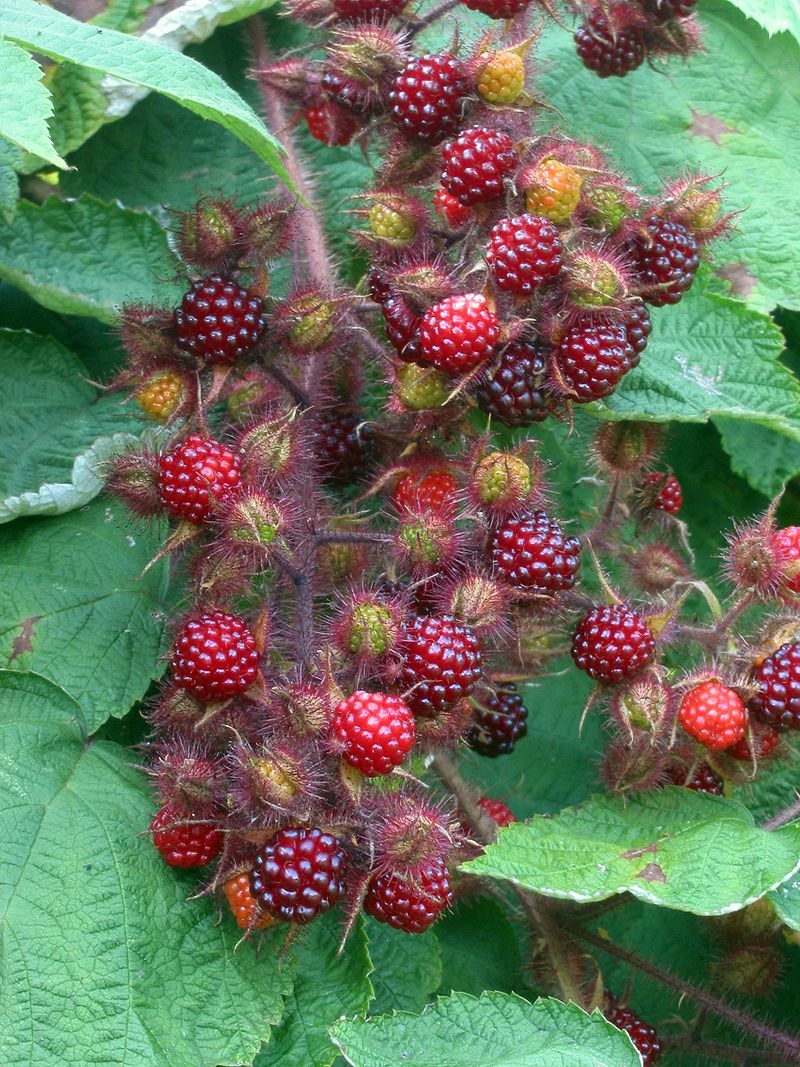
I will say, for the benefit of my timid neighbor, that feral wineberries are not poisonous. Although they invaded our non-lawns as invasive feral plants, people who think the super-prickly red stems are pretty actually paid to plant these things in their orchards and gardens. The brambles aren't actually harder to handle than blackberries (most of the prickles aren't sharp), and the berries are as edible as raspberries. I see people just assuming that the plant is poisonous because its super-prickly stems look intimidating. When they see only the ripe fruit (popped out of its husk) they assume it's a normal raspberry, eat it, and like it. People who normally enjoy a variety of fresh red, black, and yellow raspberries, and notice the distinct flavors of each cultivar, notice wineberries as a different breed. To most people, a ripe wineberry is a big red raspberry.

Photo By Wouter Hagens - Own work, Public Domain, https://commons.wikimedia.org/w/index.php?curid=1843577 . Wikipedia mentions (https://en.wikipedia.org/wiki/Rubus_phoenicolasius) that some people hate and try to eradicate wineberries. That's reasonable if you're trying to cultivate purebred raspberries and don't want the more aggressive species taking over your field, but not if you just feel intimidated by the plant's natural defense against insects. Get a grip, neighbor!

Japanse wijnbes rijpe vruchten.jpg
Photo by Rasbak: http://creativecommons.org/licenses/by-sa/3.0/ , showing wineberries ripening and bursting out of their husks. (Plants aren't toxic but, like most mature plants, inedible.)

Wikipedia's page on wineberries contains a fragment, "Chemical control via...glyphosate," which ought to be completed, "...is a crime against humanity." Attention, ignorami of the world: If you can't control weeds by ones, yourself, you should take your rightful place in society as an employer and pay someone who can. I will happily dig up your unsprayed wineberries and transplant them to a loving home. I wait for the husks to pop and reveal the berries within, pick the berries out, and enjoy them, just as you could if you had the brains God gave a goose...gooseberries grow in husks too.

And for a reasonable fee I'll also happily dig up your poison ivy...I don't replant it, but I can get it out of your yard, fast, without poisoning any innocent living thing.

And I also move paper wasps and white-faced hornets; if and when mine recover from whatever's caused the colonies to collapse, I'll adopt yours. Compared with mosquitoes they're positively lovable. Anybody who sprays poison on our native hornets and paper wasps deserves to have his head smashed into a hornets' nest.

I'm overwhelmed by the stupidity of the American people. If we can just get a good solid legal requirement that in order to get a permit to buy poison sprays people have to obtain the consent of everyone living within a mile of the proposed site of poisoning, I'm sure I can cope with the strain of generating silly novels and a culturally diverse blog (it's anonymous, but written from the perspectives of different demographics--ages, backgrounds, interests, and opinions, all predetermined by SEO algorithms) at the same time.

But I need to let everyone know that, in any case, between July 1 and 10 I won't have regular Internet access. Fortuitously, one client has scheduled a vacation for exactly the same time as the cafe's. I'll still be writing, and may or may not get online, during the first ten days of July; I hope to spend at least nine and preferably all ten of those days at home.

Y con suma suerte some of you local readers will use the time to let me help you resolve any wineberry, or poison ivy, or paper wasp, or similar problems you may have, instead of buying something that's likely to kill friendly songbirds and make humans sick.

They thrive and multiply on "pesticide" sprays, Gentle Readers--especially the ones aimed specifically at mosquitoes, but they love glyphosate fallout, too!

Friday, June 22, 2018

The Hospital as War Zone

Elizabeth Barrette is unfolding a new work of fiction about a science-fictional hospital. We discussed it this morning here:

https://ysabetwordsmith.livejournal.com/4764345.html?view=18497465#t18497465

As a tribute to EB's fiction-in-free-verse form, here's a bit of very slightly fictionalized memoir in free-verse form, sharing the memory EB's phrase triggered...

Jack, veteran of the color war,
remembers the hospital as neutral territory
from 1969, when the neighborhood around it burned.
He senses that he's dying of cancer
but does not yet know for sure,
so his two wives, his friends, his doctor
urge him to keep up the labor of living.
"Drink water, drink water," they plead.
Not "Would you like," but "Can you eat another orange?"
"Everything tastes of hospital here," he says.
"Your minerals are still unbalanced," they tell him,
"it's as sweet and juicy as any orange north of Florida."
"I have to go, I have to go," he says
ten or twenty times a day, each time he wakes up.
"Untie me now before I wet the bed."
"That's the catheter. Let go--wide open--if you can;
it helps a little. No worries, man!
A clean sheet's right there, if you soil the bed."

Joe, veteran of Vietnam,
remembers the dying men begging for water
from 1969, when others died from loss of blood.
Nobody imagines that what he has is cancer
but what could cause a massive bleeding ulcer
in the worst possible place, they're trying to find out,
so his doctor ordered no food, minimal water,
and tied him to the bed next to Jack's bed.
(His doctor was born in 1976.)
"Water, water," he yells
five or ten times a day, each time he wakes up
from dreams of blood-soaked shrapnel on the ground.
"You don't get water," students yell around the door.
"I've not eaten in five days," he yells as the lunch trays pass.
"You're not meant to," the kid pushing the cart sasses.
"Change the bedpan! Clean the wound! Oh gawd, it hurts!"
"Only an R.N. or M.D. can clean that wound!
Don't touch him, lady! We could all get sued!"
(Jack's wife had started to offer Joe a pan of water,
watching Jack's vital signs spike when Joe screams.)

Only a curtain separates their beds,
about six feet apart, and when the students
are led in to observe the marrow test procedure
the curtain's rolled back; they perch on Joe's bed, too.

Both men wake up from nightmares lost, confused;
are tied so IV drips stay in their arms,
untied, once wide awake, to watch television
and wash themselves one-handed if they can.

"Let me go home to die in peace," Jack says
softly, while Joe is watching sports on TV.
"I liked lying on my own bathroom floor."
"But what if they can cure you?" says his wife.
"Well...I suppose I'd rather live...if they're sure I will.
Don't leave me alone for a single minute.
I saw those kids pawing through the closet
before they saw that you were there, and asked
if I still wanted clothes to go home in,
and I believe my roommate's killed a man--"
"In Vietnam, he meant. He had a nightmare."
"Don't leave me alone with him, in any case."
"I wrote your son: he can have all the money
if he comes back in time to make peace with you."

"I enlisted for the job, not for any of you
but you young whelps are worse than the Viet Cong!"
Joe yells, tied face down over a pan of filth.
"At least y'might help with the odor in here!
Don't youall smell it? What is wrong with you?
Is this America? I'm a combat veteran!
I've been a cop on the city's meanest streets!
I might have saved some of your worthless lives
for all you know! What happened to Black solidarity?
That foreigner over there gets food and water,
two gorgeous nurses fight to clean his back side,
and his doctor's come to see him three times today.
I was here sixty hours before I saw my doctor
if that kid is a doctor, which I doubt,
and all he says is 'No food, no getting up
while we run a few more tests.'"
"That wound of yours needs special treatment,"
the R.N. says when she comes in at last.
"Ouch! And when they send a nurse, a little girl!"

On the sixth day Joe's family come in.
"Tape the Super Bowl for me, will you?" he asks his son.
"We'll watch it together on your VCR
when I go home. They say I can go on Sunday."

What man won't watch the Super Bowl
when it comes on? Jack waits, drugged but not that dopey,
on Sunday afternoon, while Joe cranks up
the sound on a boring documentary
("For 'football widows' to manipulate their husbands?")
about life in an "exclusive" neighborhood
in a city a thousand miles away.
"No use watching anything else over that noise.
Anyway he's sure to watch the Super Bowl"....
Joe leaves at seven. The Super Bowl is over.
The team Jack wanted to cheer for has lost it.

"Not such a bad fellow," Jack and his wife
and doctor all agree. "That was smart revenge
instead of the violent kind, and who could blame him?"
"That for your juicy orange!" his mother-in-law says.
Jack even laughs, himself.

"If I'm dying of some obscure disease,"
Jack says, "will someone please tell Joe that."
None of his friends or relatives ever learn
Joe's real name, or his address.

All these years later...Joe, I hope you know
Jack died of cancer early that July.
I hope your family are all together
and all at peace.
I hope the bleeding man they left for dead
has told you, in a dream, that he forgives you.
I hope you'll do as much for me
another twenty years from now.

Whether in this world or in a better one
I'm absolutely certain you know, now,
that every person on the urology wing
would have done more for you, sooner, had they dared.

But must hospitals be so money-grubbing
they cram two patients into every room
and never think how that can feel, to patients?

------------------------------------------------------------
(end of "poem")

Gentle Readers, if this post struck a chord, it's probably because you know a disabled veteran. Please go and do something nice for that person now.

Wednesday, June 20, 2018

Another GMO and Glyphosate Regulation to Comment On (Updated)

(Edited to reinsert a sentence that should have been visible yesterday and wasn't.)

In the excitement generated by California's success in banning glyphosate, this web site has not forgotten that there are other contaminants and GMOs out there that may be doing some of you more harm than glyphosate and "Roundup-Ready" (E. Coli) corn are doing you.

Sensitivity to these things is genetically determined. This web site basically belongs to two celiacs who are super-sensitive to glyphosate, with some help from a Cherokee who has much more trouble with sugar and alcohol than with gluten and glyphosate. I got into a conversation about this with a gentleman I met at church, who is Black. He said, "But what runs in my family is sickle cell anemia. My son has asthma, too--but when you were reacting to glyphosate sprayed along the railroad, he had no reaction at all, even though he lives two blocks above the railroad." If I'd been observing the young man, I might have noticed some reaction, but I don't doubt that he lives with other reactions that are much more unpleasant for him. And although none of us has noticed a reaction to BT corn (the other popular kind of GMO corn that most of us were eating before E. Coli corn hit the market), this web site used to have e-friends in India who claimed that people there were reacting to BT corn the way caterpillars react to BT infection, which is a horrible thing to watch; we feel for those people.

So I opened an e-mail about this proposed change in USDA regulations, which would require clear, readable labelling for most but not all GMO products in food...First, the link to the USDA site:

https://www.regulations.gov/document?D=AMS-TM-17-0050-0004

I'm on the mailing list of an organization that's come up with a clever idea for processing these things. They send everyone a form containing some facts, and if you click on "submit" the form to the appropriate agency, a tab pops up with a form that requires you to add an original comment that shows you're a human with some human interest in the issue.

Here's what I typed. (You can refer to this Comment Tracking Number, or make your comments entirely your own. You can send them your own documents.)

"
Your Comment Tracking Number: 1k2-93tw-9ijf
Your comment may be viewable on Regulations.gov once the agency has reviewed it. This process is dependent on agency public submission policies/procedures and processing times. Use your tracking number to find out the status of your comment.
Comment:GMO corn and soy may have been modified specifically in order to treat them with glyphosate. As you've probably noticed, there's a mania for "gluten-free" food these days because many people who don't even have the celiac gene (which I have) are having celiac-like reactions to grain products. We now know that glyphosate affects celiacs just as wheat gluten does, only more intensely, and has similar effects on some non-celiacs. We need no loopholes. In order for people who've invested heavily in producing "gluten-free" food to serve their market, and for celiacs and glyphosate-sensitive people to have any chance of being healthy, we need not only to have ALL GMO products plainly marked on food labels, but to have specific GMO's identified. (Celiacs can tolerate BT corn but have drastic reactions to E. Coli or "Roundup Ready" corn; on the other hand some immune-compromised people have horrible reactions to BT corn.) 

In fairness, I'm a celiac and the highly refined GMO corn syrup in some things I eat has not noticeably affected me--apparently the glyphosate is processed out of it. So I understand the argument that highly refined GMO products might not count. But others might not be so lucky, or the buildup of glyphosate residues in the environment might make me more sensitive too...and since other people will undoubtedly be sensitive to any new GMOs as those come on the market, you can save those people years of pain by requiring all GMO products to be not only clearly but SPECIFICALLY identified on food labels.

(I don't have a file to upload for you, but if anyone wants to read about the experience of a celiac with glyphosate-contaminated and GMO gluten-free food, I have a blog: priscillaking.blogspot.com. It has a search feature you can use to skip all the book and cat posts and read only the ones with "GMO" and "glyphosate" as topics, or, alternatively, click on the "Labels" at the end of this post: https://priscillaking.blogspot.com/2018/03/this-web-site-loves-vegetables-here-is.html. I'm terser and raunchier about this on Twitter, as @5PriscillaKing, and my recent relevant tweets probably show up under #GMO, #glyphosate, and #Monsanto or @MonsantoCo.)
"

Note that the fact sheet I'd already forwarded to them cited some of the information you can find at regulations.gov/document?D=AMS-TM-17-0050-0004, about what's in the proposed new rule, what needs to be in it, and who's being blamed for the loopholes. Your comments may actually be more interesting to the USDA if you read and cite this information yourself rather than sending them one more form...I don't know who's reading these things or how tired their eyes are.

(As Real Twits know...Twitter does not have a contract banning any potentially erotic content, so my Twitter account has no rule against mentioning body parts and I've even retweeted some graphics containing unprintable words. And I've tweeted some gruesome details about the celiac reaction to gluten and glyphosate. All this web site is going to tell you about that, due to our contract, is that this reaction is much more of a gross-out than our posts about cold-blooded animals.)