Friday, February 24, 2023

Book Review: America's Loveless Age

Title: America's Loveless Age 

Author: Noel Terry

Date: not shown; text indicates 2021

Publisher: Noel Terry

ISBN: 978-1-66784-1-243

Length: 266 e-pages

Quote: "[M]ainstream politics can impact dating politics."

How would they not? How many of us are liberal enough to be happy with a spouse who, even if a couple can agree to vote in different States, can be counted on to cancel our presidential vote? Fortunately, the author of this partisan screed doesn't seem to be American or to understand the public events he records in this book, so there's no reason to believe he is accurately describing the social scene for today's twenty-something. He reads only one side. With regard to "mainstream politics" that's the anti-Trump side, the side on which people are astute enough to know that nobody positively supports the unworkable ideas to which their foreign funders have chained them, so they just keep screaming "racism." With regard to "dating politics" it's the computer dating sites at which, if young people seriously seek dates, something is badly wrong.

What are dating sites all about? As a Kingsport Times-News article once reported, under the headline news that a real couple had actually used personal advertisements to find each other, relying on blind-box ads or fractionally more sophisticated computer versions can help people in very small social niches find one another. If you are a Seventh-Day Adventist ministerial student in search of a young woman who's not part of the S.D.A. prep school crowd but is friendly to S.D.A. religious beliefs, a personal ad mentioning why you're still available may be right for you. Otherwise, dating sites are bedtime reading for people who don't want real-world dates (the conversations with strangers, the expense, the need to bathe). 

I did some research once. I wanted to write a novel about a couple who bond by acting out each other's fantasies. From popular fiction I'd taken the idea that the woman wants the man to listen to her stories and put positive spins on them like an ideal therapist. There's no end to the young-adult novels where one can imagine the protagonists getting into serious difficulties, having sexual relationships when what they're really looking for is psychotherapy. Well, in this novel the woman recognized what she was looking for and the man was willing and able to do it. So what did he want that she was willing and able to do in return? What did men want besides the commercial exploitation narrative of the billionnaire playboy who buys whatever's being advertised for the top rates of the season, since anything looks good on him in any case, and theoretically fights crime but always wins? Could James Bond have a believable job (in exchange, he'd get to have hair) and Bobo rather than yuppie taste? Was that something men wanted? 

So I called a few of the phone chat lines that were popular in the 2000s, where it was generally agreed that men just wanted to talk about their fantasies, and invited men to share their fantasies with me. My first clue that men who want to talk about their fantasies are somewhat out of touch came from the hostility men showed when I introduced myself with the truth: "Hi, I'm a writer researching men's fantasies. Tell me one." Nooo! They wanted to believe that a woman to whom they were confiding their fantasies was looking for dates with men who call phone chat lines (say what?) with the same panting, audibly drooling avidity they were. They wanted to imagine that a woman who was that desperate would be unincarcerated, have a job, weigh less than 500 pounds...

And, popular though James Bond movies are, these guys did not noticeably want adventures. No fighting crime, no outsmarting enemies, no fortuitously having invented just the right tool to foil the enemies' evil schemes, no competitions, no need even to impress the fantasy gal. They all described almost identical fantasies. They all wanted to find an attractive female body somewhere--most didn't even care whether it was indoors or outdoors--and immediately start making babies. Ohhh. Slurp.

These were not coal miners or assembly line laborers. This was Washington. These guys not only read but were likely to be mentioned in nonfiction books. At least one of the callers claimed a name that hadn't been in the headlines but had been mentioned, if you read far enough into the story, in the news media. More or less by choice these guys were in places where James Bond adventures could happen, to the extent that they could happen at all. And they still had the same fantasies as thirteen-year-olds who are just starting to notice that the changes in their bodies may have uses beyond impressing schoolmates with how fast they're growing up.

Feminists deplore the poor-spirited and unimaginative heroine who, like Cinderella, can do nothing to help herself but needs only to get herself to the party (no mention even of having learned to dance) to be seen and whisked away to live happily ever after. Rightly so. But Cinderella was a model of cleverness and ingenuity compared with these poor-spirited and unimaginative men. 

And that's the demographic from which Terry thinks we can predict the future of American civilization.

So it's comforting to note that Terry's English is British. Though he says he spent some time travelling and talking to people in American bars, he probably wasn't here when most of the events he discusses took place. All he knows about those events is what he read in partisan papers/

The results can be as disastrous as Merkel's lax immigration policy. Flinging wide the gates served everyone well in Germany, Terry cites sources having written, apparently before the mass rape event in Berlin. If Terry had been paying attention to any feminist concerns other than the entertaining-catfight potential of "sisterhood wars," he'd know that that event was pivotal in flipping women's positions from "Let us help these poor refugees" to "How much are we, individually and as a nation, being paid to serve as a prison for other countries' criminal outcasts?" 

Basically Terry's argument seems to be:

1. Socialist programs that depended on population growth must be kept going and must not be refitted to a finite world where human population is already more than double what it needs to be. 

2. Therefore, even as we see overcrowding suppressing the reproductive instincts in the young, we must keep packing more people into overcrowded cities 

3. There aren't enough jobs for the existing number of job seekers already. 

4. Nevertheless, socialism might be able to buy ten years if young women would just go home and have more babies, which would keep them from doing health, education, administrative, and communicative jobs so much better than young men do. 

5. But they won't, willingly, go home and have more babies unless they've found men who can afford to keep them and their babies in the style to which they are, or would like to become, accustomed. 

6. Among young single Americans who are still willing to risk having babies, this leaves a majority of the females in unladylike competition for a minority of the males, and a lot of young men (currently) unsatisfied, blaming us mean old feminists for calling attention to things like the way mass immigration did not serve the people of Berlin well.

7. Although Americans noted these things long before Donald Trump could afford to run for President as The Candidate Who Did Not Ask Voters For Money, it has to be Trump's fault, anyway, because no party that claims to appeal to the masses wants to leave those masses time to think about the fact that ca presidential candidate won without asking them for money every few hours.

8. So this book has to keep blaming Trump, in all ways, always, and at whatever risk of making  the Democrats look like the sorest and sorriest lot of losers-even-when-life-handed-them-a-win the world has ever seen.

9. So, Trump's a Nazi, all of his supporters are White male haters whatever they may actually look like, and people who observe rationally that the Trump Administration accomplished good and bad things don't caaare enough about the people the Trump Administration hated and hurt. And the reason for their lack of caaaaring needs to be worse than "They looked around and couldn't see any such people." 

10. When your argument is very weak, like this one, polarizing people is a good strategy because it motivates them to throw their tomatoes at one another rather than you.

11. Therefore, women who criticize each other's opinions or strategies are not engaging in debate but locked in a deadly "sisterhood war," young men who aren't meeting Miss Right on dating sites don't need to go to church or temple or join a social club and talk to real women but need to blame older people (both feminists and non-feminist Trump), everything is all because the United States have that pesky Constitution that says the right to bear arms shall not be infringed, and readers of a book that supports a weak argument with misreported facts and comes to no meaningful conclusion should at least picture Terry dodging bullets as he fled back to Britain.

12. Whatever. Just don't anyone ever vote to re-elect Trump.

Apart from a tendency to use "struik," which Google says is a Dutch noun meaning a bush or shrub, as a verb meaning to speak or say, Terry's writing skills are good. However, because his research skills leave so much to be desired and his persuasion skills seem to have been developed in a partisan echo chamber, I don't expect this book will cost Trump a vote if he insists on running in 2024. 

Great books do not come out of echo chambers; they are written by reading all sides and, if writers want to oppose someone, opposing ideas in a more rational way than just screaming "ooohhh, ooohhh, the people who don't agree with us are all such horrible people." This web site did not endorse Candidate Trump, found abundant reasons to criticize the Trump Administration, and would have been receptive to parting shots from the less-brave while Trump is out of power, but in this case the parting shots miss their targets. 

There is, however, a throwaway line in this book that I like. It's on page 203, in the context of a woman's suggestion that perhaps women who get drunk or stoned in public places shouldn't be able to press charges against men who take advantage of their condition: "[M]en take care of their wasted buddies who have drunk too much; why wouldn't the same caring principle apply to a woman?"

Thursday, February 23, 2023

Book Review: Dual Purpose Microwave Instructions and Recipes

Title: Dual Purpose Microware Instructions and Recipes

Author: Anchor Hocking Corporation

Publisher: Anchor Hocking Corporation

Date: not shown

ISBN: none

Length: 16 pages

Illustrations: full-color photos

Quote: “Microware…was specifically designed for use in microwave ovens. It is also suitable for use in conventional ovens at temperatures up to 400℉ (204℃).”

With only five pages of recipes, this brittle little booklet hardly deserves to be called a cookbook. (The recipes are for something utterly American that’s called coq au vin, poached eggs, “Harvey Wallbanger Cake” (orange cake soaked in alcohol), stuffed peppers, baked late-summer vegetables, mini-quiches, baked chicken, and raspberry cheesecake.) However, if you’re a cookbook collector who is into 1970s fad items, and/or an owner of a Microware dish as shown in the photos, you must have it. I find it hard to imagine a person who is not in one of those two categories wanting this book.

So what, exactly, was Microware? The manufacturers described it as “space age material.” As shown, it was a set of ceramic dishes, each about a foot square and all designed to stack up about two feet high for efficient storage, with an unmistakable early 1970s look. There’s probably a reason why it’s not being advertised today.


Butterfly of the Week: Crassipes

This week's butterfly is another one that's been called by many names. When the original swallowtail genus, Papilio, was split up, the black-winged, red-bodied or red-spotted swallowtails were reclassified as Atrophaneura. Then some of the Atrophaneura with red spots on their wings were reclassified as Byasa. English names have also varied; the butterfly is most often called Black Windmill. But its Latin species name has been constant--crassipes, "thick foot," the Bigfoot butterfly.


You can see why. It's one of the larger swallowtails, with a wingspan up to 6 inches, and the hind wings, which are black above and red or pink-spotted below, trail out behind the body as it flies or walks. Museum specimens usually have the wings spread out to form a very broad x shape. 


Images from Ifoundbutterflies.org; click to enlarge and read the phtographers name.

Like most very large butterflies, Byasa crassipes is usually found in warm, damp places. It lives in tropical forests that are considered "dry," with four to five feet of annual rainfall, black soil, and deciduous trees. It's listed as a native of India, China, Burma, Laos, Vietnam, and neighboring countries. Though rare in most of its range, with some endangered populations, the species as a whole does not seem to be endangered. Nevertheless it's on watchlists in Burma, China, India, and Vietnam. In India it is protected by law from endangerment by logging.


Little is known about this butterfly's life cycle. It's been found only once in Thailand, where the presence of even bigger butterflies causes it to be called the Small Black Windmill. There's some question whether it really is or ever was native to China.


Very large butterflies and moths tend to be sparsely distributed across a wide range. In India, in 2018, the presence of one Black Windmill near the site of a controversial new dam made headline news; apparently people have continued waiting to see others, to find out whether the area is part of the butterflies' habitat. 

The precise location of the butterfly that blocked dam building activity was not reported. Too many of the photos of Byasa crassipes online are of dead specimens in museums and there was still concern that, short as their lives are, the big-footed butterflies' lives would be shortened even further by ill-advised "collectors." My generation did grow up, after all, reading first books about butterflies that told primary school butterfly enthusiasts how to catch butterflies in nets, kill them quickly, and pin the bodies into display boxes. Some of us seem not to have received more recent warnings that killing living butterflies is inhumane because it may lead to local or subspecies extinction. Big butterflies don't face obstacles to reproduction as overwhelming as big moths do--the butterflies do eat--but their sparse distribution means that they don't find mates and host plants for eggs easily. 

One should never kill a butterfly before its time. The purpose of preserving dead bodies was to be able to keep and share the memory of what a butterfly looked like. Nowadays that can be done much more pleasantly and efficiently with cameras.

Wednesday, February 22, 2023

Book Review: 21 None Such Mince Meat Recipes

Title: 21 None Such Mince Meat Recipes

Author: Borden Company

Publisher: Borden Company

Date: 1952

ISBN: none

Length: 32 pages counting the covers (they did)

Illustrations: full-color, black-and-white, or line drawings on almost every page

Quote: “Here are recipes for pies, desserts, muffins, cakes, bread, cookies, rolls and meat sauce…but each one…made with None Such Mince Meat!”

Mincemeat was an old English tradition. It was made by mincing dried beef and dried fruit together with enough sugar and spice that the whole thing tasted more like some exotic reconstituted fruit, when cooked, than like a savory meat dish. That was the kind of thing that was trendy in the sixteenth century, when the first English colonists came to the future United States, and in the colonies and early States it remained trendy. I don’t know whether anyone still eats it now, though, except as an historical curiosity. I last saw cans of mincemeat in a supermarket that specialized in having lots of unusual items, in the Reagan Administration.

If you do use mincemeat, here are recipes. I’ve never tried any of them but, since they all rely on reconstituting the dried ingredients, I’d guess that a mix of about half dried apples, half other dried fruit (possibly including candied ginger), and your favorite sweet spices would work. Soak to soften as necessary, and sweeten judiciously, considering that dried fruit does so much to sweeten bread.

Anyway, for the cookbook collectors, here is a cookbook with a terrific lost-in-the-1950s look, and my copy is in fairly good condition.


Wednesday Prompts

One prompt came from LongAndShortReviews. After last week's prompt, which everyone answered at some length, usually with a longish list of favorite foods, this week's prompt seems likely to generate really short answers.

"What was the first web site you remember visiting?"

That ought to tell how long we've been online...In the 1980s there were corporate computer systems, the function of which seemed to be to keep the Office Computer Expert busy fixing the steady stream of problems with awkward early programs, and there were freestanding, unconnected personal computers. I was an advocate of personal computers. I didn't think good was likely to come from linking them--still don't, actually. The fad has lasted long enough and the Internet has grown big enough that being online can certainly be interesting, but let's face it, word and data processing programs still work about five thousand times more efficiently when you're not online. 

So it was late in the 1990s when Zahara Heckscher talked me into looking up things online. She had Compuserve, like Rush Limbaugh. It wasn't free; you paid per minute, so you minimized online time and didn't surf around. Beyond her Compuserve account, the public web site we visited was an early search engine called Ask Jeeves. 

The Internet was less cluttered even in the early 2000s. I remember Asking Jeeves about Zambia. Jeeves found all of the four web sites that mentioned that country. One was a US government site, two were UN, and one was the official Zambian government site, which, most memorably, tried to attract tourists with the promise of "a treat": being allowed to hunt rare semitropical animals. The Zambian government site said nothing about the antimalarial drugs tourists would be taking, or their potential side effects. The reason why Z needed a writing assistant was the nerve damage, the chronic pain, which typing aggravated. 

Another prompt came from Spencer George, and recalls our old long-abandoned phenology theme:

"What's blooming where you live?" 

Well, yes, I suppose he does write for fellow Southerners.

I think of February as generally a beige time of year, where I live. Things aren't blooming yet, in a normal year. November is brown, the month when the dead leaves cover the earth. December and January are not always, but usually, black-and-white, the months of ice and snow. February is most often a chilly, muddy, dreary season when the dead leaves are faded and worn, and the overall color of the ground, hills, and trees, is a sort of deep rose-beige or rose-tan or rose-taupe.

This year's unusually mild winter followed an unusually long summer. The flowers that are most often tricked into blooming during the February thaw, and frostbitten in our "redbud winter," bloomed and were frostbitten in December, so I'm not seeing many of them despite temperatures in the sixties. Some years, dandelions will pop up in the January thaw. This year, I've not seen them; they all bloomed in December.

Nevertheless, in town, on the sunny side of someone's lawn, forsythia has bloomed; and I've seen the first few dandelions of this February.

What's blooming where you live, Gentle Readers?

Tuesday, February 21, 2023

Book Review: The Joy Luck Club

Title: The Joy Luck Club

Author: Amy Tan

Publisher: Putnam

Date: 1989

ISBN: my copy shows none

Length: 288 pages

Quote: “For a long time the woman had wanted to give her daughter the single swan feather and tell her, ‘…it comes from afar and carries with it all my good intentions.’ And she waited, year after year, for the day she could tell her daughter this in perfect American English.”

Or should I quote the just slightly disreputable line I first heard on NPR, where one of the older Chinese women has to evict a tenant who calls her a @#$$% landlady, and she wails to her daughter, “He knows I’m not from Fukien!” I’ve never forgotten hearing Amy Tan read that quote; but more than the pun, I think, it was Tan’s dialect switching. Tan sounds like an American baby-boomer, but as she quoted the Chinese-born character’s line she suddenly sounded like a much older woman, her mother, perhaps, or grandmother, who was born in China. An author’s happening to have a gift for improvisational acting should probably be considered separately from the author’s books.

But there’s never been any question about Amy Tan’s books. I think Tan is on every critic’s Top Ten List of American Writers of the Baby-Boom Generation; either she or Barbara Kingsolver may be the closest analogue we in the United States have to Margaret Atwood. If you like lively feel-good stories with vivid details, an exquisite ear for dialogue, characters who are not noticeably Christian but whose stories manage to reflect Christian values (Tan is a Presbyterian), you’ll want to read all of her books.

This was the first novel that made Tan famous. Ironically, I think, it may be her weakest one. Four Chinese women who moved to San Francisco at about the same time have become friends; each of the four women has a daughter, and what happens in this book is that each mother and daughter tells her story. The stories naturally intersect but they don’t form much of a plot. They affirm that to some extent each woman has had an American Dream and made it come true; each one has a US-born daughter who’s grown up, found some success in life, and become mature enough to love her parents as an adult daughter should. They celebrate the richness and variety of life, both in old China and in modern California. Each of the older women has survived some very bad things. (One of them, as a girl, was supposed to be watching a baby brother at the beach, and he drowned.) Each has preserved the abilities to laugh, to love, and to learn. None of the women is supposed to be a perfect person. All of them are likable.

Women usually love The Joy Luck Club. Men sometimes gripe because it’s realistic. Real women’s stories are not romances. The eight protagonists in The Joy Luck Club mention having loved men, but the story is about their female bonding, mothers and daughters. Some of the men they’ve loved are still on the scene; some are not. Lindo Jong, whose unusual but understandable love for her first husband, Tsun-yu, is mentioned first in the book, is content with her current husband, Tin; and so on. This is not feminist bitterness; it’s realism, like the way Lindo Jong never changes her own name to Lynn or Linda, though other people call her Linda, but names her daughter Waverly.

One important theme in the book is how much of the mothers’ stories, which the reader knows, are and are not shared with their daughters—and how much of parents’ life stories should be shared with children. (In some Chinese families children weren’t supposed to know their parents’ history or even pronounce their parents’ names; elders were to be pampered while living and worshipped when dead, all in the single category of Honorable Ancestors.) One of the characters describes how her feelings are hurt when someone tells her what her stepfather’s family think of his relationship with her mother; she still feels, looking back, that that was the kind of thing a daughter shouldn’t have to know.

Each of Tan’s novels can be identified, not with a “moral,” exactly, but with a beneficial effect it should have on an attentive reader. For The Joy Luck Club that would be love of parents. Given half a chance, this novel will remind you to call or visit your mother, if you still have that opportunity. Father, too, if you think about it a little longer. Respect their privacy, and cherish what they choose to share of their stories.


Tortie Tuesday: Discontented Calico, a Rant, and Petfinder Pictures

Three discontented calico cats, a discontented gray-and-white cat, and a discontented black-and-white cat are on the porch. 

Skeptical Reader: "How do we know they're discontented?"

Serena: "Because I'm clawing at the door. The writer known as Priscilla King does not like it when I claw at the door. That is why I do it to show that I'm discontented."

PK: "And why are you discontented?"

Serena: "You need to ask? Where is our kibble?"

PK: "You've eaten all of the little bag the driver delivered last week. A certain person who has been delivering cat food was supposed to have been here on Sunday the twelfth of February, but has not been seen since then."

Serena: "Where is that person?"

PK: "Anyone's guess. The sixties are an awkward age in my family. I worry about person being in the hospital again. Lonely people in Tennessee and Kentucky, who are not already related to us, worry about person having enough parties and dates, and drive out to take person to places of entertainment where alcohol is served. There may be such a thing as 'responsible drinking' of alcohol for some people who do look as if all of their DNA came straight from Germany, but this can still be very dangerous when other people drink too much and start brawling, or think they're fit to drive cars. Or person might just have paid one of those big medical bills, paid one of those jacked-up electric bills that have been going out this winter, and not had enough left over to buy a sack of kibble. That could very easily be the case, even though person has a full-time job with seniority, because the behavior of the electric company this winter has really been...obsolescent."

Serena: "What does 'obsolescent' mean?"

PK: "It means that something is in the process of becoming useless now that something better is available. "

Serena: "The electric company sends out men in trucks. They never stop to deliver kibble. By 'something better' do you mean men in trucks that have kibble in them?"

Skeptical Reader: "Serena didn't say that. No cat could reason like that."

PK: "Serena obviously has her own way of thinking, which is feline rather than human, but I believe she does some of what we call reasoning. What have you been doing in these days since we've run out of kibble?"

Serena: "I've been eating human food, which is nice for a treat but doesn't satisfy us cats in the way our kibble does. So then I run into the office and kitchen, although I don't usually do that. I run inside and look around for dishes. I sniff at dishes and meow to tell you to put something in them."

PK: "You see. Of course, part of your discontentment has been with the human food itself. I've not been to the store that sells the kind of meat we can keep longer than a few days. You had the last meat in the house; after that I cooked vegan food, which is really for humans only."

Serena: "That's very selfish and impolite of you. You're supposed to share your food with me."

PK: "I know that. Let me finish. The electric company has been extremely obsolescent this winter. While we've had the sort of mild weather that uneducated people think is proof of 'global warming,' further north it's been a different kind of winter. Now, for reasons of their own, our electric company in the Point of Virginia, Appalachian Power or APCo, is still set up as a separate company from Potomac Electric Power or Pepco, in the Hump, and Dominion Electric Power, in the Swamp, or other companies further north, but they're all run by the same people as one huge conglomerate mess. When there are weather disasters they all send workers to help. And then they pay for it by sticking it to people in some place that didn't have a weather disaster. 

This winter, in December we had one real freeze. Everyone used a lot of electricity. Nobody complained about the bills being high in January. I paid my bill up so I could pay taxes in February. I had no taxable income last year but the Cat Sanctuary is taxable property.

Well, on the morning of the thirteenth, my lights went off. I couldn't believe it. They cut off electricity when bills are two months overdue or are over a hundred dollars. Mine was neither. Luckily, we've had almost all thaw and no winter, and last week, the February thaw weather really felt like spring. That might have been the pretext for gouging more money out of us to pay for repairs in New York State. I went boiling into town, and everyone else seemed to be boiling too. For one thing nobody used very much heat in January, but our bills were as high as they'd been for December, or higher.

That kind of little game is so-o-o-o obsolescent. Solar collectors are currently being built, as the company's web site will tell you, in such a way that "for safety" they'll be cut off if the company decides to disconnect your electricity, or if it goes off naturally because it rained or a squirrel jumped onto a cable somewhere, as happens about every week. That's why, although Mother hoped for great things from that old deep freezer that is still taking up space on the porch, the deep freezer didn't last long and neither did the food stored in it. It could not survive that kind of abuse. Everyone's electricity is constantly surging or shutting off, whatever they do. This does not have to be the case. Solar collectors could be storing electricity in batteries so that our lights never blinked again. 

If the company knows what's good for them they will not try to interfere with technological progress. They will be knocking on the doors of people in Scott County who have any roofs or pavements with a southwestern exposure, making bids to buy the right to use some of our sunshine. It will be our sunshine. It will be serving us first and them second. 

We need solar collectors to be built in such a way that, "for safety," individual home owners will be able to cut the company off if we don't like what the company are doing. Not only will the company be sending us monthly payments, but there's to be no more nonsense about nuclear reactors, or deep mining, strip mining, or any other un-ecological foolishness., There's to be no more spraying of power lines, and a lot better maintenance of the ground around them from the ground, weeding and pruning. And if people in the Swamp continue to complain about Dominion's abuses every few months, the way they have been doing, people in the Point and Hump of Virginia are likely to have something to say about that too.

We need legislation to the effect that, before the company can even mail out those letters threatening to cut off people's electricity, the month before that they have to mail out letters offering to install solar panels on people's property. 

Ultimately we need to get rid of the grid altogether, but there's no reason why the company can't be nice about it and stay in business for another ten or twenty years, while people in the cities work out how they are going to generate their own extra electricity. For the time being, we in the Point have something to sell, a way to stop people in the Hump thinking of us as a lot of useless welfare cheats."

Serena: "Were you going to get back to cat-related topics some time today?"

PK: "Well, there we are, back to cat-related topics!"

Serena: "Like kkkiiibbbbbbllleee?"

PK: "Oh, stop acting pitiful. You had human food again for breakfast this morning. You can always find a mouse or rabbit or something in the orchard, and the kibble situation will be resolved one way or another in a few more days. You have humans who can still work and buy kibble for you. Some cats don't even have homes."

Skeptical Reader: "Speaking of which, what happened to those other cats you were going to bring on board?"

PK: "There've been two litters of homeless kittens reported to me, so far this year, and although I did go out and meet one of the seven kittens and make preparations to bring him and his sisters to the Cat Sanctuary, actually all seven kittens were adopted before they could be brought here. That's typical of this part of the world. Most people are kind to animals, so most homeless animals find homes fast. A few people, most of whom probably live in Tennessee or Kentucky, are cruel to animals and just dump them out on streets, or outside houses where nobody is prepared to help them. So there are things people can do and should do to help animals, here, but none of those things fits into the Humane Society's narrow little agenda for the world. For one thing, people can just realize that, when you start looking around for people to foster kittens, that is a sign that your cats have had enough kittens and need to be neutered and spayed. The world needs some kittens but  it's very easy to reach a surplus point, especially if the mother cat has FIV, or the Manx gene, or some other problem."

Zipcode 10101: Pink from Hempstead 


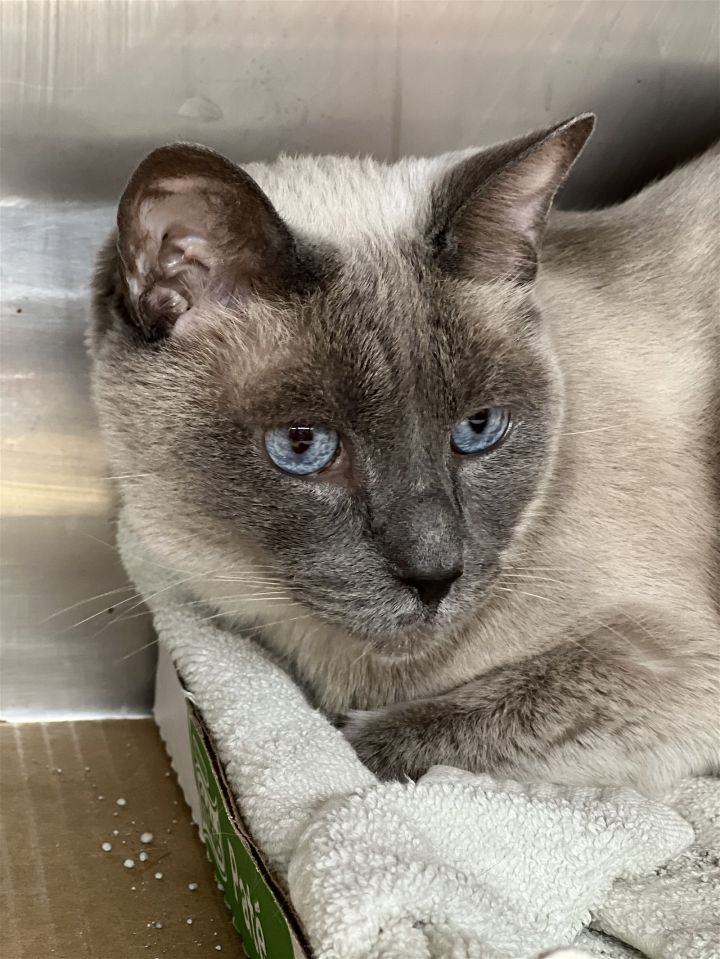
Isn't she a classic Siamese? Unfortunately Pink is a survivor of shelter trauma. She got into an official city shelter by way of an unapproved shelter or "hoarding" environment. She does take food and use a litter box but her main focus is on hiding from humans and other cats. If patiently left alone long enough she might someday reconnect with instincts to cuddle. Or not. 

Sometimes cats like Pink do better when another cat is the primary pet and soaks up all the human attention, so here is an alternate cat from Petfinder's New York page: 


This cute Q-cat is thought to be two years old, friendly and gentle, a bit lazy, and loving a good cuddle. She might satisfy the cat-cuddling needs of a person who also adopted Pink. The one thing on Shakira's web page that might put someone off is the price tag. 

Zipcode  20202: Blue from Herndon 


The most typy-looking Siamese cat on the D.C. Petfinder page is not thought to be "purebred" Siamese. He's ten years old, a mellow old fellow looking for a quiet comfortable home. He is described as quite quiet, for a Siamese, but good with other cats and children. -

Zipcode 30303: Penelope and Selene 


They're not sisters, but they may be social cats. Both are young Siamese-mix cats. Penelope is closer to the show-quality Siamese look. Selene is mostly dark "blue" gray with that white tip on her tail. They met in a shelter, after Penelope had been separated from a real sister kitten, and became sister-surrogates who sleep curled up together, twine their tails together, and generally act like best buddies. As a package deal, already vetted, they should be worth a hundred dollars even if the shelter staff sound just a tiny bit like control freaks.


Monday, February 20, 2023

Book Review: The Starlight Rider

Title: Starlight Rider

Author: Ernest Haycox

Publisher: Collier (1933), Warner (1972)

Date: 1933

ISBN: none

Length: 192 pages

Quote: “Hugh Tracy passed Indian Flat around seven of the morning, traveling fast and feeling only a slight pucker in his right flank where the bullet hole had been three months healing.”

Queen Victoria was long gone, but Victorian melodrama still lived, Haycox demonstrates in this novel. Hugh Tracy returns to the place where he was wounded because there’s a beautiful heiress in danger of being coerced into marrying a nasty relative, older than her father and interested in her money. Obviously she needs to marry Tracy, as will be shown by his success in fighting all the co-workers who are now ordered to kill him. For in the Old West work, trade, and logic had not been invented yet, and a man’s only chance was his own .44.

If anybody does like this kind of story, I have one. It is significant in the study of American literature: it's an example of what Louis L'Amour's stories were so superior to.


Ideas This Web Site Classifies as Left Wing: Part 2 of 5

2. Left 

(This is section 2 of a post that was long enough to need to be a series; links to the rest of the series will appear on the right side of the web page as the posts appear. Last week I introduced the series. This week's posts lists some ideas I identify as "Left." Lefties...)

* Cherish the ideal of liberty and justice for all, but do not necessarily read all sides enough to notice when some people's idea of justice tramples on other people.

* Hate the fact that demographic injustice ever existed and would like to redress all of it at once, to the extent that some even believe "reparations for slavery" are possible at this point in time. (If they could travel back in time and give money to ex-slaves, they would.)

* Love sex, and want those with whom they act out their tediously discussed "sexuality" to love it too. 

* Are happy to give their money to organizations that they believe will apply it to the cause of building a sense of "justice" between demographic groups; don't want to recognize which of those efforts actually help people, which actually increase hostilities, and which are boondoggles.

* Support the work of minority-demographic writers within their party; may fail to recognize others.

* Like to be liked; want to believe their party represents majority views within minority groups, even when in fact their party increasingly represents views that are abhorrent to the majority in groups within which their party has bought votes with handout programs.

* At least claim that there's nothing wrong with needing handouts and that they respect people who depend on handouts as a long-term lifestyle, though in practice most of them observably show much more respect to rich people.

* At least try to make their organizations inclusive and accessible to all who want to participate.

* At least try to be good citizens, and may in fact be both good and nice neighbors.

* May try to offset alliances with groups and ideas associated with "godless Communism" by being especially devoted members of some religious groups, notably subgroups within the Catholic, Jewish, Methodist, Quaker, and Sunni Muslim traditions. (Some of these people are literally saints--legendary mission workers loved by all who remember them and, if Catholic, likely to be canonized.)

* Cling to a belief that bigger, more centralized government works better, although this position requires them to ignore a lot of facts.

* Still think they or their daughters might want to have an abortion, and tax money ought to pay for it.

* Remember the civil rights movement, took a vow in the 1950s or 1960s to vote against Republicans because of their experience in that movement, and are sticking to it even though they have noticed that today's Republican Party is multiethnic.

* Seriously believe chattering in public about any aspect of "sexuality" is doing anyone any good.

* Seriously believe, even after The Kingsport Strike, that the Teamsters and AFL-CIO represent the average working person or per interests.

* Seriously believe that the Social Security system is or ever was sustainable, even if we pack in refugees and produce test-tube babies that live long enough to work. 

* Never noticed how much harm compulsory education, in the absence of school choice, did to my generation. 

* Might belong to religious groups that teach that redistribution of wealth through taxation is in some way similar to the sharing and giving Jesus preached.

* Seriously believe that men want to be women because they like, respect, or admire women. May have a gender-confused young relative to whom they want to believe that this applies. The alternative would be to blame the Atrazine.

* So, may not have reality-tested some of their beliefs lately, but are decent human beings with valid points of view, with whom anyone might enjoy eating lunch, working, or even taking a road trip. Some of them, like Hillary Rodham Clinton, may have been pressured into association with the Loony Left, but the ones who are not active party leaders or candidates may resist adopting Loony Left. ideas.

Sunday, February 19, 2023

Where Do You Think You'll Spend Eternity?

Let’s begin by admitting that we don’t know. Christians have, in fact, been told that we can’t know; that what we’ve been told about whatever places or conditions our Scriptures call Heaven and Hell is metaphoric.

My purpose here is not to argue for or against the idea that we can expect some sort of judgment after death. It seems fairly obvious that we can. Even if the judgment is merely subjective and passed on us by our own minds, as some of my regular readers believe...when faced with the choice of whether to depart this world in a joyous rush into the arms of people we have loved and admired, or a miserable banishment to some form of eternal penance, do we even care whether the experience is empirically verifiable or not? Maybe what remains of us has an ongoing consciousness that can interact with all the people we've known and wanted to know; maybe it has that dream for the eternal moment that's all that remains. Maybe Abraham's eternal reward includes the minor punishment of having to go and watch his erring descendants burn; maybe that was just a dream the rich man had; maybe there was a real rich man who had really reported that dream to Jesus's audience. My purpose here is to consider some of the places people think they, or we, are going to spend eternity.

One popular belief is that we’re going to come back in some other form...whatever form may be most appropriate for the universe to reward or punish us in. If we’ve demonstrated contempt for people who have less than we have, we’ll spend at least one lifetime as beggars. If we’ve shown due reverence for life and a noble disdain for our own material gain, we might come back as rich people. Very wicked people may be sent back, according to some belief systems, in the form of vermin that need killing, which is why mosquitoes and cockroaches exist. This school of thought can be very entertaining as we attempt to work out exactly why there are more poor people and more vermin than there used to be. If taken seriously it can also be depressing. If every murderer has to come back as a murder victim, the number of murders in the world can only increase each year, and everyone’s next life, even as a rich and blessed person, is likely to be less fun than the present one has been. And since people tend to develop in ways that reflect their cultural environment, an increasingly violent world is more likely to produce more violent people. And what happens if human life goes extinct? But my purpose here is not to offend people who take the doctrine of reincarnation seriously. Where do they believe they will spend eternity? Perhaps the best summary of their answer might be “In transition.”

Not all of the world’s primitive religions taught reincarnation. Many ancient Pagans believed that they were going to a specific place in some sort of afterlife. Some of these beliefs were remarkably like the classical Christian idea of a final judgment. Hunters and gatherers often imagined “happy hunting grounds” or “gardens of everlasting delight” awaiting good people, and gloomier places for the wicked.

Christian folklore about an eternity of fiery torment for evildoers has been traced to a specific spot in the Middle East called Gehenna in ancient Hebrew, Jahannam in Arabic, or Hinnom in modern Hebrew. In the twentieth century Hinnom was developed into a little park where tourists could enjoy a picnic “in Hell.” It was originally a public garbage dump. Anything considered unworthy of preservation, including the bodies of people whose heirs couldn't afford to bury them or who were generous enough to want to spare their heirs that expense, was brought there and burned. The fires of Gehenna were never put out, but eventually, as people stopped adding fuel, the fires burned themselves out.

When Jesus told the story of the rich man who was hated and sent to Gehenna for not sharing his goods with the leper who begged at his gate, He started a debate that has gone on for almost two thousand years. Exactly what was He telling us to expect? Perhaps some people prefer quibbling about details to grasping Jesus’s point—that we can expect to be judged severely for failing to share what we have with those who have less. Were the characters in the story real people? Why is the beggar in the story given the same name as one of Jesus’ friends? (The Lazarus mentioned as a living man in the New Testament was probably an older gentleman, who never tramped around with Jesus and the Apostles, but maintained a house luxurious enough to lodge and feed them all, when they came through town—he was certainly not a beggar.) Does “Abraham” in the story refer to the ancestor of the Hebrew nation, or did Abraham happen to be the name of another neighbor of the rich man and the beggar? Is “Lazarus” leaning on Abraham’s bosom because he is still crippled by his disease? Is this beggar Lazarus, for that matter, a child being carried on Abraham’s bosom? Why did the rich man think of asking for a little water to cool his tongue, rather than a bucket of water to put out the fire? What suggested to the rich man’s mind to request that this Abraham stop holding this Lazarus up and send Lazarus to carry the water? How literally true is this image of the rich man being thrown on the fire at a garbage dump, along with broken pottery and stable muck and things the dogs wouldn’t eat, and can’t we think of metaphors for an utterly outcast condition that are even worse than that?

Dante had an answer at least for the last of these questions. His answer was “Yes.” He thought of several metaphors for the torture of being cast out of fellowship with God and the saints, each one apparently more repulsive to him than the one before. In Dante’s Inferno, people who hadn’t done anything terrible but hadn’t been very good either had to spend eternity just running around in aimless circles, while really bad people were buried neck-deep in frozen sewage. In Dante’s Paradiso, likewise, good people continued working their way up to higher and higher levels of Heaven, and as friends ascended to the levels where they met each other they looked forward to meeting each other as increasing their joy.

The notion of multiple levels or departments of Hell or Heaven wasn’t new to Dante. Some Asian religions had already numbered and described the levels of both places. Often there was a belief that higher levels of Heaven were for greater saints, and lower levels of Hell were for greater sinners.

But not always. In some primitive religions, different places in the afterlife awaited different kinds of good and bad people. In Norse Pagan lore, everyone has heard that brave warriors, as servants of Odin, went to Valhalla, where they could fight a new battle every day. Not all Norsemen were warriors; each of their other gods presided over a place, apparently regarded as a good place, where his, her, or its faithful servants could hope to go. Some of the descriptions of these places sounded to Christian missionaries more like Hells than like Heavens. Valhalla, with a name that meant “hall,” seemed grim enough. Then there was Niflheim, the resting place of nocturnal creatures and sickly people, which was described as a deep cave and sometimes called Niflhel; this “-hel” was the old root word for “hole” found in all the Germanic languages, but it was the word Christian missionaries adopted for their theological teachings about Hell. As a resting place Niflheim was not to be confused with a place of eternal punishment—the cheerful “god” Baldr was there—but it wasn’t much of a reward either. There were nicer places, like the jewelled palace where loving women went to wait upon the “goddesses” of love and beauty (one source listed sixteen supernatural subordinates to Frigga); these goddesses also took in cats and babies, so we may assume that the Vikings expected their wives to live happily ever after. There was also a wealthy underwater kingdom for sailors and fishermen, and a mountain palace for those who loved the outdoors. What happened at each of these places reflected how worthy the person had been for the company of the immortals—a person might be employed, or even adopted, by the deity the person had served, or might be fed to the deity’s pets. (All Norse deities kept a few predatory animals as pets.) How seriously these stories were believed will never be known.

England was within sailing distance from Denmark, and old English writings reflect a belief, even after contact with Catholic missionaries, that departed souls had to travel around looking for a place in the next world. In one well-known song, good and bad deeds done in this world were believed to help or harm people’s chances in the next world: “If thou gav’st ever hosen and shoon, then sit thee down and put them on; but if hosen and shoon thou ne’er gav’st nane, the whin shall prick thee to the bare bane.” Catholicism brought in the gruesome, but ultimately hopeful, idea of Purgatory, where departed souls could be tortured for a while to expiate their sins, then move up to something that could be called a Heaven. The song continues, “To Purgatory fire thou com’st at last. If thou gav’st ever meat or drink, then the fire shall never make thee shrink,” but it also mentions a “brig o’ dread,” a feature of some Asian beliefs, where past sins may prevent the soul from crossing a treacherous bridge into Heaven and cause it to sink down into Hell.

Not all religions had an official teaching about where departed souls went. Before the Christian period, Irish people seem not to have reached a consensus on this question. Possibly, like their Jewish contemporaries, they had divided into parties that did and did not believe in an afterlife. It’s not clear how literally pre-Christian Irish people, or their Greco-Roman contemporaries, took stories about metamorphosis, which may or may not have reflected a belief in reincarnation. The phrase Tir nan Og meant “place of the young”; when people who had become old were said to have gone there, and the place was further described as a place where good people went and everyone remained young, it seems that some Irish people believed in something like what their Christian descendants called Heaven. There was also a belief that the dead simply ceased to be; and of course there was the belief, which spread throughout the British Isles and into North America, that the dead hover around in this world at least long enough to finish any business they hadn’t finished before going into oblivion. How seriously anybody took these beliefs will never be known.

I believe there are three distinct phenomena people perceive as “ghosts.”

(1) The misty silhouettes, shadows, or breaths of cool air we call “ghostly” are reported in fairly exact proportion to the humidity of the climate; Britain is full of such “ghosts”; Southern California has none; Northern California has several. Nufsed.

(2) Then there are the perceptions, or half-perceptions, of things people vividly remember about the dead. (Or the absent—people half-perceive children who’ve gone to school, or pets they’ve placed in other homes, as if they were still around the house too.) I have never succeeded in remembering a departed friend vividly enough to confuse these perceptions with conscious perceptions of external reality, but I have had memories that were vivid enough, spontaneous enough, and sufficiently adapted to current reality, that I can see how confusion is possible. Widows who had formed the habit of discussing everything with the spouses, and orphans who had formed the habit of discussing things with the parents, they have lost are especially likely to imagine the familiar voices giving them advice or consolation after death. 

I have personally had this experience. People who think in pictures might “see” the departed; I think in words, so as I was looking at my late husband’s belongings I would “hear” his voice, not as a hallucination but as a memory, answering each question in my mind. And some of the answers even felt to me like things he, not I, would have said. One rather hysterical personality we knew couldn’t wait a day to inherit some curtains that had belonged to him, but wanted to grab them out of my laundry and hang them right now. My usual reaction to this person was “Why don’t you go back to the mental hospital?” but on this occasion it really felt as if my husband were telling me, “She saw those curtains when you put them in to wash. Why not let her hang them up to dry and save some energy.” That was his kind of patience with such people, not mine. And if all of us managed to internalize the nicest qualities for which we loved the people we’ve loved, even if our minds processed what we’d learned from those people through our sensory memories of those people, it would be a good thing.

Of course, people who have more reason to feel guilty are “haunted” in ways that feel much less pleasant than the memory of a loved one’s friendly greetings or good advice. The value of a good horror story is that it warns us not to do things to other people that we would regret if they died. In the most hair-raising “hauntings” there may well be something going on outside the “haunted” person’s mind—the “haunting” may tap into the person’s knowledge of, or curiosity about, some past event, or living people may be actively participating in the event—but the “haunted” person is basically possessed by guilt. I’ve known siblings, one of whom seemed to be receiving affectionate memories of Daddy watching over them from Heaven, while another seemed to be “haunted”—or even “hunted”—by images of a vindictive Daddy waiting to drag them down to Hell. I am not able to believe that either sibling’s perceptions tell us anything about the present state of Daddy’s soul. They tell us which sibling went to visit Daddy every week while he was alive.

(3) This leaves some “ghost” stories that may, if true as reported, actually involve what the Bible calls “spirits”...the kind from a “spiritual plane” of reality we do not directly perceive, not the kind from a bottle. I have no experience of such an event. The Bible says that these spirits are often “deceiving” and are best left alone.

Are these spirits metaphors for thoughts in people's minds, or do they have some independent existence, and are any of them associated with deceased humans--perhaps able to watch us from Heaven or Hell? I don't claim to know. Some "hauntings" make it hard to say. In a short story I wrote recently, a murderer and his accomplice see the same things during his first haunting, but later the murderer is the only one who can see the victim who promises to spend the rest of his life with him. What that is meant to say about the ghost is that I accept the ambiguity of these things. What the story was written to say is, to the murderer, that he deserves to be haunted by a very, very angry spirit, or conscience, or whatever, for the rest of his days.

Few of us completely, literally believe what we’ve heard about either ghosts or reincarnation or the places departed souls go, as literal places—although, in a world that no longer has unexplored continents, attempts have been made to update the idea of literal places where people may spend eternity. Some people believe that our spirit forms may be able to live on planets that will not sustain physical human life. For much of the twentieth century—before Hawking—there was a serious belief, held by minorities of people in several religious groups, that departed souls moved up to a literal “spiritual” existence in a fourth dimension of space. Some people take science fiction cliches very literally; consider the Heaven's Gate cult.

Perhaps more of us have managed to translate the traditional metaphors for Heaven and Hell into a faith that some sort of afterlife exists, although we are not yet able to perceive or imagine it. Christians have found several ways to interpret the rather cryptic bits of information the Bible provides. While perhaps a majority of Christians have some vague belief that our departed are already in Heaven or Hell, several early Protestants believed, and some Protestants still preach, that the departed are actually resting and waiting for a single Final Judgment.

Before about 1995, the word “millennium” was most often used by Bible scholars in commentaries on a text according to which, at some point, Satan was to be bound on earth for a thousand years. Some commentators thought that the binding of Satan would leave earth a paradise; others thought that the faithful would be taken away from earth, and Satan would be left alone in a desolate wilderness...and if not a thousand, there are at least a few dozen alternative ideas about what anyone who is alive when it begins can expect immediately before, during, and after this prophesied millennium. The study of these prophesies is known as eschatology. Most schools of eschatology teach that, at some point, this world and its creatures will be completely made over. The Final Judgment will occur, and the blessed will be resurrected into eternal life. There is little agreement on any further details, although the bestselling Left Behind books are merely the most successful specimens of a whole genre of speculative fiction that has been written about various lines of eschatological thought.

My mother, who was a devout Seventh-Day Adventist, would have liked to see a recommendation of the eschatological thought of Ellen White, a summary of which can be found toward the end of The Great Controversy. The Great Controversy is in fact a book you can buy from me, or you can buy a brand-new copy from a needy student who may be distributing it to finance some part of an expensive education.

Do I personally believe that Ellen White’s vision was literally true? I wouldn’t go so far as to say that I believe that anything that makes sense to our present mortal minds can be literally true of something that is beyond our imagining. I believe that it’s a viable metaphor for something. I don’t claim to know what. I am just trying to live so as to die in the hope of something good--something better than my current mortal brain would be able to imagine.


Book Review: Dragons in the Waters

Title: Dragons in the Waters

Author: Madeleine L’Engle

Publisher: Farrar Straus Giroux

Date: 1976

ISBN: 0-374-31868-9

Length: 293 pages

Quote: “The Quiztano gift for healing was widely known throughout the peninsula. Indians…brought their injured or desperately ill people to Dragonlake.”

This is one of the sequels to A Wrinkle in Time in which Meg and Calvin appear in the background, as parents, but the story is mostly about their children. It’s not about time travel; it’s another of the offbeat murder mysteries L’Engle was writing at this period, with teenaged characters in the foreground and adults as helpers, victims, and murderers.

The O’Keefes are going to Dragonlake, a fictional historic lake in Venezuela, to study the effects pollution is having on its renowned healing waters. So is Simon Renier, who’s been invited to travel with his Cousin Forsyth Phair as Cousin Forsyth goes to restore one of Simon’s ancestors’ portrait of Simon Bolivar to a museum in Caracas. Polyhymnia and Charles O’Keefe are about the same age as Simon, and the three teenagers quickly become friends after two of them are accidentally knocked off the dock by a speeding forklift as they wait to board the freighter on which they’ll be sailing through the Caribbean.

The adults’ relationships are more complex. The other adults are older than the O’Keefes and the ship’s crew; the story is imagined as taking place in a fictional future time that was close to 1976, and sea travel is still a luxury usually indulged in by retirees. These retirees have not, however, outgrown their sinful passions. One nice grandpa type is a thief. One nice retired teacher used to think she was in love with a smuggler and went to jail to protect him. Forsyth Phair seems oddly attached to the painting and, as they get further from Simon’s family, oddly un-attached to his young cousin. Some people on the ship are smugglers. Someone keeps trying to push Simon overboard, and when the ship gets to Caracas one of the adults has been found in a shipped car—a hearse—with a knife in his back.

The mystery of who killed him has a logical solution. The mystery of why Simon needed to go to Venezuela has a more spiritual solution. L’Engle was a Christian, though in this book she was trying not to be narrow-minded about it. The Quiztanos have their own religion; a fictional religion for a fictional tribe. A minority of the Quiztanos belong to a religious community who still live in huts on stilts around Lago de los Dragones, study modern and traditional medicine, and help sick people. A majority, we’re told, engage in criminal activity in the city. Simon, White though he is, inherited a certain connection to this tribe that causes some of the violent ones to want to kill him even before the nice ones can decide whether they want to adopt him.

Since it’s a mystery I should probably not explain how Simon’s favorite great-aunt, who refused to travel with him at the beginning of the book, comes to join him beside the lake at the end. I will say that the conversations between Aunt Leonis Phair and the tribal elders expressed an aspect of L’Engle’s faith that was important to her, though fashionable in 1976 and decried as “New Age” syncretism later. Most Christians, I think, will agree that a certain sense of morality and spirituality is hard-wired into humanity and can even be mapped on the brain. All religions agree on the basics. The Quiztano healers cherish an old “goddess” image—an idol!—and pray in words that don’t mention Christ or Christianity. Simon, whose idea of prayer at his current age is still “God, I wish I believed in You,” and Aunt Leonis, who is a devout Christian (probably Episcopalian, like L’Engle), endorse this non-Christian religion and say, on their second day in the religious community, that they’ve heard nothing incompatible with their beliefs. Some Christians love these scenes. L’Engle reprinted them in nonfiction books where she wrote more directly about what she believed. Some people hate them, whether because they feature two wise, good, older people who are Christians or because they feature two wise, good, older people who are not Christians. As a result some public libraries have refused to add this volume to the other Wrinkle in Time books; it didn’t sell well, and can be hard to find. 

I think it's helpful to know that even the original Bible writers couldn't always draw a clear line between the truth and the sinful idolatry in non-Abrahamic religion. English translations of stories that distinguished between "the Lord" and "Baal" blur the historical fact that baal meant "lord" in Hebrew and the original texts used it to refer to both the One God and the fragmented, often destructive, lesser male-gods of the other Semitic tribes who practiced sinful idolatry. The prayers and songs in the Old Testament were also similar to those of the idolatrous Baal cults. To the careless observer most Semitic religious ceremonies must have looked very much alike. Only God could judge people's faith. 

Friday, February 17, 2023

Congressman Griffith on Fentanyl

Editorial comment: People can't be blamed if their work for this week was scheduled last week, but... Texas has a crisis? Youall think? Ohio sounds, by all reports, to be becoming the next Michigan...

From U.S. Representative Morgan Griffith, R-VA-9:

Congressman Griffith's Weekly E-Newsletter 2.17.23

I recently Chaired a joint Energy & Commerce Oversight and Investigations and Health Subcommittee field hearing on the southern border in McAllen, Texas, to examine our crisis there and how it intersects with our country’s fentanyl crisis. I heard from expert witnesses during the hearing who described the dire situation at the southern border and saw U.S. Customs and Border Protection (CPB) operations with several visits to the border and a tour of an immigration processing center.

Since the beginning of the Biden Administration, the crisis at our southern border has gotten worse by the day, due to President Biden undermining America’s border security since he took office. During his first 100 days in office, he took 94 executive actions on immigration, including halting the construction of the border wall and attempting to halt deportations for 100 days. 

While President Biden tries to shift blame away from his flawed policies, the numbers don’t lie.

According to the CPB, this past January was the worst January in over 20 years in terms of monthly crossings. And for the 23rd month in a row, our southern border had more than 150,000 illegal encounters. 

Meanwhile, during the previous Administration, the highest number of encounters ever reported was 132,856.

President Biden’s open border policies have, in turn, exacerbated another problem in our country – fentanyl-related poisonings.

As we heard at the field hearing and fentanyl roundtables earlier in the year, Mexican cartels are profiting off our open border, using precursor compounds imported from China to manufacture large quantities of fentanyl products, which are then being smuggled into our country at record rates.

In January, 1,400 pounds of fentanyl was seized at our southern border, making January the seventh month in a row with over a thousand pounds of fentanyl uncovered by Border Patrol agents.

Much of this fentanyl is trafficked in the form of fentanyl-laced fake prescription pills. These fake pills are made to look like real prescription medications, but only contain filler and fentanyl. Accordingly, these Mexican cartel pills are often deadly.

As a result of this increase in fentanyl trafficking, the United States has experienced an enormous spike in fentanyl-related overdose deaths in recent years. I’ve heard from too many parents whose children have died from fentanyl poisoning because their child bought what they thought was Percocet, Xanax, or Adderall, but was actually a Mexican cartel fake pill laced with fentanyl.

Democrats, like the Democratic witness at our field hearing, say that our issues with the illegal border crossings and fentanyl are completely separate issues because fentanyl is being smuggled through our ports of entry. 

While it is true that illicit opioids are smuggled in through other ports of entry, the southern border is a predominant entry point for these illicit opioids and the cartels will use any means necessary to get illicit opioids across our border.

While down at the border, we learned that cartels recruit migrants to the border to overwhelm ports of entry and sparsely monitored areas of the border. Flooding the border with immigrants entering illegally at strategic times and locations forces a significant number of border patrol agents to leave their patrol of the border to assist the immigrants with health concerns, etc. Border Patrol are also often called to help the intake of immigrants at ports of entry. This creates gaps along the border giving human traffickers/smugglers the opportunity to smuggle drugs through the gaps. The cartel uses the immigrants to create openings for drugs thus the two are inextricably linked.

In response to these claims, the Border Patrol Union tweeted a picture of drugs confiscated by Border Patrol in a remote area of Arizona just two days prior, where a group of drug mules was stopped carrying illicit materials including 11 kilos of fentanyl.

Further, a loophole cartels have used to traffic fentanyl into our country is by creating fentanyl analogues. The cartels do this in an attempt to evade our criminal laws.

The Drug Enforcement Administration (DEA) temporarily scheduled fentanyl analogues as Schedule I substances in 2018. We have since seen a reduction in the trafficking of fentanyl analogues into our country.

We need a permanent solution though and that's up to Congress. I’ve introduced the HALT Fentanyl Act, with Representative Latta, to permanently schedule these fentanyl analogues. I encourage my colleagues on both side of the aisle to support this important legislation.

 If you have questions, concerns, or comments, feel free to contact my office. You can call my Abingdon office at 276-525-1405 or my Christiansburg office at 540-381-5671. To reach my office via email, please visit my website atwww.morgangriffith.house.gov. On my website is the latest material from my office, including information on votes recently taken on the floor of the House of Representatives.


"


Book Review: Good Things That Were

Title: The Good Things That Were Once Under the Sycamore Are Now No More

Author: George Gibson

Publisher: George Gibson

Date: 1980

ISBN: none

Length: 16 pages

Quote: “St. Charles, a place where I’ve labored and worked all my life…turned into what some would call a Ghost Town.”

George Gibson, born in 1905, reminisces about his life as a coal miner, preacher, and union organizer in Virginia. Labor union activity was less dangerous in Virginia than it was in Kentucky; Gibson describes injuries from hard work in the mines, not from cave-ins, explosions, or those infamous outbursts of violence. He could probably have said more if he hadn’t wanted to fit his story, plus photos and other people’s statements of support for what he was saying, onto eight sheets of printer paper.

About such a short book, it’s hard to say much, but I have shared this book with older people from Lee County. (Very few people come from St. Charles, though the settlement by that name still exists.) They recognized the names of people mentioned and agreed that Gibson described those people and their activities accurately. This flimsy booklet is thus a primary document of local history. Buy it when you can.


Butterfly of the Week: Atrophaneura, or Byasa, or Papilio Alcinous

This week's butterfly seems to be in no danger of extinction, or even of being ignored. Nevertheless, some of its local populations are endangered, and this causes concern in the countries where this species lives. Byasa alcinous, to use its most current name, is so popular that we might study it for what it has to teach about popularity. 


Photo by Maria Jose on Pinterest

The early researchers who called it Papilio alcinous were showing a preference for this species. Unlike the characters for whom some of the dark-winged, red-bodied Swallowtails were named, Alcinous was remembered as being nice. (In the Odyssey he might be a little too kind. After greeting Odysseus politely, a matter of routine as he's a decent man, he starts to show selfish interests. Odysseus has a wife, Penelope, who we know loves him because she prefers to wait for him to return rather than marry one of the other men who are constantly offering her rich gifts. Ignoring Odysseus's marriage, Alcinous wants Odysseus as a son-in-law.) Though aging, in a period when monarchs were chosen for their prowess in single combat and deposed or killed as soon as younger men beat them in fights, Alcinous plans his retirement in a gracious way suggesting that he has been a good king of his island. 

As more distinct species of Swallowtail were recognized, naturalists split that genus, first listing alcinous among the Atrophaneura since it has those dark pin-striped forewings, then splitting it off into Byasa since it has that distinctive wing shape. The genus name Parides alcinous is also sometimes found. Those who prefer English names usually call it the Chinese Windmill since it's one of the Swallowtails whose wings can be spread out to form an almost symmetrical x shape, although the forewings are much broader than the hindwings. 

Since they are large and abundant, the species has been well studied. Chinese researchers have mapped the entire genome; sub-species have been identified, and one sub-species is sometimes regarded as a distinct species with identical wings but a different body shape, Byasa confusus.


As their name suggests, these butterflies are found in China, on most of the islands of Japan, and in India, Nepal, Laos, Korea, and other parts of Asia. They are rarely found as far north as Russia. There can be two or more generations in a year, depending on climate. One factor in their popularity is that they coexist well with humans. They are woodland dwellers, but people often see them and learn to recognize them. 


In a bid for sponsorship, Bart Coppens used his right hand to snap shots of Byasa alcinous on his left hand. Though intelligent as butterflies go, swallowtail butterflies aren't clever enough to learn to pose for a gallery of photos with a human. I suspect this gallery was created by sticking a dead butterfly's feet onto drops of adhesive, which would explain the odd little patches of lint on Coppens' hand. Anyway it does show the animal's size--a little bigger than the European and most North American Swallowtails, not a great deal bigger. Wingspans range from 75 to 100 mm (3 to 4 inches).The gallery at https://www.flickr.com/photos/75668720@N05/26679580960/in/photostream/also shows how the butterfly's wings reflect light. At some angles they look black, at some angles light grey with the black pinstripes.  

They also have a cheerful color. Their big wings can be translucent. Photographed against the sky, they may look bluish. In some lights, some individuals look white. In sunlight, they can look bright yellow. Looking cheerful contributes to popularity.


Photo donated to Wikipedia By 岡部碩道 - Own work, Public Domain, https://commons.wikimedia.org/w/index.php?curid=11210908

They also have generally clean habits. Some people turn against butterflies when they realize how many butterfly species are composters. Though they look prettier and don't lay eggs in nasty stuff, many butterflies' attitude toward dung and carrion is typical of, well, flies. Some butterflies annoy wounded people and may spread infections from one wound to another as they slurp up blood, lymph, and serum from wounds. The red-bodied Swallowtails, however, generally get most if not all of their nutrients from flower nectar, and like to pollinate flowers humans like to keep in gardens. Clean habits also contribute to popularity. 


Photo donated to Wikimedia by Hectonichus.

Female alcinous are slightly larger and brighter in color than males. In bright sunlight, some females are likely to be described as yellow or gold rather than black, though in dim light they're described as "dark yellow-gray" with blackish pinstripes. This yellow undertone can also make the female's red spots look orange. Bodies generally show black or grey on the back and some red on the sides; from a side view some butterflies' bodies look bright red, some are blackish with reddish markings, and some are dark with red patches only on either side of the posterior segment.


Two males and a female from Japan's Takao Museum. 

Females may also be "brighter" in learning ability; about ten years ago Japanese scientists tested these butterflies and found that both males and females learn to recognize the flowers they most enjoy pollinating, and females learned faster. Young butterflies will sip the nectar of several flowers once. Older butterflies will ignore the flowers that were less satisfactory to them and concentrate on the kinds they liked best. For forty dollars, the scientists will reveal which flowers the butterflies like and guess why.


A female alcinous normally mates only once. Though these butterflies fly for only about two weeks, so the female is not naturally motivated to find multiple mates as a female Monarch might be, researchers trying to breed them in cages tried forcing their specimens to mate repeatedly and found that, rather than increasing, multiple matings decreased the numbers of viable eggs each female produced. (Males? Like males of some other species, they'll sleep around if they can. No data is available on whether multiple matings affect the reproductive success of males.) 

Male alcinous have an odor that even humans notice, and the Japanese name for these butterflies, jyako ageha, translates literally as "musk butterflies." 

Like the other "Windmills," they use their two pairs of wings separately to fly. Most butterflies seem to get best results by flapping the two wings on each side as one, but the Windmills seem to use forewings to press forward and hindwings to steer. When perched, the forewings may be raised over the body while the hindwings trail down behind. 

After mating the female butterfly spends most of the rest of her life flitting around different Aristolochia plants, crawling about on each plant, deciding where to place her eggs. While she appears to be thinking seriously about the prospects each leaf offers for one of her babies (and there's no way to prove that she's not), she's actually reacting to chemical stimuli. She "tastes" the chemicals in different leaves through her feet, and lays eggs where she tastes a sufficient amount of the right chemicals. Researchers have trapped female butterflies in cages containing chemical-soaked paper, and the butterflies laid eggs on the paper. 

Caterpillars live mostly on three species of Aristolochia, and their looks and life cycle are affected by the quality of their food. Japanese farmers often mow or cut back Aristolochia kaempferi to stop the plant invading crop fields, roads, and paths. While this does not kill the plants or necessarily harm the caterpillars, "disturbed" Aristolochia kaempferi produces tougher leaves and stems, which seem to take longer for the caterpillars to digest and cause them to mature more slowly than they would if they were eating tenderer leaves. Spending more time as a caterpillar increases the chance of an individual's being killed before it can become a butterfly. Additionally, in an indoor laboratory, caterpillars fed on tougher leaves formed brown chrysalids preparing for a long hard winter, which would have reduced their chance of survival by putting their biological clock in opposition with the rest of their environment. Even without the additional hazards of pesticide vapor drift, even natural land management may be reducing populations and endangering sub-species of alcinous on northern Honshu island. (The species does not seem to exist on Hokkaido at all.) Overall, the caterpillar's "plasticity" of reactions to food quality, probably to humidity and light, and to temperature as it prepared to pupate probably contribute to the species' ability to survive, forming sub-species, at different latitudes and altitudes.


Photo donated to Wikipedia  By Cory, CC BY-SA 3.0, https://commons.wikimedia.org/w/index.php?curid=3004292.The caterpillar is a big bluffer. It's actually easy for a large bird to swallow, though difficult to digest due to the amount of aristolochic acid it contains. But it wants to look bristly, even to confuse predators about which side has the little claws it might be able to use to resist being swallowed!

The color of pupae reflects the adolescent butterfly's condition and the length of time it may take for the adult butterfly to emerge. Butterflies that pupate in summer don't go into a dormant phase; their pupae look yellow. Butterflies that do go through a dormant phase look brown, and remain dormant for several months to get through the long winter.


Photo donated to Wikipedia By MUSASHI-Sakai - オリジナル, Public Domain, https://commons.wikimedia.org/w/index.php?curid=7717999. This chrysalis would normally be visible in summer, and would look from a distance like a mold-blighted leaf.


Chrysalids found in Saitama, Japan. These chrysalids would normally be attached to large dead leaves and would look from a distance like smaller dead leaves.

Individual alcinous that pupate in summer often pupate right on their food plants; those who pupate in winter often hide among dead leaves.

Shun Takagi took time-lapse videos of alcinous caterpillars pupating and emerging as butterflies. Months of real time are here summarized in a three-minute video: