"
New Testing Finds Industrial Solvent-Related Chemicals in Starbucks Decaf Coffee as Consumer Lawsuit Challenges Lack of Disclosure
GMO/Toxin Free USA releases Grounds for Concern: Hidden Chemicals in Decaf Coffee white paper documenting methylene chloride, benzene and toluene in multiple lots of Starbucks Decaf House Blend
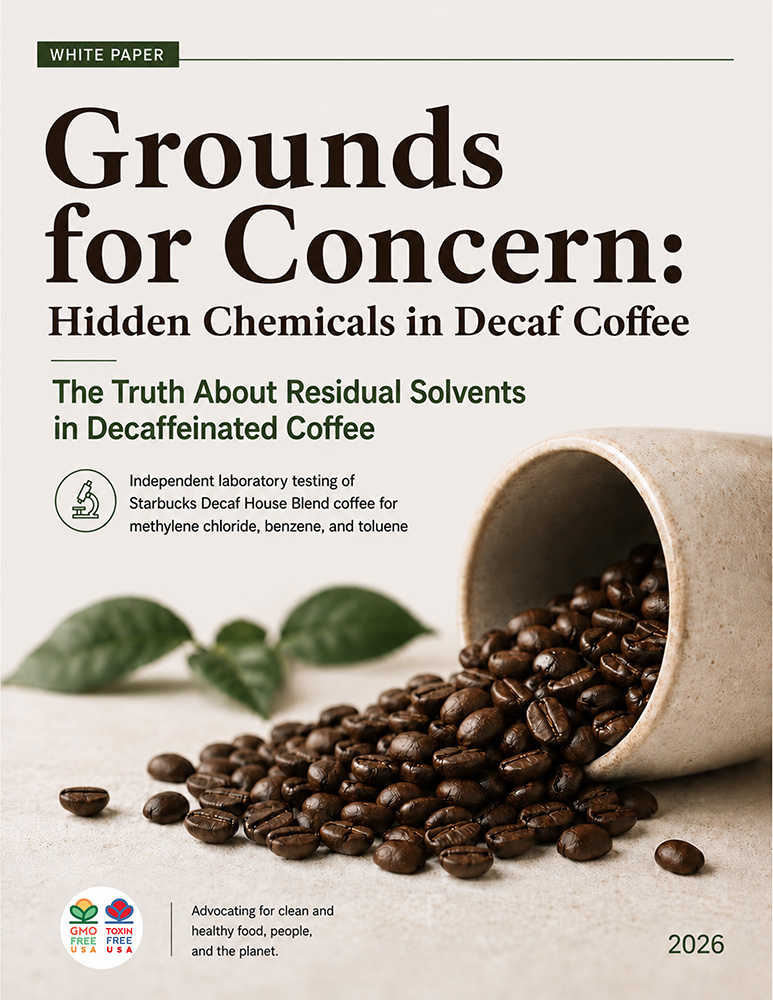
WASHINGTON, D.C., September 29, 2026 — GMO/Toxin Free USA today released a new white paper, Grounds for Concern: Hidden Chemicals in Decaf Coffee, detailing independent laboratory testing that detected methylene chloride, benzene and toluene in multiple lots of Starbucks Medium Roast Decaf House Blend.
The findings come as Starbucks Corporation faces an active consumer class action lawsuit in a Washington state federal court alleging, among other claims, that the company failed to disclose volatile organic compounds (VOCs) and industrial solvents detected in certain decaffeinated coffee products including benzene, methylene chloride, and toluene.
GMO/Toxin Free USA’s independent testing found substantially higher concentrations in two Starbucks lots tested in April 2026 than in a January 2025 lot. Methylene chloride increased from 22 ppb (parts per billion) to 84-89 ppb, benzene from 28 ppb to 159-170 ppb, and toluene from 87 ppb to 375-400 ppb. Testing was conducted through an independent ISO/IEC 17025-accredited analytical laboratory using GC/MS methodology.
The detected methylene chloride concentrations remain below FDA’s current 10 ppm limit for decaffeinated roasted coffee. The white paper identified no coffee-specific federal residue limits for benzene or toluene. Importantly, detection alone does not establish where the chemicals originated or the health risk associated with the concentrations measured.
Still, the chemicals raise significant transparency questions. Benzene is classified as a known human carcinogen, while methylene chloride and toluene have established toxicological concerns. Consumers are generally not told which decaffeination process was used or provided product-specific residual-solvent testing results.
“This is fundamentally a consumer right-to-know issue,” said Diana Reeves, Executive Director of GMO/Toxin Free USA. “If industrial solvent-related chemicals are detectable in a product millions of people regard as an everyday food, and particularly one people may choose for health reasons, consumers deserve transparency. The coffee industry has the analytical tools and alternative processing technologies to do better.”
The pending class action lawsuit similarly focuses on disclosure rather than alleging that Starbucks exceeded FDA’s methylene chloride limit. Plaintiffs seek relief under federal and state consumer-protection claims and allege consumers would have paid less, or chosen differently, had the presence of VOCs been disclosed.
GMO/Toxin Free USA is calling on coffee companies to publish decaffeination methods, routinely test finished products for residual solvents and VOCs, disclose testing results, and transition toward processes that minimize avoidable chemical residues.
Read Grounds for Concern: Hidden Chemicals in Decaf Coffee white paper.
Read the First Amended Class Action Complaint against Starbucks.
"


Considering Starbucks helps support the ongoing genocide in Gaza, I think that's enough to stop supporting them. Never mind the bad coffee. Support local 👍
ReplyDeleteLocal cafes are the tops!
Delete