Showing posts with label Caribbean Islands. Show all posts

Friday, March 13, 2026

Book Review: Holy Radishes

Title: Holy Radishes

Author: Roberto G. Fernández

Date: 1995

Publisher: Arte Publico

ISBN: 1-55885-076-7

Length: 298 pages

Quote: “On the first page was her favorite picture: ‘1940 Yacht Club Dance.’”

This is a novel about Nellie, one of the nightclub dancers in the Yacht Club in 1940, and her family, and why she moved from Cuba to Florida—and why she wants to go back. Nellie has had a long and frankly improbable life, and although, in the kitchen, sometimes she wishes to “turn the bell pepper into Delfina, the onion into Tomasa, and the garlic clove into Agripina,” the person from her past whom she really can’t forget is her pet pig, Rigoletto. People keep telling her different stories about what happened to him and whether he might still be alive. Nellie would never knowingly have hurt her pig but, according to one story, when they all got hungry enough that nobody else could bear to continue feeding him, Nellie ate her share of him with gusto.

Nellie knows her parents are dead, and her husband has an idiotic midlife crush on a gum-chewing girl. What she has left to look forward to is going back to Cuba, and although Cuba has not improved much since she left...this is a comic novel, so you have some idea how it’s going to end.

What you’ll like—if you like it—is the wackiness of this story. People act shamefully and nobly but mostly they act comically. This is not the true story of a Cuban immigrant, nor is it a composite story from several Cuban immigrants. It’s a parable, or a parody, or both. The light down there is tropical, colors seem brighter, birds and flowers and especially insects grow bigger, the reality can be strange and silly enough...but Holy Radishes is over-the-top silly. It’s Macondo redux, Cuban immigrant stories as they might have been narrated by a García Márquez character who’d eaten beans before bed.

What you’ll not like is that those lively bean dreams can be pretty horrific when you think about them, and some of these are. Someone who might have been shot, or declared and then rendered insane, in real Cuba, appears in this novel as having been basically left to die of thirst but then thrown from a tower window onto a rocky beach. Someone who might say ugly things about Cubans or refuse to rent a house to one, in real Florida, appears in this novel leading a pack of scumbags to burn down a whole neighborhood with blazing arrows. It’s funny because it’s cartoonish, like a Dali painting; if this story were remotely lifelike, like a Dali painting, it would be horrible.

Nevertheless, Nellie’s undying love for her pet pig will conquer all in the end. Many find this novel amusing, overall. You might too.

Friday, October 31, 2025

Book Review: Anansi Boys

Some people don't want to sell or promote anything by Neil Gaiman because, although his sexual misconduct wasn't rape, it did harm the marriage he betrayed and the "other woman" he disappointed. This is a valid concern. However, because today is Halloween and because we're all connecting with our Inner Caribbean Islanders this week, I'm reposting this post from the past anyway. Anansi Boys, which became American Gods, was a brilliant feat of folklore/horror/humor. 

Book Review: Anansi Boys

Author: Neil Gaiman

Date: 2005

Publisher: Harper Collins

ISBN: 978-0-06-051519-5

Length: 384 pages plus a preview chapter from Fragile Things

Quote: “As a general rule, the only things properly terrified by the approach of penguins tend to be small fish, but when the numbers get large enough...”

British-American Neil Gaiman begins this novel by acknowledging his debts to “the ghosts of Zora Neale Hurston, Thorne Smith, P.G. Wodehouse, and Frederick ‘Tex’ Avery.” If you try to imagine a novel that this unlikely quartet, or someone who’d tried to learn from each of them, might have written, there is a very slight possibility that you’ll have some idea what to expect from Anansi Boys.

It helps if you know that Anansi is a trickster character in folklore and that “Anansi Stories” is a West Indian name for anything from comic nonsense to outright lies. Anansi Boys is mostly comic nonsense, but it does contain at least one outright lie.

It’s not exactly a horror story, but it does have a few characters who ought by rights to be dead. Mr. Nancy, senior, is a supernatural creature who has chosen to seem dead, temporarily, in order to lend his immortality to his son, Charlie Nancy. Charlie once ignorantly arranged for a witch to transfer his magical qualities into a separate life form, a “long-lost twin” who Charlie decides wasn’t lost enough when he finds his grown-up brother Spider during the course of this novel. As each brother uses what powers he has to save the other, each matures into a complete young man. But there’s also a murder victim whose husband would prefer that she join him in the afterlife, but she insists on staying active as a ghost long enough to punish the murderer.

It’s meant to be nonsense, not religion, but since all “Anansi Stories” are based in a Pagan belief system that conflicts with Christian doctrines, fundamentalists are entitled to barn Anansi Boys from their home.

Banning it may make children more interested in sneaking peeks at it., They will probably “get” enough of the jokes to want to read the whole thing.

I would encourage children not to read this book. You’ll miss too many of the best bits if you’ve not read all the older books that went into Gaiman’s mind to produce this one, and it’s unlikely that you’d have time to read all of them before age 25. Why spoil the suspense by reading the story before you can understand the jokes? Read Coraline, or any of the Discworld books, and save Anansi Boys for later.

There’s less sex and violence in this book than there is in most horror stories, but there’s enough of both to offend some readers. Women who respect their life-giving potential will particularly dislike the character of Rosie, who has always been able to abstain from premature baby-making with Charlie, whom she thinks she loves, but flops into bed the first time she meets Spider and decides that this means she loves him more. (To be fair, at that point in the novel the brothers look identical; Rosie thinks she’s finally giving in to Charlie.) Gaiman spares us the disgusting details and slips this plot element into the story deftly enough, wrapping it up in enough British West Indian slang, that a child reader might miss it...but it’s there. If she’s really in love, guys, she won’t even think clearly enough to bother about birth control! That’s the outright lie. If she really loves you, she’ll protect you from premature fatherhood, just as, if you really love her, you’ll spare her from even having to think about premature motherhood.

On the other hand readers are entitled to appreciate the West Indian-ness of the characters. Their culture, like their genes, is a mixture of Native Caribbean, African, Indian, British, and European influences. Nobody takes much time to analyze what came from where except when, as occasionally happens, someone defies the genetic odds by looking completely “White.” Being financially well off, the characters travel freely among the islands, London, and Florida. Free to be their individual selves, they hold no prejudices (only an occasional individual grudge) and feel some empathy for the less well-to-do West Indians who can’t afford to travel off their native island.

Readers who live in places where they don’t meet people like this in real life will probably want to. I enjoyed being married to one; I enjoyed the memories Gaiman’s characters called back.

There’s also the chuckle factor...Gaiman is the student, former co-author, and novelistic heir of Terry Pratchett, and his comedic style is fully worthy of his teacher and should appeal to all Pratchett fans. Fans of Douglas Adams, Piers Anthony, Sue Townsend, P.G. Wodehouse, and/or Charles Williams may also enjoy this book.

Then there’s the sheer novelty of finding a story in English that sides with the spiders against the birds. You may still prefer birds, but you could still benefit from the mental stretch of identifying with the spiders. 

Bad Poetry: Montego's Monster


The old man remembered of bad hurricanes 
He survived in Florida, in the past, 
How the heat seemed to be crushing his brains 
And might have done it if it could last. 

That, and the wind that roared like the thunder 
And the lightning that flickered like blue-white flames, 
Rain hammering as if paid to push you under 
The floods of the storms given human names. 

Whatever was not built of steel and concrete 
Might as well have been made of mud and thatch. 
Power lines and poles, the grid almost complete, 
Tore off the land like a pasted patch. 

Ports of call on a luxury vacation 
Sing in chorus the post-disaster blues: 
No place has been left for luxuriation; 
The ships will have to continue to cruise. 

Vacationers must be told now that they may go 
Further south to Antigua or Trinidad. 
Montego's income routes to Tobago? 
When Jamaicans say that, we know it's bad. 

Though the three peaks of Trinidad are splendid, 
Though Barbados is rich in scenic beauty, 
Though Aruba has often been recommended 
To those who think seeing the world's a duty, 

Still the sight of a tourist dollar slipping 
Away from Bermuda and on to the south 
Surely turns fresh-caught fish, and the very best dipping 
Sauce, to ash in the businessman's mouth,

As the businessman climbs to his roofless attic 
To empty his storerooms into the street, 
For keeping foods frozen or chilled's problematic 
And they'd better be eaten while fit to eat, 

See Jamaicans standing in cheerful order 
While they wait for their luck in the street below; 
They are not desperados at the border; 
With their usual wit and good humor they go. 

May the oilmen in Port of Spain remember
The source of the growth in their tourist trade,
While the islands to their north spend November
Cleaning up the mess that the Monster made.


Update: In addition to Mercy Chefs, the Red Cross, Salvation Army, ADRA, and Catholic Relief Services are active in Jamaica. They have a good supply of local unskilled labor. Send money.

Despite State's dry response at their official web site...  


...the Organization of American States has a solid social network in Washington. No island will be forgotten. Each island has its own government, its own churches, its own way of dealing with the situation...and its own friends on the continents and on the more fortunate islands. 

This bit of Bad Poetry owes details to many online sources: 

The old man who remembered "what a Category 5 hurricane feels like" was Joe Jackson at theviewfromladylake.blogspot.com. 

The video of Jamaicans cleaning out food storerooms, throwing cold stuff out from windows and in between roofless rafters to people who could use it right away, came from the Oppenheimer Ranch Project on Rumble. 

Photo of broken electric power line in Jamaica: NPR

Photo of damaged building: Al Jazeera

Tuesday, July 15, 2025

Book Review: Holding Fast

Title: Holding Fast

Author: Susan Cole

Date: 2021

Publisher: White Bird

ISBN: 978-1-63363-538-8

Quote: "In a few weeks, we're going to move on Laughing Goat and go sailing."

This is reportedly a true memoir about a family who lived on a sailboat until one of them was lost at sea. It is narrated in a matter-of-fact way, not wordy and wooden like the products of ChatGPT or similar, but not showing any special quality of observation or insight that makes me wish I'd received the whole thing. What I received was a "sample," and if any writers think that sending out the first few chapters of a book is any way to get rave reviews, they are mistaken. I don't want to encourage this form of marketing books that, if published by anyone other than the writer, have not sold well. I will say that I received a "sample," read it, and would guess that the whole book would deserve three stars: not very bad, not extremely good, just the sort of story someone needed to tell for her own friends' and family's benefit.  

Thursday, August 15, 2024

Butterfly of the Week for 8.5.24: Hispaniolan Kite

Eurytides zonaria is called the Hispaniolan (or Haitian) Kite because it is native to Hispaniola island. Most information about it online comes from the half of the island known as the Dominican Republic. It is sometimes found on other northern Caribbean islands and in Florida. It looks almost like a Zebra Swallowtail, only different. 


Photo by Jeimyfilposisa, taken in April in the Dominican Republic.


Photo by Pedrogenarorodriguez, taken in June in the Dominican Republic.

Adult butterflies are primarily pollinators.


This photo by Pedrogenarorodriguez is one of several documenting that zonaria sip nectar from, and thus pollinate, many semitropical flowers. 

It's not hard to find or photograph, but little written information about it has been digitized. The usual bickering has gone on about whether to call it Eurytides, Neographium, or Protographium (and originally it was called Papilio zonaria). Real scientists go out and learn facts about living creatures, and then there are the bores who mooch around at universities quibbling about how they might have evolved out of some other species of living creatures, yeah right. More information is available for ?Eurytides but I checked all three names while writing this post, The IUCN says that it's not known to be threatened, but since it's not actually well known at all, more research is needed.

Papilio zonaria was identified and described, in 1782, as "alis caudatis, nigris, viridi fasciatis maculatisque, posticis subtus linea sanguine." Remarkably little has been added to this description over the years. Walter Rothschild thought some attempts at a more detailed description had confused zonaria with E. marcellinus, E. philolaus, and/or E. celadon, which also have dark wings streaked with a pale color that looks white, blue or green in some lights.

As an example of how poorly known this species is, it's been the subject of one of the great postage-printing errors of all time. The name Eurytides zonaria appears on this stamp...


...though the painter clearly was looking at a completely different butterfly. 

Nicer than some other Kites, these butterflies live in family groups as young caterpillars, and sip water from the same puddles as adults. Mother zonarias don't have to wear themselves out finding a separate host plant for each egg. 


Photo by Jimu96, taken in August. Nobody at Inaturalist was positive about identifying the host plant. 


Jimu96 also found hatchling caterpillars in August. Some are already molting from blackish to brown skins, and that humpbacked look is more conspicuous than it is on some other Swallowtails.

Monday, June 17, 2024

Butterfly of the Week: Jamaican Kite

As we've seen, many Kite Swallowtails look similar to our beloved Eurytides (or Protographium or Neographium or Boreographium) marcellus. Jamaica's Kite species, which is rare, even has a Latin name that celebrates the resemblance: Eurytides marcellinus. To do online research about this butterfly requires searching for both Eurytides and Protographium, though many nature sites use both names and will show on both searches. 

Here, for purposes of comparison, is a display of museum specimens of four Caribbean Kite Swallowtail species that could easily be mistaken for North America's Zebra Swallowtail, but are different. In fact, some experts think marcellus is distinctive enough to belong in a separate genus. Our Zebras can't hybridize with any of these zebra-striped foreigners:


There is, therefore, no excuse for the Fish & Wildlife Service's confusingly listing "Jamaican Kite" as an English name for the Zebra Swallowtail. Marcellinus and marcellus are two different animals; some person more focussed on office politics than on doing good work just confused them at https://www.fws.gov/species/zebra-swallowtail-eurytides-marcellus .

Though marcellinus is an adjective meaning "pertaining to Marcellus" in Latin, it was also used as a name. In the tradition of Swallowtail species names referring to heroes of literature, marcellinus can be said to commemorate any of several characters in Roman history and fiction, including an early Christian. When I searched the Web for information about the butterfly, search engines separated, but kept reminding me of, the Catacomb of  Marcellinus and Peter as a tourist attraction. But nobody claimed that the butterfly name had anything to do with the saint as distinct from other ancient Romans called Marcellinus.


Photo by Vaughn Turland, co-author of Discovering Jamaican Butterflies.

Some lepidopterists have identified this butterfly with Graphium sinon, an Indian butterfly that can look similar. 

By Jamaican standards it's a small Swallowtail, with a typical wingspan barely over two inches.(A Puerto Rican site, noting that some individuals measure three inches or more, calls it a large butterfly. Size is relative.) Jamaica's other native Swallowtail species are much bigger--in fact they include Papilio homerus, the biggest butterflies in the Western Hemisphere. Homerus and marcellinus eat different plants in the same forests and may be seen on the same tours. . 


Photo by Susan Koenig, documenting that some individuals, in some lights, can iridesce as blue as the Blue Kite. Others look white, pale green, or yellow, all with black stripes. On museum specimens, the scales that could iridesce blue, green, yellow, or white fade to pale tan, while the black ones fade to brown.

Jamaican Kites were, like other Kites, overlooked as attention was taken up by the bigger Swallowtails, until people noticed that, due to human population spreading into their breeding territory, there were fewer Jamaican Kites than there used to be. Flying once or twice a year, these butterflies were said to "swarm" in Kingston in the twentieth century. Then they became rare. They are one of the monophagous species that can exist only in strict proportion to their host plants. As native plants were displaced by human habitat, marcellinus became rare, a Vulnerable Species. Turland believes the species' plight is even more dire than "vulnerable" and the species should be listed as Endangered. 


The demand for lances is not great nowadays, so are the little trees on which these butterflies live now considered ornamental, or even "weeds"? No such. They are prized as making ideal props for vines, such as the yam vines that are an important cash crop in Jamaica, and some  people are calling for legal protection for the trees as well as the butterflies.


It's easy for butterflies that breed on one Caribbean island to stray to a neighboring island. Cuban and Puerto Rican species are predictably found on the Florida Keys and might be reared in Florida. Jamaican butterflies are less likely to enter the United States. Nevertheless, the US government has been petitioned to declare marcellinus an endangered species in order to protect any individual butterfly who might manage to reach Florida or Puerto Rico. In 2004 two entomological societies actually went to court to demand that the US Fish and Wildlife Service protect marcellinus and six other "foreign butterflies," none of which FWS has the authority to do much to protect. 


Such petitions have been the subject of serious deliberation; several FWS documents discuss the status of marcellinus. The species meets the criteria for being listed as endangered in the US but its listing was considered to be a low priority, for the United States, because the butterfly does not actually live here. Despite the good international relations that allow frequent travel between the US and Jamaica, Jamaica is still, like Canada, a separate nation. Confusion may have arisen because a place in Jamaica where the butterflies have been found shares the name of "St Thomas" with a different island that belongs to the United States. 

Nevertheless, this PDF is an informative first book on the species despite its lack of illustrations:


Jamaicans, meanwhile, debate how to protect the butterflies' breeding territory on their island. The area where marcellinus is known to breed is near enough to the ocean to be threatened by hurricanes and tsunamis. (If "rising sea levels" were happening, the way Al Gore claimed thirty years ago, this butterfly might already be extinct.) Another area where adult butterflies hang out, and are suspected of breeding, is a strip of forest land known as "Cockpit Country," not from any association with aviation but with unsupervised human activities including making animals fight so that people could gamble on the outcome. Pits have actually been formed in this forest by bauxite mining and, while some human encroachment on the forest reportedly consists of people trying to live on the land, Jamaicans describe the place as dangerous; farmers or hippies just might fall into a pit in the crumbling limestone. Or be pushed, apparently, by those who want to preserve the forest as a place to grow illegal crops. This forest is now reportedly being regulated as habitat for marcellinus and for homerus, with results to be determined. 


Though not quite as blue as celadon, marcellinus is also sometimes called a Blue Swallowtail, or Dark Zebra Swallowtail. It has been found on a few other Caribbean islands, and Puerto Rico has even tried to claim it as "Puerto Rican Kite." Each of those names, however, creates confusion by being used to refer to other species. None of the other species is called "Jamaican Kite" so that is probably the best English name for marcellinus.

The life cycle of marcellinus is weather-dependent, tied to the growth pattern of Oxandra lanceolata. Most butterflies fly in May and June, when this shrub puts forth fresh young leaves. Caterpillars eat a few leaves, then pupate among the leaf litter on the ground below their host plants. If there has been enough summer rain to stimulate fresh leaf growth in October, some butterflies will eclose in October while others wait till next May or June. 

Adult butterflies don't avoid each other and can appear to form loose flocks as several individuals pollinate the same flowers. They have a favorite flower, not lancewood but another Jamaican specialty, but they pollinate several kinds of flowers. Both sexes drink fresh water at puddles. Males are more likely to slurp up mineral-rich fluids from polluted water or fresh dung; this seems to be one of the species in which females occasionally become desperate enough to do a little of this composting for themselves, but normally depend on males to supply minerals to them. (Butterflies' complicated, alien reproductive systems include mechanisms that transfer nutrients to the female along with sperm. Exactly how these mechanisms work, few humans want to know. Anyway the system allows males in many butterfly species,  especially Swallowtails, to do all the dirty work of being composters while females are normally only pollinators.)

Eggs are laid on lancewood leaves, one egg to a branch, and resemble other Swallowtail eggs: tiny beads, just visible to the naked eye. Eggs can hatch within 60 hours after being laid, making this one of the few butterfly species in which parents live to see their own caterpillars, but no special family ties are observed either between mates or between parents and offspring. 

Caterpillars eat lancewood leaves and grow through five instars before pupation. The trees aren't very tall and the caterpillars seem to avoid the very tops, so they are often found at about the height of a researcher's head or hands, 1 to 2m above the ground. They can be less than one inch long, or almost an inch and a half long, in their final caterpillar skins. Their colors vary, being classified as green, brown, or black. Eric Garraway has photos: 


They have osmeteria, the "stink horns" all Swallowtail caterpillars seem to have, but researchers found this species relatively hard to provoke to display their osmeteria. 

Pupation can be completed in a week or prolonged for most of a year. Pupae lie on the ground and respond to rainfall, eclosing quickly if there is any danger of floods, resting in the pupal state if there is any danger that their host trees will not be producing fresh new leaves when they start producing eggs. This weather-dependent state is even more precarious for the adolescent butterfly than pupation is in other species. Even before populations of marcellinus began shrinking, weather conditions produced boom and bust years for this species. Some years many butterflies survived pupation, and some years only a few did. 

So it appears, in the present state of scientific knowledge, that this is a species that could potentially go extinct at any time, in any case. Still, nobody wants to be the agent of this pretty butterfly's destruction. Reporters felt that most Jamaicans are willing to leave the lancewood trees for the butterflies.

Monday, May 20, 2024

Butterfly of the Week: Cuban Kite

There's a lot of movement going on in the online documentation of the genus Eurytides, the attractive yet largely under-documented Kite Swallowtails. I feel a need to pause and make a list. Let's approach the Eurytides as we did the Atrophaneura genus, which was broken up and resorted in a more scientific, less controversial way: we'll discuss the species in as close as possible to their traditional alphabetical order in the genus Eurytides, acknowledging that some of them have been reassigned as we go. Scientists don't always agree on reassigning species to different genus names, and, even on the Internet, sources that used the older names when published aren't always updated. My goal is to include the information that's available at the time of writing.

The Eurytides species list:
agesilaus--discussed 3.18.24
anaxilaus--discussed 3.25.24
asius--discussed 4.1.24
bellerophon--discussed 4.8.24
callias--discussed 4.15.24
calliste--discussed 4.22.24
celadon--our featured butterfly today


Photo donated by XplorMor Intern to Butterflies And Moths Of North America.

...columbus--scheduled for 5.27.24
dioxippus--discussed 5.6.24
dolicaon--discussed 4.29.24
epidaus--discussed 5.13.24
iphitas
leucaspis
marcellinus
marcellus
oberthueri (?)
orabilis
philolaus
salvini
serville
thyastes
zonaria

Then there are the species now classified as Mimoides, some but not all of which were formerly classified as Eurytides

ariarathes
euryleon
ilus
lysithous
microdamas
pausanias
phaon
protodamas
thymbraeus
xeniades
xynias

The Mimoides look different from the Kites, and were separated earlier. It seems reasonable to me to consider them as a separate genus.

The Eurytides appear out of order here because a list from which I was working has been updated  It looks as if the number of scientists who classify several of these species as Protographium is increasing. Today let us consider Eurytides or Protographium celadon. At the time of writing, a search for this species will yield more results for the name Eurytides celadon, but some sites have completely updated all references so that they show only in a search for Protographium celadon.

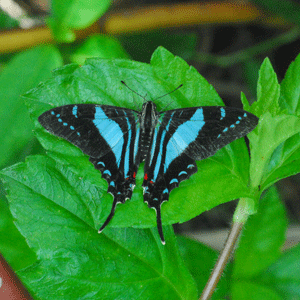
"Celadon" in English is most often used to mean a soft shade of grayish green with a yellow undertone, which makes it seem like an odd choice of name for the Cuban Kite. Newly fledged Cuban Kites' wings are black with bright sky-blue stripes. Like all butterfly wings, they get their color from scales, which actually contain blue color, but the scales wear down quickly; older butterflies are dark drab with white to transparent stripes. Or spots, since the stripes break up on different sections of the wings.


Photo by Wayne Fidler.

The Swallowtail species were traditionally named for characters in literature. "Heroes" was the general theme, but it seems to have been interpreted rather broadly. In Latin literature Celadon was the name of an adversary someone killed in battle. The name came back to people's attention in the seventeenth century as the name of a character in a French roman, who distinguished himself by wearing pale green ribbons, which was how "celadon" became the name of a shade of green. Hippolyte Lucas, who named Eurytides celadon in a study in 1852, might have thought Celadon was a hero though modern critics don't rate either the character or his story very high.

The English name is more logical. The Cuban Kite is found mostly on that island. It has been known to flit to other islands and to southern Florida, but is not established as a resident anywhere else. Though predictably easy to find in Cuba during the flight period of each of the two generations in a year (one official butterfly census counted the Swallowtail population of a park as "8 Polydamas swallowtails, 14 Papilio andraemon, 8 P. caiguanabus, and 53 Cuban Kites"), it can be described as somewhat rare because of its small overall population. Cubans are aware of it as an island specialty and protect some known habitats for the species in nature preserves.


The Cuban government has tried to document all the island's butterflies on postage. Slow-loading because of all the color pictures, but sure to appeal to those who like butterfly paintings, is this catalogue of Cuban stamps and postcards featuring butterflies including celadon


The Cuban Kite is the smallest Swallowtail butterfly in Cuba. It is not an especially small butterfly. Its wingspread of three inches, give or take a centimeter, puts it in the size range with the "smaller" early spring or Northern Zebra Swallowtail. Older butterflies, their colored stripes faded to white, remind US visitors of Zebra Swallowtails. When this butterfly has been reported as a visitor to Florida's mainland, the question always arises how it was possible to be sure that what was seen was not a Zebra Swallowtail, and the last time the butterfly was caught or photographed clearly enough to be accepted as definitely a Cuban Kite may have been in 1945. 

One way to distinguish between older, faded Cuban Kites and Zebras is that Cuban Kites' stripes line up in such a way that the tails on the hind wings are black, while Zebras' stripes line up in such a way that the tails are white. But a combination of fading and iridescence can make even this information hard to rely on in the field, and tails can be lost to predators. Wide incomplete stripes across separate sections of wings, breaking up into "spots," are typical of Cuban Kites. Small red spots can form perpendicular stripes on the underside of the wings. At a close view, the tail section of the body shows black-and-white crosswise stripes, suggesting a bee or wasp, broken up by lengthwise stripes below.


Photo by Tim Norriss. 

Another confusible species is Urania boisduvali, which, unlike Eurytides (or Protographium) marcellus, is found in Cuba and is actually classified as a day-flying moth. Urania boisduvali has long thin stripes that usually seem continuous down the full length of both wings, rather than breaking up into spots. It shares the color combination of black and cerulean blue.

Cuban Kites pollinate several flower species, including wildflowers in the genus Bidens.

Relatively little is known about the life cycle of this butterfly. Eggs are said to be light green and have been found on Nectandra coriacea, a shrub in the laurel family. Caterpillars and chrysalides have not been documented online. Cuban citizens have been prevented from sharing whatever they may have learned about this butterfly. Censorship has always been the great enemy of science. The few scientific papers online that mention it do so only in passing, usually on lists, sometimes in contrast to butterflies whose blue color is produced by iridescent effects rather than pigment as a component of the scales. Eurytides (or Protographium) celadon is known to the world almost exclusively from lucky snapshots taken by foreign tourists.

Friday, February 2, 2024

Butterfly of Week 4, 1.22.24: Battus Zetides, the Caribbean Swallowtail

 A good search engine is impersonal and objective. It may differ from other search engines in the order in which links appear, but all search engines should yield similar numbers of results for any given search term. A good search engine might be programmed to recognize scientific names like Battus zetides as suggesting that someone wants to see science and nature sites above shopping or pop culture sites, but would exclude sites only when the searcher specified--say, if a search term happened to be in use as a brand for irrelevant products, "exclude walmart, costco, target". A good search engine may limit the number of links that display on one screen but does not refuse to display all 100,000 links, if there are that many, so that the searcher can decide which ones are relevant. (For these butterfly posts, for example, I don't want links to sites that traffic in butterfly carcasses, but I might include a link to a poem about a butterfly.) I'm not pleased with Google's search results for Battus zetides.


Photo by Zac Peterson, donated to Argentinat. 

Google says it finds 1,430 results. On the first try it pulls up 107 links. On the second try, it pulls up 130 links. It refuses to go further. A majority of the 130 links are irrelevant and/or duplicates. They're not being meticulously sorted for quality, since they include uninformative lists, one of which seems to be a random list of words beginning with Z, and the resume of a job seeker who once participated in a study of this butterfly species. The results include several less than in-depth "encyclopedia" sites or which the most fact-rich may be Wikipedia. There's a general sense that zetides is considered endangered and protected on Hispaniola island (Haiti and the Dominican Republic), but, for an endangered species, there's remarkably little about either the animals or the protection campaign. The search includes links in Russian, Chinese, and Korean, none of which I can read, but not in Haitian French or Dominican Spanish, both of which I can read. It includes at least ten links to traffickers in dead bodies, although traffic in parts of dead bodies of endangered animals is certainly not helping the animal populations and is usually illegal.

The Yahoo search I did for a more popular butterfly took more than 24 hours and felt exhausting, but the Google search feels more draining in a different way. Insulting. "We can't let non-specialists read anything beyond the ninth grade level!" Maybe the major search engines need to be regulated as the public utilities they're trying to become. "Not only can you show any document that's not classified as a secret to any person who searches for it. You will."  

So much for the search process. On to the butterfly.

Why is it called zetides? Most Swallowtails were named for characters in literature, so who was Zetides? Nobody was. In Greek mythology, in what may have been originally just a poetic metaphor, two sons of the wind god Boreas joined the Argonauts. They went to Salmidessus, where their sister, who had married the king of Thrace, was locked up in prison, and liberated her. Then at Clos, when Heracles went ashore to search for Hylas, they persuaded the other Argonauts to sail without him. Resenting this slight, Heracles met the Argo at Tenos and killed the two "Boreads," Zetes and Kalais. In the sense that sons of a wind god would be breezes, it makes sense. Sort of. Breezes urged them to leave Heracles and sail on, but then Heracles caught up with them, and where were those breezes now?

Anyway, what Spanish speakers call the Caribbean Swallowtail was originally called Papilio zetes, but about the same time this butterfly was described, Linnaeus published something about another Swallowtail to which he gave that name. The Caribbean Swallowtail needed a new name. Zetides was chosen to commemorate its having been named originally after Zetes. It means, of course, Sons of Zetes in Greek. Did the mythological Zetes have sons? The name Zetides has since been given to other animal genera and species, apparently because some people think it's just a good name. This also makes sense. Sort of.

What makes no sense is that the very incomplete Wikipedia article for this species positively encourages the trade in these butterflies' carcasses, "for high prices," rather than presenting information about the butterfly and conservation efforts made on its behalf as if it were a seriously protected species. Haiti, the Dominican Republic, and Cuba are poor nations whose governments have more urgent concerns than conserving insects, perhaps. But any lifeform whose home is on an island can become a tourist attraction--flamingos on Trinidad, large venomous reptiles on Komodo, feral horses on Chincoteague...Why not butterflies in the hill forests of scenic Caribbean islands?

The IUCN suggests that people in poor countries be paid to study butterflies, write about how rare and valuable they are, and then focus the attention of the carcass collectors on the larger specimens with unblemished wings they're likely to get from a commercial butterfly farm. That might help but, seriously, I think those of us who use the Internet need to direct attention a step further in the direction of conservation. Who on Earth would want to fill boxes with nasty decaying carcasses of living things when it is now relatively easy to preserve our memories of them in beautiful photos and videos!


A commercially farmed butterfly that was killed before it could fly, to ensure perfect wings, was still a living animal. Small, with very little brain and a short life expectancy, but nevertheless endowed by its Creator with enough senses and "feelings" to make up for all the rational thought of which it was never capable. It would not have minded being photographed but it probably did mind being killed at the beginning of the ten to forty days Nature allotted to it to flit, sip, and reproduce. We don't even know that it may not have had a beshert whose life's happiness depended on finding it. We do know that photographing butterflies has no particular effect on their lives.

People in Haiti and the Dominican Republic do seem to be thinking about conserving the butterflies and other pollinators. Their thought seems to lack the focus, however, characteristic of people who succeed in monetizing an asset.


There's not (yet) a great deal of information about Battus zetides Out There. Notably, the US Fish and Wildlife Service, in 1994, reportedly came to some sort of conclusion about our federal policy on what FWS persisted in calling "a foreign butterfly." If it's Puerto Rican, it may be unfamiliar in the States, but it's not foreign. The perception that Puerto Rico and the Virgin Islands are still "foreign" places may have had something to do with the species being recognized as threatened, but not protected.

It is primarily a pollinator species.. Butterfly counts attracted more of this species, and others that share its habitat, to bananas or flowers than to rotten fruit or carrion. 


Butterflies' micro-brains don't usually have room for much loyalty to other butterflies, or anything like a group action. There are exceptions to this rule. If predators, or researchers, seem to be attacking one butterfly in a group, Antiopas sometimes charge the attacker as a group, which may startle the attacker or confuse it enough that it releases the butterfly it caught. Swallowtails are not normally that brave, but when males of some species cluster at a puddle to sip water, they all fly up and flap around in a confusing swirl of wings. Tiger Swallowtails are a well-known example of this behavior in the Eastern States. Battus zetides seems to lack this protective social instinct. When a drinking buddy was caught in a net, the others went on drinking..


Males and females usually look alike, with yellow spots on the upper side and multicolored spots on the underside of the wings. Some females, however, have white spots instead of yellow on the upper surface. 


Though big and showy and said to be "quite common, perhaps the msot common species" in the specific neighborhoods where they live, these butterflies remain remarkably little known. Google found a total of two photos of living zetides, both obviously different views of one animal on one day. While its food plants are thought to be two species of Aristolochiai, it's not clear whether that's because people have watched caterpillars mature, or because they've watched butterflies laying eggs.. The field is wide open for islanders who want to learn what the earlier forms of this butterfly look like and how they behave.

Wednesday, January 24, 2024

:Butterfly of Week 2, 1.8.24: Polydamas Swallowtail

As luck would have it, the second butterfly species we're studying behind schedule is another madly popular species. Battus polydamas, the Polydamas or Gold-Rim Swallowtail, is popular because it's eye-catching and because it has a wide range. It's found around the southern edge of the United States and in Mexico, some Caribbean islands, Central America, and South America as far as Chile. Lots of places can claim it as a native species.


Photo donated to Wikipedia by Hectonichus. This individual butterfly came from the Niagara Falls Conservatory. Polydanas don't fly outdoors as far north as Niagara Falls, so it was probably reared indoors, probably on the Aristolochia vine which it's perching. 

And Google aggravated this post. Everyone knows that commercial web sites want to be at the top of a Google search page. The goal is to deliver just enough information, often recycling information that is already widely known, to be classified as offering informative content along with the sales pitch or spyware "cookie." Serious researchers like the author of this unprecedented fact-packed post, therefore, want to scroll through lots of search results and read the handful of scientists' studies that have been published on the topic as well as the Wikipedia page, the "first articles" about the topic, and the pages dedicated to selling products related to the topic in some way. (For butterflies, that includes dead bodies and artistic renderings.) Advertisers have pleaded with Google to slow down the scrolling, to "force traffic" to the top-ranked sites. When I started researching this butterfly, Google seized up, refused to scroll smoothly through the first few pages at least, stuck on the second screen full of heavily advertised links with the pages for polydamas-inspired junk jewelry, and thereby drove me to finish the search on Yahoo. Yahoo's search algorithm proved to be less corrupted, delivering fewer duplicate links and more scientific studies/ Well...a manipulative web site is a dead web site. I expect Google to recover quickly after showing the advertisers how much traffic the effort to "force traffic" will cost them, but then again it's hard to overestimate the stupidity of people who want to be "gatekeepers" to human thought.

Google advertisers need to face reality. When people want information about butterflies, or anything else, we are not especially interested in junk jewelry. A blog post like this one might note as a sign of the butterfly's popularity that people do make and sell polydamas-inspired jewelry, but we're not going to buy or sell it. So, advertisers, kindly move your little pushcarts out of the way while we gather the fun facts that might conceivably make some reader, somewhere, recognize polydamas when person sees your junk jewelry in a store.

From a Google search...some butterflies are very obscure, and there may be only a handful of search results with two or three worthwhile links. For popular, well documented species like this one, from Google I'd expect about 200 results, 50 to 100 of which would be multiple links to the same few pages. From Yahoo I got 400 results with only about 20 duplicate links. Lots more links, photos, and videos to encourage butterfly enthusiasts and torture insect-phobics. More writing time, of course, also.

Of course, some of the links on which I clicked aren't scientific. One that's strictly for entertainment solemnly informs people that, if you see a black butterfly, you will have a sleepless night, probably because you're under stress, probably about money. Say what? I knew and loved black butterflies before I knew what money was, and the correlation between my seeing the black Swallowtails (and their mimics the Red-Spotted Purples) and my working at night is either zero or negative, I'm not sure which. The writer goes on to suggest that black butterflies might be a good omen of reconciliation among family members (a little push in the direction of niceness can't hurt, right?), or a sign that you're handling aging well (a "Barnum interpretation" if ever one was--I suppose, actually, four- and five-year-old children do handle aging well). 


Black butterflies aren't usually the ones that alight on people, and if they do, although a few black butterflies are males who like the taste of human sweat, what it's most likely to mean is that you've got something sweet and fruity on your clothes. If you cut off half-rounds of melon and eat them out of your hands, you're likely to attract black butterflies, along with less lovable animals such as ants. If you try eating a sweet tree-ripened Florida orange out of your hand, the way you might have learned to eat drier gas-ripened oranges shipped further north, that's another way to find any black butterflies who might be in the neighborhood. The general rule about Swallowtails is that females are pollinators who leave only flower pollen on your hand, while males are composters who may leave anything. How can you tell the males from the females? Black butterflies are more likely to be females, in many places, but in species like polydamas the males are black too. When a butterfly of any color alights on your hands, lets you admire its beauty for a few seconds, and then flits off, this is a sign that it's time to wash your hands.

Battus polydamas is so popular it's appeared on postage: 


Linnaeus and his contemporaries liked naming species after heroes of ancient literature. Depending on which genre of ancient literature you prefer, Battus commemorates either an ancient king, from history, or a shepherd boy who basically did what employees are usually advised to do today and found that the ancient Greeks didn't appreciate the same pattern of behavior that modern employers do, from mythology. 

What about Polydamas? The name is one of those two-part inventions that were popular in much of ancient Europe, from poly, many, and damas, to tame animals, or tame animals, or specifically cattle. In the Iliad Polydamas was a Trojan officer who urged his people not to attack Greece, but they did, and he fought bravely anyway--sort of like General Lee, except that Polydamas was killed in the battle. Another Polydamas in Greek literature was a legendary strongman, like Samson, said to have killed a lion with his bare hands, lifted a bull, and died trying to stop a rolling boulder.


Digitized image of Linnaeus' words from Lepiforum.org.

Battus polydamas was first described by Carolus Linnaeus himself. It's a large tropical butterfly, wingspan three to five inches. Though part of the Swallowtail "family" of butterfly species, it has no "swallowtails" on its hind wings.  Males and females look alike; females are larger than males, on average, but individuals vary. Generally eggs are yellower, and caterpillars have fatter bodies and smaller tubercles, than philenor.

Polydamas is a low-altitude species, usually found near its host plants. Some of the Aristolochias it eats grow on relatively open land; others climb up tall trees, but polydamas is generally found in more "open" forests rather than dark, dense growth. Females spend most of their adult lives flying around vines, looking for the best places to lay eggs. 

There are considered to be 22 subspecies--some common, some rare, some possibly extinct. The individual butterflies don't flit through their entire range; they tend to stay put and evolve distinct characteristics in each of their habitats. Some of the subspecies are, of course, better documented than others. They have different patterns of spots on the undersides of their wings; the subspecies lucayus, found in Florida and south Georgia, has similar markings on the upper and lower sides of its wings.. Wikipedia filled in photos for two of the subspecies below; I found a few more, but at least one subspecies, antiquus, never has been photographed, and probably never will be. 

That antiquus ever existed is believed entirely upon the credibility of Dru Drury, an eighteenth century Englishman who drew clearly colored pictures of it. The thinking is that Drury drew pictures only of what he'd really seen, so if he drew a picture of a polydamas that didn't quite match any living butterfly since his time, there must once have been a subspecies that looked just like what Drury drew, and it must have gone extinct.

"
Photo by Lorenzo Vega. The site using this photo online, https://www.mhnconcepcion.gob.cl/noticias/mariposa-de-la-oreja-de-zorro
 , uses archidamas and psittacus as synonyms.
Here's a video showing one of these Chilean butterflies flitting and sipping:
  • B. patahualpa Racheli & Pischedda, 1987 – Peru
Full description with large clear photos of museum specimens: 

Photo donated to butterfliesofcuba.com by Tim Noriss.
  • B. p. dominicus (Rothschild & Jordan, 1906) – Dominica
  • B. p. grenadensis (Hall, 1930) - Grenada, possibly southern Grenadines
Photo donated to Butterflies of America by Tom Bentley, who notes that this rather worn individual was found on Tobago.
{jptp
B. p. jamaicensis, Jamaica
  • B. p. jamaicensis (Rothschild & Jordan, 1906) – Jamaica
  • B. p. lucayus (Rothschild & Jordan, 1906) – Florida, Bahamas

Photo by Holly Salvato donated to Inaturalist.org.
Photo donated to butterfliesofamerica.org by Sheridan Coffey.

B. p. polydamas, Southern Amazon, Brazil
  • B. p. polydamas (Linnaeus, 1758) – tropical Central and South America
  • B. p. psittacus (Molina, 1782) – Chile, Argentina

Photo donated to Inaturalist.org by Sebastianvanzulli, who notes that it was taken in Chile in November.
  • B. p. renani Lamas, 1998 – Peru


Badly faded museum piece photographed by Gerardo Lamas for Bufferflies of America.
  • B. p. streckerianus (Honrath, 1884) – Peru

Photo by Dbeadle, who holds a copyright and wants payment if his photo is used for payment. Many of the fair-use photos here are subject to copyright if used in paid work. That's why the cost of publishing this series as a printed book would be prohibitive and why I've opted for "personal use" on my personal blog, primarily for the benefit of The Nephews, instead. You may print off your own copies, but don't sell them.
Photo donated to Butterflies of America by Alejandro Sanchez.

Badly faded museum specimen photographed by Gerardo Lamas for Butterflies Of America.
  • B. p. xenodamas (Hübner, 1825) – Martinique[4]
  • B. p. weyrauchi Lamas, 1998 – Peru[3]
"

Although some subspecies have probably gone extinct, the species as a whole is considered to be "of least concern." The distinctive mutations that produce subspecies may or may not recur. 

Trying to attract polydamas to the garden will generate controversy if you're guided by the video linked below. The young man proudly points out dozens of eggs and tiny caterpillars on the exotic pipevine, Aristolochia grandiflora. It has a much larger and stronger-smelling flower than the native Aristolochias the other butterflies in the Troidini group can eat. As the man observes, the big, dark red flower on grandiflora smells like carrion. It looks like dead meat, too; to my eyes it's not beautiful at all. He doesn't find any of the full-sized caterpillars. That may be because the cool weather he mentions has simply encouraged all those eggs and baby caterpillars to hatch a week later than he expected. However, exotic Aristolochias will attract other insects (not all of them Swallowtail butterflies) that eat native Aristolochias, and this confusion may lead to sick or dead native insects.


According to https://butterfly-fun-facts.com/gold-rim-butterfly-battus-polydamas/, both Battus species can eat the Aristolochia species fimbriata, pandurata, and trilobata. 

As bugoftheweek.com observes...


"
Members of the pipevine family, such as the strange pelican flower vine, are too toxic for some Battus species to consume as larvae, but not so for rugged caterpillars of the Polydamas swallowtail.
"

The member of the pipevine family that's too toxic for the other Troidini is A. elegans, which looks similar to A. grandiflora. Battus polydamas' various subspecies eat a wide variety of Aristolochias and can live on species that aren't harmful to Battus philenor or other native wildlife.

This post explains (in Portuguese; thanks to the pan-Europeanism of scientific jargon, it can be read as if it were Spanish) how the Aristolochias depend on Swallowtails as pollinators:


Aristolochic acid is not the caterpillars' only defense. Although it's toxic, at least three caterpillar-eating animals--carpenter ants, assassin bugs, and domestic chickens--do not immediately notice its toxicity and will eat things contaminated with aristolochic acid that otherwise taste good to them. Chickens and carpenter ants will eat another young, small polydamas caterpillar after having eaten one, but not another full-sized one. Other biochemicals make the older caterpillars even more disgusting, such that chickens and carpenter ants will leave them alone. Assassin bugs will go after even full-sized caterpillars. No lifeform's natural defense is perfect.


Although it's usually bigger and looks completely different from the typical United States specimen of Battus philenor, some of the South American subspecies of philenor are larger and can look more like polydamas, and crossbreeding is possible, though very rare, The "Coeruloaureus" butterfly ("sky-blue-and-gold") is one of the few hybrid animals known to occur in nature without human help. If you see one, snap photos and save them to show your grandchildren. Somebody offered a dead crossbreed for sale, claiming that it was "probably unique." This web site, of course, recommends never paying for dead butterflies or parts thereof. We should not encourage desperate students to contribute to local population or subspecies extinction.

In Chile, for reasons that continue to baffle scientists, the subspecies archidamas and/or psittacus and their host plant, Aristolochia chilensis, go through regular population irruptions. When the population reaches a critical density, every few years, the butterflies apparently attempt to migrate across the ocean. This migration is doomed. Though individual butterflies may be bigger than some Monarch or Mourning Cloak butterflies, they are still only Swallowtails. They fly a short distance out to sea, then collapse into the water and may wash up on beaches if the tide is coming in. While this lemming-like behavior clearly functions to regulate population, humans will probably never know whether the butterflies' last thoughts are that better food is available elsewhere or that they're escaping predators...


People who had heard that some of the Aristolochias are used as medicine, but observed that the tropical species in this plant genus tend to be too toxic for medical use, have tried extracting the medicinal properties of aristolochic acid from the caterpillars. The caterpillars were pickled in rum, which was then given to patients. The brew was sold under the name "Chiniy." However, its use and sale is now banned as likely to do more harm than good. In addition to its unpleasantly overstimulating immediate side effects, which range from heart palpitations and nausea to spontaneous abortion with hemorrhaging, aristolochic acid is known to damage the kidneys and believed to contribute to the growth of cancer in humans.


Perhaps the surplus butterflies in Chile could be studied for clues that might help humans resist cancer? Valeria Palma thinks so:


Researchers have found it possible to rear and breed these butterflies on synthetic food. The caterpillars do seem to have some biochemical ability to "detoxify" aristolochic acid, although this study emphasizes that much remains to be learned about whether this process will ever be useful to humans:


Other studies of the biochemistry of Troidine digestion and metabolism have been done. Some are old enough to be available online free of charge; some are new enough that only abstracts or first pages are available free of charge. Nothing of great importance to medical science has been learned yet, but it's a topic medical students might want to follow.

A detailed study of the life cycle of Battus polydamas cubensis is free for the downloading from 


This quick study shows how to tell polydamas from philenor. Briefly: eggs and caterpillars are easy to distinguish, pupae are not, adult butterflies are hard to confuse.


Like many other Swallowtails, these butterflies catch the eye by being active and moving fast as well as by being large and colorful. Males show off their energy by trying to fly higher and faster than one another or than females they are trying to impress. Fortunately for the males, egg-loaded females seem easily impressed. They mate back to back, but sometimes one butterfly gently enfolds the other's wings between its own. In available photos, the female seems to embrace the male, which may serve the purpose of checking his scent-releasing behavior. While flying around the female to show off, the male polydamas releases the distinctive odor of his species. His scent folds are only about a millimeter across. That's enough to prove his species identity. Female polydamas like Aristolochia and Lantana flowers, which also smell rather off-putting to humans, and they probably like their mates too--but enough is enough of anything.

Although the size difference is not necessarily great, butterflies are light. If a couple are disturbed during their moments together, the female can carry the male to a more private place. One of the few things these butterflies do that stop them fanning and fluttering their wings is snogging, sometimes for hours. 

Eggs are often laid in small groups. While many large caterpillars need a whole plant to themselves, in the tropics Aristolochia vines grow fast enough to survive having their leaves stripped by a family of very hungry caterpillars. Females seem to be in a hurry to lay their eggs, and can afford to drop ten or fifteen in the same place, a luxury many Swallowtails don't share. They look for tiny, fresh, new leaves and stem ends. By the time the caterpillars hatch, the fast-growing leaves will be big enough to hold them and still soft enough for baby caterpillars to digest.

The butterflies have an imperfect instinctive sense of which host plants are best for their young. As noted above, this is not the most survival-intelligent animal on Earth. Probably feeling some urgency to unload fast-developing eggs, they may place eggs on species of Aristolochia that will not adequately feed their caterpillars. They do recognize and prefer the optimal species, but so do the caterpillars. One can imagine a butterfly rationalizing to herself--if butterflies think so far ahead--that the caterpillars can live on an inferior host plant long enough to recognize its inferiority and crawl off to find better food...Such, of course, is not always or even often the case. A malnourished caterpillar's chance of finding better food is even lower than a healthy one's. Older caterpillars do, however, move out on their own and sometimes find better host plants than they left.


The VolusiaNaturalist blog has a full photo essay of the life cycle of polydamas lucayas, but the close-up of an egg being laid is probably unique.


Like other eggs of butterflies in this genus, the eggs look like little round beads, textured with drops of aristolochic acid that discourage predators. The eggs shown below were about to hatch.


Photo donated to Inaturalist.org by Jan Dauphin, who also photographed hatching caterpillars: 


The Dauphins' photo essay shows the life of an individual butterfly, probably Battus polydamas polydamas, reared in captivity near the Rio Grande: 


Although they eat their own shed skins, they seem to hatch with enough social instinct not to try to eat their siblings' skins. While they're small enough to share leaves, they are one of several butterfly species in which the caterpillars instinctively line up in a row. Touching sides may feel pleasant to the caterpillars; it also increases the chance that predators may mistake them for something harder to eat. As they grow bigger, they separate so that each one can eat a leaf of its own. Like all Aristolochia eaters, these caterpillars have three other defenses: they are toxic and apparently taste nasty to most creatures that eat them, they are creatively ugly, and they smell like their host plants' flowers. Swallowtail caterpillars can aggressively release a whiff of carrion by displaying their osmeteria, the "stink horns" at the back of the head that come out when the caterpillars feel threatened. 

The chemicals in the odors have been analyzed, and this species' osmeterium has been dissected under an electron microscope.


Caterpillars in groups are more likely to evert the osmeterium and merely stink at researchers who pester them. Caterpillars feeding alone are more likely to thrash their heads about in a threat display (they can't bite humans hard enough to do more than vent their emotions), during which the osmeterium may also be everted. See Week 1's joke about the benefits and costs of being en entomologist.


Photo donated anonymously to butterflyidentification.com, which states that these caterpillars mature through only four instars (changes of skin) and spend about three weeks being caterpillars. Other sources mention that while some caterpillars can pupate after four larval instars, others go through five, six, or even seven caterpillar skins before pupating. In sexually dimorphic moth and butterfly species, where the female is larger or only the male has wings, caterpillars of one sex may take an extra instar to develop, but the purpose of polydamas' range of variation is unclear. Since each additional instar lasts five or six more days, and siblings thus pupate and eclose ("hatch" from the pupa as adults) at different times, there may be an overall survival advantage in allowing some individuals to pupate through periods of less favorable weather, or allowing generations to overlap may promote genetic diversity.

Cisternas, Rios, et al., studying these caterpillars, suggest that longer juvenile lives may be normal for the species, and touch may speed up their development. As with philenor, the mother butterfly may lay her first few eggs in bunches, later eggs by ones and twos. Caterpillars who grow up alone and are undisturbed may mature through more instars, while those who grow up in groups and/or are disturbed may find themselves rushing through adolescence to reproduce earlier. The size of pupae did not seem much affected by the time the caterpillars took to reach pupation. If pupating within three weeks after hatching, going through only four instars, is normal for the species, then more instars and another week or two as caterpillars seem to add nothing to species survival. If, on the other hand, spending five or six weeks as caterpillars is normal for polydamas, the ability to reach "mature caterpillar" size and pupate as early as eighteen days after hatching is a remarkable adaptation. Passing through more vulnerable life stages more quickly would presumably allow more individuals to mature and reproduce. The entire life cycle can be over in forty days or fewer, or can last for several months if the individual matures slowly and pupates through a cool season.(It does not survive in places where temperatures drop below freezing.)


However, being closer to one another increases vulnerability to internal parasites. Battus polydamas can be parasitized by microorganisms in the genus Perissocentrus. So, a mix of faster-maturing, "chummy" caterpillars and slower-maturing, solitary caterpillars may provide the optimal balance for species survival. Interestingly, both "good touch," the presumably reassuring sensation of being close to siblings, and "bad touch," being harassed by potential predators (from the caterpillars' point of view, humans fondling their soft little horns undoubtedly seem like predators), seem to stimulate accelerated growth.

The caterpillars' ability to speed up their growing time depends partly on diet; this study found that, between caterpillars reared on only one of the Aristolochia vines that grow in Chile and caterpillars given a choice of both food species, the caterpillars given a choice pupated earlier, were more likely to survive, and also--for whatever this may be worth to them--had larger heads.


All this may have something to do with one of the anomalous facts about these butterflies. The usual rule is that the length of the caterpillar is close to the wingspan of the butterfly or moth, but several species are exceptions. Polydamas is one; while adults' wingspans are almost always over three inches, the stubby little caterpillars grow only a little over two inches long.

Diet shapes the caterpillars' development but its precise effects remain unclear. They can eat flowers as well as leaves of their host plant; they tend to strip plants, which then grow back quickly. 
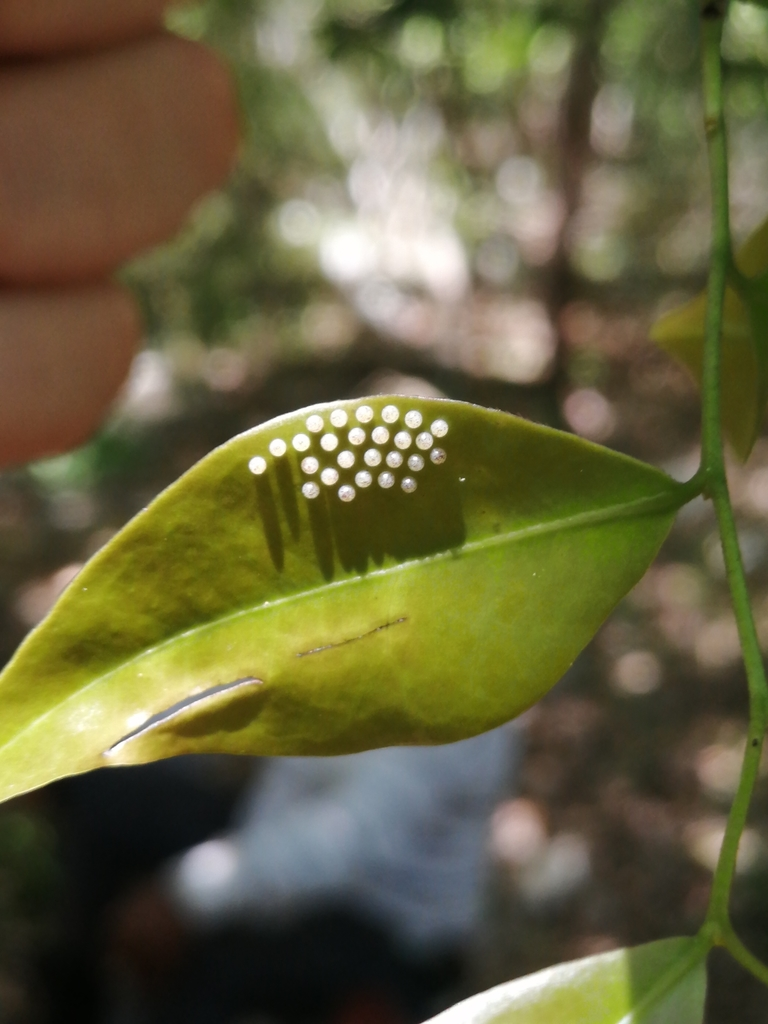

Photo donated to ButterfliesAndMoths.org by Deb Peterson.

Pinto, Troncoso, et al. found that a diet higher in aristolochic acids consistently produced bigger caterpillars with a lower mortality rate. They mention their research subjects' sixth instars but did not study whether extra instars are promoted by a richer diet, or how or whether extra instars may benefit individuals or the species.

Gonzalez-/Tauber et al. speculate that overall climate warming might benefit Battus polydamas archidamas


(Though archidamas has sometimes been regarded as a separate species, it's also often regarded as the same subspecies as psicttacus.)

Isis Meri Medri has posted a video of a caterpillar tidily eating its shed skin. Not for the squeamish.


In the fourth instar the tubercles (warts) behind the head grow longer and look like little horns, but don't become tentacles the caterpillar can use to find the freshest part of a leaf, as philenor does. Polydamas caterpillars grow bigger than philenor and have shorter "horns." The horns can be moved and can be turned down but are not tapped along the surface as the animals walk. 

In addition to the "horns" one pair of tubercles on the side, toward the end of the caterpillar, grow long enough to be moved independently. This video shows these tubercles twitching aimlessly, apparently as part of the caterpillar's body movements as it nibbles off the end of the plant. Do they help the caterpillar find tender leaves by tapping the surface on which it walks, as philenor's tentacles do? 


As the caterpillar crawls over the researcher's hand in this video, it lifts its head and looks about every few steps, while the extended tubercles toward the rear tap the surface of the hand.


Caterpillars' colors can vary. In lucayus most caterpillars are black with orange-tipped warts, and the lighter-colored caterpillars are lighter brown rather than bright red. However, they have a pattern of striation, which can be hard to see on dark brown or black individuals. This individual from Costa Rica is purple, white, and gold.: 


A white morph is documented in Peru in this study (written in Spanish only): It can be cream-colored with beautiful, subtle streaks of reddish brown, or even pink with streaks of red.


Ecos del Bosque notes that this purple-white-and-gold individual was found on a citrus tree not far from an Aristolochia vine. They can't live on citrus leaves but may, like philenor, intentionally leave the plants on which they are feeding and rest somewhere else, where they think predators won't look for them. Like the adults, fourth-instar and older caterpillars can find their way back to their food plants by scent.


A blog dedicated to showing off unusual "smartphone" photos shows the caterpillar approaching the bizarre flower of Aristolochia chilensis


The pupa can be greenish or brownish and looks as if it might be a dead leaf, at least until the butterfly inside starts to show through. Pupation often lasts less than three weeks.


Photo by Pedrova (Pedro Vargas) at inaturalist.org. 


Photo donated anonymously to butterflyidentification.com.

Natural selection favors pupae of different colors in different climate conditions, as the green ones are better camouflaged against green plants, the brown ones against dry ground. This creates another balance of benefits between traits for Chilean polydamas, whose host plants live in places that become desertlike for part of the year.


Adult butterflies are usually thought to fly for two weeks or less, though some sources think they may occasionally live longer. At the ends of its range, this species has two or three distinct generations each year--April to November in the United States, September to March in Chile. Near the equator it is active all year, with overlapping generations.