Showing posts with label disaster. Show all posts

Friday, October 31, 2025

Bad Poetry: Montego's Monster


The old man remembered of bad hurricanes 
He survived in Florida, in the past, 
How the heat seemed to be crushing his brains 
And might have done it if it could last. 

That, and the wind that roared like the thunder 
And the lightning that flickered like blue-white flames, 
Rain hammering as if paid to push you under 
The floods of the storms given human names. 

Whatever was not built of steel and concrete 
Might as well have been made of mud and thatch. 
Power lines and poles, the grid almost complete, 
Tore off the land like a pasted patch. 

Ports of call on a luxury vacation 
Sing in chorus the post-disaster blues: 
No place has been left for luxuriation; 
The ships will have to continue to cruise. 

Vacationers must be told now that they may go 
Further south to Antigua or Trinidad. 
Montego's income routes to Tobago? 
When Jamaicans say that, we know it's bad. 

Though the three peaks of Trinidad are splendid, 
Though Barbados is rich in scenic beauty, 
Though Aruba has often been recommended 
To those who think seeing the world's a duty, 

Still the sight of a tourist dollar slipping 
Away from Bermuda and on to the south 
Surely turns fresh-caught fish, and the very best dipping 
Sauce, to ash in the businessman's mouth,

As the businessman climbs to his roofless attic 
To empty his storerooms into the street, 
For keeping foods frozen or chilled's problematic 
And they'd better be eaten while fit to eat, 

See Jamaicans standing in cheerful order 
While they wait for their luck in the street below; 
They are not desperados at the border; 
With their usual wit and good humor they go. 

May the oilmen in Port of Spain remember
The source of the growth in their tourist trade,
While the islands to their north spend November
Cleaning up the mess that the Monster made.


Update: In addition to Mercy Chefs, the Red Cross, Salvation Army, ADRA, and Catholic Relief Services are active in Jamaica. They have a good supply of local unskilled labor. Send money.

Despite State's dry response at their official web site...  


...the Organization of American States has a solid social network in Washington. No island will be forgotten. Each island has its own government, its own churches, its own way of dealing with the situation...and its own friends on the continents and on the more fortunate islands. 

This bit of Bad Poetry owes details to many online sources: 

The old man who remembered "what a Category 5 hurricane feels like" was Joe Jackson at theviewfromladylake.blogspot.com. 

The video of Jamaicans cleaning out food storerooms, throwing cold stuff out from windows and in between roofless rafters to people who could use it right away, came from the Oppenheimer Ranch Project on Rumble. 

Photo of broken electric power line in Jamaica: NPR

Photo of damaged building: Al Jazeera

Monday, December 9, 2024

Bad Poetry: The Adventure That Did Not Happen

In another life I'd married one who always loved the land,
And we went to see the damage done by southern weather's hand,
And we towed a trailer rattling with tools of construction work
In a caravan of other people who thought shame to shirk,
And we did for damaged houses all that one clear week could do,
And were home again for parties others had looked forward to.

In real life he's dead, and people said, "If some are still in tents
The chances are that drink and drugs have eaten up their rents,
And in any case our shopping's done, and all our money's spent;
Let us settle down to celebrating, as God clearly meant."

And they may be right. They spent their money where it did some good.
Let them light their Christmas fires; there is plenty of dead wood.
And the worst thing about living in this grand historic State
Is that folks in the adjacent states think that we think we're "so great."
And nobody else but me has kinfolk living to our south,
And mine are farther east than that, so I will shut my mouth.
The shoe was on the other foot some forty years ago.
It may not be again for forty more, for all I know.

Monday, September 24, 2018

Morgan Griffith on WOTUS

WOTUS? Wot wot? U.S. Representative Morgan Griffith identifies wot's wot with WOTUS:

"
Cutting Red Tape
Our part of Virginia understands the damage that can be inflicted by excessive regulation. The War on Coal was largely waged in this manner, as the Obama Administration’s Environmental Protection Agency (EPA) imposed layers of rules providing no benefit to the environment but imposing massive new costs on the coal industry.
The coal industry is not the only subject of overzealous regulation. After Hurricane Florence, I toured Floyd County to see flood damage with Sheriff Brian Craig and Board of Supervisors Chairman Lauren Yoder.
I was reminded that under the Obama Administration’s Waters of the United States (WOTUS) rule, it appears that the EPA and the U.S. Army Corps of Engineers would call the shots over much of Floyd County as well as other mountainous farmland areas. WOTUS covers lands such as dry branches, puddles, and areas that get waterlogged after prolonged rain, whether they are flooded or not. This is the type of power that unelected bureaucrats have currently.
The numerous, arcane rules issued by the “alphabet soup” of federal regulators have enormous consequences for small businesses, from the restaurants to the nursing homes to the farms of our communities.
The costs of compliance are considerable, and penalties and fines for infractions, even those committed without ill intent, often far exceed the seriousness of the violation.
A local restaurant has been forced into Chapter 11 bankruptcy for an infraction the owners didn’t understand and did not profit from. Other businesses have been fined hundreds of thousands of dollars for relatively minor infractions.
These types of unreasonable penalties suppress economic growth and kill jobs. They do not protect employees or clean up the environment. So the House of Representatives and the Trump Administration have gone to work cleaning up the federal rulebook.
I’ve been working on a bill that targets a textbook example of counterproductive regulation: the EPA’s New Source Review (NSR) permitting program.
NSR definitions require owners of certain factories and power plants to obtain permission when they want to upgrade. No one wants air pollution, but NSR’s burdens deter facility owners from making improvements that would actually reduce emissions. This state of affairs hurts jobs and economic growth while doing nothing to protect the environment.
My bill, the New Source Review Permitting Improvement Act of 2018, clarifies the rules so that upgrades to existing facilities would not need NSR permits unless they increase emissions. Businesses would have more certainty in planning for the future. They would be better positioned to invest in technologies that promote efficiency and reduce pollution. It’s a win for them and for the environment.
The New Source Review Permitting Improvement Act of 2018 passed the Environment Subcommittee in July, and I look forward to further action in promoting this commonsense regulatory reform.
Part of the problem with regulation is that the executive branch has grown accustomed to writing the rules without interference from the other branches of government. By reclaiming their authority, the legislative and judicial branches can check unneeded regulations.
The House has acted to fix a bad Supreme Court ruling that gave wide latitude to the executive branch. The ruling in the case Chevron U.S.A. Inc. v. Natural Resources Defense Council, Inc., decided in 1984, declared that courts should accept an agency’s interpretation of federal law if the law is worded ambiguously and the interpretation is reasonable.
The practice of “Chevron deference,” as the ruling’s effect came to be called, effectively gave the executive branch broad new authority to write regulations.
Subjecting regulations to judicial review would force the executive branch to observe more closely the intent and language of laws passed by Congress. Regulations would have to respect statutes passed by the people’s representatives rather than the wishes of unelected bureaucrats.
I am an original cosponsor of a bill to end Chevron deference, the Separation of Powers Restoration Act. Its language was included in a bill I supported when it passed the House, the Regulatory Accountability Act, which included numerous other regulatory reforms.
This Congress was also the first to use the Congressional Review Act repeatedly to undo excessive regulations. Before 2017, the act had only been used successfully once; during 2017-18, it was used successfully sixteen times.
Some Ninth District manufacturers have told me that regulatory relief in particular contributes to their success. Along with tax cuts, regulatory reform has fueled job creation and economic growth.
If you have questions, concerns, or comments, feel free to contact my office. You can call my Abingdon office at 276-525-1405 or my Christiansburg office at 540-381-5671. To reach my office via email, please visit my website at www.morgangriffith.house.gov. Also on my website is the latest material from my office, including information on votes recently taken on the floor of the House of Representatives.
"

Wednesday, September 19, 2018

The Edge of Extortion (Updated): How Florence Hurt Inland Virginia

(Updated for those who read all the way down and wanted to know: Yes, someone "voted" to keep me and the cats on the grid. I'm glad. I'm even grateful, which is a horrible feeling to have toward a fellow mortal; gratitude, like worship, should be directed toward God. We should show gratitude for our fellow humans by repaying the nice things they do for us. And yes, I have a workable plan in mind for doing that; you know who you are and what the plan is.

I'm still not pleased with the outcome. I still want the companies to be required to appreciate customers. Not only should all property owners have a legal right to get ourselves off the grid, at least for our primary energy requirements, as fast as possible; not only should companies be required to meet our private requirements for any use we may allow them to make of solar, water, or pedal power generators on our property; but also, allowing a reasonable amount of time, the companies need to be making steady progress toward relying on our surplus private energy supply rather than on dams or coal-burning plants as a primary energy source for everyone. We may always need the companies and a few of the big unsustainable plants they've built, but we don't need them as much as they've tried to make people think, and they should be forced to acknowledge continually that they need us.

Not only do I agree that people should stop using electricity before they run up bills they can't pay; I'd be in favor of people's being able to shut off their own main switches, at that point, without the company sending anyone out. No kilowatts flowing into the house, no mounting bill! But I'm opposed to the companies being allowed to charge extra fees, especially when the fee is more than twice the amount of the unpaid bill, for disconnecting people's electricity. It does not cost $50 to flip a switch, nor should companies be allowed to think in terms of "punishing" the customers on whom their existence depends.)

Hurricane Florence came and went, with none of the melodrama associated with the word "hurricane," but a lot of rain. Two feet, about 0.6 metres, of rain is bad enough in low-lying ground, but as the rain moved west, more of it poured down over the East Coast. A lot of buildings got wet. Damage was done to the power grid.

What do our beloved utility companies do in this kind of situation? They finance rapid restoration of service, in a weather emergency, by creative billing techniques.

The biggest electricity bill I ever got was the "estimated" bill for a month during most of which there was no grid-based electric power in Scott County. When I went online that winter, I went online from Kingsport. I received a bill for approximately four times my average bill for months when I'd been using refrigerator and water heater and all. I paid up, complaining vigorously, and received a refund a few months later. I knew the money had been used to bring in laborers up from Atlanta, down from Cleveland, to clean up cables that were buried under a foot of snow.

This month, I had some other bills to pay, so I let the bill for electricity wait. After all, the amount that was overdue was, what, $25? I'm frugal with electricity, and it's been a mild summer, with little need for climate control. My bills have been below $20 each month. "We don't send people out to disconnect people for that kind of small change," I've heard, in other years.

The hurricane changed everything. I went home yesterday and found that my electricity had indeed been disconnected. The exact amount overdue: $19.43.

I have no use for the whole idea of a central grid, and monthly bills, and all those dangerous cables strung through forests to crash down every time the wind blows. The weather was quite pleasant. After eating a cold dinner I lighted a candle, worked a New York Times Sunday crossword I'd been saving, and went to bed as usual.

One of those unusual bills I had to pay this month is for repairing my own dear desktop computer. I should probably explain this, too.

All North Americans are not actually the same size, but almost all North American furniture comes in the same size. Basically that means too small to be ergonomically correct for most men and too big to be ergonomically correct for most women. Massage therapists can make livings just treating the aches and pains people develop from working at one-size-for-all desks every day.

In my home office, there is no one-size-for-all desk. Of the three I used to own, I've sold two; one is still in Grandma Bonnie Peters' home office, where its being too high doesn't bother her so much because she spends so little time typing at it. I sit on a nice low bench made by putting a board over a camp cot, which is the right distance from the floor for my less-than-5'10" legs, and put my computer on an unmatched pair of nice low tables with the big fat CRT monitor slightly higher than the keyboard, which is just right for my less-than-5'10" arms. I can type literally all day long. I've made a habit of giving myself hand, eye, and walk-about breaks at intervals in whatever I'm typing, but I have, as an experiment, typed in my home office for twenty hours. No shoulder pain. No carpal tunnel syndrome.

This, of course, was when I had the desktop computer's keyboard right at the edge of its table, so it fitted right under my hands and I worked with my elbows at a right angle. At a standard desk, even with the desktop computer's keyboard, my elbows would be at a less comfortable acute angle. I used to get cramps in my right shoulder from using a desktop computer mouse at the computer center.

The desktop computer eventually used up its memory. A hard drive had to be replaced. That was done at Christmas. It cost over $100. In the shop the computer came on flashing a message that a cable was not connected. "That doesn't seem to mean anything," said the man who'd installed the hard drive, "it boots up and runs just fine."

It did--but not for long. The message flashed every time I started the computer and, toward the end of June, the new hard drive died. Back to the shop I went. "How can we back up the files in case the next hard drive dies, too?" I asked. So the man looked inside the computer and found that, although the cable it had was adequate for all the actual work I'd been doing on it for twenty years, the newer hard drives--like the one installed last winter--were designed to require an additional cable, which "everybody" had already installed to power a modem. (My own desktop has never had a modem.) No wonder the new hard drive had burned out fast. It had been drawing more electricity through an inadequate supply...

I have been working on laptop computers at home. It's not obvious, to the minority of humankind who are exactly 5'10", that putting the battery compartment out in front of the keyboard would cause carpal tunnel syndrome. In fact that design innovation was touted as helping prevent carpal tunnel syndrome in taller typists. Let's just say that having the battery compartment in front of the keyboard forces me to type with both wrists and elbows at odd angles, so every day I have backaches and, if I've been seriously writing, numbness and tingling, and also a stiff neck from sitting with my shoulders hunched up as if I were doing an impression of Richard flippin' Nixon...so, just using a laptop as my main computer is not an option.

Let's just say that, even in winter, I don't want the radiation of a laptop going into my actual physical lap all day, so that's not an option either. Laptops as main computers equal disability. Desktop computer is a physical necessity for me.

Electricity is necessary only for the computer. If I don't have a computer at home...I'd miss being able to write on weekends, but I wouldn't miss being on the grid, either. There are public computer centers. The Internet Portal does at last have a locally sponsored storefront, and if I weren't paying for electricity at home, I could use the money to pay for it at the store, stop using up bandwidth at cafe/school/library computer centers, and start storekeeping already.

I've not had the extra money to do it, but for the past two years I've been thinking seriously that even a gas-powered generator, much as I'd prefer solar or pedal power, could give me the best of both worlds.

I've also heard, not in Virginia but in less civilized parts of the country, of people having gone completely off the grid and then being told they couldn't prove they were living on property that somebody wanted to grab using "eminent domain." I know very few natural-born citizens of these United States who want to live on property without a cushy paved driveway; that does not mean that assets like the mountain spring, the natural waterfall, and the sunny bank, might not attract evildoers who don't intend to live there.

https://www.paypal.me/PriscillaKingUS/15


"Farmers are the new Indians," somebody told Kathleen Norris, years ago. Hah. I actually am part "Indian," some of the last of the indigenous blood on the ancestral land. I'm not young. I've had a rich life. I'm not eager to die on my land rather than live off it, but I'm not afraid to do that, either. (Introverts avoid unnecessary risks, so we seem cautious, even timid, when we do things like buckle our seat belts; that's in no way to be confused with a fear of necessary risks.)

So when I talked to the anonymous robot-girl at the utility company, I had all this in mind. Any attempt to extort money from me will cost your company a lot more than you hope to gain, I said.

You pulled this stunt in 2016, I said, and as a result you lost all payments from me for six months. And it would've been a lot longer than that if relatives hadn't wanted electric heat and lights for Thanksgiving. And, due to Mother's health, we're not planning Thanksgiving at my house this year. You can lose a whole account for ever if you tick me off again.

Robot-girl kept repeating "I'm sorry," obviously not being it, and repeating that the new company policy now required that somebody scrape up not only the total amount of the bill, but a fee that would raise the total price above $100, until I think even the battery-powered phone I was using got bored and switched itself off.

There is a church fund that's set up for the express purpose of keeping the lights on at the homes of widows who don't ordinarily depend on handouts, who give something back to the church. I'm not a regular church member, not all that old, and not in any physical danger, but I did happen to have a nice blanket to give to the church, worth more than I was asking for; I did happen to have an ongoing writing job that would make it very inconvenient not to have a computer at home this weekend.

Let's see what happens, I said to myself, and I walked up the street to the church, blanket in hand. I found the church secretary talking on the phone.

There is no way...I could not believe what I was hearing. "There must be some mistake...A, could you check this? B, could you call C? They're threatening to cut off our electricity in the church...I know we've paid the bill, but..."

The church was being double-billed, just as I'd been double-billed in 2016!

"If we have the money, we'll pay your bill," the church secretary said hopelessly. I knew and she knew that the mistake was not made by the church, and will not be found and fixed for a few months; and meanwhile the church does not have the money for me, nor does it have the money for who knows how many old widows are on electric-powered oxygen pumps and are being hit up for money this month. The one thing I've done today that I'm not proud of was asking. On hearing what the church secretary was saying I should have just walked out the door--although I don't know how much she would have suffered from curiosity.

I enjoy having electricity; I use electricity as a tool of my trade. I do not, however, need electricity.

Time for a vote, Gentle Readers. What do you think I should do? It is now possible to vote with Paypal!

If you think everyone should be charitable, because people on the East Coast are less prepared to go off the grid than I am and keeping them on the grid really does take money and everybody should be willing to contribute something to disaster relief, click here to pay the bill:

https://www.paypal.me/PriscillaKingUS/100

If you think I should just go off the grid permanently now, click here to pay for the generator to be put in before the cold weather arrives:

https://www.paypal.me/PriscillaKingUS/125

(Well, those links have served their original purpose, but people can still use them to pay for more of whatever they want from this web site. We can even add one. The church has a sleek-looking web site at http://www.fbcgatecity.org/ , and they'll gladly process checks sent directly to them by mail, but they don't seem to have Paypal.me links. Paypal users who'd like to contribute to the emergency fund may use this one to route cash directly to the First Baptist Church. Their emergency fund is distributed as sudden needs are reported so it's more likely to be used for the benefit of relatively well-off widows who live in Gate City and attend Baptist services, but they don't discriminate against non-members, non-Christians, or people in other towns, at all. To support the fund by Paypal, please be sure to type "FBC" into the message field when using this link:

https://www.paypal.me/PriscillaKingUS/25

Paypal.me links are price-specific; I picked US$25 as an average amount people contribute to church funds, with kids putting a dollar in the plate and businessmen writing checks for 10% of their weekly income, but here's a tip. You can go into the browser bar, backspace over the number at the end of a Paypal.me link, and type in the number of whole monetary units you want to contribute, and the system will generate a new page for whatever whole number you type in. If you type in "FBC" I'll carry that amount of cash to the church--and if it's an amount that looks silly for an adult to deliver to a church, I'll mention your screen name.)

Sunday, March 11, 2018

Book Review: Rebel with a Cause

A Fair Trade Book

f

Title: Rebel With a Cause

Author: Franklin Graham

Web page for this author's books: here

Date: 1995

Publisher: Thomas Nelson / Word

ISBN: 0-7852-7915-6

Length: 314 pages

Quote: "If there's anything special about my story, it's not because I'm the son of Billy and Ruth Graham--it's because I'm a son of the living God."

Even William Franklin Graham's attempt to be modest could be disputed. (And it was; when an earlier version of this review appeared on Associated Content, Matthew 6:2 was duly cited. Meh. It's hard to raise much money for big expensive international charities without a bit of trumpet-sounding.) Many Christians have written unbearably dull memoirs. You don't have to be born famous, and then choose a lifestyle as full of danger and high adventure as a rich twentieth-century American could have, to write a lively memoir, but it helps. You don't have to have been brought up by two superstar writers to write a memoir that's believably straightforward but still entertaining to read, either, but that also helps.

Although Graham's purpose in writing Rebel with a Cause is clearly to promote his own organization, the title, and his selection of childhood memories, cast his life as a story of successful conflict. Graham presents himself as a young man born in privileged circumstances, with an emotional need for challenges and confrontations. At first he tried to meet that need with kid stuff--driving or biking recklessly, dropping or flunking out of schools, and living in a construction workers' camp in Alaska. He was not, however, stupid enough to want to be a failure in contrast to his father's success. He knew that his parents' idea of a clean, sober life was important for preserving the quality of his own life.

The question was how to meet his need for adventure within a Christian ministry. He didn't want to be tied down to preaching or teaching, didn't have the talent to be a singer or a doctor. When he met Bob Pierce, founder of the World Vision charity, Franklin Graham found what he was looking for. He took over the leadership of the Samaritan's Purse ministry, a group whose goal is to raise money and publicity for disaster relief, and whose rule is that each employee has to work at one disaster area overseas each year. There's nothing dull about disaster relief work. There was even an opportunity for Billy Graham's eldest son to keep himself in the public eye with a job that was compatible with, yet completely separate from, Billy Graham's.

In the introduction to Rebel with a Cause, Franklin Graham briefly introduces his family and states that he's not going to tell readers any more about them, out of respect for their right to tell their own stories. This policy also applies to the celebrity gossip in the book. Spending most of the year as a high-profile fundraiser, Graham naturally hangs out with rich and famous people. The selection of friends who contributed blurbs for the back cover, Johnny Cash, Elizabeth Hanford Dole, Joe Gibbs, Kathie Lee Gifford, Dale Evans and Roy Rogers, Robert H. Schuller, Ricky Skaggs, and Michael W. Smith, is a fair representation of the kind of names that are scattered through Rebel with a Cause. Of course, everything said about them is part of their publicity plans as well as Graham's. Many quotes, a few snapshots, some tactful explanations of why some people didn't help to promote this book, but no "dirt."

As of 1995 Graham was remembered, and criticized, for his efforts to sneak Bibles into Saudi Arabia under cover of "Operation Dear Abby" during the Gulf War. If he'd asked me whether this was a good idea I would have said no, and after reading his apologium in this book I remain unconvinced, but genuine liberals should be interested in reading the case he makes for what he did.

In the genre of memoirs by well-known people who became famous by doing something other than writing, Rebel with a Cause stands out. It doesn't read as if any attempt were made to make it Great Literature. It's not as tightly edited as Billy Graham's longer memoir, but, on the whole, reading this book is like listening to a man who has a lot of stories to tell and can tell them well.

The selection of stories is also commendable. They're supposed to be "This is what I did, this is what someone told me," but they're carefully chosen to respect privacy, minimize self-indulgence, and keep the focus on what everyone did for their causes. There are those who call this type of autobiography an excuse for self-promotion or self-aggrandizement. I grew up around people like that, people whose public manners are bland and "nice" because their private thoughts are callous and cynical; I think those people are as fallible and prone to excess as the rest of us flawed mortals. As long as people are actually doing what they claim to be doing for their causes, I think honest promotion of the work they're trying to do is a good thing.

When this post appeared on Associated Content, AC had been fundraising for disaster relief in Haiti. Samaritan's Purse had sent people there. Currently at the top of their pages is "helping Christians rebuild in Iraq." Work remains to be done and I'm sure Graham would like this review to end with a suggestion that readers click on the link to "Samaritan's Purse" above and donate a little e-money to the cause, as the paid review I posted on AC actually did.

Book reviews posted on this web site, however, end with invitations to buy books from this web site. Our minimum price is $5 per book plus $5 per package plus $1 per online payment. What makes some books "Fair Trade Books" is that (1) the author is still living and (2) the book is old enough that used copies are more widely available than new ones, in which case we send 10% of the total real-world purchase price, typically $1, to the author or a charity of his or her choice. Franklin Graham is alive and active on Twitter, so this is a Fair Trade Book. If you buy Rebel with a Cause here, no points for guessing where your $1 will go.

Tuesday, December 5, 2017

Morgan Griffith Went to Puerto Rico And...

Our Congressman, Morgan Griffith (R-VA-9), went to Puerto Rico and shared some nice clear photos and links. Hmm. Do you see pictures? Will I see pictures when this press release goes live? Here's Take One with the pictures in it. More about what the committee learned at those links, below. Testing, testing...

From U.S. Representative Morgan Griffith:

"

Bipartisan Committee Delegation Toured Storm-Ravaged Puerto Rico and U.S. Virgin Islands

WASHINGTON, DC – Bipartisan leaders of the Energy and Commerce Committee and committee staff joined Delegate Stacey Plaskett (D-VI) and Resident Commissioner Jenniffer González-Colón (R-PR) on a trip to Puerto Rico and the U.S. Virgin Islands this past weekend to receive a first-hand look at the damage wrought by the recent series of hurricanes and to receive an update on response and recovery efforts.
The Energy and Commerce Committee will continue to oversee the progress of the federal response and recovery efforts in Puerto Rico and the U.S. Virgin Islands to ensure that these territories and their people receive the assistance they need amid the massive challenges they face.
The delegation consisted of: Full committee Chairman Greg Walden (R-OR), Full committee Ranking Member Frank Pallone, Jr. (D-NJ), #SubEnergy Chairman Fred Upton (R-MI), #SubEnergy Ranking Member Bobby Rush (D-IL), #SubEnvironment Chairman John Shimkus (R-IL), #SubHealth Chairman Michael C. Burgess, M.D. (R-TX), #SubOversight Vice Chairman Morgan Griffith (R-VA), and #SubOversight Ranking Member Diana DeGette (D-CO).
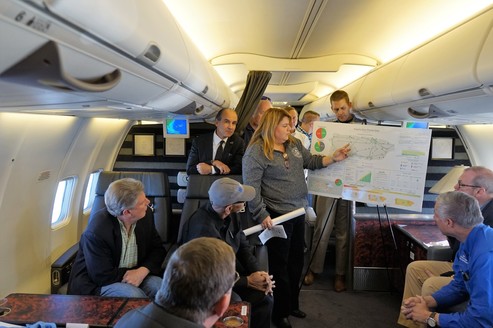
Codel1
Resident Commissioner Jenniffer González-Colón briefs committee members with a map of Puerto Rico’s power grid
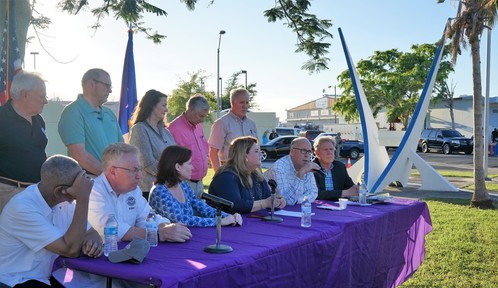
Codel2
Committee members hold a press conference after a full day of touring Puerto Rico
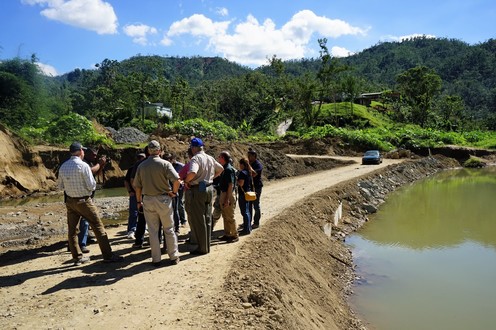
Codel3
Members tour a temporary bridge in Utuado, Puerto Rico, built by the U.S. Army Corps of Engineers to reconnect an isolated community to the mainland
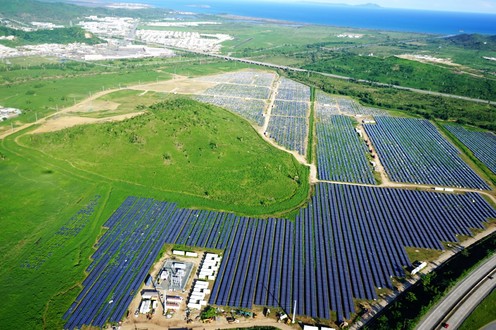
Codel5
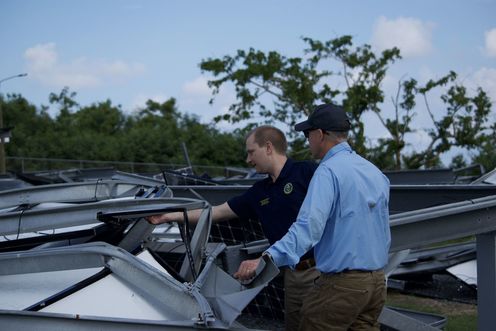
An aerial shot of a damaged solar farm outside of Humacao, Puerto Rico (10 miles south of where the hurricane made landfall)
Codel6
Chairman Walden gets a firsthand look at a damaged solar farm in the U.S. Virgin Islands
Codel7
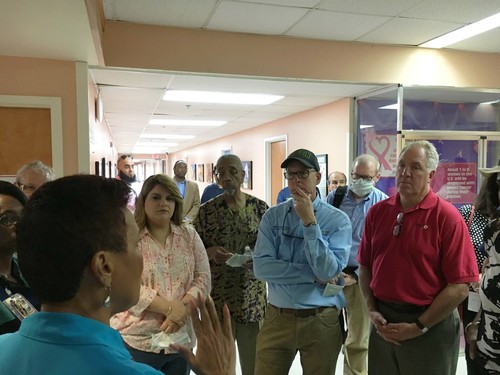
Chairman Walden, Rep. Rush, Rep. Shimkus, and Puerto Rico Resident Commissioner González-Colón listen as they tour the Juan F. Luis Hospital in St. Croix
Codel8
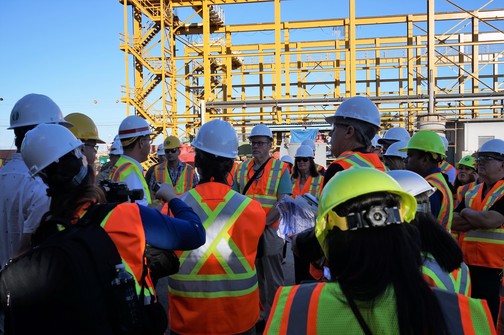
Members briefed by the U.S. Army Corps of Engineers at the Palo Seco power plant in Puerto Rico
Codel9
Committee members, Puerto Rico Governor Ricardo Rosselló, and community health care leaders pose after a briefing
Codel10
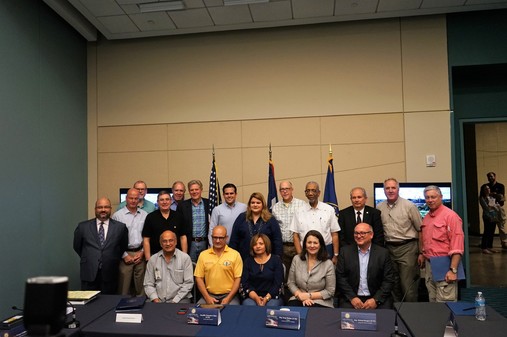
U.S. Virgin Islands Governor Kenneth Mapp, Delegate Plaskett, committee members and local public and private sector leaders following a roundtable discussion
The Energy and Commerce Committee has held three hearings on the recent series of hurricanes.
  • #SubOversight held a hearing on October 24, 2017, examining the public health response and preparedness efforts related to the hurricanes.
  • #SubEnergy held a hearing on November 2, 2017, examining the federal and state response and recovery efforts.
  • #SubEnvironment held a hearing on November 14, 2017, examining the federal, state, and local response to the environmental damage. 
"

Tuesday, October 31, 2017

Morgan Griffith on Puerto Rico, and Other Thoughts

Due to timing, this web site has missed posting several of Morgan Griffith's e-mails in a timely fashion. I regret this, and apologize to readers, who the computer shows are reading these posts. Virginia readers can always check Congressman Griffith's web site but, if you're already here...and some of these e-mails really are too good to miss. Like these suggestions for the longsuffering U.S. citizens on Puerto Rico...seriously, we have power grid problems in the Blue Ridge Mountains like nobody's business, and I think microgrids and home-based solar (and pedal) power are excellent ideas.

From U.S. Representative Morgan Griffith (R-VA-9):

"
Lessons from the Storms
The 2017 hurricane season has been the most active and destructive to the United States in a number of years. From Puerto Rico to Texas, storms have caused devastation, some of which lingers long after the hurricanes have dissipated. The challenge of rebuilding is daunting.
As part of the rebuilding process, we should learn how to better prepare for similar events in the future. The House Energy and Commerce Committee, on which I serve, is committed to evaluating preparations for and responses to these storms. We hope that thoroughly understanding what worked and what didn’t in the 2017 hurricane season will help the country prepare for future natural disasters. The lessons learned from this year can have positive impacts across the country, not just in those areas vulnerable to hurricanes.
On October 24, the Subcommittee on Oversight and Investigations held a hearing on how the U.S. Department of Health and Human Services responded to Puerto Rico. I had the opportunity to chair this hearing as the Vice Chairman. We learned that the hospital ship USNS Comfort has not been fully utilized. The Food and Drug Administration also detailed setbacks to Puerto Rico’s medical products industry, which is important to the supply both in Puerto Rico and in the rest of the United States, and its plans to address potential shortages while manufacturers restore their operations.
The Energy Subcommittee, on which I also serve, will follow suit on November 2 by reviewing how energy infrastructure weathered the storms. I expect there will be important lessons at this hearing. Throughout this year, the Subcommittee has held hearings on the electrical grid, and Puerto Rico’s struggles with restoring power have highlighted the grid’s vulnerabilities as well as possible solutions.
One of several innovations put forward to get Puerto Rico back online is the use of microgrids, defined by the Microgrid Institute as “a small energy system capable of balancing captive supply and demand resources to maintain stable service within a defined boundary.” Energy Secretary Rick Perry recently brought attention to microgrids when he suggested that small modular nuclear reactors would suit Puerto Rico’s needs: “Wouldn’t it make abundant good sense if we had small modular reactors that literally you could put in the back of C-17 [military cargo] aircraft, transport it to an area like Puerto Rico, and push it out the back end, crank it up and plug it in?”* The idea may sound far-fetched, but this technology is actually in development in the national labs overseen by the U.S. Department of Energy and may be on the U.S. market by the middle of the next decade. Besides nuclear, renewable power could fuel microgrids as well.
Microgrids make sense for an island like Puerto Rico, but there are other contexts where they would be suitable. While the technology could be used anywhere, if flooding, a snowstorm, or another catastrophe cut off a town in the mountains from the rest of the electrical grid, microgrids could keep the lights on until conditions returned to normal.
We’ll take a look at how microgrids might help Puerto Rico and consider how they could be used as part of disaster response in the future anywhere in the country. This is just one example of how we can better understand what works and what doesn’t. If the lessons learned from these storms better prepare us for the next one, these tragedies will not have been in vain.
The “Windshield Phenomenon”
A recent study published in the scientific journal PLOS One suggests that insects are in decline. One way this finding has been made more tangible is the “windshield phenomenon.” You would once have plenty of bugs splattered on your windshield driving down a highway, but now there are fewer bugs to meet their demise as you head on down the road.
While insects are an important part of any ecosystem, I am glad this study has come out now and not, say, a year ago. If it had, the Obama Administration’s Environmental Protection Agency may have sought to ban windshields to protect the insects, or perhaps mandated that all cars be outfitted with a soft net mounted a few inches in front of their hoods and windshields so bugs would be protected from the windshield until they could fly away safely.
For History Lovers
For those of you who love history, a friend recently sent me an interesting article about Greek resistance to the Axis powers in World War II. The Greeks’ tenacious defense changed the course of the war. You can read the article here.
If you have questions, concerns, or comments, feel free to contact my office. You can call my Abingdon office at 276-525-1405 or my Christiansburg office at 540-381-5671. To reach my office via email, please visit my website at www.morgangriffith.house.gov. Also on my website is the latest material from my office, including information on votes recently taken on the floor of the House of Representatives.

* “Puerto Rico Eyed As Electricity Grid Innovation Testing Ground,” https://www.bna.com/puerto-rico-eyed-n73014467356/
"

Friday, September 29, 2017

Friday That Feels Like a Thursday

Status report: Once again, by a coincidence that wouldn't work in fiction, $33 in sales this morning, bringing this week's income up to, wow, $53. If you earned more than US$53 in the past week, you need to support this web site. Here are the links that make it easy:

https://www.patreon.com/user?u=4923804

https://www.freelancer.com/u/PriscillaKing

https://www.guru.com/freelancers/priscilla-king

https://www.fiverr.com/priscillaking

https://www.iwriter.com/priscillaking 

https://www.seoclerk.com/user/PriscillaKing


You can also mail a U.S. postal money order to Boxholder, P.O. Box 322, Gate City, Virginia, 24251-0322.)


Now it's a Friday that feels like a Thursday, because earlier this month I started writing a short story, and it's gone slowly, and most of it is on the little old emergency backup computer known as the Sickly Snail, and I didn't want to lug the Snail into town on a sunny Friday when there was going to be so much other lugging to do, and the deadline is tomorrow, which means that in order to finish that "job" I'm going to have to come into town on a Saturday. Cue the "Wah wah waaahhh..." music from old TV shows. Wail! Woe is me!

Dump unsold books back in the storage space. Lug out the New Laptop, the one from 2009, into the nice cool cafe.

I should mention that, although a Bakery Cafe seemed for a long time like the wrong place for a celiac blog about the gluten-free life to be written, there actually are things at the cafe that I can eat, and like, whenever I can talk myself into imagining that I can afford them. There's the corn taco soup, the Cow Patties (chocolate oatmeal cookie/candies), and (in summer) the fruit salad. As temperatures vaulted up into the eighties in the market this morning, I visualized a meal-size fruit salad. I got into the cafe and was told that they buy the fruit for the fruit salad in summer only. Well...that's probably why it's so good, when they do the fruit salad: fresh local fruit. Greenhouse produce trucked up from Florida is never quite as good...

Log on to the Internet. See updates from Puerto Rico in the e-mail. I'm not seeing so much about the U.S. Virgin Islands so I'm imagining, hopefully, that they're recovering by now; this may or may not be true.

Be underwhelmed by the Huffington Post's claim that after a flood people don't have drinking water. Right, so the water they have is nasty. In the lower-lying parts of these United States all the water is pretty nasty, all the time. People strain it, boil it...er, wait...strain it through what, exactly? Lack of water does not appear to be the real problem, but Hermes Ayala does not discuss the status of the supply of water filters on Puerto Rico. I would imagine they're running through their supply rapidly.

Bandied about on Twitter yesterday, but apparently not happening, was a proposal to evacuate Puerto Ricans to the U.S. at the federal budget's expense and then require them to pay the full cost of their visit before reclaiming their passports. Hmm. Do the ones who can't afford to evacuate themselves to Florida have passports? In the contiguous States, most people at that income level don't have passports. Did whoever proposed this realize that Puerto Ricans are U.S. citizens and should not actually need passports, either to come here, or to go home? This sounded so unworkable that I posted yesterday that it had to have been just a prod for people to come up with better ideas. Apparently it was. Apparently the prod has yet to generate a workable idea.

Do Puerto Ricans have to wait for the overburdened federal government to process yet another demand for disaster funding, after two previous hurricane disasters?

A song parody started to pop into my mind..."They Call the Wind Mariah."

Paint Your Wagon (Original Broadway Cast Recording)

The Territories we'll protect, we said, come flood come fire.
If we don't stand by Puerto Rico, then we'll be a liar,
A liar, a liar, we'll be a big fat LIII-ar...

That's "we," as in We The People. Yesterday President Trump did suspend a law that had interfered with the shipping of supplies to Puerto Rico. Bombs away, Gentle Readers. Food and bottled water are being sent. Bleach, diesel fuel, antibiotic and antifungal treatments, and prescription medications are still needed, and people probably wouldn't mind more food and bottled water. Or water filters. Or personal hygiene supplies, clean unused underwear, school supplies--the same things people need in Texas or Florida.

What they want the federal government to do is fix their electrical power system, an issue this web site can't claim to understand. I'm guessing that their system will serve them better, longer, if they fix it themselves. At least, although nature provides plenty of challenges to the electricity, the water, and other things at the Cat Sanctuary, the last thing I'd want would be to try to get the federal government to handle those things.

Tuesday, September 5, 2017

Houston Camper Drive, or the Difference Between Blogging and Journalism

(Yes, you still need to support this web site. A local lurker's gift of subsidized coffee at one of Virginia's very best bakeries has been noted and appreciated...web sites do not run on coffee alone. Anyone whose income exceeded US$12,000 for the year 2016 should use one of these support options...note that each one gives you the option of commissioning a piece of writing just for you:

https://www.patreon.com/user?u=4923804

https://www.freelancer.com/u/PriscillaKing

https://www.guru.com/freelancers/priscilla-king

https://www.fiverr.com/priscillaking

https://www.iwriter.com/priscillaking 

https://www.seoclerk.com/user/PriscillaKing

One of those six sites ought to work for you, but you can also mail a U.S. postal money order to Boxholder, P.O. Box 322, Gate City, Virginia, 24251-0322.)

Here in a nutshell, Gentle Readers, is the difference between a blog post and a Real News Report: If this were a Real News Report, it would begin with a long confident sentence similar to this one:

"Mr. J.B. of Yuma, Virginia, is leading a Houston Flood Relief Camper Drive, actually driving campers and RV's to Houston and loading them with supplies, starting in the vacant parking lot on Route 23 across from the Yuma Road in Weber City, Virginia, on Saturday morning, September 8, loading from 8 a.m. to midday; donations of vehicles, drivers, supplies, giftcards, and cash will be appreciated."

If this were a Real News Report, a Real News Media Company would be paying for a car, phone, probably a camera and/or crew, so I would have driven out to the B. family residence and to the churches J.B. says are supporting this drive, to confirm that I had a right to use real names and pictures. Instead of waiting until today to go online and post a tentative little story about what I heard, I would have pounced on the story like a cat on a mouse and started interviewing people right at the Duffield car show, where political types marched in the parade just ahead of the classic cars, and I would have had a quote if not a video clip from at least one Republican and one Democrat ready for you when this post went live...which might have been on Sunday or Monday. And if churches, social clubs, and elected officials agree with Mr. B. that this is a good idea, by now we'd be burning up Twitter with advance notice of the Camper Drive itinerary, and people would be loading on more supplies at collection points all through Tennessee and Arkansas.

This is, however, a lowly blog post. Nobody's paying for anything. I had to wait until this morning to start pestering the staff of our local elected officials for comments on the Camper Drive. Nobody's paying me to use prepaid phone minutes to call church offices, and the churches that I believe are backing the Camper Drive, according to what Mr. B. told me, don't do Twitter. All I can tell you about is my conversation with Mr. B. after the car show. And it'd be incompatible with the rest of the blog not to do that in a bloggy, cafe-conversation-style, me-me-me sort of way.

Anyway, long story short: While the rest of us were filtering through the reports of the #HoustonFlood and thinking, "Major economic damage, yes, oilmen can take care of their own, now what about Jane Doe?" and confirming that our friends were safe and dry, or not...this local gentleman connected with his friend and found that his friend's home had become unlivable. His friend was sweltering in a shelter.

His immediate response was, "Hey, I have this camper I won't be using this winter, if you need..."

His friend's response was, "I need the camper, and I know another family who need one, too."

His response was, "Right, so I can hitch the RV onto the van and drive both of them to Houston, starting, God willing, on Monday the 11th of September. That will give me time to load the vehicles with gas, water, cleaning supplies, etc., and recruit local support."

So...although his Thunderbird was the dream car of many people our age, and we are not exactly antiques yet, the car has been maintained well enough to qualify for a place in the Classic Car show at Duffield Daze. It attracted attention. Mr. B. was using that attention to tell everyone about his Camper Drive. So far, what I've been able to confirm is that a sign has been set up identifying the time and place for loading the vehicles, on Route 23, in the parking lot at the other side of the intersection where you turn onto the Yuma Road.

I have planned this post to the extent of identifying and numbering five thoughts.

1. Should anybody drive a thousand miles alone?

First of all, without being authorized to identify this man in real life...local lurkers recognize the man with the white Thunderbird, and may remember the Real News Reports about the crash in the other car...Mr. B. is not disabled, but the fact that he is walking, talking, and driving alone is easy to recognize as something people would claim as an answer to prayer. Our conversation was impeded by his hearing loss, such that he didn't seem to understand or answer some questions I asked. He did mention concern that the drive might become "rough," since disasters can bring out the worst in people.

Although middle-aged people are not "too young" or "too old" to do whatever we jollywell want to do, we are at an awkward age for road trips. Our parents may not be fit to travel, our children may be too young to drive, our friends may be too busy to go along, and so it may be hard to find a buddy for a long road trip. Modern technology can help a lot (see below). Still, nobody is ever going to be able to plan ahead and notify people in time about things like "I'm going to become sleepy on mile #500" or "I'm going to have a drastic allergy reaction after driving past a freshly sprayed cotton field outside Nashville." Even good drivers need a buddy in the passenger seat who can prod them to take a break or switch seats. My feeling is that taking a long road trip without a buddy is just "too stupid" for anybody, any age, any level of ability.

Well, even if the churches would continue to support an unmarried male and female on a long road trip, I'm not volunteering to spend a thousand miles (or more, to connect with supporters) in a van with a smoker. (Mr. B. is not a chain smoker, but he does have the habit.) But as I talked with him I kept thinking, "Some man from the church ought to go with him."

2. Should participants in this Drive come back empty-handed? 

It's #TortieTuesday and although this post is long enough without throwing in animal pictures, my own Queen Cat Heather and our e-friends Mudpie and Abby have to remind people that floods leave a lot of animals homeless. Sometimes these animals still have homes, so rescuing them may be more "temporary fostering" than "adopting." As of today, I think I'll leave this thought for others to take up, mull, and discuss.

3. Are we feeding the Gimmee Monster, or are we respectfully trading services with friends who are willing and able to give something back? 

Some people in the Appalachian Mountain Region just absolutely love any opportunity to make charitable donations, and let everyone know that the said donations are coming from "Appalachia." Maybe it even feels like altruism to them, although what I see in their faces looks more like "Yesss! I'll take that Daily Double for $1000, Alex!" However, for those who have campers, RV's, or trailer houses that just sit around all winter, may I suggest...Houston is not exactly a poverty pocket. Your friend(s) probably went there to follow the money. They probably have jobs, when (and if) their workplaces are open. Floods cost money, but eventually, after their homes are clean and dry, your friends are likely to be willing and able to pay rent on the trailer. They might actually feel better thinking of it in terms of an interest-free loan, rather than a handout. I'll stop this thought right here, too, and leave it for discussion between trailer owners and flood survivors.

4. Should this Drive exploit modern marketing technology to maximize support for hurricane-affected communities? 

In the crisis moment of any natural disaster, the role of electronic gadgets is to break down. During the clean-up phase, however, they can be helpful beyond the wildest dreams anyone had even twenty years ago. If J.B. is active online, he's anonymous enough (which I fully approve) that I'm not finding him. However, the Drive could easily have its own Twitter account and receive up-to-the-minute Tweets about how many supplies could be purchased from businesses that are recovering from the hurricane, too, and need a cash infusion. (Or even a plastic one.)

I tagged #RonRamsey , Lieutenant-Governor of Tennessee, in the Twitter discussion earlier, because he retweeted the landmark photo that came up during a preliminary search, and also because...once upon a time, after Nashville was flooded, one of my late lamented sponsors wanted to sponsor Lieut. Gov. Ramsey's collection drive through Tennessee. Sponsor handed me $20, handed a few other people $20, and took me to a store to buy cleaning supplies and write about it for Associated Content...if this person were still living, this web site would not be heading every post with fundraising links today. A great big trailer was set up outside the Bristol Motor Speedway to start the collection...and let's just say I hoped the trailer stopped at lots of points on its drive through Tennessee, because our little shopping bags of cleaning supplies looked so pitiful in the vast echoing cavern of that trailer. And the young staffers packing things into the trailer looked competent to pack things in tightly, but...it is so much more fun to receive supplies fresh from a nice cool store, before they've jolted over five hundred or a thousand miles in a hot truck.

So...we want to support our own community of course, and local business owners may want to make donations, but local lurkers can also support businesses near Houston. We can even use the Internet to pre-purchase supplies from chain stores that have outlets in or near Houston, and physically load the supplies from sites nearer Houston, if that seems a good idea. Wal-Mart, Target, and other stores will let online readers buy things where they are and pick them up in Arkansas. Thoughts?

5. How big can or should this Drive get? 

The Drive should not include scammers or "disaster tourists." I believe Mr. B. is sincere in his intentions of delivering two vehicles to one friend and one friend-of-that-friend. I can easily picture this Drive growing into a convoy of campers and trailers and RV's. How big do youall want to make it?

Some people who seriously believe in altruism are put off by the way American politicians...


A presidential visit to a disaster area is a major nuisance. Other local officials, whose visits require less security and protocol, are a mix of "disaster tourism" and real help: Yes, the politicians benefit from the photo opportunities, but the survivors who talk to them are likely to gain some status and economic benefit from it too. On the whole I think this tradition tends to be a win/win. It is certainly bipartisan--if politicians agree on nothing else, they can agree on the need to help disaster victims.

If you agree, re-share this post, especially with contacts in Tennessee, Arkansas, and eastern Texas, and let's find out how big the Camper Drive can get.

Friday, October 14, 2016

Mercy Chefs Go to Lumberton

From Steve Elliott. Do we have readers in Lumberton? How are Mercy Chefs doing?

"
Priscilla, did you see my email yesterday about an emergency text from Mercy Chefs? Grassfire's disaster-relief partner needs to raise $10,000 THIS WEEKEND to pay for a water-purification unit. The water supply in flood-ravaged Lumberton, North Carolina will be undrinkable for weeks, but Mercy Chefs needs fresh water immediately to cook thousands of meals for flood victims and first responders. Please see my urgent update below, or click here to help now. --Steve

+ + + + + + +

Thursday afternoon:

This is urgent, so I'll keep it brief. The following is an emergency text I received a short time ago from Gary LeBlanc of Mercy Chefs, Grassfire's disaster-relief partner:

"Just heard. Water in town will be undrinkable for 2-3 weeks."
Gary and his team are on the ground in Lumberton, North Carolina. Heavy rains from Hurricane Matthew caused two levees there to breach and flood the entire city, killing a currently unknown number of people. Thousands of residents have been forced from their homes, and the entire surrounding county is without power.

We spoke to Gary earlier today, and he urgently needs Grassfire Nation's help. He stepped out in faith today to order a water-purification unit, so it can be in Lumberton tomorrow. Mercy Chefs needs fresh water for cooking, cleaning and drinking.

The water purifier costs $10,000 and can process 120 gallons per hour. This unit isn't a luxury item. It's a requirement for him to feed thousands of daily meals to flood victims and first responders in Lumberton.

I told Gary that I'd send a special, urgent appeal to Grassfire members, asking them to contribute whatever they can to purchasing this unit. Even $25 or $50 will help get fresh water to thousands of flood victims in Lumberton. Can they count on your support today?

Please click here or on the DONATE button below to make a tax-deductible gift, right now, to Mercy Chefs' relief effort in North Carolina:

Donate to Mercy Chefs

Gary also told me that the water level in Lumberton and the surrounding communities is still rising, forcing even more residents out of their homes and into shelters. (Click here to watch a video update from North Carolina.)

Mercy Chefs urgently needs your support, right now, to help feed these people. Your tax-deductible gift of $25, $50 or more will bless flood victims who have lost everything in the aftermath of Hurricane Matthew. Please click here to give now.

Thanks in advance,

Steve

"

Tuesday, March 1, 2016

Robert Hurt on Weathering the Storm

From U.S. Representative Robert Hurt, R-VA-5, the district that includes the tornado zone:

"
Dear Friend,
On Wednesday, a deadly storm tore through Virginia’s Fifth District and across a broad swath of the Commonwealth. In the Fifth District, Appomattox County bore the brunt of the storm as it was struck by a tornado that left in its wake a path of destruction and loss. Sadly, seven people were injured, and 78 year-old Edward K. Harris was killed. Elsewhere in Virginia, three people were killed in Waverly and dozens more across Virginia were injured. We continue to pray for those who lost loved ones and for a speedy recovery for the other victims.
In the Evergreen area of Appomattox County, the tornado tore through the peaceful community damaging or destroying more than 200 homes, in a stretch that was 16 miles long. Nearly 400 people have been displaced by the storm. These numbers are staggering, but the damage this tornado left is hard to fathom. Our thoughts and prayers continue to be with all of those who have been affected by this storm.
On Friday, I visited Evergreen and met with local leaders and those who had been impacted by the tornado. There, I saw firsthand the devastating destruction this storm caused, and I also witnessed the overwhelming outpouring of support for those who had lost so much.
I spoke with Appomattox County High School football players and students from Rustburg High School who were hard at work cleaning up debris. At Evergreen Baptist Church, which has become a relief and volunteer center, I visited with volunteers, who were serving meals and organizing donations of everything from teddy bears to paper products. I met with members of the National Guard who came in to assist, and I was grateful for the opportunity to thank our first responders, who put themselves in danger each day to ensure our safety. The men and women I met with came from all across the Commonwealth and rushed to Appomattox County to volunteer to help.
In the wake of this storm, we have seen a tremendous response from the community. We well know that our communities are resilient and full of Virginians who care deeply about their neighbors, but last week, we were again reminded of just how strong our people are.
I thank all of those involved for their speedy response, and our office remains committed to offering assistance in any way that we can. If our office may be of assistance to you in any way, please do not hesitate to contact us.
Several local and regional service organizations are aiding the Appomattox community, and I encourage all Central and Southside Virginians who are able to contribute to the cause. In the end, I have no doubt that Evergreen and Appomattox County will rebuild and become even stronger than it was before.
If you need any additional information or if we may be of assistance to you, please visit my website at hurt.house.gov or call my Washington office: (202) 225-4711, Charlottesville office: (434) 973-9631, Danville office: (434) 791-2596, or Farmville office: (434) 395-0120.
Last night, the House of Representatives held a moment of silence for the victims of this terrible storm. You can view the proceedings here.
I attended the Gold Medal Ceremony in honor of the Foot Soldiers of the 1965 Voting Rights Marches with Danville Mayor Sherman Saunders.


Sincerely,
" [signature graphic: Robert Hurt]

Monday, January 4, 2016

Malheur: the Rest of the Story

I don't usually do this, nor do I like to...but because this is shaping up to resemble the Waco disaster, where accurate reportage was the only thing that might have saved about twenty little children's lives, I'll do it. Here, without checking or editing, is an infodump from Patricia Evans. Please check the links and facts below for yourselves--I'll try to, as best I can, but I can't guarantee I'll be online this week due to possible snow.

"
Bundy Ranch Statement, watch the video here:
https://www.facebook.com/bundyranch/videos/938588846217924/

"Calling all freedom loving people to come to Harney County Oregon, come to the Malhuer Wildlife Refuge."


We all need to know the FULL STORY on What’s Going on In Oregon – Militia Take Over Malheur National Wildlife Refuge In Protest to Hammond Family Persecution…

The Last Refuge, January 3, 2016 by Sundance:
http://theconservativetreehouse.com/2016/01/03/full-story-on-whats-going-on-in-oregon-militia-take-over-malheur-national-wildlife-refuge-in-protest-to-hammond-family-persecution/


Many people will awaken today to the news of approximately 100 to 150 armed militia taking control of a closed Wildlife Park Headquarters, and not know the full back-story – so here it is:

burns 4burns 5
The short summary is: in an effort to draw attention to a ridiculous arrest of a father and son pair of Oregon Ranchers (“Dwight Lincoln Hammond, Jr., 73, and his son, Steven Dwight Hammond, 46,) who are scheduled to begin five year prison sentences (turning themselves in tomorrow January 4th 2016), three brothers from the Cliven Bundy family and approximately 100/150 (and growing) heavily armed militia (former U.S. service members) have taken control of Malheur Wildlife Refuge Headquarters in the wildlife reserve. They are prepared to stay there indefinitely.
Here’s the long version you need to know: including history, details, links video(s) and explanations:

Hammond Family Hammond Family

HISTORY: (aa) The Harney Basin (were the Hammond ranch is established) was settled in the 1870’s. The valley was settled by multiple ranchers and was known to have run over 300,000 head of cattle. These ranchers developed a state of the art irrigated system to water the meadows, and it soon became a favorite stopping place for migrating birds on their annual trek north.
(ab) In 1908 President Theodor Roosevelt, in a political scheme, create an “Indian reservation” around the Malheur, Mud & Harney Lakes and declared it “as a preserve and breeding ground for native birds”. Later this “Indian reservation” (without Indians) became the Malheur National Wildlife Refuge.
(a) In 1964 the Hammonds purchased their ranch in the Harney Basin. The purchase included approximately 6000 acres of private property, 4 grazing rights on public land, a small ranch house and 3 water rights. The ranch is around 53 miles South of Burns, Oregon.
(a1) By the 1970’s nearly all the ranches adjacent to the Blitzen Valley were purchased by the US Fish and Wildlife Service (FWS) and added to the Malheur National Wildlife Refuge. The refuge covers over 187,000 acres and stretches over 45 miles long and 37 miles wide. The expansion of the refuge grew and surrounds to the Hammond’s ranch. Being approached many times by the FWS, the Hammonds refused to sell. Other ranchers also choose not to sell.
(a2) During the 1970’s the Fish and Wildlife Service (FWS), in conjunction with the Bureau of Land Management (BLM), took a different approach to get the ranchers to sell. Ranchers were told that, “grazing was detrimental to wildlife and must be reduced”. 32 out of 53 permits were revoked and many ranchers were forced to leave. Grazing fees were raised significantly for those who were allowed to remain. Refuge personnel took over the irrigation system claiming it as their own.
(a3) By 1980 a conflict was well on its way over water allocations on the adjacent privately owned Silvies Plain. The FWS wanted to acquire the ranch lands on the Silvies Plain to add to their already vast holdings. Refuge personnel intentional diverted the water to bypassing the vast meadowlands, directing the water into the rising Malheur Lakes. Within a few short years the surface area of the lakes doubled. Thirty-one ranches on the Silvies plains were flooded. Homes, corrals, barns and graze-land were washed a way and destroyed. The ranchers that once fought to keep the FWS from taking their land, now broke and destroyed, begged the FWS to acquire their useless ranches. In 1989 the waters began to recede and now the once thriving privately owned Silvies pains are a proud part of the Malheur National Wildlife Refuge claimed by the FWS.
(a4) By the 1990’s the Hammonds were one of the very few ranchers that still owned private property adjacent to the refuge. Susie Hammond in an effort to make sense of what was going on began compiling fact about the refuge. In a hidden public record she found a study that was done by the FWS in 1975. The study showed that the “no use” policies of the FWS on the refuge were causing the wildlife to leave the refuge and move to private property. The study showed that the private property adjacent to the Malheur Wildlife Refuge produced 4 times more ducks and geese than the refuge did. It also showed that the migrating birds were 13 times more likely to land on private property than on the refuge. When Susie brought this to the attention of the FWS and refuge personnel, her and her family became the subjects of a long train of abuses and corruptions.
(b) In the early 1990’s the Hammonds filed on a livestock water source and obtained a deed for the water right from the State of Oregon. When the Bureau of Land Management (BLM) and US Fish and Wildlife Service (FWS) found out that the Hammonds obtained new water rights near the Malhuer Wildlife Refuge, they were agitated and became belligerent and vindictive towards the Hammonds. The US Fish and Wildlife Service challenged the Hammonds right to the water in an Oregon State Circuit Court. The court found that the Hammonds legally obtained rights to the water in accordance to State law and therefore the use of the water belongs to the Hammonds.*
(c) In August 1994 the BLM & FWS illegally began building a fence around the Hammonds water source. Owning the water rights and knowing that their cattle relied on that water source daily the Hammonds tried to stop the building of the fence. The BLM & FWS called the Harney County Sheriff department and had Dwight Hammond (Father) arrested and charged with “disturbing and interfering with” federal officials or federal contractors (two counts, each a felony). He spent one night in the Deschutes County Jail in Bend, and a second night behind bars in Portland before he was hauled before a federal magistrate and released without bail. A hearing on the charges was postponed and the federal judge never set another date.
(d) The FWS also began restricting access to upper pieces of the Hammond’s private property. In order to get to the upper part of the Hammond’s ranch they had to go on a road that went through the Malhuer Wildlife Refuge. The FWS began barricading the road and threatening the Hammonds if they drove through it. The Hammonds removed the barricades and gates and continued to use their right of access. The road was proven later to be owned by the County of Harney. This further enraged the BLM & FWS.
(e) Shortly after the road & water disputes, the BLM & FWS arbitrarily revoked the Hammond’s upper grazing permit without any given cause, court proceeding or court ruling. As a traditional “fence out state” Oregon requires no obligation on the part of an owner to keep his or her livestock within a fence or to maintain control over the movement of the livestock. The Hammonds intended to still use their private property for grazing. However, they were informed that a federal judge ruled, in a federal court, that the federal government did not have to observe the Oregon fence out law. “Those laws are for the people, not for them”.
(f) The Hammonds were forced to either build and maintain miles of fences or be restricted from the use of their private property. Cutting their ranch in almost half, they could not afford to fence the land, so the cattle were removed.
(g) The Hammonds experienced many years of financial hardship due to the ranch being diminished. The Hammonds had to sale their ranch and home in order to purchase another property that had enough grass to feed their cattle. This property included two grazing rights on public land. Those were also arbitrarily revoked later.
(h) The owner of the Hammond’s original ranch passed away from a heart attack and the Hammonds made a trade for the ranch back.
(i) In the early fall of 2001, Steven Hammond (Son) called the fire department, informing them that he was going to be performing a routine prescribed burn on their ranch. Later that day he started a prescribed fire on their private property. The fire went onto public land and burned 127 acres of grass. The Hammonds put the fire out themselves. There was no communication about the burn from the federal government to the Hammonds at that time. Prescribed fires are a common method that Native Americans and ranchers have used in the area to increase the health & productivity of the land for many centuries.
(j) In 2006 a massive lightning storm started multiple fires that joined together inflaming the countryside. To prevent the fire from destroying their winter range and possibly their home, Steven Hammond (Son) started a backfire on their private property. The backfire was successful in putting out the lightning fires that had covered thousands of acres within a short period of time. The backfire saved much of the range and vegetation needed to feed the cattle through the winter. Steven’s mother, Susan Hammond said: “The backfire worked perfectly, it put out the fire, saved the range and possibly our home”.
(j1) The next day federal agents went to the Harney County Sheriff’s office and filled a police report making accusation against Dwight and Steven Hammond for starting the backfire. A few days after the backfire a Range-Con from the Burns District BLM office asked Steven if he would meet him in town (Frenchglen) for coffee. Steven accepted. When leaving he was arrested by the Harney County Sheriff Dave Glerup and BLM Ranger Orr. Sheriff Glerup then ordered him to go to the ranch and bring back his father. Both Dwight and Steven were booked and on multiple Oregon State charges. The Harney County District Attorney reviewed the accusation, evidence and charges, and determined that the accusations against Dwight & Steven Hammond did not warrant prosecution and dropped all the charges.
(k) In 2011, 5 years after the police report was taken, the U.S. Attorney Office accused Dwight and Steven Hammond of completely different charges, they accused them of being “Terrorist” under the Federal Antiterrorism Effective Death Penalty Act of 1996. This act carries a minimum sentence of five years in prison and a maximum sentence of death. Dwight & Steven’s mug shots were all over the news the next week posing them as “Arsonists”. Susan Hammond (Wife & Mother) said: “I would walk down the street or go in a store, people I had known for years would take extreme measures to avoid me”.
(l) Shortly after the sentencing, Capital Press ran a story about the Hammonds. A person who identified as Greg Allum posted three comments on the article, calling the ranchers “clowns” who endangered firefighters and other people in the area while burning valuable rangeland. Greg Allum, a retired BLM heavy equipment operator, soon called Capital Press to complain that he had not made those comments and request that they be taken down from the website. Capital Press removed the comments. A search of the Internet Protocol address associated with the comments revealed it is owned by the BLM’s office in Denver, Colorado. Allum said, he is friends with the Hammonds and was alerted to the comments by neighbors who knew he wouldn’t have written them. “I feel bad for them. They lost a lot and they’re going to lose more,” Allum said of the ranchers. “They’re not terrorists. There’s this hatred in the BLM for them, and I don’t get it,” The retired BLM employee said. Jody Weil, deputy state director for communications at BLM’s Oregon office, indicated to reporters that if one of their agents falsified the comments, they would keep it private and not inform the public.
(m) In September 2006, Dwight & Susan Hammond’s home was raided. The agents informed the Hammonds that they were looking for evidence that would connect them to the fires. The Hammonds later found out that a boot print and a tire tracks were found near one of the many fires. No matching boots or tires were found in the Hammonds home or on their property. Susan Hammond (Wife) later said; ” I have never felt so violated in my life. We are ranchers not criminals”. Steven Hammond openly maintains his testimony that he started the backfire to save the winter grass from being destroyed and that the backfire ended up working so well it put out the fire entirely altogether.
(n) During the trial proceedings, Federal Court Judge Michael Hogan did not allow time for certain testimonies and evidence into the trail that would exonerate the Hammonds. Federal prosecuting attorney, Frank Papagni, was given full access for 6 days. He had ample time to use any evidence or testimony that strengthened the demonization of the Hammonds. The Hammonds attorney was only allowed 1 day. Much of the facts about the fires, land and why the Hammonds acted the way they did was not allowed into the proceedings and was not heard by the jury. For example, Judge Hogan did not allow time for the jury to hear or review certified scientific findings that the fires improved the health and productivity of the land. Or, that the Hammonds had been subject to vindictive behavior by multiple federal agencies for years.
(o) Federal attorneys, Frank Papagni, hunted down a witness that was not mentally capable to be a credible witness. Dusty Hammond (grandson and nephew) testified that Steven told him to start a fire. He was 13 at the time and 24 when he testified (11 years later). At 24 Dusty had been suffering with mental problems for many years. He had estranged his family including his mother. Judge Hogan noted that Dusty’s memories as a 13-year-old boy were not clear or credible. He allowed the prosecution to continually use Dusty’s testimony anyway. When speaking to the Hammonds about this testimony, they understood that Dusty was manipulated and expressed nothing but love for their troubled grandson.
(p) Judge Michael Hogan & Frank Papagni tampered with the jury many times throughout the proceedings, including during the selection process. Hogan & Papagni only allowed people on the jury who did not understand the customs and culture of the ranchers or how the land is used and cared for in the Diamond Valley. All of the jurors had to drive back and forth to Pendleton everyday. Some drove more than two hours each way. By day 8 they were exhausted and expressed desires to be home.
On the final day, Judge Hogan kept pushing them to make a verdict. Several times during deliberation, Judge Hogan pushed them to make a decision. Judge Hogan also would not allow the jury to hear what punishment could be imposed upon an individual that has convicted as a terrorist under the 1996 act. The jury, not understanding the customs and cultures of the area, influenced by the prosecutors for 6 straight days, very exhausted, pushed for a verdict by the judge, unaware of the ramification of convicting someone as a terrorist, made a verdict and went home.
(q) June 22, 2012, Dwight and Steven were found guilty of starting both the 2001 and the 2006 fires by the jury. However, the federal courts convicted them both as “Terrorist” under the 1996 Antiterrorism Act. Judge Hogan sentenced Dwight (Father) to 3 months in prison and Steven (son) to 12 months in federal prison. They were also stipulated to pay $400,000 to the BLM. Hogan overruling the minimum terrorist sentence, commenting that if the full five years were required it would be a violation of the 8th amendment (cruel and unusual punishment). The day of the sentencing Judge Hogan retired as a federal judge. In his honor the staff served chocolate cake in the courtroom.
(r) On January 4,, 2013, Dwight and Steven reported to prison. They fulfilled their sentences, (Dwight 3 months, Steven 12 months). Dwight was released in March 2013 and Steven, January 2014.
(s) Sometime in June 2014, Rhonda Karges, Field Manager for the BLM, and her husband Chad Karges, Refuge Manager for the Malheur Wildlife Refuge (which surrounds the Hammond ranch), along with attorney Frank Papagni exemplifying further vindictive behavior by filing an appeal with the 9th District Federal Court seeking Dwight’s and Steven’s return to federal prison for the entire 5 years.*
(t) In October 2015, the 9th District Court “resentenced” Dwight and Steven, requiring them to return to prison for several more years. Steven (46) has a wife and 3 children. Dwight (74) will leave Susan (74) to be alone after 55 years of marriage. If he survives, he will be 79 when he is released.
(u) During the court preceding the Hammonds were forced to grant the BLM first right of refusal. If the Hammonds ever sold their ranch they would have to sell it to the BLM.
(v) Dwight and Steven are ordered to report to federal prison again on January 4th, 2016 to begin their re-sentencing. Both their wives will have to manage the ranch for several years without them.
To date they have paid $200,000 to the BLM, and the remainder $200,000 must be paid before the end of this year (2015). If the Hammonds cannot pay the fines to the BLM, they will be forced to sell the ranch to the BLM or face further prosecution. (more citations here)
Hammond Family Hammond Family

Now you can watch this video where Ammon Bundy responds to why he and his brothers are involved. (This was recorded two days ago on Jan 1st):

VIDEO HERE: https://youtu.be/Zl5rkosu2Ig
After a protest rally supporting the Hammond family yesterday, a pre-planned group, including the Bundy Brothers, left a peaceful protest at the Harney County Sheriffs Office and went to the closed (for holiday) Malheur Wildlife Refuge, where they have seized and occupied the refuge headquarters.

Statement from Harney County Sheriff Dave Ward:

“After the peaceful rally was completed today, a group of outside militants drove to the Malheur Wildlife Refuge, where they seized and occupied the refuge headquarters. A collective effort from multiple agencies is currently working on a solution. For the time being please stay away from that area. More information will be provided as it becomes available. Please maintain a peaceful and united front and allow us to work through this situation.” (link)
Malheur National Wildlife Refuge Headquarters Malheur National Wildlife Refuge Headquarters
(Via Oregon Live) […] The Bundy family of Nevada joined with hard-core militiamen Saturday to take over the headquarters of the Malheur National Wildlife Refuge, vowing to occupy the remote federal outpost 50 miles southeast of Burns for years.
The occupation came shortly after an estimated 300 marchers — militia and local citizens both — paraded through Burns to protest the prosecution of two Harney County ranchers, Dwight Hammond Jr. and Steven Hammond, who are to report to prison on Monday.
Among the occupiers is Ammon Bundy, son of Nevada rancher Cliven Bundy, and two of his brothers. Militia members at the refuge claimed they had as many as 100 supporters with them. The refuge, federal property managed by the U.S. Fish and Wildlife Service, was closed and unoccupied for the holiday weekend.
In phone interviews from inside the occupied building Saturday night, Ammon Bundy and his brother, Ryan Bundy, said they are not looking to hurt anyone. But they would not rule out violence if police tried to remove them, they said.
“The facility has been the tool to do all the tyranny that has been placed upon the Hammonds,” Ammon Bundy said.
“We’re planning on staying here for years, absolutely,” he added. “This is not a decision we’ve made at the last minute.” (more)
Malheur National Wildlife Refuge is located roughly south of the town of Burns, Oregon. The refuge area is roughly T shaped with the southernmost base at Frenchglen, the left top at Malheur Lake and the right top at Harney Lake. Malheur National Wildlife Refuge is located roughly south of the town of Burns, Oregon. The refuge area is roughly T shaped with the southernmost base at Frenchglen, the left top at Malheur Lake and the right top at Harney Lake.

A letter dated January 1st outlines the position of the Bundy brothers, as well as the 150+ in the Militia as it relates to the Hammond family:

With great concern and love and much consideration from prayer, I come to you Harney County Sheriff of Oregon David M. Ward, rancher Steven Dwight Hammond, and rancher Dwight Lincoln Hammond, Jr.,
I, Cliven D. Bundy, have been involved for several weeks in the background striving to understand and comprehend your dilemmas in Harney County, Oregon. I understand that the grass that was burnt on each side of the fence was grazing rights that had been created through beneficial use, one side of the fence being private property and the other side of the fence being private property rights. The fires that were set were for a good purpose and had good results.
The United States Justice Department has NO jurisdiction or authority within the State of Oregon, County of Harney over this type of ranch management. These lands are not under U.S. treaties or commerce, they are not article 4 territories, and Congress does not have unlimited power. These lands have been admitted into statehood and are part of the great State of Oregon and the citizens of Harney County enjoy the fullness of the protections of the U.S. Constitution. The U.S. Constitution limits United States government.
It is my suggestion, Steven Hammond, that you go and check yourself into Harney County jail asking for protective custody. It is my suggestion, Dwight Hammond, that you go and check yourself into Harney County jail asking for protective custody. It is my suggestion, Harney County Sheriff David Ward, accept these two ranchers into your jail, notify the United States Solicitor in Washington DC that you have these two ranchers in Harney County jail, that they will remain there indefinitely under your protective custody and the protection of We the People of Harney County and We the People of the United States of America.
I suggest an Evidentiary Hearing or a Grand Jury be formed by We the People.
I feel that this action is immediately important, that it should be taken place before 10:00 am Saturday, January 2, 2016. I will hold these suggestions private until that time then I will release this letter to those having state and county jurisdiction and to the media.
Cliven D. Bundy (LINK)
waving_usa_flag.jpg

Prayers for everyone !

References:
♦ Full Facts On Hammond Case HERE
♦ BEST Local Reporter Twitter Feed HERE
♦ Oregon Live Article HERE
♦ Bundy Ranch Facebook HERE
♦ Bundy Ranch Website HERE
♦ Malhuer National Wildlife Refuge – Resource HERE


--

"Educate and inform the whole mass of the people. They are the only sure reliance for the preservation of our liberty." - Thomas Jefferson                                                                                                                                                                                                                                                      "