Wednesday, January 8, 2025

COVID Quarantine Link Log

Since all we know about the weather for the next two weeks is that it's all but guaranteed to be cold enough to freeze limbs off trees, and since I just posted that I'm doing quarantine, here's what I'll do: This post will go live on the first day I go online from McDonald's OR have been symptom-free long enough that I could if I had to. It will contain however many links I've found during however much screen porch time I've had. If it's extra-long, or followed by a Part 2, that will indicate yet another year when COVID symptoms lasted for a day or less and I've stayed in quarantine purely out of public spirit.

Now on to more pleasant things:

Animals 

Drab little Noctuids all look alike to some people. Others really look at them and notice how varied, subtle, and rich their colors are. One of these British species is actually called a Beauty...and, to moth people, it is. 


Some readers are worried that listing Monarch butterflies as an endangered species, which they are, would present an unreasonable burden to humans since almost all of the United States can be considered Monarch habitat. There is a way to prevent this. Monarchs are loved partly because they are so congenial with humans. In some places their populations have increased as humans cleared forest land for pastures and crop fields where their food plant can grow. They've been flitting through our gardens and even flying along our roadways for years with no effect on their numbers. Their decline just happens to correlate with the period of gross abuse of glyphosate, but it doesn't seem to be specifically caused by glyphosate so much as increased use of "pesticides" generally. If we stop spraying poison on the land, Monarch populations will probably rebound. 

Weigh in on this topic at 


If you want to see, endorse, or dispute my comment, it's at:

 m5g-2m2n-2965 .

Climate Change 

Steve Milloy shares a lovely PDF:


Day by Day with COVID, if the Internet Holds Up 

New Year's Day: A deep breath, a deep cough. All muscles stiff and weak. More sleepy time than waking time. 

1.2.25: Similar, only I was awake more of the time and more aware of what a bore the virus was being. Perceptions blurred; no smell, not much taste, and sounds all sounded faint and far away. I could tell whether I was sipping water or soda pop, but that was about all. I could not smell a difference among the disinfectants I use. Things looked pretty much as they usually look, but eyes felt very weak, tearing easily, more sensitive to light, less vision in dimness. Solid food? Don't even...the body wasn't up for that kind of work.

During the night I heard the Professional Bad Neighbor drive up and park just outside my property line. I did not go out and give chase. When I heard anything near the house, whether it was a trespasser or a cat, I called out as loudly and cheerfully as I was able (which wasn't very)--"Hello, cousin, how do you do! Come in and share the COVID!"  I had done that last week with the gratifying result of hearing a scalawag, apparently some yards from the house but on my property, skedaddle. All I heard this time were cats, presumably asking one another whether I was delirious. Apparently the Bad Neighbor was harassing an older relative of ours. 

1.3.25: Some smell and taste returned. I could definitely tell when I ate a garlic clove. Mood peevish and fluzly. First steps outdoors! The Internet was not running well. Every time I clicked on Libre to paste a document into Word for printing, Libre balked. Task Manager reported that this was due to Microsoft persistently running "ApplicationFrameHost.exe" and "backgroundTaskHost.exe." The Internet is also fading in and out. Apparently the weather damage is both between here and the local tower, and between the tower and other towers. The laptop now annoyingly shows a strong connection to the local tower when no connection to the Internet is being made. With at least two areas of mechanical damage, the last thing anybody needs is this garbageware constantly interfering with any use of our computers. Having to click over and end those programs felt like having to pick a whole nest of wasps out of my hair. I used some un-auntly language. Out loud. At the computer. Tried to read another novel someone was nice enough to send me, but for hours on end, although or because other sites were working, Kindle-in-the-Cloud wouldn't turn a page. 

Memories of appetite returned but the garlic clove satisfied the appetite I had. Memories of having enough energy to sit up and write about something more interesting than my symptoms also began to return. Mid-afternoon, however, I felt the unmistakable prodrome of a glyphosate reaction. I wouldn't have smelled anything if a whole family of skunks had spent the night on the porch but, apparently, whatever the Bad Neighbor was doing on our relative's land had included spraying poison. Talk about kicking a person who is down.

I went into the warm room, set the hot-air fan right next to my bench, dug into the pile of blankets on the bench, and lay down. I could feel the now familiar COVID symptom of my blood pressure surging up as I lay down. Why does it do that, and why hadn't I noticed it doing that during the previous two days? Could I have been hypertensive for two days and too ill to notice? I could. Brr-rr-rr. 

After about an hour of meditation on how to get different body parts closest to the hot spot in the blankets, I did not feel as if I'd lost ground. In fact I was noticing more different smells. I felt guilty about not wanting to be close to the cats and, given that I wanted not to be close to them, about having touched them at all.

1.4.25: I felt hollow from not eating and, at the same time, bloated from the glyphosate reaction. My waistline was convex. Apart from that, the fever was gone, the hypertension was gone, the senses of sound and taste were back. The senses of sight and smell were still compromised,  not by COVID but by chemical reactions. My sinuses were carrying out their usual defense against poison sprays by draining all the liquid in my body out at the nose. It was hard to get much of anything else done due to the constant need to mop the nose, and hard to read with sore, swollen, teary eyes. The sensations of COVID were giving way to the more unpleasant, familiar ones of having measles and mono and food poisoning, all at once. 

Once again I spent more of the day asleep than awake. Every time I woke up I could feel muscles that had been fever-stiff and painfully sore becoming flexible, and only pleasantly sore, as from too much of the wrong kind of exercise, which they had certainly had.

Having a vivid memory of how the New Year's Day bean soup I'd planned would taste, I put it together; sipped the broth for breakfast, ate about half the solids for dinner. It tasted good. The cats liked their larger than usual portion, too. 

1.5.25: Wake up when the hot-air fan stops. A power outage? Do I have to go to McDonald's? It will soon be too cold even for me, even if I'd been building up resistance to cold all week instead of sweating-out, to do anything but burrow into a pile of blankets. I have not been symptom-free for a week. In fact, I still have a deep cough, although it's the residual kind that lasts for days or weeks after a virus is gone, and I still feel stiffness and soreness in some muscles, although it's the good kind that starts after the fever is gone. But am I public-spirited enough to spend however many hours in bed?

I am having a mild post-traumatic stress reaction. The light comes on when I press the switch. The hot-air fan switched itself off because it had been running for more than 24 hours. The real use of caffeine is to allow people to deal with mornings like that by saying "I needed coffee."

Occasional cough, while the sinuses continued their efforts to siphon every drop of liquid out of me all day. Snow began to fall. Sinus symptoms were a nuisance all day, though not so much as the day before because I was pretty well dehydrated. The worst thing was thinking about Silver, whom I've not seen this calendar year.

1.6.25: Snow falls. Nose gushes. Spent the day frantically imbibing as much liquid as my shrunken stomach could hold. Mouth still felt dry, lips cracked and sore. 

The computer spent the day insisting it had a good strong connection whether it had one or none, then switched over about 9 p.m. to saying it has no connection whether it has one or none. It's had a weak, patchy connection, either way. 

1.7.25: Snow seems less efficient than rain, or maybe it's more about the amount of poison sprayed and the wind direction and so on, I don't know. Anyway, the poison seems finally to have washed out of the air. Sinuses settle down. Body begins actually flushing out glyphosate, a process that involves a lot of feeling that lying down is safer than sitting up, interspersed with running to the bathroom, but it's all basically building up to the feeling of having returned to this life. 

The week's cat drama will be its own post.

1.8.25: No COVID symptoms for a week. If the weather stays cold and dry I might go to McDonald's tomorrow. Still have a chest cough but no chest inflammation. Walking in the cold dry air might produce inflammation. We shall see.

Fashion  

As usual I'm always hoping to scrape up the money to lease a store and display these shirts in it. Meanwhile, please feel free to order them from Joy Mayfield:


Food 

Why tomatoes bioengineered to kill whiteflies aren't likely to go on sale any time soon, why that's a good thing, and (in the comments) what actually controls whiteflies.


Trust CNN to go after an untested herbal ingredient in a product sponsored by Black women, rather than untested GMO in products from companies whose upper levels are still all White and all male. I do recommend reading about the hazards of tara flour, and, while you read, THINKING PEAS. I have not suddenly "become allergic to peas." You will not suddenly "become allergic to peas." Your child was not born "allergic to peas." Human beings have unpleasant reactions to the latest unnatural thing the big corporations have thought of doing to peas


Perceptual Filters 

The first time I saw The Sound of Music I was aware that it's loosely based on history, Hollywooded-up...I wasn't told specifically how, except for the part about the real Maria having fallen in love with the children rather than Captain von Trapp. Well, back then the real Maria's books hadn't fallen apart from overuse yet, and were still in libraries. Briefly: The movie doesn't specify how Maria came to grow up in a convent; we imagine that her parents died; in historical fact, one died, the other went insane, and Maria was removed from his custody for safety. The real Maria never, even as a teenager, looked like Julie Andrews. She believed singing was a form of worship but she was not a musician. The real Maria was hired as a tutor, but in historical fact Captain von Trapp was not bound by stuffy traditions about its being beneath his family's dignity to perform music in public, hired a music teacher for them, and might have prepared the older children to bring Maria along with her study of music. The movie denied that Captain von Trapp had any sense of humor (the real Maria said he had) and shocked, even annoyed, the real Maria by making the character based on her "far more ladylike" than the real Maria ever tried to be. For that Julie Andrews'  ineffably ladylike manner was probably to blame, but in fact, although the real Trapps were supposed to have been "extras" in the movie and were left in one street scene, the real Maria quarrelled with the movie producer so often that the real family were put off the set and seats weren't even saved for them at the premiere. In historical fact the von Trapps sang real folk songs, not parodies of them like "The Lonely Goatherd," to which some real people in Austria took offense. In historical fact the von Trapps toured Europe for some years before planning their escape to America, came here as refugees--there's a good bit about their poverty and language troubles in the books!--and worked hard to buy a lovely abandoned hill farm and build their palatial estate in Vermont. And then...the real Captain died, the real children were grown up and did their own musical thing, and the real Maria went off to warmer climates as a missionary. And in historical fact Captain von Trapp's eldest child was a boy and none of his children had anything going on with a Hitler Youth.

So why did Hollywood mangle the story as they did? Given that Christopher Plummer was a stiff,  not consciously funny actor and Julie Andrews would probably have brought a ladylike manner to the role if cast as Erszebet Bathory, so the movie took their personalities into consideration...Hollywood wanted stories about Romantic Love, as distinct from the motherly kind. Hollywood wanted kissing scenes, which were supposed to start with "You may kiss the bride" in the 1930s. Hollywood wanted aristocrats to be stuffy and hidebound even when, in historical fact, they were progressive. Cast Captain von Trapp as using his popularity (he'd been a war hero) to lead Maria into modern ways like performing on stage? They could as easily imagine...why...doing the whole movie in German (with subtitles) and showing the Trapps learning English, with difficulty, as they came to America! Whatever language people really spoke, only in the present century has Hollywood allowed us to imagine it as anything but perfect English! Perceptual filters...To me, a movie about Austrians at home would be more credible if it showed them speaking German. I might need subtitles, but I'd believe that I was watching Austrian people at home. But to the movie producers, the very furthest it was possible to go, in the direction of making a movie about people who were not American, was to have them speaking BBC rather than NBC English. 

So, in this video the young narrator adds her own spin. What exactly is "darker" about the real story of Maria von Trapp than about The Sound of Music? The real story isn't grimmer or sadder; it's simply different, apart from the detail about the real Maria's father being insane. Nor is it more obscure--the books were published before the movie was made, sold well, and can still be found in secondhand stores now and then. Nor is it more difficult to understand. The young woman just likes using the word "dark" to mean anything but what it does mean: The real Maria's hair photographed darker than Julie Andrews' did. The real story isn't darker in any sense, but the real woman was.


Philosophy
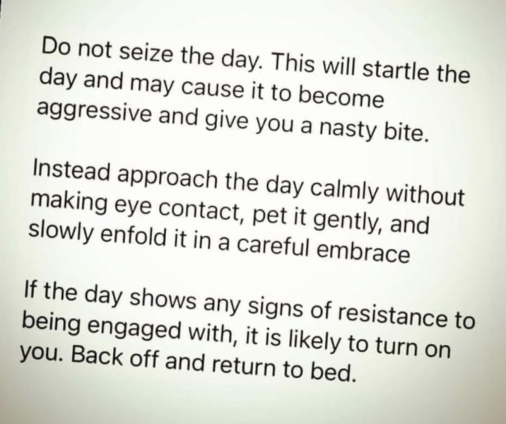


From a forum participant called Lady Bikki on the Mirror. What the Internet connection will do is minimal, so I'm not trying to run Lens. Anyway, the relevance of this meme is that when I'm healthy I'm one of the world's more annoying day-seizers. I sleep six hours and then I'm full of energy and focussed on tasks, mine, not yet worn down enough to take much interest in other people. When I show any interest in ideas like approaching the day calmly without making eye contact, you know I'm showing serious glyphosate damage. 

What I Think of Artificial Intelligence, II

I don't

What I Think of Artificial Intelligence

Thptptptpt. 

New Book Review: The Restless Dead

Title: The Restless Dead

Author: E.G. Ellory

Date: 2025

Quote: "Murder and the mundane went hand in hand."

That's right. This short thriller is oddly titled. It's not a ghost story; it's a murder mystery. A young woman's body looks too tidy to have died accidentally. Maybe an ex-boyfriend or rejected admirer did it? I had a general idea what the ending was likely to be, but didn't guess how the plot could work up to the end.  

There are sub-plots of relationships among the police force in the village of Fenburne, where this mystery is one in a series. If you enjoy reading about police officers' friendships, rivalries, support for friends'  personal lives, this series is for you. The main detective, Jodie Walsh, is new enough to be proving herself to most of her colleagues and slowly gathering her nerve to ask a potential girlfriend for a date. 

It's not a genre I normally buy, but I enjoyed my review copy.

Bonus Petfinder Post: I Believe Serena's Real Because I Couldn't Make Her Up

Just to annoy the whimsy-impaired, a Cat Sanctuary Interview. We've not had one of those for a while.

PK: "Serena, where were you on Tuesday morning? It's not like you to miss breakfast!"

Serena: "Hah. You do remember breakfast."

PK: "Just because I'm not feeling fit to do it doesn't mean I've forgotten what it is."

Serena: "Speaking of breakfasts, why did the Lap Pooper just make a noise like a mouse?"

PK: "Because someone shared a cooking video, and the person on the cooking video was shaking salt and pepper over their breakfast eggs."

Serena: "I think you cooked eggs once."

PK: "I didn't like the way they came out, cooking over a candle. With electric heat there's no challenge about scrambled eggs. They used to be the first thing people taught children to cook, unless you count heating up vegetables from cans, or toasting bread."

Serena: "We cats enjoyed cleaning the pan, though."

PK: "I'm sure you did."

Silver: "Well. Last week a certain human stayed out late and came in coughing and dumped out some food and forgot about us. We might as well not have been here. All our human did was lie around under a pile of blankets in front of the heater."

PK: "It was extremely boring. I wished I hadn't been trying to stay away from you cats. You would have had to have made those two days less boring than they were." 

Pastel: "You weren't very interesting for the rest of the week, either."

PK: "Neither were you, O bleary-eyed one. Your glyphosate reactions show up worse than mine do! Nyah nyah nyah!"

Serena: "Really."

PK: "Really. Sorry you've been so bleary-eyed, Pastel. Where were we?"

Silver: "I don't know, and I don't care. Crayola's Trumpkin came around saying his place had become lonely. Well, they've lost Crayola. They might need a Queen Cat. I went to stay with them for a few...I was thinking weeks, actually."

PK: "I worried about you, Silver. I missed you."

Silver: "Should've set out fresh kibble twice a day then."

PK: "Sweating out the COVID cough was boring enough. Then the glyphosate reactions set in and were really unpleasant. Fortunately I had Serena to take care of me, such as a cat can. After all signs of COVID virus were gone, Serena came in and purred and showed an interest in what I was doing, even in the computer, for the first time in her life. While mopping my face after almost every breath, trying desperately to drink enough water to stay hydrated, feeling sickish from drinking as much water as fast as possible while my dried-out surface shrivelled and cracked, is nobody's idea of fun and there should only be a way to deliver that experience to all poison sprayers, I have to say that I felt loved, the whole time."

Serena: "I feel sorry for you and Pastel, having such ugly, icky reactions."

PK: "Whereas you have beautiful kittens, with never a trace of the Manx gene, born dead. People don't think they have glyphosate reactions because they don't have the same ones someone else has. The first thing all those horrible animal studies ought to have shown anyone who was not looking for an excuse to license glyphosate for use is that, though only a small minority of any species show any specific reaction,  the majority do show reactions. The majority of all species show nasty reactions. Not having any reaction at all is very rare, but in quite a few females across species, especially if they had ancestors from southern Europe, the poison is transferred into the placenta the next time the female conceives, and her babies don't survive. The Seralini Effect. Do you and Silver have ancestors from southern Europe?"

Serena: "Who knows? Samantha came from the other side of town. Burr was born here."

Silver: "And everyone made a glorious fuss over me! It was 'Come and sit by me.' 'No,  sit by me and have some fried chicken.' 'Over here and have some fish!' 'May I comb your fur?' Everyone takes me for granted here, but everyone there was thinking of different ways to spoil me! All! Week! Long!" (Probably exaggerating a bit.)

PK: "Yes, you obviously ate well all week."

Silver: "Don't you wish you did, then! I'm not too fat."

PK: "Eating very much defeats the purpose of sweating-out. A person has to do one thing before the other. There's no pleasure in eating solid food when one is dehydrated. And you have the classic Siamese body shape,  but if you overate every day you could probably become fat. Which might be what happened to our unfortunate Crayola."

Serena: "You don't know that."

PK: "I know that when I dragged my weary, chilly self outside to put down kibble for you, Silver wasn't there. I missed her. I called her..."

Silver: "Couldn't hear you."

PK: "I couldn't breathe well enough to project my voice very far."

Serena: "And so, in view of your distress, what could I do but venture out and tell Silver to show some responsibility and come home before you made yourself sicker than you already were."

PK: "I couldn't believe YOU not reporting for breakfast, Serena!"

Pastel: "I tried to tell you that our mother could take care of herself, that she'd only gone after Silver and would be back soon."

PK: "I suppose that was what you were doing when I went out and called Serena. It was hard to tell. I never know how much you understand of anything, Pastel."

Pastel: "More than you think."

PK: "Except when I think of you as like Serena and Silver. Then it's always obvious that you understand much less."

Pastel: "Well, it's not as if I'll ever be as thick as a human."

PK: "But then, while I was still only thinking about going out to look further afield for Serena, she came home."

Serena: "Purr-course."

PK: "And cuddled."

Serena: "Oh be quiet. You needed distraction from worrying about Silver. There was nothing to worry about. I'd told her to come home."

PK: "And then about an hour later..."

Silver: "I really had to think long and hard about it, because Trumpkin's humans were trying so hard to please me and offering me everything I could possibly fancy to eat..."

PK: "I don't suppose they read this web site. I don't suppose they read much of anything any more. I expect they're like most people in this town and would rather be functional illiterates for a few years than buy a new pair of glasses. But they can't have you, Silver. You would be missed. They can have Diego if they want another cat. I was so delighted to see you!"

Silver: "Trumpkin does not want Diego."

PK: "Somebody ought to want Diego. I'm surprised he's not been claimed already. He shows no sign of understanding words, and does seem to hear sounds well enough--so he's like a normal cat, only social, with a kind, gentle, sharing side to his purrsonality. He has that marvellous, thick, soft, pale orange coat and loves to be groomed and petted. Some people like to turn cats upside down and tickle them; Diego's favorite thing is to lie on his back on someone's lap and see how much tickling he can endure without even grabbing at person's finger. He's not just another tomcat. As the inferior kind of cats go, our Diego is indeed a prince. Not that I want him here particularly. But he could be a real house pet."

Silver: "Have you no sympathy for poor little Trumpkin?! Imagine being a social cat with no cat family. Trumpkin wanders the roads, crying out loud from loneliness. He's fed and groomed but has no one who can really understand him..."

PK: "Oh, I can understand how he might not want Diego as competition. And Diego's not going to starve even if he stays here. Still, the sort of people who think I make animal interviews up out of thin air, and think an animal who understands human words is sort of creepy? For them Diego could be a once-in-a-lifetime pet. They'd probably let him run the place, which does seem to be what he'll always want to do. Do you cats know any of that sort of people?"

Serena: "That's like asking you if you know any really racist White people. How would we? They may exist but they certainly don't spend time around us."

PK: "True. Or asking us if we know of places where there is still a cat overpopulation problem--not just hysterical cat haters who think any cat doing its duty to protect the neighborhood from plague is a problem, who all ought to be sterilized and confined in safe places, but actual alleys full of starving cats nobody wants, with not even so much as a cricket to quarrel over and no way to fight off the infections they all share from living too close together. I'm told there are places like that, but thank goodness we do not live in one of them. So, although we're starting our reviews of what became of last year's photo contest winners, let's look at some nice homeless cats in Kingsport who might help Trumpkin's humans keep the mice down."

Silver: "I could do that. I could be like a Queen Cat!"

PK: "You'd soon get tired of being one. You are by nature a Junior Cat. Anyway, Serena needs a hunting teammate, and the possums need a kind but firm Possum Manager, so you'd be missed here. But Trumpkin needs a housemate he can talk to. Perhaps one of these nice lady cats would do."

Kitty Kitty


This cat is currently in the custody of a small private organization. You can tell they're new because they still think of "Kitty Kitty" as an available name. They probably think it's extra cute. I can't say the cat is anything to look at but they say she's a sweet, lovable little follower. That might make her especially satisfying company for a lonely social cat like Trumpkin. She might not be bright enough to understand him but she'd probably think he was wonderful. 

Joan Jett 


And if that's not an overload of Tuxie looks already, she's actually half of a matched pair. The Blountville shelter also has Suzi Quatro, whose photo is not reproduced here because she looks more or less exactly like Joan Jett Cat. The Blountville shelter makes no promises about either cat's purrsonality but let's just say that the last time I was there, I came home with a cat who converted a dog person into a cat person. Some of their cats come from Kingsport so there's a strong chance of finding a real social cat there.

Missy and Sissy 


Sissy is, if possible, even more melodramatic looking. These two long-haired calico cats are just piles of gorgeous fur that will need to be brushed or combed at least once a day. Everybody wants to grab them and sink their hands into all the fur, and these are nice, quiet, gentle lady cats who just want to hide from all the attention from total strangers. Take time, act a tiny bit cool, and they will show an interest in you and be friendly. They have a rather high adoption fee but they have apparently run up a substantial vet bill, for which the fee could be considered a bargain payment. 

Could Trumpkin deal with housemates as gorgeous as Missy and Sissy? I have no idea. I know he's borne the withering blast of Serena's contempt. Repeatedly. He's a brave little stinker, anyway.

Footsie 


Footsie is described as a lazy home-loving cat, which might help Trumpkin feel better about spending more time at home, too. She doesn't sound as if she'd  be his mental equal but sometimes social cats like to keep rather dim ordinary cats as pets. 

The Kingsport city shelter doesn't even list cats on Petfinder, and the Blountville one has some more. Males and senior cats as well as young females who'd be likely to interest Trumpkin. 

Please help, local readers! Trumpkin needs a housemate soonest! 

Tuesday, January 7, 2025

Happy Pub Date, S.F. Williamson

Today we celebrate the actual, official publication of A Language of Dragons, which should be in your local bookstore by now.


This is what reviewers mean by "pub date"--date of official publication of a book we've already read. It would be impossible for all of us to have a date with the author at a pub, or "public house," or bar-and-grill. Some publishers want the reviews to go live on the pub date; some want the reviews to generate advance publicity and reminder posts on the pub date.

And today's book review is a rerun...I'm sorry. My New Year's resolution was to recover from COVID in quarantine. Due to complications from deliberate poison spraying (because we all know unwanted plants just tend to make roads impassable when temperatures are below freezing unless it's actually raining or snowing for weeks on end) I'm still working on that. The computer's connection depends on a box that's out in the rain, snow, and freeze, which makes the computer about as weak and peevish as the human operating it. Actually the two handicaps fit together nicely. The computer now says it has no Internet connection; when it behaves as if that's true I lean back, pull blankets up around my neck, and take a nap. I have now nibbled my way through two days' provisions in the seven days of this year. I'm not doing much, nor is the computer doing much, but holding on until we're able to do more.

So please reread the review and support the new book. For those who can stand science fiction dystopias, I repeat, it's a good one.

Monday, January 6, 2025

Book Review: Baby's Day Out

Title: Baby’s Day Out

Author: Ron Fontes

Date: 1994

Publisher: Troll Associates

ISBN: none

Length: 127 pages

Illustrations: 8 pages of color photos from the movie

Quote: “Baby Boo, today you shall go on a wonderful adventure!”

This is not a novel. It’s the printed version of a cleverly filmed revision of the oldfashioned “slapstick” comedy where the humor was watching actors simulate fear and pain. In order to make that kind of act funny the characters supposedly howling in pain have to be played as both stupid and nasty enough to deserve to suffer, so in this movie audiences got to laugh at the misery three incompetent kidnappers inflict on each other while the kidnapped baby appears to be crawling happily all over the city and having a wonderful time.

In real life, of course, the baby wouldn’t crawl across very many rough streets before it flopped over and howled for Mommy, and while animals often do tolerate babies (or calm, peaceable people) while they go into threat or attack mode toward anxious, aggressive people, the probability of the gorilla sequence...well, actually, it highlights the extreme improbability of the whole melodrama. Baby’s parents guilt-trip about having left baby with a nice, kind nanny whom the baby actually loves, though actually the problem arose when they removed baby from the nanny and left him with the photographer. They meet a few people less wealthy than themselves who are ordinary human beings, some more decent than others, and shower money on them impartially. Baby Bink’s favorite word is “boo-boo,” which he uses to mean a picture book about Baby Boo who gets a day out with his nanny, and the baby is particularly thrilled because he crawls through the same sort of places Baby Boo visits before coming safely home to his own little bed.

So all anybody learned from this story was how John Hughes spliced the image of a happily crawling baby through the images of a bustling city, and how four grown-up comedians imitated the anxiety of a worried mother and the pain of three criminals who spend a day getting hit and falling down. In one scene, which did make me laugh by its improbable literalization of what everyone always knew was a metaphor, Baby Bink is tucked under the jacket of a kidnapper sitting on a bench and finds a lighter in the man’s pocket, and the liar’s pants really appear to catch fire.

If you want a moral in a story you can probably find one, and I’m not entirely pleased with the moral of this story. Baby is lucky—well, in a comedy the baby has to be lucky. Kidnappers are unlucky—ditto. Baby’s parents don’t know how to deal with non-wealthy people and shower cash on the deserving and undeserving ones alike—that’s the left-wing propaganda cropping up. In the real world that does happen, and the story leaves me looking for a realistic resolution. Two are possible:

(1) Baby’s parents continue to appease their guilt by throwing more money into left-wing social handout programs, while they stop doing the one thing they were doing right: providing steady work to a nice girl who has in fact bonded with Baby Bink. That’s what Hughes seems to have had in mind, but for a complete resolution the story would need to show how badly it works in real life.

(2) Baby’s parents follow up on their acquaintance with the non-wealthy people they’ve met and are able to help the Totally Deserving Stereotype earn more money while cutting off handouts to the con artist, on the basis of that acquaintance. That does work if people commit to doing it.

The copy of this book I physically own was knocked onto the floor right below where a fire hose was aimed at the ceiling, and got plaster dust stuck between the pages. I’m not impressed by the story the book tells, but I will admit that the survival of the book itself is congruous with the story, and makes me smile.

If you want to laugh at the idea of kidnappers getting a beating that makes what supposedly awaits them in prison seem mild, all by themselves, through their own incompetence, without anyone having to soil a hand by hitting them, Baby’s Day Out is for you.

Butterfly of the Week: Green Jellybeans

This week's  Graphium is a black or sable Swallowtail with a row of pale green or yellow dots down each wing. The shape and color of the dots can remind people of jellybean candies. Some online sources call Graphium codrus the Green Jellybeans Butterfly. Soberer writers call it the Green-Banded Kite. Some writers call it the Green or Eastern Olive Triangle, because its colors can be olive drab and olive green, it lives east of Britain, and it's in the family called Triangles. A few call it the Ghost, or even the Zombie, because its wings have an unusual whitish gloss that positively glows in the light.


Photo donated to Wikipedia By Tokalabo - Own work, CC BY-SA 3.0, https://commons.wikimedia.org/w/index.php?curid=26573204.

To researchers it looks like a bad photo until we notice that photos of this species all tend to look "bad" in the same way. Even dead museum specimens reflect light. In real life some people see Graphium codrus as ghostly. It likes to fly through patches of sun in forests, and may drop suddenly from the sky onto a flower. Its wingspan is usually over three inches. Obviously this butterfly is not easy to ignore. 


Photo by Frankaz.

Photographs of it are abundant on the Internet, although unfortunately the great majority of photos of this species that Google is willing to display come from sites that claim to trade in dead bodies. It has even appeared on coins--as in Vanuatu, where they were experimenting with stamping colored pictures onto coins. I found no photo of a living butterfly that had such a bright coppery glow, though they can look brown with amber or pale orange spots. I think the copper tone of the one on the coin has something to do with the amount of copper in the metal.


The glossy reflective effect is, like other butterflies' color patterns, produced by the tiny scales that cover butterfly wings. Codrus scales don't have a distinctive color but come in distinctive shapes that reflect light in that almost fluorescent way. Most of the Graphiums have scales that iridesce, showing different colors at different angles; sarpedon and weiskei have pigmented scales, and codrus has reflectors.


Photo by James_Birdtourasia. 

Fifteen subspecies are currently recognized: auratus, celebensis, codrus, gilolensis, medon, melanthus, noeli, pisidice, schoutensis, segonax, stiris, taloranus, tenebrionis, toealensis, and yayoeae. An early description of each subspecies, not necessarily in English, and a list of places where it's found, is available at


It seems almost as if each island habitat tends to produce its own typical color patern. All Graphium codrus have dark wings with a band of bright light colored spots and that patch of glowing reflective scales on the inner hind wings. Usually they reflect silvery white; sometimes some butterflies reflect greenish, yellow, or reddish. In some individuals the basic color of the wings might be described as dark olive drab, with light olive green spots. 


Photo by mr12345. This one is thought to belong to the subspecies celebensis


Photo by Lisa James. This individual is thought to belong to the subspecies medon.

A subspecies lawlencei, according to Adam Cotton, has never been formally described to scientists and properly named; it's a fake or at least unofficial variation described only at web sites that purport to sell dead bodies of butterflies. Apparently several subspecies have been described only by and for this industry. 


This butterfly is found in the Philippines and nearby islands. It can live on a few different kinds of trees, all with five-lobed leaves, in the genera Annona, Fernandia, and Uvaria. It spends much of its time flitting among the tops of these trees, occasionally coming down (with startling speed) to sip fruit juice, flower nectar, or water. 


Photo by A.S. Kono. Graphium codrus is primarily a pollinator species, especially of some wild flowers and salvias, lantanas, and hibiscus as well as its host trees. It gets nutrients from salt water and is often found at puddles on beaches.


Photo by Hdemann. Only a few photos show that it's not that photographers are unable to focus on codrus, but that codrus wings scatter light in a way that makes it look as if they were.

The life cycle of this species seems undocumented on the Internet. 


Photo from Collector-secret. The caterpillar is trying to look like a damaged leaf with thorns; its little spines are not very sharp or dangerous to humans, who don't think it looks edible anyway. (Nor is it. The leaves it eats have emetic properties.)

Pupae are said to be light green, like other Graphium pupae, but to have a rounder shape without the sharp angles and points observed on some other species in this genus.

Sunday, January 5, 2025

Book Review: Dancing with Angels

Title: Dancing with Angels

Author: Kevin Basconi

Date: 2010

Publisher: Destiny Image

ISBN: 978-0-7684-9024-4

Quote: "Do angels actually intervene in the lives of ordinary people today?" 

It depends on what the meaning of "angels" is. The word comes from Greek words for "message" and "messenger." Even on the most ordinary level, messages and messengers obviously do intervene in the lives of ordinary people today. To what extent messages are conveyed by a special kind of supernatural messengers, spirit beings with individual lives but without bodies, and whether such beings might be created as spirits or post-incarnated from departed human souls, are two very divisive questions. Kevin Basconi claims to have performed miraculous healings with help from angels, a few of whom he and his associates have "seen," or at least vividly visualize; one seemed to be a gigantic White man, one seemed to be a Black man, one seemed to be an eagle...

My faith tradition differs from his, so I tend to be skeptical, but I claim no revelation authorizing me to say that Basconi is either lying or delusional. Some people have livelier visual imaginations than others. Basconi might be sincere. Messages from God don't depend on visual effects but may be visualized by some minds, for all we know; they may even move people, or animals, or even objects, to behave in ways that human eyes can see. 

Nevertheless, when people list Oral Roberts among the founders of their groups or churches, I think it's a good idea not to send them money. (Oral Roberts was a very well known preacher whose life overlapped with mine enough that people my age remember him for having prophesied events that did not come to pass.) People who are on familiar terms with angels should not need much money and should be able to get what they need from sources other than us. This book is available online free of charge. Its sequels are not on my Wish List of books friends who want to buy gifts for me should order.

Friday, January 3, 2025

Book Review: Money Bona Fide or Non Bona Fide

Title: Money Bona Fide or Non-Bona Fide

Author: Edward E. Popp

Date: 1970

Publisher: Wisconsin Education Fund

ISBN: none

Length: 126 pages

Quote: “While it is appropriate to use the term usury when referring to very high interest rates, we must also remember that demanding low interest rates may be usury as well...if it is physically impossible for the borrower to pay them...also...if the lender loans counterfeit or inflationary money.”

Before Bitcoin, there were small groups of people, disgusted by the antics of the bank and money industry, who got together and worked out schemes to invent their own “money,” valid among members of the group only. It’s legal, legitimate, potentially a useful market corrective, and also severely limited. Given the alternative of being paid in Good Neighbor Coupons or in U.S. dollars...well, actually, for the duration of some very successful Town Festivals, intelligent people do exchange U.S. dollars for Good Neighbor Coupons. But not during the rest of the year.

During the recent Grapefest in the suburb-town of Grapevine, outside Dallas, wine, art, and street fair lovers shelled out the dollars for coupons, with the warning that this year’s coupons would have souvenir value only at the end of this year’s Grapefest. That’s typical. Citizens could send a message to the federal government in an absolutely legal, public-spirited, and probably delicious way. People who’ve tried it have, however, generally been tagged as wingnuts whether “left” or “right,” and alternative money has rarely reached high value even as a souvenir. Grapefest coupons just aren’t considered as exciting a collection piece as Confederate money, old-style printed food stamps, or 1940s ration tickets.

Edward E. Popp and his Wisconsin Education Fund seriously wanted to correct the 1970s’ “recession” with their own Wis-cash. (Insert jokes about cheese and/or snow here.) They wanted others to consider similar correctives: the bigger a protest movement gets, the better.

The result of which was...that Popp wrote a book that’s of historical interest to present-time protesters. The late George Peters had studied this book, while able to see, and his review is worth quoting here:

“This Mr. Popp gets out in left field about page 70.
It won’t work as he says.
Even so it can be done.
But I guess there would be some injustice.”

 Nevertheless, there was considerable appeal in the idea, as expressed on page 29:

“There will not be inflation and deflation...No one will have a monopoly...The price of goods and services will not be able to be raised or lowered by the banking system...People...would know that when the government asked for more taxes, it would be asking for the people to work harder...Government officials, as well as others, who expect the government officials to take something from everyone to give something to all, might—just might—learn the meaning of justice and they just might think about practicing it.”

One of the Islamic world’s great advantages is that, although Islamic banks demand money from customers to sustain the bank operations, they don’t charge interest that compounds into a spiral of debt and inflation. Muslims can be extremely rich or extremely poor; more of them are poor than are rich and the traditions of modesty and generosity don’t completely fix this, but they know how rich or poor they are, year to year. They pay a straightforward, reasonable fee for using a bank if they do, and keep their cash if they prefer not to use the bank, and their countries don’t reach economic conditions where they have to take a wheelbarrow full of money to the store to fill a handbasket with groceries. Some of their countries have been poor, before the oil boom, but money has tended to keep its value. 

Jewish law forbids charging interest on loans to fellow Jews. More recently written corporate law removes individual Jews from the responsibility of owning a corporation that is an out-of-control, amoral money-making machine with no religious identity, so Jewish Americans suffer as much from mortgages and credit cards as everyone else does. The trouble in the United States and Europe is that for a long time Europe allowed businesses to be operated by specific families. Jews were often barred from farming or entering trades, so they specialized in banking. While only the Rothschilds became quite as wealthy as the Rothschilds, the historical fact was that a loophole in the law of Moses allowed Jews to gouge as much interest out of enemy nations as they could get. As bankers they tended to define everyone, even Jews of different nationality, as an enemy. 

The other Europeans, who were nominally Christians and thus claimed to be adoptive heirs to Abraham, might have adopted the law of Moses for themselves and built a modern banking system as good as the Islamic one, but the historical fact was that they chose to treat everyone, even relatives, as an enemy, when it came to charging compound interest on terms limited by what had rallied a mob to run a banker out of town recently. They approached banking the way they perceived the Jews doing it only without even the constraint of kinship. And this fouled-up system, with its roots in intertribal warfare as a primary source of wealth, was what they brought to North America. Europeans learned about banking at a stage in their evolution when they still heard a claim like, “I never worked a day in my life! Every one of those cattle grazing on the hill was won from another man in a fight!”as a boast. And unless and until we start by recognizing the law of Moses, trying to fix our banking system is going to be like trying to bathe a Tar Baby—a glob of tar wrapped up like a baby (or some other object people wanted to pick up) to fool the naïve into getting tar all over their hands and clothes.

Such reforms as we have achieved have been made primarily by religious groups that are willing to be perceived as extreme, fanatical...and puritanical, with bans on all sorts of things manufactured by Unbelievers just because the community’s hoard of money is maintained by members not buying this or that.

Popp’s recommendation for reform started with using coins—“as few Federal Reserve notes as is practical”—and, if “producing or selling goods,” “issue certificates of credit,” and, “if our governmental body is in need of money and is considering borrowing it, advise it not to borrow, but to issue tax credit certificates.”

It’s still workable, Gentle Readers. Making it work will require mindful use of money, frugality, discipline, purchasing things from individuals you respect even if you can get similar things cheaper from the greedhead corporations. The Internet can help mindful communities connect across the miles but, in the long term or on a large scale, it won’t be reliable; the Internet itself is a greedhead corporate scheme and will be made to work against anyone who is using it to beat a monopoly or price-fixing cartel. (Similarly, the federal government will, if regarded as our only defense against the monopolies and cartels, become the biggest monopoly of all.) Then again, since we’re all subject to uncontrollable losses of income these days, those are ideas worth our attention in any case.

If you don’t have much income, it’s much better to live frugally on a small income than it is to have more of some things doled out to you as a welfare cheat.

If you have a decent income, it’s much better to make your own purchasing decisions and reward people who produce good things than it is to peel off money mindlessly for whatever the big-chain stores push at you.

Do you need Popp’s Money for guidance on mindful spending, or would a newer book or one relating to a community that interests you, such as the Mennonites, be more useful? Which should be your first book on mindful use of money is a topic beyond the scope of this review. I recommend Popp’s Money as a book for people who are ready to form an economic community (and not willing to affiliate with a religious one). If that’s not where you are, Money is primarily a book of historical interest. It can help you communicate with “preppers” of a certain vintage, being part of their history. It did not inspire a major economic movement all by itself, and plenty of historians will tell you it was read only by wingnuts and has no historic significance; they are wrong. But it is a short, simple, readable book that may inspire you to connect with others and become an economic community.

This review says nothing about specific attempts to create and use online community money. That is intentional. Popp obviously did not foresee Bitcoin and this web site is observing Bitcoin for a few more years.

Thursday, January 2, 2025

Book Review: Whickering Place

Title: Whickering Place

Author: London Clarke

Date: 2019

Publisher: Carfax Abbey

ISBN: 978-1393470373

Quote: "Agoraphobia is hard enough to overcome on its own, but you've made some great strides this past year."

Avery's therapist is encouraging her to move to the house where her father died, Whickering Place. Her father behaved somewhat strangely after moving there; he's thought to have committed suicide. So, maybe Dr. Murphy believes in the flooding technique for overcoming irrational fears? Whatever. Within a few days, Avery won't know whether she's more afraid of leaving her new home or of staying in it.

The place really does, in its fictive reality, whicker. There are thumping and slithering sounds as if a succubus, a massive snake with a woman's head and arms, lives in the attic. There are bats, too. There is an oldfashioned phone that rings and replays creepy voices. There are mysterious toy coins that turn up in the house and around town, frequently before or after a murder. There are evil spirits who take over the narrative at times, who whisper people's names at night just to scare them.

The town is a fictional world's version of Asheville, where, London Clarke assures us, there is no history of a vampire cult in the real world. 

A few trigger warnings are in order. Teenagers can probably handle the squick level in this book, but adults probably won't want to recommend it to them, or seem to recommend it by letting them catch us reading it. (Hello, younger Nephews? You did not see your Auntie Pris reading this book. You can't be sure someone else is not writing this review.) Avery has a gun--before hospitalization for post-traumatic stress, she was training to be a police officer--and, before the story's over, she will shoot homicidal maniacs to save lives. Avery was a virgin, still getting to know her very first boyfriend when they were shot and he didn't survive, and she's not felt like dating anyone else until she meets the two attractive brothers who are renting rooms in Whickering Place. In the course of the book she will marry one of them and enjoy a proper honeymoon. Before the final page she'll be living alone with the other one, not really as a wife but letting people think she is, waiting to find out whether the one she's married is dead, alive, or maybe undead. The dominant visual image throughout this book is blood, some of it shed consensually in vampire cult meetings, much of it spilled during homicides, some of which are committed by sympathetic characters.

If you enjoy that kind of story, you'll love Whickering Place. Please understand that many people who are brave in real life, including doctors (like one of the brothers) who've worked in emergency rooms and seen this kind of gore on a daily basis, just don't enjoy reading a full-length book about it. 

Bonus for some readers: This novel is part of a series that began with Pearse, previously reviewed here, and describes just how the cult are continuing to use and abuse Pearse Gallagher. Avery will taste Pearse's blood in this story. 

Loyal Opposition Obituary for Jimmy Carter

Jimmy Carter was the first President I ever actually helped campaign against...lol. This was some time after my brother and I had been publicly identified as "little Republicans," when we were just old enough to wonder what that meant. The person who called us that was Dad's second cousin once removed, a Republican Party operative. Dad also had a third cousin who was a Democratic Party boss. Mother and Dad weren't registered party members but they usually voted for Republicans.

The civics teacher said, "Youall are old enough to take an interest in the election! Watch the debate on television, or listen on the radio."

So I sat up to listen to the debate on the radio. So naturally my brother did too. The debate aired around the time we normally went to bed. We were familiar with the candidates' names and some things the newspaper had reported that they'd said, but not with their accents, or with some of the issues they discussed. Fifteen minutes into the debate, we were asleep. This, however, meant that we'd listened to more of it than most of our school friends had.

One issue was of direct interest to us. Senator Mondale had sponsored a bill that, if passed, would have subsidized full school terms for everyone above age two. We had read a bit of the history and knew that subsidized school always meant compulsory school. 

We went back to school, where everyone was wailing about having to go to school between ages six and sixteen, and informed our friends that the candidate Carter, if elected, would make it mandatory for everyone to go to school between ages two and twenty.

Adults actually worried that our campaign rhetoric was getting too strong. "He has a daughter about your age. What would you say to her if you met her?" This was a real possibility, though not a high probability. The Carters didn't drag Amy out to every small town they visited. In fact the students who were taken to wave at them did not meet Amy, and in fact we were not in that group.

"I would say, 'We think your father is a nice man, but he's all wrong about school'."

"Then that's the way to say it to other people. Everybody is wrong about something, sooner or later. There's no need to be hateful about it."

The school had mock elections. Other grades showed a modest R majority, representative of our town before the Ds got lost in Left field. In our classes Ford got  more than 95% of the mock votes.

Unfortunately the nation as a whole did not have the benefit of clear guidance from middle school students, and for the next four years we observed something like a definition of a nice man being all wrong about a number of things. President Carter did not extend the age of mandatory school attendance but he did create a federal Department of Education that reduced the control parents, teachers, and elected school boards had over schools, thus opening the school choice debate. 

He talked a lot about the energy crisis, or energy crunch. He preferred that people associate the energy crisis with President Nixon, a sneaky rhetorical trick that didn't slip past us children unobserved. He advised businesses, though unfortunately not schools, to close early on Wednesday so they could save on heating expenses. 

I don't think President Carter himself did much to bring sweaters back to the height of fashion--he was not exactly the fashion model type--but his administration did. Sweaters, and longish skirts, knee-high boots, velour, corduroy, "the layered look" generally, and lots of autumn-leaf colors that looked good with Mrs. Carter's auburn hair. I was interested in fashion design at that stage of life. I couldn't afford to make human-sized clothes, but made boxes full of doll-sized designs, some only drawings, some actual doll outfits, demonstrating how much better all those blonde blue-eyed dolls looked in candy-mint pastels and white rather than autumn-leaf colors. I did appreciate the return to fashion of the long missing concept of dressing for the weather.

Like the outbound President, Carter presided over a period of inflation. There wasn't even a virus panic to blame it on. In 1974 one of the sentences I'd learned to say in Spanish was "There is always an inflation after a war," but the inflation took a long time to stop after that undeclared war. I learned, though, that this inflation was to be blamed on the Federal Reserve more than on a series of Presidents who belonged to different parties and had little in common. I didn't blame President Carter for the inflation but I thanked President Reagan for stopping it.

The Carters really tried to make frugal and Green choices fashionable. Bicycles for adults, recycling, gardening, cooking and canning your garden's produce, weaving your own fabric and sewing your own clothes, were trendy in the Carter years. People started knitting again. People who weren't Amish were mail-ordering hand tools from Amish stores. I liked that. Jimmy Carter had actually insisted on his right to walk rather than be paraded in a car when he officially moved into the White House. Washington frothed. The guards threatened mutiny. Presidents of the United States forfeit the right to walk down the street like human beings, everyone agreed. The Carter administration failed to make walking to work a dominant trend but did establish that walking and car-pooling were cool things for ordinary people to do, at least among True Greens. Using public transportation also became cool, in some cities. The core of Washington's Metrorail system had been designed before, but it came into actual use during, the Carter years.

Those who talked about foreign policy thought Carter could have taken a tougher line. Considering how much the US had invested in the Panama Canal, some thought he sold the management of it back to Panama too cheap. Some thought he showed too much sympathy to the Arabs, some to the Israelis. If the peace negotiations with which he helped didn't last long, still, anyone who endures public criticism for being too nice to both sides of a dispute has to be doing something right. The Ayatollah (a title I will probably always want to translate as "well-known religious maniac") Ruhollah Khomeini held Americans who had been working in Iran as hostages, ordering that the ones who tried to escape or resist be murdered, the others treated courteously with every effort to convert them to Islam. Some thought Carter should have tried to appease the Ayatollah; some thought he should have declared war. President Truman had famously observed that when Americans were "passing the buck" of blame, "the buck" stopped with the President, and this was certainly seen for President Carter. He was scolded Left and Right. 

Well...what would you have done with the Ayatollah? There is an ancient and honorable tradition of national leaders offering pardons to convicted murderers if they can get people like the Ayatollah off the scene, but not doing that made most of the hostages' experience pleasant and educational; having the Ayatollah murdered might have got the hostages murdered too. I think this was when I learned to say that it was possible that the President had information I didn't have. I've said that about all of them since.

Some of the information the President had that not all of his constituents had was made available even to me as I entered my teens. I knew that our relations with the Arab countries were strained not only by our alliance with Israel but also by market competition among oilmen, some of whom wanted to aggravate hostilities in order to boost their own profits at others' expense. The Gulf War was being set up in the 1970s, perhaps even the 1960s. Some of the things you might have thought of saying to Khomeini would have been unacceptable to some oilmen whose support the President wanted.

Some of the things you might have thought to saying to some other people seem not to have occurred to Jimmy Carter because he was too nice to think about them. The Carters accepted the misleading and superficial information the cult chose to let them see, and spoke favorably about Jim Jones's cult. They spoke diplomatically to Idi Amin, too. Idi Amin represented a lot of people but passing up an opportunity to have Jim Jones locked up might have qualified as too nice.

President Carter was serious about diversity, too, although some saw him as the quintessence of nice-but-wrong even about that. He appointed people as different from the usual White Anglo-Saxon Protestant "President's Men" as Andrew Young, Zbigniew Brzezinski, and, most unusual of all, Billy Carter. They were all roasted thoroughly while living. Then there was the time, a BBC reporter recalled to me, still indignant ten years later, when President Carter looked around the group of White men who were discussing some issue or other, noticed that the reporter was the only one in the room who didn't look like part of a clone, and asked the reporter to pose with the actual discussants just to "add a little color to the picture." We know that the BBC was a better organization in those days than it is now, because a worldwide inquiry into why real Black American voters had not been invited to be in the group was not launched. 

Another passing eddy of tackiness that caught President Carter was told to and retold by another writer, but it's too good to forget...Carter thought it best if his staff were all safely married. One young man was in an open-ended relationship, and it was not his boss's place to nudge him along: "And when do you plan to have the wedding?" The young man muttered something about "when the magnolias are in bloom," possibly with the mental reservation that he was thinking of magnolia trees that hadn't been planted yet. "In Georgia," Carter reportedly said, "the magnolias are in bloom right now!"

And everyone always agreed that, even by US standards, Jimmy Carter smiled too much. 

Well...the Cold War was on. How quickly we forget. The Cold War was a trade war conducted on terms of "coldly" minimizing contact with countries "Behind the Iron Curtain," but in practice it meant that, for forty years (1947-1988; Wikipedia says 1947-1991), everyone had to live with the prospect of an all-out "hot" nuclear war with the Bad Old Soviet Union, any minute. We didn't think "We'll show those Russians that our ideas work better," although that was what we did. We thought "If the Russians drop bombs on..." and "If the President does anything stupid and starts World War III..." Presidents Johnson and Nixon had seemed just about foolish enough to do that. President Carter did not. Considering what we were told about what was going on in several countries where people had reasons to feel annoyed by us as a nation, both Carter and  Ford were appreciated just for staying out of any more wars. Real reconciliation between men who had risked their lives for their pro- or anti-war beliefs, in the 1960s, often took place only in the 1980s but President Carter at least tried to start that, too.

President Carter had written a campaign book called Why Not the Best. The book was less inspirational, more about party politics, than the title sounded. Baby-boomers were, undeniably, attracted to the idea of asking "why not the best" when making any decision. Did we want to keep having new fashion looks every season, all interpreted in nylon and polyester, or to buy some decent cotton and wool clothes and wear them for years? We said "Why not the best?" and bought the decent cotton and wool clothes with classic cuts. Did we want college educations? I didn't, particularly, but "Why not the best?"--the Pell Grant program made it possible for every literate citizen of my age to go to college. Were we going to let a federal Department of Education lower the standards of public schools even below where they'd been? "Why not the best?"--we'd homeschool! And so on! So then in 1980, in the next presidential election, we said "Why not the best?" and elected President Reagan. 

I think the Reagan administration is guaranteed a higher rating than the Carter administration. President Reagan not only stayed out of any real wars but ended the Cold War. If the President's primary duty is to avoid getting into any avoidable wars and win any wars that become unavoidable, Reagan did that, and with flair, and while adjusting to increasing physical disability. However, only some of us get to be Irish. I don't think the Carter administration was a huge success, but it was less bad than several; consider the Bushes' wars, Obama's race treason on the welfare issue, Biden's vaccine mandates, Johnson's war, Nixon's failure either to end or to win the war, Truman's bombs, or FDR's or Wilson's power grabs.

What Carter will be best remembered for is that, having been a relatively young President (though his face didn't show it), he had more time than anyone else has ever had, or is likely to have again, to be an Ex-President. He used that time to show the world how retirement and aging are done in a healthy society. He travelled, socialized, wrote, and continued to teach Sunday School as he'd done before being elected, but mostly he donated real work to a charitable cause. 

Both Rosalynn and Jimmy Carter continued to be describable as nice-but-wrong in several ways throughout their lives. They promoted measles vaccines and other ideas this web site considers to have been mistakes. The houses Jimmy Carter helped to build are small and tend to be packed too closely together. Some lines in the Carters' jointly produced book, Everything to Gain, sound inane--though others are excellent. At least the Carters did work for good causes. They donated their celebrity status to charity, rather than using it to sell patent medicines or bad ideas.

They seemed to stay middle-aged, but more youthful and active than most middle-aged people, for forty years. They literally wrote the book on how to age gracefully. They never avoided talking about either politics or religion; they never seemed divisive or exclusive about anyone else's politics or religion. While Jimmy Carter seemed neurologically to be an introvert, he also lived more modestly, and made himself much easier to meet or talk to, than any other ex-President ever has done.

I never met any of his family. Washington is a city that attracts celebrity hounds; in some social circles any evidence of the most cursory acquaintance with a Famous Person is worth money. If you want to speed up things, from waiting for a table in a restaurant to getting an appointment with a medical specialist, first visit your Congressman and latch on to a souvenir pen, then be sure the desk clerk sees you use the souvenir pen to fill out a form. After that, some Congressmen may be seen as more valuable than others, but in any case the suggestion that you might be either related to or working for a Congressman will speed up matters that run very slowly for an ordinary unconnected person. Do you think that's very nice, either to the individual the clerk is waiting on, or to Congressmen? I do not. I think the Carters' way of expressing contempt for that approach to social life was to make themselves so easy to meet. After the elementary school principal who was also a D party boss, I worked for half a dozen people who knew the Carters socially. It's one thing to meet someone famous by working on the same project or walking a dog in the same park; it's quite another thing to choose a project, a dog park, even a church, on the chance of meeting someone famous there. Quite a lot of people in Washington who were very accessible to fans, constituents, etc., I managed to avoid meeting--not because I didn't think they were interesting, or wouldn't have wanted to work on any project of interest to them, but because I didn't want to be or seem like a celebrity hound. Rosalynn and Jimmy Carter were in that group. 

This is my little testimony in the court of history, as we lay to rest a President who, if not the best President we had, was far from the worst. I believe that, if Heaven has anything remotely like the "pearly gates" scene as we picture it in jokes, a junior angel at the gate will say, "Carter, is it? Why Not the Best, indeed! Why were you not the best President?" 

And St Peter will say, "Because he was the best retiree, and role model and teacher for other retirees. Come in, Brother!"

And some time or other in the course of Eternity, I'll fly from the part of Heaven that looks like Virginia to the part that looks like Florida, to visit my Aunt Dotty. In Heaven no poison sprays ruin the pleasure of birdwatching. We will watch the pelicans. And then Aunt Dotty will say, "There's a young woman I want you to meet," and we'll fly up to the part that looks like Georgia. Landing beside the finest, healthiest peanut patch that ever grew, because in Heaven there is no black rot, we'll walk up to the house and find the Carters there. Aunt Dotty will say, "I always wanted to see you shake hands with Amy Carter."

I won't think I have much to say. Adults don't usually greet new acquaintances with "So, are you going to vote for my father?"

In the special case of Jimmy Carter, however, his daughter might well say, "So, what do you remember about my father?"

I'll say, "I always thought he was a nice man but all wrong about school. Who cares about that any more? Like everyone else up here, he was close enough to being right about Jesus."

Our cartoon image of Heaven is a feeble attempt to imagine what the unimaginable might be like. I pray that it may be something like this.  

Wednesday, January 1, 2025

Have COVID, Leave Deliveries Beside Road

Status update: I had felt myself fighting off this year's version of COVID so I didn't think twice about visiting someone who wasn't sure whether weakness and a chest cough were reactions to going diabetic, to medication, to flu or to COVID. I didn't even think twice about nibbling chips from the same plate, which was probably a mistake. In my defense I'll say that this person is relatively young, is pure White so far as is known, gets plenty of exercise, and generally should not have to worry about diabetes for another decade at least, so person's being sent home with an insulin kit disturbed my mind considerably. I know how to prepare the kind of meals that reverse diabetes for people like this person. I don't know whether, in today's world of poisoned and gene-spliced vegetable foodoids, the McDougall Diet would do person more good than harm. And I had to (I didn't cry, but I still might) tell person so.

On New Year's Day, I have a deep chest cough and feel just slightly feverish. Could be COVID, could be flu, could be the unholy alliance of both about which we've been warned. Before coming online I've already pretended not to be at home so as to avoid breathing on the first visitor of the new year. Don't visit me. I have provisions, I'm not diabetic, I don't anticipate any real discomfort from COVID this year either, and I've never noticed a difference whether the first visitor was male or female. If the lights go out during the anticipated Big Freeze, I have emergency plans. They do not include underestimating the virus but I don't think I'm glyphosate-damaged enough to need to do anything but stay warm, avoid really heavy overwork or party pig-outs, sit down if I feel faint, and stay away from people who are or might be at any real risk. 

Which youall should do, too, if you notice anything in the way of a chest cough. Coronavirus is still insidious stuff, mutating ahead of whatever vaccines you've had, popping up and turning nasty on people who either think it's a nothingburger or don't even know they've got it. COVID coughs can potentially open hernias or cardiac surgery scars. Multiple vax for other mutations do not put your immune system ahead of the virus, quite the contrary, so I recommend asking a doctor who does not just recommend all the COVID vaccines to everybody, a policy that's breaking very bad news for some doctors who've followed it. If you have a jab, be sure it's relevant to the version of COVID that is actually in your neighborhood. In many places a relevant vaccine won't be available. Just do quarantine as if everyone's life depended on it, is all I can say.

To those who really are in mortal danger from COVID, condolences--vaccines may or may not buy you one more year. Write letters. We all need to stand by our Postal Service.

To the neighborhood odd jobs man, I had to pay a late fee to get the primary address at the bottom of this web page reopened, so can't afford to go shopping, and you should stay as far from me and my relatives, including the Professional Bad Neighbor, as you can get. He'd breathe any kind of virus on you and probably snicker through his twisted mouth while doing it. I would not. Most of my relatives would not knowingly breathe any virus on anybody, but are healthy enough not to know when they have COVID.

To the Bad Neighbor, why don't you come up and say hello to everyone? You can tell who's got COVID by who runs out to give you a handshake, or even a cousinly hug. 

The lights already went out this week. They were restored when The Infernal Grid That Needs To Be Broken Up Before Our Enemies Exploit It was scheduled for restoration. I knew it was The Grid, itself, because the young person sitting in an office in (I think) Ohio said confidently, right away, without finding other reports on the same line or sending anyone to check the line, when my lights would come back on--and they did. Innovative young men deliberately chose to disconnect customers' electricity for more than 24 hours in December. They were working on connecting more local lines to each other, expanding The Grid's power to zap whole cities' and counties' business and create instant emergencies endangering multiple human lives, when they badly needed an order--by federal law if necessary--to keep America resilient by shortening existing connections, with a goal of making every house its own primary source of solar energy. 

Then the lights went off again, right away, for a few more hours while actual workers checked the actual line. They did not inspect the whole line for dead trees, which was probably a bad idea; they had the whole day and the December Thaw weather. The power outage did further damage to the Internet connection, which has been fading in and out ever since. Yes, the company owe me money for this, and no doubt owe lots of other people even more, since most people had a lot more things plugged into the walls when the lights went off. Yes, this winter's legislature needs to establish a firm procedure for collecting that money, as well as a time line for solarization and energy independence that imposes a fine for even whining about building new plants until every house has clean reliable energy for 72 hours after any sort of problem with The Grid. "Treasonous" is not too strong a word to embed in legislation mandating the slow but steady breakdown of The Grid.

If you've sent real mail and it's been returned, please re-send it--the box is open again. I wasn't too far away to have gone into Gate City between Election Day and Holy Innocents Day, but I neglected to do that and thus failed to receive the annual reminder to pay the PO box rent.

If you've sent e-mail and it's been ignored, kindly assume further Internet connection trouble, in which case I'll go to McDonald's again after being symptom-free for a week. 

If you are delivering any bottled water, or belated Boxing Day gifts, or anything else, and don't already know this: Do not touch anything or come inside the yard. Leave it on or behind the block beside the road. You will not see me, but I plan to be sitting up in a place from which I can see the block, throughout quarantine. I will go out when the road is clear of traffic. 

I don't expect this to happen but, if you must leave an animal, please leave a note (in plastic and/or under pebbles, as necessary), go home, wait 24 hours, and then deliver our furry friend, in a box with its blanket, toys, and food treats if possible. Look for a note indicating alternative directions before releasing an animal--there will probably be one. Please be sure any fowl, or adorable tame rodents, are in a secure cage, and tie any dogs to a tree or post with a lead that will hold them. 

If the weather gets bad enough to justify even one more worn-out joke about Al Gore, plans have been made. Otherwise I'll probably be either in the warm room or on the screen porch, probably huddled inside a pile of hand-knitted things. Multiple layers of cheap acrylic yarn will hold body heat longer than anybody wants to find out about at single-digit temperatures. You may buy some and find out after I emerge from quarantine, which should be in time to watch the inaugural festivities on TV. Any knits I may have handled during COVID will be washed with disinfectant before they're shown for sale, if they ever are. The blanket shawl, tabard, and sample-patch blankets that I use are not and have never been offered for sale.

Medical Care 

First a grumpy, fluzly Nag: There's no excuse for these young men failing to type out the words in this video. Expecting people who are able to read to sit through an hour and a half of lazy, self-indulgent talking heads, when there are professional transcription services that could turn it into a nice efficient script that could be read quickly AND kept for reference, when (bleep!) there are (bloop!) computer apps that could deliver a draft transcription in seconds so nobody even has to type the full (dang) script, is just disrespectful to the audience. Youtube does not make it easy to get a transcription (you have to start the video, and find where the button is on your screen, and scroll down to just before the last period highlighting the script), but you can probably force one out of it. The person who posted the video should have done that for you, corrected the robot transcription, and posted it as a nice link to a document in which you can edit the fonts and spacing to suit your eyes.

Nevertheless, I did listen to some of the sound. What I heard was very interesting. I think you might want to watch or listen to this one, too. I think somebody should make a TXT transcription beautiful and e-mail it to everyone in the new presidential administration. (E-mail, plain text, is key. Bulky envelopes scare many people in our federal government. Multiple copies of the same e-mail, otoh, might be read and discussed by multiple interns, which is very good.)

Long story short: the insurance gamble may be morally worse than betting money on card games.


Music 

Since this web site mentioned Kwanzaa, it's received links to a more mainstream video about a Black American holiday celebration--"Christmas in Hollis." (This web site prefers music videos to talk videos because music videos tend to consist of one song, which means it's possible to listen to all the ones this web site receives in one human lifetime.)

Book Review: I Want to Grow Up...

Title: I Want to Grow Hair I Want to Grow Up I Want to Go to Boise

Author: Erma Bombeck

Date: 1989

Publisher: Harper & Row

ISBN: 0-06-06170-1

Length: 174 pages

Illustrations: color inserts of children’s artwork

Quote: “At the moment they stop being a kid and turn into a child with cancer, the smiles disappear.”

At Wit’s End, Just Wait, I Lost Everything, The Grass Is Always Greener, If Life Is a Bowl of Cherries, and Aunt Erma’s Cope Book were hilarious. Motherhood and Family were, just slightly, predictable,and after Family Erma Bombeck reached that dreaded point in a comic writer’s career when the writer is asked to write a whole book that’s earnest and sweet. Dave Barry wisely turned down that offer. Bombeck was persuaded that children with cancer wanted a funny book about their shared experience. This is that book.

It’s funny in spots, but...Laughing out loud, life with cats has taught me, is what we humans do instead of purring; it usually expresses a pleasant feeling and, if that pleasant feeling happens to coincide with unpleasant feelings about something else, the acts of laughing or purring work internal muscles and activate biological mechanisms that make us feel better. People recovering from cancer, and their families, need to laugh out loud, long and often. Funny books, records, and movies help. A humorist has a high spiritual calling in this world.

However, the experiences that prompt laughter in real life don’t always work in books. When you are the patient or the family member caring for the patient, then, in the moment, you can laugh out loud about cancer itself. You scrub the patient’s favorite coverlet in the tub, dry it, get it smelling fresh at last, and within half an hour it’s nasty again. Either you or the patient says “Lather. Rinse. Repeat,” and this becomes the funniest joke ever to use this line, funnier than all other jokes that used this line together, and you roll about and paw the air. But this kind of moment is not meant to be shared. Someone else laughing about your illness or your caretaking is not funny. Someone else’s laughing about their illness or their caretaking is a gross-out.

So this was the one of Bombeck’s books that people bought to complete their collections, or encourage a favorite author who already knew she wasn’t going to have a very long life either, or support the cancer research funds in aid of which the book was sold. I’d pick any of Bombeck’s other books over this one for personal pain control.

In this book we meet children. The last thirty pages of this book are a roll call of cancer patients and their siblings who laughed at cancer in ways Bombeck worked into this book. They are painfully adorable children. They wrote in from several countries where Bombeck had a following, including France as well as New Zealand. Some of them did grow hair and grow up. Some of them went to Heaven, and some even went to Boise. Some of them may still be alive today.

They stick their artificial legs out of doors or under tent flaps to make people think a whole person is watching or listening.

They turn their prosthetic feet backward.

They pour fruit juice into specimen cups, then freak out nurses by saying “I think I’ll run it back through” before anyone runs actual lab tests on these “samples” of sick comedy.

They build snowmen with carrots stuck in their back sides for transfusions.

They race wheelchairs.

They joke about their hair falling out, telling inquisitive people “I joined the Marines,” or claiming that then-popular TV tough guy “Kojak is my father.”

They hug their doctors tight, saying “I hope I never see you again.”

One of them, in full remission and growing fast, shows Bombeck around the campus of the university hospital where she went for chemotherapy. Another one affectionately nicknames one of the best university hospitals in the world “Motel Hell.”

Nearly all the ones we meet had survived, and several had gone into remission, during the time the book was written.

They’re still very, very sick, and their parents and doctors are still very, very sad .(Mothers, Bombeck reports, did most of the caretaking and fretting in 1989. Fathers were “rare birds”; in 1989 a lot of younger men had become those “Sensitive New Age Guys” who cried real tears about being turned down for dates or being late for meals, but fathers still felt a need to reframe grief as anger, growling about how “if some guy was harassing your daughter you could rip his throat out, but you can’t do anything about cancer.”)

And research, of course, helps people with cancer live longer. Donations may be made...pick your cancer research fund; you undoubtedly have one.

Bombeck’s focus on the kids who joke about cancer makes this book less unpleasant to read than I may have made it sound but, if you want to shriek and cackle and make your children want to share a full-sized book with you, pick any or all of this writer’s other books.